1. Introduction
The two main questions behind the present cross-sectional study are: 1) To what extent do Spanish–English bilingual children born and raised in the United States have knowledge of grammatical gender and target phrasal word order in Spanish as a heritage language; 2) What is the role of cross-linguistic influence and language experience in this process?
Despite extensive research on the psycholinguistic nature of heritage language grammars, and the type of errors heritage speakers typically have, it is still unclear what the sources of those errors are (Alarcón, Reference Alarcón2011; Cuza, Reference Cuza2013; Cuza & Frank, Reference Cuza and Frank2014; Montrul, Davidson, de la Fuente & Foote, Reference Montrul, Davidson, de la Fuente and Foote2014). One influential camp has suggested that the linguistic asymmetries between heritage speakersFootnote 1 and monolingual speakers stem from incomplete acquisition during early childhood primarily due to reduced input and age effects (Montrul, Reference Montrul2002, Reference Mariscal2008). Other researchers have argued for the first language (L1) attrition of previously learned grammatical structures during the bilingual's lifespan (Polinsky, Reference Polinsky2011). This previous research is limited as it argues for incomplete development or child L1 attrition during early childhood without providing data from child heritage speakers, either cross-sectionally or longitudinally. With the exception of a few recent studies (Montrul & Sánchez-Walker, Reference Montrul and Sánchez-Walker2013; Silva-Corvalán, Reference Silva-Corvalán2014), there is a gap in the literature regarding the developmental path that heritage Spanish children take in the acquisition of specific grammatical properties. More recently, Putnam and Sánchez (Reference Putnam and Sánchez2013) have argued that heritage speakers’ linguistic asymmetries are the result of a re-assembly of functional features and the emergence of a different albeit complete set of featural matrices. This proposal is advantageous in that it allows for subsequent morphosyntactic shifts in the bilingual continuum depending on the specific patterns of language activation. The complexity of the structure and the specific patterns of language use seem to account best for the morphosyntactic asymmetries heritage speakers often show.
The goal of the present study is to contribute to current theoretical discussions on the nature and dynamic of heritage language development by examining the acquisition of gender concord in child heritage Spanish. Research in child heritage Spanish is particularly relevant in the United States where approximately 64% of the total Hispanic population is U.S. born (U.S. Census Bureau, 2010). Furthermore, we contribute to previous research by exploring the development of noun/adjective (N/ADJ) word order, an issue within the Spanish determiner phrase (DP) that has remained unexplored in heritage language acquisition research. Given that N/ADJ word order in Spanish is argued to be motivated by the strong gender and number features of the noun phrase (NP) (Bernstein, Reference Bernstein1993; Carstens, Reference Carstens1991; Picallo, Reference Picallo2008; Zagona, Reference Zagona2002), this analysis will provide empirical evidence regarding the potential relationship between morphological competence and syntactic variability in heritage language acquisition. If errors with gender concord stem from a NP feature deficit, as has been proposed for second language (L2) acquisition (Franceschina, Reference Franceschina2005; Hawkins & Franceschina, Reference Hawkins, Franceschina, Prévost and Paradis2004), we would expect heritage Spanish children to have both non-target morphology (morphological variability) as well as non-target N/ADJ word order (syntactic variability) (Rothman, Judy, Guijarro-Fuentes & Pires, Reference Rothman, Judy, Guijarro-Fuentes and Pires2010). However, if instances of non-target morphological production but target word order patterns (*un(DET MASC) flor(N FEM) *chiquito(ADJ MASC) “a small flower”) are found, this would suggest multiple grammars (Amaral & Roeper, Reference Amaral and Roeper2014; Roeper, Reference Roeper1999) and dissociation between overt morphology and syntax (Lardiere, Reference Lardiere, Liceras, Zobl and Goodluck2008).
Following a Feature Re-Assembly Approach for L2 acquisition (Lardiere, Reference Lardiere1998, Reference Lardiere, Dekydtspotter, Sprouse and Liljestrand2005, Reference Lardiere, Liceras, Zobl and Goodluck2008) and Putnam and Sánchez's (Reference Putnam and Sánchez2013) proposal on feature reassembly for heritage language development, we propose that the morphosyntactic differences Spanish heritage speakers often show with gender concord can be accounted for in terms of a restructuring/reassembly of L1 functional features, and the development of a new featural matrix that intrinsically diverges from that of monolingual speakers by instantiating both L1 and L2 properties (Putnam & Sánchez, Reference Putnam and Sánchez2013). In her analysis on the ultimate attainment of morphological competence and syntactic aspects of English as L2 by Patty, a native speaker of Chinese, Lardiere (Reference Lardiere1998, Reference Lardiere, Liceras, Zobl and Goodluck2008) argues that the L2 learner's task consists of the reassembly of L1 relevant features as they are required by the L2, but that this does not preclude morphosyntactic variability and L1 transfer effects. Rather than predicting an abrupt change in the speaker's internal system (an all-or-nothing parameter resetting perspective), Lardiere's approach allows for variability/optionality in the range of feature reassembly and morphological competence primarily due to L1 influence; she also argues for a dissociation between overt morphology and syntax in light of data documenting a dissociation between verb raising and the lack of overt verbal agreement morphology.
Putnam and Sánchez (Reference Putnam and Sánchez2013) follow Lardiere's model to argue that heritage speakers undergo a reassembly of L1 functional features by the L2 features and that the extent of this process will depend on the specific patterns of language use and activation of their L1 (minority language) in the bilingual continuum. That is, the difficulties heritage speakers have in their minority (L1) language stem from lower levels of morphosyntactic activation (language output), which in turn generate a decline in the availability of L1 functional features. The authors thus conceptualize heritage speakers’ linguistic variability as the result of the formation of a new albeit complete system formed by both L1 and L2 forms and dependent on language activation and use. Their analysis provides a formal articulation of heritage speakers’ variability via reconfiguration or feature values shifts, and in this sense constitutes an alternative approach to incomplete acquisition. Another innovation of this approach is that it does not take into consideration input as the main variable leading to feature reconfiguration but rather considers language activation for both comprehension and production as the main contributing factor. However, this approach does leave open the possibility that the lack of restructuring of L1 features could be due to lack of activation to start with, and not necessarily due to influence from L2 features. An item that is not stimulated becomes more difficult to activate over time, resulting in L1 attrition through lack of stimulation, as proposed in Paradis’ (Reference Paradis1993) Activation Threshold Hypothesis, or incomplete development (in case that the features remain underspecified altogether due to insufficient activation).
The feature reassembly approach is consistent with Amaral and Roeper's (Reference Amaral and Roeper2014) proposal of Multiple Grammars (Roeper, Reference Roeper1999). The authors argue that monolingual and multilingual grammars present parallel ‘rule-sets’ and that the speaker has to decide which of these rules are productive in each specific language. That is, some rules are more productive in some languages than others (e.g., English pro-drop and Spanish non pro-drop) but this does not mean that two subsets of rules cannot coexist in the same grammar, leading to L1 variation in the case of monolingual development, L2 optionality in the case of L2 acquisition and diachronic language change. For bilingual children specifically, the authors argue that the bilingual child's task is to attend and parse two existing options and choose the one that is more productive for either language depending on input frequency and use (Amaral & Roeper, Reference Amaral and Roeper2014). Along these lines, we argue that the feature reconfiguration/restructuring process is motivated by cross-linguistic influence from English as the dominant societal language and language experience in the form of specific patterns of language exposure and use during early childhood (Meisel, Reference Meisel2007; Silva-Corvalán, Reference Silva-Corvalán2014; Yip & Matthews, Reference Yip and Matthews2000, Reference Yip and Matthews2009). This does not mean that cross-language interaction necessarily leads to feature reassembly but they are not mutually exclusive.
The paper is organized as follows. Section 2 examines the system of gender concord in Spanish and English. Section 3 presents a review of previous work on the acquisition of gender expression in heritage and L2 Spanish. The study is presented in section 4 followed by the results, discussion and conclusions in sections 5 and 6.
2. Gender concord in Spanish and English
Spanish nouns are inherently marked by grammatical gender features, and thus can be either masculine or feminine (Demonte, Reference Demonte, Bosque and Demonte1999; Zagona, Reference Zagona2002). Animate nouns denoting humans or animals are semantically based and instantiate natural gender (hombre “man”, mujer “women”). Inanimate nouns instantiate grammatical gender: in transparent or canonical nouns, the ending –a usually designates feminine gender (casa “house”) while the ending –o usually designates masculine gender (carro “car”). In opaque or non-canonical nouns, vowel endings –e, –i, –u or consonants – n, –l, –s can be masculine (guante “glove”) or feminine (calle “street”). Although the endings –o or –a are not true gender markers in Spanish but word type markers (see Harris, Reference Harris1991), most masculine and feminine inanimate nouns follow these prototypical gender forms (Teschner & Russell, Reference Teschner and William1984). The presence of canonical versus non-canonical nouns in Spanish plays a role in the target acquisition of gender concord in L2 and heritage Spanish. Given that canonical nouns have overt morphophonemic cues, they are typically easier to acquire and more difficult to lose than non-canonical nouns.
Spanish determiners and adjectives also instantiate grammatical gender, and they must agree in gender and number with the noun they modify. Gender assignment is established between the determiner (e.g., el, la “the”; un, una “a”) and the noun (DET/N). Gender agreement is established between the noun and certain adjectives (e.g., rojo, roja “red”; pequeño, pequeña “small”) (N/ADJ) and between the determiner and certain adjectives (DET/ADJ), as in (1) and (2). In contrast, English lacks gender grammatical features on determiners, nouns or adjectives. There are some lexicalized animate nouns (e.g., actor/actress) which differentiate between feminine and masculine gender but do not agree in gender with any element within the DP.
-
(1)

-
(2)


While gender assignment is considered an inherent lexical property on Spanish nouns, gender agreement between the noun and the adjective is considered the result of a syntactic operation within the Spanish DP driven by the [+strong] gender and number features of Number Phrase (NumP) (Bernstein, Reference Bernstein1993; Carstens, Reference Carstens1991; Cinque, Reference Cinque, Cinque, Koster, Pollock, Rizzi and Zanuttini1994; Demonte, Reference Demonte, Kennedy and Mc Nally2008; Picallo, Reference Picallo1991). These [+strong] features are argued to trigger an overt movement of the head noun (noun raising) to the functional head preceding the adjective to check the corresponding number and gender features. This results in the default N/ADJ word order in Spanish (nubeN rojaADJ “red cloud”). In contrast, English does not instantiate [+strong] gender features, and therefore the head noun remains in situ, leading to the default ADJ/N word order in English (red ADJ cloud N ). Number features are checked via agreement, not via noun raising. This is shown in (3) below:
-
(3)

This syntactic analysis is limited in that it does not explain cases where semantic factors rather than syntactic processes determine the order of constituents within the DP, as is the case of set-denoting or restrictive adjectives, which require postnominal position (un cantante famoso “a famous singer”) as opposed to kind-denoting or non-restrictive adjectives, which require prenominal positioning (un famoso cantante “a famous singer”) (Berstein, Reference Bernstein1993; Demonte, Reference Demonte, Kennedy and Mc Nally2008, Reference Demonte, Bosque and Demonte1999; Picallo, Reference Picallo2008). However, attributive adjectives that modify the denotation of the noun – the type of adjectives we focus on in the present study – cannot appear in prenominal position in Spanish, as they do in English (*roja casa “red house”) (see Bosque & Picallo, Reference Bosque and Picallo1996, and Demonte, Reference Demonte, Kennedy and Mc Nally2008, for discussion).
More recently, Picallo (Reference Picallo2008) argues that the gender interpretation of nouns is not affected by a particular gender type (feminine or masculine). Instead, the author proposes that “gender is the formal exponent of an independent interpretable functional feature” (p. 50). Picallo labels this functional feature as [CLASS] and argues that it heads its own functional projection. It is hosted by a functional category c that appears immediately before the noun, as represented in (4):
-
(4)

Within this approach, in Romance languages like Spanish or Catalan gender will then follow the noun, and the gender inflectional suffixes will surface as the result of a syntactic Agree operation between CLASS in c and the formal features encoded in N [±fem]. This category is not projected in English, which makes the acquisition process more difficult for Spanish–English bilinguals due to restructuring of Spanish feature values by English values.
Given the parametric differences between the two languages, Spanish–English bilingual children have to develop the set of features responsible for gender assignment in Spanish, the appropriate form-meaning mappings, as well the syntactic mechanism involved in N/ADJ gender agreement (noun raising). This is complicated by the lack of gender features and contrasting phrasal word order in English, which could lead to potential cross-linguistic influence effects (Hulk & Müller, Reference Hulk and Müller2000; Liceras, Fernández Fuertes, Perales, Pérez-Tattam & Spradlin, Reference Liceras, Fernández Fuertes, Perales, Pérez-Tattam and Spradlin2008; Paradis & Genesee, Reference Paradis and Genesee1996; Pérez-Leroux, Cuza & Thomas, Reference Pérez-Leroux, Cuza and Thomas2011), as well as by the existence of prenominal adjective position in Spanish, which provides ambiguous input. The acquisition process among young bilingual children is further affected by reduced exposure and use of Spanish as a minority language in the American context, where English is both the dominant societal language and the language of formal instruction (Cuza, Pérez-Tattam, Barajas, Miller & Sadowski, Reference Cuza, Pérez-Tattam, Barajas, Miller, Sadowski and Schwieter2013).
3. The acquisition of grammatical gender in heritage Spanish
The acquisition of grammatical concord in Spanish monolingual children is typically complete by the age of 3;0 (Pérez-Pereira, Reference Pérez-Pereira1989, Reference Pérez-Pereira1991). Although previous research shows more use of masculine nouns during earlier stages of development (Karmiloff-Smith, Reference Karmiloff-Smith1979; Mariscal, Reference Mariscal1997, Reference Mariscal2008) as well as the use of determiner-like elements preceding nouns known as protodeterminers or filler syllables (López-Ornat, Reference López-Ornat, Pérez-Leroux and Glass1997; Lleó, Reference Lleó, Sorace, Heycock and Shillcock1997, Reference Lleó, Fabri, Ortmann and Parodi1998), monolingual children soon develop complete knowledge of the formal properties of Spanish nouns as they rely on morphophonological and syntactic cues.
In contrast with monolingual development, researchers have documented developmental delays in both L2 learners (Bruhn de Garavito & White, Reference Bruhn de Garavito, White, Pérez-Leroux and Liceras2002; Franceschina, Reference Franceschina2005; McCarthy, Reference McCarthy2007) and adult heritage speakers at the university level (Alarcón, Reference Alarcón2011; Montrul, Foote & Perpiñan, Reference Montrul, Foote and Perpiñán2008). Montrul et al. (Reference Montrul, Foote and Perpiñán2008) investigated the role of age of onset of bilingualism in the acquisition of grammatical gender among a group of Spanish heritage speakers and L2 learners via an oral production task, a written comprehension task and a written recognition task. They found more deficits with non-canonical nouns, overextension of the masculine form in lieu of the feminine and better results with determiner/noun assignment than with noun/adjective agreement. The heritage speakers outperformed the L2 learners in the oral production task, but showed more errors with comprehension and written recognition. Despite the obvious deficits in comparison with native speakers, the authors argue that both groups had knowledge of the underlying representation of gender features but “such knowledge might be stored, represented, and deployed differently.” (p. 40). They conclude that the advantage of the L2 learners in the two written tasks could be related to their higher level of metalinguistic awareness and not necessarily because they have a better internal representation compared to the heritage speakers. The differences could be attributed to the fact that L2 learners are exposed to different language learning mechanisms that make them vulnerable to task effects and their degree of metalinguistic awareness.
Alarcón (Reference Alarcón2011) revisited the comprehension and production of grammatical gender in Spanish heritage speakers and L2 learners via a written recognition task and oral description task. In contrast to Montrul et al.'s (Reference Montrul, Foote and Perpiñán2008) results, she found no errors between groups with written recognition but the heritage speakers did outperform the L2 learners in the oral production task, as previously found by Montrul et al. Alarcón also found overextension of the masculine form, especially with non-canonical nouns. Both L2 learners and heritage speakers showed more gender assignment errors than agreement errors with feminine nouns. However, the opposite was found with masculine nouns (more agreement errors than assignment errors). The author concludes that the asymmetries found stem from form-meaning mapping errors (processing errors) but the internal representation of gender in Spanish is in place, thus supporting previous research (Bruhn de Garavito & White, Reference Bruhn de Garavito, White, Pérez-Leroux and Liceras2002; White, Valenzuela, Kozlowska-Macgregor, Leung & Ayed, Reference White, Valenzuela, Kozlowska-Macgregor, Leung, Ayed and Do2001).
Recently, Montrul et al. (Reference Montrul, Davidson, de la Fuente and Foote2014) examined the extent to which the age of onset of bilingualism interacts with the type of tasks, and related implicitness or explicitness in the processing of gender agreement among L2 learners and heritage speakers of Spanish. They measured the level of processing that heritage speakers and L2 learners undergo depending on the amount of conscious attention and metalinguistic awareness when processing gender. The results showed more native-like performance among the heritage speakers, which indicates a clear age of onset of acquisition effect for the advantage of the heritage speakers. The authors argue that heritage speakers develop more native-like patterns in implicit tasks requiring aural comprehension. By contrast, the L2 learners develop sensitivity to grammatical gender only in visual and auditory tasks that tap on their metalinguistic awareness of the language.
Compared to the extensive research on the acquisition of gender concord among L2 learners and adult heritage speakers (usually at the university level), there is a paucity of data on child heritage language development, except for the work of Montrul and Potowski (Reference Montrul and Potowski2007). The authors investigated gender marking in young and older Spanish–English bilingual children (6;0–11;0) via narratives and a picture description task. They found 30% of agreement errors among the younger children (simultaneous bilinguals) with an overextension of the masculine form. The older children (sequential bilinguals) also showed low levels of target production; however, they outperformed the younger children. Montrul and Potowski argue for patterns of incomplete acquisition during early childhood and age related effects.
To investigate this issue further, we examine the knowledge that school-age Spanish–English bilingual children have of grammatical gender in Spanish. Given that heritage speakers do not typically receive explicit instruction in their heritage language until later on in life, we would like to find out the extent to which the lack of knowledge attested in adult heritage speakers is also present at earlier stages of language development. Furthermore, we examine the potential correlation between target gender morphology (agreement and assignment) and N/ADJ word order. This syntactic operation (noun raising) is argued to be motivated by the strong abstract features of the NumP. We therefore expect to find a correlation between target morphological production and word order. On the other hand, it is also possible for bilinguals to show target gender morphology but non-target noun/adjective word order (*una roja calle “a red street”), or non-target morphology but target word order (*un calle rojo “a red street”). If this is found, then previous theoretical accounts on noun raising will have to be revisited in light of the data.
Following Putnam and Sánchez's (Reference Putnam and Sánchez2013) feature-based account, we argue that errors with gender concord and word order in child heritage Spanish are best accounted for by a re-assembly of Spanish gender features by English features. Spanish heritage speakers will reconfigure their initial inventory of [+strong] gender feature values and map English [-strong] values onto their Spanish lexical items upon more exposure and activation of English functional features and less activation/production of their minority language. This reconfiguration is constrained by the patterns of language use, and the presence of a less marked configuration in English (dominant societal language). Therefore, heritage bilingual children will develop a new set of uniquely specified gender features that are intrinsically neutral [±strong] and distinct from the monolingual norm. Within this new set of features, we propose that the masculine form takes a neutral semantic value equally pertinent for both masculine and feminine representations in the absence of morphological cues that trigger a feminine classification. This new set of features is not the result of incomplete or interrupted development but rather a unique set of features characteristic of heritage language children which fluctuates during the lifespan of the speaker depending on the patterns of minority language use and activation (Putnam & Sánchez, Reference Putnam and Sánchez2013).
A feature reassembly approach provides predictive power to morphosyntactic shifts. In that respect, it differs from an incomplete acquisition approach, which does not predict how bilingual shifts could occur once a linguistic system is incomplete. At the same time, as discussed earlier, an incomplete acquisition approach and a feature reassembly approach are not mutually exclusive; it is possible, based on Putnam and Sánchez's argument, that L1 gender features in Spanish [+strong] could remain initially underspecified altogether given lack of insufficient activation and processing load. We hypothesize the following:
-
1) Gender mismatch errors. Given the proposed restructuring of L1 gender features, we expect bilingual children to overextend the masculine form to feminine nouns. This will affect:
-
a) DET/N Assignment (* un MASC calleFEM “a street”)
-
b) N/ADJ Agreement (unaFEM llaveFEM *chiquito MASC “a small key”) and
-
c) DET/ADJ Agreement (*unMASC nubeFEM *rojo MASC “a red cloud”)
-
-
2) Phrasal word order errors (*ADJ/N word order, e.g., *un amarillo calcetín “a yellow sock”) due to lack of [+strong] gender features in the NumP to trigger noun raising. Feature restructuring of L1 gender features should lead to both morphological deficits in the production of target agreement and assignment, as well as syntactic variability in the production of N/ADJ strings. In addition, the learning process will be compromised by an overlapping word order in the two languages (Yip & Matthews, Reference Yip and Matthews2009), as pronominal adjectival placement is possible in Spanish with certain adjectives. This provides ambiguous input to the child, who may show a preference for the pre-nominal option.
-
3) A relation between performance and age. We expect more errors among the older children due to more exposure and use of English after school immersion and reduced exposure and activation of Spanish as a minority language.
-
4) A relation between performance and patterns of language use. We expect that higher patterns of use of Spanish will boost child heritage learners’ performance.
4. The study
4.1. Participants
We discuss experimental data from thirty-two (n = 32) Spanish–English bilingual children (age range, 5;0–10;8; M = 7;4; SD = 1.66) and nineteen (n = 19) monolingual Spanish children (age range, 4;7–9;1, M = 6;7; SD = 1.48) serving as a comparison group.Footnote 2 Testing took place at the children's school, home or public library. Responses were digitally recorded by the experimenter and later transcribed into an Excel file by the authors, both native speakers of Spanish.
The bilingual children were born and raised in the United States, except for one child who was born in Mexico and immigrated to the U.S. at the age of three. They were attending English-only schools in northwest Indiana and they were exposed to both Spanish and English from birth via family members, TV, school, social events (e.g., church), siblings and peers. Parents reported Spanish to be the home language, and the language most often used with their children (72%) when starting a conversation. Spanish was reported as the main language used with the mother (78%) and to some extent with the father (50%). English was also reported to be used at home by the children but primarily with their siblings (50%). Outside the home environment and family members, English was reported as the main language used by the children with their friends and peers. The children came from low-income families in Indiana. Following previous research (Pérez-Leroux et al., Reference Pérez-Leroux, Cuza and Thomas2011), we calculated their language dominance by subtracting parental child fluency ratings given to English from those given to Spanish. The ratings ranged from ‘not fluent’ (1) to ‘completely fluent’ (4) (1 = not fluent; 2 = somewhat fluent; 3 = very fluent; 4 = completely fluent). Older children were reported as more English dominant, whereas younger children were reported as fairly balanced in both languages. These ratings are consistent with increased exposure to and use of English after school immersion. Parental rating is a reliable and well-attested independent measure of language ability (Dunn & Fox Tree, Reference Dunn and Fox Tree2009; Paradis, Nicoladis & Crago, Reference Paradis, Nicoladis, Crago, Caunt-Nulton, Kulatilake and Woo2007; Pirvulescu, Roberge, Thomas, Pérez-Leroux & Strik, Reference Pirvulescu, Roberge, Thomas, Pérez-Leroux and Strik2014).Footnote 3
The children's parents were born and raised in Mexico and immigrated to the U.S. as adults, except for one parent who was born in Texas and one who was born in Colombia. Their mean age at time of testing was 35 years old and their mean length of residence in the United States was 12 years. Most parents reported to be Spanish dominant (4/4) and ‘somewhat fluent’ (2/4) or ‘not fluent’ in English (1/4). When asked in which language they felt more comfortable in, the large majority indicated they felt more comfortable in Spanish. They also reported to speak mostly Spanish at home and in social situations. Regarding their educational level, most parents reported to have either elementary or high school education.
The Spanish monolingual children were born and raised in Spain, and were living in Guadarrama (Autonomous Region of Madrid) at the time of testing. They came from Spanish families except for one child of Colombian heritage and two children of Bulgarian heritage. Spanish was reported as the only language used at home and outside the home environment. Recruiting and testing took place at a Spanish-only school in similar conditions to the bilingual children. It was conducted by one of the authors in one sitting. As pointed out by one of the reviewers, we acknowledge it would have been preferable to collect data from monolingual Mexican children but this was not possible due to logistical reasons relative to international travel to Mexico. Having said that, it is important to note that there are no dialectal differences between Mexican Spanish and Peninsular Spanish as far as gender concord and noun/adjective word order are concerned. We also avoided lexical items that are marked differently for gender across dialects (el radio “radio set” – Mexican Spanish vs. la radio “radio set” – Peninsular Spanish).
4.2. Methods and design
The parents completed a child language background questionnaire and a parental language background questionnaire, both adapted from Pérez-Leroux et al. (Reference Pérez-Leroux, Cuza and Thomas2011). The child background questionnaire elicited information on language dominance on both languages by the children, caretakers, parents and siblings, as well as patterns of language use at home. The parent language background questionnaire elicited information on place of birth, level of education, age of arrival to the U.S., length of residence and linguistic proficiency in each language, among other things.
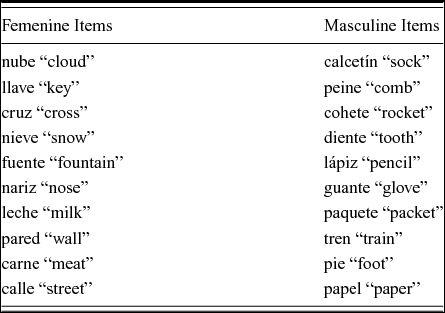
The children completed a picture-naming task designed to elicit Det+N+Adj strings, adapted from Sharp (Reference Sharp2012) and Gathercole, Sharp, Pérez-Tattam, Stadthagen-González, Laporte & Thomas (in preparation). We generated 30 linguistic trials for this task, which included 20 test items and 10 distracters. We also created a prompt picture and a target picture for each trial, which depicted the referent for the trial (e.g., a picture of a train for tren “train”). We took into account the age of our participants and chose items that even young children were likely to know in order to minimize the effect of vocabulary knowledge on their performance. All trials were inanimate to avoid any interference from natural gender. Half the trials were feminine and half were masculine.
The test items were non-canonical (i.e., the items ended in –e or a consonant) and the distracters were canonical (the items ended in –a and –o). We decided to focus on non-canonical forms only, as previous research overwhelmingly shows much less difficulty with canonical forms in heritage speakers (Alarcón, Reference Alarcón2011; Montrul & Potowski, Reference Montrul and Potowski2007; Montrul et al., Reference Montrul, Davidson, de la Fuente and Foote2014). Table 1 lists the test items by grammatical gender.
Test items

We randomized the trials and generated four versions of the picture-naming task. We also created six practice items to train the children to produce Det+N+Adj strings, which always appeared at the beginning of the task. The task was administered individually as a PowerPoint presentation on a laptop computer. After the practice session, the children were shown prompt pictures depicting the items and were asked to orally name the picture using the question ¿qué ves? “what do you see?”. Naming the prompt picture entailed producing the appropriate determiner and noun (e.g., un tren “a train”). They were then shown target pictures of the items that contrasted with the prompts in terms of size or color, and were asked to name the picture using the question ¿y aquí? ¿qué ves? “and here, what do you see?”. Naming the target picture entailed producing the appropriate determiner, noun and size/color adjective (e.g., un tren chiquito “a small train”). This is represented in (5):Footnote 4
-
(5)

We designed the pictures to elicit indefinite articles un/una “a” and adjectives that are obligatorily marked for gender. Half of the pictures were designed to elicit the size adjective pequeño/a, chiquito/a “small”, the other half were designed to elicit the color amarillo/a “yellow” or the color rojo/a “red”. The questions were worded in such a way as to avoid giving any cues on the gender of the item. We elicited different answers, including Det+N, N+Adj and Det+N+Adj strings. We obtained a total of 603 utterances from the bilinguals and 380 utterances from the monolinguals. We then calculated the proportion of correct gender marking on the determiner (Determiner-Noun Assignment) (6a and 7a), on the adjective (Noun-Adjective Agreement) (8a and 9a), and on the determiner and the adjective (Determiner-Adjective Agreement) (10a and 11a) for each participant, for feminine and masculine items separately:
-
a) Determiner-Noun Assignment
-
(6)
-
(7)
-
-
b) Noun-Adjective Agreement
-
(8)
-
(9)
-
-
c) Determiner-Adjective Agreement
-
(10)
-
(11)
-


We also looked at the proportion of correct noun-adjective placement (Word Order) for each participant, for feminine and masculine items separately:
-
d) Word Order
-
(12)
-

For each of these four conditions, the numerator of the proportion represented the number of correct utterances. For the gender concord analysis, we excluded isolated nouns and adjectives (three instances), unintelligible strings (four instances) and mixed utterances with no determiner (e.g., red papel “red paper”, nine instances in the bilingual dataset). We considered the use of determiners other than indefinite articles as correct (e.g., otra/otro “another” or definite articles el/la “the”), as long as the gender marking was appropriate for the item in question. For the word order analysis, we included mixed utterances with no determiner. Mixed utterances that maintained the canonical Spanish N-ADJ word order (e.g., una cruz yellow “a yellow cross”) were considered correct.
The denominator represented the total number of utterances (both correct and incorrect), with the exclusion of unintelligible strings (4 instances) and instances where no utterance was produced (33 instances for the feminine items and 8 instances for the masculine items). The reason we decided to use total number of utterances was to keep the denominator constant across all four conditions. A potential pitfall for the interpretation of the resulting data is that the denominator effectively includes different types of errors (e.g., incorrect gender concord on the determiner and/or the adjective, determiner omission, incorrect adjective placement) and different types of production (Det+N strings, N+Adj strings and Det+N+Adj strings, among others). As observed by one reviewer, it is not the same to avoid doing something than to do something incorrectly. Therefore, the main analyses for all four conditions are followed by an analysis of the types of errors and, where relevant, an analysis of the types of production.
5. Results
In order to examine the knowledge of gender concord and phrasal word order, we conducted a repeated measures ANOVA. To correct for the heterogeneity of errors, we transformed the data points into arcsine values before conducting the parametric tests.
To address hypothesis 1, the language group (bilingual children vs. monolingual children) was treated as between-subject (independent) variable and the proportion of correct responses by gender (feminine vs. masculine) as a within-subject (dependent) variable in the four conditions under examination: DET/N assignment, N/ADJ agreement, DET/ADJ agreement and N/ADJ word order. To address hypothesis 2, age was included in the ANOVAs as a continuous variable and entered as a covariate in the main analysis. Wherever there was an effect of age, the bilingual data was reanalyzed to look more closely at the effect of age on performance as a proxy for reduced exposure and activation of Spanish.
In order to address hypothesis 3, it was necessary to determine first what to include as the language use variable. On the basis of the data from the background questionnaires, bilinguals were divided into language use groups according to language behavior (language spoken to the mother, language spoken to the father, language spoken to siblings, language spoken to friends, language used by the parents when starting a conversation). Language spoken was categorized as English, Spanish or both (Spanish and English). Monolinguals did not vary according to language behavior. Correlational analyses of these language use indicators with performance on each of the four conditions under examination showed a significant correlation with the language spoken to the father only for N/ADJ agreement, and only with feminine items (r = .414, p = .050). No other language behavior variables showed any significant correlations. We decided to use language spoken to the father as a proxy for language use and to look at the effect of language use in the N/ADJ agreement data only. The statistical analysis for each condition is discussed in what follows.
5.1. Determiner-Noun Assignment
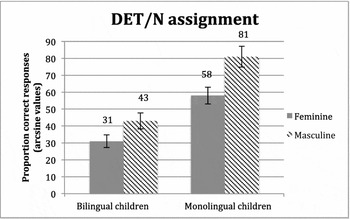
Regarding performance on DET/N assignment, we obtained a main effect of language group (F(1, 48) = 22.41, p < .001). There was no main effect of gender (F(1, 48) = .19, p = .665), but comparisons across gender showed that mean performance with feminine nouns was lower than with masculine nouns (M = 44.72 vs. 62.43, pairwise comparison p < .001). There was no interaction between gender and language (F(1, 48) = 2.64, p = .111). As expected, bilinguals’ mean proportion of correct responses was lower than the monolinguals’ (M = 37.41 vs. 69.74). However, performance was not only lower with feminine nouns than masculine nouns for the bilingual children in Det+N and Det+N+Adj strings, as predicted in hypothesis #1(a), but also for the monolingual children. This is represented in Figure 1.
Determiner-noun gender assignment

A closer look at the errors on the determiner (i.e., omission and incorrect use of the masculine or form of the determiner) showed that over three-quarters of errors in the bilingual data (76%) were determiner omission errors for feminine nouns, compared to 24% incorrect form of the determiner. For masculine nouns there was 78% of determiner omission error compared to 22% incorrect form of the determiner. Clearly, the rate of determiner omission in the bilingual data was high for both feminine nouns and masculine nouns. In contrast, the monolingual children did not show incorrect use of the masculine or feminine forms on the determiner, and they showed high levels of determiner omission with feminine nouns (76%) compared to masculine nouns (24%). The high levels of determiner omission in the monolingual data are due mainly to three feminine items (leche “milk”, carne “meat”, nieve “snow”), which are mass nouns in Spanish. Mass nouns do not take a determiner in Spanish and these items were inadvertently included in the task. These item effects are examined in more detail in the item analysis. As to determiner omission with the remaining items (including masculine nouns and countable feminine nouns), we observed that two children were responsible for over 70% of the determiner omission errors in the monolingual data. It is possible that these two children did not understand the task, as they behaved completely differently from the other monolingual children.
The inclusion of mass nouns was a limitation of our study as it threw up some spurious results in terms of determiner omission, and largely explains the monolingual children's performance on DET/N assignment. As to the bilingual children, their roughly equal proportion of determiner omission with feminine and masculine nouns could be explained as a task-related effect (there were no mass nouns among the masculine items). As suggested by one reviewer, the bilinguals might have felt that responding to the elicitation questions without the appropriate determiner was pragmatically appropriate. Thus, we decided to factor out the determiner omission errors and focus on the incorrect use of the masculine form of the determiner compared to the feminine form in the bilingual data. Out of all errors involving incorrect use of gendered forms, roughly over half the errors consisted in overextending the masculine form of the determiner to feminine nouns (56%) as opposed to overextending the feminine form to masculine nouns (44%). Hypothesis 1(a) is confirmed in that bilingual children showed a tendency to favor overextension of the masculine form, but the difference between the rate of incorrect use of the masculine form vs. the feminine form of the determiner was smaller than expected, particularly in light of the Noun-Adjective agreement results presented in the following section.
There was no main effect of age (F(1, 48) = 3.00, p = .090) and no interaction between age and gender (F(1, 48) = .58, p = .449). Contrary to what was predicted in hypothesis (3), performance and age do not seem to be related for DET/N assignment.
5.2. Noun-Adjective Agreement
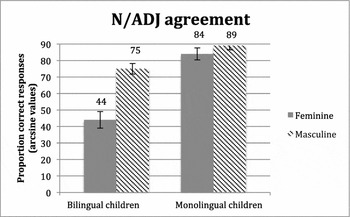
Regarding performance on N/ADJ agreement, we obtained a main effect of language group (F(1, 48) = 54.17, p < .001) and gender (F(1, 48) = 5.10, p = .028). There was also a significant interaction between gender and language group (F(1, 48) = 12.58, p = .001). As expected, the bilinguals’ mean proportion of correct responses was lower than the monolinguals’ (M = 60 vs. 86) and performance was lower with feminine nouns compared to masculine nouns (M = 64 vs. 82). This is represented in Figure 2.
Noun-adjective gender agreement

A closer look at the errors on feminine and masculine nouns confirms that overextension of the masculine or feminine form of the adjective was by far the most common error, followed very distantly by mixed utterances in the bilingual data (un yellow cruz “a yellow cross”, un red papel “a red paper”; eight instances for feminine nouns and four instances for masculine nouns), prepositional phrases or verbal phrases (carne con color amarillo “meat with yellow color”, una calle que han hecho rojo “a street painted red”; two instances in the bilingual data and three instances in the monolingual data, all feminine nouns), and use of an incorrect noun (use of pata “leg” instead of pie “foot”, one instance in the bilingual data). There were hardly any adjective omission errors in the bilingual data, and none in the monolingual data. In sum, lower performance with feminine nouns in the bilingual data can be explained as a result of overextending the masculine form of the adjective, confirming hypothesis (1b).
There was a main effect of age (F(1, 48) = 5.85, p = .019) but no interaction between age and gender (F(1, 48) = 1.33, p = .254). The data were reanalyzed to examine more closely the effect of age on the bilinguals’ performance, to confirm whether their performance was worsening as they grew older due to reduced exposure and activation of Spanish. For the purpose of this analysis, the bilingual children were divided into three groups representing two year intervals at time of testing: Group 1 (n = 10; range, 5;0–6;8, M = 5;4; SD = 0.5), Group 2 (n = 12; range, 7;0–8;5; M = 7;4; SD = 0.46) and Group 3 (n = 10; range, 9;2–10;8; M = 9;4; SD = 0.45). The ANOVAs revealed no main effect of age for masculine nouns (F(2, 29) = .56, p = .576) or feminine nouns (F(2, 29) = 2.73, p = .082). These partial effects of age are examined in more detail in the individual analysis. Hypothesis 3 is not confirmed.
The data were also reanalyzed to examine the effect of language use on the bilinguals’ performance, with language spoken to the father as a proxy for language use. The ANOVAs revealed a main effect of language use for feminine nouns (F(2, 20) = 4.51, p = .024) but not for masculine nouns (F(2, 20) = 1.83, p = .186). Comparisons across patterns of language use showed that for feminine nouns, the performance of the group that spoke English to the father was significantly worse compared to the group that spoke Spanish (M = 20 vs. 52, pairwise comparison p = .014) or both languages (M = 20 vs. 64, pairwise comparison p = .015). The performance of the group that spoke Spanish to the father, however, was not significantly different from the group that spoke Spanish and English (pairwise comparison p = .399). Hypothesis 4 is confirmed for N/ADJ agreement: higher patterns of use of Spanish are boosting the bilingual children's performance on feminine nouns.
5.3. Determiner-Adjective Agreement
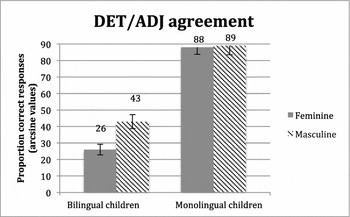
Regarding performance on DET/ADJ agreement, we obtained a main effect of language group (F(1, 48) = 96.72, p < .001). There was no main effect of gender (F(1, 48) = 2.68, p = .108), but comparisons across gender showed that mean performance with feminine nouns was lower than with masculine nouns (M = 57 vs. 66, pairwise comparison p = .004). There was an interaction between gender and language group (F(1, 48) = 8.54, p = .005). As expected, the bilinguals’ mean proportion of correct responses was lower than the monolinguals’ (M = 34 vs. 88). This is shown in Figure 3.
Determiner-adjective gender agreement

Something to bear in mind when interpreting the DET/ADJ agreement data is the aforementioned high rate of determiner omission for feminine and masculine nouns in the bilingual data. Roughly a quarter of the bilingual data was comprised of N+Adj strings for countable feminine nouns (27% N+Adj strings compared to 73% Det+N+Adj strings) and for masculine nouns (28% N+Adj strings compared to 72% Det+N+Adj strings). In contrast, most of the DET/ADJ agreement monolingual data comprised Det+N+Adj strings; there were seventeen instances of N+Adj strings for countable feminine nouns and eighteen instances for the masculine nouns.
In Det+N+Adj strings, the most frequent type of errors in the bilingual data were gender mismatch errors on the determiner (*un llave chiquita “a small key”, *una guante rojo “a red glove”), the adjective (una nube *rojo “a red cloud”, un diente *pequeña “a small tooth”) or both (*un nube *rojo “a red cloud”, *una peine *roja “a red comb”), followed distantly by mixed utterances. Roughly half the gender mismatch errors were on both the determiner and the adjective: 42% with feminine nouns and 46% with masculine nouns. In other words, over half the errors consisted in overextending the masculine form of the determiner to feminine nouns (59%). As to the monolingual data, there were hardly any agreement errors; only five instances in the data set. In sum, lower performance with feminine nouns in the bilingual data can be explained as a result of overextending the masculine form of the determiner and the adjective, confirming hypothesis (1c). There was no main effect of age (F(1, 48) = 1.87, p = .117) and no interaction between age and gender (F(1, 48) = .95, p = .334). Contrary to what was predicted in hypothesis 3, there is no relation between performance and age for DET/ADJ agreement.
5.4. Noun/Adjective Word Order
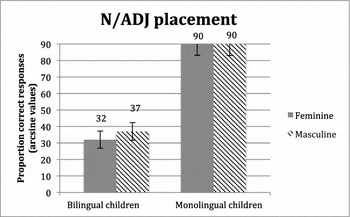
Regarding performance on N/ADJ placement, we obtained a main effect of language group (F(1, 48) = 43.71, p < .001). There were no main effects of gender (F(1, 48) = 1.37, p = .248) or age (F(1, 48) = .009, p = .923), and no interactions between gender and language (F(1, 48) = 1.42, p = .239) or gender and age (F(1, 48) = .93, p = .339). Bilinguals showed lower levels of performance than the monolinguals (M = 34 vs. 90) due to pre-nominal placement of the adjective, confirming hypothesis 2. In contrast with gender assignment and agreement, performance was equally low for feminine and masculine items. This is represented in Figure 4.
Noun/adjective word order

As suggested by one reviewer, we looked at the potential correlations between word order and assignment and agreement to explore the theoretical link between noun raising and the abstract features of the NumP. We found that word order was significantly correlated with assignment (r(30) = .371, p = .037), N/ADJ agreement (r(30) = .452, p < .009) and D/ADJ agreement (r(30) = .447, p < .010) for feminine nouns. For masculine nouns, we found high correlations between word order and assignment (r(30) = .567, p = .001), and D/ADJ agreement (r(30) = .620, p < .001), but not for N/ADJ agreement (r(30) = .246, p = .174). This means that the participants who performed well in the gender concord conditions (particularly D/ADJ agreement for masculine nouns) also tended to perform well with word order for masculine nouns, but to a lesser extent for feminine nouns.
At prima facie, these results suggest [-strong] gender feature values, which should result in non-movement if we follow previous research claiming an association between overt gender morphology and noun raising (Bernstein, Reference Bernstein1993; Carstens, Reference Carstens1991). However, correct agreement did take place in some instances where adjective placement was incorrect (i.e., *una roja nube “a red cloud”). This could be accounted for by Picallo's (Reference Picallo2008) proposal in which agreement occurs via an Agree operation with a high functional projection, and movement is triggered by a category other than gender. It is also possible that syntactic transfer from English is affecting phrasal word order more pervasively than it is affecting agreement, as suggested by one of the reviewers. This might be specially so given the fact that Spanish allows pre-nominal adjectival placement with certain adjectives, which overlaps with the English word order. The existence of a surface overlap in the two languages makes this specific area of the grammar more vulnerable to cross-language interaction in child bilingual syntax (Döpke, Reference Döpke1998; Hulk & Müller, Reference Hulk and Müller2000).
5.5. Analysis of items
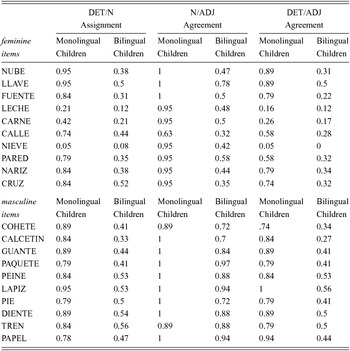
To analyze possible item effects in our data, particularly in the light of the spurious results in terms of determiner omission obtained in the study, we examined the proportion of correct responses for each of the feminine and masculine items in terms of DET/N assignment, N/ADJ agreement and DET/ADJ agreement.
As mentioned earlier, three feminine mass nouns evidenced high rates of determiner omission in the bilingual children: carne “meat” (66%), leche “milk” (80%) and nieve “snow” (89%). Other errors were due to gender mismatch on the determiner and/or the adjective (*un carne amarillo vs. una carne amarilla). In addition to determiner omission, the bilingual children showed some cases of overextension of the feminine, especially with the masculine nouns calcetín “sock”, guante “glove” and paquete “package” and use of English adjectives (un yellow calcetín “a yellow sock”). The monolingual children showed comparable rates of determiner omission with the same lexical items: carne (58%), leche (74%) and nieve (89%). Table 2 shows the proportion of correct responses for each of the feminine and masculine items.
Proportion of correct responses for feminine and masculine items

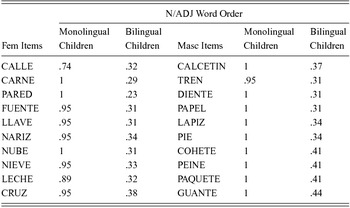
With regard to word order, we found low levels of performance in the bilingual children across all nouns, regardless of the type of lexical class. The monolingual children performed at ceiling with many items, particularly with masculine nouns. Their performance was lower with the noun calle “street” (74%), but this was related to the use of prepositional or verbal phrases to describe the picture representing a ‘red street’ (e.g., una calle (de) color rojo “a street of red color”). Although these phrases were not what we wanted to elicit, they are grammatically correct. Table 3 represents these results.
Proportion of correct responses for feminine and masculine items

In sum, the analysis of items reveals that much of the variation across the items was triggered by the inadvertent inclusion of mass nouns, which gave rise to high levels of determiner omission in bilinguals and particularly monolinguals. These results are consistent with previous research suggesting a correlation between determiner drop and mass/count lexical distinction (Chierchia, Reference Chierchia1998; Gavarró, Pérez-Leroux & Roeper, Reference Gavarró, Pérez-Leroux, Roeper, Torrens and Escobar2006; Valian, Reference Valian2009). That said, the rate of determiner omission among the bilingual children also extended to other countable nouns. Thus, determiner omission in the bilingual children was partially independent of the mass noun effect.
5.6. Individual analysis
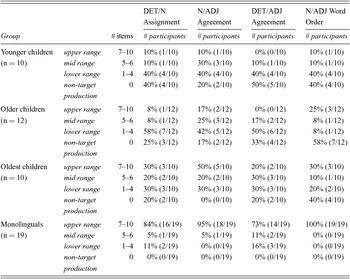
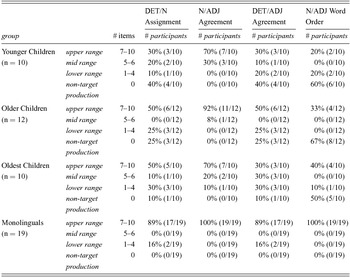
For the individual analysis, monolingual and bilingual children were classified according to whether they were high achievers (7 or more correct answers out of 10), mid achievers (between 5 and 6 correct answers), low achievers (between 1 and 4 correct answers) or non-target production (no correct answers). Regarding feminine nouns, most of the bilingual children were in the lower range for DET/N assignment and DET/ADJ agreement. In contrast, the percentages for target N/ADJ word order were distributed between the upper and lower ranges. The percentage of bilinguals with non-target production ranged between 13% for N/ADJ agreement and 47% for word order. For gender concord, the percentages of non-target production tended to decrease with age; with word order, the percentage remained fairly constant, ranging from 40% to 58%. None of the oldest children evidenced cases of non-target production in N/ADJ agreement, whereas 20% evidenced non-target production in DET/N assignment and DET/ADJ agreement. The monolingual children showed high levels of accuracy across all conditions, as expected. This is represented in Table 4.
Percentage of correct answers for feminine items

Regarding masculine nouns, most bilinguals were in the upper range, particularly for N/ADJ agreement in contrast to what was observed with feminine nouns. In addition, the bilinguals did not evidence any cases of non-target production for N/ADJ agreement with masculine nouns. However, with word order, most bilinguals were in the non-target production range. This is indicative that the valuing of the gender feature via Agree is a different syntactic operation from the one that triggers movement (Picallo, Reference Picallo2008), and it is the latter one that appears to be more affected by contact with English due to its vulnerability to syntactic priming (see Austin, Blume & Sánchez, Reference Austin, Blume and Sánchez2013, for recent discussion). As in the case of feminine nouns, target rates for gender concord tended to decrease with age; the proportion of non-target production for word order remained fairly constant, ranging from 50% to 67%. The monolingual children again showed high levels of accuracy across all conditions. These results are represented in Table 5.
Percentage of correct responses for masculine items

6. Discussion
We have examined the extent to which young Spanish–English bilingual children of Hispanic background born and raised in the U.S. have knowledge of gender concord and N/ADJ word order in Spanish. We have also examined the extent to which developmental age and patterns of language use play in the acquisition process. We predicted overextension of the masculine forms in DET/N assignment, N/ADJ agreement and DET/ADJ agreement in the bilingual data. This was the case with N/ADJ agreement, but the results were mixed with DET/N assignment and DET/ADJ agreement, as determiner omission accounted for many of the errors with feminine and masculine nouns; this was partially due to the effect of the three mass nouns that were accidentally included in the testing battery. In addition, we hypothesized we would find phrasal word order errors. This was indeed the case, as ADJ/N word order strings accounted for the majority of the errors in regards to word order. Furthermore, we hypothesized there would be a relation between performance and patterns of language use in the bilingual data. Although we did not find that higher patterns of exposure and use of Spanish in child heritage learners predicted better performance with gender concord or word order, we did find some correlations between performance and patterns of language use with feminine nouns (N/ADJ agreement). Finally, we hypothesized there would be a relation between performance and age in the bilingual data. In contrast to what was expected, we found no differences in performance by age in our data: younger children did not perform worse than the older children, which would have been interpreted as evidence of incomplete acquisition, and the oldest children did not perform worse than the younger children, which would have been interpreted as evidence of L1 attrition in the life span as children become more English dominant. However, given that we are dealing with cross-sectional data, a longitudinal study examining canonical and non-canonical forms would be needed to disentangle L1 attrition from incomplete acquisition in the gender system of these young children. One possible explanation for the lack of age effects for the majority of the conditions could be that there has been a plateau of the Spanish skills among our group of bilingual children given their reduced input and use of the minority language.
The gender mismatch and phrasal word order errors observed in our production data make sense in the framework of a feature re-assembly approach (Lardiere, Reference Lardiere, Liceras, Zobl and Goodluck2008; Putnam & Sánchez, Reference Putnam and Sánchez2013) for child heritage Spanish. We argue that errors stem from a restructuring of L1 [+strong] gender features and the mapping of English [-strong] values onto their Spanish lexical items (i.e., ‘masculine’ forms take a neutral semantic value equally pertinent for both masculine and feminine representations in the absence of morphological cues on the noun) due to patterns of reduced input and output of their minority language. This explains why we find more cases of overextension of masculine gender marking in gender agreement.
Lack of [+strong] gender features in the NumP fails to trigger noun raising to check functional gender features, giving rise to (1) ungrammatical ADJ/N word order in the Spanish DP and (2) more overextension of masculine gender marking (N/ADJ agreement errors), as observed in our data. This is supported by the strong correlations between word order and gender concord conditions reported earlier. However, this account does not fully explain cases of target gender agreement but non-target word order. It is possible that word order errors are more affected than gender agreement due to cross-linguistic influence from English, and from ambiguous input from Spanish, which allows prenominal adjectival placement in certain contexts. This would be in line with previous research on cross-linguistic influence and structural overlap on child bilingual development in general (Hulk & Müller, Reference Hulk and Müller2000; Kupisch, Reference Kupisch, Beachley, Brown and Conlin2003; Pérez-Leroux et al., Reference Pérez-Leroux, Cuza and Thomas2011; Yip & Matthews, Reference Yip and Matthews2009; Silva-Corvalán, Reference Silva-Corvalán2014) and on the acquisition of gender features in bilingual children specifically (Kupisch, Reference Kupisch2006; Montrul & Potowski, Reference Montrul and Potowski2007; Nicoladis & Marchak, Reference Nicoladis and Marchak2011).
Although our own observation during testing suggests that the bilingual children recognized the pictures and concepts they represented, we do not rule out the role of frequency and output practice in the production of non-target gender concord, especially in the case of non-canonical nouns. It is possible that in some cases the children knew the corresponding labels in English but not in Spanish, due to the distributed nature of language knowledge in bilingual children (Oller & Pearson, Reference Oller, Pearson, Oller and Eilers2002). Future research would benefit from obtaining spoken-language frequency ratings from comparable bilingual populations (bilingual children of similar age and sociocultural background, bilingual parents and caretakers), rather than using frequency ratings obtained from monolingual speakers and written sources. Another solution is to use parents as informants regarding their children's familiarity with the Spanish words tested. Using frequency counts derived from written sources is a limitation, as the heritage children might not have been exposed to such written sources.
Our bilingual data also show some interesting trends that we had not anticipated. For example, the higher rate of determiner omission in DET/N assignment compared to overextension of the masculine form. If we set aside the effect of the mass nouns and task-related effects, it could be the result of lack of lexical knowledge in bilinguals, given that gender assignment is an inherent lexical property of Spanish nouns. The fact that the younger children showed the highest rate of determiner omission suggests a developmental delay, perhaps in relation to bilingualism effects (Kupisch, Reference Kupisch, Beachley, Brown and Conlin2003, Reference Kupisch2007), as determiners are usually in place by 2;0 years of age in monolingual Spanish development (Lleó, Reference Lleó, Fabri, Ortmann and Parodi1998, Reference Lleó, Weissenborn and Höhle2001; Lleó & Demuth, Reference Lleó, Demuth, Greenhill, Littlefield and Tano1999). It is possible that our younger children were still in a ‘variation stage’ for determiner omission (Chierchia, Guasti & Gualmini, Reference Chierchia, Guasti and Gualmini1999), as some of them produced both bare nouns and determiner headed nouns. These findings cannot be explained by the feature reassembly approach. This property might remain underspecified in the heritage grammar, which could be interpreted as evidence of incomplete acquisition (Montrul, Reference Montrul2008). However, we acknowledge that these results are limited by the accidental inclusion of mass nouns, which skewed the data for determiner omission. In addition, we observed some cases of overextension of feminine forms in gender agreement in the bilingual data. It is possible that the restructuring process of L1 gender features is not uniform across the board and that feminine forms are still operative in some bilinguals. Research with adult heritage speakers confirms that this may persist in advanced stages of bilingual development (Montrul & Potowski, Reference Montrul and Potowski2007).
Finally, the results of our correlational analyses between performance and patterns of language use were mixed. We believe this stems from the fact that our bilingual children came from similar socio-economic and socio-cultural background and presented similar patterns of language use at home, school and social-situations. In order to find stronger correlations between performance and patterns of language use, it is necessary to study bilingual children with more diverse backgrounds, and particularly children with more exposure to Spanish in and outside the home compared to children with less exposure. However, we did find that speaking Spanish to the father had a significant impact in the development of Noun-Adjective Agreement. Future research would benefit from examining further the role that child-father interaction plays in the development of child heritage Spanish.
7. Conclusion
This study examined the cross-sectional development of gender concord and phrasal word order in Spanish among a group of Spanish–English bilingual children. We have claimed that the morphosyntactic asymmetries observed among these children stem from a process of L1 functional features restructuring, and the development of a new featural matrix that instantiates both L1 and L2 properties, as recently proposed by Putnam and Sánchez (Reference Putnam and Sánchez2013).
We have argued for a feature re-assembly approach as an elegant account for the idiosyncrasies of L1 bilingual language acquisition in general, and for the development of child heritage Spanish in a contact situation with English particularly. This approach does not preclude subsequent morphosyntactic shifts in the bilingual's grammar depending on the specific patterns of language activation and use, and accounts for the existing differences in heritage language development as an inherent/normal characteristic of perhaps a new language system in its own right, constrained by the robustness of the human language-making capacity as well as language experience and use (Meisel, Reference Meisel2007; Sánchez, Reference Sánchez2004).