Introduction
The present paper discusses two simultaneous episodes in late nineteenth-century mathematical research by Karl Hermann Brunn (1862–1939) and Hermann Minkowski (1864–1909) that have been described as the origin of the theory of convex bodies.Footnote 1 Brunn and Minkowski began their investigations independently of each other, for different reasons, and with different methods. The aim of the present paper is to understand and explain (1) how and why the concept of such bodies emerged in these two trajectories of mathematical research; and (2) why Minkowski's – not Brunn's – strand of thought led to the development of a theory of convexity.
To gain insight into the history of the subject-matter of mathematics developed in these episodes, they are studied from the practice of mathematics. The strength of this almost micro-history method is that the performed analysis gets attached to mathematicians' specific mathematical activities, and it is through such activities that mathematical ideas and knowledge emerge and are produced. This approach allows the development of the subject-matter of mathematics to be connected not only to a time period, but also to a location, and to specific intellectual contexts.
In order to deal with concrete mathematical practices, Moritz Epple introduced the concepts of epistemic objects, epistemic techniques, and an epistemic configuration of mathematical research (Epple, Reference Epple1999; idem 2004). Epple's notions are adapted to the historiography of mathematics from an approach that Hans-Jörg Rheinberger (Reference Rheinberger1997) had proposed in the historiography of experimental sciences.Footnote 2 These concepts of epistemic objects and techniques should be understood functionally, and as such they can be used to uncover differences in mathematical activities. With Rheinberger's methodological framework – as adapted to mathematical activities by Epple – the time, space, and context dependence of mathematical concepts can be sustained regardless of the universal nature of mathematical knowledge.
This methodological framework has been applied in analyzing the two episodes of mathematical research, and, as will be shown in the paper, it shows that Brunn and Minkowski worked in quite different, and changing, epistemic configurations of research that exhibit differences between their objects, their techniques, and their theories, differences that can provide an understanding of and explain (1) and (2) above.
Investigating and understanding the history of mathematics from the practice of mathematical research brings the history of mathematics closer to the study of the history of other sciences. As a consequence, it makes sense to use tools and approaches from other fields – as is exhibited here by the use of Rheinberger's methodology developed for the study of experimental science. A change or adaptation takes place when such approaches are applied to the history of mathematics, as Epple's redefinition of Rheinberger's terms to terms that are specific to mathematical research clearly shows. The way the approach is used also changes. In the new field to which it is adapted, the approach deals with issues and answers questions that are different from the issues and questions of the original field. This might, in turn, feed back into other sciences and give inspiration to new issues and questions or new angles on old issues and questions in the original field.
In the following, I will first explain Epple's adaptation of Rheinberger's methodological framework to the historiography of mathematics. Then I will present concrete pieces of Brunn's and Minkowski's mathematical work in the two episodes and analyze these concrete pieces according to the proposed methodological framework guided by research questions (1) and (2) above. Thereby, detailed descriptions of the objects and techniques that Brunn and Minkowski studied and used in the episodes will be obtained. The conclusion will be based on these descriptions and a comparison of them in order to provide answers to (1) and (2). It will be argued that Brunn and Minkowski worked in quite different epistemic configurations which had a significant influence on the mathematics they developed. I will also discuss the independence of Brunn's and Minkowski's work.
Epistemic objects and techniques adapted to the history of mathematics
In his historical studies of the experimental practice of molecular biologists, Rheinberger has investigated what he calls experimental systems, which he characterizes as the smallest working units of research.Footnote 3 In such an experimental system Rheinberger differentiates between epistemic things and technical objects. The epistemic things are intellectual constructions under investigation, often partly or vaguely understood, in which case they initiate questions. Epistemic things thus function as question-generators, whereas technical objects provide answers. Moritz Epple has explained Rheinberger's notions as follows:
As research progresses, certain aspects of the epistemic objects under investigation become clearer while other, previously unseen aspects again emerge as vague and problematic, posing new challenges to research. . . . Technical objects, on the other hand, are procedures or techniques . . . that allow one to determine some of the vague features of research objects. They either help to describe research objects in a way that enables scientists to handle them effectively and ask precise questions about them, or they provide the tools to answer some of these problems. Technical objects are stable, finished products of earlier activities. (Epple, Reference Epple2004, 149)
Epple has then “adapted” these notions into mathematical research:
Clearly, it also makes sense to talk about epistemic objects in mathematics, namely with reference to those partly understood, partly non-understood, mathematical objects about which new knowledge is searched for in a concrete episode of mathematical research. At first glance it might seem though that the second kind of objects, perhaps with the exception of material aid for calculation, plays no role in mathematical research. But this impression is mistaken. Actually, Rheinberger's distinction can also be fruitfully employed in the history of mathematics if – as Rheinberger demands explicitly – they are given a functional meaning and not simply understood as a distinction between theory and experimental practice, between things of knowledge and material equipment. There is also in mathematical research, namely in each concrete situation, besides objects of creative activity also a “technical machinery” without which the objects in question cannot be understood at all and cannot be investigated. When a concept like polygonal knots is investigated a collection of well functioning mathematical techniques with which the new object can be grasped and investigated – in this case above all group theoretical techniques – must be available at the same time, or at least developed along the way. (Epple Reference Epple1999, 15; translation mine)
To avoid the association with material things, Epple uses the term “epistemic techniques” instead of Rheinberger's “technical objects.” Epistemic objects and techniques are tied to concrete episodes of mathematical research. They are not intrinsically given but bound to time and space as they are used and understood by a mathematician or group of mathematicians in a specific mathematical practice. In this way they can be used to describe and capture mathematical research in the making. It also means that they are constantly changing and they might shift place: “The epistemic objects of one research episode may turn into tools for another or they may vanish from a mathematical laboratory altogether. Techniques may themselves move in the focus of research interest and become modified for new tasks” (Epple Reference Epple2004, 151).
These concepts of epistemic objects and techniques seem to be promising working tools for micro-historical approaches to the history of mathematics precisely because they are constructed to distinguish between how problem-generating and answer-generating elements of particular research episodes function, interact, and change in the course of the work of a specific mathematician or group of mathematicians. Instead of Rheinberger's experimental systems, Epple talks about epistemic configurations of mathematical research, by which he understands “the entirety of the intellectual resources that are involved in a particular research episode” (Epple Reference Epple2004, 148). An epistemic configuration can – in an abstract sense – be thought of as the workshop of a particular mathematician or group of mathematicians in a concrete research episode.
In the following two sections I will enter into the workshops of Brunn and Minkowski through their mathematical manuscripts. I will analyze their mathematical activities using the terms of epistemic objects and techniques to discuss and compare what kind of bodies they worked on, how they came to investigate such bodies, and how they carried out their investigations in order to provide answers to (1) and (2) in the introduction.
Ovals, egg-surfaces, and synthetic geometry: the practice of Brunn
Karl Hermann Brunn was born in Rome, 1 August 1862, but he grew up and lived most of his life in Munich.Footnote 4 In 1880 he entered the Ludwig-Maximilian University of Munich, where he studied mathematics and physics. In 1884–85 he studied for two semesters in Berlin with Weierstrass, Kronecker, and Fuchs, after which he returned to Munich. He graduated from the University of Munich in 1887 with his inaugural thesis Ueber Ovale und Eiflächen (Brunn Reference Brunn1887), which is the work that Bonnesen and Fenchel talked about when they credited Brunn as the first one to have engaged in systematic investigations of sets characterized alone by the property of convexity (Bonnesen and Fenchel Reference Bonnesen and Fenchel1934).
Brunn's thesis is devoted to what in the preface he called elementary geometrical investigations of a special kind of real curves and surfaces, which he named ovals and egg-surfaces (Brunn Reference Brunn1887, “Vorwort”). The term “elementary geometrical” is a reference to the method used in the thesis, where he consciously avoided an analytical presentation of these “egg-forms,” which he probably would have classified as a non-elementary treatment.
In the first chapter of his thesis, Brunn defined his geometrical objects of egg-forms. By an “Oval” he understood a closed plane curve that has two and only two points in common with every intersecting straight line in the plane (ibid., 1), and by a “volles [full] Oval” he understood an oval together with the inner points. Mathematicians of today would call an oval the boundary of a closed convex set in the plane and a full oval a convex set. He also introduced the corresponding spatial objects which he called egg-surfaces and egg-bodies. So an egg-surface is a closed surface that has two and only two points in common with every intersecting straight line, and an egg-body is an egg-surface together with its inner points (ibid.). Today, mathematicians would describe these objects as the boundary or the surface of a convex body in three-dimensional space and as a closed convex body respectively.
These egg-forms that Brunn defined in his thesis are the mathematical objects that can be thought of as the epistemic objects of his investigation. They were intellectual constructions whose properties were unknown and as such they were not fully understood. In his thesis, Brunn searched for knowledge about these objects. They initiated questions about curvature, area, and volume for egg-forms and as such they functioned as question generators and the thesis is basically a study of various kinds of properties along those lines about these objects.
Brunn divided his thesis into three chapters. The first chapter contains the definitions of the egg-forms as explained above as well as some of their fundamental properties. In the second chapter, properties about curvature are treated, and the third chapter deals with cross sections in egg-forms and discusses extremal properties.Footnote 5 In retrospect, the last chapter turned out to be the most interesting part of Brunn's thesis. It was here he presented the result through which his name afterwards got connected with Minkowski's in the so-called Brunn-Minkowski inequality, a result that Gardner phrased as a “beautiful and powerful apparatus for conquering all sorts of problems involving metric quantities such as volume and surface area” (Gardner Reference Gardner2002, 356).Footnote 6 Because of that it is considered a cornerstone of the Brunn-Minkowski theory. The only thing, though, Brunn wrote about this result in his thesis was that “. . . this theorem cannot be used to prove the extremal property of the sphere” (Brunn Reference Brunn1887, 31). With this statement he left the matter and continued with theorems about egg-forms with middle-point. Later, Minkowski, contradicting Brunn's statement, explicitly used the Brunn-Minkowski inequality to prove the isoperimetric problem. Clearly, Brunn did not realize the importance of this result for proving the extremal property of the sphere, or as Bonnesen and Fenchel phrased it in their preface to Theorie der konvexen Körper: “It is thanks to Minkowski, that this theorem's importance has been emphasized” (Bonnesen and Fenchel Reference Bonnesen and Fenchel1934, “Vorwort”). I will return to this part of Brunn's thesis and go into detail about his result in the section where I discuss whether or not Minkowski was inspired by Brunn at the time Minkowski proved his own version of the inequality.
Why did Brunn introduce and study these objects? What was his motivation? He did not write anything in his thesis about the background for his study. Apparently, his work did not originate in an effort to solve a recognized problem. It seems that he just defined the objects and then set out to build a mathematical theory of these objects from scratch, so to speak. Only at the very end of the thesis did he hint at a possible motivation for his endeavor which – in his opinion – is reflected by the choice of theorems presented in his last chapter: “There is a series of theorems in the plane regarding lengths of lines that can be transferred to space, where lengths of lines are replaced by areas of surfaces” (Brunn Reference Brunn1887, 41). From this quotation it may be inferred that his aim was to generalize basic geometrical theorems in the plane about the length of lines to areas of surfaces in three-dimensional space. Also, even though he defined the “full oval” and the egg-body, the main objects of focus in his thesis seems to have been the oval-curves, and the egg-surfaces, which can be seen as generalizations of line segments to curves and surfaces.
That no specific, recognized mathematical problem or problems guided his work is also reflected in his final remark, where he expressed a hope for the future for these ovals and egg-surfaces:
With time I hope to be able to prove that this correspondence between ovals and egg-surfaces is more general than the few presented theorems suggest. This includes assignments that are as easily asked as they are hard to solve. I beg to be pardoned that I for the moment have not advanced further that way.
However the complete work is intended to show that also geometrical figures of unusual few specialized construction laws after all allow some statements that are not quite obvious. (Ibid., 41–42)
It seems that he was intrigued by the similarities between theorems for ovals and egg-surfaces, similarities that made it possible for him to pose easily understandable and similar questions about these objects which nonetheless were mathematically challenging to prove.
The egg-forms – the epistemic objects of Brunn's investigations – were the question-generating elements in this episode. But, the questions Brunn in practice could ask about these objects depend on the answer-generating method – the epistemic techniques – the tools, by which he investigated the objects. The understanding of the epistemic objects in a concrete episode of mathematical research are tied to and intertwined with the epistemic techniques. This will be exemplified with Minkowski's so-called lattice-point theorem and further discussed in the conclusion in a comparison of the epistemic configuration of Brunn and Minkowski respectively and the configuration's significance for the mathematical knowledge they each produced. But first I will analyze Brunn's thesis with respect to the mathematical techniques he used.
In order to understand how Brunn investigated his objects – the egg-forms – we have to take into account his geometrical “paradigm” at the time when he wrote his thesis. He was committed to the “Steiner methodology” of geometry, or – in his own words:
I was not entirely satisfied with the geometry of that time which strongly stuck to laws that could be presented as equations quickly leading from simple to frizzy figures that have no connection to common human interests. I tried to treat plain geometrical forms in general definitions. In doing so I leaned primarily on the elementary geometry that Hermann Müller, an impressive character with outstanding teaching talent, had taught me in the Gymnasium, and I drew on Jakob Steiner for stimulation. (Brunn Reference Brunn1913, 40)
What Brunn was referring to here is a controversy that took place in the nineteenth century about the right way to argue in geometry. Two camps of geometrical methodologies emerged; one that favored analytical arguments and one that felt that geometry should be treated synthetically. In the quotation above, Brunn echoed the main criticism raised by the synthetic geometers against the use of analytical methods in geometry, which basically ran as follows: by using analytical arguments the geometrical forms are translated into equations which are then manipulated algebraically detached from the geometrical objects that disappear in the process, with the consequence that the geometrical statements corresponding to the algebraic manipulations are difficult to follow.Footnote 7
Synthetic geometry was taken up by the French mathematicians Monge, Carnot, Chasles, Poncelet, Dupin, and Brianchon at the beginning of the nineteenth century (see e.g. Daston Reference Daston1986). Jakob Steiner (1796–1863) established his own style of synthetic geometry and became the first of a German school (see e.g. Kline Reference Kline1972, chap. 35). During the nineteenth century Steiner was the leading expert on synthetic geometry in Germany and very much a part of the controversy between synthetic and analytic geometers about the proper way to approach geometry. That strong feelings were at stake in this controversy is illustrated by the story that Steiner at some point threatened that he would stop publishing papers in Crelle's Journal if the journal continued to publish the papers of Julius Plücker (1801–1868), another German mathematician, who used analytical method in his geometrical investigations (ibid., 836). In his Elementarmathematik vom höheren Standpunkte Felix Klein later described the two approaches as follows:
However, I should like to add to this account an explanation of the difference between analytic and synthetic geometry, . . . Synthetic geometry is that which studies figures as such, without recourse to formulas, whereas analytic geometry consistently makes use of such formulas as can be written down after the adoption of an appropriate system of coordinates. Rightly understood, there exists only a difference of gradation between these two kinds of geometry, according as one gives more prominence to the figures or to the formulas. . . .
In mathematics, however, as everywhere else, men are inclined to form parties, so that there arose schools of pure synthesists and schools of pure analysts, who placed chief emphasis upon absolute “purity of method,” and who were thus more one-sided than the nature of the subject demanded. Thus the analytic geometricians often lost themselves in blind calculations, devoid of any geometric representation. The synthesists, on the other hand, saw salvation in an artificial avoidance of all formulas, and thus they accomplished nothing more, finally, than to develop their own peculiar language formulas, different from ordinary formulas. Such exaggeration of the essential fundamental principles into scientific schools leads to a certain petrifaction; when this occurs, stimulation to renewed progress in the science comes primarily from “outsides.” (Klein [Reference Klein1908] 1939, 55–56; emphasis in original)
In this rather critical evaluation of the controversy, Klein's description of the analysts lost in calculations is, as we saw above, exactly what Brunn disliked about the analytical approach. Even though the controversy seems to have disappeared by Brunn's time, as expressed by Klein in 1872: “The difference between recent synthesis and recent analytic geometry has no longer to be considered as an essential one, since the ways of reasoning on both sides have gradually evolved into quite similar forms” (quoted in Epple Reference Epple, Otte and Panza1997, 181).
Brunn nonetheless defined himself as belonging to Steiner's “school” of synthetic geometry, and his thesis is built upon this view of “proper” geometrical reasoning, and reflects very clearly that he indeed did subscribe to Steiner's views on geometry. Steiner's influence on Brunn is also evident from the content of chapter 3 in Brunn's thesis where he called attention to some inaccuracies in Steiner's second treatise on minima and maxima of figures (Brunn Reference Brunn1887, 26; Steiner Reference Steiner1882, vol. II, 241–308).
The epistemic techniques Brunn used were taken from synthetic geometry and the epistemic objects were the egg-forms. In Brunnn's work, the objects did not change and the two elements – objects and techniques – did not switch places, which is, as will be seen below, in contrast to the dynamics in the episode of Minkowski's research.
Brunn studied, as mentioned above, at the Ludwig-Maximilian University of Munich and, except for the two semesters when he studied in Berlin, his intellectual environment was confined primarily to this university and to the Technical University of Munich. Brunn dedicated his thesis to his high school teacher, Professor Hermann Müller, who taught him elementary geometry and was, as Brunn wrote in his short autobiography, “an impressive character with outstanding teaching talent.” Hermann Müller taught at the Maximilian gymnasium (Maximilian High School). His ability to inspire students was not limited to Brunn; apparently he was the one who stimulated Max Planck's interest in mathematics and physics. Max Planck entered the Maximilian High School in May 1867.
Munich was not the center of mathematics in Germany during Brunn's years as a student, but with Philip Ludwig Seidel and Conrad Gustav Bauer, mathematical research and teacher training in mathematics education had been established (Toepell Reference Toepell1996, 201). Bauer lectured on algebra and geometry, especially synthetic geometry, and Brunn's thesis seems to have been influenced by Bauer (Hashagen Reference Hashagen2003, 245). Walfried Marx from the Technical University seemed to have influenced Brunn especially regarding the view of geometrical intuition. For his habilitation in 1889, he thanked Walther von Dyck also from the Technical University for scientific supervision (ibid.). At the University of Munich, the end of the nineteenth century marked a transition from empirical-intuitive to formal-deductive mathematics beginning with Alfred Pringsheim who became privatdozent in 1878 and extraordinarius in 1886 (Toepell Reference Toepell1996, 201). However, it seems that Brunn did not really take part in this transition but stayed in the former intellectual environment in Munich. He graduated with his 1887 thesis from the university with the highest mark, summa cum laude, but that it also contained critical points is clear from a letter Dyck wrote to Felix Klein in January 1888 where Dyck described Brunn's thesis as containing some fine naïve ideas and Brunn as being very vain: “I think however, that something can be made of him if he becomes more modest and learns something” (quoted in Hashagen Reference Hashagen2003, 245).
Apparently, Brunn's knowledge of mathematics was too limited which was also noted by Dyck and Paul Gordan from Erlangen who only rewarded Brunn's performance for the exam for Lehramts candidates in mathematics with the mark II because of his original work and his otherwise insufficient knowledge (ibid.). Dyck tried to convince Brunn to leave Munich and go somewhere else for his habilitation. Brunn did not follow Dyck's advice. He took his habilitation in Munich in 1889 and, as Dyck had feared, he never achieved an academic career.
Measure-bodies and geometrical number theory: the practice of Minkowski
Hermann Minkowski (1864–1909) was born in Aleksotas in the Russian Empire.Footnote 8 In 1872 the Minkowski family moved to Königsberg, the city where David Hilbert (1862–1943) lived with his family. Hilbert, two years older than Minkowski, would become one of the most influential mathematicians at the turn of the twentieth century. In contrast to Brunn, Minkowski could not be scolded for lack of mathematical knowledge. Already in high school he had studied Gauss's Disquisitiones Arithmeticae and Dirichlet's Vorlesungen über Zahlentheorie and at the age of 15 he had written two papers on the reduction theory of quadratic forms (Strobl Reference Strobl1985, 145–146). When he was 17 years old he submitted a paper for the French Academy prize in mathematics answering the proposed question of representing integers as the sum of five squares. In the paper Minkowski went much further than the proposed question as he developed a general theory of quadratic forms in n variables with integer coefficients. Minkowski's work was so impressive that he was awarded the prize together with the English mathematician Henry Smith even though Minkowski, contrary to the rules, had not translated his paper into French.
Minkowski entered the Albertus University of Königsberg in 1880 where Hilbert was also a student. The mathematical center at the time was Berlin and, just like Brunn, Minkowski went to Berlin for a few semesters of study, after which he returned to Königsberg. While at Königsberg, Minkowski and Hilbert became close friends and when Adolf Hurwitz came to Königsberg in 1884 as an assistant professor, he became a kind of mentor for both of them. The habit of the three of them discussing mathematics at daily walks to “the apple tree” at five o'clock is well known. Hilbert cultivated this habit of oral discussions of mathematics further when he came to Göttingen in 1895.Footnote 9 The point here is that already as a student Minkowski was engaged in mathematics discussions with men who would become the most influential mathematicians of his time. When Minkowski went to Bonn in 1887 as Privatdozent this praxis was kept alive through letters and he went to Königsberg to talk to Hilbert as often as he could (Reid Reference Reid1970, 30). While in Bonn, Minkowski missed the company of able mathematicians to discuss mathematics with and he became attracted to physics through Heinrich Hertz. In 1894 Minkowski was back in Königsberg but already in 1895 Hilbert left for Göttingen and the year after that Minkowski also left to take a position in Zürich. From 1902 until his sudden death of a ruptured appendix in 1909, Minkowski was professor in Göttingen with Hilbert and Klein. As such, he was in the middle of what had become a very dynamic place for mathematical research (Rowe Reference Rowe2004).
In the present paper, the object is to understand and explain how and why the concept of a general convex body emerged and took form in Minkowski's work. Therefore, the relevant parts of Minkowski's work will be discussed with that purpose in mind, rather than the significance of his work for number theory. In the following, I will trace the development of the idea of a convex body in Minkowski's work through shifts in focus, in concrete pieces of parts of his mathematical research. One such shift occurred when he, driven by his work on reduction theory and the minimum problem for positive definite quadratic forms in n variables, interpreted geometrically, began to research the geometrical method, and created a new theory which he named Geometry of Numbers. In this process, as will be seen below, the concept of a convex body gradually emerged as a geometrical object that could be investigated in itself. So, the parts of Minkowski's work that are analyzed here are treated from the point of view of this development of the concept of a convex body and not from the viewpoint of the history of number theory. Minkowski's contributions to number theory and the significance of his work on the reduction theory of positive definite quadratic forms for his work on the minimum problem and for his development of geometry of numbers are treated elsewhere (Schwermer Reference Schwermer1991; idem 2007), and will not be discussed in any detail here.
As I have argued in Kjeldsen Reference Kjeldsen2008, three phases can be identified in Minkowski's development of the concept of a convex body. In the first phase, Minkowski worked on the minimum problem for positive definite quadratic forms using geometrical methods. In the second phase, he investigated the geometrical methods. In this phase he introduced mathematical objects which he referred to as nowhere concave bodies with middle point, Eichkörper, and nowhere concave bodies. In the third phase, Minkowski changed the name of nowhere concave bodies to convex bodies and began a systematic investigation of the properties of these bodies, thereby initiating the development of a modern theory of convex sets as a new mathematical discipline.
Since the purpose of this paper is to investigate the significance of the two trajectories of Brunn's and Minkowski's work for why and how they investigated convex bodies, as well as the significance of their work for the emergence of a modern theory of convexity I will here only present enough of Minkowski's work to illustrate this. For a more elaborate story of Minkowski's development of convex bodies and for further details on the material presented in this section, see Kjeldsen Reference Kjeldsen2008.
Whereas Brunn probably got the idea of defining ovals and egg-surfaces from figures he encountered in daily life, Minkowski's idea of introducing, first nowhere concave bodies with middle point, then the Eichkörper, which, as will be discussed below, can be thought of as a measuring or gauge body, and finally the more general nowhere concave bodies, which he later named convex bodies, originated in his work on the minimum problem for positive definite quadratic forms in n variables: A quadratic form f in n variables

is said to be positive definite if

The minimum problem is to determine the precise bound for the minimum of f for integer values of the variables which are not all zero. The minimum problem is closely connected to the theory of reduction for positive definite quadratic forms. Its significance in Minkowski's work on the theory of reduction of positive definite quadratic forms is discussed in Schwermer Reference Schwermer1991 and Reference Schwermer, Goldstein, Schappacher and Schwermer2007.
Minkowski's beginning research in number theory built upon Gauss's Disquisitiones Arithmetica, Dirichlet's published lectures, the works of Gotthold Eisenstein, Charles Hermite, and others. The innovative element in Minkowski's strand of thought was not the very formulation of the minimum problem, which, for forms of two variables, dates back to Lagrange, but the method by which he solved it, and his subsequent examination of the method.
Minkowski always very carefully revealed his sources of inspiration, and regarding the minimum problem for positive definite quadratic forms of n-variables he repeatedly acknowledged his debt first and foremost to Charles Hermite in particular his work on the minimum problem communicated in a letter to Jacobi from 6 August 1845, which was published in volume 40 of Crelle's Journal. In this letter Hermite proved that for a positive definite quadratic form f in n+1 variables integers α, β, γ, . . .λ can be found such that
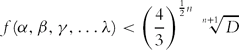
where D is the determinant of the form (Hermite Reference Hermite1850, 263). In the same volume of Crelle's Journal there is a paper by Dirichlet “Über die Reduction der positiven quadratischen Formen mit drei unbestimmten ganzen Zahlen” (Dirichlet Reference Dirichlet1850) in which Dirichlet developed a geometrical foundation for the theory of positive definite quadratic forms in three variables. Inspired by Hermite's minimum result and Dirichlet's paper, Minkowski approached the minimum problem geometrically.
Gauss indicated a geometrical interpretation of positive definite quadratic forms in 1831 (Gauss Reference Gauss1863, vol. II, 188–196),Footnote 10 for forms in two variables:

Gauss associated a system of coordinates with the form f in which the angle ϕ between the axes is determined by the equation

and where  and
 measure the units of the axes. The positive definite quadratic form f in a certain sense measures distances between points in the coordinate system, because f(x 0, y 0) equals the square of the distance between the origin and the point
 . For integer values of x and y the points
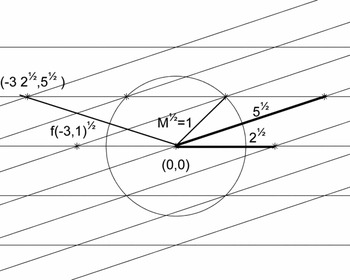
 will form a pattern – a lattice – built up of equal (standard) parallelograms. The square of the area of such a parallelogram is equal to the determinant of the form. There are infinitely many ways in which such a system of points – a lattice – can be organized in parallelograms. So, a system of points is associated with infinitely many forms which are equivalent. Also, for equivalent forms the above construction will result in the same system of points, but associated with different systems of coordinates (see fig. 1).
The lattice representing the quadratic form f(x, y)=2x 2+6xy+5y 2. The lattice points are the points where the two sets of parallel lines intersect. The minimum distance between lattice points is  = 1.

According to Schwermer, Minkowski was aware of the close relationship between the minimum problem and reduction theory in 1883. And a year later, “Minkowski discussed the geometrical significance of this precise bound in the case n = 2 as a result about the existence of a shortest vector in the lattice attached to the quadratic form in question” (Schwermer Reference Schwermer, Goldstein, Schappacher and Schwermer2007, 499). The significance of the geometrical interpretation of a positive definite quadratic form for determining upper bounds for its minimum is clearly laid out in Minkowski's manuscript for his probationary lecture for the German Habilitation which was held on 15 March 1887 at the Friedrich-Wilhelm University in Bonn.Footnote 11
In the manuscript for the probationary lecture, Minkowski treated a positive definite quadratic form in three variables geometrically, introducing a (skew) coordinate system and constructing a lattice of integer points as explained above. Since the square of the distance from a lattice point in this coordinate system to the origin is measured by the quadratic form for integer values of the variables the minimum problem is to determine “the [lattice] point closest to the origin, or . . . the smallest distance between two points in the lattice” (Minkowski Reference Minkowski1887, in Schwermer Reference Schwermer1991, 86). The technique Minkowski employed to reach an upper bound for this minimum was to place spheres, with the smallest distance in the lattice as diameter, around each lattice point. Since these spheres will not overlap and their volume is smaller than the volume of a standard parallelotope, Minkowski compared the volume of such a sphere with the volume of the standard parallelotope. From this observation he reached an inequality from which he could deduce an upper bound for the smallest distance in the lattice.
However, to be really useful in number theory the technique should go beyond the three-dimensional space. Minkowski mentioned in the manuscript that his result can be generalized to n-dimensions but he did not give any arguments. Two years later, in 1889, he formulated the result for n-dimensions in a letter to Hilbert:
Now I have come much further in the theory of positive quadratic forms, for larger numbers of variables it becomes much different. Perhaps the following theorem (which I can prove on half a page) will interest you or Hurwitz: In a positive quadratic form with n (≥2) variables and determinant D one can always assign integer values to the variables such that the form becomes < nD 1/n. For the coefficient n Hermite had only (4/3)½(n−1), which obviously, in general, is a much larger limit. (Minkowski [Reference Minkowski1889] 1973, 38)
Two more years passed before Minkowski published a geometrical proof for the n-dimensional case. The proof ran along the lines he had outlined in the manuscript for the probationary lecture: A positive definite quadratic form in n-variables is represented geometrically by a lattice constructed of standard n-dimensional parallelotopes. With each lattice point as center, Minkowski constructed n-dimensional cubes around the lattice points, and arranged the cubes in a parallel pattern. The edge length of each cube was

where denoted the smallest distance in the lattice. As explained by Minkowski, due to the Pythagorean Theorem the point of such a cube that has the largest distance to the center is a corner point, and the distance is ½. Since is the smallest distance between two points in the lattice this implies that the cubes do not overlap, and they do not fill out the whole space either. From this Minkowski concluded that the volume of one of the cubes is less than the volume of one of the standard parallelotopes that is:
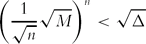
where Δ is the determinant of the quadratic form (Minkowski [Reference Minkowski1891a] 1911, vol. I, 254–255). From this inequality Minkowski easily concluded that

which is the upper bound for the minimum that he announced in the letter to Hilbert.
In the probationary lecture, Minkowski used spheres instead of cubes. Spheres can also be used in the n-dimensional case and immediately following the “cube”-argument Minkowski repeated the argument with spheres. Around each lattice point he constructed an n-dimensional sphere with radius ½. Since the spheres have the same properties as the cubes: they do not overlap each other and they do not fill out the whole space, the argument is the same. These spheres circumscribe the cubes, so the only thing that changes is the upper bound for the minimum which gets sharpened.Footnote 12
As we shall see below, Minkowski's concept of a convex body grew out of his analysis of this proof-technique with lattices and bodies circumscribing lattice points that he used for solving the minimum problem. In what I call phase 1 of Minkowski's path towards the introduction of a concept of a convex body, he worked on the minimum problem for positive definite quadratic forms. Here the epistemic objects, the question-generating elements, were positive definite quadratic forms in n-variables. Minkowski used geometrical reasoning to solve the minimum problem for such forms. The answer-generating element, the epistemic technique, was this analytical geometrical reasoning which could be applied through the geometrical interpretation of quadratic forms. The epistemic configuration in which Minkowski worked in the first phase encompasses the whole number theoretical tradition found in the works of Gauss, Dirichlet, and Hermite on quadratic forms. Minkowski was not working on a new object in phase 1, but he was trying to solve the minimum problem for positive definite quadratic forms in n variables using geometrical methods that answer the question of a bound for the minimum in a new way. This technique of treating positive definite quadratic forms geometrically was promising. Gauss and Dirichlet had worked with it for forms of two and three variables but Minkowski extended it to forms of n-variables. So here we have a research episode where the object under investigation to some extent was known and understood while this was not, at the outset, the case with the technique Minkowski employed to study the object, and as we have seen, Minkowski developed the technique as he went along, using the n-dimensional lattice. Here we have a situation where the geometrical interpretation of positive definite quadratic forms functioned both as an object about which questions could be posed and as a technique that proposed new ways of answering questions about the object.
A shift in focus on the part of Minkowski's mathematical practice that led him to coin a concept of a convex body can be identified in a resume of a talk he gave in 1891. As we have just seen, Minkowski published his geometrical proof of the minimum problem for positive definite quadratic forms in n-variables in 1891, in a paper where he focused on the minimum problem not the proof technique. However, the same year he gave a talk in Halle, Germany, with the title “Über Geometrie der Zahlen” in which he talked about the lattice of integer points in the ordinary three-dimensional Euclidean space with perpendicular coordinate axes. From the resume of the talk it follows that:
The speaker asked mainly two questions concerning the lattice; they supplement each other in certain ways and they have the following in common: It is always, especially when the talk concerns space, about a very general category of bodies that are constructed in such a way that they circumscribe a particular lattice point – for instance the origin – in a certain way, and for such bodies, through the size of the volume of the body alone, a certain property with respect to the lattice shall always be achieved.
The first category of bodies consists of all those bodies that have the origin as middle point, and whose boundary towards the outside is nowhere concave; and for that category the property in question reads: When the volume of a body of that category is ≥23 then this body necessarily contains additional lattice points in addition to the origin. (Minkowski [Reference Minkowski1891b] 1911, vol. I, 264–265)
Here we see the first trace of Minkowski's development of a concept of convex bodies: bodies with middle point and a boundary that is nowhere concave towards the outside. The research he presented in this talk came out of and was driven by his work on the minimum problem of positive definite quadratic forms, but the focus in the paper was on geometry of numbers by which Minkowski understood geometrical investigations of the three-dimensional lattice and associated bodies as well as extensions to n-dimensional manifolds. In this talk, the epistemic objects were not positive definite quadratic forms but the lattice and the general category of bodies as described in the quotation above. The lattice became very important in Minkowski's thinking about number theory because every theorem about the lattice can be translated into a theorem about numbers. The theorem stated in the last part of the previous quotation is the three-dimensional formulation of his famous lattice point theorem.
The key to understanding this reorientation through which phase 2 is characterized, where nowhere concave bodies with middle point are the epistemic objects and the main result is phrased as the lattice point theorem instead of as a bound for the minimum of positive definite quadratic forms, lies in Minkowski's geometrical proof of his theorem of the upper bound for the minimum. As pointed out, the essential property of the bodies (the cubes and the spheres) that he used to circumscribe the lattice points, is that they do not overlap each other and the reason for this is exactly because they are, as mathematicians would say today, convex sets. Every geometrical body with middle point and a nowhere concave boundary and sufficiently small volume could be used in the argument. It follows from the quotation that Minkowski realized this in or before 1891 and this made him coin the concept of such bodies. This reorientation, as it is interpreted above, does not mean that Minkowski moved away from number theory and the theory of positive definite quadratic forms; on the contrary, these subjects were, as will be seen in the following, the reasons why Minkowski began to investigate lattices and nowhere concave bodies with middle points in the first place. In ordinary Euclidean space with perpendicular coordinate axes the level curves of a positive definite quadratic form are ellipsoids with the origin as middle point that is nowhere concave bodies with middle point. In terms of the lattice the minimum problem is the problem of determining how big the ellipsoid must be in order to contain a point with integer coordinates – a lattice point. The lattice point theorem states that if the volume of the ellipsoid f(x, y, z)≤N is at least 23 then the ellipsoid contains a lattice point other than zero meaning that N provides an upper bound for the minimum of the form f.
The next step in Minkowski's investigations of the proof-technique was to introduce the radial distance – or gauge – function and the corresponding Eichkörper or measure/gauge-body. As we have seen, in the (skew) coordinate system representing a positive definite quadratic form f, the form measures the square of distances from the origin. In the perpendicular coordinate system the level curves of the form give rise to ellipsoids, which are nowhere concave bodies with middle point. The essential property is again the shape of the body, so it does not have to be a positive definite quadratic form that is used to measure the distance. At some point Minkowski realized that and introduced the radial distance function and the Eichkörper.
Minkowski's ideas of radial distance functions and Eichkörper were presented at a talk that was read two years later at the international Mathematical Congress at Chicago in 1893.Footnote 13 As in his previous talk Minkowski restricted himself to three dimensions but announced that the theory would be fully developed for n-dimensions in his forthcoming book Geometrie der Zahlen to be published by T. G. Teubner. Minkowski's ideas were expressed in the following quotation from the manuscript of the talk. Here the lattice is the collection of points with integer coordinates in the usual three-dimensional Euclidean space with perpendicular axes:
The deeper properties of the lattice are connected with a generalization of the concept of the length of a straight line by which only the theorem, that the sum of two of the sides in a triangle is never less than the third side, is maintained.
Consider a function S(ab) of two arbitrary variable points a and b, at first only with the following properties: (1) S(ab) is positive when b is not equal to a, and equal to zero when b is equal to a; (2) if a, b, c, and d are four points with b different from a, and if the relationship d − c = t (b − a) holds for t positive then S(cd) = t S(ab). The relationship should be understood in the sense of the Barycentric Calculus and means that cd and ab are line segments in the same direction and with length (in the usual sense) in the proportion t:1. In contrast to the usual length, S(ab) is called the radial distance from a to b.
Let 0 be the origin; obviously, all the values of S(ab) are determined when the set of points u for which S(0u) ≤ 1 is given. This set of points is called the Eichkörper of the radial distance. In any given direction from 0 there exists a line segment from 0 in this direction with non-vanishing length and belonging to the Eichkörper.
If moreover S(ac) ≤ S(ab) + S(bc) for arbitrary points a, b, and c the radial distance is called einhellig. Its Eichkörper then has the property that whenever two points u and v belong to the Eichkörper then the whole line segment uv will also belong to the Eichkörper. On the other hand every nowhere concave body, which has the origin as an inner point, is the Eichkörper of a certain einhellig radial distance.
. . .
S(ab) is called reciprocal if S(ba) = S(ab) without exceptions. This is the case when and only when the “Eichkörper” has the origin as middle point. (Minkowski [Reference Minkowski1893] 1911, vol. I, 272–73)
The essential property that defines nowhere concave bodies is what mathematicians today recognize as the convexity property. A modern mathematician, reading Minkowski's talk, will also recognize the einhellig, reciprocal radial distance function as a metric that satisfies the conditions for (ℜ3, S) to also be a normed space. The associated Eichkörper will be recognized as the unit ball around the origin which need not be the usual spheres from Euclidean geometry but can be any nowhere concave, or as mathematicians would phrase it today, convex shape with the origin as middle point. In such a geometry, looking from outside, it seems that the unit for measuring distances changes with the direction.Footnote 14
Minkowski's book Geometrie der Zahlen, though announced already in 1893, was not published until 1896. In this book, Minkowski developed the analytical theory of radial distance functions, nowhere concave surfaces, and “Eichkörpers” for n-dimensional space, not for their own sake but with the purpose of solving number theoretical problems. That these concepts were not the prime purpose of the theory is illustrated by the very late appearance in the book of the formal definition of a nowhere concave body, which was not presented until towards the end of the book:
The manifold of all points x 1, . . .x n will be denoted by H. A given set of points B is characterised as a nowhere concave body in H already through the following two properties:
1. that a straight line has either no points, one point or a line segment of points in common with the set,
2. that in the set some n+1 points, not in the same hyperplane, exist.
. . . ..
In 1. is also the following property inherent:
3. when two points belong to B so does every point on the line segment between the two. (Minkowski Reference Minkowski1896, 200)
Besides being reflected in the title, the number theoretical focus is also reflected in an advertisement for the book that T. G. Teubner published in 1893, where Minkowski explicitly wrote that the book is about arithmetical theorems: “I have chosen the title Geometry of Numbers for this work because I reached the methods that give the arithmetical theorems, by spatial intuition. Yet the presentation is throughout analytic which was necessary for the reason that I consider manifolds of arbitrary order right from the beginning” (Minkowski Reference Minkowski1910, v).
In this treatment of nowhere concave bodies Minkowski, just as Brunn, relied heavily on geometrical intuition; but in contrast to Brunn, Minkowski was not, at this point, investigating these bodies for their own sake but as a tool for investigating, as he explained in the advertisement, e.g. approximate solutions of equations in integers, the theory of algebraic numbers, and the theory of quadratic forms in n-variables. In order to be able to use them as such Minkowski needed the geometrical objects of nowhere concave bodies to “live” on n-dimensional manifolds. In the announcement written for the 1896 edition of the book he emphasized this geometrical intuition again: “I have reached my theorems through spatial intuition. . . . But here I have prepared a purely analytical presentation because the limitation to a three-dimensional manifold seemed impossible. Only, I aim using expressions that are suitable for evoking geometrical imaginations” (ibid., vi).
As already stated, in phase 2 the epistemic objects under investigation were the lattice and associated bodies, as Minkowski phrased it in his talk at Halle in 1891, but these objects had a different status than the positive definite quadratic forms in n variables which were the epistemic objects of phase 1. Because, contrary to what was the case in phase 1, the epistemic objects in phase 2 were not investigated for their own sake. Minkowski examined and researched them because they were fundamental objects of the geometrical technique he was developing in order to answer questions about positive definite quadratic forms in n-variables. So here we see the dynamics between question-generating elements and answer-generating elements of mathematical research, how they interchange and in periods function as both at the same time. The lattice and its associated bodies functioned both as problem-generating and answer-generating elements in phase 2 of the parts of Minkowski's work that led him to define the concept of a convex body. Minkowski researched them as objects and at the same time they constituted the technique he used to solve problems. This phase was a very fruitful period in Minkowski's work during which “the associated bodies” crystallized into several objects: nowhere concave bodies with middle point, the Eichkörper – the measure/gauge body, and nowhere concave bodies. In phase 2 these interrelated epistemic objects were investigated as tools. They were essential parts of the technique that Minkowski very successfully put to use in number theory. The Eichkörper was examined as a means through which distances in space could be generalized and measured with the purpose of solving problems in number theory. Even though they were objects under investigation they first and foremost functioned as tools, but, interesting enough, towards the end of the book Geometrie der Zahlen Minkowski gave, as we have seen, a formal definition of nowhere concave bodies, indicating that he had begun to think of them as objects detached from number theory.
This is further supported with the publication of Minkowski's first paper solely devoted to investigations of convex bodies for their own sake, a year after the publication of Geometrie der Zahlen. Here Minkowski gave the following definition of a convex body: “A convex body is completely characterized by the properties that it is a closed set of points, has inner points, and that every straight line that takes up some of its inner points always has two points in common with its boundary” (Minkowski [Reference Minkowski1897] 1911, vol. II, 103).
From a footnote to this definition it becomes clear that Minkowski regarded this concept of a convex body to be the same as the one he had developed and treated in Geometrie der Zahlen: “There [page 200 in Geometrie der Zahlen] I called these objects nowhere concave bodies, here I will use the shorter term convex” (ibid.). He gave two arguments for why convex bodies were interesting to investigate: (1) theorems about them had a certain appeal because of their generality, they are valid for the whole category of objects (ibid.); and (2) more specifically he had for a long time expected that if a convex body is built up by a finite number of bodies with middle point that only touch each other in the boundary, that is they do not overlap, then this body also has a middle point (ibid.). We recognize the non-overlapping bodies with middle point from his geometrical solution of the minimum problem, suggesting that this move into the study of convex bodies for their own sake was a continuation of Minkowski's previous work on number theory and geometry of numbers.
This paper from 1897 signifies the beginning of what I have called the third phase in Minkowski's development of the concept of a convex body and the initiation of what grew into the modern theory of convexity (Kjeldsen Reference Kjeldsen2008). All together Minkowski published four papers where he treated convex bodies not as a technique to solve problems in number theory but as mathematical objects interesting as such (Minkowski Reference Minkowski1897, Reference Minkowski1901a, Reference Minkowski1901b, Reference Minkowski1903). A fifth, longer treatment was published posthumously in his collected works (Minkowski Reference Minkowski1911 vol. II, 131–229). In a certain sense one can say that Minkowski in this phase did what Brunn started out to do in his thesis: to build a theory of such bodies from the bottom up, so to speak. In these papers he developed, just as Bruun, a geometrical theory of convex bodies in three-dimensional space. In phase 3 the convex bodies are the epistemic objects. In this phase Minkowski investigated the nowhere concave bodies, or convex bodies as he renamed them, for their own sake, as objects as such.
Regarding the famous Brunn-Minkowski inequality, Minkowski used the inequality in the paper “Über die Begriff Länge, Oberfläche und Volumen” from 1901 to prove the maximum property of the sphere (Minkowski [Reference Minkowski1901a] 1911, vol. II). Here he credited the inequality to Brunn but added the following not so flattering comment: “Mr. Brunn has indeed at the mentioned place [Brunn's thesis from Reference Brunn1887, 31] explicitly uttered the opinion: ‘This theorem can not be used to prove the maximum property of the sphere’” (ibid., 125).
So, Minkowski contradicted Brunn's statement, and it is clear that Brunn had not been aware of the potentials of this inequality. Minkowski proved the inequality for n-dimensions already in Geometrie der Zahlen, where he also referred to Brunn. Whether Minkowski was inspired by Brunn at that time or not is discussed in the next section.
Brunn and Minkowski become aware of each other's work
Even though Minkowski's book Geometrie der Zahlen was not published until 1896 most of his ideas were, as we have seen above, developed and formulated already in 1893, and up to that time Brunn and Minkowski had worked independently developing two parallel strands of knowledge. Teubner's first announcement of Minkowski's book appeared in 1893 and from the paper “Referat über eine Arbeit: Exacte Grundlagen für eine Theorie der Ovale” (Brunn Reference Brunn1894) that Brunn published in 1894, we can infer that this event probably initiated that Brunn and Minkowski became aware of each other's work.Footnote 15
This paper by Brunn is a revised version of parts of his inaugural thesis from 1887, so after seven years Brunn returned to the matter of egg-forms as he had treated them in his thesis. In the paper he explained that Minkowski's announcement by Teubner in June 1893 of the book Geometrie der Zahlen was the direct occasion for him to revisit the thesis. Reading the announcement, Brunn became aware that Minkowski had recognized an “un-supposed and fruitful relationship between number theory and the geometry of bodies with nowhere concave boundaries” (ibid., 94). It also follows from Brunn's paper that Minkowski's book apparently was already in print at the time.
Geometrie der Zahlen was published in two steps. The first delivery (“Lieferung”) was published in 1896 and in 1910 David Hilbert and Andreas Speiser published the second delivery posthumously. According to Hilbert and Speiser the first “Lieferung” consisted of pages 1–240. Apparently due to some unexpected difficulties the second “Lieferung” was delayed, and Minkowski published most of the results that were intended to have been developed in the second “Lieferung” in smaller separate papers (Minkowski Reference Minkowski1910, Vorwort der Herausgeber). The book that was published in 1910 as the second “Lieferung” was the original 1896 book together with the pages 241–254. It is not so easy to get hold of the original version of the book, but Mount Holyoke Library in South Hadley, Massachusetts, has the book in two separate bindings. In the first binding is written in pencil that this is the first “Lieferung” published in Leipzig 1896. This binding consists of pages 1–240, which accords with Hilbert's and Speiser's description in the preface to the 1910 publication. The second binding contains the title page from B. G. Teubner with the year 1910, and written in pencil is added that this is the second “Lieferung.” It consists of the preface by Hilbert and Speiser, the announcement from 1893, the second cover sheet of the first “Lieferung” (which is not in the first binding), the list of contents, the pages 241–254, and finally the index for both “Lieferungs.” On the second cover sheet Minkowski wrote that it would take several months to complete the book and therefore, and because he had been urged to, he had decided to publish a part of the book, which had already been in print for a long time. This part was the first 240 pages consisting of the first four chapters and most of chapter five. What is added in the 1910 edition, which Hilbert and Speiser called the second “Lieferung,” are the last 14 pages of chapter five. According to a remark by Minkowski, it was intended that the book would contain at least seven chapters, but it was never completed (Minkowski Reference Minkowski1896, 39).
Towards the end of the book Minkowski included some references to Brunn: The first reference is on page 209, and I will return to that shortly; the second is in a footnote on page 237, printed in the first “Lieferung”; and the last is on page 254, the very last page of chapter five in the 1910 edition, printed only in the second “Lieferung.” In the footnote Minkowski credits Brunn for having uncovered a number of interesting properties of nowhere concave bodies in two and three dimensions, and referred the reader to Brunn's theses from Reference Brunn1887 and Reference Brunn1889, to the revised version from 1894 of the first thesis, as well as to the end of section 57 which was not included in the first “Lieferung” but is on page 254 in the second “Lieferung,” indicating that the last 14 pages of chapter five were already planned and maybe written in 1896. According to Brunn's Reference Brunn1894 paper Minkowski's book was, as we saw above, already in print when that paper was published, indicating that, as I have also argued in Kjeldsen Reference Kjeldsen2008, Minkowski's references to Brunn were added during the proofreading.
Most likely Minkowski was not aware of Brunn's work in 1893. From Brunn's writings in the revision of the inaugural thesis it follows though that Minkowski must have read Brunn's thesis before Brunn published the revision because here Brunn modified theorem 5 in part 3 of the 1887 thesis, characterizing it as a main theorem of the thesis, and explaining that Minkowski had pointed out to him that there were some flaws in his original proof (Brunn Reference Brunn1894, 102).
In this theorem Brunn claimed that among a family of parallel plane cross-sections in an egg-surface there exists one and only one with maximum area realized through one cross-section or through a continuum of congruent cross-sections forming part of a cylinder. In the course of the proof of this theorem Brunn considered two rectangles lying in parallel planes and having the same area. He then constructed a third one lying in a parallel plane in-between the other two planes and argued that the area of the rectangle in-between was larger than the area of the “outer” rectangles. He gave a formulation of a similar result for comparing the volumes of three egg-bodies where one in a certain sense lies between the other two. Again he considered two egg-bodies of equal volume. He constructed the third, intermediate, egg-body in the following way: To the two original egg-bodies he considered pairs of parallel tangent planes on the same side of the egg-bodies. To each such pair he constructed a third plane that is parallel to the tangent planes and divides the distance between the two tangent planes in a constant proportion. These third planes all lie between pairs of tangent planes and they form the contour or envelope of an egg-body whose volume is bigger than the volumes of the original egg-bodies (Brunn Reference Brunn1887, 31). This was Brunn's formulation of the result that Minkowski referred to in the very last paragraph of the second “Lieferung” of Geometrie der Zahlen where he credited Brunn for being the first one to establish, in three dimensions, the inequality that later became known as the Brunn-Minkowski inequality (Minkowski Reference Minkowski1910, 254).
Minkowski's own version was different from Brunn's; it was for n-dimensions and written as an inequality where the two outer bodies do not necessarily have the same volume (ibid., 246):

Here B′ and C′ are the volumes of the two outer bodies whereas T′ is the volume of the body in between. Whether or not Minkowski derived his inequality completely independent of Brunn is hard to say. He has a similar result on page 208, which seems to be his own. Then he continues on page 209 by introducing an inequality like the one above, crediting Brunn, and postponing the proof to the last entry, number 57, of the book, which according to Hilbert and Speiser was not included in the first “Lieferung.” This could mean that Minkowski's Brunn-Minkowski inequality was inspired by Brunn's work and the material added in the proofreading stage. On the other hand, Minkowski had already developed a similar inequality and in the last paragraph he expressed the importance of this inequality for the applications in chapter 6. There was no chapter 6 in the first “Lieferung,” nor in the second “Lieferung” of the book, but he clearly had several more chapters in mind, and in one of them the material to be discussed was apparently based on this inequality, suggesting that this was not something that was added only in the proofreading, but had already been developed. Minkowski very carefully acknowledged his sources in his published papers, so if he had been aware of Brunn's work prior to 1893–94 he would probably have mentioned Brunn in his earlier papers or at least right from the beginning of Geometrie der Zahlen where he in the first chapter introduced nowhere concave surfaces and the measure – or gauge – bodies.
In the last paragraph of the second “Lieferung,” Minkowski revealed, in accordance with Brunn's own statements in his 1894 paper, that Brunn, after a comment from Minkowski about the need for more rigorous arguments for some of the theorems, had returned to the issue in the 1894 paper, but, as Minkowski continued, he thinks that one reaches the goal much more easily by using the analytical proof given by himself instead of Brunn's geometrical proof. Brunn on his side finished the 1894 revision with the following remark on the different proofs: “In exchange for my proof professor Minkowski has informed me of an analytical proof of the theorem that extends to forms of more than three dimensions” (Brunn Reference Brunn1894, 111). In contrast to Minkowski, Brunn did not at this point say anything about the advantage of one proof-method over the other, but in the introduction he tried to place his own work in relation to Minkowski's:
Presumably, the present work will have the major part of its subject matter in common with certain chapters of Minkowski's book, however it is hoped that it also will provide many essential and illuminating deviations in the structure due to the huge difference in the used methods (analytic and pure geometric) as well as in the starting points and research goals. (Ibid., 94)
Here we see how Brunn with reference to their different mathematical practices drew attention to the differences between his and Minkowski's work especially emphasizing the distinction between analytic and synthetic treatments.
Conclusion
The analysis presented in the present paper shows that Brunn and Minkowski investigated for different reasons and in different ways what mathematicians today call convex bodies. Minkowski was motivated by his work on positive definite quadratic forms. He initially introduced the objects of nowhere concave bodies with or without middle point, not for their own sake but rather as useful tools. Brunn, on the other hand, introduced and studied his objects for their own sake. His motivation was driven by the idea that easily asked questions about such objects turned out to be hard to prove, and he wanted to see how far he could go. Both were inspired by geometrical visualization. Minkowski got his ideas through “raumliche Anschauungen.” But, as we have seen, that functioned only as a means for inspiration; when it came to the actual theory building, that is argumentation and proof, he used higher dimensional analysis. Brunn, on the other hand, considered space geometry as much more than a source of inspiration. For him synthetic geometry was the method of geometrical thinking and argumentation. His first paper had a touch of methodological purity as was seen at the time of Steiner and his followers.
By using the methodological framework of epistemic objects and techniques to analyze Brunn's and Minkowski's works, it became possible to single out the differences in their mathematical practices in the investigated episodes. In Minkowski's work, elements of epistemic objects and epistemic techniques at times functioned as both, they changed places, and they had different status in the three phases. Minkowski's objects also changed during the three research phases. In Brunn's work the objects didn't change and the two elements – objects and technique – did not switch places. This does not mean though that they were not intertwined in Brunn's work. The questions Brunn in practice could ask about the objects were dependent on his answer-generated method – the synthetic geometry. In the epistemic configuration or mathematical workshop Brunn was working in at the time, it is for example very hard to imagine that he could have asked the question of how large the volume of an egg-body must be for it to have a lattice point. This is a question regarding the size of the objects he investigated, the size of egg-bodies. But in Brunn's workshop for this particular work on egg-forms, there was no lattice and there were no tools to link the volume of a body to spatial points with integer coordinates. So even though Brunn investigated objects which in introductions to some later monographs on convexity (Bonnesen and Fenchel Reference Bonnesen and Fenchel1934; Klee Reference Klee1963) are considered to be the same as the ones investigated by Minkowski, namely convex bodies, his epistemic configuration was so different that he in practice could not develop the same mathematics as Minkowski did.
In the introductions mentioned above Brunn's egg-forms and Minkowski's nowhere concave bodies are considered to correspond to each other, but, by using the terminology of Epple and Rheinberger, we have seen that Brunn and Minkowski worked in different epistemic configurations. If, instead of considering convex bodies as universal, de-contextualized mathematical entities, we view and compare them from inside these different epistemic configurations, then we might question whether Brunn and Minkowski in practice investigated the same objects. Brunn examined ovals, egg-surfaces, and the corresponding egg-bodies, objects which he probably thought of as abstractions of objects that exist in our physical space. This is supported by the names he chose, which he took from everyday experiences with material things: oval drawings and egg shapes. Minkowski's objects were quite different and he created new ones in the research process. First they were bodies which were nowhere concave towards the outside and surrounded the origin in a certain way. Then they got a name: nowhere concave bodies with middle point. They were a tool to investigate the minimum problem and Minkowski investigated them as such. This led him to interpret them as measure – or gauge – bodies associated with a radial distance function. These measure/gauge-bodies constituted a major part of Minkowski's proof-technique and during his investigations of his proofs he coined the concept of nowhere concave bodies as such, that is without necessarily having a middle point. Common for all these objects were that they did not arrive as abstractions from material objects; on the contrary, they were dictated by positive definite quadratic forms in n-variables, and as such they “lived” in n-dimensional manifolds. While Brunn's objects had reference to our physical space, Minkowski's were objects in mathematical space.
Regarding the potential of Brunn's and Minkowski's works for generating new knowledge, I will emphasize two aspects. First, if one only looks at Minkowski's papers on convexity from 1897, that is, his work in the third and last phase of his development of the concept of a convex body and the theory of convexity, then his work might look like a continuation of Brunn's work. However, if we did look only at this last phase of development of the concept, then most of Minkowksi's mathematical practice would disappear from sight. As we have seen, his work on convex bodies in phase 3 did not suddenly materialize out of nowhere, and that is one of the big differences between Brunn's and Minkowski's work. Minkowski's mathematics on convexity came out of his effort to solve mathematical problems that were recognized as important problems, indicating that productive theories develop from such kind of problem-solving. A theory of convexity in itself did not have the potential to success, but in the “right” context, it did. Minkowski's approach in the two first phases highlights the usefulness of the objects in interaction with other mathematical theories, both in connection with number theory, but just as important, in connection with the beginning general functional analysis with its definition of metric and normed spaces. Thereby, Minkowski's objects of convex bodies became centrally placed in the mathematical universe of his time.
Second, Brunn and Minkowski had in common that they both attached great significance to geometry: Brunn in the way of Steiner and Minkowski as a way to get intuitive ideas and proofs. In Brunn's case this functioned as a restriction, it narrowed the possibilities, whereas in Minkowski's case it broadened the investigations and opened new possibilities, because methods from one field – geometry – were applied to problems from another field – number theory. This mixing of different mathematical disciplines, the crossing of disciplinary boundaries within mathematics that to a large extent characterizes Minkowski's mathematical practice in this research episode is another significant difference between Brunn and Minkowski, which is a second aspect regarding the possibility of generating new knowledge. Brunn stayed within two- and three-dimensional synthetic geometry, whereas Minkowski's work was situated in a much richer context, connecting several different mathematical disciplines. To draw parallels to the work of Rheinberger and Epple, the work of Minkowski can be said to be a hybridization of different strands of knowledge,Footnote 16 the tradition in number theory combined with the development of new geometrical techniques to deal with its problems constituted a very productive epistemic configuration that gave rise to no less than two new mathematical disciplines in the twentieth century: geometry of numbers and the theory of convexity.
Acknowledgments
I wish to thank Leo Corry and two anonymous referees for helpful comments and suggestions on an earlier version of this paper.