

1. Introduction
The theoretical discussion of the properties that a risk measure must respect to be used in practical matters gained prominence in the literature after the seminal work of Artzner et al. (Reference Artzner, Delbaen, Eber and Heath1999), who developed the class of coherent risk measures. From there, other classes of risk measures were proposed, for instance, the convex (Föllmer and Schied, Reference Föllmer and Schied2002; Frittelli and Rosazza Gianin, Reference Frittelli and Rosazza Gianin2002), spectral (Acerbi, Reference Acerbi2002), and generalized deviation measures (Rockafellar et al., Reference Rockafellar, Uryasev and Zabarankin2006). In this sense, an entire stream of literature has proposed and discussed distinct features for risk measures, including axiom sets, dual representations, and mathematical and statistical properties. For a detailed review of this literature, we refer to the books of Pflug and Romisch (Reference Pflug and Römisch2007), Delbaen (Reference Delbaen2012), Rüschendorf (Reference Rüschendorf2013), and Föllmer and Schied (Reference Föllmer and Schied2016) and the studies of Föllmer and Knispel (Reference Föllmer, Knispel, MacLean and Ziemba2013) and Föllmer and Weber (Reference Föllmer and Weber2015).
Based on the axiomatic discussion of risk measures, the indiscriminate use of value at risk (VaR) has been criticized for not being a coherent measure since it does not satisfy the subadditivity/convexity axiom. Thus, in contrast to the principle of diversification, the risk of a diversified position can be greater than the sum of individual risks. Another drawback of VaR is that it completely disregards losses beyond the
 $\alpha$
-quantile of interest. In order to remedy these deficiencies, some studies present alternatives that satisfy the axioms of coherent risk measures and quantify the expected value of losses that exceed VaR. Different authors have presented similar measures with different names to fill this gap (Artzner et al., Reference Artzner, Delbaen, Eber and Heath1999; Pflug, Reference Pflug2000; Acerbi and Tasche, Reference Acerbi and Tasche2002; Rockafellar and Uryasev, Reference Rockafellar and Uryasev2002). The most accepted measure in finance literature is the one proposed by Acerbi and Tasche (Reference Acerbi and Tasche2002), which is named expected shortfall (ES). From then on, the expected value of losses has become the primary focus from a regulatory point of view (Basel Committee on Banking Supervision, 2013).
Despite the strengths presented by ES, the literature that discusses the statistical properties of risk measures has shown some disadvantages compared to VaR. As Fissler and Ziegel (Reference Fissler and Ziegel2016) show, the ES is not directly elicitable (see Section 2, for details), which may partially justify its difficulties with robust estimation and backtesting (Gneiting, Reference Gneiting2011). The elicitability of a risk measure means that it is the minimizer of expectation of some score function (Ziegel, Reference Ziegel2016; Acerbi and Szekely, Reference Acerbi and Szekely2017). For risk management, this property is important because it allows the evaluation of different forecasting procedures by the scoring rule. An example of elicitable functionals is quantiles, making the VaR elicitable. Elicitable monetary risk measures are fully characterized in Bellini and Bignozzi (Reference Bellini and Bignozzi2015) and Delbaen et al. (Reference Delbaen, Bellini, Bignozzi and Ziegel2016). Cont et al. (Reference Cont, Deguest and Scandolo2010) also point out that there is a conflict between convexity and robustness to data disturbance of risk measurement procedures. According to the authors, ES did not pass the qualitative robustness test and had a high sensitivity to outliers. This concept of robustness is generalized beyond the weak topology by Kratschmer et al. (Reference Kratschmer, Schied and Zahle2014), allowing to capture the fine structure of robustness. We recommend Embrechts et al. (Reference Embrechts, Wang and Wang2015) for a brief discussion, and some references regarding different notions of robustness explored in scientific articles.
To remove the disadvantage of ES having non-robust estimators, Cont et al. (Reference Cont, Deguest and Scandolo2010) slightly modified the definition of the ES and proposed the range value at risk (RVaR). This measure can be understood as the average of VaR levels across a range of loss probabilities
 $\alpha, \beta \in [0, 1]$
. RVaR is a robust risk measure, and it includes VaR and ES as special cases. Although RVaR considers most of the tail, it does not reflect very extreme losses captured by ES, implying that the measure is not convex. For more details on RVaR, we suggest Cont et al. (Reference Cont, Deguest and Scandolo2010), Bignozzi and Tsanakas (Reference Bignozzi and Tsanakas2016), Embrechts et al. (Reference Embrechts, Liu and Wang2018), Fissler and Ziegel (Reference Fissler and Ziegel2021), Bairakdar et al. (Reference Bairakdar, Cao and Mailhot2020), and Bernard et al. (Reference Bernard, Kazzi and Vanduffel2020).
In this paper, we propose to generalize the role of VaR in the construction of RVaR by considering other risk measures induced by a tail level. Thus, for any risk measure
 $\rho^s$
parameterized by a level
 $s \in [0, 1]$
, we derive a range-based formulation
 $R_\rho$
. The definition of
 $R_\rho$
can be understood as a weighting scheme over the probability on
 $([0, 1],\mathcal{B}[0, 1])$
defined as
 $\mu(A)=\lambda(A|[\alpha,\beta])$
, where
 $\lambda$
is the Lebesgue measure. We discuss in detail
 $R_\rho$
, its properties, and theoretical representations. We analyze the prominent examples of the family of proposed risk measures.
To present the proposed concepts more practically, we performed an illustration using Monte Carlo simulation. In our example, we use VaR and ES as tail measures, as they are the two most popular regulatory risk measures in banks and insurance, in addition to Expectile and shortfall deviation risk (SDR). We use the Expectile because it is the only coherent risk measure besides the expected loss (EL) that respects the elicitability; some authors present it as an option to VaR and ES (Emmer et al., Reference Emmer, Kratz and Tasche2015; Ehm et al., Reference Ehm, Gneiting, Jordan and Krüger2016; Bellini and Di Bernardino, Reference Bellini and Di Bernardino2017). The SDR was included because it contemplates the two fundamental pillars of risk, which are the probability of extreme events and the variability of an expectation (Righi and Ceretta, Reference Righi and Ceretta2016; Righi, Reference Righi2019). In our numerical experiment, we present two examples. The first illustration uses range-based risk measures for calculating the risk premium in an insurance setup, and our second illustration explores our approach to predicting market risk. We quantify the risk forecasts with the AR-GARCH (autoregressive-generalized autoregressive conditional heteroskedasticity) model considering different probability distributions. In the Online Supplementary Material, we present an illustration with real financial data. In this illustration, we assess the risk forecasts using realized loss (Gneiting, Reference Gneiting2011; Emmer et al., Reference Emmer, Kratz and Tasche2015; Fissler and Ziegel, Reference Fissler and Ziegel2016, Reference Fissler and Ziegel2021), realized cost (Righi et al., Reference Righi, Müller and Moresco2020), and model risk measures (Kellner and Rösch, Reference Kellner and Rösch2016; Müller and Righi, Reference Müller and Righi2020; Berkhouch et al., Reference Berkhouch, Müller, Lakhnati and Righi2022). In the Online Supplementary Material, we also report additional results from our numerical experiments, which include absolute and relative bias and root mean square error of the risk forecasts.
Our study contributes both to the academic literature and to the financial industry. The use of another functional instead of VaR in the ES formulation
 $\frac{1}{\beta}\int_0^\beta VaR^s(X)ds$
, where
 $\beta \in [0, 1]$
is the significance level, is not new in the literature. Rockafellar and Royset (Reference Rockafellar and Royset2013), Rockafellar et al. (Reference Rockafellar, Royset and Miranda2014), and Rockafellar and Royset (Reference Rockafellar and Royset2018), for instance, employ the ES instead of VaR, giving rise to a functional called superquantile, which has the structure
 $\frac{1}{\beta}\int_0^\beta ES^s(X)ds$
. Tadese and Drapeau (Reference Tadese and Drapeau2021), Daouia et al. (Reference Daouia, Girard and Stupfler2020), Tadese and Drapeau (Reference Tadese and Drapeau2020) explored the Expectile-based ES as
 $\frac{1}{\beta}\int_0^\beta \text{Expectile}^s(X)ds$
, which changes VaR by Expectile. Both approaches are special cases in our framework. Furthermore, our approach applies to any risk measure parameterized by a tail level
 $s\in[0, 1]$
. From a general point of view, risk measurement combinations have their properties studied on the framework of Righi (Reference Righi2023). However, we explore this case in detail, developing new and specific results. Furthermore, from a technical point of view, we make the theory for
 $L^1$
, while their paper is for
 $L^\infty$
, and we do not need some of their measurability assumptions. Liu and Wang (Reference Liu and Wang2021) also propose an analysis for tail risk measures as those that only depend on a tail part from some distribution function. Nonetheless, their approach is distinct from the one we propose. To the best of our knowledge, the present research is the first one that generalizes the role of VaR in the construction of RVaR by using other tail risk measures.
Our study contributes from a practical point of view because we provide an extensive analysis considering numerical and financial data to illustrate the practical usefulness of our framework. Thus, although this is not the objective of this study, we corroborate with previous studies that compare the risk forecasts obtained by different volatility specifications and/or probability distributions. See, for example, Diaz et al. (Reference Diaz, Garcia-Donato and Mora-Valencia2017) and Garcia-Jorcano and Novales (Reference Garcia-Jorcano and Novales2021). Different from previous works that mainly evaluate ES and VaR forecasts (Kuester et al., Reference Kuester, Mittnik and Paolella2006; Orhan and Köksal, Reference Orhan and Köksal2012; Righi and Ceretta, Reference Righi and Ceretta2015), we also evaluated the forecasts obtained by Expectile, SDR, and RVaR, which until then had not been investigated in studies for this purpose.Footnote 1
The remainder of this paper divides into the following contents: in Section 2, we expose definitions and results regarding risk measures from literature. In Section 3, we define the range-based risk measure and study its properties. In Section 4, we present a numerical example to illustrate our approach. In the Online Supplement, we describe additional results from numerical examples and exhibit an empirical illustration of our approach to capital determination.
2. Background
Consider the probability space
 $(\Omega,\mathcal{F},\mathbb{P})$
. All equalities and inequalities are in the
 $\mathbb{P}$
-a.s. sense. We have that
 $L^0=L^0(\Omega,\mathcal{F},\mathbb{P})$
,
 $L^1=L^1(\Omega,\mathcal{F},\mathbb{P}),$
and
 $L^{\infty}=L^{\infty}(\Omega,\mathcal{F},\mathbb{P})$
are, respectively, the spaces of (equivalent classes under
 $\mathbb{P}$
-a.s. equality of) finite, integrable and essentially bounded real random variables in
 $(\Omega,\mathcal{F},\mathbb{P})$
. Let
 $\mathcal{P}$
be the set of all probability measures on
 $(\Omega,\mathcal{F})$
. We denote
 $E_{\mathbb{Q}}[X]=\int_{\Omega}Xd\mathbb{Q}$
,
 $F_{X, \mathbb{Q}}(x)=\mathbb{Q}(X\leq x)$
, and
 $F_{X, \mathbb{Q}}^{-1}(\alpha)=\inf\left\lbrace x\,:\,F_{X, \mathbb{Q}}(x)\geq\alpha\right\rbrace $
, respectively, the expected value, the (nondecreasing and right continuous) probability function and its left quantile for X under
 $\mathbb{Q}\in\mathcal{P}$
. We drop subscripts regarding probability measures when
 $\mathbb{Q}=\mathbb{P}$
. Furthermore, let
 $\mathcal{Q}\subseteq\mathcal{P}$
be the set of probability measures that are absolutely continuous about
 $\mathbb{P}$
with essentially bounded Radon-Nikodym derivatives
 $\frac{d\mathbb{Q}}{d\mathbb{P}}\in L^\infty$
. Moreover,
 $1_A$
is the indicator function of event A.
We begin with a brief background on the definitions and results from the risk measures literature we use alongside the paper. In this sense, we first define risk measures as functionals on
 $L^1$
.
Definition 1.
A functional
 $\rho\,:\,L^1\to\mathbb{R}\cup\{-\infty,\infty\}$
is a risk measure. Its acceptance set is defined as
 $\mathcal{A}_\rho=\left\lbrace X\in L^1\,:\,\rho(X)\leq 0 \right\rbrace $
.
 $\rho$
may possess the following properties:
-
(i) Monotonicity: if
 $X \leq Y$
, then
$\rho(X) \geq \rho(Y),\:\forall\: X,Y\in L^1$
.
-
(ii) Translation Invariance:
$\rho(X+C)=\rho(X)-C,\:\forall\: X\in L^1,\:\forall\:C \in \mathbb{R}$
. -
(iii) Convexity:
$\rho(\lambda X+(1-\lambda)Y)\leq \lambda \rho(X)+(1-\lambda)\rho(Y),\:\forall\: X,Y\in L^1,\:\forall\:\lambda\in[0, 1]$
. -
(iv) Positive Homogeneity:
$\rho(\lambda X)=\lambda \rho(X),\:\forall\: X\in L^1,\:\forall\:\lambda \geq 0$
. -
(v) Law Invariance: if
$F_X=F_Y$
, then
$\rho(X)=\rho(Y),\:\forall\:X,Y\in L^1$
. -
(vi) Comonotonic Additivity:
$\rho(X+Y)= \rho(X)+\rho(Y),\:\forall\: X,Y\in L^1$
with X,Y comonotone, that is,
$\left(X(w)-X(w^{\prime})\right)\left( Y(w)-Y(w^{\prime}) \right)\geq0$
holds
$\mathbb{P}\times\mathbb{P}$
-a.s.


We have that
 $\rho$
is called monetary if it fulfills Monotonicity and Translation Invariance, convex if it is monetary and respects Convexity, coherent if it is convex and fulfills Positive Homogeneity, law invariant if it has Law Invariance and comonotone if it attends Comonotonic Additivity.
Under some properties, we have a robust characterization for coherent risk measures. Such portrayal, known as dual representation, allows us to understand a risk measure as a worst-case scenario for the loss expectation.
Theorem 1. (Theorems 2.11 and 3.1 of Kaina and Rüschendorf, Reference Kaina and Rüschendorf2009). A map
 $\rho \,:\, L^1\to \mathbb{R}$
is a coherent risk measure if and only if it can be represented as
 \begin{equation} \rho(X)=\max\limits_{\mathbb{Q}\in\mathcal{Q}_\rho} E_\mathbb{Q}[{-}X],\:\forall\:X\in L^1, \end{equation}
where
 $\mathcal{Q}_\rho\subseteq\mathcal{Q}$
is nonempty, closed in total variation norm, and convex set called the dual set of
 $\rho$
. Moreover,
 $\rho$
is continuous in the
 $L^1$
norm.
Remark 1. We have that
 $L^1$
norm continuity and continuity under dominated
 $\mathbb{P}$
-a.s. convergence, also known as Lebesgue continuity in the risk measures literature, are equivalent for real-valued functionals. See Chen et al. (Reference Chen, Gao, Leung and Li2022) for results on continuities of risk measures and an overview of the literature.
Example 1. We now expose some examples of risk measures that are governed by a tail significance parameter
 $\alpha\in[0, 1]$
. Such functionals are nonincreasing and integrable in
 $\alpha$
for any
 $X\in L^1$
.
-
(i) Value at risk (VaR): This is a law invariant comonotone monetary risk measure defined as
We have that
\begin{equation*}VaR^\alpha(X)=-F_{X}^{-1}(\alpha).\end{equation*}
\begin{equation*}\mathcal{A}_{VaR^\alpha}=\left\lbrace X\in L^1\,:\,\mathbb{P}(X<0)\leq\alpha\right\rbrace.\end{equation*}
-
(ii) Expected shortfall (ES): This is a law invariant comonotone coherent risk measure defined as
We have
\begin{equation*}ES^{\alpha}(X)=-\frac{1}{\alpha}\int_0^\alpha F_X^{-1}(s)ds,\:\alpha\in(0,1],\;\text{and}\;ES^0(X)=VaR^0(X).\end{equation*}
and
\begin{equation*}\mathcal{A}_{ES^\alpha}=\left\lbrace X\in L^1\,:\,\int_0^\alpha VaR^s(X)ds\leq0\right\rbrace\end{equation*}
\begin{equation*}\mathcal{Q}_{ES^\alpha}=\left\lbrace \mathbb{Q}\in\mathcal{Q} \,:\, \frac{d\mathbb{Q}}{d\mathbb{P}}\leq\frac{1}{\alpha} \right\rbrace,\;\alpha>0.\end{equation*}
-
(iii) Expectile: It is defined as
It is law invariant coherent for
\begin{align*}\text{Expectile}^{\alpha}(X)&=-\mathop{\textrm{arg min}}\limits_{x\in\mathbb{R}} E\left[\alpha((X-x)^+)^2+(1-\alpha)((X-x)^-)^2\right]\\&=-\mathop{\textrm{arg min}}\limits_{x\in\mathbb{R}} \int_0^1\left( \alpha\left((F^{-1}_X(s)-x)^+\right)^2+(1-\alpha)\left((F^{-1}_X(s)-x)^-\right)^2\right)ds.\end{align*}
$\alpha\leq0.5$
. In this case, we haveand
\begin{equation*}\mathcal{A}_{\text{Expectile}^\alpha}=\left\lbrace X\in L^1\,:\,\frac{E[X^+]}{E[X^-]}\geq\frac{1-\alpha}{\alpha} \right\rbrace\end{equation*}
\begin{equation*}\mathcal{Q}_{\text{Expectile}^\alpha}=\left\lbrace\mathbb{Q}\in\mathcal{Q} \,:\,\:\exists\: a>0,\: a\leq\frac{d\mathbb{Q}}{d\mathbb{P}}\leq a\frac{1-\alpha}{\alpha} \right\rbrace.\end{equation*}
-
(iv) Shortfall Deviation Risk (SDR): This measure was proposed and studied in Righi and Ceretta (Reference Righi and Ceretta2016), Righi and Borenstein (Reference Righi and Borenstein2018), and Righi (Reference Righi2019). It is defined as
where
\begin{align*} SDR^\alpha(X)&=ES^\alpha(X)+kE\left[(X+ES^\alpha(X))^-\right]\\ &=-\frac{1}{\alpha}\int_0^\alpha F_X^{-1}(s)ds+k\int_0^1\left(\left(F^{-1}_X(s)+ES^\alpha(X)\right)^- \right)ds, \end{align*}
$k\in[0, 1]$
and
$X^-=\max\{-X,0\}$
. The penalty term is known as shortfall deviation (
$SD^\alpha$
). It is a law invariant coherent risk measure withand
\begin{equation*}\mathcal{A}_{SDR^\alpha}=\left\lbrace X\in L^1\,:\, \int_0^\alpha VaR^s(X-SD^\alpha(X))ds\leq0\right\rbrace \end{equation*}
where
\begin{equation*}\mathcal{Q}_{SDR^\alpha}=\left\lbrace\mathbb{Q}\in\mathcal{Q}\,:\,\frac{d\mathbb{Q}}{d\mathbb{P}}=\frac{d\mathbb{Q}_\rho}{d\mathbb{P}}(1+\beta E_\mathbb{P}[W])-\beta W ,\frac{d\mathbb{Q}_\rho}{d\mathbb{P}}\in\mathcal{Q}_{ES^\alpha},W\in\mathcal{W} \right\rbrace,\end{equation*}
$\mathcal{W}=\left\lbrace W\,:\,W\leq0,\operatorname{ess}\sup |W|\leq1 \right\rbrace$
.


Interesting features are present when there is Law Invariance, which is the case in most practical applications. We focus on dual representation. For the following results, we assume our probability space is atomless.
Theorem 2. (Theorem 7 of Kusuoka, Reference Kusuoka2001, Theorem 4.1 of Acerbi, Reference Acerbi2002, Theorem 7 of Frittelli and Gianin, Reference Frittelli and Gianin2005, Theorem 2.2 of Filipovi´c and Svindland, Reference Filipović and Svindland2012).
 $\rho \,:\, L^1\to \mathbb{R}$
is a law invariant coherent risk measure if and only if it can be represented as
 \begin{equation} \rho(X)=\sup\limits_{m\in\mathcal{M}_\rho} \int_{(0,1]}ES^p(X)dm(p),\:\forall\:X\in L^1, \end{equation}
where
 $\mathcal{M}_{\rho}=\left\lbrace m\in\mathcal{M}\,:\,\int_{(u,1]}\frac{1}{v}dm=F^{-1}_{\frac{d\mathbb{Q}}{d\mathbb{P}}}(1-u),\:\mathbb{Q}\in\mathcal{Q}_\rho\right\rbrace $
and
 $\mathcal{M}$
is the set of probabilities over
 $(0, 1]$
. If in addition
 $\rho$
is comonotone, then
 \begin{equation} \rho(X)= \int_{(0,1]}ES^p(X)dm(p)=\int_0^1VaR^p(X)\phi(p)dp,\:\forall\:X\in L^1, \end{equation}
where
 $m\in\mathcal{M}_\rho$
,
 $\phi\,:\,[0, 1]\to\mathbb{R}_+$
is a nonincreasing functional such that
 $\int_{0}^{1}\phi(u)du=1$
and
 $\int_{(u,1]}\frac{1}{v}dm=\phi(u)$
.
A recently highlighted statistical property is Elicitability, which enables comparing competing models in risk forecasting. See Ziegel (Reference Ziegel2016), Bellini and Bignozzi (Reference Bellini and Bignozzi2015), Kou and Peng (Reference Kou and Peng2016), Fissler and Ziegel (Reference Fissler and Ziegel2016, Reference Fissler and Ziegel2021) and the references therein for more details. We now adapt it to our framework.
Definition 2.
A map
 $S\,:\,\mathbb{R}^{k+1}\to\mathbb{R}_+$
is called scoring function if
 $\omega\mapsto S(X(\omega),y)\in L^1$
for any
 $X\in L^1$
and any
 $y\in\mathbb{R}^k$
. A function
 $\rho\,:\, L^1\to\mathbb{R}^k$
is elicitable if exists a scoring function
 $S^\rho\,:\,\mathbb{R}^{k+1}\to\mathbb{R}_+$
such that
 \begin{equation} \rho(X)=-\mathop{\textrm{arg min}}\limits_{y\in\mathbb{R}^k}E\left[S^\rho(X,y) \right],\:\forall\:X\in L^1. \end{equation}
Remark 2. Elicitability, when confined to risk measures, can be restrictive depending on the demanded financial properties at hand. In this sense, we may end up with only one example of risk functional which satisfies the requisites. See Theorem 4.9 of Bellini and Bignozzi (Reference Bellini and Bignozzi2015) and Theorem 1 in Kou and Peng (Reference Kou and Peng2016). For instance, VaR and Expectile, when finite, are elicitable, respectively, under scores on
 $\mathbb{R}^2$
 \begin{align} S^{VaR^\alpha}(x,y)=\alpha(x - y)^+ + (1 - \alpha)(x - y)^- \end{align}
and
 \begin{align} S^{\text{Expectile}^\alpha}(x,y)=\alpha((x-y)^+)^2+(1-\alpha)((x-y)^-)^2, \end{align}
while ES and SDR are not. However, under joint elicitability of
 $(VaR^\alpha(X), ES^\alpha(X))$
, we can have a useful score for ES, on
 $\mathbb{R}^3$
, as
 \begin{align} S^{ES^\alpha}(x,y,z)=y\left(1_{x<y}-\alpha \right) - x1_{x<y} + e^{z} \left(z -y + \frac{1_{x<y}}{\alpha}\left( y - x \right) \right) - e^{z} + 1-\log\!\left(1- \alpha\right). \end{align}
3. Range-based risk measures
We are now in conditions to define the main functional in our approach. The goal is to consider a risk measure parameterized by a tail level
 $\alpha\in[0, 1]$
, as is the case of those we presented as examples, and to derive a range-based formulation.
Definition 3.
A collection of risk measures
 $\{\rho^s\,:\, L^1\to\mathbb{R}\cup{\{-\infty,\infty\}},\:s\in[0, 1]\}$
defines a tail level functional if
 $s\mapsto \rho^s(X)$
is nonincreasing and integrable in
 $[\alpha,\beta]$
for any
 $X\in L^1$
. Its range-based risk measure is defined as
 \begin{equation} R_\rho(X)\,:\!=\, R_\rho^{\alpha,\beta}(X)=\begin{cases} \frac{1}{\beta-\alpha}\int_{\alpha}^{\beta}\rho^s(X)ds,\:\text{if}\:\alpha<\beta,\\[6pt] \rho^\alpha(X),\:\text{if}\:\alpha=\beta, \end{cases} \end{equation}
where
 $\:0\leq \alpha\leq \beta\leq 1$
.
Remark 3.
-
(i) Since
$s \rightarrow \rho^s(X)$
is nonincreasing and integrable over
$\left[\alpha, \beta\right]$
, it follows automatically that
$\rho^s(X)$
is finite for
$\lambda$
-almost all
$s\in[\alpha,\beta]$
for any
$X \in L^1$
. In the following, when clear from the context, we assume that
$\{\rho^s\,:\, L^1\to\mathbb{R}\cup{\{-\infty,\infty\}},\:s\in[0, 1]\}$
is a tail-level functional. -
(ii) When
$\rho$
is VaR, we recover the usual RVaR. The special case of
$\beta>\alpha=0$
gives rise to the tail average
$R_\rho^{0,\beta}=\frac{1}{\beta}\int_0^\beta\rho^s(X)ds$
. When
$\rho$
is VaR, ES, or Expectile, such formulation results, respectively, in the ES, the superquantile of Rockafellar and Royset (Reference Rockafellar and Royset2018), and the expectile-based expected shortfall of Tadese and Drapeau (Reference Tadese and Drapeau2021). In fact, one can write for
$\beta>\alpha$
the range as(3.2)
\begin{equation}R_\rho^{\alpha,\beta}(X)=\dfrac{\beta R^{0,\beta}_\rho(X)-\alpha R^{0,\alpha}_\rho(X)}{\beta-\alpha}. \end{equation}
-
(iii) Some caution is required for the range functional to allow for
$\alpha=\beta=0$
or
$\alpha=\beta=1$
in order to include the usual risk measures from the literature. This because, for unbounded X, one can define, for instance,
$VaR^0=ES^0=\text{Expectile}^0=-\operatorname{ess}\inf X=\infty$
. However, note that endpoints do not alter the integration since
$\lambda\{\alpha\}=\lambda\{\beta\}=0$
, where
$\lambda$
is the Lebesgue measure on [0, 1]. Regarding the acceptance set of
$R_\rho$
, when it is well defined, it can be addressed as(3.3)
\begin{equation} \mathcal{A}_{R_\rho}=\left\lbrace X\in L^1\,:\,\int_{\alpha}^\beta\rho^s(X)ds\leq0\right\rbrace. \end{equation}
-
(iv) Our range-based risk measures can be of the tail type, that is, to possess the p-tail property, studied in Liu and Wang (Reference Liu and Wang2021), as
$F^{-1}_X(s)=F^{-1}_Y(s)$
for all
$s\in (0,p]$
implies
$\rho(X)=\rho(Y)$
. Such property means that the risk is entirely determined by the left tail region of its distribution. If we consider risk measures determined by quantiles as
$\rho^s(X)=S\left(F_X({\cdot}|X\leq F^{-1}_X(s))\right)$
for some map S on the space of distribution functions, as is the case of VaR and ES, we have that
$R_\rho$
has the p-tail property if
$\beta\leq p$
. -
(v) A related concept is the one of interdifferences, as studied in Bellini et al. (Reference Bellini, Fadina, Wang and Wei2022), which are maps as
$X\mapsto\rho^\alpha(X)-\rho^\beta(X)$
. Such functionals are typically measures of variability, also known as deviation measures in the literature. Other possibility for extension is to consider maps
$\phi\,:\,[0, 1]\to\mathbb{R}$
that works as spectrum and to study functionals as
$\frac{1}{\beta-\alpha}\int_{\alpha}^{\beta}\rho^s(X)\phi(s)ds$
. This is related to spectral risk measures of Acerbi (Reference Acerbi2002).


We now explore some results of our approach. We focus on the case
 $\beta>\alpha$
as otherwise claims are trivially obtained. We begin with the preservation of properties since it is crucial for using
 $R_\rho$
in financial applications.
Proposition 1.
If
 $X\mapsto \rho^s(X)$
fulfills any property in Definition 1 for
 $\lambda$
-almost all
 $s\in[\alpha,\beta]$
, then also does
 $R_\rho$
.
Proof. The properties are preserved from the monotonicity and linearity of the integral.
Remark 4.
 $R_\rho$
also preserves Lipschitz continuity from tail-level functionals. Lipschitz continuity regarding metrics on probabilities is directly linked to quantitative robustness, as in Wang et al. (Reference Wang, Xu and Ma2021). Thus, this kind of robustness is preserved. In contrast, qualitative ones, such as in Cont et al. (Reference Cont, Deguest and Scandolo2010) and Kratschmer et al. (Reference Kratschmer, Schied and Zahle2014), linked to regular continuity, are not preserved. Moreover, by monotonicity and linearity of the integral operator, any property for risk measures based on inequalities of linear forms are preserved by the proposed range structure. See, respectively, Cerreia-Vioglio et al. (Reference Cerreia-Vioglio, Maccheroni, Marinacci and Montrucchio2011), El Karoui and Ravanelli (Reference El Karoui and Ravanelli2009), and Delbaen (Reference Delbaen2012) for details on Quasi-convexity, Cash-subadditivty, and Relevance, for instance.
We now derive in the next result the dual set for range-based risk measures.
Proposition 2.
Let
 $X\mapsto \rho^s(X)$
be a coherent risk measure with fixed
 $\mathbb{Q}^\prime\in\mathcal{Q}_{\rho^s}$
for
 $\lambda$
-almost all
 $s\in[\alpha,\beta]$
. Then
 $R_\rho$
also is finite and coherent and its dual set
 $\mathcal{Q}_{R_\rho}$
is given by the closure in total variation norm of
 \begin{equation}\left\lbrace \mathbb{Q}\in\mathcal{Q}\,:\, \mathbb{Q}(A)=\frac{1}{\beta-\alpha}\int_{[\alpha,\beta]}\mathbb{Q}^s(A)d\lambda(s)\:\forall\:A\in\mathcal{F},\mathbb{Q}^s\in\mathcal{Q}_{\rho^s}\:\text{for}\:\lambda\:\text{-almost all}\:s\in[\alpha,\beta]\right\rbrace.\end{equation}
Moreover,
 $\mathbb{Q}^{*}\in\mathcal{Q}_{R_\rho}$
is optimal for
 $R_\rho(X)$
, that is,
 $\mathbb{Q}^{*}=\mathop{\textrm{arg\,max}}\limits_{\mathbb{Q}\in\mathcal{Q}_{R_\rho}}E_\mathbb{Q}[{-}X]$
, if and only if
 $\mathbb{Q}^s$
is optimal for
 $\rho^s(X)$
for
 $\lambda$
-almost all
 $s\in[\alpha,\beta]$
.
Proof. Coherence and finiteness of
 $R_\rho$
are straightforward. We then focus on the dual representation. By Theorem 1,
 $\mathcal{Q}_{R_\rho}$
is nonempty. We claim that the proposed dual set is composed by probability measures. Let
 $\mathbb{Q}(A)=\frac{1}{\beta-\alpha}\int_{[\alpha,\beta]}\mathbb{Q}^s(A)d\lambda(s)$
for any
 $A\in\mathcal{F}$
, where
 $\mathbb{Q}^s\in\mathcal{Q}_{\rho^s}$
for
 $\lambda$
-almost all
 $s\in[\alpha,\beta]$
. Note that such
 $\mathbb{Q}$
exists since some
 $\mathbb{Q}^\prime\in\mathcal{Q}_{\rho^s}$
for
 $\lambda$
-almost all
 $s\in[\alpha,\beta]$
. Further, by definition of
 $\mathbb{Q}$
we have that
 $s\mapsto\mathbb{Q}^s(A)$
is measurable for any
 $A\in\mathcal{F}$
. It is direct that both
 $\mathbb{Q}(\emptyset)=0$
and
 $\mathbb{Q}(\Omega)=1$
. For countably additivity, let
 $\{A_n\}_{n\in\mathbb{N}}$
be a collection of mutually disjoint sets. Then, since both
 $s\mapsto\mathbb{Q}^s(A)$
and
 $s\mapsto\sum_{n=1}^\infty \mathbb{Q}^s(A_n)$
are bounded we have by Monotone Convergence Theorem that
 \begin{equation*}\mathbb{Q}(\!\cup_{n=1}^\infty A_n)=\frac{1}{\beta-\alpha}\int_{[\alpha,\beta]}\sum_{n=1}^{\infty}\mathbb{Q}^s(A_n)d\lambda(s)=\sum_{n=1}^{\infty}\left( \frac{1}{\beta-\alpha}\int_{[\alpha,\beta]}\mathbb{Q}^s(A_n)d\lambda(s)\right) =\sum_{n=1}^{\infty}\mathbb{Q}(A_n).\end{equation*}
Hence,
 $\mathbb{Q}$
is a probability measure. By continuity of probability measures, limit points are also probability measures. Further, it is clear that
 $\mathcal{Q}_{R_\rho}$
is closed and convex. Notice that
 $\mathcal{Q}_{\rho^{s}}\subseteq\mathcal{Q}_{\rho^{r}}$
if and only if
 $s\leq r$
. Moreover, we have that
 \begin{align*} E_{\mathbb{Q}}[{-}X]&=\int_{0}^{\infty}\frac{1}{\beta-\alpha}\int_{[\alpha,\beta]}(1-\mathbb{Q}^s(X\leq x))d\lambda(s) dx+\int_{-\infty}^{0}\frac{1}{\beta-\alpha}\int_{[\alpha,\beta]}\mathbb{Q}^s(X\leq x)d\lambda(s) dx\\[5pt] &=\frac{1}{\beta-\alpha}\int_{[\alpha,\beta]}\left( \int_{0}^{\infty}(1-\mathbb{Q}^s(X\leq x))dx+\int_{-\infty}^{0}\mathbb{Q}^s(X\leq x)dx\right) d\lambda(s)\\[5pt] &=\frac{1}{\beta-\alpha}\int_{[\alpha,\beta]}E_{\mathbb{Q}^s}[{-}X]d\lambda(s). \end{align*}
The measurability of
 $s\mapsto\rho^s(X)$
for any
 $X\in L^1$
it is attained from the definition of
 $\{\rho^s,\:s\in[0, 1]\}$
. This also implies that the maps
 $s\mapsto E_{\mathbb{Q}^s_{*}}[{-}X]=\max_{\mathbb{Q}\in\mathcal{Q}_{\rho^s}}E_\mathbb{Q}[{-}X]$
are measurable any
 $X\in L^1$
. From Hölder inequality, we have
 $E_{\mathbb{Q}^s_{*}}[|-X|]<\infty$
. Thus,
 $R_\rho(X)=\frac{1}{\beta-\alpha}\int_{[\alpha,\beta]}E_{\mathbb{Q}^s_{*}}[{-}X]d\lambda(s)\geq E_\mathbb{Q}[{-}X]$
for any
 $\mathbb{Q}\in\mathcal{Q}_{R_\rho}$
. By taking supremum (which is not affected by closure operation), we get
 $R_\rho(X)\geq\sup_{\mathbb{Q}\in\mathcal{Q}_{R_\rho}}E_\mathbb{Q}[{-}X]$
. For the converse, consider for each
 $n\in\mathbb{N}$
the partition
 $P^n$
of
 $[\alpha,\beta]$
as
 $P^n=\left\lbrace t^k_n=\alpha+\frac{k(\beta-\alpha)}{n},\:k=0,\dots,n\right\rbrace $
. Define for each
 $n\in\mathbb{N}$
the set
 $\mathcal{Q}^n$
as and
 \begin{equation*}\left\lbrace \mathbb{Q}\in\mathcal{Q}\,:\, \mathbb{Q}(A)=\frac{1}{\beta-\alpha}\sum_{k=0}^{n-1}\mathbb{Q}^{t^n_{k}}(A)(t^n_{k+1}-t^n_k)\:\forall\:A\in\mathcal{F},\mathbb{Q}^{t^n_{k}}\in\mathcal{Q}_{\rho^{t^n_{k}}}\:\forall\:k=0,\dots,n-1\right\rbrace\!.\end{equation*}
It is clear that
 $\mathcal{Q}^n\subseteq \mathcal{Q}_{R_\rho}$
. Define for each
 $n\in\mathbb{N}$
the map
 \begin{equation*}R^n_\rho(X)=\sup\limits_{\mathbb{Q}\in\mathcal{Q}^n}E_\mathbb{Q}[{-}X]=\dfrac{1}{\beta-\alpha}\sum_{k=0}^{n-1}\rho^{t^n_{k+1}}(X)(t^n_{k+1}-t^n_k),\:X\in L^1.\end{equation*}
We then have that
 $R^n_\rho(X)\to R_\rho(X)$
for any
 $X\in L^1$
. Thus, we get for any
 $X\in L^1$
that
 \begin{equation*}R_\rho(X)\geq\sup_{\mathbb{Q}\in\mathcal{Q}_{R_\rho}}E_\mathbb{Q}[{-}X]\geq \lim\limits_{n\to\infty}\sup_{\mathbb{Q}\in\mathcal{Q}^n}E_\mathbb{Q}[{-}X]=\lim\limits_{n\to\infty} R^n_\rho(X)=R_\rho(X).\end{equation*}
Hence, from Theorem 1,
 $R_\rho(X)=\max_{\mathbb{Q}\in\mathcal{Q}_{R_\rho}}E_\mathbb{Q}[{-}X]$
. Moreover,
 $\mathbb{Q}^{*}\in\mathcal{Q}_{R_\rho}$
is the argmax if and only if
 $R_\rho(X)- E_{\mathbb{Q}^{*}}[{-}X]=\frac{1}{\beta-\alpha}\int_\alpha^\beta\left(\rho^s(X)-E_{\mathbb{Q}^s}[{-}X] \right)d\lambda(s)=0$
. Since
 $R_\rho(X)\geq E_{\mathbb{Q}^{*}}[{-}X]$
, we have that this is equivalent to
 $\rho^s(X)=E_{\mathbb{Q}^s}[{-}X]$
for
 $\lambda$
-almost all
 $s\in[\alpha,\beta]$
.
Remark 5. The last Proposition implies, from Theorem 1, that coherent
 $R_\rho$
is continuous in the
 $L^1$
norm and in the dominated
 $\mathbb{P}$
-a.s. convergence. Further, the integral that defines the dual set
 $\mathcal{Q}_{R_\rho}$
can also be understood as
 $\mathbb{Q}=\frac{1}{\beta-\alpha}\int_{[\alpha,\beta]}\mathbb{Q}^sds$
, where
 $\mathbb{Q}^s\in\mathbb{Q}_{\rho^s}$
for
 $\lambda$
-almost all
 $s\in[\alpha,\beta]$
. This is the concept of Bochner integral; see Aliprantis and Border (Reference Aliprantis and Border2006) chapter 11 for details.
We now expose a result for the representation of
 $R_\rho$
under Law Invariance and Comonotonic Additivity. For such a claim, we assume that our probability space is atomless.
Proposition 3.
If
 $X\mapsto \rho^s(X)$
is a law invariant coherent risk measure for
 $\lambda$
-almost all
 $s\in[\alpha,\beta]$
, then the representation is
 \begin{equation} R_\rho(X)=\sup\limits_{m\in cl\left(\mathcal{M}_{R_\rho}\right)} \int_{(0,1]}ES^p(X)dm(p),\:\forall\:X\in L^1, \end{equation}
with
 $\mathcal{M}_{R_\rho}=\left\lbrace m\in\mathcal{M}\,:\, m=\frac{1}{\beta-\alpha}\int_{[\alpha,\beta]}m^sd\lambda(s),\:m^s\in\mathcal{M}_{\rho^s}\:\forall\:s\in[\alpha,\beta]\right\rbrace$
and the closure taken under the total variation norm. If, in addition, we have Comonotonic Additivity, then
 \begin{equation} R_\rho(X)= \int_{(0,1]}ES^p(X)dm(p)=\int_{0}^{1}VaR^p(X)\phi(p)dp,\:\forall\:X\in L^1, \end{equation}
where
 $m\in cl(\mathcal{M}_{R_\rho})$
and
 $\phi(u)=\frac{1}{\beta-\alpha}\int_{[\alpha,\beta]}\phi^s(u)d\lambda(s)$
.
Proof. Law invariance implies
 $\mathbb{P}\in\mathcal{Q}_{\rho^s}$
for
 $\lambda$
-almost all
 $s\in[\alpha,\beta]$
. By Theorems 1 and 2, we have that for any
 $m\in\mathcal{M}_{R_\rho}$
, there is
 $\mathbb{Q}^\prime\in\mathcal{Q}_{R_\rho}$
such that
 \begin{align*}\int_{(0,1]}ES^\alpha(X)dm&=\sup\left\lbrace E_\mathbb{Q}[{-}X]\,:\, \frac{d\mathbb{Q}}{d\mathbb{P}}\sim \frac{d\mathbb{Q}^\prime}{d\mathbb{P}},\int_{(u,1]}\frac{1}{v}dm=F^{-1}_{\frac{d\mathbb{Q}^\prime}{d\mathbb{P}}}(1-u)\right\rbrace\\&=E_{\mathbb{Q}^\prime}[{-}X],\:\forall\:X\in L^1.\end{align*}
Thus, the result for (3.5) follows similarly steps of those for Proposition 2 by considering the maps
 $s\mapsto\int_{(0,1]}ES^p(X)dm^s(s)=E_{\mathbb{Q}^s}[{-}X]=\max_{\mathbb{Q}\in\mathcal{Q}_{\rho^s}}E_\mathbb{Q}[{-}X]$
. For (3.6), the claim is a consequence of Theorem 2. The measurability of
 $s\mapsto\phi^s(u)$
for any
 $u\in[0, 1]$
can be found in Remark 4.15 of Righi (Reference Righi2023).
In the context of tail risk, one typically has that smaller values for
 $\alpha$
lead to larger losses. Thus, studying the role of significance levels is relevant, and the following result explores such features.
Proposition 4.
We have the following for any
 $0\leq\alpha\leq\beta\leq 1$
and any
 $X\in L^1$
:
-
(i)
$\rho^\beta(X)\leq R_\rho^{\alpha,\beta}(X)\leq \rho^\alpha(X)$
. -
(ii)
$(\alpha,\beta)\mapsto R_\rho^{\alpha,\beta}(X)$
is nonincreasing.
-
(iii) if
$s\mapsto\rho^s(X)$
is convex for any
$X\in L^1$
, then
$\rho^{\frac{\alpha+\beta}{2}}(X)\leq R_\rho^{\alpha,\beta}(X)\leq\dfrac{\rho^\alpha(X)+\rho^\beta(X)}{2}$
. -
(iv) if both
$s\mapsto R_\rho^{s,\beta}(X)$
and
$s\mapsto R_\rho^{\alpha,s}(X)$
are twice differentiable for any
$0\leq\alpha\leq\beta\leq 1$
and any
$X\in L^1$
, we have that
$\alpha\mapsto R_\rho^{\alpha,\beta}(X)$
is nonincreasing, concave and continuous,
$\beta\mapsto R_\rho^{\alpha,\beta}(X)$
is nonincreasing, convex and continuous and
$(\alpha,\beta)\mapsto R_\rho^{\alpha,\beta}(X)$
is continuous.


Proof. In the following, we fix for once
 $0\leq\alpha\leq\beta\leq 1$
and
 $X\in L^1$
. For (i), for any
 $s\in[\alpha,\beta]$
we have that
 $\rho^\alpha(X)\geq \rho^s(X)\geq \rho^\beta(X)$
. Thus, by monotonicity of integral we have that
 \begin{equation*}\rho^\alpha(X)=\dfrac{1}{\beta-\alpha}\int_{\alpha}^\beta\rho^\alpha(X)ds\geq R_\rho^{\alpha,\beta}(X)\geq\dfrac{1}{\beta-\alpha}\int_{\alpha}^\beta\rho^\beta(X)ds\geq\rho^\beta(X).\end{equation*}
Concerning (ii), let
 $(\alpha_1,\beta_1)\geq(\alpha_2,\beta_2)$
. Then we have that
 $R_\rho^{\alpha_1,\beta_1}(X)\leq R_\rho^{\alpha_2,\beta_1}(X)\leq R_\rho^{\alpha_2,\beta_2}(X)$
. Item (iii) is direct the Hadamard-type inequality.
Regarding (iv), we prove for
 $\alpha\mapsto R_\rho^{\alpha,\beta}(X)$
. We have that the map
 $\alpha\mapsto\rho^\alpha(X)=R_\rho^{\alpha,\alpha}$
is monotone. We then get that
 \begin{align*} \dfrac{\partial R_\rho^{\alpha,\beta}(X)}{\partial\alpha}&=\dfrac{1}{(\beta-\alpha)^2}\int_{\alpha}^\beta\rho^s(X)ds-\dfrac{1}{\beta-\alpha}\rho^\alpha(X)\\[5pt] &=\dfrac{1}{\beta-\alpha}\left(R_\rho^{\alpha,\beta}(X)-\rho^\alpha(X)\right)\leq 0. \end{align*}
Since the map has a nonnegative derivative, it is nonincreasing. For concavity, we look for the second derivative. We have that
 \begin{align*} \dfrac{\partial^2 R_\rho^{\alpha,\beta}(X)}{\partial\alpha^2}&=\dfrac{1}{(\beta-\alpha)^2}\left(R_\rho^{\alpha,\beta}(X)-\rho^\alpha(X) \right)+\dfrac{1}{\beta-\alpha}\dfrac{\partial R_\rho^{\alpha,\beta}(X)}{\partial\alpha}\leq 0. \end{align*}
Nonnegativity thus implies the map is concave. Together with monotonicity we have, it is continuous. For
 $\beta\mapsto R_\rho^{\alpha,\beta}(X)$
the deduction is quite similar. We have that
 \begin{align*} \dfrac{\partial R_\rho^{\alpha,\beta}(X)}{\partial\beta}&=-\dfrac{1}{(\beta-\alpha)^2}\int_{\alpha}^\beta\rho^s(X)ds+\dfrac{1}{\beta-\alpha}\rho^\beta(X)=\dfrac{1}{\beta-\alpha}\left(\rho^\beta(X)-R_\rho^{\alpha,\beta}(X)\right)\leq 0,\\[5pt] \dfrac{\partial^2 R_\rho^{\alpha,\beta}(X)}{\partial\beta^2}&=-\dfrac{1}{(\beta-\alpha)^2}\left(\rho^\beta(X)-R_\rho^{\alpha,\beta}(X) \right)-\dfrac{1}{\beta-\alpha}\dfrac{\partial R_\rho^{\alpha,\beta}(X)}{\partial\beta}\geq 0. \end{align*}
Finally, continuity in the product Euclidean metric is obtained from the counterpart property in real line for both the first and second arguments.
Despite the continuity of probability tail levels, we can expect an asymmetric variation rate at extreme tails. This pattern can represent, for instance, more sensibility to greater losses than to smaller ones reflecting risk aversion, that is,
 $s\mapsto\rho^s(X)$
be convex and continuous. This is the case, for instance of
 $\rho^s=\frac{1}{s}E\left[e^{-sX}\right]$
for
 $s\in(0,1]$
and
 $\rho^0(X)=-E[X]$
, which is linked to the Entropic risk measure; see Föllmer and Schied (Reference Föllmer and Schied2016) for details. The following result addresses this feature.
Proposition 5.
Let
 $s\mapsto\rho^s(X)$
convex for any
 $X\in L^1$
. Then
 $\epsilon\mapsto R_\rho^{\alpha-\epsilon,\beta+\epsilon}(X)$
, with
 $\epsilon\in[0,\min\{\alpha,(1-\beta)\}]$
, is nondecreasing for any
 $0\leq\alpha\leq\beta\leq 1$
and
 $X\in L^1$
.
Proof. First, we get that any
 $s\in [\alpha-\epsilon,\beta+\epsilon]$
, with
 $\epsilon\in[0,\min\{\alpha,(1-\beta)\}]$
, lies in the unit interval. From convexity of
 $s\mapsto\rho^s(X)$
, we have that
 $\epsilon\mapsto R_\rho^{\alpha-\epsilon,\beta+\epsilon}(X)$
is differentiable. We then have that
 \begin{align*}\dfrac{\partial R_\rho^{\alpha-\epsilon,\beta+\epsilon}(X)}{\partial\epsilon}&=-\dfrac{2}{(\beta-\alpha+2\epsilon)^2}\int_{\alpha-\epsilon}^{\beta+\epsilon}\rho^s(X)ds+\dfrac{1}{\beta-\alpha+2\epsilon}\left(\rho^{\beta+\epsilon}(X)+\rho^{\alpha-\epsilon}(X) \right) \\&=\dfrac{1}{\beta-\alpha+2\epsilon}\left(\rho^{\beta+\epsilon}(X)+\rho^{\alpha-\epsilon}(X)-2 R_\rho^{\alpha-\epsilon,\beta+\epsilon}(X)\right)\geq 0.\end{align*}
The last inequality comes from item (iii) in Proposition 4. Hence, we have that the map
 $\epsilon\mapsto R_\rho^{\alpha-\epsilon,\beta+\epsilon}(X)$
is nondecreasing.
A question that naturally arises in the context of
 $\rho^\alpha\geq R_\rho^{\alpha,\beta}\geq \rho^\alpha$
is if exists an equivalent probability tail level
 $s\in[\alpha,\beta]$
such that
 $\rho^s=R_\rho^{\alpha,\beta}$
. This feature is studied in Li and Wang (Reference Li and Wang2023), which introduce the probability equivalent level of VaR-ES (PELVE) as the ratio of the ES confidence level to that of VaR, which yields an equivalent risk value. We now define a functional to deal with this task in our proposed context.
Definition 4.
The probability equivalent level to
 $R_\rho$
is a functional
 $\Pi^{\alpha,\beta}\,:\!=\,\Pi\,:\, L^1\to [0, 1]$
defined as
 \begin{equation}\Pi^{\alpha,\beta}(X)=\inf\left\lbrace x\in[\alpha,\beta]\,:\,\rho^x(X)\leq R_\rho^{\alpha,\beta}(X)\right\rbrace .\end{equation}
Example 2. We now expose some simple examples to illustrate the equivalent probability level for some risk measures and distributions. This approach can be useful to replace multinomial backtests, as in Bettels et al. (Reference Bettels, Kim and Weber2022), with those designed for the base risk measure.
-
(i) Let
$\rho^s=VaR^s$
, which generates
$R_\rho=RVaR$
. In this case, we haveFor instance, if
\begin{align*} \Pi^{\alpha,\beta}(X)&=\inf\left\lbrace x\in[\alpha,\beta]\,:\, F^{-1}_X(x)\geq -RVaR^{\alpha,\beta}(X)\right\rbrace \\[5pt] &=\inf\left\lbrace x\in[\alpha,\beta]\,:\, F_X\left(-RVaR^{\alpha,\beta}(X)\right)\leq x\right\rbrace = F_X\left(-RVaR^{\alpha,\beta}(X)\right). \end{align*}
$X\sim Unif(c,d)$
, that is, uniform distribution in [c, d], a simple computation leads to
\begin{equation*}\Pi^{\alpha,\beta}(X)=\dfrac{\int_\alpha^\beta s(d-c)ds}{(\beta-\alpha)(d-c)}=\dfrac{\alpha+\beta}{2}.\end{equation*}
-
(ii) For Let
$\rho^s=ES^s$
and, again,
$X\sim Unif(c,d)$
we obtain
\begin{align*}\Pi^{\alpha,\beta}(X)&=\inf\left\lbrace x\in[\alpha,\beta]\,:\,\dfrac{1}{x}\int_0^xF^{-1}_X(y)dy\geq \dfrac{1}{\beta-\alpha}\int_\alpha^\beta\dfrac{1}{s}\int_0^sF^{-1}_X(y)dy ds\right\rbrace\\[5pt]&=\inf\left\lbrace x\in[\alpha,\beta]\,:\,\dfrac{(d-c)x^2}{2x}\geq \dfrac{1}{\beta-\alpha}\int_\alpha^\beta\dfrac{(d-c)s^2}{2s}ds\right\rbrace\\[5pt]&=\inf\left\lbrace x\in[\alpha,\beta]\,:\, x\geq \dfrac{\alpha+\beta}{2}\right\rbrace=\dfrac{\alpha+\beta}{2}.\end{align*}


The next Proposition explores the properties of the probability equivalent-level functional we have defined. More specifically, we explore the existence and uniqueness of the satisfying value, an alternative representation, monotonicity with respect to the probability levels, invariance, and quasi-concavity for comonotone pairs.
Proposition 6.
We have the following for any
 $X\in L^1$
:
-
(i)
$\Pi^{\alpha,\beta}$
is well-defined, that is,
$\exists\:x\in[\alpha,\beta]$
such that
$\rho^x(X)\leq R_\rho(X)$
. -
(ii)
$\alpha\mapsto\Pi^{\alpha,\beta}(X)$
is nondecreasing and
$\beta\mapsto\Pi^{\alpha,\beta}(X)$
is nonincreasing.
-
(iii) if
$\rho^s$
fulfills translation invariance and positive homogeneity for
$\lambda$
-almost all
$s\in[\alpha,\beta]$
, then
$\Pi(\lambda X+c)=\Pi(X)$
for any
$\lambda\geq 0$
, any
$c\in\mathbb{R}$
and any
$X\in L^1$
. -
(iv) if
$\rho^s$
fulfills positive homogeneity and comonotonic additivity for
$\lambda$
-almost all
$s\in[\alpha,\beta]$
, then we have
$\min\{\Pi(X),\Pi(Y)\}\leq\Pi(\lambda X+(1-\lambda)Y)$
for any
$\lambda\in[0, 1]$
and any comonotone pair
$X,Y\in L^1$
.


If in addition
 $s\mapsto\rho^s(X)$
is continuous for any
 $X\in L^1$
, then we have the following:
-
(i)
$\exists\:x\in[\alpha,\beta]$
such that
$\rho^x(X)= R_\rho(X)$
. Further, if
$y\mapsto\rho^y(X)$
is not constant on
$[\alpha,\beta]$
, then such x is unique.
-
(ii)
$\Pi^{\alpha,\beta}(X)=\Pi^{\alpha,\beta}_\prime(X)\,:\!=\,\sup\{x\in[\alpha,\beta]\,:\,\rho^x(X)\geq R_\rho^{\alpha,\beta}(X)\}$
. In particular, for any
$0\leq a\leq b\leq1$
,
$a<\Pi^{\alpha,\beta}(X)<b$
if and only if
$\rho^b(X)<R_\rho^{\alpha,\beta(X)}<\rho^a(X)$
.


Proof. For (i), the claim follows from nonincreasing of
 $s\mapsto\rho^s(X)$
together to definition of
 $R_\rho$
.
For (ii), let
 $\alpha_1\geq \alpha_2$
. Then the claim follows since
 $[\alpha_1,\beta]\subseteq[\alpha_2,\beta]$
and infimum is greater for smaller sets. Similarly for
 $\beta_1\geq \beta_2$
.
For (iii),
 $\{x\in[\alpha,\beta]\,:\,\rho^x(\lambda X+c)\geq R_\rho(\lambda X+c)^{\alpha,\beta}\}=\{x\in[\alpha,\beta]\,:\,\rho^x(X)\geq R_\rho(X)^{\alpha,\beta}\}$
for any
 $\lambda\geq 0$
, any
 $c\in\mathbb{R}$
and any
 $X\in L^1$
.
Regarding (iv), let
 $X,Y\in L^1$
be comonotone and
 $a<\min\{\Pi(X),\Pi(Y)\}$
. Then,
 $\rho^a(X)>R_\rho(X)$
and
 $\rho^a(Y)>R_\rho(Y)$
. By positive homogeneity and comonotonic additivity of both
 $\rho^a$
and, from Proposition 1,
 $R_\rho$
, we have
 $\rho^a(\lambda X+(1-\lambda)Y)>R_\rho(\lambda X+(1-\lambda)Y)$
for any
 $\lambda\in[0, 1]$
.We thus obtain
 $a<\Pi(\lambda X+(1-\lambda)Y)$
for any
 $a<\min\{\Pi(X),\Pi(Y)\}$
. Hence,
 $\min\{\Pi(X),\Pi(Y)\}\leq\Pi(\lambda X+(1-\lambda)Y)$
. Analogously, we have that
 $\Pi(\lambda X+(1-\lambda)Y)\leq \max\{\Pi(X),\Pi(Y)\}$
.
Regarding (v), existence is due to the intermediate value Theorem since
 $\rho^\alpha(X)\geq R_\rho^{\alpha,\beta}(X)\geq \rho^\beta(X)$
. Regarding uniqueness, since
 $y\mapsto\rho^y(X)$
is not constant on
 $[\alpha,\beta]$
it is straightforward to verify that
 $y\mapsto R^{y,\beta}_\rho(X)$
is continuous and strict decreasing in
 $[\alpha,\beta]$
.
For (vi), let
 $X\in L^1$
and
 $x\in[\alpha,\beta]$
be such that
 $\rho^x(X)=R_\rho(X)$
and
 $\Pi^{\alpha,\beta}_\prime(X)=\sup\{x\in[\alpha,\beta]\,:\,\rho^x(X)\geq R_\rho(X)^{\alpha,\beta}\}$
. Since,
 $s\mapsto\rho^s(X)$
is nonincreasing, we have that
 $\Pi^{\alpha,\beta}(X)\geq\Pi^{\alpha,\beta}_\prime(X)$
. Moreover, by definition we have
 $\Pi^{\alpha,\beta}_\prime(X)\geq x\geq \Pi^{\alpha,\beta}(X)$
. Hence,
 $\Pi^{\alpha,\beta}(X)=\Pi^{\alpha,\beta}_\prime(X)$
. The particular implication is direct from definition of both
 $\Pi$
and
 $\Pi_\prime$
, together to continuity of
 $(\alpha,\beta)\mapsto R_\rho^{\alpha,\beta}(X)$
.
Regarding statistical properties, it does not have to necessarily exist a score
 $S^{R_\rho}$
such that
 $R_\rho$
is elicitable at all. For the particular case of RVaR, as pointed out in Fissler and Ziegel (Reference Fissler and Ziegel2021), there is a scoring function over
 $\mathbb{R}^4$
that makes it jointly elicitable with
 $(VaR^\alpha,VaR^\beta,RVaR^{\alpha,\beta})$
. Such scoring function is as
 \begin{align}S^{RVaR^{\alpha,\beta}}(x,y,z,w) &= y\left(1_{x<y} - \alpha\right)- x1_{x<y} + z\left(1_{x<z} - \beta\right)-x1_{x<z}\nonumber\\& \quad + (\beta - \alpha) \tanh\!\left(\left(\beta - \alpha\right)w \right)\left[ w + \frac{1}{\beta - \alpha}\left(S^{VaR^\beta}(x,z)-S^{VaR^\alpha}(x,y)\right)\right] \nonumber\\&\quad - \log\!\left( \cosh\!\left((\alpha - \beta)w\right)\right)+ 1 - \log\!\left(1 - \alpha\right).\end{align}
Nonetheless, in the case
 $\{\rho^s,\:s\in[0, 1]\}$
are elicitable, we may consider a range criteria for comparison of forecasting for the resulting
 $R_\rho$
. We now define such concept.
Definition 5.
Let
 $\rho^s$
be elicitable under
 $S^{\rho^s}\,:\,\mathbb{R}^{k+1}\to\mathbb{R}_+$
for
 $\lambda$
-almost all
 $s\in[\alpha,\beta]$
, and
 $(s,\omega)\mapsto S^{\rho^s}(X(\omega),y)$
integrable, in the product measure space, for any
 $X\in L^1$
and any
 $y\in \mathbb{R}^{k}$
. In this case its range-based score is a map
 $S^{R_\rho}\,:\, \mathbb{R}^{k+1}\to\mathbb{R}_+$
defined as
 \begin{equation}S^{R_\rho}(x)=\frac{1}{\beta-\alpha}\int_{\alpha}^\beta S^{\rho^s}(x)ds.\end{equation}
Remark 6. We have that the scores for VaR, ES, and Expectile are contemplated by such definition. In fact, they are all continuous and bounded in the
 $\alpha$
parameter. For SDR, one can consider as an approximation the score for
 $ES^\alpha(Y)$
, where
 $Y=X-SD^\alpha(X)$
. Furthermore, note that
 \begin{equation*}\mathop{\textrm{arg min}}\limits_{y\in\mathbb{R}^k}\frac{1}{\beta-\alpha}\int_{[\alpha,\beta]}E\left[S^{\rho^s}(X,y)\right]ds=\mathop{\textrm{arg min}}\limits_{y\in\mathbb{R}^k}E\left[S^{R_\rho}(X,y)\right].\end{equation*}
However, such quantity does not have to coincide with
 \begin{equation*}\frac{1}{\beta-\alpha}\int_{[\alpha,\beta]}\mathop{\textrm{arg min}}\limits_{y\in\mathbb{R}^k}E[S^{\rho^s}(X,y)]ds=R_\rho(X).\end{equation*}
This is exactly why elicitability does not have to be inherited.
4. Numerical example
This section presents two numerical examples to explain the concepts and theoretical results of the proposed approach from a practical point of view. In our experiments, we utilize as tail risk measures (
 $\rho^{\alpha}$
) the VaR, ES, Expectile, and SDR, and the range-based risk measure generated from these functionals. The number of Monte Carlo replications was set at 1,000. We use this value because it provides satisfactory results when comparing risk forecasting models in simulation studies (Escanciano and Olmo, Reference Escanciano and Olmo2011; Yi et al., Reference Yi, Feng and Huang2014). For window estimation (n), we employ 250 and 1000 observations. Both n are common in the risk forecasting literature (Kuester et al., Reference Kuester, Mittnik and Paolella2006; Yi et al., Reference Yi, Feng and Huang2014; Righi and Ceretta, Reference Righi and Ceretta2016), and 250 is the minimum sample size recommended by the Basel Committee to determine daily risk forecasts of banks and other Authorized Deposit-taking Institutions (ADIs) (Basel Committee on Banking Supervision, 2013).
Initially, we present a brief illustration of the use of range-based risk measures for calculating the risk premium in an insurance setup. For the data generating process, we consider Weibull distribution because it is common in actuarial and financial risk management problems (Gebizlioglu et al., Reference Gebizlioglu, Şenoğlu and Kantar2011; Ahmad et al., Reference Ahmad, Mahmoudi and Hamedani2022). For simplicity, we omit the cumulative distribution function and probability density function of the Weibull distribution, but both functions can be seen in the research of Gebizlioglu et al. (Reference Gebizlioglu, Şenoğlu and Kantar2011). The Weibull distribution has two parameters, the scale and the shape parameter. Based on the numerical example of Gebizlioglu et al. (Reference Gebizlioglu, Şenoğlu and Kantar2011), who evaluated the performance of different estimators for Weibull distribution and VaR estimation, we consider the scale parameter equal to 1 and the shape parameters equal to 0.5, 1.5, and 3.0. We choose 99%, 97.5%, and 95% as confidence intervals since they are typical values in the insurance literature (Tsai et al., Reference Tsai, Wang and Tzeng2010; Ahmad et al., Reference Ahmad, Mahmoudi and Hamedani2022). In the numerical insurance problem, we are interested in the upper tail. For risk estimation, we consider all combinations between the referred confidence levels, that is, 97.50% and 99.00%, 95.00% and 97.50%, and 95.00% and 99.00%. For a better description of the parameterizations of each scenario, see the Online Supplementary Material.
For risk premium quantification, we consider the simulated data defined in some discrete probability space
 $\Omega = (w_1, \cdots, w_n)$
, as
 $X(w_t) = X_t, t = 1,\cdots,n$
, where n represents the number of observations. Thus, we have
 $\mathbb{P}(X = X_t) = \mathbb{P}(w_t) = \frac{1}{n}$
, which results in the empirical distribution and expectation given by
 \begin{align*}F_X(x) = \frac{1}{n}\sum^n_{t=1}1_{X_t \leq x}, \; \; \; E[X] = \frac{1}{n}\sum^n_{t=1}X_i.\end{align*}
Based on the empirical distribution of the data, the estimation method we consider is the historical simulation (HS). This method is a nonparametric approach that makes no assumptions about the data distribution. Furthermore, HS is a common risk estimation approach (Kuester et al., Reference Kuester, Mittnik and Paolella2006).
During the simulation process, in each Monte Carlo replica, we compute the risk premium using a sample size n for each
 $\rho^{\alpha}$
and range-based measure generated from
 $\rho^{\alpha}$
. Our intention with this illustration is to show the behavior of the insurance risk premium using our approach in relation to traditional options in the literature. For this reason, our analysis will be based on the risk premium’s mean value and standard deviation in an insurance setup. These results are exposed in Table 1.
the average and standard deviation of the risk premiums obtained in Monte Carlo experiments.

Note: SN
 $^{*}$
refers to scenarios. Scenarios 1–9 consider
 $n = 1000$
, while Scenarios 10–18 consider
 $n = 250$
. All scenarios consider scale parameters equal to 1. For scenarios 1–3 and 10–12, the shape parameter is equal to 0.5; for scenarios 4–6 and 13–15, the shape parameter is equal to 1.5; and for the other analyzed scenarios, the value is equal to 3. Scenarios 2, 5, 8, 11, 14, and 17 use
 $\alpha = 95.00\%$
and
 $\beta= 97.50\%$
; scenarios 3, 6, 9, 12, 15, and 18 consider
 $\alpha = 95.00\%$
and
 $\beta = 99.00\%$
; and scenarios 1, 4, 7, 10, 13, and 16 use
 $\alpha = 97.50\%$
and
 $\beta = 99.00\%$
. This table describes the average and standard deviation values of risk premiums. The results are based on 1000 Monte Carlo replications. For estimation, we consider the historical simulation.
Our results indicate that risk premium increases for scenarios with lower values for the shape parameter (Weibull distribution). Distinct shape parameters result in marked effects on the behavior of the data distribution. Smaller shape values generate simulated distributions with more extreme observations, which explains the higher risk premium values in these scenarios. We verified that the difference is more accentuated when we take into consideration shape = 0.5. As expected, we identified that the average value of the risk premium of the range measures is between the value determined by
 $\rho^{\alpha}$
and
 $\rho^{\beta}$
. By illustration, for Scenario 4, the risk premiums quantified by VaR
 $^{\alpha}$
, VaR
 $^{\beta}$
, and R
 $_{VaR^{\alpha}}$
are, respectively, 2.373, 2.733, and 2.541. We also observe that the risk premium obtained via
 $\rho^{\beta}$
is greater than
 $\rho^{\alpha}$
. The measure
 $\rho^{\beta}$
considers a more extreme tail associated with a higher insurance premium. Thus, we have the premium of
 $\rho^{99\%} > \rho^{97.5\%} > \rho^{95\%}$
. Another interesting finding is that the interval measures maintain the behavior of the functionals used to generate them. In this sense, it can be mentioned that the risk premium determined by the ES for the same confidence interval is greater than that of the VaR. Following this behavior, we realize that the premium obtained by R
 $_{ES^{\alpha}}$
is greater than the premium quantified using R
 $_{VaR^{\alpha}}$
. Notably, this is valid when we use the same values of
 $\alpha$
and
 $\beta$
for both measures. Concerning R
 $_{SDR^{\alpha}}$
because it has a penalty coefficient (deviation term), it was expected that his premium would be higher compared to R
 $_{ES^{\alpha}}$
and consequently to R
 $_{VaR^{\alpha}}$
. The lowest risk premium computed by R
 $_{\text{Expectile}^{\alpha}}$
is consistent with the behavior of Expectile values concerning VaR and ES premiums (Bellini and Di Bernardino, Reference Bellini and Di Bernardino2017).
In our second example, we perform an extensive numerical risk prediction study. We consider the AR(p)-GARCH(q, s) model as a data generating process (DGP).Footnote 2 This model can be defined as
 \begin{align}& X_t = \phi_0 + \sum_{i=1}^{p}\phi_i X_{t-i} + \epsilon_t, \nonumber \\& \epsilon_t = \sigma_tz_t, \qquad z_t \sim i.i.d. \;F(z_{t};\,\boldsymbol{\theta}), \nonumber \\& \sigma_t^2 = a_0 + \sum_{j = 1}^{q}a_{j}\epsilon^2_{t-j} + \sum_{k = 1}^{s}b_{k}\sigma^2_{t-k},\end{align}
where
 $X_t$
is the return for period t,
 $\phi_i$
, for
 $i = 1, \cdots, p$
, being p term autoregressive order, are parameters of autoregressive model,
 $\epsilon_t$
is the error term,
 $z_t$
is a white noise process with distribution
 $F(z_{t};\,\boldsymbol{\theta})$
, where
 $\boldsymbol{\theta}$
is a vector of parameters of distribution of
 $z_t$
, including zero mean and unit variance in addition to additional parameters that vary as the distribution.
 $\sigma_t^2$
is the conditional variance, and
 $a_j$
, for
 $j = 1,\cdots, q$
, as well as
 $b_k$
, for
 $k = 1, \cdots, s$
, are parameters of the GARCH model (
 $\omega >0$
,
 $a_j\geq 0$
,
 $b_k\geq 0$
), and q and s are its order, respectively. For more details regarding GARCH models, we suggest Francq and Zakoian (Reference Francq and Zakoian2019).
We use as model a Student’s t-AR(1)-GARCH(1, 1) because it takes into account common stylized facts of financial data, which include volatility clusters and heavy tails, and it is employed by other studies in risk measures forecasting (So and Philip, Reference So and Philip2006; Angelidis et al., Reference Angelidis, Benos and Degiannakis2007; Ardia and Hoogerheide, Reference Ardia and Hoogerheide2014). Parameter values similar to those used by us are also considered by Escanciano and Olmo (Reference Escanciano and Olmo2011), Righi and Ceretta (Reference Righi and Ceretta2016), and Müller and Righi (Reference Müller and Righi2018). We use the degree of freedom parameter (
 $\eta$
) equal to 8 to simulate a series with heavy tails, as this feature is frequent in financial data. We consider
 $\eta = 800$
to represent a normal distribution since when
 $\eta \to \infty$
the t-distribution approaches normal. For this decision, we follow Christoffersen and Gonçalves (Reference Christoffersen and Gonçalves2005), which resort Student’s t-distribution with
 $\eta = 500$
to simulate a normal distribution.
As significance values, we employ 1%, 2.5%, and 5%. 1% and 5% are the most frequent values to forecast risk measures (Kuester et al., Reference Kuester, Mittnik and Paolella2006; Escanciano and Olmo, Reference Escanciano and Olmo2011; Müller and Righi, Reference Müller and Righi2018), and 1% and 2.5% are the levels recommended for VaR and ES forecasting, respectively, by the Basel Committee on Banking Supervision (2013). The level pairs used in each experiment to forecast range-based risk measures are named
 $\alpha$
and
 $\beta$
. The VaR, ES, SDR, and Expectile are predicted considering both levels in each scenario. Our chosen parameterizations are described in detail in the Online Supplementary Material.
In each Monte Carlo replication, we generate the returns distribution considering each of the 12 analyzed scenarios. Each simulated sample has
 $n + 1$
observations. We use n observations for estimation and the observation regarding the
 $n+1$
position to evaluate risk predictions. In every replication, we determine the real risk value corresponding to the
 $n+1$
position.Footnote 3 Descriptive statistics of the real risk and the out-of-sample are available under request. As expected, for scenarios generated with lower
 $\eta$
, that is,
 $\eta = 8 $
, the average value of the real risk forecasts is higher. Smaller values of
 $\eta$
imply heavier tails, that is, a higher probability of extreme values than the normal distribution. In contrast, higher values of
 $\eta$
make the t-distribution close to the normal distribution with mean 0 and standard deviation 1.
To forecast the mean (
 $\mu_{t+1}$
) and conditional standard deviation (
 $\sigma_{t+1}$
), we use an AR(1)-GARCH(1,1) model,Footnote 4 which is defined in Equation (4.1) for
 $p = q = s = 1$
. In the estimation, we assume that
 $z_t$
follows normal (
 ${\text{norm}}$
), skewed normal (
 ${\text{snorm}}$
), Student-t (
 ${\text{std}}$
), skewed Student-t (
 ${\text{sstd}}$
), generalized error (
 ${\text{ged}}$
), skewed generalized error (
 ${\text{sged}}$
), and Johnson SU (
 ${\text{jsu}}$
) distribution.Footnote 5 We use the quasi-maximum likelihood (QML) method to estimate model parameters. According to the results of Garcia-Jorcano and Novales (Reference Garcia-Jorcano and Novales2021), the risk forecast performance is associated with the probability distribution of the innovations, and model selection plays a secondary role. For this reason, we focus on using the AR(1)-GARCH(1,1) model with different probability distributions instead of considering different volatility models.
This table describes the average and standard deviation of the risk forecasts obtained in Monte Carlo experiments, considering Scenarios 1–6. The results are multiplied by 100.

Note: SN
 $^{*}$
refers to scenarios. This table describes the average and standard deviation values of risk and range-based forecasts. The results are based on 1000 Monte Carlo replications considering scenarios 1–6, as detailed in the Online Supplementary Material. Scenarios 1–3 consider
 $\phi_1 = 0.50, a_0 = 4.00E-06, a = 0.10, b = 0.85, \eta= 8.00$
, while scenarios 4–6 differ only in the value of
 $\nu$
, considering it equal to 800. For scenarios 1 and 4, we use
 $\alpha = 1.00\%$
and
 $\beta = 2.50\%$
. In the scenarios 2 and 5, we use
 $\alpha = 2.50\%$
and
 $\beta = 5.00\%$
, while for the scenarios 3 and 6, we consider
 $\alpha = 1.00\%$
and
 $\beta = 5.00\%$
. Scenarios 1–6 use a
 $n=1000$
. For risk estimation, we consider an AR(1)-GARCH(1,1) model, where
 $z_t$
follows normal (
 ${\text{norm}}$
), skewed normal (
 ${\text{snorm}}$
), Student-t (
 ${\text{std}}$
), skewed Student-t (
 ${\text{sstd}}$
), generalized error (
 ${\text{ged}}$
), skewed generalized error (
 ${\text{sged}}$
), or Johnson SU (
 ${\text{jsu}}$
) distributions.
In general, the risk forecasts are obtained in the following way:
 \begin{align} \rho^{\alpha}_{t+1} = -\mu_{t+1} + \sigma_{t+1}\rho^{\alpha}\left(z_t+1\right), \end{align}
where
 $\rho^{\alpha}$
can be VaR
 $^{\alpha}$
,
 $\text{ES}^{\alpha}$
,
 $\text{SD}^{\alpha}$
,
 $\text{SDR}^{\alpha}$
, and
 $\text{Expectile}^{\alpha}$
(see Example 1) and their range-based counterparts (see Equation (3.1)). The Equation (4.2) is also valid when
 $\rho^{\alpha}$
refers to
 $\text{RVaR}^{\alpha}$
. For
 $\text{SDR}^{\alpha}$
, we use
 $k = 1$
, as performed by Righi and Borenstein (Reference Righi and Borenstein2018) when comparing risk measures for portfolio optimization. In each replicate, we compute a 1-step-ahead forecast for each risk measure.Footnote 6
According to the resultsFootnote 7 of Table 2, the average value of the range-based risk measures is between the average values of the tail risk measures for significance levels
 $\alpha$
and
 $\beta$
, that is,
 $\rho^{\alpha}(X) \geq R_{\rho}(X) \geq \rho^{\beta}(X)$
. By a illustration, see the Scenario 1 and normal distribution, the average values of VaR
 $^{\alpha}$
and VaR
 $^{\beta}$
are 1.934 and 1.629, respectively, while for R
 $_{\text{VaR}^{\alpha}}$
is 1.762. Thus, we have VaR
 $^{\alpha} \geq \text{R}_{\text{VaR}^{\alpha}} \geq $
VaR
 $^{\beta}$
. We can conclude that R
 $_{\rho}$
gives greater protection than
 $\rho^{\beta}$
and is more conservative than
 $\rho^{\alpha}$
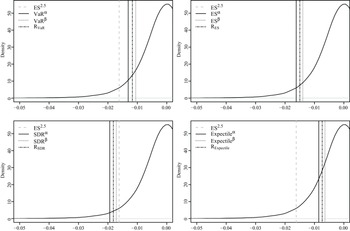
. For visual analysis of this inequality, we present Figure 1, which illustrates the left tail of the sample generated using Scenario 5Footnote 8 with
 $n =10^5$
. This figure has four illustrations, one for each range measure and tail risk measure used to generate it with
 $\alpha = 2.5\%$
and
 $\beta = 5\%$
. In each illustration, we also include the ES
 $^{2.5\%}$
value.Footnote 9 The risk values are with the sign adjusted.Footnote 10 We perceive that this inequality is maintained in most cases for deviation values.
Tail and range risk measures with
 $\alpha = 2.5\%$
and
 $\beta = 5\%$
for sample generated considering a AR(1)-GARCH(1,1) model with
 $\phi_1 = 0.50, a_0 = 4.00E-06, a = 0.10, b = 0.85, \eta= 800.00$
and
 $n =10^5$
. The risk values are with the sign adjusted.

We verify as expected that lower significance levels imply higher average risk values. We inform a pair of significance levels (
 $\alpha$
and
 $\beta$
) to compute range-based risk measures. For level pairs with lower values, the average risk value is higher. So, we have that higher risk values for
 $\alpha = 1\%$
and
 $\beta = 2.5\%$
, followed by
 $\alpha = 1\%$
and
 $\beta = 5\%$
. On the other hand, the lowest risk values are found for
 $\alpha = 2.5\%$
and
 $\beta = 5\%$
. From a risk management point of view, lower significance levels result in higher levels of security, which implies higher risk estimates.
For scenarios in which there is a change only in the value of degrees of freedom, we find that the average risk forecasts tend to be higher for a smaller
 $\eta$
. Lower degrees of freedom result in more extreme values than when considering an
 $\eta = 800$
. The measures considered in this study are applied under the left tail. Thus, for the series with more extreme observations, it is expected that the value of the risk measure will be higher than a distribution with light-tailed. By way of illustration, for Scenarios 2 (
 $\eta = 8$
) and 5 (
 $\eta = 800$
) and R
 $_{\text{VaR}^{\alpha}}$
forecasts considering normal distribution, we have an average risk forecast equal to 1.525 and 1.494, respectively. We also observe that the risk forecasts of scenarios with a smaller estimation window but with the same GARCH parameters and significance level have a greater standard deviation (in absolute value). This result can be justified by the fact that smaller window estimations tend to present bias and variability in the GARCH model estimates (Hwang and Valls Pereira, Reference Hwang and Valls Pereira2006; Fantazzini, Reference Fantazzini2009). As the sample size increases, this problem becomes insignificant. Hwang and Valls Pereira (Reference Hwang and Valls Pereira2006) point out that for the estimation of the GARCH model, it is recommended to use a sample of at least 500 observations.
Expectile and R
 $_{\text{Expectile}^{\alpha}}$
result in the lowest risk estimates when compared with other risk measures. For a visual description, we suggest reviewing Figure 1. According to Bellini and Di Bernardino (Reference Bellini and Di Bernardino2017), for a normally distributed X, the Expectile is closely comparable to the VaR
 $^{1\%}$
and ES
 $^{2.5\%}$
when we consider a significance level equal to
 $0.145\%$
(Expectile
 $^{0.145\%}$
). Moreover, the forecasts of the Expectile and R
 $_{\text{Expectile}^{\alpha}}$
have less variability in absolute terms. However, this result is not maintained when assessing the relative standard deviation (RSD), that is,
 $ \text{RSD} \,:\!=\, \frac{\text{Standard Deviation}}{\text{Average value}}$
. The R
 $_{\text{Expectile}}$
is based on Expectile, which unlike quantile measures, such as VaR, is obtained by minimizing the asymmetrically weighted quadratic loss function (Newey and Powell, Reference Newey and Powell1987). Due to the squared error loss function used for its estimation (see Example 1, (iii)), Expectile is more sensitive to the tails distributions (Xie et al., Reference Xie, Zhou and Wan2014). Thus, changes in the left tail have a more significant impact on the results of the Expectile and the measure based on it compared to the other measures used, which naturally leads to greater relative variability.
In summary, our results show the similarity between the range and tail measures used to generate them. We numerically confirm our theoretical results and the representations. The mean value of the range measures is between the values of
 $\rho^{\alpha}$
to
 $\rho^{\beta}$
, and R
 $_{\text{VaR}}$
coincide with the RVaR. In the Online Supplementary Material, we further evaluate the risk predictions obtained from the numerical example. Also, we present an illustration of our approach to capital determination.
Supplementary material
To view supplementary material for this article, please visit http://doi.org/10.1017/asb.2023.28.
Acknowledgement
We are grateful for the financial support of CNPq (Brazilian Research Council) projects number 302614/2021-4 and 307779/2022-0.