Introduction
This article draws on Michael Lipsky's (Reference Lipsky1971, Reference Lipsky1980) street level bureaucrat (SLB hereafter) conceptual framework to explore the exercise of (chiefly negative) discretion in English local authority housing advice services (LAHAS hereafter). It begins by summarising the current political climate in England, and is followed by an exploration of studies which have assessed frontline LAHAS delivery. It then outlines the SLB conceptual framework before exploring the findings based on interviews which were carried out in twelve LAHAS. Whilst statutory homelessness services in many developed countries are currently operating within an austerity driven environment (FEANTSA, 2012), LAHAS in England are the focus due to the unique evolution of its homelessness law and the specific policy areas which have been created, or transformed, by the Coalition Government. In a similar vein, while England shares some similarities to homelessness services based in Scotland, Wales and Northern Ireland, each have employed devolved powers to develop distinct systems which are not directly comparable (for example, in Scotland a priority need policy is no longer in operation).
Where the impact of frontline discretion has been considered in previous studies, it has generally either dealt with a particular aspect of its application, or has not factored an implementation orientated perspective into the research frame. With respect to the former, commentators have linked divergent decision making to specific characteristics, such as gender (Cramer, Reference Cramer2005) and ethnicity (Halliday, Reference Halliday2000). Further, it has been found that presenting with more fluid or transient circumstances, for instance domestic violence (Rashleigh, Reference Rashleigh2005), leaving the parental home (Niner, Reference Niner1989), or specific health concerns (Bretherton et al., Reference Bretherton, Hunter and Johnsen2013), can negatively impact upon the assessment process. Commentators have also assessed internal review procedures (Cowan et al., Reference Cowan, Halliday and Hunter2006) and the means by which the requirement to ration resources may interact with service outcomes (Lidstone, Reference Lidstone1994). A few scholars have uncovered the use of negative discretion, but within an overall framework that is primarily interested in the experiences of homeless populations. One example of this is Bowpitt et al.'s (Reference Bowpitt, Dwyer, Sundin and Weinstein2011) discovery that LAHAS assessments were insufficiently conducted when researching multiple exclusion homelessness. The most prevalent explorations around the exercise of illegitimate discretion in LAHAS are those which centre on gatekeeping practices. However, much of the literature with an interest in this area tends to be descriptive in nature rather than theoretically focused. One possible reason for this is that a large volume of research in this area has been commissioned by third sector organisations (Pannell and Palmer, Reference Pannell and Palmer2004), particularly Crisis (for example, Rashleigh, Reference Rashleigh2005; Brent Homeless Users Group, 2009; Cheeseman, Reference Cheeseman2011; Reeve and Batty, Reference Reeve and Batty2011), or Government departments (for example, Niner, Reference Niner1989; Pawson et al., Reference Pawson, Netto and Jones2006; Pawson, Reference Pawson2007), who are perhaps more likely to expect an applied approach to understanding legal interpretation and service provision on the frontline. It should be reiterated here that although a number of the studies referred to above have acknowledged Lipsky's framework, none applied it at the outset. This article adds to the literature around the use of potentially unlawful discretionary practices in English LAHAS by employing the SLB framework to assess what factors influence the likelihood of frontline practitioners applying it. It further provides an insight into how the current politically austere climate may impact on discretionary behaviour. In summary, it aims to answer the following broad questions: where frontline LAHAS decision makers apply negative discretion, what factors determine the form it might take? Is its exercise led by individual, organisational or central factors, or a mixture of each?
Homelessness in the contemporary political climate
In broad terms, the aims of LAHAS are to prevent homelessness, provide housing advice and make statutory homelessness assessments. The Housing Act 1996 (amended 2002) (Great Britain, 1996) and related code of guidance (DCLG, 2006) form the main statutory underpinning of the role, and regular case law updates aim to flesh this out. For a household to be accepted as statutorily homeless and be owed a main housing duty, they must be eligible for assistance, literally homeless or at threat thereof, within twenty-eight days, have not caused their homelessness intentionally, reach the threshold of priority need, and have a local connection. In respect of priority need, a household would be assessed as vulnerable if it contained dependent children, a pregnant person, a person under eighteen or a care leaver under twenty-one. Alongside these are categories that require more interpretation, such as vulnerability due to health issues, institutionalisation, violence, or old age (Great Britain, 2002).
Homelessness acceptances continued to rise throughout the 1990s until they reached a record high by 2003 (Pawson and Wilcox, Reference Pawson and Wilcox2012). This escalation triggered proactive prevention strategies and formed part of the then New Labour government's homelessness prevention agenda, which also saw the introduction of targets aimed at reducing statutory homelessness and the use of temporary accommodation (Great Britian, 2002). The new emphasis on prevention was credited with ensuring a year on year decline in statutory homelessness acceptances from the turn of this century (Pawson and Wilcox, Reference Pawson and Wilcox2011: 206). However, recent research has found that following the economic downturn these reductions have reversed (Chartered Institute of Housing, National Housing Federation and Shelter, 2012), with acceptances rising by nearly a quarter since 2009 (DCLG, 2014). Similar increases have been reported in respect of people requiring help due to the threat of homelessness (Fitzpatrick et al., Reference Fitzpatrick, Pawson, Bramley and Wilcox2012). It has further been predicted that these numbers will continue to escalate as austerity measures become more inexorably ingrained into the political psyche (Crisis, 2012). However, despite these increases and an economic policy agenda which has been described as ‘radical fiscal retrenchment’, whereby housing and welfare spending has fallen to its lowest level in over 60 years (Nevin and Leather, Reference Nevin and Leather2012: 14), reducing homelessness acceptances and use of temporary accommodation remains a primary political objective (DCLG, 2012; House of Commons, 2012). In summary, LAHAS are experiencing an environment in which service users have increased, but resources to tackle this have not risen to meet the demand; if anything, they are reduced. It has been found that these conflicting circumstances can lead to specific types of policy contravention at implementation level (Rashleigh, Reference Rashleigh2005; Ellis, Reference Ellis2007; Sullivan, Reference Sullivan2009; Evans, Reference Evans2010, Reference Evans2011).
An implementation perspective
It is now generally accepted that the policy process is a messy affair (Lindblom, Reference Lindblom1959), and to view central government as the primary determinant of policy outcomes from inception to implementation is flawed. Most scholars now agree that in respect of social policy issues, effective research must evaluate the aggregate influences manifest at the frontline (Evans, Reference Evans2010). It is therefore argued that to comprehend the forces that drive LAHAS to interpret or act upon directives in a particular way it is necessary to investigate how that policy is delivered. As highlighted above, researchers who have undertaken investigations into the operation of LAHAS have tended to focus on the more negative elements of discretion as they relate to the use of gatekeeping. These studies have found divergent interpretations of housing law, resulting in a geographic inequity of outcomes for those who present to services as threatened with homelessness (Niner, Reference Niner1989; Loveland, Reference Loveland1991; Burrows, Reference Burrows, Burrows, Pleace and Quilgars1997). Although it was found that discretion was not the sole reason for gatekeeping, as ambiguity around the meaning of the Housing Act also played a part (Niner, Reference Niner1989; Rashleigh, Reference Rashleigh2005; Brent Homeless Users Group, 2009), it remained an important explanatory factor. It has been argued that the use of discretion to gatekeep is not necessarily an exercise of power on the part of employees, but rather a reaction to top-down pressures and policy ambiguity (Lipsky, Reference Lipsky1980), underpinned by an overriding lack of resources (Niner, Reference Niner1989; Evans, Reference Evans, Hutson and Clapham1999: 138; Bowpitt et al., Reference Bowpitt, Dwyer, Sundin and Weinstein2011). More specifically, pressure to meet organisational performance measures (Halliday, Reference Halliday2000; Rashleigh, Reference Rashleigh2005) and heavy workloads (Evans, Reference Evans, Hutson and Clapham1999) were identified as the main contributory causes. Overall, the literature placed a heavy emphasis on middle or macro level forces and suggested that individual autonomy exerted little, if any, influence.
The street level bureaucrat
Lipsky (Reference Lipsky1971) coined the term ‘street level bureaucrat’ to refer to those at policy delivery level who exercised discretion by manipulating interpretation of law in the course of their day-to-day role (Lipsky, Reference Lipsky1980: 4). This was generally regarded in a negative light as practitioners were required to re-shape legal directives in response to higher level (chiefly resource led) pressures and to deal with an inherent contradiction that the purpose of their role was to assist all service users, yet being furnished with insufficient tools to do so (Lipsky, Reference Lipsky1980). It was thus maintained that frontline decision makers were at times required to apply discretion in a flawed or discriminatory fashion to effectively undertake the role (Lipsky, Reference Lipsky1971: 393–5). The ability to reshape policy intentions, deliberately or otherwise, was viewed as being further assisted by the ambiguous nature of legal directives (Lipsky, Reference Lipsky1980).
Although formed within an American context, Lipsky (Reference Lipsky1980) believed that his framework was applicable to any public service organisation that had extensive face-to-face contact with the public and exercised discretion (Lipsky, Reference Lipsky2010: xvii). Of particular interest to this research is Lipsky's (Reference Lipsky1980: 193) argument that the uneven distribution of available resources led to unequal service outcomes (Lipsky, Reference Lipsky1980: pxi). LAHAS were assessed as representing a good fit due to a combination of their statutory function, tight budget, discretionary element in service delivery, and their position as a ‘stigmatised’ service, which Lipsky (Reference Lipsky1980) believed would be especially prone to SLB type behaviours. Although Lipsky (Reference Lipsky1971) conceived of his framework over forty years ago, and American public services were the focus of enquiry, his unique conceptualisation of a SLB has been widely utilised by commentators interested in statutory policy implementation. Furthermore, while UK investigations have been heavily concentrated in social work departments (Baldwin, Reference Baldwin2000; Ellis, Reference Ellis2007; Sullivan, Reference Sullivan2009), it has been effectively applied to Jobcentre Plus offices (Fletcher, Reference Fletcher2011) and nursing staff (Hoyle, Reference Hoyle2014). For the most part, these studies have viewed the application of discretion in negative terms, linking it to detrimental outcomes for particular service users.
A small number of scholars have argued that the SLB framework is no longer valid due to managerialist developments and an associated drive to scrutinise the public sector (Howe, Reference Howe and Davies1991; Taylor and Kelly, Reference Taylor and Kelly2006). But it has been countered that although enhanced scrutiny may stem flagrant abuse of policy, it does not erode the undercurrent of discretion that is embedded in statutory organisations (Hudson, Reference Hudson and Barton1989: 49). Lipsky (Reference Lipsky2010) has revisited his original work in recent years, concluding that while changes such as managerialism had restructured local government, the organisational pressures that cause policy intentions to be reshaped persisted. What tends to be more common is that researchers concur with the principle factors that make up the SLB, but modify elements to reflect specific research findings, or contemporary developments (see below). Understanding the potential motivational factors which may lead to unlawful discretionary practices is complex due to the array of potential influences that can impact upon frontline ruminations. However, most SLB commentators argue that it is chiefly attributable to central or organisational led causations. It has been suggested that even when discretionary decisions are based on specific values held by individuals, this may have been formed within the organisation for which they are employed (Taylor and Kelly, Reference Taylor and Kelly2006: 631). For the purposes of this article, an exploration of the potential determinants of negative discretionary practices considers how assessments formed by individual officers interact with supervisory, organisational and central level influents.
Relationship between central, organisational and individual values
As highlighted above, Lipsky (Reference Lipsky1980) found that higher level pressures due to supervisory (see below), organisational and central aims generally took precedence over individual or service level concerns where discretion is applied by SLBs, hence its negative application; yet this prerogative focus has been disputed by some commentators. Durose (Reference Durose2011) argued that newer, more decentralised elements of service provision meant that practitioners were no longer unilaterally controlled by bureaucratic concerns. Subsequently, far from merely ensuring organisational goals are achieved, they juggled central directives and worked toward making these ‘fit’ with local needs. Maynard-Moody and Musheno (Reference Maynard-Moody and Musheno2000) similarly argued that SLBs would be better operationalised as ‘citizen agents’ as opposed to ‘state agents’ in an attempt to draw attention to the fact that official objectives were viewed by officer's in their study as secondary to assisting service users.
Yet most scholars have concurred with Lipsky's more negative perception of discretionary practices, as highlighted above. Further, Maynard-Moody and Musheno (Reference Maynard-Moody and Musheno2000: 340) themselves contended that that the role of ‘citizen agent’ tended to be reserved for a minority of service users, in particular those viewed as more ‘responsive’ or ‘receptive’ to services. Foster (Reference Foster1983) argued that far from service users benefiting from discretion, inequality of outcomes were embedded in its practice. Heywood et al. (Reference Heywood, Oldman and Means2002) further questioned whether the action of frontline staff should even be viewed as discretion due to a view that policy outcomes were manipulated by frontline staff as a result of vertical dictation. These latter arguments imply that practitioners operate under the hegemonic control of a bureaucratic machine and that the term professional discretion may be an overstatement of frontline implementation behaviour; this discussion is returned to below.
Supervisory influence
Lipsky (Reference Lipsky1980) held the assumption that supervisory staff wished to suppress SLB practices whilst suggesting that frontline administration remained relatively unregulated. Yet recent research in UK public service settings suggests that Lipsky may have oversimplified the dynamics that exist between staff and supervisor. For example, it has been shown that senior staff can have conflicting goals themselves, and may be torn between upper and lower level concerns (Evans, Reference Evans2011; Hoyle, Reference Hoyle2014). Referring specifically to social workers, Evans (Reference Evans2011: 371) argued that Lipsky overemphasised a managerial desire to secure hegemony over staff and that insufficient regard was paid to supervisors, who may exhibit SLB behaviours where they viewed it as necessary. A related argument is that if employers are advised to make fiscal savings, this may influence the decision of supervisors to turn a blind eye to policy contravention if it resulted in meeting set objectives (Evans and Harris, Reference Evans and Harris2004: 873; Evans, Reference Evans2010), which, as highlighted above, is a particularly salient issue within LAHAS in the current austere political climate. The argument that managers may tacitly approve SLB practices in many respects runs counter to Lipsky's unique conceptualisation and is considered further below.
Research methods
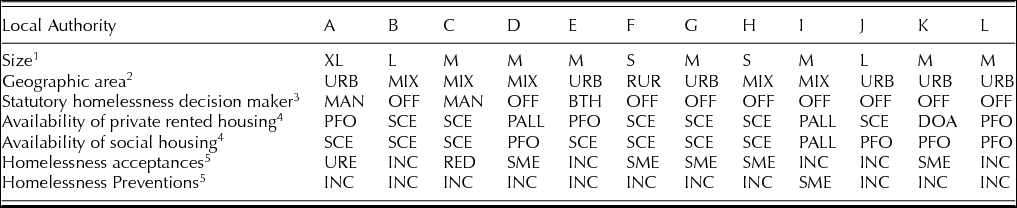
The project took a two stage approach, whereby a baseline survey was forwarded to all LAHAS in England prior to the qualitative interviews being carried out. The survey was emailed to senior officers in December 2012 and was analysed with the assistance of SPSS in March 2013. It provided a broad overview of current service provision in English LAHAS and assisted in identifying determinants within LAHAS which were utilised for the purposes of selecting authorities for follow up interviews. A total of 272 practitioners completed the survey, representing over two thirds of authorities; it was felt that the high response rate helped to ensure a comprehensive representation was achieved. Although the survey results are only referred to briefly in this article, it is covered here as the responses informed the question guide for the follow up interviews. Based on the results of the baseline survey it was ensured that the LAHAS approached for interviewing had a mixture of sizes, geographical location type and other variables which were found to represent differences in how a given LAHAS may operate a service, Table 1 provides further details around these specific factors. Eighteen LAHAS based in Northern England were initially selected: details regarding the manager of each department were gathered and each contacted via email to invite both the recipient and staff members to participate in an interview. A total of twenty-seven employees in twelve LAHAS were interviewed between April and July 2013; one third consisted of line managers, and the remainder were frontline practitioners. To protect the identity of the LAHAS, the type of authority (i.e. metropolitan, unitary, etc.) has not been added to the table below, but it included one unitary authority, one district, two metropolitan districts, four boroughs and four metropolitan boroughs.
Profile of local authorities

Notes:
1 extra large (XL), large (L), medium (M), small (S)
2 urban (URB), rural (RUR), mixed (MIX)
3 manager (MAN), officer (OFF), both (BTH)
4 scarce (SCE), plentiful all (PALL), plentiful families only (PFO), depends on area (DOA)
5 increased (INC), reduced (RED), same (SME), unsure (URE)
Very large and rural LAHAS were slightly underrepresented based on the survey mix, whereas small, medium and large authorities alongside urban and rural LAHAS broadly reflected the survey demographics. The majority of employees were interviewed in two of the authorities, to gather information on how views and practices may differ endogenously. In the remaining LAHAS, between one and four practitioners were interviewed in each. The interviews were semi structured and guided by broad topics relating to housing policy implementation and service delivery in the current political climate. The main themes were informed by Lipsky's (Reference Lipsky1980) conceptual model, survey data and the literature review, and covered resource levels, organisational targets, evidence of rationing or related gatekeeping behaviours, training and interpretation of housing law. The interviews were transcribed and analysed by the researcher with the assistance of NVIVO software. Although codes were created as the interview data were input into NVIVO, the initial interview themes were chiefly informed by Lipsky's SLB framework, and as a result the codes were strongly influenced by the factors present within the framework. This was not a concern as the SLB model was consciously adopted at the outset, and utilising its main variables did not preclude the researcher from identifying potential challenges to the framework, which are considered below.
Findings
Central and organisational factors
Nearly all interviewees suggested a detachment from the central context of the policy they delivered, and many, including managers, appeared to view themselves within a linear top-down reality with little opportunity to influence outcomes. Many expressed what could perhaps be described as a fatalist outlook; policy happened to them, and there was nothing they could do to prevent whichever trajectory the Government chose to pursue:
Top-down, and I think that ain't going to change . . . on the team level, we can make suggestions that change things for our particular team, it isn't going to change things in the organisation, it just isn't the way it happens. (Officer Six, LAHOS B)
A number of interviewees, both senior and frontline, viewed the protection of resources as an important factor when assessing households affected by homelessness, with a few acknowledging that service users could expect differing treatment due to limited time and budget. This pressure was generally seen as being less in response to intense scrutiny and more attributable to general targets and political objectives. For example, one manager advised that although policy makers do not get closely involved in micro level delivery, there is little freedom to adapt the role due to pressure around keeping statutory homeless acceptance levels low:
I would like to think the frontline staff had some influence but I don't think we do, I think it is top line that need to acknowledge the work and I am not convinced that that is always the case, I think they are happy as long as the figures aren't too high and there is nothing particularly bad happening. (Manager, LAHOS K)
In line with the findings discussed in the introductory sections, many interviewees had either witnessed or practiced gatekeeping in response to higher level pressures, due mainly to a lack of resources and a target driven environment:
All authorities gatekeep, and if they have told you they don't they are lying to you; they have to because of the shortage of resources. (Officer One, LAHOS J)
You are trying to not let them make a presentation, simply because we don't have enough temporary accommodation . . . I have got into a situation where I am turning around and saying to people, your priority need, you fit the criteria, go away, I have got nothing for you. (Manager, LAHAS B)
Pressure to exercise negative discretion was exacerbated in authorities with scarcer housing options, which is in line with previous findings (Niner, Reference Niner1989; Bowpitt et al., Reference Bowpitt, Dwyer, Sundin and Weinstein2011). For example, one practitioner stated that the availability of suitable accommodation had a significant impact on how a given LAHAS interpreted and applied the Housing Act:
We apply intentionality very very rarely, and I think your stock almost dictates how you use the act, especially here, as we are lucky, as we do have the housing stock to cover people's needs. (Officer Two, LAHAS I)
Further, authorities with scarcer accommodation resources were more likely to encourage practitioners to exercise negative discretion in comparison to those (albeit few) where some types of accommodation were more plentiful. A good illustration of this can be seen in the conflicting instructions given by two managers in respect of how staff should assess if their respective authority had a statutory duty toward a household. Where accommodation was assessed as plentiful, one manager noted that she encouraged staff to look for reasons to accept a person:
When you take a homeless application you are very thorough, and you look for a priority rather than say there isn't one . . . I just hope staff are proactive, and sort of, how can I put it, don't be negative, don't look for the no's look for the yes’s. (Manager, LAHAS I)
In contrast, a manager employed in an authority with scarce accommodation resources urged staff to look for reasons not to accept an applicant in an attempt to protect resources:
We have to be quite harsh in our decision-making process because, as I say, we have got very limited accommodation. (Manager, LAHAS C)
These quotes draw attention to the ways in which supervisory staff may attempt to influence the ways in which practitioners make decisions due to the pressure to meet organisational goals. This is considered in further detail below.
Supervisory influence
Maynard-Moody and Musheno (Reference Maynard-Moody and Musheno2000: 342) argued that a practitioner's peers could be more influential than a senior officer, but here it was found that this depended on the style of supervision, and what role management played in the day-to-day running of the service. Some senior officers were able to significantly alter the culture of the authority, and this appeared to have a marked impact on individual decision making. Furthermore, this influence was not limited to statutory homelessness decision making, as officers who made their own assessments could still be influenced by supervisory pressures. For example, some managers vetted households who required temporary accommodation, or practitioners in some cases were compelled to reduce statutory acceptances or use of temporary accommodation. Some officers advised that they were pressurised by senior officers to send priority need households away, or to unlawfully refuse to provide temporary accommodation. A few explicitly accused a supervisor of encouraging gatekeeping; for example, when discussing a former manager one practitioner stated that:
The manager at the time was a gatekeeper and changed the rules to fit her understanding of what the service can be; the law was manipulated to fit the service she wanted to provide. I think that is the best way I can put it. (Officer One, LAHAS C)
Another officer reported that a previous line manager had encouraged staff to pretend to take a homeless application disguised as an advice case if a service user asserted a legal right to make a statutory presentation. In one particular instance, this led to a service user who was deemed to meet the priority need threshold for mental health being sent away, on the proviso that ‘further checks’ would be made:
The manager at the time, well, she was very adverse to us taking homeless applications and we would always have to run it past her if we wanted to take one, she would basically say ‘no, tell them they are not homeless’ or whatever. (Officer Three, LAHAS B)
Although there were numerous examples of decision making which had been influenced by senior staff, practitioners did not necessarily adhere to these pressures. For example, one officer advised that management were pressing staff to make quicker decisions on intentionality in an attempt to prevent the need for temporary accommodation pending enquiries, but he refused to allow this to impact upon his assessments:
We have had recent instructions to try and get intentionality decisions done before we place someone [in temporary accommodation] . . . that is probably pressure on management filtering down again . . . It's kind of cutting corners. (Officer Six, LAHAS B)
Most of the examples above demonstrate that if a manager chooses to be more directly involved in decision making, or applies ‘close supervision’ (Prottas, Reference Prottas1979: 155), practitioners have less flexibility in terms of applying autonomy to their own decisions. In this sense, and based on the suggestion by some interviewees that managers may encourage contravention of housing law to meet set goals, this fits with Evans’ (Reference Evans2010) findings that supervisors exhibit SLB behaviours if the conditions require it. Those pressures that bear directly on management may be further exacerbated in the few instances where practitioners suggested that they were either not aware of, or did not concern themselves with, central objectives:
Yeah there are lots of targets and quotas, management deal with most of that side of things but we have to log em; we have got targets for prevention, we have to log all our prevention cases, and they are looked at annually and reports are sent back to council members; we have targets within homelessness, statutory targets for when decisions should be made and things like that. (Officer Four, LAHAS B)
This suggests that in certain circumstances senior staff may shoulder the burden of central directives. However, the officer quoted above still felt pressured due to the lack of temporary accommodation for households that required emergency housing.
Individual values
Although tangible factors, such as meeting organisational goals, were important determinants of decision making, personal judgement proved to be a crucial area in which homelessness assessments may differ. Most interviewees agreed that although the Housing Act itself was broad and ambiguous, divergent decision making could not be reduced to organisational led interpretations of the Act, but, rather, must be understood in the context of a given decision maker's own worldview, life experiences and values:
I think sometimes it depends on background, I am from a psychology mental health background so when you see people coming through with depression maybe I am more hardline, saying, I don't think that is severe enough, because I have seen the other end of the spectrum. (Officer Six, LAHAS B)
In a similar vein to Rashleigh's (Reference Rashleigh2005) findings, just under half of the interviewees referred to themselves as ‘hard’ or ‘soft’ decision makers, and often defined other officers in this dichotomous manner. It was suggested that factors which contributed toward the type of decision maker you fitted into was not just developed through the role, but also as a result of individual attitudes which existed independently of it:
I think people just come to the job with slightly different approaches, so people feel that they are gatekeepers and they are there to stop people from going through temporary accommodation no matter what it takes, and those are the hardliners as I call them, and then I think there are people who see themselves as more there to help people. (Officer Four, LAHAS B)
This officer suggested that subsequent behaviours and decision making would then be determined, at least in part, by this split. A few managers and practitioners agreed that ‘soft’ officers would be more likely to apply priority need, whereby those with a harder approach would expect a far higher threshold to be met:
Very often I think if someone is coming in here and they are saying they are homeless there is something wrong, there is some vulnerability there, there can be quite a difference of opinion really, on how we apply that. It's a value judgement very often you know, like is a drug user vulnerable? We [referring to self and colleague] might say yes, but a lot of the staff would say ‘no, no’. (Officer Two, LAHAS I)
One practitioner recalled an incident where her colleague had turned away a service user who had fled domestic violence, advising her to return home and fight for the joint tenancy. When the same person approached the authority a few months later and saw a different officer, emergency accommodation was provided immediately. The interviewee argued that the original officer was incorrect to initially send the service user away:
When I came out of that interview, there is no way that I think that women is lying, I believed she was genuinely genuinely fearful of going back . . . when I came out the worker went to me, the other worker she kind of said: ‘right, has she been lying again’, and I just thought, I just wouldn't of thought she was lying, I just kind of thought hmmmmm . . . I don't know how much of the story she got . . . but I do think she got quite a lot looking at the notes. But, then again, I am more experienced than her. (Officer One, LAHAS B)
The suggestion that lack of experience caused ‘incorrect’ decision making was threaded throughout the interview findings. Another practitioner argued that due to his softer approach, he would work harder to use discretion to positively assist a household, while his colleagues would be unlikely to so. In this particular example, he moved a family who were receiving police protection due to harassment:
One person might be a bit more generous, whereas another person might say, no − the rules say that, it's just like, just before I came into this room I had to award a priority on welfare grounds . . . I mean, another person might have said, no, the property is being target hardened, and therefore enough is being done by the police, so it's kind of, you see that conflict there, it can go either way, I would describe myself as more softer in approach to the rules . . . but because I know the geographical layout of the area because I am from [the local area], yeah, it's a bit isolated where they are. (Officer Four, LAHAS I)
The above examples aptly demonstrate how characteristics unique to the individual decision maker have the potential to determine the outcome of particular cases. However, this must be considered alongside the aforementioned limits imposed by frontline supervision and the overarching pressures which may cause gatekeeping behaviours to occur in the first place.
Discussion
It was found that, in respect of executing the Housing Act, LAHAS as organisations technically had the freedom to interpret law as they saw fit, but a significant caveat was the requirement to meet conditions, centrally set, to reduce statutory homelessness and use of emergency accommodation. The use of negative discretion could be attributed to a complex mesh of individual, organisational and central level concerns. But it appeared that even where individual values impinged on the process, many were led by organisational and, by extension, macro level priorities. For example, hardline decision makers were often motivated by the desire to protect resources, rather than applying strict criteria for their own sake. Examples of positive discrimination were few and far between, and focused on specific types of individual rather than the community of homelessness applicants as a whole. It is therefore concluded that terms such as ‘civic entrepreneur’ (Durose, Reference Durose2009) or ‘citizen agent’ (Maynard-Moody and Musheno, Reference Maynard-Moody and Musheno2000) did not adequately reflect the exercise of discretion in LAHAS. Rather, the nature of policy dissemination tended to emulate those of social service departments (Ellis, Reference Ellis2007; Sullivan, Reference Sullivan2009; Evans, Reference Evans2010). This is likely to be a consequence of unique research contexts, reflecting the diversity between street level bureaucracies and the SLBs employed within them. This is not to say that community orientated or altruistic intentions do not exist in LAHAS, but, rather, that for the most part this appeared secondary to organisational objectives. Of more concern was evidence that the negative application of discretion due to these pressures led to unlawful gatekeeping. The interviews supported the claim that gatekeeping in LAHAS was not an exercise of power on the part of a given employee, but rather a reaction to top-down pressures (Loveland, Reference Loveland1991; Rashleigh, Reference Rashleigh2005). It was moreover identified, in line with Evans (Reference Evans2011), that although the SLB framework provided a useful tool to understand the application of discretion, the relationship between supervisory and frontline staff is more complex than that presented by Lipsky.
The findings paint a picture of LAHAS dealing with limited resources in a highly pressurised environment, but it must be noted here that many officers valued face-to-face contact with the public, and that a few gave examples of when they had applied discretion to help certain service users. However, in the majority of cases practitioners were unable to provide an ideal service for many who required it, particularly in respect of households assessed as having no priority need. In summary, if a household seeks help they may be unwittingly entering a bureaucratic lottery, whereby the type of decision maker they see, a local scarcity of accommodation options, or the priorities of a given senior officer within an organisation may dramatically affect the outcome.
Conclusion
This article, in the main, supports Lipsky's (Reference Lipsky1980) assertion that frontline officers exhibit SLB type behaviour due to wider level role pressures. Lipsky (Reference Lipsky1980: 159) argued that preventing discretionary practices that may lead to misappropriation of the law was unachievable in street level bureaucracies, though he did feel that it could be potentially reduced. He suggested that management had a role to play in respect of containing the use of negative discretion by frontline officers, and this view remained evident in his updated work where he considered the strategies supervisory staff might attempt in order to limit SLB type behaviours (Lipsky, Reference Lipsky2010). Yet, as highlighted above, this research indicated that the relationship between line managers and staff is more complex than that depicted by Lipsky. A further issue is that the interview findings supported Evans’ (Reference Evans2011) contention that supervisors may also exhibit SLB type behaviours. This was due to the fact that they were subject to central pressures relating to lean budgets and targets to an even greater extent than staff members in many cases.
Another suggestion was to ensure decisions were made on a team basis, whereby individual officers would no longer work in isolation or make assessments independently, thus lessening pressures around accountability (Lipsky, Reference Lipsky1980: 208–11). Yet it is contended that as professionals LAHAS practitioners are best placed to make legal homelessness assessments; although an important caveat is that they must be furnished with the appropriate tools to do so. Ultimately, a significant financial injection and change of central role focus would be required to make this become reality, particularly as findings suggest that both staff and supervisors are motivated by the need to protect limited resources. Alongside this, central government should acknowledge that housing law is being misapplied as a direct result of pressure to reduce homeless acceptances. Yet it was the escalation of statutory homelessness figures which caused the Labour Government over a decade ago to introduce stringent targets to reduce it in the first place. Related to this, there is a concern that policy makers provide tacit approval of gatekeeping as it ensures the main political agenda, at least on the surface, has a measure of success. It may therefore be that the illegitimate use of discretion in the form of gatekeeping is likely to worsen as the current austere political climate fosters an even tighter rationing environment.
This article has added to the literature around frontline implementation in LAHAS by applying Lipsky's SLB framework to assess discretion in an environment where resources have been significantly tightened alongside greater pressures due to an increase in service users. It has shown the importance of recognising that, although higher level pressures may lead to negative discretion, the impact of individual actions should not be underestimated. On a final note, due to space limitations this article was unable to discuss how stereotypical frames of reference and bias impinge upon decision making, although both were found to be important contributing factors to the exercise of negative discretion.