Introduction
Non-suicidal self-injury (NSSI), defined as the direct and deliberate damage to one's body tissue for reasons other than to end one's life (International Society for the Study of Self-Injury, 2018), is a significant public health issue among young people worldwide. The onset of NSSI peaks in adolescence around the age of 14–15 (Gandhi et al., Reference Gandhi, Luyckx, Baetens, Kiekens, Sleuwaegen, Berens and Claes2018), with pooled lifetime prevalence rates estimated in the 15.1–22.7% range among 12–18-year olds (Gillies et al., Reference Gillies, Christou, Dixon, Featherston, Rapti, Garcia-Anguita and Christou2018). Although NSSI is often episodic, the 12-month prevalence is estimated to be 2–14% among emerging adults (Benjet et al., Reference Benjet, Gonzalez-Herrera, Castro-Silva, Mendez, Borges, Casanova and Medina-Mora2017; Serras, Saules, Cranford, & Eisenberg, Reference Serras, Saules, Cranford and Eisenberg2010; Whitlock et al., Reference Whitlock, Muehlenkamp, Purington, Eckenrode, Barreira, Baral Abrams and Knox2011; Wilcox et al., Reference Wilcox, Arria, Caldeira, Vincent, Pinchevsky and O'Grady2012). For approximately 70% of adolescents in high-income countries (BLS, 2017; Roser & Ortiz-Ospina, Reference Roser and Ortiz-Ospina2013), the transition to emerging adulthood (18–29 years) coincides with college entrance. The college years constitute a unique period for personal growth characterized by exploration and opportunities in identity development, interpersonal and romantic relationships, and excitement about future occupational prospects (Arnett, Reference Arnett2015, Reference Arnett2016; Magolda & Taylor, Reference Magolda, Taylor and Arnett2016; Shulman & Connolly, Reference Shulman and Connolly2013). However, this is also a period of heightened instability and uncertainty. Academic pressure, identity confusion, relationship concerns, financial hardship, and uncertainty about future employment can all combine to make this a stressful time (American College Health Association, 2018; Arnett, Žukauskienė, & Sugimura, Reference Arnett, Žukauskienė and Sugimura2016; Cvetkovski, Reavley, & Jorm, Reference Cvetkovski, Reavley and Jorm2012; Karyotaki et al., Reference Karyotaki, Cuijpers, Albor, Alonso, Auerbach, Bantjes and Kessler2020). Research shows that college students are at risk for a broad range of mental health problems (Bruffaerts et al., Reference Bruffaerts, Mortier, Kiekens, Auerbach, Cuijpers, Demyttenaere and Kessler2018; Hunt & Eisenberg, Reference Hunt and Eisenberg2010; Mortier et al., Reference Mortier, Demyttenaere, Auerbach, Cuijpers, Green, Kiekens and Bruffaerts2017), with 20–30% meeting criteria for at least one 12-month mental disorder (Auerbach et al., Reference Auerbach, Alonso, Axinn, Cuijpers, Ebert, Green and Bruffaerts2016, Reference Auerbach, Mortier, Bruffaerts, Alonso, Benjet, Cuijpers and Kessler2018). However, few students are willing to seek help (Ebert et al., Reference Ebert, Mortier, Kaehlke, Bruffaerts, Baumeister, Auerbach and Kessler2019), and many do not find their way to treatment (Auerbach et al., Reference Auerbach, Alonso, Axinn, Cuijpers, Ebert, Green and Bruffaerts2016; Bruffaerts et al., Reference Bruffaerts, Mortier, Auerbach, Alonso, Hermosillo De la Torre, Cuijpers and Kessler2019).
Accordingly, students may use emotion-regulating behaviors like self-injury to cope with college-related stressful experiences (Hamza, Goldstein, Heath, & Ewing, Reference Hamza, Goldstein, Heath and Ewing2021). Researchers have observed that 25–63% of those with adolescent-onset NSSI continue to self-injure (Glenn & Klonsky, Reference Glenn and Klonsky2011; Hamza & Willoughby, Reference Hamza and Willoughby2014), and 7% begin repetitive NSSI during the college years (Kiekens et al., Reference Kiekens, Hasking, Claes, Boyes, Mortier, Auerbach and Bruffaerts2019). Recent studies also suggest that rates of NSSI among college students have increased over the past decade (Duffy, Twenge, & Joiner, Reference Duffy, Twenge and Joiner2019; Wester, Trepal, & King, Reference Wester, Trepal and King2018). However, we lack a representative cross-national reference regarding the prevalence of NSSI among college students. Prior studies have found that rates of NSSI varied from 5% to 55% in college samples, relying primarily on non-representative samples of psychology students (Swannell, Martin, Page, Hasking, & St John, Reference Swannell, Martin, Page, Hasking and St John2014). A better understanding of the prevalence and course of NSSI should be considered a necessary first step in screening at-risk students and evaluating new interventions (Glenn, Jaroszewski, Milner, Kearns, & Nock, Reference Glenn, Jaroszewski, Milner, Kearns, Nock and Bromet2015). Relative to students who do not self-injure, emerging evidence suggests that students who engage in NSSI may be more likely to report academic failure (Kiekens et al., Reference Kiekens, Claes, Demyttenaere, Auerbach, Green, Kessler and Bruffaerts2016), experience greater stigmatization (Burke, Piccirillo, Moore-Berg, Alloy, & Heimberg, Reference Burke, Piccirillo, Moore-Berg, Alloy and Heimberg2019), and exhibit higher rates of suicidal thoughts and behaviors (Hamza & Willoughby, Reference Hamza and Willoughby2016). Together, these findings underscore the clinical significance of NSSI among college students.
Numerous studies have highlighted the strong association between NSSI and the presence of a mental disorder (Kiekens et al., Reference Kiekens, Hasking, Claes, Mortier, Auerbach, Boyes and Bruffaerts2018; Taliaferro & Muehlenkamp, Reference Taliaferro and Muehlenkamp2015). Although historically considered a symptom of mental illness, NSSI is now recognized as a transdiagnostic behavior that occurs in a variety of diagnostic contexts and warrants research in its own right (Selby, Kranzler, Fehling, & Panza, Reference Selby, Kranzler, Fehling and Panza2015). The American Psychiatric Association formally emphasized this viewpoint in 2013 with the inclusion of NSSI as a ‘condition requiring further study’ in Section III of the Diagnostic and Statistical Manual of Mental Disorders, Fifth Edition (DSM-5; APA, 2013) However, the high co-occurrence between NSSI and mental disorders raises several critical questions regarding the nature of this association, particularly whether NSSI functions as a correlate, risk factor, or outcome of mental illness. Prospective studies show that mental disorders predict the onset of NSSI (Fox et al., Reference Fox, Franklin, Ribeiro, Kleiman, Bentley and Nock2015; Kiekens et al., Reference Kiekens, Hasking, Claes, Boyes, Mortier, Auerbach and Bruffaerts2019), but more research is needed to tease apart whether specific mental disorders are predictors of NSSI onset and course. Conversely, there is emerging evidence that the presence of NSSI may be associated with an increased risk of newly emerging mental disorders (Daukantaitė et al., Reference Daukantaitė, Lundh, Wångby-Lundh, Claréus, Bjärehed, Zhou and Liljedahl2020; Wilkinson, Qiu, Neufeld, Jones, & Goodyer, Reference Wilkinson, Qiu, Neufeld, Jones and Goodyer2018). However, it remains unclear whether NSSI uniquely predicts the onset and course of specific mental disorders. Clarifying the developmental directionality between NSSI and mental disorders will be essential for developing appropriate prevention and intervention efforts.
In the current study, we investigate: (1) the prevalence of NSSI in a cross-national sample of college students, and (2) the associations between onset and recency of NSSI and several common DSM-IV disorders. Data were obtained from a census of the entering class in 24 colleges across nine countries participating in the WHO World Mental Health International College Student (WMH-ICS) initiative. The WMH-ICS is a coordinated series of ongoing epidemiological surveys of common mental disorders among college students, along with cost-effective, evidence-based prevention, and clinical interventions using precision medicine procedures (Cuijpers et al., Reference Cuijpers, Auerbach, Benjet, Bruffaerts, Ebert, Karyotaki and Kessler2019). Given that the WMH-ICS gathers the age-of-onset of the disorders assessed, we were able to investigate reciprocal time-lagged associations based on retrospective reports between NSSI and DSM-IV mood (major depressive and bipolar disorder), anxiety (generalized anxiety and panic disorder), and substance use disorders (alcohol and drug use disorder).
Method
Sample
The first wave of WMH-ICS surveys was administered to first-year students in 24 colleges and universities (henceforth referred to as ‘colleges’) in nine middle- to high-income countries (Australia, Belgium, Germany, Hong Kong, Mexico, Northern Ireland, South Africa, Spain, and the United States). Web-based self-report questionnaires were administered to all first-year students in each college (eight private and 16 public) across these countries between October 2014 and February 2018. In addition to earlier WMH-ICS reports (Auerbach et al., Reference Auerbach, Mortier, Bruffaerts, Alonso, Benjet, Cuijpers and Kessler2018; Mortier et al., Reference Mortier, Auerbach, Alonso, Bantjes, Benjet, Cuijpers and Kessler2018a), the current sample includes five new colleges, one additional country (Hong Kong), and 6998 additional students. A total of 21 369 questionnaires were completed, with sample sizes ranging from 208 in Hong Kong to 8076 in Mexico. The weighted (by achieved sample size) mean response rate across surveys was 45.6%. Online Supplementary Table S1 presents an overview of the sample design in each country. The sample for the analyses reported here is restricted to students identifying as male or female who were full-time students (n = 20 842). Students excluded from analyses (n = 527) were: (a) those who did not identify as male or female (n = 79); (b) those who reported not being a full-time student (n = 413); and (c) those with missing information on gender or student status (n = 39).
Procedure
All first-year students were invited to participate in a web-based self-report survey. The mode of contact varied across colleges, with the survey incorporated into a routine health evaluation in some colleges, as part of the registration process in others, and as a stand-alone survey advertised via student e-mail addresses in still others. In cases other than in Mexico, all first-year students were invited to participate, and initial non-respondents were re-contacted through a series of personalized reminder e-mails containing unique electronic links to the survey. In Mexico, students were invited to participate in conjunction with mandatory activities, which varied between colleges (e.g. student health evaluations and tutoring sessions), with time set aside for completing the survey during these sessions. In Hong Kong, all respondents who completed the survey were given a store credit coupon as an incentive. In other countries, conditional incentives were offered in the final stages of refusal conversion (e.g. movie passes). In Spain, an ‘end-game strategy’ was used in which a random sample of non-respondents was offered an incentive for participation. Respondents to these end-game surveys were given a weight equal to 1/p, where p represents the proportion of non-respondents at the end of the standard recruitment period that was included in the end-game to adjust for the under-sampling of difficult-to-recruit students. Informed consent was obtained from all students before administering the questionnaires, and institutional review boards approved the study procedures of all participating colleges.
Measures
Non-suicidal self-injury
The self-report version of the Self-Injurious Thoughts and Behaviors Interview (SITBI) was used to assess lifetime and 12-month NSSI (Nock, Holmberg, Photos, & Michel, Reference Nock, Holmberg, Photos and Michel2007). In Australia and Belgium, lifetime NSSI was assessed with a checklist from the SITBI that asks respondents to indicate each NSSI behavior (e.g. cutting, hitting, and burning) they ever engaged in to hurt themselves on purpose, without wanting to die. In all other countries, lifetime NSSI was assessed with a single item taken from the SITBI: ‘Did you ever do something to hurt yourself on purpose, without wanting to die (e.g. cutting yourself, hitting yourself, or burning yourself)?’. Follow-up questions assessed the age-of-onset and frequency of NSSI. Consistent with the proposed DSM-5 frequency criterion (i.e. self-injury on 5 or more days in the past year), students screened positively for 12-month NSSI disorder if they reported at least five instances of NSSI in the past year (using available past year response categories this was operationalized as ⩾5 acts in Australia and Belgium and >5 acts in other countries). Prior research has shown that the SITBI has good construct validity (κ = 0.74–1.0) and excellent test–retest reliability for the presence of NSSI (κ = 1.0; Nock et al., Reference Nock, Holmberg, Photos and Michel2007). The self-report format has also demonstrated strong alternate-forms reliability (κ = 0.84) and excellent test–retest reliability (κ = 0.94–1.0) and external validity (κ = 1.0; Fox et al. Reference Fox, Harris, Wang, Millner, Deming and Nock2020; Latimer, Meade, & Tennant, Reference Latimer, Meade and Tennant2013).
Socio-demographic and college-related variables
Gender was assessed by asking respondents whether they identified themselves as male, female, transgender (male-to-female, female-to-male), or ‘other’. Respondent age at the survey was categorized as 18 years, 19 years, 20 or more years old. Parental educational level was assessed for father and mother (none, elementary, secondary, some post-secondary, college graduate, doctoral degree), and was categorized into low (secondary school or less), medium (some post-secondary education), and high (college graduate or more), based on the highest-of-both parents' educational level. Respondents were also asked where they ranked academically (from top 5% to bottom 10%) compared with other students at the time of their high school graduation and was categorized into top 10%, top 30–10%, and bottom 70%. Parental marital status was dichotomized into ‘parents not married or at least one parent deceased’ v. ‘parents married and both alive’. The religious background was categorized as ‘Christian’, ‘other religion’, and ‘no religion’. Similar to previous WMH-ICS reports (Auerbach et al., Reference Auerbach, Mortier, Bruffaerts, Alonso, Benjet, Cuijpers and Kessler2018; Mortier et al., Reference Mortier, Auerbach, Alonso, Bantjes, Benjet, Cuijpers and Kessler2018a), sexual orientation was classified as: heterosexual with no same-sex attraction, heterosexual with same-sex attraction, non-heterosexual without same-sex sexual intercourse, and non-heterosexual with same-sex sexual intercourse.
Mental disorders
The self-administered questionnaire included short validated self-report screening scales for six common DSM-IV mood (major depressive and bipolar disorder), anxiety (generalized anxiety and panic disorder), and substance use disorders [alcohol abuse or dependence (AUD), drug abuse or dependence, involving either cannabis, cocaine, any other street drug, or a prescription drug either used without a prescription or used more than prescribed to get high, buzzed, or numbed out]. The assessment of these mental disorders, except for AUD, was based on the Composite International Diagnostic Interview Screening Scales (CIDI-SC; Kessler & Ustun, Reference Kessler and Ustun2004). The CIDI-SC was developed by the WHO to gain reliable estimates of DSM-IV mental disorder diagnoses, with clinical reappraisal studies generally indicating good concordance between CIDI-SC and independent clinical diagnoses based on structured clinical interviews, with an area under the curve (AUC) in the range of 0.70–0.78 (Kessler et al., Reference Kessler, Calabrese, Farley, Gruber, Jewell, Katon and Wittchen2013a; Kessler et al., Reference Kessler, Santiago, Colpe, Dempsey, First, Heeringa and Ursano2013b). An initial validation study among Spanish college students confirmed that all diagnostic outcomes show good AUCs (>0.7), except for panic disorder, which demonstrates fair concordance with clinical diagnosis (AUC = 0.6; Ballester et al., Reference Ballester, Alayo, Vilagut, Almenara, Cebria, Echeburua and Alonso2019). Assessment of AUD was based on the Alcohol Use Disorders Identification Test (AUDIT; Saunders, Aasland, Babor, de la Fuente, and Grant, Reference Saunders, Aasland, Babor, de la Fuente and Grant1993). The version of AUDIT that we used (Babor, Higgings-Biddle, Saunders, & Monteiro, Reference Babor, Higgings-Biddle, Saunders and Monteiro2001), which defines alcohol use disorder as either a total score of 16+ or a score 8–15 with 4+ on the AUDIT dependence questions, has been shown to have good concordance with clinical diagnoses (AUCs in the 0.78–0.91 range; Reinert & Allen, Reference Reinert and Allen2002). Additional items from the CIDI were used to assess age-of-onset of each disorder (Kessler & Ustun, Reference Kessler and Ustun2004).
Statistical analysis
Data were weighted to adjust for differences between survey respondents and non-respondents on whatever socio-demographic information made available by college officials using post-stratification weights. This always included gender and age, but additional information was used when available (e.g. socio-economic status, parental educational level). Multiple imputation (MI) by chained equations was used to adjust for item-missing data, random internal sampling of survey sections in some countries to reduce survey length, and missing data due to skip logic errors that occurred in a few surveys (van Buuren, Reference van Buuren2007). All estimates were pooled across 20 multiple imputed datasets using Rubin's rules (Rubin, Reference Rubin1987), with associated MI-adjusted standard errors obtained through the Taylor series linearization method.
A series of models was estimated to understand the associations between NSSI and mental disorders. First, discrete-time survival models, with person-year as the unit of analysis and a logistic link function (Efron, Reference Efron1988,) were used to investigate time-lagged associations between mental disorders/NSSI and the subsequent onset of NSSI/mental disorders, respectively. A person-year data set was created such that each year in the life of each respondent (up to and including the age at onset of the outcome or age at the survey, whichever came first) was treated as a separate observational record. Person-years began at age 4, the youngest age evaluated for possible disorder and NSSI onset (Gandhi et al., Reference Gandhi, Luyckx, Baetens, Kiekens, Sleuwaegen, Berens and Claes2018; Green et al., Reference Green, McLaughlin, Berglund, Gruber, Sampson, Zaslavsky and Kessler2010). Predictor variables were considered time-varying, with predictors lagged relative to the outcome. We estimated models that examined bivariate associations between NSSI and only one common mental disorder at a time (with adjustment for country, gender, age, education, parental marital status, religion, sexual orientation, and person-year) as well as multivariate models that included information on all temporally primary mental disorders. To better understand the unique associations between type of mental disorders, number of mental disorders, and NSSI, we considered two types of multivariate models: one that included all types of mental disorders simultaneously (multivariate additive), and one that included type and number of mental disorders experienced by each respondent as dummy variables (multivariate interactive).
Second, we investigated the associations between primary mental disorders/NSSI and recency of NSSI/mental disorders, respectively, using logistic regression models with person as the unit of analysis. Recency was defined as the ratio of 12-month (i.e. presence in the year before the survey) to lifetime prevalence. A predictor was considered present in these models only if the predictor emerged before the outcome or when the outcome did not (yet) occur. We again considered bivariate and multivariate models that were adjusted for socio-demographic variables and included dummy variables for age-of-onset, time since onset, and high-school ranking. In light of the NSSI disorder included in DSM-5 (APA, 2013), we additionally investigated associations between primary mental disorders and meeting the diagnostic frequency criterion (i.e. at least five instances of NSSI in the past year) among those reporting 12-month NSSI. This gives us an indication of the value of mental disorders in determining clinically severity among those reporting 12-month NSSI at college entrance. Coefficients in all these models were exponentiated to create odds ratios (ORs) with 95% confidence intervals (CIs).
All results were pooled across countries using fixed-effects modeling (FEM) by including dummy control variables for country membership. Due to considerable variation in country sample sizes and survey procedures, no attempt was made to explore between-country variation in associations. Given that our focus is on pooled within-group associations between individual-level predictors and dependent variables rather than geographic variation in mean associations, we chose FEM instead of multilevel modeling to account for the nested structure of the data. FEM is preferable in this particular situation because it does not have the restrictive, and in our case, inappropriate, assumption that the aggregate units (i.e. countries and colleges within countries) represent random samples from the population of all such units (Goldstein, Reference Goldstein2011). All significance tests were evaluated using α = 0.05, two-sided test. Analyses were conducted with SAS version 9.4.
Results
Prevalence of NSSI among first-year college students
The lifetime and 12-month prevalence of NSSI was 17.7% [s.e. = 0.3; interquartile range (IQR) between countries = 14.3–19.6%] and 8.4% (s.e. = 0.2; IQR between countries = 4.8–10.3%), respectively. Of those reporting 12-month NSSI, 28.0% (s.e. = 1.1) screened positively for 12-month DSM-5 NSSI disorder. This corresponds to 2.3% (s.e. = 0.1; IQR between countries = 1.0–3.1%) of the entire sample. The median age-of-onset of NSSI was 13.7 years (IQR = 11.7–15.4). Figure 1 displays the hazard function and the projected cumulative lifetime probability curve for the age-of-onset of NSSI up to the age of 25 years. As shown, the probability of NSSI is low in childhood, starts to increase in early-adolescence, peaks in mid-adolescence between 15 and 16 years, and then declines again across the age range 17–22 years. The hazard function increases again between 23 and 25 years, but this finding should be interpreted with caution in this first-year college sample. Among respondents who began NSSI more than 1 year ago, the recency (12-month-to-lifetime) ratio for NSSI was 44% (s.e. = 0.9).
Hazard rate and cumulative age-of-onset distribution for NSSI in WMH-ICS. Note: Projected age of onset are based on first-year students, limiting the representativeness of the estimated distributions above age 18–19 years (i.e. the typical age of entering college).

When considering socio-demographic correlates of NSSI (a detailed presentation of these analyses can be found in online Supplementary Table S2), there are three notable findings. First, compared to male students, female students had slightly higher odds for the onset of NSSI (OR 1.6, 95% CI 1.4–1.7), but a significantly lower probability of 12-month NSSI among those reporting lifetime NSSI (OR 0.8, 95% CI 0.7–1.0). Second, recency of NSSI was positively associated with an early-onset (11 or younger v. 15–17 years; OR = 1/0.6 = 1.7) and onset in the year before college (OR 5.0; 95% CI 3.2–7.8). Third, non-heterosexual orientation consistently predicted onset, recency, and clinical severity of NSSI (ORs in the 1.6–2.9 range).
Co-occurrence and temporal priorities between NSSI and DSM-IV mental disorders
We first examined the prevalence of lifetime mental disorders among respondents with and without a history of NSSI regardless of the temporal order (Table 1). Respondents reporting NSSI had significantly higher rates (7.3–35.2%; 59.6% any disorder) than those with no history of NSSI (2.3–11.6%; 25.0% any disorder) for all six common disorders (ORs in the 1.7–5.0 range). We then considered the temporal sequence between the onset of NSSI and the onset of each separate mental disorder within the subset of respondents who reported both NSSI and the mental disorder. Table 1 summarizes the proportion of respondents with (1) NSSI onset before particular mental disorder onset, (2) NSSI onset in the same year as the mental disorder, and (3) NSSI onset after the mental disorder onset. Goodness-of-fit tests revealed that NSSI occurred more often before than after panic disorder, bipolar disorder, alcohol use disorder, and drug use disorder. In contrast, major depressive disorder occurred more often before (44.1%) than after NSSI onset (32.7%; χ2 = 22.5, p < 0.001), while there was no difference in temporal sequence for generalized anxiety disorder.
Lifetime prevalence of DSM-IV mental disorders and temporal priorities with NSSI in the WMH-ICS (n = 20 842)

NSSI, non-suicidal self-injury.
a F-test to evaluate significance of pooled χ2 goodness-of-fit test across 20 imputed datasets on a reduced subset of respondents comparing percent with onset of NSSI prior to disorder onset v. percent with onset of NSSI after mental disorder onset.
* Significant at the 0.05 level, two-sided test.
Associations between temporally primary DSM-IV mental disorders and subsequent onset, recency, and severity of NSSI
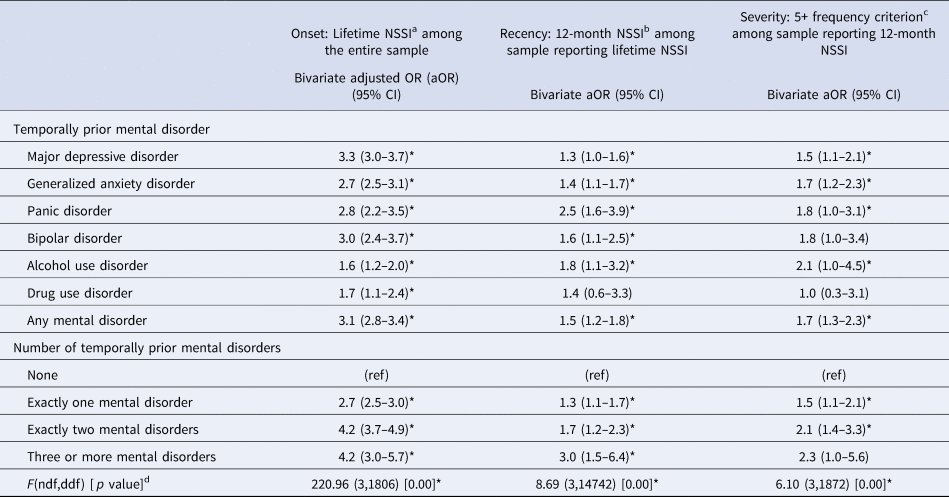
We then examined the associations between mental disorders and subsequent onset, recency, and severity of NSSI taking into consideration differences in the age at onset distributions of the different disorders in relation to the age at onset distribution of NSSI (Table 2). Bivariate survival models revealed that each of the examined disorders was significantly associated with the subsequent onset of NSSI, with ORs ranging from 1.6 for alcohol use disorder to 3.3 for major depressive disorder (median OR 2.8). Four out of six mental disorders were also significant, although weaker, predictors of recency (median OR 1.5) and meeting the 5+ diagnostic frequency criterion (median OR 1.8). Subsequently, we evaluated the association between the number of mental disorders and onset, recency, and severity of NSSI by estimating models in which the only substantive predictors were dummy variables for the number of primary mental disorders (Table 2). These models revealed a dose–response relationship between the number of disorders and each of the NSSI outcomes. For NSSI onset, ORs increased from 2.7 for those with one primary preceding disorder (relative to those with zero disorders) to 4.2 for those with exactly two and three or more preceding mental disorders. As was generally the case for the associations between type of disorder and recency and severity of NSSI, the ORs for the number of disorders become smaller in models that predict 12-month NSSI among those reporting lifetime NSSI (ORs in the 1.3–3.0 range) and meeting the 5+ diagnostic frequency criterion among those reporting 12-month NSSI (ORs in the 1.5–2.3 range), respectively.
Bivariate associations between temporally prior DSM-IV mental disorders and subsequent NSSI in the WMH-ICS

NSSI, non-suicidal self-injury; ndf, numerator degrees of freedom; ddf, denominator degrees of freedom.
a NSSI at least once in lifetime.
b NSSI at least once in past 12-months.
c NSSI at least five times in past 12-months.
d F-test to evaluate joint significance of number of mental disorders across 20 imputed datasets. Each cell displays the result of a separate bivariate model within a person-period survival (onset models) or person-level time-order (recency and severity models) framework, including the disorder specified in the row as predictor controlling for the following covariates: country membership, gender, age (onset models), education, marital status parents, religion, sexual orientation, person-year (onset models), high-school ranking (recency and severity models), age-of-onset NSSI (recency and severity models), and time since onset NSSI (recency and severity models).
* Significant at the 0.05 level, two-sided test.
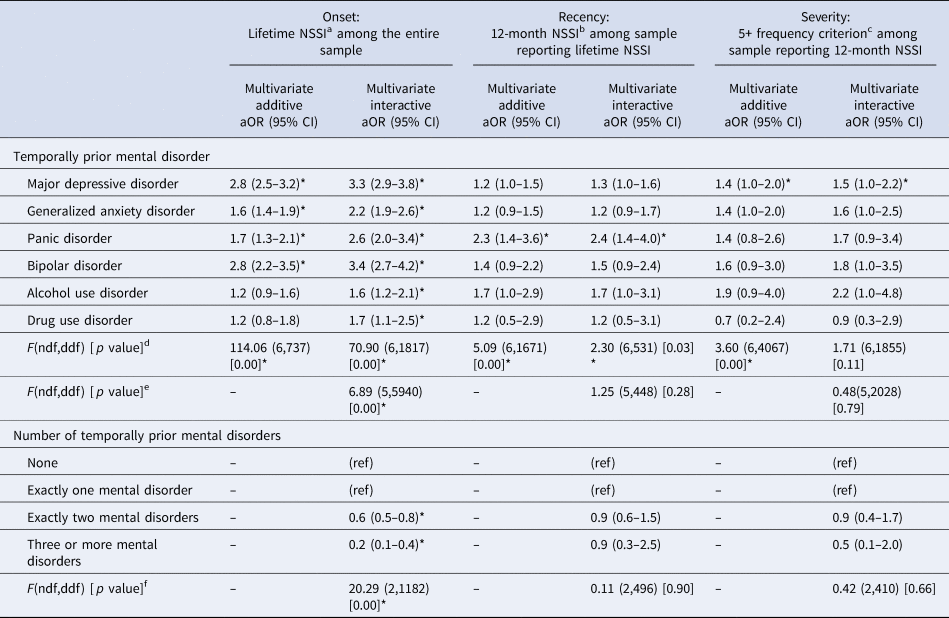
Model coefficients in the multivariate models show that the strongest effects are found for the prediction of NSSI onset in the multivariate interactive model (ORs in the 1.6–3.4 range) (Table 3). The ORs associated with the number of disorders in this model were significantly lower than 1.0 and became smaller as the number of disorders becomes larger, indicating a sub-additive interaction whereby the relative odds of NSSI onset increases at a decreasing rate with the number of temporally primary disorders. A similar pattern of results was not observed when predicting recency and severity of NSSI, indicating additive effects for type of mental disorders. However, the association with most disorders became non-significant in these multivariate models, except for the association between panic disorder and 12-month NSSI among the sample with lifetime NSSI (OR 2.3) and major depressive disorder and meeting the 5+ diagnostic frequency criterion among those reporting 12-month NSSI (OR 1.4) (Table 3).
Multivariate associations between temporally prior DSM-IV mental disorders and subsequent NSSI in the WMH-ICS

NSSI, non-suicidal self-injury; ndf, numerator degrees of freedom; ddf, denominator degrees of freedom.
* Significant at the 0.05 level, two-sided test.
a NSSI at least once in lifetime.
b NSSI at least once in past 12-months.
c NSSI at least five times in past 12-months.
d F-test to evaluate joint significance of six types of mental disorders across 20 imputed datasets.
e F-test to evaluate significant between-disorder differences in estimates across 20 imputed datasets.
f F-test to evaluate the significance of number of mental disorders across 20 imputed datasets. Each column of each model displays the result of a separate multivariate model within a person-period survival (onset models) or person-level time-order (recency and severity models) framework, with type of mental disorders (additive models) and type and number of mental disorders (interactive models) that occurred prior to NSSI as predictors, controlling for the following covariates: country membership, gender, age (onset models), education, marital status parents, religion, sexual orientation, person-year (onset models), high-school ranking (recency and severity models), age-of-onset NSSI (recency and severity models), and time since onset NSSI (recency and severity models).
Associations between temporally primary NSSI and subsequent onset and recency of DSM-IV mental disorders
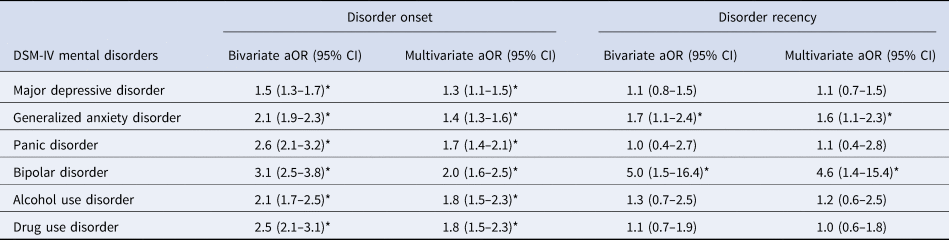
We also examined the associations between NSSI and the subsequent onset and recency of particular mental disorders (Table 4). NSSI was associated with the subsequent onset of all assessed mental disorders (median OR 2.3). Controlling for pre-existing mental disorders, these associations became weaker but remained significant, with ORs ranging from 1.3 for major depressive disorder to 2.0 for bipolar disorder (median OR 1.8). Bivariate- and multivariate models revealed that NSSI was also associated with elevated odds of 12-month bipolar disorder (ORs in the 4.6–5.0 range) and generalized anxiety disorder (ORs in the 1.6–1.7 range) among college students who met lifetime criteria for these disorders.
Associations between temporally prior NSSI and onset and recency of DSM- IV mental disorders in the WMH-ICS

Note: Each cell in the first and third columns displays the result of a separate bivariate model within a person-period survival (onset models) or person-level time-order (recency models) framework, including temporally prior NSSI as predictor controlling for the following covariates: country membership, gender, age (onset models), education, marital status parents, religion, sexual orientation, person-year (onset models), high-school ranking (recency models) age-of-onset (recency models), and time since onset (recency models) of mental disorders. The second and fourth column display the result of a separate multivariate model controlling all sociodemographic variables of the bivariate models and all temporally primary mental disorders shown in the table, and the number of temporally mental disorders (not shown here, see online supplementary Tables S3 and S4).
* Significant at the 0.05 level, two-sided test.
Discussion
The objective of this study was to estimate the prevalence and examine basic retrospectively reported time-lagged associations between the onset and recency of NSSI and common DSM-IV disorders among first-year college students. Several noteworthy findings were revealed. First, consistent with meta-analytic findings in adolescent samples, we found a pooled cross-national lifetime NSSI prevalence of 17.7% with a typical onset in mid-adolescence (Gillies et al., Reference Gillies, Christou, Dixon, Featherston, Rapti, Garcia-Anguita and Christou2018; Swannell et al., Reference Swannell, Martin, Page, Hasking and St John2014). In addition, we observed that for 44% of students, NSSI persisted into the first year of college, approximately one-quarter of whom met the 5+ diagnostic frequency criterion proposed in the DSM-5. We also replicated prior studies in finding that socio-demographic correlates of NSSI are generally weak (Kiekens et al., Reference Kiekens, Hasking, Claes, Boyes, Mortier, Auerbach and Bruffaerts2019), indicating that NSSI is widely distributed across all segments of the incoming college student population. Being female was associated with a slightly increased risk of lifetime NSSI (Bresin & Schoenleber, Reference Bresin and Schoenleber2015), identifying as non-heterosexual with a moderately increased risk of lifetime NSSI (Batejan, Jarvi, & Swenson, Reference Batejan, Jarvi and Swenson2015), as well as recency and severity of NSSI at college entrance.
Second, our retrospectively reported time-lagged analyses confirm that the presence of a lifetime mental disorder is related to the subsequent onset of NSSI (Fox et al., Reference Fox, Franklin, Ribeiro, Kleiman, Bentley and Nock2015; Kiekens et al., Reference Kiekens, Hasking, Claes, Boyes, Mortier, Auerbach and Bruffaerts2019). The relatively consistent increased odds of NSSI onset associated with temporally primary disorders indicate that a wide range of mental disorders predict subsequent NSSI, although mood disorders were a somewhat stronger predictor than the other disorders considered here. These findings are consistent with a vulnerability conceptualization in which distress, and impairment associated with mental disorders (Alonso et al., Reference Alonso, Mortier, Auerbach, Bruffaerts, Vilagut, Cuijpers and Kessler2018), signal increased susceptibility for self-injury. Extending earlier work, we also observed a dose–response relationship between the number of temporally primary mental disorders and subsequent onset of NSSI, with the increased odds of NSSI decreasing as the number of prior disorders increases. From a developmental psychopathology perspective (Shahar & Henrich, Reference Shahar and Henrich2019), these findings support a dual-vulnerability patternFootnote †Footnote 1 whereby a mental disorder's incremental utility is most potent for those without mental disorders and has an upper limit for those with comorbid disorders. One potential explanation for this ceiling effect may be shared etiological pathways through which disorders govern risk for onset of NSSI (Bentley, Cassiello-Robbins, Vittorio, Sauer-Zavala, & Barlow, Reference Bentley, Cassiello-Robbins, Vittorio, Sauer-Zavala and Barlow2015). Additional NSSI-specific risk factors, such as NSSI-related cognitions (Hasking, Whitlock, Voon, & Rose, Reference Hasking, Whitlock, Voon and Rose2017) and self-criticism (Hooley & Franklin, Reference Hooley and Franklin2017), may need to be taken into account to determine who develops an onset of NSSI. Future studies that illuminate the psychological mechanisms leading to NSSI are needed to elucidate the pathways through which earlier mental disorders are associated with the risk of NSSI. Of note, mental disorders appear to be less strongly predictive of the course of NSSI once initiated. This finding highlights the need to understand better what other (i.e. non-diagnostic) factors predict ongoing self-injury among college students. Ecological momentary assessment studies that investigate such relationships with greater temporal specificity may provide a unique opportunity to clarify factors that govern more proximal risk of NSSI (Burke et al., Reference Burke, Fox, Kautz, Siegel, Kleiman and Alloy2021; Hepp et al., Reference Hepp, Carpenter, Störkel, Schmitz, Schmahl and Niedtfeld2020; Kiekens et al., Reference Kiekens, Hasking, Nock, Boyes, Kirtley, Bruffaerts and Claes2020; Reference Kiekens, Robinson, Tatnell and Kirtley2021).
Third, our retrospective results suggest that NSSI often occurs before the onset of the mental disorders considered here (32.7–69.8%) and is associated with the subsequent onset of each of these disorders. These time-lagged associations remained when controlling for other temporally primary mental disorders. Furthermore, we also observed that prior NSSI is associated with recency of generalized anxiety disorder and bipolar disorder among students with a lifetime history. There are two explanations for these findings, which cannot be ruled out based on the current study. First, NSSI may precede the onset of a mental disorder and be a behavioral marker of an emerging mental disorder and its course (i.e. course pattern explanation; Shahar, Bareket, Rudd, & Joiner, Reference Shahar, Bareket, Rudd and Joiner2006). This might be because it is an indicator of more severe temporally primary disorders, and this severity – which we did not assess – is the more proximal predictor of secondary disorders. Second, the presence of NSSI may increase the susceptibility for mental disorders (i.e. cause pattern explanation). Emerging evidence suggests that engagement in NSSI brings not only short-term relief but may also lead to negative psychosocial outcomes, including stigma due to scarring (Burke et al., Reference Burke, Piccirillo, Moore-Berg, Alloy and Heimberg2019; Staniland, Hasking, Boyes, & Lewis, Reference Staniland, Hasking, Boyes and Lewis2020), interpersonal stressors about self-injury (Burke, Hamilton, Abramson, & Alloy, Reference Burke, Hamilton, Abramson and Alloy2015; Waals et al., Reference Waals, Baetens, Rober, Lewis, Van Parys, Goethals and Whitlock2018), and impaired psychological functioning (Buelens, Luyckx, Gandhi, Kiekens, & Claes, Reference Buelens, Luyckx, Gandhi, Kiekens and Claes2019; Robinson et al., Reference Robinson, Garisch, Kingi, Brocklesby, O'Connell, Langlands and Wilson2018). Taken together, the present findings add to a growing body of evidence that NSSI is important in its own right and underscore the need to obtain better insight into the developmental consequences of engaging in NSSI and the potential mediating mechanisms underlying the time-order associations with mental disorders.
Although this study includes a large sample across a range of countries, a number of significant limitations should be kept in mind when interpreting these results. First, the cross-national prevalence estimates are based on a convenience sample of colleges, potentially limiting the generalizability of results. Relatedly, response rates were not optimal in all countries. Although analyses were weighted, it has recently been shown that there is a risk of overestimating prevalence rates in samples with lower response rates to self-report surveys (Mortier et al., Reference Mortier, Cuijpers, Kiekens, Auerbach, Demyttenaere, Green and Bruffaerts2018b). Second, the retrospective self-report nature of the data can introduce underreporting or biased recall about the timing of onset. However, given the age of participants in this student sample, recall bias is likely minimized. Third, we used screening scales instead of full diagnostic interviews to assess risk for mental disorders; hence, these prevalence estimates should be interpreted cautiously. Fourth, although 5+ NSSI days is one of the central criteria for the recently proposed NSSI disorder in the DSM-5, this was operationalized as five or more NSSI acts in the past year, and we did not assess full diagnostic criteria and had no information on the age-of-onset of potential NSSI disorder. Hence, we could not determine to what extent the presence of NSSI without meeting diagnostic criteria for NSSI disorder remains associated with later risk of mental disorders. Therefore, future prospective cohort studies should consider the risk factor status of NSSI disorder v. behavior in predicting secondary mental disorders during adolescence and (emerging) adulthood. Finally, as the present sample consists of first-year students, studies are needed that examine the relationship between NSSI and mental disorders during the college period. In light of the present findings, future investigations should differentiate meaningfully different developmental patterns (Hamza & Willoughby, Reference Hamza and Willoughby2014), as the salience of diagnostic factors that predict NSSI onset (Kiekens et al., Reference Kiekens, Hasking, Claes, Boyes, Mortier, Auerbach and Bruffaerts2019) may be different from those predicting NSSI persistence among students with an onset of NSSI before entering college (Kiekens et al., Reference Kiekens, Hasking, Bruffaerts, Claes, Baetens, Boyes and Whitlock2017; Steinhoff et al., Reference Steinhoff, Ribeaud, Kupferschmid, Raible-Destan, Quednow, Hepp and Shanahan2021). Addressing this knowledge gap may provide valuable information for the prevention of NSSI among college students.
These limitations notwithstanding, the current study presents the first cross-national data on NSSI among first-year college students. NSSI is a prevalent mental health concern among incoming students worldwide, with one in 12 reporting self-injury in the previous year. Furthermore, findings confirm that diverse mental disorders are associated with NSSI and provide evidence suggesting that NSSI may be a behavioral marker or risk factor for subsequent mental disorders. Together, these findings underscore the need for an effective institutional response to self-injury among college students (Lewis et al., Reference Lewis, Heath, Hasking, Whitlock, Wilson and Plener2019). Appropriate and effective interventions that target adolescents with a history of NSSI may hold potential to help offset future impairment and disease burden among college students. Before implementing such interventions, future studies that use prospective designs are needed to replicate the findings reported here and evaluate whether NSSI has any predictive value in determining the onset and persistence of mental disorders during the college years after controlling for disorder severity indicators.
WHO WMH-ICS collaborators
Australia: Penelope Hasking (PI), Mark Boyes, David Preece (School of Psychology, Curtin University); Belgium: Ronny Bruffaerts (PI), Erik Bootsma, Koen Demyttenaere, Glenn Kiekens (KU Leuven); France: Mathilde Husky (PI), Université de Bordeaux; Viviane Kovess-Masfety, Ecole des Hautes Etudes en Santé Publique; Germany: David D. Ebert (PI), Matthias Berking, Marvin Franke, Fanny Kählke (Friedrich-Alexander University Erlangen Nuremberg); Harald Baumeister, Ann-Marie Küchler (University of Ulm); Hong Kong: Arthur Mak (PI), Chinese University of Hong Kong; Siu Oi-ling, Lingnan University; Mexico: Corina Benjet (PI), Yesica Albor, Guilherme Borges, María Elena Medina-Mora (Instituto Nacional de Psiquiatría Ramón de la Fuente); Alicia Edith Hermosillo de la Torre, Kalina Isela Martínez Martínez (Universidad Autónoma de Aguascalientes); Rebeca Guzmán Saldaña (Universidad Autónoma del Estado de Hidalgo); Ana María Martínez Jérez (Universidad Autónoma de Tamaulipas); Adrián Abrego Ramírez (Universidad Cuauhtémoc y Universidad Politécnica de Aguascalientes); Ma. Socorro Durán, Gustavo Pérez Tarango, María Alicia Zavala Berbena (Universidad De La Salle Bajío, campus Campestre); Rogaciano González González, Raúl A. Gutiérrez-García, Maria Abigail Paz Pérez (Universidad De La Salle Bajío, campus Salamanca); Anabell Covarrubias Díaz-Couder (Universidad La Salle Noroeste); Sinead Martínez Ruiz (Universidad La Salle Pachuca); Netherlands: Pim Cuijpers (PI), Eirini Karyotaki (VU University Amsterdam); Northern Ireland: Siobhan O'Neill (PI) (School of Psychology, Ulster University); Tony Bjourson, Margaret McLafferty, Elaine Murray (School of Biomedical Sciences, Ulster University); South Africa: Dan J. Stein (PI) (Department of Psychiatry and Mental Health, SA MRC Unit on Risk & Resilience in Mental Disorders, University of Cape Town); Christine Lochner, Janine Roos, Lian Taljaard (SA MRC Unit on Risk & Resilience in Mental Disorders, Department of Psychiatry, Stellenbosch University); Jason Bantjes, Wylene Saal (Department of Psychology, Stellenbosch University); Spain: The UNIVERSAL study group (Universidad y Salud Mental) includes: Jordi Alonso (PI), Gemma Vilagut, Philippe Mortier (IMIM-Hospital del Mar Medical Research Institute/CIBERESP); Itxaso Alayo, Laura Ballester, Gabriela Barbaglia, Maria Jesús Blasco, Pere Castellví, Ana Isabel Cebrià, Carlos García-Forero, Andrea Miranda-Mendizábal, Oleguer Parès-Badell (Pompeu Fabra University); José Almenara, Carolina Lagares (Cadiz University), Enrique Echeburúa, Andrea Gabilondo, Álvaro Iruin (Basque Country University); María Teresa Pérez-Vázquez, José Antonio Piqueras, Victoria Soto-Sanz, Jesús Rodríguez-Marín (Miguel Hernández University); and Miquel Roca, Margarida Gili, Margarida Vives (Illes Balears University); USA: Randy P. Auerbach (PI) (Columbia University); Ronald C. Kessler (PI) (Harvard Medical School); Jennifer G. Green (Boston University); Matthew K. Nock (Harvard University); Stephanie Pinder-Amaker (McLean Hospital and Harvard Medical School); Alan M. Zaslavsky (Harvard Medical School).
Supplementary material
The supplementary material for this article can be found at https://doi.org/10.1017/S0033291721002245
Financial support
Funding to support this project was received from the National Institute of Mental Health (NIMH) R56MH109566 (RPA), and the content is solely the responsibility of the authors and does not necessarily represent the official views of the National Institutes of Health or NIMH; Flemish Fund for Scientific Research (11N0514N/11N0516N and 1114717N/1114719N) (PM, GK), the King Baudouin Foundation (2014-J2140150-102905) (RB), and Eli Lilly (IIT-H6U-BX-I002) (RB, PM); BARMER, a health care insurance company, for project StudiCare (DDE); ZonMw (Netherlands Organisation for Health Research and Development; grant number 636110005) and the PFGV (PFGV; Protestants Fonds voor de Geestelijke Volksgezondheid) in support of the student survey project (PC); South African Medical Research Council (Mid-Career Scientist Programme awarded to Jason Bantjes); Consejo Nacional de Ciencia y Tecnología (CONACyT: CB-2016-01-28554) (CB); Fondo de Investigación Sanitaria, Instituto de Salud Carlos III – FEDER (PI13/00343), ISCIII (Río Hortega, CM14/00125), ISCIII (Sara Borrell, CD12/00440); European Union Regional Development Fund (ERDF) EU Sustainable Competitiveness Programme for Northern Ireland, Northern Ireland Public Health Agency (HSC R&D), and Ulster University; Ministerio de Sanidad, Servicios Sociales e Igualdad, PNSD (Exp. 2015I015); DIUE Generalitat de Catalunya (2017 SGR 452), FPU (FPU15/05728) (JA). In Australia the World Mental Health International College Student project is supported by Suicide Prevention Australia (PH) and the National Health and Medical Research Council (NHMRC; MB). Philippe Mortier has a Sara Borrell research contract awarded by the Instituto de Salud Carlos IIII (SCIII – CD18/00049). The World Mental Health International College Student project is carried out as part of the WHO World Mental Health (WMH) Survey Initiative. The WMH survey is supported by the National Institute of Mental Health NIMH R01MH070884, the John D. and Catherine T. MacArthur Foundation, the Pfizer Foundation, the US Public Health Service (R13-MH066849, R01-MH069864, and R01 DA016558), the Fogarty International Center (FIRCA R03-TW006481), the Pan American Health Organization, Eli Lilly and Company, Ortho-McNeil Pharmaceutical, GlaxoSmithKline, and Bristol-Myers Squibb. The World Mental Health International College Student (WMH-ICS) initiative is carried out as part of the WHO World Mental Health (WMH) Survey Initiative. A complete list of all WMH-ICS publications can be found at: http://www.hcp.med.harvard.edu/wmh/college_student_survey.php.
Conflict of interest
Dr Auerbach serves on the scientific advisory board for Ksana Health. Dr Ebert reports to have received consultancy fees/served on the scientific advisory board for Sanofi, Novartis, Minddistrict, Lantern, Schoen Kliniken, and two German health insurance companies (BARMER and Techniker Krankenkasse). He is also a stakeholder in the Institute for Health Training Online (GET.ON), which aims to implement scientific findings related to digital health interventions into routine care. In the past 3 years, Dr Kessler was a consultant for Datastat, Inc., Holmusk, RallyPoint Networks, Inc., and Sage Pharmaceuticals. He has stock options in Mirah, PYM, and Roga Sciences.