Introduction
Proteases are the most important group of commercial hydrolytic enzymes, constituting approximately 60% of the total enzymes produced worldwide (Rao et al., Reference Rao, Tanksale, Ghatge and Deshpande1998) and proteases from microorganisms, such as nematophagous fungi, represent 40% of the total commercialized production (Godfrey & West, Reference Godfrey and West1996; Meyer & Wiebe, Reference Meyer and Wiebe2003). Rao et al. (Reference Rao, Tanksale, Ghatge and Deshpande1998) reported that the production cost of these enzymes remains one of the major obstacles to industrial application and that the high costs of the substrates used for microorganism cultivation are the main cause for their limited production. Thus, optimization of protease production by microorganisms can effectively contribute to cost reduction (Joo & Chang, Reference Joo and Chang2005).
Nematophagous fungi capture and destroy nematodes, being natural antagonists of these parasites. Braga et al. (Reference Braga, Araújo, Silva, Araujo, Carvalho, Tavela, Campos and Carvalho2009a) showed that these fungi can be used successfully in the control of gastrointestinal nematodes of horses, including the Cyathostominae subfamily, which is prevalent in most of the Brazilian territory. Duddingtonia flagrans is considered the most promising species because it produces a large number of chlamydospores, which are resistant structures ensuring its survival. This species is also classified as predatory and can produce a range of enzymes, including proteases (Park et al., Reference Park, Choi, Kim, Lee, Hooper and Park2001; Meyer & Wiebe, Reference Meyer and Wiebe2003; Araújo et al., Reference Araújo, Mota and Campos2004).
In biotechnology research, the culture medium is usually optimized by a one-variable-at-a-time approach, in which all variables, except one, are kept constant, then the optimal level for the tested variable is determined. However, this method is too time consuming when there are a large number of variables (Kammoun et al., Reference Kammoun, Naili and Bejar2008).
According to Djekrif-Dakhmouche et al. (Reference Djekrif-Dakhmouche, Gheribi-Aoulmi, Meraihi and Bennamoun2006), statistical tools such as the Plackett–Burman design and the response surface methodology (RSM) have been used for culture medium optimization, and Hajji et al. (Reference Hajji, Rebai, Gharsallah and Nasri2008) suggested that they can also be applied to investigate the interaction effect between the various parameters with the smallest possible number of experiments. RSM is an empirical statistical modelling technique to evaluate the relations between a group of controlled experimental factors and the observed results of a selected criterion (Ambati & Ayyanna, Reference Ambati and Ayyanna2001). The factorial design and the regression analysis help to validate the effective factors and to build blocks for studying their interactions, also serving to select the optimum conditions of the variables for a chosen response (Sharma et al., Reference Sharma, Goel and Capalash2007).
In the present work, a response surface methodology was used to optimize the protease production by Duddingtonia flagrans and to evaluate its larvicidal activity.
Materials and methods
Culture conditions
The isolate (AC001) of the nematophagous fungus D. flagrans was obtained from a soil located in the Zona da Mata region, Viçosa, Minas Gerais, Brazil, 20°45′20″S, 42°52′40″W 20,649 m altitude. The isolate was kept in test tubes containing corn-meal-agar 2% (2% CMA), at 4°C, in the dark for 10 days.
Fungal mycelia were obtained by transferring culture discs (approximately 5 mm in diameter) of fungal isolates in 2% CMA into Erlenmeyer flasks (250 ml) containing 50 ml of liquid medium, according to the methodology modified by Meyer & Wiebe (Reference Meyer and Wiebe2003). The medium consisted of glucose, casein, bibasic potassium phosphate (K2HPO4), magnesium sulphate (MgSO4), zinc sulphate (ZnSO4), ferrous sulphate (FeSO4) and copper sulphate (CuSO4) in varying concentrations as a function of the statistical treatment. Fungal inoculum was grown in rotary shaker at 120 rpm and pH 9.0. After 6 days, the supernatant was collected and filtered in Whatman filter paper No. 1, at 4°C.
Enzymatic assay
The proteolytic activity was measured and modified as described by Joo & Chang (Reference Joo and Chang2005). Volumes of the solutions used in this method were: 100 ml crude extract, 400 ml Tris–HCl 100 mm, pH 7.0 and 500 μl of 1% casein pH 8.0. The reaction mixture was incubated at 43°C for 15 min. The reaction was interrupted with 1 ml of 10% trichloroacetic acid. After 10 min, the medium was centrifuged at 10,000 g for 5 min, the supernatant was collected and absorbance determined in a 280 nm spectrophotometer. A standard tyrosine curve was constructed using various amounts of tyrosine. One protease unit was defined as the required enzyme quantity to release 1.0 μg of tyrosine/min under the tested conditions.
Plackett–Burman design
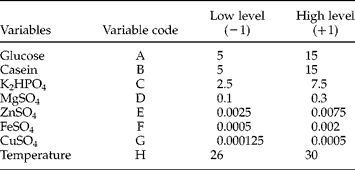
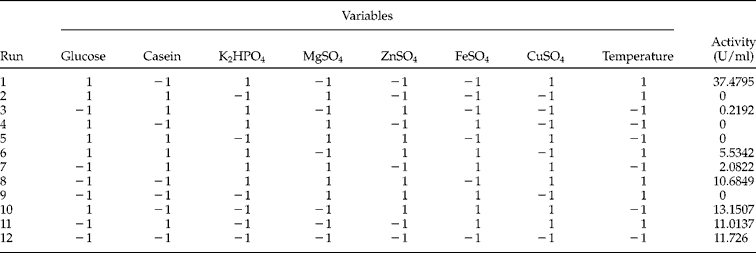
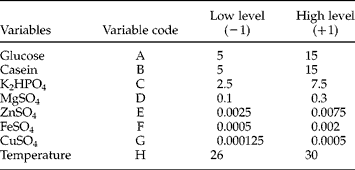
The Plackett–Burman design is used for rapid multifactor screening to find the most significant physical and chemical independent factors required for high protease production (Plackett & Burman, Reference Plackett and Burman1946). Carbon and nitrogen sources previously tested by Meyer & Wiebe (Reference Meyer and Wiebe2003) were added to the main culture medium for optimization. The Plackett–Burman design allows the validation of N variables in N+1 experiments. Each factor was tested at low ( − 1) and high (+1) levels. Table 1 shows the analysed factors and respective levels and table 2 the matrix of the Plackett–Burman experimental design with the different levels ( − 1 and 1) of protease production. Minitab® Release 15 software was used to analyse the Plackett–Burman assays.
High (+1) and low levels (−1) with the eight selected variables (g/l): glucose (A), casein (B), K2HPO4 (C), MgSO4 (D), ZnSO4 (E), FeSO4 (F), CuSO4 (G) and temperature in °C (H) in the Plackett–Burman experimental design.
Matrix of the Plackett–Burman experimental design with different production levels (−1 and 1) of proteases (U/ml) by the nematophagous fungus Duddingtonia flagrans (AC001).
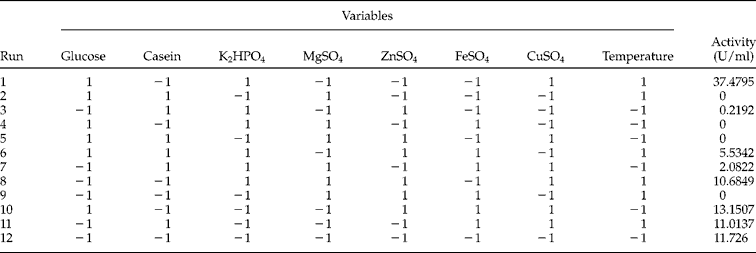
Glucose: − 1 (5 g/l); 1 (15 g/l); casein: − 1 (5 g/l); 1 (15 g/l); K2HPO4: − 1 (2.5 g/l); 1 (7.5 g/l); MgSO4: − 1 (0.1 g/l); 1 (0.3 g/l); ZnSO4: − 1 (0.0025 mg/l); 1 (0.0075 mg/l); FeSO4: − 1 (0.0005 mg/l); 1 (0.002 mg/l); CuSO4: − 1 (0.000125 g/l); 1 (0.0005 g/l); temperature: − 1 (26°C); 1 (30°C).
Central composite design
Central composite design (CCD) is a response surface methodology (Chakravarti & Sahia, Reference Chakravarti and Sahia2002). This design was used to determine the optimal concentration of the significant variables tested by the Plackett–Burman design. The effects of the significant variables on enzymatic activity were assayed at five different levels: − α, − 1, 0, 1,+α, where α = 2n/4, n is the number of variables and 0 corresponds to the central point. The experimental levels were selected using the Plackett–Burman design.
CCD with three factors and five levels, including six replicates at the central point, was used to adjust the second-order surface response. Protease production was analysed by multiple regression using least squares to fit the following equation:

where Y is the predicted response, a 0 is the intercept, a i is the linear coefficient, a ii is the quadratic coefficient and a ij is the interaction coefficient. x i and x j are the coded factor levels of variables X i and X j. Variable X i was coded as x i according to the following transformation equation:

where x i is the non-dimensional coded factor of X i, X 0 is the value of X i at the central point, and ΔX i is the step point. The whole experiment was carried out in triplicate.
Larvicidal activity of the optimized enzymatic extract
Fresh faeces were collected from the rectum of 16 naturally infected, mixed breed horses (Equus caballus), aged 3–8 years. Eggs/gram of faeces (EPG) were counted as described by Gordon & Whitlock (1939) to find positive animals. Coprocultures were then carried out and third-stage larvae (L3) were obtained after 7 days, identified and quantified in an optical microscope ( × 10 objective) according to criteria proposed by Bevilaqua et al. (Reference Bevilaqua, Rodrigues and Concordet1993). Baermann readings showed that 100% of the detected L3 were cyathostomins.
Treated and control groups were plated in Petri dishes (4.5 cm in diameter) with six replicates each. A total of 200 cyathostomin L3 were incubated in Petri dishes containing 5 ml of the optimized enzymatic extract from D. flagrans (AC001). The plates were sealed with Rolapack film and incubated at 26°C in the dark for 24 h. The control group contained 200 cyathostomin L3 in distilled water (10 ml) and incubated under the same conditions. The total number of cyathostomin L3 was counted in each Petri dish of both groups after 24 h (Mukhtar & Pervaz, Reference Mukhtar and Pervaz2003). Data were examined by analysis of variance (ANOVA) at significance levels of 1 and 5% probability. The Tukey test (1% probability level) was used to assess predatory efficiency of L3 compared with the control (Ayres et al., Reference Ayres, Ayres, Ayres and Santos2003). Reduction percentage of mean larval number was calculated by the following equation:

Results and discussion
Selection of carbon and nitrogen sources
Preliminary studies by Meyer & Wiebe (Reference Meyer and Wiebe2003) with glucose and casein as carbon and nitrogen sources for production of lytic enzymes by the same fungus were used as a reference for this work. Nguyen et al. (Reference Nguyen, Justin, Bastow, Jaffee and Strong2007) reported that the growth of nematophagous fungi is linked directly to the carbon:nitrogen (C:N) ratio, while Araújo (Reference Araújo2001) and Jaffee (Reference Jaffee2004) reported that their predatory capacity is enhanced by the presence of nematodes or substances derived from these parasites as a major nitrogen source. Glucose and casein were successfully used as carbon and nitrogen sources for the growth of D. flagrans (AC001) and protease production in this study.
Plackett–Burman design
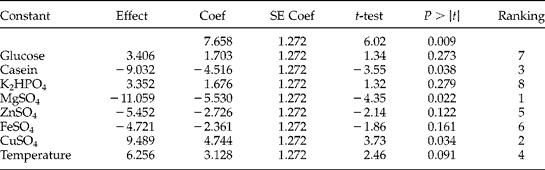
Eight variables were analysed using the Plackett–Burman design with regard to their effects on protease production by D. flagrans (AC001) (tables 1 and 2). Table 3 shows the results for the statistical analysis of the responses. Factors evidencing P values of less than 0.05 were considered to have a significant effect on the response (protease production). The selected factors MgSO4, CuSO4 and casein influenced (P < 0.05) the protease production of D. flagrans in liquid medium, whereas ZnSO4 showed no effect (P>0.05). Abidi et al. (Reference Abidi, Limam and Nejib2008) investigated the effect of divalent metal ions and cations in the production of fungal proteases and found that there was a higher proteolytic activity when the liquid medium was added with FeSO4 and CaCl2. In that study, however, the addition of ZnSO4 and other salts had no effect on the production of proteases. This is partly in accordance with the results reported here, since FeSO4 showed no significance (P>0.05) in the production of proteases by D. flagrans.
Factors (g/l): glucose, casein, K2HPO4, MgSO4, ZnSO4, FeSO4, CuSO4 and temperature (°C) in the Plackett–Burman experimental design and significance ranking.
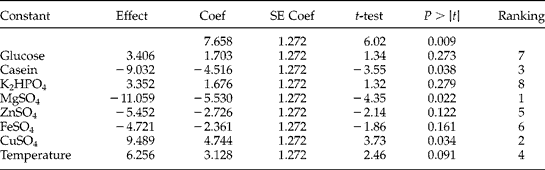
Coef, coefficient; SE, standard desviation; t-test, the value of the variables determined by Student's t-test at the 5% probability level P value.
Reports in the literature indicated that the ion Ca2+ is a good inducer of the enzymatic activity (Abidi et al., Reference Abidi, Limam and Nejib2008), but this may not influence the protease production of specific fungal isolates. Since the ion Ca2+ was not tested in the present work, the authors used results obtained by Meyer & Wiebe (Reference Meyer and Wiebe2003) who also evaluated proteolytic enzyme production by D. flagrans, demonstrating that Ca2+ had no effect on the protease production.
Central composite design
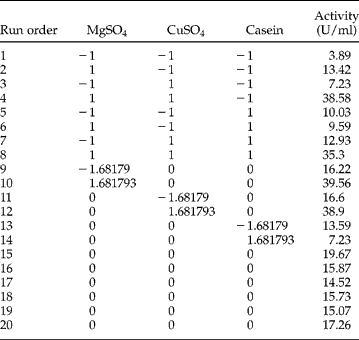
Based on the results from the Plackett–Burman design, RSM was applied to determine optimal levels of the three selected variables (MgSO4, CuSO4 and casein). A total of 20 runs with different combinations of the selected factors were performed and the results for the full factorial experimental assay are shown in table 4.
Experiments used for response surface methodology (RSM) with three dependent variables (casein, MgSO4 and CuSO4), with five levels each (−1,+1, 0, −1.68179 and 1.681793) and proteolytic activity values.
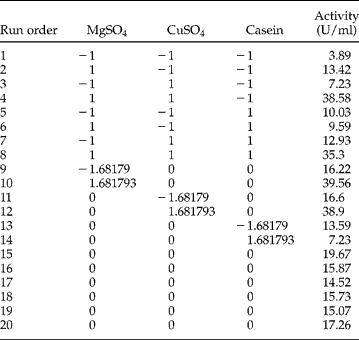
MgSO4: − 1 (0.05 g/l); 1 (0.15 g/l); 0 (0.10 g/l); − 1.68179 (0.015910 g/l); 1.681793 (0.18 409 g/l). CuSO4: − 1 (0.25 mg/l); 1 (0.75 mg/l); 0 (0.50 mg/l); − 1.68 179 (0.079552 mg/l); 1.681793 (0.920448 mg/l). Casein: − 1 (5 g/l); 1 (15 g/l); 0 (10 g/l); − 1.68179 (1.5910 g/l); 1.681793 (18.409 g/l).
The function for the final response, which estimates the proteolytic activity after removing the non-significant variables (P>0.05), is as follows:

where Y is the response value, which corresponds to the enzyme activity, and X 1, X 2 and X 3 are the coded levels of MgSO4, CuSO4 and casein, respectively.
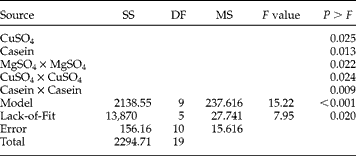
The statistical significance of the regression model was tested by the F test, and the analysis of variance (ANOVA) was used for the response surface quadratic model (table 5).
Analysis of variance (ANOVA) for the response equation developed for protease production by Duddingtonia flagrans (AC001).
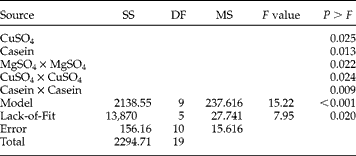
R 2 = 0. 9319; R 2 (adj) = 0.8707; SS, sum of squares; DF = degrees of freedom; MS = mean of squares.
A high R 2 indicates fitness of the model (Weisberg, Reference Weisberg1985). The regression coefficients and analysis of variance in this work estimated R 2 as 0.93 (fit: 0.8707), showing the high significance of the model, which is consistent with the above statement. The results also indicated that the linear terms of MgSO4 and CuSO4 showed a significant effect (P < 0.001) on protease production by D. flagrans. Besides, the quadratic effect of MgSO4, CuSO4 and casein and the interactive effect between MgSO4 and CuSO4 also had significant effect, with the following values of P>F: (0.022) MgSO4; (0.024) CuSO4; (0.009) casein; (0.003) MgSO4 and CuSO4. On the other hand, the linear effect of casein, the interactive effect between MgSO4 and casein and the interactive effect between CuSO4 and casein showed no significance (P>0.05) in this work.
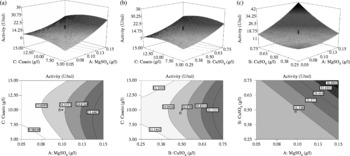
Figure 1 presents the results of three-dimensional (3D) response surfaces plotted as a function of the model equation for protease production by D. flagrans (AC001). The response surfaces were based on the final model, with one constant variable fixed at its optimal level, while the remaining two factors varied within the experimental range.
Response surface curve (RSM) and contour map of protease production by Duddingtonia flagrans (AC001) and the interaction between the variables MgSO4 and casein (a); CuSO4 and casein (b); MgSO4 and CuSO4 (c).

Results of the effect of casein variation with either variable demonstrated that response surfaces for both combinations were similar (fig. 1a and b). The rise in the concentrations of MgSO4 or CuSO4 increased the protease production by D. flagrans to optimum values. However, Hajji et al. (Reference Hajji, Rebai, Gharsallah and Nasri2008) discussed that an excessive increase in substrate concentration could lead to a decrease in protease production by fungi.
An ascending curve shows the combined effect of MgSO4 and CuSO4, indicating a possible synergism between them (fig. 1c). In addition, the authors of this work also suggest that the combination of these variables at higher levels could be significant for protease production by the D. flagrans (AC001) fungus.
Validation of the model
Validation was carried out under the conditions predicted by the model. The experimental values were very close to the predicted values; hence, the model was successfully validated. The validation of the statistical model and regression equation was performed by taking: casein (1.59 g/l), MgSO4 (0.10 g/l) and CuSO4 (0.50 mg/l) and casein (10.0 g/l), MgSO4 (0.0159 g/l) and CuSO4 (0.50 mg/l) in the experiment. The predicted response for protease production was, respectively, 13.59 U/ml and 16.22 U/ml, while the actual (experimental) response was, respectively, 12.82 U/ml and 16.93 U/ml, thus proving the validity.
Larvicidal activity of the fungal extract
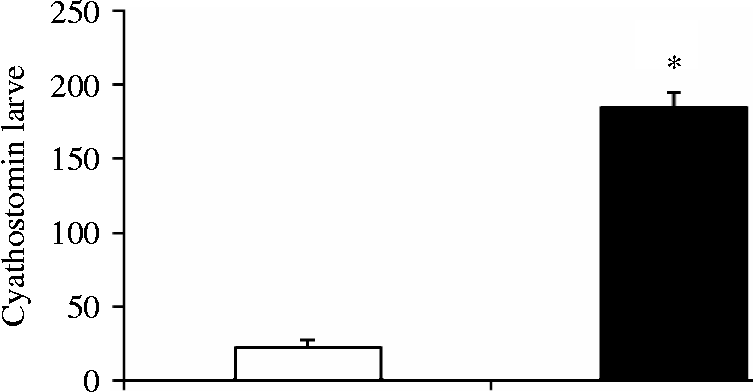
The optimized enzymatic extract obtained from D. flagrans (AC001) exhibited larvicidal activity in the Petri dishes of the treated group after 24 h of interaction (fig. 2). No destruction of cyathostomin L3 was observed in the control group in the same interval. There were differences (P < 0.01) between the number of L3 in the treated group Petri dishes and those of the control group, with 95.4% percentage reduction of cyathostomin L3 in the treated group in comparison with the control.
Mean number and standard deviation of L3 cyathostomes recovered after 24 h of interaction in Petri dishes with optimized enzyme extract of Duddingtonia flagrans (AC001) (white bar) and control group (black bar). There was a significant difference (*, P < 0.01) between the treated group and control (Tukey's test).
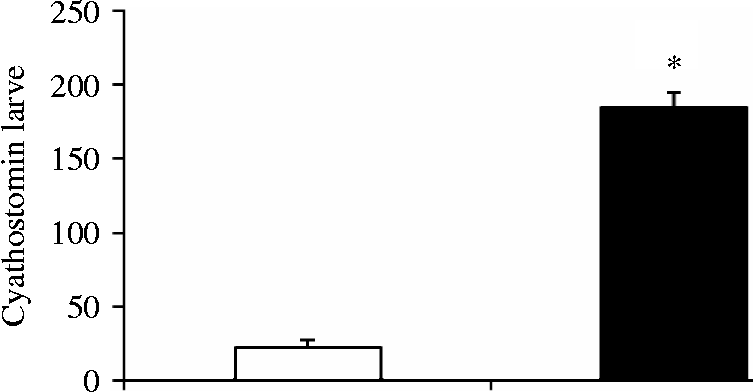
Proteases produced by nematophagous fungi have been studied extensively, since they seem to take part in nematode cuticle degradation (Tunlid & Jansson, Reference Tunlid and Jansson1991). In this study, the optimized enzymatic extract of D. flagrans was effective in the destruction of cyathostomin L3, suggesting proteolytic action. This is the first report on culture medium optimization for protease production by D. flagrans.
According to Braga et al. (Reference Braga, Carvalho, Araujo, Silva, Araújo, Lima, Tavela and Rodrigo2009b), D. flagrans (AC001) has been used successfully under laboratory conditions in the biological control of gastrointestinal nematodes of humans and animals. In another study, Braga et al. (Reference Braga, Araújo, Araujo, Silva, Carvalho and Campos2009c) reported that the isolate AC001 of D. flagrans grown in 2% water-agar medium showed predatory activity against cyathostomin L3, with a percentage reduction of 97.5% under laboratory conditions. The destruction of cyathostomins was confirmed with the use of optimized D. flagrans (AC001) enzymatic extract in this work.
Several studies have aimed at the improvement of protease production by microorganisms (Gupta et al., Reference Gupta, Beg and Lorenz2002). Enzymatic production may be maximized since each fungal species has specific requirements in special conditions. As suggested by Araújo et al. (Reference Araújo, Mota and Campos2004), the development of fungal formulations for biological control is a major step towards the commercial production of these microorganisms.
The authors suggest the characterization of substances produced by the fungus D. flagrans (AC001) in future work and indicate that this was the first step towards the use of an enzymatic extract of D. flagrans as an alternative for biological control of cyathostomin larvae; however, they admit the need for more studies in this area. Thus, studies aimed at producing fungal material in an economically viable manner are extremely necessary and an important step to enable the commercial production of nematophagous fungi and enzyme extracts, including isolation, synthesis and applicability tests.
The results obtained in this study demonstrate that MgSO4, CuSO4 and casein optimized protease production by the fungus D. flagrans (AC001) in liquid medium and destroyed cyathostomin L3.
Acknowledgements
The authors would like to thank Coordenação de Aperfeiçoamento de Pessoal de Nível Superior (CAPES), Fundação de Amparo a pesquisa de Minas Gerais (FAPEMIG), Conselho Nacional de Desenvolvimento Cientifico e Tecnológico (CNPq) and Financiadora de Estudos e Projetos (FINEP) for financial support.