Hypertrophic cardiomyopathy is characterised by unexplained left ventricular hypertrophy and has an estimated prevalence in adults of 1:500.Reference Elliott, Andersson and Arbustini 1 Patients with hypertrophic cardiomyopathy are often asymptomatic, but may present with various symptoms including syncope, chest pain, and dyspnoea.Reference Moak and Kaski 2 In some cases, sudden cardiac death may be the initial presentation. Routine clinical screening of first-degree relatives is recommended as hypertrophic cardiomyopathy is usually inherited as an autosomal dominant trait, most commonly caused by mutations in the cardiac sarcomere protein genes.Reference Elliott, Andersson and Arbustini 1 , Reference Bratt, Ostman-Smith, Sparud-Lundin and Axelsson 3 , Reference Kaski, Syrris and Esteban 4
The diagnosis of hypertrophic cardiomyopathy can result in substantial psychological consequences and impairment of health-related quality of life in adults.Reference Cox, O’Donoghue, McKenna and Steptoe 5 Data on the psychological impact in children diagnosed with hypertrophic cardiomyopathy are limited, and the few studies that have been reported so far have enrolled a small number of patients using a qualitative approach.Reference Bratt, Ostman-Smith, Sparud-Lundin and Axelsson 3 , Reference Bratt, Ostman-Smith, Axelsson and Berntsson 6 , Reference Bratt, Sparud-Lundin, Ostman-Smith and Axelsson 7 In addition, there are few data on the psychological effects of screening asymptomatic children with a family history of hypertrophic cardiomyopathy.Reference Aatre and Day 8 The objectives of this study, therefore, were to investigate psychosocial well-being and health-related quality of life in children with hypertrophic cardiomyopathy, as well as to examine the psychological impact of clinical and genetic screening in phenotypically normal paediatric relatives attending a specialist hypertrophic cardiomyopathy tertiary referral centre.
Materials and methods
Patients
A total of 152 children and adolescents aged 18 years or younger attending the hypertrophic cardiomyopathy clinic between October, 2006 and November, 2007 at Great Ormond Street Hospital, London, the United Kingdom, were enrolled in the study. Only three children and their parents refused to participate in the cohort study. Children younger than 3 years were excluded due to the low reliability of scales below this age, as were children who did not speak English or whose learning difficulties precluded them from completing the questionnaires. This study assessment was part of the standard care for the patients enrolled, and appropriate consent was obtained for research purposes. Patients and parents self-completed the questionnaire separately. The United Kingdom normative data from field studies of healthy childrenReference Uzark, Jones, Slusher, Limbers, Burwinkle and Varni 9 and from children with heart conditionsReference Varni, Seid and Kurtin 10 were used as population controls.
Psychosocial assessment
Patients’ psychological status was evaluated using the Generic Core Scales and Cardiac Modules of the Paediatric Quality of Life Inventory (PedsQL) questionnaire. The PedsQL 4.0 Generic Core Scales are child self-report and parent proxy-report scales developed to measure health-related Quality of Life in children and adolescents.Reference Uzark, Jones, Slusher, Limbers, Burwinkle and Varni 9 , Reference Varni, Seid and Kurtin 10 It consists of 23 items, encompassing Physical, Social, Emotional, and School Functioning.Reference Varni, Seid and Kurtin 10 The 27-item PedsQL 3.0 Cardiac Module assesses Heart Problems/Symptoms, Perceived Physical Appearance, Treatment Anxiety, Cognitive Problems, and Communication.Reference Uzark, Jones, Slusher, Limbers, Burwinkle and Varni 9 The PedsQL Generic Core Scales and PedsQL Cardiac Module are standardised, validated questionnaires of quality of life in the paediatric population. Parameters are reverse-scored and linearly transformed to a 0–100 scale, so that higher scores indicate better quality of life. Parents completed the parent-report versions of the Generic Core Scales and Cardiac Module of the PedsQL questionnaire. In addition, parents also completed the Strengths and Difficulties Questionnaire; this is composed of 25 items subdivided into five categories, which are scored separately and measure the child’s emotional difficulties, conduct problems, social problems, hyperactivity symptoms, and pro-social behaviours. Each category can have a maximum of 10 points, 10 representing severe difficulties in all categories, except pro-social behaviour, in which the higher the score, the more pro-social the behaviour. A total score of difficulties is calculated as the sum of all scores, with the exclusion of the pro-social score. The Strengths and Difficulties Questionnaire has been extensively validated as a tool for assessing behavioural problems in children and offers the additional advantages of being brief and including an evaluation of positive (pro-social) attributes.Reference Goodman 11
Statistical analysis
SPSS for Mac (v20.0) and Stata (v12) were used for all the analyses. Data are reported as mean±standard deviation for normally distributed parameters and as median (interquartile range) for non-normally distributed data. Categorical data are expressed as proportions. This cohort included three different groups of patients: group S included children undergoing clinical cardiological screening, group A included affected children, and group G included genotype positive–phenotype negative patients. For univariate analysis, scores among different groups of children were compared using analysis of variance, and regression analysis was used to adjust for the potential confounding effects of age, sex, socio-economic status, ethnicity, white versus non-white, and the presence of a comorbidity. Some of the score data were skewed, and we investigated the use of non-parametric methods such as the Kruskal–Wallis test. The results were very similar to those from parametric methods, and therefore we present the findings from the latter. Results from the regression analysis adjusted for confounders are presented. A p-value of <0.05 was considered to be statistically significant.
Results
Demographics
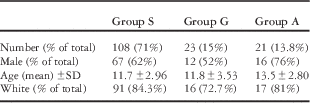
Detailed demographic characteristics of the patients are shown in Table 1. The mean age was 12±3 years. Among all, 108 children (71%) had a family history of hypertrophic cardiomyopathy and normal electrocardiograms and echocardiograms and attended the clinic for clinical cardiological screening (group S); 21 patients (14%) fulfilled the conventional diagnostic criteria for hypertrophic cardiomyopathyReference Moak and Kaski 2 (group A); and 23 (15%) patients harboured hypertrophic cardiomyopathy-causing sarcomeric mutations identified in one or more first-degree relatives but had normal echocardiograms (group G). Of the 108 children in group S, four of them (3.7%) had co-morbidities – Noonan’s syndrome, Turner’s syndrome, Friedrich ataxia, and hemiplegia. None of the group G children had significant co-morbidities, whereas in group A one child was diagnosed with Noonan’s syndrome and another one with Danon’s disease. Within group A, six patients (29%) had symptoms at the time of study entry; six (29%) had resting left ventricular outflow tract obstruction; and six (29%) had undergone implantation of an implantable cardioverter-defibrillator – in five cases for primary prophylaxis, with no shocks delivered and in the remaining patient for secondary prevention and with previous appropriate therapies. Median maximal left ventricular wall thickness was 20 mm (interquartile range from 15 to 24 mm).
Demographic characteristics of patients.

Group S: patients attending for screening
Group G: gene (+) patients with normal echocardiograms
Group A: patients fulfilling the diagnostic criteria for hypertrophic cardiomyopathy
Time from initial clinical visit to enrolment in the study ranged from 0 days to 12 years (median 2 years; interquartile range from 1 to 4 years).
Generic PedsQL scores
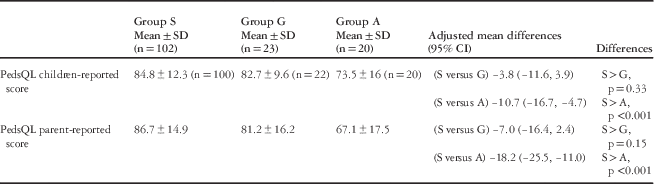
Patients completed the Generic Core Scales (n=145; 95.4%) and Cardiac Module (n=144; 94.7%) of the PedsQL questionnaire. Parents completed the parent-report versions of the Generic Core Scales (n=142; 93.4%) and Cardiac Module (n=141; 92.7%) of the PedsQL questionnaire, as well as the Strengths and Difficulties Questionnaire (n=135; 88.8%). Not all patients and parents completed all the questionnaires, resulting in discrepancies in the numbers provided. For the Generic Core Scales, questionnaires were completed by 136 of the 152 patients and their parents (89.5%). For the Cardiac Module, questionnaires were completed by 134 of the 152 patients and their parents (88.1%). The mean child-reported PedsQLTM total score was 84.8 (95% CI=82.38–87.22) in group S versus 73.5 (95% CI=65.96–81.04) in group A (p<0.001) and 82.7 (95% CI=78.65–86.95) in group G versus group S (p=0.33) (Table 2). The mean parent-reported total score was 86.7 (95% CI=83.74–89.66) in group S versus 67.1 (95% CI=58.72–75.48) in group A (p<0.001) and 81.2 (95% CI=74.02-88.38) in group G versus group S (p=0.15) (Table 2). No significant difference was observed between the affected patients (group A) and the normative UK population, in which the mean child-reported PedsQLTM total score was 78.1 (p=0.21) and the parent-reported total score was 77.98 (p=0.01).Reference Uzark, Jones, Slusher, Limbers, Burwinkle and Varni 9 There were no significant differences between group S and group G on any of the scales (p>0.05); however, the mean score was significantly lower in group A compared with group S, in both the child-reported scores and the parent-reported scores (p<0.001) (Table 2). When comparing group G scores reported by children with the normative UK population, there was no statistically significant difference (p=0.7). Furthermore, there was no statistically significant association between length of time from initial visit to study enrolment and PedsQL score (p=0.14).
Mean values for PedsQLTM- child and parent reports.

PedsQLTM=Paediatric Quality of Life Inventory
Group S: patients attending for screening
Group G: gene (+) patients with normal echocardiograms
Group A: patients fulfilling the diagnostic criteria for hypertrophic cardiomyopathy
PedsQL cardiac module
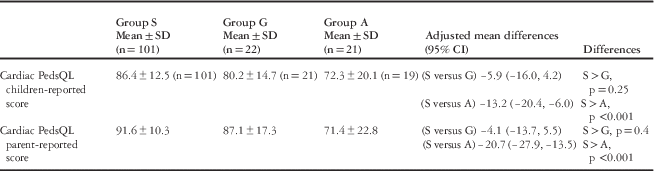
The mean child-reported Cardiac module PedsQLTM total score was 86.4 (95% CI=83.93–88.87) in group S versus 72.3 (95% CI=63.15–81.45) in group A (p<0.001) and 80.2 (95% CI=73.68–86.72) in group G versus group S (p=0.25) (Table 3); the mean parent-reported total score was 91.6 (95% CI=89.57–93.63) in group S versus 71.4 (95% CI=60.41–82.39) in group A (p<0.001) and 87.1 (95% CI=79.53–94.97) in group G versus group S (p=0.4) (Table 3). The mean values of scales for the child report module are depicted in Table 4. There were no significant differences between group G and group S across all scales, although there was a trend towards higher “communication” scores in group S compared with group G; however, the mean scores on the PedsQL Cardiac Module were significantly lower for both child-reported and parent-reported scales in group A compared with group S (p<0.001) (Table 3). There was no statistically significant association between PedsQL cardiac module scores and length of time from initial clinic visit to study enrolment (p=0.42).
Mean values for cardiac PedsQLTM- child and parent report.

PedsQLTM=Paediatric Quality of Life Inventory
Group S: patients attending for screening
Group G: gene (+) patients with normal echocardiograms
Group A: patients fulfilling the diagnostic criteria for hypertrophic cardiomyopathy
Mean values for scales of cardiac PedsQL-child report.

PedsQL=Paediatric Quality of Life Inventory
Group S: patients attending for screening
Group G: gene (+) patients with normal echocardiograms
Group A: patients fulfilling the diagnostic criteria for hypertrophic cardiomyopathy
Strengths and difficulties questionnaire
The mean Strengths and Difficulties Questionnaire score for group S was 8.5 (95% CI=7.5–9.7) compared with 8.2 (95% CI=6.02 to 10.46) for group G and 10.4 (95% CI=7.2–13.6) for group A. There was no significant difference between the three groups (p=0.87 when comparing group G with group S, and p=0.38 when comparing group A with group S).
Discussion
This study shows that children with hypertrophic cardiomyopathy have significantly lower psychosocial adjustment scores overall and in most dimensions of a cardiac-specific psychological quality-of-life questionnaire compared with unaffected individuals. Importantly, Quality-of-Life scores among unaffected children attending for screening did not differ from the scores of a normative UK population. The results highlight the need for early and comprehensive psychological support in children with hypertrophic cardiomyopathy, within the setting of an expert centre in paediatric inherited cardiovascular diseases.
Psychosocial adjustment in hypertrophic cardiomyopathy
The findings of the present study are in accordance with previous reports, suggesting that the diagnosis of hypertrophic cardiomyopathy both in adults and in children impacts substantially on the psychosocial well-being of the affected individuals.Reference Bratt, Ostman-Smith, Sparud-Lundin and Axelsson 3 , Reference Cox, O’Donoghue, McKenna and Steptoe 5 – Reference Bratt, Sparud-Lundin, Ostman-Smith and Axelsson 7 In patients with hypertrophic cardiomyopathy, Quality of Life can be negatively affected by symptoms, limitations to physical activity recommended by the treating physician, and side-effects of medication.Reference Bratt, Ostman-Smith, Sparud-Lundin and Axelsson 3 In addition, children with hypertrophic cardiomyopathy may have to re-consider lifestyle choices and also future professional plans. Furthermore, anxiety and low mood can mimic cardiac symptoms. Effective management of anxiety and low mood, therefore, will not only improve the quality of life in these patientsReference Ingles, Yeates and O’Brien 12 but also might reduce the number of clinic visits, reassurance-seeking from medical and nursing staff, as well as potentially unnecessary medical management. An important aspect of this management is education about the disease and provision of information regarding support groups, as uncertainty about the disease and lack of information have been suggested to be strong predictors of significant psychosocial impact in inherited cardiac diseases, including hypertrophic cardiomyopathy.Reference Ingles, Lind, Phongsavan and Semsarian 13 The results of this study highlight the importance of access to comprehensive psychological evaluation and early intervention for patients with hypertrophic cardiomyopathy; however, it is worthy of note that, although children with hypertrophic cardiomyopathy as a group have a lower quality of life than healthy children, most of them reported a relatively good quality of life, as perceived by both themselves and their parents, although the numbers were too small to investigate whether there were specific differences between those who do report a lower quality life and those who do not.
Psychological implications of screening for hypertrophic cardiomyopathy
It has been suggested that the process of clinical and/or genetic screening in asymptomatic, healthy relatives of individuals with inherited cardiac disease may itself result in impaired Quality of Life.Reference Cox, O’Donoghue, McKenna and Steptoe 5 Reassuringly, the findings of the present study show that, in the setting of an expert referral centre for paediatric inherited cardiac conditions, there is no adverse effect on psychosocial adjustment or Quality of Life from screening. This is consistent with previous studies showing no evidence of psychological harm up to 12 months after a positive genetic test.Reference Ingles, Lind, Phongsavan and Semsarian 13 This may result from improved knowledge of the underlying condition and a more accurate perception of potential risks,Reference Morgan, O’Donoghue, McKenna and Schmidt 14 as well as providing patients and their parents with a sense of control, facilitating the patient’s compliance with regular follow-up, even if they remain asymptomatic.Reference Ingles, Lind, Phongsavan and Semsarian 13 These findings are also consistent with previous studies in children with inherited cardiac conditions, including long QT syndrome, where no difference in health-related quality of life has been observed in carrier children compared with a representative normal population.Reference Smets, Stam and Meulenkamp 15 An important issue to consider specifically in the paediatric population is the fact that a child’s understanding of the condition will change with time, and therefore it is essential to tailor the medical and psychological input by continuous adjustment to the child’s level of understanding.
Clinical implications of screening for hypertrophic cardiomyopathy in childhood
The findings of the present study have important implications for the clinical and genetic screening for hypertrophic cardiomyopathy in children. Current international guidelines recommend that clinical screening of first-degree relatives should commence routinely at 10 years of age in the absence of a malignant family history in childhood, cardiac symptoms, or competitive sports;Reference Elliott and Anastasakis 16 however, findings from recent genetic studies in children with hypertrophic cardiomyopathy suggest that routine clinical screening below the age of 10 may be appropriate,Reference Kaski, Syrris and Esteban 4 , Reference Morita, Rehm and Menesses 17 and, indeed, previous epidemiological studies have reported a substantial increase in sudden death risk from the age of 8 years.Reference Ostman-Smith, Wettrell and Keeton 18 Therefore, in our institution, we use the screening algorithm proposed previously by Moak and Kaski, where paediatric first-degree relatives are offered clinical cardiological screening once in infancy, every 2–3 years from the age of 2 up to 8 years, annually from 8 to 12 years, and twice a year thereafter and throughout adolescence.Reference Moak and Kaski 2 In families where a known pathogenic mutation is identified or where a variant segregates with disease, our practice has been to offer the possibility of predictive genetic testing for families who request it, taking into consideration issues related to autonomy, confidentiality, and psychosocial harm.Reference Charron, Arad and Arbustini 19 Importantly, the results from the present study demonstrate that these approaches do not result in higher levels of anxiety or impaired psychosocial adjustment. Interestingly, there was no association between length of time from initial cardiological screening and psychosocial scores, suggesting that, with appropriate and early counselling and support, impairment of psychosocial adjustment can be prevented, although further studies are required to confirm this.
Limitations
This study is limited by the fact that the patients were recruited from a tertiary referral centre with specific expertise in the management of hypertrophic cardiomyopathy and inherited cardiac conditions, which may result in bias, as patients attending a specialised clinic have been shown to be better adjusted than those attending general local services.Reference Morgan, O’Donoghue, McKenna and Schmidt 14 Moreover, the patients were mainly of white ethnic background (84.3%) and both patients and parents had to be competent to complete the questionnaires; both of the above-mentioned parameters might interfere with the perceived quality of life. Moreover, our data have been adjusted for age, sex, socio-economic status, ethnicity, and co-morbities. Furthermore, there was no baseline psychological assessment performed before attending the clinic for the first time, which means that we cannot rule out a potential effect of attending the clinic itself on psychological adjustment and Quality of Life; however, the psychosocial adjustment scores, for both child-reported and parent-reported measures, are not significantly different from United Kingdom normative values, suggesting that the results can be interpreted with confidence. The strengths of the study include a large sample size and the use of a well-validated, standardised, multidimensional, and disease-specific questionnaire for the psychosocial parameters investigated. Future studies should focus on determining whether there are specific age-related differences and differences in these patients, perhaps considering gene-positive phenotype-negative individuals together with clinically unaffected relatives, given that there was no difference in psychosocial adjustment between these groups in this study.
Conclusion
The present study shows that quality of life is not affected in most children attending for clinical screening, but is significantly reduced in children diagnosed with hypertrophic cardiomyopathy. This highlights the importance of early psychological support as part of a multidisciplinary approach in order to improve patients’ understanding of the disease and to prevent psychological complications. Further studies are required to determine potential risk factors for poor psychosocial adjustment.
Acknowledgement
None.
Financial Support
This research received no specific grant from any funding agency, commercial, or not-for-profit sectors.
Conflicts of Interest
None.
Ethical Standards
The authors assert that all procedures contributing to this work comply with the ethical standards of Good Clinical Practice and with the Helsinki Declaration of 1975, as revised in 2008, and has been approved by the Great Ormond Street Hospital R&D Department.