

In the immediate aftermath of the financial crisis, the problem of “globally systematically important banks”Footnote 1—otherwise known as “Too Big To Fail” (TBTF)—became conspicuous. At different levels and in different venues, regulators discussed which policies would be most effective to tackle the issue that some banks are simply so significant in economic terms that governments have no choice but to save them, or risk letting their failure jeopardize the whole economy. Yet, no international consensus was reached on the TBTF issue. Even within the European Union, states have maintained different priorities regarding their largest and systematically important banks. This article analyzes two policy domains: banking structural reform (BSR) and the regulation of competition in retail banking in the United Kingdom, France, and Germany.
BSR and competition policies are two important areas because they have the potential to affect the evolution of banks’ business models. Regarding BSR, the important overall issue of functional separation between retail and trading activities for banks lies in the extent to which the deposit-taking bank is prevented from supporting the trading bank during its operations. A lack of support from the deposit-taking bank would increase the financing costs of the trading bank, limiting its profitability. An ambitious BSR might, thus, result in larger universal banks scaling back their trading operations globally. More competition in retail banking may hinder the expansion of large banks at home and potentially decrease their structural importance. These two policy areas, thus, reveal state priorities towards the expansion of large banks, both globally and at home.
The British government implemented a stringent version of BSR and has promoted a tougher competitive environment for large banks in domestic retail markets. British priorities have, thus, been to hinder the expansion of TBTF banks, both globally and at home. By contrast, the French government implemented a weak version of BSR and has continued to restrict competition in domestic retail banking markets, where France's largest banks occupy a hegemonic position. French priorities have, thus, been to enhance the expansion of its TBTF banks, both globally and at home. The German government implemented a weak version of BSR while it protected the incumbent position of public banks from competition in the domestic retail market. German priorities were, thus, to pursue the expansion of TBTF banks globally, but not at home, where local public-sector banks prevail.
This variation is puzzling. First, scholars have stressed the convergence of these three countries towards market-based banking in the years leading up to the crisis.Footnote 2 According to both the globalization and Varieties of Capitalism (VoC) analytical frameworks, if banks have started converging, there is no reason why they should resume diverging again.Footnote 3 Second, all three countries endured significant risks and losses during the international financial crisis and/or the Euro-crisis, and all their political leaders made strong commitments in favor of far-reaching banking reform. Finally, the three countries share a common framework of European and international financial regulation.Footnote 4 Two of them—France and Germany—have even shown a commitment to deepening their participation in a European regulatory framework through the implementation of the European banking union after the crisis, which would tend to signal that they share the same priorities towards TBTF banks. So, what explains the variation in regulation of TBTF banks across Europe?
I argue that in order to understand the politics of European banking, one needs to examine how two dynamics, one global and one domestic, have interacted after the crisis. The financialization of the economy and the globalization of finance have created a structural incentive for states to pursue global competitiveness for their domestic banks.Footnote 5 Even in the aftermath of the crisis, because they are accountable for growth, the executive branches of European governments have sought to preserve the capacity of their national champions to expand, both globally and at home. On the other hand, the structural incentive to promote TBTF banks has been subject to contentious politics at home. Factions—often led by actors from within the state itself—have opposed governments’ impetus to promote TBTF banks. The specific identity, preferences, and resources of these factions are determined by distinctive domestic political institutions. In brief, the different priorities of European states towards their banks are explained by the different institutional capacities of “anti-TBTF” factions to carry weight in policymaking processes and limit the incentive of the state's executive branch to support TBTF banks’ expansion.
In the United Kingdom, independent regulators and the Parliamentary Commission on Banking Standards (PCBS) were able to shape preferences that were in contradiction with the treasury's stance that British economic competitiveness depended on the growth of domestic TBTF banks. The political resources available to the PCBS, as well as the relative independence of its cross-partisan members from party politics for career advancement, enabled them to put continuous pressure on the treasury. The British government implemented a comparatively stringent version of the BSR and has been proactive in promoting a tougher competitive environment for large domestic banks in retail banking.
France is the case where the institutional capacity of factions opposing state promotion of TBTF banks is the thinnest. The key position in the typical decision-making process is held by a narrow and closely intertwined nexus of state-bank elites, which makes it very difficult for other actors to step in. The French government has implemented a weak version of the BSR and has protected its largest domestic banks from competition in retail markets. Yet, the French state-bank relationship is more nuanced than sheer “capture.” The institutionalized reciprocal relationship between state and banking elites generally also makes French bankers more sensitive to the requests made by state actors than in other countries.Footnote 6
In Germany, the institutional capacity of local coalitions, which are composed of public-sector banks and state governments, to veto policies that may be detrimental to German public banks have limited the incentive of the executive branch to promote domestic TBTF banks’ expansion in domestic retail markets (which public banks dominate), but not in global markets. This one-sided capacity is reflected in the regulatory outcome: the German government sought to promote the expansion of its largest commercial banks globally through the implementation of a weak version of the BSR. But on the other hand, it continued to protect the incumbent position of public banks in its domestic retail markets, by shielding them from the competition of commercial banks.
States’ structural incentive to promote TBTF banks and contentious domestic politics
The traditional “quid pro quo” between banks and states has long been stressed in the literature on comparative capitalism.Footnote 7 The terms of the quid pro quo are simple. Banks provide credit to strategic economic sectors or firms that the state wants to promote and helps in mobilizing targeted political support. In return, states provide banks with regulatory protection from outsider competition, regulatory forbearance, and fiscal support in times of crisis. But following the insights of functional theories, scholars have argued that the globalization of finance has broken the traditional ties between states and banks. Banks are no longer able or willing to support states’ industrial policy because their business opportunities have gone global. States are no longer able to provide regulatory protection at the national level. The end of the structural interdependency between banks and states, they argue, has broken the very incentives for both banks and states to support the quid pro quo.Footnote 8
These authors correctly stress that the traditional state-bank quid pro quo is no longer sustainable. Yet, the financialization of the economy has led to simply a different, not weaker, structural interdependency between states and banks. In a financialized economy, states depend on the growth of the banking sector itself for overall “economic growth.”Footnote 9 Banks’ roles have changed, but their roles have become more, not less, important for the overall competitiveness of political economies that are engaged in global financialized capitalism. Far from leading to a break of state-bank ties, the financialization of the economy had led to a structural alignment of interests between states and banks. The growth of banks themselves—not the financing of industrial policy—has become an objective for states. In early 2019, when German finance Minister Olaf Scholz spoke of industrial policy, it was to push for the creation of a banking national champion.Footnote 10
After the crisis, it very soon became an objective for European governments to make their banks competitive again. Because executive branches are the ones accountable for growth, the incentive to promote TBTF banks is particularly strong within governments’ finance ministries and treasuries. The alignment of (perceived) interests between governments and TBTF banks could be deemed to be a case in point of large banks’ “structural power.” Indeed, because the growth of the whole economy depends on them, governments are predisposed to adopt policies that promote these firms, even without banks’ top managers necessarily having to do anything to influence them.Footnote 11
Yet, states have implemented different policies to regulate TBTF banks after the crisis. Varieties in banking regulation are explained by varieties of political institutions across European jurisdictions. Different factions, often led by actors from within the state itself, opposed the promotion of TBTF banks by executive branches. The capacity of these factions to shape the outcome depends on the political institutions structuring the typical policymaking process in each of these countries.
Although it is in agreement with the insights of historical institutionalism, the explanation stressing the different institutional capacity of “anti-TBTF” factions to carry weight in policymaking processes differs from the explanations offered by the traditional comparative capitalism literature.Footnote 12 Scholars in this tradition mostly underlined the internal coherence of postwar capitalisms. Zysman analyzed each “political economy with a distinctive institutional structure for governing the markets of labor, land, capital and goods.”Footnote 13 Hall and Soskice argued that economic actors coordinated on “equilibrium strategies offering higher returns to all concerned.”Footnote 14 In both their accounts, the institutions that mattered were encompassing and complementary institutions characteristic of distinctive and nationally consistent models of capitalism. In my account, the institutions that matter are political institutions structuring ad hoc policymaking processes and imply no overarching consistence with institutions specific to one given model of capitalism.
To sum up, in order to explain the different state priorities of European states towards their TBTF banks after the crisis, I make two claims:
1) In financialized economies, the incentive for states to promote the growth of their domestic banks was revived soon after the crisis: state executive branches sought to implement policies that would not hinder—or even promote—the expansion of TBTF banks.
2) How countries regulate their banks varies according to the differentiated institutionalized preferences and resources of actors opposing state promotion of TBTF banks, which have different capacities and ways to influence policymaking processes across countries.
Typical policymaking processes in the United Kingdom, France, and Germany
To test the validity of these claims, I use comparative process analysis of policymaking of the BSR and competition policies implemented in the United Kingdom, France, and Germany after the crisis. The analysis is based on more than one hundred interviews of state officials, bankers, and regulators, as well as public and private documentation, secondary sources, and newspapers.Footnote 15
The first part of this section briefly exposes the variations in the banking structural reform and key competition policies in the United Kingdom, France, and Germany. The second part of the section is a detailed analysis of typical policymaking processes in the three countries. Because of space constraints, I focus on the BSR process in the three countries. I develop the policymaking process in one specific segment of competition policy (SME's data sharing), in the German case; only here does it add to the demonstration of the argument, since the capacity of local coalitions to oppose the promotion of TBTF banks carries weight only in the regulation of retail markets.
BSR in the United Kingdom, France, and Germany
The need to limit the exposure of retail banking to trading activities was a central theme of the G20 Summit in Pittsburgh in 2009. What followed was a host of BSR projects and recommendations: the Volcker rule in the United States; the Vickers Commission proposals in the United Kingdom; and the EU's Liikanen Report and EU Commission proposals in 2014.Footnote 16 Yet, the three largest European countries anticipated the EU project and implemented their own BSR.
The United Kingdom has implemented a relatively ambitious structural reform. The British approach is described as “ring-fencing” because the separate entities may still be part of the same group, but they must be operationally separate and economically independent.Footnote 17 The Banking Reform Act of 2013 prevents any bank housing over £25bn in domestic, personal, or small business retail deposits from trading in financial instruments and commodities.Footnote 18 The BSR affects the five largest banks operating in the United Kingdom: HSBC, Barclays, RBS, Lloyds, and Santander UK.Footnote 19
By contrast, the French and the German BSR are extremely watered-down versions of the project proposed by the EU Commission. The French law separates out the banks’ proprietary speculative activities—that is, market trading operated on the account of the bank itself.Footnote 20 The separation does not concern market trading in general, as the Commission's proposal suggested, but only a minor part of these activities. Straightforward proprietary trading represents only 1 to 4 percent of a bank's activities. In the words of Hardie and Macartney: “the law was deliberately intended to protect the domestic banking system, clearly weaker than the EU proposals, and involved minimal threat to the strengths of French universal banks.”Footnote 21 The German bill also deviates quite dramatically from the EU proposal.Footnote 22 The German government established thresholds above which proprietary speculative trading would have to be separated out, which meant that only the largest German banks would be affected by the reform. But even for those banks, the German proposal is quite benign. Like in France, only the blurry domain of proprietary trading is to be separated out.
Competition policies in the United Kingdom, France, and Germany
Divergent priorities towards banking are also observed in the domain of competition. If states want to limit the expansion of large commercial banks in their domestic retail markets, they can voluntarily skew competition in favor of challenger banks through regulatory advantages. For example, they can grant easier access to banking licenses or impose lower capital requirements on new banks. Regulators can also erase identified obstacles to competition; they can make it easier for customers to transfer their banking accounts by obliging banks to make this process free. States can also promote indirect competition by promoting credit consumers’ data sharing among lenders. Indeed, smaller firms are often hesitant to embark on SME and consumer lending because of the risk of doing so without thorough access to a borrower's information. Two European directives were passed to promote indirect competition in banking after the crisis.Footnote 23 Yet, the three countries followed different paths.
The United Kingdom toughened the competitive environment considerably for large domestic banks in its domestic retail markets. Fifteen new banking licenses were granted between 2014 and 2017, while both capital and liquidity requirements have been reduced for challenger banks. The British government has also used indirect channels to promote competition. High street banks have been required to participate in a fund aimed at facilitating the switching of customer accounts to eligible challenger banks, through the so-called “Incentivized Switching Scheme.”Footnote 24 In terms of credit data sharing, the government required the nine largest banksFootnote 25 to share credit information with designated private Credit Rating Agencies,Footnote 26 which are, in turn, required to share this data equally with all finance providers.Footnote 27
In France, there was no direct promotion of potential challengers willing to compete with the five largest banking groups that dominate nearly 90 percent of the domestic retail market.Footnote 28 The 2015 so-called “Macron Law’’ introduced an “aid to banking mobility,” obliging the bank to which an account is transferred to provide the client's new banking information to all the bodies to which and from which the client is transferring money, free of charge.Footnote 29 Yet, this concerns only checking accounts and it remains expensive for customers to transfer savings accounts. An early version of the so-called “Hamon law,”Footnote 30 in 2014, provisioned the creation of a national register for consumer credit data, but the register was rejected by the French constitutional court.Footnote 31
Germany is noticeable for the competition reform it has not introduced. In blatant contradiction with EU guidance, the government has continued to protect German public-sector banks from competition. By law, commercial banks are still prevented from acquiring public banks.Footnote 32 A law on banking mobility was implemented in 2016.Footnote 33 But like in France, the law is unlikely to introduce any significant change in the retail market. In terms of indirect promotion of competition, the creation of a national register of consumer credit loans has simply never made it to a legal proposal. Competition regulation in Germany has mostly consisted of protecting the incumbent position of local and public-sector banks against commercial banks.Footnote 34Table 1 sumps up the implemented policies regarding BSR and banking competition in the United Kingdom, France, and Germany, with their corresponding state priorities towards TBTF banks.
Implemented policies and revealed state priorities regarding TBTF banks in the United Kingdom, France, and Germany after the crisis.

BSR in the United Kingdom: The institutional capacity of “anti-TBTF banks” public actors
The City of London, in which British banks played a prominent role, is often cited as an example of a very influential economic sector: strong cultural supremacy, a lot of money, and considerable access to policymakers. Furthermore, the British economy relies heavily on its financial sector. The argument that hurting TBTF banks would hurt the whole economy should, thus, be exceptionally strong in the United Kingdom, as well as the effect of international banks’ threat to relocate.Footnote 35
Indeed, after the crisis, the British government was sensitive to banks’ argument and threat. A British HM treasury official explained in an interview why the treasury was worried about implementing ring-fencing reform: “The regulators are focused on stability, we have a requirement of competitiveness.”Footnote 36 Treasury officials were also alarmed that banks would carry out their threat to relocate, thus, depriving the country of important tax revenue, as made clear by this treasury official explaining the outcome of another banking policy:
“The bank levy was initially on the entire balance sheet. Now it is only on the UK balance sheet. The whole tax policy was actually designed in order to keep HSBC here.”Footnote 37
If the British government eventually implemented a relatively ambitious version of the BSR, it is because its executive branch was put under pressure by “anti-TBTF” factions led by other public actors, in particular, the Commission on Banking (ICB) and the Parliamentary Commission on Banking Standards (PCBS). As illustrated by this comment from a treasury official, parliamentary pressure was key:
“Look at ring-fencing. Banks hate ring-fencing. But the government didn't change it because they knew Parliament wouldn't step back. Even at the BoE, many were not very keen on ring-fencing. But the Treasury cannot do what they want.”Footnote 38
Why did British political institutions permit public actors to oppose the treasury's incentive to comply with TBTF banks’ preferences more effectively than elsewhere?
Recent studies have shown how institutions that allow venue shifting and political salience to occur may mediate the structural power of business.Footnote 39 By altering venues, new actors may mobilize around an issue.Footnote 40 The involvement of outsiders favors the emergence of new ideas, in general, and a new interpretation of the reality of business structural power, in particular.Footnote 41 Under low salience, business power is likely to be disproportionately greater as policymaking is less visible, so government is more likely to defer to the preferences of industry.Footnote 42 As an issue becomes increasingly salient, constituents start paying more attention and hold the government more accountable for sticking with their own preferences and not the industry's. Independence from party leaders (for example, concerning career advancement) can explain why some actors would take the risk of alienating fellow politicians by stirring political salience around an issue contradicting powerful business interests.Footnote 43 British political institutions allowed both venue shifting and political salience to occur in the BSR policymaking process.
The ICB, presided over by Sir John Vickers put together the first version of the “ring-fence” reform, the British version of the BSR.Footnote 44 The ICB is a British specificity. It was set up by Chancellor George Osborne, and granted complete autonomy and considerable resources. The establishment of the ICB came from the pressure of important political figures in the Liberal Democratic Party (LibDem) and the House of Lords. In 2010, the LibDems accepted to form a coalition with the Conservatives. To reassure their constituents, they took the lead in putting pressure on Osborne to establish the ICB; they were joined by a major conservative figure, Lord Lawson of Blaby. With a permanent seat in the House of lords, Lord Lawson remained a major political figure following his years as chancellor under Margaret Thatcher. Lawson, with no electoral terms to face, did not fear alienating conservative politicians.Footnote 45 According to a fellow member of the House of Lords, “Lawson persuaded Osborne to set up the Committee. Osborne didn't want to in the first place but he didn't find a good argument to oppose it.”Footnote 46
The ICB was composed of independent-minded and reputable commissioners; it was also well-endowed in terms of material resources. ICB members, thus, had the capacity to shape their own opinions about the desirability and feasibility of BSR. James described how the ICB “served as a highly effective screening mechanism of industry signals.”Footnote 47 The ICB members were capable of calling out the falsehoods and exaggerations of bankers. For example, a claim made by banks that ring-fencing would cost £12–15 billion in increased bank funding costs was countered by the ICB, which led its own investigation and found that the figure was closer to £4–5 billion.Footnote 48
In parallel to the ICB, the PCBS was appointed by both Houses of Parliament, and it pushed for the reform recommended by the ICB to be adopted and implemented. The PCBS was very well-endowed in terms of material and intellectual resources. An interviewee recalls: “The PCBS was very powerful (…). There were Lawson, the archbishop of Canterbury, McFall.… It was a powerful lot.”Footnote 49
PCBS members became involved in an independent process of preference shaping regarding the BSR. In line with Bell and Hindmoor's argument, they were collectively convinced that the threat of large British banks (and more particularly, of HSBC) to leave the United Kingdom was not credible. One interviewee bluntly stated: “I don't believe HSBC when it says they'll leave.” This statement is to contrast with treasury officials’ sensitivity to banks’ threat to relocate.Footnote 50,Footnote 51
Most PCBS members were senior politicians from major parties. To a large extent, they were independent from party leaders for future career advancement; they very consciously stirred up public attention over the BSR and publicly denounced lobbying by the banks. PCBS Chair MP Tyrie was especially vocal against banks’ attempts to weaken the ring-fencing reform. The PCBS relied on formal, publicly available “Watergate hearings” in which senior bank executives were scrutinized.Footnote 52 PCBS members were aware of the necessity for them to follow up on the political work needed to implement the reform. In 2015 (two years after the Commission was dissolved), Andrew Tyrie was still publicly stating that “Parliament's job now is to ensure that the regulators don't inadvertently allow the reforms to be called off before they have been implemented.”Footnote 53
The capacity of British political institutions to facilitate venue shifting and the emergence of political salience around issues of banking regulation explains how the ICB and the PCBS managed to keep the treasury under pressure and implement a relatively ambitious BSR.
France: A narrow bank-state elites’ nexus dominating the policymaking process
France used to be the archetypal state-led political economy. Scholars have stressed how dramatic a rupture French capitalism underwent in a relatively short amount of time.Footnote 54 Yet, important aspects of the French political institutional heritage have survived. In particular, France still stands out for the centralized character of the organization of both its state, organized around the treasury and the executive, and of its banks, organized in the French Banking Federation.Footnote 55 In addition, the persistence of elites’ proximity in this country has repeatedly been underlined by French scholars, often to explore how banks have “captured” government policies. More than capture, I argue that characteristic French institutions foster a symbiotic mode of coordination between state and bank elites through mechanisms of group identification and trust.Footnote 56 Bank top managers and French state officials conceive of each other's preferences as legitimate and find it comfortable and useful to agree with each other. They prefer to find common ground and shape their preferences collectively. Where antagonism remains, they prioritize the crafting of compromises, not confrontation. In France, the key position in the decision-making process is thus held by a narrow nexus of state-bank elites, which makes it very difficult for other actors to step in. French state officials have, indeed, to a large extent, abided by domestic large banks’ preferences after the crisis.Footnote 57
In his “Bourget speech’ in 2012, the then presidential candidate François Hollande promised a far-reaching banking reform that “will start with a vote that will oblige banks to separate their credit activities from their speculative market activities.”Footnote 58 President Hollande charged Minister of Finance Pierre Moscovici to examine the feasibility of the BSR as proposed in the Liikanen Report. The minister was advised by the newly created Council of Financial Regulation and Systemic Risk (COREFRIS), which was composed of neither independent experts nor members of Parliament, like in the United Kingdom, but of officials from the Banque de France (BdF) and the French regulator Financial Markets Authority (AMF). Since the outset, debates in the COREFRIS focused mostly on the effects that ring-fencing reforms would have on French universal banks’ competitive position, especially with regard to U.S. investment banks.
In accordance with COFRERIS, the treasury, the regulators, and the banks together soon agreed that BSR would be bad for France's national interests, because it would hinder French banks’ position on global markets and favor U.S. banks. French bankers presented the BSR as a way for “Anglo-Saxon finance” to impose its domination in the global financial markets: “US banks are taking the leadership. They kick the Europeans out and they are taking the market. A full separation [of activities] would allow them to continue doing that. You might as well tell us: ‘sell to the US’!”Footnote 59 The Minister of Finance Pierre Moscovici said nothing else: A stricter separation was like “giving a gift to the Anglo-Saxon banks.” He would later note in relation to the French reforms, “I did not want to weaken the French banking system. I want it to be strong.” For both, ring-fencing would go “against the national interest.”Footnote 60
A Socialist Member of Parliament involved in the discussion of BSR text in the lower chamber deplored the consensus between French banks and the government: “We understood that banks had started their lobbying as soon as May 7 [2012], the day after the election of François Hollande as president], and that techno-structure of the Treasury at Bercy shared their point of view more than ours.”Footnote 61 Actually, the observed harmony between French bankers and state officials builds on mechanisms that date back to long before May 2012.
When asked who they consulted during the process of crafting the BSR law project, a member of the finance cabinet answered: “the usual suspects [in English].”Footnote 62 The usual suspects are the top executive managers of the four largest domestic banks, the governor of the Banque de France, and the director of the treasury.
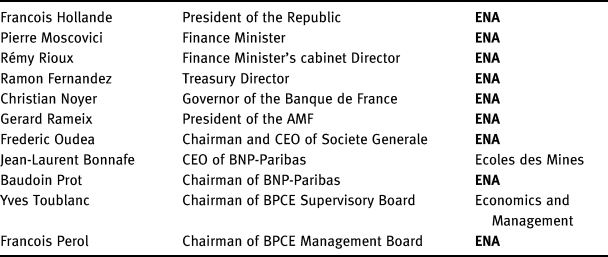
As table 2 shows, almost all of the “usual suspects” were alumni of the Ecole Nationale d'Administration (ENA). ENA alumni share very similar career paths and the “same way of seeing things.”Footnote 63 During interviews about the details of decision making, interviewees’ answers had a flavor of the evidence: everybody understood that BSR was problematic. There was, in fact, not a great deal of discussion between banks and public officials, as they all agreed very early on of the necessity not to break up the banks. Bankers presented their contribution to the French BSR as just calling their colleagues in the public sector back to reason: “There is a lot of heat during political campaigns. I understand that. And then you have to be called back to reason. They [the newly elected government] are smart people. They got that.”Footnote 64
Education background of the “usual suspects”

In France, there was no institutional room for potential public actors to effectively oppose this public-private consensus. Top regulators are also part of the state-bank elite nexus and are, thus, not eligible for an “outsider” position in the policymaking process. In agreement with the treasury and ministry of finance, the governor of the Bank of France, Christian Noyer, was a strong critic of BSR: “the French state would have found itself with only the big Wall Street banks to place its debt. Companies would have found only Wall Street banks to finance their operations.”Footnote 65
In Parliament, the socialist MPs who would have favored a stricter version of the BSR were constrained by party discipline. A former Socialist MP recalls: “Of course, we were seeing that the mountain was about to give birth to a mouse. But it is difficult, politically, to go against your government. There are retaliations. So we thought: ‘at least we got something [a watered down version of the BSR]”Footnote 66. The declaration of the speaker for the socialist majority supports this claim: “We called for wisdom [among the socialists] (…). Accepted amendments would remain cosmetic. We don't want to make banks’ life more difficult.”Footnote 67 On the other hand, the mainstream right, in the opposition, came out early in favor of the Socialist-led government's draft. A conservative MP, Gilles Carrez, president of the Finance Committee, bluntly responded to a colleague who wanted to push for a stricter version of the law: “I would like, Madam, for this debate to be motivated in the first place by the general interest and the preoccupation to protect our banking industry.”Footnote 68
This widespread bipartisan support ensured that there would be no significant politicization of BSR by parliamentarians. A French lobbyist for consumer interests recalls with annoyance: “I was going to the hearings.… Jerôme Chartier (a socialist MP) came to me. I could see right away that French political authorities, from the right and the left, think that we absolutely should not touch BNP-Paribas or Societe Generale, that they are national champions.… If we don't have them, Goldman Sachs will rule …”Footnote 69
In France, there were no institutional opportunities for political actors outside of the state-bank elites’ nexus to form independent preferences on the issue of TBTF banks, nor to effectively step into the policymaking process for those who had different preferences.
Germany: The institutional power of local coalitions
Germany is the poster child of the Coordinated Market Economy (CME). Since the 1980s, it has been much discussed whether Germany still corresponds to the CME model of capitalism. In labor and training, Germany has undergone significant changes. The tax reform led by Gerhard Schroeder, in 2000, put an end to one key institution of traditional German capitalism: banks’ interlocking directorates. Commercial banks and the largest public state banks also adopted a global and market-based banking strategy, metamorphosing their traditional business models.Footnote 70 Yet, some typical German institutions remain unchanged. In particular, Germany remains a federalist state, and the economy still relies on an important public banking sector with close political links to state governments.
German governments have always considered it crucial for Germany to have its “own” national champion in finance. This champion is Deutsche Bank. Deutsche Bank's top executives enjoy privileged access to treasury officials and the minister of finance. The attitude of treasury officials to these top managers is characterized by deference to their expertise.Footnote 71 When they can, federal state officials abide by their national champion's preferences. Yet, they must also cope with strong coalitions composed of state governments and public-sector banks, which are also supported by well-organized networks of medium enterprises.Footnote 72 The German three-pillars banking system is still alive and well.Footnote 73 Local cooperative banks and state public banks represent around two thirds of German banking—the last third being taken by private commercial banks. State politicians are shareholders in public banks, and they sit on bank directorates. The preservation of public banks’ turf, thus, ranks high in the priorities of state governments, which have many formal and informal, parliamentary and party channels to veto or promote policies.Footnote 74 When the preferences of TBTF banks conflict with their own priorities of protecting public banks, state governments will overrule them. Consequently, the German government was successful in promoting a weak implementation of BSR, but it has also enforced policies aimed to protect public banks from the competition of large commercial banks at home.
Soon after the publication of the EU Commission's proposal for BSR, the German government moved to introduce a “defensive measure” in the hope of getting an exemption.Footnote 75 As an EU official involved in the crafting of the European proposal recalls: “The EU was united behind this [BSR] approach. But Germany came and refused! Deutsche Bank was key in pushing for the refusal by Germany.”Footnote 76 Shortly before the crafting of the bill, Deutsche Bank published a report entitled “Universal Banks: Optimal for clients and financial stability - Why it would be wrong to split them up.”Footnote 77 This report argued that splitting large universal banks would hurt the competitiveness of European banks and ruin the economy. Throughout the policymaking process, CDU controlled the finance ministry and communicated directly and frequently with the private banks and their peak associations.Footnote 78 German state officials feared for the position of the German bank in the global markets. One EU lobbyist argues:
“Germany also wants a national champion. It is Deutsche Bank. Deutsche Bank's shareholders contemplated asking the bank to separate some activities. To keep only market activities within Deutsche bank. They were ready for a clear-cut separation! The government was opposed. It is unbelievable. It comes to recognize that you need deposits to support market activities. Of course, Deutsche Bank thinks so too. It is a scandalous position on the part of the public authorities.”Footnote 79
The German Parliament and financial regulators lacked the institutional capacity to go against the incentives of the treasury to accommodate Deutsche Bank.
The German Parliament remained mostly quiet on the BSR issue. The Green Party called for the creation of an independent commission similar to the British ICB. This proposal was easily blocked by the governing Grand Coalition's MPs, whose interest was to remain loyal to their party leaders. During the BSR discussions, the financial committees of the lower and upper chambers passed no amendments to the project presented by the government. In both Houses, only the Green Party and the far-left actively criticized the draft legislation. But as one of their colleagues recalls, “they were completely alone.”Footnote 80 No political work was done by independent experts or parliamentarians to politicize the question of BSR in Germany. The issue, thus, remained in the domain of quiet politics.Footnote 81
Local coalitions, composed of state banks and governments, could have stepped in in favor of a more stringent BSR. But as soon as they had secured the engagement that the reform would not apply to public banks (even to the largest of them, like Dekabank and DZ Bank), they kept a neutral stance towards the BSR. They secured this engagement quite early on in the process. The German Savings Banks Association and Association of German Public Sector Banks (VÖB), thus, remained passive. To make sure that the largest public banks would not be concerned, the wisest strategy was to remain silent and not push for the implementation of a reform for their private competitors.Footnote 82 Some of them were even sensitive to the argument that a big political power like Germany “should be a global financial player too.”Footnote 83 Because their banks were safe, the representative association of the German SMEs (BVMW) did not get involved either.
The story is different regarding the competition regulation in retail banking. There, public banks intervened actively in the policymaking process and prevented the government from yielding to Deutsche Bank's argument in favor of increased competition at home.
The continuous refusal by Germany to expose local cooperative and public banks to competition from commercial banks has irritated global market actors for a long time. Yet, they came to see it largely as a fait accompli that must be reckoned with. Rating agencies write that competition reform “looks elusive at best.”Footnote 84 A German commercial banker laments that despite regular lobby for more open competition, “there is nothing to be done.”Footnote 85 State governments have always vetoed any attempt to increase competition in retail banking markets. The same has been true since the crisis:
“There have been quiet discussions about whether we would have to standardize SME credit information to make it cheaper. This is a high risk for the local banks. This would ruin the qualitative assessment done by the local banks and their business would become more difficult. Large international banking groups would like to see that, but not our small local banks.”Footnote 86
The creation of a national register for consumer credit data has never even been mentioned in Germany. Customer information remains, to this day, a well-defended jewel of the local banks.
The role of the financial crises and banking scandals on states’ banking policies
The three largest European countries were affected by the financial crises of the early twenty-first century: the crisis of 2007–8 and the Euro-crisis of 2010–11. Yet, the impact of these crises on each political economy was not homogenous. One explanation of banking regulatory variation, thus, points to the differentiated impact of the crises on banks across European countries. The main related hypothesis is that states were more stringent, if their banks fared worse during the crisis, were the costliest to bail out and were involved in more scandals. Although there are many ways in which the crises may have affected banking regulation, no linear relationship can be observed between how national banks fared in the crises and how states regulated TBTF banks.
All European banks had become more involved in market activities before the crisis and it is very difficult to argue that some of them were spared by the crisis just because they behaved more cautiously.Footnote 87 Given the size of banking in the British economy though, British policymakers may have realized that the whole country could be wiped out. But the British particularity should not be overstated. Politicians and bankers in France, too, realized the potential disruption on the whole country that the banking crisis could have caused. BNP-Paribas CEO was saying in September 2008: “Lehman is a catastrophe. But if AIG collapses, we are all dead.”Footnote 88 A senior advisor at the French Tteasury told me during an interview: “You should not forget that we were in a period… Today we can talk about it coldly, but then.… It was such a crisis. With my experience, I had never seen people so worried, so anxious. We feared a collapse.”Footnote 89 During the Euro-crisis, French banks were, again, a major concern. Without liquidity support from the ECB, they would have been in serious trouble.Footnote 90 No clear linear relationship can, thus, be established between the health of banks and the substance of banking reform.
How much banks suffered from the 2008 financial crisis depends on the type of bailout put together by their governments. Because the smooth cooperation between French state officials and bankers opened on a collective bailout, the costs ended up being considerably lower in France than in Germany and the United Kingdom.Footnote 91 But if state priorities towards TBTF banks were directly explained by the costs of the bailouts, policymakers should have been as stringent in Germany as in the United Kingdom. Yet, the United Kingdom adopted more restrictive regulation for TBTF banks.
Finally, European banks were involved in high profile scandals involving the manipulation of interest and exchange rate swaps. Barclays, Deutsche Bank, and Société Générale all submitted to big fines. However, these scandals triggered more public anger in the United Kingdom than in France or Germany.Footnote 92 Yet, with the “affaire Kierviel’ (a fraudulent trader of Societe Generale), the expensive nationalization of Dexia, the revelation of the involvement of French banks in tax heavens, the perjury of banks’ top executives in parliamentary hearings, pretexts for public anger were not lacking in France either. To understand post-crisis regulatory variations, the emergence of political salience around banking issues is part of the question rather than part of the answer.
Conclusion
In the aftermath of the crisis, European governments soon revived with the incentive to promote TBTF banks. Indeed, they perceived the growth of these banks as an essential element of their economy's global competitiveness. The executive branches of the British, French, and German governments, thus, sought to implement regulation that would not hinder—or even promote—domestic TBTF banks. Yet, typical political institutions have allowed factions—often led by actors from within the state itself—to resist this incentive. The institutional resources that these factions were able to mobilize determined their capacity to carry weight in policymaking processes and eventually shape the different regulatory banking outcomes across Europe.
Thus, two trends must be taken into account in the politics of European banking: a global trend (the financialization of the economy has enhanced the incentive for governments to promote TBTF banks) and a domestic dynamic (domestic political institutions shape the capacity of “anti-TBTF” factions to carry weight in the policymaking process differently). Accounts stressing how the financialization of the economy have enhanced global banks’ structural power and aligned state-bank interests in the pursuit of banks’ global competitiveness tend to over-evaluate the convergence of advanced political economies. State-bank interest alignment is strong and these authors are right to observe the general “strange non-death of neoliberalism.”Footnote 93 Yet, this global trend is powerfully mediated by domestic political institutions. Varieties are important, not just theoretically, but because how states treat their TBTF banks have very concrete consequences for firms and people, as recent studies on TBTF banks’ capital allocation,Footnote 94 or their role in rising inequalities,Footnote 95 show.
It is also important to examine the sources of remaining varieties across Europe. Scholars in the comparative capitalism tradition have underlined the coherent complementarity of economic institutions characteristic of distinctive models of capitalism. By contrast, this article argues that states can and do regulate and shape markets.Footnote 96 But their priorities are not shaped by the incentive to fulfill a given institutional competitive advantage. They are shaped by distinctive political institutions. Potential mismatches between political and economic institutions may explain the impression of incoherence that some authors have observed in contemporary capitalisms.Footnote 97
What are the implications of the argument developed in this paper regarding the politics of European integration, and more particularly the European Banking Union (EBU)? Although varieties remain, the European Union can no longer be described as an arena where a “battle of the systems”Footnote 98 is raging. States no longer seek to preserve distinctive institutional competitive advantages characteristic of their national model of capitalism. Large European states now all share the incentive to promote their TBTF banks. The EBU is coherent with this priority. The creation of a truly European banking field would benefit the largest European banks.Footnote 99 Despite internal tensions, the general workings of the newly settled EBU seem to accommodate growing TBTF banks well.Footnote 100 Yet, domestic politics still matter in banking. As long as all policies and decision-making processes are not lifted up to the EU level, states remain relevant polities. Factions opposing the promotion of TBTF banks at home influence state priorities, which in turn determine both policies adopted at home and policies that states advocate at the European level. European politics thus also reflect the tensions between global and domestic dynamics described in this paper.