1. Introduction
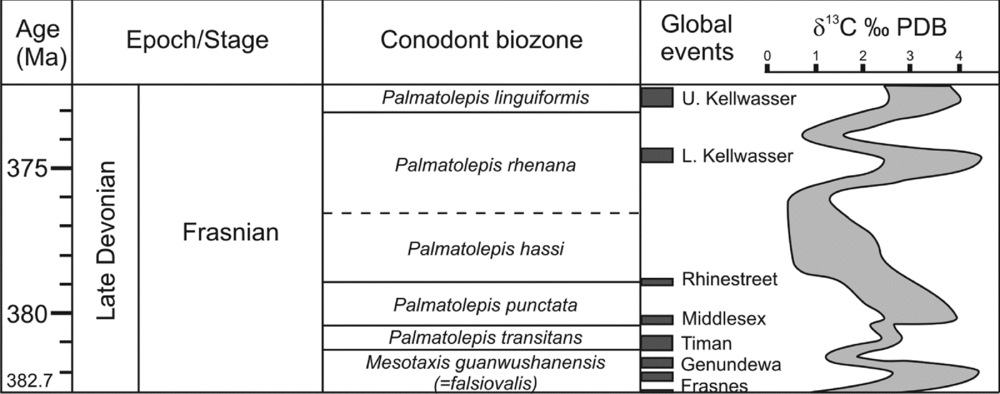
The variations in carbon isotopic composition of carbonates (δ13C shifts of different scope and duration) are useful proxies for past ecological perturbations and can be applied to resolving stratigraphic problems. On frequent occasions, the δ13C shifts are associated with global events (Fig. 1). The use of C isotopic variations as markers of palaeoecological changes and as means of correlation is possible only if there is a reference curve superimposed on a reliable biostratigraphic and/or chronostratigraphic framework. The reference δ13C curve for West Siberia can be constructed based on the best fossiliferous sedimentary successions cropping out in the folded periphery of the West Siberian Plate. In particular, the eastern part of the West Siberian Plate consists of the complexes extending into the Siberian Platform and the Altai–Sayan Region. An isotope–geochemical study of the Upper Devonian carbonate sedimentary sequence in the Rudny Altai containing diverse benthic and pelagic fauna (Bakharev et al. Reference Bakharev, Sennikov, Yolkin, Izokh, Alekseenko, Obut, Rodina, Saraev, Baturina, Kipriyanova, Timokhina, Yazikov and Yolkin2004) allowed us to reconstruct a lower–middle Frasnian fragment of the δ13C curve, which serves as part of the reference curve for West Siberia. Determining the state of preservation of carbonate material and its isotopic characteristics has proven to be an important step in the reconstruction of the reference δ13C curves, which is why a series of methods was deployed therewith, including petrographic studies and assessment by geochemical criteria (Mn/Sr ≤ 0.2 and Fe/Sr ≤ 5) and their correlation with carbon and oxygen isotopic composition (Kuznetsov et al. Reference Kuznetsov, Gorokhov, Semikhatov, Kislova, Maslov, Krupenin and Prasolov2006; Izokh et al. Reference Izokh, Izokh, Ponomarchuk and Semenova2009).
Standard conodont zonation, global events and generalized carbon isotope stratigraphy in the Upper Devonian (Gradstein et al. Reference Gradstein, Ogg, Schmitz and Ogg2012).

2. Geological setting
The Altai–Sayan Region is a typical mosaic-block megastructure within the Ural–Mongolia Foldbelt. It consists of numerous different-sized and heterogeneous blocks bounded by Late Palaeozoic and Mesozoic faults. The Rudny Altai, Altai–Salair–Kuznetsk, South Altai, West Sayan, Tuva and Minusa are among these blocks (Yolkin et al. Reference Yolkin, Sennikov, Buslov, Yazikov, Gratsianova and Bakharev1994). Of all the lower Upper Devonian sections, marine strata are most widely distributed in the Rudny Altai. According to geodynamic reconstructions (Filippova, Bush & Didenko, Reference Filippova, Bush and Didenko2001), the Rudny Altai in Late Devonian time appears as a volcanic arc system, with shallow water grey-coloured sediments and deep water turbidites representing marginal seas (Yolkin et al. Reference Yolkin, Sennikov, Buslov, Yazikov, Gratsianova and Bakharev1994). These marginal seas were characterized by diverse biota in both benthic and pelagic realms and connected with other basins of present-day Eurasia, as evident from a large diversity of cosmopolitan invertebrate species including conodonts (Dubatolov & Krasnov, Reference Dubatolov and Krasnov2000; Yolkin et al. Reference Yolkin, Bakharev, Izokh, Kirda, Klets, Kontorovich, Obut and Timokhina2003). The sedimentary and volcanic arc complexes accreted to the southwestern (in modern coordinates) periphery of the Siberian Craton in Carboniferous time. These complexes are partly exposed in the Southeastern Gornyi Altai, Rudny Altai and Eastern Kazakhstan, although locally covered by the cover of the West Siberian Plate.
The Middle–Upper Devonian in the study area is represented by the Kamenevka Formation. The Kamenevka Formation conformably overlies felsic rocks of the Davydovka Formation and is divided into three members: the lower, volcanogenic–sedimentary, with evidence of mafic, rarely felsic volcanism; the middle, felsic volcanogenic; and the upper, volcanogenic–sedimentary, represented by interbedded siltstone and tuff sandstone, tuff gravelstone, felsic tuffs and limestone biostromes.
Two biostromes are recognized within the Upper Kamenevka Member, the Surgutanovo and Razdolnoe palaeoreefs. In terms of structural geometry, the Razdolnoe organogenic limestone has an irregular shape and is located on the northeastern slope of the Titovo–Gerikhovka palaeovolcano; in cross-section it appears embedded, gradually pinching out northwards. The limestone is conformable with felsic volcanic rocks of the Middle Kamenevka Member. It is coeval with and partially overlapped by the Upper Kamenevka Member, and both are overlain by the Pikhtovka Formation.
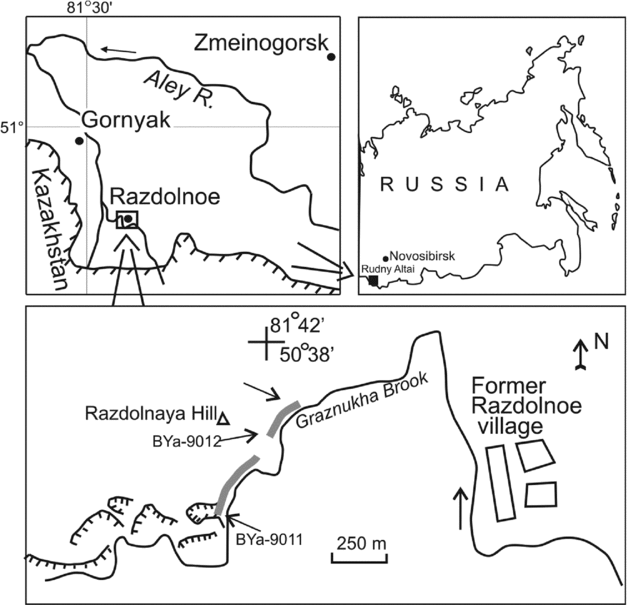
Deposits of the reef systems and bioclastic debris are exposed in the lower reaches of the Gryaznukha Brook (Fig. 2). A detailed description of the section BYa-9011, together with the occurrence of microfauna, has been provided in a number of publications (Bakharev et al. Reference Bakharev, Sennikov, Yolkin, Izokh, Alekseenko, Obut, Rodina, Saraev, Baturina, Kipriyanova, Timokhina, Yazikov and Yolkin2004; Izokh, Yolkin & Bakharev, Reference Izokh, Yolkin and Bakharev2004; Saraev et al. Reference Saraev, Baturina, Bakharev, Izokh and Sennikov2012). Below is a brief description of the section:
Location of the Frasnian section on the right bank of Gryaznukha Brook, downstream of Razdol’noe Village.

The lowermost unit (Stratum 1) of the Lower Member is poorly exposed reaching 2 m in thickness. It is a weakly developed weathered crust formed upon felsic volcanic rocks, as well as karstic and brecciated, locally silicified red-coloured limestones enriched with ferruginous and clayey material.
Stratum 2 (thickness 8.3 m) comprises biocalcirudites consisting of white to light grey clasts (up to 0.25 m in size) and dark brownish-red clay–calcareous pelitic–siltitic, rarely psammitic matrix. The clasts are represented by reef framework debris including fragments of massive tabulate, occasionally dendroid and cateniform colonies, together with crinoid ossicles, isolated brachiopod valves, rare stromatopore fragments, ostracodes, trilobites and tentaculites. Bioclasts in the lower part of the stratum are partly silicified. Some of the large fragments demonstrate primary reef cavities, as well as newly formed encrusted caverns filled by pelitomorphic clay–carbonate red-coloured material.
Stratum 3 (thickness c. 1 m) exhibits lateral structural variation. It consists of pinkish-grey unsorted calcarenites, calcirudites, with randomly occurring indistinct lenticular interbeds enriched in psephitic–psammitic siliciclastic material (clasts of rhyolite, andesite, volcanic quartz and plagioclase), and fragments of clay–siliceous, bauxite-like rocks. Also found are lenticular interbeds of relatively well-sorted crinoid calcarenites with irregularly distributed clay–carbonate red-coloured material. The largest clasts (up to 5 cm) are represented by fragments of tabulate colonies; smaller fractions consist of crinoidal detritus, brachiopod valves, and occasionally trilobites and ostracodes. Regardless of size, the clasts are angular to sub-rounded. The bioclasts and fine-grained matrix are characterized by irregular and patchy recrystallization accompanied by cavitation, whereas light-coloured clasts are irregularly ‘saturated’ with finely dispersed red-coloured Fe–Al material.
Stratum 4 (thickness 12 m) consists of unsorted detrital limestones (breccia). The size of the clasts varies between 1 and 30 cm. The clasts are represented by white to light grey angular skeletal fragments of reef-building organisms (60–70%), as well as reddish muddy limestone and marl (20–25%). The matrix of the breccia (5%) is reddish-grey calcarenite with abundant crinoid debris. Large bioclasts include diverse tabulate colonies, as well as rugose corals, crinoids and brachiopods. Muddy limestone and marl clasts contain minor ferruginous volcaniclastic material and volcanic quartz. These clasts represent fragmented laminae and formed as slump breccia when the sediment was weakly cemented to allow plastic deformation. In particular, the shape of the fragmented laminae often replicates the contours of the relatively rigid bioclasts. Some of the fragments demonstrate fine lamination and graded bedding. Cavities in the reef fragments are filled with brick-red Fe–Al material and are often encrusted with 1–3 mm thick calcite. Most of the bioclasts also contain fine-grained Fe–Al material along microscopic fractures.
Strata 5 and 6 (thickness 12.5 and 6.2 m, respectively) are similar in composition and structure to Stratum 4 and consist of a series of slump breccia fans. Clasts in the breccia are light coloured and represented by skeletal fragments of colonial and solitary reef-building organisms, fragmentary laminae of brick-coloured clay–calcareous siltites and pink biocalcarenite matrix. In contrast to Stratum 4, each of these strata exhibits an upward increase in matrix content in the breccia. Furthermore, matrix-like material comprises lenticular interbeds (up to 50 cm in length and 15 cm in thickness) in Stratum 5 and forms laterally continuous interbeds, with fine lamination and graded bedding, in Stratum 6. The strata demonstrate variation in the ratio of skeletal fragments of various reef-building organisms, the size of these fragments and the number and thickness of clay–carbonate siltite laminae. Thus, the number of fragmented laminae in the lower part of Stratum 5 reaches 40% within an indistinct interval of 4 m in thickness, whereas higher in the section in the same stratum there are intervals (up to 1 m in thickness) where such fragments are missing.
Compared to Stratum 4, carbonate clasts in Strata 5 and 6 were not subjected to the process of karstification.
Stratum 7 is characterized by a variable thickness (2–10 m) and structure. The lower part is dominated by pinkish-grey crinoid medium- and coarse-grained calcarenites containing altered (chloritized, ferruginous) volcaniclastic and clay material, with fine lamination and graded bedding, whereas the upper part consists primarily of calcirudite–arenites, with the maximum size of bioclasts being 2 cm. Semi-rounded and angular bioclasts are represented by crinoids, rare corals and brachiopods. The siliciclastic content reaches 35% and includes clasts (0.3–1.5 mm) of quartz-porphyry, volcanic quartz and ferruginous volcanic rocks.
Carbonates in the studied section characterize the depositional environment of a seaward slope of a large reef system developed in proximity to active palaeovolcanoes. The carbonates are represented primarily by calcirudites, with a matrix consisting of calcarenite, calcisiltite and red-coloured pelitomorphic mudstone–calcareous material. Observed bioclasts and coarse framestone fragments appear to be redeposited. Grains of all sizes are poorly rounded; carbonate material is poorly sorted. Often carbonates appear as olistostromes of slump breccia, with olistoliths represented by fragments of deformed finely laminated red-coloured mudstone–calcareous shales, along with large fragments of a reef biostrome. Several stratigraphic levels of the coarse clastic breccia aprons identified in the section probably correspond to episodes of tectonic activity.
Calcarenite grains consist primarily of bioclastic material. Crinoid calcarenites often comprise thin graded turbidites in the upper part of the section. Certain interbeds contain very rare siliciclastic silt- to sand-size material represented by redeposited primarily felsic tephra and correspond to episodic increases in volcanic explosive activity. In addition, fine-dispersed ferruginous–aluminous material is present in variable quantities imparting different shades of brick-red colour to the carbonates. A relatively high content of the ferruginous–aluminous material has been observed in the olistostromal breccia, particularly in the clasts of muddy limestones and marls, together with isolated clasts of bauxite-like ferruginous–aluminous rocks.
The earliest carbonates of the Upper Kamenevka Member (Stratum 1) are poorly preserved following karstification during a short episode of sea-level drop. Coeval red-coloured ferruginous–aluminous material, a product of volcanic rock weathering, was deposited in the karst limestone. Partial erosion of the fine-dispersed red-coloured material during a subsequent slight sea-level rise gave the reddish colour to later-deposited carbonates. Palaeokarst processes are manifested as caverns partially or completely filled with encrustations of late calcite and ferruginous–aluminous material (colmatation residual clay deposit) showing a zonal structure. There is also evidence of palaeokarst formation identified in Stratum 4 of the studied section. The latter palaeokarst is thought to be a result of a short episode of reef system emergence and is manifested as incipient bauxite-like deposits in elevated parts of the basin, which is reflected in the appearance and composition of the clasts in the tail.
3. Conodont biostratigraphy
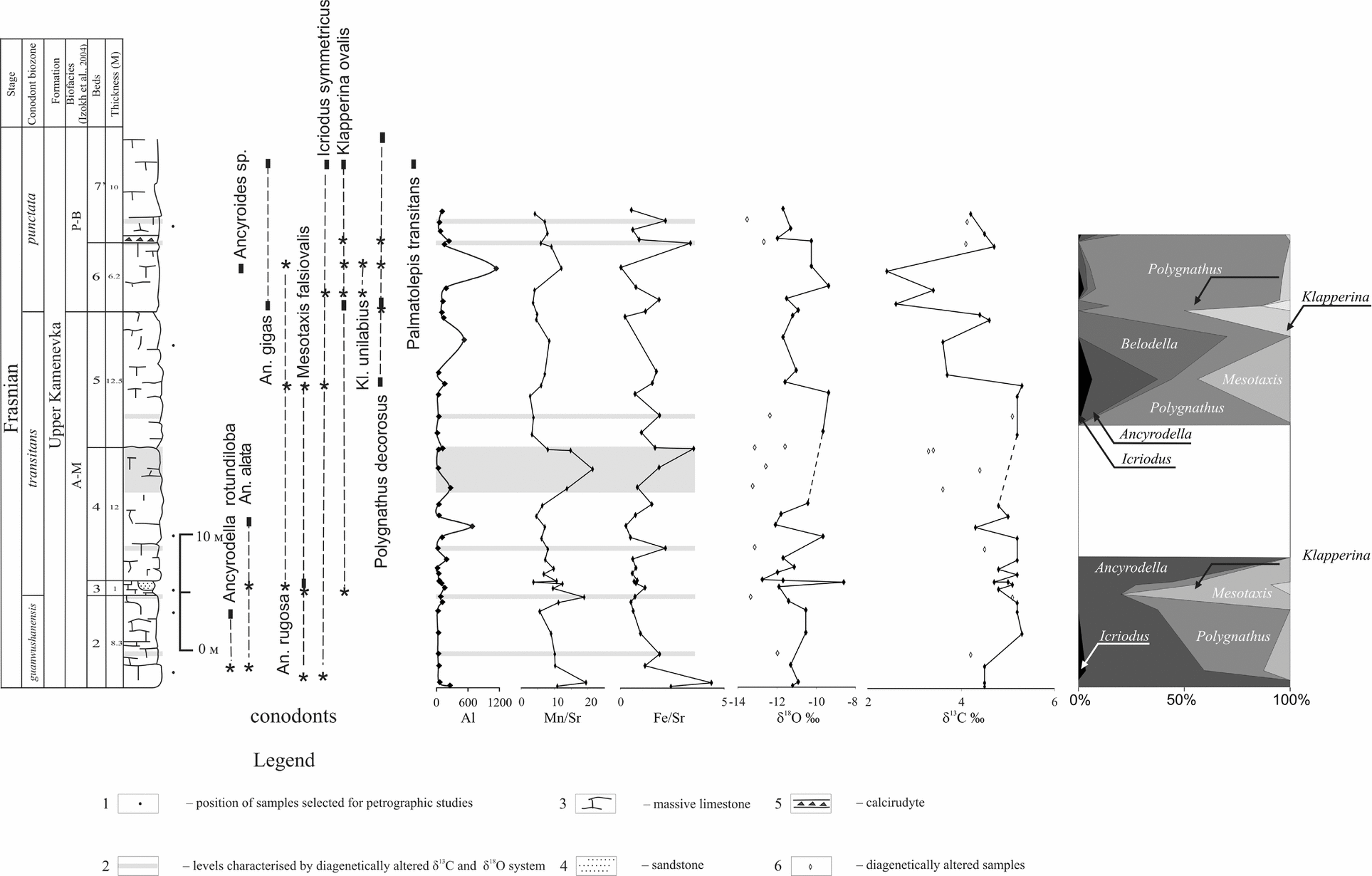
A conodont complex of the Upper guanwushanensis (= falsiovalis) – punctata zones in the reef limestone allows correlation with the lower–middle Frasnian of the International Stratigraphic Chart (Izokh, Yolkin & Bakharev, Reference Izokh, Yolkin and Bakharev2004). The Upper guanwushanensis (= falsiovalis) Zone is established by the co-occurrence of Mesotaxis guanwushanensis and Ancyrodella rotundiloba and the occurrence of A. alata in association with Icriodus symmetricus, a taxon of broad stratigraphic range. The transitans Zone in the absence of the zonal index-taxon is characterized by the first appearance of Ancyrodella rugosa (Ji & Ziegler, Reference Ji and Ziegler1993). All species of the preceding interval, together with the earlier species Klapperina ovalis and Polygnathus decorosus, are transitory in this Zone. The punctata Zone in the section is established in its upper limit by the first appearance of Palmatolepis hassi, an index-taxon of the succeeding Zone (Fig. 3). Here, the punctata zonal interval is characterized by the last occurrence of Ancyrodella rotundiloba and the first occurrence of An. gigas (Ziegler & Sandberg, Reference Ziegler and Sandberg1990), as well as the presence of Mesotaxis guanwushanensis, Klapperina ovalis, Kl. unilabius, Pa. transitans, An. alata, An. rugosa, Polygnathus decorosus, Icriodus symmetricus and Ancyroides sp. The lower boundary of the interval in the section BYa-9011 is tentatively drawn at the base of Stratum 6.
Conodont distribution and assemblages and covariation of δ13C, δ18O, Mn/Sr and Fe/Sr in the BYa-9011 section. Intervals characterized by diagenetic alteration are indicated. δ13C data from these intervals have not been considered in the discussion.

4. Materials and method
Isotope–geochemical studies were carried out using whole-rock samples collected from the section BYa-9011. The elemental analyses of the soluble part of the carbonates were carried out on a high-resolution Element 2 Finnigan Inductively Coupled Plasma Mass Spectrometer (ICP-MS) in the Sobolev Institute of Geology and Mineralogy (Novosibirsk, Russia) by external calibration with internal standards to correct for instrumental and matrix-induced drift. The most abundant isotopes free from elemental isobaric interference were selected. Measurements of Mn and Fe were conducted at medium resolution owing to significant spectral interference; Al and Sr were measured at low resolution. Merck multi-element standards were used as calibration solutions. Analytical error is less than 10% provided the concentration is at least three-fold above the detection limit. Carbonate material was dissolved carefully in 3 ml 1N HCl with further centrifugation and separation of solution from the insoluble part. The delicate solution allows us to avoid significant terrigenous contamination. The latter is controlled using the Al content in the solution, which should have zero concentration in pure carbonate. When the Al concentration was non-zero, suggesting the presence of terrigenous material in the solution, the concentrations of other elements were normalized using Al content from the equation Xauthig = Xtotal − Xdetrital = Xtotal − Alsample × (X/Al)Average Shale, where X is the content of an element concentration in ppm. The average shale composition was used from Li & Schoonmaker (Reference Li, Schoonmaker, Holland and Turekian2003).
The isotopic composition of oxygen and carbon was measured with a Finnigan MAT-253 mass spectrometer with sample preparation on a Gas Bench II line by standard methods in the Sobolev Institute of Geology and Mineralogy (Novosibirsk, Russia). The accuracy of the carbon and oxygen carbonate material measurements was controlled by the NBS19 international standard (δ13C = +1.9‰, δ18O = −2.2‰) and amounted to 0.1‰ for δ13C and δ18O values.
5. Results
5.a. Trace elements
Limestone from the Upper Kamenevka Member has an elevated content of Mn (up to 3140 ppm) whereas concentrations of Fe do not exceed 594 ppm and Sr content is not less than 126 ppm (Online Supplementary Material available at http://journals.cambridge.org/geo). Most parts of the section are characterized by Fe content varying between 114 and 415 ppm, although a few samples from the base, middle and upper parts exhibit higher Fe contents (585–617 ppm) (Online Supplementary Material available at http://journals.cambridge.org/geo). The maximum concentration of Mn has been measured in a few samples from the uppermost part of Stratum 2, corresponding to the guanwushanensis–transitans zones boundary interval, from the upper part of Stratum 4, coinciding with the middle part of the transitans Zone, and from the lower part of Stratum 7 (base of the punctata Zone) in the upper part of the section (Online Supplementary Material available at http://journals.cambridge.org/geo). Concentration of Al varies insignificantly throughout the section, being 147 ppm on average, although values as low as 17 ppm and as high 1142 ppm have been observed (Online Supplementary Material available at http://journals.cambridge.org/geo). An increase in Al content has been observed in the lower part of Stratum 4 and upper part of Stratum 5 that correspond to the lower and upper parts of the transitans Zone, and the maximum content has been measured at the base of the punctata Zone (Fig. 3). The ratios of Mn/Sr and Fe/Sr were calculated using Al-normalized Fe, Mn and Sr concentrations. Thus, the limestone is characterized by high values of Mn/Sr (2.7–21.4) at low values of Fe/Sr (0.02–4.4). Variations of these ratios are shown in Figure 3.
5.b. Carbon and oxygen
The variations of carbon and oxygen isotopic compositions in the studied section are shown in Figure 3. They range within +2.4‰ to +5.3‰ and −8.6‰ to −13.6‰ (Online Supplementary Material available at http://journals.cambridge.org/geo) averaging at 4.5‰ and −11.6‰, respectively. The lower part of the section (Strata 2, 3 and lower part of Stratum 4), corresponding to the guanwushanensis and the lower transitans zones, is characterized by δ13C values not lower than +4‰. The δ13C values drop to +3.3‰ in the upper part of Stratum 4, corresponding to the middle part of the transitans Zone, followed by a rise to +5.2 to +5.3‰ in the lower part of Stratum 5. The upper part of Stratum 5, corresponding to the upper part of the transitans Zone, is characterized by another drop in δ13C values to +3.6‰. The boundary interval of Strata 5–6 that correlates with the transitans–punctata zones boundary demonstrates high δ13C values (+4.4to +4.6‰) followed by a negative shift to +2.4‰ in the middle part of Stratum 6. The upper part of the section (Stratum 7) again is characterized by high δ13C values reaching +4.5‰.
There is no apparent trend in δ18O values through the section. Certain stratigraphic levels are characterized by negative shifts mostly associated with intervals of low δ13C values, apart from the base of the punctata Zone where a decrease in δ13C values is accompanied by an increase in δ18O values.
5.c. Diagenetic alteration
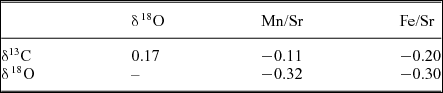
Petrographic studies revealed the absence of significant recrystallization of carbonate material across most the Kamenevka Formation. Obtained Mn/Sr values significantly exceed the limits for non-altered carbonates (Mn/Sr ≤ 0.2) suggesting diagenetic alteration of the studied material, in agreement with the low δ18O values, although the relatively low Fe/Sr (below 5) and high δ13C values imply a high state of preservation of carbonate material. There is no correlation between the Mn/Sr – δ18O (δ13C) and Fe/Sr – δ18O (δ13C) pairs (Table 1) further suggesting the lack of significant diagenetic alteration of the C and O isotope systems through the section. Synchronous δ18O and δ13C negative shifts and Mn/Sr and Fe/Sr positive excursions were used as diagenetic alteration level markers during data analyses. A pronounced correlation of these parameters is observed in the upper part of slope 4 (Fig. 3) characterized by a significant negative δ13C excursion. This stratigraphic level is marked by palaeokarst features indicative of a short subaerial exposure of the biostrome (Saraev et al. Reference Saraev, Baturina, Bakharev, Izokh and Sennikov2012). Apart from this level, synchronous decreases in δ18O and δ13C and coeval increases in Fe/Sr and/or Mn/Sr in a few samples were attributed to diagenetic alteration (Fig. 3).
Correlation between δ13C, δ18O, Mn/Sr and Fe/Sr

6. Discussion
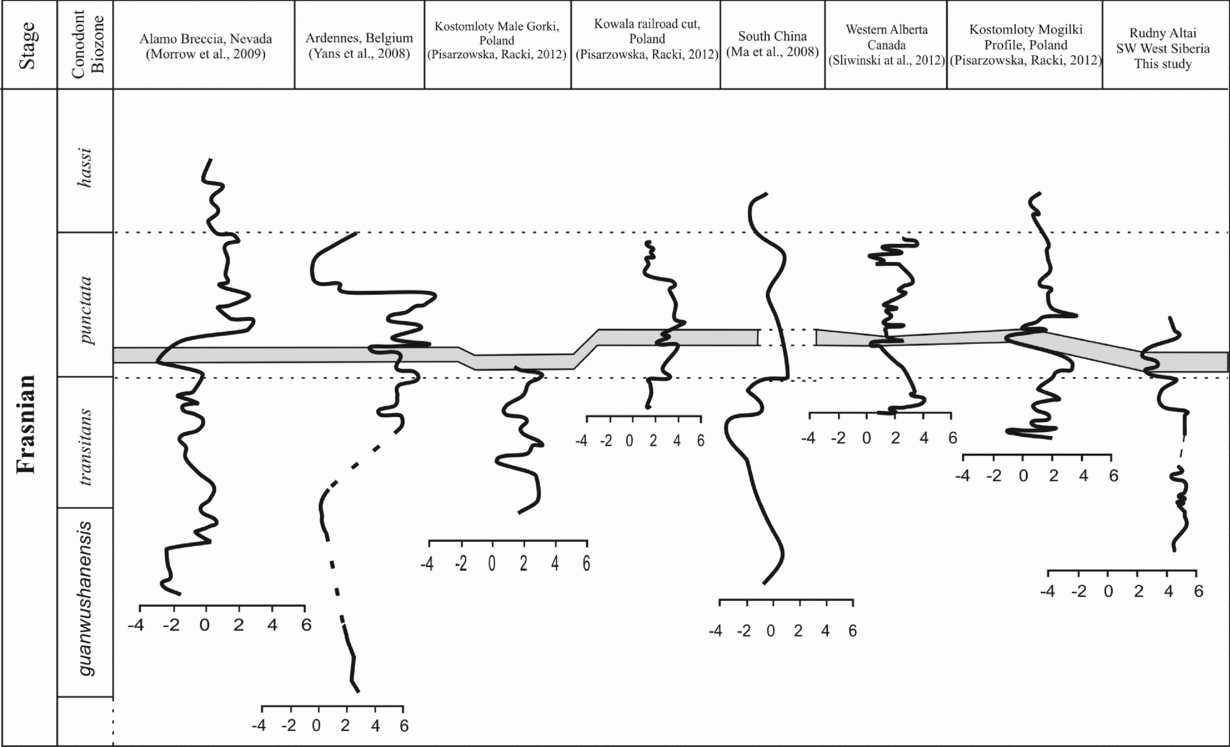
Considerable attention has been devoted in recent years to discussion of the causes of the punctata Isotopic Event (e.g. Racki, Joachimski & Morrow, Reference Racki, Joachimski and Morrow2008; Śliwiński et al. Reference Śliwiński, Whalen, Newberry, Payne and Day2011; Pisarzowska & Racki, Reference Pisarzowska and Racki2012). Among the lower Frasnian sections around the world with studied carbon isotope variations, the most complete δ13C data are found in South China (Ma et al. Reference Ma, Wang, Racki and Racka2008) and Nevada, USA (Morrow et al. Reference Morrow, Sandberg, Malkowski and Joachimski2009), whereas in other sections only fractions of the transitans Zone are represented by C isotope data (Fig. 4). Each of these sections has unique features, but there is also a general trend in δ13C variations.
Correlation of negative δ13C excursions in sections from Nevada (Morrow et al. Reference Morrow, Sandberg, Malkowski and Joachimski2009), Belgium (Yans et al. Reference Yans, Corfield, Racki and Preat2007), Poland (Pisarzowska & Racki, Reference Pisarzowska and Racki2012), South China (Ma et al. Reference Ma, Wang, Racki and Racka2008), Canada (Śliwiński et al. Reference Śliwiński, Whalen, Newberry, Payne and Day2011) and Rudny Altai, Siberia (this study).

A negative excursion, with a shift amplitude of 2.5‰ against high δ13C values, that is prominent at the base of the punctata Zone (Fig. 3) was also found in sections in Belgium (Yans et al. Reference Yans, Corfield, Racki and Preat2007), Poland (Pisarzowska, Sobstel & Racki, Reference Pisarzowska, Sobstel and Racki2006; Pisarzowska & Racki, Reference Pisarzowska and Racki2012), South China (Ma et al. Reference Ma, Wang, Racki and Racka2008), Canada (Śliwiński et al. Reference Śliwiński, Whalen, Newberry, Payne and Day2011) and the United States (Morrow et al. Reference Morrow, Sandberg, Malkowski and Joachimski2009) (Fig. 4). Most of the represented curves exhibit high δ13C values in the transitans–punctata zones interval, apart from the sections in South China and Nevada, USA where δ13C values are largely negative, becoming positive in the punctata Zone and in the guanwushanensis–transitans zones boundary interval (Fig. 4). The South China and Nevada curves, therefore, demonstrate an isochronous increase in δ13C values in the time interval that Morrow at al. (Reference Morrow, Sandberg, Malkowski and Joachimski2009) correlated with the ‘falsiovalis event’ reported by Buggisch & Joachimski (Reference Buggisch and Joachimski2006). High δ13C values in the guanwushanensis–transitans zones boundary interval in the Upper Kamenevka Member in the Rudny Altai could be coeval with the above-mentioned positive excursion, corroborating an earlier suggestion that the ‘falsiovalis event’ could have a broader stratigraphic range (Morrow et al. Reference Morrow, Sandberg, Malkowski and Joachimski2009).
The individual feature is the higher δ13C values in the Upper Kamenevka Member in the Rudny Altai that can be attributed to local aspects of carbonate deposition. The Frasnian and Famenian carbonates along the margin of the Siberian Platform in general are typically characterized by higher δ13C values (Izokh, Reference Izokh2008), which could be attributed to the palaeogeographic setting of the sedimentary basin (Izokh et al. Reference Izokh, Izokh, Ponomarchuk and Semenova2009). In addition, the increase in δ13C values could have resulted from higher regional-scale bioproductivity triggered by an input of volcanic material into the sedimentary basin during early Frasnian time (e.g. Adams, Hurtgen & Sageman, Reference Adams, Hurtgen and Sageman2010). However, the worldwide scale of negative and positive shifts on the δ13C curve, as well as the presence of cosmopolitan species of the fossil fauna including zonal index species of conodonts (Izokh, Yolkin & Bakharev, Reference Izokh, Yolkin and Bakharev2004; Yolkin et al. Reference Yolkin, Bakharev, Izokh, Gratsianova, Kipriyanova and Obut2005) suggest connections with the world ocean and a global nature of the δ13C record.
Conodont biofacies turnovers (Izokh, Yolkin & Bakharev, Reference Izokh, Yolkin and Bakharev2004) coincide with negative carbon isotope excursions (Fig. 3). Conodont genera Ancyrodella and Polygnathus predominate in the fossil assemblage of the guanwushanensis Zone. In the lower part of the transitans Zone, the Ancyrodella conodonts are predominant, whereas the upper part is characterized by a mixed biofacies, with a predominance of reef-related genera Ancyrodella and Belodella and a subordinate number of conodont genera Polygnathus and Mesotaxis typical of deep water environments. The conodont genus Polygnathus becomes dominant at the base of the punctata Zone (up to 95%). The Polygnathus biofacies is accompanied by a decrease in δ13C values (Fig. 3). Presumably, the established correlation between the drop in diversity of conodonts and the decrease in δ13C values can be attributed to changes across trophic levels as a response to reduced primary bioproductivity.
When compared to the chart of Upper Devonian events (House, Reference House2002; Gradstein et al. Reference Gradstein, Ogg, Schmitz and Ogg2012) the attained carbon isotope curve demonstrates a marked degree of synchronism between the negative δ13C excursion and the Upper Devonian (Frasnian) Middlesex global event. The decrease in the amount of reef debris and the occurrence of calcarenite turbidites in the studied section suggest that the negative δ13C excursion is coeval with landward reef progradation and marine transgression (Saraev et al. Reference Saraev, Baturina, Bakharev, Izokh and Sennikov2012), further corroborating the suggested correlation with the Middlesex Event. The latter was accompanied by a sea-level rise and the advent of anoxia in the water column and could be responsible for a decline in biological productivity or supply of isotopically light carbon to the world's sedimentary basins as a consequence of erosion of accumulated organic matter.
7. Conclusions
Based on the study of whole-rock composition of carbonates, a δ13C curve has been constructed describing variations in carbon isotope composition in the lower–middle Frasnian sedimentary basin of the Rudny Altai. This curve will serve as the basis for producing a composite reference δ13C curve for West Siberia. Comparison with other sections has revealed several departures from the assumed global trend in carbon isotope composition for the lower–middle Frasnian time interval. In particular, the guanwushanensis–transitans zonal interval is characterized by high δ13C values (+4.0 to +5.3‰), which could be correlated with the ‘falsiovalis event’ in the sections across Europe, Australia and Nevada. The ‘falsiovalis event’, therefore, could have a broader stratigraphic range.
The established negative δ13C shift at the base of the conodont punctata Zone, in contrast, is a global signal that could be used as a marker for the Middlesex Event in the sections across the Rudny Altai.
Acknowledgements
We would like to thank two anonymous reviewers for critical and constructive remarks which substantially improved this manuscript. The study was supported by the Ministry of Education and Science of the Russian Federation projects 8322 and 8321 and partially by the RFBR grant 11-05-01105. This is a contribution to the IGCP Project 596.
Supplementary material
To view supplementary material for this article, please visit http://dx.doi.org/10.1017/S0016756814000703