INTRODUCTION
A significant amount of research has pointed out the importance of adopting a holistic approach in the palliative care context (Callahan, Reference Callahan2000; National Consensus Project, 2009). As underlined in almost every international definition of palliative care and in all guidelines for end-of-life care, one needs to take into account not only patients' physical needs and resources but also their social, psychological, and spiritual situations in order to provide complete and high-quality care (National Consensus Project, 2009; National Quality Forum, 2006; WHO, 2002).
Several studies have successfully tested psychosocial interventions for palliative care patients (Breitbart et al., Reference Breitbart, Rosenfeld and Gibson2010; Reference Breitbart, Poppito and Rosenfeld2012; Reference Breitbart, Rosenfeld and Pessin2015; Fegg, Reference Fegg2006; Gysels & Higginson, Reference Gysels and Higginson2004; Houmann et al., Reference Houmann, Chochinov and Kristjanson2014; Li et al., 2012; Lorenz et al., Reference Lorenz, Lynn and Dy2008; Newell et al., Reference Newell, Sanson-Fisher and Savolainen2002; Price & Hotopf, Reference Price and Hotopf2009; Uitterhoeve et al., Reference Uitterhoeve, Vernooy and Litjens2004). These models aim to relieve patients' suffering based on such constructs as meaning, purpose, dignity, spirituality, and existential well-being (Bayés et al., Reference Bayés, Limonero and Romero2000). Counseling is one of the therapies most widely reported on in the literature (Gysels & Higginson, Reference Gysels and Higginson2004; National Comprehensive Cancer Network, 1999; Newell et al., Reference Newell, Sanson-Fisher and Savolainen2002; Porche et al., Reference Porche, Reymond and O'Callaghan2014). Meaning-centered psychotherapy, for instance, seeks to help patients with advanced cancer by enhancing their sense of meaning, peace, and life purpose. This type of counseling therapy has shown its efficacy for improving patients' quality of life, for treating depression, and in ameliorating hopelessness (Breitbart et al., Reference Breitbart, Rosenfeld and Gibson2010; Reference Breitbart, Poppito and Rosenfeld2012; Reference Breitbart, Rosenfeld and Pessin2015). Along the same lines, research on cognitive-existential group psychotherapy has yielded good results among caregivers (Kissane et al., Reference Kissane, Bloch and Smith2003; Reference Kissane, McKenzie and Bloch2006). Another type of counseling therapy, CALM (managing cancer and living meaningfully; Li et al., Reference Li, Fitzgerald and Rodin2012), consists of brief, manualized, semistructured individual psychotherapy for patients with advanced cancer. Li and colleagues (Reference Li, Fitzgerald and Rodin2012) employed this technique and found that it led to reductions in depressive symptoms and death anxiety, and in increased spiritual well-being. Using such techniques as exposure, treatment, operant conditioning, roleplaying, progressive relaxation, attentional training, thought stopping, and stress inoculation, classical behavioral therapy has also yielded promising results in palliative care patients (Holland, Reference Holland2002; Kidman & Edelman, Reference Kidman and Edelman1997; Spirito et al., Reference Spirito, Hewett and Stark1988). To the best of our knowledge, third-wave psychotherapies (e.g., mindfulness, acceptance and commitment therapy) and therapy focused on values have not yet been explored in palliative care patients. It is possible that some of the aspects of these interventions could be modified for appropriate use in this context (Fegg, Reference Fegg2006).
A new therapy focused on patient dignity has emerged over the previous decade as a tool for addressing the needs of palliative care patients at the end of life (Chochinov, Reference Chochinov2002; Chochinov et al., Reference Chochinov, Hack and Hassard2002). Dignity therapy (DT) is based on Chochinov and colleagues' model of dignity (Chochinov, Reference Chochinov2002; Chochinov et al., Reference Chochinov, Hack and Hassard2002), which incorporates a wide range of physical, psychological, social, and existential concerns that affect an individual's perception of dignity. It consists of discussing the questions that patients believe are more important, and those they think should be remembered, and its aims are to relieve the suffering inherent to the dying process and to promote hope, self-esteem, and a clear sense of life and death (Chochinov, Reference Chochinov2004). Studies on DT have demonstrated an improved sense of dignity (Chochinov et al., Reference Chochinov, Hack and Hassard2005; Houmann et al., Reference Houmann, Chochinov and Kristjanson2014; Rudilla et al., Reference Rudilla, Barreto and Oliver2015) and a better quality of life (Chochinov et al., Reference Chochinov, Kristjanson and Breitbart2011; Rudilla et al., Reference Rudilla, Barreto and Oliver2015), as well as decreased depression (Chochinov et al., Reference Chochinov, Hack and Hassard2005; Houmann et al., Reference Houmann, Chochinov and Kristjanson2014; Julião et al., Reference Julião, Oliveira and Nunes2014), anxiety (Houmann et al., Reference Houmann, Chochinov and Kristjanson2014), hopelessness (Houmann et al., Reference Houmann, Chochinov and Kristjanson2014), and suffering (Chochinov et al., Reference Chochinov, Hack and Hassard2005; Houmann et al., Reference Houmann, Chochinov and Kristjanson2014; Rudilla et al., Reference Rudilla, Barreto and Oliver2015). In cross-sectional studies, dignity has also been correlated with demoralization and symptom burden (Vehling & Mehnert, Reference Vehling and Mehnert2014).
The objectives of our current study were twofold: (1) to examine the effects of two different popular psychological therapies in palliative care (dignity therapy and counseling) in a sample of Spanish home care patients; and (2) to compare the effects of these therapies and thus offer useful information upon which therapy could be designed to better fit patients' needs.
METHODS
Procedure, Setting, and Participants
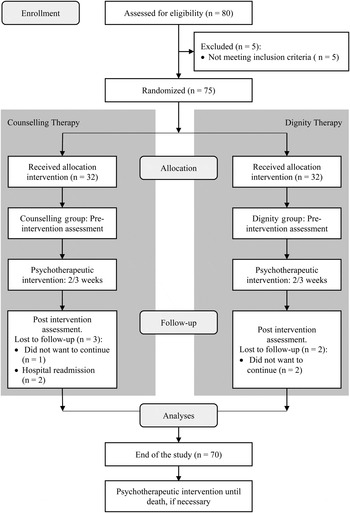
Our study focuses on a sample of palliative care patients from a home care unit at the Hospital General Universitario de Valencia (Valencia, Spain). Once we obtained permission from the hospital ethics committee and patients and relatives gave their informed consent, some 80 patients were assessed for eligibility. The inclusion criteria were: (1) patients admitted to the home care unit of the General University Hospital of Valencia for palliative treatment; (2) adult patients (18 years old or older); (3) patients with advanced/terminal illness; (4) patients with knowledge of their diagnosis and prognosis; and (5) patients with an interest in dignity. The exclusion criteria were: (1) less than two weeks of predicted survival; (2) evidence of a conspiracy of silence; and (3) cognitive impairment (comprehension/expression problems). A total of 75 patients met the inclusion criteria and were randomly assigned to both study groups. For randomization, the CONSORT criteria for nonpharmacological trials were followed (Boutron et al., Reference Boutron, Moher and Altman2008) (see Figure 1). The randomization process was basic in design: when a psychologist interviewed a patient for the first time, the patient was alternately included in one of the two groups. This process was carried out by the psychologist of the home care unit, under the supervision of the research team.
Diagram of the CONSORT protocol.

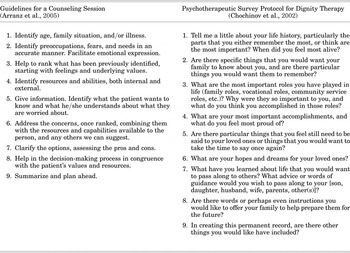
Patients completed surveys during the therapy sessions, as well as before and after interventions. The interventions took place in patients' homes and were conducted by the same psychologist. The study was undertaken over a three-month period (from April to June of 2013). The number of sessions for both interventions was based on a schedule designed by the psychologist of the home care unit. A patient was visited two to three times a week for 30- to 60-minute sessions. The counseling intervention was based on the guidelines for counseling proposed by Arranz et al. (Reference Arranz, Ulla and Ramos2005). The dignity therapy followed the psychotherapeutic protocol proposed by the original authors of this type of therapy (Chochinov et al., Reference Chochinov, Hack and Hassard2005) (see Table 1).
Intervention guidelines

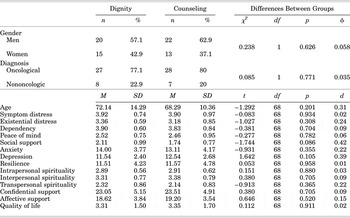
Some 70 participants completed the study, 35 in each group. The characteristics of participants at baseline are described in Table 2.
Sample characteristics and baseline differences between intervention groups

Outcome Measures
Along with the sociodemographic and clinical data, we gathered information on several variables.
Sense of Dignity
Patients' sense of dignity was assessed using the Patient Dignity Inventory (PDI; Chochinov et al., Reference Chochinov, Hassard and McClement2008) and was designed to identify patients' dignity resources at the end of life. It has been broadly employed in the palliative care literature (Chochinov et al., Reference Chochinov, Hack and Hassard2005; Reference Chochinov, Kristjanson and Breitbart2011; Houmann et al., Reference Houmann, Chochinov and Kristjanson2014; Vehling & Mehnert, Reference Vehling and Mehnert2014) and is composed of 25 items, assessing 5 dimensions of dignity: symptom distress (Cronbach's α = 0.89), existential distress (α = 0.84), dependency (α = 0.71), peace of mind (α = 0.63), and social support (α = 0.70).
Emotional Distress
Anxiety and depression were assessed with the Hospital Anxiety and Depression Scale (HADS; Zigmond & Snaith, Reference Zigmond and Snaith1983), which measures anxiety and depression in patients with comorbid physical illness. It is composed of 14 items that evaluate anxiety (α = 0.73) and depression (α = 0.45).
Emotional Well-Being
Resilience, spirituality, social support, and quality of life were also evaluated. Resilience was assessed using the Brief Resilient Coping Scale (BRCS; Sinclair & Wallston, Reference Sinclair and Wallston2004), which is composed of four items (α = 0.92). Developed by the Grupo de Espiritualidad de la SECPAL (Benito et al., Reference Benito, Oliver and Galiana2014), the GES questionnaire is composed of eight items and was utilized to assess three dimensions of spirituality: intrapersonal, interpersonal, and transpersonal spirituality (α = 0.85). The Duke–UNC-11 Functional Social Support Questionnaire (Broadhead et al., Reference Broadhead, Gehlbach and Degruy1988) included 11 items and was employed to evaluate two dimensions of social support: confidential support (support for communicating intimate feelings, α = 0.93) and affective support (support for positive empathy, α = 0.80). Finally, two items of the EORTC Quality of Life C30 Questionnaire (EORTC–QLQ–C30; Bjordal et al., Reference Bjordal, de Graeff and Fayers2000) were used to assess quality of life: “How would you rate your overall health during the past week?” and “How would you rate your overall quality of life during the past week?” (α = 0.85).
Analyses
Equivalence between groups was tested with t tests for mean differences and chi-square tests. Effect sizes were calculated with the coefficient phi (ϕ) for the chi-square tests and with Cohen's d for the t tests. A phi value of 0.10 is considered a small effect, a value of 0.30 is considered a medium-sized effect, and a value of 0.50 is considered a large effect. Cohen's d values around 0.20 indicate small differences, values of 0.50 indicate medium-sized differences, and values of 0.80 indicate large differences (Cohen, Reference Cohen1988).
Paired-samples t tests were employed in order to assess pre- and post-intervention differences for each of the variables of interest, and independent-samples t tests were utilized to compare the results of the two interventions. Cohen's d was calculated for each of the analyses.
RESULTS
Baseline Scores
The first comparisons showed equivalence between the two groups at baseline and prior to intervention, with no differences for any of the measured variables (see Table 2).
Intervention Results
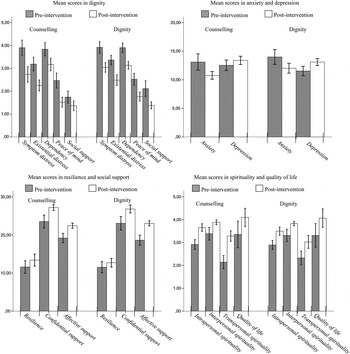
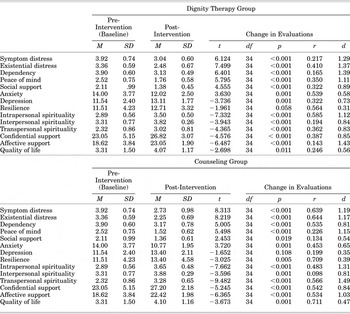
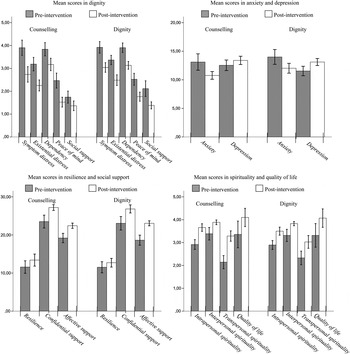
With regard to changes after an intervention, the repeated-measures t test in the DT group showed statistically significant differences for all variables of interest, except for resilience. Dignity improved in the five domains measured with the PDI, with patients reporting fewer problems in terms of symptom distress, existential distress, dependency, peace of mind, and social support. The effect sizes for the intervention were all large. Anxiety was lower after the DT intervention, but depression was not improved (in fact, levels of depression were higher). Spirituality, social support, and quality of life also improved after the intervention, with large effects in the three dimensions of spirituality and social support and a medium-sized effect for quality of life. Similarly, post-intervention results for the counseling group showed improvement in terms of dignity, anxiety, spirituality, social support, and quality of life. There was a significant though small improvement in resilience with counseling, and there were no effects for depression. The details of these results are presented in Table 3. Figure 2 depicts the improvements in mean scores for each therapy group.
Improvements in mean scores after interventions for each therapy group (95% confidence intervals).
Counseling and dignity therapy results

Comparison Between Interventions
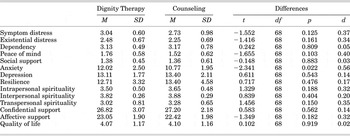
Differences between the groups following the intervention were then estimated. The results with respect to anxiety yielded statistically significant differences, which favored the counseling group. This group of patients had lower levels of anxiety following the intervention, with a medium effect size. See Table 4 for more information related to these analyses.
Comparison of results with the two therapeutic interventions

DISCUSSION
Two main conclusions can be drawn from the results of our study: (1) there is new evidence on the efficacy of dignity therapy and counseling for improvement of the well-being of palliative home care patients, and (2) particularly good results can be obtained with counseling for depression, resilience, and anxiety.
When the efficacy of dignity therapy was tested, our results showed a positive effect for almost every variable related to well-being, in line with information gathered in previous studies (Chochinov et al., Reference Chochinov, Hack and Hassard2005; Houmann et al., Reference Houmann, Chochinov and Kristjanson2014; Vehling & Mehnert, Reference Vehling and Mehnert2014). Dignity therapy improved one's sense of dignity and lessened anxiety, as found by Houmann et al. (Reference Houmann, Chochinov and Kristjanson2014), and enhanced patient quality of life, as reported by Chochinov et al. (Reference Chochinov, Kristjanson and Breitbart2011). Such variables related to the holistic well-being of palliative care patients as spirituality (Broadhead et al., Reference Broadhead, Gehlbach and Degruy1988; Edmondson et al., Reference Edmondson, Park and Blank2008; Barreto et al., Reference Barreto, Fombuena and Diego2015), social support (Edmondson et al., Reference Edmondson, Park and Blank2008; Peterman et al., Reference Peterman, Fitchett and Brady2002), and resilience (Barreto et al., Reference Barreto, Fombuena and Diego2015; Benito et al., Reference Benito, Oliver and Galiana2014) were also measured, which was the first time that the effect of DT on these variables has been ascertained. As expected, dignity therapy had large and positive effects on spirituality and social support, though resilience was not affected. Counseling therapy also had a positive effect on spirituality and social support, as well as on resilience.
Along the same lines as Houmann et al. (Reference Houmann, Chochinov and Kristjanson2014), counterintuitively, current research reports a large and negative effect of dignity therapy on depression, which increased significantly after DT intervention. Despite the reported beneficial effects of dignity therapy, Chochinov et al. (Reference Chochinov, Kristjanson and Breitbart2011) found that its ability to mitigate severe distress (e.g., major depression and suicidality) remained unproven. Julião et al. (Reference Julião, Oliveira and Nunes2014) found evidence of a positive effect of DT on depression over the short term but not by the end of the intervention (day 30). Our current research continued assessment out to two to three weeks after the intervention. An explanation for these counterintuitive effects on depression could be provided by the fact that some psychiatric syndromes (e.g., depression, anxiety, confusion, suicidal ideation, and a desire for hastened death or assisted suicide) occur in a significant percentage of patients with advanced disease (Tremblay & Breitbart, Reference Tremblay and Breitbart2011). However, other studies have demonstrated low rates of increased incidence of depressive and anxiety disorders as patients approach death (Lichtenthal et al., Reference Lichtenthal, Nilsson and Zhang.2009). Counseling therapy did not have a negative effect on depression in our study. Further research in this arena is clearly required (Chochinov et al., Reference Chochinov, Kristjanson and Breitbart2011; Fitchett et al., Reference Fitchett, Emanuel and Handzo2015; Hall et al., Reference Hall, Edmonds and Harding2009; Reference Hall, Goddard and Opio2011).
The participants who received dignity therapy and counseling in our study reported a positive effect on perception of meaning in life, quality of life, and spiritual well-being. We should also stress the fact that the results for depression and resilience were better in the counseling group. When we compared the effects of the two interventions, a significantly higher effect on anxiety was found, showing a clear benefit for the counseling group. Even though there was a significant decrease in anxiety after both interventions, the palliative care patients receiving counseling experienced a higher benefit. Counseling therapy thus seems most appropriate for treating the symptoms of anxiety in a home care context.
Our study has some strengths and some limitations. The use of an inclusion criterion related to dignity (patients' interest in dignity) may have produced some bias, which would limit the generalizability of our results. In addition, though with research team supervision, the randomization process, interventions, and data gathering were carried out by the same professional, making it difficult to the assess treatment adherence and fidelity. Finally, following Chochinov's (Reference Chochinov2012) guidelines, the dignity therapy was based on the counseling element of positive communication. This could tend to make the results with both therapies similar. Further research addressing these shortcomings would be most welcome.
Nevertheless, the findings of our study are indeed valuable, since they offer evidence for the importance of psychological therapies in enhancing the well-being of palliative care patients. We also demonstrated the superior efficacy of counseling compared to dignity therapy. Our conclusions can help professionals to design better-tailored interventions and thus more effectively customize their tools so as to achieve specific goals (e.g., management of anxiety and depression).