Background literature
Recently, there has been a resurgence of interest in linguistic relativity, the influence that language has on cognition, and if language can influence the way that we think or perceive of the world (e.g. Bowerman & Levinson, Reference Bowerman and Levinson2001; Gentner & Goldin-Meadow, Reference Gentner and Goldin-Meadow2003; Gumperz & Levinson, Reference Gumperz and Levinson1996; Levinson, Reference Levinson2003). A more subtle, less deterministic version of linguistic relativity has been formulated by Slobin, which he has termed thinking-for-speaking. This is a type of thinking ‘that is carried out on-line in the process of speaking’ as the grammatical categories of the language that one speaks shapes or filters the way that aspects of the world are expressed (Slobin, Reference Slobin, Gumperz and Levinson1996: 75). It is argued that obligatory, grammaticalized categories within a language have a special channeling effect on the attention of the speaker towards particular functions of these forms (Berman & Slobin, Reference Berman and Slobin1994; Slobin, Reference Slobin, Gumperz and Levinson1996; Strömqvist & Verhoeven, Reference Strömqvist, Verhoeven, Strömqvist and Verhoeven2004).
Thai, an Austronesian language (Sagart, Reference Sagart2004), provides an interesting comparison with English, as it has imperfective aspectual morphemes which are in general optional and not obligatory in usage, whereas English has obligatory grammaticized imperfective aspectual marking on the verb. Furthermore, Thai, a serial verb language, has verb final deictic-path verbs that form a closed class set consisting of only two verbs, i.e. paj0 ‘go’ or ma:0 ‘come’, which are frequent in usage when expressing motion of events, suggesting that deixis is a grammaticalized category in Thai (Zlatev & Yangklang, Reference Zlatev, Yangklang, Strömqvist and Verhoeven2004). These cross-linguistic differences allow us to examine if the relative degree of obligatoriness of grammatical categories has an influence on what particular aspects of the temporal events depicted are expressed by Thai and English speakers. The expressions used by Thai and English children aged four years, five years, six years, and seven years, and adults, to describe overlapping events depicted in three short animations were examined. First, we will briefly review relevant background literature, then give a more detailed comparison of the linguistic devices used to express simultaneity and deictic motion events in Thai and English, prior to outlining the specific research aims and questions of the current study.
Distinctions in a language, which are grammaticized or obligatory, are considered to have a special significance or role in shaping the way people speak about notions, events or objects in their environment (Slobin, Reference Slobin, Bowerman and Levinson2001). Grammaticized or obligatory categories are accessed more frequently or habitually, and then become automated, and hence more accessible to speakers of languages that make such distinctions (Slobin, Reference Slobin, Gentner and Goldin-Meadow2003). It is claimed that speakers from languages that do have obligatory, grammatical categories in a particular domain and speakers from languages that do not have these categories have different mental space for the particular semantic domain being encoded (Berman & Slobin, Reference Berman and Slobin1994).
Grammatical or obligatory categories have been defined as a closed set of high-frequency elements occurring in fixed syntactic position (Talmy, Reference Talmy2001), and ‘the dimension in question cannot be regularly referred to without the expression in question’ (Slobin, Reference Slobin, Gentner and Goldin-Meadow2003: 5). The distinction between closed class and open class elements in a language is not always straightforward, as these categories are not discrete categories but vary along a continuum (Slobin, Reference Slobin, Bowerman and Levinson2001; Talmy, Reference Talmy2001). Linguistic expressions which are more accessible and codable have been characterized as being short, frequently occurring and typically part of a small set of options. For example, a concept expressed by a single verb is more codable than a phrase or clause, as exemplified by the expression of manner of motion events in Satellite-framed languages such as English, whereby manner is encoded in the verb, e.g. run, whereas in Verb-framed languages such as French, it is expressed using additional lexical means, e.g. entre en courant ‘enter while running’. This latter form of expression is less codable or accessible as it involves a phrase rather than a single word, and so requires an additional processing load. Consequently, speakers from Verb-framed languages tend not to express this notion as frequently as speakers from Satellite-framed languages (Slobin, Reference Slobin, Gentner and Goldin-Meadow2003, Reference Slobin, Strömqvist and Verhoeven2004). Cognitive load is a factor that is expected to particularly affect young children, as cognitively they have limitations on the range of encodable perspectives and linguistic devices that they have available (Berman & Slobin, Reference Berman and Slobin1994). Hence, on this basis it is expected that these effects will be more accentuated in younger children than older speakers.
Grammatical and obligatory categories hold a particularly salient role in relation to language acquisition. Children acquiring a language tune into the obligatory or habitually used categories of their language and represent events in the style of their particular language from an early age and in a typical way that their language encodes experience (Bowerman & Choi, Reference Bowerman and Choi1994; Choi & Bowerman, Reference Choi and Bowerman1991; Choi, McDonough, Bowerman & Mandler, Reference Choi, McDonough, Bowerman and Mandler1999). Hence, the child learns ‘language-specific patterns of thinking for speaking’ from early in language development (Slobin, Reference Slobin, Gumperz and Levinson1996: 77).
In the temporal domain two distinct language typologies have been identified, based on whether languages have obligatory grammatical marking of the durative–non-durative aspectual contrast or not (Berman & Slobin, Reference Berman and Slobin1994). In languages such as Spanish, Turkish and English, which have obligatory, grammaticalized aspectual marking, speakers tend to express the overlapping temporal relations depicted in the frog story picture book (Mayer, Reference Mayer1969) using the aspectual forms in the language, whereas in German and Hebrew, which do not have obligatory grammaticalized aspect, speakers tend not to express the temporal distinctions depicted, even though there are alternative lexical means of expression (Berman & Slobin, Reference Berman and Slobin1994), e.g.:
(1) Der Hund rennt rennt rennt. The dog runs runs runs ‘The dog is running.’
These characteristic patterns are also evident in the youngest children studied, the three-year-olds. Furthermore, German and Hebrew narrators do not tend to ‘compensate’ by using temporal connectives, whereas Turkish and English speakers use temporal connectives as well as aspectual morphemes to mark the temporal distinctions depicted, and the acquisition of temporal connectives is relatively early in comparison to German and Hebrew. Hence, it appears that obligatory, grammaticalized categories within a language shape or facilitate particular choices and different perspectives when expressing temporal events or actions in the external world (Strömqvist & Verhoeven, Reference Strömqvist, Verhoeven, Strömqvist and Verhoeven2004).
In relation to developmental trends or patterns that emerge in the acquisition of temporal-related language, the underlying conceptual complexity of temporal terms plays a major role (Keller-Cohen, Reference Keller-Cohen1981; Slobin, Reference Slobin and Slobin1985; Weist, Atanassova, Wysocka & Pawlak, Reference Weist, Atanassova, Wysocka and Pawlak1999). One measure of conceptual complexity is the number of referent elements that are required to establish the location of a primary event in time (Weist et al., Reference Weist, Atanassova, Wysocka and Pawlak1999). Young children first use a mono-referential system of reference, i.e. the speech time is the sole point of reference, e.g. The boy paints. Within this system, children subsequently juxtapose two independent clauses, which express events in their order of occurrence, e.g. The boy paints. The monkey draws. Children then add a bi-referential dimension to their linguistic system (reference to two points or events in time) by linguistically relating two clauses with temporal conjunctions or adverbials e.g. When the boy paints, the monkey draws a picture, and both sequential reference using connectives such as then, before or after, and simultaneous reference using connectives such as while, at the same time or when, involve bi-referential referencing. The transition from a mono-referential to bi-referential system occurs at about four to five years of age (Weist, Lyytinen, Wysocka & Atanassova, Reference Weist, Lyytinen, Wysocka and Atanassova1997; Weist et al., Reference Weist, Atanassova, Wysocka and Pawlak1999). By five years of age, children in general are quite adept at combining clauses (Berman, Reference Berman, Slobin, Gerhardt, Kyratzis and Jiansheng1996). Multifunctional, least restricted connectives such as and are the first connectives to be used in the construction of compound sentences in English, Italian, German and Turkish (Clark, Reference Clark, Flores d'Arcais and Levelt1970; Clancy, Jacobsen & Silva, Reference Clancy, Jacobsen and Silva1976; Hood, Lahey, Lifter & Bloom, Reference Hood, Lahey, Lifter, Bloom and Sackett1978; Bloom, Lahey, Lifter & Fiess, Reference Bloom, Lahey, Lifter and Fiess1980). In addition, the connective when is the first subordinating conjunction to emerge in development, and as it is less restricted in its usage appears to be acquired prior to while (Aksu-Koç & von Stutterheim, Reference Aksu-Koɔ, von Stutterheim, Berman and Slobin1994, for Spanish, English and Turkish; Clancy et al., Reference Clancy, Jacobsen and Silva1976, for English, German, Italian and Turkish; Silva, Reference Silva1991, for English). A while-clause must be combined with a durative predicate that occurs over an interval of time, and it cannot be combined with a non-durative or punctual predicate, whereas when can occur with both clause types. The connective as is the most specific and also the last to be acquired by English children (Silva, Reference Silva1991). Research based on frog story narratives has indicated that temporal adverbials meaning ‘meanwhile’ or ‘in the meantime’ appear to be relatively late to emerge in the older narrators, the nine-year-olds and adults, in all languages except Hebrew (where it occurs in five-year-olds) (Aksu-Koç & von Stutterheim, Reference Aksu-Koɔ, von Stutterheim, Berman and Slobin1994). These terms are late to emerge as they have not only a temporal function but also a discourse organizational function (Aksu-Koç & von Stutterheim, Reference Aksu-Koɔ, von Stutterheim, Berman and Slobin1994). In general, research indicates that younger children use fewer expressive options in expressing temporal relations than older children and adults, and forms used serve a broader range of functions in the younger children than in the older children or adults (Berman & Slobin, Reference Berman and Slobin1994; Silva, Reference Silva1991). Late acquisition in general is characterized by increased lexical diversity in the range of forms employed within a particular semantic system, consequently a greater variety of temporal expressions are used by older speakers.
The expression of simultaneity in Thai and English
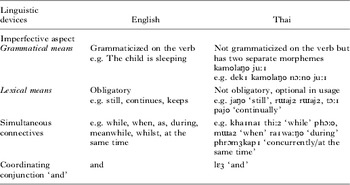
The main linguistic devices which can be used to express simultaneity or co-occurring events in English and Thai are listed in Table 1. Imperfective aspect plays an important role in the expression of simultaneity or the overlap of events or actions, as it plays an important function in backgrounding events and gives an unbounded or durative meaning to the event (Hopper, Reference Hopper and Givon1979). In English, imperfective aspect is grammaticalized on the verb and is realized by the morpheme -ing (see Table 1). Thai has imperfective morphemes that are not obligatory, hence sentences often appear without aspect markers (Koenig & Muansuwan, Reference Koenig and Muansuwan2005). In Thai there are two separate imperfective morphemes kam0laŋ0 and ju:1,Footnote 1 which can be used either separately or concurrently. The preverbal imperfective marker kam0laŋ0 signifies ‘the process of doing something’, and postverbal ju:1 signifies ‘the continuation of an event’ and translates as ‘stay or live’ (Burusphat, Reference Burusphat1991). While kam0laŋ0 is more limited to the progressive meaning and restricts its usage to dynamic verbs, ju:1 has evolved into a more general imperfective aspect marker which includes stative meaning (Meepoe, Reference Meepoe1998), hence the two imperfective markers have distinctive, though overlapping, aspectual functions.
A comparison of the main linguistic devices used to express simultaneity in Thai and English

In addition, in both languages imperfective aspect can also be implied by more indirect lexical means such as jaŋ0 ‘still’, reduplication of the adverb, e.g. rɯaj2 rɯaj2 ‘continually’, khɔj2 khɔj2 ‘gradually’ in Thai or still, continues, keeps in English, which can all give an ongoing interpretation to the clause or event. As Thai has imperfective aspect markers that are not obligatory, similar to Mandarin Chinese, then situation aspect, the intrinsic aspect of the verb and its predicate, plays an important additional role in signalling simultaneity (Smith & Erbaugh, Reference Smith and Erbaugh2005).
Additional principal means of encoding simultaneous temporal relations are through the use of simultaneous temporal connectives, e.g. when, while, which explicitly relate two events or actions either in the foreground, background or across background and foreground. The interpretation of when is somewhat ambiguous and open to interpretation, as it can give either a simultaneous or successive interpretation dependent on the aspect of the verb and its predicate in conjunction with world knowledge (Moens & Steedman, Reference Moens and Steedman1986). Even though the interpretation of devices which have a ‘when’-type meaning are somewhat ambiguous, they are classified as simultaneous connectives in the current study, as events they relate temporally either overlap or at least are closely aligned. The multifunctional, coordinating conjunction and in English or lε3 ‘and’ in Thai is somewhat ambiguous as it can theoretically express a simultaneous or successive relationship between its two clauses.
In Thai, the particle kɔ:2 is a commonly used, multifunctional device, which is used to signal cohesion or clause linkage and plays an important cohesive role in Thai discourse. It is commonly used in conjunction with temporal connectives to signal both sequential and simultaneous temporal relations and introduces the main clause in these constructions (example (2) from the Thai frog story; Winskel, Reference Winskel2007; Zlatev & Yangklang, Reference Zlatev and Yangklangforthcoming).
(2) phɔ:0 dek1 no:n0 lap1 kop1 kɔ:2 ε:p0 ni:4 paj0 when child sleep frog then sneak escape go ‘When the child sleeps the frog escapes.’
The expression of deictic motion events in Thai and English
Serial verb languages such as Thai have been classified as equipollently-framed by Slobin (Reference Slobin, Strömqvist and Verhoeven2004) as both path and manner can be expressed concurrently using equivalently weighted verbs, as illustrated in example (3). A final deictic-path verb is also frequently used.
(3) nok3 hu:k2 bin0 ?ɔ:k1 ma:0. owl fly leave come manner path deictic-path ‘The owl flies out.’
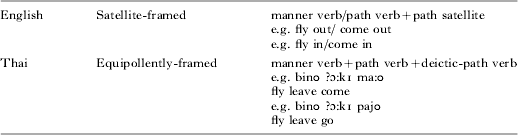
In the frog stories it has been found that older Thai speakers use both path and manner verbs, whereas younger Thai speakers attended more to path. This indicates that path is more salient or accessible than manner to Thai children (Slobin, Reference Slobin, Strömqvist and Verhoeven2004). Furthermore, deixis appears to be closely linked to conceptions of path in Thai, as speakers of all ages frequently used a final deictic-path verb ma:0 ‘come’ in serial verb constructions, as illustrated in example (3). As these frequently used deictic-path verbs form a closed class set consisting of only two verbs, i.e. paj0 ‘go’ or ma:0 ‘come’, it has been suggested that deixis is a grammaticalized category in Thai (Zlatev & Yangklang, Reference Zlatev, Yangklang, Strömqvist and Verhoeven2004). In contrast, in English, a Satellite-framed language, speakers tend to select either a deictic or a manner verb in conjunction with a path satellite in the standard construction, e.g. come out or fly out rather than come flying out, which requires a higher processing load (Slobin, Reference Slobin, Strömqvist and Verhoeven2004). Consequently, English speakers are predisposed to express either the owl's moving toward the narrator's perspective or the owl's manner of exit from the hole, but not both concurrently as that incurs an additional processing load. Refer to Table 2 for a comparison of the means of expression of deictic motion events in Thai and English.
A comparison of the expression of deictic motion events in Thai and English

The aim of the current study is to empirically test the hypothesis that the relative degree of obligatoriness of grammatical categories across languages influences the type of responses or expressions produced when describing overlapping temporal events or actions. Short animations depicting co-occurring events were used to elicit responses from Thai and English children and adults. As Thai and English differ in the degree of obligatoriness of grammatical categories of imperfective aspect and the expression of deictic motion events, they offer a good opportunity to test this empirically. Based on prior research, as Thai does not have obligatory aspectual marking in comparison with English, we can predict that ongoingness of the events and the simultaneous relationship between the two events depicted will be expressed explicitly to a greater degree by English than Thai speakers. In relation to the entrance and exit of protagonists in the animations, as Thai has a closed set of frequently used deictic-path verbs, we can predict that Thai speakers will express the exit and entrance of protagonists in the animations more than English speakers. In addition, collecting data from children at four years, five years, six years and seven years old and a comparison group of adults allows us to examine developmental trends and patterns, and if children show the same language-specific patterns as adults. As children have a limitation on the cognitive resources available to them, it is expected that these effects may be more accentuated in younger children than older speakers. In addition, as young children have limitations on the range of linguistic devices that they have available (Berman & Slobin, Reference Berman and Slobin1994), it is expected that children will use a more limited selection of temporal devices. Young children are also constrained by the range of perspectives they can take (Berman & Slobin, Reference Berman and Slobin1994). On this basis, it is expected that young children will not be able to attend to and explicitly express all the temporal events and actions depicted, particularly in the more complex embedded and partial overlap animations where protagonists enter and exit the scene.
Method
Participants
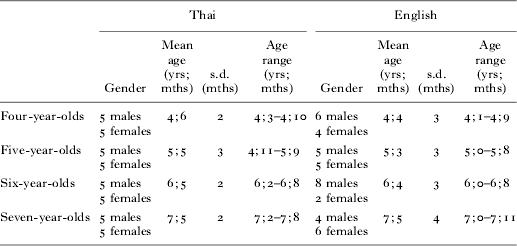
There were ten participants in each of the following age groups; four-year-olds, five-year-olds, six-year-olds, seven-year-olds and adults for Thai and English. The Thai participants were recruited from preschools and schools in Bangkok, whereas the monolingual English participants were recruited in Sydney. All of the children recruited had typical or normal language development as reported by parents and/or schoolteachers. Participants were from predominantly middle SES. Participant's age and gender background details are included in Table 3. The age group and age range selection reflect the placement of the Thai children in the respective preschool and school grades. There are minor age differences between the two language groups. There is an unequal gender ratio in some of the English age groups due to availability of the children with parental permission at the time of testing.
The mean age, standard deviation, age range and gender ratio of the Thai- and English-speaking children

The test stimuli
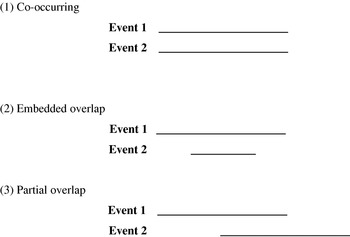
In the current study three different types of overlapping animations were used which depict varying degrees of overlap between two overlapping events: Event 1 – either a person painting the wall or a girl telephoning; and Event 2 – either a monkey drawing on a piece of paper or a baby rolling a ball (animations were created by Ann Wong, Linguistics Department, Chinese University of Hong Kong). In Type 1, the Co-occurring animation, the two events depicted co-occur, for example there is a person painting and a monkey drawing at the same time. This is a simpler form of simultaneity compared with the other two animation types which depict more complex temporal contours with protagonists entering and exiting the scene. In Type 2, the Embedded overlap animation, the second event is embedded within the first event, and consequently, the protagonist depicted in the second event enters and exits while the first event is still ongoing. For example, while the person is painting the wall, the monkey walks in and starts to draw on a piece of paper, then finishes drawing and walks out of the room. In Type 3, the Partial overlap animation, the first event occurs prior to the second event, and the protagonist in the second event enters while the first event is still ongoing, then the protagonist in the first event exits while the second event continues. For example, the person is painting the wall then the baby crawls into the room and starts rolling the ball, then the person stops painting and walks out of the room while the baby is still rolling the ball (see Figure 1).
The three types of overlapping animations.

Procedure
Children were tested individually with a total of eighteen short animations of approximately 20 seconds duration, which were presented in random order to participants individually on a laptop. In the current study, data from only nine animations depicting three different animation types were used. The other nine animations were designed to assess the expression of sequentiality, and so were not used in the current study. Instructions given were: ‘Can you tell me what happens here/in this picture?’ Children were prompted if necessary with ‘what happens (here)?’ and animations were replayed if necessary two or three times. There were three trials per animation type per participant and thirty trials per age group. Responses were audio-recorded using a Sony DAT Walkman TCD-D100 with a tie pin microphone, later transcribed orthographically by native speakers, and analyzed into the six categories as explained in the next section.
Coding and scoring
Speakers have various choices in what aspects of a situation they encode or express linguistically. In order to ascertain if obligatory aspectual categories in a language influence the expression of temporal and deictic events in the animations, responses of participants to the animations were classified into six categories related to the expression of ongoingness of the events and the expression of the temporal relationship between the two events. Participant's responses were classified into the following six categories dependent on if and how these particular aspects of the events were expressed.
The expression of ongoingness of the events
(a) The ongoingness of Event 1 was explicitly expressed
English example: The person is painting the wall
Thai example: dek1 phu:2 tchaj0 ta:0 si:4 ju:1 child boy paints colour impfv ‘The boy is painting.’
(b) The ongoingness of Event 2 was explicitly expressed
English example: The monkey is drawing on the paper
Thai example: liŋ0 khian4 ju:1 monkey write impfv ‘The monkey is writing.’
For ongoingness of action, grammatical and lexical means of expression were combined. Lexical means of expression were used infrequently across both languages; twice across all age groups in Thai and English.
The expression of the temporal relationship between the two events
(c) The overlapping temporal relationship between the two events was explicitly expressed using simultaneous temporal connectives. In the current study even though the interpretation of devices which have a ‘when’-type meaning are somewhat ambiguous, they are classified as simultaneous connectives, as events they relate temporally either overlap or at least are closely aligned. The following connectives were classified as expressing the overlapping temporal relationship in English; while, when, as, during, meanwhile, whilst, at the same time, and in Thai; kha1na1 thi:2 ‘while’, phɔ:0 ‘when’, tɔ:n2 ‘when’, mɯa2 ‘when’, ra1wa:ŋ0 ‘during’, phrɔm3kap1 ‘concurrently/at the same time’.
English example: While the person paints the wall, the monkey draws on the paper.
Thai example: meua2 dek1 phu:2 tçhaj0 ta:0 si:4 liŋ0 when child boy paint colour monkey khaw3 kɔ:2 ma:0 wa:t2 ru:p2 he then come draw picture ‘When the child paints the colour the monkey comes and draws a picture.’
(d) The more ambiguous or less explicit coordinating conjunction ‘and’ was used to express the temporal relationship between the two events.
English example: The person paints the wall and the monkey draws on the paper
Thai example: phu:2 tçhaj0 ta:0 si:4 lε3 liŋ0 wa:t2 ru:p2 boy paint colour and monkey draw picture ‘The boy paints the colour and the monkey draws the picture.’
(e) The temporal relationship between the two events was not explicitly expressed, instead the two events were juxtaposed without a connective
English example: The person paints the wall, the monkey draws on the paper.
Thai example: phɔ:2 ta:0 si:4 liŋ0 wa:t2 ru:p2 father paint colour monkey draw picture. ‘Father paints the colour, the monkey draws the picture.’
(f) Another connective was used. In the current dataset, this category consisted of sequential connectives only, which included then, before, and after in English or lε:w3 kɔ:2 ‘then’, laŋ4tça:k1 ‘after’, or kɔ:n1 ‘before in Thai, to express the temporal relationship.
English example: The person paints the wall then the monkey draws on the paper.
Thai example: phɔ:2 ta:0 si:4 lε:w3 kɔ:2 liŋ0 wa:t2 ru:p2 father paint colour then monkey draw picture ‘The father paints the colour then the monkey draws the picture.’
In Thai the particle kɔ:2 is a commonly used, multifunctional device, which is used to signal cohesion or clause linkage and plays an important cohesive role in Thai discourse (Burusphat, Reference Burusphat1991). In the current study, kɔ:2 was used either preceding the verb as a cohesive device within the clause when expressing one of the events or actions, or in conjunction with a connective to relate the two events. It was not coded separately as it operated in conjunction with a connective.
Furthermore, the explicit expression of the entrance and exit of the protagonists in the embedded and partial overlap animations were noted and categorized into two categories dependent on if the speaker explicitly expressed the entrance and exit of the protagonist as follows.
(a) The entrance of the protagonist was explicitly expressed
English examples: A monkey walks in/ a baby crawls in
Thai examples: liŋ0 ma:0 monkey come ‘The monkey comes.' liŋ0 dɣ:n0 ma:0khian4 kra1da:t0 monkey walk come write paper ‘The monkey comes and writes on the paper.’
(b) The exit of the protagonist was explicitly expressed
English examples: the boy exits/the baby leaves/the boy walks off.
Thai examples: dek1 dɣ:n0 paj0/ dɣ:n0 ni:4 paj0 child walk go/ walk escape go dɣ:n0 klap1 paj0/ dɣ:n0 ?ɔ:k1 paj0 walk return go/ walk leave go
For each language, two researchers categorized the participant's responses into the six categories outlined. If there was a discrepancy in coding, the researchers discussed the particular example until agreement was reached.
RESULTS
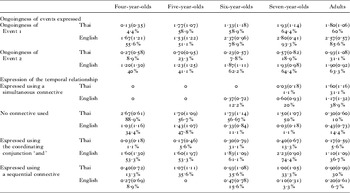
The Thai and English participant's responses to the three animation types are summarized in Tables 4 and 5. Table 4 gives the expressions of ongoingness and the temporal relationship between events for Thai and English participants. As numbers were relatively small and the assumption of homogeneity of variance was not met, a series of Kruskal–Wallis non-parametric tests were conducted to compare responses in the six categories of ongoingness of Event 1, ongoingness of Event 2, simultaneous connective, no connective, coordinating conjunction, sequential connective across languages. Alpha was set at 0·05. Overall the English participants expressed the ongoingness of both events significantly more than Thai participants (Event 1: χ2 (1, N=300)=33·94, p<0·001; Event 2: χ2 (1, N=300)=66·65, p<0·001), which supports the prediction made. Across all age groups there were no significant differences in the use of simultaneous connectives in Thai and English participants. In relation to language-specific patterns, Thai participants used the no connective and sequential connective strategy significantly more than the English participants (χ2 (1, N=300)=45·27, p<0·001; χ2 (1, N=300)=45·65, p<0·001), whereas the English participants used the coordinating conjunction significantly more than the Thai participants (χ2 (1, N=300)=120·42, p<0·001).
The means and standard deviations (in brackets) and percentage of expressions of ongoingness and temporal relationships between the events across all animations

In order to examine developmental patterns, a series of Kruskal–Wallis non-parametric tests were conducted to examine the effect of language for each age group for the six categories. In relation to the four-year-olds, the English children expressed the ongoingness of Event 1 and Event 2 significantly more than the Thai children (χ2 (1, N=60)=24·96, p<0·001; χ2 (1, N=60)=9·35, p=0·002). The English children also used the coordinating conjunction more than the Thai children (χ2 (1, N=60)=28·41, p<0·001), but the Thai children used the no connective response significantly more than the English children (χ2 (1, N=60)=26·22, p<0·001).
For the Thai and English five-year-olds, ongoingness of Event 1 and Event 2 were not significantly different. English children used the coordinating conjunction more than Thai children (χ2 (1, N=60)=25·34, p<0·001), however the Thai children used sequential connectives more than the English children in this age group (χ2 (1, N=60)=24·40 p<0·001).
In relation to the six-year-olds, English children expressed the ongoingness of Event 1 and Event 2 more than the Thai children (χ2 (1, N=60)=12·10, p=0·001; χ2 (1, N=60)=28·68, p<0·001). The English children also used the coordinating conjunction more than the Thai children (χ2 (1, N=60)=26·88, p<0·001), but the Thai children gave the no connective response significantly more than the English children (χ2 (1, N=60)=21·81, p<0·001). The English six-year-old children used significantly more simultaneous connectives than the Thai children (χ2 (1, N=60)=9·04, p=0·003). There was no significant different in usage of sequential connectives in this age group.
For the seven-year-olds, English children expressed the ongoingness of Event 1 and Event 2 significantly more than the Thai children (χ2 (1, N=60)=11·02, p=0·001; χ2 (1, N=60)=22·18, p<0·001). The English children also used the coordinating conjunction more than the Thai children (χ2 (1, N=60)=33·86, p<0·001), but the Thai children gave the no connective and sequential connective response significantly more than the English children (χ2 (1, N=60)=32·17, p<0·001; χ2 (1, N=60)=17·18, p<0·001). The English seven-year-old children used significantly more simultaneous connectives than the Thai children (χ2 (1, N=60)=10·45, p<0·001).
The English adults expressed the ongoingness of Event 1 and Event 2 more than the Thai adults (χ2 (1, N=60)=8·57, p=0·003; χ2 (1, N=60)=11·71, p=0·001). The English adults also used the coordinating conjunction more than the Thai adults (χ2 (1, N=60)=14·61, p<0·001), but the Thai adults gave significantly more sequential connective responses than the English adults (χ2 (1, N=60)=11·39, p=0·001). There was no significant difference between Thai and English adults in the no connective and simultaneous connective responses.
In sum, ongoingness of Event 1 and Event 2 were expressed significantly more by the English participants than the Thai participants (with the exception of the five-year-olds who were not significantly different), which supports the prediction made. In relation to the use of simultaneous connectives, overall age groups results were not significantly different. However, it is noticeable that the Thai children did not in general explicitly express this relationship using simultaneous connectives (apart from one seven-year-old child), whereas the English six-year-olds (five children) and seven-year-olds (seven children) did to a greater extent. In contrast, Thai and English adults both used simultaneous connectives to a similar extent. Thai participants used a sequential connective significantly more than the English participants. The no connective strategy was used frequently by the Thai children, but not by the Thai adults.
Expression of entrance and exit of protagonist
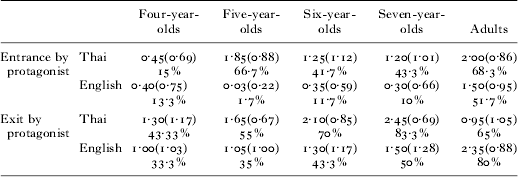
Table 5 summarizes the mean number of expressions of entrance and exit of protagonist for Thai and English participants. A Kruskal–Wallis non-parametric test was used to analyze the two categories of entrance and exit of the protagonist for language. Alpha was set at 0·05. The analysis revealed an overall effect of language for entrance and exit of protagonist (entrance: χ2 (1, N=200)=33·31, p<0·001; exit: χ2 (1, N=200)=7·45, p=0·006). Thai speakers expressed both entrance and exit of the protagonist significantly more than English speakers, which supports the prediction made.
The means and standard deviations (in brackets) and percentage of expressions of deictic motion events in the embedded and partial overlap animations

For the youngest four-year-old age group, there was no significant difference in the expression of entrance and exit of the protagonist for Thai and English children. However, there was a significant difference for the five-year-olds, as Thai children expressed the entrance and exit of the protagonist significantly more than the English children (entrance: χ2 (1, N=40)=27·67, p<0·001; exit: χ2 (1, N=40)=4·92, p=0·023). There was a similar pattern in the six-year-olds and seven-year-olds, as Thai children expressed the entrance and exit of the protagonist significantly more than the English children (entrance: χ2 (1, N=40)=7·97 p=0·005; χ2 (1, N=40)=8·92, p=0·003; exit: χ2 (1, N=40)=4·82, p=0·028; χ2 (1, N=40)=5·73, p=0·017). Both Thai and English four-year-old children were more likely to express the exit of protagonist than entrance of protagonist (t(29)=−3·32, p=0·002; t(29)=−2·69, p=0·012). In contrast, in the adults there was no significant difference between the expression of exit and entrance of protagonist by Thai and English participants.
In relation to animation type, Thai participants expressed entrance significantly more than English participants for the embedded animation (entrance: χ2 (1, N=100)=18·57, p=0·005) but it was not significantly different for exit. However, for the partial overlap animation Thai participants expressed entrance and exit of protagonist significantly more than English participants (entrance: χ2 (1, N=100)=15·11, p<0·001; exit: χ2 (1, N=100)=10·37, p=0·001). In sum, it can be seen from Table 5 that for entrance of protagonist and to a lesser extent for exit of protagonist, the Thai five-, six- and seven-year-olds, but not the youngest age group and adults, expressed entrance and exit more frequently than the English participants.
A COMPARISON OF DEVELOPMENTAL PATTERNS IN THAI AND ENGLISH
Four-year-olds
In both languages the youngest age group, the four-year-olds, have a tendency to respond with a single mono-referential response as illustrated in example (4a) and (4b), as well as juxtaposition of two or more clauses without a connective as illustrated in example (5a) and (5b).
(4a) Thai: khun0 phɔ:2 tha:0 si:4 father paint colour ‘Father paints the colour.’
(4b) English: He's painting a picture.
(5a) Thai: khun0 phɔ:2 tha:0 si:4 dek1 le:n2 lu:k2 bɔ:n0 ju:1 father paint colour child play ball impfv ‘Father paints the colour. The child is playing with the ball.’
(5b) English: The boy's painting. The monkey draws.
Children in the youngest age group also use imperfective aspectual markers; the imperfective aspect markers ju:1 and kam0laŋ0 are used in Thai (5a) and the progressive morpheme -ing is used in English (5b). The imperfective is used more frequently by the English children than the Thai children to give duration to the action.
There are also examples of bi-referential referencing (reference to two points or events in time) emerging in this age group, as indicated by usage of the connectives lε3 ‘and’ and lε:w3 kɔ:2 or lε:w3 ‘then’ in Thai (6a) and and in English (6b). The coordinating conjunction and is used more frequently by the English children than the Thai children.
(6a) Thai:phɔ:2 tha:0si:4 ba:n2 lε3 nɔŋ3 le:n2 bɔn0 father paint colour house and young child play ball ‘Father paints the house and the young child plays with the ball.’ (partial overlap)
(6b) English: The man paints and the baby plays with the ball and he leaves. (embedded overlap)
In the youngest children, it is apparent that the temporal contours depicted in the animations are not all described explicitly in the responses made, and the responses often do not allow the three different animations types to be distinguished. For example a similar response as illustrated in examples (5a) and (5b) is commonly made to all animation types. In relation to the entrance and exit of the protagonist, the children from both language groups are more likely to refer to the exit of the protagonist rather than entrance of protagonist, see example (6b) and (7).
(7) Thai: khun0 mε:2 khuj0 tho0ra3sap1 ?ɔ:k1 paj0 kha:ŋ2 nɔ:k2 dek1 Mother talk phone leave go outside child play le:n2 lu:k2 bɔ:n0 ball ‘Mother talks on the telephone (then) goes outside. The child plays (with) the ball.’ (partial overlap)
Five-year-olds
All the forms that the youngest children, the four-year-olds, used are also present among the responses made by the older children. Aspectual marking is more commonly used by the five-year-old Thai children than the younger age group as illustrated in (8). In addition, in the Thai five-year-olds the particle kɔ:2 is used more frequently than in the younger children. It is used to signal cohesion or clause linkage and precedes the verb, as also illustrated in example (8) (Burusphat, Reference Burusphat1991). The five-year-old Thai children use the imperfective marker more than the younger age group, whereas the English children continue to use imperfective aspectual marking at a similar frequency to the younger children.
(8) Thai: khaw3 kam0laŋ0 ta:0 si:4 ju:1 khrap1 dek1 he impfv paint colour impfv polite marker child ma:0 le:n2 lu:k2 bɔ:n0 khaw3 kɔ:2 ?ɔ:k1 paj0 ball come play he then leave go ‘He is painting the colour. The child comes to play ball. Then he goes.’ (embedded overlap)
In the five-year-olds, it is apparent that there is a decline in the usage of a single clause or event response and an increase in responses with juxtaposition of clauses without a connective. Usage of a bi-referential response increases, which is indicated by the greater usage of connectives in this age group, although the connectives used are limited in variety. Similar connectives as in the four-year-olds are used by the five-year-old children, primarily lε:w3 kɔ:2 or lε:w3'then' in Thai and and is primarily used in English. The English children use connectives more frequently than the Thai five-year-olds, in particular and continues to be a popular selection. In Thai juxtaposition without a connective remains a commonly used strategy. The sequential connective lε:w3 kɔ:2 or lε:w3 ‘then’ is used more frequently by the Thai five-year-olds than the four-year-olds. Furthermore, it is used more frequently by the Thai children than the English children.
The Thai five-year-olds noticeably refer to the entrance of the protagonist more frequently than the younger Thai children, as illustrated in (9). Entrance and exit of protagonist is also expressed more widely amongst the Thai children than the English children. The English children in this age group still do not explicitly express entrance of protagonist frequently.
(9) mε:2 tho0ra3sap1 ju:1 nɔ:ŋ3 le:n2 lu:k2 bɔ:n0 mother phone impfv young child play ball then lε:w3 mε:2 dɣ:n0 ?ɔ:k1 paj0 nɔ:ŋ3 kɔ:2 jaŋ 0 ju:1 mother walk leave go young child then still is ‘Mother is phoning. The young child plays ball then mother leaves. The young child is still (there).’ (partial overlap)
Six- and seven-year-olds
In the older age groups, it is apparent that children are giving more elaborate and detailed responses than the younger children as illustrated by (10a) and (10b). Children are referring more explicitly to the different events depicted in the animations, both the duration and overlap of the actions and the entrance and exit of protagonists. There is a reduction in the use of the juxtaposition of clauses without connective strategy in English children but not in the Thai children. Simultaneous connectives are also used by the English children, i.e. when and while (see 10b), but only one Thai child used a simultaneous connective, phɔ:0 ‘when’ (10c).
(10a) Thai: dek1 phu:2 jiŋ4 kam0laŋ0 khuj0 tho0ra3sap1 lε3 dek1 child girl impfv talk phone and child kɔ2 le:n2 lu:k2 bɔ:n0 lε:w3 dek1 phu:2 jiŋ4 kɔ:2? then play ball then child girl then ɔ:k1 paj0 (partial overlap) leavego ‘The girl is talking (on) the phone and the child then comes to play ball. Then the child goes out.’
(10b) English: The baby came in while the girl was on the phone, then the girl left. (partial overlap)
(10c) Thai:mε:2 kam0laŋ0 khuj0 tho0ra3sap1 ju:1 lε3 lu:k2 mother impfv talk phone impfv and child khaw3 kɔ:2 le:n2 fut3 bɔ:n0 phɔ:0 mε:2 dɣ:n0? s/he then play football when mother walk ɔ:k1 paj0 lu:k2 khaw3 kɔ:2 jaŋ0 le:n2 ju:1 leave go child s/he then still play impfv ‘Mother is talking (on the) phone and the child s/he then plays (with) the football. When the mother walks out the child is still playing.’ (partial overlap)
Adults
The emergence of a range of connectives is a very significant development in both Thai and English adults. In general, the temporal contours depicted in the animations are described in greater detail, so that the different animations can be readily distinguished. The Thai and English adults use a wide range of different connectives. English adults used while, when, as, during, meanwhile, whilst and at the same time as illustrated in (11b). The connective as was used by English adults but not by the children, which concurs with Silva's (Reference Silva1991) findings. Thai adults used kha1na1 thi:2 ‘while’, phɔ:0, mɯa2 ‘when’, ra1wa:ŋ0 ‘during’, phrɔm3kap1 ‘concurrently/at the same time’ to link clauses, which were not in general used by the Thai children (11a). The English adults were more likely to express entrance and exit of the protagonist than the children, but in particular entrance (11b).
(11a) Thai: phɔ:2 tha:0 si:4 kha1na1 tha:0 si:4 lu:k2 khla:m0 father paint colour while paint colour child crawl ma:0 le:n2 bɔ:n0 lε:w3 lu:k2 kɔ2 khla:m0 klap1 paj0 come play ball then child then crawl return go ‘Father paints the colour. While (he) paints the colour the child crawls in plays (with) the ball then the child crawls back.’ (embedded overlap)
(11b) English: The girl is on the phone, as she's talking on the phone the baby comes out and rolls a ball. The girl hangs up the phone and walks out. The baby continues to roll the ball. (partial overlap)
It can be seen from this overview of developmental patterns of the different age groups that a finer or more detailed description is given of the temporal events and actions depicted in the animations with age.
DISCUSSION
The current study has found that English speakers tend to express the ongoingness of the two events depicted in the short animations more frequently than Thai speakers. These findings concur with results found in the frog story narratives, which found that speakers from languages such as English with obligatory grammaticalized imperfective aspect tend to express the temporal ongoingness of events more than speakers from languages that do not have obligatory, grammaticalized aspect, e.g. Hebrew and German (Berman & Slobin, Reference Berman and Slobin1994). Thai speakers did not express the ongoingness of the animations as much as the English speakers, which supports the notion that the degree of ‘obligatoriness’ of aspectual marking influences the expression of temporal events. Simultaneous connectives were not found to be used significantly more by English than Thai speakers overall. However, there was a relatively earlier use of simultaneous connectives by English children in comparison with Thai children (only one Thai seven-year-old used a simultaneous connective to explicitly express this relationship). This gives qualified support for the prediction made that temporal connectives are used at a relatively earlier stage by children who speak English, which has obligatory, grammaticalized imperfective aspect in comparison with Thai, which does not have obligatory aspectual marking. In sum, it appears that the degree of obligatoriness of imperfective aspect is affecting what aspects of the overlapping temporal events depicted are expressed by Thai and English speakers.
Furthermore, as predicted, Thai speakers in general (excluding the four-year-olds) expressed the ‘entrance’ and ‘exit’ of the protagonist significantly more than English speakers. It was particularly apparent for ‘entrance’ of protagonist. This concurs with findings from the frog story as Thai speakers frequently used deictic-path verbs to express motion events, particularly for ‘entrance’ of protagonist (Slobin, Reference Slobin, Strömqvist and Verhoeven2004). These results indicate that the small closed set of deictic-path verbs in Thai increases the likelihood that speakers will express the entrance and exit of protagonists depicted in the animations in comparison with English speakers.
Underlying conceptual complexity plays a major role in the acquisition of temporal terms and the expression of temporal events and actions (Keller-Cohen, Reference Keller-Cohen1981; Slobin, Reference Slobin and Slobin1985; Weist et al., Reference Weist, Atanassova, Wysocka and Pawlak1999). Children initially used a mono-referential system of reference (the speech time is the sole point of reference). Typically, in both languages the youngest children responded with a single clause response or juxtaposed two independent clauses without a connective. Children then added a bi-referential dimension to their linguistic system, which was reflected by an increased usage of temporal connectives. In the younger children, the expressive options were very limited. The Thai children predominantly used lε:w3 kɔ:2 ‘then’, whereas the English children tended to use and. The five-year-olds used these connectives more than the four-year-olds, reflecting an increase in bi-referential referencing responses. Young children are also constrained by the range of perspectives they can take (Berman & Slobin, Reference Berman and Slobin1994), which is reflected in the children's responses. The youngest children did not explicitly express all the temporal events and actions depicted in the animations, and responses made to the three different animations types were very similar and often indistinguishable. Both Thai and English four-year-olds did not express entrance of protagonist frequently and yet they did for exit of protagonist, which suggests that exit is more salient or encodable than entrance of protagonist in the animations to the youngest children; the exit of protagonist occurs later in the animation and closer to time of recall. The older Thai children tended to refer to these deictic actions in their responses. However, even the oldest English children tended not to express the entrance of the protagonist, whereas the adults did. Gradually as children mature they are able to utilize a greater number of expressive options and perspectives in expressing the temporal events and actions depicted. Eventually, older children and adults are able to make finer and more detailed descriptions of complex temporal contours.
Language-specific patterns also emerged. The coordinating conjunction ‘and’ was used more frequently by English than Thai speakers. It was commonly used by most of the youngest four-year-old English-speaking children (nine children). As and is multifunctional and relatively unrestricted in usage, it has been found to be one of the first connectives used by children in the construction of compound sentences in several languages – English, Italian, German and Turkish (Clark, Reference Clark, Flores d'Arcais and Levelt1970; Clancy et al., Reference Clancy, Jacobsen and Silva1976; Hood et al., Reference Hood, Lahey, Lifter, Bloom and Sackett1978; Bloom et al., Reference Bloom, Lahey, Lifter and Fiess1980). In the current study usage was found to reach a peak in the English seven-year-old children, but then decline in the adults, who used relatively more simultaneous connectives. Simultaneous connectives were used relatively late in the current study; first usage occurred in the six-year-old English-speaking children but not till seven years in the Thai children. A more popular strategy used by Thai speakers was to juxtapose the two clauses without a connective. This is a common strategy used by young preschool English children (Weist et al., Reference Weist, Lyytinen, Wysocka and Atanassova1997). However, in the older Thai children, there is also a predilection to use this strategy and juxtapose two clauses without a connective. This strategy was not found to be so prevalent in Thai adults, who also utilized temporal connectives to relate the two events. Sequential connectives in general were used more by Thai speakers to express the temporal relationship between the two events than English speakers. An additional consideration is that lε:w3 kɔ:2 ‘then’ in Thai could have a less strong sequential interpretation than its English counterpart then.
In relation to the question whether children show the same characteristic language-specific patterns as adults, there is support, as the youngest four-year-old children adhere to the expected pattern that English children will express the ongoingness of events more than Thai children. However, in relation to entrance of protagonist, the youngest Thai and English children were not found to be significantly different, and hence do not adhere to the same patterns as the older children. The youngest Thai and English children did not express entrance of protagonist as frequently as exit, which is likely due to cognitive constraints, and that exit of the protagonist was nearer time of recall than entrance in this task. The results for the Thai and English adults also do not conform to expectations as much as the older children, as most Thai and English adults expressed these deictic events. Adults have the cognitive and linguistic resources available that enables them to express these events, even if the language is not conducive to expressing them.
Based on Berman & Slobin's (Reference Berman and Slobin1994) study, it was predicted that there would be an earlier usage or acquisition of simultaneous connectives in English than Thai children due to ‘the channeling effect of attention’ of obligatory aspectual marking in English in comparison with the non-obligatory aspectual marking in Thai (Berman & Slobin, Reference Berman and Slobin1994; Slobin, Reference Slobin, Gentner and Goldin-Meadow2003). English children do use simultaneous connectives earlier and more frequently than Thai children, but this could also be due to language-specific patterns and preferences rather than thinking-for-speaking effects per se. There are overriding problems in differentiating between what are thinking-for-speaking effects and what are language-specific patterns of usage in a language. Discourse organizational structure and language-usage conventions are markedly different between Thai and English, which are also reflected in the current data; in Thai it is common practice to omit the connective and to juxtapose two clauses; however in English and other Indo-European languages, usage of the coordinating conjunction and is a common and frequently used means of connecting clauses. Furthermore, in order to assess if grammatical obligatory categories have a channeling effect on ‘attention’, we need to empirically test this claim. One possible approach is to monitor eye movements while participants observe animations, as the pattern of eye fixations and the trajectory of the eye are an indicator of visual attention (Rayner, Reference Rayner1998). We would expect English speakers to be more focused on the ongoingness of the actions, whereas Thai speakers would be more focused on the entrance and exit of the protagonist.
This is clearly a preliminary study, hence we have to be cautious in interpreting the current data as only a small number of children and adults participated, and a relatively small number of stimuli were presented to participants. In addition, there are methodological problems associated with investigating thinking-for-speaking phenomena in cross-linguistic studies, as thinking-for-speaking effects are confounded by language-specific patterns and preferences. In sum, the obligatoriness of grammatical aspect appears to be a factor in shaping Thai and English speakers' expressive responses to animations depicting various degrees of overlap or simultaneity. Thai speakers appear to be influenced by the non-obligatoriness of the imperfective aspectual system and consequently do not express the ongoingness of the events to such a great extent as English speakers. In addition, the deictic-path category in Thai appears to encourage the expression of deixis by Thai speakers, in particular for the entrance of protagonist. In order to further investigate the effects of grammatical categories and obligatoriness of aspectual marking on the expression of temporal events, it would be desirable to examine a greater variety of languages. In particular, Hebrew and German, without grammaticalized imperfective aspectual marking, would make an interesting comparison, as well as other languages similar to Thai that have grammaticalized aspect that is not obligatory in usage, such as Mandarin Chinese, Cantonese or Malaysian.