1. Introduction
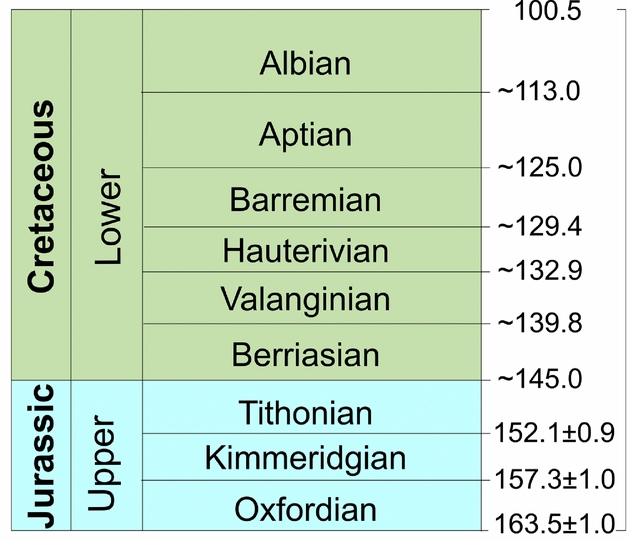
The Geological Time Scale for the Phanerozoic has one of its last geochronological gaps in the latest Jurassic – Early Cretaceous interval, where no precise radioisotopic ages are available (Fig. 1) (Cohen et al. Reference Cohen, Finney, Gibbard and Fan2013). The global Lower Cretaceous ‘standard’ subdivisions (stages) are based on sequences in the Mediterranean Province of the Tethyan Realm and are currently defined by biostratigraphic markers, especially ammonites and calcareous nannofossils (e.g. Channell et al. Reference Channell, Casellato, Muttoni and Erba2010; Wimbledon et al. Reference Wimbledon, Casellato, Reháková, Bulot, Erba, Gardin, Verreussel, Munsterman and Hunt2011; Reboulet et al. Reference Reboulet, Szives, Aguirre-Urreta, Barragán, Company, Idakieva, Ivanov, Kakabadze, Moreno-Bedmar, Sandoval, Baraboshkin, Çaglar, Fözy, González-Arreola, Kenjo, Lukeneder, Raisossadat, Rawson and Tavera2014; Aguado et al. Reference Aguado, Company, O’Dogherty, Sandoval and Tavera2014). Unfortunately, one of the main problems is that in most areas where such good biostratigraphic control exists, there are few suitable rocks for modern high-precision geochronology, for example by chemical abrasion isotope dilution thermal ionization mass spectrometry (CA-ID-TIMS) U–Pb zircon dating techniques. As a result, the exact age of stage and substage boundaries remains uncertain (Fig. 1).
The 2013 Upper Jurassic – Lower Cretaceous geological time scale of the International Commission on Stratigraphy. Note that most of the numerical ages are approximate (from Cohen et al. Reference Cohen, Finney, Gibbard and Fan2013).

Most of the previous tentative numerical age tie-points in the Early Cretaceous (Berriasian–Barremian) of Tethys are indirect, and based upon the correlation of biostratigraphic data with magnetic chrons, which, in turn, have very poor and controversial time controls for this time span (see Channell et al. Reference Channell, Casellato, Muttoni and Erba2010; Ogg & Hinnov, Reference Ogg, Hinnov, Gradstein, Ogg, Schmitz and Ogg2012 a). Some approaches have focused mainly on the Pacific sea-floor spreading numerical model of the M-sequence magnetic-polarity pattern and from limited recent cyclostratigraphic studies (Gradstein et al. Reference Gradstein, Ogg, Schmitz and Ogg2012). Other authors combined robust nannofossil biostratigraphy and cyclostratigraphy to constrain the numerical dates for stage boundaries based on the accepted magnetochron ages (Sprovieri et al. Reference Sprovieri, Coccioni, Lirer, Pelosi and Lozar2006).
Wan et al. (Reference Wan, Scott, Chen, Gao and Zhang2011) studied Lower Cretaceous strata exposed in southern Tibet in order to identify the Jurassic/Cretaceous (J/K) boundary using calcareous nannofossil assemblages and to constrain the age of Valanginian nannofossils with U–Pb SHRIMP zircon dating. Based on a single date from a rhyolite, they proposed that the numerical age of the Valanginian⁄Hauterivian boundary should be no older than 136±3.0 Ma and, by considering sedimentary accumulation rates in the studied sections, the J⁄K boundary was estimated to be 145 Ma. More recently, Liu et al. (Reference Liu, Ji, Jiang, Kuang, Ji, Gao, Zhang, Peng, Yuan, Wang and Xu2013) working also in the same general area of Tibet, studied ammonites and nannofossils, integrating their biostratigraphic results with four U–Pb SIMS zircon ages. Their main conclusion was that the J/K boundary should be older that 141–142 Ma.
The first attempt to combine robust biostratigraphic control provided by ammonites and calcareous nannofossils with high-precision CA-ID-TIMS zircon ages was published by Vennari et al. (Reference Vennari, Lescano, Naipauer, Aguirre-Urreta, Concheyro, Schaltegger, Armstrong, Pimentel and Ramos2014) for the J/K boundary in the Neuquén Basin, a predominantly marine retro-arc basin (Fig. 2a) in the foothills of the Argentine Andes. Higher in the Neuquén sequence, episodic pyroclastic deposits are interbedded with fossiliferous dark shales and limestones of Hauterivian age in the upper part of the Agrio Formation. The ammonite and calcareous nannofossil sequences here are well documented and can be correlated confidently with the ‘standard’ Mediterranean sequence (Section 4 below). A previous study (Aguirre-Urreta et al. Reference Aguirre-Urreta, Pazos, Lazo, Fanning and Litvak2008) combined this robust biostratigraphy with U–Pb SHRIMP ages in zircons from the Agrio Formation to provide an isotopic date for the base of the Upper Hauterivian. Our new research follows the recommendations of Gradstein et al. (Reference Gradstein, Ogg, Schmitz and Ogg2012) to use the U–Pb CA-ID-TIMS zircon method to provide more precise age determinations for that level and for the Hauterivian/Barremian boundary.
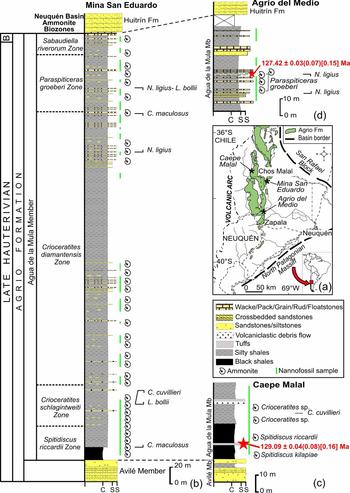
(a) The Neuquén Basin in west-central Argentina showing outcrops of the Agrio Formation, basin borders and location of studied localities. (b) Lithic log of the Agua de la Mula Member of the Agrio Formation in Mina San Eduardo with ammonoid zonation and nannofossil bioevents. B. – Barremian. (c) Lithic log of lower part of the Agua de la Mula Member in Caepe Malal with location of the tuff layer. (d) Lithic log of upper part of the Agua de la Mula Member in Agrio del Medio with location of the tuff layer.

2. The geological setting
The Agrio Formation (Weaver, Reference Weaver1931) covers extensive areas of the Neuquén Basin in west-central Argentina (Fig. 2a). It is up to 1300 m thick and is divided into three members (Leanza & Hugo, Reference Leanza and Hugo2001). Both the Pilmatué and Agua de la Mula members are marine, mainly composed of dark shales and paler, silty shales interbedded with limestones that contain an abundant invertebrate fauna. The middle Avilé Member is a 30–40 m thick package of yellowish coarse sandstones, often with cross-bedding of fluvial and aeolian origin (Gulisano & Gutiérrez Pleimling, Reference Gulisano and Gutiérrez Pleimling1988). The Agrio Formation represents a storm-dominated, shallow-marine environment, with mixed siliciclastic and carbonate sedimentation (Brinkmann, Reference Brinkmann1994; Spalletti et al. Reference Spalletti, Poire, Pirrie, Matheos and Doyle2001). Ammonoids and calcareous nannofossils together indicate that the formation is of late Early Valanginian to earliest Barremian age. Detailed ammonite zonation of the Neuquén Basin is based on Aguirre-Urreta & Rawson (Reference Aguirre-Urreta and Rawson1997) with subsequent modifications in Aguirre-Urreta et al. (Reference Aguirre-Urreta, Rawson, Concheyro, Bown, Ottone, Veiga, Spalletti, Howell and Schwarz2005, Reference Aguirre-Urreta, Mourgues, Rawson, Bulot and Jaillard2007) and Aguirre-Urreta & Rawson (Reference Aguirre-Urreta and Rawson2012). Nannofossil zones and events are documented by Bown & Concheyro (Reference Bown and Concheyro2004) and Concheyro et al. (Reference Concheyro, Lescano, Caramés and Ballent2009). Integration of the two zonal schemes is presented by Aguirre-Urreta et al. (Reference Aguirre-Urreta, Rawson, Concheyro, Bown, Ottone, Veiga, Spalletti, Howell and Schwarz2005) and Concheyro et al. (Reference Concheyro, Lescano, Caramés and Ballent2009).
One of the key factors of the Agrio Formation is that it is associated with a volcanic arc that is mainly exposed in the Chilean slope of the Andean Cordillera at these latitudes. Jurassic–Cretaceous magmatic activity along the arc was clearly episodic (Parada et al. Reference Parada, López-Escobar, Oliveros, Fuentes, Morata, Calderón, Aguirre, Féraud, Espinoza, Moreno, Figueroa, Muñoz-Bravo, Troncoso Vásquez, Stern, Moreno and Gibbons2007; Morata et al. Reference Morata, Féraud, Aguirre, Arancibia, Belmar, Morales and Carrillo2008). This calcalkaline volcanic activity, frequently of an explosive nature, shows pyroclastic pulses that peaked in Early Tithonian (Naipauer et al. Reference Naipauer, Tunik, Marques, Rojas Vera, Vujovich, Pimentel, Ramos, Sepúlveda, Giambiagi, Pinto, Moreiras, Tunik, Hoke and Farías2014), Middle–Late Berriasian (Vennari et al. Reference Vennari, Lescano, Naipauer, Aguirre-Urreta, Concheyro, Schaltegger, Armstrong, Pimentel and Ramos2014) and Late Hauterivian (this study) times to reach a maximum in Aptian–Albian times (Charrier, Pinto & Rodríguez, Reference Charrier, Pinto, Rodríguez, Moreno and Gibbons2007). These magmatic pulses may be related to the intermittent nature of the subduction and to variation in the convergence rates associated with migration and expansion of the volcanic front (Ramos, Reference Ramos2010; Folguera & Ramos, Reference Folguera and Ramos2011). Because the volcanism was intermittent there are only scattered ash-fall horizons within the Agrio Formation. In the study area, tuffs are very rare and thin in the Lower Hauterivian sequence but frequent in the Upper Hauterivian succession, in the Agua de la Mula Member. Two tuffs were sampled from this member, one at Caepe Malal and the other at Agrio del Medio, where two detailed partial sections were measured (Fig. 2c, d). A complete section through the member was studied at Mina San Eduardo, to provide a valuable reference section to which the two tuff-bearing sequences can be correlated (Fig. 2b).
2.a. Mina San Eduardo section (37°32′25″S, 70°00′22″W)
The Agua de la Mula Member reaches 475 m here (Fig. 2b) and is generally well exposed though partially covered in the middle. Fissile bluish-black shales at the base are followed by dark shales and paler silty shales with numerous levels of fossiliferous calcareous nodules. Up sequence the dark shales are interbedded at first with thin siltstones and floatstones, and then with more frequently intercalated fine calcareous sandstones and silty sandstones. The section ends with a 2 m thick, orange, hard calcareous siltstone. Ammonoids recovered from 43 horizons have been grouped into five biozones, from the Spitidiscus riccardii Biozone at the base up to the Sabaudiella riverorum Zone at the top. Calcareous nannofossils recovered from 72 horizons allowed the recognition of seven successive bioevents, consisting of the first common occurrence (FCO) of Clepsilithus maculosus, the first occurrence (FO) of Lithraphidites bollii, the last occurrence (LO) of Cruciellipsis cuvillieri, the FO of Nannoconus ligius and the LOs of Clepsilithus maculosus, N. ligius and L. bollii (Fig. 2b).
The basal levels record the FCO of Clepsilithus maculosus (BAFC-NP 1728), a species previously only recorded in the CC4-A (Eiffellithus striatus) Subzone in the Neuquén Basin (Aguirre-Urreta et al. Reference Aguirre-Urreta, Rawson, Concheyro, Bown, Ottone, Veiga, Spalletti, Howell and Schwarz2005; Concheyro et al. Reference Concheyro, Lescano, Caramés and Ballent2009). In the section, this bioevent occurs in the Spitidiscus riccardii ammonite zone. The FO of L. bollii and LO of Cruciellipsis cuvillieri (BAFC-NP 1743) have been determined together in levels with Crioceratites schlagintweiti. These bioevents mark the lowest part of the CC4-B Subzone in the Neuquén Basin.
High in the diamantensis Zone, the FO of Nannoconus ligius (BAFC-NP 1777) indicates a level high in the Neuquén CC4-B Subzone. Further up the section, the LOs of C. maculosus (BAFC-NP 1783), L. bollii and N. ligius (BAFC-NP 1788) indicate the CC5 Zone.
2.b. Caepe Malal section (37°11′S, 70°23′W)
The succession in Caepe Malal extends from the top 15 m of the Pilmatué Member, through the Avilé (83 m) and Agua de la Mula (280 m) members to the base of the Huitrín Formation. A partial section measured at the base of the Agua de la Mula Member (Fig. 2c) starts with c. 18 m of fissile dark bluish calcareous shales, in which a pale yellow vitric tuff, 1.2 m thick, is intercalated 7 m above the base and between two horizons yielding Spitidiscus characteristic of the S. riccardii Zone. The vitric tuff is formed almost exclusively by angular unwelded volcanic shards and exhibits low contents of quartz and plagioclase crystaloclasts; open spaces are filled by secondary carbonates. The succession continues with dark shales with impressions of Crioceratites sp. at two levels (Fig. 2c). Nannofossil assemblages in these and the underlying shales are very poor and badly preserved, only characterized by the presence of C. cuvillieri (BAFC-NP 3119). Higher in the sequence, several subaqueous volcaniclastic debris-flow deposits occur interbedded in the dark shales. Zircons in the vitric tuff gave an age of 132.08±1.3 Ma by U–Pb SHRIMP dating (Aguirre-Urreta et al. Reference Aguirre-Urreta, Pazos, Lazo, Fanning and Litvak2008), but we present here a new, more precise U–Pb zircon age using the CA-ID-TIMS method (Section 3 below).
2.c. Agrio del Medio section (38°20′S, 69°57′W)
The Agua de la Mula Member here reaches 420 m in thickness. The topmost part of the section (Fig. 2d) starts with an orange oyster floatstone followed by a thick greenish shale package interbedded with thin fine ondulitic sandstones. Up sequence, greenish shales with thin fine sandstones include ten prominent levels of floatstones and rudstones with a highly diverse marine fauna (bivalves, ammonoids, serpulids, crinoids, sponges and gastropods) and one conspicuous, 15 cm thick, whitish vitric tuff dated here by the U–Pb zircon CA-ID-TIMS method. In the vitric tuff, shards are the main component of the glass that it is highly altered to carbonate. Crystals are less than 10%; angular quartz grains with engulfments and plagioclase are dominant, followed in abundance by biotite and K-feldspar. Volcanic lithic particles are rare and zircons are present as accessory minerals. Two channelized oolitic grainstones reveal the somerization of the succession. The grainstones are overlain by shales with another conspicuous bioclastic grainstone. The contact with the overlying Huitrín Formation is covered.
Ammonites characteristic of the Paraspiticeras groeberi Zone occur at four horizons, the highest just above the tuff level. Moderately preserved nannofossils have been recovered from ten horizons. Two bioevents, FO and LO of Nannoconus ligius (BAFC-NP 3940 and BAFC-NP 3943, respectively), have been recorded (Fig. 2d), both within the Paraspiticeras groeberi Zone. These bioevents occur in the CC4-B nannofossil subzone and CC5 nannofossil zone of the Neuquén Basin zonation, respectively.
3. U–Pb CA-ID-TIMS results
Abundant populations of relatively large (c. 100–300 microns in long dimension), elongate, prismatic zircon crystals were separated from both tuff hand samples by conventional density and magnetic methods. The entire zircon separate from each sample was placed in a muffle furnace at 900°C for 60 hours in quartz beakers to anneal minor radiation damage; annealing enhances cathodoluminescence (CL) emission and prepares the crystals for subsequent chemical abrasion (Mattinson, Reference Mattinson2005). Following annealing, individual grains were hand-picked, mounted, polished and imaged by CL on a scanning electron microscope. From these compiled images, grains with consistent and dominant CL patterns were selected for further isotopic analysis (see Figs S1 & S2 in the online Supplementary Material available at http://journals.cambridge.org/geo).
Selected crystals were plucked from grain mounts, chemically abraded using a single aggressive abrasion step in concentrated HF at 195°C for 12 hours, and the residual crystals processed for ID-TIMS. The details of ID-TIMS analysis are described by Davydov et al. (Reference Davydov, Crowley, Schmitz and Poletaev2010) and Schmitz & Davydov (Reference Schmitz and Davydov2012). U–Pb dates and uncertainties for each analysis were calculated using the algorithms of Schmitz & Schoene (Reference Schmitz and Schoene2007), the U decay constants of Jaffey et al. (Reference Jaffey, Flynn, Glendenin, Bentley and Essling1971) and values of 235U/205Pb = 100.2329 and 233U/235U = 0.99506 for the ET535 tracer. Other details of analytical parameters can be found in the notes to Table S1 in the online Supplementary Material available at http://journals.cambridge.org/geo.
Propagated age uncertainties are based upon non-systematic analytical errors, including counting statistics, instrumental fractionation, tracer subtraction and blank subtraction. These error estimates should be considered when comparing our 206Pb–238U dates with those from other laboratories that used tracer solutions calibrated against the EARTHTIME gravimetric standards. When comparing our dates with those derived from other decay schemes (e.g. 40Ar–39Ar, 187Re–187Os), the uncertainties in tracer calibration (0.05%; Condon et al. Reference Condon, Schoene, Bowring, Parrish, McLean, Noble and Crowley2007) and U decay constants (0.108%; Jaffey et al. Reference Jaffey, Flynn, Glendenin, Bentley and Essling1971) should be added to the internal error in quadrature. Quoted errors for calculated weighted means are thus of the form ±X(Y)[Z], where X is solely analytical uncertainty, Y is the combined analytical and tracer uncertainty, and Z is the combined analytical, tracer and 238U decay constant uncertainty.
3.a. Caepe Malal tuff
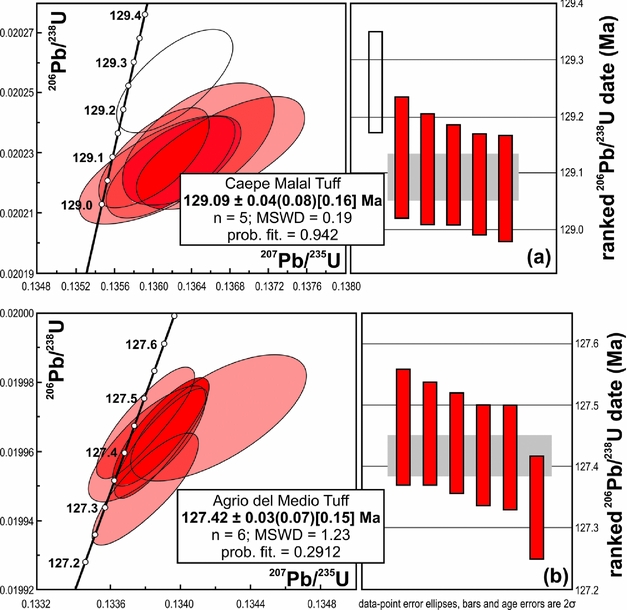
CL-imaging of the 47 zircon crystals from the Caepe Malal tuff sample revealed a consistent population of moderately to brightly luminescent, oscillatory zoned crystals (Fig. S1 in the online Supplementary Material available at http://journals.cambridge.org/geo). A minority of crystals have irregularly shaped, uniform to complexly zoned cores overgrown by these luminescent, oscillatory rims. Six of the largest zircon grains were selected for CA-TIMS analysis on the basis of CL pattern (Table S1 in the online Supplementary Material available at http://journals.cambridge.org/geo). Five of the six analyses are concordant and equivalent, with a weighted mean 206Pb–238U date of 129.09±0.04(0.08)[0.16] Ma (MSWD = 0.19) (Fig. 3a), which is interpreted as dating the eruption and deposition of this tuff. A single crystal yielded a resolvable older 206Pb–238U date of 129.26±0.09 Ma, which is interpreted to contain a small nucleus of inherited zircon in its core.
U–Pb CA-ID-TIMS data for chemically abraded zircons from the Agua de la Mula Member of the Agrio Formation (Concordia plots and mean 206Pb–238U ages). (a) Caepe Malal tuff. (b) Agrio del Medio tuff.

3.b. Agrio del Medio tuff
CL-imaging of the 74 largest zircon crystals from the Agrio del Medio tuff sample revealed a consistent population of moderately to brightly luminescent, oscillatory zoned crystals (Fig. S2 in the online Supplementary Material available at http://journals.cambridge.org/geo). A prominent thin non-luminescent (dark) zone occurs approximately two-thirds to three-quarters of the radius from the centre of most crystals. A lesser number of crystals have irregularly shaped, relatively non-luminescent cores overgrown by the luminescent, oscillatory rims. Six grains were selected for CA-TIMS analysis on the basis of the uniform, predominant CL pattern, avoiding those crystals with resorbed non-luminescent cores. All six analyses are concordant and equivalent, with a weighted mean 206Pb–238U date of 127.42±0.03(0.07)[0.15] Ma (MSWD = 1.23) (Fig. 3b), which is interpreted as dating the eruption and deposition of this tuff.
4. Correlation of tuff horizons with the Tethyan ‘standard’
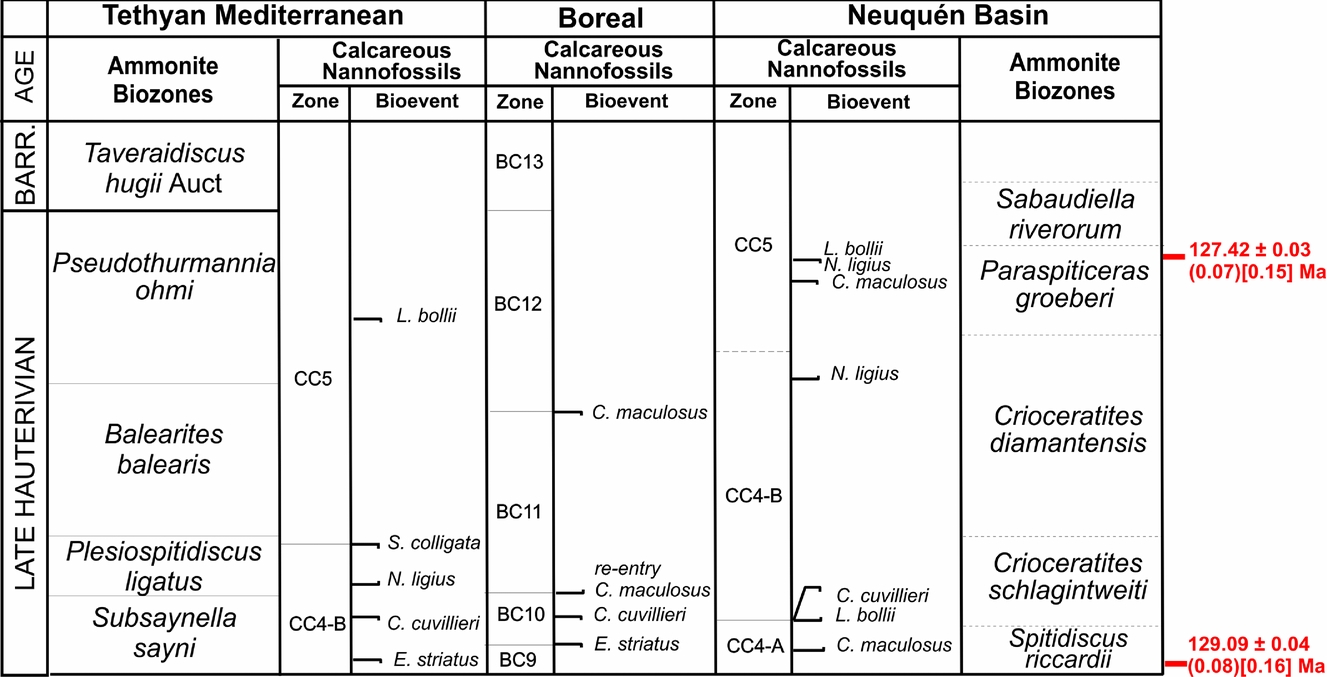
Ammonite evidence places both tuff horizons firmly within the Neuquén Basin ammonite zonation: the lower tuff lies just above the base of the Spitidiscus riccardii Zone and the upper is high in the Paraspiticeras groeberi Zone. Correlation of the Neuquén ammonite zonation with the West Mediterranean zonal scheme of the Tethyan Realm, which is taken as the ‘standard’, was discussed by Aguirre-Urreta & Rawson in Reboulet et al. (Reference Reboulet, Szives, Aguirre-Urreta, Barragán, Company, Idakieva, Ivanov, Kakabadze, Moreno-Bedmar, Sandoval, Baraboshkin, Çaglar, Fözy, González-Arreola, Kenjo, Lukeneder, Raisossadat, Rawson and Tavera2014) and their Late Hauterivian to earliest Barremian correlation is summarized in Figure 4. The base of the Spitidiscus riccardii Zone is correlated with the base of the Subsaynella sayni Zone, which marks the base of the Upper Hauterivian. The Paraspiticeras groeberi Zone is correlated with part of the highest Hauterivian Pseudothurmannia ohmi Zone.
Late Hauterivian – Early Barremian chart with Tethyan Mediterranean and Neuquén ammonite zonation and the correlation with calcareous nannofossil bioevents and zones in the Mediterranean and Boreal realms and in the Neuquén Basin, with location of the new numerical U–Pb CA-ID-TIMS ages in red.

Calcareous nannofossil records support this correlation. Combining the calcareous nannofossil records from the Mina San Eduardo, Caepe Malal and Agrio del Medio sections, seven bioevents have been identified through the Agua de la Mula Member. Most of these correspond to bioevents that have been used to construct the Mediterranean zonation of the Tethyan Realm (Sissingh, Reference Sissingh1977; Applegate & Bergen, Reference Applegate, Bergen, Boillot, Winterer and Meyer1988). However, the FO and LO of Clepsilithus maculosus, considered Boreal bioevents (Rutledge & Bown, Reference Rutledge and Bown1996) are also recognized here and elsewhere in the Neuquén Basin (Fig. 4) (see selected nannofossil species in Fig. S3 in the online Supplementary Material available at http://journals.cambridge.org/geo).
From the seven bioevents recognized, three of them are discussed here, the FO and LO of Lithraphidites bollii and the LO of Cruciellipsis cuvillieri. Lithraphidites bollii, a consistent marker, has been found in several Mediterranean sections and oceanic boreholes, allowing valuable correlations (e.g. Cecca et al. Reference Cecca, Pallini, Erba, Premoli-Silva and Coccioni1994; Sprovieri et al. Reference Sprovieri, Coccioni, Lirer, Pelosi and Lozar2006; Aguado et al. Reference Aguado, Company, O’Dogherty, Sandoval and Tavera2014). Applegate & Bergen (Reference Applegate, Bergen, Boillot, Winterer and Meyer1988) used the FO of L. bollii as a marker for the base of CC4-A. The CC4-A and CC4-B boundary has been considered Early Hauterivian in the Tethyan Realm, and has been correlated with the Crioceratites loryi ammonite zone (Bergen, Reference Bergen1994) and with Polarity Chron CM9 (Ogg & Hinnov, Reference Ogg, Hinnov, Gradstein, Ogg, Schmitz and Ogg2012 b). However, in several sections of the Neuquén Basin, the FO of L. bollii occurs at a higher level, near the base of the Upper Hauterivian (Aguirre-Urreta et al. Reference Aguirre-Urreta, Rawson, Concheyro, Bown, Ottone, Veiga, Spalletti, Howell and Schwarz2005). The LO of L. bollii has been used as a reliable marker within the CC5 Zone. In the Tethyan region, it occurs within the Pseudothurmannia ohmi ammonite zone (Bergen, Reference Bergen1994), at the top of the Hauterivian (Aguado et al. Reference Aguado, Company, O’Dogherty, Sandoval and Tavera2014; Reboulet et al. Reference Reboulet, Szives, Aguirre-Urreta, Barragán, Company, Idakieva, Ivanov, Kakabadze, Moreno-Bedmar, Sandoval, Baraboshkin, Çaglar, Fözy, González-Arreola, Kenjo, Lukeneder, Raisossadat, Rawson and Tavera2014) and within the Polarity Chron CM5 (Ogg & Hinnov, Reference Ogg, Hinnov, Gradstein, Ogg, Schmitz and Ogg2012 b). In the Neuquén Basin, this bioevent is recorded high in the Agua de la Mula Member, in beds included in the Paraspiticeras groeberi ammonite zone, which in turn is correlated with part of the Pseudothurmannia ohmi Zone (Fig. 4).
The LO of Cruciellipsis cuvillieri has been used as a global marker for the Early–Late Hauterivian boundary (Bralower et al. Reference Bralower, Leckie, Sliter, Thierstein, Berggren, Kent, Aubry and Hardenbol1995; Mutterlose et al. Reference Mutterlose, Autran, Baraboschkin, Cecca, Erba, Gardin, Herngren, Hoedemaker, Kakabadze, Klein, Leereveld, Rawson, Ropolo, Vasicek and von Salis1996; Ogg, Agterberg & Gradstein, Reference Ogg, Agterberg, Gradstein, Gradstein, Ogg and Smith2004). In the Tethyan Realm, this bioevent is associated with the LO of E. striatus (Ogg, Ogg & Gradstein, Reference Ogg, Ogg and Gradstein2008) in the middle part of the Subsaynella sayni ammonite zone (Bergen, Reference Bergen1994) close to the base of CM8r in Italy (Channell et al. Reference Channell, Erba, Nakanishi, Tamaki, Berggren, Kent, Aubry and Hardenbol1995; Channell, Cecca & Erba, Reference Channell, Cecca and Erba1995). As the S. sayni Zone has not been recognized in the Boreal Realm, the LO of C. cuvillieri has proved to be an important link between both realms. However, in the Boreal Realm both bioevents (LO of C. cuvillieri and LO de E. striatus) occur in the Upper Hauterivian (Bown et al. Reference Bown, Rutledge, Crux, Gallagher and Bown1998). In the Neuquén Basin, the LO of Cruciellipsis cuvillieri is at the base of the Crioceratites schlagintweiti Zone (Aguirre-Urreta et al. Reference Aguirre-Urreta, Rawson, Concheyro, Bown, Ottone, Veiga, Spalletti, Howell and Schwarz2005) of early Late Hauterivian age.
5. Discussion: significance of the new dates
In a seminal paper published 40 years ago, Baldwin, Coney & Dickinson (Reference Baldwin, Coney and Dickinson1974) discussed the dilemma of the Cretaceous time scale and sea-floor spreading rates. Their main conclusion was that Cretaceous spreading rates could not be finally established until the Cretaceous time scale was more precisely calibrated to numerical time. Several attempts in recent years to calibrate the magnetic time scale for the Late Jurassic – Early Cretaceous have failed, either for lack of precise ages from altered oceanic floor basalts, or for poor biostratigraphic control of these oceanic sequences (Mahoney et al. Reference Mahoney, Duncan, Tejada, Sager and Bralower2005).
We present here two robust ages tied with precise calcareous nannofossil bioevents and ammonites of Late Hauterivian age in the Neuquén Basin. The first one, of 129.09±0.04(0.08)[0.16] Ma, is from a tuff level only 7 m above the base of the Upper Hauterivian sequence, so we can place with some confidence the Early–Late Hauterivian boundary at 129.5 Ma. This age is very close to that proposed by Channell et al. (Reference Channell, Erba, Nakanishi, Tamaki, Berggren, Kent, Aubry and Hardenbol1995) and Channell, Cecca & Erba (Reference Channell, Cecca and Erba1995) based on direct correlation of ammonite biozones and land section magnetostratigraphy, together with radiometric ages. It is much older than the data published by Fiet et al. (Reference Fiet, Quidelleur, Parize, Bulot and Gillot2006) who bracketed the Hauterivian between 123.6±1.7 Ma and 118.3±1.7 Ma based on K–Ar dating of glauconite combined with orbital chronology. It also differs markedly from Ogg & Hinnov's Reference Ogg, Hinnov, Gradstein, Ogg, Schmitz and Ogg(2012a) placement of this boundary at 133 Ma. It should be noted here that in their figure 27.6 these authors misplaced the Early–Late Hauterivian boundary in the middle of the Balearites balearis Zone instead of at the base of the Subsaynella sayni Zone as internationally accepted (Reboulet et al. Reference Reboulet, Rawson, Moreno-Bedmar, Aguirre-Urreta, Barragan, Bogomolov, Company, Gonzalez-Arreola, Stoyanova, Lukeneder, Matrion, Mitta, Randrianaly, Vasicek, Baraboshkin, Bert, Bersac, Bogdanova, Bulot, Latil, Mikhailova, Ropolo and Szives2011, Reference Reboulet, Szives, Aguirre-Urreta, Barragán, Company, Idakieva, Ivanov, Kakabadze, Moreno-Bedmar, Sandoval, Baraboshkin, Çaglar, Fözy, González-Arreola, Kenjo, Lukeneder, Raisossadat, Rawson and Tavera2014).
Our second age, of 127.42±0.03(0.07)[0.15] Ma, is from a tuff level that correlates with the upper part of the Pseudothurmannia ohmi Zone and is therefore close to the top of the Hauterivian. So we suggest the Hauterivian/Barremian boundary is around 127 Ma. Again our datum is much older than that of Fiet et al. (Reference Fiet, Quidelleur, Parize, Bulot and Gillot2006) who placed that boundary at 118.3±1.7 Ma, but younger than the ages of Ogg & Hinnov Reference Ogg, Hinnov, Gradstein, Ogg, Schmitz and Ogg(2012a) and Cohen et al. (Reference Cohen, Finney, Gibbard and Fan2013) who placed the top Hauterivian at 130.8 Ma and ~ 129.4 Ma, respectively.
The new data presented here imply moving the base of the Barremian by 3 to 4 Ma in comparison with Gradstein et al.'s (Reference Gradstein, Ogg, Schmitz and Ogg2012) and the International Commission on Stratigraphy's (ICS) time scale. However, this displacement is comparable with Vennari et al.'s (Reference Vennari, Lescano, Naipauer, Aguirre-Urreta, Concheyro, Schaltegger, Armstrong, Pimentel and Ramos2014) placement of the base of the Cretaceous at 140 Ma, 5 million years younger than on the present ICS 2013 time scale. Their work is also based on a U–Pb CA-ID-TIMS numerical age combined with nannofossil and ammonite biostratigraphy of the Neuquén Basin.
Our new ages also support the proposal of He et al. (Reference He, Pan, Tauxe, Qin and Zhu2008) who dated the M0r, which is presently taken as marking the base of the Aptian, to 121.2±0.5 Ma by 40Ar–39Ar dating. This is very important because the age of the M0r has been used as a key point to construct the Early Cretaceous magnetic polarity time scale and to estimate the Pacific Ocean spreading rates.
These results are also relevant for the stratigraphy of the Agua de la Member of the Agrio Formation. The two age dates indicate a sedimentation rate ranging from 170 m/Ma to 190 m/Ma in the eastern part of the basin (Agrio del Medio and Mina San Eduardo localities, respectively) and 110 m/Ma in the northwest (Caepe Malal section). These sedimentation rates are consistent with a mixed siliciclastic–carbonate ramp setting and higher than those of pure siliciclastic shelves (Einsele, Reference Einsele2000).
In conclusion, our two new radioisotopic ages–129.5 Ma for the base of the Late Hauterivian and 127 Ma for the base of the Barremian – support the proposal of Channell et al. (Reference Channell, Erba, Nakanishi, Tamaki, Berggren, Kent, Aubry and Hardenbol1995), Channell, Cecca & Erba (Reference Channell, Cecca and Erba1995) and He et al. (Reference He, Pan, Tauxe, Qin and Zhu2008) to date the base of the Aptian around 121 Ma and that of Vennari et al. (Reference Vennari, Lescano, Naipauer, Aguirre-Urreta, Concheyro, Schaltegger, Armstrong, Pimentel and Ramos2014) to move up the base of the Berriasian to 140 Ma. Investigations in progress will hopefully provide more robust data in order to improve the numerical dating of the Berriasian and Valanginian in the marine succession of the Argentine Andes.
Acknowledgements
We are grateful to S. Adamonis, D. Lazo, E. Ottone and P. Pazos (UBA) for their help in the field. This work was supported by CONICET (V.A.R. PIP 509), ANPCYT (B.A.U. PICT 0464/10), UBACYT (V.A.R. 09523, B.A.U. 09678). This is contribution R-139 of the Instituto de Estudios Andinos Don Pablo Groeber (UBA-CONICET).
Supplementary materials
To view the Supplementary Material for this article, please visit http://dx.doi.org/10.1017/S001675681400082X