The argument that institutional change is characterized by path dependence has appeared in economics (North, Reference North1990 and 2005; David, Reference David1994), political science (Pierson, Reference Pierson2000), sociology (Mahoney, Reference Mahoney2001), and law (Bebchuk and Roe, Reference Bebchuk and Mark1999; Hathaway, Reference Hathaway2001).Footnote 1 Many social scientists believe that studying path dependence is the key to answering fundamental questions about institutions, including questions about how institutions evolve over time and why institutions sometimes persist even when they seem to have negative consequences for economic growth, political participation, or justice.
But not all social scientists agree that an emphasis on path dependence enhances our understanding of institutions. Gerald Alexander (Reference Alexander2001) argues that most political institutions are not path dependent. Colin Crouch and Henry Farrell (Reference Crouch and Henry2004) argue that an emphasis on path dependence leads us to ignore the opportunities to switch paths. Amy Bridges (Reference Bridges2000) suggests that the idea of path dependence has been misapplied to the analysis of institutions. Even proponents of the examination of path dependence complain that the term is misused (Mahoney, Reference Mahoney2001: 4; North, Reference North2005: 51).
Arguments about the value of path dependence as a methodological approach have taken place largely on a theoretical, rather than an applied, level. Applications demonstrating how path dependence improves our understanding of institutions remain relatively scarce. In fact, Douglass North recently suggested that ‘a major frontier of scholarly research is to do the empirical work necessary to identify the precise sources of path dependence’ (North, Reference North2005: 77). We explore this frontier of research on institutions by identifying the sources of path dependence in the development of American bankruptcy law during the years 1880 to 1938. We argue that an analysis that includes path dependence explains the development of bankruptcy law more completely than does the standard interpretation in the literature.
The standard interpretation is that the modern, debtor-friendly, US bankruptcy law resulted from a political compromise in 1898.Footnote 2 The standard interpretation claims that the original bill, which was drafted by associations of creditors, was changed to gain the support of legislators who were more sympathetic to debtors (Skeel, Reference Skeel2001: 43). Charles Jordan Tabb, for example, states that, ‘Notwithstanding its origins with the credit industry, the 1898 Act ushered in the modern era of liberal debtor treatment in United States bankruptcy law’ (Tabb, Reference Tabb1995: 24). The 1898 Bankruptcy Act has, however, only been viewed as debtor-friendly in retrospect. In 1898, Democrats argued that the Bankruptcy Act was nothing more than a national collection law. In the years following the enactment of the 1898 law, Democratic congressmen continued to argue that it was oppressive for debtors and continued to seek its repeal. Opponents of the 1898 Bankruptcy Act did not believe there had been any compromise.
The authors of the 1898 Bankruptcy Act were merchants and manufacturers concerned with small business failures. In the first 20 years after it was enacted, the law was widely used by these creditors and the majority of cases were business bankruptcies. However, it became increasingly apparent that the system of administration they created to deal with business bankruptcy presented no obstacles to discharge for bankrupt wage earners. By the late 1920s, it was clear that the primary use of bankruptcy law had shifted from distributing the assets of a failed business to discharging insolvent wage earners.
The changing reality of bankruptcy law led to changes in interests groups lobbying for bankruptcy legislation, changes in the Democratic Party's position on bankruptcy law, and changes in beliefs about the role of bankruptcy in the economy. First, organized groups of legal professionals and retail creditors replaced the wholesalers and manufacturers as the primary lobbyists for bankruptcy legislation. Lawyers found a lucrative business in bankruptcy and retailers found wage earner bankruptcy an increasingly common problem. Second, the Democratic Party dropped its opposition to the bankruptcy law as it became increasingly clear that the law was actually used primarily for debt relief. Third, beliefs about the primary purpose of bankruptcy law changed to fit the actual workings of the law. By the 1930s, legislators, judges, and even creditors stated that the primary purpose of bankruptcy law was to relieve debtors. The interplay of these forces in the 1930s prevented attempts to change the administration of the law, and resulted in the addition of wage earner workouts and business reorganization to the bankruptcy law. The debtor-friendliness of American bankruptcy was an unintended and path-dependent outcome of the 1898 Bankruptcy Act, rather than the result of a legislative compromise.
1. Path dependence and theories of institutional change
The first models of institutional change developed by new institutional economists employed the comparative statics of neo-classical economics.Footnote 3 Starting from an initial equilibrium, these models predict that institutional change occurs when an exogenous shock creates incentives for individuals to alter some institution. A society moves from one institutional equilibrium to another in response to an exogenous shock in the same way that a market moves from one equilibrium to another in response to changes in such exogenous variables as income, prices of inputs, and technology.
The focus of the new institutional economics on exogenous factors as the determinants of institutional change contrasts markedly with the work of old institutional economists. For Veblen, ‘changing institutions in turn make for a further selection of individuals endowed with the fittest temperament, and a further adaptation of individual temperament and habits to the changing environment through the formation of new institutions’ (Veblen, Reference Veblen1973: 131). A classic example is Veblen's argument that institutions adopted in England during the Industrial Revolution severely constrained the country's ability to respond to changes in economic circumstances in the late nineteenth century (Veblen, Reference Veblen1968).
Recently, interest in endogenous institutional change has experienced resurgence, motivated by the belief that ignoring endogenous change is inconsistent with the central premise of institutional economics: institutions matter.Footnote 4 If institutions influence rates of technological change, the distribution of wealth and other important factors, it is reasonable to suspect that these changes might then influence subsequent institutional change.
The concept of path dependence incorporates endogenous change back into the analysis of institutional change. According to Paul David, ‘A path dependent stochastic process is one whose asymptotic distribution evolves as a consequence (function of) the process's own history’ (David, Reference David, Pierre and Stavros2001). Because in the path-dependent view change is stochastic, exogenous shocks remain a feature of the process. In fact, exogenous shocks become even more important because their effects can be persistent.
There has been considerable controversy in economics over the use of path dependence to analyze the process by which economies might become ‘locked in’ to inefficient technologies (Liebowitz and Margolis, Reference Liebowitz and Margolis1990 and Reference Liebowitz and Margolis1995; and David, Reference David, Pierre and Stavros2001). David, however, warns that path dependence need not lead inevitably to an inefficient outcome. Path dependent systems may ‘become locked in to attractors that are optimal, or that are just as good as any others in the feasible set, or that take paths leading to places everyone would wish to have been able to avoid, once they have arrived there’ (David, Reference David, Pierre and Stavros2001). In other words, the essential feature of path dependence is not the nature of the outcome. It is the nature of the process that is essential. A path dependent process moves in a direction that is influenced by previous steps in the process.
How path dependence manifests itself, depends on the specific institution under consideration. In the United States, the story of changes in bankruptcy law begins with Congress because the Constitution empowers Congress to enact uniform laws on bankruptcy. A large literature describes the static choices of legislators as a function of ideology, party influence, constituent interest, and organized interests. To support a claim that bankruptcy law is a path dependent process, we must show that early choices in legislation caused changes in ideology, organized interest groups, constituent interests, or party influence, which then, in turn, influenced subsequent legislation.Footnote 5 Path dependence thus acts as a complement to traditional studies of legislative change not a substitute for them. Bankruptcy legislation was determined by the interest groups, party politics and preferences that existed in the 1930s, but we show that these determinants had themselves been determined, at least in part, by earlier bankruptcy legislation.
To make the case for a path dependent explanation of debtor-friendly bankruptcy law it is necessary to show that it is more consistent with the available evidence than alternative explanations. There are three alternative paths through which nineteenth-century creditor-friendly bankruptcy law could have been transformed into twentieth-century debtor friendly bankruptcy law:
1. Bankruptcy law became debtor friendly as a result of a political compromise in 1898. Path dependence played a limited role as a stabilizing force, preventing repeal of the Act. This is the standard interpretation.
2. The 1898 Bankruptcy Act was not debtor friendly (that is, there was no 1898 compromise with pro-debtor groups), but the United States shifted toward debtor friendly bankruptcy law in the early twentieth century as a result of exogenous shocks rather than path dependent forces. This alternative fits the profile of early New Institutional models of institutional change.
3. The 1898 Bankruptcy Act was not debtor friendly, but a combination of exogenous and path dependent processes led to debtor friendly bankruptcy law. This alternative recognizes the exogenous changes in the economy that contributed to the transformation of bankruptcy law, and also argues that endogenous, path-dependent changes played an important role.
We argue that the third alternative is most consistent with the historical evidence. The argument proceeds as follows. In Section 2, we establish that the 1898 Bankruptcy Act was not the result of a compromise with pro-debtor groups. In Section 3, we review how the 1898 Bankruptcy Act led to changes in interest group activity regarding bankruptcy legislation. In Section 4, we explain how the 1898 Bankruptcy Act unintentionally facilitated an increase in wage earner bankruptcy that altered both public beliefs about the role of bankruptcy law in the economy and the Democratic Party's stance toward bankruptcy legislation. Section 5, describes how these changes in interest groups, party influence, ideology and constituent interests came together to shape bankruptcy legislation in the 1930s.
2. Proposals for bankruptcy legislation: 1881–1898
The federal government enacted four bankruptcy laws during the nineteenth century – one each in 1800, 1841, 1867, and 1898. The first two were passed in the wake of financial crises and repealed within a few years because of complaints by creditors about high expenses and low dividends. The third law was enacted in 1867. It was amended several times and lasted longer than its predecessors, but, again, complaints of excessive fees and expenses led to its repeal in 1878.
In 1881, three years after the repeal of the 1867 Bankruptcy Act, The New York Board of Trade and Transportation organized a National Convention of Boards of Trade and asked Judge John Lowell to draft a bankruptcy bill. The merchants and manufacturers who belonged to the Boards of Trade were concerned with bankruptcy law because they typically provided unsecured trade credit to the retailers. Merchants and manufacturers desired a federal bankruptcy law because three features of state collection laws made collecting on bad debts difficult. First, the details of collection laws varied from state to state, forcing merchants and manufacturers to learn the laws in all the states in which they wished to sell goods. Second, many state laws discriminated against creditors who were not citizens of the state. Third, many of the state laws were codified versions of common law remedies and provided a first-come, first-served distribution of assets. The first-come, first-served rule of collection created incentives for creditors to race to be the first to file a claim, a practice that could create insolvency for even a financially sound debtor.
Lowell's bankruptcy bill was introduced in the Senate in 1882, and the next year Senator John Ingalls, a Republican from Kansas, introduced an alternative bill. Both the Lowell bill and the Ingalls bill used systems of bankruptcy administration referred to as officialism. Official systems rely on government officials to oversee the administration of bankruptcy cases and the investigation of the bankrupts. Lowell argued that these officials would provide the ‘supervision over the speedy and economical settlement of bankrupt estates which creditors can not be relied on to furnish’ (quoted in Dunscomb, Reference Whitney1893: 147).
After failing to obtain passage of either bill, merchants and manufacturers met again under the name of The National Convention of Representatives of Commercial Bodies in 1889. Jay Torrey, lawyer, businessman and president of the Convention drafted a new bill that the Convention lobbied for throughout the 1890s.
In contrast to Lowell and Ingalls, Torrey believed that creditor control rather than officialism would provide the best remedy for the high fees and expenses that had plagued previous American bankruptcy laws. Under the Torrey bill, the court was required to schedule a meeting of creditors within 30 days of the filing of a petition. The creditors were authorized to select a trustee. Creditors were expected to play an active role in the examination of bankrupts, ensuring honesty and the highest possible dividends.
The National Convention of Representatives of Commercial Bodies presented bankruptcy law as an important means of promoting interstate commerce. As a measure promoting interstate commerce, bankruptcy law fitted neatly into the ideological divide that already existed between Democrats and Republicans. Richard Bensel (Reference Bensel2002) argues that the three pillars of Republican policy in the late nineteenth century were the gold standard, protective tariffs, and a national market. Bankruptcy law was supported by Republicans as part of the program of promoting a national market. The position of the Republican Party on bankruptcy was summarized by George Ray of New York:
We have tried to so frame the bill as to promote business intercourse and the giving of credit. Under its provisions, when in operation, the manufacturer and merchant in New England will not hesitate to extend credit to the trader in New Orleans. The merchants and traders of the great Northwest will not fear to extend it to those asking it all through out the South (Congressional Record, 1898, 28 June: 6435).
Bankruptcy, then, was not primarily about discharging insolvent debtors for Republicans, it was part of a broader program for creating the conditions necessary to support a modern commercial nation.
Like Republicans, Democrats regarded bankruptcy as one piece in a puzzle. Opposition to the Torrey bill was part and parcel of Democratic opposition to the gold standard, expansion of the power of federal courts, and to big business.Footnote 6 Democrats opposed the Torrey bill precisely because it promoted a national economy. They argued that a national bankruptcy law would take away one of the few advantages that local wholesalers had over national businesses (Hansen, Reference Hansen1998: 105). As an alternative to the Torrey bill, Democrats advocated a temporary and purely voluntary bankruptcy law under which only debtors could file petitions. They further proposed that bankruptcy be administered through state courts rather than federal courts.
The standard interpretation of the 1898 Bankruptcy Act posits that compromises between Republicans and pro-debtor interests made the Torrey bill debtor friendly, and that the bill's enactment was due to these compromises. Douglas Boshkoff (Reference Boshkoff1982) suggests that the commercial associations probably made compromises to pro-debtor interests in the drafting of the bill. Boshkoff notes that in the Torrey bill discharge was not conditional upon paying a certain percentage of the debt or upon obtaining the consent of creditors. He claims that ‘one can only conclude that the creditor forces concluded this was a battle they could not win’ (Boskoff, 1982: 108).
However, the members of the Association, including Torrey, believed that a discharge should be contingent only on the honest behavior of the debtor. They believed that leaving an honest debtor with un-discharged debt burden was bad public policy. Torrey wrote:
If [the petitioner] is an honest man he ought to be discharged from the obligation to the end that he may be, if he can, a proprietor, instead of a salaried clerk. If he is held down by the burden of debt he is ordinarily forced into competition with the great army of day laborers and salaried workers and it is not possible that he can make any considerable payment of obligations and at the same time provide education and maintenance of the average family. (National Convention of Representatives of Commercial Bodies, 1889: 119)
Note that Torrey is unconcerned by wage earners. His analysis not only reveals why advocates of the national bankruptcy law supported discharge of any honest debtor, but the extent to which they were concerned only with facilitating business credit.
Torrey also argued that making a discharge contingent on payment of a particular percentage of the debt was unjust because while one debtor might be discharged ‘another debtor of equal moral worth could not have a discharge because his estate had sold under unfavorable circumstances’ (Senate Miscellaneous Document No. 165, 55th Cong. 2nd Session, 1898: 9).
In addition, advocates of bankruptcy law argued that making discharge contingent on anything other than the honesty of the debtor defeated the fundamental purpose of the law, to prevent the ‘race of diligence’ and preferential treatment of some creditors. According to Judge Lowell, requiring creditor consent would inevitably lead to a situation in which, ‘certain creditors, the most avaricious and the least scrupulous, will take advantage of any power which may be given them over the debtor's discharge by exacting terms from him, either of present payment or of promises for the future’ (Lowell, Reference Lowell and Lalor1899).
It has also been argued that Republican legislators modified the Torrey bill to obtain needed votes. According to David Skeel (Reference Skeel2001: 39) ‘the Republicans who promoted bankruptcy had to make concessions to pro-debtor interests to minimize defections (especially of southern and western Republicans) and to pick up a few Democratic votes’. Evidence for this interpretation should be clear in the Congressional record. We would expect to see notable changes between the early versions of the bankruptcy bill and the conference report that was passed by both houses, and we would expect compromises to be reflected in changes in the votes cast on various versions of the bills.
The primary features of the Torrey bill, however, remained unchanged. From the beginning, the Torrey bill had been based on creditor control; allowed individuals and most businesses to file voluntary bankruptcy petitions; prohibited involuntary bankruptcy petitions against wage earners and farmers; provided for the liquidation of a debtor's non-exempt assets; required pro-rata distribution of the proceeds among like creditors; specified that exemptions were to be determined by each state; provided for a discharge; and made acts of fraud, false statements, and concealing property grounds for criminal punishment and denial of a discharge.Footnote 7
The bankruptcy bill introduced in the House by David Henderson was acknowledged to be the Torrey bill (Congressional Record, 1898, 16 February: 1804). The Henderson Bill was passed in the house on a vote of 120 yeas to 67 nays. The Senate, however, passed a bankruptcy bill put forward by Knute Nelson, on of vote of 45 yeas to 11 nays. A conference committee was established to resolve the differences between the two bills.
Knute Nelson, the sponsor of the Senate bill, declared the main differences to be: ‘First as regards to the grounds of involuntary bankruptcy; next as the grounds for which a bankrupt could be imprisoned; and, thirdly, what limitations and restrictions should be placed upon a discharge’ (Congressional Record, 1898, 24 June: 6297). He claimed that the conferees had softened the bill in all of these areas. The changes made in conference were, however, more about style than substance.
The Henderson bill had made it an act of bankruptcy if a debtor concealed, removed, or remained away from his place of business, residence, or domicile with the intent to avoid civil process or defeat his creditors. This ground for involuntary bankruptcy was removed in the conference report, but Henderson pointed out that its removal was probably of little consequence because the conference report made it an act of bankruptcy for an insolvent debtor to fail to remove a preference obtained by legal proceedings five days before a sale of his property. In the debtor's absence a creditor could obtain an attachment on his property; the debtor would then have to return and remove the preference or prove his solvency in order to avoid being forced into bankruptcy.
The number of grounds on which a discharge might be denied was reduced from nine to two. The two grounds that remained were: ‘(1) committed an offense punishable by imprisonment as here in provided; or (2) with fraudulent intent to conceal his true financial condition and in contemplation of bankruptcy, destroyed concealed or failed to keep books of account from which his true condition might be ascertained’ (Senate Document 294, 55th Congress 2nd Session, 1898: 8). But the reduction from nine grounds for denial to two is partly the result of rewording rather than the result of actually eliminating grounds for discharge. Offenses punishable by imprisonment included concealing property of his estate, and making a false oath or account in relation to the bankruptcy proceedings, which had been listed among the nine original grounds upon which a discharge might be denied. In other words, these acts remained grounds for the denial of a discharge. In addition, the original Henderson bill had refused a discharge if the debtor ‘had within four months of the adjudication given a preference not surrendered to the trustee, obtained property by false statements or representations, made a fraudulent transfer of property, or transferred property in contemplation of bankruptcy otherwise than in the ordinary course of his business.’ These actions were removed from the list of grounds upon which a discharge might be denied. But Henderson himself noted that the discharge would not cover debts directly arising from those acts (Congressional Record, 1898, 28 June: 6428).
Not surprisingly, the changes did little to reduce the partisan rhetoric or voting. David De Armond declared of the conference report: ‘No man can read a page of it without finding upon that page indisputable evidence that the bill originated with those who have debts to collect’, and that ‘scarcely can the insolvent get through under this law and with this machinery if those who take the other side – the creditors – choose to bar the exit and deny him a discharge’ (Congressional Record, 1898, 28 June: 6429). DeArmond's views seem to have been shared by other Democrats; voting remained split along partisan lines (Hansen, Reference Hansen1997 and 1998). More than 80% of the Democratic votes cast were against passing the conference report.
The conference report was passed in the House by a vote of 134 to 53, with 112 of the yea votes cast by Republicans. Only 14 representatives switched from voting nay on the Henderson bill to voting yea on the conference report. Only one of the 14 was a Republican. In the Senate, the conference report passed 43 to 13. Five senators who had voted for the Nelson bill voted against the conference report, but three who had voted against the Nelson bill voted for the conference report.
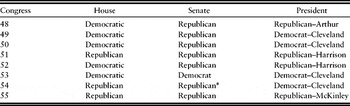
The highly partisan nature of voting on bankruptcy would not have been a problem had it not been the case that for most of the 1880s and 1890s control of the House and Senate was split. Table 1 shows that for most years between 1882 and 1898 neither party held clear control. Before the 55th Congress, in which the Bankruptcy Act was passed, Republicans controlled the House, the Senate and the White House only in the 51st Congress. During the 51st Congress the House passed the Torrey bill, but the Senate, more concerned with tariffs and monetary issues, did not have time to take it up (Hansen, Reference Hansen1998: 103). In the 54th Congress Republicans held a majority in the House, but in the Senate they held just 44 seats, while Democrats held 40, Populists 4 and silver Republicans held 2 seats. In the 55th Congress Republicans held a clear majority in both houses and had McKinley in the White House. A national bankruptcy law was passed in 1898 because the Republican Party had sufficient control of Congress to get its bankruptcy bill to a Republican President.
Party control, 1882–1900

Note: *Republicans held a plurality not a majority.
James Olmstead (Reference Olmstead1902), writing in the Yale Law Journal, has frequently been used as evidence that the 1898 Bankruptcy Act was regarded as debtor-friendly by contemporary observers, because of Olmstead's reference to bankruptcy law as a ‘Hebrew Jubilee’ (Skeel, Reference Skeel2001: 251; and Tabb, Reference Tabb1995: 23). Olmstead, however, did not believe the 1898 Bankruptcy Act was a ‘Jubilee’. To the contrary, he warned that ‘if the “Hebrew Jubilee” idea is to prevail, the country will be confronted with successive repeals as heretofore’ (Olmstead, Reference Olmstead1902: 843). He argued that both the constitutional history and late nineteenth century congressional debates showed that the Bankruptcy Act “is essentially a commercial regulation, and that its main objects are administration or distribution, rather than the relief of the debtor” (Olmstead, Reference Olmstead1902: 843).Footnote 8
In 1902, when Republican sought to amend the law, Democrats called attention to ‘the fact that the present act is the most oppressive law, so far as the unfortunate debtor is concerned, that has ever been enacted’ (Congressional Record, 1902, 17 June: 6945). David De Armond offered as a substitute an amendment that would have repealed the law. The result was that 60 out of 80 Democratic votes were cast for repeal of the law, while 117 out of 121 Republican votes were against repeal. The Republican amendments passed without a roll call vote.
The 1903 amendments are sometimes portrayed as attempts to remove compromises made in 1898 (Tabb, Reference Tabb1991: 366; and Skeel, Reference Skeel2001: 44). It is not clear why Republicans would have to make major compromises in 1898, but not in 1902. Political conditions were roughly the same in 57th Congress as they had been in the 55th. In the House, Republicans held 200 of 357 seats in the 57th Congress as opposed to 206 in the 55th Congress. In the Senate, Republicans held 56 seats in the 57th Congress as opposed to 51 in the 55th Congress.
The 1903 amendments were less attempts to restore some teeth to the law, than they were attempts to close loopholes, respond to legal decisions, and generally make the law more useful for businesses (US Department of Justice, 1903: 125). One of the amendments eliminated a loophole that allowed liabilities arising from fraud to be discharged if the creditor did not obtain a judgment before the discharge was granted. Alimony, child support, and liabilities from causing intentional harm to someone were added to the list of debts that would not be discharged. Four grounds for denial of a discharge were added. Two of the grounds had appeared in the Torrey bill: obtaining credit on a false statement; and concealing, destroying, or conveying property with the intent to defeat a creditor. David Henderson had suggested in 1898 that these acts would be adequately dealt with by not discharging the obligations directly associated with them, but George Ray argued that including them as grounds for denial of a discharge was in keeping with the philosophy that only honest bankrupts should receive a discharge (Congressional Record, 1902 17 June: 6940). Two of the new grounds for denial of discharge had not been included in the Torrey bill. The two new grounds were that a person could be denied a discharge if they had received one in the previous six years, or if they failed to obey the orders of the court. The law was also amended to allow corporations to file voluntary bankruptcy petitions, to allow trustees to file cases in either State or Federal courts, and to provide that creditors who had received payments from bankrupts in the due course of business did not have to surrender those payments before proving their other claims.
Even if one viewed the amendments as attempts to restore the original Torrey bill, the central problem posed in this paper remains to be solved. How did a bill that was viewed by many as a creditors bill and amended to make it even more of a creditors bill ultimately lead to what is widely regarded as the most debtor friendly bankruptcy system in the world? The debates on the 1903 amendments shed light on the issue by again showing the extent to which people still thought of bankruptcy as a business problem not a wage earner problem. The report of the Minority of the House Judiciary Committee stated that, ‘The man who has gone voluntarily into bankruptcy and made an honest showing has been, in some degree considered in this legislation, but it does seem to make the unfortunate debtor, who has been put into involuntary bankruptcy . . . subject to every inquisitorial method and harsh measure that commercial lawyers and hard-hearted creditors can suggest’ (Congressional Record, 1902, 17 June: 6946). When Democratic critics of the law spoke about its harshness they referred to the involuntary feature of the law, which applied only to business owners not wage earners or farmers.
At the end of the first decade after the law was enacted Republicans continued to argue that the law ‘encourages commercial activity, no matter how distant the creditor and the debtor may be’ (Congressional Record, 23 February 1910: 2265). They claimed it had ‘done more to increase the credit of the poorer sections of this country than any law that was ever put on the books’ (Congressional Record, 1910, 23 February: 2273). Democrats still sought its repeal. In the House in 1910, 81 out of 121 Democratic votes were cast for repeal, while 126 out of 135 Republican votes were against repeal.
To sum up, the texts of the bankruptcy bills themselves, and the legislative history do not support the argument that the 1898 Bankruptcy Act was the result of a political compromise or that it was regarded as debtor friendly. The question remains: did bankruptcy law move in a debtor friendly direction in the twentieth century as a result of exogenous shocks, as a result of changes set in motion by the 1898 Bankruptcy Act itself, or did both contribute?
3. Changes in organized interest groups, 1899–1919
Changes in interest groups concerned with bankruptcy law began to appear soon after the passage of the 1898 Act. Lawyers’ interest groups grew stronger; the business-oriented credit men turned their attention elsewhere; and retail creditors began to form their own associations to represent their interests.
Lawyers actively supported the Bankruptcy Act because the system of creditor control provided many opportunities for them. In 1910, Representative Clayton described how legislation could create a self-reinforcing mechanism in the form of an interest group, declaring that ‘whenever a special interest is sheltered behind special legislation, then immediately. . .there is formed some sort of trust, some sort of association for the perpetuation of that special interest’. In the case of bankruptcy that special interest was ‘the referees in bankruptcy, the receivers in bankruptcy, the court favorites, the men who are fed by virtue of the bankruptcy law’ (Congressional Record, 1910, 23 February: 2272).
David Skeel (Reference Skeel1999) argues that ‘the genius of the Bankruptcy Act’ was precisely that it gave rise to a group of lawyers with a vested interest in preserving the law. The bankruptcy bar opposed efforts to repeal the law and became a force in shaping future legislation, but there are several reasons why its significance should not be overstated. First, Republicans retained control of both the House and Senate for the first decade after the law was passed. Although the House Judiciary Committee recommended repeal in 1905, the voting record makes clear that the vast majority of Republican legislators continued to support the law. Second, lawyers had benefited from earlier bankruptcy laws. By the 1860s, it was already an old joke that lawyers were the primary beneficiaries of bankruptcy law. In 1867, Senator Cragin declared that the only correspondence he had received in favor of a bankruptcy law was from a lawyer who said ‘that the law business in his community was very dull and he hoped the bankrupt bill might pass so as to give more business to the legal profession’ (Congressional Globe, 1867, 12 February: 1189).
The difference between the 1898 Act and previous bankruptcy laws was that it worked well enough that merchants and manufacturers did not seek its repeal. The National Convention of Representatives of Commercial Bodies, formed for the sole purpose of obtaining bankruptcy legislation, ceased to exist after the law was passed.
Individual associations, especially the Credit Men's Association, continued to lobby legislators to vote against repeal and to pass amendments to improve the law, but they did not press for any wholesale changes. They were particularly pleased that the law ended the race of diligence and facilitated out-of-court settlements that had been difficult to obtain before (Brewster, Reference Brewster1924: 454). Credit men turned their attention toward fostering private settlements in order to gain the maximum benefit from the law. The number of private adjustment bureaus recognized by the National Association of Credit Men increased from five in 1904 to 84 in 1922. For many creditors the Bankruptcy Act was most successful when it enabled them to stay out of bankruptcy court.
The merchants and manufacturers who had supported the 1898 Bankruptcy Act continued to remain unconcerned about wage earner bankruptcy. In a speech to the meeting of the National Association of Credit Men in 1905 William Prendergast observed that if retailers ‘suffered through wage-earners or consumers availing themselves of the discharge feature of the law, those who sell to the consumer must understand that they have the remedy in their own hands and are in a position at any time to curtail credit’ (Prendergast, Reference Prendergast1905: 382). In 1928, the National Association of Credit Men still regarded consumer credit as essentially illegitimate (Meech, Reference Meech1928: 60). The Association represented wholesalers and manufacturers that provided credit to retailers. For them the expansion of consumer credit in the 1920s was a source of increased risk that their customers would default.
It is, perhaps, not surprising given the attitude toward retail credit expressed by the National Association of Credit Men that retailers formed their own association, the National Association of Retail Credit Men, in 1912. At first retail creditors focused on trying to reduce the default rate by providing services such as exchange of information (New York Times, 1917, 8 July: 24). In the late 1920s, they began to participate in the national legislative process. In 1927, the members of the National Retail Credit Men's Association changed its name to the National Retail Credit Association and voted to lobby the federal government to conduct a survey of credit methods (New York Times, 1927, 13 August: 19). After they obtained support for the survey, they lobbied to make it an ongoing activity rather than a one time study. By the early 1930s, the association had over 1,300 credit bureaus and was serving over 150,000 retail credit providers (Washington Post, 1934, 16 June: 18).
With the addition of retail creditors there were three organized interest groups with distinct and sometimes opposing views on bankruptcy legislation. The wholesalers and manufacturers, represented by the National Association of Credit Men, were joined by two groups that could trace their origins to the passage of the Bankruptcy Act: bankruptcy lawyers and retail creditors. The stake of the two new groups would be enhanced by the rapid expansion of wage earner bankruptcy in the 1920s.
4. Wage earner bankruptcy
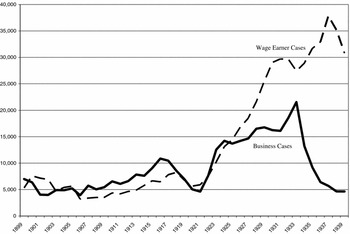
The primary features of the national bankruptcy law remained largely the same in the 1920s as when it had been enacted in 1898. The use of the law, however, had changed dramatically. Figure 1 shows wager earner cases and business (merchant and manufacturer) bankruptcy cases from 1899 to 1933. After 1924, wage earner cases exceeded business cases in each year, and the gap widened as the rate of wage earner bankruptcy increased. The wage earner bankruptcy rate was less than 10 per 100,000 persons from 1899 to 1923, but reached 17 per 100,000 in 1928, and 21 per 100,000 in 1929. By the time of the Chandler Amendments to the Bankruptcy Act in 1938, wage earner cases were 70% of all bankruptcy cases.
Wage earner and business bankruptcy cases, 1899–1939 Source: Annual Report of the Attorney General of the United States, Washington, DC: GPO, Years 1899–1939.

How could so many wage earner bankruptcies take place under a law that was drafted by creditors, regarded as unfriendly to debtors, and amended to make obtaining a discharge more difficult? The crux of the matter, is that the people who drafted and lobbied for the 1898 bankruptcy Act were concerned with business failure not wage earner bankruptcy. They sought a law that would provide for the equitable and efficient distribution of the assets of an insolvent business, and they believed that the creditors of the business were in the best position to provide it.
The system of administration that Torrey wrote into the law depended on active participation by creditors. However, a survey of bankruptcy referees in 1930 found that in 87% of non-commercial cases no creditors attended the meeting arranged by the court (US Senate, 1932: 174). Creditors did not appear in court because there was nothing for them to gain by participating in wage earner cases. In wage earner cases there were no assets for creditors to liquidate. A 1929–30 study of bankrupts in Boston found that in 85% of wage earner cases the debtor had no non-exempt assets, and that in an additional 9.4% of cases the debtor had less than $100 in assets (Sadd and Williams, 1931). Not surprisingly, discharges were denied in less than 0.5% of wage earner cases (Douglas and Marshall, Reference Douglas and Marshall1931: 33).
The authors of a Department of Commerce study conducted in 1929–30 asked ‘whether the law is being put to the use that it was intended and whether the law and its administration are particularly suitable for changed economic and social conditions’ (US Bureau of Foreign and Domestic Commerce, 1931: 26). Another report declared that the 1898 Act had been ‘carefully drawn and thoroughly considered’ but concluded that ‘under the stress of greatly changed social and economic conditions it has had quite unforeseen consequences, the most serious of which have resulted from a failure of the theory that creditors can be relied upon to take charge of the management and enforcement of the act’ (US Senate, 1932: 3).
There was no general agreement as to exactly what these changed social and economic conditions were. Some pointed to excessive use of consumer credit (Sadd and Williams, Reference Sadd and Williams1933; and Nehemikis, Reference Nehemikis1933).Footnote 9 Others, however, disputed the importance of consumer credit as an explanatory factor and pointed to unanticipated decreases in income from unemployment and unanticipated increases in expenses caused by medical problems (Douglas, Reference Douglas1933). One study of wage earner bankruptcy cases in New Jersey found that automobile accident liability judgments were a significant cause of wage earner bankruptcy cases (US Bureau of Foreign and Domestic Commerce, 1931). Whatever the other factors were, the one essential ingredient for the increase in wage earner bankruptcy was the easy discharge that the system of creditor control provided for wage earners.
As the primary use of the bankruptcy law shifted from the distribution of an insolvent's assets to the relief of the debtor, beliefs about the purpose of bankruptcy law changed to reflect its actual use. F. Regis Noel, an historian of bankruptcy law, claimed that insolvency ‘is now regarded not as a crime, but as a misfortune, not as a disgrace, but as a malady which needs the soothing remedy of sympathy and encouragement’ (Noel, Reference Regis1925: 154.) This view was reflected in efforts to give wage earners a middle path between garnishment and bankruptcy. In 1917 Nebraska created a ‘poor man's receivership’. The idea behind the law was that ‘many of these persons would have paid their debts in full if they could have done so without being tormented by collectors, or penalized by costs in suits commenced and prosecuted against them by their numerous creditors’ (Palmer, Reference Palmer1917). The law required both debtors and creditors to appear before the court, after which the court would ‘enter an order directing the debtor to pay to the clerk of the court monthly or weekly such sum as, in the judgment of the court, should be paid by the debtor on his indebtedness’. In 1927, a similar plan was introduced in the Boston Poor Debtor Court (Nehemikis, Reference Nehemikis1933). Private amortization companies were also established in several cities to facilitate installment plans for insolvent wage earners.
Changes in beliefs about the purpose of bankruptcy law could also be seen among those who interpreted the law. In the first decades after the law was enacted, courts tended to emphasize that the primary purpose of bankruptcy law was to serve creditors. Soon after the 1898 Act was passed, Judge Addison Brown declared that ‘the most fundamental element in every system of bankruptcy has been to provide for and regulate the distribution of the bankrupt's property among his creditors’ (quoted in Olmstead, Reference Olmstead1902: 844). In 1915, Justice McReynolds presented a similar view when he wrote: ‘It is the purpose of the Bankrupt Act to convert the assets of the bankrupt into cash for distribution among creditors and then to relieve the honest debtor from the weight of oppressive indebtedness and permit him to start afresh free from the obligations and responsibilities consequent upon business misfortunes’ (Williams v. US Fidelity & G. Co., 236 US 549). By 1925, the discharge of debtors had taken on greater prominence. Justice Sutherland wrote: ‘A proceeding in bankruptcy has for one of its objects the discharge of the bankrupt from his debts. In voluntary proceedings . . . that is the primary object’ (Freshman v. Atkins 269 US 121). Wage earner cases were necessarily voluntary and by the mid 1920s represented the largest category of bankruptcy cases. The court had declared that in the majority of cases, discharge was the primary object of the law.
5. Bankruptcy amendments of the 1930s
Bankruptcy legislation in the 1930s was shaped by a very different set of interest groups, party politics, and beliefs about the purpose of bankruptcy law than existed in 1898. These changes cannot simply be attributed to the economic crisis that began in 1929. To begin, there was not a crisis in wage earner bankruptcy in the early part of the Great Depression. The number of wage earner cases increased by an annual average of 16% between 1921 and 1929, but increased by only 12% in 1930, 2% in 1931, less than 1% in 1932, and fell by 8% in 1933. Second, the changes began well before the onset of the Great Depression. By the second half of the 1920s, one could already see calls to reform bankruptcy law, the end of Democratic opposition to bankruptcy law, changes in organized interest groups, and changing beliefs about the primary purpose of bankruptcy law.
In January of 1929, the six federal judges sitting in the Southern District of New York ordered a grand jury investigation into allegations of corruption in bankruptcy administration. The investigation of bankruptcy eventually expanded to a national scale, culminating in the Thacher Report. The Thacher Report recommended sweeping changes. The authors of the report explicitly recognized that it might not be best to treat all bankruptcy cases the same regardless of whether they were wage earners, small businesses, or large corporations. They recommended that corporate reorganization, which had been carried out by means of equitable receivership, be incorporated into bankruptcy law and that wage earner amortization plans be incorporated as well. The Report also recommended that Congress reverse course and move toward officialism in administration. It stated: ‘In order to correct the fundamental weakness of the act in permitting bankrupts to obtain its benefits without adequate, and often without any, inquiry into their conduct, it is proposed to create a staff of examining officials, appointed under civil service rules’ (US Senate, 1932: 93). Amendments of 1933 and 1934 introduced corporate reorganization into bankruptcy law. In 1933, Congress added section 74 (arrangements of unsecured debts of unincorporated business), section 75 (adjustments for farmers), and section 77 (railroad reorganization). In 1934, Congress added section 77b (which made it possible for any corporation to attempt reorganization). In 1938, Congress passed the Chandler Act, which extensively amended the Bankruptcy Act. The Chandler Act created Chapter XI (arrangements for small businesses), Chapter X (corporate reorganization), and Chapter XIII (wage earner workouts).
The bankruptcy amendments of the 1930s were all enacted with large Democratic majorities in both houses. The end of Democratic opposition to bankruptcy law was already apparent in the 1920s. When the Act was amended in 1926, instead of seeking to repeal the law, Democrats voted 113 to 17 in favor of amending it. The rising numbers of wage earner bankruptcy cases made it clear that the criticisms the Democratic Party had traditionally leveled against bankruptcy law did not reflect the reality of bankruptcy law in the 1920s.
The changing Democratic position on bankruptcy law was not the result of an overall change in Democratic ideology. Democrats had initially opposed the national bankruptcy law as part of the program to protect small, local businesses from competition from large, national businesses. In the 1930s, Democrats supported bankruptcy law as part of a program of protecting the weak against the powerful. According to Senator O'Mahoney, the Chandler Act made ‘the machinery of the Federal courts available to small businesses and individuals in the same manner as to railroads and large corporations’ (New York Times, 1938, 11 June: 6). Roosevelt touted the corporate reorganization portions of the 1938 Chandler Act as part of a broader program to strengthen protection of investors by reining in corporate abuses (New York Times, 1937, 26 May: 6). David Skeel (Reference Skeel1998 and 2001) has described how New Deal reformers, especially William Douglas, successfully opposed the attempts of the reorganization bar to enact amendments that would have enabled managers to retain control of bankrupt corporations. The debtor friendliness of the New Deal was for wage earners, farmers, and small businesses not large corporations.
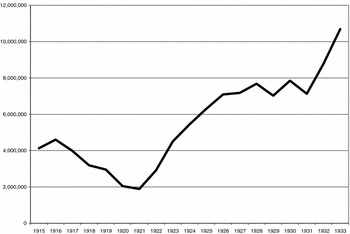
While the recommendations to add wage earner workouts and business re-organization were implemented, the recommendations to move toward officialism were not. A number of creditor organizations supported the move, but legal professionals strongly opposed it (Skeel, Reference Skeel2001: 90). The rapid increase in bankruptcy cases during the 1920s had served to further increase the stake of lawyers in the bankruptcy system. Figure 2 shows bankruptcy fees earned by lawyers; fees increased by a factor of five over the decade. As their stake in bankruptcy law increased, legal professionals formed associations dedicated specifically to bankruptcy law. In 1929, they organized the National Association of Referees in Bankruptcy and in 1933 they formed the National Bankruptcy Conference.
Lawyers’ fees, 1915–33 (in 1929 $s) Source: Annual Report of the Attorney General of the United States. Washington, DC: GPO, years 1915–1933.

Bankruptcy lawyers were not, however, the only interest group that influenced bankruptcy law during the 1930s. Skeel argues that the participation of trade creditors in bankruptcy legislation ‘dwindled after the early New Deal’ (Skeel, Reference Skeel1998: 511), but creditors were not entirely displaced by lawyers as lobbyists for bankruptcy legislation. As bankruptcy shifted from business bankruptcy to wage earner bankruptcy, lobbying on bankruptcy law shifted from wholesalers and manufacturers to retailers. William J. Morgan, the credit manager of Brooks Brothers noted that the 1898 Bankruptcy had been written ‘at a time when the retailer sold almost entirely for cash and it is due to this fact and the lack or organization upon a national scale that his interests were not taken care of’ (New York Times, 1931, 6 December: N10). The National Retail Credit Association sought to make sure this did not happen again. They did not gain everything they wanted. They were not able to obtain significant changes in administration or greater restrictions on discharges. However, they did see the enactment of the wage earner workouts they lobbied for, and they were even able to obtain the inclusion of a section requiring creditors to state that their claims were not usurious, even though the requirement had been opposed by the National Bankruptcy Conference (In re Perry, 272 F. Supp. 73).
Not all the opposition to the retailers came from bankruptcy lawyers. Retailers also had to confront changing beliefs about the purpose of bankruptcy law. Retailers supported a suspension of the wage earners discharge for two years, during which time wage earners would have to turn over any income above that which was necessary for living expenses. Wage earners would have been forced into a workout plan for at least two years. This new restriction on the ability to obtain a discharge was out of step with changing conceptions about the purpose of bankruptcy law. One witness before the Senate Judiciary Committee believed that the founding fathers would turn over in their graves at the thought of an American citizen having to go before a government official and ‘explain to the court how much he needs for food and shelter and clothing for his family’ (quoted in Boshkoff, Reference Boshkoff1982: 113). A referee from Alabama likened the proposed rules to slavery and suggested that the law would say to wage earners ‘either go into servitude or stay out of the bankruptcy court’ (quoted in In re Perry, 272 F. Supp. 73).
The belief that the primary object of bankruptcy law was relief of the debtor was widely acknowledged by the second half of the 1930s. In 1935, the Supreme Court put the two purposes of bankruptcy law on equal footing when Justice Brandeis wrote that ‘discharge of the debtor has come to be an object of no less concern than the distribution of his property’ (Louisville Joint Stock Land Bank v. Radford, 295 US 555). In 1937, Senator Michener declared: ‘a new concept of bankruptcy has been accepted during the last 4 or 5 years’. He explained that ‘when financial evil days come upon one he may seek the aid of the bankruptcy court of the United States, and by this method may keep his creditors at bay until he has had time to regain his financial equilibrium’ (Congressional Record, 1937, 10 August: 8649). The most compelling evidence that there was a change in fundamental public beliefs about the role of bankruptcy law comes not from Congress or the Court, but from creditors. In 1939, The National Association of Credit Men pointed out to its members that ‘it is well to recall that all bankruptcy legislation is primarily for the benefit of the bankrupt’. The reversal of priorities is clear: ‘A secondary object of the bankruptcy statute is to bring about an efficient and economical liquidation of an insolvent debtor's assets so they may be equitably distributed to his creditors’ (National Association of Credit Men, 1939: 467, emphasis added). The transformation of bankruptcy law was complete. Bankruptcy was no longer primarily a commercial regulation. Bankruptcy law was a tool for the relief of people made insolvent by circumstances beyond their control.
6. Conclusion
The standard interpretation of the development of bankruptcy law in the United States asserts that debtor-friendly bankruptcy law was the result of a political compromise in 1898, but neither the rhetoric nor the voting record is consistent with that view. The provisions for creditor control were regarded as very unfriendly to debtors at the time the law was passed, but the advocates of the law were little concerned with wage earners and could not foresee that creditor control would provide virtually no bar to discharge of wage earners. To the extent that the United States developed an unusually debtor friendly approach to bankruptcy it was due to the unanticipated consequences of the 1898 Act, rather than compromises made in the 1890s.
But if it were simply a story of unintended consequences, then creditors would have been able to reverse course, as they sought to do, when the problems of creditor control were clearly understood. They could not reverse course because the system of creditor control gave rise to changes in interest groups, beliefs about the purpose of bankruptcy law, and the Democratic Party's position on bankruptcy. It was these changes that made the story path dependent.
Our analysis illustrates the complementarities between path dependent analysis of law and traditional analysis of voting behavior. Legislative action during any particular Congress is the result of the factors that have traditionally been emphasized: ideology, constituent interest, party influence, and interest group activity. Path dependence arises when legislative action causes changes in these factors, which in turn influence future legislation. Incorporating path dependence thus provides a clearer picture of the long-term evolution of legislation.