Introduction
The word “success” deeply marked the history of gerontology research and the emergence of a positive gerontology. In the last two decades, gerontologists have been shifting their research emphasis from illness to wellness, focusing on optimal functioning rather than on loss and decline. Nevertheless, the approach of successful aging has been defined, measured, and predicted in multiple ways and operationalized in different contexts and samples, resulting in a huge variability of results but in an overall lack of consistency (Depp and Jeste, Reference Depp and Jeste2006).
What is successful aging?
The most influential conceptualization of successful aging was introduced by Rowe and Kahn, who defined it through a biomedical approach as the avoidance of disease and disability, maintenance of high physical and cognitive function, and sustained engagement in social and productive activities (1997). This model was operationalized through the MacArthur study, and individuals who met the three criteria (avoiding disease and disability, high cognitive and physical functioning, and engagement with life) were identified as “successful agers” (Rowe and Kahn, Reference Rowe and Kahn1997). However, no consensus has been reached on which of these criteria have to be met and on their importance for understanding how individuals manage to age well (Freund et al., Reference Freund, Nikitin, Riediger, Weiner, Lerner, Easterbrooks and Mistry2012).
In order to explore “what is successful aging” and “how people age successfully” in a more process-oriented approach, other models have emerged (Freund et al., Reference Freund, Nikitin, Riediger, Weiner, Lerner, Easterbrooks and Mistry2012). Baltes and Baltes (Reference Baltes and Baltes1990), for instance, highlighted the importance of psychological and behavioral strategies and presented successful aging as an adaptive process of selection, optimization and compensation strategies (SOC model), and Bowling and Iliffe (Reference Bowling and Iliffe2006) presented a lay-based multidimensional model drawing attention to older persons’ perceptions of successful aging. As for the measures of successful aging, there is an ongoing debate whether quantitative or qualitative methodologies should be used. Von Faber and collaborators (Reference Von Faber2001) found that the qualitative approach allows considering the individuals that view success as a process of adaptation, suggesting that an expanded definition including the perspective of older adults in order to complement the researchers’ definitions. Also, a combinatory approach whereby objective and subjective measures should be used in tandem has been recommended (Young et al., Reference Young, Frick and Phelan2009). Strawbridge et al. (Reference Strawbridge, Wallhagen and Cohen2002) found that half (50.3%) of older individuals included in their study agreed strongly with the statement I am aging successfully, whereas less than a fifth of participants (18.8%) met objective criteria, suggesting that objective measures do not allow to capture the whole history (Depp and Jeste, Reference Depp and Jeste2006; Pruchno et al., Reference Pruchno, Wilson-Genderson and Cartwright2010).
Successful aging in the very old
Age, i.e. being younger, has been the most consistent predictor of successful aging (Depp and Jeste, Reference Depp and Jeste2006; Hank, Reference Hank2011), indicating a dramatic drop of the rate of success with advancing age. However, emergent studies based on a more psychological approach have presented the admirable capacity of very old individuals in overcoming adversities and adapting to the challenges of advanced age (Rott et al., Reference Rott, Jopp, D’Heureuse, Becker, Wahl, Brenner, Mollenkopf, Rothenbacher and Rott2006).
Studies that have focused on the objective successful pattern of centenarians found that they may easily fail to be categorized as successful agers when objective criteria are applied. In a study with 602 centenarians from the Italian Multicenter Studies on Centenarians revealed that even in the group of participants without any particular disease, they did not preserve any social or productive activities, and therefore could not be considered as prototypes of successful aging (Motta et al., Reference Motta2005). In another study with a sample of 234 centenarians from the Georgia Centenarian Study, Cho et al. (Reference Cho, Martin and Poon2012) found that 29.5% had low probability of disease, 4.4% satisfied the physical and cognitive capacity criteria, and 57.5% were engaged with life, but none of the centenarians satisfied all three components of successful aging. These authors suggested an alternative model focused on psychosocial aspects (i.e. subjective health, perceived economic status, and happiness) leading 47.5% of the centenarians to be considered as successful agers. Such findings suggest the need to consider additional criteria, expanding the concepts and multidimensional aspects of successful aging among oldest-old adults.
Important resources for being successful at 100 years old
The study of lives and patterns of centenarians reveals great heterogeneity between individuals and some paradoxes have been associated with this special age group. The differences between objective measures (e.g. lack in family and friends, sensory deficits) and the subjective appreciations (e.g. perceived quality of life, happiness) elevate the status of these long lived individuals to resilient survivors (Martin et al., Reference Martin, MacDonald, Margrett, Poon, Fry and Keys2010). The mechanisms and attributes associated with this positive adaptation have been of great interest in centenarians’ research over the last years, with emphasis on basic factors (e.g. educational level, job training), psychological attributes (e.g. self-referent beliefs, attitudes toward life), and social and economic resources (e.g. social network, income) as determinants of happiness (Jopp and Rott, Reference Jopp and Rott2006) and positive affect (Martin et al., Reference Martin, MacDonald, Margrett, Poon, Fry and Keys2010). Cho and colleagues (Reference Cho, Martin and Poon2012) have addressed an alternative model of successful aging based on psychosocial aspects (subjective health, perceived economic status, and happiness), but their relation with centenarians’ resources was not explored.
The present study
Seeking to clarify whether centenarians are able to be successful agers (Rowe and Kahn's model) and what kind of resources may be related with that possibility, the present study had two main purposes: first, to investigate objective and subjective profiles of successful aging among the three components of successful aging (physical health, cognitive/physical functioning, and engagement with life) in a sample of Portuguese centenarians. Assuming that very old individuals maintain their psychological resilience, we expected that the percentage of centenarians fulfilling subjective criteria of successful aging would be higher than the percentage fulfilling objective criteria. Second, the association between objective and subjective profiles of successful aging with socio-demographic characteristics and individual (psychological) and external (social and economic) resources was explored.
Methods
Participants
The subjects for this study come from the population-based Oporto Centenarian Study (PT100). The potential participants were from a defined geographical region of approximately 60 km around Porto in Portugal (comprising 16 municipalities), having 14,77,440 inhabitants, 18.7% aged 65 and more years old, and with 182 centenarians identified in the last National Census (INE, 2011). All inhabitants who were aged 100 years and more between December 2012 and December 2013 were identified through voter registration files, churches, nursing home, and local media newspapers. This first step of recruitment provided 186 potential participants. Although all these centenarians, and respective families and/or caregivers, were contacted, 140 were effectively face-to-face interviewed. The other 46 centenarians were subsequently excluded because they died in the interim or their relatives refused participation because of obvious dementia, severe health problems, or lack of interest. Information was collected during one or two sequential sessions directly with the centenarian and/or with a proxy respondent. More specifically, information on the centenarians’ own perception (health, cognitive, and functional capacity, social activities and relationships) was only assessed if the individual was not affected by severe cognitive impairment and was willing to present information on these aspects. Taking into account cut-offs that had been utilized in previous studies with centenarians (e.g. Rott et al., Reference Rott, Jopp, D’Heureuse, Becker, Wahl, Brenner, Mollenkopf, Rothenbacher and Rott2006), we determined a score of 4 or higher on the Short version of the Mini-Mental Status Examination (SMMSE) to indicate the necessary cognitive capacity for answering self-report questions. Based on this cut-off, from the initial 140 centenarians, 70 were selected for this study. Information on the centenarians’ physical conditions was also obtained by the proxies, following the methodology used in previous studies that demonstrated high levels of agreement between participants and proxies’ answers (MacDonald et al., Reference MacDonald, Martin, Margrett and Poon2009). Age validation was accomplished via confirmation with identity card or birth certificate and informed consent for participating in the study was fully considered.
The mean age of the sample was 100.91 (SD 1.37), 87.1% were women and 75.7% were widowed. 27.1% of the sample lived in institutions, 48.6% with children, 4.3% alone, and the remaining with other relatives (20.0%). The mean of school years attended was 2.08 (SD 2.38); 40.0% never attended school and 48.6% had up to four years of education (elementary school). In what concerns monthly income, 5.9% received less than 250€, 70.6% between 250€ and 500€, and 23.5% more than 500€ per month. Because drop-outs are usually worse off, we investigated differences between this group (n = 70, i.e. persons unable to contribute with valid self-reports) and full participants (n = 70, present sample) in basic socio-demographic variables, cognitive capacity, and function. Fisher's exact tests showed significant differences (p < 0.01) for living arrangements, with a higher proportion of institutionalized centenarians within the drop-outs, and no differences for gender, marital status, and education. With respect to physical and cognitive functioning, drop-outs scored significantly lower (ADL: t = −8.40, p < 0.001; IADL: t = −5.97, p < 0.001; SMMSE: t = −17.76, p < 0.001; GDS: t = 3.87, p < 0.001). Consequently, the sample for this study only represents a selected range of physical and cognitive functioning within centenarians and results cannot be generalized to the entire centenarian population.
Study design and data collection
For classifying centenarians as “successful agers,” objective and subjective criteria were considered and four groups created: (i) centenarians that meet only the objective criteria of successful aging, (ii) centenarians that meet only the subjective criteria of successful aging, (iii) centenarians that meet both criteria, and (iv) a final group of centenarians that do not meet any criteria. Guided by Rowe and Kahn's conceptualization of successful aging, Depp and Jeste (Reference Depp and Jeste2006) review about the components widely used to assess successful agers, recent publications on the prevalence of successful aging in both American and European studies (McLaughlin et al., Reference McLaughlin, Connell, Heeringa, Li and Roberts2010; Hank, Reference Hank2011) and particularly among centenarians (Cho et al., Reference Cho, Martin and Poon2012), the following criteria and cut-offs were used to define the existence of objective successful aging:
-
1. No major disease and disability. Participants were asked about the existence of any chronic diseases and for this analysis, we included the absence of any of the major causes of death among older adults (cancer, chronic lung disease, diabetes, heart disease, and stroke). Disability was examined considering activities of daily living (ADLs), namely bathing, taking care of own appearance, dressing, eating, getting in or out of the bed, walking, and using toilet as assessed in Older Americans Resources and Services (OARS) multidimensional functional assessment questionnaire (Fillenbaum and Smyer, Reference Fillenbaum and Smyer1981). All of these seven items were scaled as 2 = without help, 1 = with some help, 0 = completely unable. Cronbach's α in this study was 0.90, demonstrating high reliability of the scale within this sample of extremely old individuals. Cut-points were chosen at the 33rd percentile to include the best third of the total score, in order to select 1/3 of the cases with high independence.
-
2. High physical and cognitive functioning. Instrumental activities of daily living (IADLs) that require physical capacity as traveling, shopping, and housework were considered (OARS, Fillenbaum and Smyer, Reference Fillenbaum and Smyer1981). Cronbach's α was 0.67. The best 33rd percentile of the total score was selected, thus considering 1/3 of the individuals who presented better results on this measure. Cognitive functioning was evaluated by the interviewer rating of subjective memory complaints, orientation, and functional ability with the Global Deterioration Scale which is composed by seven stages (Reisberg et al., Reference Reisberg, Ferris, de Leon and Crook1982). A cut-off score of 2 or less, including stage 1 (no cognitive decline) and stage 2 (very mild cognitive decline) were considered as indicative of good cognitive functioning.
-
3. Active engagement with life. Taking into account the social connections and the engagement in productive activities included in this dimension, individuals were defined as “successful,” if they reported at least one community engaged activity of a list of three (including volunteering, voting, and attending religious celebrations). Social connectedness was considered existent if the centenarian had at least three regular visits.
Rowe and Kahn’ model was evaluated by the centenarian through self-reported measures in order to obtain the profiles of subjective success. Each of the model's components included two questions that were answered by those centenarians with response capacity (those who were not able to give self-reports due to their cognitive impairment were classified as unsuccessful in any criteria). Selected items were:
-
1. No major disease and disability. A positive general self-rated health (In general, how would you rate your overall health?) and the absence of perceived frequent health restrictions (How often does your health interfere in your daily living?) were considered for the group with subjective successful aging.
-
2. High physical and cognitive functioning. The absence of perceived memory problems (In general, do you think you have memory problems?) and a good perception of physical health (In general, do you feel physically healthy?) were selected.
-
3. Active engagement with life. The will to perform activities abroad (Do you prefer to stay at home rather than going out and do things?) and the perception of having at least one family or friend as confident (With how many persons do you can talk with about private matters?) were considered as representing engagement with life.
In order to evaluate centenarians’ resources, information was also collected on psychological, social, and economic functioning. Items indicating self-efficacy (I feel able to accomplish my goals), hope (I feel hopeful right now), and purpose (Life as meaning for me) were drawn from the Valuation of Life Scale (Lawton et al., Reference Lawton, Moss, Hoffman, Kleban, Ruckdeschel and Winter2001), with a Cronbach's α of 0.75. For positive emotional status, the third item of the Satisfaction with Life Scale (I am satisfied with my life) from Diener and colleagues (Reference Diener, Emmons, Larsen and Griffin1985) was used. For all these items, the answering format was modified for 1 = no, 2 = in between, 3 = yes, due specific difficulties in assessing centenarians (see Jopp and Rott, Reference Jopp and Rott2006). For social resources, we used the total number of living children and a question retrieved from the social components of frailty (Tilburg Frailty Indicator, Gobbens and van Assen, Reference Gobbens and van Assen2012) was used to assess whether the individual felt satisfied or not with his social support. In addition, information about monthly income (1 = ≤500 €, 2 = >500 €) and income adequacy for expenses (1 = does not cover expenses, 2 = cover expenses) were used as economic resources indicators. Finally, socio-demographic information on gender (1 = male, 2 = female), marital status (1 = widower, 2 = not widower), education (1 = illiterate. 2 = literate), and living arrangements (1 = community, 2 = institution) was collected by means of a questionnaire.
Data analyses
The existence of objective or/and subjective conditions of successful aging were calculated considering four distinct groups: those fulfilling objective successful aging criteria, those fulfilling subjective successful aging criteria, those fulfilling both objective and subjective criteria, and finally, those having no successful aging criteria. Pearson's χ 2 tests were performed to identify differences between study participants to achieve objective and subjective criteria of the original successful aging model. For the second aim, the Kruskal–Wallis test were performed with successful aging profiles and the Valuation of Life items of three core constructs within the scale: self-efficacy, hope, and purpose (Lawton et al., Reference Lawton, Moss, Hoffman, Kleban, Ruckdeschel and Winter2001) in order to choose one item per construct. Pearson's χ 2 test and Student-t test were performed to identify differences between participants with objective or subjective successful aging and participants without successful aging in relation to socio-demographic characteristics, psychological, social, and economic resources. All analyses were conducted using IBM SPSS Statistics Software Version 21.
Results
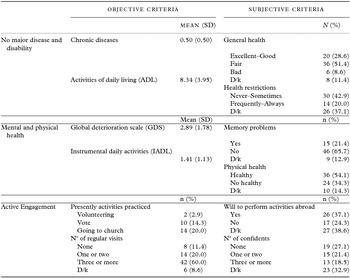
The centenarians’ distribution by objective and subjective successful aging criteria (Table 1) show that 28.6% of the centenarians rated their health as excellent to good, 65.7% reported no memory problems, and 39.9% reported the existence of at least one family or friend as confident. In what concerns the objective criteria, the mean of diseases was less than 1, the Global Deterioration Scale's mean score was 2.89 (SD 1.78), and the most common outdoor activity was going to the church (20%).
Centenarians distribution by objective and subjective successful aging criteria (Rowe and Kahn's model)

Chronic disease (0 to 5 diagnosis); ADL (0–14, 0 = maximum dependence); GDS (1–7; 1 = no cognitive decline); IADL (0–6, 0 = maximum dependence); D/k – don't know.
Figure 1 contains the distribution of centenarians in the various groups described in the methods section. Only a person met simultaneously both objective and subjective criteria in all three components of successful aging (1.4%); 2 centenarians (2.8%) met exclusively the objective criteria and 4 centenarians (5.6%) met solely the subjective criteria. When separately considering objective and subjective profiles, the results revealed a higher percentage of centenarians that perceived themselves as successful agers compared to those who were objectively defined as being so. More specifically, 28.6% did not have any major disease and disability, 38.6% had positive self-perceived outcomes of health and functional capacity; 20.0% had good objective indicators of physical and cognitive functioning, and 40.0% had a positive perception of their functioning (p < 0.05). The only exception was the active engagement component that showed a higher proportion of centenarians fulfilling objective criteria (18.6% had presented productive activities and social connections and only 14.3% perceived themselves as being socially engaged with life), though no statistical differences were found.
Profiles of successful centenarians (Rowe and Kahn's model).

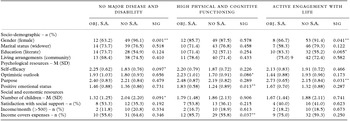
Main socio-demographic characteristics of the centenarians that had fulfilled objective criteria for successful aging are presented in Table 2. When compared with the group of centenarians that did not fulfill objective criteria of successful aging, the objective successful centenarian group had a lower percentage of women in all the three components of the model but only with statistical significant differences for no major disease and disability (χ 2 = 13.39 (df = 1), p < 0.1) and active engagement with life (χ 2 = 5.42 (df = 1), p < 0.1). For this last component of the model, significant differences were also found according education level (χ 2 = 3.29 (df = 1), p > 0.1). In relation to psychological resources, there were higher values of self-efficacy (t = −1.70 (df = 39), p < 0.1) for centenarians with no major disease and disability, higher values of hope and positive emotions in centenarians with high physical and cognitive functioning (t = −1.75 (df = 48), p < 0.1; t = −2.65 (df = 44), p < 0.1), and higher purpose in life in centenarians with active engagement with life (t = −2.35 (df = 47), p < 0.1). Regarding social and economic resources there was a lower mean in the number of living children in centenarians with no major disease and disability (t = 1.72 (df = 44), p < 0.1) and less difficulties covering expenses in centenarians with high physical and cognitive functioning (χ 2 = 4.20 (df = 1), p < 0.1).
Socio-demographic characteristics, psychological, social, and economic resources for objective successful aging (Obj. S.A.)

*p < 0.10; **p < 0.05.
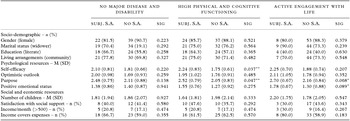
When analyzing the same factors between centenarians fulfilling subjective ratings of successful aging and centenarians with no subjective successful aging, it is possible to see that differences were only significant in the components of high physical and cognitive functioning and active engagement (Table 3). More specifically, successful centenarians had higher levels of self-efficacy (t = −2.16 (df = 39), p < 0.1), purpose in life (t = −2.04 (df = 47), p < 0.1; t −1.87 (df = 47), p < 0.1), and positive emotions (t = −1.81(df = 44), p < 0.1).
Socio-demographic characteristics, psychological, social, and economic resources for objective successful aging (Subj. S.A.)

*p < 0.10; **p < 0.05.
Discussion
This paper examined one of the most controversial and impactful concepts in aging research, successful aging, among individuals that reached the threshold of 100 years old. The results suggest that the prevalence of “success” in the oldest old, even when considering subjective criteria, is very low, confirming the markedly fewer possibilities of being successful as age increases (McLaughlin et al., Reference McLaughlin, Connell, Heeringa, Li and Roberts2010).
The results prove our hypothesis that the percentage of centenarians fulfilling subjective criteria of successful aging would be higher than the percentage fulfilling objective criteria in Rowe and Kahn's health related components but not for active engagement with life. A reduced proportion of individuals fulfilling Rowe and Kahn's objective criteria of successful aging was also found in previous studies with younger elders, more precisely in European adults aged 50 years and above (Hank, Reference Hank2011) and American elders aged 65 years and above (McLaughlin et al., Reference McLaughlin, Connell, Heeringa, Li and Roberts2010), confirming that this concept might be too narrow. In fact, in our sample, only one centenarian fulfill all three criteria, which is somewhat expected due to the physical constraints present in nearly all centenarians (Andersen-Ranberg et al., Reference Andersen-Ranberg, Schroll and Jeune2001), the highly expected cognitive restrictions (Hagberg et al., Reference Hagberg, Alfredson, Poon and Homma2001), the loss of family and friends that may lead to a reduced social network (Randall et al., Reference Randall, Martin, MacDonald and Poon2010), and the high levels of anxiety symptoms (Ribeiro et al., Reference Ribeiro, Teixeira, Araújo, Afonso and Pachana2015).
The disparity between objective and subjective measures of successful aging, that had already been reported in previous studies with younger populations (e.g. Strawbridge et al., Reference Strawbridge, Wallhagen and Cohen2002; Pruchno et al., Reference Pruchno, Wilson-Genderson and Cartwright2010) and confirmed in a sample with long living individuals (Cho et al., Reference Cho, Martin and Poon2012), suggests that a combination of measures should provide a more comprehensive account of how successful aging might be approached.
A specific attention is to be given to the lowest proportion of centenarians considering themselves as successful agers in the component of active engagement. This finding leads us to think that some healthy and autonomous centenarians, with good physical and cognitive capacities, may not have social activities and connections and/or are satisfied with them. Leisure time and productive social activities did not feature as important factors in previous studies among centenarians (Motta et al., Reference Motta2005), which strengthen the tendency of older adults to gradually withdraw from social rules and activities, and to reduce their social network (e.g. Carstensen et al., Reference Carstensen, Isaacowitz and Charles1999). Moreover, it may also suggest the higher importance of transcendence in fulfilling individual needs, as an adaptive mechanism through which the individual can maintain psychological well-being (Tornstam, Reference Tornstam2005). With regard to social relationships, these are seen as changing from the wider and shallower relationships with others (characteristic of young people) to few and narrower relationships later in life, and an eventual departure from a social role. Whether this reduced subjective appreciation of social engagement is protective in terms of maintaining positive levels of well-being is an issue that requires further attention, especially as the extent of being “socially engaged” at such a very long age is probably strongly limiting the prototype of (perceived) successful aging.
The analysis of socio-demographic factors, psychological, social, and economic resources across objective and subjective profiles of successful aging reveals that some psychological resources are significantly different across groups. The association of self-efficacy, purpose, and hope with measures of well-being and life quality has been previously presented (e.g., Reker and Woo, Reference Reker and Woo2011), but few studies addressed the specific contribution of these type of resources in centenarians (Jopp and Rott, Reference Jopp and Rott2006) and within a successful aging approach.
In overall, multidimensional approaches of successful aging based on objective and subjective dimensions may contribute to a greater understanding of its correlates and modifiable aspects as defended by Pruchno et al. (Reference Pruchno, Wilson-Genderson and Cartwright2010) through the test of successful aging as a two-factor model including objective and subjective components. Hence, it is crucial to think and investigate about appropriate subjective criteria. Concretely for the group of centenarians, such an approach may help researchers to gain deeper insights on how this special group achieves successful aging even under conditions of physical health limitations, disabilities, and social constraints. A broaden definition of successful aging more process-oriented is therefore warranted. Future studies should address the possibilities of successful aging at such advanced age, confronting different models and methodological approaches, in order to adapt this concept to the constraints of an older and possible more impaired population. The availability of resources should be another important feature to take into account since certain psychological resources (e.g. self-efficacy, hope, and purpose) revealed to be higher in the successful group reinforcing their importance when considering the maintenance of both objective and perceived successful aging.
Some final considerations about the challenges and limitations that had emerged during this study are required. The first ones concern data collection. Since self-reports on extremely long-lived individuals are more difficult to obtain due to multiple sensory and cognitive limitations, and in this particular case due to the low levels of literacy in Portuguese centenarians, the successful aging profiles were explored in a sample without severe cognitive impairment. In addition, we also recognize as a constrain the provenience of the sample that though coming from a population-based study, refers to a specific geographical area and centenarians of other regions might present different patterns of (un)successful aging. The results related with psychological resources should be carefully considered, since self-efficacy, hope, purpose in life, and positive emotions were evaluated thought single items.
Conflict of interest declaration
None.
Description of authors’ roles
L. Araújo wrote the manuscript and with L. Teixeira performed the data analysis; O. Ribeiro was responsible for the study conception and design, and supervised data collection; C Paúl critically revised the paper for important intellectual content.
Acknowledgments
The project would not have been possible without the involvement of our centenarians and their family members, as well as the participation of PT100 team in collecting data. The authors would like to thank the guidance of Daniela Jopp and Christoph Rott (Second Heidelberg Centenarian Study).