1. Introduction
Richtmyer–Meshkov instability (RMI) (Richtmyer Reference Richtmyer1960; Meshkov Reference Meshkov1969) occurs when a perturbed interface separating two substances of different densities is accelerated by a shock wave. It has gained extensive attention for decades due to its crucial role in many important scientific and engineering fields, such as inertial confinement fusion (ICF) (Nuckolls et al. Reference Nuckolls, Wood, Thiessen and Zimmerman1972; Lindl et al. Reference Lindl, Landen, Edwards, Moses and N.I.C.2014; Betti & Hurricane Reference Betti and Hurricane2016), supernova explosion (Arnett et al. Reference Arnett, Bahcall, Kirshner and Woosley1989; Kuranz et al. Reference Kuranz2018), scramjet (Billig Reference Billig1993; Yang, Kubota & Zukoski Reference Yang, Kubota and Zukoski1993), shock-flame interaction (Khokhlov et al. Reference Khokhlov, Oran, Chtchelkanova and Wheeler1999a; Khokhlov, Oran & Thomas Reference Khokhlov, Oran and Thomas1999b), and so on. Comprehensive insights and specific details regarding RMI and its applications can be found in several recent systematic reviews (Zhou Reference Zhou2017a,Reference Zhoub; Zhou et al. Reference Zhou, Clark, Clark, Glendinning, Skinner, Huntington, Hurricane, Dimits and Remington2019, Reference Zhou2021). For ICF, RMI is one of the tremendous obstacles to its realization, and the effect of RMI is highly related to the target design (Kritcher et al. Reference Kritcher2022). There are several types of target in ICF, such as the typical target with one ablative layer made of one main material, and the innovative target with multiple ablative layers formed of different main materials (Lindl Reference Lindl1995; Qiao & Lan Reference Qiao and Lan2021; Kritcher et al. Reference Kritcher2022). In addition, the main materials for the ablative layer are diverse, including CH plastic and high-density carbon, etc. (Lindl et al. Reference Lindl, Landen, Edwards, Moses and N.I.C.2014). In other words, the Atwood number (defined as  $A=(\rho _j-\rho _i)/(\rho _j+\rho _i)$, with
 $\rho _i$ and
 $\rho _j$ being the densities of substances upstream and downstream of the interface, respectively) of the interface separating deuterium-tritium ice and ablator or different ablative layers can be significantly different for different targets. Therefore, it is necessary and desirable to study the evolution of RMI under various
 $A$ conditions. Pre- and post-shock
 $A$ (
 $A_0$ and
 $A_1$) are equivalent in incompressible RMI, but inequivalent in compressible RMI. Since we consider the compressible RMI in this work,
 $A$ generally refers specifically to
 $A_1$ containing information on the compressibility of the flow field.
For RMI with small scaled initial amplitude  $k a_0$ (where
 $k$ and
 $a_0$ are perturbation wavenumber and initial amplitude, respectively), the perturbation amplitude
 $a$ first varies at an increasing rate due to the start-up process (Richtmyer Reference Richtmyer1960; Lombardini & Pullin Reference Lombardini and Pullin2009), and then enters a linear growth period until nonlinearity becomes pronounced. Theoretically, Richtmyer (Reference Richtmyer1960) first investigated RMI on a light–heavy interface and deduced a compressible linear theory for forecasting the amplitude growth rate
 $\dot {a}$ in the linear regime. On the basis of the compressible linear theory, a semi-empirical model, i.e. the impulsive model, was proposed for predicting the linear asymptotic amplitude growth rate
 $\dot {a}_1$. Notably, the impulsive model loses accuracy with the increase of the flow compressibility (Mikaelian Reference Mikaelian1994; Yang, Zhang & Sharp Reference Yang, Zhang and Sharp1994). An exact compressible linear theory that, in principle, is capable of solving for
 $\dot {a}$ within the linear regime under arbitrary flow compressibility conditions was deduced by Wouchuk & Nishihara (Reference Wouchuk and Nishihara1996). Based on the compressible linear theory, Wouchuk & Nishihara (Reference Wouchuk and Nishihara1997) proposed an analytical solution (the WN model) to predict
 $\dot {a}_1$, and obtained a simplified model in the weak shock limit (the WN-WL model). Subsequently, the WN model was modified further by Wouchuk (Reference Wouchuk2001). RMI was first studied experimentally by Meshkov (Reference Meshkov1969) using interfaces formed by nitrocellulose membranes. Different gas combinations on both sides of the interface were considered to achieve a wide variation of
 $A_1$. It was found that the experimental
 $\dot {a}_1$ (denoted
 $\dot {a}_1^e$) is qualitatively consistent with the impulsive model prediction (denoted
 $\dot {a}_1^i$): both are positively related to
 $A_1$. However, quantitatively, all
 $\dot {a}_1^e$ are significantly lower than the corresponding
 $\dot {a}_1^i$, possibly due to the effects of high amplitude and membrane. Jones & Jacobs (Reference Jones and Jacobs1997) investigated experimentally the shock-induced evolution of a continuous N
 $_2$–SF
 $_6$ interface with
 $A_0=0.67$. Although the agreement between
 $\dot {a}_1^e$ and
 $\dot {a}_1^i$ is better relative to that in previous work (Meshkov Reference Meshkov1969),
 $\dot {a}_1^e$ is still lower than
 $\dot {a}_1^i$ due to the diffusion layer. By dropping a two-liquid system mounted on a sled onto a coil spring to produce a nearly impulsive upward acceleration, Niederhaus & Jacobs (Reference Niederhaus and Jacobs2003) studied experimentally incompressible RMI with low negative
 $A_1$ (
 $=-0.1587$). Very clear views of the developing interface were realized using planar laser-induced fluorescence imaging. Due to the extended duration of the acceleration pulse, the theoretical
 $\dot {a}_1$ was determined by integrating numerically the first-order time derivative of the impulsive model. A remarkably good agreement between the theoretical and experimental results was reached for a dimensionless time up to 0.3. Using the soap-film technique to generate an interface free of solid membrane and diffusion layer, Liu et al. (Reference Liu, Liang, Ding, Liu and Luo2018) studied elaborately the evolution of a shocked air–SF
 $_6$ single-mode interface, and provided the first direct experimental validation of the impulsive model. However,
 $A_1$ in the work of Liu et al. (Reference Liu, Liang, Ding, Liu and Luo2018) is within a narrow range (
 $0.54\le A_1 \le 0.61$), and it is desirable to examine the impulsive model over a wider range of
 $A_1$.
In the early stages of RMI, since the perturbed waves are close to interface and  $k a$ is small, compressibility dominates the perturbation evolution while nonlinearity is less important. As perturbed waves move away from the interface and
 $k a$ increases, compressibility becomes weaker and nonlinearity begins to dominate the perturbation growth (Zhang & Sohn Reference Zhang and Sohn1997). In other words, RMI has different dominant mechanisms at different evolution stages, making its overall evolution behaviour from linear to nonlinear stages difficult to describe rigorously. Fortunately, RMI can be approximated as a linear compressible physical process in the early stages and as a nonlinear incompressible one in the late stages (Zhang & Sohn Reference Zhang and Sohn1997). Referring to this idea, several empirical nonlinear models were proposed (Zhang & Sohn Reference Zhang and Sohn1997; Sadot et al. Reference Sadot, Erez, Alon, Oron, Levin, Erez, Ben-Dor and Shvarts1998; Mikaelian Reference Mikaelian2003; Dimonte & Ramaprabhu Reference Dimonte and Ramaprabhu2010; Zhang & Guo Reference Zhang and Guo2016, Reference Zhang and Guo2022), and they are briefly reviewed as follows.
Zhang & Sohn (Reference Zhang and Sohn1997) first derived the perturbation series of the amplitude growth rates of spike, bubble and entire interface ( $\dot {a}_s$,
 $\dot {a}_b$ and
 $\dot {a}$). Then, by applying the Padé approximation to extend the valid range of the perturbation series, an approximate nonlinear solution was derived. Finally, through matching the linear and nonlinear solutions, a nonlinear model known as the ZS model was obtained. Sadot et al. (Reference Sadot, Erez, Alon, Oron, Levin, Erez, Ben-Dor and Shvarts1998) proposed a nonlinear model (the SEA model) by matching the impulsive model prediction, perturbation expansion solution and potential flow solution. Note that different coefficients
 $C$ (see table 3) were employed for RMI with
 $A_1\ge 0.5$ and
 $A_1<0.5$ to account for the effect of
 $A_1$ on asymptotic
 $\dot {a}_s$ (spike) and
 $\dot {a}_b$ (bubble). By analysing the extension of Layzer-type theory (Layzer Reference Layzer1955) to arbitrary
 $A_1$ (Goncharov Reference Goncharov2002) and assuming that the linear to nonlinear growth transition occurs when
 $ka=1/3$, Mikaelian (Reference Mikaelian2003) proposed a nonlinear model for bubble evolution (the MIK model). Theoretically, the extension of the MIK model to spike (Goncharov Reference Goncharov2002; Jacobs & Krivets Reference Jacobs and Krivets2005) is strictly inapplicable to RMI with finite
 $A_1$ (Mikaelian Reference Mikaelian2008). Nonetheless, it is still interesting to evaluate the capability of the MIK model to predict spike evolution because of its simplicity compared with other models (Dimonte & Ramaprabhu Reference Dimonte and Ramaprabhu2010). Through focusing on the asymptotic evolution law and the effects of
 $A_1$ and
 $ka_0$ on spike acceleration, Dimonte & Ramaprabhu (Reference Dimonte and Ramaprabhu2010) proposed a nonlinear model (the DR model) applicable to high
 $A_1$ and
 $ka_0$ conditions based on numerous simulations and previous models (Zhang & Sohn Reference Zhang and Sohn1997; Sadot et al. Reference Sadot, Erez, Alon, Oron, Levin, Erez, Ben-Dor and Shvarts1998; Mikaelian Reference Mikaelian2003). Zhang & Guo (Reference Zhang and Guo2016) first derived the late-time finger (bubble and spike) growth rate for a system with any density ratio based on the finger curvature characteristics predicted by the Layzer-type models. Then, by matching the early- and late-time solutions, a nonlinear model known as the ZG model was obtained. On the basis of the ZG model, recently Zhang & Guo (Reference Zhang and Guo2022) proposed a new nonlinear model (the ZG-New model) by considering additionally the weakly nonlinear and pre-asymptotic behaviours.
Various experimental studies have been performed to explore the nonlinear evolution law of RMI and to examine nonlinear models. In the experiments on incompressible RMI with  $A_1=-0.1587$ conducted by Niederhaus & Jacobs (Reference Niederhaus and Jacobs2003), it was observed that the ZS (SEA) model predicts the early-time amplitude evolution well, while it underestimates (overestimates) the experimental results at later stages. The failure of the SEA model at late times was ascribed to the fact that coefficient
 $C=1/2{\rm \pi}$ is strictly true only when
 $A_1=0$. Using well-defined interfaces created by a membrane deposited on a stereolithographed grid support, Mariani et al. (Reference Mariani, Vandenboomgaerde, Jourdan, Souffland and Houas2008) conducted shock-tube experiments on RMI with
 $A_1$ ranging from 0.644 to 0.721. It was observed that the predictions of the ZS and SEA models deviate from the experimental data from the early stages, which was ascribed to a part of the kinetic energy of the fluid at the interface being diverted to the motion of the membrane remnants. Subsequently, Vandenboomgaerde et al. (Reference Vandenboomgaerde, Souffland, Mariani, Biamino, Jourdan and Houas2014) studied RMI with
 $A_0=0.679$ employing an interface formation method similar to that in previous work (Mariani et al. Reference Mariani, Vandenboomgaerde, Jourdan, Souffland and Houas2008). A stronger incident shock was applied to reduce the deleterious effects of the membrane remnants. It was found that in the experiment with small
 $ka_0$ (
 $=0.24$), the SEA (MIK) model slightly overestimates (underestimates) the amplitude evolution in the late stages, while the DR model offers a reasonable prediction. The RMI on a continuous air–SF
 $_6$ interface with
 $A_1 \approx 0.62$ was investigated by Collins & Jacobs (Reference Collins and Jacobs2002). It was found that the prediction of the ZS model deviates from the experimental results in the late stages, as it does not capture the late-time
 $1/t$ behaviour of
 $\dot {a}$. In contrast, the SEA model, which captures the late-time
 $1/t$ behaviour of
 $\dot {a}$, predicts the amplitude evolution well. Subsequently, Jacobs & Krivets (Reference Jacobs and Krivets2005) performed experiments on the late-time development of RMI with
 $A_1=0.635$ and 0.692. Stronger shocks and initial perturbations with shorter wavelengths, in comparison to those in previous studies (Jones & Jacobs Reference Jones and Jacobs1997; Collins & Jacobs Reference Collins and Jacobs2002), were adopted to obtain images at significantly later dimensionless times. Jacobs & Krivets (Reference Jacobs and Krivets2005) observed predictive capabilities of the ZS and SEA models similar to those in previous work (Collins & Jacobs Reference Collins and Jacobs2002), and found that the MIK model starts underestimating the amplitude evolution from the early times, although it does capture the late-time
 $1/t$ behaviour of
 $\dot {a}$. Recently, Mansoor et al. (Reference Mansoor, Dalton, Martinez, Desjardins, Charonko and Prestridge2020) studied the late-time growth of RMI on a continuous quasi-single-mode interface with
 $A_0\approx 0.67$. For experiments with small
 $ka_0$ (
 $=0.30$), the ZG and DR models predict reasonably the amplitude growth, while the ZS, MIK and SEA models fail to predict the experimental results well. Note that the diffusion layer of the continuous interface and the remnants of the solid membrane interface may influence the nonlinear interface evolution, thus affecting the model validation. Liu et al. (Reference Liu, Liang, Ding, Liu and Luo2018) investigated elaborately RMI on an air–SF
 $_6$ soap-film interface, and found that the ZG model predicts the amplitude growth well, while the ZS, MIK, SEA and DR models fail to predict the experimental results well in general or at specific stages. In addition, based on the accurate interface profiles extracted from high-quality schlieren pictures, modal analysis was performed. It was found that the modal model proposed by Zhang & Sohn (Reference Zhang and Sohn1997) (the ZSM model) predicts the modal evolution better than the model proposed by Vandenboomgaerde, Gauthier & Mügler (Reference Vandenboomgaerde, Gauthier and Mügler2002) (the VM model). It is noteworthy that
 $A_1$ in previous experimental works discussing nonlinear evolution of RMI (Collins & Jacobs Reference Collins and Jacobs2002; Niederhaus & Jacobs Reference Niederhaus and Jacobs2003; Jacobs & Krivets Reference Jacobs and Krivets2005; Mariani et al. Reference Mariani, Vandenboomgaerde, Jourdan, Souffland and Houas2008; Vandenboomgaerde et al. Reference Vandenboomgaerde, Souffland, Mariani, Biamino, Jourdan and Houas2014; Liu et al. Reference Liu, Liang, Ding, Liu and Luo2018; Mansoor et al. Reference Mansoor, Dalton, Martinez, Desjardins, Charonko and Prestridge2020) is within a narrow range, and it is desirable to examine existing nonlinear models over a wider range of
 $A_1$.
Numerically, the evolution law of RMI has been investigated extensively (Zhou Reference Zhou2017a,Reference Zhoub; Zhou et al. Reference Zhou, Clark, Clark, Glendinning, Skinner, Huntington, Hurricane, Dimits and Remington2019, Reference Zhou2021). Lombardini et al. (Reference Lombardini, Hill, Pullin and Meiron2011) studied the dependence of RMI under reshock conditions on  $A$ using the large-eddy simulation technique. A wide range of
 $A_0$ in both positive and negative signs was considered:
 $\pm$0.21,
 $\pm$0.67 and
 $\pm$0.87. The magnitude of
 $|A|$ was found to strongly influence the turbulent kinetic energy, turbulent dissipation and post-reshock growth rate of the mixing width. Furthermore, an empirical formula and a semi-analytical model based on a diffuse-interface approach were proposed to describe the dependence of the post-reshock growth rate on the post-reshock
 $A$. However, Lombardini et al. (Reference Lombardini, Hill, Pullin and Meiron2011) placed more emphasis on the post-reshock flow, whereas the pre-reshock classical RMI phenomenon was not highlighted. In addition to the work of Lombardini et al. (Reference Lombardini, Hill, Pullin and Meiron2011), several numerical and vortex-method-based theoretical studies of the dependence of RMI in planar and cylindrical geometries on
 $A_1$ were performed (Nishihara et al. Reference Nishihara, Wouchuk, Matsuoka, Ishizaki and Zhakhovsky2010). Matsuoka & Nishihara (Reference Matsuoka and Nishihara2006a,Reference Matsuoka and Nishiharab) found that the growth rates of the bubble and spike in both planar and cylindrical geometries are closely related to
 $A_1$. Besides, the dependence of the motions, strengths and roll-up of the vortex sheet representing the interface on
 $A_1$ was discussed in detail. Existing numerical works have offered valuable insights into the evolution law of RMI under various
 $A_1$ conditions, and should be verified further through experiments. Therefore, conducting an elaborate experimental study on RMI over a wide range of
 $A_1$ conditions is desirable.
How does RMI evolve under different  $A_1$ conditions? Can existing linear and nonlinear models describe RMI correctly over a wide range of
 $A_1$? These issues remain unclear, which motivates the present study. The soap-film technique (Liu et al. Reference Liu, Liang, Ding, Liu and Luo2018; Liang et al. Reference Liang, Zhai, Ding and Luo2019) enables the formation of well-defined desirable interfaces, while the gas-layer scheme (Liang & Luo Reference Liang and Luo2021; Chen et al. Reference Chen, Xing, Wang, Zhai and Luo2023) allows for a wide variation of
 $A_1$, providing us with a rare opportunity to study RMI over a wide range of
 $A_1$ finely through experiments. In this work, by using the soap-film technique to generate initial interfaces and the gas-layer scheme to alter
 $A_1$, first the evolution law of RMI under a wide range of
 $A_1$ conditions is obtained experimentally. Then the semi-empirical and analytical linear models and some nonlinear models are examined, and the predictive capabilities of nonlinear models are analysed and summarized. Finally, modal analysis is performed to explore the effect of
 $A_1$ on modal evolution, and also to examine modal models.
2. Experimental method
The experiments are conducted in a horizontal shock tube whose reliability and reproducibility have been verified extensively in prior investigations (Liu et al. Reference Liu, Liang, Ding, Liu and Luo2018; Liang et al. Reference Liang, Zhai, Ding and Luo2019; Luo et al. Reference Luo, Liang, Si and Zhai2019). The shock tube consists of a driver section, a driven section, a transitional section, a stable section and a test section, as depicted in figure 1. To generate a shock wave, initially a thin polyester film is placed between the driver and driven sections to separate the gases in them. Afterwards, nitrogen contained in a high-pressure gas cylinder is charged into the driver section. Once the pressure difference between the gases in the driver and driven sections exceeds the pressure-bearing capacity of the polyester film, the film ruptures and a shock wave is launched into the driven section. The shock wave propagates from the circular driven section to the rectangular stable section through a transitional section, and recovers to a stable one before entering the test section. In this work, the generation method of the shock wave and the thickness of the polyester film (0.03 mm) are kept consistent across all experiments, which ensures that the intensity of the shock entering the test section remains similar across different experiments.
Sketch of the shock tube and high-speed schlieren system.

The soap-film technique, which has been utilized widely in our previous works (Liu et al. Reference Liu, Liang, Ding, Liu and Luo2018; Liang et al. Reference Liang, Zhai, Ding and Luo2019; Luo et al. Reference Luo, Liang, Si and Zhai2019), is used to generate the initial interface. To allow for a wider variation of  $A_1$, it is necessary to fill different gases in the two spaces separated by the soap film. Therefore, except for the experiment with an air–SF
 $_6$ interface, a gas-layer scheme that has been validated in previous works (Liang & Luo Reference Liang and Luo2021; Chen et al. Reference Chen, Xing, Wang, Zhai and Luo2023) is adopted. Before each experimental run using the gas-layer scheme, as shown in figure 2, flat and single-mode soap films are first formed on the left- and right-hand sides of device b, respectively, while a single-mode soap film is formed on the left-hand side of device c, closed with a polyester film on the right-hand side. Subsequently, gases with relatively low and high densities are charged into devices b and c, respectively, through inflow holes, and air is released through outflow holes. Finally, devices a, b and c are carefully connected and inserted into the test section of the shock tube. Note that two single-mode soap films merge into one when devices b and c are connected. Since the gas in device b (gas b) is lighter compared to that in device c (gas c), a light–heavy single-mode interface is formed. More details regarding the soap-film technique can be found in previous works (Liu et al. Reference Liu, Liang, Ding, Liu and Luo2018; Liang et al. Reference Liang, Zhai, Ding and Luo2019).
Schematic of interface formation devices and gas-layer scheme.

The flow field evolution is captured by a high-speed schlieren system as depicted in figure 1. The system contains a xenon light source (CEAULIGHT CEL-HXF300), two optical lenses, a slit, two concave mirrors with a focal length of 2000 mm, two plane mirrors with a diameter of 400 mm, a blade, and a high-speed video camera (FASTCAM SA5, Photron Limited) equipped with a macro lens (TOKINA M100 PRO D 100 mm/F2.8 MACRO). The frame rate of the high-speed video camera is set to 50 000 frames per second, with an exposure time of  $1\,\mathrm {\mu }{\rm s}$. The spatial resolution of schlieren images is about 0.40 mm pixel
 $^{-1}$. The ambient pressure and temperature are
 $101.3\pm 0.1$ kPa and
 $295.0\pm 0.5$ K, respectively.
Some important parameters for seven experimental runs labelled by  $A_1$ are shown in table 1, and there are several issues that need further clarification. First, since the intensity of the incident shock changes as it interacts with the flat interface, there are small differences in the Mach number of the incident shock impacting the single-mode interface (
 $M$) between runs. Second, the initial distance between flat and single-mode interfaces is 105.00 mm, which ensures that the flat interface would not heavily affect the single-mode interface evolution within the effective experimental time (Chen et al. Reference Chen, Xing, Wang, Zhai and Luo2023). Third, gas components,
 $A_0$ and
 $A_1$ are obtained by matching the velocities of shocks and interface obtained from experiments and predicted by one-dimensional gas dynamics theory. Fourth, to validate the linear models and also the nonlinear models, the perturbation wavelength (
 $\lambda$) and
 $ka_0$ are chosen as 40.00 mm and 0.285, respectively. This
 $ka_0$ is not too small while still satisfying the small-amplitude criterion (
 $ka\ll 1$), which ensures that the interface has a sufficiently long linear growth period and can also evolve into the weakly nonlinear stage within the effective experimental time.
Some important parameters for seven experimental runs labelled by  $A_1$. Superscripts
 $e$ and
 $t$ denote experimental and theoretical results, respectively. Gases b and c are gases in devices b and c, respectively;
 $\rho _b$ and
 $\rho _c$ are the post-shock densities of gases b and c, respectively;
 $M$ is the Mach number of the incident shock impacting the single-mode interface;
 $v_{is}$,
 $v_{ts}$ and
 $v_{rs}$ are the velocities of the incident, transmitted and reflected shocks, respectively;
 $u_b$ is the velocity of gas b behind the incident shock;
 $u$ is the shock-induced interface velocity. The unit of velocity is m s
 $^{-1}$.

3. Results and discussion
3.1. Flow features and interface morphology
Experimental schlieren images of the evolutions of shocked light–heavy single-mode interfaces with different  $A_1$ are shown in figure 3. Since the flat interface does not heavily affect the evolution of the shocked single-mode interface (SI) and provides no additional information, it is removed in all the schlieren images through image processing. Run 0.68 is taken as an example to illustrate the detailed process. The temporal origin (
 $t=0\,\mathrm {\mu }{\rm s}$) is defined as the moment when the incident shock (IS) reaches the mean position of the initial interface (II). It should be noted that the initial interface looks quite thick due to the sinusoidal filaments embedded on the interface formation devices for constraining the soap film. The filaments are also removed from the images after the shock impact through image processing for clarity. When IS encounters II, a transmitted shock (TS) and a reflected shock (RS) are generated (
 $54\,\mathrm {\mu }{\rm s}$). Note that for runs in which gas b is a mixture of helium and air, RS is barely visible since the difference in gas density between its two sides is small. As SI evolves, its asymmetry increases gradually, followed by the formation of distinct spike and bubble structures (
 $674\,\mathrm {\mu }{\rm s}$), indicating the generation of high-order harmonics. Subsequently, roll-up structures are formed on SI (
 $1114\,\mathrm {\mu }{\rm s}$).
Schlieren photographs of the evolutions of shocked interfaces with different  $A_1$. Here, IS, TS and RS denote incident, transmitted and reflected shocks, respectively; II and SI denote initial and shocked single-mode interfaces, respectively. Numbers in photographs represent time in
 $\mathrm {\mu }$s.

The nonlinear evolution features of SI, including spike, bubble and roll-up structures, develop faster in RMI with higher  $A_1$. Specifically, before moving out of the experimental observation area, SI in run 0.30 remains a quasi-single-mode profile (
 $1123\,\mathrm {\mu }{\rm s}$), while SI in run 0.86 becomes highly asymmetrical and has roll-up structures (
 $1103\,\mathrm {\mu }{\rm s}$). Notably, Matsuoka & Nishihara (Reference Matsuoka and Nishihara2006a) observed that the roll-up structures of RMI in cylindrical geometry appear rapidly even under low
 $A_1$ conditions, which appears to be inconsistent with the present results. However, this discrepancy is due to the difference in time normalization between RMI in planar and cylindrical geometries. In the studies conducted by Matsuoka & Nishihara (Reference Matsuoka and Nishihara2006b) and Nishihara et al. (Reference Nishihara, Wouchuk, Matsuoka, Ishizaki and Zhakhovsky2010) on RMI in planar geometry, using the same time normalization as that in the current work (see § 3.3 for details), the roll-up structures have not yet emerged when the dimensionless time reaches 2 under low
 $A_1$ conditions. This observation aligns with the phenomenon witnessed in our experiments.
3.2. Linear evolution of perturbation amplitude
Temporal variations of perturbation amplitude  $a$ in dimensional form for different runs are shown in figure 4(a), in which
 $t^*$ is the moment when the linear growth of
 $a$ starts, and
 $a^*$ is the corresponding
 $a$ at
 $t=t^*$. Note that
 $a$ is determined via measuring the distance between the peak and trough of SI along the streamwise direction (2
 $a$), as shown in figure 3. In all runs,
 $a$ would initially undergo a linear growth period, and
 $\dot {a}_1^e$ is determined by linearly fitting the early-time experimental data. According to previous works (Mikaelian Reference Mikaelian1994; Yang et al. Reference Yang, Zhang and Sharp1994; Velikovich & Dimonte Reference Velikovich and Dimonte1996), the impulsive model is valid theoretically for predicting
 $\dot {a}_1$ only when
 $k a_0$ is small and compressibility is weak. In the experiments conducted in this work,
 $ka_0$ satisfies the small-amplitude criterion and
 $M$ is low. Therefore, our experiments are suitable for validating the impulsive model, which can be written as
 \begin{equation} \dot{a}_1^i=C k a_0 A_1 u^t =k a_1 A_1 u^t, \end{equation}
where  $C$ (
 $=1-u^t/v^e_{is}$) is the shock compression factor, with
 $u^t$ and
 $v^e_{is}$ being the theoretical velocity of SI and the experimental velocity of IS, respectively, and
 $a_1$ is the post-shock amplitude. In addition to the semi-empirical impulsive model, it is also desirable to examine the analytical linear models (Wouchuk & Nishihara Reference Wouchuk and Nishihara1996, Reference Wouchuk and Nishihara1997; Wouchuk Reference Wouchuk2001). According to Wouchuk & Nishihara (Reference Wouchuk and Nishihara1997), the difference between the predictions of the WN and WN-WL models is negligible when
 $\beta <0.5$ (where
 $\beta =1-\,p_{in}/\,p_{be}$, in which
 $p_{in}$ and
 $p_{be}$ are the pressures in front of and behind IS, respectively). Since
 $\beta$ in current experiments are smaller than 0.4, only the WN-WL model is considered. The WN-WL model can be expressed as
 \begin{equation} \dot{a}_{1}^{ww}=ka_0\,\frac{u^t\,\dfrac{\rho_c}{\rho_b}\left(1-\dfrac{v^e_{ts}}{v^e_{is}}\right)+ (u^t_b-u^t)\left(1+\dfrac{v^t_{rs}}{v^e_{is}}\right)}{1+\dfrac{\rho_c}{\rho_b}}, \end{equation}
where  $\rho _b$ and
 $\rho _c$ are the post-shock densities of gases b and c, respectively;
 $v^e_{ts}$ is the velocity of TS extracted from experiments; and
 $v^t_{rs}$ and
 $u^t_b$ are the velocities of RS and gas b behind IS predicted by one-dimensional gas dynamics theory, respectively. To demonstrate more visually the dependence of
 $\dot {a}_{1}$ on
 $A_1$ described by the WN-WL model, the model can be rewritten as
 \begin{equation} \dot{a}_{1}^{ww}=ka_0\left[\frac{1+A_1}{2}\,u^t\left(1-\frac{v^e_{ts}}{v^e_{is}}\right) +\frac{1-A_1}{2}\,(u^t_b-u^t)\left(1+\frac{v^t_{rs}}{v^e_{is}}\right)\right]. \end{equation}
Values of  $\dot {a}_1^e$,
 $\dot {a}_1^i$ and
 $\dot {a}_1^{ww}$ are provided in table 2 for comparison. It can be found that the impulsive model predicts excellently
 $\dot {a}_1^e$ under a wide range of
 $A_1$ conditions, while the WN-WL model provides reasonable predictions for all experimental results. The result of the comparison indicates that both models describe correctly the dependence of the linear amplitude evolution on
 $A_1$.
Temporal variations of perturbation amplitude for runs with different  $A_1$: (a) dimensional form, (b) dimensionless form.

Comparison of linear asymptotic amplitude growth rates  $\dot {a}_1$ obtained from experiments (
 $\dot {a}_1^e$) and predicted by the impulsive model (
 $\dot {a}_1^i$) and the WN-WL model (
 $\dot {a}_1^{ww}$).

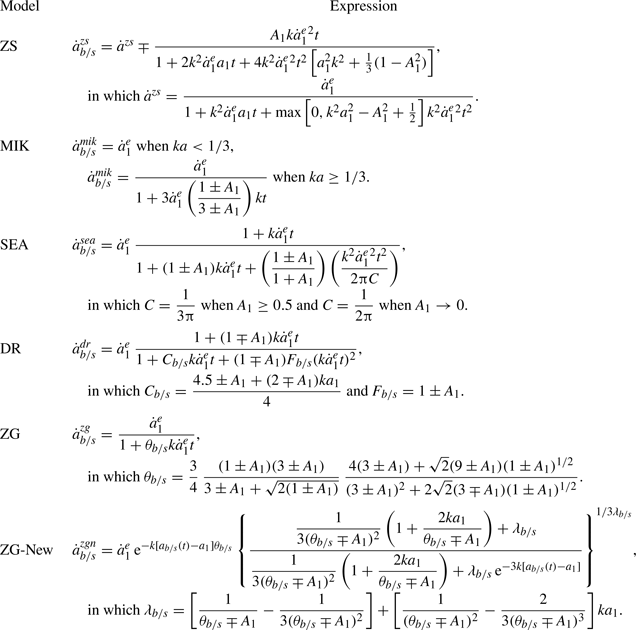
Detailed expressions of considered nonlinear models.

3.3. Weakly nonlinear evolution of perturbation amplitude
Temporal variations of perturbation amplitude  $a$ in dimensionless form for runs with different
 $A_1$ are shown in figure 4(b). Here,
 $t$ and
 $a$ are normalized as
 $\tau =k\dot {a}_1^e(t-t^*)$ and
 $\alpha =k(a-a^*)$, respectively, where
 $\tau$ values corresponding to the last data point (
 $\tau _l$) in different runs are in the range 0.7–2.3. Therefore, SI in all runs can be considered to be within the weakly nonlinear evolution stage at
 $\tau =\tau _l$. The scaling collapses the results of all runs except run 0.86, indicating that the weakly nonlinear evolution law of RMI with
 $A_1$ close to 1 is significantly different from that of RMI with relatively low
 $A_1$. Then a comparative analysis of experimental results and predictions by typical nonlinear models is performed. Nonlinear models including the ZS, MIK, SEA, DR, ZG and ZG-New models are considered, and their detailed expressions are listed in table 3. From the comparison of the experimental and theoretical results, we notice that the predictive capabilities of considered nonlinear models for runs 0.30, 0.44 and 0.52 (runs 0.61, 0.68 and 0.72) are similar. Therefore, for clarity, three typical experiments (runs 0.30, 0.68 and 0.86), referred to below as RMI with low, intermediate and high
 $A_1$, respectively, are chosen for further discussion.
The temporal variations of  $a$ and
 $a_{b/s}$ (where subscripts
 $b$ and
 $s$ represent bubble and spike, respectively) in dimensionless form obtained from experiments and predicted by nonlinear models for runs 0.30, 0.68 and 0.86 are shown in figure 5. For run 0.30, the MIK (ZG) model excellently (reasonably) predicts the experimental results, while the other models slightly overestimate
 $a$ and
 $a_{b/s}$. For run 0.68, the ZG model provides the best prediction of the experimental results, while the MIK model slightly underestimates
 $a$ and
 $a_s$ at late stages. The ZS, SEA, DR and ZG-New models well predict
 $a_b$ while obviously overestimating
 $a$ and
 $a_s$. In run 0.86,
 $\dot {a}_s$, which decreases continuously in RMI with low or intermediate
 $A_1$, increases gradually, verifying the numerical observation that the spike acceleration is significant when
 $A_1$ is high (Dimonte & Ramaprabhu Reference Dimonte and Ramaprabhu2010). The SEA model (MIK and ZG models) obviously overestimates (underestimate)
 $a$ and
 $a_s$ while still predicting (forecasting)
 $a_b$ well. In contrast, the ZS, DR and ZG-New models also predict
 $a$ and
 $a_s$ well. Notably, the significant spike acceleration phenomenon is observed experimentally for the first time.
Comparisons between experimental and theoretical results for (a,c,e) dimensionless  $a$ and (b,d,f) dimensionless
 $a_{b/s}$, for (a,b) run 0.30, (c,d) run 0.68, and (e,f) run 0.86.

Before analysing the predictive capabilities of nonlinear models, it is important to mention that even if the experimental and theoretical results agree well, it may be accidental. For example, as observed by Dimonte & Ramaprabhu (Reference Dimonte and Ramaprabhu2010), the MIK model, which is theoretically inapplicable when  $ka_1>1/3$, reasonably predicts the numerical results with
 $ka_1\approx 1$. All considered models can reasonably predict the bubble evolution under a wide range of
 $A_1$ conditions, probably because the bubble is more stable than spike, and its asymptotic curvature is insensitive to
 $A_1$ (Zhang & Guo Reference Zhang and Guo2022). In the following, we will focus on the predictive capabilities of models for the evolutions of
 $a$ and
 $a_s$.
ZS model: asymptotic  $\dot {a}$ predicted by the ZS model satisfies the
 $1/t^2$ law when
 $A_1<\sqrt {1/2+(ka_1)^2}\approx 0.75$ and the
 $1/t$ law when
 $A_1>\sqrt {1/2+(ka_1)^2}\approx 0.75$. Note that the late-time
 $1/t$ law of
 $\dot {a}$ is expected from the potential flow model and has been validated in previous numerical and experimental works (Dimonte & Ramaprabhu Reference Dimonte and Ramaprabhu2010; Mansoor et al. Reference Mansoor, Dalton, Martinez, Desjardins, Charonko and Prestridge2020). Thus the ZS model fails to predict
 $a$ and
 $a_s$ well for runs 0.30 and 0.68, while reasonably predicting the results of run 0.86.
SEA model: the overestimation of the SEA model for  $a$ and
 $a_s$ under various
 $A_1$ conditions should be ascribed to its overestimation of the spike acceleration (Dimonte & Ramaprabhu Reference Dimonte and Ramaprabhu2010).
MIK model: the extension of the MIK model to spike is realized using Goncharov's method (Goncharov Reference Goncharov2002), and Goncharov's method is based on the assumption that the asymptotic curvatures of spike and bubble are equal. Besides, the MIK model includes no term describing spike acceleration. When  $A_1$ is low, the assumption of Goncharov's method is reasonable (Zhang & Guo Reference Zhang and Guo2022), and the spike acceleration should be absent or very weak. Therefore, the MIK model predicts the weakly nonlinear evolution of RMI with low
 $A_1$ well. Since the asymptotic curvature of spike is sensitive to
 $A_1$ (Mikaelian Reference Mikaelian2008; Zhang & Guo Reference Zhang and Guo2022), the assumption of Goncharov's method is no longer reasonable when
 $A_1$ is intermediate or high. In other words, the MIK model is theoretically inapplicable to predict the spike evolution of RMI with intermediate or high
 $A_1$. Therefore, the relatively good prediction of RMI with intermediate
 $A_1$ by the MIK model may be accidental. The spike acceleration is significant when
 $A_1$ is high, therefore the MIK model obviously underestimates
 $a$ and
 $a_s$ for run 0.86.
DR model: the purpose of Dimonte & Ramaprabhu (Reference Dimonte and Ramaprabhu2010) was to develop an empirical nonlinear model applicable to RMI with high  $A_1$ and
 $ka_0$ conditions. Therefore, although numerical simulations with low and intermediate
 $A_1$ were also considered when constructing the DR model, more emphasis was placed on achieving a good match between model predictions and numerical results of RMI with high
 $A_1$. Accordingly, the poor predictive capability of the DR model for runs 0.30 and 0.68, and its good predictive capability for run 0.86, are reasonable and expected.
ZG and ZG-New models: the similarities and differences between these two models can be summarized in three parts. First, compared to the ZG model, the ZG-New model considers two additional physical processes, i.e. the weakly nonlinear process and the pre-asymptotic process. Therefore, whether for RMI with low, intermediate or high  $A_1$, the ZG-New model is theoretically more accurate than the ZG model. Second, in the early stages, the ZG and ZG-New models recover to the small-time behaviours predicted by the linear and ZS models, respectively. In other words, the ZG-New model (ZG model) considers (does not consider) the spike acceleration. Third, in the asymptotic stages, both models recover to the late-time solution proposed based on several properties observed from a potential flow system with infinite density ratio (
 $A_1=\pm 1$). Therefore, both models should be more accurate for RMI with high
 $A_1$ than for RMI with low or intermediate
 $A_1$. The ZG-New model overestimates the results of RMI with low or intermediate
 $A_1$, which should be attributed to the limitation of the late-time solution. The ZG model ignores the weakly nonlinear and pre-asymptotic processes, and its late-time solution may be not very accurate when
 $A_1$ is low or intermediate. Therefore, the relatively good prediction of RMI with low or intermediate
 $A_1$ by the ZG model should be accidental. When
 $A_1$ is high, the spike acceleration is significant and the late-time solution on which the ZG and ZG-New models are based is theoretically more reasonable. Therefore, the ZG-New model predicts the results of run 0.86 well, while the ZG model, which ignores spike acceleration, underestimates
 $a$ and
 $a_s$ in this case.
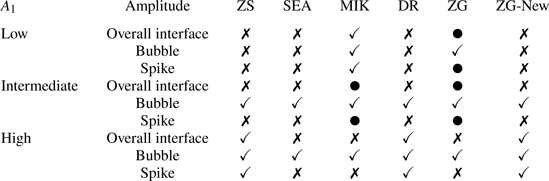
The predictive capabilities of considered nonlinear models for the amplitude evolutions of the overall interface, bubble and spike under different  $A_1$ conditions are summarized in table 4. None of the considered models is applicable to RMI under all
 $A_1$ conditions. Since the interface evolution studied in the present work is limited to weakly nonlinear stage, the failure of models should be attributed mainly to the insufficient description of the dependence of the spike acceleration on
 $A_1$. A rigorous description of the spike acceleration under various
 $A_1$ conditions is rather difficult, therefore we attempt to propose an empirical model applicable to RMI over a wide range of
 $A_1$ based on the present experimental results. The DR model not only considers the spike acceleration occurring in the early stages and captures the late-time
 $1/t$ behaviour of
 $\dot {a}$, but also describes the effect of
 $ka_0$ on nonlinear evolution law. Therefore, we will construct a new empirical model (the mDR model) by modifying the DR model. The mDR model obtained after many attempts can be written as
 \begin{equation} \dot{a}_{b/s}^{mdr}=\dot{a}_1^e\,\frac{1+E(1\mp A_1)k \dot{a}_1^e t}{1+C_{b/s}k \dot{a}_1^e t+E(1\mp A_1)F_{b/s}(k \dot{a}_1^e t)^2}, \end{equation}
in which  $E=(3-2A_1)/(9-9A_1)$. The introduction of the coefficient
 $E$, which is smaller than 1 when
 $A_1$ is low or intermediate, solves the problem that the DR model overestimates spike acceleration under low and intermediate
 $A_1$ conditions. When
 $A_1\rightarrow 0.86$,
 $E\rightarrow 1$, i.e. the mDR model recovers to the DR model, which ensures that the mDR model can also predict well RMI with high
 $A_1$. Besides, the mDR model can also recover to the DR model in the asymptotic stages. Note that although the mDR model is invalid when
 $A_1$ approaches 1 due to the limitation of
 $E$, it is capable of predicting the amplitude evolution of RMI with
 $A_1$ ranging from 0.30 to 0.86 as shown in figure 5.
Summary of the predictive capabilities of considered nonlinear models for the amplitude evolutions of the overall interface, bubble and spike under different  $A_1$ conditions. Here, ✓ indicates that the model is applicable both theoretically and practically,
 $\bullet$ indicates that the model is theoretically inapplicable but accidentally applicable in practice, and ✗ indicates that the model is practically inapplicable.

3.4. Modal evolution in the weakly nonlinear stage
Modal analysis is performed to explore the modal evolution under various  $A_1$ conditions. Similarly, three typical experiments (runs 0.30, 0.68 and 0.86) are considered for clarity. The fast Fourier transform (FFT) is applied to obtain the modal information of the interface. Because the FFT is applicable only when the interface profile can be described by a single-valued function (Wang et al. Reference Wang, Cao, Chen, Zhai and Luo2022), only the modal evolution prior to the formation of roll-up structures is investigated. In addition, since the modal analysis is limited to the weakly nonlinear stage, the magnitudes of the fourth-order and other higher-order harmonics are very small relative to that of the first harmonic, therefore only the first three harmonics (m
 $_1$, m
 $_2$ and m
 $_3$) are considered (Liu et al. Reference Liu, Liang, Ding, Liu and Luo2018).
3.4.1. Effect of modal evolution on interface morphology
The dimensionless contours of shocked interface SI at  $\tau \approx 0.7$ obtained from runs with different
 $A_1$ are provided in figure 6(a). Here,
 $x=0$ and
 $y=0$ correspond to the
 $x$-coordinate of the bubble tip and the
 $y$-coordinate of the middle position between bubble and spike tips, respectively. It can be noticed that SI in run 0.30 remains almost symmetrical, and the asymmetry of SI is higher in RMI with higher
 $A_1$.
(a) Comparison of dimensionless contours of SI at  $\tau \approx 0.7$ obtained from different runs. Modal information of the contour of SI at
 $\tau \approx 0.7$: (b) run 0.30, (c) run 0.68, and (d) run 0.86.

Modal information of the SI contours shown in figure 6(a) is obtained by FFT and presented in figures 6(b–d). For run 0.30, the dimensionless amplitudes of m $_2$ and m
 $_3$ (
 $\alpha _2$ and
 $\alpha _3$) are still significantly smaller than that of m
 $_1$ (
 $\alpha _1$) at
 $\tau \approx 0.7$, therefore SI maintains an almost symmetrical shape. For run 0.68,
 $\alpha _2$ increases to a considerable level when
 $\tau \approx 0.7$. Considering only the right half of SI, i.e. SI with
 $x/\lambda$ ranging from 0 to 0.5, m
 $_1$ and m
 $_2$ have the same phase at positions close to the spike tip (
 $0.375< x/\lambda <0.5$) and in the range
 $0.125< x/\lambda <0.25$. In contrast, m
 $_1$ and m
 $_2$ have opposite phases at positions close to the bubble tip (
 $0< x/\lambda <0.125$) and in range
 $0.25< x/\lambda <0.375$. Therefore, m
 $_2$ tends to flatten the bubble (Guo et al. Reference Guo, Zhai, Ding, Si and Luo2020) and sharpen the spike, resulting in a significant asymmetry of the SI in run 0.68. For run 0.86,
 $\alpha _3$ also increases to a considerable level when
 $\tau \approx 0.7$. Here, m
 $_2$ and m
 $_3$ have opposite phases at positions close to the bubble tip (
 $0< x/\lambda <0.083$) and have the same phase at positions close to the spike tip (
 $0.417< x/\lambda <0.5$). In other words, m
 $_2$ and m
 $_3$ have opposite contributions to the flatness of the bubble, while together promoting the sharpening of the spike. Therefore, the spike profile in run 0.86 is obviously different from that in run 0.68, while the difference in bubble profile between these two runs is less pronounced.
3.4.2. Model validation and analysis
Evolutions of  $\alpha _1$,
 $\alpha _2$ and
 $\alpha _3$ obtained from experiments and predicted by modal models for runs 0.30, 0.68 and 0.86 are shown in figure 7. For run 0.30, both
 $\alpha _2$ and
 $\alpha _3$ grow very slowly. The ZSM and VM models have limited effective range, and their accuracies are sensitive to
 $ka$ (Jacobs & Krivets Reference Jacobs and Krivets2005) since they are both derived by the perturbation expansion method. Thus the ZSM and VM models predict
 $\alpha _1$ well (poorly) when
 $\alpha _1<0.3$ (
 $\alpha _1>0.3$). The predictions of the ZSM and VM models for
 $\alpha _2$ are similar and agree with the experimental results. In the late stages, the predictions of the ZSM and VM models for
 $\alpha _3$ differ slightly, and both deviate slightly from the experimental results.
Modal evolutions obtained from experiments and predicted by modal models: (a) run 0.30, (b) run 0.68, and (c) run 0.86.

For run 0.68,  $\alpha _3$ still varies very slowly and remains far smaller than
 $\alpha _1$ from early to late stages. In contrast,
 $\alpha _2$ grows to a considerable level in the late stages. The predictions of the ZSM and VM models for
 $\alpha _1$ are similar and agree well (poorly) with the experimental results when
 $\alpha _1<0.2$ (
 $\alpha _1>0.2$). The ZSM model considers only the contributions of the first fourth-order perturbation solutions, whereas the VM model accounts for perturbation solutions up to 11th-order, but with an additional simplification: only the terms with the highest power in
 $t$ are retained. Therefore, when high-order harmonics can (cannot) be ignored, the ZSM model should be more (less) accurate than the VM model. In run 0.68, m
 $_3$ is negligible and, accordingly, the higher-order harmonics should also be negligible. Therefore, the ZSM model predicts
 $\alpha _2$ and
 $\alpha _3$ in run 0.68 better than the VM model.
In run 0.86, m $_2$ (m
 $_3$) develops obviously faster than those in runs 0.30 and 0.68, and becomes considerable in the late stages. The predictions of the ZSM and VM models for
 $\alpha _1$ are similar and agree well (poorly) with the experimental results when
 $\alpha _1<0.1$ (
 $\alpha _1>0.1$). It can be noticed that the predictive capabilities of the ZSM and VM models for
 $\alpha _1$ are also related to
 $A_1$. For
 $\alpha _2$ (
 $\alpha _3$), the VM model instead of the ZSM model provides a better prediction in the late stages, validating the above analysis that the VM model should be more accurate than the ZSM model when high-order harmonics are no longer negligible.
4. Conclusions
Richtmyer–Meshkov instability (RMI) on a light–heavy single-mode interface over a wide range of post-shock Atwood numbers ( $A_1$) is studied finely and systematically through experiments. To perform experiments under a wide range of
 $A_1$ conditions, in addition to the soap-film technique, which can produce well-defined desirable interfaces, a gas-layer scheme is adopted such that the spaces on both sides of the soap film can be filled with different gases.
Qualitatively, the nonlinear evolution features of the shocked interface (SI), including spike, bubble and roll-up structures, are more significant in RMI with higher  $A_1$. Specifically, before moving out of the experimental observation area, SI in RMI with low
 $A_1$ remains a quasi-single-mode profile, while SI in RMI with high
 $A_1$ becomes highly asymmetrical and has roll-up structures. Quantitatively, the impulsive model (Richtmyer Reference Richtmyer1960) and the WN-WL model (Wouchuk & Nishihara Reference Wouchuk and Nishihara1997) are found to be valid for predicting the linear growth rate under a wide range of
 $A_1$ conditions, indicating that both models describe correctly the dependence of the linear amplitude evolution on
 $A_1$. For the weakly nonlinear evolution stage, the significant spike acceleration (occurring when
 $A_1$ is high) results in the evolution law of RMI with high
 $A_1$ being different from that of RMI with low or intermediate
 $A_1$. Notably, the significant spike acceleration phenomenon is observed experimentally for the first time. None of the considered nonlinear models (Zhang & Sohn Reference Zhang and Sohn1997; Sadot et al. Reference Sadot, Erez, Alon, Oron, Levin, Erez, Ben-Dor and Shvarts1998; Mikaelian Reference Mikaelian2003; Dimonte & Ramaprabhu Reference Dimonte and Ramaprabhu2010; Zhang & Guo Reference Zhang and Guo2016, Reference Zhang and Guo2022) is found to apply to RMI under all
 $A_1$ conditions, and the predictive capabilities of these models are analysed and summarized. Based on the present experimental results, an empirical nonlinear model applicable to RMI over a wide range of
 $A_1$ is proposed. Further, modal analysis shows that the second harmonic tends to flatten the bubble and sharpen the spike, while the third harmonic tends to sharpen both bubble and spike. In RMI with high (low or intermediate)
 $A_1$, high-order harmonics evolve rapidly (slowly) and cannot (can) be ignored. Accordingly, for RMI with high (low or intermediate)
 $A_1$, the modal model proposed by Zhang & Sohn (Reference Zhang and Sohn1997) is less (more) accurate than the model proposed by Vandenboomgaerde et al. (Reference Vandenboomgaerde, Gauthier and Mügler2002), since the former ignores perturbation solutions higher than fourth order (the latter retains only terms with the highest power in time).
In inertial confinement fusion (ICF), the development of spike can lead to ablative material entering the hot spot, which would substantially reduce the energy gain and even lead to ignition failure (Kritcher et al. Reference Kritcher2022). According to the present work, to avoid the intense spike development occurring when  $A_1$ is high, we discreetly suggest choosing ablative material with relatively low density to reduce the density ratio between ablator and deuterium-tritium (DT) ice. In addition, it is important to note that in ICF, the interface separating ablator and DT ice, and the interface separating DT ice and DT gas, are both heavy–light. Therefore, investigating RMI on a heavy–light interface over a wide range of
 $A_1$ is also necessary and interesting, as discussed by Lombardini et al. (Reference Lombardini, Hill, Pullin and Meiron2011). A relevant work is currently ongoing. Fortunately, due to the flexibility of the gas-layer scheme – i.e. gases on both sides of the soap film can be altered as desired – experiments on RMI with diverse negative
 $A_1$ can be conducted without changing the structure of the shock-tube facility adopted in the present work.
Funding
This work was supported by the National Natural Science Foundation of China (nos 12102425, 12022201 and 91952205) and Youth Innovation Promotion Association CAS.
Declaration of interests
The authors report no conflict of interest.