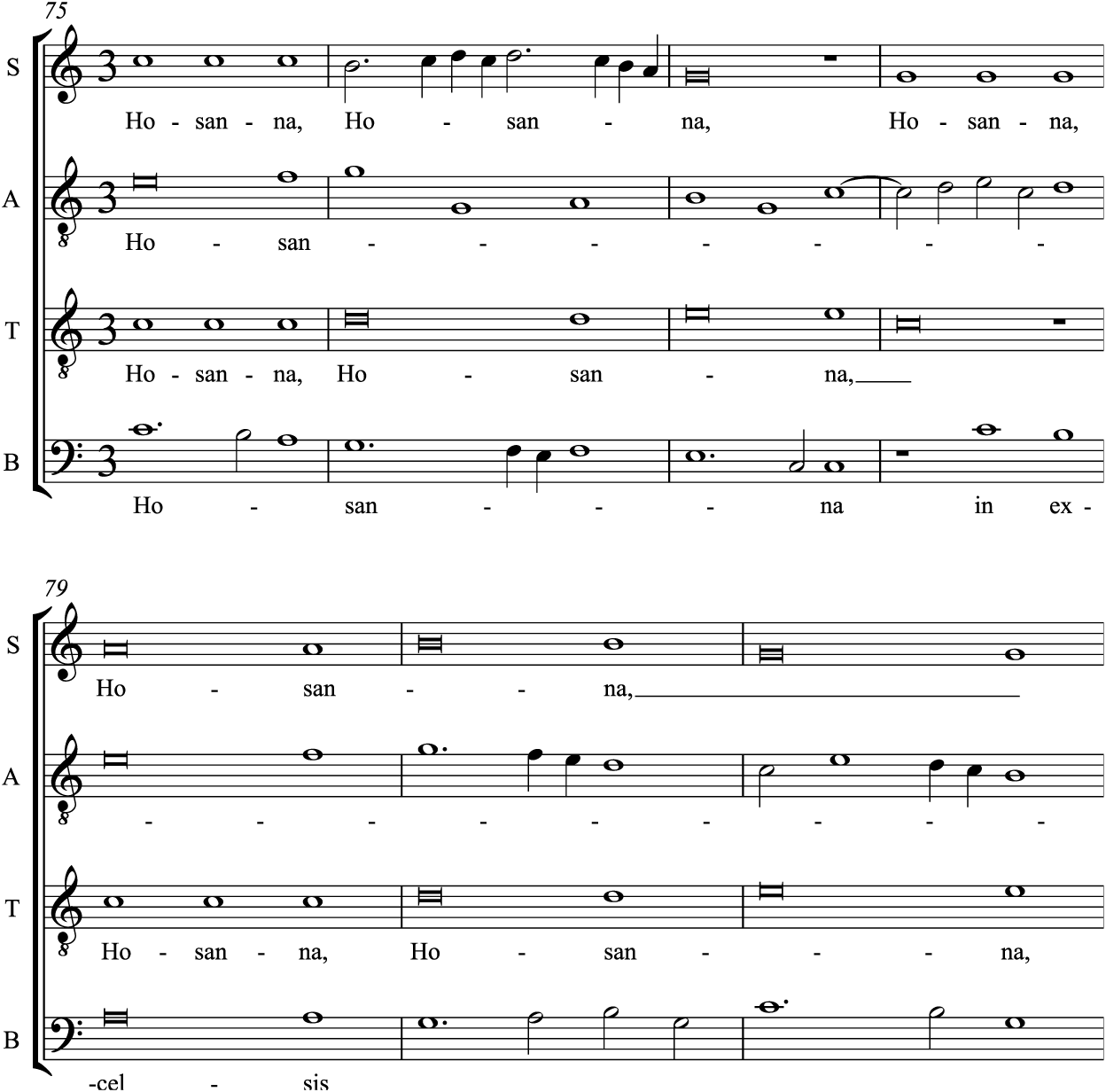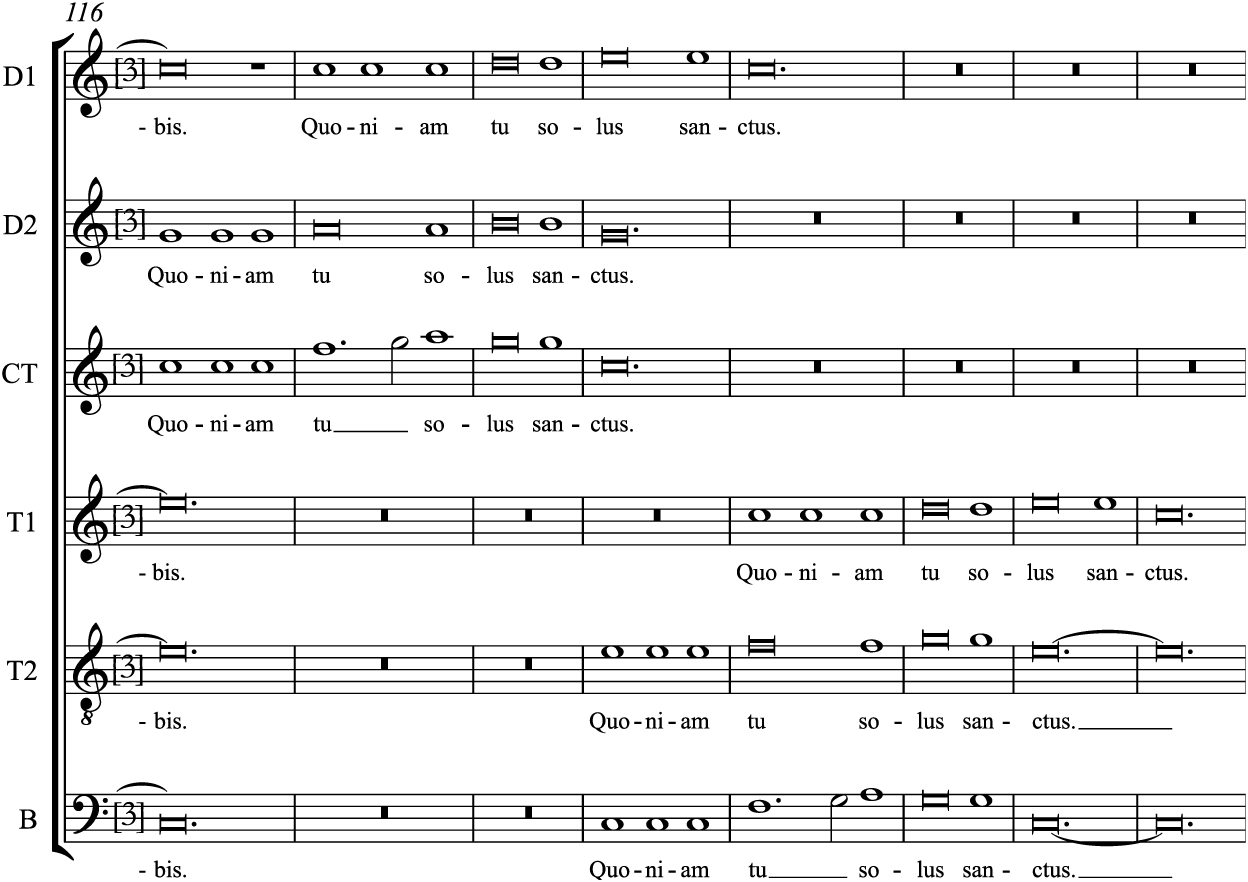



Ave Maria was chosen by Petrucci to stand at the head of his first motet collection … Clearly it owes its position, and its evident popularity, to the way in which it was felt to typify the perfection of a particular style.Footnote 1
Josquin’s Ave Maria … virgo serena occupies a special position at the intersection of academia and contemporary culture. The most widely anthologised and recorded Renaissance motet, Ave Maria enjoys the unique quality of being recognisable to lay audiences, while simultaneously garnering decades of debate and a multitude of scholarly articles concerning not only its geographic and chronological origins but its stylistic significance as well. The motetalso serves an important pedagogical function, introducing generations of music students to the sound-world of the Renaissance.
How did Ave Maria achieve this special status? As Jeremy Noble’s description for the 1980 edition of New Grove makes clear, the motet’s position at the opening of the first printed book of motets, Petrucci’s Motetti A (Venice, 1502), has played a crucial role in shaping its contemporary esteem. Indeed, citing its placement in Motetti A and its relatively robust circulation, Stephanie Schlagel recently asserted that Josquin’s Ave Maria has ‘always been one of his most famous motets’.Footnote 2 But besides its location at the opening of Petrucci’s print, what can we say for certain about the motet’s reputation in the Renaissance? As John Milsom has succinctly stated: ‘relatively little is known about its reception in and immediately after Josquin’s lifetime beyond the fact that it became one of his more popular works and served as a model for other compositions’.Footnote 3 Joshua Rifkin also cautions against reading too much into the motet’s placement, noting: ‘Whether Petrucci’s choice … reflects any motive beyond the rather obvious one of starting the volume with a Marian piece by a reputable composer must remain a matter of speculation.’Footnote 4 Indeed, many manuscript and print collections – even songbooks – begin with a Marian motet, including Petrucci’s Odhecaton, which opens with Marbriano de Orto’s Ave Maria.Footnote 5
In the nearly forty years that have elapsed since Noble’s assessment of the motet’s Renaissance reputation, Josquin studies have undergone sweeping changes. For one, the composer’s biography has shifted in significant ways: his birthdate has been pushed forward by a generation or so and his tenure in Milan is now known to be much shorter than previously believed.Footnote 6 For another, we possess a more nuanced understanding of the composer’s posthumous reception, and greater awareness of the historiographical issues in play.Footnote 7 With respect to Ave Maria specifically, we now know more about the stylistic – if not the precise geographic – context surrounding the work.Footnote 8 And yet in spite of these developments, the motet’s reception remains shadowy at best. We are thus in an ideal position to take a step back from our modern impression of the work’s significance and to consider afresh the reception of Ave Maria.
If we take the motet’s seemingly conspicuous placement in Motetti A as the starting point, rather than the end point, what might we uncover about its life both during and after the Renaissance? The reception of a motet such as Ave Maria can – and indeed, should – be measured in terms more comprehensive than a tally of sources and positions within those sources. Though the significance of these numerical indicators is indisputable, they are only part of the picture. Nuances of the work’s circulation, including alterations made to its text and counterpoint, also shed light on its uses at different times and in geographic contexts. Written discourse has traditionally featured prominently in reception studies, particularly for later repertories that have left greater paper trails, including concert programmes and reviews. As will be discussed below, however, contemporary written accounts of Ave Maria are very limited in scope.Footnote 9
If all this makes the Renaissance reception of Ave Maria seem impossible to trace, I suggest that the most significant and telling evidence lies in the corpus of sixteenth-century motets and masses that engage with Josquin’s motet. As the bulk of the work’s transmission occurred within a comparatively condensed time-frame (see below), such reworkings probably provided an essential conduit through which the motet was experienced in the sixteenth century. In this context, then, composition can be understood as a meaningful act of reception; and the specific ways in which these pieces highlight as well as camouflage Josquin’s original work are paramount to its reception history.Footnote 10 Analysing each in turn provides new insight into the motet’s reception in the Renaissance.
In doing so, I take my cue from Jessie Ann Owens and Jesse Rodin, who both strive to cultivate awareness of the composite nature of Josquin’s reception and to move towards a more granular reception history. Owens has suggested teasing apart the geographic shaping forces behind Josquin’s reception – the different ‘Josquins’ known in discrete geographic regions. She recommends: ‘We need to work with even smaller areas … or with other defining characteristics – genre, religious context – to define more precisely the pieces that stayed in the repertory and trace more accurately the patterns of transmission.’Footnote 11 Rodin, meanwhile, proposed identifying more precisely the chronological turning points, and taking care not to collapse Josquin’s posthumous reception with his career.Footnote 12 For Ave Maria, this caution is all the more essential in the light of the motet’s unparalleled twentieth-century fame. Lastly, this reception project also seeks to fulfil Paula Higgins’s recommendation from 2004 that Ave Maria would ‘make an excellent subject for an individual reception history’ based on its survival and value ‘spanning multiple centuries’.Footnote 13
Focusing on the motet’s Renaissance reception, Part I tackles questions of dissemination and style in Ave Maria and the motets and masses that engage with it. Part II considers the work’s modern reception, scrutinising not only its appearance in scholarly articles, but also in survey texts and audio recordings. What makes this dual-epoch reception history so compelling is that, as will be discussed below, modern scholars have consistently described Ave Maria as prefiguring later styles, and even as a sixteenth-century motet avant la lettre. Examining the specific ways in which sixteenth-century composers engaged with Ave Maria thus provides a fertile testing ground for this hypothesis. The types of sources examined in Part I and Part II are decidedly different: whereas written accounts feature to a limited degree in the Renaissance reception of Ave Maria, the bulk of the evidence for Part I stems from musical responses to the work. By contrast, scholarly discourse and written accounts form the substance of Part II. Though they are connected by virtue of Ave Maria itself, the two sections generate two very different reception histories. Thus, while I do compare the motet’s status in these two periods, my goal is not simply to ask whether our modern conception of Ave Maria is commensurate with its Renaissance reception, but rather to consider the various angles and nuances of its reception, and in particular, how its meaning and significance have transformed over time.
PART I: THE RECEPTION OF AVE MARIA … VIRGO SERENA IN THE RENAISSANCE
1. The Circulation of Ave Maria in Manuscript and Print Sources
Ave Maria … virgo serena survives in twenty-seven sources: twenty-three manuscripts, two tablatures, one treatise and one printed edition, ranging from the 1480s to the 1550s.Footnote 14 The surviving manuscripts suggest a fairly wide geographic reach, encompassing northern France, Florence, Rome, Milan, Modena, Toledo, Prague, Basel, as well as the Catholic centres of Munich and Augsburg, and the Lutheran centre of Torgau.Footnote 15 As Willem Elders pointed out, approximately one-third of the sources existed prior to c. 1500; one-third belong to the period between Petrucci’s motet publication (1502) and 1521; and one-third fall between the composer’s death and c. 1550. This last third includes three manuscripts that preserve a contrafact version of the motet, one that has a si placet version, and one printed treatise.
The surviving source tradition for Ave Maria is indisputably robust. Indeed, in purely numerical terms Ave Maria ranks as Josquin’s fifth most widely disseminated motet. Nevertheless, placing it side by side with the composer’s most widely circulating motet, Benedicta es celorum regina, reveals telling differences. Benedicta es survives in sixty-five sources, twenty-seven of which are manuscripts originating in Austria, the Low Countries, France, the Czech Republic, multiple centres in Spain and Italy, Scotland, as well as Bavaria, Augsburg and the Lutheran centre of Zwickau.Footnote 16 Whereas the geographic reach of Benedicta es is not too dissimilar to that of Ave Maria – the most notable difference being the uptick in Spanish manuscripts – its transmission extends over a much longer period of time, with sources copied as late as c. 1620.Footnote 17 Thus, while the transmission of Ave Maria is only one-third that of Benedicta es, it is remarkably compact given the relatively short period of time in which it occurred.
Whereas the transmission of Benedicta es increased through the first two-thirds of the sixteenth century, the circulation of Ave Maria was already beginning to decline after the composer’s death in 1521. Setting apart the transmission of Ave Maria from Josquin’s other widely circulating motets like Benedicta es is the fact that Ave Maria survives in a single printed edition: Petrucci’s Motetti A (1502). Of the composer’s widely disseminated motets, Ave Maria possesses the greatest manuscript-to-print ratio (see Figure 1). The transmission of Ave Maria is 85 per cent manuscript-based and only 3.7 per cent print-based; by contrast, for Benedicta es manuscripts make up only 41 per cent and prints 15 per cent. As Schlagel has shown, mid-sixteenth-century anthologies printed in Germany and France included large quantities of motets attributed to Josquin.Footnote 18 These editions played a formative role in shaping Josquin’s posthumous reception. Crucially, Ave Maria is not included in any of the German anthologies, such as Senfl’s Liber selectarum cantionum quas vulgo mutetas appellant (Augsburg, 1520), Hans Ott’s Novum et insigne opus musicum, or his Secundus tomus novi operis musici (Nuremberg, 1537–8), which catapulted Josquin’s motets to a new level of fame.Footnote 19
The circulation by type of Josquin’s most widely disseminated motets

What does survive in the Secundus tomus, the second volume in Ott’s printed series, is a mammoth six-voice reworking of Josquin’s four-voice original by Ludwig Senfl (c. 1489–1543). That Ott included Senfl’s motet rather than Josquin’s is probably indicative of the tastes and preferences of mid-sixteenth-century German consumers. Additionally, Schlagel has hypothesised that Senfl’s version of Ave Maria may have ‘upstaged’ Josquin’s, ‘thwarting its transmission after Josquin’s death’.Footnote 20
Motets attributed to Josquin make up approximately one-third of Ott’s print, and include some of the composer’s most famous five- and six-voice pieces, such as Benedicta es, celorum (6v); Inviolata, integra et casta es Maria (5v); Miserere mei, Deus (5v); Praeter rerum seriem (6v); and Stabat mater dolorosa (5v).Footnote 21 Because Ott’s print is organised by number of voices, the lack of four-voice works by Josquin (such as Ave Maria) and the dominance of Heinrich Isaac and Senfl in this section is particularly apparent. Whether Ott lacked access to Josquin’s four-voice motets, or whether he was responding to a perceived lack of interest in smaller-scale works like Ave Maria remains unclear. What is certain, however, is that the Josquin motets that reached the highest circulation rates are scored for five or six voices and were printed in German sources. Had Josquin’s four-voice Ave Maria featured in Ott’s print or in the Liber selectarum cantionum (1520), its transmission might have been a very different story. Figure 1 above shows the dissemination of Josquin’s most widely circulating motets by type (i.e., manuscript, print, etc.). As the graph makes plain, Ave Maria is uniquely positioned among these works in that it is the only motet to achieve prominent circulation and yet not be included in the German anthologies.
2. Contrafacta and Textual Changes
The twenty-seven sources transmitting Ave Maria present a varied impression of the motet. Beyond subtle variations in counterpoint, these changes also include substantial textual differences, impacting in significant ways the manner in which Ave Maria could have been encountered in the fifteenth and early sixteenth centuries. What is more, these differences engage elements of the motet we have come to understand as not only quintessential to the work, but as contributing to its fame.
As central as Motetti A is to the renown of Ave Maria … virgo serena, Petrucci’s print provides a text different from that of the original.Footnote 22 More specifically, Petrucci’s editor Petrus Castellanus substituted new lines for the first full stanza:Footnote 23
- Ave Maria [critical edition]
Ave Maria in Petrucci, Motetti A (1502)
- Ave Maria, gratia plena,
Ave Maria, gratia plena,
- Dominus tecum, virgo serena.
Dominus tecum, virgo serena.
- Ave cujus conceptio,
Ave celorum domina,
- Solemni plena gaudio
Maria plena gratia,
- Celestia, terrestria,
celestia, terrestria,
- Nova replet Letitia.
mundum Replens Letitia.
In addition to Petrucci’s version of the text, the motetalso circulated with two distinct contrafact texts. Berlin 40021 is underlaid with text beginning ‘Verbum incarnatum’, and three manuscripts associated with the Lutheran centre of Torgau present a contrafact text beginning ‘Ave Maria … et benedicta tu in mulieribus’.Footnote 24 Adapting the motet to Protestant worship, this version shifts the motet’s textual focus from Mary to Jesus, but it also disturbs its original syllabification, and perhaps even more importantly, its rhyme scheme and form.Footnote 25 Finally, Ave Maria also circulated in two non-tablature sources without any text.
The upshot of these textual variants is that the Ave Maria known to Renaissance musicians may have differed greatly depending on the source, and significantly, these versions differ from Josquin’s original work. Considering the consistency with which modern authors identify text-setting as one of the motet’s most important hallmarks (on which more below), it is important to recognise that our understanding of the tightly knit correlation between music and text would not have been evident to many who encountered Ave Maria in the Renaissance. Textual variants, including full-scale contrafacta, are par for the course in music of this period, and while we are accustomed to accommodating conflicting sources in this way, it bears emphasising that even a work with such a monumental and fixed status as Ave Maria is not immune to such variation and fluidity.
3. Musical Changes
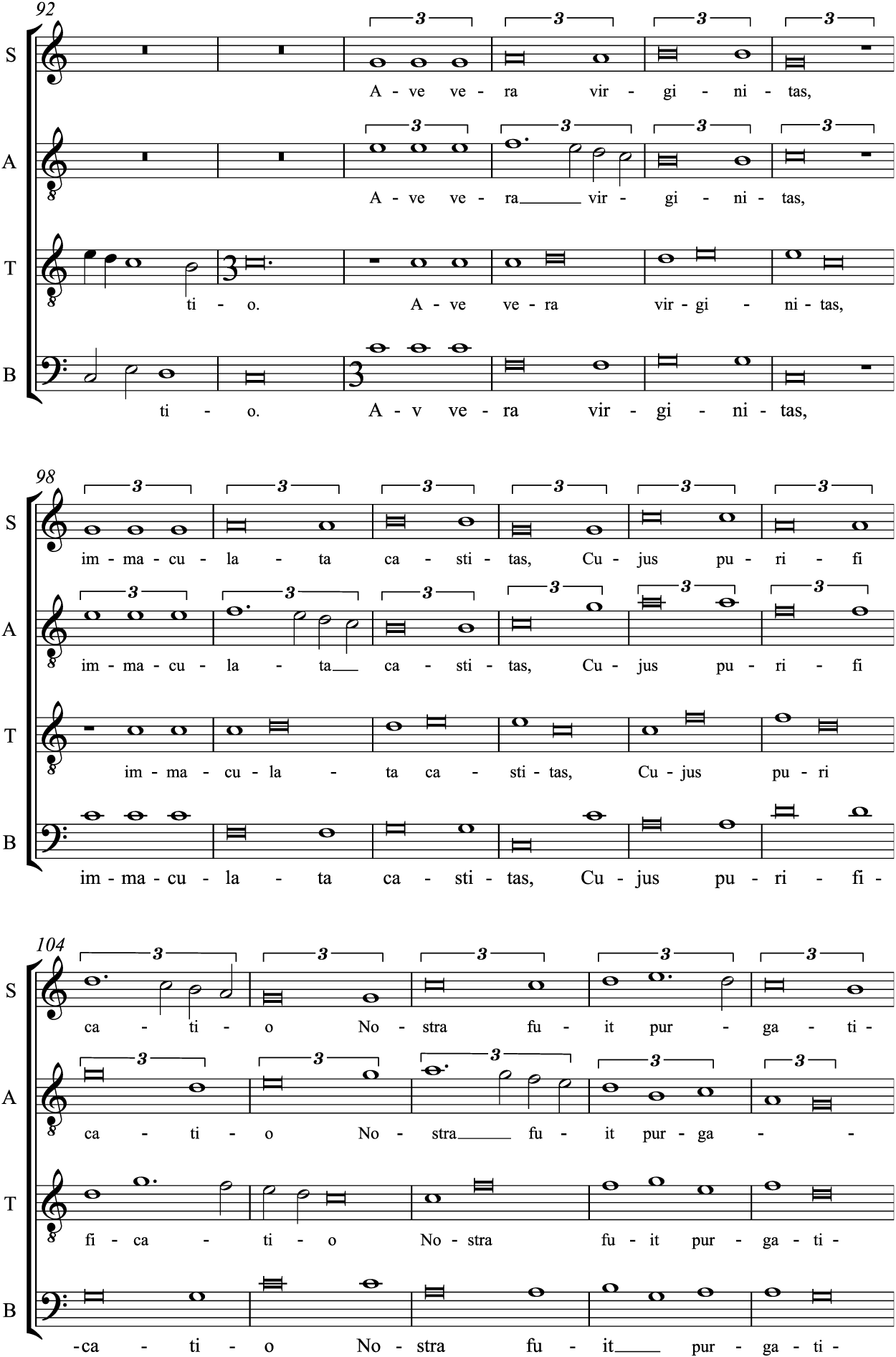
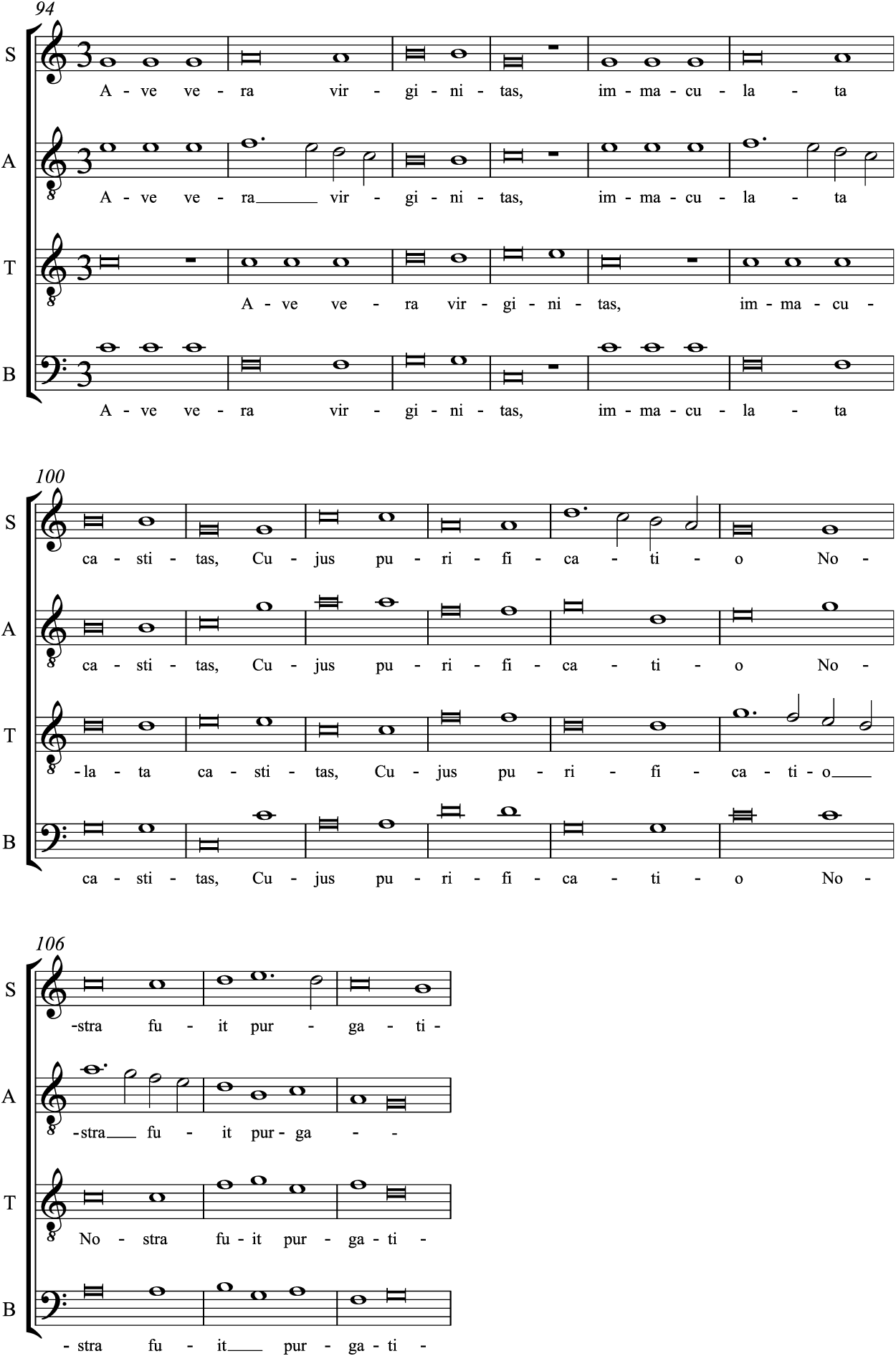
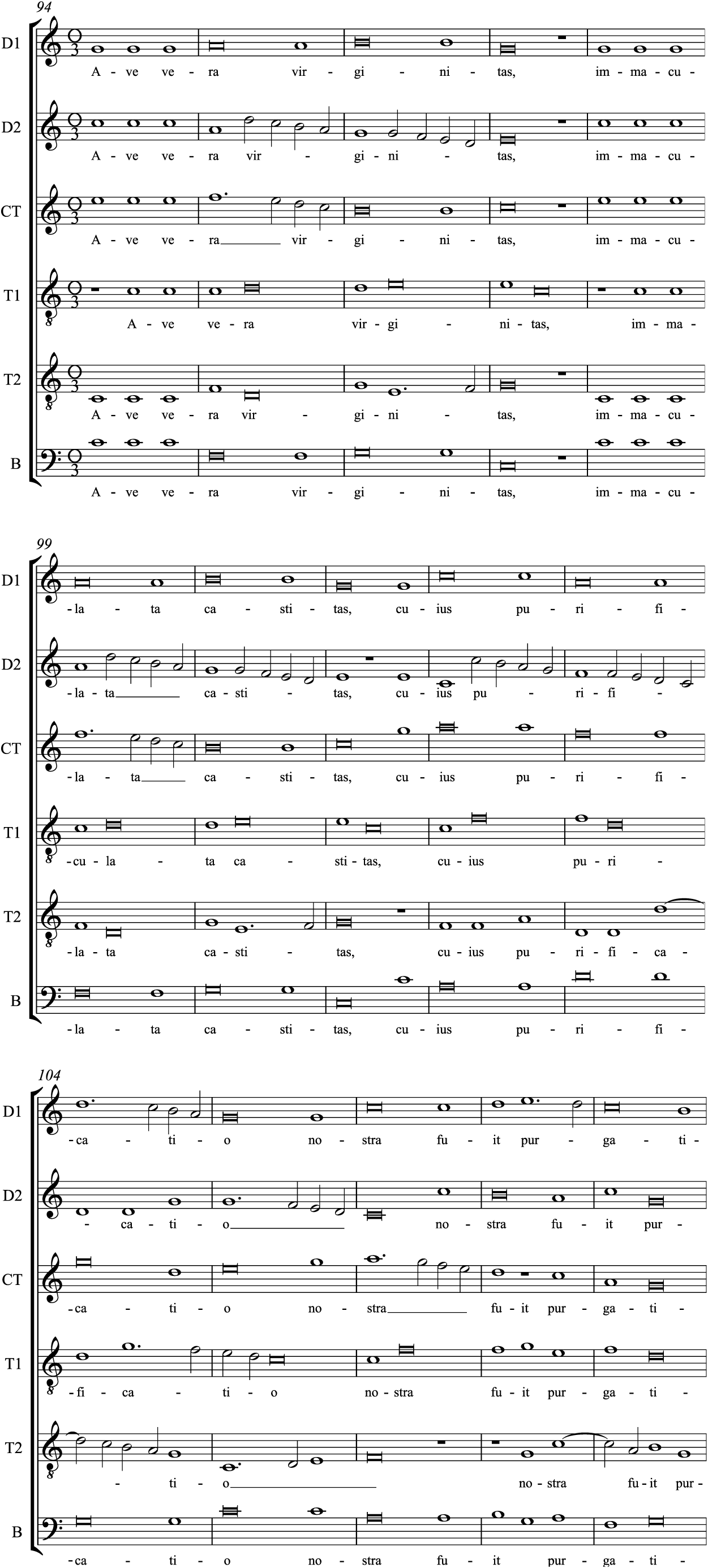
In addition to textual modifications, musical variants also shape the Josquin motet corpus, and Ave Maria is home to a particularly robust musical change. Four sources preserve a variation in the sesquialtera passage that, while seemingly slight, generates a profound change in Josquin’s counterpoint. The sesquialtera passage in Josquin’s original features stately homorhythm, but it also incorporates stretto fuga between the tenor and superius at the time interval of a semibreve (see Example 1a). The semibreve stretto fuga injects a jolt of rhythmic vitality into an otherwise vanilla sesquialtera passage that lasts until duple metre resumes at bar 109. The impact of this passage redoubles as the four-bar phrase is restated with new text (bb. 94–7, 98–101).
Josquin, Ave Maria … virgo serena, bb. 92–108. The imitation between superius and tenor is at the time interval of a semibreve (stretto fuga)

In Heinrich Glarean’s Dodecachordon (1547) and his partbooks Munich 322–5, as well as two manuscripts copied in the early sixteenth century (Warsaw 5892 and Barcelona 5), the time interval of the superius–tenor imitation has been delayed, so that the tenor enters after a perfect breve rather than a semibreve (see Example 1b, b. 95).Footnote 26 Though the altered version maintains the same rhythms and sonorities, by delaying the imitative entry it eradicates the stretto fuga, and thereby one of the most definitive elements of Josquin’s motet. This modification results in three brazen consecutive fifths between the lower two voices: see bars 95–6, 99–100, 104–5. It therefore seems likely that the alteration may have arisen from a copying error rather than compositional intervention.
Josquin, Ave Maria … virgo serena, bb. 94–108, as it appears in Glarean’s Dodecachordon. The tenor’s entrance is delayed until the following breve, thereby eliminating the stretto fuga

Many fifteenth-century composers employ sesquialtera in fairly consistent ways.Footnote 27 This is particularly true of the Milanese motetti missales, in which the majority of individual motets employ this metric shift. The way in which Josquin begins the sesquialtera passage with stretto fuga at the semibreve is not only drastically dissimilar to the motetti missales, it is very rare in the composer’s secure works.Footnote 28 Consequently, by removing the stretto fuga, Glarean or his copyist eliminated one of the motet’s most distinctive characteristics.
In addition to the four sources described above, Févin’s Missa Ave Maria, Ludwig Daser’s Missa Ave Maria, and an anonymous Missa Ave Maria in Dresden 1/D/506, all of which are based on Josquin’s motet, make the same rhythmic adjustment, thereby eliminating the characteristic stretto fuga. Moreover, all reworkings of Ave Maria in one way or another engage with and amplify the sesquialtera passage (see below). Thus, Josquin’s sesquialtera emerges as not only significant to his sixteenth-century counterparts, but divisive for the motet’s reception more generally, inspiring some composers to side with the original stretto framework, and others opting for the ‘simplified’ version.
4. Written Accounts
Though Glarean includes Josquin’s Ave Maria from beginning to end in the Dodecachordon, the theorist’s commentary on the motet is somewhat reserved.Footnote 29 Citing it as an example of the Hypoionian mode, Glarean writes that Josquin ‘composed the Ave Maria according to this mode, truly very learnedly and pleasingly … ’.Footnote 30 He subsequently posits that Ave Maria ‘is indeed older, but it can be justly set above any number of the new songs emerging daily’.Footnote 31 Compared to the praise he lavishes on Févin in the sentence following, Glarean’s description of Josquin’s motet is unmistakably subdued: ‘Antoine Févin, a distinguished young man and a successful rival of Josquin, later admired [the Ave Maria] so much, that he, showing the highest skill and the utmost moderation, composed according to it a Mass which is as skillful as any I have ever seen.’Footnote 32
This amounts to the sole commentary on Josquin’s Ave Maria in the Dodecachordon. In his discussion of other works attributed to Josquin, Glarean is far more ebullient. Of De profundis, he praises its ‘freedom of texture’ and explains that the beginning is composed with ‘much expression’, and admires ‘how much dignity [Josquin] has brought us the phrase De profundis’.Footnote 33 Of the Liber generationis, Glarean writes that it ‘possesses great majesty and it is wonderful that from such unfruitful material … [Josquin] has been able to create just as many delights’.Footnote 34 The Missa super voces musicales is ‘magnificent in external display’ and in the Missa de beata Virgine, Josquin ‘extends himself in competition’.Footnote 35
In comparing Glarean’s description of Ave Maria to his writing on other works by Josquin, it becomes clear that the theorist was interested in Ave Maria chiefly, if not exclusively, because it exemplifies the C mode so clearly. That is, Glarean does not praise its clarity of texture, imitation or text setting. Moreover, the theorist is quick to advance Févin’s mass based on Ave Maria – almost as if his principal objective in bringing Ave Maria into the fold was to use it as a segue to Févin’s mass.Footnote 36
5. Compositional Responses
Beyond the circulation of Ave Maria in manuscript, print and theoretical sources, an essential indicator of the motet’s reception stems from its use by later composers in parody masses, motets and si placet settings. Broadly speaking, Ave Maria fits the general trend of using the most widely disseminated of Josquin’s motets as models for new works.Footnote 37 For instance, there are seven masses based on the most widely circulating Benedicta es (65 motet sources) and seven on Preter rerum seriem (51 motet sources). Miserere mei, Deus was hugely popular as the basis for later motets, inspiring a total of eighteen surviving reworkings in the sixteenth century. One potential point of contrast with these other models, however, is that several of the Ave Maria reworkings engage with the motet in ways that have very little precedent or immediate context (see below).
Among these models, the transmission of Ave Maria also stands out. As mentioned above, the circulation of Benedicta es, Preter rerum, Miserere mei and Stabat mater increases through at least the first two-thirds of the sixteenth century. By contrast, the transmission of Ave Maria already begins to decline after the composer’s death. This means that while Benedicta es, for instance, continues to be copied, intabulated and printed in step with its reworkings, for Ave Maria no such correlation exists between the longevity of the motet’s transmission and later reworkings. Consequently, reworkings and si placet settings probably provided a crucial conduit through which sixteenth-century musicians and listeners encountered Josquin’s motet. Thus, examining the specific ways in which Josquin’s motet was added to (in the case of si placet settings) or reworked (in the case of masses and motets based on Ave Maria) sheds light on the shifting compositional aesthetics between the time of the motet’s genesis in the late fifteenth century and its compositional reception in the sixteenth century.Footnote 38
The earliest sources for compositional responses to Ave Maria span the decades between c. 1500 and c. 1564. Judging from the attributed works, these responses materialised within the environments of the French royal court, an institution crucial to the inception of parody masses, and the Bavarian ducal court, which played a significant role in curating Josquin’s sixteenth-century reception.Footnote 39 Though both cultural centres were among the most significant hubs for compositional engagement with Josquin’s motets, they did so from opposite ends of the stylistic spectrum. At risk of oversimplifying, the early sixteenth-century French-court style of Févin is marked by relatively transparent four-voice textures that bear (at least) a surface resemblance to those found in Josquin’s Ave Maria.Footnote 40 By contrast, the German repertory as exemplified by Senfl, Daser and the anonymous si placet composer is farther removed both chronologically and stylistically from Josquin’s Ave Maria and employs thicker vocal textures marked by denser counterpoint.Footnote 41 In short, by the mid-sixteenth century, Ave Maria would arguably have seemed old-fashioned in its original guise.
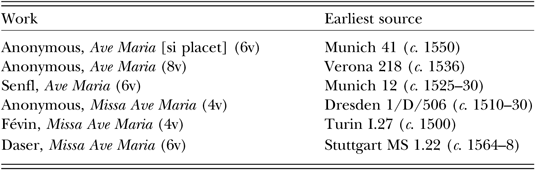
The following analysis considers the three surviving motets based on Ave Maria: two anonymous and one by Senfl. In all, these works engage with Josquin’s motet in diverse ways – si placet additions, parody, cantus-firmus technique and ostinato – and they range in scope from identical in length to Ave Maria to more than twice its duration. After analysing these three motets, I consider three masses based on Ave Maria that betray similarly diverse techniques. Table 1 enumerates the compositional responses to Ave Maria and their earliest sources. The following analysis does not proceed in chronological order, but instead according to genre.
Compositional responses to Ave Maria

Notwithstanding the dramatic differences between these pieces, isolated elements of Josquin’s original, in particular the sesquialtera passage, periodic entries, wholescale repetition and reduced textures emerge as telling sites of stylistic interconnectivity. As many will no doubt observe, these are among the most easily recognisable features of Josquin’s motet, which, as I have written elsewhere, offers a meticulously choreographed and concise experiment in texture and textural contrast.Footnote 42
Motets
In si placet settings, newly composed voice(s) are added to the pre-existing texture. The new voices can be sung ‘if it pleases’ (si placet) or the original piece can be performed without them.Footnote 43Si placet additions are much more common in secular works, which, unlike Ave Maria, tend consistently to employ a full texture.Footnote 44 Schlagel has identified fourteen si placet versions for motets of the Josquin generation; of these, half are based on works attributed to Josquin.Footnote 45 An outstanding total of six si placet settings, all anonymous, survive in Munich 41, a manuscript copied c. 1550 at the Bavarian ducal court.Footnote 46 In addition to Ave Maria … virgo serena, these include O bone et dulcissime Jesu (also attributed to Josquin), three by Jean Mouton (c. 1459–1522) and one by Mathieu Gascogne (fl. 1517–18).Footnote 47 Ludwig Daser (c. 1525–89), who became Kapellmeister in Munich in 1552, probably copied the si placet settings into the Bavarian sources; and although they are anonymous in Munich 41, Schlagel hypothesises that Daser or Senfl may also have composed the si placet voices.Footnote 48
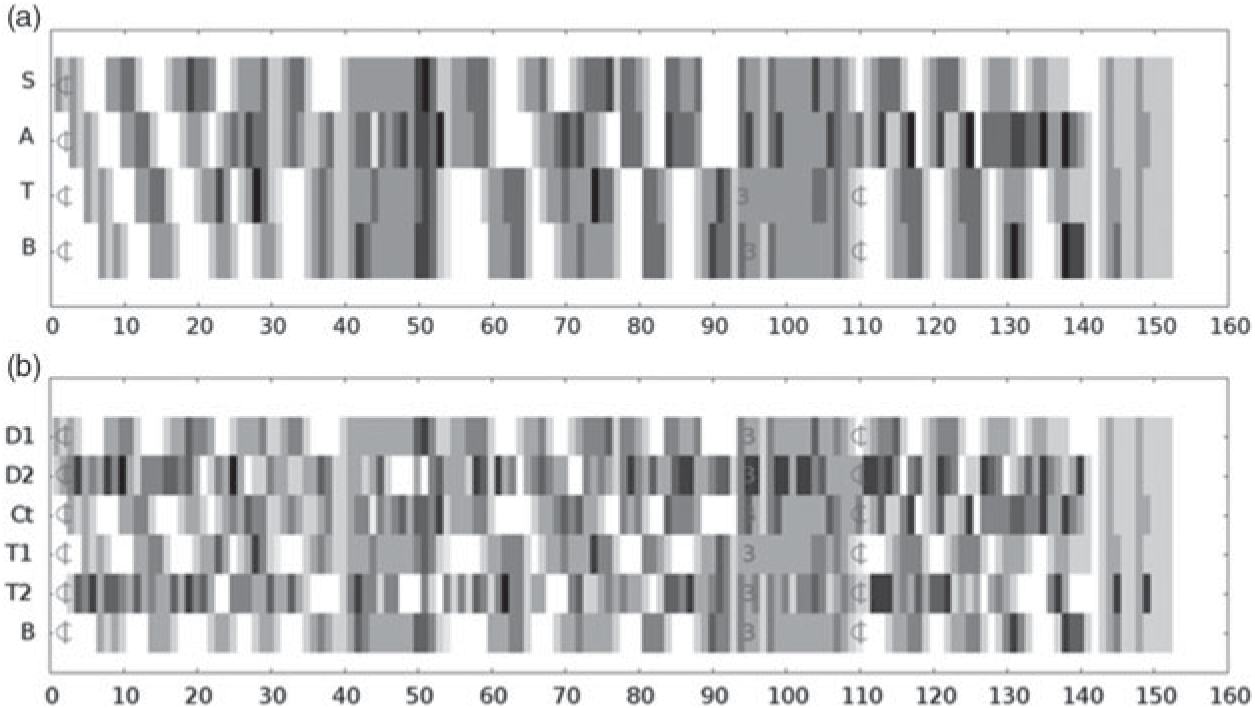
To Josquin’s four-voice Ave Maria, the si placet setting in Munich 41 adds a discantus secundus and a tenor secundus that sits around a third lower in pitch.Footnote 49 Though the anonymous composer is sensitive to Josquin’s long-range execution of texture, the addition of two new voices fundamentally alters each and every contrapuntal device in Josquin’s original. The opening phrase of Josquin’s motet, for instance, famously sets ‘Ave Maria’ in periodic entries: a single motif is stated by each voice in turn after an identical time interval.Footnote 50 Josquin crafts a noticeably sparse opening: no more than two voices overlap until bar 8, when the next textual phrase begins; the rhythmic motion is very relaxed and composed solely of breves and semibreves; and the melody involves only four pitches. The si placet voices move substantially faster, filling in the bare texture with minim runs, dotted notes and a greater melodic ambitus. Thus, the si placet setting not only conceals the periodic entries, but fundamentally changes the sounding surface of the motet as well. The stylistic distance between Josquin’s original and the si placet version comes to light in activity plots adapted from the Josquin Research Project website, which map rhythmic density (see Figure 2).Footnote 51
Density in (a) Josquin’s Ave Maria … virgo serena compared with (b) the anonymous six-voice setting in Munich 41. Rhythmic activity is mapped on a continuum of white to black, where white signals no rhythmic activity (i.e., rests) and black indicates pervasive minim articulation. Each voice appears on the Y axis and the bar numbers on the X axis. Note the relative darkness of the si placet voices compared to the original voices

In other si placet settings of Josquin motets that circulated in mid-century German sources there is a greater degree of stylistic similarity between the original and added voices. In O bone et dulcissime Jesu, for instance, the two si placet voices approximate the rhythms and imitative figures of Josquin’s original voices (e.g., bb. 24–39; 69–73). Against the backdrop of other si placet settings, then, the stylistic distance between Josquin’s four-voice Ave Maria and the two supplementary voices is particularly conspicuous.
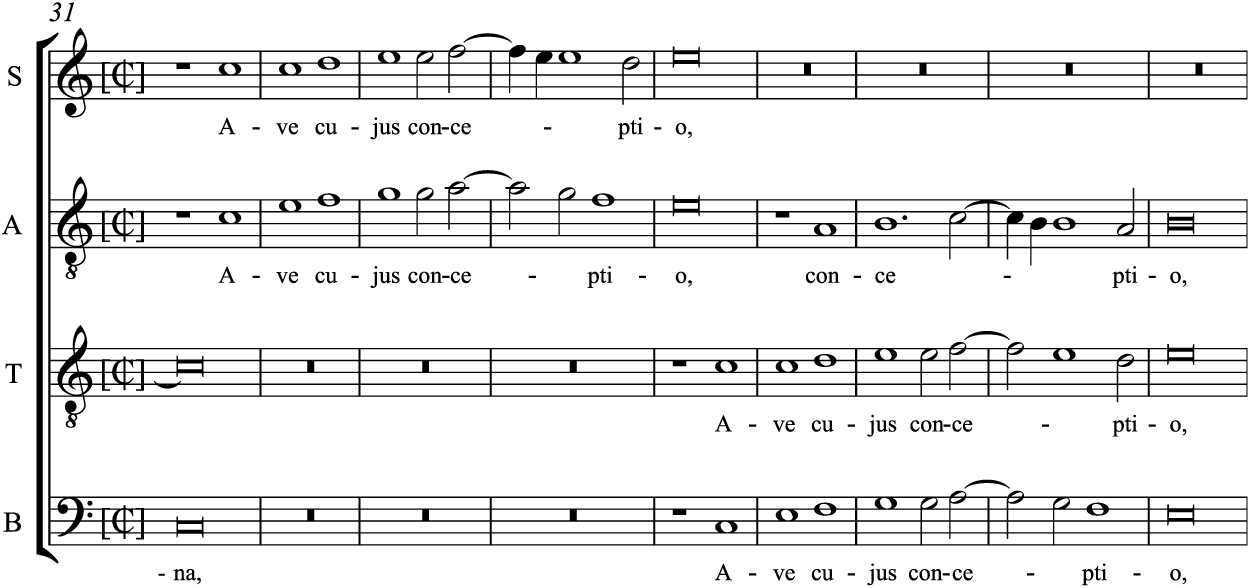
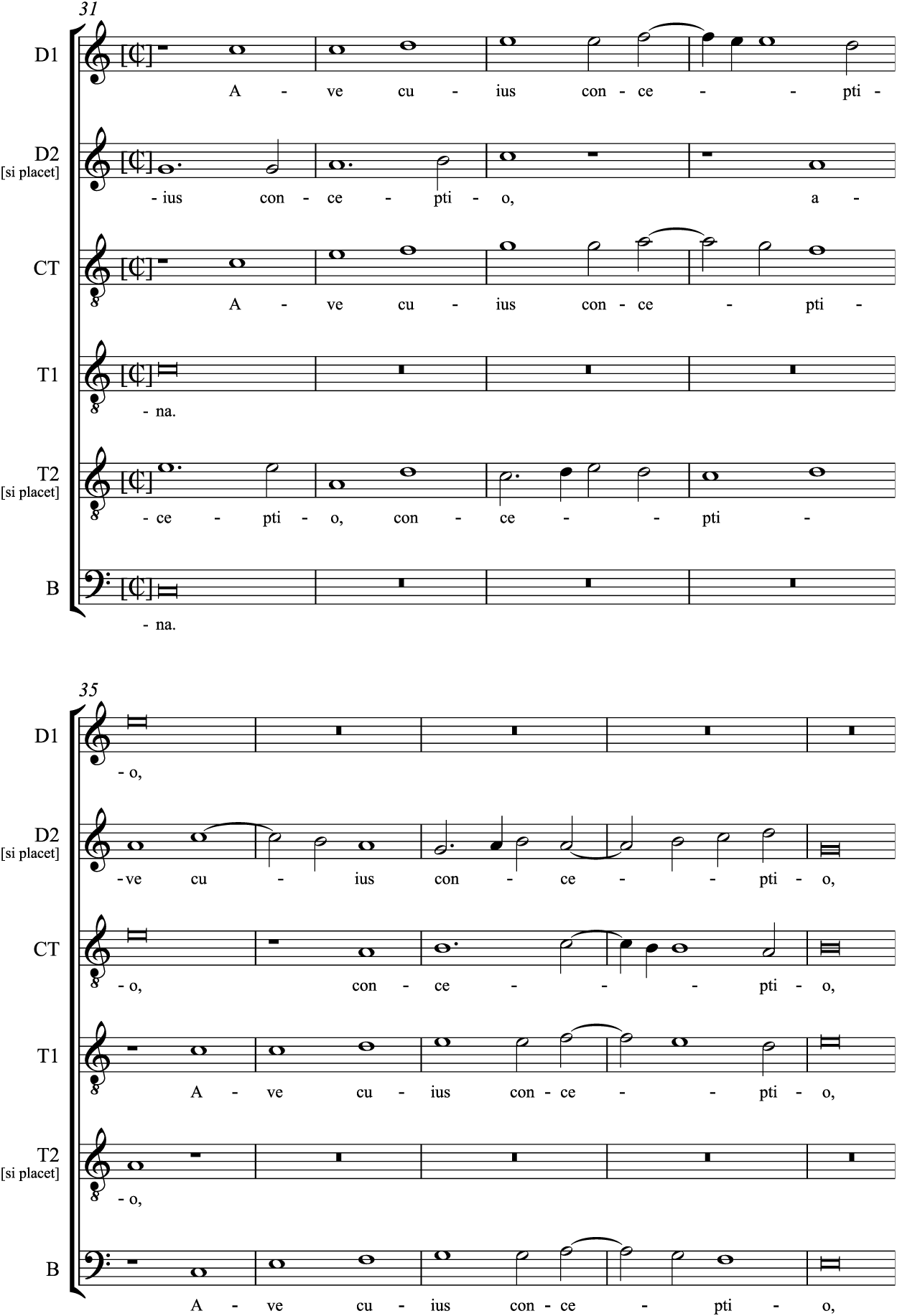
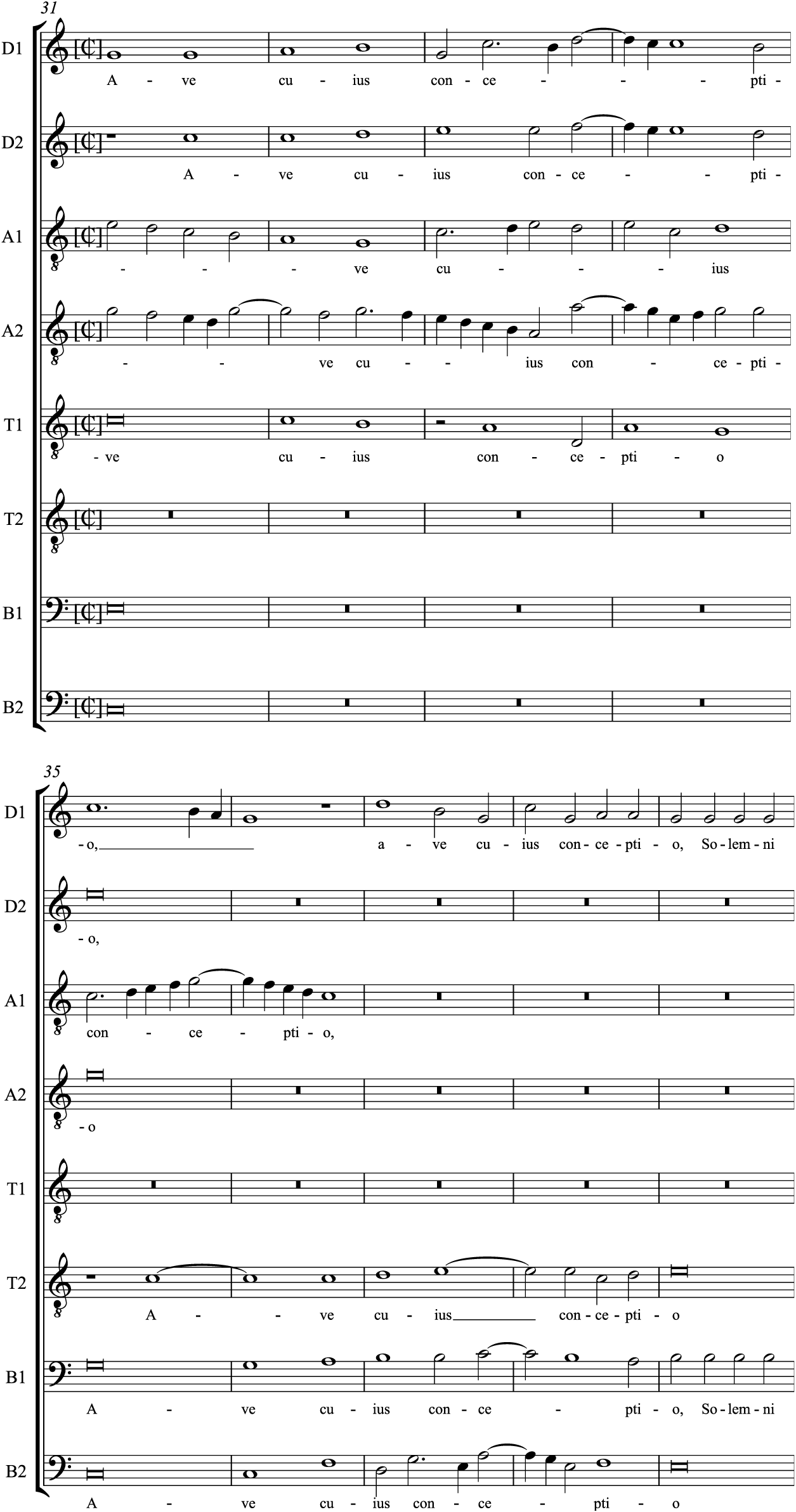
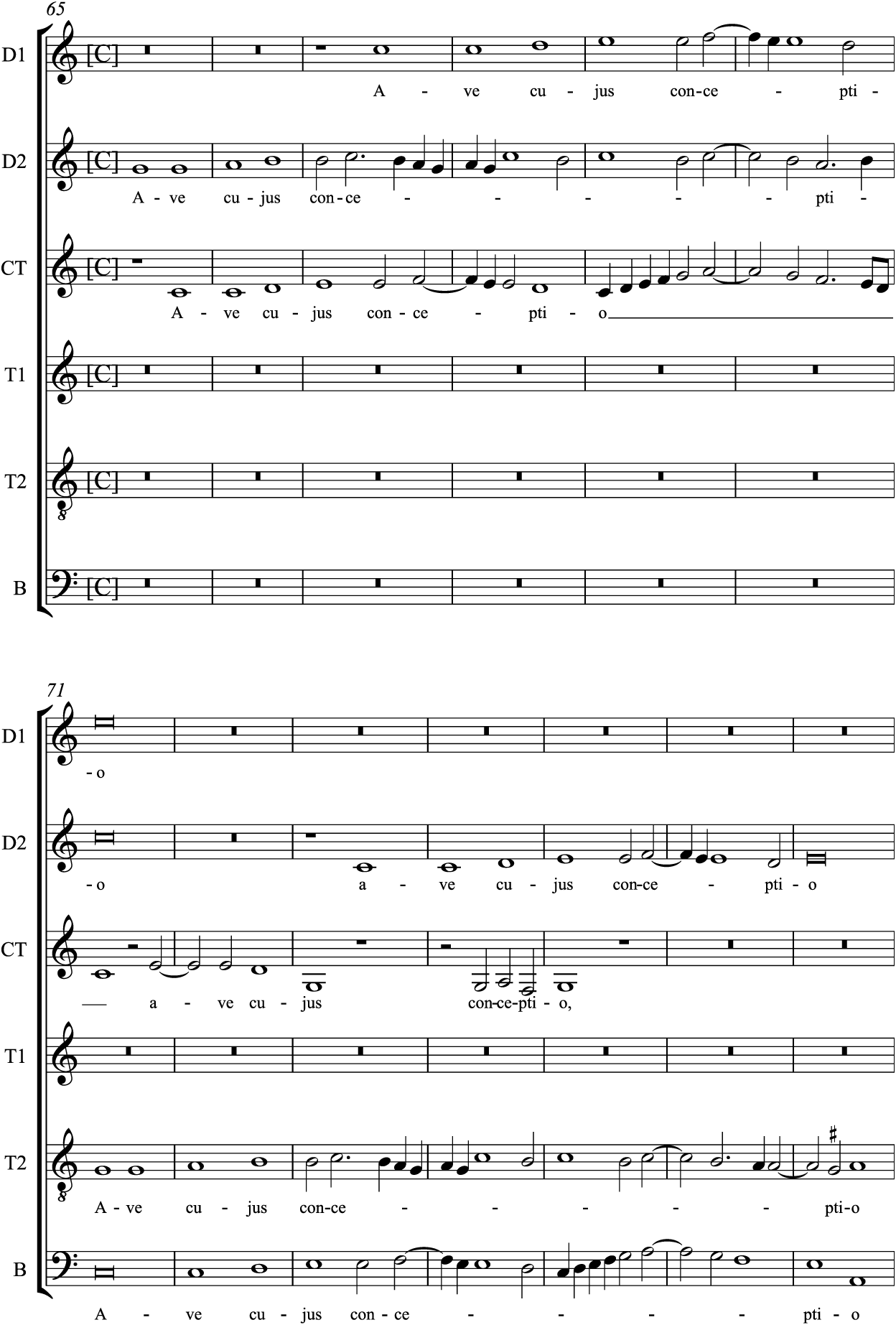
Josquin carefully coordinates reduced textures – and paired duo subtypes in particular – in his four-voice Ave Maria.Footnote 52 The near-constant presence of the two si placet voices, however, fills in the gaps left by these reduced textures – profoundly changing the contours and overall impression of the motet. This can be observed in the motet’s first reduced texture, set to ‘Ave cuius conceptio’ (bb. 31–9) (see Example 2a).Footnote 53 In the si placet setting (Example 2b), the first ‘duo’ statement is joined by the two additional voices (discantus secundus and tenor secundus), thereby increasing the thin two-voice texture to a full four voices.Footnote 54 Besides busying the texture, the si placet voices also expand – and lower – the tessitura.
Josquin, Ave Maria … virgo serena, bb. 31–9: the motet’s first reduced-texture passage

Anonymous, Ave Maria … virgo serena (6v si placet version), bb. 31–9: the si placet voices camouflage Josquin’s reduced texture

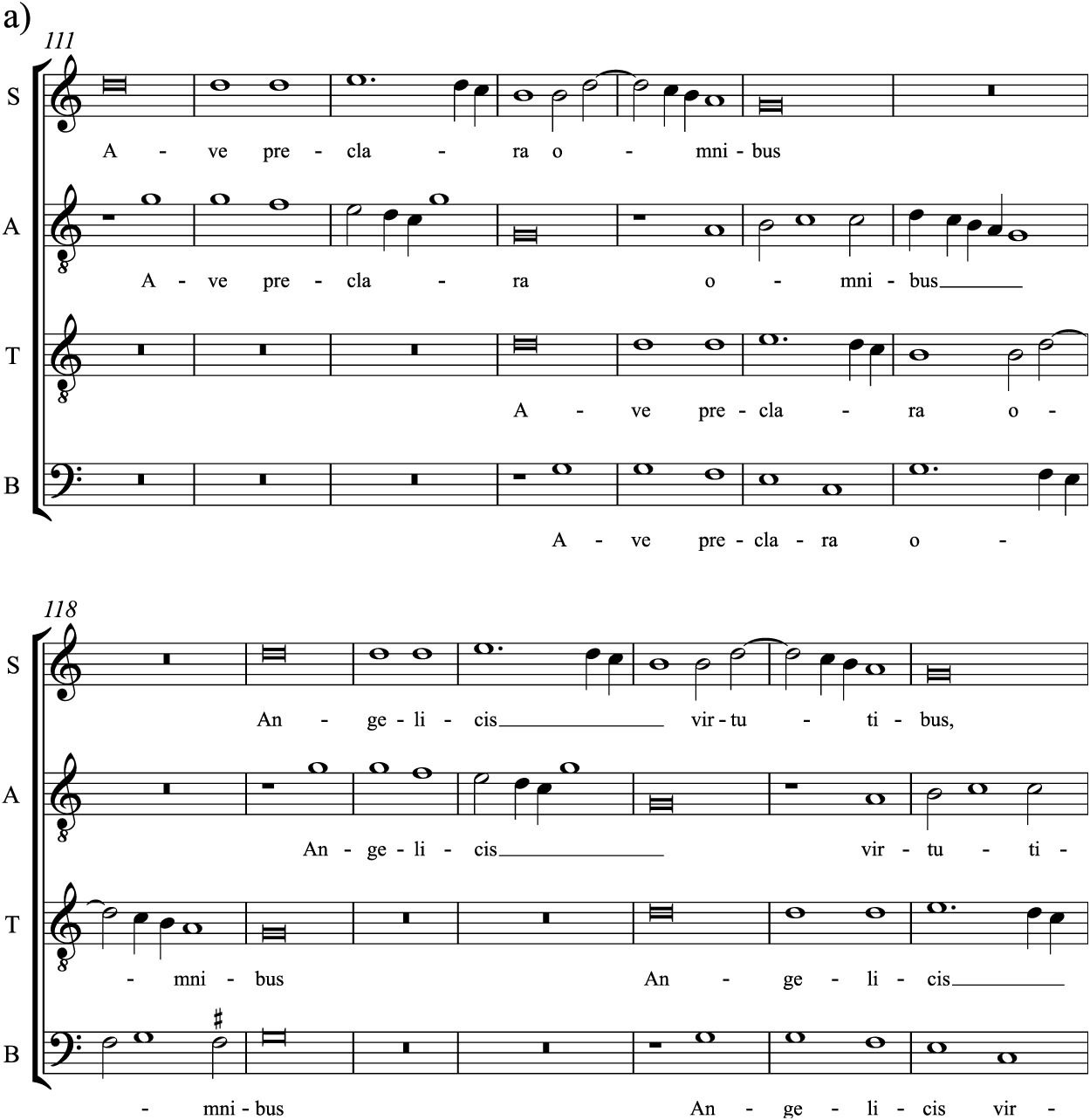
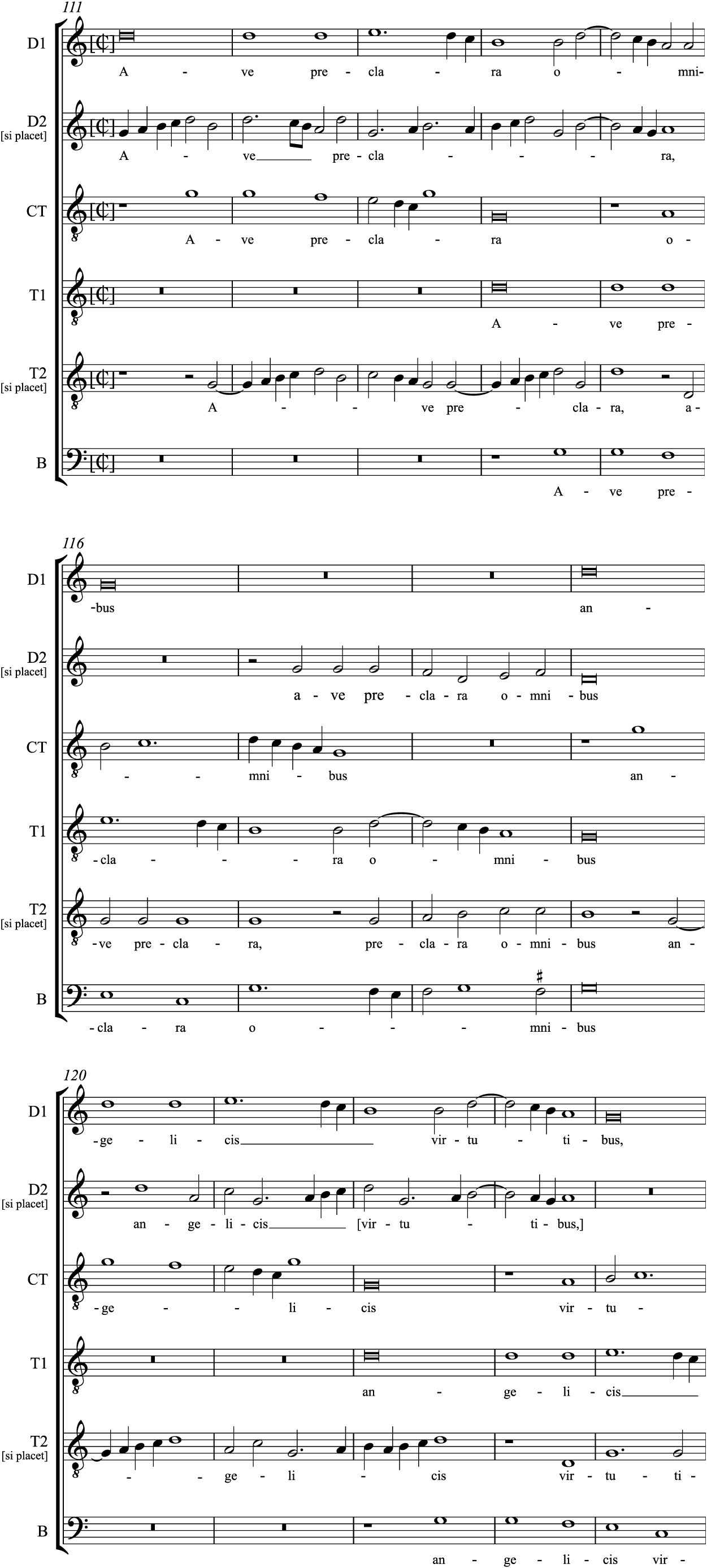
Passages of literal repetition shape the landscape of Josquin’s Ave Maria (see Example 3a).Footnote 55 In adding two si placet voices (Example 3b), the anonymous composer could have retained this contrapuntal feature by simply repeating the si placet material in each voice. He not only eschews this option, however, but seems intent on providing different counterpoint the second time around (bb. 111–24). The first five pitches constitute the only snippet that is repeated verbatim from one iteration to the next. The anonymous composer thus steers Josquin’s motet away from its wholesale repetition scheme and towards a more varied structure.
Josquin, Ave Maria … virgo serena, bb. 111–24: literal repetition

Anonymous, Ave Maria … virgo serena (6v si placet version), bb. 111–24: the si placet voices cover up the literal repetition in Josquin’s original

In still more passages, the si placet voices diversify moments of homogeneity in Josquin’s counterpoint. To the purely homophonic opening of ‘solenni plena gaudio’ (bb. 40–4), for instance, the anonymous composer shapes the si placet discantus secundus and tenor secundus in rhythms offset from the original four-voice complex, and for reasons that do not seem motivated by dissonance treatment. In other words, as in the literal repetition described above, the composer could have aligned the new voices with Josquin’s original, but opted for variety over homogeneity.
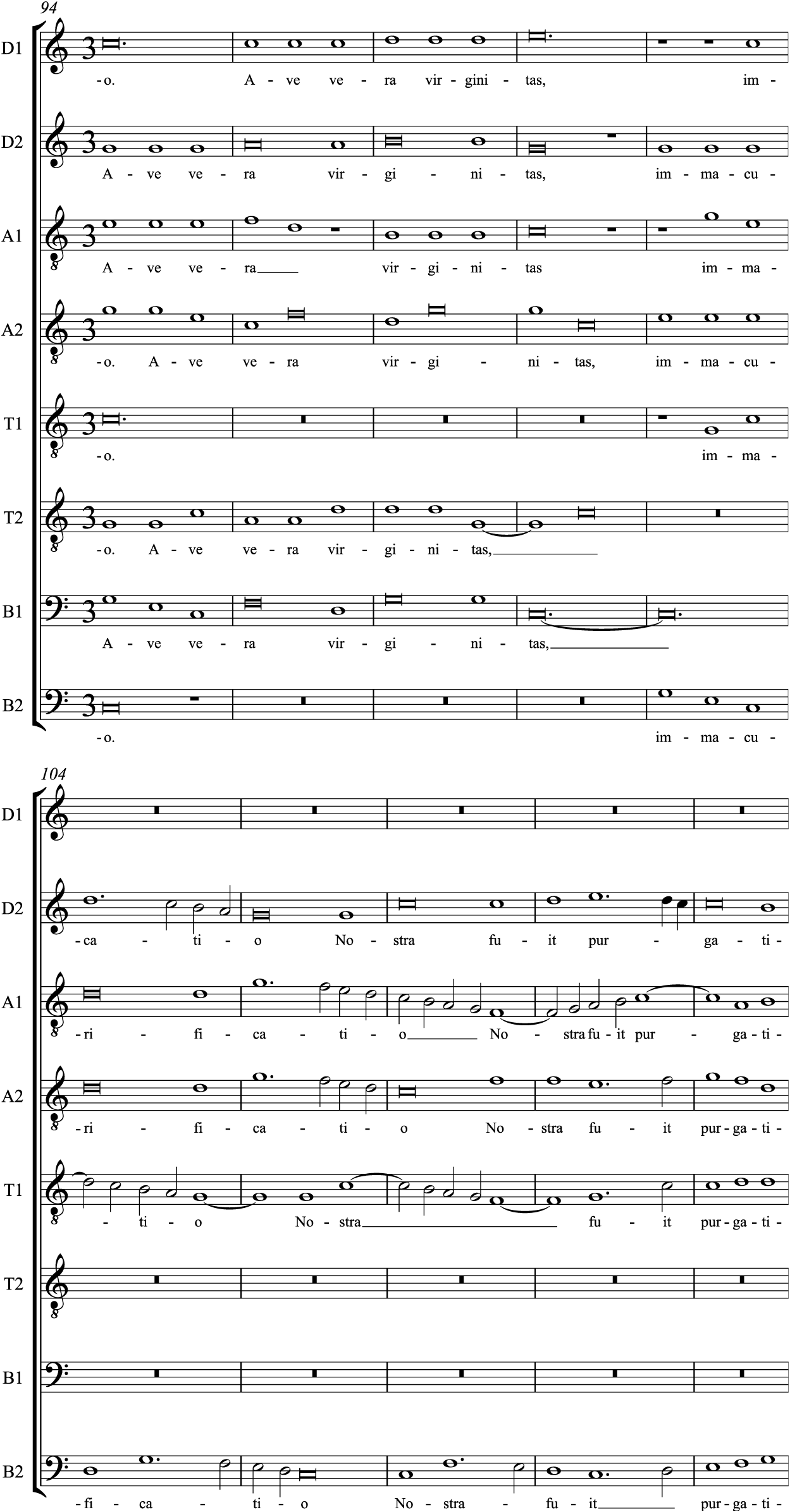
The foregoing examples reveal ways in which, by adding two si placet voices to Josquin’s counterpoint, the anonymous composer did not endeavour to blend in or to camouflage the new voices, but rather used them to generate an entirely new motet as distinct from the older one as possible. There are at least two passages, however, in which the si placet voices not only participate in but actually grow and intensify a contrapuntal device from Josquin’s original. Such is the case in the sesquialtera section (bb. 93–108), where the si placet discantus secundus picks up on the brief minim run that begins in Josquin’s altus (b. 95, b. 99, bb. 104–5, b. 106; see Example 1 above), the only sense of motion in this otherwise static opening, and expands upon it, extending it into the following bar (see Example 4). This motif is reinforced when the polyphonic passage repeats verbatim in bars 98–101. In the final passage, set to ‘cuius purificatio nostra fuit purgatio’, the motif’s significance becomes even clearer as it is passed between all six voices in the si placet setting.Footnote 56
Anonymous, Ave Maria … virgo serena (6v si placet version), bb. 94–108: the descending minim run first heard in b. 95 (altus) of Josquin’s motet appears sprinkled throughout all six voices

Though these two passages pay homage to Josquin’s four-voice motet, most of the changes brought about by the anonymous composer seem to be an exercise in contrast: expanding the vocal texture from four to six voices, the composer crafts a musical work as dissimilar from the original as possible. It is also notable that in responding musically to the motet, the anonymous composer effectively erased all that modern listeners have come to recognise, above all the motet’s textural transparency.
Besides si placet settings, composers also engaged with Josquin’s motets through parody as well as by isolating a single voice and creating a new polyphonic complex around it (i.e., cantus-firmus technique). Schlagel identifies twenty-seven reworkings of Josquin’s motets in total, an astonishing eighteen of which are based on Miserere mei, Deus. Ave Maria was reworked in a much more modest total of two motets (in addition to the si placet setting).Footnote 57 These are Senfl’s six-voice Ave Maria and an eight-voice Ave Maria in Verona 218, a manuscript possibly copied after the mid-1540s.Footnote 58 Though the eight-voice motet carries an attribution to Josquin in the manuscript (though only in the bassus primus partbook), it has been excluded from the composer’s secure works list. In this respect, it falls in line with works like Levavi oculos meos in montes and Nunc dimittis, both of which are attributed to Josquin, but are in fact later motets modelled on the well-known and securely attributed Qui habitat and Memor esto.Footnote 59
The eight-voice motet quotes the superius from Josquin’s motet verbatim, placing it in the superius secundus of the new composition.Footnote 60 Though the pre-existing voice functions as a cantus firmus, the motet is categorised as an ‘arrangement’ of Josquin’s Ave Maria in New Grove and as a ‘superius paraphrase’ by Schlagel.Footnote 61 This terminological variance probably reflects the rarity of cantus-firmus motets in the sixteenth century, particularly those derived from pre-existing motets – as opposed to chant, chorale tunes, or songs. Moreover, Ave Maria appears to be the only Josquin motet to receive such a setting.Footnote 62
Boasting a thick eight-voice texture, the motet has little in common with Josquin’s original beyond the strict quotation of the superius, and in this respect is a very different kind of compositional response from the si placet setting just discussed. In a handful of passages, however, the anonymous motet quotes additional voices or references salient textures from Josquin’s motet. The first such moment occurs at ‘ave cuius conceptio, solemni plena gaudio’ (bb. 30–40). As described above, this is the first phrase Josquin sets in a reduced texture, pitting upper voices against lower (see Example 2a above). The anonymous composer follows Josquin’s textural cue and reduces the vocal texture, albeit from eight to five voices, and approximates the melodic contours of Josquin’s motet (see Example 5).Footnote 63
Anonymous, Ave Maria … virgo serena 8v, bb. 31–9: the motet’s first substantial ‘reduced texture’ (8v→5v) parallels the first such passage in Josquin’s motet

A more striking parallel emerges at the beginning of the sesquialtera passage of the eight-voice motet (bb. 94–108), which mirrors Josquin’s sesquialtera passage in terms of not just metre but also homophonic texture and imitative flair. In Josquin’s original, the first two textual lines (‘Ave vera virginitas/Immaculata castitas’) are set to the same music (see Example 1a above). The anonymous composer echoes this repetitive structure, restating individual voices from one textual phrase to the next: the bassus 1 (bb. 94–7) is repeated in the bassus 2 (bb. 98–101); and the altus 1 (bb. 94–7) is repeated in the altus 2 (bb. 98–101). The superius 1 and 2 also repeat from one textual line to the next (bb. 95–7 and 98–101), though with a shift in rhythmic emphasis in the superius 1 (see Example 6).
Anonymous, Ave Maria … virgo serena 8v, bb. 94–108: echoes the polyphonic repetition of Josquin’s sesquialtera, as well as (in the final phrase) Josquin’s stretto fuga

Even more prominently, the third textual line, ‘cuius purificatio’ (bb. 101–8), in the eight-voice motet mimics the unforgettable stretto fuga of Josquin’s original. The anonymous motet quotes the superius and tenor from Josquin, distributing these voices in the superius 2, altus 1, altus 2 and bassus. In all, each sounding voice derives from Josquin’s motet, even though the polyphonic complex is not identical. The anonymous composer also adjusts the order of vocal entries: the tenor enters first (b. 101), followed by the superius 2 a semibreve later (that is, in stretto fuga); the bassus enters simultaneously, but its first note is lengthened to an imperfected breve. Consequently, the ascending perfect fourth motion on ‘cuius’ is heard on four separate beats.Footnote 64 The impact of withholding this polyphonic quotation until the final iteration in the sesquialtera passage is intensified by the fact that it is also the first time the descending minim run, which punctuates each of the three textual phrases in Josquin’s original, is heard. Moreover, each of the five sounding voices states the minim run, which is additionally drawn out in the altus 1 (bb. 105–6). As in the si placet version just discussed, the sesquialtera passage of Josquin’s motet thus also emerges in this eight-voice arrangement as a captivating compositional idea. It is all the more intriguing in the eight-voice motet, however, as the superius is the only voice strictly borrowed from Josquin, whereas the si placet setting preserves the full four-voice complex.
Senfl’s Ave Maria … virgo serena survives in five manuscripts, the earliest of which is Munich 12 (c. 1525–30), and two prints, including Hans Ott’s Novum et insigne opus musicum (Nuremberg, 1537). Employed at the Hofkapelle in Munich from c. 1523 until his death in 1543, Senfl played an active and multifaceted role in shaping Josquin’s reception in Germany. As an editor, Senfl curated the first German anthology of motets, the Liber selectarum cantionum (Augsburg, 1520), approximately one-third of which is dominated by Josquin.Footnote 65 Senfl may also have been partially responsible for copying Munich 10 and 12, both of which are exclusively made up of his own motets and others attributed to Josquin. In all, Senfl engaged with Josquin’s music not only as a composer, but very likely as a singer, copyist and editor. It is intriguing to consider how these adjunct activities may in turn have shaped his compositional approach to pre-existing material.Footnote 66
Of the approximately 130 surviving motets attributed to Senfl, three are based on or inspired by Josquin. Within this subset, Ave Maria is the only motet that can reasonably be described as a ‘parody’.Footnote 67 Though Josquin’s motets were popular as sixteenth-century models, they largely featured in parody masses rather than motets. Beyond si placet settings and the Miserere motet tradition, Josquin’s motets were parodied in Magnificat settings and ‘imitation’ motets, which rework a pre-existing motet under the guise of a different text.Footnote 68 Additionally, Stephen Rice has recently shed light on the existence of several motets that engage Josquin’s Inviolata, integra, et casta es.Footnote 69 Thus, beyond these relatively circumscribed traditions, there is surprisingly little precedent for Senfl’s treatment of Ave Maria, an procedure it seems to share with the eight-voice Ave Maria in Verona 218.Footnote 70
Senfl’s six-voice Ave Maria … virgo serena spans 331 bars – more than double the length of Josquin’s Ave Maria. Furthermore, Senfl stretches the opening four-breve ‘Ave Maria’ phrase from Josquin’s original into a twenty-one-breve ostinato, stating it fourteen times throughout the course of the motet.Footnote 71 Senfl extends almost every phrase of the original through multiple restatements, usually lightly reworking each. The opening phrase set to ‘Ave Maria’, for instance, occupies the first forty bars of Senfl’s motet (it spans just ten bars in Josquin’s original), during which the superius states ‘Ave Maria’ eight times. With each statement, the superius seems to grow farther away from the original, such that the last two statements bear no melodic or rhythmic similarity to Josquin’s.Footnote 72
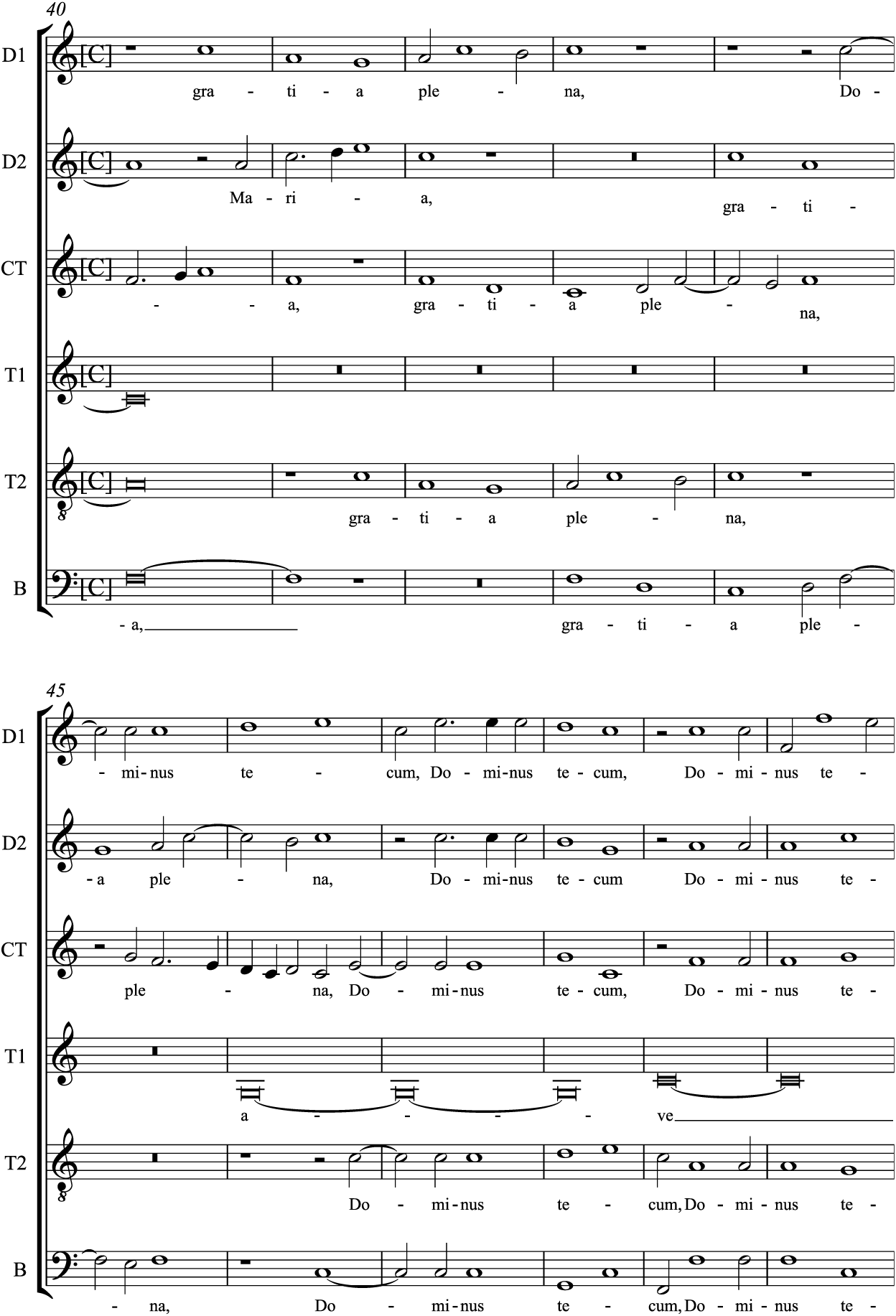
But Senfl does not stretch all phrases in this way. ‘Gratia plena’, which follows directly on the heels of ‘Ave Maria’, is stated only once in each voice and occupies just seven bars (see Example 7). Perhaps paradoxically, the phrases Senfl chooses to state just once stand out as much as, if not more than, the phrases he repeats and varies seemingly endlessly. Another telling instance is Senfl’s treatment of ‘Ave cuius conceptio’. As described above, this phrase is set to a paired duo – the first such reduced texture in Josquin’s motet – where its transparency is made all the more apparent by its even semibreve opening (Example 2a above). Senfl crafts this phrase into a textural turning point, too: the long-note ostinato in the tenor drops out and a reduced texture emerges for the first time (bb. 65–78; see Example 8).Footnote 73 Further dramatising this moment is that it is the first time in Senfl’s motet that the lower voices sound alone. Senfl quotes the polyphonic fabric of Josquin’s passage, thereby preserving its original texture, and perhaps significantly, allowing it to stand alone as in the ‘gratia plena phrase’, rather than reworking it. Indeed, the Josquin-derived passages that Senfl lets stand on their own are as prominent – if not more so – than those he repeats and reworks.
Senfl, Ave Maria … virgo serena, bb. 40–50: the ‘gratia plena’ phrase is stated a single time, as in Josquin’s original

Senfl, Ave Maria … virgo serena, bb. 65–77: the top three voices derive from Josquin’s paired duo, which is repeated in the lowest two voices (accompanied by the discantus 2 and contratenor)
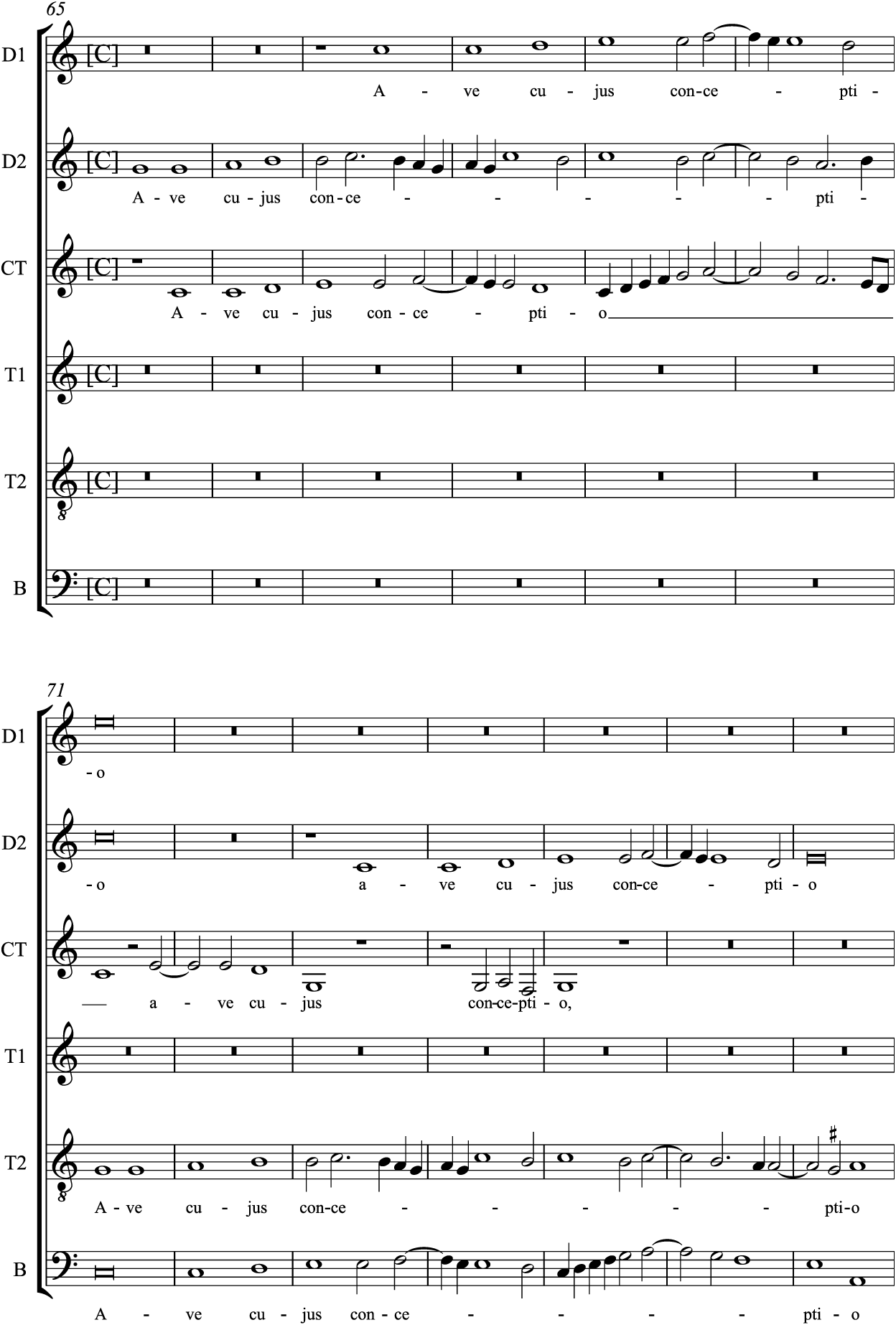
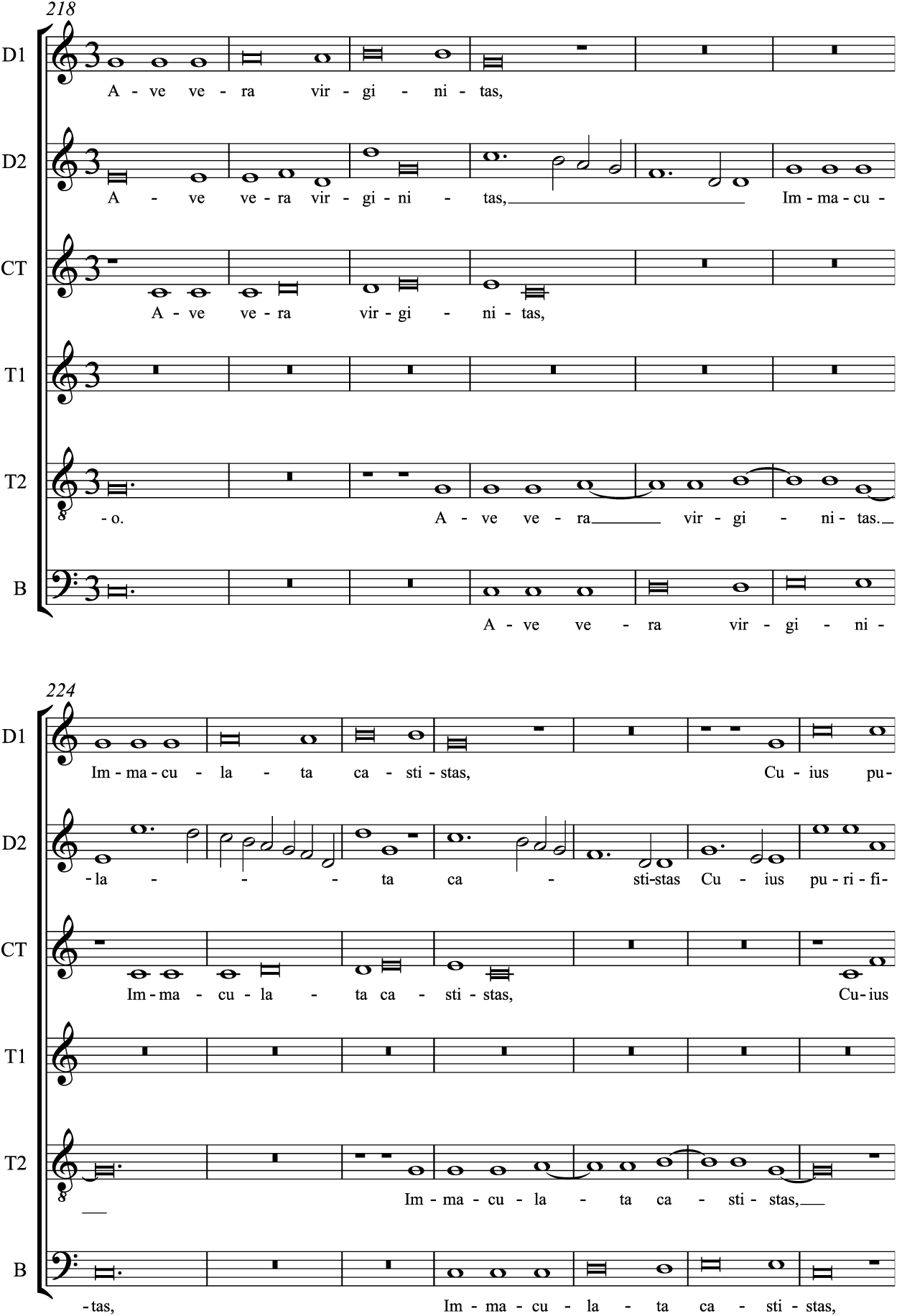
As in the si placet setting and eight-voice Ave Maria discussed above, Josquin’s sesquialtera passage is important for Senfl’s motet as well. In the sesquialtera section (bb. 218–57), Senfl preserves the stretto fuga of Josquin’s sesquialtera passage, but refashions its texture. In expanding the vocal texture of Josquin’s motet to six voices, Senfl states the first three textual phrases (‘Ave vera virginitas/immaculata castitas/cuius purificatio’) twice: once in the top three voices, then in the tenor secundus and bassus, which reuse the stretto fuga imitation between superius and tenor.Footnote 74 In doing so, he not only maintains Josquin’s stretto fuga, he reinforces it by restating it in the lower-voice duo (see Example 9).Footnote 75
Senfl, Ave Maria … virgo serena, bb. 218–30: Senfl maintains Josquin’s stretto fuga, and restates Josquin’s imitative duo in the tenor secundus and bassus

Though Senfl expands the stretto fuga quality of Josquin’s Ave Maria, he turns away from its homorhythmic quality, at least initially. ‘Nostra fuit purgatio’ is the last phrase in Josquin’s sesquialtera section, and it marks a structurally important point in Senfl’s motet as well. From the beginning of Senfl’s sesquialtera section (bb. 218 ff.), the slow-moving tenor ostinato has not been in play; but for the final bar of the ‘purgatio’ statement the ostinato re-enters (b. 242), followed by a return to the beginning of the ‘ave vera virginitas …’ text, where Josquin’s melody is quoted in the Discantus secundus but not in the other voices. Senfl crafts this return homorhythmically, as in Josquin’s motet, but does not employ stretto fuga this time around.
Senfl’s six-voice Ave Maria, the anonymous six-voice si placet setting, and the eight-voice motet offer three remarkably dissimilar compositional responses to the same piece. Whereas Senfl’s is a mammoth reworking and expansion of Josquin’s polyphony, the si placet setting keeps the polyphonic fabric intact while simultaneously adding two new voices, and the eight-voice setting reframes the top voice of Josquin’s motet with newly composed counterpoint. In spite of these differences, however, these three reworkings are united in their presentation of far thicker textures than that of the original. The anonymous and unicum transmission of both the si placet and the eight-voice setting precludes a richer discussion of the stylistic and cultural environments in which these motets were composed. Nevertheless, it does seem notable that for the eight-voice setting as well as Senfl’s six-voice reworking, there appears to be relatively little immediate context or compositional precedent, at least within the realm of responses to Josquin’s motets.Footnote 76 In keeping the generic identity of Ave Maria unchanged (that is, by engaging with it as a motet), these pieces shed light on the stylistic distance between the late fifteenth-century motet on the one hand, and the sixteenth-century motet repertory on the other.
Of these three, the si placet setting emerges – somewhat paradoxically – as the motet most dissimilar to Josquin’s. (Perhaps not coincidentally, it was probably also the last to be composed.) Indeed, the si placet framework is the strictest: in keeping Josquin’s four-voice framework untouched, but adding two voices to it, the new setting camouflages and muddles Josquin’s counterpoint. By contrast, Senfl’s is unencumbered by strict compositional devices (notwithstanding the relatively flexible ostinato), and despite its expansive vocal texture and length, the composer is freer to echo and reinforce Josquin’s contrapuntal and textural ideas. As the foregoing analyses have shown, a handful of passages from Josquin’s motet emerge in these three reworkings as consistent sites of stylistic exchange, including the opening periodic entries (excluding the si placet setting); the first reduced-texture passage (‘Ave cuius conceptio …’); and most prominently, the sesquialtera section. That these passages proved captivating in spite of the technical and stylistic differences between these motets (from the si placet framework, to an eight-voice cantus-firmus setting, and a lengthy parody motet with ostinato) speaks to how Josquin’s counterpoint resonated with subsequent generations of composers.
Masses
In addition to the motet reworkings, three masses survive from the sixteenth century that also respond to Josquin’s Ave Maria: one by Antoine de Févin (c. 1470–1512); one anonymous and an unicum in Dresden 1/D/506, and one by Ludwig Daser that absorbs both Josquin’s Ave Maria and Senfl’s reworking of Josquin’s Ave Maria.Footnote 77 As multi-movement works with a fixed text, these masses present different formal issues and opportunities for citation than the aforementioned motet reworkings.
Févin’s mass survives in nine manuscripts, the earliest of which is Turin I.27 from c. 1505, in addition to two printed editions including Petrucci’s Misse … Fevin (1515), which was published after the composer’s death.Footnote 78 Févin also composed a mass based on Josquin’s Mente tota, both of which are among the very earliest parody masses. Moreover, Févin’s Missa Ave Maria is evidently the earliest surviving compositional response to Josquin’s Ave Maria, and perhaps even the earliest response to any of Josquin’s motets.Footnote 79 As in the eight-voice motet and Senfl’s Ave Maria, the absence of precedent for Févin’s treatment of Ave Maria is remarkable.Footnote 80
In the Missa Ave Maria, Févin reworks discrete polyphonic passages of Josquin’s Ave Maria in a fairly circumscribed manner. Whereas some parody masses lean heavily on the antecedent material, Févin interpolates large swathes of unrelated counterpoint, and some internal sections are entirely free of pre-existing material.Footnote 81 Each major section of the mass begins with a citation of the motet’s opening, and with a few telling exceptions, Févin situates the polyphonically derived passages according to their order in the motet. In the Et in terra, for instance, he reworks the opening quatrain and the first stanza in order, though not all lines of the stanza are incorporated.Footnote 82 The third stanza is skipped entirely: the two-voice Domine deus does not appear to make any reference to Josquin’s motet. The Qui tollis reworks the motet’s fifth stanza (beginning ‘Ave preclara’) before backtracking to the fourth stanza, thereby matching the triple metre of the mass to the corresponding metre change in the motet (‘Ave, vera virginitas’).
The Credo is noticeably less moored to the motet. Not only are the references to Josquin’s Ave Maria farther apart, but they are also fainter. Unlike the Gloria, however, the Credo does invoke the motet’s opening gambit at several moments within the section.Footnote 83 The Sanctus is freer still: with the exception of the opening and the triple-metre Osanna, which reworks Josquin’s sesquialtera passage, the Sanctus makes very little reference to the motet. As in the other major sections, the Agnus I begins by citing the opening of the motet: what is different here, however, is that Févin has tightened the distance between vocal entries such that they now replicate Josquin’s original. In each of the foregoing sections, Févin alters Josquin’s interlock by delaying the entry of the second voice, as Milsom has shown.Footnote 84 Févin concludes the Agnus I by drawing on Josquin’s ‘Celestia, terrestria’ passage, which is set in an ascending melodic sequence shaped by stretto fuga between the tenor and bassus that articulates both the strong and weak beats. He aptly transforms the climactic nature of this passage into the conclusion of the Agnus I (Agnus: bb. 43–51; motet: bb. 44–53).Footnote 85 Of all the sections, the Agnus Dei I presents the most condensed, saturated and literal interpretation of the motet.
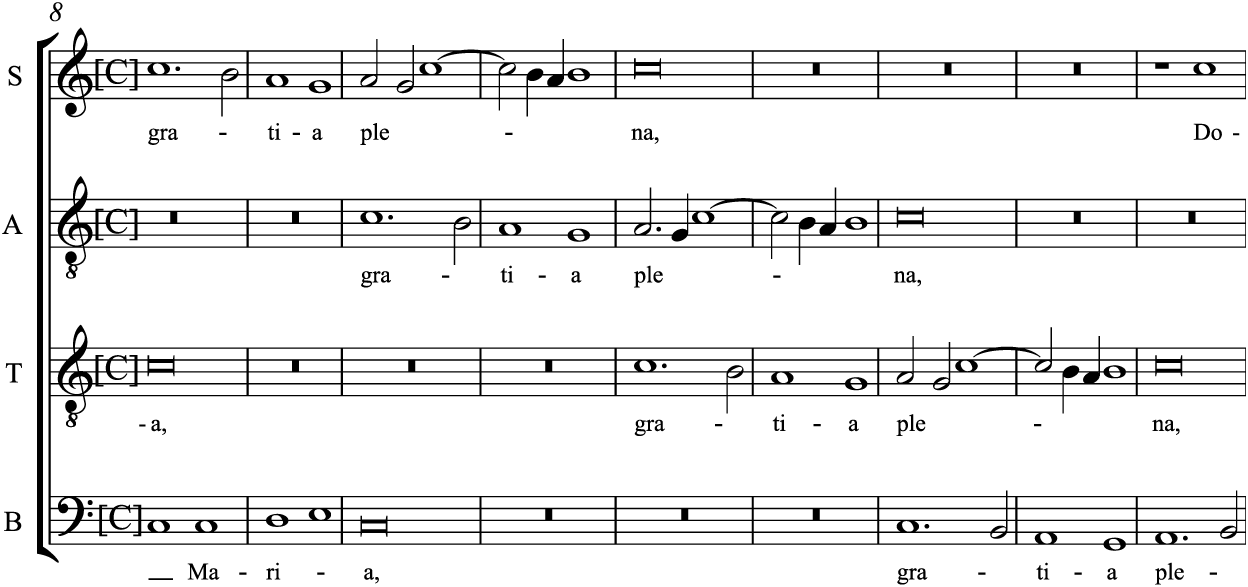
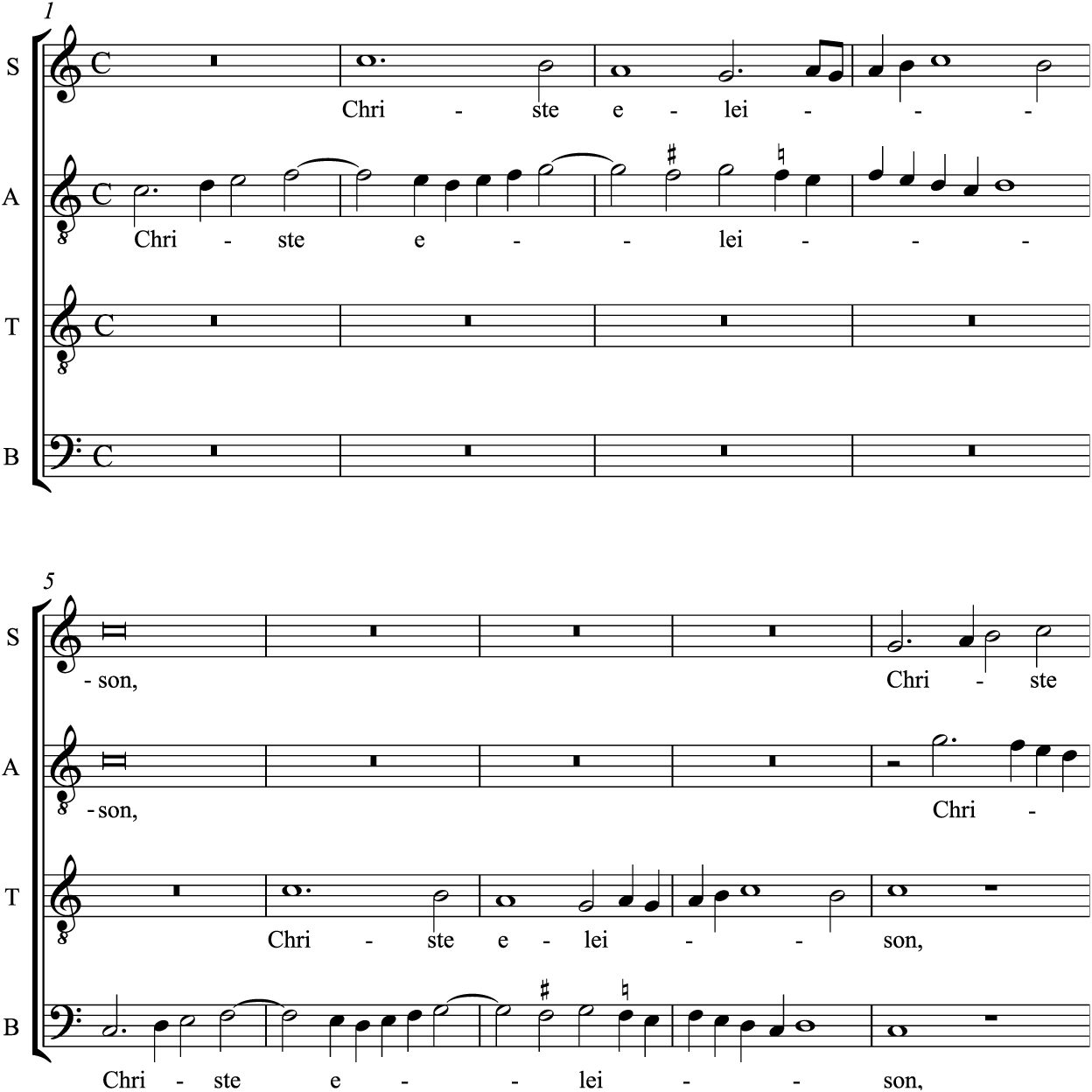
Though the mass replicates the motet’s four-voice texture, one of the most conspicuous differences between the two works stems from Févin’s tendency to significantly extend Josquin’s melodic lines with quickly paced and seemingly endless stepwise motion that runs counter to the sparse quality of the antecedent motet. Moreover, though Févin draws from all four voices of Josquin’s motet, he rarely quotes its entire polyphonic complex. Instead, he draws heavily on its individual motifs, but casts each in a new texture dissimilar to Josquin’s original. In the Kyrie I, for instance, Févin derives the opening melody from Josquin’s initial ‘Ave Maria’ statement.Footnote 86 Rather than periodic entries (as in Josquin’s original), however, Févin constructs the melody into a superius–altus duo, a vestige of which is picked up by the tenor and bassus. Similarly, the Christe begins with the ‘gratia plena’ phrase of Josquin’s motet (see Example 10a), which Févin distributes across paired duos (A/S→B/T), rather than echoing the periodic entries of Josquin’s motet (Example 10b).Footnote 87
Josquin, Ave Maria … virgo serena, bb. 8–16: ‘gratia plena’ set to periodic entries

Févin, Missa Ave Maria, Christe, bb. 1–9: originally cast in periodic entries, the ‘gratia plena’ phrase of Josquin’s motet is transformed into paired duos

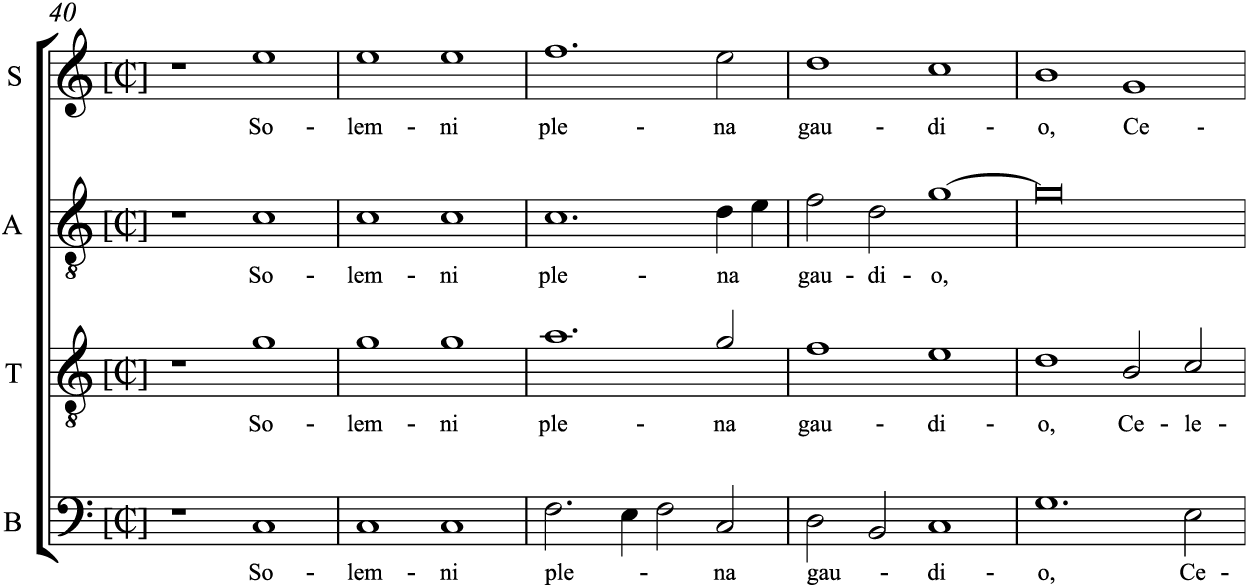
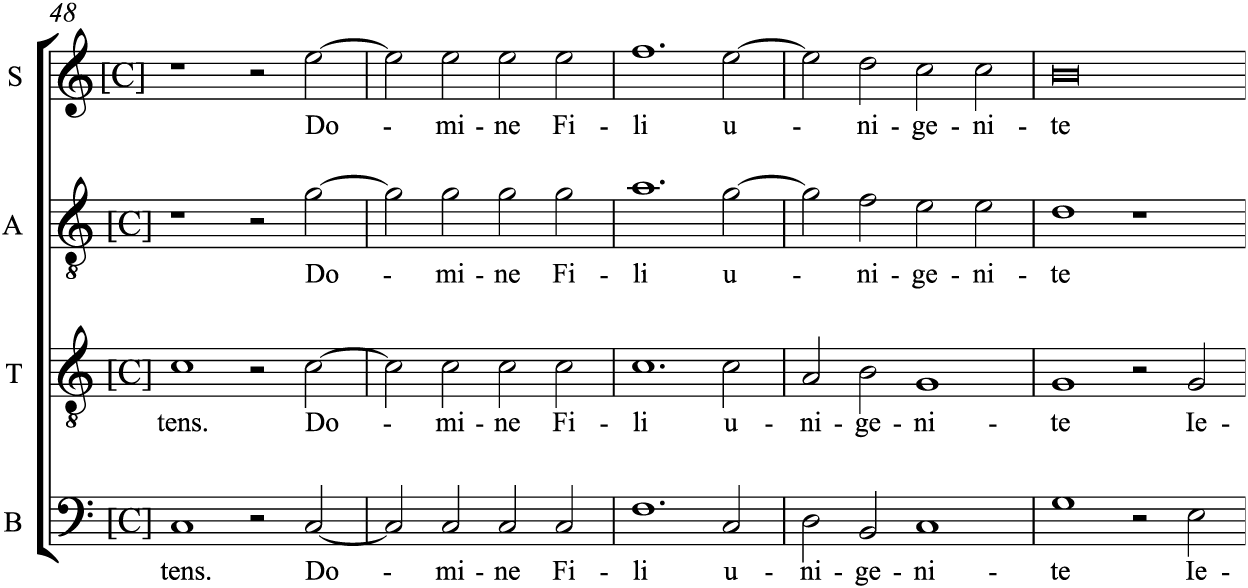
The majority of passages proceed in this fashion: that is, Févin absorbs Josquin’s melodies but reworks them into textures differing from their original context. In a handful of passages, however, he replicates the polyphonic complex of Josquin’s motet. Two such condensed moments occur in the Gloria, at ‘Domine Fili unigenite’ (bb. 48–52), which draws from ‘Solemni plena gaudio’ (bb. 40–4) of Josquin’s motet (see Example 11a). Though some changes can be observed between Josquin’s and Févin’s settings, Févin allows the four-voice homorhythm of Josquin’s setting to shine through; and in both, this passage constitutes the first occurrence of four-voice homorhythm (Ex. 11b).Footnote 88 A similarly focused textural connection comes at the beginning of the Qui tollis, where Josquin’s ‘ave pia humilitas/sine viro fecunditas’ phrase set to paired duos receives the same textural treatment in the mass. In Josquin’s motet, this strict paired duo signals the beginning of the third full stanza, a structural signpost assigned to the first and second stanzas as well.
Josquin, Ave Maria … virgo serena, bb. 40–4: the motet’s first four-voice homorhythmic passage

Févin, Missa Ave Maria, Gloria, bb. 48–52: the mass’s first homorhythmic passage mirrors Josquin’s

As in the motet reworkings described above, the sesquialtera passage of Ave Maria emerges as a particularly fertile site for interpretation and compositional engagement in Févin’s mass. Fevin’s Missa Ave Maria offers three compositional versions of this unique moment in Josquin’s motet: at the end of the Gloria (‘Cum sancto spiritu’), the end of the Credo (‘Et expecto’) and the beginning of the Osanna. Whereas all other sections of the mass are in ¢, these three passages are all cast in ¢3.
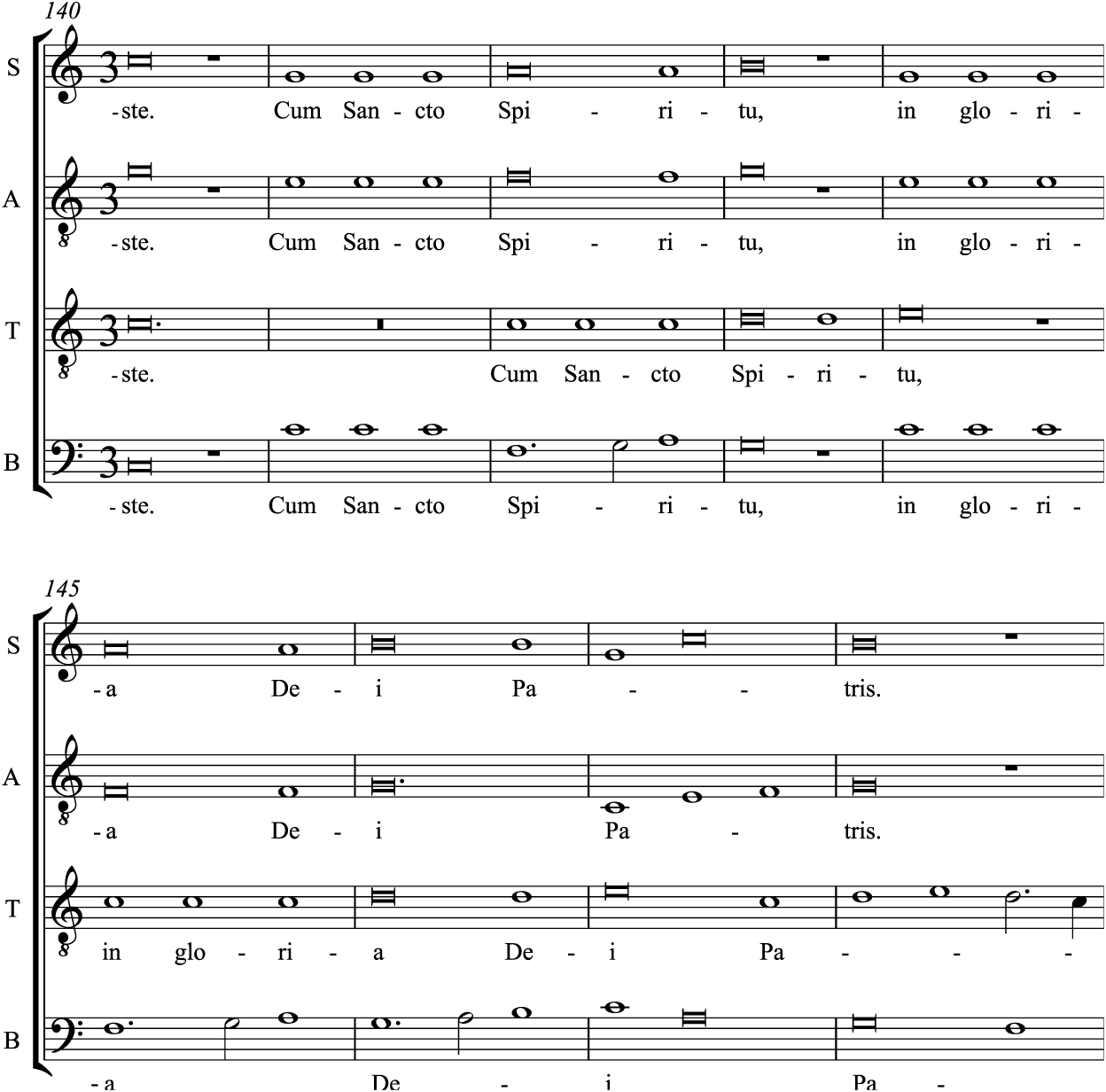
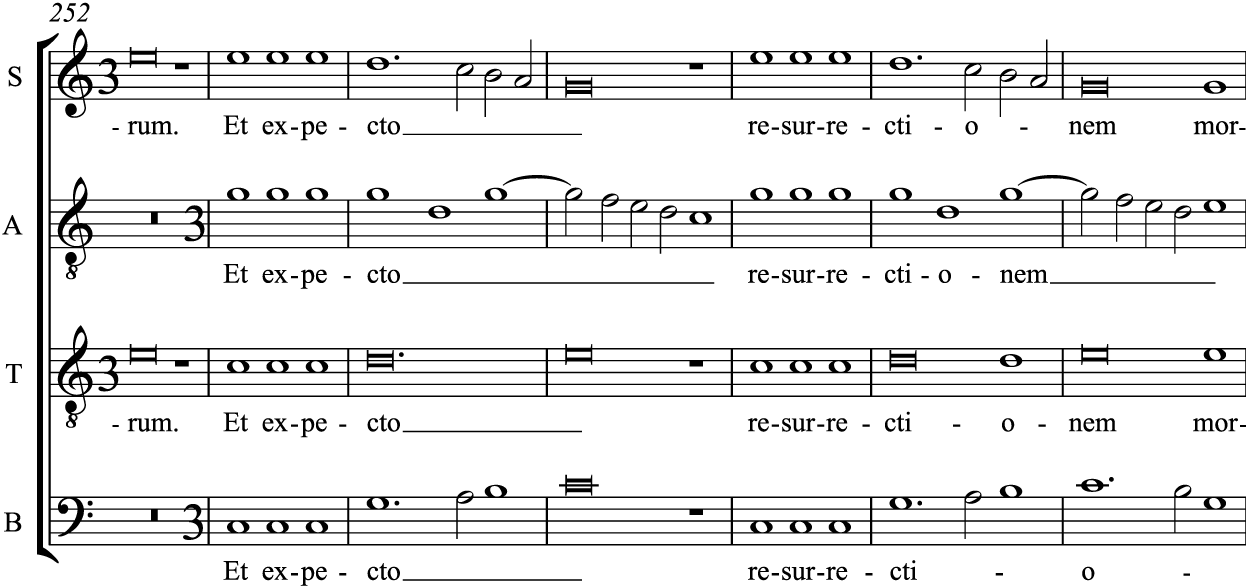
In the first of the triple-metre passages (Gloria, bb. 140–8; see Example 12a), Févin reworks the initial nine bars of Josquin’s sesquialtera passage (bb. 94–102; cf. Example 1a above). The mass, however, substantially alters the imitative structure of Josquin’s polyphony, lengthening the time interval between the superius and tenor from a semibreve to a perfect breve, thereby erasing the definitive stretto fuga of Josquin’s sesquialtera in a manner similar to the restructuring of the superius–tenor imitation found in Glarean as well as the Warsaw 5892 and Barcelona 5 copies, but without the consecutive fifths. The second triple-metre passage (Credo, bb. 253–65) references Josquin’s sesquialtera more obliquely: Févin eschews not only the stretto fuga as in the Gloria, but imitation altogether, opting instead to coordinate the voices in four-voice homorhythm. Mirroring the repetitive structure of Josquin’s sesquialtera passage, he restates the opening three bars with new text (bb. 253–5; 256–8; see Example 12b). He also absorbs the dotted descending figure from Josquin’s sesquialtera passage and distributes it in the superius and altus in quick succession. In Ave Maria, this dotted figure begins in the altus before migrating to the superius and tenor in the phrases following (bb. 95, 99, 104–5, 106). Févin picks up on this figure, seeding and expanding the dotted motif throughout the sesquialtera passage in a manner similar to the anonymous si placet setting (see Example 4 above). The final triple-metre passage in the mass (Osanna) begins with a verbatim quotation of Josquin’s tenor but clothes the antecedent voice in different polyphony (Example 12c, bb. 75–7). Févin then restates the tenor, this time bringing in the superius in imitation (bb. 78–). As in the other triple-metre passages, Févin lengthens the time interval to a perfect breve, thereby continuing to efface the stretto fuga quality of Josquin’s sesquialtera.
Févin, Missa Ave Maria, Gloria, bb. 140–8: lengthens the time interval of imitation from a semibreve to a perfect breve (as in Glarean, Example 1b above)

Févin, Missa Ave Maria, Credo, bb. 252–8: Févin absorbs and redistributes the descending minim figure from Josquin

Févin, Missa Ave Maria, Osanna, bb. 75–81: Josquin’s tenor is accompanied by an entirely new polyphonic framework that once again alters the time interval of imitation

Unlike Févin’s mass, which is cast in a four-voice framework identical to Josquin’s motet, Ludwig Daser’s Missa Ave Maria is scored for six voices.Footnote 89 Accordingly, the mass has been described by Schlagel as simultaneously a ‘consolidation’ of Senfl’s motet and an ‘expansion’ of Josquin’s.Footnote 90 Beyond the six-voice texture shared by both works, Schlagel posited that Senfl’s ostinato technique inspired Daser’s mass. Whereas both works forge a recurring motif from the same opening phrase of Josquin’s motet (bb. 1–10), Daser approaches the material in a much less systematic manner. In the Kyrie, the motif appears twice, at different speeds (bb. 6–11; 14–25); in the Gloria, it is entirely absent; in the Credo, the motif sounds just once (at ‘Et ascendit’, bb.129–36); in the Sanctus, it is stated multiple times at various speeds and periodically with unrelated material between statements; and in the Agnus Dei, one statement of the motif appears after another. Thus, while Daser repurposes Josquin’s ‘Ave Maria’ motif throughout the mass, its appearance is by no means systematic until the Agnus Dei, when it approaches Senfl’s much more structured ostinato treatment (Senfl’s tenor carries only the ostinato).
Beyond its tenor ostinato and six-voice framework, Daser’s mass shares little by way of concrete connection to Senfl’s motet: Daser does not quote extensive passages of Senfl’s work; rather, both pieces employ similar compositional techniques. In at least one passage at the beginning of the Sanctus, however, Daser seems to take his cue from Senfl’s setting of ‘Dominus tecum’. This passage marks the first real homophonic texture in Senfl’s motet, and in this way constitutes a real departure from Josquin’s staggered statement of this phrase in periodic entries. Daser moulds the phrase in much the same way as did Senfl, and in opposition to Josquin. That Daser saw fit to reference Senfl’s motet based on Ave Maria in his own mass suggests that these reworkings played a key role in interpreting – and providing additional access to – Josquin’s motet.
For the bulk of the mass, however, Daser draws from Josquin’s motet and works it into his own six-voice style, leaving Senfl to one side. Nowhere is this clearer than at the beginning of the mass. To Josquin’s sparse periodic entries, Daser writes a completely new countermelody for the added vagans voice, switches the order of vocal entries, and changes the interval of imitation from an octave to a fifth.
As the foregoing mass and motet analyses have shown, the sesquialtera section of Josquin’s Ave Maria is decisive for sixteenth-century musicians. Like Févin and Glarean, Daser lengthens the time interval to a perfect breve, removing Josquin’s quintessential stretto fuga from the equation. Moreover, Daser expands Josquin’s four-voice sesquialtera passage into a series of paired trios, pitting upper voices against lower (bb. 115–37) (see Example 13), thus retrofitting the texture in a manner similar to Senfl, but without the stretto fuga that Senfl leaves untouched (cf. Example 9a above).Footnote 91
Daser, Missa Ave Maria, Gloria, bb. 116–23: Josquin’s sesquialtera passage is reformatted as paired trios with the stretto fuga removed

As in the motets based on Ave Maria, these two masses are diverse not just in terms of scope (i.e., vocal disposition, ostinato technique) but in their approach to the pre-existing material as well. Févin reliably cites Josquin’s melodies, but rarely his textures (arguably an equally definitive element of the motet). Thus, the passages in which both melody and texture align with Josquin’s motet, such as the first homorhythmic passage, a formally significant paired duo, and the sesquialtera passage emerge as particularly salient. With its unpredictably recurring ostinato-like motif and six-voice texture, Daser’s mass has less in common with Josquin’s motet, but nevertheless does not fail to communicate the importance of Josquin’s sesquialtera passage.
Of the three masses based on Ave Maria, the anonymous Dresden mass is the shortest: the Gloria, for instance, lasts just seventy-nine bars, whereas Daser’s Gloria clocks in at 168 bars and Févin’s at 159.Footnote 92 The Dresden mass is also far less systematic and thoroughgoing in its use of Josquin’s musical material. The most salient connection occurs at the beginning of each major section of the mass, where the opening of the motet is presented and varied from movement to movement.Footnote 93 In the Kyrie I, for instance, the anonymous composer invokes the melodic contour and periodic entries of Josquin’s original, including the order in which the voices enter. Whereas Josquin lets the ‘Ave Maria’ statement stand alone, with three full breves of rests following in each voice, here the composer immediately extends the melody in all voices, transforming a gesture that once luxuriated in silence almost as much as melody into one that stays busy until the final cadence (see Example 14a).Footnote 94 Elsewhere, he forgoes Josquin’s periodic entries. In the Kyrie II, for instance, he opts instead to present the melody in an imitative duo between altus and bassus at the time interval of two breves, later joined by superius and tenor.Footnote 95 Following this initial imitation, the Kyrie II promptly transitions (b. 20) to a paraphrase of Josquin’s sesquialtera passage in all four voices, though (as in Févin, Daser and Glarean) with the quintessential stretto fuga removed (see Example 14b). The successive appearance of these two characteristic passages in the Kyrie II, disconnected by approximately one hundred breves in Josquin’s motet, gives the impression of a kind of highlight reel, collapsing particularly significant moments from the antecedent work onto one another, with no concern for the broader context or sequence in which they originated. The Kyrie II is one of only a handful of movements that parodies material beyond the opening phrase of Josquin’s motet. Other significant moments include the Qui tollis, which begins with an imitative duo between altus and bassus that outlines Josquin’s ‘Dominus tecum’ phrase, and the Pleni sunt celi, which traces the passage beginning ‘Ave preclara’ through ‘Cujus fuit assumptio’, amounting to by far the lengthiest interaction with the Ave Maria.
Anonymous, Missa Ave Maria, Kyrie I, bb. 1–9, from Dresden 1/D/506: the anonymous composer mimics Josquin’s opening periodic entries but immediately extends them, replacing Josquin’s contemplative rests with rapid melodic motion

Anonymous, Missa Ave Maria, Kyrie II, bb. 1–27, from Dresden 1/D/506: the anonymous composer fuses Josquin’s opening (recast as an imitative duo) and his sesquialtera passage (without the characteristic stretto fuga)

Beyond these specific passages, references to the pre-existing motet in the Dresden mass are sporadic and limited in scope. While the consistent reference to the opening of Josquin’s motet at the beginning of major sections of the mass anchors it to the pre-existing work, the overall style could hardly be more dissimilar. The end of the Christe presents a telling example: as the bassus moves in longs, the upper three voices fixate incessantly on a pithy and recurring motif that repeats at the same pitch. Both the repetitiveness of the upper-voice counterpoint as well as the protracted motion in the bassus contrast with the painstaking vocal equality of Josquin’s Ave Maria. Rapid monotone repetition also shapes several passages in the mass, including the end of the Gloria, Credo and Benedictus.Footnote 96 Moreover, the mass contains not a hint of the motet’s textural contrast: besides the periodic entries or imitative duos that open each movement, the four-voice texture remains constant throughout the mass. This stylistic dissimilarity makes the extended polyphonic citations, including the sesquialtera passage, stand out all the more.
While the melodic gesture that opens each movement – whether in periodic entries or imitative duos – systematically grounds the mass in the sound-world of the antecedent motet, it also serves to underscore the fundamental role of the chant underpinning the first thirty bars of Josquin’s motet (through ‘virgo serena’). Indeed, the significance of the chant quotation comes to the fore in the Agnus Dei, where the mass composer traces the same segment of the Marian chant that Josquin adopts in the motet, solidifying the impression that the chant was the main guiding force behind the composition of the mass. In spite of the chant’s fundamental role in the mass, however, as well as the stylistic contrast between the mass and motet, it would be nearly impossible to come away with the impression that the mass was based on the chant alone, as the sesquialtera passage and other extended interactions highlight the mass’s connection to Josquin’s antecedent motet.
Particularly in the light of the relatively compact transmission of Ave Maria, these compositional responses to Josquin’s motet – whether si placet setting, parody motet, or mass – bear vital witness to the ways in which sixteenth-century composers engaged with the motet’s idiosyncrasies. That Ave Maria was reshaped across motets as well as masses – genres with distinct formal, textural and textual conventions – speaks to the work’s pliability. Arguably even more telling is that in spite of these generic distinctions, the compositional responses to Ave Maria highlight many of the same features. First and foremost in this regard is the sesquialtera passage, which surfaced time and again as a pivotal site of compositional engagement. Other salient elements include references to Josquin’s reduced textures (particularly at textually significant points like the beginning of stanzas) and homophonic passages, in addition to magnifying contrapuntal features of Josquin’s motet (i.e., the sequence expansion in the si placet setting, and the descending minim motif from the sesquialtera passage in the si placet setting, eight-voice motet, Senfl motet and Févin mass). Given that these compositional responses to Ave Maria may have provided a crucial conduit through which sixteenth-century musicians and audiences experienced Josquin’s motet, the specific ways in which these compositions highlight as well as camouflage the composer’s original work are paramount in its reception.
PART II: THE MODERN RECEPTION OF AVE MARIA
As John Milsom has noted, the most interesting documents for understanding the reception of Josquin’s Ave Maria date from the twentieth century, when the ‘motet won especial favor’.Footnote 97 Whereas the foregoing section focused on compositional responses to Ave Maria and the specifics of its source circulation, this section delves into the motet’s appearance in scholarly articles, survey texts and audio recordings.
1. Scholarly Sources
Ave Maria is mentioned briefly in August Wilhelm Ambros’s Geschichte der Musik from 1862, and printed in the second volume of Robert Julien van Maldeghem’s Trésor musical (1866).Footnote 98 Earlier texts, such as Charles Burney’s A General History of Music, John Hawkins’s A General History of the Science and Practice of Music, and Raphael Georg Kiesewetter’s 1834 Geschichte der europaeisch-abendlaendischen oder unsrer heutigen Musik do not mention the piece.Footnote 99 In what turns out to be the earliest nineteenth-century description, Ambros characterised the motet as a ‘true white lily of tenderness and purity’, a glowing account that probably inspired subsequent writers. But Ambros did not single out only Ave Maria in this way; indeed, of Marbrianus de Orto’s Ave Maria, which opens Petrucci’s Odhecaton (Venice, 1501), he writes that it is ‘extraordinarily beautiful, of the most charming gentleness and deepest fervour’.Footnote 100
In the twentieth century, no doubt one of the most significant moments for the work’s reception was its publication in the inaugural volume of the Complete Works edition begun by Albert Smijers in 1921.Footnote 101 Indeed, reflecting on the imbalance between the modern standing of Josquin’s Ave Maria and de Orto’s, the lack of a critical edition for de Orto’s works emerges as perhaps the single most crucial distinction. The first substantial engagement with Josquin’s Ave Maria in the scholarly literature appeared in 1948, when Edward Lowinsky published an article on the use of scores by sixteenth-century musicians.Footnote 102 Though the motet has a comparatively minor role in his discussion, this article, together with Smijers’s edition, seems to have precipitated – perhaps even guided – the motet’s reputation over the course of the next half-century. Lowinsky’s towering reputation ensured the long-standing impact of his contribution, and his essay set the tone for scholarship on Ave Maria in the twentieth century. Indeed, following Lowinsky, almost every author describes the motet as famous, and while not all mention Lowinsky, it is clear that his hypothesis that the motet was a mature work gained wide acceptance.Footnote 103
Arguably even more significant than Lowinsky’s ‘maturity’ hypothesis was that he linked Ave Maria to a breakthrough in musical style and compositional technique that opened the floodgates of its modern reception. Indeed, Lowinsky stressed the significance of the motet’s imitation, homophony, vocal equality and lack of cantus firmus, all of which (at some time or other) would become paramount in the work’s scholarly reception.Footnote 104 He did so, however, without citing any specific bars or phrases, which may have indicated to contemporary scholars that the motet’s familiarity and significance were already a foregone conclusion. Equally important is precisely how Lowinsky articulated the motet’s stylistic importance:
This transition, from the rigid, isometric treatment of the cantus prius factus to that of free composition in which the techniques of homophony and imitation are used by turns, is perfectly mirrored in the motets of Josquin des Prez, whose mature motet-style is well summed up in the lovely Ave Maria with which Smijers opens his edition of the Josquin motets.Footnote 105
In describing this motet as summing up Josquin’s mature motet style, Lowinsky established Ave Maria as a paradigm, one made all the more important because of its purported connection to a radical shift in compositional style. In the decades following Lowinsky’s article, Ave Maria calcified in the scholarly literature, survey texts and recordings as the most important motet from the Renaissance.
Scholarly encounters with Ave Maria have taken many shapes over recent decades: while some writers have engaged with the motet on its own terms, interrogating its stylistic features or text-setting, for instance, others have employed it not only as a paradigm but also as a means to an end, taking advantage of its apparent familiarity to discuss more general issues like musica ficta (Margaret Bent, 1984) and pre-Baroque analysis (Cristle Collins Judd, 1985).Footnote 106 In approaching Ave Maria as a prototype, the motet is reduced to a set of analytical issues representative of the century as a whole. As such, Ave Maria is made to stand for something larger than itself.
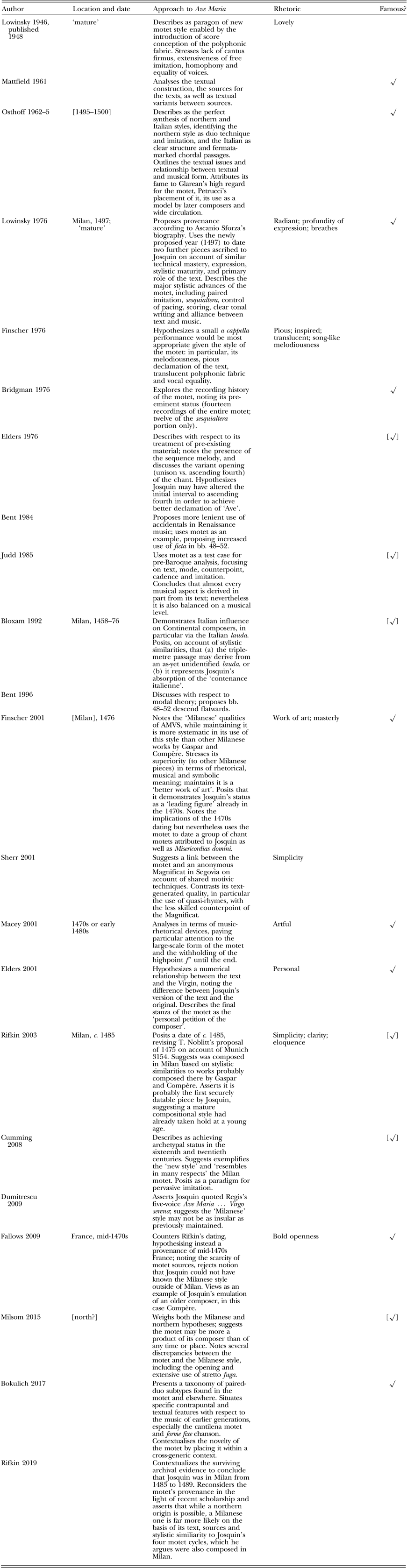
Though the significance of Ave Maria in the scholarly literature has hardly fluctuated since Lowinsky’s pioneering 1948 article, the specific rationales attached to its significance have shifted over time. That is, for some, the motet’s significance lies in its imitative techniques, while for others it is text-setting or harmony. Scrutinising the scholarly literature in chronological order reveals telling commonalities in terms of both approach and rhetoric used to describe the motet. Table 2 tracks the most significant scholarly contributions to the Ave Maria literature over the past century, taking note of the rhetoric used to describe the motet’s style. Among the most frequently cited stylistic features are imitation, homorhythm and text-setting. Common terms, including ‘simplicity’, ‘clarity’, ‘radiant’, ‘eloquence’, and ‘artful’, apply to the motet’s style, whereas terms such as ‘pious’, ‘personal’, and ‘breathes’ seem more aesthetically driven.
Ave Maria in the Scholarly Literature
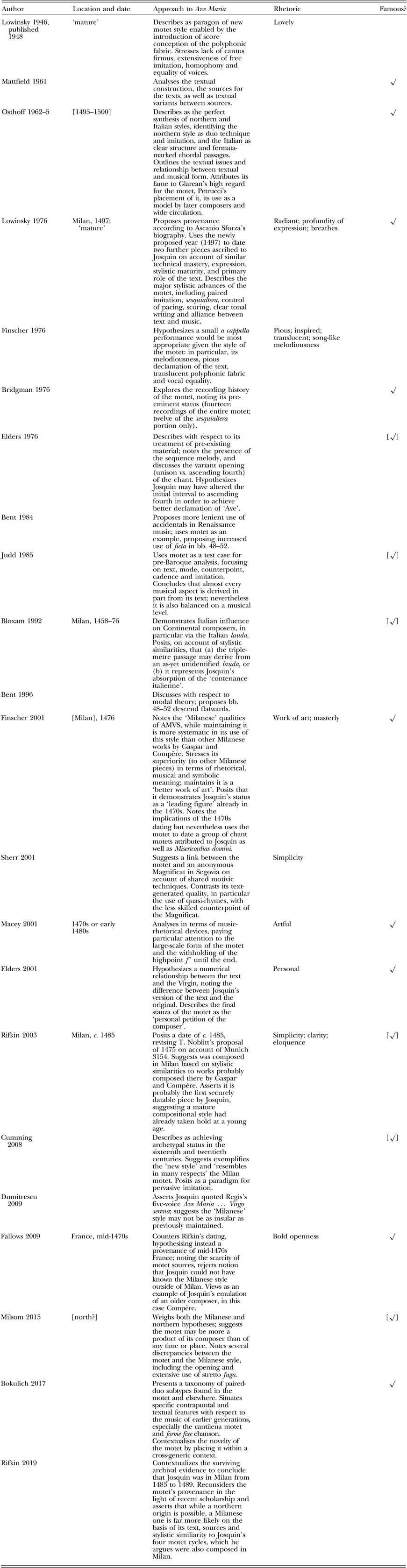
See Appendix for abbreviated references.
2. Audio Recordings
This rhetoric may be symbiotically related to the motet’s recording history. After all, Ave Maria has been recorded more often than any other motet from the Renaissance: by the time of the International Josquin Festival-Conference in 1971, the motet had featured on ten LPs, with a further nine recordings of the sesquialtera section only.Footnote 107 Perhaps even more important than the quantity of recordings is their quality, above all, their tendency towards very slow tempi. The most influential recordings (viz. the Hilliard Ensemble, Josquin Desprez: Motets et Chansons, 1984) take the motet at an extraordinarily slow pace, thereby enshrining a particular kind of reverent reception.Footnote 108 It is with these recordings in mind that characterisations such as ‘radiant’, ‘breathes’, and ‘eloquent’ come to life.
3. Survey Texts
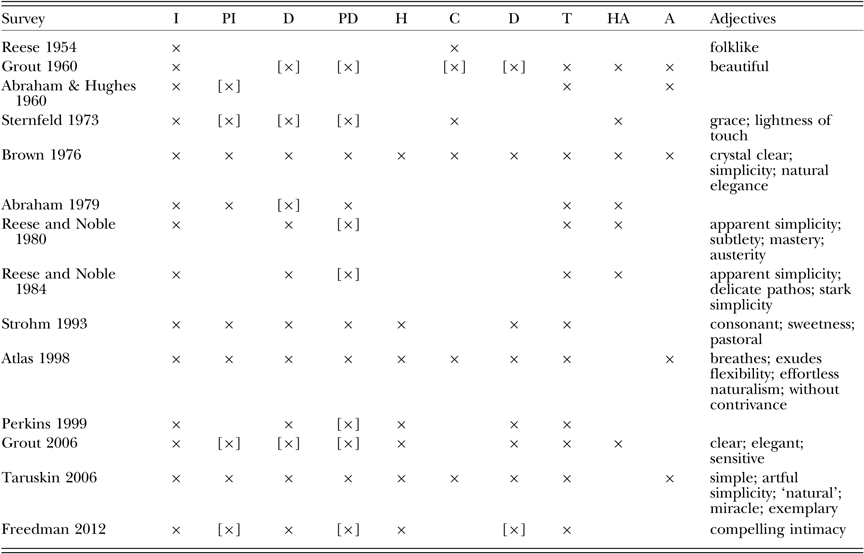
Many issues implicit in the scholarly tradition and recording history come to the fore in survey texts. These sources simultaneously distil and amplify much of the contemporary scholarship, and in this sense function as a kind of barometer for the field. In this instance more than most, survey texts have shaped how the field as a whole has approached the Ave Maria. This is true in part because the motet is used as an example as often as Mozart’s Symphony No. 40 or Beethoven’s Symphony No. 9. Even more important is that, unlike our engagement with Mozart or Beethoven, many of us are dependent for our entire view of late fifteenth-century sacred music on this single motet. Particularly in the absence of robust reportorial context, the themes brought out by survey texts carry enormous weight. Table 3 tracks the motet’s appearance in English-language survey texts, taking note of the compositional features pinpointed as significant and/or innovative in each. Even more than the scholarly literature, the fluctuation among features identified as significant (e.g., text-setting, imitation, etc.) in survey texts is extraordinary.
Ave Maria in the Survey Literature
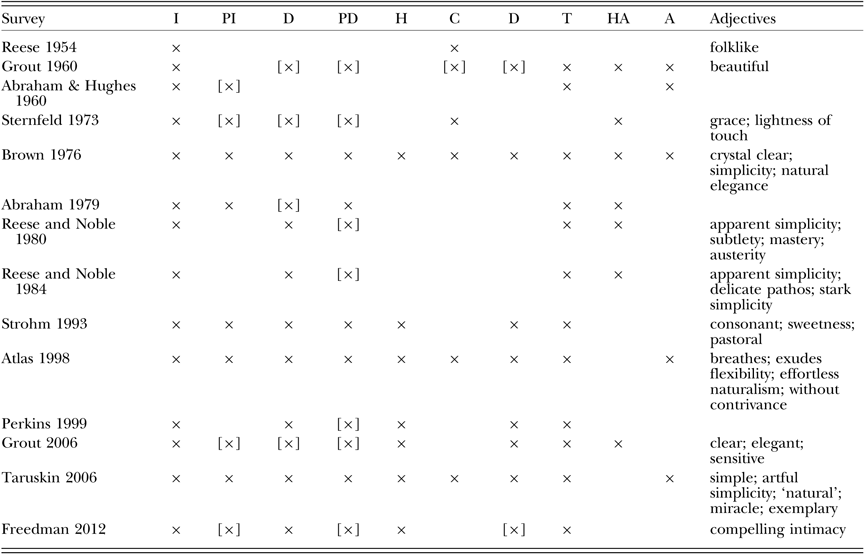
Key: I = imitation; PI = pervading imitation; D = duos; PD = paired duos; H = homorhythm; C = chant; D = declamatory; T = text–music relationship; HA = harmony; A = avant la lettre. [x] = implied or indirectly attributed. For abbreviated references see the Appendix.
Throughout the twentieth century, these surveys have tended to stress the motet’s novelty, painting Ave Maria as a stylistic watershed; a progenitor of the later sixteenth-century motet; or even a sixteenth-century motet avant la lettre. In his 2005 Oxford History of Western Music, for instance, Richard Taruskin writes: ‘The whole “perfected art” of sixteenth-century sacred music, it sometimes seems, was formed on the example of this one supreme masterpiece.’Footnote 109 As Taruskin’s declaration makes clear, almost every aspect of the motet’s style is considered innovative, including text-setting, texture (specifically the prevalence of two-voice textures), imitation, harmony and form. Among these features, imitation has received by far the greatest attention in recent years.Footnote 110 Allan Atlas, for example, describes the motet as follows:
Although Josquin and his contemporaries were not the first to use imitation, they were the first to make it the basic building block of their style. Whereas in earlier chapters we took note of pieces in which imitation was used in a systematic way, we now take note of pieces in which it is not. Moreover, while imitation was earlier used in duet sections or superius-tenor duet of a three-part texture, it now permeates all four (or more) voices. And where imitation previously behaved in a fairly predictable way, it now appears in countless permutations … The new approach to imitation appears in Josquin’s motet Ave Maria … virgo srena, probably the piece most often cited to illustrate the stylistic innovations of Josquin and his generation … The years around 1500 were witnessing the dawn of a new world, and Josquin’s motet, possibly composed at Milan – the birthplace of a new style? – as early as the 1470s, can stand for its musical realm.Footnote 111
Even the organisational scheme of Atlas’s book suggests synonymy between Ave Maria and pervading imitation: his analysis appears under the subheading ‘Pervasive Imitation’, of which this work is the sole example.
Pervasive imitation is also at the forefront of Taruskin’s description:
Févin was ‘Josquin’s happy follower’ chiefly in matters of texture – the texture exemplified in Ave Maria, with its rhetorically supple alternation of pervading imitation and emphatic chordal declamation. The full integration of musical space – rather than the hierarchical stratification of parts found in older music, with each part carrying out its own particular functional assignment – implied not only a new technique but a whole new philosophy of composition.Footnote 112
Patrick Macy similarly refers to the motet’s ‘homogeneous imitative texture’.Footnote 113 And an even earlier description, from The New Oxford History of Western Music (1960), calls attention to the motet’s ‘continuous imitation’: ‘Although [Josquin] does not completely abandon the old canto fermo technique, he often substitutes it for that of continuous imitation, the principle that was to be fundamental to the creative work of his successors … as in … Ave Maria … virgo serena.’Footnote 114
Ave Maria has not always been understood as a paragon of pervading imitation, however.Footnote 115 In Gustave Reese’s magisterial Music in the Renaissance (1954), the motet is conspicuously absent from a discussion of pervading imitation, even though the author credits Josquin with the advent of this technique.Footnote 116 Compared with later descriptions, Reese gives Ave Maria exceptionally peripheral treatment: it is mentioned only after discussion of thirteen other motets attributed to Josquin, and it is not included as one of the chapter’s musical examples.Footnote 117 Unlike most authors, Reese calls attention to Ave Maria for its chant quotations. His relative inattention to Ave Maria is all the more surprising when one considers the larger context of the book, which is full of admiration for the composer, and above all, his motets.Footnote 118 Similarly, Howard Mayer Brown, whose lavish treatment of Ave Maria in Music in the Renaissance (1976) occupies fully six pages, including a 53-bar-long example partially reproduced on the book’s cover, does not make the connection between pervasive imitation and Ave Maria explicit.Footnote 119 Thus, while Ave Maria has almost always been identified as a stylistic watershed and as a foreshadowing of the sixteenth-century motet, the features that have been pinpointed as innovative have varied throughout time.
Following imitation, reduced textures (e.g., paired duos) and issues of text-setting are the most consistently cited features in the survey literature. The importance of text-setting, specifically Josquin’s sensitivity to the structure and meaning of the text, has received much attention on account of its purported connection to Italian humanism. In Music in the Renaissance (2013), for instance, Richard Freedman writes:
Josquin’s contemporaries often hinted at the effectiveness of his treatment of his chosen texts … For modern writers, their suggestions have opened a long thread of discussions about the rhetorical eloquence of Josquin’s approach to words and his emblematic status as a composer whose music gives voice to the humanist currents of the day and their abiding concern for the affective, persuasive dimensions of language. Ave Maria … virgo serena is especially rich in this regard.Footnote 120
Or, to take an example from the first edition of Donald J. Grout’s History of Western Music, published more than fifty years earlier:
[Ave Maria] illustrates the style which came to be characteristic of the entire sixteenth century. Each phrase of the text has its own musical motive, which is first presented in imitation by each voice in turn; the musical sentence thus initiated comes eventually to a cadence, and a similar sentence, on the next phrase of the text and with its own musical motive, begins … This was the basic plan of a sixteenth-century motet … All of the vocal music of Josquin’s time shows the influence of humanism in the effort for a more understandable text and better adherence to correct accentuation of the words …Footnote 121
On the significance of paired duos in Ave Maria, Brown writes that they are ‘one of the hallmarks of Josquin’s style, and one of the chief ways by which he created open and spacious textures’.Footnote 122 Moreover, in drawing a link between Josquin’s motet and later compositional idioms, he portrays the reduced textures of Ave Maria as trailblazing:
[it] contains many such antiphonal passages, in which two of the voices are answered by two others. This stylistic mannerism, which led in the later sixteenth century to a more systematic exploration of antiphonal effects by cori spezzati (divided choirs) is but one of the ways in which Josquin worked with choral sonority, pitting low against high, full against half choirs … a new interest in the sound of music – in its sensuous surface – marks the work of Josquin …Footnote 123
In stressing the connection between Ave Maria and the future, rather than the past, Brown exemplifies a rhetorical gambit common to many survey texts, which tend to stress that which Ave Maria is not as much as what it is. Writer after writer has sought to distance Ave Maria from the ‘old-fashioned’ techniques of the fifteenth century. The description in Grout cited above, for instance, continues:
… in effect, this was a reaction against the highly florid, melismatic style of Ockeghem and the other early Netherlands composers, who evidently were so preoccupied with the music that they were willing to leave the details of text underlaying entirely to the trained judgment of the singers.Footnote 124
Similarly, in Frederick Sternfield’s Music from the Middle Ages to the Renaissance (1973), the single-texted Ave Maria is contrasted with the ‘archaic’ use of two texts simultaneously in large-scale tenor motets, and described in terms of having ‘saved’ Josquin’s works from the ‘extravagances of Flemish counterpoint’.Footnote 125 In the New Oxford History of Music, the motet ‘gives more evidence of independence of the current musical system’.Footnote 126 For Allan Atlas, ‘what might be called Josquin’s naturalism has supplanted Ockeghem’s complexity and artifice’.Footnote 127
Conspicuously absent from the descriptions of Ave Maria in the survey literature is mention of the motet’s chant paraphrase: until very recently, only a handful of authors (most prominently Reese) even acknowledged the existence of the sequence melody. Indeed, it would not be difficult to come away from these texts with the impression that Ave Maria was composed entirely without reference to pre-existing material. Had chant paraphrase featured more prominently in early accounts of the motet, Ave Maria might not have been considered a progenitor of the sixteenth-century motet; and it would have made an unlikely candidate for claims of originality and (arguably) for characterisations such as ‘simple’ and ‘personal’.
In describing the novel features of Ave Maria, writers have found many ways to distance the piece from the prevailing style of its time, if not through its use of pervading imitation, then through its approach to text-setting or form. This work – the great harbinger of the new sixteenth-century motet – thus became everything the motet in the fifteenth century had not been: monotextual and free of complex rhythmic patterns; texturally, structurally and harmonically transparent; possessed of a natural kinship between music and text; composed almost entirely de novo; and held together by pervading imitation, a technique that accords equal importance to all of the voices.
With but one exception, the sixteenth-century pieces that rework Ave Maria conspicuously depart from the stylistic hallmarks of Josquin’s motet, including its textural and structural clarity, imitative techniques and approach to text-setting: features identified in the survey literature as evidence of the motet’s connection to later sixteenth-century idioms. Among the Ave Maria reworkings, Févin’s Missa Ave Maria stands out as that most similar to Ave Maria in terms of textural devices. It is also the earliest. Indeed, a French-court composer himself, for Févin, Ave Maria probably felt modern – a French-court motet avant la lettre. But as the French-court style faded, and as interest in Ave Maria may have shifted to the Bavarian ducal court and German-speaking lands more broadly, Josquin’s motet became suitable as a model for heavily reworked, densely textured sixteenth-century pieces: pieces that, on the whole, look nothing like Ave Maria. In short, the kinds of motets Ave Maria ostensibly prefigures and those that actively engaged with it are not one and the same. Indeed, it is worth entertaining the possibility that Ave Maria may have been appealing to Senfl, Daser and the anonymous si placet composer precisely because of the stylistic contrast it embodied.
Focusing on Ave Maria and its reworkings enables a site-specific approach to the history of musical style. With a lens trained on individual passages and techniques in Josquin’s motet – such as stretto fuga, sesquialtera, reduced textures and wholesale repetition – we can discern broad patterns of stylistic change from the 1480s to the mid-sixteenth century. Whereas histories of musical style are usually couched in broad terms derived from corpus-wide inquiries, this site-specific approach operates on a more microscopic level. As we continue to come to grips with the extensive stylistic changes that unfolded between c. 1480 and the mid-sixteenth century, we should consider how these two approaches might fruitfully be used in tandem.
APPENDIX
Abbreviated References in Tables 2 and 3
- Abraham & Hughes 1960
A. Hughes and G. Abraham (eds.), New Oxford History of Western Music (London, 1960)
- Abraham 1979
G. Abraham, The Concise Oxford History of Music (Oxford, 1979)
- Atlas 1998
A. Atlas, Renaissance Music: Music in Western Europe 1400–1600 (New York, 1998)
- Bent 1984
M. Bent, ‘Diatonic Ficta’, Early Music History, 4 (1984), pp. 1–48
- Bent 1996
M. Bent, ‘Diatonic Ficta Revisited: Josquin’s Ave Maria in Context’, Music Theory Online, 2 (1996)
- Bloxam 1992
M. J. Bloxam, ‘“La Contenance Italienne”: The Motets on “Beata es Maria” by Compere, Obrecht, and Brumel’, Early Music History, 11 (1992), pp. 39–89
- Bokulich 2017
C. Bokulich, ‘Contextualizing Josquin’s Ave Maria … virgo serena’, Journal of Musicology, 34 (2017), pp. 182–240
- Bridgman 1976
N. Bridgman, ‘On the Discography of Josquin and the Interpretation of his Music in Recordings’, in E. E. Lowinsky and B. J. Blackburn (eds.), Josquin des Prez: Proceedings of the International Josquin Festival-Conference (London, 1976), pp. 633–41
- Brown 1976
H. M. Brown, Music in the Renaissance (Englewood Cliffs, NJ, 1976)
- Cumming 2008
J. Cumming, ‘From Variety to Repetition: The Birth of Imitative Polyphony’, Yearbook of the Alamire Foundation, 6 (2008), pp. 21–44
- Dumitrescu 2009
T. Dumitrescu, ‘Reconstructing and Repositioning Regis’s Ave Maria … virgo serena’, Early Music, 37 (2009), pp. 73–88
- Elders 1976
W. Elders, ‘Plainchant in the Motets, Hymns, and Magnificats of Josquin des Prez’, in E. E. Lowinsky and B. J. Blackburn (eds.), Josquin des Prez: Proceedings of the International Josquin Festival-Conference (London, 1976), pp. 523–42
- Elders 2001
W. Elders, ‘Symbolism in the Sacred Music of Josquin’, in R. Sherr (ed.), The Josquin Companion (Oxford, 2000), pp. 531–68
- Fallows 2009
D. Fallows, Josquin (Turnhout, 2009)
- Finscher 1976
L. Finscher, ‘Historical Reconstruction versus Structural Interpretation in the Performance of Josquin Motets’, in E. E. Lowinsky and B. J. Blackburn (eds.), Josquin des Prez: Proceedings of the International Josquin Festival-Conference (London, 1976), pp. 627–32
- Finscher 2001
L. Finscher, ‘Four-Voice Motets’, in R. Sherr (ed.), The Josquin Companion (Oxford, 2000), pp. 249–79
- Freedman 2012
R. Freedman, Music in the Renaissance (New York, 2013)
- Grout 1960
D. J. Grout, A History of Western Music (New York, 1960)
- Judd 1985
C. C. Judd, ‘Some Problems of Pre-Baroque Analysis: An Examination of Josquin’s Ave Maria … virgo serena’, Music Analysis, 4 (1985), pp. 201–39
- Lowinsky 1946, published 1948
E. E. Lowinsky, ‘On the Use of Scores by Sixteenth-Century Musicians’, Journal of the American Musicological Society, 1 (1948), pp. 17–23; repr. in Lowinsky, Music in the Culture of the Renaissance and Other Essays, ed. B. J. Blackburn (Chicago, 1989), pp. 797–800
- Lowinsky 1976
E. E. Lowinsky, ‘Ascanio Sforza’s Life: A Key to Josquin’s Biography and an Aid to the Chronology of his Works’, in E. E. Lowinsky and B. J. Blackburn (eds.), Josquin des Prez: Proceedings of the International Josquin Festival-Conference (London, 1976), pp. 31–75
- Macey 2001
P. Macey, ‘Josquin and Musical Rhetoric: Miserere mei, Deus and other Motets’, in R. Sherr (ed.), The Josquin Companion (Oxford 2000), pp. 485–530
- Mattfeld 1961
J. Mattfeld, ‘Some Relationships between Texts and Cantus Firmi in the Liturgical Motets of Josquin des Pres’, Journal of the American Musicological Society, 14 (1961), pp. 159–83
- Milsom 2015
J. Milsom, ‘Making a Motet: Josquin’s Ave Maria … virgo serena’, in A. M. Busse Berger and J. Rodin (eds.), The Cambridge History of Fifteenth-Century Music (Cambridge, 2015), pp. 183–99
- Osthoff 1962–5
H. Osthoff, Josquin Desprez, 2 vols. (Tutzing, 1962–5)
- Perkins 1999
L. Perkins, Music in the Age of the Renaissance (New York and London, 1999).
- Reese 1954
G. Reese, Music in the Renaissance (New York, 1954)
- Reese and Noble 1980
J. Noble, ‘Josquin des Prez’, in The Grove Dictionary of Music and Musicians, ed. S. Sadie (London, 1980), vol. 9, pp. 713–38.
- Reese and Noble 1984
G. Reese and J. Noble, ‘Josquin Desprez’, in The New Grove High Renaissance Masters (London, 1984), pp. 1–90.
- Rifkin 2003
J. Rifkin, ‘Munich, Milan, and a Marian Motet: Dating Josquin’s Ave Maria … virgo serena’, Journal of the American Musicological Society, 56 (2003), pp. 239–350
- Rifkin 2019
J. Rifkin, ‘Milan, Motet Cycles, Josquin: Further Thoughts on a Familiar Topic’, in D. V. Filippi and A. Pavanello (eds.), Motet Cycles between Devotion and Liturgy (Basel, 2019), pp. 221–335
- Sherr 2001
R. Sherr, ‘Two Hymns and Three Magnificats’, in Sherr (ed.), The Josquin Companion (Oxford 2000), pp. 321–34
- Sternfeld 1973
F. Sternfeld, Music from the Middle Ages to the Renaissance (London, 1973)
- Strohm 1993
R. Strohm, The Rise of European Music, 1380–1500 (Cambridge, 1993)
- Taruskin 2006
R. Taruskin, Oxford History of Western Music, vol. 1 (New York and Oxford, 2005)