The transition from primary to secondary school is a critical moment during adolescence (Hanewald, Reference Hanewald2013). It is around this time that young people encounter multiple bio-psychosocial changes, and often simultaneously. Evidence indicates that contact with other groups of similar-aged peers provide an essential source of emotional and psychological support for adolescents (La Greca & Harrison, Reference La Greca and Harrison2005). Moreover, the quality of peer relationships also shapes how young people view their future selves. Difficulty establishing and maintaining satisfactory peer relationships during adolescence is associated with decreased self-worth and self-esteem (Hall-Lande, Eisenberg, Christenson, & Neumark-Sztainer, Reference Hall-Lande, Eisenberg, Christenson and Neumark-Sztainer2007; Hansen, Giacoletti, & Nangle, Reference Hansen, Giacoletti, Nangle, Van Hasselt and Hersen1995), perceptions of social rejection (Hansen et al., Reference Hansen, Giacoletti, Nangle, Van Hasselt and Hersen1995), the internalisation of problems such as anxiety and depression (Hall-Lande et al., Reference Hall-Lande, Eisenberg, Christenson and Neumark-Sztainer2007), and suicidal ideation and self-harm (Bearman & Moody, Reference Bearman and Moody2004). Hence, the quality of peer relationships is considered one of the strongest indicators of current and future psychological wellbeing in adolescents (Boivin, Hymel, & Bukowski, Reference Boivin, Hymel and Bukowski1995).
Bullying behaviour is a major factor affecting the healthy emotional development and relationships of young people (Lester, Cross, Dooley, & Shaw, Reference Lester, Cross, Dooley and Shaw2012). Exposure to bullying at school can have a long-lasting impact on academic, behavioural, emotional, physical, and mental health outcomes for some adolescents (Carney, Reference Carney2008; Johnson, Reference Johnson2009). Peer support (Pellegrini, Reference Pellegrini2002), a sense of belonging and connectedness to school (Benner & Graham, Reference Benner and Graham2009; O’Brennan & Furlong, Reference O’Brennan and Furlong2010), and feeling safe at school (Espelage, Bosworth, & Simon, Reference Espelage, Bosworth and Simon2000) appear to be protective factors against bullying victimisation; whereas negative outcome expectancies of bullying another student and a pro-victim attitude, including empathy towards the target and disapproval of bullying, have been found to ameliorate the likelihood of perpetration of bullying behaviour (Andreou & Metallidou, Reference Andreou and Metallidou2004; Pellegrini, Bartini, & Brooks, Reference Pellegrini, Bartini and Brooks1999). Critically, mental health has been found to be both a risk factor for bullying perpetration and an outcome of bullying victimisation during adolescence (Meland, Rydning, Lobben, Breidablik, & Ekeland, Reference Meland, Rydning, Lobben, Breidablik and Ekeland2010; Riittakerttu, Fröjd, & Marttunen, Reference Riittakerttu, Fröjd and Marttunen2010).
Earlier research has shown that while boarding and non-boarding students have similar social and emotional wellbeing and mental health prior to transitioning to secondary school, boarding students report a more difficult transition experience and have significantly greater negative emotional wellbeing and mental health indicators immediately post-transition (Mander, Lester, & Cross, Reference Lester, Mander, Cross, Taylor, Pooley and Merrick2014). It is increasingly acknowledged that school entry can be a particularly challenging experience for those students transitioning from a local primary school to a secondary boarding school (Mander, Reference Mander2012). It requires negotiating an unfamiliar and new school environment, as well as new academic demands and the need to form new social networks and friendships with peers, while also establishing relationships with new teachers. This circumstance commands boarding students to undertake a significant change in mindset that demands: the rapid mastery of functioning autonomously with less dependence on parents; an even greater reliance on support from peers and non-parental adults; the development of coping, decision-making, self-regulation and self-management skills; and building a repertoire of pro-social communication and coping skills necessary to interact effectively with peers and staff in a communal living and learning environment (Hawkes, Reference Hawkes2010).
Arguably, the boarding school context provides a greater opportunity for bullying behaviours to occur (Poynting & Donaldson, Reference Poynting and Donaldson2005; Schaverien, Reference Schaverien2004) as the bullying can follow the target from the day school setting into their boarding context (Carlisle & Rofes, Reference Carlisle and Rofes2007). Recent research suggests boarding students encounter significantly higher bullying prevalence rates (Mander et al., Reference Mander, Lester, Cross, Taylor, Pooley and Merrick2014) and report lower levels of mental and emotional wellbeing compared to non-boarding students (Mander et al., Reference Mander, Lester, Cross, Taylor, Pooley and Merrick2014). Moreover, this significant difference in bullying prevalence may continue for 2 years after the initial transition to boarding school (Mander et al., Reference Mander, Lester, Cross, Taylor, Pooley and Merrick2014). While the transition to secondary school requires all students to develop new coping strategies and support structures, for boarding students this has to be often achieved with only the distal support of their family. An increase in psychological problems (e.g., depressive symptoms, conduct problems) and a decline in academic attainment (Riglin, Frederickson, Shelton, & Rice, Reference Riglin, Frederickson, Shelton and Rice2013) are also associated with this transition. Evidence suggests that this transition presents a greater challenge for boys than for girls, as female students seem to look forward to the transition more than males, and seem to be more settled after transition (Marston, Reference Marston2008), whereas previous bullying research has shown males are more likely than females to be both perpetrators and targets of bullying over the transition period (Cross et al., Reference Cross, Shaw, Hearn, Epstein, Monks, Lester and Thomas2009).
It is important to understand the implications of bullying victimisation and perpetration during the first few years of boarding school for both males and females. Previous articles have discussed in detail the differences between boarders and non-boarders with respect to bullying behaviours and social, emotional and mental wellbeing (Lester, Mander, & Cross, Reference Lester, Mander, Cross, Taylor, Pooley and Merrick2014; Mander et al., Reference Mander, Lester, Cross, Taylor, Pooley and Merrick2014), hence this article focuses on the implications for boarding students only. It aims to identify social, emotional and mental wellbeing predictors of bullying victimisation and perpetration for boarding students following the transition from primary school to secondary boarding school.
Methods
The data used in this article were taken from a larger longitudinal study, the Supportive Schools Project (SSP), conducted in Perth, Western Australia. The SSP aimed to develop and implement whole-of-school strategies to reduce the prevalence of frequent bullying behaviours, as well as positively influence common mediators of bullying. The research protocols, as well as school and parent consent procedures, were approved by the Edith Cowan University Human Research Ethics Committee and the relevant Catholic Education school authorities.
Cohort data were collected during the SSP from 3,462 students from 21 of the 28 Catholic secondary schools in Western Australia. All schools were stratified according to the total number of students enrolled at the school and each school's socio-economic status (SES) to help to control for the influence of these two factors on student bullying behaviour. These schools were randomly selected and randomly assigned to an intervention or comparison group.
To collect data relating to their pre-transition experiences of bullying, all Grade 7 (mean age 12 years old) students enrolled to commence in Grade 8 at each of the 21 schools received a baseline survey. An opt-out consent process resulted in 93% of parents whose children were enrolled in the 21 recruited secondary schools consenting to their child participating in the study.
The student cohort was surveyed at the end of Grade 7 (mean age 12 years), the beginning of Grade 8 (mean age 13 years old), the end of Grade 8 (mean age 13 years old) and the end of Grade 9 (mean age 14 years old). In total, 3,462 (92% of the total recruited) students completed questionnaires at least at one time point, with 3,123 (90%) responding to at least three of the four data collection points. One half of the students surveyed were male and 70% attended a co-educational secondary school versus a single sex secondary school. Data from comparison schools only was used in this paper. A total of 5% of the student sample (76 males, 74 females) identified themselves as living away from home to complete their secondary education at the study schools. Of these, 89% responded to at least 3 of the 4 data points.
Measures
Boarder status
Students in Grades 8 and 9 were asked whether they were living away from home while going to school this year. Those who indicated they were living away from home in Grade 8 and Grade 9 were classified as boarders.
Bullying victimisation and perpetration
A global measure of victimisation was obtained by asking students ‘In the previous 10 weeks at school, how often did another student or group of students bully you?’, with the response options recorded on a 5-point scale (1 = never, 2 = only once or twice, 3 = every few weeks, 4 = about once a week, 5 = most days). Similarly, a global measure of perpetration was obtained using the same scale. The type of bullying victimisation was assessed using a nine-item categorical index adapted from Rigby and Slee (Reference Rigby and Slee1998), Olweus (Reference Olweus1996) and from the 2004 Youth Internet Survey (Ybarra & Mitchell, Reference Ybarra and Mitchell2004). Students were asked how often they were bullied through physical (hit, kicked and pushed around; had money or other things broken or taken away from them; made to feel afraid they would get hurt), verbal (made fun of and teased in a hurtful way; called mean and hurtful names), relational (students ignored them, didn't let them join in, or left them out on purpose; and students told lies about them and tried to make other students not like them) or cyber (were sent mean and hurtful text [SMS] messages; were sent mean and hurtful messages on the internet) means during the prior 10 weeks at school. For each item students were asked how often they were bullied, rating each item on a 5-point scale (1 = never, 2 = only once or twice, 3 = every few weeks, 4 = about once a week, 5 = most days). The type of perpetration was assessed using a similar nine-item perpetration index that asked students how often they bullied others in the different ways listed. Frequent victimisation and perpetration were classified as every few weeks or more often.
Peer support
The Peer Support at School Scale adapted from the 24-item Perceptions of Peer Social Support Scale (Ladd, Kochenderfer, & Coleman, Reference Ladd, Kochenderfer and Coleman1996) comprised 11 items: How often would students: choose you on their team; tell you you’re good at things; explain something if you didn't understand; invite you to do things with them; help you if you are hurt; miss you if you weren't at school; help you if something is bothering you; ask to work with you; help you if other students treat you badly; ask you to join in when alone; and share things with you? Items were measured on a 3-point scale (1 = never, 2 = sometimes, 3 = lots of times). A factor analysis performed on the adapted peer support scale confirmed its unidimensionality (CFI > 0.9, SMR < 0.10 at all time points). A peer support score at each time point was calculated for each student by averaging all items, higher scores reflecting greater feelings of peer support (average alpha = 0.88).
Loneliness
Loneliness was measured using seven items adapted from Cassidy and Asher's (Reference Cassidy and Asher1992) 15-item Loneliness at School Scale. The seven items (I feel alone at school; I have lots of friends to talk to at school; It's hard for me to make friends at school; I have nobody to talk to in my classes; I don't have anyone to spend time with at school; I’m lonely at school; I feel left out of things at school) were measured on a 5-point scale ranging from 1 = strongly disagree to 5 = strongly agree. A factor analysis performed on the adapted loneliness scale confirmed its unidimensionality (CFI > 0.9, SMR < 0.10 at all time points). A mean loneliness score was calculated at each time point for each student; higher scores reflected greater feelings of loneliness (average alpha = 0.72).
Connectedness
The Connectedness to School Scale comprised four items adapted from the Resnick et al. (Reference Resnick, Bearman, Blum, Bauman, Harris, Jones and Udry1997) six-item School Connectedness Scale (I feel close to people at school; I feel like I am part of this school; I am happy to be at school; the teachers treat students fairly) measured on a 5-point scale (1 = never, 2 = unsure, 3 = sometimes, 4 = usually, 5 = always). The unidimensionality of the adapted scale was confirmed in a factor analysis (CFI > 0.9, SMR < 0.10 at all time points). For each student at each time point an average school connectedness score was calculated, with a higher score reflecting greater feelings of connectedness to their school (average alpha = 0.80).
Safety
Safety at school was a single item adapted from the Peer Relations Questionnaire (Rigby & Slee, Reference Rigby and Slee1998) and measured on a 3-point scale (1 = no, I never feel safe at school, 2 = yes, some of the time, 3 = yes, all or most of the time) for each time point, with a higher value reflecting greater feelings of safety at school.
Pro-victim attitudes
The Pro-victim Attitude Scale was adapted from the Rigby and Slee's (Reference Rigby and Slee1991) 20-item Pro-victim Scale. The scale used in this study comprised seven pro-victim items (A person who bullies is really a coward; It makes me angry when someone is picked on; Students should tell someone if they are being bullied; Students who pick on someone weaker should be told off; I like it when students stand up for themselves; You should not pick on someone who is weaker than you; I like it when someone sticks up for students who are bullied; I feel uncomfortable when I watch someone being bullied) and two items not supportive of students who were bullied (Students who get picked on all the time usually deserve it; It's funny to see students get upset when they are teased) with three response choices of 1 = agree, 2 = not sure and 3 = disagree. After reverse coding the latter items, an average pro-victim score was calculated from the nine items, with a higher score reflecting attitudes more supportive of victims (average alpha = 0.70).
Negative outcome expectancies
The Outcome Expectancies Scale (from bullying others) was adapted from Rigby (Reference Rigby2003) and comprised 11 items (Other students would be scared of me; Other students would like me; My parents would find out and talk to me about it; I would feel bad about myself; Other students would think I was tough; I would get into trouble; I would feel bad for the student I bullied; Other students would not want to be my friend; My parents would be unhappy with me; I would feel good about myself; Other students wouldn't bully me) with three response choices of 1 = yes, 2 = maybe and 3 = no. After reverse coding the appropriate items, an average outcome expectancies score was calculated, with a higher score reflecting a belief of greater negative outcomes for the student if they engage in bullying behaviours (average alpha = 0.71).
Mental wellbeing
Self-reported depression, anxiety and stress were assessed using the Depression Anxiety Stress Scale (Lovibond & Lovibond, Reference Lovibond and Lovibond1995), which comprises seven items relating to depression, seven items related to anxiety, and seven items related to stress measured on a 4-point scale (scores ranged from 0 = not at all, to 3 = applied to me very much, or most of the time). A depression, anxiety and stress score were calculated at each time point for each student by adding the items, with higher scores reflecting greater feelings of depression, anxiety and stress.
Emotional wellbeing
The Strengths and Difficulties Questionnaire (SDQ; Goodman, Reference Goodman1997) comprises 25 items measured on a 3-point scale (0 = not true, 1 = somewhat true, 2 = certainly true) and explores constructs such as emotional difficulties, conduct problems, hyperactivity, peer problems and prosocial skills. An overall score was calculated in accordance with the scale author's instructions, with a range of possible scores from 0–10. A higher score indicates greater emotional difficulties, conduct problems, hyperactivity and peer problems for each of these subscales. A higher score for the prosocial subscale indicates strong social skills.
Statistical Analysis
Analyses on boarding school students were conducted using STATA v13 and SPSS v22. Chi-square analyses were used to determine gender differences between bullying prevalence for students who were boarders, whereas ANOVAs were used to determine gender differences between social, emotional and mental wellbeing. Separate multinomial regression models were used to determine whether the social, emotional and mental wellbeing of boarding students at the beginning of Grade 8 were predictors of victimisation and perpetration for these same students at the beginning and end of Grade 8. All predictors of victimisation and perpetration were then placed in the one multinomial regression model to determine the strength of the social, emotional and mental wellbeing predictors of victimisation and perpetration relative to each other.
Results
Target of Bullying
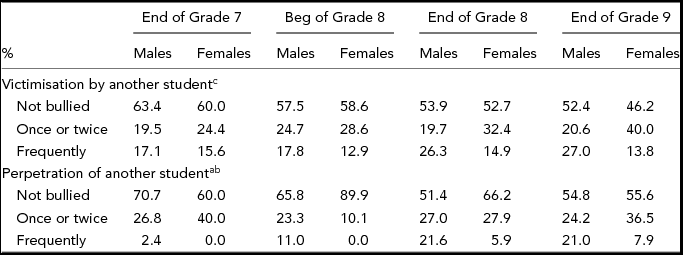
At the end of Grade 7, 62% (n = 53) of the students who became boarders following their transition to secondary school reported not being victimised, while 22% (n = 19) reported being victimised once or twice in the past 10 weeks, and 16% (n = 14) reported frequent victimisation (Table 1). Frequent victimisation (every few weeks or more often) increased from one in six at the end of Grade 7 (prior to boarding), to one in five by the end of Grade 8 and Grade 9 when these students were boarding at their secondary school. At the end of Grade 9 a significantly greater proportion of male boarders reported frequent victimisation (χ2 = 6.908, p = .032) than female boarders.
Frequency of Victimisation and Perpetration of Boarders by Gender

Note: ap < .05 at beginning of Grade 8 for gender, bp < .05 at end of Grade 8 for gender, cp < .05 at end of Grade 9 for gender.
Perpetration of Bullying
The majority of students (in Grade 7) prior to their transition to secondary school and boarding school (65%, n = 56) reported they did not bully others, 34% (n = 29) reported they bullied others once or twice, and 1% (n = 1) reported they frequently perpetrated others. Following their transition to secondary and boarding school, frequent perpetration (every few weeks or more often) was reported by 6% of boarders at the beginning of Grade 8, increasing to 14% at the end of both Grade 8 and Grade 9. At the beginning of Grade 8 (χ2 = 13.847, p = .001) and the end of Grade 8 (χ2 = 7.576, p = .023), a significantly greater proportion of male boarders reported frequent perpetration than female boarders.
Social, Mental and Emotional Wellbeing of Boarders
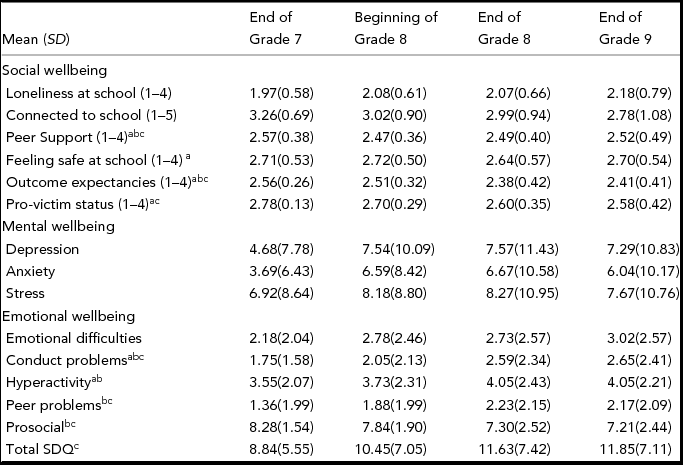
On average, boarders reported low levels of loneliness at school, high school connectedness, high peer support, high negative outcome expectancies, and high pro-victim attitudes, and they felt safe at school (Table 2). At the beginning of Grade 8, females reported significantly greater peer support (p = .013), significantly greater negative outcome expectancies (p < .001), and significantly greater pro-victim attitudes (p = .018) than males, whereas males felt significantly more safe at school (p = .012). At the end of Grade 8, females reported significantly greater peer support (p < .001) and significantly greater negative outcome expectancies than males (p < .001), and at the end of Grade 9, females reported significantly greater peer support (p = .001), significantly greater negative outcome expectancies (p < .001) and significantly greater pro-victim attitudes (p = .016) than males.
Sample Characteristics of Boarders
Note: ap < .05 at beginning of Grade 8 for gender, bp < .05 at end of Grade 8 for gender, cp < .01 at end of Grade 9 for gender.
At the end of Grade 7 prior to their transition to high school, there were no significant differences between students’ emotional wellbeing with respect to gender. However, male boarders reported significantly higher conduct problem scores than female boarders in secondary school (beginning of Grade 8: p = .013; end of Grade 8: p = .005; end of Grade 9: p = .002), and significantly higher hyperactivity scores at the start and end of Grade 8 than females (beginning of Grade 8: p = .025; end of Grade 8: p = .049). Male boarders compared to female boarders also reported significantly higher peer problems at the end of Grades 8 and 9 (end of Grade 8: p = .016; end of Grade 9: p < .001), while females reported significantly higher prosocial tendencies during the same period (end of Grade 8: p < .001; end of Grade 9: p < .001). Males reported significantly higher total difficulties at the end of Grade 9 (p = .015).
Social, Emotional and Mental Wellbeing Predictors of Frequency of Bullying Victimisation at Beginning of Grade 8
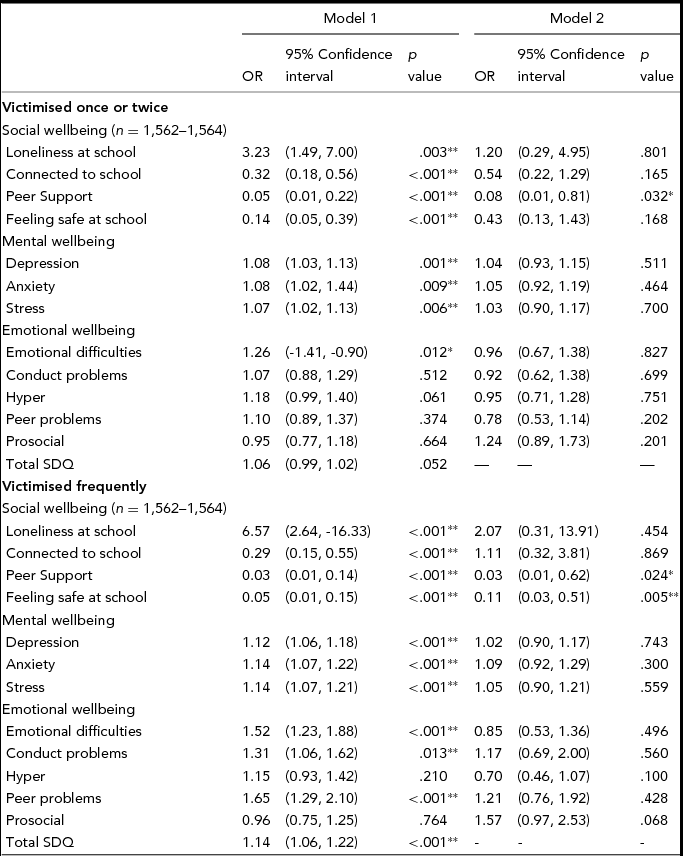
At the beginning of Grade 8, boarders with greater peer support, greater school connectedness and who felt safer at school, had decreased odds of reporting being victimised. Boarders with greater loneliness at school had increased odds of reporting being victimised at the beginning of Grade 8 (Model 1, Table 3). Boarders with higher levels of depression, anxiety and stress had increased odds of being victimised at the beginning of Grade 8. Boarders with emotional difficulties at the beginning of Grade 8 had increased odds of being victimised at the beginning of Grade 8, whereas boarders reporting conduct problems and peer problems had significantly increased odds of reporting frequent victimisation at the beginning of Grade 8.
Multinomial Logistic Regression Models of Social, Mental and Emotional Wellbeing Predictors of Victimisation at the Beginning of Grade 8
Note: *Significant at 5% level, **Significant at 1% level. OR: odds of victimisation versus no victimisation. Model 1: separate models have been used for individual predictors of victimisation. Model 2: all predictors have been entered into the one model.
When all predictors were placed in the one multinomial regression model, peer support was the only significant factor found to be protective of being victimised once or twice at the beginning of Grade 8, whereas peer support and feeling safe at school was protective against being frequently victimised at the beginning of Grade 8 (Model 2, Table 3).
Social, Emotional and Mental Wellbeing Predictors of Frequency of Bullying Victimisation at End of Grade 8
Social, emotional and mental wellbeing variables at the beginning of Grade 8 were used to predict victimisation at the end of Grade 8. After taking into account victimisation at the beginning of Grade 8, boarders who felt lonely at school at the beginning of Grade 8 were 2.3 times more likely to be frequently victimised at the end of Grade 8, and boarders who felt unsafe at school at the beginning of Grade 8 were 3.4 times more likely to be frequently victimised at the end of Grade 8.
Social, Emotional and Mental Wellbeing Predictors of Bullying Perpetration at Beginning of Grade 8
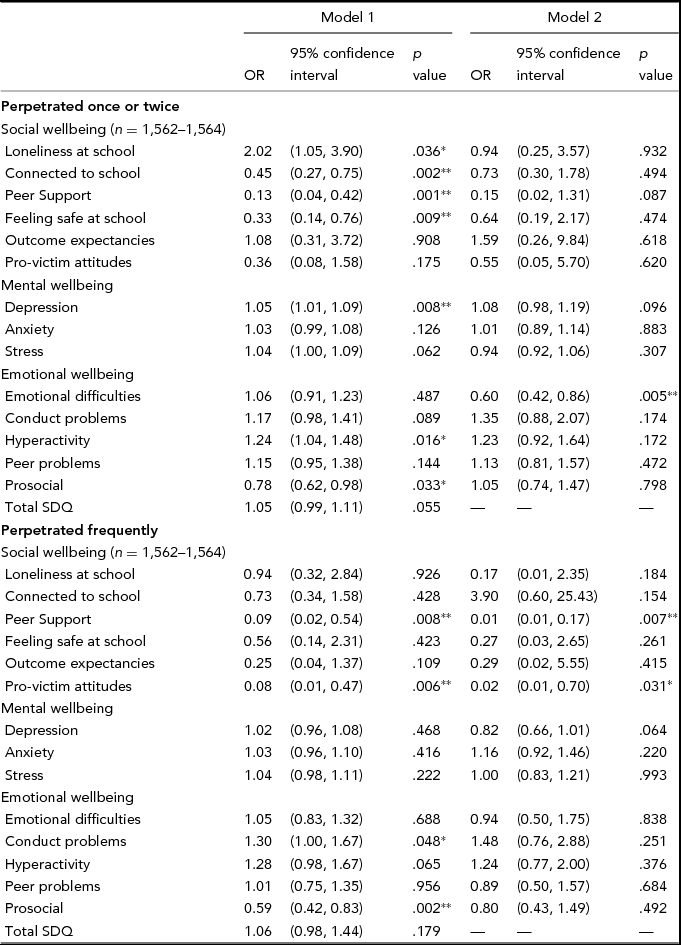
At the beginning of Grade 8, boarders with greater peer support, greater school connectedness and who felt safer at school had decreased odds of reporting infrequent perpetration, whereas boarders with greater loneliness at school had increased odds of reporting infrequent perpetration at the beginning of Grade 8 (Model 1, Table 4). Boarders with greater peer support and a greater pro-victim attitude at the beginning of Grade 8 had decreased odds of frequent perpetration at the beginning of Grade 8. Boarders with higher levels of depression had increased odds of occasional perpetration (once or twice in the last 10 weeks at school) at the beginning of Grade 8. Boarders reporting higher levels of hyperactivity had increased odds of occasional perpetration, whereas borders reporting conduct problems had significantly increased odds of reporting frequent perpetration (every few weeks or more often in the last 10 weeks) at the beginning of Grade 8. Boarders with pro-social tendencies had reduced odds of frequent perpetration.
Multinomial Logistic Regression Models of Social, Mental and Emotional Wellbeing Predictors of Perpetration at the Beginning of Grade 8
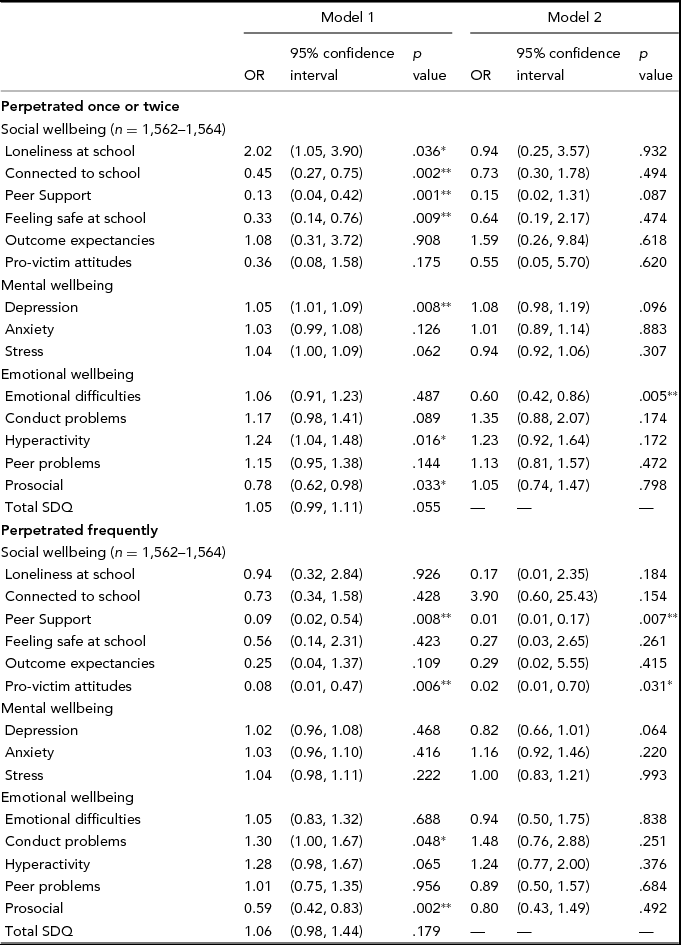
Note: *Significant at 5% level, **Significant at 1% level. OR: odds of perpetration versus no perpetration. Model 1: separate models have been used for individual predictors of perpetration. Model 2: all predictors have been entered into the one model.
When all predictors were placed in the one multinomial regression model, emotional difficulties was the only significant predictor of occasional perpetration at the beginning of Grade 8, whereas peer support and pro-victim attitudes were significant protective factors against frequent perpetration at the beginning of Grade 8 (Model 2, Table 4).
Social, Emotional and Mental Wellbeing Predictors of Frequency of Bullying Perpetration at End of Grade 8
Social, emotional and mental wellbeing variables at the beginning of Grade 8 were used to predict perpetration at the end of Grade 8. After taking into account perpetration at the beginning of Grade 8, boarders with greater negative outcome expectancies at the beginning of Grade 8 were 7.7 times less likely to infrequently perpetrate and 30 times less likely to frequently perpetrate, while those reporting higher conduct problems were 1.3 times as likely to frequently perpetrate at the end of Grade 8. Boarders with greater emotional difficulties were also 1.3 times as likely to frequently perpetrate at the end of Grade 8.
Discussion
This study used longitudinal data (four data points) to determine the social, emotional and mental wellbeing predictors of bullying victimisation and perpetration following the transition from primary school to secondary boarding school. A spike in frequency of bullying ‘perpetration’ occurred immediately after the transition to secondary school and boarding school, with an increase in bullying perpetration continuing to occur throughout the following 2 years. Hence, these findings suggest that for some students bullying still shapes their transition experience to life at boarding school and underpins a wide range of problems. In particular, it emerged that social, mental and emotional wellbeing were significant predictors of bullying victimisation in boarding students. Those boarding students reporting higher levels of depression, anxiety, and stress symptoms were significantly more at risk of frequent bullying victimisation at the beginning of Grade 8. Peer support and feeling safe were found to be factors most likely to decrease frequent bullying victimisation; however, boarding students reported receiving less peer support at the ‘beginning’ and ‘end’ of Grade 8 than at the end of Grade 7, a finding that aligns with previous research that emphasised the proactive role that peers play during adolescence in both preventing and moderating the incidence of bullying behaviour (Baker & Bugay, Reference Baker and Bugay2011).
On the other hand, boarding students experiencing conduct problems and emotional difficulties during Grade 8 were more likely to engage in frequent bullying perpetration. Results indicated that increased peer support and pro-victim attitudes were protective factors against participation in frequent bullying perpetration. However, pro-victim attitudes reported by boarding students in this study were found to decrease over time, a finding consistent with previous research that described how in late primary and early secondary school, attitudes towards the student victimised tend to become less supportive (Gini, Albiero, Benelli, & Altoè, Reference Gini, Albiero, Benelli and Altoè2008), with some adolescents condoning the use of aggressive behaviour to resolve problems with peers and even blaming the victim of bullying for allowing bullying behaviour to take place in the first place (Gini, Albiero et al., Reference Gini, Albiero, Benelli and Altoè2008).
Such findings highlight the importance of addressing attitudes towards bullying both prior to and immediately after the commencement of boarding school. Targeted intervention and support may be particularly needed for male boarding students at the beginning and end of Grade 8, as both their victimisation and perpetration rates were found to be significantly higher than female boarding students. Moreover, males also reported significantly lower pro-victim attitudes and peer support yet experienced higher problems with peers, conduct problems and overall difficulties compared to female boarding students. It is well established that adolescent males can find it harder to establish peer networks during the transition to a new school (Aikins, Bierman, & Parker, Reference Aikins, Bierman and Parker2005); similarly, that adolescent males are more likely to utilise less effective coping strategies during stressful life events (Hampel & Petermann, Reference Hampel and Petermann2006) and less likely to engage in help-seeking behaviours (Hunter, Boyle, & Warden, Reference Hunter, Boyle and Warden2004). It would seem important to use data like this to identify explicit points for bullying prevention and intervention during the transition experience and tailor staff practices and policy in boarding schools to meet the specific needs of adolescent males. The findings of this study suggest that peer relationships and the opportunity to establish new peer groups and social networks when transitioning to boarding school play a key role in moderating both bullying victimisation and perpetration, a finding congruent with other research that indicates the successful development of healthy and multiple friendship groups is protective against bullying victimisation (Pellegrini & Bartini, Reference Pellegrini and Bartini2000); may reduce the negative impact of victimisation; and can reduce the probability of further victimisation and loneliness (Gini, Pozzoli, Borghi, & Franzoni, Reference Gini, Pozzoli, Borghi and Franzoni2008; Menesini, Codecasa, Benelli, & Cowie, Reference Menesini, Codecasa, Benelli and Cowie2003).
Current evidence suggests bullying is best addressed using a whole-of-school strategy that is both systematic and targeted in its approach. Key steps underpinning this approach should include: building capacity for action; a supportive school culture; proactive policies, procedures and practices; school community key understandings and competencies; a protective school environment; and school-family-community partnerships (Pearce, Cross, Monks, Waters, & Falconer, Reference Pearce, Cross, Monks, Waters and Falconer2011). Within a boarding school context, this would involve gaining a perspective on bullying-related issues from boarding students, staff and parents, assessing what actions the boarding community consider important to undertake, and in what areas further or different action need to be undertaken to promote respectful and positive peer relationships. Evaluating the consistency between school policy, procedures and practices towards bullying behaviours is critical (Pearce et al., Reference Pearce, Cross, Monks, Waters and Falconer2011), as it is well recognised that if students perceive staff as unreliable and inconsistent in the application of school rules, they are less likely to seek help and to view staff as not caring about addressing bullying seriously (Mander et al., Reference Mander, Lester, Cross, Taylor, Pooley and Merrick2014). School staff who are perceived as proactive in their efforts to intervene and reduce bullying can significantly influence students’ sense of safety while at school (Beran & Tutty, Reference Beran and Tutty2002). Hence, supporting staff to prevent, detect and intervene in bullying incidents in a rapid and consistent manner represents a simple and achievable action that boarding schools can immediately take to reduce bullying perpetration and victimisation and increase students’ perceived sense of safety (Beran & Tutty, Reference Beran and Tutty2002; Bradshaw, O’Brennan, & Sawyer, Reference Bradshaw, O’Brennan and Sawyer2008).
Lastly, boarding students’ ability to interact effectively with peers at school is essential to their overall social, emotional, and mental wellbeing while at boarding school. Peer support initiatives such as engaging students in extracurricular activities and meetings of students who share similar goals can be promoted among students (Buchanan & Bowen, Reference Buchanan and Bowen2008), but could be extended to include interaction between families, parents and teachers. Similarly, encouraging empathy among boarding students, positive bystander behaviour, and reflection of their own beliefs and beliefs of their peer group in relation to bullying episodes have been found to be critical in increasing pro-victim behaviour and reducing bullying prevalence rates (Almeida, Correia, & Marinho, Reference Almeida, Correia and Marinho2010; Fox, Elder, Gater, & Johnson, Reference Fox, Elder, Gater and Johnson2010; Gini, Albiero, Benelli, & Altoè, Reference Gini, Albiero, Benelli and Altoè2007; Nickerson, Mele, & Princiotta, Reference Nickerson, Mele and Princiotta2008; Poyhonen & Salmivalli, Reference Poyhonen, Salmivalli, Pepler and Craig2008).
Strengths and Limitations
The findings here suggest that the effect of bullying on boarding students — both perpetrators and students targeted by bullying — requires more substantive and empirical investigation. There are several strengths of this study. The longitudinal nature of the quantitative research design over the transition from primary into secondary school enabled the investigation of bullying at a time that can be challenging for many students, especially those students who are also transitioning to boarding school. Moreover, the quantitative findings are robust due to the large proportion of boarders (89%) who completed questionnaires for at least three data collections. The limitations of this study included relying on student self-report of bullying victimisation and perpetration. The reliance on self-report of bullying perpetration and victimisation over the adolescent years rather than also using peer, teacher or parent report may result in under-reporting of involvement in bullying behaviours, particularly perpetration. As social, mental and emotional wellbeing was also measured using self-report, shared variance is a limitation of the study as the estimates of the correlation between bullying behaviours and social, mental, and emotional wellbeing may be inflated. Missing data due to absentee students and students lost to attrition may mean that students with greater levels of involvement in bullying perpetration or victimisation behaviours were not included in the analyses. However, the effect of this is believed to be minimal as there were no significant differences in bullying behaviours at the beginning of Grade 8 between boarding students who remained in the study and those lost to attrition. Parents may have been present during questionnaire completion by students in Grade 7, which may result in different responses compared to completion in a classroom situation, as was the case in Grades 8 and 9. This reduces the comparability of the data across the time points to some degree. The research was conducted with a sample of Catholic secondary schools within the Perth metropolitan area, which affects the generalisability of results given they represent 11% of all secondary schools (n = 186) in Perth, Western Australia. All boarding schools involved in this study vary in size, operational and organisational practices, as well as school activities over the transition period, which will likely influence students’ experiences. Students were classified as ‘boarders’ in this study if they indicated they were living away from home while going to school. Some students who were living away, but with relatives, may have been included in the analysis. It is unknown how many students within this sample were boarding before Year 8. It is recommended that further longitudinal research be undertaken following greater numbers of boarding students from primary until the end of secondary school to enable further clarification and validation of the relationships found in this research.
Conclusion
The results from this study show that emotional wellbeing and mental health indicators were significant predictors of involvement in bullying behaviours for boarding students. It is imperative that boarding schools not only adopt a targeted and systematic whole-school approach to bullying prevention but modify school policy and practice to increase awareness in staff of the emotional wellbeing and mental health elements of transition for boarding students.
Acknowledgments
We thank Ms Melanie Epstein, Ms Erin Erceg, and Dr Stacey Waters for their contributions to the Supportive Schools Project (SSP) project, as well as the SSP study schools and their staff, parents, and students. The SSP Project and this study were funded by the Western Australian Health Promotion Foundation (Healthway) and the research supported by the Child Health Promotion Research Centre (CHPRC) at Edith Cowan University, Western Australia. We would also like to thank Professor Donna Cross from The Telethon Kids Institute for her guidance and support in writing this paper.