Introduction
The history of maritime activity in polar regions is highly dynamic. It is the record of the fortunes of men and machines driven before the winds of economic and social change, scientific discovery, technological development and world events. Like any other history, it can be recounted in general or specific terms. Biography is specific: it is the history of (usually) a single individual, and describes and interprets how he or she responded to the circumstances to which he or she was exposed. The history of ships is similar. Some are written about, and therefore best known, in general terms, with the ship being merely an adjunct to greater events. Thus, Vega, for instance, is best known as Nordenskiöld's expedition ship; Terra Nova as Captain Scott's; Krasin as the ship that rescued the crew of Italia. However, all three ships had careers prior to and following the voyage for which each is justly famous. Likewise with Arctic ‘sealers’. None were purely sealers: the season was short, and the ships and their crews served other roles once they were out of the ice. This paper describes marine multitasking of a kind typical of such vessels, following the career of one polar ship across the six decades from its construction to its destruction. The career of the Norwegian ship Brategg is as interesting for its diversity as it is remarkable for its length. It serves as a vehicle to show how economic and political developments both locally and internationally moulded polar ships and polar shipping across the twentieth century, as indeed they continue to do to this day.
Construction in 1932
Somewhat curiously, the Depression years of the 1930s were the heyday of West Greenland fishery and the use, in those cold waters, of vessels up to 6000 tons. Brategg was one of these.
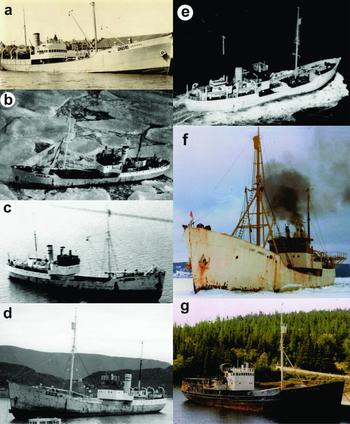
Early in 1931, two Norwegian businessmen, Willi Gørrisen from Ris in Vestre Aker outside Oslo, and Peter Skarbøvig from Ålesund, ordered the construction of two virtually identical fishing vessels for Storegga Ltd, a company based at Son in the Oslo Fjord (Hansen, Reference Hansen1995; Ottesen, Reference Ottesen2007). These ships, Brategg and Nyegg, were built at the Trondheim Mechanical Workshop in Trondheim. They were 166 feet long and measured 480 gross tons, and had riveted steel cruiser hulls, freezer rooms in their holds and 500 h.p. Atlas diesel engines. Brategg was completed in 1932 and received the fisheries registration number M 299 A, ‘A’ signifying the town of Ålesund (Fig. 1a).
Fig. 1.Photographs of the ship originally named Brategg at various stages (and under various names) during its career. (a) Brategg (fisheries number M 299 A) moored at the quayside in Ålesund, Norway, sometime between 1932 and 1936; (b) Jopeter in pack ice off northeast Greenland, September 1955; (c) Jopeter in August 1956 in Mountnorris Fjord, Traill Island, northeast Greenland, where it had drifted after being abandoned the previous year; (d) Jopeter moored at Ålesund in August 1956 after being towed back to Norway from Greenland; (e) Polarbjørn steaming at full speed for Ålesund in the summer of 1958 after four persons on board had succumbed to carbon monoxide poisoning; (f) Lady Johnson II, probably in Canadian waters and probably in 1975; (g) Arctic Trader, probably in Sheet Harbour, where it sank in 1994. This photograph was taken in 1993 after vandals set fire to the ship's stern. Photography credits: (a, c, d) Ishavsmuseet, Brandal, Norway; (b) Sunnmørposten, Ålesund, Norway; (e) Magnar Aklestad; (f, g) unknown.
1930s
Perhaps in an effort to survive the global economic crisis, Storegga Ltd concentrated on large-scale operations involving vessels capable of fishing distant waters. Brategg fished halibut off the west coast of Greenland and Iceland. The fishing was varied and prices were generally poor. On one voyage to Iceland in 1933 an auxiliary boiler in the engine room exploded. One member of the crew was seriously injured and died in hospital in Vestmannaeyjar a short time later (Ottesen, Reference Ottesen2007).
Brategg continued its fishing expeditions to Iceland until August 1934, after which it was engaged by the Royal Norwegian Navy and served as a coastguard vessel until June 1935 (Ottesen, Reference Ottesen2007).
In 1935, Storegga Ltd was obliged to sell both Brategg and Nyegg. The vessels were bought at auction by two Trondheim banks that had merged following an improvement in the economic outlook. These entered into partnership with Trondheim District Council and the businessman Kaare Bagøien, and the conglomeration founded Trondheim Marine Fishery Ltd. The vessels were considered to be an asset for the commercial life of the city. Brategg received the fisheries registration number ST 12 T (Ottesen, Reference Ottesen2007).
In February 1939 eight Norwegian sealers bound for the sealing ground off Newfoundland were caught in a hurricane southwest of Iceland. Three ships were lost, one with its entire crew of 18 men. Brategg, which was fishing cod off Iceland, received and relayed radio traffic from the stricken vessels to Ålesund Radio in Norway. The Norwegian government subsequently engaged Brategg in the search for survivors (Nordanger, Reference Nordanger1980).
World War II
Brategg was used as a freighter during World War II. It was based at Svolvær in Lofoten, and from there carried fish from Lofoten and the northern counties of Troms and Finnmark to Narvik, probably for onward transport by train through Sweden to Germany. It sailed several times to Hirtshals in Denmark and through the Kiel Canal to Hamburg for the same purpose. Once it was bombed by allied aircraft off the west coast of Norway while sailing with a cargo of timber, but the ship suffered minimal damage.
Brategg was accompanied frequently by its sister ship Nyegg. In 1941 the two vessels raced each other on a voyage north with a cargo of salt. Nyegg ran aground and sank off Eigerøy lighthouse in southwestern Norway (Ottesen, Reference Ottesen2007).
The same year Brategg underwent an extensive refit, which increased its size to ca. 486 tons. It was probably then that it was fitted with an upper bridge and wheelhouses on two levels (A. Brandal, personal communication; Brategg logbook).
Brategg expedition 1947–1948
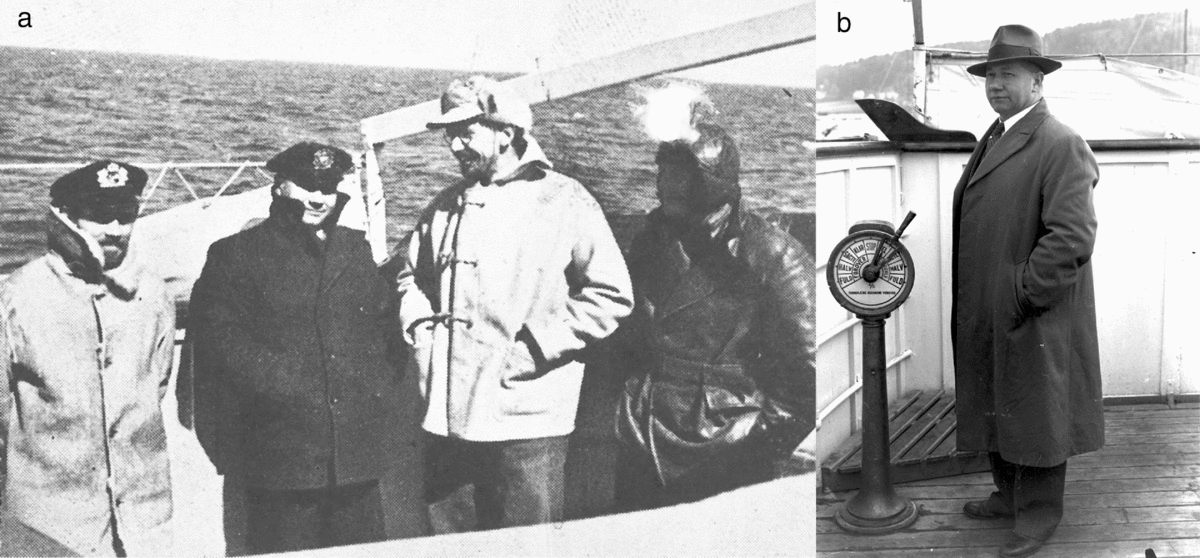
In October 1947 Brategg sailed from Sandefjord to the Pacific sector of Antarctica via Montevideo, the Magellan Straits and Punta Arenas. The chief purpose of the expedition was to find new whaling grounds and, secondarily, to conduct marine research. The expedition was fitted out by the Norwegian Whaling Companies' Association in collaboration with the marine research committee of the Norwegian Geographical Society (Whaling Museum Archive). The scientific director of the expedition was the zoologist and curator Holger Holgersen. The skipper was Nils Larsen from Sandefjord, who had captained the Norwegian vessel Norvegia on three research cruises to Antarctica during 1927–1931 and was subsequently captain of a whaling factory ship (Fig. 2).
Fig. 2.(a) Four members of the ship's company on the upper bridge of Brategg, probably in the Southern Ocean. Left to right: Brede Oluf Nylænder, telegraphist; Captain Nils Larsen; Lars Midttun, oceanographer; unknown. (b) Captain Nils Larsen aboard Brategg in Sandefjord after the return of the Brategg expedition in the spring of 1948. (Copyright Sandefjord Whaling Museum)
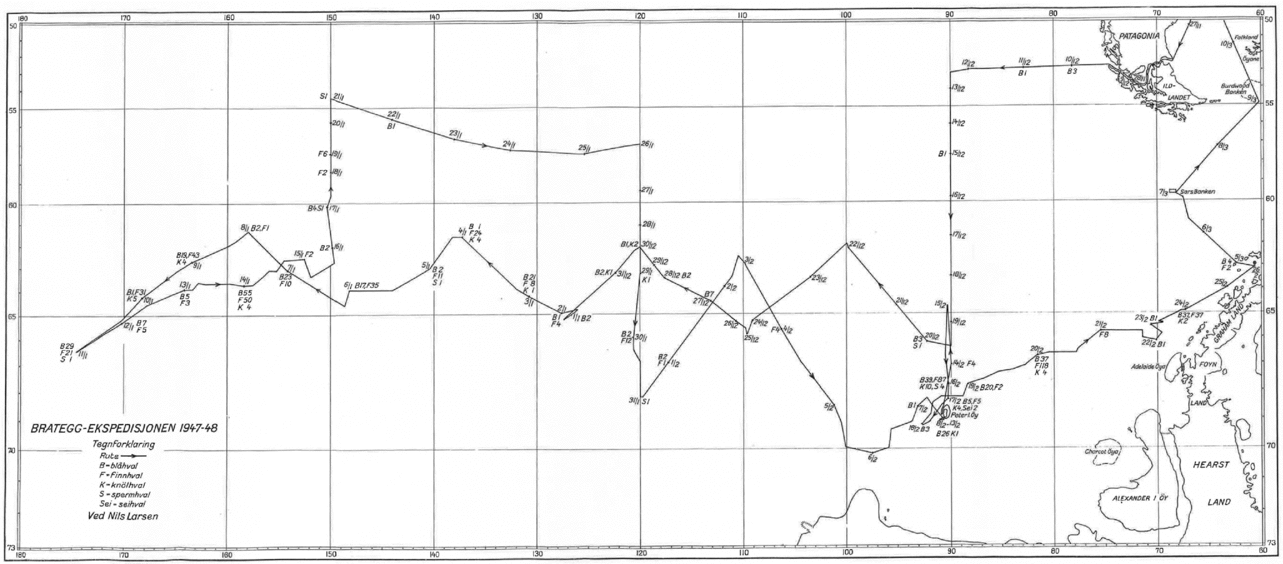
Brategg was not ice-strengthened at that time and its contract specified that it should not force ice. After leaving Punta Arenas it sailed across the Pacific to the 90°W meridian, turned due south and continued almost to Peter I Island before sailing west, zig-zagging between approximately 62 and 66°S, to 174°31′W, 66°36′S, north of the Ross Sea. Here it turned and headed back along a simpler route, which extended north to 54°S and south to 70°S. The purpose of this tortuous route was to ensure that the vessel crossed the Antarctic Convergence (Brategg logbook; Fig. 3).
Fig. 3.Map of Brategg’s voyage in the Southern Ocean in 1947/1948. (Copyright Sandefjord Whaling Museum)
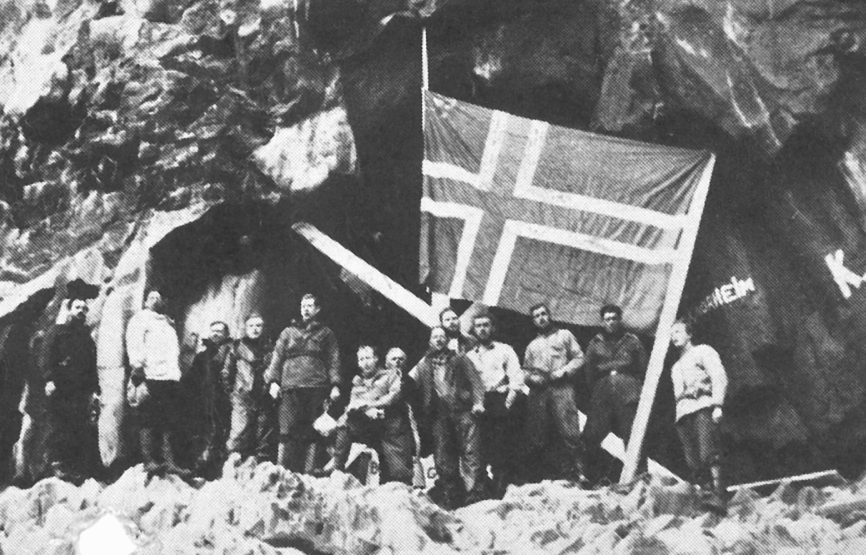
The vessel interrupted its return journey to call at, and assert Norwegian rights to, Peter I Island (Fig. 4). This was the second Norwegian landing on the island. By coincidence, Nils Larsen had been skipper of Norvegia when the island was annexed by Norway in 1929. His second (1948) visit was short-lived because Brategg was nearly trapped by icebergs (Audun Gården, personal communication; Brategg logbook).
Fig. 4.The Brategg expedition on Peter I Island in February 1948. (Copyright Sandefjord Whaling Museum)
Brategg continued east to Deception Island and on the way discovered and charted two submerged ridges. The first, west–northwest of the Antarctic Peninsula, lay at a depth of 300–400 m. The second, at 70°W, 65°S, lay at almost 3000 m and is now known as the Brategg Bank (Magnar Aklestad & Sigvald Brandal, personal communication, 12 May 2001).
At Deception Island the expedition replenished its fresh water supply and inspected the abandoned Norwegian whaling station. Taking advantage of the fine natural harbour, the cargo was reorganised in the hold and oil was pumped from barrels to fuel tanks. Deception was British but Argentina maintained a base there.
On the afternoon of 26 February 1948 an Argentinian naval officer came aboard Brategg from the minesweeper Parker and asked to see the ship's papers, which he found to be in order. The officer wrote the following in Spanish in Brategg's logbook:
26th February 1948, 17.30 hrs, in the Bay of Whales at Deception Island, South Shetland, I boarded the Norwegian merchant vessel Brategg LCOE on the orders of Commander Guillermo Jose Zarrabeitia of the minesweeper Parker. I have inspected the ship's papers concerning the vessel, her cargo and her voyage. I have found them to be in order and have therefore given the captain permission to remain at anchor in the Bay of Whales.
Carlos R. Uhalde, Lieutenant
The text was sealed with the seal of the Parker and with Uhalde's personal seal. Before he left, Uhalde gave orders that in future the captain should go immediately to the Argentinian base and request permission to anchor at Deception Island (Brategg logbook, Larsen (no date, a)). However, three days later, on 29 February, the British harbour master came aboard Brategg and stated that the Norwegians should pay no attention to what the Argentinians had said or written. The following day he came aboard again and requested to see the ship's logbook. He crossed out what Uhalde had written and wrote the following:
This is to certify that the above entry made by an Argentine officer is illegal, these being British territorial waters, and is not [illegible] by the Captain or by the Harbourmaster and Magistrate of Deception Island.
Adrian G. Scadding, Harbourmaster & Magistrate
A Royal Navy vessel appeared and a British officer also came aboard to inspect the ship's papers. He invited the officers of the Brategg to a reception on board the British vessel (Brategg logbook, Larsen (no date, a)).
After this, Brategg fuelled and supplied at Montevideo, before heading directly for Norway in April 1948. On arrival in Sandefjord, Brategg had sailed 27000 nautical miles, including 11000 nautical miles south of 50°S (Brategg logbook).
The expedition made meteorological observations throughout the voyage. These included air pressure, air temperature, humidity, wind, and sea state. Data were telegraphed to Buenos Aires, Falkland, Montevideo, Oslo or Wellington, depending on where Brategg happened to be at the time. Other data included ocean salinity and temperature (measured with a thermosonde), sea depth (measured with sonar), the size, frequency and location of icebergs, and the presence of whales. Plankton samples were collected (Hvalfangst Tidende No. 6/1948).
In 1948 Brategg underwent minor modification at the Framnes Mechanical Workshop in Sandefjord before carrying frozen cargo in European waters and the Mediterranean. It carried meat from Genoa to Haifa and fruit from Tunisia to London (Brategg logbook, 1942–1947, 1948–1949).
Research results from the Brategg expedition
Observations of icebergs were a routine part of navigation and also a part of the scientific programme of the voyage. Ice was recorded by date, position, type and abundance. Observations of icebergs were quantitative up to 200 or 300 icebergs and qualitative thereafter; that is, recorded simply as ‘masses of icebergs’. The largest iceberg observed was ca. 11 km long (Brategg logbook, Larsen (no date, b)).
The sonar equipment did not work well during the expedition and the charting of waters off Peter I Island was cancelled because of drift ice. Nils Larsen, the skipper, wrote to the Norwegian Whaling Companies' Association reporting the problems with sonar and the efforts made to correct resulting mistakes in the data. He emphasised that telegraphist Brede Oluf Nylænder (Fig. 2a) had had very demanding work with sonar (Larsen, no date, c).
On their return to Sandefjord, Larsen told the press that they had discovered no new whaling grounds or places where foraging conditions for whales were particularly good. The Antarctic Convergence seemed to have moved southwards and there was less snow and ice on Peter I Island compared with observations made in the same season during the Norvegia expedition of 1929.
Arne Foldvik, Professor of Oceanography at the University of Bergen, assessed the oceanographic programme of the Brategg expedition as follows:
. . . the oceanographic part of the expedition made no startling discoveries. However, the expedition did clarify important aspects of the way in which the Antarctic Convergence moves in a north-south direction. The expedition contributed to a clearer picture of temperature and circulation conditions in the area. . . .Publication Nr. 20, by Midttun and Natvig [expedition publication No. 20: ‘Pacific Antarctic Waters’]. . .represented a meticulous analysis of observations made by the expedition. The problem with sonar. . .affected quality of data regarding depth observations (A. Foldvik, personal communication, 11 June 2005).
All sightings of whales were recorded. Whenever possible, numbered tags attached to barbed arrows were fired into whales, and these were retrieved when the whales were subsequently killed, providing information about the movement of the animals across the ocean.
Twenty-nine blue whales, 21 fin whales and one sperm whale were observed near the expedition's westernmost position (174°51′W, 66°28′S). The animals seemed to be moving in a southeasterly direction. In total, 388 blue whales, 538 fin whales, 43 humpback whales, 10 sperm whales and two sei whales were observed (Brategg logbook).
All material collected by the expedition belonged to the Norwegian Whaling Companies’ Association but its analysis was administered by the Marine Committee of the Norwegian Geographical Society. The work progressed slowly, in part because the analysis of water samples required special facilities. At the end of 1954 the Norwegian Whaling Companies' Association wrote to Professor Haakon Mosby, chairman of the Marine Committee, expressing the hope that the work would be finished soon. Professor Mosby of the Committee and Einar Vangstein of the Association entered into a long correspondence concerning the analysis of material and publication of results. The situation was complicated by the fact that data on the distribution of whales belonged to the member companies of the Association, which, for obvious reasons, required them to be kept secret. Indeed, a 1952 collation of the various universities, research institutions, donors and other stakeholders that would normally expect to receive copies of scientific publications emanating from the expedition itself constituted a booklet of 25 pages. Eventually, the data collected by the expedition appeared in numerous reports published in the 1950s and 1960s by Commander Chr. Christensen's Whaling Museum in Sandefjord (Table 1). The costs of publication were paid by the Association.
Table 1.Some publications from the Brategg expedition of 1947–1948.
Jopeter 1950–1958
In 1949 Brategg was sold to Peter S. Brandal & Co. of Brandal near Ålesund (Ottesen, Reference Ottesen2007). The vessel was converted for service in polar waters at a shipyard in Amsterdam. Its hull was reinforced with many more ribs, making the ship suitable for sealing off Newfoundland (Ottesen, Reference Ottesen2007). It was renamed Jopeter (a combination of Peter – the name of the sealing pioneer Peter S. Brandal – and his wife Josefine; pronounced ‘you-piter’, equivalent, in English, to ‘Jupiter’) and given the fisheries registration number M 31 HD (Fig. 1b).
Jopeter continued carrying frozen cargo but its principal task was the delivery of supplies to Danish stations in East Greenland for the Royal Greenland Trading Company. These voyages generally started in Copenhagen, where, in the early 1950s, a member of the crew was lost while preparing for an expedition to East Greenland (Jopeter logbook; A. Brandal, personal communication).
It became clear during the first sealing trips to Newfoundland that the ship's hull required strengthening. In 1952 a larger main engine, a 1080 h.p. diesel Nohab, was installed. The following year the propeller shaft ruptured during a sealing voyage off Newfoundland (Ottesen, Reference Ottesen2007).
In 1955 Jopeter carried supplies to Danmarkshavn in northeast Greenland. After arrival it was trapped and crushed in ice off the island of Store Koldewey. It lost its propeller, was badly dented and began to take in water (Mikkelsen, Reference Mikkelsen2001). It drifted south with the ice and, lacking a propeller, was unable to manoeuvre. The chief engineer could do little, but with remarkable foresight he drained the cooling fluid from the engines (Åsmund Tangen, personal communication). At this point Jopeter was due east of Bontekoe Island. An American helicopter from Greenland transferred the passengers and some of the crew to the Norwegian ship Tottan, which lay at the ice edge. The Danish vessel Kista Dan pushed into the ice, reached Jopeter, and took off the remaining crew and the skipper, Knut Nakken. However, it did not attempt to pull Jopeter free, for fear of itself becoming trapped (Jarle Sandvik, Idar Kaldhol, Leif Kristian Brandal, personal communications; Mikkelsen, Reference Mikkelsen2001).
The leak was such that Jopeter was expected to sink within a fortnight. The ship was declared wrecked and the insurance was paid (Rettsbok, 1955). In August the following year (1956) an aeroplane from a Danish expedition sighted Jopeter aground on a sandbank in Mountnorris Fjord, Traill Island, in northeast Greenland (Fig. 1c). The Norwegian vessel Polarbjørn (Jopeter’s predecessor in that name), which was in the area, and the Danish patrol vessel Teisten raced to Mountnorris Fjord, each hoping to be first on board and, hence, to claim Jopeter. Teisten arrived first and hoisted the Danish flag. A vigorous dispute over ownership of the vessel ensued. Both the Danes on Teisten and John Giæver (expedition leader) and Henrik Marø (skipper) on Polarbjørn claimed the ship; however, it soon became clear that Jopeter belonged to the insurance company (John Giæver Jr, personal communication).
The Brandal/Karlsen Shipping Company sent Melshorn to inspect Jopeter and, if possible, tow it back to Norway on the instructions of the insurance company. Melshorn carried divers and electricians. Remarkably, Jopeter’s batteries were capable of powering the ship's radio transmitter despite not having been charged for a year. The chief engineer's foresight in draining coolant from the engines had prevented frost damage, and one auxiliary engine, mounted beyond reach of water in the engine room, started after a minimum of preparation and provided power to all the electrical systems on the vessel (Nils Gunnar Pilskog, Åsmund Tangen, Leiv Korshamn, personal communications). A diver made a makeshift repair to the hull and Melshorn and Polarbjørn pulled Jopeter off the bank. It was then towed back to Norway (Fig. 1d), repaired at the Bergen Mechanical Workshop and sold back to Peter S. Brandal & Co. (Det Norske Veritas, 1956; Melshorn logbook). Thereafter, registered as M 88 HD, Jopeter entered the same service as before, with Henrik Marø as skipper (Nils Gunnar Pilskog, Åsmund Tangen, Leiv Korshamn, personal communications).
Polarbjørn 1958–1974
In 1958 the family company Brandal/Karlsen reorganised. Jopeter was transferred to Polarbjørn Ltd and named Polarbjørn (Fig. 1e). (The previous Polarbjørn was wrecked in 1957 so the traditional name was available once more; Ottesen, Reference Ottesen2007).
In the summer of 1958 Polarbjørn set sail from Copenhagen bound for the Danish stations in East Greenland. It carried a cargo of coal and a drum of petrol lashed on deck for an expedition in Scoresby Sound. Polarbjørn had sailed only as far as the coast of Norway when coal in the hold began to smoulder and carbon monoxide gas penetrated the fo'c’sle. The occupants were badly affected and required medical attention urgently. The skipper changed course and headed for Ålesund at full speed. Two passengers and two of the crew, including skipper Henrik Marø’s son, died of carbon monoxide poisoning (Magnar Aklestad, personal communication).
In the southern summer 1958–1959 Polarbjørn sailed to Norway Station in Dronning Maud Land, Antarctica, for the Norwegian Polar Institute. The voyage was part of the International Geophysical Year (IGY) initiative. The ship carried two Single Otter aircraft in crates on deck (Magnar Aklestad, personal communication).
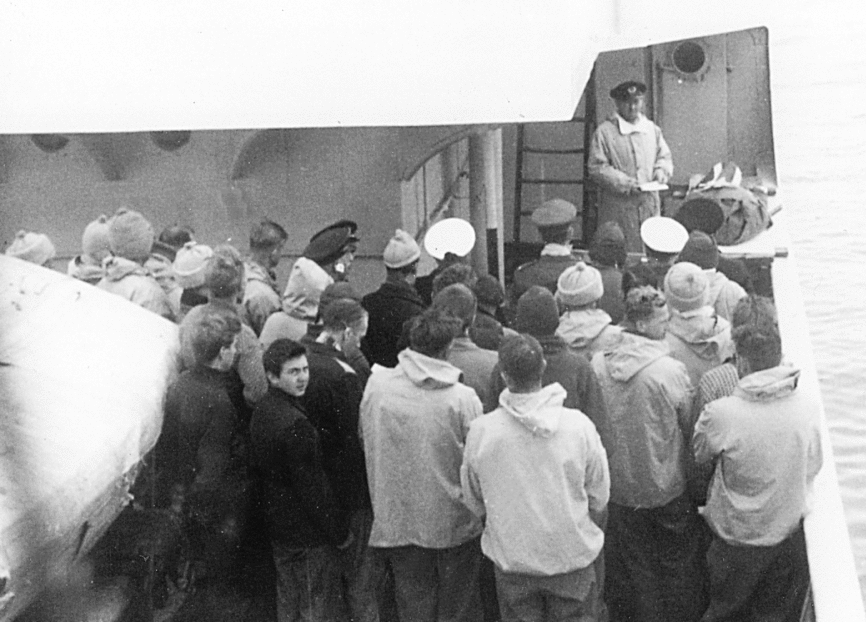
Polarbjørn returned to Antarctica the following year. The voyage was ill-fated. Its purpose was to collect the crew of Norway Station (which was subsequently taken over by South Africa and renamed SANAE). Just a few hours out of Cape Town the steward fell overboard. It was night and the sea was rough. Polarbjørn searched all night, joined the next day by ships and aircraft from South Africa, but the steward was never found. A short time later one of the mates lost his life in an explosion while handling dynamite. Being outside shipping lanes, beyond the range of a helicopter and unable to return to South Africa for repatriation of the deceased (which would have precluded completion of the mission), the man was buried at sea. The burial took place south of Bouvet Island, with Henrik Marø, the skipper, officiating at a simple, dignified ceremony (Fig. 5; Magnar Aklestad, personal communication). Polarbjørn’s misfortune continued after it reached Antarctica. It became trapped in and lifted by ice, such that the water intakes for the main and auxiliary engines were raised out of the water, with the result that the ship lost all power. The Argentine icebreaker San Martin arrived and helped Polarbjørn free of the ice (Magnar Aklestad, personal communication; Polarbjørn logbook).
Fig. 5.Burial at sea from the deck of Polarbjørn, off Bouvet Island, December 1959. Photographer unknown.
Polarbjørn carried South Africans from Cape Town to Norway Station/SANAE and brought home the Norwegian expedition. An official inquiry into the two deaths was held in Cape Town.
Two of the participants in the Norwegian expedition had stayed at Norway Station for more than three consecutive years. Their female partners had received free transport from Norway to Cape Town on board a whaling factory ship. Reunited, the two couples drove home to Norway across Africa and Europe in the Volvo PV 544 car belonging to one of them, which had also been brought to Cape Town free of charge. One of them stated later that he wanted to make the journey all over again (Magnar Aklestad, Ole Christen Røren, personal communications).
From 1960 onwards Polarbjørn was regularly engaged in sealing off Newfoundland. Here, too, the ship was beset by tragedy. A crewman was lost after falling overboard at Cape Farewell on the voyage home in 1962 (Magnar Aklestad, personal communication).
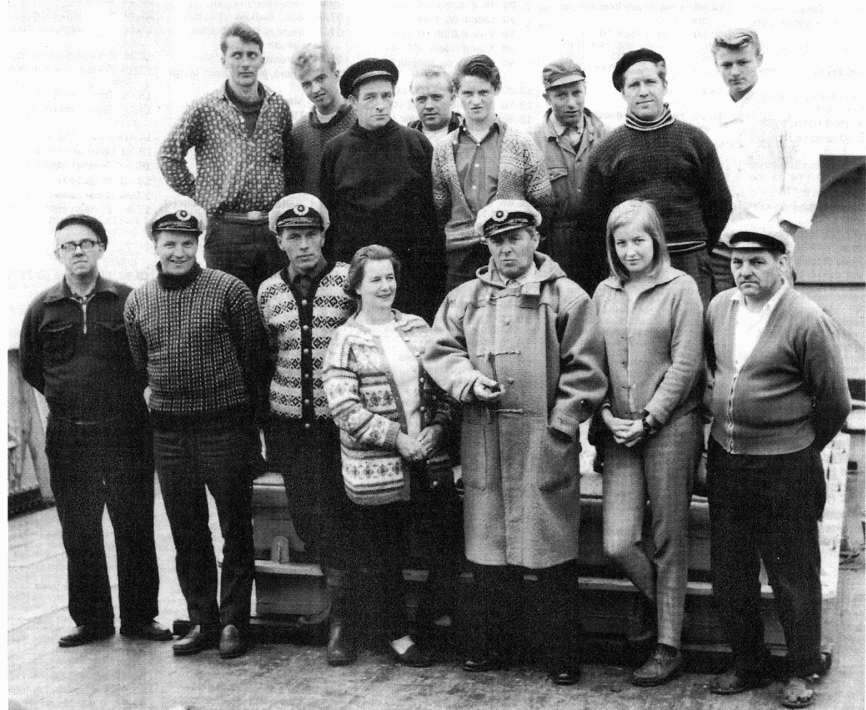
In addition to sealing, Polarbjørn carried supplies to East Greenland for the Danish authorities (Fig. 6), to Jan Mayen for the Norwegian government/NATO, and to international oil companies engaged in exploration in Svalbard (Ottesen, Reference Ottesen2007). In this service it lost a propeller at Tingmiarmiut in southeast Greenland in 1969 (Ole-Christen Røren, personal communication).
Fig. 6.Crew of Polarbjørn prior to departure for East Greenland in 1966. Back row (left to right) Kåre Nils Brandal; Asbjørn Barstad; Leonhard Sulebust, chief engineer; Olav Barstad; Idar Dimmen; Bjarne Hustadnes; Myklebust (first name unknown); Danish cook (name unknown). Front row (left to right) Sigmund J. Brandal, engineer; Magnar Aklestad, mate; Kåre Frøland, mate; Mrs Ellen Marø; Henrik Marø, skipper; Eli Holstad, telegraph operator; Bernt Marø, steward. Photograph: Edvard Hole.
Cargo service to Jan Mayen and Svalbard necessitated fitting lifting gear capable of loading and unloading excavators, bulldozers and heavy vehicles. Once Polarbjørn shipped a bulldozer weighing 11 tons (Magnar Aklestad, Ole-Christen Røren, personal communication). Development of the Norwegian station on Jan Mayen saw Polarbjørn engaged in shuttle service between Jan Mayen and Bodø, sometimes carrying up to forty passengers (Odd Eiken, personal communication; Barr, Reference Barr1991).
Sealing declined during the 1970s, largely as a result of campaigning by animal welfare organisations. At the same time, offshore activity in northern waters increased. Ice-going vessels were required for seismic operations but Polarbjørn was not suitable. In 1974 it was sold to Canada, and was delivered early in the following year (Ottesen, Reference Ottesen2007). The ship's last skipper in Norwegian service was Arne Røbekk (Arne Røbekk, personal communication).
Canada 1975–1994
Polarbjørn was bought first by Johnson Combined Enterprises Ltd (Frederick Morrissey Johnson) in Catalina, Newfoundland. Frederick Morrissey Johnson was a well-known and respected Canadian sealing skipper. He and his father owned the sealing ship Lady Johnson, which was lost in a fire. They renamed Polarbjørn Lady Johnson II (Fig. 1f).
A few years later Johnson Combined Enterprises Ltd bought the Arctic vessel Polarfart from Jan Olsen of Tromsø and renamed it Clayton M. Johnson after Johnson's father (Ulf Snarby, personal communication, 8 October 2006; Ottesen, Reference Ottesen2007). Jan Olsen was the father of J. H. T. Olsen, who was Norwegian Minister of Fisheries in the 1990s.
From 1975 to 1982 Lady Johnson II was frequently joined on the sealing grounds off Newfoundland by sealers of the Brandal/Karlsen fleet, in which it had served both as Jopeter and Polarbjørn. The ship still had the Nohab engine that had been fitted in 1952. Several Norwegian veterans who had served on the ship confirmed that the engine remained in good condition (Ole-Christen Røren, personal communication).
Except for a few trips carrying fish freight from Labrador, Lady Johnson II was largely taken out of service in 1982 following the ban on hunting harp seal pups (white-coats).
Frederick Morrissey Johnson served a term as a member of the Canadian Parliament but also remained active in shipping, aquaculture and offshore activity. He died in Newfoundland in 2003 when the car in which he was a passenger hit a moose (https://en.wikipedia.org/wiki/Morrissey_Johnson).
In 1988 Lady Johnson II was sold to Beothic Fish Processors Ltd (Bruce Davis) of Badger's Quay, Newfoundland and renamed Beothic Endeavour (Ottesen, Reference Ottesen2007). Beothic Endeavour was used in diverse inshore shipping operations in Labrador, the Gulf of St. Lawrence, Hudson's Bay and the islands of the Canadian Arctic archipelago. At one stage it was used for fisheries inspection in the Davis Strait.
Final phase
Early in 1993 Beothic Endeavour was bought by two men, who paid $175000 in cash, which they carried in several shopping bags (Ulf Snarby, personal communication, 8 October 2006).
In the spring of that year the ship appeared in Halifax under the name Arctic Trader (Fig. 1g) and, according to its manifest, was owned by Avalon Seafood Products Ltd of St. John's. Arctic Trader had an unusual crew (Ottesen, Reference Ottesen2007). Subsequently it suffered engine failure and the crew was arrested for smuggling narcotics. The ship's role had been to divert the attention of the authorities from a major transport of drugs. Bruce Davis was questioned by police about the sale of Beothic Endeavour. The sale was legitimate but he regretted it, stating that the hull was in such good condition that it could have lasted many more years (Ulf Snarby, personal communication, 8 October 2006).
In the summer of 1993 Arctic Trader was towed to Sheet Harbour, Nova Scotia, and laid up at a quay. Here its stern was damaged twice by arson attacks. Following the second fire the ship was taken from the quay and moored at a beach nearby before subsequently being sold for scrap. In February 1994 frost damage caused a major leak. Arctic Trader took on water and sank before anyone could do anything about it. The wreck lies in shallow water and is a recognised site for sport diving (http://www.wannadive.net/spot/North_America/Canada/Nova_Scotia/Arctic_Trader_shipwreck/).
Conclusion
The story of Brategg, rich in its diversity, is not unique. Brategg was typical of its time and type. Although built for a purpose, it was not purpose built. It was multifunctional and adaptable, as indeed were the crews who served onboard. Some of the ship's roles, such as line fisher or coastal steamer, were and still are entirely conventional. Others, including service as an expedition ship looking specifically for new whaling grounds, were highly exclusive. Brategg was, in this respect, the vanguard of what was then a great and important industry: deplorable as it seems today, Norwegian Antarctic whaling was highly significant economically, providing work for 7500–10500 Norwegians annually (Knudtzon, 1950, in Kjær, Reference Kjær2016). The story of Brategg across six decades, involving investment and bankruptcy, war, shipwreck, and innovation and renovation in both Arctic and Antarctic waters, although a record of a single vessel, is also a model of the changing times and fortunes of the Norwegian polar fleet as a whole during the twentieth century.






 You have
Access
Introduction
The history of maritime activity in polar regions is highly dynamic. It is the record of the fortunes of men and machines driven before the winds of economic and social change, scientific discovery, technological development and world events. Like any other history, it can be recounted in general or specific terms. Biography is specific: it is the history of (usually) a single individual, and describes and interprets how he or she responded to the circumstances to which he or she was exposed. The history of ships is similar. Some are written about, and therefore best known, in general terms, with the ship being merely an adjunct to greater events. Thus, Vega, for instance, is best known as Nordenskiöld's expedition ship; Terra Nova as Captain Scott's; Krasin as the ship that rescued the crew of Italia. However, all three ships had careers prior to and following the voyage for which each is justly famous. Likewise with Arctic ‘sealers’. None were purely sealers: the season was short, and the ships and their crews served other roles once they were out of the ice. This paper describes marine multitasking of a kind typical of such vessels, following the career of one polar ship across the six decades from its construction to its destruction. The career of the Norwegian ship Brategg is as interesting for its diversity as it is remarkable for its length. It serves as a vehicle to show how economic and political developments both locally and internationally moulded polar ships and polar shipping across the twentieth century, as indeed they continue to do to this day.
Construction in 1932
Somewhat curiously, the Depression years of the 1930s were the heyday of West Greenland fishery and the use, in those cold waters, of vessels up to 6000 tons. Brategg was one of these.
Early in 1931, two Norwegian businessmen, Willi Gørrisen from Ris in Vestre Aker outside Oslo, and Peter Skarbøvig from Ålesund, ordered the construction of two virtually identical fishing vessels for Storegga Ltd, a company based at Son in the Oslo Fjord (Hansen, Reference Hansen1995; Ottesen, Reference Ottesen2007). These ships, Brategg and Nyegg, were built at the Trondheim Mechanical Workshop in Trondheim. They were 166 feet long and measured 480 gross tons, and had riveted steel cruiser hulls, freezer rooms in their holds and 500 h.p. Atlas diesel engines. Brategg was completed in 1932 and received the fisheries registration number M 299 A, ‘A’ signifying the town of Ålesund (Fig. 1a).
Photographs of the ship originally named Brategg at various stages (and under various names) during its career. (a) Brategg (fisheries number M 299 A) moored at the quayside in Ålesund, Norway, sometime between 1932 and 1936; (b) Jopeter in pack ice off northeast Greenland, September 1955; (c) Jopeter in August 1956 in Mountnorris Fjord, Traill Island, northeast Greenland, where it had drifted after being abandoned the previous year; (d) Jopeter moored at Ålesund in August 1956 after being towed back to Norway from Greenland; (e) Polarbjørn steaming at full speed for Ålesund in the summer of 1958 after four persons on board had succumbed to carbon monoxide poisoning; (f) Lady Johnson II, probably in Canadian waters and probably in 1975; (g) Arctic Trader, probably in Sheet Harbour, where it sank in 1994. This photograph was taken in 1993 after vandals set fire to the ship's stern. Photography credits: (a, c, d) Ishavsmuseet, Brandal, Norway; (b) Sunnmørposten, Ålesund, Norway; (e) Magnar Aklestad; (f, g) unknown.
1930s
Perhaps in an effort to survive the global economic crisis, Storegga Ltd concentrated on large-scale operations involving vessels capable of fishing distant waters. Brategg fished halibut off the west coast of Greenland and Iceland. The fishing was varied and prices were generally poor. On one voyage to Iceland in 1933 an auxiliary boiler in the engine room exploded. One member of the crew was seriously injured and died in hospital in Vestmannaeyjar a short time later (Ottesen, Reference Ottesen2007).
Brategg continued its fishing expeditions to Iceland until August 1934, after which it was engaged by the Royal Norwegian Navy and served as a coastguard vessel until June 1935 (Ottesen, Reference Ottesen2007).
In 1935, Storegga Ltd was obliged to sell both Brategg and Nyegg. The vessels were bought at auction by two Trondheim banks that had merged following an improvement in the economic outlook. These entered into partnership with Trondheim District Council and the businessman Kaare Bagøien, and the conglomeration founded Trondheim Marine Fishery Ltd. The vessels were considered to be an asset for the commercial life of the city. Brategg received the fisheries registration number ST 12 T (Ottesen, Reference Ottesen2007).
In February 1939 eight Norwegian sealers bound for the sealing ground off Newfoundland were caught in a hurricane southwest of Iceland. Three ships were lost, one with its entire crew of 18 men. Brategg, which was fishing cod off Iceland, received and relayed radio traffic from the stricken vessels to Ålesund Radio in Norway. The Norwegian government subsequently engaged Brategg in the search for survivors (Nordanger, Reference Nordanger1980).
World War II
Brategg was used as a freighter during World War II. It was based at Svolvær in Lofoten, and from there carried fish from Lofoten and the northern counties of Troms and Finnmark to Narvik, probably for onward transport by train through Sweden to Germany. It sailed several times to Hirtshals in Denmark and through the Kiel Canal to Hamburg for the same purpose. Once it was bombed by allied aircraft off the west coast of Norway while sailing with a cargo of timber, but the ship suffered minimal damage.
Brategg was accompanied frequently by its sister ship Nyegg. In 1941 the two vessels raced each other on a voyage north with a cargo of salt. Nyegg ran aground and sank off Eigerøy lighthouse in southwestern Norway (Ottesen, Reference Ottesen2007).
The same year Brategg underwent an extensive refit, which increased its size to ca. 486 tons. It was probably then that it was fitted with an upper bridge and wheelhouses on two levels (A. Brandal, personal communication; Brategg logbook).
Brategg expedition 1947–1948
In October 1947 Brategg sailed from Sandefjord to the Pacific sector of Antarctica via Montevideo, the Magellan Straits and Punta Arenas. The chief purpose of the expedition was to find new whaling grounds and, secondarily, to conduct marine research. The expedition was fitted out by the Norwegian Whaling Companies' Association in collaboration with the marine research committee of the Norwegian Geographical Society (Whaling Museum Archive). The scientific director of the expedition was the zoologist and curator Holger Holgersen. The skipper was Nils Larsen from Sandefjord, who had captained the Norwegian vessel Norvegia on three research cruises to Antarctica during 1927–1931 and was subsequently captain of a whaling factory ship (Fig. 2).
(a) Four members of the ship's company on the upper bridge of Brategg, probably in the Southern Ocean. Left to right: Brede Oluf Nylænder, telegraphist; Captain Nils Larsen; Lars Midttun, oceanographer; unknown. (b) Captain Nils Larsen aboard Brategg in Sandefjord after the return of the Brategg expedition in the spring of 1948. (Copyright Sandefjord Whaling Museum)
Brategg was not ice-strengthened at that time and its contract specified that it should not force ice. After leaving Punta Arenas it sailed across the Pacific to the 90°W meridian, turned due south and continued almost to Peter I Island before sailing west, zig-zagging between approximately 62 and 66°S, to 174°31′W, 66°36′S, north of the Ross Sea. Here it turned and headed back along a simpler route, which extended north to 54°S and south to 70°S. The purpose of this tortuous route was to ensure that the vessel crossed the Antarctic Convergence (Brategg logbook; Fig. 3).
Map of Brategg’s voyage in the Southern Ocean in 1947/1948. (Copyright Sandefjord Whaling Museum)
The vessel interrupted its return journey to call at, and assert Norwegian rights to, Peter I Island (Fig. 4). This was the second Norwegian landing on the island. By coincidence, Nils Larsen had been skipper of Norvegia when the island was annexed by Norway in 1929. His second (1948) visit was short-lived because Brategg was nearly trapped by icebergs (Audun Gården, personal communication; Brategg logbook).
The Brategg expedition on Peter I Island in February 1948. (Copyright Sandefjord Whaling Museum)
Brategg continued east to Deception Island and on the way discovered and charted two submerged ridges. The first, west–northwest of the Antarctic Peninsula, lay at a depth of 300–400 m. The second, at 70°W, 65°S, lay at almost 3000 m and is now known as the Brategg Bank (Magnar Aklestad & Sigvald Brandal, personal communication, 12 May 2001).
At Deception Island the expedition replenished its fresh water supply and inspected the abandoned Norwegian whaling station. Taking advantage of the fine natural harbour, the cargo was reorganised in the hold and oil was pumped from barrels to fuel tanks. Deception was British but Argentina maintained a base there.
On the afternoon of 26 February 1948 an Argentinian naval officer came aboard Brategg from the minesweeper Parker and asked to see the ship's papers, which he found to be in order. The officer wrote the following in Spanish in Brategg's logbook:
26th February 1948, 17.30 hrs, in the Bay of Whales at Deception Island, South Shetland, I boarded the Norwegian merchant vessel Brategg LCOE on the orders of Commander Guillermo Jose Zarrabeitia of the minesweeper Parker. I have inspected the ship's papers concerning the vessel, her cargo and her voyage. I have found them to be in order and have therefore given the captain permission to remain at anchor in the Bay of Whales.
Carlos R. Uhalde, Lieutenant
The text was sealed with the seal of the Parker and with Uhalde's personal seal. Before he left, Uhalde gave orders that in future the captain should go immediately to the Argentinian base and request permission to anchor at Deception Island (Brategg logbook, Larsen (no date, a)). However, three days later, on 29 February, the British harbour master came aboard Brategg and stated that the Norwegians should pay no attention to what the Argentinians had said or written. The following day he came aboard again and requested to see the ship's logbook. He crossed out what Uhalde had written and wrote the following:
This is to certify that the above entry made by an Argentine officer is illegal, these being British territorial waters, and is not [illegible] by the Captain or by the Harbourmaster and Magistrate of Deception Island.
Adrian G. Scadding, Harbourmaster & Magistrate
A Royal Navy vessel appeared and a British officer also came aboard to inspect the ship's papers. He invited the officers of the Brategg to a reception on board the British vessel (Brategg logbook, Larsen (no date, a)).
After this, Brategg fuelled and supplied at Montevideo, before heading directly for Norway in April 1948. On arrival in Sandefjord, Brategg had sailed 27000 nautical miles, including 11000 nautical miles south of 50°S (Brategg logbook).
The expedition made meteorological observations throughout the voyage. These included air pressure, air temperature, humidity, wind, and sea state. Data were telegraphed to Buenos Aires, Falkland, Montevideo, Oslo or Wellington, depending on where Brategg happened to be at the time. Other data included ocean salinity and temperature (measured with a thermosonde), sea depth (measured with sonar), the size, frequency and location of icebergs, and the presence of whales. Plankton samples were collected (Hvalfangst Tidende No. 6/1948).
In 1948 Brategg underwent minor modification at the Framnes Mechanical Workshop in Sandefjord before carrying frozen cargo in European waters and the Mediterranean. It carried meat from Genoa to Haifa and fruit from Tunisia to London (Brategg logbook, 1942–1947, 1948–1949).
Research results from the Brategg expedition
Observations of icebergs were a routine part of navigation and also a part of the scientific programme of the voyage. Ice was recorded by date, position, type and abundance. Observations of icebergs were quantitative up to 200 or 300 icebergs and qualitative thereafter; that is, recorded simply as ‘masses of icebergs’. The largest iceberg observed was ca. 11 km long (Brategg logbook, Larsen (no date, b)).
The sonar equipment did not work well during the expedition and the charting of waters off Peter I Island was cancelled because of drift ice. Nils Larsen, the skipper, wrote to the Norwegian Whaling Companies' Association reporting the problems with sonar and the efforts made to correct resulting mistakes in the data. He emphasised that telegraphist Brede Oluf Nylænder (Fig. 2a) had had very demanding work with sonar (Larsen, no date, c).
On their return to Sandefjord, Larsen told the press that they had discovered no new whaling grounds or places where foraging conditions for whales were particularly good. The Antarctic Convergence seemed to have moved southwards and there was less snow and ice on Peter I Island compared with observations made in the same season during the Norvegia expedition of 1929.
Arne Foldvik, Professor of Oceanography at the University of Bergen, assessed the oceanographic programme of the Brategg expedition as follows:
. . . the oceanographic part of the expedition made no startling discoveries. However, the expedition did clarify important aspects of the way in which the Antarctic Convergence moves in a north-south direction. The expedition contributed to a clearer picture of temperature and circulation conditions in the area. . . .Publication Nr. 20, by Midttun and Natvig [expedition publication No. 20: ‘Pacific Antarctic Waters’]. . .represented a meticulous analysis of observations made by the expedition. The problem with sonar. . .affected quality of data regarding depth observations (A. Foldvik, personal communication, 11 June 2005).
All sightings of whales were recorded. Whenever possible, numbered tags attached to barbed arrows were fired into whales, and these were retrieved when the whales were subsequently killed, providing information about the movement of the animals across the ocean.
Twenty-nine blue whales, 21 fin whales and one sperm whale were observed near the expedition's westernmost position (174°51′W, 66°28′S). The animals seemed to be moving in a southeasterly direction. In total, 388 blue whales, 538 fin whales, 43 humpback whales, 10 sperm whales and two sei whales were observed (Brategg logbook).
All material collected by the expedition belonged to the Norwegian Whaling Companies’ Association but its analysis was administered by the Marine Committee of the Norwegian Geographical Society. The work progressed slowly, in part because the analysis of water samples required special facilities. At the end of 1954 the Norwegian Whaling Companies' Association wrote to Professor Haakon Mosby, chairman of the Marine Committee, expressing the hope that the work would be finished soon. Professor Mosby of the Committee and Einar Vangstein of the Association entered into a long correspondence concerning the analysis of material and publication of results. The situation was complicated by the fact that data on the distribution of whales belonged to the member companies of the Association, which, for obvious reasons, required them to be kept secret. Indeed, a 1952 collation of the various universities, research institutions, donors and other stakeholders that would normally expect to receive copies of scientific publications emanating from the expedition itself constituted a booklet of 25 pages. Eventually, the data collected by the expedition appeared in numerous reports published in the 1950s and 1960s by Commander Chr. Christensen's Whaling Museum in Sandefjord (Table 1). The costs of publication were paid by the Association.
Some publications from the Brategg expedition of 1947–1948.
Jopeter 1950–1958
In 1949 Brategg was sold to Peter S. Brandal & Co. of Brandal near Ålesund (Ottesen, Reference Ottesen2007). The vessel was converted for service in polar waters at a shipyard in Amsterdam. Its hull was reinforced with many more ribs, making the ship suitable for sealing off Newfoundland (Ottesen, Reference Ottesen2007). It was renamed Jopeter (a combination of Peter – the name of the sealing pioneer Peter S. Brandal – and his wife Josefine; pronounced ‘you-piter’, equivalent, in English, to ‘Jupiter’) and given the fisheries registration number M 31 HD (Fig. 1b).
Jopeter continued carrying frozen cargo but its principal task was the delivery of supplies to Danish stations in East Greenland for the Royal Greenland Trading Company. These voyages generally started in Copenhagen, where, in the early 1950s, a member of the crew was lost while preparing for an expedition to East Greenland (Jopeter logbook; A. Brandal, personal communication).
It became clear during the first sealing trips to Newfoundland that the ship's hull required strengthening. In 1952 a larger main engine, a 1080 h.p. diesel Nohab, was installed. The following year the propeller shaft ruptured during a sealing voyage off Newfoundland (Ottesen, Reference Ottesen2007).
In 1955 Jopeter carried supplies to Danmarkshavn in northeast Greenland. After arrival it was trapped and crushed in ice off the island of Store Koldewey. It lost its propeller, was badly dented and began to take in water (Mikkelsen, Reference Mikkelsen2001). It drifted south with the ice and, lacking a propeller, was unable to manoeuvre. The chief engineer could do little, but with remarkable foresight he drained the cooling fluid from the engines (Åsmund Tangen, personal communication). At this point Jopeter was due east of Bontekoe Island. An American helicopter from Greenland transferred the passengers and some of the crew to the Norwegian ship Tottan, which lay at the ice edge. The Danish vessel Kista Dan pushed into the ice, reached Jopeter, and took off the remaining crew and the skipper, Knut Nakken. However, it did not attempt to pull Jopeter free, for fear of itself becoming trapped (Jarle Sandvik, Idar Kaldhol, Leif Kristian Brandal, personal communications; Mikkelsen, Reference Mikkelsen2001).
The leak was such that Jopeter was expected to sink within a fortnight. The ship was declared wrecked and the insurance was paid (Rettsbok, 1955). In August the following year (1956) an aeroplane from a Danish expedition sighted Jopeter aground on a sandbank in Mountnorris Fjord, Traill Island, in northeast Greenland (Fig. 1c). The Norwegian vessel Polarbjørn (Jopeter’s predecessor in that name), which was in the area, and the Danish patrol vessel Teisten raced to Mountnorris Fjord, each hoping to be first on board and, hence, to claim Jopeter. Teisten arrived first and hoisted the Danish flag. A vigorous dispute over ownership of the vessel ensued. Both the Danes on Teisten and John Giæver (expedition leader) and Henrik Marø (skipper) on Polarbjørn claimed the ship; however, it soon became clear that Jopeter belonged to the insurance company (John Giæver Jr, personal communication).
The Brandal/Karlsen Shipping Company sent Melshorn to inspect Jopeter and, if possible, tow it back to Norway on the instructions of the insurance company. Melshorn carried divers and electricians. Remarkably, Jopeter’s batteries were capable of powering the ship's radio transmitter despite not having been charged for a year. The chief engineer's foresight in draining coolant from the engines had prevented frost damage, and one auxiliary engine, mounted beyond reach of water in the engine room, started after a minimum of preparation and provided power to all the electrical systems on the vessel (Nils Gunnar Pilskog, Åsmund Tangen, Leiv Korshamn, personal communications). A diver made a makeshift repair to the hull and Melshorn and Polarbjørn pulled Jopeter off the bank. It was then towed back to Norway (Fig. 1d), repaired at the Bergen Mechanical Workshop and sold back to Peter S. Brandal & Co. (Det Norske Veritas, 1956; Melshorn logbook). Thereafter, registered as M 88 HD, Jopeter entered the same service as before, with Henrik Marø as skipper (Nils Gunnar Pilskog, Åsmund Tangen, Leiv Korshamn, personal communications).
Polarbjørn 1958–1974
In 1958 the family company Brandal/Karlsen reorganised. Jopeter was transferred to Polarbjørn Ltd and named Polarbjørn (Fig. 1e). (The previous Polarbjørn was wrecked in 1957 so the traditional name was available once more; Ottesen, Reference Ottesen2007).
In the summer of 1958 Polarbjørn set sail from Copenhagen bound for the Danish stations in East Greenland. It carried a cargo of coal and a drum of petrol lashed on deck for an expedition in Scoresby Sound. Polarbjørn had sailed only as far as the coast of Norway when coal in the hold began to smoulder and carbon monoxide gas penetrated the fo'c’sle. The occupants were badly affected and required medical attention urgently. The skipper changed course and headed for Ålesund at full speed. Two passengers and two of the crew, including skipper Henrik Marø’s son, died of carbon monoxide poisoning (Magnar Aklestad, personal communication).
In the southern summer 1958–1959 Polarbjørn sailed to Norway Station in Dronning Maud Land, Antarctica, for the Norwegian Polar Institute. The voyage was part of the International Geophysical Year (IGY) initiative. The ship carried two Single Otter aircraft in crates on deck (Magnar Aklestad, personal communication).
Polarbjørn returned to Antarctica the following year. The voyage was ill-fated. Its purpose was to collect the crew of Norway Station (which was subsequently taken over by South Africa and renamed SANAE). Just a few hours out of Cape Town the steward fell overboard. It was night and the sea was rough. Polarbjørn searched all night, joined the next day by ships and aircraft from South Africa, but the steward was never found. A short time later one of the mates lost his life in an explosion while handling dynamite. Being outside shipping lanes, beyond the range of a helicopter and unable to return to South Africa for repatriation of the deceased (which would have precluded completion of the mission), the man was buried at sea. The burial took place south of Bouvet Island, with Henrik Marø, the skipper, officiating at a simple, dignified ceremony (Fig. 5; Magnar Aklestad, personal communication). Polarbjørn’s misfortune continued after it reached Antarctica. It became trapped in and lifted by ice, such that the water intakes for the main and auxiliary engines were raised out of the water, with the result that the ship lost all power. The Argentine icebreaker San Martin arrived and helped Polarbjørn free of the ice (Magnar Aklestad, personal communication; Polarbjørn logbook).
Burial at sea from the deck of Polarbjørn, off Bouvet Island, December 1959. Photographer unknown.
Polarbjørn carried South Africans from Cape Town to Norway Station/SANAE and brought home the Norwegian expedition. An official inquiry into the two deaths was held in Cape Town.
Two of the participants in the Norwegian expedition had stayed at Norway Station for more than three consecutive years. Their female partners had received free transport from Norway to Cape Town on board a whaling factory ship. Reunited, the two couples drove home to Norway across Africa and Europe in the Volvo PV 544 car belonging to one of them, which had also been brought to Cape Town free of charge. One of them stated later that he wanted to make the journey all over again (Magnar Aklestad, Ole Christen Røren, personal communications).
From 1960 onwards Polarbjørn was regularly engaged in sealing off Newfoundland. Here, too, the ship was beset by tragedy. A crewman was lost after falling overboard at Cape Farewell on the voyage home in 1962 (Magnar Aklestad, personal communication).
In addition to sealing, Polarbjørn carried supplies to East Greenland for the Danish authorities (Fig. 6), to Jan Mayen for the Norwegian government/NATO, and to international oil companies engaged in exploration in Svalbard (Ottesen, Reference Ottesen2007). In this service it lost a propeller at Tingmiarmiut in southeast Greenland in 1969 (Ole-Christen Røren, personal communication).
Crew of Polarbjørn prior to departure for East Greenland in 1966. Back row (left to right) Kåre Nils Brandal; Asbjørn Barstad; Leonhard Sulebust, chief engineer; Olav Barstad; Idar Dimmen; Bjarne Hustadnes; Myklebust (first name unknown); Danish cook (name unknown). Front row (left to right) Sigmund J. Brandal, engineer; Magnar Aklestad, mate; Kåre Frøland, mate; Mrs Ellen Marø; Henrik Marø, skipper; Eli Holstad, telegraph operator; Bernt Marø, steward. Photograph: Edvard Hole.
Cargo service to Jan Mayen and Svalbard necessitated fitting lifting gear capable of loading and unloading excavators, bulldozers and heavy vehicles. Once Polarbjørn shipped a bulldozer weighing 11 tons (Magnar Aklestad, Ole-Christen Røren, personal communication). Development of the Norwegian station on Jan Mayen saw Polarbjørn engaged in shuttle service between Jan Mayen and Bodø, sometimes carrying up to forty passengers (Odd Eiken, personal communication; Barr, Reference Barr1991).
Sealing declined during the 1970s, largely as a result of campaigning by animal welfare organisations. At the same time, offshore activity in northern waters increased. Ice-going vessels were required for seismic operations but Polarbjørn was not suitable. In 1974 it was sold to Canada, and was delivered early in the following year (Ottesen, Reference Ottesen2007). The ship's last skipper in Norwegian service was Arne Røbekk (Arne Røbekk, personal communication).
Canada 1975–1994
Polarbjørn was bought first by Johnson Combined Enterprises Ltd (Frederick Morrissey Johnson) in Catalina, Newfoundland. Frederick Morrissey Johnson was a well-known and respected Canadian sealing skipper. He and his father owned the sealing ship Lady Johnson, which was lost in a fire. They renamed Polarbjørn Lady Johnson II (Fig. 1f).
A few years later Johnson Combined Enterprises Ltd bought the Arctic vessel Polarfart from Jan Olsen of Tromsø and renamed it Clayton M. Johnson after Johnson's father (Ulf Snarby, personal communication, 8 October 2006; Ottesen, Reference Ottesen2007). Jan Olsen was the father of J. H. T. Olsen, who was Norwegian Minister of Fisheries in the 1990s.
From 1975 to 1982 Lady Johnson II was frequently joined on the sealing grounds off Newfoundland by sealers of the Brandal/Karlsen fleet, in which it had served both as Jopeter and Polarbjørn. The ship still had the Nohab engine that had been fitted in 1952. Several Norwegian veterans who had served on the ship confirmed that the engine remained in good condition (Ole-Christen Røren, personal communication).
Except for a few trips carrying fish freight from Labrador, Lady Johnson II was largely taken out of service in 1982 following the ban on hunting harp seal pups (white-coats).
Frederick Morrissey Johnson served a term as a member of the Canadian Parliament but also remained active in shipping, aquaculture and offshore activity. He died in Newfoundland in 2003 when the car in which he was a passenger hit a moose (https://en.wikipedia.org/wiki/Morrissey_Johnson).
In 1988 Lady Johnson II was sold to Beothic Fish Processors Ltd (Bruce Davis) of Badger's Quay, Newfoundland and renamed Beothic Endeavour (Ottesen, Reference Ottesen2007). Beothic Endeavour was used in diverse inshore shipping operations in Labrador, the Gulf of St. Lawrence, Hudson's Bay and the islands of the Canadian Arctic archipelago. At one stage it was used for fisheries inspection in the Davis Strait.
Final phase
Early in 1993 Beothic Endeavour was bought by two men, who paid $175000 in cash, which they carried in several shopping bags (Ulf Snarby, personal communication, 8 October 2006).
In the spring of that year the ship appeared in Halifax under the name Arctic Trader (Fig. 1g) and, according to its manifest, was owned by Avalon Seafood Products Ltd of St. John's. Arctic Trader had an unusual crew (Ottesen, Reference Ottesen2007). Subsequently it suffered engine failure and the crew was arrested for smuggling narcotics. The ship's role had been to divert the attention of the authorities from a major transport of drugs. Bruce Davis was questioned by police about the sale of Beothic Endeavour. The sale was legitimate but he regretted it, stating that the hull was in such good condition that it could have lasted many more years (Ulf Snarby, personal communication, 8 October 2006).
In the summer of 1993 Arctic Trader was towed to Sheet Harbour, Nova Scotia, and laid up at a quay. Here its stern was damaged twice by arson attacks. Following the second fire the ship was taken from the quay and moored at a beach nearby before subsequently being sold for scrap. In February 1994 frost damage caused a major leak. Arctic Trader took on water and sank before anyone could do anything about it. The wreck lies in shallow water and is a recognised site for sport diving (http://www.wannadive.net/spot/North_America/Canada/Nova_Scotia/Arctic_Trader_shipwreck/).
Conclusion
The story of Brategg, rich in its diversity, is not unique. Brategg was typical of its time and type. Although built for a purpose, it was not purpose built. It was multifunctional and adaptable, as indeed were the crews who served onboard. Some of the ship's roles, such as line fisher or coastal steamer, were and still are entirely conventional. Others, including service as an expedition ship looking specifically for new whaling grounds, were highly exclusive. Brategg was, in this respect, the vanguard of what was then a great and important industry: deplorable as it seems today, Norwegian Antarctic whaling was highly significant economically, providing work for 7500–10500 Norwegians annually (Knudtzon, 1950, in Kjær, Reference Kjær2016). The story of Brategg across six decades, involving investment and bankruptcy, war, shipwreck, and innovation and renovation in both Arctic and Antarctic waters, although a record of a single vessel, is also a model of the changing times and fortunes of the Norwegian polar fleet as a whole during the twentieth century.
Acknowledgements
I would like to thank the following for assistance, advice and encouragement during preparation of this paper: Magnar Aklestad, Johannes Bjarne Alme, Arnljot Brandal, Leif Kristian Brandal, Sigvald Brandal, Dag Børresen, Odd Eiken, Arne Foldvik, John Giæver Jr, Audun Gården, Sigurd G. Helle, Erik Haakonsholm, Idar Kaldhol, Kjell-G. Kjær, Leiv Korshamn, Henrik Landmark, Webjørn Landmark, Henrik Marø, Johan Olsen Jr, Nils Gunnar Pilskog, Arne Røbekk, Ole-Christen Røren, Jarle Sandvik, Ulf Snarby, Åsmund Tangen, Øyvind Thuresson, Nicholas Tyler and the staff of the library of the Norwegian Maritime Museum.