I. INTRODUCTION
Analysis of the determinants of consumption registered enormous development in the United States during the 1940s and 1950s in a process characterized by close relations between the findings of empirical studies and the theoretical explanations put forward to account for them. The investigation of consumption thus underwent a radical change in direction that was to mark its future course. The principles deriving from the Institutionalist tradition, which attained their greatest popularity in Duesenberry’s formulation, were rapidly abandoned after this debate.
Our purpose here is to examine this turning point by comparing the relative income hypothesis of J. Duesenberry and the permanent income hypothesis of M. Friedman. This will also allow us to identify a feature of Duesenberry’s analysis—its heterogeneity—which must be taken into consideration by those seeking a return to the Institutionalist principles in the analysis of aggregate consumption.
II. THE GENERAL CONTEXT OF THE DEBATE AND THE EMPIRICAL QUESTION
Analysis of the determinants of consumption was an extremely fertile field of research, especially in the United States,Footnote 1 as from the end of the nineteenth century, when it developed out of investigations into poverty based on the study of household budgets.
The publication of Keynes’ General Theory marked a crucial stage in empirical studies into consumption. As shown by Thomas (Reference Thomas1989), many applied economists and statisticians who had previously carried out empirical investigations of family budgets now entered the debate on consumption in an effort to estimate the aggregate consumption function. A considerable number of these analyses display links with the tradition of studies into family budgets and a sociological approach. Thomas describes these studies as “both much richer, in terms of the insights into consumers’ behaviour it produced, and superior econometrically to much of the work that followed” (Thomas Reference Thomas1989, p. 145).
Moreover, aggregate data lending themselves to estimation of the macroeconomic consumption function began to become available to economists halfway through the 1940s, when the US Department of Commerce published the yearly figures of national accounting for the period from 1923 to 1940. This led many economists to undertake economic estimates of consumption functions, and, as Thomas notes, “the standard of the econometric work declined” (1989, p. 145).
In these works, Keynes’ contribution was reduced to the so-called Absolute Income Hypothesis and represented with the ‘Keynesian consumption function’: aggregate expenditure on consumption is a function of the level of income, with the positive marginal propensity to consume less than 1 and the average propensity to consume inversely proportional to the level of income.Footnote 2
Debate came to focus in the second half of the 1940s on the interpretation of an evident contradiction, both between the results of the various empirical studies and between some of them and Keynes’ theory of consumption.
Many empirical works estimated Keynesian consumption functionsFootnote 3 in which the proportion of income consumed decreased as the level of income increased. These works can be divided, from the statistical viewpoint, into two groups, one based on cross-section data for different units (households or countries) at the same point in time, and the other on data regarding the aggregate consumption of a country in different periods. Due to the limited availability of data, the time series on which the latter were thus based were restricted to short periods (ten or twelve years at most). The cross-sectional studies led to different estimates of the level of the consumption function and the marginal propensity to consume for different social groups or countries.
As from the work of Kuznets (Reference Kuznets1942), however, works based on considerably longer time seriesFootnote 4 showed a constant relationship between consumption and income, a function with average and marginal propensity that thus proved equal.
These conflicting empirical results were generally interpreted with the view that the cross-sectional studies and those based on short time series pinpointed the short-period aspects of the relationship between consumption and level of income, whereas those based on long time series pinpointed the long-period relationship between income and consumption. Variations in consumption would thus be less than proportional with respect to cyclical variations in income but proportional with respect to variations in income due to long-period growth.
This view emerged in overall terms in the debate that began with a work by P. Samuelson in 1943 and developed in 1945 and 1946 through economic forecasts for the post-war period with the contributions of Smithies (Reference Smithies1945), Woytinsky (Reference Woytinsky1946), and Bennion (Reference Bennion1946).Footnote 5
A turning point in American economic analysis can be identified in the debate on interpretation of these empirical results, whereby a set of principles deriving from the Institutionalist analyses of the early decades of the twentieth century and widely used in empirical analyses gradually gave way to the entire set of microeconomic marginalist principles.
This shift is examined with reference to two authors, whose work proves particularly conducive, for different reasons, to the identification of some key points in the process.
Many of the above-mentioned empirical works—and a few others of later years, such as Modigliani (Reference Modigliani1949), and Brady and Friedman (Reference Brady and Friedman1947)Footnote 6—used principles deriving from the Institutionalist analyses. It is, however, in Duesenberry’s analysis that we find the only complete theoretical justification of the use of these Institutionalist principles as an explanation of the empirical question.
On the other hand, most of the critical considerations to be developed here on Friedman’s analysis could be formulated equally well with respect to the Modigliani and Brumberg life-cycle hypothesis, which was immediately perceived as essentially equivalent to the permanent income hypothesis in both theoretical and empirical terms. The decision to consider Friedman’s analysis was based on two major considerations.
First, Friedman’s book presents an explicit comparison with Duesenberry’s hypothesis from both the theoretical and the empirical standpoints. Friedman acknowledges the equivalence of the hypotheses as regards empirical performance, as we shall see, but also pinpoints a radical difference between them in theoretical terms, and asserts the superiority of his approach on the grounds of internal coherence. Modigliani and Brumberg, instead, confine themselves to pointing out a general difference between their hypothesis and Duesenberry’s, develop no direct comparisons, and have no “wish to deny that the earlier explanation may have some validity” (Modigliani and Brumberg 1952, p. 424; see Mason Reference Mason2000). Second, unlike Modigliani and Brumberg, Friedman develops both cross-section and time series analyses, and extends his theoretical explanation to the whole set of possible empirical results. Consideration of his analysis thus permits more complete comparison with the alternative explanations of the same set of empirical results. By comparing Duesenberry and Friedman, we are, therefore, able to reduce this complex debate to the juxtaposition of two different approaches.
III. DUESENBERRY: THE SOCIAL SIGNIFICANCE OF CONSUMPTION EXPENDITURE
Duesenberry combined principles drawn from the American Institutionalist analyses and the marginalist analysis of consumption. While successful in spreading the Institutionalist ideas on consumption among economists throughout the world, this synthesis proved essentially unstable, as we shall demonstrate, and generated an internal contradiction in the theory, which repays critical attention.
According to Duesenberry (Reference Duesenberry1949, p. 19), “A real understanding of the problem of consumer behaviour must begin with a full recognition of the social character of consumption patterns.” Individuals determine their expenditure on consumption through reference to various standards arranged in a socially recognized hierarchy. Higher consumption standards generally mean higher spending.
Income is the yardstick of an individual’s success and status in the developed societies. Enjoying a particular degree of social status entails behavior typical of the members of the group in question. Consumption is the visible element indicating the income, the status, and, ultimately, the success of an individual. All the components of consumption become more or less accentuated in this function, for which Veblen coined the term “conspicuous consumption” in 1899. “[H]igh standards of consumption become established as criteria for high status. Once this has occurred, it becomes difficult for anyone to attain a high status position unless he can maintain a high consumption standard, regardless of any other qualifications he may have” (Duesenberry Reference Duesenberry1949, p. 30).
The lack of strong formal barriers preventing contact between individuals of different social groups leads to a great frequency of what Duesenberry calls invidious comparisons, another expression borrowed from Veblen. Every unfavorable comparison prompts the individual to purchase goods in order to eliminate the source of this particular type of discomfort.
A rising standard of living is an existential objective so widely shared in the advanced societies as to be “incorporated in the ego-ideal.” A certain degree of success in achieving this social aim becomes essential for self-esteem, which is one of the fundamental stimuli prompting individual action.
These principles are the same as those presented in Veblen’s Theory of the Leisure Class (1899),Footnote 7 subsequently developed in many works on consumption, both theoretical and empirical, by American economists in the early decades of the twentieth century.Footnote 8 All those who used these principles can be described as Institutionalists through their connection with Veblen. They were openly critical of the marginalist theory and, in particular, of the idea of marginal utility as a basis for the analysis of consumption choices.Footnote 9
Like the other economists who used the principles of the social significance of consumption in the 1940s, including Samuelson (Reference Samuelson and Harris1943) and Modigliani (Reference Modigliani1949), Duesenberry instead adopted no critical attitude towards the marginalist theories, which indeed had an obvious influence on his and their works.Footnote 10 In particular, Duesenberry put forward a synthesis of these principles and the marginalist theory of intertemporal utility maximisation.
It is very significant that Duesenberry cites none of the authors of the theory of the social significance of consumption. The sole mention of Veblen, in the introduction, is again highly significant:
The interdependence of preference systems has been recognized since the early days of economics. … Writers like Knight and Veblen were engaged in criticism of the neo-classical economics. Veblen attacked analytical economics and tried to substitute for it a historical approach. For the most part his work bears on questions different from those dealt with in analytical economics and, whatever its other merits, throws little light on problems of resource allocation and employment…. Both Veblen and Knight made real contributions to our understanding of consumer behavior problems…. The negative character of their comments on “orthodox” demand theory explains, in large measure, their lack of influence on it. Most people would rather have a bad theory than no theory at all (Duesenberry Reference Duesenberry1949, pp. 14–15).Footnote 11
The Determination of Long-Period Average Propensity to Consume
Duesenberry’s attitude towards marginalist principles and the composite nature of his analysis of consumption manifest themselves primarily in the explanation of the constancy of the propensity to save that emerges from the empirical analyses based on long time series.
Duesenberry argues that the social significance of consumption generates a constant tendency of individuals to increase their consumption, which clashes with the tendency to save. He maintains that each individual balances these two contrasting forces in a process of “rational inter-temporal choice between present and future consumption.” Duesenberry adds to this approach, originally put forward by Fisher (Reference Fisher1903), the assumption that the “choice between present and future consumption will be indirectly affected by the interdependence of desires for current consumption” (Duesenberry Reference Duesenberry1949, p. 33).
The utility of the individual i at the time j is a function of the level of his consumption Cij and the levels of consumption of the other individuals he frequents, concisely represented by the weighted average of the consumption of other individuals:
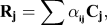
where the weights αij are high for individuals socially close to one another and decrease as the degree of social diversity increases.
Duesenberry gives a very summary description of this process of maximization and its plausible solution.Footnote 12 The primary characteristic deduced is that since the well-being of individuals is determined by the level of their consumption with respect to that of the people they frequent, their consumption expenditure is determined in each case by their relative position on the social ladder, and thus depends on their relative, rather than absolute, income. It is position on the ladder of income distribution that determines the individual’s desired ratio of consumption to income.
Moreover, various social groups—such as black communities with respect to white, rural to non-rural, urban to non-urban, and groups differing in terms of average income or age—tend to consume a specific proportion of their income when sufficiently isolated. The average propensity to consume of the economy as a whole can be seen as a weighted average of the different specific propensities of the different individuals and groups, and, therefore, depends on the factors that determine the individual maximization of intertemporal utility and on the distribution of income between individuals and classes. This average propensity is seen at both the individual and the aggregate levels as a long-period equilibrium value, and is regarded, again at both levels, as independent of the absolute level of income. “(1) The aggregate saving ratio is independent of the absolute level of aggregate income. (2) The aggregate saving ratio is dependent on (a) interest rates, (b) the relation between current and expected future incomes, (c) the distribution of income, (d) the age distribution of the population, (e) the rate of growth of income” (Duesenberry Reference Duesenberry1949, p. 45). Analysis of the available data led Duesenberry to claim that some of these variables, including interest rates, expectations, and preference parameters, underwent considerable variation but exercised a limited influence on saving during the period taken into consideration by Kuznets. Other variables, such as the age distribution of the population and the distribution of income, instead underwent variations that affected the rate of saving, even though they balanced out so as to keep the rate of saving constant.
In this explanation of the constancy of the long-run propensity to save, Duesenberry used a marginalist conceptual framework combined with Institutionalist principles. This synthesis is an original contribution by Duesenberry. As recalled above, the Institutionalist economists who developed the principles of the social relevance of consumption were openly critical of the idea of marginal utility. Veblen (Reference Veblen1909a) considered it too abstract to be a useful guide in interpreting reality, and Veblen (Reference Veblen1909b) contains a radical rejection of the Fisher approach based on the intertemporal maximization of utility. Moreover, all the other economists who developed Veblen’s ideas either criticized marginal utility openly or made no use of it.Footnote 13
Duesenberry’s analysis was also original with respect to marginalist principles. Status motivations for consumption choices had been taken into account since the very beginning of the analyses based on the notion of marginal utility. In a marginalist context, however, any social motivation for consumption choices introduces a dependency of the utility functions of different individuals that clashes with the required independence of the individual demand function. This independence is needed in order to construct aggregate demand functions for goods. This issue already had been addressed in a European debate ignored by Duesenberry,Footnote 14 which was, however, framed in terms of the existence of some goods demanded for reasons of status and the quantitative/logical relevance of these exceptions with respect to the theory.
Duesenberry’s analysis was criticized on this point by authors with different views. While Clower (1952) stated that the interdependence of preferences was not a problem for traditional theory, Pigou (Reference Pigou1951) put forward severe methodological criticisms of Duesenberry’s treatment of the issue.
Different attempts have been made to reconcile the social significance of consumption and the marginalist logical framework since Duesenberry.Footnote 15 The number and the variety of these attempts bear witness to the great difficulty of overcoming the inconsistency between the two sets of principles.
From the viewpoint of this paper, the difficulty of combining these two strands of Duesenberry’s analysis becomes apparent when this long-run analysis is considered in relation to his short-period analysis.
Relative Income and Cross-sectional Studies
Institutionalist principles play a dominant role in explaining the results of cross-sectional studies and studies based on short time series.
According to the relative income hypothesis, all the individuals in a given social group seek at a given moment of time to satisfy a standard level of consumption determined by their status and by comparison with the standard of consumption of those socially close to them. The proportion of income consumed (or saved) depends on relative income, which means the relative position of the subject in the community. Once this standard level has been reached, a higher level of individual income means a larger amount of residual income available for saving and, therefore, a larger proportion of income devoted to saving.
Moreover, the same level of income in a community with a different average income places the individual at a different relative level within that community. The system of consumption standards is, in fact, socially determined, and socially isolated communities with different average incomes can manifest different systems of consumption standards. According to Duesenberry, this explains the differences in estimates of consumption functions, the level of which proved lower for communities with a higher average income than for communities with a lower average income (white communities with respect to black, urban with respect to non-urban, etc.).
Estimates based on cross-section data thus implied both an average propensity to consume that was inversely proportional to the level of income and functions of different levels for different socially isolated communities.
Relative Income and Analyses of Short Time Series
Duesenberry inherited other two principles from the tradition of the American Institutionalists: the irreversibility of expenditure on consumption; and the resulting cyclical asymmetry of consumption, both of which had already been identified in Veblen’s analysis.Footnote 16 Duesenberry reformulates these principles as follows:
The fundamental psychological postulate underling our argument is that it is harder for a family to reduce its expenditure from high level than to a family to refrain from making high expenditures in the first place.… [T]he significant result of this argument is not the conclusion that deficits will occur when income falls below a previously attained level, but the more general proposition that families are willing to sacrifice saving in order to protect their living standard (Duesenberry Reference Duesenberry1949, p. 85).
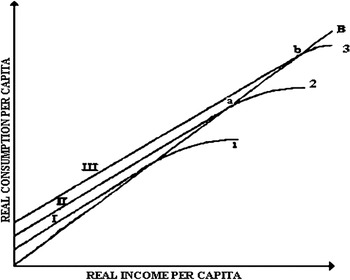
In the event of cyclical reductions of income, individuals tend to maintain standards of consumption enabling them to assert their social status. Saving tends to contract more than proportionally, thus generating an increase in the amount of income consumed. With reference to Duesenberry’s graph, a decrease in income would prompt movement to the left from point a along function II. In this case, saving is regarded as the residue of income once the acquired standard has been met.
At the same time, individuals obtaining an increase in income can easily assume there is a change in their relative position on the ladder of distribution. If they acted on this assumption, consumption would increase less than proportionally, and saving more than proportionally. Again with reference to point a of Figure 1, the economy would move to the right along function 2. II-2 would be valid, therefore, with respect to cyclical variations in income, and describe a Keynesian function with an average propensity to consume inversely proportional to the growth of income. The estimates based on relatively short time series capture this aggregate behavior of the economy.
Short and long period in Duesenberry’s analysis.

If what is happening is a general increase in aggregate income such as to leave the distribution of income substantially unchanged, however, the magnitudes of importance for the individual—relative position as regards the distribution of income and relative level of consumption—will prove unchanged over time. Apart from a short-term effect, the units of consumption in any case involved in a constant process of comparison and imitation will expand consumption proportionally to income, which will thus lead to a proportional increase in consumption with respect to income when the long-period values are re-established for the average propensities to consume and save. Again with reference to Figure 1 and point a, once the short-period illusion has been dispelled, consumption would, therefore, expand in proportion to income along a function like OB, described by Duesenberry as a “long-run consumption function,” and drawn with a slope of 0.9, which coincides with the estimate put forward by Kuznets for the long interval of time considered.
Duesenberry represents this trend of consumption over time with St, a function of saving at time t proportional to the current level of income and to the relationship between the current level of income, yt, and highest previously attained, y0:

In presenting Figure 1, Duesenberry associates the long-period function OB with a constant rate of growth corresponding to the full utilization of resources. The long-period rate of saving corresponds to these particular long-period conditions, and is the value determined by the process of intertemporal maximization of utility that emerges from the estimates based on data regarding long periods of time.
This long-period value of the average (and marginal) propensity to save is determined independently of the values that this variable assumes during cyclical fluctuations.
The Heterogeneity of Duesenberry’s Analysis
The explanation offered by Duesenberry of the empirical results as a whole is thus clearly heterogeneous. In the long-run analysis, all the relevant magnitudes are determined by marginalist principles. The long-period, full-employment constant rate of growth is determined by increased productivity, and a corresponding long-period average propensity to save, S/Y, is seen as a desired magnitude determined by a process of intertemporal maximization of utility.
The principles of the theory of the social significance of consumption play no crucial part in determining the long-period trend of the economy. Their only long-period effect may be an indirect influence of the interdependence of preferences on the long-period value of the propensity to save.
The social significance of consumption instead is used essentially to explain why Keynesian consumption functions emerge in estimates based on cross-section data or short time series. The importance of the standards socially determined within separate communities, and the irreversibility and asymmetry of consumption constituting the basis of these explanations, are, in fact, derived directly from the principle of the social significance of consumption.
This heterogeneity even leads to terminological ambiguity, in that the term “relative income” has different meanings in the three different contexts examined. In the long-period analysis, consumption depends on the individual’s income as considered in relation to the income of others. In the analyses regarding different social groups, consumption again depends on the income of individuals in relation to the average income of their community. In the analyses based on short time series, consumption is regarded instead as depending on current income in relation to the highest level of income attained in the past.
One final manifestation of the heterogeneity of Duesenberry’s analysis is the coexistence within it of two different conceptions of saving. In the analysis of the cycle, saving is seen essentially as residual. A tendency is assumed to defend the level of consumption when income falls through a reduction in saving, which is, therefore, regarded as the income remaining once this level has been maintained. In the same way, the increase in consumption when income rises is less than proportional due to errors of perception with respect to the nature of the variations in income, and saving therefore increases. This view of saving, as what remains once a certain standard of consumption has been attained, is a typical characteristic of the analyses of the Institutionalist economists. The average value over the cycle of the proportion of saving to income is not understood as a propensity; i.e., a desired magnitude.Footnote 17 In Duesenberry’s long-period analysis, the proportion of income that is not consumed is instead the result of the rational intertemporal allocation of income of individual consumers, a view of saving derived directly from marginalist theory. These two conceptions of saving are inherently heterogeneous, and the relationship between them is not discussed in Duesenberry’s analysis.
This composite nature weakens Duesenberry’s analysis because it proves to be an unstable and contradictory combination of approaches. It can be stressed that the determination of the long-period value of the average propensity is completely independent of the principles determining the values that the same variable assumes in cyclical fluctuations (namely, asymmetry and irreversibility). Thus, there appears to be no good reason to assume that the short-period values determined by erroneous perception of the nature of variations in income on the part of individuals will tend to determine an average value corresponding to the long-period value determined by intertemporal utility maximization.
The lack of any relationship between the short-run and long-run values of the theoretical magnitudes is an indication of the fact that, as recalled above, the principles of the social relevance of consumption are difficult to reconcile with the logical framework of marginalist analysis.
The heterogeneity was pinpointed by different authors in the following years. Kenneth Arrow observed in a review of Duesenberry’s book in the American Economic Review that Pigou’s effect on consumption must be taken into consideration once the approach based on the intertemporal maximization of utility is assumed and financial assets thus become arguments of the budget constraint. Arrow (Reference Arrow1950, p. 911) argues:
Superficially, at least, [Pigou’s] theory would seem capable of explaining virtually all the empirical findings presented in this essay. The long-run constancy of the saving ratio is an outcome of the battle between the opposite effects of income and assets. The failure of consumption to fall in a depression is due to the rise in the value of liquid assets in a period of falling prices.
In a sense, the marginalist approach proves sufficient to justify the empirical results without introducing any Institutionalist principles at all.
Modigliani and Brumberg criticized the heterogeneity of Duesenberry’s explanation of the empirical results more explicitly in their discussion of the relative income hypothesis: “Although our current interpretation is much simpler and integrates these findings with many others without recourse to additional postulates, we do not wish to deny that the earlier explanation may have some validity” (Modigliani and Brumberg 1952, p. 424, emphasis added).
The heterogeneity of relative income hypothesis was also highlighted by comparison with the permanent income hypothesis, which instead offered a theoretical analysis of consumption and an interpretation of empirical results that were homogenously consistent with the principles of the marginalist theory. In point of fact, Friedman explicitly presented the homogeneity of his analysis as a strength with respect to relative income hypothesis.
IV. FRIEDMAN AND THE PERMANENT INCOME HYPOTHESIS
From Fisher to Permanent Income
According to Friedman, interpretation of the empirical question of consumption requires direct reference to the pure theory of consumer behavior. Put forward by Fisher (Reference Fisher1907 and Reference Fisher1930), this had exercised limited influence for many years both in the sphere of marginalist theory, dominated by Marshall’s partial equilibrium, and in the American sphere, characterized up to the 1940s by the coexistence of many different theoretical approaches with no central role at all for marginalism.
Fisher suggested that individuals determine their expenditure on consumption in every period through the rational allocation—i.e., a process of intertemporal utility maximization—of the sum of the income of all future periods. Thus, Fisher’s theory is, in fact, also the basis of Duesenberry’s analysis, which makes use, as we have seen, of this assumption, albeit with additions.
Fisher represents the individual’s process of intertemporal utility maximization by means of a now canonical graph made up of indifference curves for present and future consumption and an intertemporal budget constraint. The possibility of borrowing and lending leads consumers to maintain a comparatively steady level of spending on consumption even though their incomes are comparatively variable.
According to Friedman, Fisher’s analysis shows that consumption decisions do not depend on receipts,Footnote 18 understood as the effective or measured income of the single period, but on the subject’s overall wealth, a composite amount determined by future income as a whole and the conditions of the credit market. The annual yield of this wealth—which Friedman calls permanent income—determines the income actually involved in consumption choices. Every particular ‘receipts’ therefore affects current consumption only insofar as it influences overall wealth and hence permanent income.
At the same time, Friedman develops a concept of permanent consumption as the object both of individuals’ choices and of theoretical analysis. This is defined as the value of the goods and services that the individual actually intends to consume in a given period. Consumption is instead regarded in statistical analysis and national accounting as the actual expenditure on goods and services in a given period, for which Friedman uses the term “measured consumption.”
Friedman uses this direct reference to the pure theory of consumption and saving to justify the introduction of the concept of permanent income into the macroeconomic debate. As is known, this idea had been “in the air” for some time, being present in an embryonic form in a paper that Friedman wrote with Simon Kuznets in 1945. Professor Mason (Reference Mason2000) also tells us that M. Reid, who worked together with Brady and Rose Friedman,Footnote 19 studied the effects of permanent income on consumption in an unpublished paper, which
impressed Friedman as much as it impressed Modigliani. Reid herself was aware that her empirical research had produced important results, but being no theorist, she subsequently asked Friedman to write up the underlying theory to her work so that she could then refer to it in a paper presenting her conclusions…. It is to Reid that credit was given for the empirical work that pointed to the importance of permanent income in shaping and directing consumer demand (Mason Reference Mason2000, p. 560).
The Relationship between Permanent Consumption and Permanent Income and the Macroeconomic Consumption Function
For every individual j—Friedman argues—the permanent consumption cpj is a proportion k of his permanent income, ypj, which can be understood as the product of the current interest rate and wealth Wj. The latter corresponds to the actual value of the flow of all future incomes deriving from work (human wealth) and property (non-human wealth).
The proportion k is determined by the interest rate i (which determines the slope of the intertemporal budget constraint) and by some “utility factors” indicated with a variable u: tastes, age, family composition, education, and other characteristics that influence the shape of the individual indifference curves. The determination of k is also influenced, in conditions of uncertainty, by the proportion w of the total wealth of the individual constituted by non-human wealth. The individual’s permanent consumption is therefore:

As we shall see, for the purposes of the interpretation that Friedman puts forward of the macroeconomic relations between consumption and income, it is essential that the function k should be independent of the level of permanent income. As a plausible initial approximation of reality subject to due empirical verification, Friedman assumes that the rate at which individuals generally substitute future for present consumption does not depend on the level of their permanent income.Footnote 20 This hypothesis is in no way derived from Fisher’s analysis, which instead takes the opposite as a plausible assumption.Footnote 21
The variables u, i, and w make it possible to handle differences in tastes and individual characteristics so as to determine different values of k for each of them. It is, therefore, possible to combine the individual functions and obtain an aggregate average propensity to consume that depends on the individual functions k and a function that describes the distribution of individuals in the community for the relevant variables in the individual analysis; namely, i, w, and u. The aggregate function is as follows:

where c*p is the permanent consumption for the entire community, y*p the aggregate permanent income and k*(.......) the proportion of permanent income consumed at the aggregate level.Footnote 22
Friedman presents a system of equations providing a framework for his interpretation of the macroeconomic relations between consumption and income:



Equation [4] summarizes the results of the “pure theory of consumer behaviour” with aggregate permanent consumption taken as a proportion (independent of income level) of permanent income. In relations [5] and [6], the measured income, y, used in statistical analyses is conceived as the sum of permanent income, yp, and transitory income, yt, while measured consumption is the sum of permanent consumption, cp, and transitory consumption, ct.
The transitory components of income reflect incidental factors of an individual and collective nature (from illness and unemployment to meteorological conditions), which are not necessarily unforeseeable (cyclical or seasonal fluctuations), and also include errors in measurement. Transitory consumption also reflects individual and collective factors, such as favorable opportunities for purchasing and abundant harvests as well as errors in measurement.
The empirical investigations used the ordinary least squares method to estimate linear relations between consumption and income of this type:

Friedman works on the relations defining the estimates of the parameters α and β by breaking the measured variables down into the corresponding sums of transitory and permanent components (using [5] and [6]). He also assumes there are no correlations between the transitory and permanent components of income and consumption (ρytyp= ρctcp= 0), or between the transitory components of consumption and income (ρytct= 0).Footnote 23
He thus expresses the estimates of the parameters in terms of the theoretical variable k, equal to the ratio between permanent consumption and permanent income, and the variable Py, which measures the proportion of the total variability of measured income determined by the variability of permanent income.Footnote 24 The estimates are as follows:


If there were no transitory components of income in a sample, the entire variability of income would be determined by the variability of the permanent incomes of the single periods or individuals. The variable Py would assume the value 1. A situation in which great importance attached to the transitory components—e.g., in a sample of individuals with identical permanent incomes—would mean instead that the variability of permanent income was unimportant, and the value of the variable Py would be close to zero. In the first case, the estimated parameter b would, therefore, coincide with k, the ratio between permanent consumption and permanent income, and with a constant average propensity to consume. The estimate of the intercept, a, would, in fact, be zero.
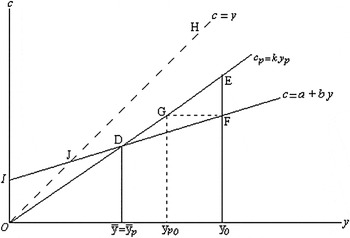
This manipulation of the estimated relations of the parameters of the regression provides Friedman with a way of interpreting the empirical issue, illustrated below with a figure taken from his work:
In Figure 2, while IF is a Keynesian consumption function, OE instead represents a consumption function—in line with the “pure theory of consumption”—with average (and marginal) propensity independent of the level of income.
The hypothetical relation between measured consumption and measured income.

Let us assume that IF is a function estimated on the basis of cross-section data or short time series. In these samples, measured income and consumption are affected by transitory components that determine part of the overall variability of the sample. Individuals with measured income y0 have measured consumption equal to y0F. As their measured income is higher than the average, the presence of positive transitory components of income in some cases is very probable. Their expenditure on consumption would tend to be a proportion k of their permanent income (smaller than the measured income). The consumption y0F is, therefore, lower than a proportion k of measured income.
Similarly, it is reasonable to assume that some of the individuals with a smaller than average measured income will have negative transitory components. By consuming in proportion to their permanent income, they will ensure that the consumption of the group as a whole is higher than the proportion k of measured income.
By drawing a horizontal line from F to the point of intersection with function OE, we obtain the permanent income, yp0, of the units of consumption with measured income y0. The ratio  measures the fraction of the deviance of the measured incomes of the units with income y0 from the average of the sample as a whole, attributable to transitory components. Therefore, this ratio corresponds to (1-Py), and increases as the slope of IF rises.
A low value of Py derives from the fact that the variability of the permanent income of the group accounts for a limited proportion of the variability of the measured income and, hence, derives from a marked effect of the transitory components on the measured incomes. IF proves to be comparatively flat. The estimate of the marginal propensity to consume b=kPy on sample data is, therefore, systematically lower than the marginal (and average) propensity k that individuals effectively seek to attain, and lower levels of Py make the estimate of k still lower.
A high value of Py instead means that transitory components have a limited effect on the data. IF will tend to be steeper and closer to OE, and the estimate for the marginal propensity to consume will be closer to the propensity k.
The relationship between income and consumption suggested by the theory can emerge from the estimate only when the variability of the data is wholly determined by the variability of permanent income; i.e., when transitory components have no effect whatsoever.
Interpretation of the Empirical Issue
In cross-sectional studies and those based on short time series, measured incomes and consumption most probably will be affected by transitory components determining a large proportion of the variability of the former. Py will, therefore, be less than 1, and the estimate of the marginal propensity to consume will prove smaller than that on the basis of which individuals adjust their consumption to permanent income. The estimate will also lead to the determination of a positive intercept.
The transitory components of income and consumption tend instead to lose importance in estimates based on very long time series, like those of Kuznets. These components are incidental and short-lived, and their variability is independent of the length of the period of observation. An increase in the latter leads instead to an increase in the variability of permanent income caused by long-period growth, and increasing importance will, therefore, attach to this variability in accounting for the overall variability of the measured data. As the length of the period of observation increases, the values of Py will become closer to 1. The estimated consumption function will tend to coincide with the function OE. The marginal propensity to consume will be independent of the level of income and tend to coincide with the proportion k of the theoretical analysis.Footnote 25
Measured income and consumption are not magnitudes representing the variable involved in economic choices. As the difference is greater the shorter the period of time to which the sample refers, the incidental components of the variables will also have greater influence on the registered variability of the phenomenon. The distortion of data leads to a positive intercept and an average propensity differing from the marginal propensity, and thus to a function unlike the one suggested by the theory.
This explanation of the empirical issue neither assumes differences in the behavior of individuals in the short and long periods, nor rests on heterogeneous principles. Individuals behave in accordance with a single rational framework; following the same principles are both the short and the long periods. The difficulty of measuring the magnitudes effectively involved in their decisions has the effect, however, of making the short-period ratio of consumption to income appear different from the one established in the long period. The homogeneity of this explanation makes it extremely solid and convincing, especially by comparison with the heterogeneity noted above with respect to the explanation offered by the hypothesis of relative income.
Comparison of Permanent Income and Relative Income
Friedman makes great use of the empirical studies and data of other authors, including Brady and Friedman (Reference Brady and Friedman1947), Duesenberry (Reference Duesenberry and Metzler1948 and Reference Duesenberry1949), and Mack (Reference Mack1948), many of whom adopted the hypothesis of relative income. Using both the same and some newer data—Goldsmith (Reference Goldsmith1955)—Freidman develops a considerable amount of original empirical work based on his hypothesis. The statistical performances of the two hypotheses are then compared. It is neither possible to examine this comparison in detail here nor worthwhile, as the standard of econometric work of that period now appears quite inadequate.
Friedman himself states that the grounds for deciding which is the better hypothesis are not those of empirical performance. He acknowledges that both are equally capable of accounting for the contrasting empirical results from the empirical viewpoint, and in formal terms that the estimates of parameters obtained by means of one can be easily transformed into those of the other through “algebraic manipulation, including a change of scale” (Friedman Reference Friedman1957, p. 159).
In examining the consistency of his hypothesis with time series data, Friedman produces different estimates on the basis of data obtained by Goldsmith for periods considerably longer than those studied by Modigliani, Duesenberry, and Mack. He compares different determinations of the consumption function, some of which (following Duesenberry and Modigliani) involve current and highest previous income, while others (following Mack) involve current and previous year income. He then compares these results with those obtained by estimating a function in which permanent income is approximated by attaching decreasing exponential weights to current and previous income levels, and then leaving the estimates themselves to determine which and how many of these terms of income should be included.Footnote 26 While acknowledging that the previous highest income or the previous year’s income provide a better basis for permanent income than his own, more complex, estimate of expected income, he concludes that the magnitudes of the differences in fit are such that they can be “explained on purely statistical grounds of spurious correlation” (p. 150).
As regards consistency with cross-section data, Friedman asserts the superiority of the permanent income hypothesis, not on the grounds of simple statistical performance but with reference to the breadth and consistency of the explanations of the differences in the estimates based on the various samples. His most relevant conclusion regards a controversial aspect of the empirical results for which permanent income makes it possible to provide a more complete explanation.
Estimates regarding different social groups (black and white, urban and non-urban, etc.) and different countries or different periods for the same country generate consumption functions with different levels and different marginal propensities.
The only explanation compatible with the hypothesis of relative income adopted by Duesenberry is that the differences in the estimates of the functions account for the differences between the various samples in tastes, interest rates, or characteristics determining the allocation between present and future.
Friedman instead assumes the comparative homogeneity of k over the different social groups, countries, or periods, and explains these differences in terms of the differing importance of the transitory components of income in the various samples. According to Friedman, the incomes of agricultural communities are thus intrinsically more variable than those of non-agricultural communities, as are those of white communities—with a greater proportion of professionals and entrepreneurs—with respect to black. For samples of white and agricultural communities, Py will, therefore, tend to assume moderate values; the intercept will be high and the marginal propensity to consume will be low. Similarly, regressions based on data for periods with marked variability of income (like those including the years of the Great Depression) present a greater incidence of transitory components and, therefore, estimate a higher intercept and a lower propensity to consume than regressions based on data for periods of moderate and regular growth.
Here, too, the explanation that Friedman offers for the empirical results owes its solidity to homogeneity. The differences in the empirical estimates are all related to differences in the variability of the sample incomes (of a period, group, or country). Moreover, as Friedman points out, the greater or lesser importance of transitory components within a given sample, and, therefore, the cause of the differences between estimates, can be verified empirically and independently with respect to the regression. It is, in fact, possible to measure the variability of the incomes of one sample and compare it with another, both for cross-sectional samples regarding different communities and for temporal series regarding different periods.
Friedman’s arguments prove highly convincing. Interest attaches in this connection to his concluding summary of the comparison of the two hypotheses.
The permanent income hypothesis seems to me superior to the relative income hypothesis on three grounds: first, it has a simpler and more attractive theoretical basis in that it uses the same constructs to account for cross section and temporal results, whereas the relative income hypothesis introduces very different considerations to account for declining ratio of consumption to measured income in budget study regressions of consumption to income and for the constant ratio of aggregate consumption to aggregate income over long spans of time; second, it is more fruitful, in that it predicts a wider range of characteristics of observed consumption behaviour; and finally, the evidence that we have cited seems to fit it somewhat better. In respect of the third point, however, this evidence is by no means sufficient to justify a firm rejection of the relative income hypothesis. It is much to be desired that a fuller test be made of the two hypotheses (Friedman Reference Friedman1957, pp. 168–169, emphasis added).Footnote 27
V. CONCLUSIONS
Together with the life-cycle hypothesis, which was soon combined with it, the permanent income hypothesis became the basis of every analysis of consumption and saving in just a few years. The analysis of consumption unquestionably has undergone major changes since the late 1950s, primarily by incorporating the hypothesis of rational expectations and developing econometric analysis with technical standards and methods superior to those of the debate considered here. Friedman’s analysis is still, however, the theoretical basis of the more recent formulations.Footnote 28
Important phenomena played a part in determining the success of Friedman’s hypothesis. In particular, the debate on the consumption function must be seen within the broader context of the change in American economic thinking that took place during the 1940s and 1950s, when the predominance of the Neoclassical Keynesian Synthesis gradually gave way to the search for micro-foundations in macroeconomics and the pluralism of the inter-war yearsFootnote 29 to the almost unanimous acceptance of neoclassical principles in microeconomics.
Political factors may have played a role in determining the respective fortunes of the two positions considered here. While Duesenberry’s hypothesis unquestionably fits in with the progressive attitude of the Institutionalists, Friedman’s leads, on the contrary, to a view of the automatic mechanisms of markets as the best solution to short-run fluctuations. The success of Friedman’s theory may thus have also been fostered by the gradual swing of the political pendulum towards the more conservative views that came to predominate in the mid-1970s. By that time, however, the Institutionalist principles used by Duesenberry had been definitely forgotten.
The analysis developed here identifies a turning point in the study of consumption and the eclipse of an hypothesis widely used in the investigation of consumption in the early decades of the twentieth century. At the same time, it enables us to identify the heterogeneity of Duesenberry’s analysis and to show how it has been perceived as an element of weakness by the authors proposing alternative hypotheses.
The analysis of this heterogeneity also allows us to show that the two strands of Duesenberry’s analysis are actually inconsistent, as the social relevance of consumption generally clashes with the rationality of the marginalist consumer and with the need of independence of preferences entailed by those theories. On the other hand, the idea of the social relevance of consumption leads to a conception of saving as a residual, which is inconsistent with the idea of a long-run propensity to save determined by the rational process of intertemporal maximization of utility.
The identification of this heterogeneity enables us to identify a line of theoretical research, in that the principles of the theory of the social significance of consumption can be developed independently of the principles of the marginalist theory of intertemporal choice.
The first step in this direction would appear to involve developing the view of the average proportion of savings out of income as the ex post average of the residual part of income in each period remaining available for saving once the standards of consumption have been satisfied. The reconstruction of a theoretical analysis of the determinants of consumption based on the principles of the social significance of expenditure on consumption appears to offer a potential field of study.Footnote 30