1. INTRODUCTION
Some languages distinguish two types of suffixes depending on how the suffixed word behaves phonologically: cohering and non-cohering suffixes (Dixon, Reference Dixon1977; van Oostendorp, Reference van Oostendorp2004; Haspelmath and Sims, Reference Haspelmath and Sims2010: chapter 10; Raffelsiefen, Reference Raffelsiefen, Müller, Ohnheiser, Olsen and Rainer2015; Plag, Reference Plag2018: chapter 4). With cohering suffixes, the shape of the suffixed word is determined by the regular phonotactics of the language: the suffixed word behaves phonologically like a monomorphemic word. English suffix -al provides an example of a cohering suffix: words suffixed with -al behave like monomorphemic words with respect to the position of stress in the word. For instance, stress falls on the heavy penult in parént-al, as expected phonotactically (compare to monomorphemic uténsil). With non-cohering suffixes, the stem in the suffixed word behaves phonologically like the base, i.e. the word-form containing the stem without any affix. English suffix -hood provides an example of non-cohering suffix. For instance, in párent-hood, stress falls on the stem-initial syllable, as in the base párent and in violation of regular stress phonotactics (the phonotactically regular form is *parént-hood).
The distinction between cohering and non-cohering suffixes often correlates with phonological properties of the relevant suffixes. For instance, in Yidiny derivational and inflectional paradigms, cohering suffixes are monosyllabic and non-cohering suffixes are disyllabic (Dixon, Reference Dixon1977: 27). In English and Dutch, cohering suffixes tend to be vowel-initial and non-cohering suffixes consonant-initial (e.g. English -al vs. -hood; see Raffelsiefen, Reference Raffelsiefen, Müller, Ohnheiser, Olsen and Rainer2015: 901 on English; van Oostendorp, Reference van Oostendorp2004: 1376 on Dutch).
This article contributes to enriching this typology by uncovering a previously undescribed pattern of suffix cohesion in French. More specifically, it provides evidence that, in French, vowel- and glide-initial suffixes are cohering, as illustrated in (1a,b), while other consonant-initial suffixes are non-cohering, as illustrated in (1c,d). In (1a,b), the stem mid vowel (in bold characters) is pronounced according to the language’s regular phonotactics, namely with the same quality as in phonologically similar monormophemic words (shown in parentheses). In (1c,d), the stem mid vowel is pronounced with the same quality as in the corresponding base (shown in parentheses). Morpheme boundaries are indicated with a dash (-).
-
(1) Suffix cohesion in French: cohering suffixes (a, b) vs. non-cohering suffixes (c, d)Footnote 1


The evidence comes from a reassessment of well-known data on [ə]–[ɛ] stem alternations and from an acoustic study of [e]–[ɛ] and [o]–[ɔ] stem alternations in suffixed words as pronounced by 10 speakers living in the Paris area. The suffix-initial segment’s phonological category (vowels or glides vs. non-glide consonants) is found to provide the best account of the data among a set of factors that have been argued to be relevant for suffix cohesion in other languages (resyllabification, suffix’s morphological function, and relative frequency of the base with respect to the suffixed word).
The study’s results have implications for theories of suffix cohesion. In particular, the French pattern is problematic for prosodic analyses of suffix cohesion that have been proposed for other languages (e.g. Plag, Reference Plag2018: chapter 4; Raffelsiefen, Reference Raffelsiefen, Müller, Ohnheiser, Olsen and Rainer2015 on English; van Oostendorp, Reference van Oostendorp2004 on Dutch). In these approaches, suffix cohesion follows from independent principles of prosodic structure, with cohering suffixes corresponding to suffixes that trigger a resyllabification of the stem-final consonant and non-cohering suffixes corresponding to suffixes that do not trigger resyllabification. However, as will be shown in the article, resyllabification fails to account for the behaviour of liquid-initial suffixes in (1c) as non-cohering.
An alternative analysis in terms of paradigm uniformity will be proposed, building on Storme (Reference Storme2017b). Paradigm uniformity describes cases where the pronunciation of a word-form in a morphological paradigm is influenced by another form in the same paradigm, potentially in violation of the language’s regular phonotactics (e.g. Kenstowicz, Reference Kenstowicz, Downing, Hall and Raffelsiefen2005; Raffelsiefen, Reference Raffelsiefen, Downing, Hall and Raffelsiefen2005). In the present case, the suffixed word’s stem is proposed to be attracted to the corresponding base through paradigm uniformity (this type of paradigm uniformity is also referred to as ‘base-identity’ in Kenstowicz, Reference Kenstowicz, Durand and Laks1996 and ‘transderivational correspondence’ in Benua, Reference Benua1997). The distinction between cohering and non-cohering suffixes follows from the effect of the suffix’s phonological shape on the ability to recognize the corresponding base in the suffixed word: suffixed words are attracted to the corresponding base if the suffix’s phonological shape facilitates the recognition of the base (see Hay, Reference Hay2003: chapter 8 for a similar analysis of affix ordering in English). Suffixes starting with non-glide consonants in (1c,d) facilitate the recognition of the base because, contrary to vowel- and glide-initial suffixes in (1a,b), they do not add salient formant transitions to the stem-final consonant that are absent in the corresponding base-final consonant (Storme, Reference Storme2017b).
Section 2 provides preliminary evidence for the hypothesis that French distinguishes cohering and non-cohering suffixes and that this distinction can be explained in terms of the suffix-initial segment’s phonological category. Section 3 presents the acoustic study that was conducted to further test this hypothesis, using [e]–[ɛ] and [o]–[ɔ] stem alternations. Section 4 reports the study’s results. Section 5 highlights some limits of the study and briefly presents the paradigm uniformity analysis.
2. BACKGROUND
2.1 Cohering vs. non-cohering suffixes in French: preliminary data and hypothesis
Data on [ə]–[ɛ] stem alternations in suffixed words (e.g. Dell, Reference Dell1985: 198–214) point to a pattern of suffix cohesion in French, where the phonological shape of the suffix determines whether the suffixed word is phonotactically regular or paradigmatically uniform with the corresponding base.Footnote 2 The relevant data are shown in (2), using forms of the inflectional paradigm of jeter ‘throw’ to illustrate. In the paradigm of jeter, [ə] alternates with [ɛ] (an open-mid vowel) in stems (see (2b,c) vs. (2a,d,e)). Note that, in (2e), the word-medial schwa is not part of the suffix or the stem underlyingly: it is epenthetic and motivated by the need to avoid the triconsonantal cluster [tʁj] (see Dell, Reference Dell1978 on schwa epenthesis at morpheme boundaries).
-
(2) [ə]–[ɛ] stem alternations in FrenchFootnote 3

Forms (2a–c) are phonotactically regular. Schwa does not occur before word-final consonants (_C#; Dell, Reference Dell1985; Walker, Reference Walker1993), explaining why [ɛ] is preferred to [ə] in (2a). According to the so-called loi de position, open-mid vowels are disfavoured before consonant-vowel and consonant-glide-vowel sequences (_CV, _CGV), and more generally in open syllables, explaining why [ə] is favoured over [ɛ] in (2b,c). Contrary to the ban against schwa in _C#, the loi de position is not categorical, but still a strong tendency in Parisian French (Lyche, Reference Lyche, Detey, Durand, Laks and Lyche2010; Hansen and Juillard, Reference Hansen and Juillard2011).
However, forms (2d,e) are not easily accounted for by the regular phonotactics of French. According to the loi de position, open-mid vowels are disfavoured in open syllables in general. All stem mid vowels in (2b,e) are in open syllables. Indeed, obstruent-liquid clusters as [tʁ] in (2d) are treated as onsets in French (the French liquids are [l ʁ]). Therefore vowels occurring before obstruent-liquid-vowel sequences (_CLV) are in open syllables. Hence, on purely phonotactic grounds, (2d) and (2e) should show the same preference for schwa in the stem as (2b) and (2c): these forms should be realized as *[ʒət-ʁe] and *[ʒət-ə-ʁje], respectively. However, they are not.
One way to explain these alternations, and in particular the phonotactically problematic forms in (2d,e), is hypothesis (H1).
(H1) Phonologically-conditioned paradigm uniformity in French
In suffixed words, the phonological shape of the stem is:
-
– phonotactically regular when the suffix is underlyingly vowel- or glide-initial (e.g. in (2b,c))
-
– paradigmatically uniform with the base with other consonant-initial suffixes (e.g. in (2d,e)).
The base is the word-form containing the stem without any affix (e.g. (2a)).
In other words, this hypothesis states that underlyingly vowel- and glide-initial suffixes are cohering and other consonant-initial suffixes are non-cohering. According to this hypothesis, suffixed forms (2b,c) are phonotactically regular for mid-vowel quality because they are built with underlyingly vowel-initial and glide-initial suffixes (-ez [e] and -iez [je], respectively). Suffixed forms (2d,e) are paradigmatically uniform with the base jette [ʒɛt] in (2a) with respect to mid-vowel quality because they are built with suffixes starting with a non-glide consonant underlyingly (-rez [ʁe] and -riez [ʁje], respectively). As noted above, the word-medial schwa in (2e) is epenthetic and not underlying: therefore the suffix in (2e) does not qualify as a cohering suffix according to (H1).
To the author’s knowledge, the data in (2) have not been analyzed in terms of suffix cohesion before. For instance, Dell (Reference Dell1985: 198–214) accounted for forms (2d,e) without reference to paradigm uniformity. Instead, he proposed rules of schwa-lowering. A rule lowering /ə/ to [ɛ] before two consonants (including before obstruent-liquid sequences) accounts for (2d), i.e. /ʒətʁe/ → [ʒɛtʁe]. A rule lowering /ə/ to [ɛ] before a syllable containing a schwa accounts for (2e), i.e. /ʒətəʁje/ → [ʒɛtəʁje]. However, these rules are not phonotactically motivated because (i) schwa can occur before obstruent-liquid clusters morpheme-internally (e.g. sevr-ez [səvʁ-e] ‘wean-pres.2pl’, chevr-eau [ʃəvʁ-o] ‘goat kid’) and (ii) schwas can occur in two adjacent syllables morpheme-internally (e.g. Genev-ois [ʒənəv-wa] ‘Genevan’, ensevel-ir [ãsəvəl-iʁ] ‘bury’).Footnote 4 Therefore, to avoid overgenerating lowering morpheme-internally (e.g. sevr-ez [səvʁ-e]/*[sɛvʁ-e], Genev-ois [ʒənəv-wa]/*[ʒɛnəv-wa]), Dell’s two lowering rules need to be restricted to apply across morpheme boundaries.Footnote 5 This account is very different from the one proposed in (H1) because it does not make any reference to the vowel quality in the corresponding base: the open-mid quality in suffixed forms (2d,e) is not explained by reference to the base in (2a), but in terms of ad hoc rules of lowering.
Another important reference on [ə]–[ɛ] stem alternations is Morin (Reference Morin and Verluyten1988). Morin (Reference Morin and Verluyten1988) is important in the context of this article because he argued against the hypothesis that the distribution of [ə] and [ɛ] stems in (2) is phonologically conditioned. This hypothesis is crucial in (H1). Morin’s main argument is based on the observation that the schwa stems are actually attested in their schwa-less variants in casual Parisian French, at least for disyllabic stems like achet-/achèt- [aʃ(ə)t-]/[aʃɛt-] ‘to buy’: achèt-e-rez ‘buy-fut.2pl’ can be pronounced as [aʃ(ə)t-ʁe] or [aʃɛt-ʁe] (Morin, Reference Morin and Verluyten1988: 145–153). Based on this observation, Morin argues that there is no phonological conditioning for the distribution of the two stem allomorphs: they are basically in free variation.
However, at least to my knowledge, the [ɛ] stems are not attested with vowel-initial and glide-initial suffixes. For instance, achet-ez ‘buy-pres.2pl’ is pronounced as [aʃ(ə)t-e] and cannot be pronounced as *[aʃɛt-e]. Achet-iez ‘buy-imp.2pl’ is pronounced as [aʃ(ə)t-je] and cannot be pronounced as *[aʃɛt-je]. The [ɛ] stems only occur with liquid-initial suffixes, e.g. achèt-e-rez [aʃɛt-ʁe]/[aʃ(ə)t-ʁe]. This means that the distribution of the two allomorphs [aʃət-] and [aʃɛt-] is not phonologically arbitrary, contra Morin (Reference Morin and Verluyten1988): for disyllabic stems, the [ɛ] stem can occur in violation of the language’s phonotactics with liquid-initial suffixes but not with vowel- and glide-initial suffixes, where only the phonotactically expected [ə] stem is attested. Free variation is therefore limited to a phonologically defined context. Note also that, for monosyllabic stems like jet-/jett- ‘throw’, only the paradigmatically uniform [ɛ] stem (e.g. jett- [ʒɛt]) is attested with liquid-initial suffixes, as illustrated in (2d). In other words, free variation is completely absent in monosyllabic stems.
2.2 Implications for theories of suffix cohesion
If hypothesis (H1) was confirmed, then French would have a distinction between cohering and non-cohering suffixes very similar to the one found in Germanic languages such as English and Dutch, where vowel-initial suffixes tend to be cohering and consonant-initial suffixes non-cohering. There are also differences between the French pattern and these other patterns, and some of them happen to have important implications for theories of suffix cohesion.
In prosodic theories of suffix cohesion proposed for English and Dutch, resyllabification plays a crucial role: a suffix is cohering if and only if the final consonant in the stem is resyllabified as a consequence of suffixation with this suffix (e.g. Plag, Reference Plag2018: chapter 4 and Raffelsiefen, Reference Raffelsiefen, Müller, Ohnheiser, Olsen and Rainer2015 on English; van Oostendorp, Reference van Oostendorp2004 on Dutch). Under this view, English -al is cohering because it imposes different syllabifications for the stem-final consonant and the corresponding base-final consonant (e.g. [t] is in onset position in paren.t-al but in coda position in the base parent; the dot indicates the syllable boundary). English -hood is non-cohering because it imposes identical syllabifications for the two consonants (e.g. [t] is in coda position in both parent.-hood and parent).
However, this analysis cannot straightforwardly account for suffix cohesion in French as defined in (H1). Indeed, there are two immediate problems for an account where resyllabification matters for suffix cohesion. First, it incorrectly predicts that liquid-initial suffixes should be cohering. Obstruent-liquid clusters are syllabified as onsets in French (Dell, Reference Dell1985; Goslin and Frauenfelder, Reference Goslin and Frauenfelder2000). Therefore, stem-final consonants are expected to be resyllabified before liquid-initial suffixes. For instance, [t] is expected to form an onset cluster with the following consonant in jette-rez [ʒɛ.t-ʁe] in (2d). Yet liquid-initial suffixes are non-cohering according to (H1).
One could argue that derived C-L clusters are not syllabified identically as underlying CL sequences (whereas derived and underlying C(-)V and C(-)G sequences would be syllabified identically). However, allowing syllabification to be sensitive to morpheme boundaries removes the main conceptual appeal of the prosodic analysis, i.e. explaining suffix cohesion through independently motivated principles of syllabification. Indeed, if CL clusters are allowed to be syllabified differently within morphemes and across morpheme boundaries, one still needs to explain why this would not also be the case for CV and CG sequences. More importantly, there is no conclusive evidence that underlying and derived CL clusters differ in the way they are syllabified (Storme, Reference Storme2017b) or even in their phonetic realization (see Bürki et al., Reference Bürki, Fougeron, Veaux and Frauenfelder2009 contra Fougeron and Steriade, Reference Fougeron and Steriade1997). For instance, in Storme (Reference Storme2017b: 204–205), seven participants were asked to syllabify the past participle entr-é [ãtʁ-e] ‘entered’ (with an underlying CL cluster) and chante-ra [ʃãt-ʁa] ‘sing-fut.3sg’ (with a derived CL cluster). All participants syllabified the two clusters identically as onsets ([ʃã.tʁa] and [ã.tʁe]).
The second problem concerns epenthetic schwa. The prosodic analysis fails to derive the different behaviours of suffixes that are underlyingly vowel-initial (e.g. jetez [ʒət-e] in (2b)) and suffixes that are vowel-initial in the surface as a result of schwa epenthesis (e.g. jetteriez [ʒɛt-ə-ʁje] in (2e)). All prevocalic consonants are syllabified as onsets in French. Therefore, stem-final consonants are expected to be resyllabified before both vowel-initial suffixes and epenthetic schwa (e.g. [t] is expected to be syllabified as an onset in both jetez [ʒə.te] and jetteriez [ʒɛ.tə.ʁje]). Yet only suffixes that are underlyingly vowel-initial are cohering according to (H1).
Another difference between French and English following from (H1) concerns the behaviour of glide-initial suffixes.Footnote 6 According to (H1), glide-initial suffixes pattern as cohering in French: like underlyingly vowel-initial suffixes, they trigger regular phonotactics in the stem. But in English, glide-initial suffixes pattern with other consonant-initial suffixes as non-cohering (see Raffelsiefen, Reference Raffelsiefen, Müller, Ohnheiser, Olsen and Rainer2015: 901 on -ward [wəɹd] and -ior/-iure [jəɹ]). Note that the fact that glide-initial suffixes behave like vowel-initial suffixes in French is not problematic for the prosodic analysis of suffix cohesion. Indeed, consonant-glide clusters are syllabified as onsets in French (Goslin and Frauenfelder, Reference Goslin and Frauenfelder2000).
2.3 [e]–[ɛ] and [o]–[ɔ] alternations: predictions
One of the goals of this article is to further test hypothesis (H1), using [e]–[ɛ] and [o]–[ɔ] alternations. These alternations are particularly relevant because they are more natural phonologically and phonetically than [ə]–[ɛ] alternations. Phonologically, [e]–[ɛ] and [o]–[ɔ] alternations involve changes along a single dimension (height) whereas [ə]–[ɛ] alternations involve changes along two dimensions: [ə]–[ɛ] differ in height but also in rounding (French [ə] is rounded). Phonetically, [e]–[ɛ] and [o]–[ɔ] are also closer than [ə]–[ɛ]. The acoustic Euclidean distances among the members of each of these three pairs are as follows: d([e],[ɛ])=179 Hz, d([o],[ɔ])=206 Hz, and d([ə],[ɛ])=310 Hz. The distance between [ə] and [ɛ] is about 100 Hz larger than the distance between [e] and [ɛ] and the distance between [o] and [ɔ]. These distances were calculated using Gendrot and Adda-Decker’s (Reference Gendrot and Adda-Decker2005) first three formants’ data on [e ɛ o ɔ ø], assuming that [ə] is phonetically identical to [ø] (see Malécot and Cholet, Reference Malécot and Chollet1977 and Fougeron et al., Reference Fougeron, Gendrot and Bürki2007 for evidence that [ə] is similar to [ø] in Parisian French) and averaging across male and female speakers. Alternations that are more natural phonologically and phonetically are also more likely to be more productive. Therefore, if [e]–[ɛ] and [o]–[ɔ] alternations also patterned according to (H1), this would provide stronger evidence for (H1) as a productive generalization in French. This section describes how these alternations are expected to behave if (H1) also applies to them.
Data on [o]–[ɔ] alternations are particularly relevant because [o]–[ɔ] contrasts are available in base-final syllables before consonants (e.g. côte [kot] ‘coast’ vs. cote [kɔt] ‘rating’) but not word-medially in monomorphemic words (Tranel, Reference Tranel1987). If these contrasts were maintained in suffixed words with consonant-initial suffixes but were not maintained in suffixed words with vowel- and glide-initial suffixes, this would provide strong evidence in favour of (H1). This kind of strong evidence is not available for [ə]–[ɛ] alternations because the two vowels do not contrast in word-final syllables, where only [ɛ] is available before consonants. Note that the maintenance of [o]–[ɔ] contrasts before consonant-initial suffixes is not predicted by Dell’s (Reference Dell1985) analysis of [ə]–[ɛ] alternations presented in section 2.1. Indeed, Dell’s analysis does not apply to back rounded vowels [o]–[ɔ]. If Dell’s two rules of lowering discussed in section 2.1 were to be extended to all mid vowels including back rounded vowels, then this would predict a single open-mid quality [ɔ] in stems containing back rounded vowels and suffixed with consonant-initial suffixes (e.g. côte- and cote- would neutralize to [kɔt-] before consonant-initial suffixes).
Like [ə]–[ɛ], [e] and [ɛ] do not contrast in base-final syllables before consonants, where only [ɛ] is available (Tranel, Reference Tranel1987). Therefore, paradigm uniformity cannot be diagnosed by contrast maintenance for this mid-vowel pair. However, it can be diagnosed by other means. As in the case of [ə]–[ɛ] alternations, paradigm uniformity and regular phonotactics predict different qualities in some contexts. Paradigm uniformity before consonant-initial suffixes predicts a preference for [ɛ] before morphologically-derived C-LV sequences and before epenthetic schwa in C-ə-CV sequences (in violation of the language’s phonotactics, which requires [e] in these contexts, due to the loi de position). Regular phonotactics before vowel- and glide-initial suffixes predicts a preference for [e] over [ɛ] before morphologically-derived C-GV and C-V sequences, due to the loi de position (in violation of paradigm uniformity, which requires [ɛ]). In other words, one expects [e]–[ɛ] alternations to pattern identically to [ə]–[ɛ] alternations.
The predictions of hypothesis (H1) for [e]–[ɛ] and [o]–[ɔ] alternations are summarized in (3). Here it is assumed that the effect of phonotactics on stem mid vowels before vowel- and glide-initial suffixes is mid-vowel raising, according to the hypothesis that the loi de position is the main factor explaining the distribution of close-mid vs. open-mid allophones in non-final positions (see Nguyen and Fagyal, Reference Nguyen and Fagyal2008:23). The predictions of (H1) for [ə]–[ɛ] alternations (see section 2.1) are summarized in the last column in (3).
-
(3) Underlyingly vowel-/glide-initial suffixes as cohering vs. other consonant-initial suffixes as non-cohering (=H1)

2.4 Previous studies
2.4.1 Previous studies of mid-vowel quality in French
The predictions concerning [e]–[ɛ] and [o]–[ɔ] alternations are not as easy to test as in the case of [ə]–[ɛ] and this is why this article uses an acoustic study rather pronunciation dictionaries (or speakers’ metalinguistic judgements). Indeed, pronunciation dictionaries do not always provide a single variant for the realization of non-final mid vowels in the relevant stems (whereas they do for [ə]–[ɛ]) and it is not very clear what the source of this variation is. For instance, Martinet and Walter (Reference Martinet and Walter1973) list both [e] and [ɛ] realizations for the stem mid vowel in the suffixed word fêt-ard ‘reveller’, derived from the base fête [fɛt] ‘party’. The authors indicate that the choice between the two realizations is speaker-dependent. However, in the absence of systematic acoustic data, it is difficult to conclude whether one is really dealing with speaker variation or other sources of noise, for instance a difficulty with discriminating phonetically close allophones on the part of transcribers. Indeed, [e]–[ɛ] and [o]–[ɔ] are closer in the acoustic space than [ə]–[ɛ] (see section 2.3), and therefore probably harder to distinguish perceptually, as the first three formants are the main dimensions of the similarity space for oral vowels (Shepard, Reference Shepard, David and Denes1972). This difficulty should be increased in the context under consideration, namely in non-final syllables. Indeed, there is substantial target undershoot in non-final syllables as compared to word-final syllables in French, resulting in close-mid and open-mid vowels being closer in the acoustic space non-finally than word-finally (Storme, Reference Storme2017a). Moreover, close-mid and open-mid vowels do not contrast in non-final syllables in morphologically simple words (Tranel, Reference Tranel1987), making it potentially harder to detect differences between the two vowels in this context. Indeed, there is evidence that pairs of sounds are harder to discriminate if the two sounds are in allophonic distribution in one’s language than if they contrast (Boomershine et al., Reference Boomershine, Hall, Hume, Johnson, Avery, Dresher and Rice2008).
Concretely, this means that any study of [e]–[ɛ] and [o]–[ɔ] alternations should include several speakers (to control for speaker variation) and be based on acoustic data (to bypass potential biases introduced by transcriptions). The study that comes closest to satisfy these requirements is Nguyen and Fagyal’s (Reference Nguyen and Fagyal2008) acoustic study on vowel harmony in suffixed words (with six speakers). Nguyen and Fagyal (Reference Nguyen and Fagyal2008:23) found that, in stems suffixed with vowel-initial suffixes (e.g. fêt-ard), stem mid vowels tend to be closer to a close-mid realization than to an open-mid vowel realization in the F1/F2 space. This would be in line with the prediction that regular phonotactics (in particular, the loi de position) are privileged over paradigm uniformity in stems suffixed with vowel-initial suffixes.
However, this study was not meant to test hypotheses about suffix cohesion and therefore does not include the data relevant for a comprehensive test of these hypotheses. In particular, it does not include data on suffixes other than vowel-initial. In addition, the study does not include paradigm uniformity and phonotactic baselines to compare stem mid vowels to: mid-vowel realizations in suffixed words are not compared to mid-vowel realizations in the corresponding bases (e.g. fête for fêt-ard) or to mid-vowel realizations in morphologically simple phonological neighbours (e.g. féta ‘feta cheese’ for fêt-ard). Therefore, the study does not provide a direct test of whether phonotactics are favoured over paradigm uniformity, even in stems suffixed with vowel-initial suffixes.
2.4.2 Previous studies of suffix cohesion
The current article proposes that suffix cohesion in French is determined by the phonological nature of the suffix’s initial segment. But other factors have been argued to be relevant to suffix cohesion in previous works on other languages. This section reviews some of these other factors and describes how mid-vowel alternations should pattern in French if there was no suffix cohesion or if suffix cohesion was conditioned by these other factors. These different hypotheses will be compared quantitatively against the acoustic data collected in this study.
First, we need to consider the possibility that all stems are treated identically, all according to regular phonotactics or all according to paradigm uniformity. The predictions of these two hypotheses are summarized in (4) and (5), respectively.
-
(4)
-
(5)


Next, we consider models assuming different conditionings for suffix cohesion. The first obvious hypothesis to consider is the one according to which cohering suffixes coincide with resyllabifying suffixes and non-cohering suffixes with non-resyllabifying suffixes. This hypothesis is indeed central to accounts of suffix cohesion in Germanic languages (see section 2.2). The predictions of the syllable-based conditioning on suffix cohesion are summarized in (6). This hypothesis distinguishes two sets of contexts: before CV, CGV, and CLV, where mid vowels behave regularly due to resyllabification of the stem-final consonant, and before other consonantal clusters (CCV), where mid vowels behave according to paradigm uniformity due to the absence of resyllabification. In this hypothesis, consonant-initial suffixes preceded by epenthetic schwa pattern with underlyingly vowel-initial suffixes because epenthetic schwa also induces a resyllabification of the stem-final consonant.
-
(6)

Paradigm uniformity may also be conditioned by non-phonological factors. In dual-route models of lexical access, the relative frequency of a suffixed word with respect to its base is expected to affect the derivative’s pronunciation (Hay, Reference Hay2001; Hay, Reference Hay2003; Cohen, Reference Cohen2014; Zuraw and Peperkamp, Reference Zuraw and Peperkamp2015). Suffixed words that are frequent as compared to their base favour the direct route (i.e. they are analysed as a single morphological unit) and therefore are expected to be more likely to behave according to regular phonotactics. In other words, the base is not sufficiently salient in speakers’ memory so as to be activated when the suffixed word is accessed, resulting in the suffixed word taking on a life of its own as a morphologically simple word. Suffixed words that are not frequent compared to their base favour the decomposition route (i.e. they are analysed as a complex morphological unit) and therefore are more likely to behave according to paradigm uniformity. In other words, the base is sufficiently salient in speakers’ memory so as to be activated when the suffixed word is accessed, resulting in the phonology of the suffixed word being influenced by the phonology of its base.
The morphological function of suffixes as inflectional or derivational is also predicted to be relevant to the phonology of suffixed words in dual-route models of lexical access. Because inflectional paradigms are generally more transparent semantically than derivational paradigms (Haspelmath and Sims Reference Haspelmath and Sims2010: chapter 5), dual-route models of lexical access predict that the base will be more salient when accessing an inflected word than when accessing a derived word. In accordance with the hypothesis of a greater cohesiveness of inflectional paradigms as compared to derivational ones, Schriefers et al. (Reference Schriefers, Friederici and Graetz1992) found priming effects among forms belonging to the same inflectional paradigm but not among forms belonging to the same derivational paradigm. From a phonological perspective, the greater cohesiveness of inflectional paradigms is expected to translate into a greater pressure for paradigm uniformity in words suffixed with inflectional morphemes than in words suffixed with derivational morphemes.
It should be noted that, although models resorting to frequency and morphological function are plausible conceptually, the data on [ə]–[ɛ] stem alternations described in section 2.1 do not make them particularly plausible for French. All suffixed forms jetez, jetiez, jetterez, and jetteriez in (2b–d) are less frequent than their base jette in (2a) (New et al., Reference New, Brysbaert, Veronis and Pallier2007) and yet they do not pattern identically in terms of suffix cohesion, contrary to the predictions of the frequency-based model of suffix cohesion. Also, all forms jetez, jetiez, jetterez, and jetteriez are inflected and yet they do not pattern identically in terms of suffix cohesion, contrary to the predictions of the morphological model of suffix cohesion. One also finds cohering and non-cohering suffixes among derivational suffixes. For instance, lunetier [lynət-je] ‘eyewear manufacturer’ (built with the glide-initial, derivational suffix -ier [je]) behaves regularly phonologically whereas lunetterie [lynɛt-ʁi] ‘eyewear industry’ (built with the liquid-initial, derivational suffix -rie [ʁi]) behaves according to paradigm uniformity, i.e. it copies the vowel quality of its derivational base lunettes [lynɛt] ‘glasses’. These data suggest that suffix cohesion is orthogonal to the suffix’s morphological function in French, at least for [ə]–[ɛ] stem alternations.
Although these models of suffix cohesion are not particularly plausible to explain [ə]–[ɛ] stem alternations, they will still be considered as alternatives to explain [e]–[ɛ] and [o]–[ɔ] in this article. One reason for that is that it is possible that the two types of alternations ([ə]–[ɛ] on one hand and [e]–[ɛ] and [o]–[ɔ] on the other hand) behave differently. Indeed, as explained above, [e]–[ɛ] and [o]–[ɔ] alternations are more natural phonologically and phonetically than [ə]–[ɛ] alternations and this difference could translate into different patterns of alternations. In particular, due to their greater naturalness, [e]–[ɛ] and [o]–[ɔ] alternations could pattern in a way that is more consistent with the predictions of the dual-route model of lexical access.
3. METHODS
The current study aims to compare hypotheses about suffix cohesion in French using acoustic data on the realization of mid vowels in suffixed stems, in the corresponding bases, and in morphologically simple words. The use of an acoustic measure for mid-vowel quality makes it possible to avoid transcription biases. The study includes several participants, making it possible to control for speaker-dependent variation. The use of phonotactic and paradigm uniformity baselines makes it possible to directly assess (i) whether the suffixed word is realized according to regular phonotactics or to paradigm uniformity, (ii) whether this effect depends on the suffix, as predicted under suffix cohesion, and (iii) in case it does, what properties of the suffixes are relevant to determine their cohesion (suffix’s initial segment, resyllabification, morphological function, or base saliency).
3.1 Participants
Ten French native speakers living in the Paris area at the time of the recordings (six females, four males; aged 21–30, mean = 25.3 years, sd = 3.1) participated in the study on a voluntary basis. All of them were university students at the time of the recordings. To make sure that the participants had the relevant mid-vowel contrasts in bases (in particular, [o]–[ɔ] in word-final syllables before consonants), they were asked (after being recorded) whether they distinguished the pronunciation of taupe [top] and top [tɔp] in their daily speech. They all answered positively.
3.2 Stimuli and recordings
To test hypotheses about the realization of stem mid vowels as phonotactically regular or paradigmatically uniform, three forms are needed: the suffixed word (e.g. fêt-ard ‘partier’), the corresponding base (e.g. fête ‘party’), and the phonotactic baseline (e.g. féta ‘feta cheese’). In what follows, these forms will be referred to as the derivative, the base, and the neighbour, respectively. Note that the term ‘derivative’ is used as a cover term for both inflected and derived forms. The stimuli used in the study can be found in the appendix at the end of this article.
Forty-two derivative/base/neighbour triplets were selected (see the appendix for a list of all triplets). There were 14 bases for each vowel among [ɛ o ɔ] ([e] is not represented because it does not occur in final syllables of consonant-final bases). Derivatives were built with V-initial, G-initial, L-initial, and C-initial suffixes (where C is not a glide or a liquid). For each base mid vowel among [ɛ o ɔ], there were four vowel-initial suffixes, three glide-initial suffixes, three liquid-initial suffixes, three other consonant-initial suffixes, and one suffix requiring an epenthetic schwa between the stem and the suffix (maigr-e-let for [ɛ], pauvr-e-té for [o], sobr-e-ment for [ɔ]). The C-initial suffix -ment is represented in several suffixed words (see the appendix) because it was difficult to find actual examples of words with other suffixes. This means that the results for this condition might be heavily influenced by this suffix. See section 5.1 for further discussion.
The broad segmental context following the target mid vowel was the same in the derivative and in the neighbour. If the target mid vowel was in an open syllable in the derivative (i.e. followed by CV, CGV, or CLV), it was also in an open syllable in the neighbour. For instance, the target mid vowel is in an open syllable in both fêt-ard and féta. If it was in a closed syllable in the derivative (i.e. followed by CCV), it was also in a closed syllable in the neighbour. For instance, the target mid vowel is in a closed syllable in both vête-ment ‘article of clothing’ and Etna.
In two cases, the neighbour was actually a morphologically complex word, i.e. in the triplets coquelet/coq/mot-clé and faussiez/fausse/dossier, where mot-clé ‘keyword’ is a compound and dossier is a suffixed word (etymologically derived from dos [do] ‘back’ with the suffix -ier). However, in these words, regular phonotactics and paradigm uniformity predict the same realization. The mid vowel in mot-clé should be realized as [o] according to both phonotactics (due to the loi de position before CLV) and paradigm uniformity (because the base mot is pronounced as [mo] in the French variety under study). The mid vowel in dossier should be realized as [o] according to both phonotactics (due to the loi de position before CGV) and paradigm uniformity (because the base dos is pronounced as [do] in the relevant French variety). Therefore, the fact that these words are morphologically complex is probably harmless: they should have the same phonology whether their phonology is realized according to phonotactics or paradigm uniformity. Other neighbours were morphologically simple verbs, common names or proper names.
Word-position is known to affect the realization of mid vowels: non-final vowels are shorter than word-final vowels and this causes F1 undershoot (Gendrot and Adda-Decker, Reference Gendrot and Adda-Decker2005; Storme, Reference Storme2017a). This may make it hard to detect an effect of paradigm uniformity in base-derivative pairs. For instance, assuming paradigm uniformity of the suffixed word fête-ra with the base [fɛt], the underlying /ɛ/ in /fɛtʁa/ could be raised and realized as [e] due to undershoot in non-final syllables. To avoid this confound, the target syllable was put under contrastive focus for all words: in this context, vowels should be longer and therefore less reduced. In order to elicit contrastive focus on the first syllable of target words, participants were told that they should imagine they are correcting the pronunciation of a non-native French speaker. The target word Y was included in a carrier sentence On dit pas X, on dit Y ‘one does not say X, but Y’, where X was a faulty pronunciation of Y with the mid vowel in the initial syllable of Y being incorrectly pronounced as a high or low vowel. For instance, X was fitard and Y fêtard. The simple negation (pas) was used instead of the double negation (ne… pas) in order to elicit more casual speech. Each word was repeated three times. The stimuli were presented in three lists where the sentences appeared in random order.
Speakers were recorded in a sound attenuated booth with a head-mounted Shure SM35-XLR connected to a computer via a Shure X2u XLR-to-USB signal adapter. The recordings were made using the Audacity software, with 44 kHz/16 bit sampling. The distance (approx. 5 cm) of the participants to the microphone was held constant across all recording sessions.
3.3 Acoustic analyses
Vowels were segmented and labelled in Praat (Boersma and Weenink, Reference Boersma and Weenink2019). The segmentation was done using voicing and changes in formant trajectories as indicators. Formant measurements (F1, F2 at vowel midpoint; in Hertz) were done automatically with a Praat script. Manual corrections were performed when a formant value was obviously wrong (in a handful of cases, F2 was misidentified as F3). F1 and F2 values were normalized for each speaker using z-scores (this was done using the function scale() in R; R Core Team, 2020).
As a measure of mid-vowel quality, the distance to the centre of the F1/F2 space was chosen. Close-mid vowels are expected to be further away from this centre than open-mid vowels. The centre of the F1/F2 space was calculated as follows. For each speaker, three averages were calculated for each of the first two formants: the average realization for target front mid vowels, the average realization for target back mid vowels, and the average realization for 10 occurrences of [a] (these occurrences came from the negation pas). Then, these three numbers were averaged to obtain the centre of the F1/F2 space. The average was computed in two steps rather than in a single step because the sample was not balanced between front and back: due to the absence of [e] in consonant-final bases, there were more back vowels than front vowels in the stimuli.
3.4 Statistical analyses
The models of mid-vowel realization discussed in section 2 were implemented as mixed effects models in R (R Core Team, 2020) using lme4 (Bates et al., Reference Bates, Mächler, Bolker and Walker2015). The dependent variable was the distance to the F1/F2 centre. Fixed effects included the vowel in the base (as established by pronunciation dictionaries, i.e. [ɛ o ɔ]), the vowel’s broad segmental context (_C#, _CV, _CGV, _CLV, and _CCV), the vowel’s word position (final, non-final), and the speaker’s gender (female, male). Word position was not included in the purely phonotactic model (where all derivatives behave regularly) because, in this model, word position is already captured by the segmental context. All interactions between the fixed effects were included, except for interactions of word position and segmental context. Indeed, we don’t find all possible combinations of word position and segmental context in the data: indeed, by definition, vowels that occur in _CV, _CGV, _CLV, and _CCV only occur in non-final positions. However, via paradigm uniformity, vowels that occur in the context _C# can be word-final, i.e. when they are in the base, or word-medial, i.e. when they are in derivatives that copy the mid-vowel quality from the corresponding base. Random effects included a random intercept by speaker and a random intercept by word. Models with more complex random structure did not converge.
What differed between the different models of mid-vowel quality in suffixed stems (see section 2 for a presentation of these models) was the way mid vowels were assigned to their segmental context in derivatives. When a given derivative was predicted to behave according to paradigm uniformity with the base, the segmental context was the same as in the base (e.g. the segmental context for the stem mid vowel in fêt-ard is treated as _C#, as in the base fête). When it was predicted to behave according to phonotactics, the segmental context was the same as in the phonotactic baseline (e.g. the segmental context for the stem mid vowel in fêt-ard was treated as _CV, as in the neighbour féta).
To determine which of the base or the derivative was more frequent, frequencies based on French subtitles were used (Lexique 3.80; New et al., Reference New, Brysbaert, Veronis and Pallier2007). The relative frequency of the base with respect to the derivative was coded as a binary variable (see Base saliency in the appendix), taking value ‘yes’ if the base was more frequent and ‘no’ otherwise. It should be noted that the derivative was more frequent than the base in only five of the 42 pairs used in the study.
Although phonology, frequency, and morphology could all play a role in determining a derivative’s pronunciation, only a single factor at a time was considered. The reason is that the statistical analysis was set up so that derivatives could only be assigned to a single segmental context at a time. As a consequence, the analysis did not determine whether the relevant factors (i.e. suffix’s phonological shape, suffix’s morphological function, frequency of the base with respect to the derivative) significantly affected a derivative’s pronunciation but rather what was the single best predictor among them. See section 5.1 for more discussion.
Model selection was done using the Akaike information criterion (AIC; Sakamoto et al., Reference Sakamoto, Ishiguro and Kitagawa1986). The model with the lowest AIC was preferred. Likelihood ratio tests could not be used because the models under consideration were not nested. The AIC makes it possible to compare both models’ fit and complexity. There is a larger penalty for models with more parameters. Because of the way suffixed words were assigned to segmental contexts, the different hypotheses all had the same number of parameters and therefore the same complexity, except for the purely phonotactic model (which does not include word position as a fixed effect, as explained above). Therefore, for most models, the AIC actually only compares model fit.
4. RESULTS
4.1 Model comparison
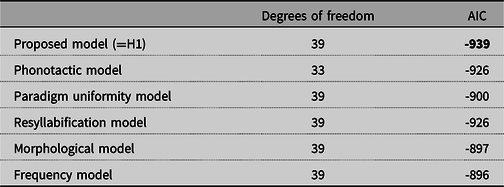
Table 1 shows the AIC values for all six models discussed in section 2. The model in the first row of the table is the model proposed in this article, where (underlyingly) vowel- and glide-initial suffixes are cohering and other suffixes are non-cohering (=H1). The phonotactic model corresponds to the hypothesis that all suffixed words are realized according to the regular phonotactics of the language. The paradigm uniformity model corresponds to the hypothesis that all suffixed words are realized like the base. The resyllabification model corresponds to the hypothesis according to which resyllabifying suffixes are cohering whereas non-resyllabifying suffixes are non-cohering. The morphological model corresponds to the hypothesis according to which derivational suffixes are cohering and inflectional suffixes non-cohering. The frequency model corresponds to the hypothesis according to which suffixed words with salient bases (the base is more frequent) are non-cohering and suffixed words with non-salient bases (the base is less frequent) are cohering. The phonotactic model has a smaller number of degrees of freedom than the other models because it does not include word position as a predictor. Indeed, in this model, the effect of word position is already captured by the segmental context (_C# vs. all other segmental contexts). In the other models, the segmental context does not distinguish bases from derivatives that behave according to paradigm uniformity (both are treated as _C#). That’s why word position (non-final for derivatives vs. final for bases) is needed in addition.
Model comparison

The model proposed in this article has the smallest AIC. This means that the phonological shape of the suffix as vowel/glide-initial or consonant-initial is the single best predictor of suffix cohesion among the different factors considered. These results corroborate the hypothesis developed in section 2 based on [ə]–[ɛ] alternations.
4.2 Summary of the model
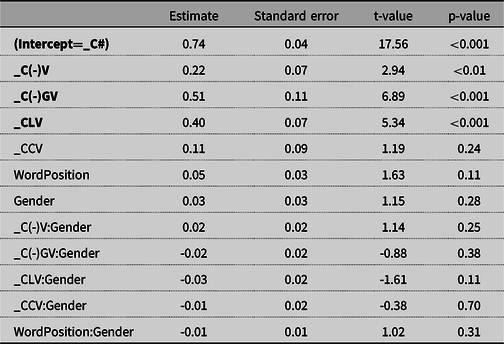
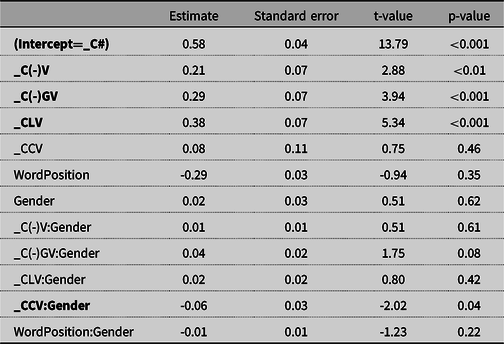
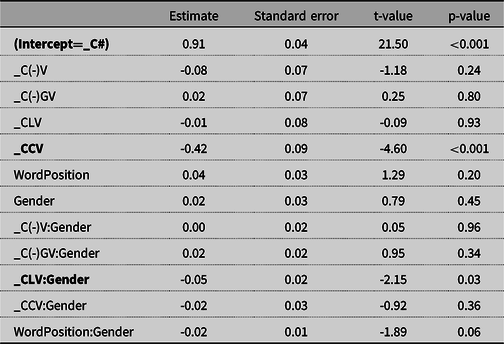
The summary of the best model is shown in Tables 2–4. The three tables summarize the same model, but using different baselines to make the summary easier to read: Table 2 focuses on [ɛ] bases, Table 3 on [ɔ] bases, and Table 4 on [o] bases. In each table, the intercept indicates the average distance to the centre of the F1/F2 space for mid vowels occurring in bases and in derivatives built with liquid-initial and stop-initial suffixes (both are treated as involving the segmental context _C# in the model). The parameters corresponding to the other segmental contexts (_C(-)V, _C(-)GV, _CLV, _CCV) indicate how the distance to the F1/F2 centre in these contexts differs from the baseline context _C#. Contexts _C(-)V and _C(-)GV include both monomorphemic words and derivatives built with V-initial and G-initial suffixes (indeed, these suffixes are treated as cohering in the model). Contexts _CLV and _CCV only include monomorphemic words (because L-initial suffixes and C-initial suffixes are treated as non-cohering in the model). Positive coefficients indicate an increase in the distance to the F1/F2 centre (i.e. they signal more peripheral realizations). Word position indicates how the distance to the F1/F2 centre varies in word-final syllables (i.e. in bases) vs. in non-final syllables (i.e. in neighbours and in derivatives). Gender indicates how the distance to the F1/F2 centre in the baseline context _C# varies for female vs. male speakers. Interaction terms indicate how the effects of the segmental context and word position vary by gender. Effects that are significant (p<0.05) are bolded.
Model summary (base mid vowel = [ɛ])

Model summary (base mid vowel = [ɔ])

Model summary (base mid vowel = [o])

The results are consistent with the predictions for [e]–[ɛ] and [o]–[ɔ] alternations developed in section 2. These predictions are repeated in (7). For bases in [ɛ] (see Table 2), the coefficients corresponding to non-final open syllables (_C(-)V, _C(-)GV, and _CLV) are positive, indicating an increase in peripherality as compared to the baseline context (_C#/_C-LV/_C-CV). This is consistent with a close-mid realization [e] in the former contexts and an open-mid realization [ɛ] in the latter contexts. The coefficient corresponding to non-final closed syllables (_CCV) is not significantly different from zero. This is consistent with an open-mid realization [ɛ] in this context. Table 3 shows the same thing for bases in [ɔ]: the coefficients in this table are consistent with a close-mid realization [o] in non-final open syllables (_C(-)V, _C(-)GV, and _CLV) and an open-mid realization [ɔ] in the remaining contexts (_C#/_C-LV/_C-CV and _CCV). For bases in [o] (see Table 4), the coefficient corresponding to non-final closed syllables (_CCV) is negative, indicating a decrease in peripherality as compared to the baseline context (_C#/_C-LV/_C-CV). This is consistent with an open-mid realization [ɔ] in the former context and a close-mid realization [o] in the latter contexts. The coefficients corresponding to non-final open syllables (_C(-)V, _C(-)GV, and _CLV) are not significantly different from zero. This is consistent with a close-mid realization [o] in these contexts. The reader can check that all these results are in line with the predictions in (7).
The main effect of word position is not significant in any of the three models presented in Tables 2–4, meaning that the distance to the F1/F2 centre does not vary significantly between bases and derivatives built with L-initial and C-initial suffixes.Footnote 7 This is consistent with the hypothesis that these suffixes are non-cohering.
-
(7) Predictions for [e]–[ɛ] and [o]–[ɔ] alternations

The description above focused on the main effects. But there were also significant two-way interactions involving gender. This paragraph shows that, despite these additional effects, the predictions of the analysis remain correct for both groups of participants. Male speakers were found to have slightly more peripheral realizations of the back mid vowel [ɔ] in _CCV than female speakers (see the two-way interaction _CCV:Gender in Table 2). But a post-hoc test showed that the back mid vowel in this context remained not significantly different from the corresponding [ɔ] in _C# for male speakers, in line with the predictions in (7). Female speakers were found to have slightly more central realizations of the back mid vowel [o] in _CLV than male speakers (see the two-way interaction in _CLV:Gender). But a post-hoc test showed that the back mid vowel in this context remained not significantly different from the corresponding [o] in _C# for female speakers, in line with the predictions in (7).
4.3 Additional tests
The model comparison in section 4.1 suggested that the model treating underlyingly vowel- and glide-initial suffixes as cohering and other consonant-initial suffixes as non-cohering is the best model among the set of models considered in the article. The summary of the model presented in section 4.2 further suggested that L-initial and C-initial suffixes are non-cohering, as predicted by the analysis. However, this analysis did not provide a direct test of the hypothesis that underlyingly V-initial and G-initial suffixes are cohering. Indeed, the model treats _CV (within a morpheme) and C-V (across a morpheme boundary) identically. It also treats _CGV (within a morpheme) and _C-GV (across a morpheme boundary) identically.
This section describes additional tests that were run to check that (i) stem mid vowels are not significantly different from the corresponding mid vowels in neighbours when the suffixes are underlyingly V-initial and G-initial and (ii) stem mid vowels are not significantly different from base mid vowels when the suffixes are L-initial and C-initial. To test these hypotheses, the same kind of linear mixed-effects models were run as in section 4.1. The models included base mid vowel, segmental context, gender and all their interactions as fixed effects (in these models, word position is not needed because the segmental context already captures the distinction between final and non-final syllables). There was a random intercept for each speaker and a random intercept for each word. To keep this section short, the presentation focuses on the average effects observed across female and male speakers (the two groups behaved very similarly).
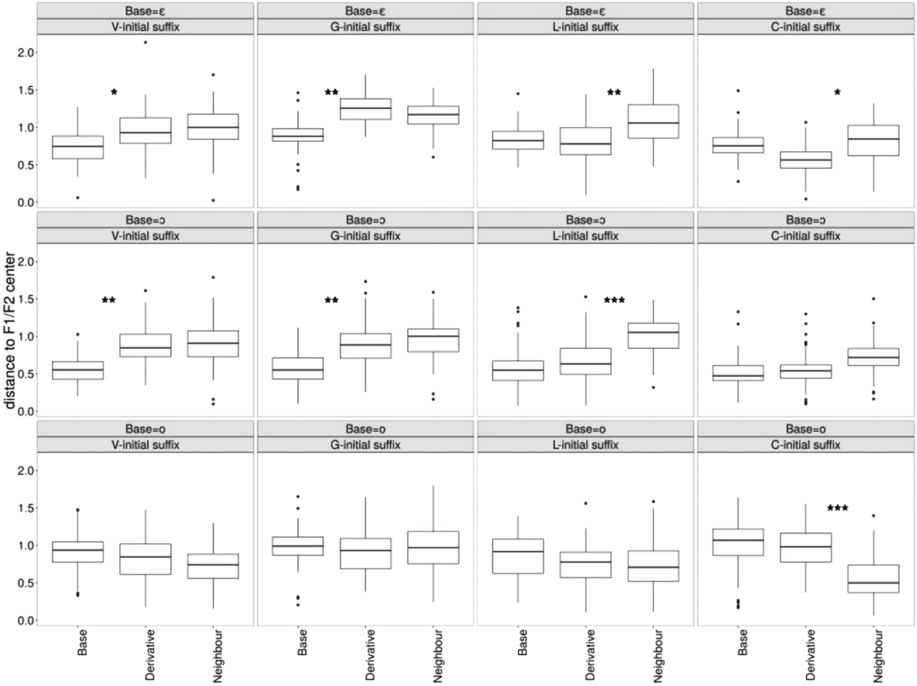
The results are reported on Figure 1. Figure 1 compares the realization of mid vowels in the derivative with their realization in the base and in the phonotactic neighbour as a function of the base mid vowel ([ɛ o ɔ]) and the suffix-initial segment (vowels, glides, liquids, and other consonants). Hypothesis (H1) predicts that mid vowels in derivatives should be identical to the corresponding mid vowels in neighbours with vowel- and glide-initial suffixes (see the six leftmost panels) but identical to the corresponding mid vowel in bases with other consonant-initial suffixes (see the six rightmost panels). Note that, for [o], for all V-, G-, and L-initial suffixes, the same vowel quality is expected for derivatives, their bases, and their neighbours. Indeed, phonotactics and paradigm uniformity predict a close-mid quality in these three cases.
Mid vowel realization in the study. The distance to the F1/F2 centre was calculated using z-scored F1 and F2 values. Significant differences between derivatives and bases or between derivatives and neighbours are indicated with stars (* indicates a p-value <0.05, ** indicates a p-value <0.01, *** indicates a p-value <0.001).

The results are largely compatible with the predictions of the analysis proposed in this article. With vowel-initial and glide-initial suffixes, suffixed words do not behave significantly differently from their neighbours, i.e. they behave according to the regular phonotactics of the language. With liquid-initial suffixes and other consonant-initial suffixes, suffixed words do not behave significantly differently from their bases, i.e. they behave according to paradigm uniformity. The results are described in more details below, focusing first on bases in [ɛ] and [ɔ] (the first two rows in Figure 1) and then on bases with [o] (the last row in Figure 1).
4.3.1 Bases in [ɛ] and [ɔ]
For bases with open-mid vowels [ɛ ɔ] (see the first two rows in Figure 1), stem mid vowels are significantly more peripheral in the words suffixed with vowel- and glide-initial suffixes than in the corresponding bases (see columns 1 and 2 in Figure 1). This is compatible with the hypothesis that the quality of stem mid vowels is determined by the loi de position before these suffixes. Indeed, the loi de position requires close-mid vowels [e o] before CV and CGV morpheme-internally, and [e o] are more peripheral than [ɛ ɔ].
Stem mid vowels in derivatives built with liquid-initial suffixes are significantly more central than in the corresponding neighbours (see column 3 in Figure 1). This is also compatible with the current hypothesis. Indeed, for bases with open-mid vowels [ɛ ɔ], paradigm uniformity before liquid-initial suffixes predicts [ɛ ɔ] in the corresponding derivatives and the loi de position predicts more central realizations (namely [e o]) in neighbours before CLV.
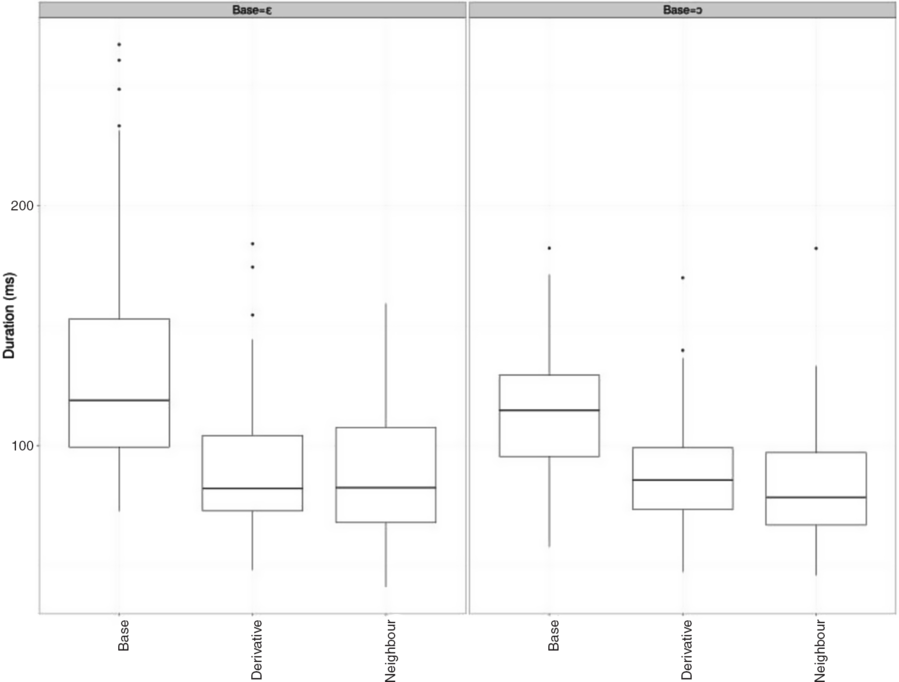
Finally, the current hypothesis predicts an open-mid vowel quality [ɛ ɔ] for derivatives suffixed with other consonant-initial suffixes and for their neighbours. For derivatives, this is because mid-vowel quality is copied from bases with [ɛ ɔ]. For neighbours, this is because the loi de position predicts an open-mid vowel quality [ɛ ɔ] in non-final closed syllables. However, contrary to this prediction, mid-vowel quality was found to be slightly less peripheral in neighbours than in derivatives (see column 4 in Figure 1; note that this effects reaches significance only for [ɛ]). How can we explain this difference between derivatives and neighbours? Open-mid vowels are expected to be more peripheral acoustically word-finally than non-finally, due to vowel undershoot in nonfinal syllables (see Storme, Reference Storme2017a). If paradigm uniformity effects are sensitive to this level of fine grained phonetic detail (see Steriade, Reference Steriade, Broe and Pierrehumbert2000), then we actually do expect open-mid vowels [ɛ ɔ] to be more peripheral in derivatives than in the corresponding neighbour: under Steriade’s hypothesis that paradigm uniformity cares about the base’s detailed phonetic realization, the derivative is expected to copy the vowel quality of the base without undershoot and not just the phonological label [ɛ ɔ]. Note that the difference between derivatives and neighbours cannot be attributed to stem mid vowels in derivatives also copying the long duration of base mid vowels in addition with their quality. Indeed, although mid vowel duration is longer in bases than in neighbours, it is not longer in derivatives than in neighbours in the relevant conditions, as shown in Figure 2.
Mid vowel duration in derivatives suffixed with C-initial suffixes, in the corresponding bases, and in the corresponding neighbours.

4.3.2 Bases in [o]
For bases in [o] (see the last row in Figure 1), stem mid vowels in derivatives suffixed with V-, G-, and L-initial suffixes are not significantly different from the corresponding mid vowels in bases or neighbours (see columns 1 to 3 in Figure 1). This is expected under the present analysis. In neighbours, we expect a close-mid quality [o], due to the loi de position before CV, CGV, and CLV. In derivatives, we also expect a close-mid quality [o] both with V- and G-initial suffixes (due to the loi de position) and with L-initial suffixes (due to paradigm uniformity). Before other C-initial suffixes, mid vowels are more peripheral in derivatives than in neighbours (see column 4 in Figure 1). This is expected under the present analysis. Indeed, paradigm uniformity predicts a close-mid quality [o] for derivatives suffixed with C-initial suffixes while, in neighbours where the mid vowel appears in a closed syllable, the loi de position predicts a more central, open-mid quality [ɔ].
5. DISCUSSION
The hypothesis that suffix cohesion is conditioned by the suffix-initial segment in French was corroborated by acoustic evidence on [e]–[ɛ] and [o]–[ɔ] alternations. Section 5.1 highlights some limits of this study and makes suggestions for future research. Section 5.2 proposes an analysis of suffix cohesion in French.
5.1 Limits of the study
It was difficult to find neighbours that perfectly matched the corresponding derivatives segmentally. For example, the neighbour of fêt-ard was féta, without final rhotic. In some cases, the discrepancy between the neighbour and the derivative was greater: for instance, the neighbour of cloche-ton was pochtron, where the target mid vowel is preceded by one consonant instead of two, followed by three instead of two, and the word-initial cluster/consonant have different places of articulation ([kl] vs. [p]). In a future study, the segmental context should be controlled for more carefully. This could be done by considering nonce words as neighbours (e.g. fake proper names like Fétar). As mentioned earlier, the C-initial suffix -ment was represented in several suffixed words because it was difficult to find actual examples of words with other suffixes. To overcome this problem, it might also be necessary to consider nonce words built with other consonant-initial suffixes.
The acoustic study only considered a small pool of Parisian French speakers in their 20s. Therefore, caution should be used before generalizing, in particular with other French varieties. French varieties notoriously differ in their patterns of distribution of mid vowels. For instance, in Southern French, there are no contrasts between close-mid and open-mid vowels (Coquillon and Turcsan, Reference Coquillon, Turcsan, Gess, Lyche and Meisenburg2012). In particular, in contrast with Parisian French, all mid vowels in Southern French are open-mid before word-final consonants (e.g. côte is pronounced as [kɔt] instead of [kot]). This means that suffix cohesion cannot be diagnosed by contrast maintenance in suffixed stems in this variety. As a consequence, the protocol used in this study should be slightly adapted to take this type of difference into account when dealing with other French varieties.
Finally, the models that were compared in the article treated the different predictors (in particular frequency, morphological function, and suffix’s phonological shape) as exclusive. However, the behaviour of derivatives as phonologically regular or paradigmatically uniform could be affected by all these factors at the same time (see Hay, Reference Hay2003 on English affixes for instance). The choice of focusing on a single predictor at a time made sense because the main theoretical goal of the article was to compare two exclusive predictors, namely resyllabification and suffix’s initial segment. However a full model of the phonology of derivatives should include all these potentially interacting predictors.Footnote 8
5.2 An alternative to the prosodic analysis of suffix cohesion
Suffix cohesion cannot be straightforwardly captured in terms of resyllabification of the stem-final consonant, as discussed for [ə]–[ɛ] alternations in section 2 and as further shown with [e]–[ɛ] and [o]–[ɔ] alternations in section 4. In this section, I summarize the key points of the alternative, phonetically-based analysis I proposed in Storme (Reference Storme2017b).
The analyses makes a crucial use of paradigm uniformity: in words suffixed with L-initial and C-initial suffixes, the mid-vowel quality in the base’s final syllable is analogically extended to the stem. But paradigm uniformity is phonetically conditioned: it only applies if the stem is sufficiently similar to the base phonetically, in a ‘rich get richer’ effect. This type of ‘rich get richer’ effects in the phonology of derivatives has already been identified in previous works, in particular in Burzio’s (Reference Burzio and Boucher2002) work on ‘gradient attraction’.
As compared to liquids, stops, and fricatives, vowels and glides provide salient release transitions to a preceding consonant (Wright, Reference Wright, Hayes, Kirchner and Steriade2004). This phonetic difference can explain in a principled way the different behaviour of V-initial and G-initial suffixes vs. other suffixes: V-initial and G-initial suffixes deeply affect the phonetic realization of stem-final consonants by adding formant transitions that are absent in the base whereas other consonant-initial suffixes do not. The phonetic difference between the realizations of stem-final and base-final consonants makes the base harder to recognize in stems suffixed with V-initial and G-initial suffixes. This results in the base failing to further attract the suffixed word’s stem. In the absence of paradigmatic pressure from the corresponding bases, the stems are pronounced according to the language’s regular phonotactics: stem mid vowels are pronounced as close-mid in accordance with the loi de position. With other consonant-initial suffixes, the absence of salient release transitions makes the stem-final consonant sufficiently similar to the corresponding base-final consonant to allow for the stem to be further attracted to the base. This attraction results in stem mid vowels being pronounced identically as the corresponding base mid vowels.
The difference between G-initial and L-initial suffixes is particularly problematic for an account in terms of resyllabification, as both suffixes should trigger resyllabification and therefore behave as cohering suffixes. In the current analysis, the difference between the two types of suffixes is expected if glides affect the release properties of a preceding consonant more than liquids do. Both glides and liquids have formant structure and therefore provide release transitions to a preceding consonant (Wright, Reference Wright, Hayes, Kirchner and Steriade2004). However, glides are acoustically more similar to vowels than liquids are, and therefore potentially provide more salient release transitions to a preceding consonant. Also, Storme (Reference Storme2017b) provides preliminary experimental evidence that word-final consonants are perceptually more similar to their pre-liquid counterparts than to their pre-glide counterparts. In a nutshell, a [t] extracted from fête is judged as more similar to a [t] extracted from fête-rez than to a [t] extracted from fêt-iez. This difference then underlies the different patternings of G-initial and L-initial. G-initial suffixes induce a sufficiently salient change to allow the stem to drift further apart from the base and comply with the language’s regular phonotactics. By contrast, L-initial suffixes do not hinder the recognition of the base, allowing for further similarity between the stem and the base with respect to mid-vowel quality.
Due to their output-oriented nature, the prosodic analysis and the alternative phonetically-based analysis face the same difficulty in accounting for the paradigmatically uniform behaviour of stems followed by epenthetic schwa (e.g. fêteriez [fɛt-ə-ʁje]; see section 2.2 on the prosodic analysis). For the phonetically-based analysis, the problem is due to the fact that the presence of salient release transitions in epenthetic schwa should make the final consonants in the stem (e.g. [t] in fêteriez [fɛt-ə-ʁje]) and in the base (e.g. [t] in fête [fɛt]) sufficiently dissimilar for the stem not to be further attracted to the base, as for underlyingly vowel-initial suffixes.
In Storme (Reference Storme2017b), I proposed the following solution to this problem. Schwa epenthesis between the stem and the suffix does not weaken the base’s attraction because schwa epenthesis is also available at the end of bases. For instance, fête is usually realized as [fɛt] but can also be realized as [fɛtə], with a final epenthetic schwa. As a consequence, the specific release transitions that are added to the stem-final consonant in case of schwa epenthesis before a suffix (e.g. fêteriez [fɛt-ə-ʁje]) can also be present in the base-final consonant, in case of word-final schwa epenthesis (e.g. fête [fɛtə]). In other words, schwa epenthesis at a morpheme boundary does not hinder the recognition of the base, allowing for the stem to be further attracted to the base with respect to mid-vowel quality. This does not happen with other vowels (e.g. [a] in fêt-ard [fetaʁ]) because other vowels cannot be epenthesized freely at the end of words in French.
6. CONCLUSION
This article has provided converging evidence for a previously undescribed pattern of suffix cohesion in French, where words suffixed with vowel- and glide-initial suffixes behave phonologically like simple units and words built with other suffixes behave phonologically like complex units. This finding is relevant for theories of suffix cohesion because it suggests that other factors beyond resyllabification, morphological function, and frequency play a role in determining whether a suffix is cohering or not. It was suggested that suffix cohesion in French can be interpreted in terms of how the suffix-initial segment affects the phonetic similarity between the suffixed stem and the corresponding base.
The results are also relevant for theories of paradigm uniformity more generally. Indeed, some of the results in section 4 suggest that paradigm uniformity is sensitive to fine-grained phonetic detail, as hypothesized by Steriade (Reference Steriade, Broe and Pierrehumbert2000). However, these results are very preliminary and should be evaluated further in a future study.
Finally, the results are also relevant for transcription conventions for French. In the dictionary le Petit Robert (Robert, Reference Robert2013), suffixed words with vowel-initial or glide-initial suffixes are not consistently transcribed according to the language’s regular phonotactics. For instance, fêt-ard is transcribed according to paradigm uniformity as [fɛtaʁ] and differently from monomorphemic féta ‘feta cheese’, transcribed as [feta]. The findings in this article suggest that words with vowel- and glide-initial suffixes should be more consistently transcribed as phonotactically regular, at least in the French variety studied here. Further studies should be carried out to assess whether the results reported here extend to other French varieties.
Appendix