1 Introduction
Previous work on yod dropping, i.e. the loss of the onglide after the coronals /t, d, n/, has shown that the yod-less pronunciation has become increasingly common in North American varieties of English during the late twentieth century (Chambers Reference Chambers1998: 17). This means that words such as ‘student’ now tend to be pronounced as [studənt] rather than [stjudənt]. For a long time, scholars believed that speakers of Canadian English, similar to speakers of standard British English, retained the yod as a sign of ‘a distinct Anglo-Canadian linguistic identity’ (Clarke Reference Clarke2006: 226). However, virtually all studies conducted in the last few decades suggest that yod dropping is fairly common in Canada, and has been for some time (Scargill Reference Scargill1974; Owens & Baker Reference Owens and Baker1984; Nylvek Reference Nylvek1992; Clarke Reference Clarke and Clarke1993; Chambers Reference Chambers1998; Boberg Reference Boberg2004; Dollinger Reference Dollinger2012; Serendiak & D'Arcy Reference Serendiak and D'Arcy2015; Roeder et al. Reference Roeder, Onosson and D'Arcy2018, inter alia).
There has not been much recent inquiry into the current state of yod dropping in Canadian English (but see Serendiak & D'Arcy Reference Serendiak and D'Arcy2015 and Roeder et al. Reference Roeder, Onosson and D'Arcy2018). Most existing studies rely on reported language use and are therefore limited to a few words, such as news and student (Chambers Reference Chambers1998; Boberg Reference Boberg2004).Footnote 2 Moreover, the situation is complicated by the fact that /u/ itself is fronting in many inner-circle varieties of English (Fought Reference Fought1999; Hawkins & Midgley Reference Hawkins and Midgley2005; Fridland & Bartlett Reference Fridland and Bartlett2006; Labov et al. Reference Labov, Ash and Boberg2006; Harrington et al. Reference Harrington, Kleber and Reubold2008; Hall-Lew Reference Hall-Lew2011; Baranowski Reference Baranowski2017, inter alia), including Canadian English (Boberg Reference Boberg2011; Hoffman Reference Hoffman2016; Hall & Maddeaux Reference Hall and Maddeaux2020; Umbal Reference Umbal2021). As Roeder et al. (Reference Roeder, Onosson and D'Arcy2018: 104) point out, this is problematic because ‘it is possible that what looks like retention of yod overlaps acoustically with a bona fide ongoing change’ – namely, the fronting of /u/, which has been shown to be particularly advanced in postcoronal position (Roeder et al. Reference Roeder, Onosson and D'Arcy2018: 104).
Keeping the problematic relationship between retention and /u/-fronting in mind, this article investigates the current state of yod dropping in Toronto English using both auditory and acoustic analyses. Results of the auditory analysis indicate that yod dropping is the norm in Toronto English, with less than 6 percent retention. The acoustic analysis confirms that the change towards the yod-less pronunciation is largely complete, with both older and younger speakers showing no statistically significant differences in F2 at 20 percent between words which historically had a yod after /t, d, n/ (henceforth: new words) and words which did not (henceforth: too words; see Roeder et al. Reference Roeder, Onosson and D'Arcy2018 for similar findings). Taken together, these findings suggest that yod retention is clearly a minority variant in contemporary Toronto English, especially when compared to more linguistically conservative Canadian varieties such as Victoria English, which has a much higher retention rate (Roeder et al. Reference Roeder, Onosson and D'Arcy2018). They further highlight the need to move away from pre-determined cut-off points for determining yod presence, which are common in previous work, and find more clear-cut acoustic correlates that may help us to distinguish between the two changes (see also Roeder et al. Reference Roeder, Onosson and D'Arcy2018).
2 Background
2.1 Diachronic perspective
In this article, yod dropping refers to the loss of the onglide in words which historically had it after the coronals /t, d, n/. However, the term is often used more broadly to describe the loss of yod in other contexts. According to Wells (Reference Wells1982: 207), yod dropping started in the seventeenth century in three contexts: ‘(i) after palatals (including palato-alveolars), as in chute, chew, juice, yew; (ii) after /r/, as in rude, crew, shrew, grew; and (iii) after consonant plus /l/, as in blue, flue, flew, glue’. This process is usually referred to as ‘Early Yod Dropping’ (Wells Reference Wells1982: 206). Nowadays, the loss of yod is also common following other coronal consonants, as in tune, dew and suit (Chambers Reference Chambers2002). This so-called ‘Later Yod Dropping’ (Wells Reference Wells1982: 207) is considered a stereotypical feature of American English. In fact, the research literature abounds with metalinguistic commentary about this feature from researchers and laypeople alike. For example, Pringle (Reference Pringle and Greenbaum1985: 190) noted that
[t]here is one shibboleth of pronunciation which Canadians use to mark their difference from Americans: the pronunciation of ‘u’ and ‘ew’ spellings after t, d, and n. Canadians think they know that Americans invariably say ‘toon’ for ‘tune’, ‘doo’ for ‘dew’, ‘nooz’ for ‘news’. They also believe that the British do not do these things. Consequently when they want to stress how their English differs in sound from American English, they are particularly likely to settle on these sounds.
However, research has shown that this description does not reflect what speakers of Canadian English actually do. In the following, I will briefly review the existing literature on yod dropping in Canadian English in more detail.
2.2 Synchronic perspective
As mentioned earlier, most research on yod dropping is based on reported language use. Two studies stand out: Scargill's (Reference Scargill1974) Survey of Canadian English, examining over 14,000 postal surveys by grade nine students and their parents from all over Canada, and Chambers’ (Reference Chambers1998) Dialect Topography Project, which also used postal surveys to sample over 1,000 speakers from the Golden Horseshoe region. Both surveys showed a decline in reported yod usage in Ontario, with younger speakers reporting far less retention than older speakers, suggesting that yod was rapidly disappearing in both real and apparent time. Even among the older speakers, the yod-ful pronunciation was rare (19 percent for news, 20 percent for student); among younger speakers, only 9 percent reported yod in the words news and 14 percent in the word student. Using comparable methods, Clarke (Reference Clarke2006) found similar results for speakers from Newfoundland.
One drawback of these studies is that they only provide information about a handful of words. Moreover, they risk being unreliable, since speakers are often unaware of what they actually do. Chambers (Reference Chambers1998) argued that it is unlikely that speakers would report yod dropping given the prestigious connotations of retention. Yet Dollinger (Reference Dollinger2012) found that speakers consistently under-report their use of yod in written questionnaires. At first sight, these two positions seem to be at odds. However, given that /u/ is fronting in Canadian English, it is possible that at least some of the instances Dollinger coded as retention are actually instances of /u/-fronting. Be that as it may, one thing is clear: even if the large survey studies underestimate retention, there is a general trend towards the yod-less pronunciation. Evidence for this comes from Clarke (Reference Clarke and Clarke1993), who found extremely low retention rates (10 percent or less) in a word-list task conducted with students from Ontario and Newfoundland, and a number of large-scale studies of Canadian English from the turn of the century, such as Gregg's (Reference Gregg2004) study of Vancouver English and Woods' (Reference Woods1999) survey of Ottawa English. As Clarke (Reference Clarke2006) observed, all three studies point to the same conclusion, namely that yod dropping seems to be a ‘change from below’ (Labov Reference Labov1994: 196), i.e. a change below the level of consciousness. Interestingly, this change was not led by females, as is frequently the case, but by males and blue-collar workers. An additional layer of complexity comes from stylistic variation (here operationalized in the Labovian sense as attention paid to speech), which showed that upper-class women tend to retain yod in more formal styles. Clarke (Reference Clarke2006) interpreted this as a change in indexicality. More precisely, she argued that different parts of the population have different realization targets: upper-class women aim for the yod-ful pronunciation, which is associated with ‘culture and erudition’ (Clarke Reference Clarke2006: 243), while lower-class men use the yod-less pronunciation, which is indexes ‘modernity and progressiveness’ (Clarke Reference Clarke2006: 241).
It is unclear to what extent this interpretation matches listeners’ perceptions and whether it still holds up today, more than ten years after Clarke's findings were published. Recent work suggests that yod may be retained in some parts of Canada: examining a stratified community corpus consisting of sociolinguistic interviews with 162 speakers, Roeder et al. (Reference Roeder, Onosson and D'Arcy2018) found an unusually high rate of retention (39.5 percent overall, N = 440), with rates for individual words ranging from 22.3 percent for due (N=112) to 51.0 percent for student (N=104). The authors offer two possible explanations: for one thing, it is possible that speakers of Victoria English are holding on to the yod despite the nationwide trend towards deletion. Given Victoria's geographic isolation and the fact that it experienced a constant influx of immigrants from England during the late nineteenth and early twentieth century, this would not be surprising. Another possibility is that speakers are not retaining the yod, but participating in /u/-fronting instead. Indeed, Roeder et al. (Reference Roeder, Onosson and D'Arcy2018: 104) found that yod-less words with preceding coronals (i.e. chew and too words) occupy almost the same F2 values as new words, especially among young speakers. They point out that the resulting acoustic overlap makes yod retention and /u/-fronting ‘virtually indistinguishable’ (Roeder et al. Reference Roeder, Onosson and D'Arcy2018: 104).
One predictor that has not received a lot of attention in the Canadian context is word frequency. Previous work on US English showed that word frequency seemed to play an important part during earlier stages of yod dropping, with low-frequency words leading the change towards the yod-less pronunciation (Phillips Reference Phillips1981, Reference Phillips1994). Given that a similar effect was found for the stress shift in noun–verb pairs like EXploit–exPLOIT and EXtract–exTRACT, Phillips (Reference Phillips2006) argued that word frequency has a systematic influence on lexical diffusion, with high-frequency words leading in changes that involve phonetic realizations of phonemes (such as /u/-fronting and other vowel shifts), and low-frequency words leading in changes that require detailed structural information about a word (such as yod dropping, which has slowly but surely started to spread to different linguistic contexts). She further speculated that the markedness of the clusters /tj, dj, nj/ may make them particularly susceptible to change. Recent work on Derby English, a variety spoken in the north midlands of England, did not replicate Phillips’ results, finding that low-frequency words were actually more likely to retain the yod (Sóskuthy et al. Reference Sóskuthy, Foulkes, Hughes and Haddican2018). Following Bybee (Reference Bybee, Barlow and Kemmer2000), the authors argue that this might be related to dialect borrowing – most English varieties, including the standard variety, retain the yod after the coronals /t, d, n/ and since low-frequency items are more likely to get borrowed into local varieties, they are more likely to reflect supra-local norms. One of the few studies considering the effect of word frequency in the Canadian context is Serendiak & D'Arcy's (Reference Serendiak and D'Arcy2015) paper on yod dropping in synchronic and diachronic data from Victoria, British Columbia. The authors found that retention was particularly high with preceding nasals, but there were high rates of inter-speaker variability. While they noted that word frequency is one possible explanation for this variability, frequency did not turn out to be a significant predictor in their study.Footnote 3 There are several possible explanations for this result: first, the change may be complete, and all words are affected to the same extent. However, given the high rates of retention in the synchronic data, this seems unlikely. A more plausible explanation is that the materials they used did not include a sufficiently large number of low-frequency words to find an effect. In order to avoid this pitfall, this study used a wordlist to collect data, with frequency being controlled for both variable yod words and yod-less words with preceding alveolars. Last but not least, Serendiak & D'Arcy's (Reference Serendiak and D'Arcy2015) results may have been affected by the presence of test words with secondary stress, which have been shown to pattern differently in previous work (Chambers Reference Chambers2002).
3 Data and methods
3.1 Speakers
The data come from 20 speakers from the Greater Toronto Area (GTA), who have lived in the GTA between the ages of 5 and 18. The sample is balanced for gender (women vs men) and age (over 40 (mean age = 55.6) vs under 40 (mean age = 22)).Footnote 4 The speakers come from a variety of ethnic backgrounds. All of them identify as native speakers of English, but five of them report speaking an additional language at home (Cantonese, Vietnamese, French, Spanish and Italian, respectively). This is quite typical for Toronto, which is one of the most linguistically diverse cities in the world, with approximately 200 different languages spoken on top of Canada's official languages, English and French (Endangered Language Alliance Toronto n.d.). While variationist work on sound change tends to control for ethnicity and language background, this approach did not seem warranted here since creating an artificially homogenous sample would not have been an accurate reflection of the speech community under investigation. Since all five speakers come from different backgrounds, and the statistical models control for individual variation, I do not expect this diversity to have an undue influence on the results.
3.2 Materials
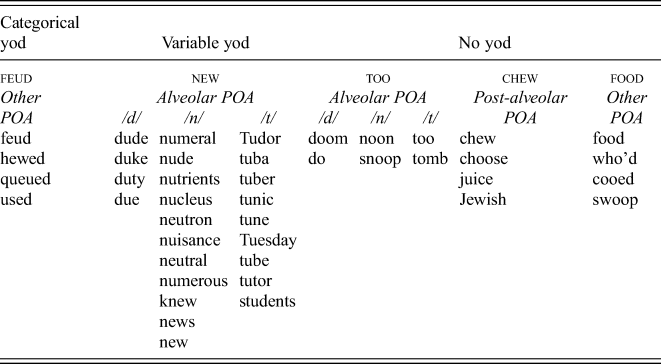
Speakers read a randomized wordlist of 142 words, including 42 test words and 100 distractor items (appendix A).Footnote 5 Following Sóskuthy et al. (Reference Sóskuthy, Foulkes, Hughes and Haddican2018), test items were grouped into three categories:
(i) words which historically contained an onglide in primary stress position (i.e. new words),Footnote 6 such as new, duty and Tudor;
(ii) words which categorically include an onglide in primary stress position (i.e. feud words), such as feud and hewed; and
(iii) words which never contained an onglide in primary stress position (i.e. yod-less words).
The latter were further divided into three subcategories:
(iiia) yod-less words with preceding alveolars (i.e. too words), such as noon, doom and too;
(iiib) yod-less words with preceding postalveolars (i.e. chew words), such as chew and juice; and
(iiic) yod-less words with other preceding segments (i.e. food words), such as food and who'd.
The new words were adapted from Phillips’ studies on yod dropping in the southern US (Phillips Reference Phillips1981, Reference Phillips1994), and are roughly balanced for frequency and preceding consonant (/n/ vs /d/ vs /t/). too words (also roughly balanced for frequency and preceding consonant) were added to test whether the merger was complete.
Both the feud words and the food words were adapted from Harrington et al. (Reference Harrington, Kleber and Reubold2008) and were included to see if the new words pattern more closely to a diphthongal /ju/ (as in feud words) or a monophthongal /u/ (as in food words). The chew words were added to get a better idea of how words with preceding postalveolars, which lost the yod during the early stages of yod dropping, compare to words with preceding /t, d, n/, which lost the yod much later (Wells Reference Wells1982: 206).
Since previous research has shown that words where /u/ is followed by /l/ tend to have much lower F2 values than those with other following consonants (with the exception of Baranowski's Reference Baranowski2017 study of Manchester English), the words duel and tulips, which were included in Phillips’ (Reference Phillips1981, Reference Phillips1994) work, were excluded from the analysis. Words where /u/ is followed by /ɹ/, such as durable and during, were also excluded because /u/ is usually realized as [ʊ] in this context (Rogers Reference Rogers2013: 76). For an overview of test words, see table 1.
Overview of test words

3.3 Procedure
Participants were recorded in a quiet area of their choice. First, they were presented with a brief background questionnaire (see appendix B). Then, they were asked to read the wordlist, which was presented twice and in random order on a laptop computer using PsychoPy (Peirce Reference Peirce2007). Sessions were recorded using a Zoom H4n Pro handy recorder with an AT832R lavalier microphone. The sampling frequency was set to 44,100 Hz.
3.4 Measurements
In order to make the results comparable to Roeder et al.'s (Reference Roeder, Onosson and D'Arcy2018) findings from Victoria English, F2 at 20 percent of vowel duration was used as the dependent variable in the mixed effects models, with the assumption that words where the onglide is present will have higher F2 values than words where it is not present. The measurements were obtained as follows: first, the test words were segmented manually in Praat (Boersma & Weenink Reference Boersma and Weenink2018). Then, the vowel in all new tokens was coded impressionistically by the author as retaining (/ju/) or not retaining the onglide (/u/) to get an idea if there were any audible differences between the two sounds. Since previous research has shown that there is a third possibility, where speakers palatalize preceding /d/ and /t/ and delete the yod (Clarke Reference Clarke and Clarke1993), preceding coronal obstruents were further coded for whether or not they are affricated.Footnote 7 Tokens that were distorted by background noise of affected by mispronunciations were excluded, yielding 950 new tokens for the auditory analysis. Subsequently, a Praat script was used to extract F2 measurements at ten evenly spaced points throughout the vowel from all test words, whereby the script referred to a manually determined formant ceiling. Whenever necessary, formant measurements were hand-corrected by determining a more appropriate formant range and rerunning the script. Again, any that were not clearly audible or mispronounced were excluded. This approach yielded 1,185 tokens for the first part of the acoustical analysis (i.e. the comparison between variable yod words and yod-less words with preceding alveolars) and 1,655 tokens for the second part of the acoustical analysis (i.e. the comparison between categorical yod words, variable yod words and yod-less words with different preceding segments).
Following Hay et al. (Reference Hay, Pierrehumbert, Walker and LaShell2015: 86), formant values were not normalized. In order to account for individual differences in formant values, a random by-subject intercept and a random by-subject slope for vowel type were included in the first part of the acoustic analysis. Due to convergence issues, the random by-subject slope for vowel type was not included in the second part of the analysis.
4 Coding and analysis
4.1 Coding schema
4.1.1 The dependent variable
For the auditory coding, yod was coded impressionistically as present or absent. Since previous work has shown that using predetermined cut-off point for determining yod presence is problematic, the acoustic analysis relies on continuous F2 values instead. If the contrast between presence and absence of the onglide was retained, F2 at 20 percent was expected to be higher for new words than for too words, especially among older speakers who are more likely to retain the distinction.
4.1.2 The independent variables
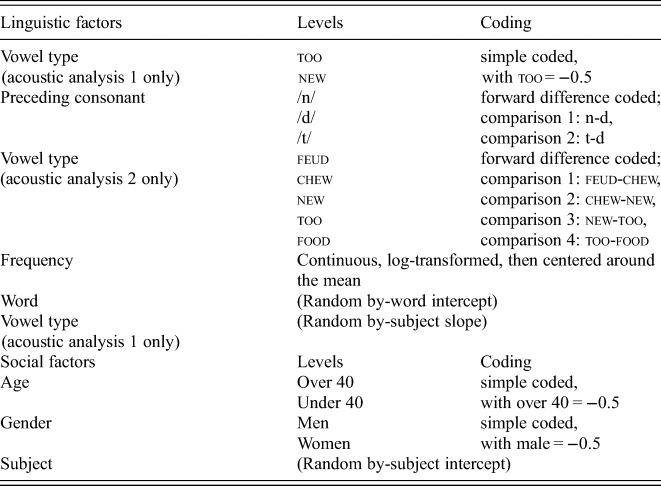
The data were coded for a variety of linguistic and social predictors. For an overview of the coding schema, please see table 3.
The first predictor is vowel type. As mentioned above, the test words fall into five categories: feud words, new words and yod-less words, which can further be divided into too, chew and food words.
For the first part of the acoustic analysis, which seeks to determine whether there is still a contrast between /ju/ and /u/ in words with preceding alveolars, only new and too words were included. Given that the merger seemed to be in its final stages over twenty years ago (Chambers Reference Chambers1998), no significant differences between the two vowel types are expected.
To determine whether there is any difference between the preceding alveolars, the data were further coded for the preceding consonant (/n/ vs /d/ vs /t/). Following Serendiak & D'Arcy (Reference Serendiak and D'Arcy2015), preceding /n/ is expected to have higher F2 values at 20 percent than preceding /d/ and /t/.
For the second part of the acoustic analysis, which focuses on how the potentially merged sound compares to categorical yod words and yod-less words, all five vowel types were considered. Following Sóskuthy et al. (Reference Sóskuthy, Foulkes, Hughes and Haddican2018), new words are expected to pattern in between feud and food words. Given that /u/-fronting is particularly advanced in postcoronal position, no statistical difference in F2 at 20 percent is expected between new, too and chew words (Boberg Reference Boberg2011; Roeder et al. Reference Roeder, Onosson and D'Arcy2018).
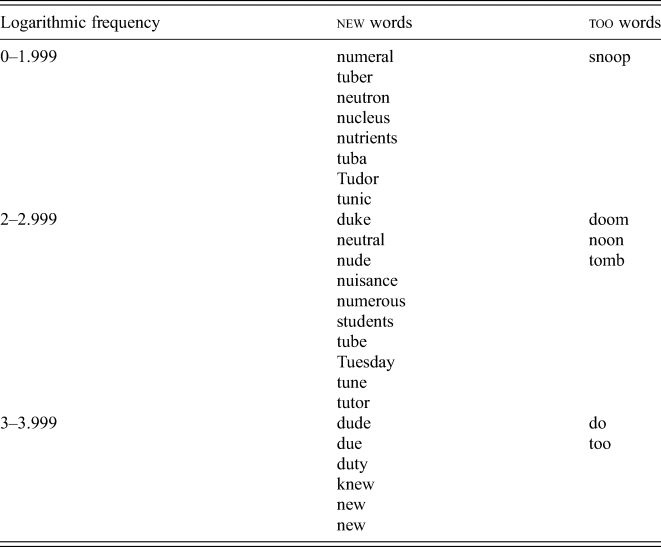
The test words were also coded for word frequency, based on the logarithmic frequency measure in SUBTLEXUS, which is based on a 51-million-word corpus of US American subtitles (Brysbaert & New Reference Brysbaert and New2009). An overview of the frequency values is provided in table 2. In order to improve readability, the test words were divided into three arbitrary groups of roughly equal size.
Test words by word frequency

Coding schema

Given the contradictory findings by Phillips (Reference Phillips1981, Reference Phillips1994) and Sóskuthy et al. (Reference Sóskuthy, Foulkes, Hughes and Haddican2018), there are no firm predictions regarding the effect of word frequency. Since standard Canadian English seems to have been in the process of losing the yod for decades at this point, it seems unlikely that low-frequency words in Toronto English retain yod as a dialect borrowing, though, as they did in Sóskuthy et al. (Reference Sóskuthy, Foulkes, Hughes and Haddican2018).
The data was further coded for age (over 40 vs under 40) and gender (men vs women). Given that the loss of the onglide has been almost complete for over twenty years, while the change towards /u/-fronting is still ongoing, an interaction between vowel type and age is anticipated, with younger speakers having significantly higher F2 values at 20 percent for too words. Since speakers’ F2 values were not normalized, a gender effect is expected, with men having significantly lower F2 values at 20 percent vowel duration than women.
4.2 Analysis procedures
In order to investigate the question whether the contrast between /ju/ and /u/ between new and too words still exists in Toronto English, F2 values at 20 pecent were analyzed using the lme4 package (Bates et al. Reference Bates, Maechler, Bolker and Walker2015) in R (R Core Team 2018) to examine the effect of vowel type (new vs too), preceding consonant (/n/ vs /d/ vs /t/), word frequency (log-transformed and centered around the mean), age (over 40 vs under 40) and gender (women vs men). The lmerTest package (Kuznetsova & Christensen Reference Kuznetsova and Christensen2017) was used to determine degrees of freedom and p-values. Given that older speakers and high-frequency words are more likely to retain the contrast (at least according to Phillips Reference Phillips1981, Reference Phillips1994), the model included interactions between vowel and age and vowel and word frequency. The model further included random intercepts for subject and word as well as a random by-subject slope for vowel.
In order to investigate the second question, namely how the potentially merged phoneme compares to categorical yod words (i.e. feud words) and yod-less words with different preceding segments, a similar analysis was run with all test words included. Frequency was not included since the frequency values for the five vowel types were not evenly distributed. The random by-subject slope for vowel type was not included, either, since it led to convergence issues.
5 Results
5.1 Auditory analysis
As mentioned in section 3.4, all new words were coded impressionistically for whether the onglide was present (/ju/) or not (/u/).Footnote 8 The results in table 4 show that the overall rate of yod dropping is very high, at 94.32 percent (n=54/950). Of the 54 words where the yod is retained (at least perceptually), 38 have a preceding /n/, 3 have a preceding /d/ and 13 have a preceding /t/. The majority of words which retain the yod are high-frequency items, such as knew (N = 9), news (N = 9), new (N = 7) and Tuesday (N = 5). The majority of retained tokens (N = 38) was produced by women. Age no longer seems to play a role when it comes to retention, with approximately half of the retained tokens uttered by speakers over 40 (N = 26) and half by speakers under 40 (N = 28). Given the low rate of retention, statistical modeling of the factors influencing yod retention was not possible, but the overall conclusion in clear: in Toronto English, the change towards the yod-less pronunciations is largely complete.
Overall distribution of yod dropping in Toronto English (based on perceptual coding)

5.2 Acoustic analysis 1: new vs too
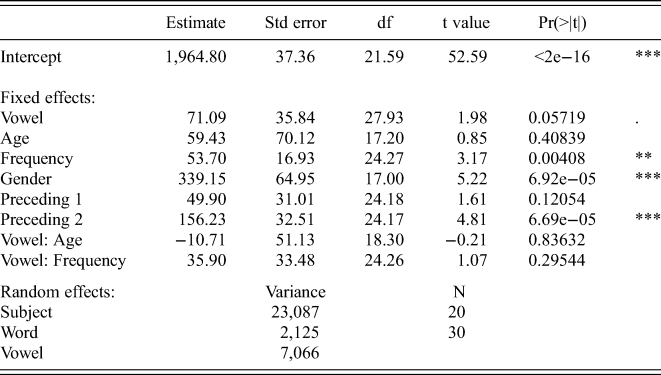
In order to determine if there is any difference between the F2 values of new and too words, I ran a linear mixed effects model on the acoustic data (see table 5). Results show that word frequency is statistically significant, indicating that high-frequency words generally have higher F2 values at 20 percent than low-frequency words (p = .001).Footnote 9 The interaction between vowel type and frequency is not significant (p =.295).Footnote 10
Mixed-effects linear regression on F2 values (in Hz, non-normalized) at 20 percent of vowel duration by vowel type (too = −0.5), age (over 40 = −0.5), gender (men = −0.5), preceding consonant (comparison 1: difference between /d/ and /n/; comparison 2: difference between /t/ and /d/), frequency (continuous, log-transformed and centered around 0), the interaction between vowel type and age, and the interaction between vowel type and frequency. Random intercepts for speaker and word are included as well as a by-subject slope for vowel. N = 1,185

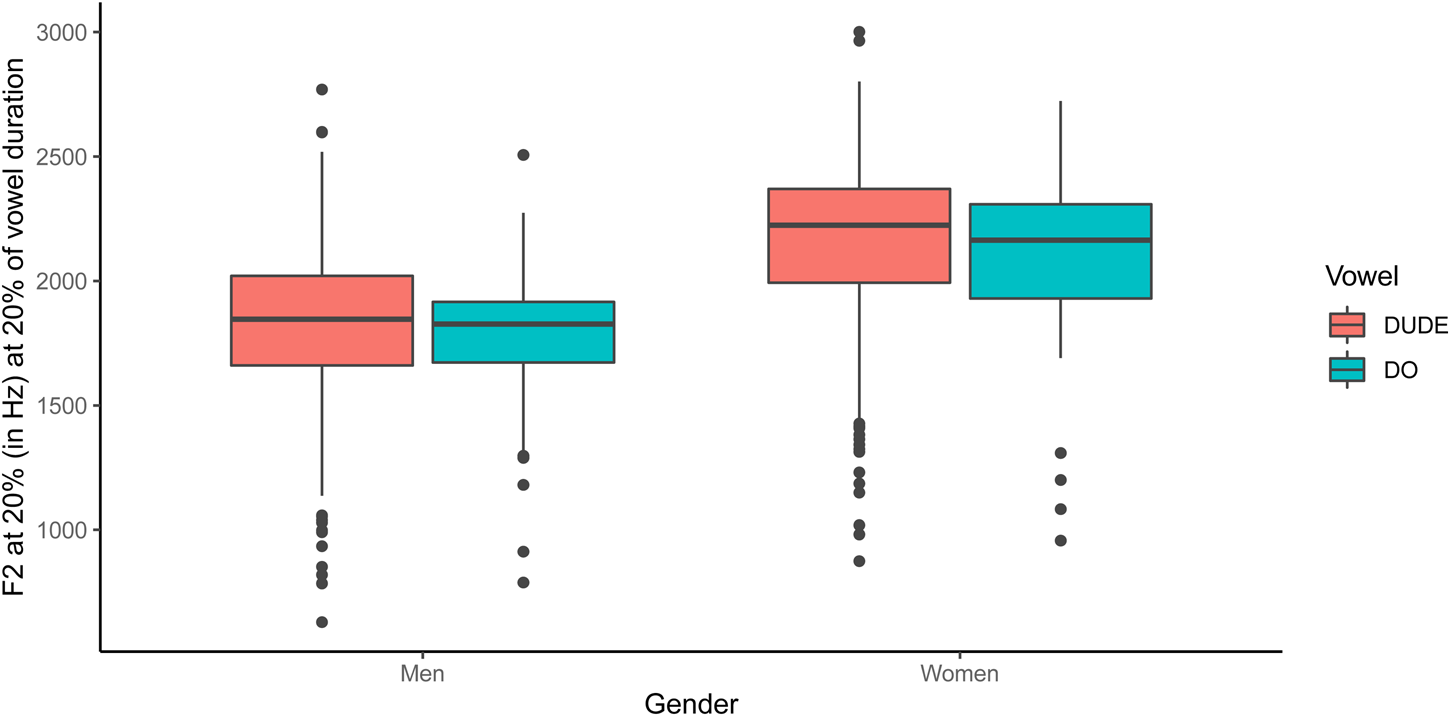
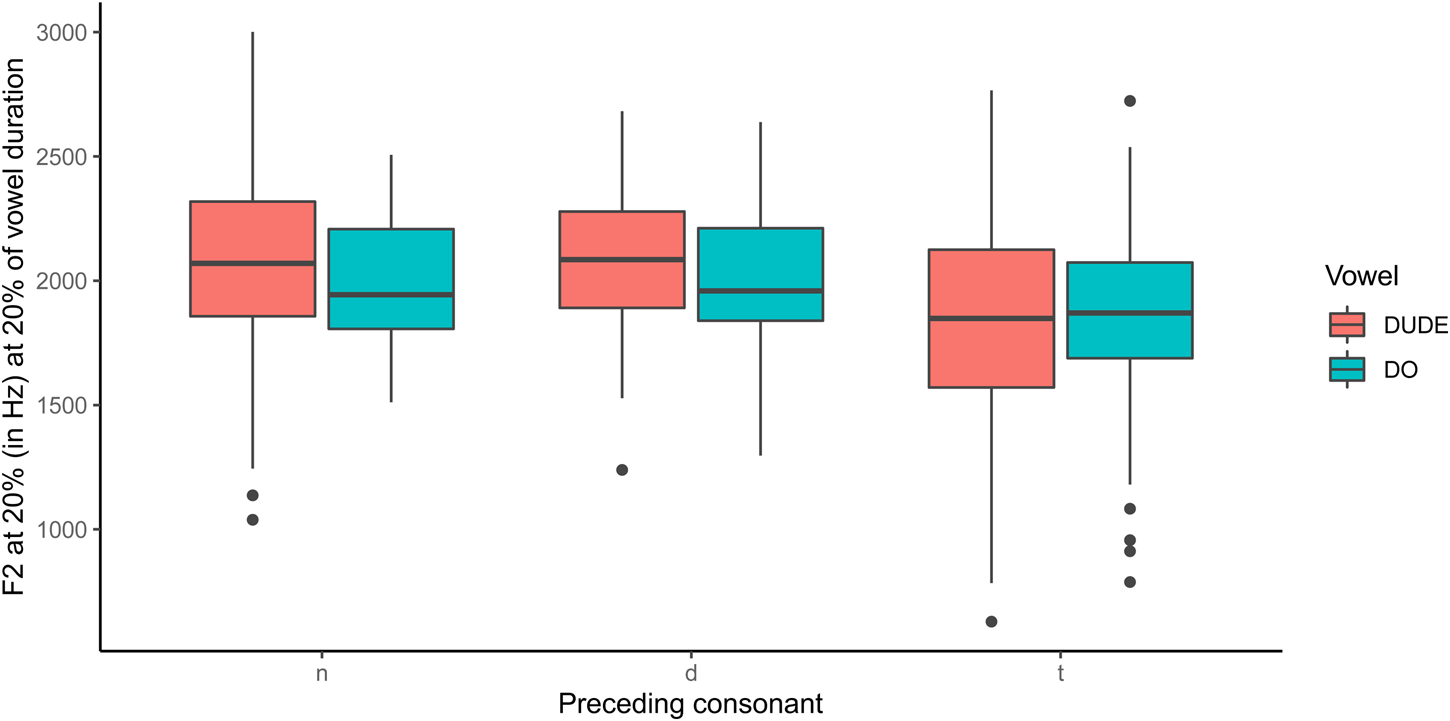
The model further shows that men have significantly lower F2 values than women (1,795 Hz vs 2,134 Hz; see figure 1 for a distribution of the raw data). This is expected due to physiological differences in vocal tract length between men and women. The model also shows that words with preceding /t/ have significantly lower F2 values at 20 percent than words with preceding /d/ (estimated difference: 156 Hz; see figure 2 for a distribution of the raw data). It is unclear why this would be the case. The most likely explanation is that the coarticulation effects of the preceding coronal is mitigated by the presence of aspiration: following the release of /d/ and /n/, there is little to no aspiration, meaning the F2 values for the vowel are necessarily high due to coarticulation; following the release of /t/, there is usually at least some aspiration (at least at the beginning of stressed syllables), which results in a short delay between stop release and vowel onset, during which F2 goes down.
F2 (in Hz) at 20 percent of vowel duration by vowel type and gender

F2 (in Hz) at 20 percent of vowel duration by vowel type and preceding consonant

In order to determine whether the difference between /n/ and /t/ was significant, a pairwise comparison between the different levels of preceding consonant was conducted using the testInteractions functions in the phia package (De Rosario-Martinez Reference De Rosario-Martinez2015) in R (R Core Team 2018) (see table 6). The results indicate that the difference between /n/ and /t/ is indeed significant (estimated difference: 206 Hz).
Pairwise comparison between preceding consonants in analysis 1. P-value adjustment method: Holm

Taken together, the results of the linear mixed effects model suggest that the change towards the yod-less pronunciation is indeed largely complete in Toronto English. The auditory analysis revealed that less than 6 percent of all tokens contain a yod. This leads to the question how the merged phoneme compares to categorical yod words (i.e. feud words) and yod-less words, and what role the place of articulation plays in this context, which is investigated in analysis 2. Since yod-less words have been shown to pattern quite differently depending on the place of articulation of the preceding segment, they were broken up into yod-less words with alveolar place of articulation (i.e. too words), yod-less words with postalveolar place of articulation (i.e. chew words) and yod-less words with other place of articulation (i.e. food words).
5.3 Acoustic analysis 2: feud vs new vs too vs chew vs food
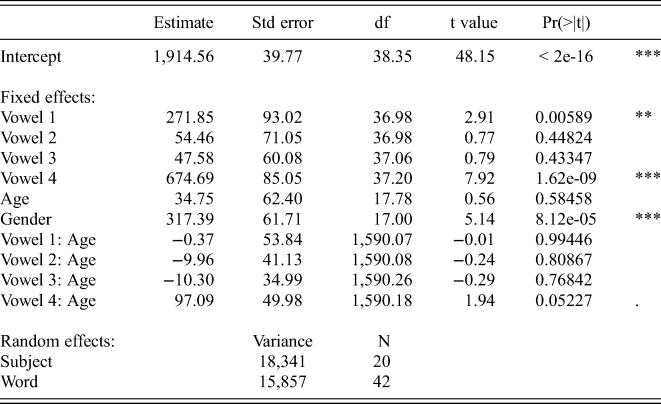
Table 7 presents the results of the linear mixed effects model for acoustic analysis 2. The results confirm that feud words have significantly higher F2 values at 20 percent than chew words (estimated difference: 272 Hz). chew words have higher F2 values than new words (estimated difference: 54 Hz), which in turn have higher F2 values than too words (estimated difference: 48 Hz). However, neither of these two differences is statistically significant. The difference between too words and food words is statistically significant, however (estimated difference: 675 Hz). Age does not have a significant effect. As in analysis 1, men have significantly lower F2 values than women (1,756 Hz for men, 2,073 Hz for women).
Mixed-effects linear regression on F2 values (in Hz) at 20 percent of vowel duration by vowel type (comparison 1: difference between feud and chew; comparison 2: difference between chew and new; comparison 3: difference between new and too; comparison 4: difference between too and food), age (over 40 = −0.5) and gender (men = −0.5). Random intercepts for speaker and word are included. N = 1,655

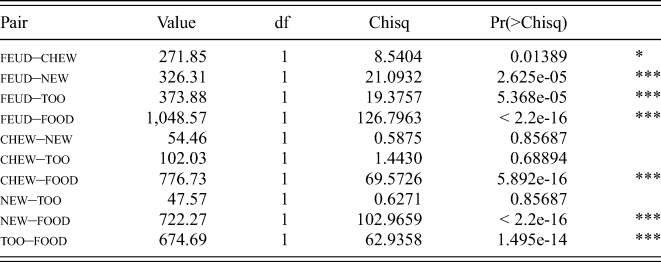
In order to find out if the contrasts between the other vowel types are significant as well, it is necessary to test different types of contrasts. As a consequence, a pairwise comparison between all vowel types was conducted using the testInteractions function in the phia package (De Rosario-Martinez Reference De Rosario-Martinez2015) in R (R Core Team 2018) (table 8). Results indicate that all vowel types are significantly different from each other with three exceptions: (i) the contrast between chew and new words (X2 = 0.5875, df = 1, p = 0.856), (ii) the contrast between chew and too words (X2 = 1.4430, df = 1, p = 0.688) and (iii) the contrast between new and too words (X2 = 0.6271, df = 1, p = 0.856).
Pairwise comparison between vowel types in analysis 2. P-value adjustment method: Holm

As expected, the results show that there is no significant difference between the F2 values at 20 percent for new, too and chew words (i.e. words with preceding coronals). Based on these findings, we can conclude that in Toronto English, there is significant overlap between the F2 values of new words and yod-less words with preceding coronals, which makes it difficult to determine whether the high F2 values are due to retention or /u/-fronting. This is in line with previous findings from Victoria, British Columbia, where there are no significant differences between the two types for the youngest speakers (Roeder et al. Reference Roeder, Onosson and D'Arcy2018).
6 Discussion
In the following, I will briefly review my findings and relate them back to the original research questions. For the first question, which is whether or not there is still a contrast between /ju/ and /u/ after the coronals /t, d, n/, I found that the change towards the yod-less pronunciation is complete for all age groups. Both gender and preceding consonant have a significant effect on F2 at 20 percent. The most likely explanation for the latter is that the coarticulation effect from the preceding coronal is mitigated due to the presence of aspiration.
Interestingly, the interaction between vowel type and age is not significant. This is surprising since we would expect strong age differences for /u/ fronting, which is an ongoing change in Canadian English, while we would not expect to see any age differences (or at least, not very strong ones) for yod dropping, which is a change that was already at its tail end twenty years ago. It is unclear why this might be the case, but it is possible that this is related to the low number of too words in the sample.
While word frequency does have a significant effect, there was no interaction between vowel type and word frequency, as we may have expected based on Phillips’ (Reference Phillips1981, Reference Phillips1994) observations. This does not invalidate Phillips’ (Reference Phillips1981, Reference Phillips1994) observations, or suggest that the change towards the yod-less pronunciation in Toronto English proceeded differently from the US varieties examined in Phillips’ work. In fact, given that the change seems to be all but complete, it is possible that the vast majority of variable yod words have lost the yod and the original frequency effect is no longer visible. If this were true, the fact that high-frequency new words tend to have higher F2 values than low-frequency new words may be due to the former being at the forefront of /u/-fronting (Sóskuthy et al. Reference Sóskuthy, Foulkes, Hughes and Haddican2018). This would also explain why they are not lagging behind, as in Sóskuthy et al.'s (Reference Sóskuthy, Foulkes, Hughes and Haddican2018) data from Derby. In order to determine if word frequency ever had a systematic influence on yod dropping in Canadian English, it would be necessary to turn to diachronic data. This would also allow us to determine if and how these two changes have influenced each other over time.
This brings us to the second question, namely to what extent the F2 values of new words overlap with categorical yod words (i.e. feud words) and yod-less words, and what role the place of articulation of the preceding segment plays in this context. As expected, new words pattern in between feud and food words, but there are no significant differences between these words and other words in which the vowel /u/ is preceded by a coronal consonant (i.e. too and chew words). This supports recent reports from Victoria, British Columbia, which first showed that there was considerable phonetic overlap between these categories (Roeder et al. Reference Roeder, Onosson and D'Arcy2018). As Roeder et al. (Reference Roeder, Onosson and D'Arcy2018) remark, this overlap poses a methodological challenge for scholars investigating yod dropping since high F2 values could be an indicator of yod presence as well as advanced /u/-fronting, making popular methods like using pre-determined F2 cut-of points to determine yod presence problematic. The question is: what can researchers do to overcome these challenges in future work?
One option would be to move away from using one-point measurements (as in Labov et al. Reference Labov, Ash and Boberg2006 and Roeder et al. Reference Roeder, Onosson and D'Arcy2018) and focus on vowel trajectories instead. Promising results in this area come from Koops (Reference Koops2010), who found that there are two types of fronted /u/ among Anglo speakers in Houston: a more monophthongal type, which is similar in nature to the fronter /u/ found in other rural varieties from the southern US, and a more diphthongal type, which resembles the trajectory of /u/ found outside of southern varieties. It would be interesting to see if similar differences in trajectory type might be found between yod retention and /u/-fronting. In order to answer this question, researchers will either have to draw upon larger data sets or carefully control test words for both the preceding and following context. Since the present study only controlled for the preceding segment, this was not viable here (but see Sóskuthy et al. Reference Sóskuthy, Foulkes, Hughes and Haddican2018 for a similar approach that controls for one following environment: presence of /l/). Another option would be to explore if there are any acoustic correlates that distinguish the two changes. Given that yod retention has become incredibly scarce in most contemporary varieties of Canadian English, the best approach would likely be to turn to diachronic data for this purpose, which may also shed light on how we got to this point and how the two changes may have influenced each other over time. It would be particularly interesting to see if the contrast between /ju/ and /u/ was neutralized before /u/ began to front and what social groups were implicated in these changes.
Aside from these methodological issues, it would be interesting to investigate the social meaning of yod dropping. As mentioned in section 2, the distribution of yod dropping in Clarke's (Reference Clarke2006) study suggests that retention may have carried different social meanings for different segments of the population at one point in time. Work on the perception of yod retention could shed light on whether these findings still hold up and to what extent they overlap with the social meanings of /u/-fronting, which, to my knowledge, have not been explored in the research literature. Comparative work along these lines could also add to our understanding of why Victoria seems to be such a stronghold for retention, while Torontonians largely abandoned the yod decades ago.Footnote 11
7 Conclusion
More than twenty years ago, Chambers first concluded that yod dropping was ‘nearing completion’ (Chambers Reference Chambers1998: 17) in southern Ontario. At this point, the change is for all intents and purposes complete: perceptual coding revealed that less than 6 percent of new words retain the yod, and that there is no statistical difference between new and too words. As such, the most interesting question is no longer how the change is proceeding in different varieties, but how we got to this point, and what role the social meaning of this change may have played in the process. Results from other parts of Canada clearly show that the trend towards dropping is not uniform within Canada. While there are certainly historical reasons which may explain why speakers of Victoria English may be holding on to the yod longer than speakers from Toronto, it is possible that retention has developed a more local meaning there. This, in turn, could influence how speakers perceive (and potentially even produce) different realizations of /u/. Future work on these two changes would be well-suited to address this potential link between production and perception.
Methodologically, the findings presented here have important implications for future work: given that yod retention and /u/-fronting look and sound similar, it is imperative that studies on both phenomena clearly differentiate between new and too words and how the history of the two changes in the communities under investigation may affect the results. While studies on /u/-fronting consistently code for place of articulation of the preceding segment, they often do not distinguish between words that historically had a yod and those that did not (see, for example, Fought Reference Fought1999; Hawkins & Midgley Reference Hawkins and Midgley2005; Hall-Lew Reference Hall-Lew2011; Baranowski Reference Baranowski2017). This may lead researchers to overestimate both the rate of retention and the rate of /u/-fronting, depending on what change they are investigating. The most pressing question for future work is if there are any acoustic correlates that may be used to tell these two phenomena apart or what turning to more dynamic vowel measurements may add to our understanding. Despite the fact that the onglide has all but disappeared from most Canadian varieties of English, yod dropping (as well as the apparent lack thereof in certain pockets) has long-lasting effects for the study of contemporary varieties of Canadian English, and thus leaves much to be explored.
APPENDIX
A. Complete word list. Bolded words were included in both analyses, bolded and italicized words only in analysis 2. Words in square brackets were used in Phillips (Reference Phillips1981, Reference Phillips1994), but were excluded from the analysis in this article.

B. Background questionnaire
Thank you for helping us with our project. Your participation is anonymous, but we need some general information about you.
Please state town and province/country where applicable.