Introduction
Human paranasal sinuses are a major source of intrinsic nitric oxide production. Nitric oxide is an important biological messenger in the nasal airways that is involved in defence mechanisms (such as bacteriocidal activities and mucociliary clearance regulation) and in several stages of the immune response.Reference Lundberg and Weitzberg1, Reference Maniscalco, Sofia and Pelaia2 The recent American Thoracic Society guideline on the interpretation of nitric oxide measurements stated that fractional exhaled nitric oxide can be used as a biomarker to add a new dimension to the traditional clinical tools used for assessing and managing airway diseases.Reference Dweik, Boggs, Erzurum, Irvin, Leigh and Lundberg3
Nasal nitric oxide production is regulated by the activity of three nitric oxide synthase isoforms (NOS1, neuronal nitric oxide synthase; NOS2, inducible nitric oxide synthase; and NOS3, endothelial nitric oxide synthase) and the availability of the amino acid l-arginine, the nitric oxide synthase substrate.Reference Maarsingh, Zaagsma and Meurs4, Reference Luiking, Ten Have, Wolfe and Deutz5l-arginine is also utilised by arginase, commonly known as the final enzyme in the urea cycle, to form urea and ornithine. Different arginase isoforms, arginase-1 and arginase-2 (encoded by ARG1 and ARG2, respectively), were recently identified in non-hepatic tissues.Reference Maarsingh, Zaagsma and Meurs6, Reference Maarsingh, Dekkers, Zuidhof, Bos, Menzen and Klein7 The mechanisms regulating ARG1 and ARG2 gene expression are implicated in the pathogenesis of various human airway diseases via l-arginine–nitric oxide pathway modulation.Reference Zimmermann, King, Laporte, Yang, Mishra and Pope8, Reference Lara, Khatri, Wang, Comhair, Xu and Dweik9
In the present study, arginase isoform expression and localisation were examined in human paranasal sinus mucosa, and fractional exhaled nitric oxide was monitored in the nasal airways of chronic rhinosinusitis patients. Nasal nitric oxide levels are thought to be decreased in most chronic rhinosinusitis patients.Reference Lindberg, Cervin and Runer10, Reference Ragab, Lund, Saleh and Scadding11 However, there is little information on the role of arginase in arginine metabolism that might inform the pathophysiology pertinent to chronic rhinosinusitis classification.
To examine the role of arginase and nasal nitric oxide levels in chronic rhinosinusitis, chronic rhinosinusitis patients were subdivided into two groups based on their clinical features: the presence or absence of nasal polyps.Reference Fokkens, Lund, Mullol, Bachert, Alobid and Baroody12 Patients with intractable nasal polyps have become more common in the Japanese population, and most cases are accompanied by numerous infiltrations of activated eosinophils.Reference Nakayama, Yoshikawa, Asaka, Okushi, Matsuwaki and Otori13, Reference Yoshimura, Kawata, Haruna, Moriyama, Hirakawa and Fujieda14 The present study is the first to report alterations in nitric oxide production caused by changes in the nitric oxide synthase–arginase balance in different chronic rhinosinusitis subtypes. Findings reveal complex but important roles for NOS2 and arginase-2 in the competitive consumption of l-arginine that may contribute to chronic rhinosinusitis phenotypes, as detected by fractional exhaled nitric oxide measurement.
Materials and methods
Patients
Eighteen chronic rhinosinusitis patients without nasal polyps and 27 with nasal polyps and who underwent endoscopic sinus surgery at the ENT Department, Hiroshima University Hospital, Japan, were included in this cross-sectional study. The diagnosis of sinus disease was based on patient history, clinical symptoms, endoscopic findings and computed tomography (CT) scanning, as described elsewhere.Reference Takeno, Taruya, Ueda, Noda and Hirakawa15 No patient had taken topical or systemic steroids for at least four weeks prior to surgery. Patients who had undergone previous sinus surgery were excluded. Computed tomography images were graded radiologically using the Lund–Mackay system.Reference Lund and Mackay16 A histological examination of sinus mucosal specimens from all patients was performed to evaluate the proportion of mucosal eosinophilia.
Nitric oxide measurements
Oral and nasal fractional exhaled nitric oxide levels were measured before surgery using a hand-held electrochemical analyser (NObreath; Bedfont Scientific, Rochester, UK) according to American Thoracic Society and European Respiratory Society guidelines.17 For oral fractional exhaled nitric oxide measurements, each patient was instructed to exhale through a mouthpiece for 16 seconds at a flow rate of 50 ml/second, assisted by visual cues. For nasal fractional exhaled nitric oxide measurements, each patient was instructed to exhale transnasally with the mouth closed into a nose adaptor at the same flow rate, as previously described.Reference Noda, Takeno, Fukuiri and Hirakawa18
Reverse transcription polymerase chain reaction analysis
Mucosal specimens were obtained from the ethmoid sinus and nasal polyps (if any) at the time of surgery. Specimens were divided into two parts and either immersed in RNAlater solution (Ambion, Austin, Texas, USA) for real-time reverse transcription polymerase chain reaction or fixed in 4 per cent paraformaldehyde for immunohistochemical analysis. Quantitative polymerase chain reaction analysis was performed on an ABI Prisms 7300 system (Applied Biosystems, Foster City, California, USA). Cellular RNA was isolated using RNeasy mini kits (Qiagen, Valencia, California, USA). Total RNA was then reverse transcribed to form complementary DNA using a High Capacity RNA-to-cDNA kit (Applied Biosystems) according to the manufacturer's instructions. Gene expression was measured using a real-time polymerase chain reaction system and TaqMan Gene Expression Assays (Life Technologies, Carlsbad, California, USA).
Polymerase chain reaction primers specific for the nitric oxide synthase genes NOS1 (Hs00167223_m1), NOS2 (Hs01075529_m1), NOS3 (Hs01574659_m1), ARG1 (Hs00163660_m1) and ARG2 (Hs00265750_m1) were used. Triplicate polymerase chain reactions were run for each sample. Amplification of polymerase chain reaction products was quantified by the number of cycles, and results were analysed using the comparative cycle threshold method (2−ΔΔCt). Target gene expression was normalised to GAPDH (Hs03929097_g1) reference gene expression (ratio = target gene expression ÷ GAPDH expression).
Immunohistochemical analysis
Immunostaining was carried out on 5-μm thick cryostat sections using primary antibodies against human arginase-1 (rabbit polyclonal, H-52; Santa Cruz Biotechnology, Santa Cruz, California, USA) and human arginase-2 (rabbit polyclonal, H-64; Santa Cruz Biotechnology). For antigen retrieval, sections were immersed in Histo VT One (Nacalai Tesque, Kyoto, Japan) at 70 °C for 40 minutes. Slides were then incubated overnight at 4 °C in a primary antibody solution according to the manufacturer's recommendations. Colour development was achieved using streptavidin–biotin amplification (ChemMate EnVision kit; Dako, Glostrup, Denmark). Peroxidase activity was visualised using a diaminobenzidine solution. Sections were counterstained with haematoxylin. Control specimens were assayed without the primary antibody and used to verify the absence of non-specific binding. Consecutive sections were stained with haematoxylin and eosin to observe mucosal pathology and assess the degree of eosinophil infiltration.
All procedures used in this study complied with the ethical standards of Hiroshima University School of Medicine and with the Helsinki Declaration of 1975, as revised in 2008. The study protocol was approved by the Institutional Review Board, Hiroshima University School of Medicine (approval numbers Hi-50 and Rin-181). Written informed consent was obtained from all patients prior to participation.
Data analysis
For multiple comparisons, data were first screened for differences using the Kruskal–Wallis test. If the results were significant, between-group analysis was performed using the Mann–Whitney U test. The chi-square test was used to compare qualitative data. A p value less than 0.05 was considered significant.
Results
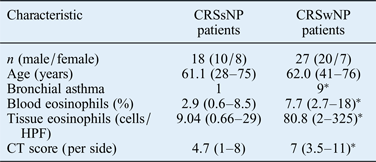
Clinical characteristics of the study population are summarised in Table I. All chronic rhinosinusitis with nasal polyps patients had multiple nasal polyps bilaterally and high viscosity mucus secretion. Significant differences were observed between chronic rhinosinusitis with nasal polyps and chronic rhinosinusitis without nasal polyps groups in the baseline proportion of asthma co-morbidity and degree of blood and tissue eosinophils. In addition, chronic rhinosinusitis with nasal polyps patients showed significantly higher CT scores. Opacification of the ethmoid sinus was also more severe than that of maxillary sinus in this group.
Background and baseline characteristics of the study population

Data are shown as mean with ranges in parenthesis. *p < 0.01; significant difference between groups. CRSsNP = chronic rhinosinusitis without nasal polyps; CRSwNP = chronic rhinosinusitis with nasal polyps; HPF = high power field (×400); CT = computed tomography
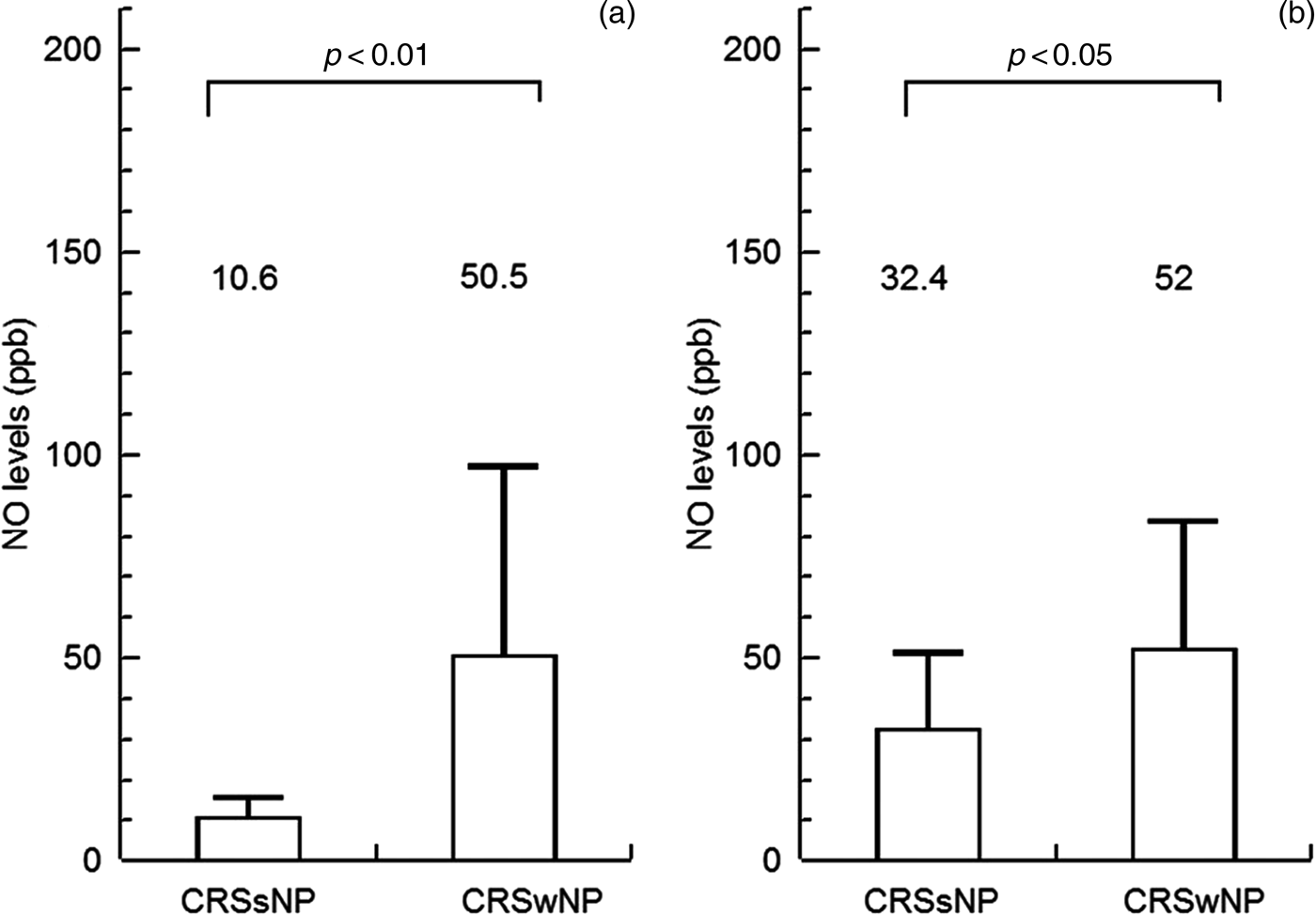
Patients with each chronic rhinosinusitis subtype had distinct pre-operative values for fractional exhaled nitric oxide (Fig. 1). The mean oral and nasal fractional exhaled nitric oxide levels were 10.6 ppb and 32.4 ppb, respectively, in chronic rhinosinusitis without nasal polyps patients and 50.5 ppb and 52 ppb, respectively, in chronic rhinosinusitis with nasal polyps patients. Chronic rhinosinusitis with nasal polyps patients showed significantly higher levels of both oral and nasal fractional exhaled nitric oxide compared with chronic rhinosinusitis without nasal polyps patients.
(a) Oral and (b) nasal fractional exhaled nitric oxide levels in chronic rhinosinusitis without nasal polyps (CRSsNP) patients (n = 18) and chronic rhinosinusitis with nasal polyps (CRSwNP) patients (n = 27). Data are mean values and error bars indicate the standard deviation. NO = nitric oxide; ppb = parts per billion
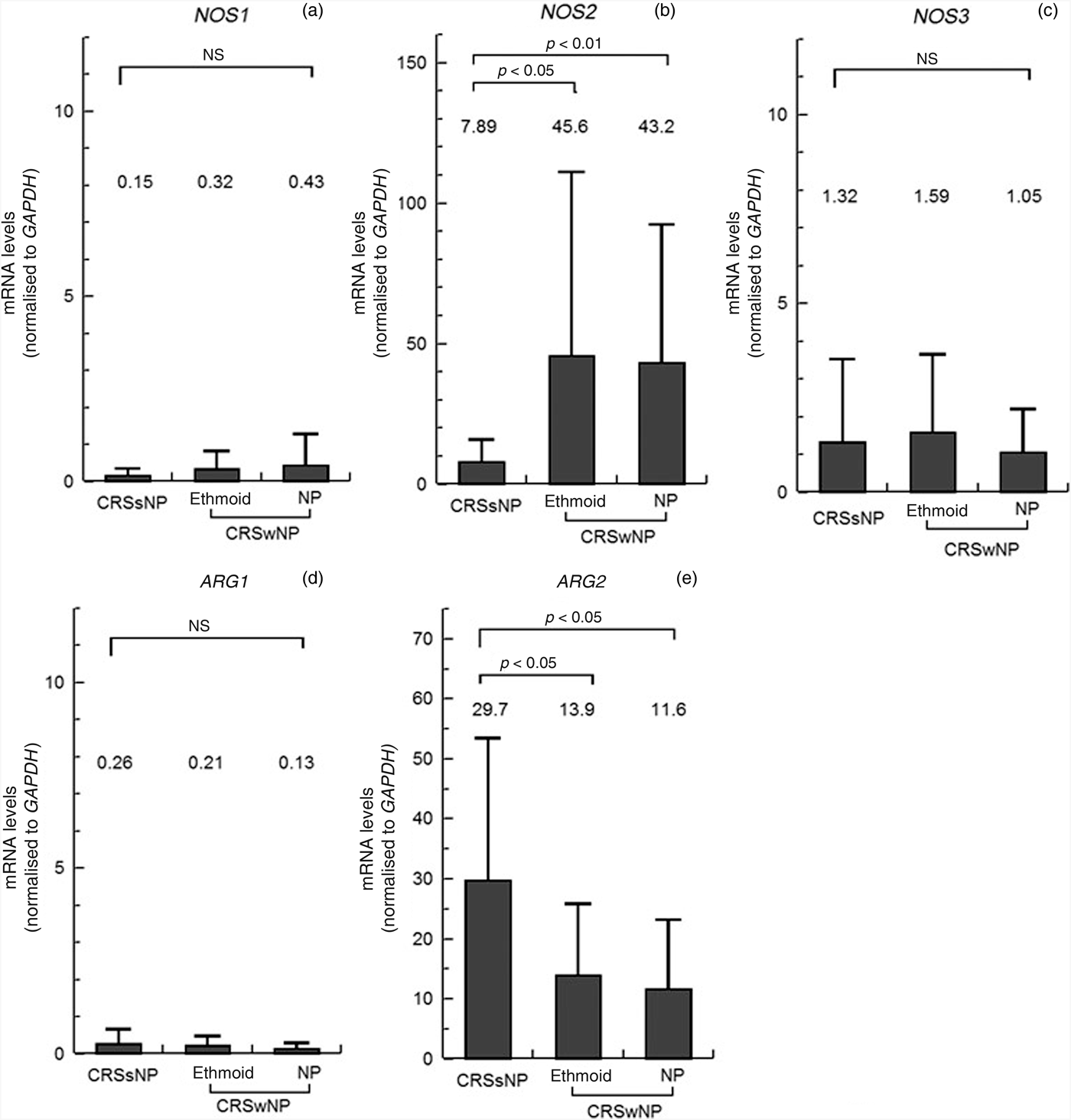
Messenger RNA (mRNA) levels of NOS1, NOS2, NOS3, ARG1 and ARG2 in the ethmoid sinus mucosa and nasal polyps were assessed by quantitative real-time polymerase chain reaction (Fig. 2). Chronic rhinosinusitis with nasal polyps patients showed significant upregulation of NOS2 mRNA compared with chronic rhinosinusitis without nasal polyps patients. In contrast, chronic rhinosinusitis without nasal polyps patients showed significant upregulation of ARG2 mRNA compared with chronic rhinosinusitis with nasal polyps patients. There were no significant differences in NOS1, NOS3 or ARG1 mRNA levels between groups. Messenger RNA expression profiles in nasal polyps and ethmoid sinus mucosa were similar in chronic rhinosinusitis with nasal polyps patients.
Comparison of messenger RNA (mRNA) expression in ethmoid sinus mucosa from chronic rhinosinusitis without nasal polyps (CRSsNP) and chronic rhinosinusitis with nasal polyps (CRSwNP) patients and in nasal polyps from CRSwNP patients. (a) NOS1, (b) NOS2, (c) NOS3, (d) ARG1 and (e) ARG2 mRNA levels are normalised to GAPDH mRNA levels. Data are mean values and error bars indicate standard deviation. NP = nasal polyp; NS = not significant
Immunohistological staining shows the distribution of arginase-1 and arginase-2 positive cells in the ethmoid sinus mucosa (Figs 3 and 4). Chronic rhinosinusitis with nasal polyps patients had intense eosinophil accumulation in their ethmoid mucosa. Arginase-1 immunoreactivity was weakly detected in surface epithelial cells, submucosal glandular cells and fibroblasts, with diffuse cytoplasmic staining. The arginase-1 distribution pattern was similar in all samples, and staining intensity was essentially identical in both groups. In contrast, arginase-2 staining showed a distinct pattern in chronic rhinosinusitis without nasal polyps patients. Arginase-2 was detected in surface epithelial cells, submucosal glandular cells and fibroblasts, with nuclear and cytoplasmic staining in both groups. However, intense arginase-2 staining of epithelial and glandular cells was generally seen in samples from chronic rhinosinusitis without nasal polyps patients but not in those from chronic rhinosinusitis with nasal polyps patients (Fig. 4a, c).
Immunohistological images showing arginase-1 expression in an ethmoid sinus mucosa sample from (a) a chronic rhinosinusitis without nasal polyps (CRSsNP) patient and (b) a chronic rhinosinusitis with nasal polyps (CRSwNP) patient. Scale bar = 20 µm
Immunohistological images of arginase-2 expression in the ethmoid sinus mucosa from (a,c) a chronic rhinosinusitis without nasal polyps (CRSsNP) patient and (b) a chronic rhinosinusitis with nasal polyps (CRSwNP) patient. Scale bar = 20 µm
Discussion
The fractional exhaled nitric oxide level has been proposed as a surrogate marker for paranasal sinus inflammation. Previous studies indicated that nitric oxide levels in the human nose and paranasal sinuses are decreased in most chronic rhinosinusitis patients because of hampered ventilation of gaseous nitric oxide through occluded sinus ostia and increased nitric oxide absorption by inflamed paranasal sinus mucosa.Reference Lindberg, Cervin and Runer10, Reference Ragab, Lund, Saleh and Scadding11 Nasal nitric oxide levels in untreated chronic rhinosinusitis patients inversely correlated with disease severity and normal ranges were restored as a consequence of appropriate therapies.Reference Noda, Takeno, Fukuiri and Hirakawa18, Reference Arnal, Flores, Rami, Murris-Espin, Bremont and Pasto19 Research since the early 2000s has revealed a remarkable causal role for nitric oxide synthase and arginase in l-arginine homeostasis and the pathophysiology of human airway diseases.Reference Maarsingh, Zaagsma and Meurs4–Reference Maarsingh, Zaagsma and Meurs6 However, little is known about the regulatory mechanisms of nitric oxide synthesis in the paranasal sinuses related to a potential role for arginase isoforms in l-arginine availability.
The present study examined for the first time arginase isoform expression and localisation in the paranasal sinus mucosa of chronic rhinosinusitis patients. Increased consumption of l-arginine by arginase may affect nitric oxide production via a nitric oxide synthase–arginase imbalance and contribute to the pathophysiology of chronic sinus inflammation. The pathologies of chronic rhinosinusitis without nasal polyps and chronic rhinosinusitis with nasal polyps are considered to differ based on the expression of inflammatory mediators.Reference Fokkens, Lund, Mullol, Bachert, Alobid and Baroody12 Therefore, our results indicate that fractional exhaled nitric oxide monitoring can be another useful marker to distinguish chronic rhinosinusitis subtypes.
l-arginine is the established substrate for nitric oxide synthase, yielding nitric oxide and l-citrulline.Reference Moncada, Palmer and Higgs20l-arginine is also metabolised to urea and ornithine by arginase.Reference Maarsingh, Zaagsma and Meurs4 Different arginase isoforms were recently identified in tissues lacking a complete urea cycle.Reference Luiking, Ten Have, Wolfe and Deutz5 Arginase-1 is constitutively expressed, mainly in the liver, whereas arginase-2 catalyses the same reaction but differs in its tissue specificity and subcellular location. Arginase-2 is mainly expressed in non-hepatic tissues, including the respiratory tract.Reference Maarsingh, Zaagsma and Meurs6, Reference Maarsingh, Dekkers, Zuidhof, Bos, Menzen and Klein7
• Human paranasal sinuses are a major site of intrinsic nitric oxide production
• Nasal nitric oxide production is regulated by arginine bioavailability through the nitric oxide synthase–arginase balance
• Low nasal nitric oxide levels are related to increased arginase-2 activity in chronic rhinosinusitis without nasal polyps patients
• High nitric oxide levels in chronic rhinosinusitis with nasal polyps patients reflect nitric oxide synthase 2 upregulation
• Oral and nasal nitric oxide levels can differentiate chronic rhinosinusitis subtypes
In the present study, chronic rhinosinusitis with nasal polyps patients showed increased NOS2 and relatively decreased ARG2 mRNA expression compared with chronic rhinosinusitis without nasal polyps patients. In contrast, ARG1, NOS1 and NOS3 mRNA levels were similar in both groups. In both humans and animal models, regulatory mechanisms for arginase gene expression have been proposed to be involved in the induction of airway responsiveness in the lower airways by limiting substrate availability.Reference Maarsingh, Zaagsma and Meurs4, Reference Maarsingh, Dekkers, Zuidhof, Bos, Menzen and Klein7–Reference Lara, Khatri, Wang, Comhair, Xu and Dweik9, Reference Cho, Kim, Kim, Lee, Lee and Ju21 However, controversy remains regarding the clinical significance of arginase activity that predicts nitric oxide deficiency in inflammatory airway diseases.
Serum arginase activity inversely correlated with physiological lung function in severely asthmatic patients with higher levels of fractional exhaled nitric oxide, suggesting that arginine bioavailability is strongly associated with airflow abnormalities.Reference Lara, Khatri, Wang, Comhair, Xu and Dweik9 However, other reports described lower plasma arginase activities in asthmatic patients compared with controls, or no significant difference in plasma arginase activity between untreated allergic rhinitis patients and normal controls.Reference Ceylan, Aksoy, Gencer, Vural, Keles and Selek22, Reference Unal, Eskandari, Erçetin, Doğruer and Pata23 Increased expression of both arginase-1 and arginase-2 were observed in the inferior turbinate mucosa of perennial allergic rhinitis patients, suggesting a possible role for the l-arginine–ornithine pathway in disease pathogenesis through competition for the common substrate.Reference Cho, Kim, Kim, Lee, Lee and Ju21
Yamamoto et al. recently examined the relationship between the expressions of nitric oxide related enzymes (i.e. NOS2 and arginase-2) and asthma severity, fractional exhaled nitric oxide and eosinophilic inflammation.Reference Yamamoto, Tochino, Chibana, Trudeau, Holguin and Wenzel24 They found that severe asthma with higher fractional exhaled nitric oxide levels was closely associated with the highest levels of NOS2 mRNA. However, there was a tendency for ARG2 mRNA expression to decrease with increasing asthma severity; consequently, the index of NOS2 to ARG2 mRNA most strongly differentiated severe from milder asthma. These results from severely asthmatic patients are compatible with the present data for chronic rhinosinusitis with nasal polyps patients with higher oral and nasal fractional exhaled nitric oxide levels. Chronic rhinosinusitis with nasal polyps patients showed a similar profile of increased NOS2 mRNA and relatively attenuated ARG2 mRNA expression in the paranasal sinus mucosa. Together with the clinical features of chronic rhinosinusitis with nasal polyps (local and systemic eosinophilia and a higher prevalence of asthma), the results of the present study suggest an intimate relation between upper and lower airway function regarding the delicate balance between NOS2 and arginase-2 activities in the nitric oxide synthesis pathway.
It is interesting to compare the gene expression profiles of chronic rhinosinusitis without nasal polyps patients with the corresponding recently elucidated profiles of cystic fibrosis (CF) patients, in which imbalances in l-arginine metabolism also play a role in changing nitric oxide production. Airway diseases in chronic rhinosinusitis without nasal polyps and CF share some similar clinical features of chronic inflammation caused by recurrent bacterial infection, with neutrophil-dominated exacerbations.Reference Ratjen and Döring25 Nitric oxide synthase 2 expression is known to be decreased or even absent in CF airways. In addition, upregulated arginase activity and increased levels of the endogenous nitric oxide synthase inhibitor may contribute to decreased airway nitric oxide production in CF.Reference Grasemann, Schwiertz, Matthiesen, Racke and Ratjen26 The incidence of CF in Asian races (including the Japanese) is very low,Reference Yamashiro, Shimizu, Oguchi, Shioya, Nagata and Ohtsuka27 and no CF patients were enrolled in this study. We consider that the decreased nasal fractional exhaled nitric oxide levels in our chronic rhinosinusitis without nasal polyps patients may reflect both anatomical causes (e.g. occluded sinus ventilation in the inflamed mucosa) and an imbalance between nitric oxide synthase and arginase activities resembling CF pathology.
Acknowledgements
We thank Ms A Kashima for her technical assistance. This study was supported in part by a Grant-in-Aid for Scientific Research from Japan's Ministry of Education, Culture, Sports, Science and Technology (grant number 25462665) and by Japan's Ministry of Health, Labour and Welfare (grant number H26-itaku-ippan-076).