INTRODUCTION
Traditional rainfed agriculture is one of the three major production systems in Sudan. It covers about 9.0 million ha, representing more than 50% of the total national cultivated land. Crop production in this system is dominated by traditional farming methods and is entirely dependent on rainfall. Most of the areas in the traditional rainfed sector are in the semi-arid zone of western Sudan, which has experienced several drought cycles in recent decades. The average annual rainfall varies from less than 150 mm on the northern border of western Sudan to more than 600 mm on the southern border. The rainy season varies from less than three months in the north to more than four months in the south and rains occur between May and October. Seasonal variations in rainfall amount and distribution are common. The natural resource base is fragile and severely degraded, especially in the north (DLRC, 2005).
Groundnut (Arachis hypogaea) and sesame (Sesamum indicum) are the main cash crops occupying between 20 and 30% of the farmers’ cultivated land in the traditional rainfed sector, especially in the Kordofan and Darfur states. The average total groundnut area in the traditional rainfed sector for the period 1979/80 to 2008/09 is about 0.97 million ha and the average total area of sesame for the same period is about 0.71 million ha (Osman and Ali, 2009). During the past 30 years (1979/80–2007/08), groundnut and sesame area and total production in the traditional rainfed sector have increased while productivity has decreased (Osman and Ali, 2009). The average productivity of groundnut and sesame are 497 and 186 kg ha−1 respectively (Osman and Ali, 2009). The low yields are due to natural and socio-economic constraints such as erratic rainfall, poor and low soil fertility, and limited access to inputs.
Cowpea (Vigna unguiculata) is a food crop generally grown as a minor subsistence intercrop in many parts of western Sudan. It is cultivated in small plots as a sole crop or in intercropping systems with pearl millet, sorghum, sesame, groundnut or hibiscus. Cowpea is also grown extensively in home garden (jubraka) systems, especially the extra-early maturing varieties, to provide food during the hunger period in August. The total annual area allocated to cowpea is about 154 000 ha with an annual total production of 19 000 t and a mean grain yield of 181 kg ha−1 (Hassan and Elasha, 2009).
The objective of this study was to use on-station and on-farm trials to evaluate the effect of seed priming and micro-fertilizing on groundnut, sesame and cowpea in the marginal and dry areas of the North Kordofan State in western Sudan. Seed priming has been found to increase crop yields in the dryland areas of India, Pakistan and southern Africa (Harris, Reference Harris2006) and is particularly effective in improving crop establishment, which is a serious problem in the drylands of Africa. Micro-dosing is the application of a small amount of mineral fertilizer in the planting pocket (Aune and Bationo, Reference Aune and Bationo2008; Aune et al., Reference Aune, Doumbia and Berthe2007; Hayashi et al., Reference Hayashi, Abdoulaye, Gerard and Batinono2008).
MATERIALS AND METHODS
On-station and on-farm trials were conducted for three seasons (2007, 2008 and 2009) under rainfed conditions.
On-station trials
Three on-station trials (researcher managed) on groundnut, sesame and cowpea were carried out at the research farm at the El-Obeid Agricultural Research Station (lat: 13°10′N, long: 30°14′E, alt. 570 m, 650 km west of Khartoum), North Kordofan State, Sudan. The soil of the experimental site has more than 90% sand and is classified as a Quartzipsamments. It has very low organic matter (0.112%), organic carbon (0.560%), nitrogen (0.030%), available phosphorus (4 ppm-HCO3), C/N (18) and a pH of about 7. The total annual rainfall and its distribution during the study seasons are presented in Aune and Ousman (Reference Aune and Ousman2011). No irrigation was applied.
Each of the three seed priming / micro-fertilizing trials was a 2 × 4 factorial design, consisting of eight treatments. Micro-dosing treatments were 0.0, 0.3, 0.6 and 0.9 g fertilizer per pocket and priming treatments were without and with priming. There were four replications.
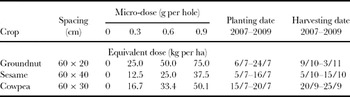
Primed seeds were soaked in water for eight hours, surface dried and sown. The fertilizer (NPK) applied was 17-17-17 in the 2007 and 2008 seasons and 15-15-15 in the 2009 season. This choice was based on the availability of fertilizer within Sudan. Fertilizer was applied with the seeds at planting as a micro-dose, i.e. a small amount added to the planting pocket. This corresponds to a fertilizer rate per hectare as presented in Table 1.
Calculated fertilizer dose per hectare for groundnut, sesame and cowpea.

The experimental plot was 5 m × 3 m and the between-rows distance was 60 cm. Varieties used were Gubeish groundnut (85–90 days maturity), El-Obeid-1 sesame (75 days maturity) and Ein-Elgazal cowpea (55–60 days maturity). Before sowing and after priming, the seeds were treated with Furnisan-D at the rate of 3 g kg−1 seed. Two seeds per pocket were planted. Weeding was done twice using a hand hoe. The first weeding was undertaken two–three weeks after sowing and the second a month after the first weeding.
Data collected were grain and hay yields, number of fruits per plant, plant population/unit area and vigour score. The plant vigour score was measured using a 1–4 rating scale (score) where: 1 = low, 2 = moderate, 3 = vigorous and 4 = highly vigorous.
The effects of the treatment were tested using the interaction treatment × years as an error in the analysis of variance.
On-farm trials
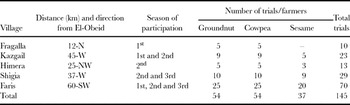
On-farm trials (farmer managed) were conducted to compare seed priming and micro-fertilizing in farmers’ fields in order to evaluate the technologies under real farming conditions and to enhance farmers’ appreciation of the technologies. Participating villages and the number of participating famers for the three seasons of the study are presented in Table 2.
On-farm trials − participating villages and number of farmers.

The treatments in each farmer's field consisted of control (1), seed priming (2) and seed priming + 0.3 g fertilizer/planting pocket (3). All the cultural practices were carried out by the farmers and the recommended planting density was used. Yield measurements were taken from all farmers’ plots. Plot size for each treatment was 360 m2 (15 m × 24 m) and one farmer represented a replicate in the statistical analysis. The treatments were tested using the interaction treatment × replication (farmer) as an error.
Agronomic efficiency of fertilizer
The agronomic efficiency of fertilizer of the different priming and micro-dosing treatments was calculated by dividing the increase in grain yield (kg ha−1) in each treatment over the amount of fertilizer applied (kg ha−1).
Economic analysis
All the seed priming and micro-dosing treatments were economically evaluated using gross margin and the value-cost ratio (VCR).
The gross margin was calculated by subtracting the production cost from the total income (value of grains). All monetary values were converted from Sudanese pounds to US$ at an exchange rate of 1 US$ equivalent to 2.50 Sudanese pounds, and the average yields over seasons and replications in each treatment were calculated. The average field prices of the crops during the past three years were taken from the markets where the farmers sell their produce. Average prices per kg of groundnut, sesame and cowpeas were respectively 0.42, 0.69 and 0.33 US$ kg−1. Production cost is the sum of labour and input costs (without fertilizer). These data were taken from surveys conducted by the Ministry of Agriculture, North Kordofan State, Sudan (MOA North Kordofan, 2008). Costs of production (without fertilizer) for groundnut, sesame and cowpea were 119, 53 and 42 US$ ha−1, respectively. A fertilizer cost of 0.80 US$ kg−1 was added in the micro-fertilizer treatment based on the amount of fertilizer used. Fertilizer application does not increase the labour cost as seeds and fertilizer are applied simultaneously in the same operation.
The VCR for each treatment was calculated as in Aune and Ousman (Reference Aune and Ousman2011).
RESULTS
On-station trials
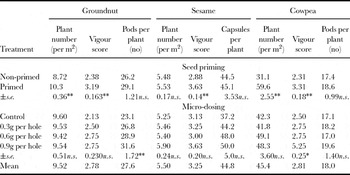
Groundnut. Seed priming affected groundnut crop establishment positively. Seed priming increased groundnut stand number and vigour score by 18% and 34% respectively (Table 3). The number of pods per plant was not significantly changed by seed priming, but this characteristic was increased by micro-dosing. There was no significant interaction between priming and micro-dosing for any of these traits.
Effect of seed priming and micro-dosing on crop establishment of groundnut, sesame and cowpea (average results across three seasons).

Note: n.s.,*, ** indicate respectively, not significant, significant at p ≤ 0.05 and 0.01
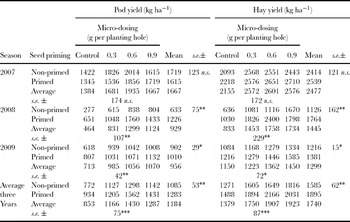
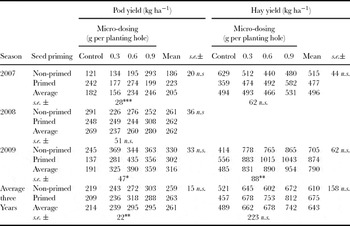
Seed priming and micro-dosing increased grain and hay yields significantly (Table 4). Pod yield and hay yield were increased by 18% and 20% respectively as a result of seed priming. Grain yield increased significantly by seed priming and micro-dosing in two of the three years. Seed priming and micro-dosing had a significant effect in the years when the rainfall was low (2008 and 2009). Micro-dosing of 0.3, 0.6 and 0.9 g fertilizer per pocket increased groundnut pod yield across the three years, by 36.7, 67.6 and 50.8% respectively compared to the control. The corresponding yield increase for groundnut hay was 26.9, 38.2 and 39.2%. The combination of seed priming and 0.6 g fertilizer per pocket more than doubled the average yield across the three seasons. There was no significant interaction between priming and micro-fertilizing for yields.
Effect of seed priming and micro-dosing on groundnut pod and hay yields (kg ha−1) for 2007, 2008, 2009 and across three seasons.

Note: n.s.,*, **,*** indicate respectively, not significant, significant at p ≤ 0.05, 0.01 and 0.001.
Sesame. Analysis of variance results showed a highly significant effect of seed priming on vigour score. Priming increased vigour score by 26% compared with the control. The number of capsules per plant and stand count were not significantly changed by either priming or micro-dosing. There was no significant interaction between priming and micro-dosing for any of these traits (Table 3).
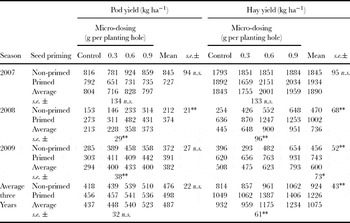
Seed priming did not increase sesame yield in any of the years or across the years (Table 5). The application of 0.3 g fertilizer per pocket increased sesame seed yield across the years by 11.7%, and 0.6 and 0.9 g per pocket increased grain yield by 37.8% compared to the control. Hay yield increase for 0.3, 0.6 and 0.9 g fertilizer per pocket was 35.4, 38.7 and 51.7% respectively (Table 5). Contrary to the results for groundnut, sesame yields were greatest in the third season and least in the first season. Generally, sesame is not tolerant to excessive water and frequent cloudy weather. There was no significant interaction between priming and micro-fertilizing.
Effect of seed priming and micro-dosing on sesame seed and hay yields (kg ha−1) for 2007, 2008, 2009 and across three seasons.

Note: n.s.,*, ** indicate respectively, not significant, significant at p ≤ 0.05 and 0.01.
Cowpea. Seed priming improved stand number and vigour score in cowpea by 92% and 43% respectively. The number of pods per plant was not influenced by priming. With the exception of vigour score, these traits were not significantly affected by micro-dosing. There was a significant interaction between priming and micro-dosing for vigour score (Table 3).
Seed priming significantly increased cowpea pod yield in one out of three years, but there was no significant effect across the seasons (Table 6). The hay yield increased by 32.6% across the seasons. Grain yield increased by 3, 24 and 20% with micro-dose applications of 0.3, 0.6 and 0.9 g respectively. Hay yield was significantly increased by micro-dosing. There was no significant interaction between priming and micro-fertilizing for grain or hay yields.
Effect of seed priming and micro-dosing on cowpea seed and hay yields (kg ha−1) for 2007, 2008, 2009 and across three seasons.

Note: n.s.,*, **,*** indicate respectively, not significant, significant at p ≤ 0.05, 0.01, 0.001.
On-farm trials
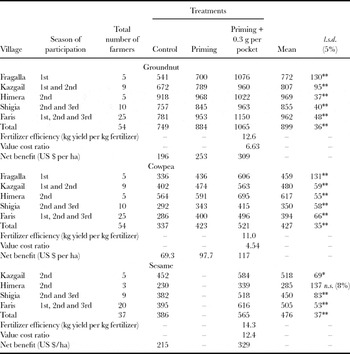
In general there was a highly significant effect of seed priming and micro-dosing in the crops tested (Table 7). For groundnut, the yield increase due to priming was consistent across the sites and ranged from 5 to 29% in the villages. The average groundnut pod yield increase compared to the control was 18% for seed priming. The yield increase due to priming combined with 0.3 g fertilizer per pocket ranged among villages from 11 to 99% with an average yield increase across locations of 42.2%.
On-farm trials − effect of seed priming and micro-dosing on groundnut, cowpea and sesame yields (kg ha−1).

Note: n.s.,*, ** indicate respectively, not significant, significant at p ≤ 0.05 and 0.01. l.s.d.: least significant difference.
Priming increased cowpea yields among the villages from 5 to 40%, with an overall average increase across locations of 26%. The yield increase due to priming together with micro-dose application ranged from 23 to 80%, with an overall average increase across locations of 55%.
For sesame on-farm trials, seed priming was not practiced and only micro-dose application of 0.3 g per pocket was tested. Micro-dosing increased sesame yield on average by 46.3%.
Fertilizer use efficiency
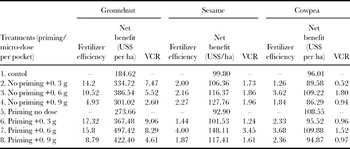
The fertilizer use efficiency (FUE) for the three crops in the on-station and on-farm trials is presented in Tables 7 and 8. In the on-station trials, FUE was clearly improved by seed priming. It was consistently higher for groundnut with the combination of priming and 0.3 g fertilizer per pocket giving a fertilizer efficiency of 17 kg grain per kg fertilizer, and in sesame and cowpea the highest fertilizer efficiency was around 4 kg grain per kg fertilizer. In the on-farm trials, FUE for groundnut, sesame and cowpea was 12.6, 14.3 and 11.0 kg grain per kg fertilizer respectively.
Agronomic efficiency of fertilizers, gross margin and value/cost ratio (VCR) of the different priming and micro-dosing treatments across seasons in on-station experiments.

Note: groundnut, sesame, cowpea and fertilizer prices are: 0.42, 0.69, 0.33 and 0.80 US $ per kg, respectively.
Economic analysis
Calculations of the gross margin and VCR for the different crops and treatments in the on-station and on-farm trials are summarized in Tables 7 and 8. For all the crops, the highest gross margins were obtained when both seed priming and micro-dosing were used. The treatment in the on-station trials that gave the highest gross margin for all the crops tested was the combination of seed priming and 0.6 g fertilizer per pocket. The increase in gross margin for this treatment compared to the control was 313, 48 and 14 US $ ha−1 for groundnut, sesame and cowpea respectively.
The VCR was also clearly higher in groundnut compared to cowpea and sesame in the on-station experiments. The highest VCR recorded was 9.06 when combining seed priming and micro-dosing. The VCR in sesame in the on-station experiments was above 2 for all the micro-fertilizer treatments in combination with seed priming. The VCR for cowpea was below 2 for all the treatments. In the on-farm trials, the groundnut gross margin increased from 196 US $ ha−1 in the control to 253 US $ ha−1 in the priming treatment and 309 US $ ha−1 in the combination of seed priming and 0.3 g fertilizer per pocket. In cowpea, priming increased the net return from 69 US $ ha−1 to 98 US $ ha−1, and the gross margin in the treatment where seed priming was combined with micro-dosing was 117 US $ ha−1. The sesame gross margin increased from 215 US $ ha-1 in the control to 329 US $ ha−1 in micro-dosing using 0.3 g fertilizer per pocket.
DISCUSSION
Seed priming and micro-dosing were able to improve crop establishment, increase yields and improve economic return in groundnut, sesame and cowpea production. However, the effects differed among the crops and between the on-station and the on-farm experiments. These results are the first to our knowledge to document the effect of seed priming and micro-dosing in groundnut, sesame and cowpea. Yields in the drylands of West Africa have been stagnating (Aune and Bationo, Reference Aune and Bationo2008), and these results indicate that it is possible to increase yields in these areas at a meagre cost.
The most consistent effect of seed priming among the crops tested was found in groundnut. Seed priming increased crop vigour for all the crops while the effect on plant number was only observed in groundnut and cowpea. Seed priming increased the yield in groundnut grain in both the on-station and on-farm experiments by 18%. The groundnut hay yield also increased as a result of seed priming in the same order. Seed priming on its own increased cowpea yield in the on-farm experiments. For sesame, no effect of seed priming was found. Seed priming can be recommended for groundnut and cowpea independently of the economic resources of the farmers. Seed priming has previously been found to work both for species with large (maize and chickpea) and small seeds (pearl millet and mungbean) (Harris, Reference Harris2006).
Micro-dosing did not improve plant stand or vigour for any of the crops tested, except for vigour in cowpea. However, there was a clear effect of micro-dosing on grain and hay yield for all the crops. The on-station experiments showed an effect on yield up to 0.6 g fertilizer per pocket while the straw yield can be increased by using up to 0.9 g fertilizer per pocket. The interaction of seed priming and micro-dosing was not significant, but the highest yields were consistently found when seed priming and micro-dosing were combined. If micro-dosing is used, it should preferably be used in combination with seed priming to reduce the risk of fertilizer application and to increase the fertilizer efficiency. The combination of seed priming and 0.6 g fertilizer per pocket gave a yield increase of 102.6, 45.2 and 29.4% compared to the control for groundnut, sesame and cowpea respectively. However, the on-farm experiment showed that the application of 0.3 g fertilizer per pocket in combination with seed priming can also significantly increase yield. This treatment gave a yield increase of 42.3, 54.6 and 46.4% compared to the control for groundnut, sesame and cowpea respectively in the on-farm experiments. The application of phosphorous fertilizer has previously been found to increase yields of groundnut and cowpea in the Sahel (Buerkert and Hiernaux, Reference Buerkert and Hiernaux1998; Buerkert et al., Reference Buerkert, Bationo and Piepho2001).
It appeared from the results that best effect of seed priming and micro-dosing in groundnut and cowpea was found in 2008 and 2009 which were the two driest years. No such a tendency was observed in sesame. This support the conclusion by Harris et al. (Reference Harris, Breese and Rao2005) that seed priming is a low cost and low risk technology of value to resource-poor farmers in marginal conditions as a form of insurance to mitigate the effects of poor management or adverse physical conditions.
Micro-dosing has been tested in sorghum and millet in the Sahel, but there are no published scientific papers on micro-dosing in groundnut or sesame. However, several studies have shown that micro-dosing is an efficient way to increase millet and sorghum yields in drylands (Aune et al., Reference Aune, Doumbia and Berthe2007; Hayashi et al., Reference Hayashi, Abdoulaye, Gerard and Batinono2008; Tabo et al., Reference Tabo, Bationo, Gerard, Ndjeunga, Marchal, Amadou, Annou, Sogodogo, Taonda, Hassane, Diallo, Koala, Bationo, Waswa and Kimetu2007). These results indicate that micro-dosing is an approach that effectively addresses the problem of low fertility in the sandy soils in the North Kordofan State. These soils have been found to have severe deficiencies of P and N (Madibo, Reference Madibo1987). The broadcasting of fertilizer, the traditional method of adding fertilizer, cannot be recommended because it is too costly and risky for the farmers.
The highest FUE in the on-station experiments for groundnut, sesame and cowpea was 17.3, 4.0 and 3.68 kg grains per kg fertilizer respectively, and in the on-station experiments it was 12.6, 11.0 and 14.3 kg grains per kg fertilizer. It appears therefore that the most consistent effect of fertilizer can be found in groundnut. The generally higher FUE in the on-farm experiments compared to the on-station experiments might be explained by a general lower fertility in the on-farm fields compared to the on-station field. The practice of fallowing is systematically used to maintain soil fertility in the fields on the station, while this is less frequently practised in farmers’ fields.
The economic analysis of the on-station experiments showed that the best economic return was found in groundnut. For groundnut, the gross margin increased from 184 in the control to 497 US $ ha−1 in the treatment where seed priming and 0.6 g fertilizer were combined. Micro-dosing in sesame of 0.6 g fertilizer per pocket in combination with seed priming increased the gross margin by 48%. In cowpea there was only a marginal increase in the gross margin as a result of priming and micro-dosing. The on-farm experiments showed that seed priming in combination with 0.3 g fertilizer per pocket increased the gross margin for the three crops tested. The absolute increase in US $ ha−1 was highest in groundnut, whereas the percentage increase was highest for cowpea. These gross margin calculations underestimate the effect of the treatments because the value of hay is not taken into consideration. The VCR for groundnut up to 9.06 in the on-station experiments and 6.6 in the on-farm experiments show that micro-dosing is a very good investment. The VCR should be above 4 in order to cater for the risk under dryland conditions (Koning et al., Reference Koning, Heerink and Kauffman1998).
Micro-dosing and seed priming can also contribute to strengthening livestock production in the area by increasing the supply of high quality groundnut and cowpea hay. El-Hag (Reference El-Hag1992) points out that one of the primary constraints to livestock productivity in the region is the unavailability of adequate nutritional resources on a year-round basis.
It has been shown that nitrogen fixation increases with increasing biomass production in groundnut (Pimratch et al., Reference Pimratch, Jogloy, Vorasoot, Toomsan, Patanothai and Holbrook2007) and increased nitrogen fixation as a result of seed priming and micro-dosing is therefore likely. The value of these crops in rotation will therefore increase with increasing yield.
Access to mineral fertilizer is a problem in North Kordofan, but it is used in areas of Sudan where irrigated agriculture is practiced. It should therefore not be difficult to introduce fertilizer to North Kordofan if there is a demand.
CONCLUSIONS
The on-farm as well as the on-station experiments showed that seed priming combined micro-dosing of fertilizer is a promising approach for increasing crop productivity particularly for groundnut but also for sesame and cowpea. Application of 0.6 g fertilizer per pocket combined seed priming gave the best economic return for all crops. The technology developed through this research project was approved by the Crop Husbandry Committee in Sudan in 2010 and can therefore be promoted through the national extension system in Sudan. This technology not only increases grain yields but will also increase fodder production thereby strengthening crop-livestock interactions. Extension departments and development projects can play a major role in the transfer and dissemination of knowledge about these technologies, while the agricultural banks need to ensure the availability and accessibility to fertilizers on affordable terms.
Acknowledgements
The authors would to thank the Drylands Coordination Group in Norway and Sudan for supporting the project as well as the research staff at El-Obeid Research Station.