

The increasing incidence of mental health problems in the adolescent population (Sawyer et al., Reference Sawyer, Arney, Baghurst, Clark, Graetz and Zubrick2001; Thapar, Thapar, Collishaw, & Pine, Reference Thapar, Thapar, Collishaw and Pine2012; Zubrick, Silburn, Burton, & Blair, Reference Zubrick, Silburn, Burton and Blair2000) and the fact that young people do not always seek appropriate professional help when it is necessary (beyondblue, 2011; Booth, Knox, & Kang, Reference Booth, Knox and Kang2008; Rickwood, Reference Rickwood1995; Sawyer et al., Reference Sawyer, Borojevic, Ettridge, Spence, Sheffield and Lynch2012) challenges school counsellors to seek innovative ways of delivering support services to students. Counselling services for students are provided in most secondary schools in Australia. The role of the school counsellor aims to provide assistance to students when personal, psychological and educational issues impact on educational outcomes. Currently, this requires the student to physically meet face-to-face with the school counsellor. However, although students can make appointments to meet with the counsellor, many students do not seek this help when experiencing difficulties.
Online Counselling as a Pathway to Mental Health Support
Although there is evidence that young people experience mental health difficulties (Kessler, Avenevoli, & Merikangas, Reference Kessler, Avenevoli and Merikangas2001; Sawyer et al., Reference Sawyer, Arney, Baghurst, Clark, Graetz and Zubrick2001; Sawyer, Miller-Lewis, & Clark, Reference Sawyer, Miller-Lewis and Clark2007; Zubrick, Silburn, Burton, & Blair, Reference Zubrick, Silburn, Burton and Blair2000), a review of the international research indicates that of those who require professional help, only 25% of Australians aged 4–17 years seek such help (Gulliver, Griffiths, & Christensen, Reference Gulliver, Griffiths and Christensen2010). In fact, the more severe a young person's mental health issue is, such as depression, the more likely they are not to seek help from a professional (Sawyer et al., Reference Sawyer, Borojevic, Ettridge, Spence, Sheffield and Lynch2012; Wilson, Deane, Marshall, & Dalley, Reference Wilson, Deane, Marshall and Dalley2010). Instead, young people are increasingly turning to the internet for support with mental health problems (Havas, de Nooijer, Crutzen, & Feron, Reference Havas, de Nooijer, Crutzen and Feron2011; Stallard, Reference Stallard2010) and government funding has supported the development of self-help sites such as Reach Out! (www.reachout.com.au; Nicholas, Oliver, Lee, & O'Brien, Reference Nicholas, Oliver, Lee and O'Brien2004). These resources are especially vital for rural youth (Mordaunt, 2010) who often have the requisite mental health literacy but are hesitant to seek help within their own communities (Hernan, Philpot, Edmonds, & Reddy, Reference Hernan, Philpot, Edmonds and Reddy2010). When adolescents do seek professional help, they first access their general practitioner. However, adolescents mainly seek GP support for physical health problems rather than mental health issues (Booth, Knox, & Kang, Reference Booth, Knox and Kang2008). The school counsellor has been found to be the second professional that young people turn to for assistance (Sawyer, Miller-Lewis, & Clark, Reference Sawyer, Miller-Lewis and Clark2007). In combining adolescents’ trust of school counsellors and their propensity to go online, a trial of online counselling in one secondary school was conducted that resulted in positive outcomes for a number of students (Glasheen & Campbell, Reference Glasheen and Campbell2009). This trial prompted further investigation into why online counselling has not been introduced into Australian secondary schools to assist students who are reticent to seek face-to-face help.
What is Meant By Online Counselling
Richards and Viganò (Reference Richards, Viganò and Yan2012) define online counselling as the use of computer-mediated communication (CMC) technologies for the delivery of therapeutic interventions by a professional counsellor in cyberspace. The use of online technology in therapy is often referred to as e-therapy, and this has been perceived as a useful tool for those who provide internet-based interventions and mental health support (Barak, Hen, Boniel-Nissim, & Shapira, Reference Barak, Hen, Boniel-Nissim and Shapira2008; Manhal-Baugus, Reference Manhal-Baugus2001). One mode of providing therapy online is by using ‘real-time’ or synchronous chat in providing online counselling. The use of text-based communication within a synchronous chat room was trialled with secondary students in an earlier pilot and found effective (Glasheen & Campbell, Reference Glasheen and Campbell2008). This modality of online counselling was the focus of this study. The model presented to the school counsellors is one where the student initially requests an online appointment with the school counsellor, who responds by providing a link to a secure chat facility to be accessed at a pre-arranged time.
The Effectiveness of the Online Alliance and Counselling
The internet has also seen the growth of virtual communities that provide support for specific populations. Many users of virtual communities report that they feel less inhibited in their interactions online, which highlights the possibilities for school counsellors to enable student success through collaboration through virtual communities (Sabella & Halverson, Reference Sabella, Halverson, Walz and Kirkman2004). The disinhibition effect of online counselling (Suler, Reference Suler2005), together with the benefit of writing in counselling has been shown to be a powerful therapeutic tools for university students (Richards & Tangney, Reference Richards and Tangney2008). A number of community agencies already provide online support for young people, such as KidsHelpLine in Australia (Ellerman-Bull, Reference Ellerman-Bull2003), and in the United Kingdom reviews of Kooth.com and e-motion online demonstrate that young people often seek help online (Hanley, Reference Hanley2004). Studies of the online counselling process have focused on a comparison between online counselling and telephone counselling or online counselling and face-to-face counselling (King, Bambling, Reid, & Thomas, Reference King, Bambling, Reid and Thomas2006; King et al., Reference King, Bambling, Lloyd, Gomurra, Smith, Reid and Wegner2004). Efforts to determine the level of effectiveness have not been conclusive but do indicate potential advantages of using online counselling over face-to-face counselling (Barak et al., Reference Barak, Hen, Boniel-Nissim and Shapira2008; Cook & Doyle, Reference Cook and Doyle2002; Day & Schneider, Reference Day and Schneider2002). Essential to effective counselling is the therapeutic alliance, and Hanley (Reference Hanley2011) found that engagement, rapport and especially the aspect of control were valued by young people when online. The positive reaction to the proposed use of online counselling as a means of providing student support within tertiary educational institutions (Ryan, Shochet, & Stallman, Reference Ryan, Shochet and Stallman2010; Richards, Reference Richards and Tangney2008) suggests that it could also be a useful tool for secondary school counsellors in the delivery of school counselling services. Although community based agencies such as Kids Help Line provide online counselling for young people, there are still many students who do not access these agencies and therefore there is also a need to provide ‘pathways to care’ within the environment where young people spend most of their time, namely within the secondary school. To date, studies of how school-based counsellors adopt technology have been limited to exploring their general attitudes towards the use of technology in service delivery and their personal comfort with its use (Carlson, Portman, & Bartlett, Reference Carlson, Portman and Bartlett2006; Vinluan, Reference Vinluan2011).
As mentioned previously, it is surprising to note that Australian school counsellors have not embraced online counselling in their work (Campbell & Glasheen, Reference Campbell, Glasheen, Popoola and Adebowale2012). The reasons for this have not been fully explored. It is hypothesised that potential barriers could be a counsellor's personal use and comfort with using technology and their confidence in using technology for counselling. Carlson, Portman, and Bartlett (Reference Carlson, Portman and Bartlett2006) found in a survey of 381 American school counsellors that a counsellor's level of comfort with technology use was a predictive factor of use of technology. There was no gender difference reported in school counsellors’ level of comfort with technology. Further barriers could be counsellors’ beliefs about online counselling in general, their perceptions of student behaviour online and the acceptability to students of online counselling. In another survey of general counsellors conducted by McLeod (Reference McLeod2007) in the United States, it was found that professional counsellors reported a low opinion and lack of knowledge about online counselling. These counsellors reported concerns about ethical and legal implications of online practice in relation to ensuring safety and the efficacy of counselling efficacy. Filipino school counsellors also expressed concern about cost, as well as concerns with confidentiality and security in online school counselling (Vinluan, Reference Vinluan2011). A Turkish study of school counsellors found that both males and females were reluctant to use online counselling in schools (Dincyurek & Uygarer, Reference Dincyurek and Uygarer2012).
In this study we examined the factors that would predict Australian school counsellors’ intention to use online counselling. In particular, we were interested in factors that had been identified through focus groups of school counsellors. These factors were: the counsellor's confidence in using technology for counselling, their general beliefs about technology in general, their perceptions of student acceptability of online counselling offered in a school setting, and their beliefs about student use of technology (Campbell & Glasheen, Reference Campbell, Glasheen, Popoola and Adebowale2012). We hypothesised that their general beliefs about technology in general and their confidence in using online counselling would be the major predictors of their intention to use.
Method
Participants
School counsellors in one Australian state were invited to complete an online survey in 2011. Participants were accessed through the Queensland Guidance and Counselling Association (QGCA), a state counselling professional association, in addition to guidance counsellors employed by the Queensland Education Department.
Two hundred and ten counsellors completed the survey, which is approximately a 20% response rate. Seventy-two per cent were female and 28% male. The largest percentage was aged between 51 and 60 years old (43%) with 28% aged between 41 and 50, 16% between 30–40, 10% over 60 and 3% between 20 and 29 years old. The age and gender distribution reflects the composition of the present workforce in guidance counselling in the Queensland Education Department.
Measure
An online survey was constructed using data collated from focus groups of counsellors previously reported in Campbell and Glasheen (Reference Campbell, Glasheen, Popoola and Adebowale2012). The survey consisted of 38 questions divided into seven sections (see Appendix).
Section 1 consisted of five questions about counsellors’ frequency of ‘personal experience of technology use’; for example: ‘I use a computer for work.’
Section 2 asked participants to rate six statements on their beliefs about ‘online technology in general’ on a 5-point Likert scale of strongly disagree to strongly agree; For example, ‘Bad things are likely to happen online’; ‘People are usually honest when online.’ Cronbach's alpha was 0.64.
Section 3 asked participants to rate four statements about their ‘perceptions of student use of online technology’ on a 5-point Likert scale; for example, ‘Online communication is important for students’; ‘Students tend to be deceptive when online.’.Cronbach's alpha was 0.70.
Section 4 included the dependent variable, which asked participants to indicate their ‘intention to use online counselling’, namely: ‘If online counselling facilities were available in my school, I would use them.’ Three other items were included in this section of the survey and although they related to the use of online counselling, they were not considered to indicate an intention to use online counselling. These three items were: ‘Online counselling would be an effective way to counsel students’; ‘I would be confident that a secure chat room would be a suitable place to counsel students’; and ‘I have the required skills to provide online counselling in my school.’ On reflection, these three items would have been better placed in sections 2 and 5.
Section 5 consisted of seven statements about participants’ ‘level of confidence’ in using online counselling on a 5-point Likert scale from high to low; for example: ‘Keeping control of the online counselling process’; ‘My understanding of the legal issues related to online counselling’. Cronbach alpha was 0.89.
Section 6 asked participants to rate six statements on a 5-point Likert scale of strongly disagree to strongly agree on their perceptions of ‘student acceptability’ of online counselling; for example: ‘Students would be worried about confidentiality’; ‘Students would like online chat used for counselling.’ Cronbach's alpha was 0.77.
Section 7 consisted of six demographic questions seeking data on age, gender, counselling experience, qualification and their preparedness to undertake training in online counselling.
Ethical Considerations
The Queensland University of Technology, Brisbane granted ethical approval for this study and the use of the online measure. All participants indicated their acceptance of the terms and provided consent by completing the first item. If they did not agree, the participant was directed to a ‘thank you’ message.
Results
The online counselling survey for counsellors was subjected to a principal components analysis (PCA) using SPSS Version 18. The six demographic questions (Section 7), the five personal experience of technology questions (Section 1), and the question of intention to use online counselling (item 16, the dependent variable) were removed for the analysis, leaving 26 items. The survey items (6, 8, 9, 13, 20, 21, 22, 23, 24, 25, 26, 28 and 31) were reversed scored. After an examination of the survey items, it was decided that items 17, 18, and 19 did not ask if counsellors would use online counselling, so they were included in the factor analysis and removed as the dependent variable. This initial judgment was confirmed in the PCA as items 17 and 18 were cross-loaded on two factors and were discarded, and item 19 loaded on the factor related to the counsellor's confidence to use online counselling.
Before the PCA was performed the factorability of the data was assessed. The Kaiser-Meyer-Olkin Measure of Adequacy (KMO MSA) value was .872, which was above the recommended value of .6 (Kaiser, Reference Kaiser1970, Reference Kaiser1974), and Bartlett's Test of Sphericity (Bartlett, Reference Bartlett1954) was statistically significant, therefore supporting the factorability of the correlation matrix. The diagonals of the anti-image correlation matrix were all over .5, which supported the inclusion of the items in the factor analysis.
Principal components analysis using Oblimin rotation revealed the presence of six components with eigenvalues exceeding 1, explaining a total of 60.9% of the variance, with the first component contributing 30%, the second 10%, the third 6.9%, the fourth 5.5%, the fifth 4.4% and the sixth 4% of the variance. A further principal components analysis was undertaken that included only the components that accounted for more the 5% of the variance (Hair, Black, Babin, & Anderson, Reference Hair, Black, Babin and Anderson2010). This reduced the number of components from six to four. A four-component solution explained a total of 52.5% of the variance with first component contributing 30%, the second 10%, the third component 6.9%, and the fourth component 5.5%. Items with factor loadings less than 0.3 and cross-loadings above 0.4 were deleted. The items that were deleted were 6, 8, 10, 17, 18 and 31.
A principal components analysis of the remaining items (20), using oblimin rotation was conducted. The Kaiser-Meyer-Olkin value was .853 and Bartlett's Test of Sphericity was statistically significant. The four components had eigenvalues exceeding 1, explaining a total of 57.2% of the variance with the first component explaining 30.8%, the second 11.8%, the third 8.2%, and the fourth 6.4%.
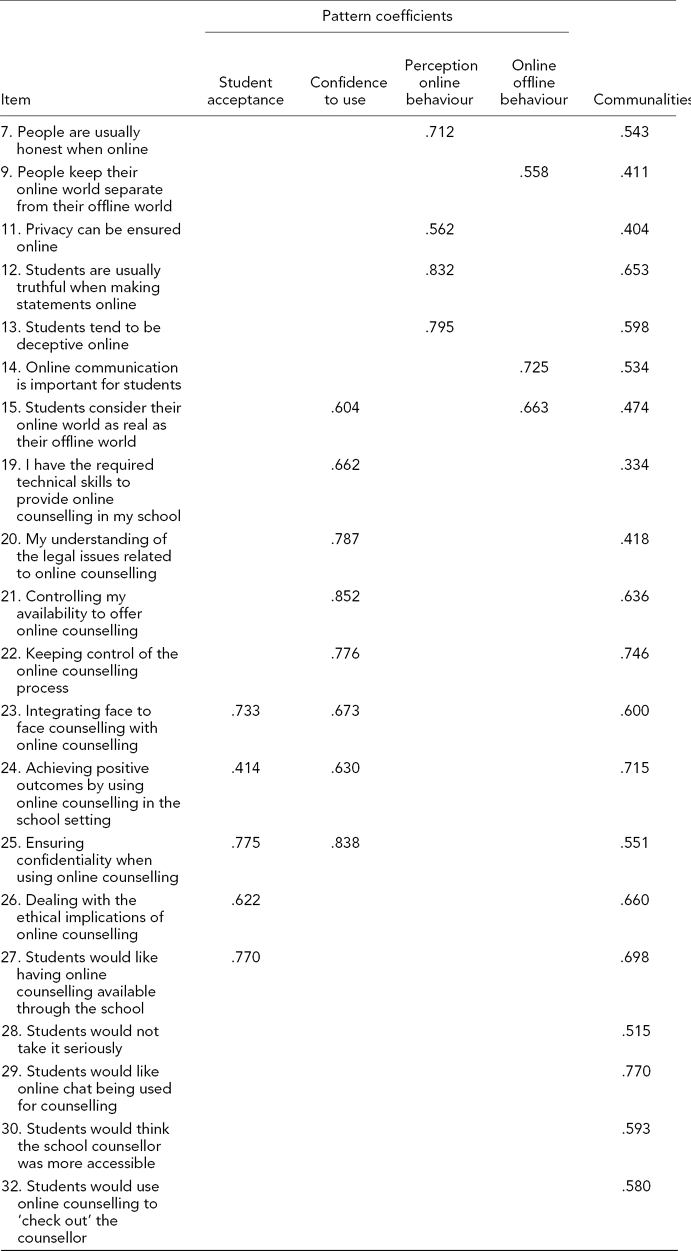
The factor loading matrix for this final solution is presented in Table 1. The four factors were labelled counsellor expectation of student acceptance (five items — 27, 28, 29, 30, 32), counsellor confidence to use (eight items — 19, 20, 21, 22, 23, 24, 25, and 26), counsellor perception of student online behaviour (four items — 7, 11, 12, and 13) and student online offline behaviour (three items — 9, 14 and 15). As the Cronbach's alpha for the fourth factor was only 0.43, these three items were removed from further analysis.
Pattern Matrix for PCA with Oblimin Rotation of Four Factor Solution of the Online Counselling Questionnaire Items

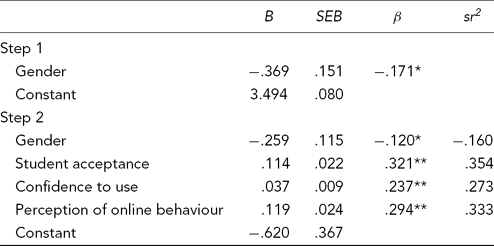
Hierarchical multiple regression was used to examine if the three factors (student acceptance, confidence to use and perception of online behaviour) predicted counsellor intention to use online school counselling, after controlling for the influence of gender as it was not deemed to influence the prediction. Gender was entered at Step 1, which explained 3% of the variance in intention to use online counselling. Confidence to use, student acceptance, and perception of online behaviour were entered at Step 2, with the total variance explained by the model of 46% after controlling for gender, R squared change = .43, F change (3, 194) = 52.21, p < .01. In the final model, gender, confidence to use, counsellor expectation of student acceptance and perception of online behaviour were statistically significant. Counsellor expectation of student acceptance had the highest beta value (β = .32, p < .000) followed by counsellor perception of student online behaviour (β = .29, p < .000) and confidence to use (β = .24, p < .01) and gender had the lowest value (β = −.12, p < .05) see Table 2.
Hierarchical Multiple Regression Analysis Summary Predicting Intention to Use Online Counselling From Gender, Confidence to Use, Student Acceptance and Perception of Online Behaviour Variable
Note: *p < .05, ** *p < .01.
Discussion
This study was designed to examine the predictive factors that contribute to counsellor's intention to use online counselling. It was found that the factor of the counsellor's expectation of student acceptance of online counselling in schools was the most important variable that influenced school counsellors’ intention to use online counselling in the school setting. That is, if counsellors believed that student would think the counsellor was more accessible and would chat online for counselling then counsellors would be more inclined to use it. Although we thought this would be an important reason, it was surprising it had the most influence as we expected issues of technical, legal and ethical issues would be more prominent.
Of second importance as a predictor was the school counsellors’ perception of students’ online behaviour. That is, if school counsellors believed students were usually truthful online and were not deceptive when online, they were more likely to intend to use online counselling. Most counsellors believed students were not honest online but they did not consider students to be deliberately deceptive. This was one section where female counsellors thought students were more honest online than male counsellors thought they were. Perhaps this was the reason that female counsellors were more likely to use online counselling in the school setting than their male counterparts. The assumption that young people are usually dishonest online was reinforced by these findings. However, a search of literature to confirm the belief that young people would be dishonest within online therapy revealed no such research at this time. In one survey, not specific to online counselling, the majority of users were honest online, with only a third of the 257 participants reported as engaging in any form of online deception (Caspi & Gorsky, Reference Caspi and Gorsky2006). An examination of adolescents’ online profiles reveal they are more likely to disclose personal information (Williams & Merten, Reference Williams and Merten2008). Further research is required to address this issue of honesty and the role it has in the therapeutic alliance. The third factor that predicted intention to use online counselling was the counsellors’ confidence to use it. As mentioned before, we were surprised that this factor did not more strongly predict intention to use as it probed factors such as ensuring confidentiality, legal and ethical issues and control.
It was interesting to note that only 13% of counsellors believed it was possible to ensure privacy in online counselling. Perhaps this could be a significant reason for school counsellors not to offer this type of counselling to date. Nonetheless, 50% of this sample indicated that they would use the online counselling facilities in their school if they were available, with only 15% reporting they would definitely not use it. Only 7% would not be interested in further training, with 17% prepared to pay for professional development in this area, which bodes well for future use. Similar to the findings of Carlson et al. (Reference Carlson, Portman and Bartlett2006), the data also indicated that while most of the counsellors use technology for routine applications in their work (such as email, and word processing), very few had participated in chat rooms, which would be used for online counselling.
A number of popular assumptions question the value of online counselling. Fenichel et al. (Reference Fenichel, Barak, Zelvin, Jones, Munro, Meunier and Walker-Schmucker2002) listed 10 myths, ranging from the belief that online therapy is impossible, to the assumption that any clinician can work online. From clinical experience, they reported that an effective and therapeutic alliance can be established online. It is possible that if counsellors were more experienced in using the technology, their concerns about privacy would be negated by their understanding of how to be secure online. These findings imply the need for significant skill development of school counsellors in order to tap the potential benefits of using technology in their practices.
Strengths and Limitations
While a limitation of this study was that there was a gender and age imbalance in the sample, this is a reflection of the population of school counsellors. Furthermore, the fact that the study utilised an online survey may have also biased the sample towards those who have some familiarity of technology. A strength of the study was that although there has been research into the introduction of online support services in other areas such as university and community agencies, this appears to be the first study examining school counsellors’ reasons for intention to use online counselling in secondary schools.
Conclusion
This study examined the factors that contributed to school counsellors’ intention to use online counselling in a secondary school setting. The findings from this study established that there are three factors that contribute to counsellors’ intention. First, counsellors will consider using online counselling if they knew students would accept it. Second, if counsellors believed students were truthful online they would be more inclined to use it. Third, counsellors are more likely to implement online counselling if they are confident in dealing with the ethical, legal and privacy issues related to using online technology. These finding have implications for the future training of counsellors in online counselling. Together with the development of online skills required to conduct an online consultation, counsellors also need to have a level of confidence in understanding the issues associated with online counselling. Although these school counsellors were motivated to assist students if they felt the young people would use online counselling, research is required to identify the attitudes of young people and establish if they would actually use online counselling in schools if it was available.
Appendix School Guidance Counsellors’ Perceptions of Online Counselling Survey
Section 1: Counsellors’ personal experience of technological use
Section 2: Counsellors’ beliefs about online technology in general
Sections 2, 3, and 4 require participants to respond on a 5-point Likert scale: strongly disagree, disagree, unsure, agree, strongly agree.
6. Bad things are likely to happen online.
7. People are usually honest when online.
8. As a rule people present an untruthful persona online.
9. People keep their online world separate from their offline world.
10. It is easy to get to know people online.
11. Privacy can be ensure online.
Section 3: Counsellors’ perceptions of student use of technology
12. Students are usually truthful when making statements online.
13. Students tend to be deceptive when online.
14. Online communication is important for students.
15. Students consider the online world as real as the offline world.
Section 4: Counsellors’ intention to use online counselling
16. If online counselling facilities were available in my school I would use them.
17. Online counselling would be an effective way to counsel students.
18. I would be confident that a secure chat room would be a suitable place to counsel students.
19. I have the required technical skills to provide online counselling in my school.
Section 5: Counsellors’ confidence to use online counselling
Section 5 requires participants to respond on a 5-point Likert scale ranging from high to low
20. My understanding of the legal issues related to online counselling.
21. Controlling my availability to control online counseling.
22. Keeping control of the online counselling process.
23. Integrating face-to-face counselling with online counselling.
24. Achieving positive counselling outcomes by using online counselling in the school setting.
25. Ensuring confidentiality when using online counseling.
26. Dealing with the ethical implications of online counselling.
Section 6: Counsellors’ perceptions of student acceptability of online counselling
Section 6 requires participants to respond on a 5-point Likert scale: strongly disagree, disagree, unsure, agree, strongly agree.
27. Students would like having online counselling available through the school.
28. Students would not take it seriously.
29. Students would like online chat being used for counselling.
30. Students would think the school counsellor was more accessible.
31. Students would be worried about confidentiality.
32. Students would use online counselling to check out the counselor.
Section 7: Demographics
33. If training in the use of online counselling was available would you attend?
34. Please select the area of education — primary, secondary.
35. How long have you been providing counselling for young people?
36. What is the highest level of qualifications you have in counseling?
37. Gender
38. Age