Introduction
The Cambridge Examination for Mental Disorders of the Elderly (CAMDEX) is a popular structured interview for the diagnosis of several mental disorders in the elderly (Roth et al., Reference Roth1986). The instrument is useful and known worldwide for its contribution to the clinical diagnosis of Alzheimer's disease (AD) and other forms of dementia, such as dementia with Lewy bodies (Ballard et al., Reference Ballard1999), vascular dementia (de Koning et al., Reference de Koning, Dippel, van Kooten and Koudstaal2000), and Parkinson's disease (Athey et al., Reference Athey and Walker2006). It contains several sections, to be used in the context of a clinical interview with the patient, covering physical, neurological and psychiatric examinations, the patient's medical and family history, a mental state evaluation, a record of laboratory test results, and a structured interview with a relative or caregiver for additional information. The Cambridge Cognitive Examination (CAMCOG) is the brief neuropsychological battery of the CAMDEX that assesses a range of cognitive functions (orientation, language, memory, attention, praxis, calculation, abstract thinking, and perception) required for the diagnosis of dementia, with an application time estimated in 30 minutes and a maximum score of 107 (Roth et al., Reference Roth1986).
In its original study, the accuracy of the CAMCOG for discriminating dementia from controls was elevated, with 92% sensitivity and 96% specificity for a cut-off score of 79/80 (Roth et al., Reference Roth1986). The study did not include mild stage dementia subjects (Roth et al., Reference Roth1986). Nevertheless, the CAMCOG appears to be affected by age, gender, social class, and education (Huppert et al., Reference Huppert, Brayne, Gill, Paykel and Beardsall1995; Cullum et al., Reference Cullum2000; Williams et al., Reference Williams, Huppert, Matthews and Nickson2003). Although cognitive changes can be detected by the CAMCOG years before the diagnosis of AD (Nielsen et al., Reference Nielsen, Lolk, Andersen, Andersen and Kragh-Sørensen1999), patients with early stage AD and mild cognitive impairment need a different cut-off for their discrimination from controls (Schmand et al., Reference Schmand, Walstra, Lindeboom, Teunisse and Jonker2000; Nunes et al., Reference Nunes2008). Recently, the CAMCOG also was shown to be vulnerable to education bias (Yassuda et al., Reference Yassuda2009).
Education can modulate age-related changes in cognition, and lower education implies a higher risk of developing cognitive impairment and dementia among the elderly (Katzman, Reference Katzman1993; Bottino et al., Reference Bottino2008; Hototian et al., Reference Hototian2008). The ability to read and write, achieved in childhood, may change the morphological and functional status of the human brain, influencing several linguistic and non-linguistic domains (Morais and Kolinsky, Reference Morais and Kolinsky2000; Petersson et al., Reference Petersson, Reis and Ingvar2001; Brucki and Nitrini, Reference Brucki and Nitrini2008). In Brazil, low education has also been associated with worse performance in vocabulary, working memory and visuo-spatial abilities as assessed by several neuropsychological tests (Yassuda et al., Reference Yassuda2009). Education effects have even been found in motor tasks such as the Luria sequence (Nitrini et al., Reference Nitrini2004).
Although the CAMCOG in its original and revised versions are validated in Brazil (Bottino et al., Reference Bottino, Stoppe, Scalco, Ferreira, Hototian and Scalco2001; Paradela et al., Reference Paradela, Lopes and Lourenço2009), the instrument has been mostly studied in patients with high educational level (Nunes et al., Reference Nunes2008). A recent study has reported normative data for older Brazilians in the CAMCOG screened for dementia and depression, including illiterates, and seniors with 1–4 years of education, and ≥5 years (Moreira et al., Reference Moreira, Lourenço, Soares, Engelhardt and Laks2009). However, at present, there is no accuracy data for the older population with lower education. A better understanding of the impact of education on the diagnostic accuracy of the CAMCOG is needed, particularly in developing countries where a large proportion of the elderly population has limited education (Neri, Reference Neri2007). Therefore, the aim of this study was to evaluate the accuracy of the CAMCOG, and to propose cut-off scores for the CAMCOG, in a sample of mild and moderate AD patients and normal controls with heterogeneous levels of education.
Methods
The current study used cross-sectional methodology and included 113 community-dwelling outpatients previously diagnosed with mild and moderate AD and 208 normal controls (NC) from a private geriatric institution. All subjects were older than 60 years and the sample had heterogeneous levels of education. Subjects were recruited from an outpatient geriatric facility, and both groups consisted of patients who sought general medical attention. Control patients did not have memory or behavioral complaints. AD patients sometimes, but not always, came to the clinic due to functional or memory complaints. All subjects were divided into groups according to educational level so that the main objective of the study could be achieved (group 1 = 1–4 years; group 2 = 5–8 years; and group 3 = ≥ 9 years). This sample has been described in a previous study (Aprahamian et al., Reference Aprahamian, Martinelli, Neri and Yassuda2010).
We excluded AD patients with severe cognitive decline (CDR 3), major depression, any plegia or paresis, important tremor, functional impairment in both hands, severe visual or auditory impairment, and patients who refused to complete any of the tests.
Patients in both groups were thoroughly evaluated by two of the authors (IA and JEM) using a clinical protocol which included the CAMDEX (see Procedures, below). The CAMCOG score did not contribute to the clinical diagnosis. Clinical and functional impression, including information from the CAMDEX battery and from auxiliary exams, was taken into account for establishing the diagnosis for AD. Both investigators (IA and JEM) were blind to the CAMCOG final score. In all patients, medical conditions had to be stable and not severe in order for the patient to be included in the study protocol. If the CAMDEX indicated any mood or cognitive disorder in patients in the NC group, that patient was excluded.
Procedures
Each patient underwent a comprehensive psychiatric, clinical and neurological examination. Caregivers and family members were interviewed to provide information regarding functional status. Laboratory (hemogram, renal and hepatic function, electrolytes, vitamin B12 and folate, TSH, T4, and VDRL) and imaging exams (computerized tomography and magnetic resonance of the brain, with single photon emission tomography in selected cases of mild AD) were carried out in all patients to exclude potentially treatable causes for cognitive impairment and identify other dementia etiologies other than AD. All subjects with AD met DSM-IV (American Psychiatric Association, 1994) and NINCDS-ADRDA criteria for probable AD (McKhann et al., Reference McKhann1984). Two geriatricians with neuropsychiatric training participated in the diagnostic process in order to increase diagnostic reliability. The Clinical Dementia Rating (CDR) was obtained using the scoring rules suggested by Morris et al. (Reference Morris, Bergener and Finkel1995). All patients were found to have mild or moderate AD (CDR 0.5, 1.0 or 2.0).
The CAMDEX was completed for each patient. The instrument was translated and validated in Brazil by Bottino et al. (Reference Bottino, Stoppe, Scalco, Ferreira, Hototian and Scalco2001), and it was found to have a high level of stability over time, high agreement among raters, and high internal consistency (Paradela et al., Reference Paradela, Lopes and Lourenço2009). The study protocol was designed and written by the lead author and approved by the local institutional ethical committee.
Statistical analysis
The statistical package SPSS-14 for Windows was used for data analysis. Differences between diagnostic groups (AD v. NC) on continuous variables were assessed using independent samples t-test when data followed normal distribution. Nonparametric data were analyzed using the Mann–Whitney U test. Pearson's χ2 statistics were calculated to compare sociodemographic categorical data for the two groups. ROC curve analyses were carried out to compare the sensitivity and specificity of the CAMCOG to differentiate the two groups in the three educational strata. All statistical tests were two-tailed and regarded as significant when p<0.05.
Results
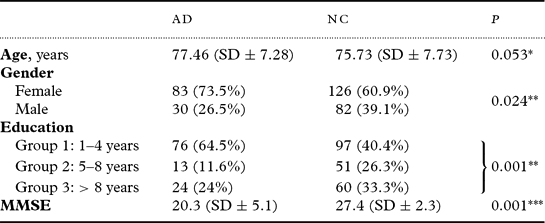
The sample consisted of 113 AD patients and 208 NC, and comprised 209 women (65%) and 112 men (35%) (Table 1). AD patients showed a non-significant slightly higher mean age (77.46 years, SD 7.28, versus 75.73 years, SD 7.73; p = 0.053) with a significant higher presence of women (p = 0.024; Table 1). AD subjects were less educated than controls (p = 0.001; Table 1). There were 37 AD patients with CDR 0.5, 47 with CDR 1.0, and 29 with CDR 2.0.
Characteristics of the sample regarding age, gender, education and MMSE score
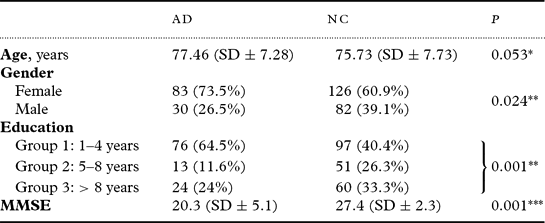
Note. SD = standard deviation; * t student test; ** Pearson's χ2; *** Mann-Whitney.
AD = Alzheimer's disease; NC = normal; control; MMSE = Mini-mental State Examination.
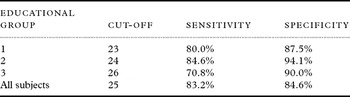
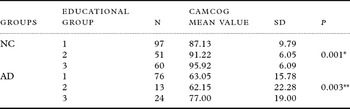
With regard to cognitive measures, the Mini-mental State Examination (MMSE) cut-off score for the role sample was 25.5 with sensitivity of 82.3% and specificity of 84.6% (Table 2). The MMSE cut-off varied from 23.5, 24.5 and 26.5 depending upon education, with higher scores for the more educated groups (Table 2). The AD group showed lower CAMCOG mean values than the NC group (Table 3). The scores were lower among less educated subjects in both diagnostic groups (Table 3).
MMSE cut-off scores, sensitivity and specificity for each educational group

Note. In group 1, n = 173; in group 2, n = 64; in group 3, n = 84. Total: 321 subjects.
CAMCOG mean values and standard deviations for educational groups in AD and NC samples

Note. N = sample size; SD = standard deviation; CAMCOG = Cambridge Cognitive Examination; AD = Alzheimer's disease; NC = normal; control.
* post hoc analysis showed that the three groups were different. ** post hoc analysis showed no difference between groups 1 and 2, which were both different from 3.
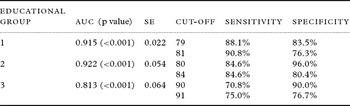
CAMCOG cut-off scores decreased in lower educational levels (Table 4). The education groups showed cut-off scores equal to or lower than 79, 80 and 90 (Table 4). Sensitivity and specificity and areas under the curve (AUCs) were high for the three education strata, yet, lower for the subsample with higher education (Table 4). Among the more educated group, specificity was higher than sensitivity.
AUC, cut-off scores, sensitivity and specificity for the CAMCOG for the educational groups

Note. Group 1, n = 76 AD, 97 NC; group 2, n = 13 AD, 51 NC; group 3, n = 24 AD, 60 NC.
AUC = area under the curve; SE = standard error; AD = Alzheimer's disease; NC = normal control.
Discussion
The aim of the study was to evaluate CAMCOG performance as a cognitive test in a sample of patients with mild and moderate AD and normal controls with heterogeneous educational levels. The accuracy of the test was adequate to establish it as an early diagnostic test for AD in all studied educational strata.
In a previous study examining the association between CAMCOG scores and sociodemographic variables (age, sex, education and social class), education did influence language and abstract thinking scores directly (Huppert et al., Reference Huppert, Brayne, Gill, Paykel and Beardsall1995). Education and social class were highly correlated with performance, and when the association with education was examined without adjusting for social class, attention and praxis were also found to be significantly related to education. The authors concluded that caution must be applied when the CAMCOG is used as a screening test for dementia, using a single, predetermined cut-off point, as performance may be modulated by sociodemographic characteristics.
Nunes et al. (Reference Nunes2008) studied the use of the CAMCOG as a screening tool among MCI, AD and normal control elderly Brazilian subjects with an average of 14 years of schooling (range: 8–26 years). The cut-off score and accuracy for the CAMCOG for dementia screening was higher (92/93; sensitivity of 100% and specificity of 95%) than previously described. The present study provides empirical data to complement the education range not addressed by Nunes et al. (Reference Nunes2008). Both studies suggest the Brazilian version of the CAMCOG is an accurate dementia screening tool and may be used in a wide range of education strata. Nevertheless, the current sample did not include illiterate elderly, who should be recruited in future studies.
Another recent Brazilian study evaluated the reliability of the Brazilian CAMCOG-Revised version (Paradela et al., Reference Paradela, Lopes and Lourenço2009). It was applied among 123 elders who were retested at a mean interval of 30.7 days. In this study, 86.3% of the sample had less than eight years of formal education. The intraclass coefficient for the set of items and for the subscales was high, varying from 0.93 to 0.98. In the retests, the agreement was nearly perfect for the set of items. There was no expressive range in the stability of the instrument for sex, age, and schooling, between healthy controls or dementia. Cronbach's α for the test was high (0.89). In this heterogeneous population, the presence of an important amount of lower education subjects did not influence the reliability, consistency and stability of the CAMCOG.
The sensitivity and specificity of the CAMCOG in the current study were lower than those reported in the original study, for most studied educational groups (Roth et al., Reference Roth1986). The CAMCOG cut-off point for the lowest educational level group in our sample was equal to the score for discriminating dementia in the original study (Roth et al., Reference Roth1986). As expected, in this dataset the cut-off scores increased as the educational level was higher. These findings agree with previous studies regarding education and CAMCOG performance (Nunes et al., Reference Nunes2008; Yassuda et al., Reference Yassuda2009). The fact that CAMCOG accuracy among patients with lower education was similar to the original accuracy values, derived from populations with a higher educational background, may be explained by differences in sample characteristic, such as education.
Other points must be addressed regarding the cognitive aspects of the current sample. The reported MMSE scores are similar to other Brazilian studies carried out in different regions, varying from 23 to 26 depending on education (Brucki et al., Reference Brucki, Nitrini, Caramelli, Bertolucci and Okamoto2003; Larks et al., Reference Larks, Baptista, Contino, de Paula and Engelhardt2007). Patients in the study by Roth et al. (Reference Roth1986) might have presented with more severe dementia or other comorbidities, generating a lower cut-off score compared with our sample, when the educational background was comparable. In the present study, 32% of participants had mild dementia, which might have increased the cut-off score despite a lower educational level.
There are some limitations to the present study. First, the sample may not be representative of Brazilian older adults in different regions of Brazil. Although most of the sample was comprised of seniors with less than eight years of formal schooling, they did not come from impoverished areas. The sample was recruited from a private geriatric clinic, and not from public primary care. Previous discrepancies associated with education bias have been found between the current sample (Aprahamian et al., Reference Aprahamian, Martinelli, Neri and Yassuda2010) and a sample derived from a public primary care unit in Rio de Janeiro for the Clock Drawing Test (Lourenço et al., Reference Lourenço, Ribeiro-Filho, Moreira, Paradela and Miranda2008), which might be explained by income and cultural differences. Secondly, it is important to point out that for some of the education groups in this study, especially Group 2, sample size was limited. Thus, the findings in this paper may need replication in larger samples. Finally, one should consider that inclusion and exclusion criteria may affect cut off scores. In the present study, for example, if mild AD cases had not been included, reported cut-off scores could have been lower.
In conclusion, the present study presents original data regarding CAMCOG accuracy to identify dementia for different educational ranges. Results suggest that the CAMCOG retains high accuracy when used in samples of elderly with limited education and this constitutes an original finding.
Conflict of interest
None.
Description of authors' roles
I. Aprahamian designed the study, collected the data and wrote the paper. J. E. Martinelli collected the data and supervised the data collection. J. Cecato collected the data. R. Izbicki participated in study design and statistical analysis. M. S. Yassuda participated in study design and statistical analysis, and revised the paper.