


%20--%3e%3c!DOCTYPE%20svg%20PUBLIC%20'-//W3C//DTD%20SVG%201.0//EN'%20'http://www.w3.org/TR/2001/REC-SVG-20010904/DTD/svg10.dtd'%3e%3csvg%20version='1.0'%20id='Layer_1'%20xmlns='http://www.w3.org/2000/svg'%20xmlns:xlink='http://www.w3.org/1999/xlink'%20x='0px'%20y='0px'%20width='64px'%20height='64px'%20viewBox='5.5%20-3.5%2064%2064'%20enable-background='new%205.5%20-3.5%2064%2064'%20xml:space='preserve'%3e%3cg%3e%3ccircle%20fill='%23FFFFFF'%20fill-opacity='0'%20cx='37.785'%20cy='28.501'%20r='28.836'/%3e%3cpath%20fill='%23595959'%20d='M37.441-3.5c8.951,0,16.572,3.125,22.857,9.372c3.008,3.009,5.295,6.448,6.857,10.314%20c1.561,3.867,2.344,7.971,2.344,12.314c0,4.381-0.773,8.486-2.314,12.313c-1.543,3.828-3.82,7.21-6.828,10.143%20c-3.123,3.085-6.666,5.448-10.629,7.086c-3.961,1.638-8.057,2.457-12.285,2.457s-8.276-0.808-12.143-2.429%20c-3.866-1.618-7.333-3.961-10.4-7.027c-3.067-3.066-5.4-6.524-7-10.372S5.5,32.767,5.5,28.5c0-4.229,0.809-8.295,2.428-12.2%20c1.619-3.905,3.972-7.4,7.057-10.486C21.08-0.394,28.565-3.5,37.441-3.5z%20M37.557,2.272c-7.314,0-13.467,2.553-18.458,7.657%20c-2.515,2.553-4.448,5.419-5.8,8.6c-1.354,3.181-2.029,6.505-2.029,9.972c0,3.429,0.675,6.734,2.029,9.913%20c1.353,3.183,3.285,6.021,5.8,8.516c2.514,2.496,5.351,4.399,8.515,5.715c3.161,1.314,6.476,1.971,9.943,1.971%20c3.428,0,6.75-0.665,9.973-1.999c3.219-1.335,6.121-3.257,8.713-5.771c4.99-4.876,7.484-10.99,7.484-18.344%20c0-3.543-0.648-6.895-1.943-10.057c-1.293-3.162-3.18-5.98-5.654-8.458C50.984,4.844,44.795,2.272,37.557,2.272z%20M37.156,23.187%20l-4.287,2.229c-0.458-0.951-1.019-1.619-1.685-2c-0.667-0.38-1.286-0.571-1.858-0.571c-2.856,0-4.286,1.885-4.286,5.657%20c0,1.714,0.362,3.084,1.085,4.113c0.724,1.029,1.791,1.544,3.201,1.544c1.867,0,3.181-0.915,3.944-2.743l3.942,2%20c-0.838,1.563-2,2.791-3.486,3.686c-1.484,0.896-3.123,1.343-4.914,1.343c-2.857,0-5.163-0.875-6.915-2.629%20c-1.752-1.752-2.628-4.19-2.628-7.313c0-3.048,0.886-5.466,2.657-7.257c1.771-1.79,4.009-2.686,6.715-2.686%20C32.604,18.558,35.441,20.101,37.156,23.187z%20M55.613,23.187l-4.229,2.229c-0.457-0.951-1.02-1.619-1.686-2%20c-0.668-0.38-1.307-0.571-1.914-0.571c-2.857,0-4.287,1.885-4.287,5.657c0,1.714,0.363,3.084,1.086,4.113%20c0.723,1.029,1.789,1.544,3.201,1.544c1.865,0,3.18-0.915,3.941-2.743l4,2c-0.875,1.563-2.057,2.791-3.541,3.686%20c-1.486,0.896-3.105,1.343-4.857,1.343c-2.896,0-5.209-0.875-6.941-2.629c-1.736-1.752-2.602-4.19-2.602-7.313%20c0-3.048,0.885-5.466,2.658-7.257c1.77-1.79,4.008-2.686,6.713-2.686C51.117,18.558,53.938,20.101,55.613,23.187z'/%3e%3c/g%3e%3c/svg%3e)
%20--%3e%3c!DOCTYPE%20svg%20PUBLIC%20'-//W3C//DTD%20SVG%201.0//EN'%20'http://www.w3.org/TR/2001/REC-SVG-20010904/DTD/svg10.dtd'%3e%3csvg%20version='1.0'%20id='Layer_1'%20xmlns='http://www.w3.org/2000/svg'%20xmlns:xlink='http://www.w3.org/1999/xlink'%20x='0px'%20y='0px'%20width='64px'%20height='64px'%20viewBox='5.5%20-3.5%2064%2064'%20enable-background='new%205.5%20-3.5%2064%2064'%20xml:space='preserve'%3e%3cg%3e%3ccircle%20fill='%23FFFFFF'%20fill-opacity='0'%20cx='37.637'%20cy='28.806'%20r='28.276'/%3e%3cg%3e%3cpath%20fill='%23595959'%20d='M37.443-3.5c8.988,0,16.57,3.085,22.742,9.257C66.393,11.967,69.5,19.548,69.5,28.5c0,8.991-3.049,16.476-9.145,22.456%20C53.879,57.319,46.242,60.5,37.443,60.5c-8.649,0-16.153-3.144-22.514-9.43C8.644,44.784,5.5,37.262,5.5,28.5%20c0-8.761,3.144-16.342,9.429-22.742C21.101-0.415,28.604-3.5,37.443-3.5z%20M37.557,2.272c-7.276,0-13.428,2.553-18.457,7.657%20c-5.22,5.334-7.829,11.525-7.829,18.572c0,7.086,2.59,13.22,7.77,18.398c5.181,5.182,11.352,7.771,18.514,7.771%20c7.123,0,13.334-2.607,18.629-7.828c5.029-4.838,7.543-10.952,7.543-18.343c0-7.276-2.553-13.465-7.656-18.571%20C50.967,4.824,44.795,2.272,37.557,2.272z%20M46.129,20.557v13.085h-3.656v15.542h-9.944V33.643h-3.656V20.557%20c0-0.572,0.2-1.057,0.599-1.457c0.401-0.399,0.887-0.6,1.457-0.6h13.144c0.533,0,1.01,0.2,1.428,0.6%20C45.918,19.5,46.129,19.986,46.129,20.557z%20M33.042,12.329c0-3.008,1.485-4.514,4.458-4.514s4.457,1.504,4.457,4.514%20c0,2.971-1.486,4.457-4.457,4.457S33.042,15.3,33.042,12.329z'/%3e%3c/g%3e%3c/g%3e%3c/svg%3e)
Introduction
Healthcare-associated infections (HAIs) are a major source of preventable harm in hospitalized patients contributing substantially to morbidity, prolonged hospitalization, and healthcare costs. Reference Schults, Hall and Charles1–3 From a consumer perspective, HAI risk is inherently difficult to understand. Unlike other complications of healthcare, HAIs represent a largely invisible risk. Although a substantial proportion of HAIs are preventable, infection risk cannot be completely eliminated, even in healthcare systems with mature infection prevention and control programs. Consequently, patients rely on health systems and institutional safeguards (eg, infection prevention and control (IPC) teams) to manage infection risk, Reference Seale, Novytska, Gallard and Kaur4 while forming perceptions of HAIs through indirect experience, media, and public health campaigns. Existing qualitative studies Reference Russo, Digby and Bucknall5–Reference Lum, Page, Nissen, Doust and Graves8 and cross-sectional surveys Reference Seale, Novytska, Gallard and Kaur4,Reference Abbate, Di Giuseppe, Marinelli and Angelillo7 have shown when HAIs occur, they are often seen as health system failures, which in turn impact patients trust in and expectations of the healthcare system.
Understanding how consumers conceptualize HAI risk, trust in healthcare systems, and perceive their role in prevention is critical for designing effective IPC communication strategies, improving transparency and strengthening patient engagement in the field. Q-methodology offers a structured approach to examine complex issues of human “subjectivity”. Reference Churruca, Ludlow and Wu9–Reference Güneş Şan, Çelik and Altay15 It is a mixed-method approach that asks participants to rank-order a set of statements according to their level of agreement or disagreement. Statistical analysis is then used to identify shared patterns of thinking or viewpoints among participants. We therefore aimed to identify and describe shared consumer viewpoints regarding HAIs and IPC, with a focus on risk perception, health system trust, and perceived responsibility for prevention. A secondary aim was to explore associations between participant characteristics and specific viewpoints.
Methods
Study design
A cross-sectional Q-methodology study was conducted to identify consumer viewpoints regarding HAI risk and IPC initiatives. Ethical approval was obtained from Griffith University (GU Ref No: 2024/880). The study is reported in line with recommendations for Q-methodology studies. Reference Churruca, Ludlow and Wu9 Additional methodological detail is provided in Supplementary Material 1.
Participants and sampling
Adult residents (healthcare consumers, aged 18 yr or older) in Queensland were purposively sampled using quotas for age, sex, and geographic location. Healthcare consumers were defined broadly as members of the public who use, have used, or may use healthcare services, including patients, family members, carers, and supporters involved in healthcare experiences. Recruitment was conducted on a first-come, first-served basis through Q&A Market Research®, 16,17 who distributed email invitations until quotas were filled. Participants were drawn from an established opt-in online research panel comprising community members who had previously registered to participate in market and survey research. Membership was not restricted to patients or individuals with prior healthcare experiences. Multiple data quality safeguards were applied, including digital fingerprinting to prevent duplicate responses, enforced minimum completion times, and automated checks for inattentive or inconsistent responding, with all flagged responses excluded prior to analysis. This was a paid survey, with incentive arrangements managed solely by Q&A Market Research®. The research team were not involved in or had knowledge of the specific payment structures offered to participants.
Data collection
Survey tool
The online Q survey included four sections: (1) participant demographics including geography, age, and HAI experience; (2) HAI attitudes using a 5-point Likert scale (strongly disagree to strongly agree); (3) Q sort, sorting of statements (n = 44); and (4) survey useability feedback (optional).
Participants completed the survey online using the Qualtrics platform. No identifiable data were collected. While QandA Market Research® did not have access to raw data or individual responses, participants’ age, sex, and geographic location was shared with them to enable quota monitoring and ensure target sample distribution. The survey tool took approximately 30 minutes to complete, and survey useability data were collected alongside Q-set statements.
Development of Q sets—statements
A Q-set of 44 statements were developed from published literature (HAI studies on burden, patient experience, risk perceptions, and attitudes toward healthcare/IPC), Reference Lydeamore, Mitchell, Bucknall, Cheng, Russo and Stewardson2,Reference Mitchell, Northcote and Rickett6,Reference Chang, Fan and Kuo18–Reference Mitchell, Hall, Halton, McBeth and Gardener24 and government policy and reports. 25–27 Statements were independently reviewed by six healthcare consumers including SS (consumer and community investigator). Feedback and refinement were iterative, involving three rounds of consumer review, terminology edits, and survey pilot testing (total n = 9 pilot tests). The final 44 Q set is provided in Supplementary Material 2. The full survey instrument is provided in Supplementary material 3.
Development of Q-sorting procedure
For the Q-sorting procedure, a quasi-normal distribution was used, with endpoints “most disagree” and “most agree,” scaled from −5 to + 5. Reference Haua, Wolf, Harrison and Aspden28 An exclusion method was applied to the Q-sorting process.
Selection of statements
Participants asked to select which statement, they agreed with the most, in the following order:
-
• Three statements they most agreed with. These statements were assigned the highest score of (+4).
-
• Four or more statements they strongly agreed with, rated as (+3),
-
• Followed by five statements rated as (+2),
-
• Then six statements rated as (+1).
Participants were then asked to select the statements that they most disagreed with, in the following order:
-
• Three statements they most disagreed with. (−4).
-
• Participants then selected the statements with which they disagreed, following the same stepwise principle as the agreement task, with scores assigned in reverse from −4 to −1.
-
• The remaining statements, neither selected as “strongly agreed with” or “strongly disagreed with,” were considered neutral and assigned a score of 0.
Analysis
Descriptive statistics were used to summarize participants’ demographic characteristics (eg, age, gender, geographic location, income, education, rurality) and to provide an overview of initial attitudes toward HAIs. Frequencies and percentages were reported for categorical variables. Q-sort data were analyzed using Ken-Q Analysis, 29 with factor extraction via principal component analysis and varimax rotation. Factor retention was guided by eigenvalues, explained variance, scree plots, and interpretability. Ordered logistic regression was used descriptively to explore associations between participant characteristics and Likert-scale responses. Further details are provided in Supplementary Material 1.
A factor represented a shared viewpoint, identified when participants rank statements in a similar way. Participants loading significantly onto the same factor are interpreted as sharing a common perspective on the topic under investigation. Factor labels were developed post hoc during interpretation and were not predefined. Labels were assigned based on examination of distinguishing statements, factor arrays, consensus statements, and the overall narrative represented by each shared viewpoint.
Results
Sample
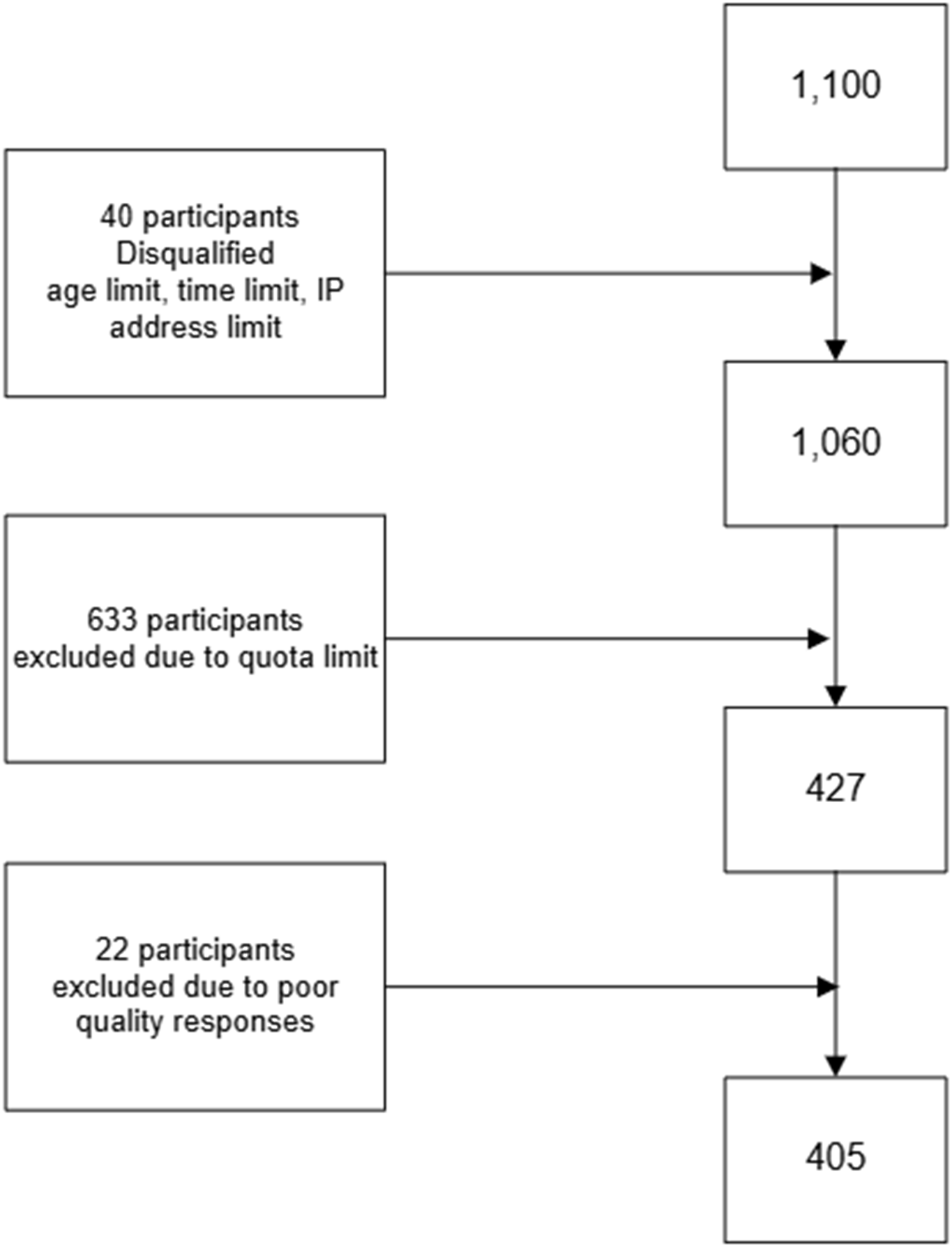
A total of 1,100 participants attempted the survey between the 20th May and 5th June. Forty participants were excluded for failing to meet survey quality standards, such as completing the survey too quickly, failing the age requirement, or residing outside Australia (as indicated by IP address). An additional 633 participants were disqualified once demographic quotas were filled, leaving 427 eligible responses. Following Qualtrics’ built-in data quality checks, an additional 22 responses were removed due to poor data quality (eg, inconsistent response patterns), resulting in a final analytic sample of 405 valid participants (Figure 1).
PRISMA flow diagram.

Participant characteristics
Table 1 outlines respondent characteristics. Most participants reported good or very good (74%) overall health, with the most common comorbidities chronic illnesses (28%), chronic pain (22%), and nervous or emotional conditions (21%) (Supplementary material 4).
Participant characteristics across sample and per factor

Table 1. Long description
The table presents participant characteristics across various factors. It includes data on sex, age, marital status, Aboriginal status, place of residence, education, employment, personal income, health insurance, hospital admission, knowledge of someone with HAI, HAI awareness, and general health. The table has 405 participants in total, divided into four factors and an unallocated group. Each row lists specific characteristics and their percentages across these groups. For example, the sex distribution shows 52.35 percent male and 47.65 percent female participants. Age groups range from 18-35 to over 55, with varying percentages across factors. Marital status includes categories like never married, married, divorced, and separated, with percentages provided for each. Aboriginal status is divided into Aboriginal, both Aboriginal and Torres Strait Islander, and no, with corresponding percentages. Place of residence includes major cities, regional areas, and remote areas. Education levels range from university qualifications to not completing high school. Employment status includes categories like full-time, part-time, casual, self-employed, unemployed, student, unable to work, and retired. Personal income is categorized into different ranges, with percentages for each. Health insurance types include hospital only, ancillary only, both, and none. Hospital admission data shows the percentage of participants admitted to the hospital. Knowledge of someone with HAI and HAI awareness are also categorized with percentages. General health is rated as excellent, very good, good, fair, and poor, with respective percentages. The table provides a comprehensive overview of the demographic and health-related characteristics of the participants.
Hospitalization and HAI experience
Thirty-five per cent of respondents reported a hospital admission in the preceding 12 months; most admissions were for a day case (47%) at a public hospital (66%) (Table 1). Approximately one in ten respondents (10%) reported having acquired a HAI, 36% knew someone who had. 35% of respondents reported they were ‘somewhat aware’ of HAIs, while 34% reported they were “somewhat familiar” with HAI associated risks.
Community and consumer attitudes and perceptions of HAI and ICP (Q statements)
Likert ratings for the 44 Q statements are summarized in Table 2. Fifty-four percent of participants reported they would be concerned about acquiring a HAI during a hospital stay (Q2), while 85% reported HAI acquisition would make them anxious and stressed (Q6). Concern regarding AMR was almost universal (88%), while 82% of respondents supported increased national reporting and transparency of HAI rates. Four in five respondents (82%; Q26) felt IPC should be a top government priority, with a call for more HAI education (72%; Q27). Three-quarters (74%) of respondent believed hospitals should be required to publicly report their infection rates (Q38). Respondents expressed trust in IPC clinicians (85%; Q28) but felt healthcare workers should communicate infection risk more clearly to patients (75%; Q29). While most respondents trusted healthcare providers to act responsibly, those with personal or indirect experience of HAIs reported lower trust, nearly 40% indicated they would lose trust in the health system if they acquired a HAI.
Likert scale: frequencies and percentage

Table 2. Long description
The table presents Likert scale ratings for 44 statements related to healthcare-associated infections (HAIs). It includes columns for Strongly disagree, Disagree, Neutral, Agree, and Strongly agree, with percentages and frequencies for each response category. The table is organized into several sections: Occurrence, Harms and complications, Recovery and healthcare seeking, Burden on family and system, Antimicrobial resistance, Trust in the health system, Prevention, Government/healthcare policies, Responsibilities and visitors, Surveillance and reporting, Willingness to pay, Public view, and Technology. Each section contains multiple statements with corresponding response percentages. For example, in the Occurrence section, 21.5 percent strongly agree that HAIs are rare occurrences, while 49.12 percent agree. In the Harms and complications section, 11.2 percent strongly agree that HAIs are life threatening. The table provides a comprehensive overview of public perceptions and concerns regarding HAIs and related healthcare policies.
Distinct viewpoints
Three factors reflecting shared participant viewpoints were identified. Together, factors explain 49% of the variance in rankings. Overall, 305/405 participants loaded onto one of the three factors. The remaining 100 participants were not flagged to a single factor because they either (a) loaded significantly onto more than one factor or (b) did not load significantly on any of the three retained factors. Distinguishing statements are provided in Supplementary material 5. Factor arrays are provided in Figure 2.
Factor arrays.

Factor 1: heightened anxiety and vigilance (n = 148)
Factor 1 accounted for 21% variance, was defined by 27 distinguishing statements and represented the largest viewpoint in the study (n = 148 participants).
Participants in this factor viewed HAIs as serious, anxiety-inducing events, believing that “HAIs are life-threatening” (+2; Z = 0.78). Participants strongly agreed that “Having a HAI would be stressful and make me worried and/or anxious” (+4; Z = 1.70) and perceived “HAIs becoming resistant to antibiotics as a concern” (+4; Z = 1.61). Participants rejected any attempt to downplay these risks. They strongly disagreed with “I wouldn’t be worried if someone I cared for got a HAI when in hospital” (−4; Z = −1.86). and the idea that HAIs are “minor” complications (−3, Z = −1.14).
Factor 1 participants recognized the financial and logistical challenges associated with HAIs. They strongly agreed that “Contracting a HAI can lead to unexpected costs due to additional treatments or time off work” (+4; Z = 1.44). This group strongly supported “Hospitals should be required to publicly report their infection rates” (+3; Z = 1.06) and agreed that “Patients would need subsequent hospital visits to treat HAIs” (+2; Z = 0.70). They also disagreed with the statement “Cleanliness and hand hygiene are enough to prevent HAIs” (−2; Z = −0.67), instead signaling a belief in more comprehensive prevention strategies.
Factor 2: trust and reassurance-orientated (n = 84)
Factor 2 accounted for 13% of the variance, with 84 participants and 30 distinguishing statements.
Participants expressed confidence in the system, strongly agreeing that “Healthcare workers take infection prevention seriously” (+4; Z = 2.22) and that “Healthcare facilities take every precaution to prevent infections” (+4; Z = 2.02). They also recognized “Infection becoming resistant to antibiotics is a concern” (+4; Z = 1.78). Importantly, they reported feeling safe: “I feel safe in the hospital when it comes to infection risk” (+3, Z = 1.66).
Factor 2 participants tended to view HAIs as uncommon and manageable. They strongly agreed with “HAIs are rare occurrence” (+3; Z = 1.28) and placed less weight on them as life-threatening, actively disagreeing with “HAIs are life-threatening” (−2; Z = 0.60). Similarly, they disagreed that “I would be worried about catching an infection during hospital stay” (−4, Z = −1.20).
Factor 2 participants strongly supported “Information about preventing HAIs should be available in healthcare facilities” (+3; Z = 1.08) and agreed that “Preventing HAIs is a critical part of ensuring high-quality healthcare” (+2, Z = 1.07). However, participants were neutral to mildly dismissive of statements about overcrowding, financial burden, or staff shortages.
Factor 3: concern but balanced (n = 73)
Factor 3 accounted for 15% of the variance, with 73 participants and 29 distinguishing statements.
Participants in this factor expressed strong personal concern about HAIs agreeing that “Having a HAI would be stressful and make me worried and/ or anxious” (+3; Z = 1.10) and rejecting suggestions of indifference, including “Having an infection in the hospital wouldn’t worry me” (−3, Z = −1.30) and “I wouldn’t be worried if someone I cared for got an infection when in the hospital” (−4, Z = −1.53).
Factor 3 participants had high levels of confidence in healthcare systems and staff, strongly agreeing with statements, “Healthcare workers take infection control seriously” (+3; Z = 1.06) and that “Healthcare facilities take every precaution to prevent infections” (+2, Z = 0.76). Participants in this factor also supported better access to information, agreeing that “Information about preventing HAIs should be available in healthcare facilities” (+2; Z = 0.89).
Participants rejected the idea that HAI prevention rests solely with hospitals or staff, “Preventing infections during a hospital stay is entirely the responsibility of the hospital and healthcare workers” (−3; Z = 1.35) as well as rejecting “I don’t believe patients can do much to prevent HAIs” (−2; Z = −1.10).
Consensus and disagreement
Factor Q-sort Values for Statements sorted by Consensus versus Disagreement are provided in Supplementary material 6. Across factors there was disagreement that patients don’t need to be informed if they get an infection during their hospital stay (QSort value = −4, −4, −4 for Factor 1, 2 and 3 respectively; P = .014). There was universal agreement that AMR, infections becoming resistant to antibiotics is a concern (QSort value = +4, +4 to + 4 for Factor 1, 2 and 3 respectively; P = .02) and that infections acquired in healthcare often lead to longer recovery times than expected (QSort value = +3, +3, +4 for Factor 1, 2 and 3 respectively; P = .02).
Multivariable analysis
Based on the multivariable logistic regression participants with greater HAI awareness, personal or indirect experience of HAIs (self or knowing someone affected), and older age were significantly more likely to report stronger perceptions of HAI severity, impacts on recovery, financial burden, and the need for prevention, transparency, and system-level action. Socio-demographic factors including education, income, marital status, and geography were significantly associated with different response patterns across statements relating to trust in the health care system, preventability, and willingness to invest in infection prevention. Supplementary material 7 outlines results from the ordered logistic regression by themes. Predictors of factor membership are provided in Supplementary material 8.
Discussion
We identified three distinct consumer viewpoints (factors) regarding HAIs, reflecting different perceptions of risk, trust in health systems, and roles in IPC. The most prevalent, factor 1 reflected a perspective of heightened concern and vigilance, characterized by strong endorsement of HAIs as serious and costly with rejection any minimization of HAI risk. Factor 2 reflected a system-trusting, reassurance-oriented perspective, with trust in healthcare staff and institutions and a belief that HAIs are rare and that hospitals take IPC seriously. Factor 3 was characterized by anxiety around HAIs, balanced by trust in healthcare staff and institutions. Across the three viewpoints, areas of consensus (issues considered important) were notification of infection (and transparent HAI rates), AMR significance, and morbidity derived from HAIs.
Understanding of HAI risk varied across viewpoints, with a key finding being the central role HAI experience played in shaping risk perception. Participants with direct or indirect experience of HAIs were more likely to perceive infections as severe, costly, and indicative of system vulnerability, aligning with the ‘heightened anxiety and vigilance’ viewpoint. In contrast, participants without such experience were more likely to interpret the relative invisibility of HAIs as evidence of effective prevention, reflecting a reassurance-oriented perspective. In contrast to AMR, where agreement on risk statements was high, understanding of HAI risk was fragmented and experience dependant, aligning with published HAI risk awareness studies. Reference Russo, Digby and Bucknall5 This suggests that unlike AMR, which has received significant media attention, increasing public awareness of HAIs may shift public perceptions but may also influence system trust.
Institutional trust emerged as a defining element across viewpoints. Participants in factor 2—reassurance-oriented, expressed strong confidence in clinicians and hospitals, perceiving low visibility of infections as evidence of effective prevention activities. Conversely highly concerned respondents interpreted limited information and variable reporting as indicators of potential system failure. Across viewpoints, transparent notification of infection and access to institutional performance data were consistently valued, indicating that trust may be linked to facility openness and accountability. There was support for greater transparency in reporting HAI rates, particularly among highly anxious respondents. However, while public reporting was widely endorsed, prior research suggests that some forms of HAI reporting may increase apprehension about seeking hospital care. Reference Russo, Digby and Bucknall5 This underscores the importance of providing contextualized, consumer-informed information instead of publishing online unadjusted HAI rates and ladder tables. Reference Mazor, Dodd and Kunches30
Most respondents (82.5%) agreed infection prevention should be a government priority and a core component of high-quality care regardless of cost. Reference Schults, Smith and Havers31 These findings align with international willingness to pay studies Reference Himmler, van Exel, Perry-Duxbury and Brouwer32 which indicate the public willingness to pay for prevention can be substantially higher than the willingness to pay for treatment, Reference Wolff, Larsson and Svensson33 suggesting the public places a higher economic value in preventing illness rather than treating. However, when asked about support for higher taxes or insurance premiums responses varied with stronger support evident among older participants and those with greater HAI awareness.
Implications for practice, policy, and research
Our findings have implications for IPC, particularly in relation to communication, engagement, and transparency. Tailoring HAI communication, education resources, and policy to address the three distinct viewpoints may help build public understanding and institutional trust (eg, clear, detailed information with opportunities for involvement, vs concise, reassurance-focused messaging, or opportunities for shared responsibility). Consumers with prior HAI experience appear to be an important group for targeted engagement. They reported greater concern and lower trust, suggesting a need for tailored communication and stronger inclusion in IPC initiatives. System-level opportunities include establishing public reporting of HAI rates using national surveillance. Reference Richards and Russo34 However, this would require substantial piloting, consumer engagement, and appropriate reporting of context, background explanation, and information on IPC efforts.
Our study has some limitations. Although the sample was diverse, participants were recruited through an online panel, which may introduce selection bias. A proportion of participants did not load clearly onto a single factor, reflecting either mixed or less strongly defined viewpoints. Additionally, neutral responses observed in the initial Likert stage suggest variability in baseline knowledge or engagement with HAI-related concepts, which may influence interpretation. Finally, findings are based on an Australian population and may not be directly generalizable to other healthcare systems.
Conclusion
Overall, respondents agreed that infection prevention should be a top priority for the government and a critical part of ensuring high-quality healthcare. We identified three key viewpoints which reflect healthcare consumer opinion clusters in Queensland. While consumers and community members take HAI, IPC, and AMR seriously, diversity in consumer perspectives was evident. Segmented public views mean a one-size-fits-all approach to HAI and IPC messaging is likely to be ineffective and not result in an increased public awareness or understanding of the issue. A tailored approach is needed to address these viewpoints.
Supplementary material
The supplementary material for this article can be found at https://doi.org/10.1017/ash.2026.10804.
Acknowledgements
We acknowledge the contribution of Mr Gaurav Langan to study reporting.
Financial support
This project was supported by funding received from the Queensland Government.
Competing interests
JS, ON, SMH, LW, BH, AS, SS, KRC, MD, and JB have no conflicts of interest to declare.
CMR declares her employer (The University of Queensland) received an unrestricted investigator-initiated research grant on her behalf from BD and consultancy payments for lectures or expert opinion from BBraun, BD, and ITL Biomedical, all unrelated to this project.


 Open access

