INTRODUCTION
The description of distribution patterns is still one of the fundamental starting blocks when investigating the ecology of biological communities (Underwood et al., Reference Underwood, Chapman and Connell2000). Current research is largely based on the description of assemblages using species or higher taxa (Armenteros et al., Reference Armenteros, Ruiz-Abierno, Fernández-Garcés, Pérez-García, Díaz-Asencio, Vincx and Decraemer2009). As the most dominant group of meiofauna, marine nematodes receive much attention as indicator fauna for investigating the effects of anthropogenic activities (Heip et al., Reference Heip, Vincx and Vranken1985; Schratzberger et al., Reference Schratzberger, Bolam, Whomersley and Warr2006). Taxon-based approaches are normally used to study nematode assemblage dynamics in estuaries, subtidal shallow water and the deep-sea (Schratzberger et al., Reference Schratzberger, Forster, Goodsir and Jennings2008; Armenteros et al., Reference Armenteros, Ruiz-Abierno, Fernández-Garcés, Pérez-García, Díaz-Asencio, Vincx and Decraemer2009; Hourston et al., Reference Hourston, Potter, Warwick, Valesini and Clarke2009).
Warwick et al. (Reference Warwick, Goss-Custard, Kirby, George, Pope and Rowden1991) stated that salinity and several interrelated sediment static variables, such as grain size and organic content, are considered to be the most important environmental variables that control the distribution and abundance of zoobenthos in estuaries. Water depth was potentially an important factor in influencing benthic assemblage structure, probably because it determines other factors such as the quality of phytoplankton-derived carbon reaching the seafloor (Schratzberger et al., Reference Schratzberger, Whomersley, Kilbride and Rees2004). Guo et al. (Reference Guo, Helleouet and Boucher2008) considered that meiofauna was mostly influenced by sediment thickness and, at a lower level, by pigments, organic matter and silt content. Coull (Reference Coull1999) deemed that sediment particle size, salinity and temperature are the three most important factors. Semi-enclosed bays are characterized by relatively shallow waters, low hydrodynamics, and fine and organically enriched sediments. In addition, these habitats are very often affected by anthropogenic disturbance due to urban settlements, harbourage activities and industrial development (Armenteros et al., Reference Armenteros, Ruiz-Abierno, Fernández-Garcés, Pérez-García, Díaz-Asencio, Vincx and Decraemer2009). In many coastal and inshore marine areas, human activities bring distinctive pollutants which may cause serious alterations in the different trophic levels of the ecosystems (Sandulli et al., Reference Sandulli, De Leonardis and Vanaverbeke2010). Soetaert et al. (Reference Soetaert, Vincx, Wittoeck, Tulkens and Van Gansbeke1994) found that subtidal communities showed much more distorted assemblages patterns affected by dredging, pollution and as a result of oxygen depletion. Gobin (Reference Gobin2007) stated that natural occurrences, physical perturbations or pollution effects (or a combination of these) contribute to changes in spatial and temporal distributions of organisms. The impacts of these influences are usually reflected in the abundance and species composition of the zoobenthos including nematodes. Because benthic organisms are largely sedentary and can withstand the extremes of their local environment, they are often used to monitor the biological effects of marine pollution (Schratzberger et al., Reference Schratzberger, Whomersley, Kilbride and Rees2004). Variations in the composition of the nematode community are good indicators, if variations occur in the habitat, whether naturally (Guo et al., Reference Guo, Somerfield, Warwick and Zhang2001) or from anthropogenic activities (Coull & Chandler, Reference Coull and Chandler1992).
Meiofauna has been extensively studied in the China Seas (Zhang et al., Reference Zhang, Li, Tu and Yu1989, Reference Zhang, Lin and Yu1994; Fang et al., Reference Fang, Lv, Zhang, Cai and Hong2000; Guo et al., Reference Guo, Somerfield, Warwick and Zhang2001; Mu et al., Reference Mu, Zhang and Guo2001; Liu et al., Reference Liu, Zhang and Huang2007, Reference Liu, Xu, Cheung and Shin2008; Yang & Cai, Reference Yang, Cai, Hu and Yang2008). Several studies on the community structure of free-living nematodes have been carried out in the Bohai Sea, China (Guo et al., Reference Guo, Somerfield, Warwick and Zhang2001), in the Taiwan Strait (Cai et al., Reference Cai, Hong, Zou, Fang, Lv and Zhang2001), and in the Changjiang Estuary and its adjacent waters (Hua et al., Reference Hua, Zhang and Zhang2009). However, there are few studies on the nematode assemblages in the Beibu Gulf, South China Sea. The Beibu Gulf is a semi-closed large and shallow subtidal bay, located in the South China Sea. It has a high productivity, strong fishing activity and complicated food web relationships (Chen et al., Reference Chen, Qiu and Jia2006). Some information on the structural aspects of biodiversity is available for tropical areas regarding free-living nematode assemblages (Boucher & Gourbault, Reference Boucher and Gourbault1990; Boucher & Lambshead, Reference Boucher and Lambshead1995; Gobin & Warwick, Reference Gobin and Warwick2006). The shallow subtidal system is very special and fragile, because of the highly dynamic environment (Brown & McLachlan, Reference Brown and McLachlan1990). However, papers concerned with semi-enclosed tropical or subtropical areas are limited (Liu et al., Reference Liu, Xu, Cheung and Shin2008; Armenteros et al., Reference Armenteros, Ruiz-Abierno, Fernández-Garcés, Pérez-García, Díaz-Asencio, Vincx and Decraemer2009).
In the present study, we described the spatial and temporal distributions of free-living marine nematode assemblages and some of the associated environmental variables. The investigation was carried out based on samples from a semi-enclosed subtropical bay, the northern Beibu Gulf, using both the taxonomic and biological trait approach. Based on the design of a quantitative study of nematode assemblages in nine selected stations in the Gulf, we initially hypothesized that there were some differences of marine nematode assemblages between inshore and offshore stations, because of the higher human disturbance in the inshore area. Additionally, in this paper we investigate the following question: which are the main environmental variables that control free-living marine nematode assemblages?
MATERIALS AND METHODS
Study area and sampling method
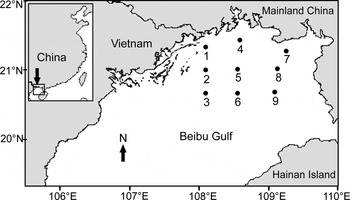
The northern Beibu Gulf is situated at 20°45′–21°45′N 108°00′–109°45′E, with an area of 44,238 km2 and a mean depth of 26 m. It is surrounded by the Chinese Guangxi Zhuang Nationality Autonomous Region, the Leichou Peninsula, the Qiongzhou Strait, Hainan Island and Vietnam (Figure 1). Most of the subtidal area of the bay is characterized by a muddy bottom. A GPS device was used to ensure the same station sampled in the four seasons. Results of a previous study on meiofaunal assemblages (to main taxa) in 27 subtidal stations from the Beibu Gulf can be found in Yang & Cai (Reference Yang, Cai, Hu and Yang2008). For the quantitative study of nematode assemblages in the northern Beibu Gulf, nine stations (1–9) were selected (Figure 1). The distance between two stations is about 3000 m. Meiofauna was collected in four surveys in summer (July) 2006, winter (January) 2007, spring (April) 2007 and autumn (October) 2007. At each station during each cruise, one replicate sediment sampling was collected using a 0.05 m2 box corer. Four undisturbed meiofaunal subcores were taken using a cut-off syringe (ф = 2.9 cm) to 10 cm depth from the box corer, preventing subcore-compression in the process. Each subcore was then divided into three layers, 0–2 cm, 2–5 cm, and 5–10 cm; and each one was immediately placed in a 250 ml jar, and fixed in a 5% formalin and seawater solution. The first centimetre of sediment samples were also taken from a box sediment corer, then were stored in an ice box on-board; they would be used to measure environmental variables.
Study area in the northern Beibu Gulf. The nine sampling stations are shown.

Determination of environmental variables
Twelve benthic environmental variables were determined in the present study. Water depth, sediment temperature and salinity were determined using a depth sounding apparatus and an SBE917-PLUS-CTD (Chen et al., Reference Chen, Hu, Sun, Zhu, Hu and Yang2008); dissolved oxygen and pH were determined using the iodometric method and a pH meter; and chlorophyll-a (Chl a) was analysed using the extraction fluorescence method (Guo et al., Reference Guo, Somerfield, Warwick and Zhang2001). For Chl a analysis, 200–1000 ml bottom seawater samples were filtered onto Whatman GF/F filter of 0.7 µm in pore size under low vacuum. The filters were wrapped in aluminium foil and kept in the refrigerator (at least −20°C) until analysis. When back to the laboratory, concentrations of Chl a were determined on a Turner Designs fluorometer (model 10-AU-005-CE) after extraction in 5 ml of 90% acetone at 4°C in the dark for 24 hours. For sediment particle size determination, pre-weighed (dry-weight) sediment was passed through a 2000 µm sieve. The sediment that passed through this sieve was then analysed using a Mastersizer 2000 particle size analyser, which could detect fractions between 2 and 2000 µm. The weight of sediment retained by the 2000 µm sieve was incorporated with the data obtained from the sieve formula (Xu et al., Reference Xu, Ma, Zhang, Wang, Li, Ye, Hu and Yang2008). The organic matter content of the sediment was measured using the chromic acid method (Greiser & Faubel, Reference Greiser, Faubel, Higgins and Thiel1988).
Meiofauna and nematode sample processing in the laboratory
Samples of meiofauna were stained with rose Bengal for more than 24 hours and then sieved using 0.5 mm and 0.042 mm mesh size; material retained on the smaller mesh size was collected. Sorting of meiofauna from the sediment was performed using a flotation technique in Ludox HS40 solution (Heip et al., Reference Heip, Vincx and Vranken1985; Zhang et al., Reference Zhang, Li, Tu and Yu1989). All meiofauna individuals were sorted into major groups and counted under a stereoscopic microscope.
Nematodes were placed in anhydrous glycerol, mounted on permanent slides (Zhang & Platt, Reference Zhang and Platt1983), and identified to genus using a compound microscope (maximum magnification 1000×) and illustrated guides (Platt & Warwick, Reference Platt and Warwick1983, Reference Platt and Warwick1988; Warwick et al., Reference Warwick, Platt and Somerfield1998). Feeding types of marine nematodes were based on the morphology of the buccal cavities. Wieser (Reference Wieser1953) classified the free-living nematodes into four feeding types: selective deposit feeders (1A); non-selective deposit feeders (1B); epigrowth feeders (2A); and omnivore/predators (2B). A nematode maturity index was calculated for each station based on the c-p scores of the genera present using the formula (Bongers et al., Reference Bongers, Alkemade and Yeates1991):
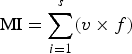
where MI = maturity index, S = number of genera or species, v = the c-p value of taxon i and f = the frequency of that taxon.
All of the genera that we found were included in the papers by Wieser (Reference Wieser1953: feeding type) and Bongers et al. (Reference Bongers, Alkemade and Yeates1991: MI).
Data analysis
All nematode individuals of three layers at each subcore during each cruise were added together. Density, the number of genera, the percentage of epigrowth feeders and the maturity index were calculated at each subcore. Two-way analysis of variance (ANOVA) was used to investigate the difference between stations and seasons for nematode variables. The environmental variables were water depth (m), water temperature (°C), salinity (ppt), pH, dissolved oxygen (mg/l), silt, clay, sand, median sediment particle size (μm), chlorophyll-a concentration (μg/l), inorganic nitrogen (mg/l) and organic matter in the sediment, while the biotic variables were density, number of nematode genera, maturity index and the percentage of epigrowth feeders. Pearson coefficient of correlation was used to investigate the relationships among four biotic variables and environmental variables. All univariate analyses were carried out using the SPSS v 13 statistical software package.
Multivariate analyses were carried out using the PRIMER v.5 statistical software package (Clarke & Warwick, Reference Clarke and Warwick1994), including non-parametric multidimensional scaling (MDS), two-way crossed analysis of similarity (ANOSIM), similarity percentages (SIMPER), principal component analysis (PCA) and BIOENV. MDS was carried out to analyse the nematode assemblages from the nine stations in four seasons, the densities of genera were square root transformed based on the Bray–Curtis similarity measure, to visualize whether the compositions of the nine stations and four seasons were different; two-way crossed ANOSIM of square root transformation was used to elucidate if there were significant differences in the nematode assemblages among stations and seasons; two-way crossed station by season SIMPER (cut-off of 50%) was used to determine the main genera that distinguish among the nine stations and four seasons; PCA was carried out for the ordination of samples or relationships among environmental variables, which were compared using normalized Euclidean distance; and BIOENV showed the most correlated combination of environmental variables with the nematode assemblages. Similarity among nematode samples was calculated using the Bray–Curtis coefficient, and the abundance data were square root transformed, then Spearman rank correlation was computed. A significance level of P < 0.05 was used in all tests.
RESULTS
Abiotic environment
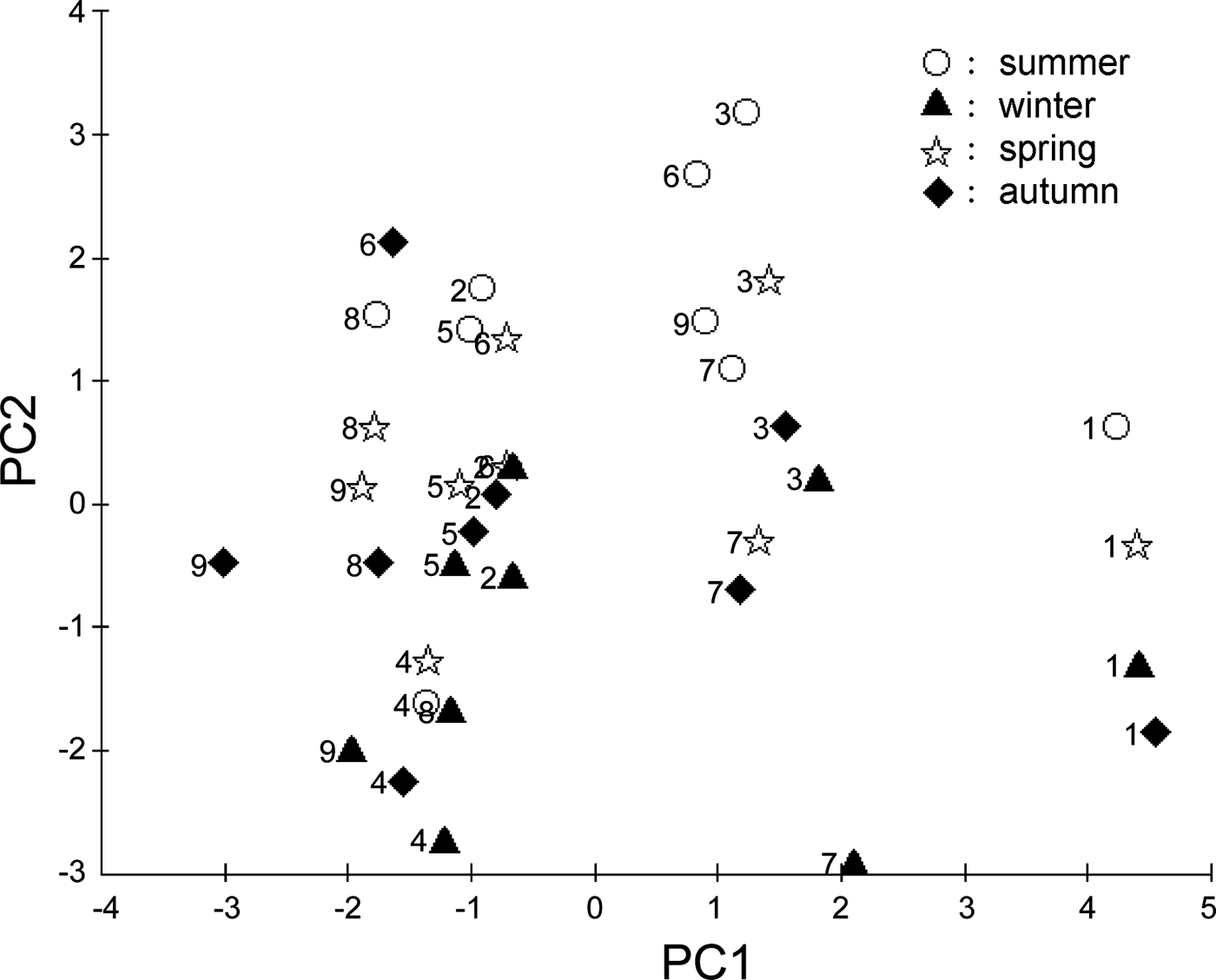
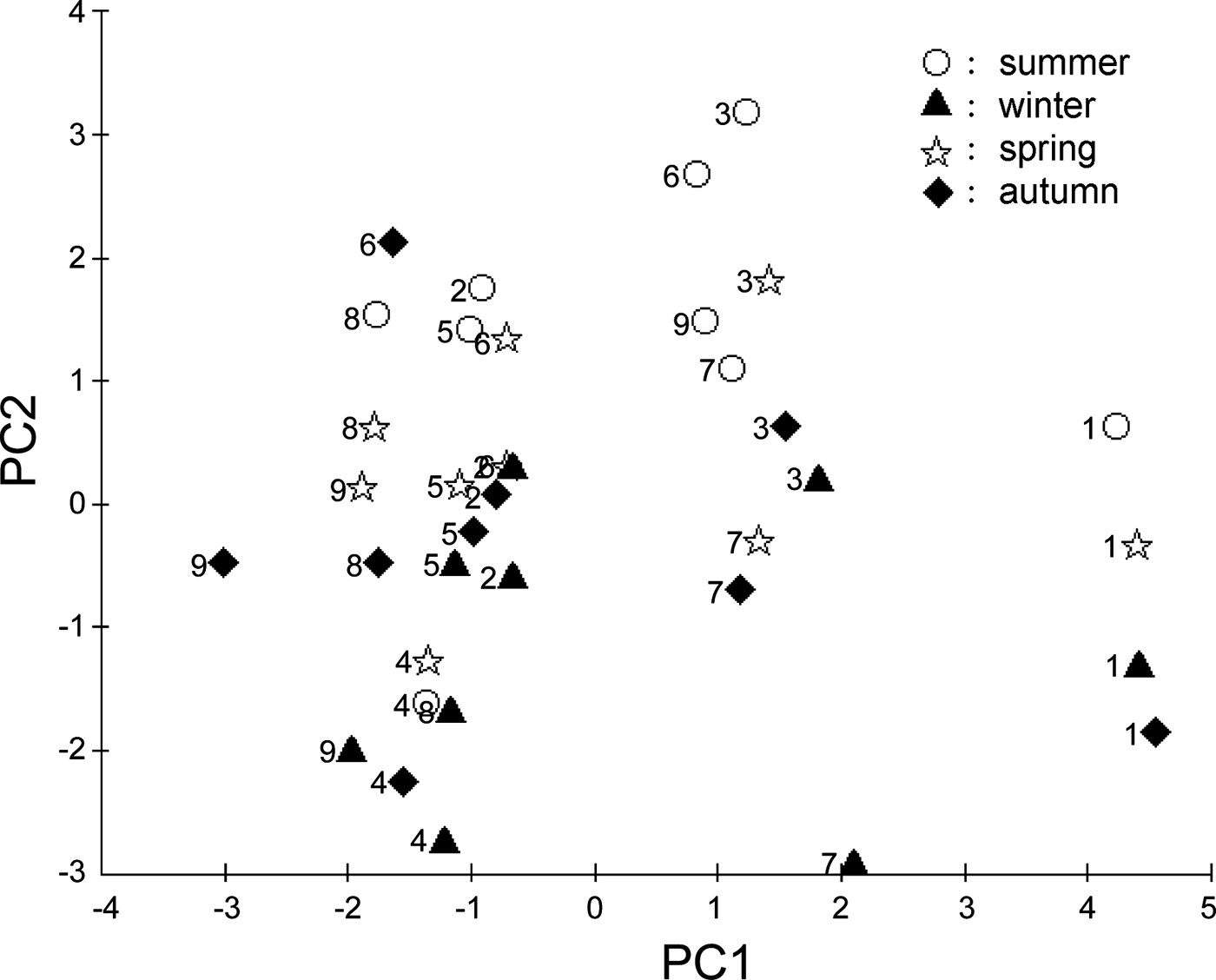
Principal component analysis was used to visualize the trend of the environmental variables in the northern Beibu Gulf, and there were three groups on the PC1, which provided a clear distinction between stations (Figure 2). Group I included Station 1 in all four seasons. Group II included Stations 3 and 7 in all four seasons and Stations 6 and 9 in summer. Group III included Stations 2, 4, 5 and 8 in all four seasons and 6 and 9 in autumn, winter and spring. The first two principal components (PC1 and PC2) explained 52.4% of the total variability, in which PC1 accounted for 33.8%. Along PC1, variability was mainly explained by sand (0.466), median sediment particle size (0.444), silt (−0.432) and clay (−0.429); whereas along PC2, variability was mainly explained by salinity (0.520), depth (0.430), dissolved oxygen (−0.374) and pH (−0.340). Furthermore, Pearson correlation showed that there were very significant relationships among median sediment particle size, content of silt, clay and sand (P < 0.01). PC1 showed the separation of stations groups mainly due to the median sediment particle size values. The content of sand and median sediment particle size values at Station 1 were higher than that at Stations 3 and 7, and higher than that at Stations 2, 4, 5, 6, 8 and 9. The contents of silt and clay showed the reverse. PC2 indicated that some stations such as Station 3 were more correlated with the salinity and depth, explained by the positive values of their coefficients, while other stations such as Station 4 were more related to dissolved oxygen concentration and pH value, for the negative values of sizeable coefficients.
Principal component analysis based on sediment abiotic variables measured in the nine stations and four seasons.
Density and number of genera
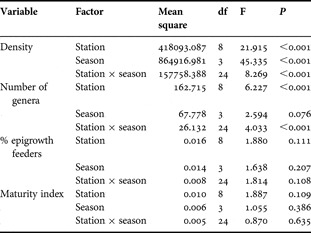
The densities of nematode were significantly different among stations, seasons and in the interaction between these two after two-way ANOVA (Table 1).
Results of two-way analysis of variance testing differences among stations and seasons.

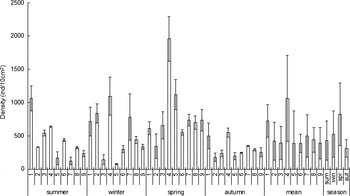
Density did not change clearly from north to south, the north stations (1, 4 and 7) did not always have the highest values and the south stations (3, 6 and 9) did not have the lowest values for changes were also season-dependent. The mean density of nematode was highest at Station 4 and lowest at Station 6. The mean density of four seasons decreased from Stations 1 to 3, from Stations 4 to 6, and from Stations 7 to 9. There was a clear trend that the mean density of nematodes decreased from north to south, or from alongshore to offshore (Figure 3).
Means ± standard deviation of densities of nematode assemblages in the nine stations and four seasons.

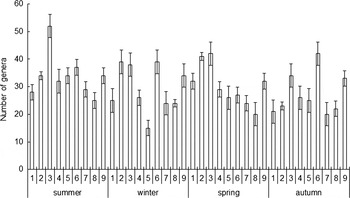
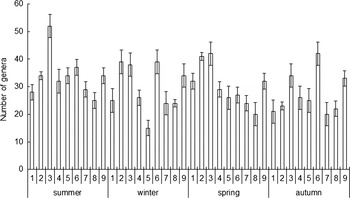
Two-way ANOVA showed that the number of genera was significantly different among stations and in the interaction between stations and seasons, but not in terms of seasons (Table 1). On the whole, the number of genera increased from alongshore to offshore. For example, the number of genera was highest at offshore Stations 3, 6 and 9 in summer and autumn. However, offshore stations did not always have the highest values for changes were also season-dependent (Figure 4). There was a clear trend for the number of nematode genera increasing from north to south, or from alongshore to offshore in the northern Beibu Gulf. This distribution was the reverse of the distribution in nematode density.
Means ± standard deviation of the number of nematode genera in the nine stations and four seasons.
Taxonomic composition of nematode assemblages
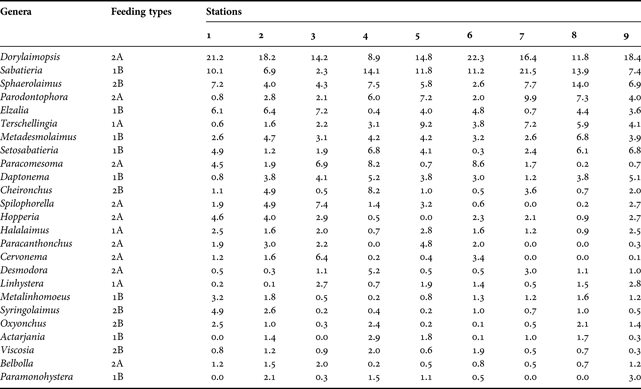
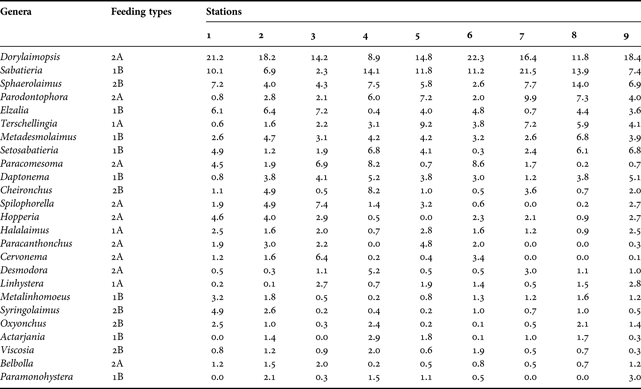
A total of 102 genera belonging to 28 families were identified in the northern Beibu Gulf in the four seasons. There were seventy-seven genera contributing to less than 1% of the total density (all samples combined). Six genera accounted for almost 50% of the total density: Dorylaimopsis (16.3%); Sabatieria (11.0%); Sphaerolaimus (6.7%); Parodontophora (4.7%); Elzalia (4.2%); and Terschellingia (4.2%) (Table 2). Only Dorylaimopsis and Sabatieria existed in all nine stations and four seasons.
List of nematode genera including feeding types in nine sampling stations by dominance (%) beyond 1.0.
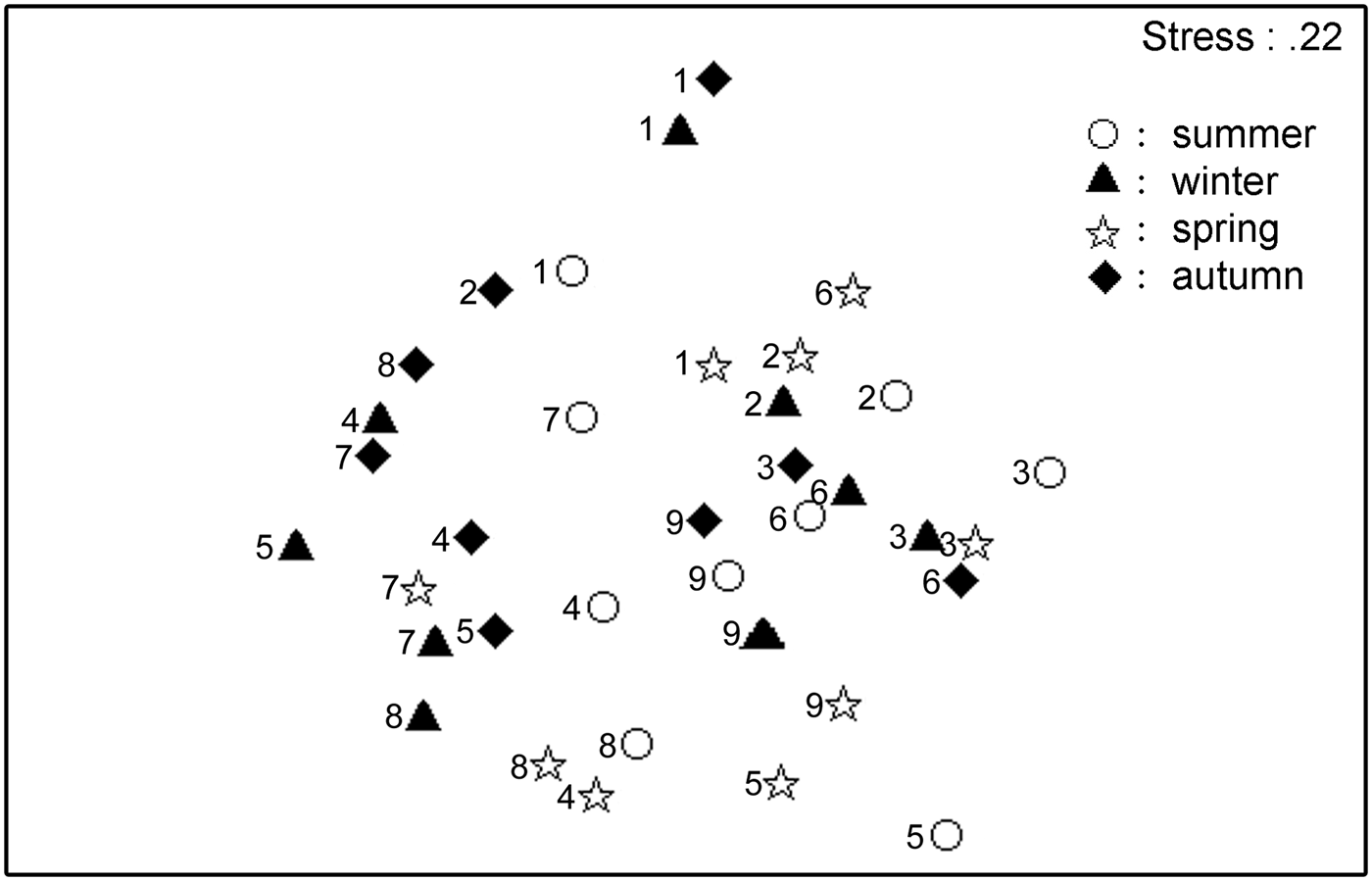
Two-way crossed ANOSIM on square root transformed analysis showed that there were significant global differences in the nematode assemblages among stations (R = 0.276, P = 0.002; 999 permutations), but not among seasons (R = 0.059, P = 0.215; 999 perm.). Pair-wise comparisons showed that there were no significant differences among Stations 1, 2, 3, 6 and 9 (P > 0.05).
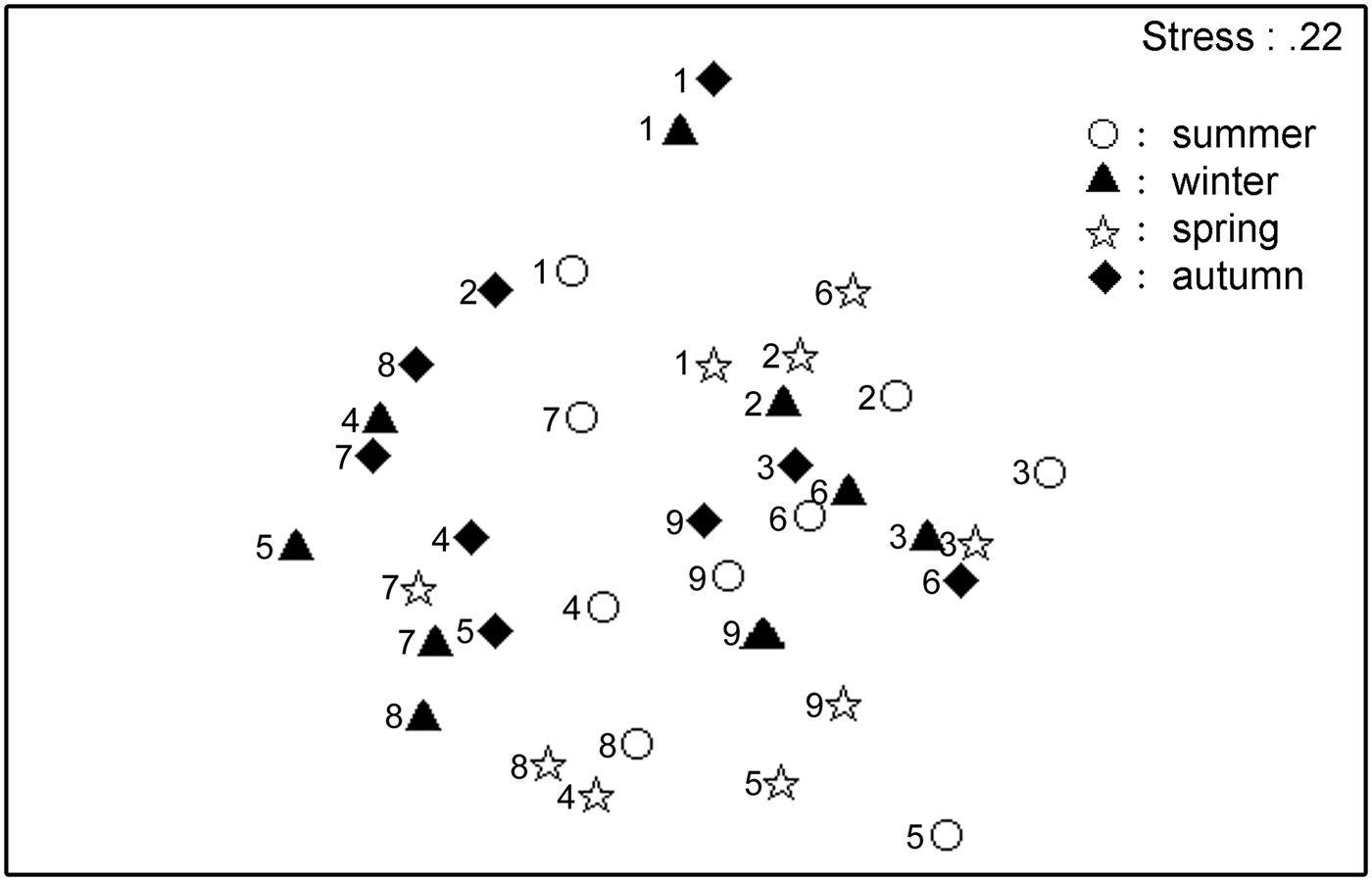
The ordination of samples by MDS analysis showed that no clear seasonal changes for nematode assemblages were found in most sampling stations (Figure 5).
Non-parametric multidimensional scaling analysis of nematode assemblages based on square root transformed data of numbers of genera from the nine stations and four seasons.
The SIMPER analysis showed that the genera Sabatieria, Dorylaimopsis, Paracomesoma, Cheironchus and Sphaerolaimus most frequently contributed to the dissimilarities among nine stations and four seasons.
Analysis of nematode feeding types and maturity index
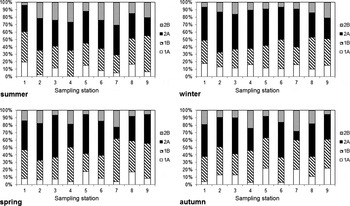
The mean percentage of each feeding type as a part of the total feeding types was highest in the epigrowth feeders (2A, 34.78%), second highest in the non-selective deposit feeders (1B, 30.40%), third highest in the predators (2B, 13.49%) and lowest in the selective deposit feeders (1A, 10.22%). The percentage of epigrowth feeders (2A) was the highest of all four feeding types in all four seasons—40.0, 36.5, 36.0 and 44.5% in spring, summer, autumn and winter, respectively.
The percentage of epigrowth feeders (2A), the dominant feeding type, was lowest at Station 7, and highest at Station 3 in spring and autumn, but this pattern was different in the other seasons (Figure 6). All of the percentage of epigrowth feeders (2A), non-selective deposit feeders (1B), predators (2B), and selective deposit feeders (1A) did not vary widely across stations, seasons or in the interaction between these two after two-way ANOVA (P > 0.05). Furthermore, no clear trends existed either spatially or seasonally.
The percentages of the four nematode feeding types at the nine stations in the four seasons (1A, selective deposit feeders; 1B, non-selective deposit feeders; 2A, epigrowth feeders; 2B, predators).

Two-way ANOVA indicated that the maturity index was not significantly different among stations, seasons or in their interaction (Table 1).
Relationships between nematode assemblages and environmental variables
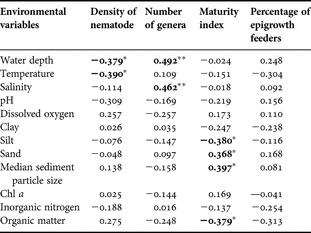
There were significant negative correlations between nematode density and water depth and temperature; significant positive correlations between number of nematode genera and water depth and salinity; and significant negative correlations between maturity index and silt and organic matter; significant positive correlations between maturity index and sand and median sediment particle size; but no significant correlations between the percentage of epigrowth feeders and environmental variables (Table 3).
Pearson correlation coefficients between four biotic variables and environmental variables (N = 36). Significant results in bold type.

*, difference is significant at the 0.05 level; **, difference is significant at the 0.01 level.
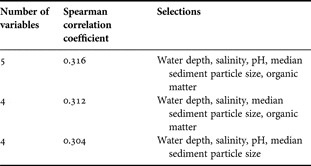
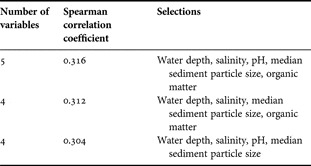
BIOENV showed that the most correlated combination of environmental variables with the nematode assemblages were water depth, salinity, pH, median sediment particle size and organic matter (Table 4).
BIOENV results carried out on nematode assemblages in the northern Beibu Gulf.
DISCUSSION
Our results provided a description of the densities, number of genera, genera composition, maturity index and trophic structure of free-living nematode assemblages in the subtidal waters of the northern Beibu Gulf, South China Sea on both seasonal and spatial scales, and also a relatively good characterization of the abiotic environment. This enabled us to explore which environmental variables were mainly responsible for influencing the spatial and temporal distribution of these nematode assemblages. Our study also showed how the contributions of the various functional feeding groups changed with location and which seasonal and environmental variables were responsible for such changes.
In shallow marine subtidal areas, Sabatieria, Dorylaimopsis and Sphaerolaimus are dominant genera (Boucher, Reference Boucher1972) and Sabatieria, Dorylaimopsis and Terschellingia are the dominant genera in the shallow stations of Italian coasts (De Leonardis et al., Reference De Leonardis, Sandulli, Vanaverbeke, Vincx and De Zio2008). Most of the sampling stations in the northern Beibu Gulf have muddy sediments. These genera are important in most muddy coastal areas (Heip et al., Reference Heip, Vincx and Vranken1985). In the Southern Yellow Sea, China, the first three dominant genera are Dorylaimopsis, Microlaimus and Parodontophora (Liu et al., Reference Liu, Zhang and Huang2007); in the Bohai Sea, China, Parodontophora, Dorylaimopsis and Daptonema (Guo et al., Reference Guo, Somerfield, Warwick and Zhang2001); in the Changjiang Estuary and its adjacent waters Daptonema, Cobbia and Sabatieria (Hua et al., Reference Hua, Zhang and Zhang2009); and the most abundant genera in the North Taiwan Strait are Vasostoma, Sabatieria, Linhystera, Sphilophorella, Daptonema, Halalaimus and Dorylaimopsis (Cai et al., Reference Cai, Hong, Zou, Fang, Lv and Zhang2001). We deduced that the subtidal free-living nematode assemblages had certain differences in their geographical and geomorphic compositions, for example, open sea (Taiwan Strait) (Cai et al., Reference Cai, Hong, Zou, Fang, Lv and Zhang2001) or concealed sea (Bohai Sea) (Guo et al., Reference Guo, Somerfield, Warwick and Zhang2001).
In most cases, the density of the genus Sabatieria was higher than that of Terschellingia, but their densities were both high at Stations 4, 6, 7; both were low at Station 3. There was a significant positive correlation between the density of the two genera (N = 36, R = 0.472, P < 0.01). Both genera are deposit feeding, cosmopolitan genera, inhabiting organically enriched sediment and tolerating pollution (Armenteros et al., Reference Armenteros, Ruiz-Abierno, Fernández-Garcés, Pérez-García, Díaz-Asencio, Vincx and Decraemer2009). It can be concluded that Sabatieria and Terschellingia may share similar resources or space. For example, these two genera are dominant in Victoria Harbour, Hong Kong (Liu et al., Reference Liu, Xu, Cheung and Shin2008), an urbanized embayment in Brazil (Somerfield et al., Reference Somerfield, Fonsêca-Genevois, Rodrigues, Castro and Santos2003), the Changjiang Estuary of China (Hua et al., Reference Hua, Zhang and Zhang2009), the Tagus estuary of Portugal (Franco et al. Reference Franco, Steyaert, Cabral, Tenreiro, Chambel, Vincx, Costa and Vanaverbeke2008), a tropical semi-closed bay of the Caribbean Sea (Armenteros et al., Reference Armenteros, Ruiz-Abierno, Fernández-Garcés, Pérez-García, Díaz-Asencio, Vincx and Decraemer2009), and the deep-sea Hakon Mosby Mud Volcano (Portnova, Reference Portnova2009); and they show first and second dominance in Long Island Sound (Tietjen, Reference Tietjen1977). Besides, higher densities of Elzalia and Tricoma were found in the offshore assemblages, and a higher density of Cheironchus was found in the alongshore assemblage. Hourston et al. (Reference Hourston, Potter, Warwick, Valesini and Clarke2009) indicated a clear separation between samples from upstream and downstream sites in dendograms produced using data for each season separately, and showed that one-way ANOSIM tests demonstrate that the composition of nematode assemblages differs significantly among seasons at every site. In tropical areas, due to the lower fluctuations of temperatures and to the more stable sediment environment, seasonal variations of the nematode community may be absent or may be influenced by spatial differences (Liu et al., Reference Liu, Xu, Cheung and Shin2008; Armenteros et al., Reference Armenteros, Ruiz-Abierno, Fernández-Garcés, Pérez-García, Díaz-Asencio, Vincx and Decraemer2009).
The geographical trend of densities was related to water depth. Water depth at the alongshore was obviously shallower than that at the offshore stations in the northern Beibu Gulf. Grémare et al. (Reference Grémare, Medernach, DeBovée, Amouroux, Vétion and Albert2002) showed that nematode densities were lower and more consistent than that in shallower waters. Armenteros et al. (Reference Armenteros, Ruiz-Abierno, Fernández-Garcés, Pérez-García, Díaz-Asencio, Vincx and Decraemer2009) showed that in a tropical bay, nematode abundance is correlated with depth, organic matter and the silt/clay fraction. BIOENV results indicate that water depth, salinity, Chl a and phaeopigment-a are the factors most responsible for nematode assemblages in the Changjiang Estuary and its adjacent waters (Hua et al., Reference Hua, Zhang and Zhang2009). The number of nematodes also shows a significant correlation with water depth in the Bohai Sea, China (Guo et al., Reference Guo, Somerfield, Warwick and Zhang2001). Lambshead & Boucher (Reference Lambshead and Boucher2003) ascribed the negative correlation of nematode densities with depth to a descent of primary producers available as a food source. Poor food resource has been mentioned as the most important environmental variable causing decreasing densities of meiofauna with increasing water depth (Vincx et al., Reference Vincx, Bett, Dinet, Ferrero, Gooday, Lambshead, Pfannkuche, Soltwedel and Vanreusel1994). The correlation coefficients between nematode density and water depth, temperature were negative values, and the correlation coefficients between nematode density and dissolved oxygen, organic matter were positive values in the northern Beibu Gulf (Table 3). The results showed that water depth and temperature increase may cause dissolved oxygen and organic matter decrease. In addition, as the water temperature rises, the seawater loses the ability to keep the dissolved oxygen. For example, the dissolved oxygen in Station 9 in autumn was 3.44 mg/l, while it was 5.92 mg/l in summer and 7.14 mg/l in winter in our study area. These results suggested that dissolved oxygen could affect nematode density. The spatial distribution of nematode density influenced by water depth and temperature, suggested that their variability essentially responded to the water depth and temperature characteristic of the gulf gradients. In general, the spatial distribution of subtidal nematode density and composition reflects both the sediment composition and the hydrodynamic conditions. Adão et al. (Reference Adão, Alves, Patrício, Neto, Costa and Marques2009) indicated mesoscale variability with gradients, at the km scale, in response to natural stressors characteristic of estuarine gradients.
The tendency for the number of nematode species in the Swan River Estuary to decrease with declining salinity and then to show a slight increase at the lowest salinities broadly parallels the Remane paradigm that was based on analysis of the changes in the number of species along a salinity gradient in the Baltic Sea (Remane, Reference Remane1934). In the Mira and the Mondego estuaries, the spatial distribution of nematode density, composition, and feeding types appears to be clearly related to the salinity gradient (Adão et al., Reference Adão, Alves, Patrício, Neto, Costa and Marques2009). The salinity in the northern Beibu Gulf is lowest in autumn because it is surrounded by land and more rainwater flows into the Gulf from the land due to tropical storms and heavy rainfall at this time (Lin et al., Reference Lin, Liang and Gu2004; Chen et al., Reference Chen, Qiu and Jia2006). The lowest salinity was found at the alongshore sampling stations. For example, in autumn, salinities at sampling Stations 1 and 4 were 30.57 and 30.96 ppt, whereas salinities in the offshore at sampling Stations 3 and 6 were 32.69 and 33.90 ppt. The influence of some environmental variables (clay, Chl a and inorganic nitrogen) appeared not to be relevant to the spatial distribution of the nematode's five biotic characteristics.
Bongers et al. (Reference Bongers, Alkemade and Yeates1991) reported that disturbance and an increase in decomposition rate will result in a decreasing MI, and an increased quantity of food favoured rapid generation of species, which would also result in a decreasing MI. No clear changes in the feeding types may be because this classification was not sensitive enough, or dynamics of the nematode population are unpredictable.
The Beibu Gulf is a natural semi-enclosed part of the South China Sea and has strong fishing activity (Chen et al., Reference Chen, Qiu and Jia2006). The alongshore Stations 4, 7 and 8 are close to cities of Beihai and Fangchenggang, where human disturbances are stronger than that in the offshore Stations 3, 6 and 9. More than 90% of fishing boat caught fish in the coastal regions, resulted in over-exploitation of fishery resources (Yang, Reference Yang2001). Furthermore, oil concentration ranged from 0.0049 to 0.0413 mg/l in the northern Beibu Gulf in summer, of which alongshore stations were higher than offshore. Excessive marine fishing, expansion of aquaculture, waste that is released by port and ship and the sewage water that contains large amounts of oil substances are influencing the northern Beibu Gulf (Ma et al., Reference Ma, Zheng, Cheng, Zhuang, Liu, Hu and Yang2006). Human disturbance reduces the diversity of benthic community structure (Kaiser & Spencer, Reference Kaiser and Spencer1996), and Schratzberger & Jennings (Reference Schratzberger and Jennings2002) demonstrated that the number of species, diversity and species richness of the nematode community were significantly lower in the areas that are subjected to high levels of trawling disturbance than that are subjected to low or medium levels of disturbance. The results in our study also tested our initial hypothesis.
CONCLUSIONS
(1) Some cosmopolitan genera dominated in the study area. Two genera Sabatieria and Terschellingia may share the similar habitat, in addition, higher densities of Elzalia and Tricoma were found in the offshore assemblages, and a higher density of Cheironchus was found in the alongshore assemblage. The mean percentage of each feeding type compared to the total numbers was highest in epigrowth feeders (2A).
(2) The nematode density and the number of nematode genera showed a clear geographical trend, namely alongshore and offshore stations, in all four seasons in the northern Beibu Gulf. There were significant differences in the nematode assemblages among stations, but not among seasons. This is probably due to the lower fluctuations of temperatures and to the more stable sediment environment; seasonal variations of the nematode community may be absent or may be influenced by spatial differences.
(3) The geographical trend of nematode assemblages was closely related to an overall decline in depth and, to a lesser extent, to an increase in salinity. BIOENV analysis indicated that water depth, salinity, pH, median sediment particle size and organic matter were the most correlated combination of environmental variables affecting the nematode assemblages. Nematode assemblages of the alongshore stations were influenced by strong human disturbance.
ACKNOWLEDGEMENTS
The present study was part of the ‘Chinese offshore investigation and assessment Project’ funded by the State Oceanic Administration of the People's Republic of China. We thank all members who attended the survey cruises for their kind help during sampling and also those who provided environmental data. Professor John Hodgkiss of The University of Hong Kong is thanked for his valuable comments on earlier versions of the paper and for his assistance with English in the preparation of this manuscript. We also thank the anonymous referees for helpful comments and suggestions.