The first step in bridging any disciplinary or epistemological divide is engaging in intentional dialogue with those on the other side of that apparent divide. Scholarship attempting to bridge divides ought to be celebrated and encouraged, and the best way to do so is to continue the dialogue such scholarship begins. One constructivist scholar's particularly bold engagements with game theory (Fierke Reference Fierke2012a, Reference Fierke2012b) and game theorists (Fierke and Nicholson Reference Fierke and Nicholson2001) exemplifies such attempts. By inverting the well-known Prisoner's Dilemma model, Karin Marie Fierke (Reference Fierke2012a, Reference Fierke2012b) has constructed the Warden's Dilemma as an explanation for the role self-sacrifice plays in facilitating compromise between asymmetric powers. Fierke demonstrates these dynamics through a case study of Irish Republican Army (IRA) hunger strikers in the early 1980s and also applies the prison analogy to Poland's Solidarity movement. Despite her model's ingenuity, its applicability to a variety of contexts, and Fierke's attempt to engage a broader community of scholars, the Warden's Dilemma does not appear to have sparked much vigorous transdisciplinary discussion or any further development of the model.Footnote 1 This lack of discussion may stem from constructivists’ presumed unfamiliarity with the highly specialized approach of game theory or from game theorists’ presumed aversion to what they might consider unorthodox adaptations of standard practice, such as the Warden's Dilemma.
This article focuses on two related aspects of the Warden's Dilemma in the hope of sparking a dialogue and encouraging future adaptation of the model. First, Fierke's model closely resembles a set of what game theoreticians call ‘nested games’ (Tsebelis Reference Tsebelis1990). By framing the Warden's Dilemma as a nested game, I hope to provide scholars with additional leverage in approaching the model and studying political self-sacrifice. Considerations of space do not permit introducing a formal nested game model, so orthodox game theory modelling protocol is neglected in the current discussion. Second, framing the Warden's Dilemma as a nested game emphasizes how ‘forms of power involve social processes that are not in themselves controlled by specific actors, but may be effected by their meaningful practices’ (Fierke Reference Fierke2012b: 68). Specifically, the model highlights the tripartite relationship inherent in and fundamental to Fierke's model. A re-examination of the dynamics at play in the IRA hunger strikes suggests that, despite Fierke's assertion, a rationalist perspective is not antithetical to or unhelpful for studying political self-sacrifice.
The applicability of a rationalist perspective is buttressed with a case study of third-party support for strategic non-violence in Myanmar (Burma).Footnote 2 The case study illustrates a pattern of political self-sacrifice conceived of and diffused within a rationalist framework. By investigating ‘the context itself and how this delimits or enables a space of manoeuvre’ for those who would eventually engage in strategic non-violence (Fierke and Nicholson Reference Fierke and Nicholson2001: 20), the historical analysis reveals how a rationalist framework has informed the transnational diffusion of practices intended to provoke a Warden's Dilemma scenario. The third-party facilitation of strategic non-violence in Burma indicates an awareness among international actors of the notion of political self-sacrifice in a globalizing world, ‘in which its potential use as a political weapon, for attracting the attention of a much larger audience, across national boundaries, has expanded’ (Fierke Reference Fierke2012b: 12).
Thus, my overall aim is to participate in the transdisciplinary division of labour suggested by Karin Marie Fierke and Michael Nicholson (Reference Fierke and Nicholson2001: 25) in which the development of a game theoretic model follows the ‘excavation of the language games of a context, to uncover the structure of the game being played’. By first suggesting the reformulation of the original Warden's Dilemma into a nested game model and then providing historical evidence supporting the study of political self-sacrifice from a rationalist perspective, this article initiates a discussion intended to develop Fierke's model of the Warden's Dilemma further.
Original Warden's Dilemma
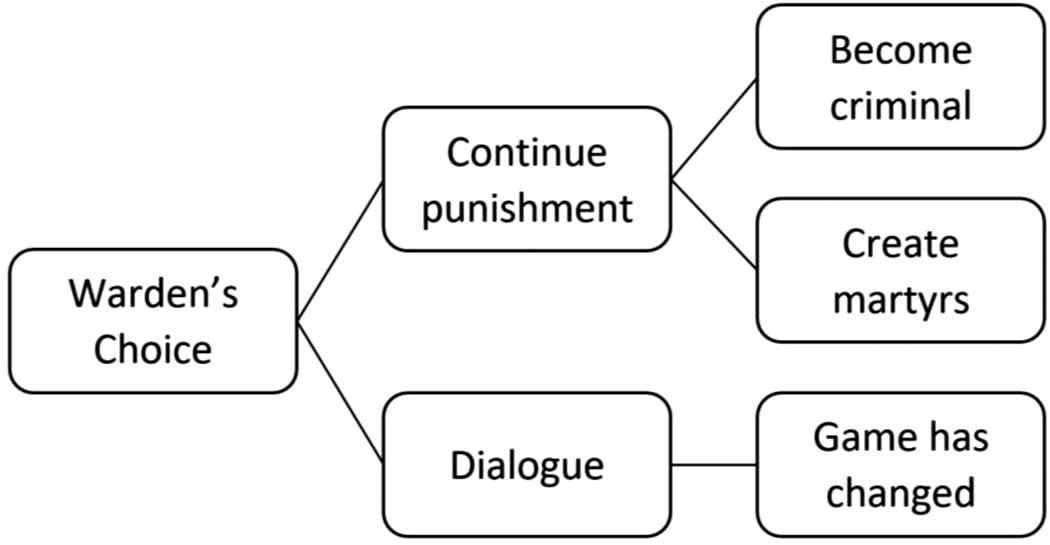
A brief overview of the Warden's Dilemma will aid this discussion. In Fierke's telling (Reference Fierke2012a), a prison in Northern Ireland is filled with prisoners whose sovereignty the warden has taken away; all prisoners are expected to abide by the rules established by the warden. The prison also contains IRA prisoners who would normally be granted special rights as political prisoners under international law but are instead labelled and treated as terrorists. Desiring their own political subjectivity, these political prisoners engage in non-violent non-cooperation, but the warden repeatedly responds with repression. The cycle of non-cooperation and repression escalates, and the prisoners eventually begin a hunger strike which brings still harsher punishment. The warden's actual dilemma (Figure 1) occurs when a hunger striking prisoner approaches death but continues to resist the warden's authority non-violently. Enforcing the prisoner's conformity with the prison rules would require the warden to use a degree of force that ‘appears disproportionate to a larger audience’ given the hunger striker's unwillingness to respond violently to the warden's punishment (Fierke Reference Fierke2012a: 330). ‘The warden’, Fierke writes (Reference Fierke2012a: 327), ‘must now decide whether his self-interest in appearing to run a humane prison is maximized by continuing the punishment’ or by instead changing his strategy. Thus, rather than continuing to exert his authority within the asymmetric relationship, the warden may compromise and grant the prisoner some measure of political subjectivity.
Fierke's Original Warden's Dilemma Model

For Fierke (Reference Fierke2012a: 323), ‘the identity of the agent of self-sacrifice is at the centre of contestation’, as is the legitimacy of the warden's response to that self-sacrifice. Is the hunger striking prisoner a terrorist who should be allowed to perish or a political prisoner deserving of special treatment under international law? In identifying the political prisoner as a terrorist, the warden – and by extension the state – links to a ‘larger international discourse of sovereignty’ which justifies the elimination of existential threats to the state (Fierke Reference Fierke2012a: 324). The prisoner also links to a broader audience by sacrificing him or herself ‘on behalf of a community which politicizes the suffering or the dead body and plays a role in constituting’ the martyred prisoner as a member of that broader community in opposition to the established sovereign authority. Thus, the ‘interaction is not purely internal to the prison’, and the choices made by each party are ‘part of the management of public perceptions and image’ (Fierke Reference Fierke2012a: 327). According to Fierke (Reference Fierke2012a: 323), this emphasis on identity and legitimacy requires methodological assumptions that focus ‘less on rational self-interest than on the underlying rules that define the context of action. This represents a shift from an individual ontology to a social ontology which acknowledges the importance of language’ (Fierke Reference Fierke2012a: 323).
Nested Warden's Dilemma
Game theory and the Warden's Dilemma
I contend that this focus on the underlying rules need not require shifting away from the individual ontology of game theory and rationalist analysis towards a social ontology.Footnote 3 I do agree with Fierke, however, that ‘knowledge of the underlying rules of the game is the prior condition for understanding the rationality of an act’ (Fierke Reference Fierke2012b: 27) and that rational self-sacrifice arises ‘in a social world of others in which welfare of the self cannot be separated from that of the community as a whole’ (Reference Fierke2012b: 59). However, the social nature of rules does not preclude a rationalist or game theoretic analysis of the game played by those rules, even if the rules of that game are contested by the players or changed during the game itself. According to Till Grüne-Yanoff and Paul Schweinzer (Reference Grüne-Yanoff and Schweinzer2008: 134, 137), game theory relies on model narratives that provide ‘a full interpretation of the specific game structure’ and ‘embed the interpreted terms in a coherent account of a strategic situation’. The Warden's Dilemma involves contested and changing interpretations, but as Fierke and Nicholson (Reference Fierke and Nicholson2001: 14) note, ‘in a changing situation, games change. One game may be replaced by another game that has evolved from it, which then requires a separate analysis. Thus, analyzing a changing conflict in terms of a set of games, each of which reflects a new situation, is a respectable procedure.’
Framing the Warden's Dilemma as a nested game illustrates this manoeuvre. George Tsebelis (Reference Tsebelis1990) describes a nested game as an interaction with consequences in multiple arenas, all of which influence the actors’ eventual outcomes. Because Fierke's (Reference Fierke2012a) discussion of the Warden's Dilemma highlights the fact that the interaction between the prisoner and the warden has implications beyond the prison walls for both actors, analysing her model as a nested game may make the Warden's Dilemma and its dynamics more accessible to those inclined to rationalist analysis.
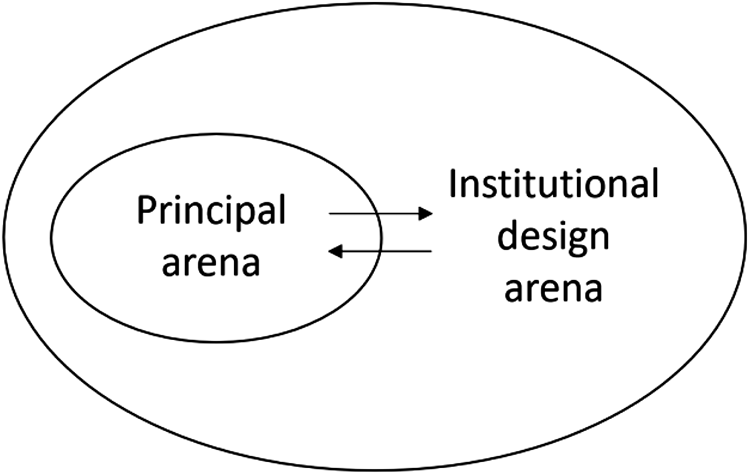
From a game theoretical perspective, the prison in Fierke's original telling is the principal arena. The only players involved in this arena are the hunger-strikers and the warden. Because this is a nested game (see Figure 2), the principal arena of the prison ‘is nested inside a bigger game that concerns the rules of games’ (Tsebelis Reference Tsebelis1990: 113). This bigger game – the broader contestation over the permissible rules of the prison – takes place in the institutional design arena (Tsebelis Reference Tsebelis1990: 8–9).
Simplified Nested Game Setup

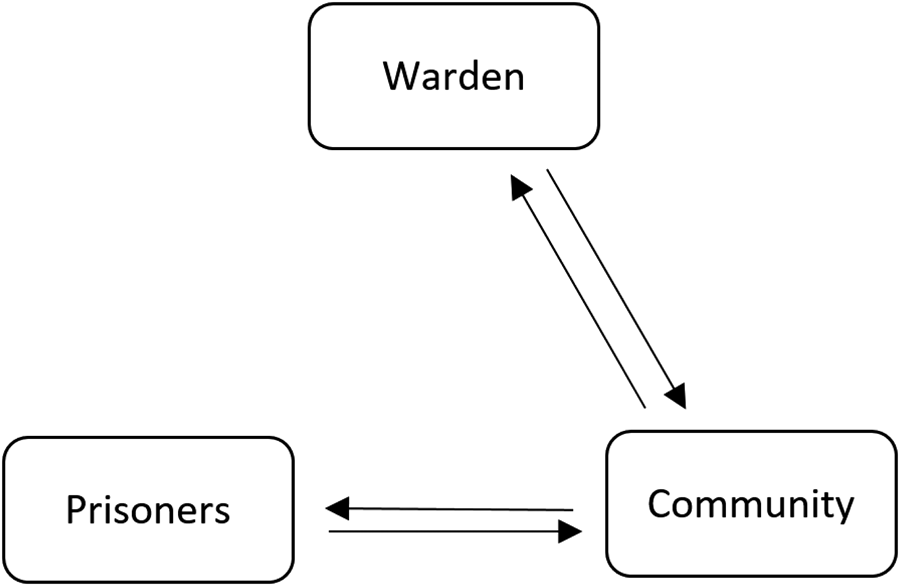
The players involved in the institutional design arena are, on the one hand, the prisoner and the community for whom the prisoner engages in self-sacrifice and, on the other hand, the warden and the community which authorizes the warden to run the prison (Figure 3). Although the two communities just mentioned do not overlap perfectly with each other, they are both included within the broad and simplified group constituted by everyone outside of the prison itself.
Player Interactions within Institutional Design Arena

The warden's main dilemma involves the implications his or her actions within the principal arena may have within the institutional design arena (top arrow in Figure 2). If the warden's authority within and control over the prison were absolute, the warden would almost certainly continue punishing the hunger strikers. But because the warden knows that the death of a hunger striker may incur severe sanctions from the broader community (bottom arrow in Figure 2), the warden's actions hinge on his or her perception of the risk involved in continuing to mete out repression. Although the warden calculates this risk by comparing the support he or she expects to receive following a prisoner's death with the support her or she expects the martyred prisoner to receive, the warden is unlikely to be confident in either of these predictions.
As Fierke notes (Reference Fierke2012a: 332–333), prisoners’ acts of self-sacrifice in response to repression and humiliation are key elements of the Warden's Dilemma since the prisoners’ willingness to suffer – rather than conform and thereby substantiate the warden's authority – is ‘presented as proof of the strength of their political convictions and the selflessness and justness of their cause’. While the importance of the completed self-sacrifice within the Warden's Dilemma is undeniable, Fierke's explanation appears to downplay the potential for strategic non-violence as an intentional strategy designed to court broader audiences in the institutional design arena who might intervene on the would-be martyr's behalf prior to the warden's final decision in the principal arena. Although Fierke's model and the nested version describe the same event, the nested Warden's Dilemma approaches political self-sacrifice as potentially part of a coherent rationalist strategy of ‘us versus them’. Those who understand the Warden's Dilemma dynamics may thus adopt an ‘instrumental rationality’ (Fierke and Nicholson Reference Fierke and Nicholson2001: 18) by initiating strategic non-violence, thereby willingly offering themselves up for martyrdom in the name of their group.
Logic of hunger strikes
A comparison of two hunger strike campaigns which preceded the IRA hunger strikes demonstrates the vital role played by actors within the institutional design arena. The first involves 1940s IRA prisoners in the Curragh Camp who organized their own command structures and attempted to gain prisoner-of-war status through hunger strikes. Although two strikers died, the government's control over information outlets limited the hunger strikers’ ability to make the warden's actions consequential outside of the prison. The state limited the prisoners’ access to the court of public opinion, thereby weakening the prisoners’ ability to compel compromise. Contrasting the Curragh hunger strikes with the 1909 hunger strike by British suffragette Marion Wallace Dunlop demonstrates the usefulness of publicity and propaganda in self-sacrificial protest. Dunlop's 91-hour hunger strike in London's Holloway Prison may have been the ‘first recorded and publicized [hunger strike] in the modern British empire’ (Lennon Reference Lennon, Flannery and Mitchell2007: 19). According to Joseph Lennon (Reference Lennon, Flannery and Mitchell2007: 20–21), this hunger strike ‘signaled an actualization and transformation of age-old practices into a strategy for individually resisting imperial power – one that relied upon both the newly developed means of publicity in mass print media and the use of the non-violent or sacrificial body as an agent and site of resistance’. But Dunlop's appeal to public emotion is a continuation of the same dynamics found in the medieval Irish legal practice of public fasting.
Dunlop may have been inspired by the 1904 play The King's Threshold, which was loosely based on the medieval public fast (Lennon Reference Lennon, Flannery and Mitchell2007: 35). According to the 5th-century Senchas Már (or ‘The Great Book of Irish Law’), the ‘law of distress and seizure without suit’ provided a ‘universal remedy by which rights were vindicated and wrongs were redressed’ among ‘men of the same grade’ (Gorman Reference Gorman1913: 221–222). However, claimants seeking to retrieve debts from chieftains – that is, in certain asymmetric power relations, weaker parties making claims against stronger parties – were required to fast publicly against the debtor in an attempt to compel settlement through a legal professional known as a Brehon. The public fast, according to M.J. Gorman,
consisted in the creditor sitting at the door of the debtor, and abstaining from food until he consented to refer the dispute to a Brehon. The spectacle of a hungry and clamorous creditor (who, though he was not allowed to eat, was allowed to talk) sitting at a chieftain's door and proclaiming his wrongs to the passerby, would be such a disgrace, that it would soon wring the necessary consent from the debtor to have the claim adjudicated upon. (Gorman Reference Gorman1913: 222)
Thus, even in 5th-century Irish law, hunger strikes entail an instrumental rationality and initiate Warden's Dilemma dynamics so that the risk of social sanction might change the stronger party's decision calculus. Instrumental rationality is likewise present in Dunlop's 1909 hunger strike and the 1940s Curragh hunger strikes. Because the appeal to those within the institutional design arena is vital to the logic of hunger strikes, analysing the Long Kesh IRA hunger strike as a strategy can be helpful, even if the protesters may not have engaged in strategic thinking based on instrumental rationality.Footnote 4
Hunger strike as IRA strategy
It is possible that the hunger strikes in Long Kesh Prison were inspired by public medieval fasting or by more modern hunger strikes. One historian has noted that the more than 200 hunger strikes by British suffragettes in the five years after 1909 ‘directly encouraged hunger strikers in Ireland and India, including Mohandas Gandhi and Terence MacSwiney’ (Lennon Reference Lennon, Flannery and Mitchell2007: 22). Because MacSwiney was both a member of Sinn Féin (the largest Irish republican political party) and the elected Lord Mayor of Cork when he went on hunger strike and died in 1920, it seems plausible that the IRA hunger strikers in 1980–1981 were aware of his example. Similarly, the IRA hunger strikers may have been emulating Thomas Ashe who fasted to death in 1917 while imprisoned as a member of the Irish Republic Brotherhood, the forerunner of the IRA. The Long Kesh protesters were certainly familiar with Billy McKee. In 1972, 40 IRA prisoners led by McKee sought prisoner-of-war status through hunger strikes while imprisoned in Crumlin Road Prison. The government compromised after 37 days, granting them ‘special category status’ (Mulholland Reference Mulholland2002: 133). The Long Kesh hunger strikers were also likely aware of the medieval public fast. At the end of the 19th century, Laurence Ginell and James Kerr published a commentary on medieval Irish law which ‘was reprinted throughout the twentieth century and had wide influence in Irish cultural nationalist circles’ (Lennon Reference Lennon, Flannery and Mitchell2007: 21).
Regardless of the IRA's inspiration for the 1980–1981 hunger strikes, whether these protests were part of an intentional strategy to manage public perception has consequences for how scholars might reasonably analyse them. Rationalist analysis in no way requires the actors to have engaged in intentional strategizing, but instances of such strategizing are uniquely amenable to rationalist analysis. The ‘us vs them’ positionality and the instrumental rationality inherent in strategic thinking are traditionally analysed using methodologies associated with an individual ontology regardless of whether the interaction involves two individuals or a collective ‘us’ and a collective ‘them’. A survey of IRA history suggests that the Long Kesh protesters and the IRA adopted an instrumental rationality and approached the hunger strikes from a strategic, ‘us vs them’ perspective intended to enhance the IRA's standing vis-à-vis the British government.
Following the Christmas Truce in 1972, the IRA was aware of its diminishing popular support. The IRA's increasing isolation from the ‘majority of people in the Catholic ghettos’ and the widespread war-weariness stemming from IRA violence and civilian casualties led to a ‘temporary upsurge’ in support for the peace movement in 1976 (Drake Reference Drake and O'Day1995: 89; Patterson Reference Patterson1997: 190). Although Sinn Féin boycotted the July 1979 parliamentary elections and denounced an ‘anti-repression’ candidate who focused on the issues at Long Kesh, that candidate's nearly 6% vote share led the IRA to consider running prisoners as candidates (Patterson Reference Patterson1997: 193). However, the IRA was hesitant to engage in electoral politics since a ‘poor vote for declared republicans would undermine the armed struggle’ and expose them to charges of ‘being the armed wing of a minority political party, rather than “the army of the people”’ (Mulholland Reference Mulholland2002: 138). This possibility seemed increasingly likely as the already waning support for the IRA – and for the ‘blanket men’ who refused to wear prison uniforms – plunged following the Pope's visit to Ireland in the autumn of 1979. During his visit, the Pope condemned the IRA and refused even to mention the Long Kesh protests, providing the British government with a ‘propaganda windfall’ (McKearney Reference McKearney2011: 151).
By the end of the 1970s, the IRA realized that reorganization for the ‘long war’, which incorporated armed struggle with mainstream political activity, required finding new ways of linking its political realities to the ‘potent historical image of a wounded nation’ (Boyce Reference Boyce and O'Day1995: 22). The IRA's failure to connect the blanket men's tactics to the Catholic nationalist historical imagination may have contributed to the IRA's waning support over the 1970s. A hunger strike, however, more directly articulated the alienation of working-class Irish Catholics. By drawing upon medieval legal practices and the modern history of hunger strikes, the Long Kesh prisoners implied that acquiescence to or assimilation with a non-Irish authority was a fate worse than death.
Although the IRA Army Council initially resisted the prisoners’ calls to escalate their protests into full-blown hunger strikes, the IRA's need to garner increased public support may have encouraged the Army Council to permit the hunger strikes which began on 27 October 1980 (Mulholland Reference Mulholland2002: 138). Although this first strike was called off 53 days later, Bobby Sands, the IRA's officer commanding in Long Kesh, began a second hunger strike on 1 March 1981. The IRA's opportunity to embrace electoral politics came on 5 March when a by-election was triggered with the unexpected death of an MP who, though an Independent, was nevertheless ‘quite a traditional republican close to’ the IRA (Mulholland Reference Mulholland2002: 138). The IRA ran Sands in that by-election rather than the IRA's new officer commanding in Long Kesh, Brendan ‘Bik’ McFarlane, who had taken over from Sands when Sands began his hunger strike. The IRA's choice to run Sands was motivated in part by public perception; McFarlane ‘had been convicted for machine-gunning a Protestant pub’ while Sands was ‘very much the acceptable face of militant republicanism’ (Mulholland Reference Mulholland2002: 139). In both its prison protest strategy and its electoral strategy, the IRA appeared to embrace instrumental rationality by appealing to the broader public within the institutional design arena.
The IRA's ability to manage public perception and present a unified image of itself grew in the period preceding the Long Kesh hunger strikes. The January 1979 merger of the two republican newspapers, Republican News and An Phoblacht, relieved the IRA from the need to consider internal republican debate over the possibly of shifts in strategy undermining the broader campaign and allowed the IRA to ‘push their opinions and beliefs without fear of alternative viewpoints within the movement being put forward’ (Horgan Reference Horgan2013: 23).
Even if the IRA Army Council's permission to escalate was driven by a lack of options in the face of the prisoners’ insistence, rather than by an explicit strategy, analysing the consequences of the hunger strikes on the institutional design arena demonstrates the logic of individual self-sacrifice within an ‘us vs them’ framework. The rationality of the individual's actions within the principal arena is evident when viewed from the broader arena of institutional design.
Several factors are important for understanding the instrumental rationality of the Long Kesh hunger strikes. First and most importantly, the hunger strikes increased public sympathy for the IRA by linking the prisoners to the Catholic nationalist historical imagination. As D. George Boyce notes (Reference Boyce and O'Day1995: 20), ‘the sight of grieving relatives, so potent in 1917 and 1920 during the fast to death of Thomas Ashe and Terence MacSwiney, was again enacted.’ The prisoners’ potential martyrdom recalled the historical memory of republican sacrifice and nationalist struggle.
Second, the prisoners’ limited and specific demands elicited public support for the hunger strikes and the general IRA cause. When viewed as alternatives to the prisoners’ deaths, the demands – involving prison uniforms, visits and letters, and the ability to fraternize within the prison – appeared innocuous and garnered international support ‘on civil libertarian grounds’ (Mulholland Reference Mulholland2002: 134–135).
Third, despite the ‘relatively apathetic initial response from the catholic masses’ (Bew Reference Bew, Alexander and O'Day1984: 242), the Catholic Church's response helped ensure that the broader public viewed the government as responsible for the outcome of the hunger strikes. Although the Church ardently attempted to end the hunger strikes, it also urged the British government ‘to accept its primary responsibility for the strike’ (Boyce Reference Boyce and O'Day1995: 20). In so doing, the Church also shifted focus away from the principal arena and towards the institutional design arena.
Lastly, Sands’ own account of the protest (Reference Sands1990) helped shape public perception of the hunger strikes. Portions of Sands’ diary, handwritten on toilet paper during the first 17 days of his 66-day hunger strike and smuggled out of the prison, framed the hunger strikes from a broad perspective. Although Sands could not have known the fate or impact of his diary while he was writing it, his diary discouraged the public from viewing the hunger strikes as non-rational acts of suicide divorced from the broader context. His assertion that ‘everyone, republican or otherwise, has his own particular part to play’ (Sands Reference Sands1990: 46) has been characterized as holy writ intended to both ‘extend campaign inclusiveness to the weak and the weary’ and convince outsiders that the hunger strike was ‘bigger than the republican struggle, so even those who disagree with [it] should get involved for the sake of saving lives’ (O'Doherty Reference O'Doherty1998: 5). By framing the hunger strike as part of a broader struggle, Sands contextualized his role as sacrificial agent while encouraging outsiders to join in the broader struggle. One's personal views on the act of fasting unto death were irrelevant to one's capacity to support the hunger strikes within the institutional design arena.
Sands’ plea for support was powerful. The first edition of his diary was published the month after his death but only about halfway through the seven-month hunger strike and before half of the hunger strikers had died. The six hunger strikers who died after the diary's publication all began their hunger strike after Sands’ death. This suggests that the diary's publication brought additional attention to the IRA cause and convinced the dozen or so future hunger strikers of the strategic usefulness of their tactic. The hunger strike was called off, however, in October 1981 as ‘popular fatigue began to set in’ and continuation appeared increasingly nonsensical to outsiders (Mulholland Reference Mulholland2002: 140). Although public support for the hunger strike itself ‘waned with each death, support for political Republicanism rose throughout the hunger strike’ (Horgan Reference Horgan2013: 23). Thus, as the campaign continued, support for the protests was transformed into support for the IRA cause. This indicates a shift in the location and object of popular support; support in the principal arena became support in the institutional design arena.
Nested Warden's Dilemma and outside third parties
Third-party cost reduction
To maintain the prison analogy inherent in the Warden's Dilemma, an ideal context for applying the nested model should involve both a stronger party authorized to repress with violence and a weaker party challenging the stronger party through non-violence. Recent history is replete with non-violent resistance to established authority. Although these instances vary dramatically, self-sacrificial cases are most interesting from a rationalist perspective since they involve the clear potential for death at the hands of the ‘legitimate’ authority. And as Fierke notes (Reference Fierke2012a: 324), framing self-sacrifice as a rational act is ‘in many respects nonsensical since the agent of self-interest potentially ceases to exist as a result’. Fierke's original telling of the Warden's Dilemma locates the rationality of self-sacrifice within a social ontology. The nested model provides a rationalist framework for analysing that same self-sacrifice as an instrumentally rational strategy predicated on awareness of the Warden's Dilemma dynamics.
But rationalist analyses account for broader costs and benefits, and the risk of death is not the only concern of those entertaining self-sacrifice. It can be costly to develop, organize and implement strategic non-violence, particularly when coordinating multiple actors. Those within the institutional design arena, in addition to being the ‘ultimate referee’ who determines ‘which game is being played and thus the legitimacy or illegitimacy’ of political self-sacrifice (Fierke Reference Fierke2012b: 65), can also act as recruiter, trainer, coach and announcer. These third-party actors can reduce the costs of developing strategic non-violence through their organizational assistance, knowledge diffusion, funding, publicity and moral support. Thus, by approaching the Warden's Dilemma from a rationalist perspective and focusing on third-party actors within specific historical contexts, one may uncover previously overlooked or disregarded events which reduce the costs and risks of initiating political self-sacrifice.Footnote 5
Here, the focus is less on the weaker party's appeal to third parties and more on third parties aiding the weaker party in initiating non-violent struggle. Third parties that reduce the organizational costs of non-violence reduce the costs that go into self-sacrificial behaviour rather than the costs that may result from it. However, just as the IRA hunger strikes were merely one self-sacrificial element within a broader struggle, non-violent protesters who appear to capitalize on the Warden's Dilemma dynamics by presenting themselves as sacrificial bodies are also embedded within broader struggles. Thus, third-party cost reduction is merely one facet of any account of strategic non-violence, if it is one at all. However, this facet is an important one to examine since self-sacrificial resistance may entail instrumental rationality. The case study below, which focuses on third-party contributions towards the development of non-violent resistance, is inspired by a rationalist approach to the Warden's Dilemma and relies primarily on archived administrative and promotional documents produced by the supportive third parties.
Third-party support of non-violence in Myanmar (Burma)Footnote 6
Third-party support for non-violent revolutionary protest in Burma is evident in many of the major non-violent protests that have occurred there over the past several decades. While a wide variety of international and transnational actors have supported the non-violent pro-democracy movement, the current case study will focus primarily on how a few of these third parties worked cooperatively with the intention of developing and nurturing organized non-violent opposition to both the ruling party and the State Law and Order Restoration Council (SLORC), the military regime that came to power through the repression of non-violent protesters following a nationwide strike on 8 August 1988 (8888). The two third parties examined here – exiled Burmese elite and professional non-violence trainers – both played important roles in facilitating non-violent revolutionary protests in Burma. By encouraging, teaching and helping organize non-violent protests, these third parties manipulated the relative costs and benefits of engaging in self-sacrificial protest.
A small group of Burmese exiles formed the Committee for the Restoration of Democracy in Burma (CRDB) in September 1986 and incorporated in Virginia in March 1987 with the assistance of the International Center for Development Policy (ICDP), an organization based in Washington DC.Footnote 7 From the outset, one of CRDB's main goals was to unseat the ruling party in Burma and establish a federal republic. The CRDB's parent organization, the Foundation for Democracy in Burma, was formed in conjunction with CRDB, as was its political party, the New Republic Party of Burma. Of the founding Burmese members, Tin Maung Win (vice chairman and general secretary) and Ye Kyaw Thu (executive director) seem to have played the most direct roles in organizing and directing the CRDB's activities. Both Win and Thu had ‘long been in the national and revolutionary politics’ of Burma and ‘had participated in leadership in the armed struggle’ before migrating to the US in the 1970s, after which they kept the line of communication with the revolutionary leaders ‘active and healthy’ (CRDB 1987: 2). Throughout 1987, the CRDB opened branches in four Western countries and in Thailand and Bangladesh. The CRDB also opened a branch in Japan in 1988.
Professional non-violence training within Burma was spearheaded by Robert Helvey, a retired US Army colonel and former military attaché to Burma from 1983 to 1985, who invited several CRDB members to the Albert Einstein Institution (AEI) in Boston in December 1987 to spend some days with Dr Gene Sharp (Spencer Reference Spencer2008: 12). Sharp founded the AEI in 1983 for the purpose of ‘promoting and conducting serious investigations of non-violent struggle’ (AEI 1998: 6). Helvey's and Sharp's publications on strategic non-violence encourage readers to think of non-violence as one set of tactics that should be approached with the same strategic thinking that accompanies war-planning and can be used in conjunction with or in lieu of violent resistance. Although the specific content of Sharp's discussion with the visiting CRDB members is unknown, as is whether Helvey was present for these discussions, a later report by an organization named American Friends of Democracy in Burma (AFDB), a 501(c)(3) non-profit, provides some suggestions as to the meeting's purpose (AFDB 1992b: 2). AFDB was created ‘to support the information and education efforts required for creating a Political Defiance capability for the Burmese pro-democracy movement’. The report indicates that Sharp's expertise was sought in 1987 for developing a model to ‘permit the insertion of a non-violent element’ into the existing Burmese conflict while allowing for the expansion of non-violent capability through ‘recruitment and training of planners and activists’.
In addition to meeting with the AEI in 1987, the CRDB engaged in a wide variety of activities prior to the military repression following the 8888 protests. In March 1987, for example, the CRDB had 500 political cassettes – the specific contents of which are unknown – smuggled into Burma and distributed to ‘students, monks, army personnel and civilian activists’, although this was just one portion of the ‘thousands’ of cassettes sent that year (CRDB 1989, n.d.a: 34). The CRDB also published open letters in Burma calling upon the ruling party's leader to transfer power peacefully. One of these open letters specifically listed a dozen or so tactics of non-violent resistance that could be used to undermine the government's ability to rule (CRDB 1988c: 2). Although the content and thus the direct impact of the political cassettes and open letters is unknown, one Western diplomat reported that ‘some older students who seemed to be leaders’ of the protests which occurred in June 1988 told the diplomat that ‘they had received political publications issued by’ the organization (CRDB n.d.b). Win himself later claimed ‘that CRDB may have been a contributor to the events of 1988’, noting that his organization ‘did emphasize the importance of non-violent struggle’ while offering hope, information and coordination (CRDB n.d.a: 35).
On at least four occasions prior to the protests in 1988, Thu visited the Thai–Burmese border region to meet with leaders of the National Democratic Front (NDF), a coalition of 10 ethnic minority resistance groups which controlled the liberated zone along the border region. Thu formally proposed the CRDB's 12-point plan to the NDF at the latter's Second Congress in the spring of 1987 and requested permission for the CRDB to join the NDF's resistance as the sole representative of the majority ethnic Bamar population. The NDF initially denied this request, but Thu was able to convince the NDF to give up its explicit call for secession from Burma and support the CRDB's goal of a federal government. After meeting with one set of minority leaders in Tokyo in September–October 1987, Thu returned to the NDF's liberated zone in December of that year to again try to convince the NDF leaders of the CRDB plan's worth, urging the NDF to:
make no mistake about it. This is warfare. The principles of war are here applied for the same purpose … to impose our will upon the opponent at his weakest point … his international flanks. He cannot marshal his military forces to pursue us and our democratic movement in Washington, London, Bonn, Hamburg and at Vancouver. (CRDB 1988b: 2)
While the CRDB's activities prior to the 1988 protests merely indicate the exiled group's intentions to facilitate strategic non-violence within Burma, the group's post-8888 coordination with Sharp and Helvey, as well as with the Burmese student protesters and the NDF, clearly facilitated the pattern of non-violent revolutionary protests that would continue over the next several decades. In the last half of 1988, several thousand Burmese fled to the NDF-controlled regions along the Thai–Burmese border seeking safety from government repression. This compelled the CRDB to create what it called an Advanced Operations Group ‘to accept the responsibility of coordinating the movement of large numbers of student groups, political exiles, [and] members of the Buddhist order’ into NDF-controlled areas (CRDB 1988a). Some of the fleeing Burmese, intent on mounting an offensive against the Burmese government, sought arms and training from the ethnic minorities. One ethnic resistance group was in the process of training 800 student freedom fighters when a US Congressman-elect visited the camp in November 1988. Earlier that month, students in a separate minority stronghold had established the All Burma Students Democratic Front (ABSDF) which, according to Ashley South (Reference South2003: 145) was ‘from the outset the most influential and widely-recognised students’ organization’. The ABSDF then joined with the NDF and a dozen other newly formed opposition groups to form the Democratic Alliance of Burma (DAB) with Win elected first general secretary. By this time, both Win and Thu were considering moving to Chiangmai in Thailand, to reduce operational costs and to be closer to the action.
In July 1989, the students constructed and operated the first ‘Jungle University’ where they continued to train and learn the skills needed to publicize their cause to the international community. In October 1989, the CRDB met with the International Republican Institute (IRI) to discuss the possibility of the CRDB serving as a channel for funds from the National Endowment for Democracy (NED) to build an additional Jungle University. Although it is unclear whether this particular funding proposal was approved by the NED or whether the CRDB was involved in this proposal beyond the discussion stage, the CRDB's later participation in a separate Jungle University training programme is well documented.
With encouragement and funding from private donors, Helvey travelled to the NDF-controlled region in October 1991 ‘to assess the interest and capability’ of the students in being trained for strategic non-violent struggle (AFDB n.d.b: 1). Helvey's meeting with the NDF's leader resulted in a small pilot programme for ‘political defiance’ training at the NDF's headquarters, funded through a US$45,000 grant that AFDB received from the NED. In May–June 1992, Helvey trained a total of 55 students in political defiance, including Win, representatives from the National League for Democracy (NLD) and a minister from the government-in-exile. Of the 55 students, 13 were designated as coordinators who would ‘become cadre for training others in their respective towns and cities’ (AFDB Reference Nathan1992a: 3). One coordinator is reported to have trained 16 additional students within a four-day period in July 1992. Over the following two months, these 16 new coordinators then ‘made presentations to over 400 people from 19 villages’ (AFDB n.d.a: 6). AFDB concluded that, if this one coordinator's experience was representative of other coordinators, then the training could be considered ‘a major contribution in the struggle for democracy in Burma’ (AFDB n.d.a: 8).
AFDB reported that both the students and the senior DAB leadership approached the course with more seriousness and enthusiasm than AFDB had expected. The DAB's leader confirmed that Helvey's political defiance would be incorporated into ‘a nation-wide, multidimensional strategy’ which AFDB assumed would be developed jointly by the DAB and the NLD (Nathan Reference Nathan1992b). In August 1992, the DAB established both a Political Defiance Committee (PDC) and a National Council of the Union of Burma (NCUB).Footnote 8 The PDC reported directly to the NCUB's presidium, of which the CRDB's Win and Dr Sein Win, then prime minister of the government-in-exile, were both members. The PDC chairman also held a cabinet-level position within the government-in-exile (Helvey Reference Helveyn.d.d). One of the PDC's first tasks, issued by Prime Minister Win, was to ‘destroy the SLORC so-called National Convention’ to be convened on 9 January 1993 (AFDB 1992b: 3; AFDB n.d.b: 2; Nathan Reference Nathan1992a). The DAB's leader also requested AFDB train an additional 1,000 students in political defiance to support the newly established PDC.
Helvey returned to Burma with Sharp in October 1992 to evaluate the initial programme. The CRDB's Win was also in the NDF-controlled territory at this time. During their visit, Helvey and Sharp trained approximately 60 additional students, including monks and ‘members of the Moe Thee Zun faction’ of ABSDF which was ‘the most militant of all student groups’ (AFDB n.d.b: 2). In November 1992, AFDB submitted a second NED project proposal to train 1,000 further activists at a cost of nearly US$150,000. This proposal included a course specifically designed for female activists. Sharp (Reference Sharp1992: 2) wrote in support of AFDB's proposal, noting that Helvey's courses had ‘made a great impact’ and that credit for future political freedom in Burma would be due ‘to a significant degree’ to Helvey. According to a memorandum submitted to the United Nations General Assembly (1996) by the Burmese government, additional training programmes were given in 1994 and 1995, and Helvey returned to Burma in May 1996 accompanied by staff from the AEI and the IRI, the organization through which the NED funds for the programme were dispersed.
Helvey's Political Defiance Coordinator course, which required in-class translators, was a mix of political theory and training in military strategy. Of the 74 hours devoted for the entire course given in 1992, the first 26 hours were devoted to political theory and strategic thinking while the remaining 48 hours were spent on the practicalities of organization and military planning. Helvey's course began with Machiavelli, Clausewitz, American revolutionary history, Gandhian strategy (based on Sharp's Reference Sharp1979 book, Gandhi as a Political Strategist) and Sharp's theory of strategic non-violence before moving on to various lessons on the nature of political power, power relationships, obedience and fear.
The first military planning lesson introduced the notions of a grand strategy and its strategic supporting plans; Helvey provided the students with already fleshed-out templates for each. The grand strategy template for the NCUB (Helvey Reference Helveyn.d.c) included a situation report of the enemy and friendly forces; provided three-pronged strategies for the military, political defiance and international components for execution during dry and monsoon seasons; and outlined administrative and logistical considerations for the military and political defiance components. The PDC strategic supporting plan (Helvey Reference Helveyn.d.d) references ‘hit and run’ protests, ‘discreet PD actions at funerals and memorials’ for Burma Army personnel, refining the ‘thresholds of violence’ without crossing them and creating effective road barriers using interlocked vehicles, among other non-violent tactics. The PDC plan also provides command and signal instructions as well as guidelines for administration and logistics.
Later lessons discuss the ‘inverse planning sequence’ found in military strategizing (Helvey Reference Helveyn.d.a),Footnote 9 psychological operations (white, grey and black propaganda), reporting requirements, reconnaissance, encoding speech and evading government surveillance. A lesson on ‘the operational art of political defiance’ discussed the complex nature of military campaigns, the variety of staff officers involved, and the need-to-know restrictions vital for the success of strategic non-violent operations. This lesson compared Burma to a prison, noting that ‘for every 100 people being held in the prison of Burma, there is only one “prison guard”.’ It also described the broader community's role in making non-violent struggle relevant in the institutional design arena: ‘It was only because of massive public actions that [foreign] governments acted to impose sanctions on the military dictatorship. When general public participation was not present, international pressure was absent’ (Helvey Reference Helveyn.d.e: 2–3).
The final lesson in Helvey's Political Defiance Coordinator course (Helvey Reference Helveyn.d.b) urged the students to avoid a number of ‘contaminants’ that would undermine their political defiance strategy. Of course, the first contaminant was violence since it ‘may give the oppressor the public justification it needs’ to punish the protesters and could lead to the ‘loss of support from groups and individuals capable of reinforcing the moral authority of the pro-democracy movement’. A later portion of this lesson makes clear that:
foreign nationals should not be seen as participating in the domestic political defiance struggle. This is a Burmese struggle, conducted by the Burmese, led by the Burmese, for the Burmese people. There are many foreigners who have a wealth of knowledge and talent which would be useful, and you should seek the information they have to offer. At the same time, it must be made clear, there are no leadership positions in the pro-democracy struggle in Burma for non-Burmese … When you develop your organizational chart for the political defiance structure, there must be no foreigners listed on that chart … Never be seen in the company of foreigners. Do not make joint statements. Do not appear in photographs with foreigners … As political defiance strategic war planners, it may not be beneficial to give the impression that you are getting advice from foreigners. (Helvey Reference Helveyn.d.b)
Helvey also instructs the political defiance coordinators to avoid direct involvement in party politics or being seen with military allies, to ‘avoid even discussing violent alternatives to the struggle and [to] never, ever write anything containing references to acts of violence by pro-democracy forces’ (Helvey Reference Helveyn.d.b).
The Burmese freedom fighters seem to have taken Helvey's training and his exhortations regarding the management of public perception to heart. According to Bertil Lintner's account (Reference Lintner1998), ‘small, elusive and clandestine cells of students who are trained in the art of civil disobedience’ employed what Lintner called ‘hit-and-run tactics’ that seemed to be part of a ‘new strain of political defiance’. Lintner also cites an unnamed Westerner familiar with the PDC training who claimed that ‘tens of thousands of booklets on this subject have been distributed throughout Burma’.
According to Amy Kazmin (Reference Kazmin2007), between 2004 and 2007, the PDC trained approximately 3,000 Burmese, including ‘several hundred Buddhist monks’, with the expectation that they would then return home and train additional political defiance actionists. Some trainees were also given mobile phones to assist in coordination efforts. Kazmin notes that this training ‘helped lay the groundwork’ for the monks’ religious boycott of the military government during the 2007 Saffron Revolution. Former 8888 student organizers led the initial protests against increased fuel prices in August 2007, followed by similar protests by monks in early September. After military repression of this group of monks, another small group of monks, some of whom had received political defiance training, initiated the religious boycott of the military government. One activist insisted that the protest was ‘completely a Burmese movement’ while a political defiance coordinator acknowledged the open assistance provided by Western supporters of the opposition movement. This coordinator also employed an analogy which compared outside support to a protective shield for the protesters. This analogy is reminiscent of the Warden's Dilemma and provides the link between third parties reducing the organizational costs of non-violent protests and the protesters’ perceptions of reduced risks stemming from non-violent protest behaviour.
Conclusion
By approaching non-violent revolutionary protest in Burma from the rationalist perspective of a nested Warden's Dilemma and focusing on how third parties reduced the costs of engaging in effective strategic non-violence, this case study emphasized events and actors that had previously been overlooked but that appear to have initiated and sustained a pattern of political self-sacrifice intended to provoke a Warden's Dilemma scenario. However, framing an asymmetric interaction as a nested game does not require the weaker party to strategize or intentionally appeal to third parties. If the outcome of the principal interaction is impacted by the potential consequences one's actions within the principal arena could have in the institutional design arena, the principal interaction can be analysed as part of a nested game. But because the stronger party in an asymmetric interaction is presumably powerful enough to not require third-party intervention on its behalf, focusing on a weaker party that intentionally appeals to an outside party – or focusing on outside third parties that intervene on behalf of the weaker party – most clearly provides a situation analogous to the Warden's Dilemma. The nested model can also be applied to cases involving contested identities or incompatible claims to sovereignty; the Burmese case study involved freedom fighters engaging in strategic non-violence as part of a broader strategy to secure internationally recognized sovereignty for the federal government proposed by the Burmese exiles.
Despite Fierke's assertion that framing self-sacrifice as a form of rational, self-interested altruism is ‘in many respects nonsensical since the agent of self-interest potentially ceases to exist as a result’ (Reference Fierke2012a: 324), it does not necessarily follow that rationalist analysis and game theory are antagonistic to the study of self-sacrificial protest. On the contrary, the seemingly nonsensical nature of self-sacrifice from an individualist ontology provides further impetus for innovations in its study using methodologies associated with that ontology. Analysing a Warden's Dilemma scenario as a nested game provides one platform for such innovations.
Adapting the Warden's Dilemma into a nested model reveals several implications suggesting avenues for future study. First, self-sacrificial protest may involve both individual and social ontologies. The sacrifice can be aimed at rationally maximizing the possible gains for the group through what appears non-rational for the individual engaged in self-sacrifice. This explanation coincides nicely with an instrumental rationality within an ‘us vs them’ framework. From a group-level perspective, the individual's sacrifice on behalf of the group is perfectly rational; the group's continued existence is strengthened by the individual's sacrifice. Of course, the most obvious response to a suggestion of relying on both individual and social ontologies is that they are mutually exclusive. While this may be true theoretically, it is also the case that one ontology cannot exist without the other. The individual and the group are two sides of the same ontological coin; striving to incorporate (or accommodate) them both seems not only more empirically realistic but also more theoretically valid than relying solely on either one. Third parties can frame the benefit of self-sacrifice by appealing to the individual's sense of collective identity. This is akin to the ‘curtailment of the “self”’ Fierke references in relation to ‘total’ institutions, such as prisons and asylums (Reference Fierke2012a: 327–328). Her discussion of such institutions does not appear to mention that similar processes of collective socialization can also be entirely voluntary, such as during a military boot camp when the cadet has not been forcibly conscripted.
Second, given the comparison of costs and benefits as a fundamental element within rationalist explanations, focusing on the broader context highlighted by the nested Warden's Dilemma could reveal means by which the costs and benefits of self-sacrificial behaviour can be manipulated in ways that are not frequently highlighted by other rationalist models or Fierke's model. Because the most obvious difference between a nested game and a standard two-player game is the former's inclusion of third parties within the broader institutional design arena, looking to these third parties as potential sources of cost–benefit manipulation is a helpful first step. Third parties can reduce the costs that go into self-sacrificial non-violence as well as the perception of the costs possibly resulting from such action.
Analysing political self-sacrifice from a rationalist perspective may also have implications that go beyond the analytical and the philosophical. As Fierke and Nicholson (Reference Fierke and Nicholson2001: 10–11) note, applying the concept of games to international relations reinforces the tendency to view trivial sport ‘not just as a substitute for war but as a training for war’. The case study tracing the development of non-violence in Burma, however, does the opposite. It demonstrates how analysts adopting a rationalist perspective may uncover instances of third parties utilizing war-training to advance strategies of self-sacrifice. Broader awareness of such peripheral histories would likely contribute towards the contestation of meanings and identities, a contestation at the root of each instance of the Warden's Dilemma. However, introducing empirical evidence derived from a rationalist research perspective is distinct from advocating the wholesale adoption of a rationalist ontology and the dismissal of the social world. I agree with Fierke (Reference Fierke2012b: 57) that the logic of political self-sacrifice relies on social meaning and thus cannot be rational from the perspective of the ‘purely economic man’ who borders on being a ‘social moron’. But I do not believe such a purely economic man (or woman) exists except as a heuristic device.
I hope that this adaptation of Fierke's model sparks a dialogue leading to further adaptation and refinement of the Warden's Dilemma analogy. As Fierke's introduction to the model and this adaptation of it has shown, scholars can analyse a Warden's Dilemma scenario from either a social or individual ontology, and these analyses need not contradict each other.