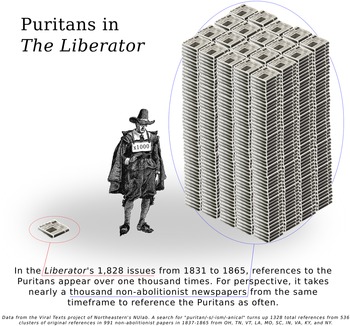
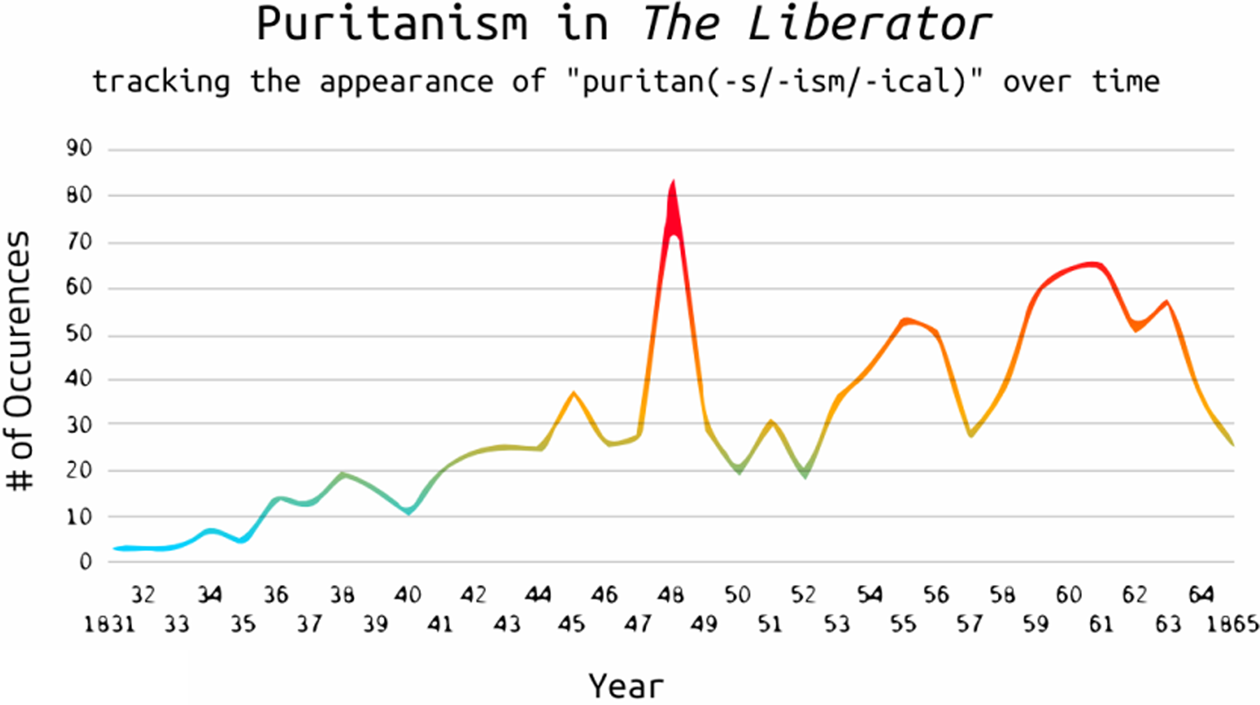
As Christmas 1865 approached a new year of emancipation and peace, William Lloyd Garrison prepared the final issue of his anti-slavery periodical The Liberator, especially pleased to print a letter to the editor from one “B.” “We want a paper that shall be Puritan of the Puritans,” B wrote, “and such a paper I esteem the Liberator to have been. Puritanism in the best sense is moral, not ecclesiastical; and herein it is to be transmitted and perpetuated.” In fact, B was only repeating what The Liberator itself had said with astounding frequency over its incessant weekly run from 1831 to 1865, where the Puritans appeared every other issue on average, and more frequently as tensions rose around slavery (Figures 1 and 2).Footnote 1
Frequency of “Puritan” in The Liberator versus other papers.

The frequency of “Puritan” in The Liberator over time.

Most often, the Puritans were evoked as a revolutionary legacy that endorsed abolitionist protest. The death of Elijah Lovejoy prompted Wendell Phillips to defend the printer's armed resistance by comparing him favorably to Cromwell, for instance, while James Russell Lowell hungered for an abolitionist revival of the English Civil War in 1848.Footnote 2 “Oh for one hour of that undaunted stock, / that went with Vane and Sydney to the block!” he wrote. “Oh for a whiff of Naseby that would sweep, / with its stern Puritan besom, all this chaff / from the Lord's threshing floor!”Footnote 3 In 1856 a journalist praised the New England guerrillas bleeding in Kansas as “worthy sons of Puritan sires,” while in 1864 Unitarian clergyman Amory Dwight Mayo sketched a more explicit genealogy of “religious opposition to despotism.” “The church and crown nicknamed it ‘Puritanism,’ and persecuted it,” he wrote, while “the slave aristocracy stigmatized ‘Abolitionism,’ and let loose upon it every infernal agency in its power.” Mayo concluded that the “best in Northern society” grew from “this ‘fanaticism,’ ‘Puritanism,’ ‘Abolitionism.’”Footnote 4
This usable past especially sanctioned The Liberator’s revolutionary mission by rooting it in a sacred Protestant tradition of print. “When I consider the Reformation and the invention of the press,” one Liberator writer noted, and “those elementary principles of liberty which were dwarfed in European soil, I have conceived that the hand of destiny was there! When I saw the immigration of the Pilgrims from the chalky shores of England … I have ventured to think that the will of Deity was there!”Footnote 5 This usable past was more myth than good history; beyond downplaying the differences between Puritans, Pilgrims, and the broader Protestant past, this vision also overlooked the more obvious fact that Catholics utilized print just as Puritans sometimes curtailed freedoms of speech. Such details were acknowledged and brushed aside as exceptions proving the general arc of Providence: a more enlightened, democratic, “purer” religion had been salvaged from papal and monarchical tyranny by print-savvy Protestant and Puritan reformers, blossoming in the fertile soils of the New World with the Pilgrim–Puritan colonies and the American Revolution. When Reverend Mayo and others lauded the Puritan roots of “all that was best in Northern society,” that is, they especially meant a tradition of Protestant print culture, and one that was increasingly under attack for its critiques of slavery. After the Pope and two English kings, the slave power was the final despot waiting to be toppled by print-slinging Protestants. If mythic, this lineage helped Garrisonians to shift the terms of debate around slavery in the American public sphere.
This essay argues that The Liberator stitched itself into a Puritan lineage to sacralize its mission of extra-ecclesiastical yet spiritually motivated protest in a public sphere and mass-media print landscape that was becoming increasingly secular and capitalist as new technologies like cheap paper, stereotype plates, and the steam press churned out penny presses and affordable weeklies.Footnote 6 David Hall has characterized this shift as one from Protestant scarcity to Victorian abundance, from a print culture dominated by relatively few books and reverential reading practices grounded in Puritanism to what many have described with Laura Langer Cohen as the “print explosion of the antebellum years” sparked by a market and industrial revolution. As a culture of devotional reading succumbed to a hastier market of journalism and novels fueled by consumer tastes, “no book, not even the Bible, retained the aura that certain texts had once possessed. Bit by bit, the structure of traditional literacy unraveled as print became abundant, school books were secularized, and the steady [devotional] sellers vanished,” he concludes.Footnote 7 Theorists from Habermas to Michael Warner and Charles Taylor have argued for a shift from the sacred to the secular as a modern public sphere emerged from this shifting print landscape. Antebellum Americans “transmut[ed] Protestantism into Victorianism,” in Hall's words, while more recent studies of antebellum American print have implied similar “subtraction stories,” to use Taylor's term, in which religion seems to fade from history as an active force while capitalist abundance rises.Footnote 8 If an explosive antebellum print culture indeed diversified America's reading landscape and shifted power from the clergy to editors and journalists, this process of secularization came with worries about print's declining sacred powers, worries to which Garrison spoke as he claimed the Puritan mantle for his own paper. In turn, The Liberator and its reclamation of Puritan spirit reveal how the story of religiosity within a shifting antebellum landscape is one less of subtraction than of evolution as Protestantism's spiritual legacies adapted and assumed more complex forms.
In the most obvious instance, traditional religious institutions tapped into new print powers to expand their spiritual reach; for one example, David Paul Nord argues for the birth of American mass media in the church-based American Tract and American Bible Societies.Footnote 9 The Liberator’s reclamation of Puritanism reveals a more complex reaction to the changing nature of print culture in the antebellum public sphere. As many orthodox believers denounced the Garrisonian press as an “infidel” attack upon American Protestantism (especially via its fierce critiques of the clergy and its “come-outer” calls for congregants to leave churches that refused to speak against slavery), Garrison and other writers for The Liberator positioned themselves as Puritanism's true heir – “moral” rather than “ecclesiastical,” in B's words – by mobilizing modern print technologies and freedom of the press for a sacred cause. Inextricably linked ever since Luther declared the printing press “God's highest and extremest act of grace,” they argued, Protestant spirituality and modern print technology had together progressively democratized the world by deposing popes and kings through the free circulation of dissent, and The Liberator made a show of taking up this torch.Footnote 10
Perhaps most importantly, the show worked, affecting readers powerfully and often with effects described in revivalist and religious terms. Lydia Maria Child reflected fondly on “the missionary work of the old Liberator days” when “the Holy Spirit did actually descend upon men and women in tongues of flame,” just as another woman spoke similarly of Garrison as a “savior from a cold and selfish life” more responsible for her “spiritual joy and growth than all other influences combined.”Footnote 11 The nineteenth century spoke often of poets writing new scriptures, but Garrison seemed the closest to having done so in his lifetime. For many readers like Child, awash in a disorienting sea of print, The Liberator offered a sense of spiritual focus and purpose, a chance to revive a sacred heritage in an era when abundant print seemed to come with diminishing spiritual returns.
PRESS AND PULPIT IN THE PUBLIC SPHERE
More than rhetoric, this reclamation of Puritan print was first sparked by the collision of Garrison's early evangelical convictions with a clergy whom he felt had ignored its anti-slavery implications. As Henry Mayer notes, Garrison's platform of moral suasion, immediatism, and come-outerism was “not so much a political tactic as an expression of the evangelical consciousness” first imbibed from his mother's days among New England Baptists and strengthened when Garrison arrived in Boston as an ambitious printer in 1826 just as Lyman Beecher thundered his orthodox cannons at the city gates, intent on reclaiming the Puritan capital from the Unitarian rule of William Ellery Channing.Footnote 12 While he admired Channing's learning, Garrison was especially attracted to Beecher's philanthropic energy, and he made a point to attend the preacher's North End services twice a week. Eager to elevate the nation in their own ways, both leaders spoke powerfully to the young man who soon decided that he could do similar work, if not as a traditional preacher then as “a new race of editors” who would use the powers of print to “enhance the value of public opinion” by “fearlessly maintain[ing] the truth” in “every moral enterprise.” What the preacher did for his congregation, the printer could do for a vaster readership as a preacher–printer of sorts. Such an approach to print was somewhat novel as an attempt to fuse two vocations usually considered separate in an emergent American public sphere, one sacred and the other secular: while the preacher had been considered a spiritual leader for two centuries, the printer was a younger and greasier species sprung from the partisanship of the 1790s, often considered a sensationalist and opportunistic party tool. Garrison admitted that “for many years, indeed, [the editor's] reputation has been sullied by the conduct, character, and principles of many who have aspired to fill it,” but he positioned himself as a new generation of editors with “nobler views,” wielding the press like Beecher and Channing's pulpits.Footnote 13
Garrison released the first issue of The Liberator on New Year's Day 1831. “My conscience is now satisfied,” he declared on the front page, posing his mission for immediate abolition against the moderation of Beecher and Channing. “I am aware, that many object to the severity of my language; but is there not cause for severity?” he asked. “On this subject, I do not wish to think, or speak, or write, with moderation. No! No! tell a man whose house is on fire, to give a moderate alarm,” he wrote, perfecting a style of increasing urgency that mirrored the fiery revivalists of the Second Awakening, concluding in pounding prose, “I am in earnest – I will not equivocate – I will not excuse – I will not retreat a single inch – AND I WILL BE HEARD.”Footnote 14 Thus began a career of capitalization, exclamation, and conflagration that bore a disturbing resemblance to David Walker's incendiary Appeal, still fresh in the minds of many.
As with Walker, alarmed citizens soon argued that such incendiarism exceeded the bounds of free speech in its potential to stir up slave revolt and destroy the republic that safeguarded these freedoms. Garrison just as quickly retorted that the right to print and speak as freely and harshly on matters of conscience was not merely a Constitutional construct dependent on a political union, but a deeper spiritual demand that rested in the authority of God alone, an impulse that had fueled a sacred Puritan heritage which pre-dated, created, and sustained the republic. This struggle over the boundaries of speech in the public sphere quickly reached a boiling point, and the New York City antiabolitionist riots of 1834 were among the first results, sparked when Arthur Tappan underwrote the formation of a female anti-slavery society and made a public statement by sitting in a segregated pew next to Samuel Cornish, the editor of America's first black paper, Freedom's Journal. Periodicals like the Journal of Commerce blamed the unrest on abolitionists, while the colonizationist editor James Watson Webb added fuel to the fire in his Courier and Enquirer by insinuating that abolitionists were encouraging interracial relationships (Tappan, he insinuated, had left his wife for a black woman). In response, The Liberator asked if a new Dark Age was overturning the nation's Protestant heritage. “Has it come to this, that in free America, men cannot express their opinions, because the whole community almost, holds to opposite opinions? … are an infuriated mob to act as censors of the pulpit and the press?” one writer asked.
God forbid. Sooner will we fight the battles of the Revolution over again, or dive into the recesses of the wilderness, where we can think, speak and act, according to the dictates of our judgments … So would have said the Pilgrims, the Huguenots, and every other genuine aspirant after liberty.
The riots confirmed the anti-slavery press's sense that it was tending a Pilgrim flame in a moral wilderness.Footnote 15
This mission became personal for Garrison the following year when the American Antislavery Society organized America's first mass mail campaign, a vast effort to send abolitionist periodicals and pamphlets to leaders in the South. When this mail arrived in the port of Charleston on 29 July 1835, a mob broke into the post office and burned the lot alongside effigies of Tappan and Garrison, cheered on by a crowd of two thousand people. This censorship came to Boston the next month when a mob shut down a speech by British abolitionist George Thompson, and when the Boston Female Anti-Slavery Society (BFASS) planned to reschedule the event, they met opposition from Boston “gentlemen of standing” who warned that Thompson risked lynching if he appeared. Undeterred, the BFASS scheduled the speech for 21 October, and again leading merchant papers like the Commercial Gazette expressed the opinion of Boston's men of business that instead of “stirring up strife between the South and the North,” such women “ought to be at home, attending to their domestic concerns.” In defiance, a group of black and white women from the BFASS walked arm in arm to their meeting on the day of the rescheduled speech, wading through an unsettled crowd. When a mob found Thompson absent from the meeting, they seized Garrison instead, parading him through Boston with a noose around his neck; he barely escaped with the help of two Irishmen.
Once more, Garrison immediately turned to his press to mythologize the event as an assault on a sacred heritage of free speech. In his account of the event for The Liberator (reprinted frequently in the year to come), Garrison shifted the terms of abolitionism to prod the conscience of apathetic white readers. “The great question to be settled is not whether 2,500,000 slaves in our land shall be either immediately or gradually emancipated,” he wrote, but
whether the liberty of speech and of the press, purchased, with the tolls and sufferings and precious blood of our fathers, is still to be enjoyed, unquestioned and complete – or whether padlocks are to be put upon our lips; gags into our mouths, and shackles upon that great palladium of human rights, the press; whether the descendants of the Pilgrim fathers … [are] to speak or be dumb, and to walk freely or with a chain upon their spirit.
If white northerners cared little about the rights of black Americans, Garrison hoped to rouse them by repositioning slavery as a threat to their own cherished Pilgrim and Patriot traditions of a free press.Footnote 16
As the clergy remained wary of speaking forthrightly on this increasingly volatile issue, each of these events further radicalized Garrison's sense of Puritanical mission as he increasingly came to consider himself “an apostle of radical Christian liberty in the Miltonic tradition,” in Mayer's words. While “the bedrock of his faith remained the Protestant's right of private conscience,” he grew frustrated with what felt like a conscious effort on the part of the clergy to suppress his own, and under the influence of John Humphrey Noyes's extreme brand of Finneyite perfectionism, Garrison thundered at his former heroes Channing and Beecher in a storm of Puritanical fervor, accusing them of dead formalisms that abdicated their historical charge.Footnote 17 When Channing outlined a more staid anti-slavery argument in his 1835 Slavery and denounced the “showy, noisy” tactics of the immediatists, Garrison responded by reprinting in The Liberator a celebrated essay which Channing had formerly written on Milton, in particular a passage where he defended the poet's harsh polemic during the English Civil War. While Channing generally read Milton as what he himself hoped to be – in the words of Kevin P. van Anglen, “a high-minded defender of dominant class authority” – Garrison cleverly excerpted the passage where even Channing could admit that extinguishing liberties required Milton's cutting polemic.Footnote 18 “Liberty was in peril,” Channing wrote, “and who will blame [Milton] for … defending them with fervor and vehemence?” Such enthusiasm was appropriate to “those great periods which have been distinguished by revolutions in government and religion,” Channing concluded, but in the pages of The Liberator, such quotes acquired an ironic new resonance within the current struggle with slavery, perhaps the latest of these “great periods.” With a clever arrogance, Garrison quietly praised his movement and himself via Channing's ode to Milton. “At such periods, men gifted with great power of thought and loftiness of sentiment are especially summoned to the conflict with evil … they must and will speak with an indignant energy, and they ought not to be measured by the standard of ordinary minds in ordinary times.”Footnote 19
The next summer Garrison similarly attacked Beecher, who proved even more infuriating in a denominational circling of wagons that surpassed Channing's reticence. After Garrison refused his invitation to work as a moderate reformer in his approved benevolent organizations, Beecher had since convinced Congregationalist and Presbyterian associations across the North to deny their pulpits to itinerant speakers deemed “dangerous to the influence of the pastoral office and fatal to the peace and good order of the churches.” Everyone understood that he meant the abolitionist firebrands rallying around Garrison and his pulpit-paper, and by 1836 every church in Boston had heeded Beecher's call. That year, the Massachusetts Anti-Slavery Society was forced to hold its annual meeting in a horse barn, and while Garrison could joke with allies that the movement finally had “a stable foundation,” he lashed out at Beecher in the voice of Luther and Milton: Beecher's goons were “selling indulgences” and “lulling consciences,” aiding the South “in all its turpitude of crime, rather than peril the union between Christ and Belial!”Footnote 20 As with Channing, the implication was clear: in the midst of a new Reformation, New England's preachers were failing to live up to their forebears’ legacies, allying themselves instead with Pandemonium.
The link between America's Puritan–Pilgrim heritage and a free abolitionist press reached its apex with the death of the printer Elijah Lovejoy in 1837 after his anti-slavery press had been destroyed, moved, rebuilt, and destroyed anew by mobs in St. Louis and Alton the year prior. After the first attack, The Liberator ran Wendell Phillips's declaration that slavery “chills the blood of the Puritans, till their sons cease to remember that it was liberty to think and speak as we pleased, which planted our rocky hills”; four months later it ran a warning from the Boston merchant George Russell to work “till the principles of our Pilgrim fathers are carried to their full extent” by erecting “the lightning rods of freedom of speech, and freedom of the press.”Footnote 21 After Lovejoy's death, even Channing found himself unsettled enough to call the public meeting in Boston at which Wendell Phillips rose to prominence. Channing insisted that they focus on a defense of free speech and avoid “mix[ing] up the meeting with Abolition,” but this was an oxymoron for Garrison, effectively defending free speech in the abstract while foreclosing actual free speech on real topics of concern.Footnote 22 Instead Garrison reprinted a more encouraging report by the Portland Anti-Slavery Society from Lovejoy's native Maine on the occasion of the printer's death:
we consider it the duty of the sons of the Pilgrims, at the hazard of their property and lives, to maintain, and transmit to their posterity, the principles of liberty, pure and free as they were received from the Puritans. Resolved, that we consider every citizen called upon, in a special manner, to use his utmost influence, in every lawful and proper way, to preserve our rights – the liberty of the press, the pen, the tongue.Footnote 23
By the end of the 1830s, the connection between a Puritan heritage and a dissenting anti-slavery press was secure, reused and bolstered in the decades leading to war as the cause faced new threats. Whether in the Congressional “Gag Rule” barring discussion of anti-slavery petitions from 1836 to 1844 or continued opposition to the gathering of female anti-slavery societies, The Liberator continued to rally its readers around a revolutionary Puritan heritage of free speech and press.Footnote 24 If this connection coalesced intuitively and spontaneously from concrete conflicts over spiritual authority in the public sphere, it remains to be examined why this connection proved intuitive, captivating, and useful.
HARSH SPIRITS
Most immediately, the Puritan past sanctioned an incendiary style that thrilled allies, angered enemies, and exasperated moderates for its purposeful agitation of the public sphere. Perhaps no movement in American history was so frequently preoccupied with defending its aesthetic as an integral facet of its spiritual and political goals as Garrisonians, constantly parrying the charge of “harsh language.” Already on The Liberator’s very first page Garrison was “aware, that many object to the severity of my language,” and while critics argued that this tone risked upsetting a precarious Union, Garrison always doubled down, even on the eve of war. “If the State cannot survive the anti-slavery agitation, then let the State perish,” he wrote, and “if the church must be cast down by the struggles of humanity to be free, then let the church fall … consumed by a living thunderbolt.”Footnote 25 Nearly fifty years later, Lydia Maria Child still felt obliged to defend such bombast to the broader readership of The Atlantic in her eulogy for Garrison. “He was dealing with something more formidable than flies, and weapons stronger than feathers were needed,” she explained, a defense that barely modified Garrison's declaration in 1831 that “I will be as harsh as truth.”Footnote 26 A Puritan heritage widely respected for its plainspeak and even its moments of iconoclasm could do much to fit this style into a venerated lineage. By stitching themselves into this history, Garrisonians defended their right to speak and write with as much Manichean militancy as one felt necessary, even on the most volatile of issues.
Garrison's and Channing's divergent approaches to abolition are illustrative. In Slavery, Channing betrayed an obvious unease not only with Garrisonians’ “fierce, bitter, and abusive … tone unfriendly both to manners and to the spirit of our religion,” but with their rowdier Jacksonian manner of organization that diverged from the genteel models of leadership he sought to embody.Footnote 27 Channing argued that the American Anti-Slavery Society “should have been an elective” association composed of carefully chosen “men of strong principles, judiciousness, sobriety,” in line with the benevolent societies which he had built. Instead they “gather together young and old, pupils from schools, females hardly arrived at years of discretion, the ignorant, the excitable, the impetuous,” and “very unhappily they preached their doctrine to the colored people.” Here was the real threat of Garrisonian bombast: it threatened to spark mobs from polloi kindling. “To this mixed and excitable multitude, minute, heart-rending descriptions of slavery were given in the piercing tones of passion,” a tactic altogether “unfriendly to the spirit of Christianity” as much as to a stable republic.Footnote 28 This shift of power from enlightened leaders to impressionable masses was amplified by a press that could deliver the intoxicating Garrisonian style to Americans across the nation. “A newspaper, which openly or by inuendoes excites a mob,” Channing asserted, “should be regarded as sounding the tocsin of insurrection,” and “the tone of their newspapers, as far as I have seen them, has often been fierce, bitter, and abusive.”Footnote 29
Channing's worries that a print-crazed mob could destroy the republic resembled Plato's fear in the Phaedrus that the invention of writing would similarly destroy the dialogic basis of enlightened republican leadership. Against Channing's Hellenic sense of the public sphere, Garrison posed a more Hebraic and indeed Puritanical model. When he responded by reprinting Channing's essay on Milton in The Liberator, he highlighted Channing's own recognition that the English Civil War was a crowning example of moments in history when dialogue was insufficient for spiritual reformation and iconoclastic conflict was instead required. “We must not mistake Christian benevolence, as if it had but one voice, that of soft entreaty,” Channing formerly wrote and Garrison now quoted, for
that deep feeling of evils, which is necessary to effectual conflict with them, and who marks God's most powerful messengers to mankind, cannot breathe itself in soft and tender accents. The deeply moved soul will speak strongly, and ought to speak so as to move and shake nations and the aristocracy.Footnote 30
One wonders whether Channing read his own words in the pages of The Liberator back to himself, perhaps blushing, perhaps annoyed. Here was another unwieldy power of print: the ability to revive and recontextualize former statements for purposes beyond the author's intentions. With this tactic, Garrison sanctioned his style not only with the Puritans, but also with the very words of a respected national clergyman, bypassing dialogue with Channing for a more aggressive and aggravating style fueled by conflict.
Garrison most fully theorized this style in the essay “Harsh Language.” In place of Channing's nearly Habermasian sense of the public sphere as a progressive process of rational debate, he posed a romantic–prophetic model in which “indignant spirits” goaded a nation's apathetic conscience with aggressive rhetoric. “That my language has been rough … is true: but why?” Garrison asked, “because any other language would have been inappropriate.” Brimming with the language of prophecy, he cast aside objections to this style, for “honeyed accents were tried in vain for years.” For precedent, he turned again to a familiar genealogy of Old Testament prophets, Reformational dissenters, New England Puritans, and Revolutionary patriots, weaving between the prophet Ezekiel, “the earnest inquiry in 1776,” Martin Luther, and the “Pride of New England! / Soul of our fathers!”Footnote 31
At the heart of this style and lineage was a particular “political theology of print,” to use Steven Mailloux's term, which hinted at the appeal of the Garrisonian ideology for antebellum seekers.Footnote 32 If the story of sacred history was the unfolding of liberty inaugurated by the Reformation, the press played a crucial role in this process, a protagonist in its own right and a potent medium on behalf of liberty in its ability to speak directly to the souls of a million individual readers. What the pulpit did for a single congregation, the abolitionist press could do for the entire North, just as Luther's use of a vernacular Bible and Puritan use of tracts had done in centuries past. “Thanks to the Printing-Press,” Phillips declared in a speech on “Public Opinion,” “wherever you have a reading people, there every tongue, every press, is a power … what gunpowder did for war, the printing-press has done for the mind.”Footnote 33 He went a step further, declaring sanguinely that “the age of bullets is over” and “the age of reading men has come. I will try to imbue every newspaper with Garrisonianism.”
Such idealism was both theological and strategic. Abolitionists were more acquainted than most with the ways in which a dissenting press's idealistic message was nonetheless rooted in and susceptible to material forces – the cost of postage and paper, Congressional gag laws passed by individuals invested in the slave economy, the brute violence of pro-slavery mobs destroying their presses, and more. But the physical press was imagined as the medium of a more expansive and dynamic spiritual message; The Liberator’s paper pages and wooden presses were the vessel for its revelations – like a martyr's body, their material base could be destroyed, but their witness lived on. Writing for The Liberator in 1835, one Reverend Waterman asked, “did the silencing of Wickliffe stay reform? Did the abandonment of the press of the Pilgrims in Leyden, stay the progress of thought?” Will today's truth “dropped, thick as flakes of snow, in our cities, and towns, and western valley … lie and rot in the room where it was sterotyped [sic], printed, and folded?” If the press was destroyed or the printer killed, “the work goes on. God sustains it.”Footnote 34 Strategically, elevating the press above bullets as Protestantism's superior weapon helped to convince allies that they could overcome formidable material forces. Wendell Phillips declared public opinion and the press the strongest force yet seen by history. “The great statesmen had pledged themselves not to talk on this subject. They have been made to talk,” he declared to a cheering crowd, “not by three newspapers, which Napoleon dreaded, but by one.”Footnote 35
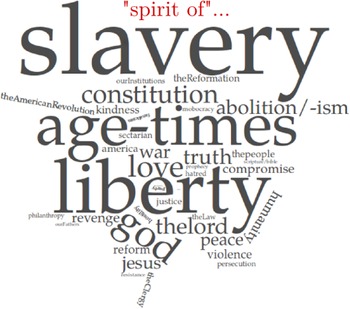
This theology of the press grew from and reinforced the Garrisonian belief that slavery was less a political problem than a sin requiring a change of spirit. References to “spirit,” “spiritual,” and a “spirit of X” abound in The Liberator, often attached to nouns that would just as well stand on their own – the spirit of the Gospel, of calculating politicians, of the Constitution, etc.Footnote 36 To speak of the “spirit of” something was not uncommon in antebellum parlance, but The Liberator relied on the formula to an extraordinary degree, returning to the phrase nearly six times as frequently as a group of southern periodicals, three times as frequently as the Free Soil Party's Emancipator-Republican, and even more often than The Congregationalist, Boston's voice for religious orthodoxy.Footnote 37 If measured by recurrence to the term alone, The Liberator seemed more preoccupied with matters of the “spirit” than other publications, unsurprisingly most concerned with the “spirit of slavery” and the “spirit of liberty/freedom”Footnote 38 (Figure 3). When John Quincy Adams used similar language in his Congressional battle against the gag laws, denouncing the Slave Power's effort to make “perpetuation of slavery the vital and animating spirit of the national government,” The Liberator returned to the quote over a hundred times in the course of its thirty-year run, likely attracted to it in part because Adams spoke their language of “spirit.”
Language of the Spirit in The Liberator.

If this trend of writing about a noun's “spirit” rather than simply the noun itself grew from the Garrisonian tendency to focus on the spiritual root of political problems, this tendency itself grew from Puritan roots. Amidst the revolutionary fervor of 1778, Benjamin Rush attributed this kind of language (as well as its political import) to the Puritans, surmising that “the destruction of our republics can originate only from causes within ourselves,” hoping “(to speak in the puritanical phraseology of our Ancestors) to see a republican Spirit yet found out upon us.”Footnote 39 If, of course, the meaning of this infamously ethereal word “spirit” shifted from Puritan to Republican to Romantic New England, it also retained a continuity with prior legacies: Rush's “republic spirit … within ourselves” and Garrisonians’ “spirit of liberty” retained something of the Puritan belief that a free society's well-being depended as much on – oftentimes more on – the inward convictions of its members than on the letter of the law. When Garrisonians spoke of the spirit of liberty or Christianity, they spoke as individuals with liberty or “Christ in the heart,” indicting institutions that failed to live up to this internal witness. The converse was true for Garrisonian talk of negative spirit (e.g. the spirit of slavery, war, or revenge) as the wicked or apathetic inner state of individuals who sustained a corrupt order. This is what Chapman meant when she concluded in her history of Garrisonianism that “the machinery of organization, with all its systematized and mechanical helps, must be utterly unequal to obtain emancipation, unless freedom be the moving ‘spirit within the wheels,’” paraphrasing the prophetic vision from Ezekiel 1:20.Footnote 40
Speaking of the “spirit within the wheels” of an existing social structure was also a political strategy for destabilizing the ideological implications of words, part of the broader Garrisonian impulse towards linguistic iconoclasm. Alvin Gouldner helpfully defines ideological change as “a linguistic conversion that carries with it a reorganization of the self, on the one hand, and an alienation from old social conventions, on the other,” highlighting how a conversion to Garrisonian immediatism came with a new vocabulary, inherently antagonistic as it contested or redefined the ideological implications of words like “liberty,” “constitution,” or “Christianity,” for instance.Footnote 41 When opponents used such terms as they were commonly understood, Garrisonians countered Protestantly by invoking the spirit beyond the letter of these terms to express their dissatisfaction with the present vocabulary. “The whole scope of the English language is inadequate to describe the horrors and impieties of slavery,” Garrison declared in his defense of harsh language, and “instead, therefore of repudiating any of its strong terms, we rather need a new and stronger dialect.”Footnote 42 Garrisonians’ “harsh language,” then, was a necessary cause and effect of the spiritual transformation demanded by its immediatism, a means of challenging corrupt institutions on the authority of deeper spiritual convictions and experiences.
THE GARRISONIAN EXPERIENCE
If one approaches Garrisonian ideology, à la Gouldner, as a new language for desires and dissatisfactions, attention to that language reveals its emotional dynamics for antebellum readers – in particular how Garrisonianism responded powerfully to an acute religious restlessness. Garrison's blend of prophecy, romanticism, and the Puritan past – his talk of the “spirit of” the church, the Reformation, the Constitution beyond their existing forms – struck the right notes for Americans who struggled to reconcile the spiritual promise of their nation with the material complacency of its present. One might consider this restlessness an inchoate “structure of feeling,” to use Williams's term, that preceded one's embrace of a fully articulated Garrisonian ideology and coalesced within a residual Puritan past and an emergent capitalist present. Within this structure of feeling, abolitionist talk of the “spirit” beyond forms emerged as a conduit between the world as it was and the world as it ought to be in the minds of the restless, a link between individual desire and social agenda. William James spoke of the need for a “means of adaptation” when one senses a disjunction between the “seen” and “unseen” world that can take an aggressive or passive form; Garrison tapped into and politicized a deep-seated desire to reclaim America's spiritual promise through an aggressive holy war which pitted America as it ought to be against America as it was.Footnote 43 Thus could Child and others describe their conversion to Garrisonianism less as a rationally adopted program than as the “tongues of flame” and “spiritual joy” which they discovered in The Liberator and its mission.
Others recognized how these structures of feeling made American abolitionism a uniquely enthusiastic and Puritanical experience compared to its French and British varieties. At the 1840 World Anti-Slavery Convention in London, Whittier found that American abolitionism had “little sympathy with anything staid, sober-paced, prosaic, and formula-fettered,” while the English were “mere non-conductors” of this more “fervid, imaginative, electric-sparkling abolitionism,” impelled by millennial desires that dreamed “of setting a whole world free from all kinds of oppression – mental, physical, social, religious and political; millenial fire-shadowings.” While the American nursed “an enthusiasm which was to go round the world,” his English cousins instead “gave him dull reports … with as much coolness and imperturbable self-possession, as if they were engaged in reckoning the interest of the British national debt.”Footnote 44 American abolitionists waved “Cromwell's ‘sword of the Lord and of Gideon’” in a spiritual fervor that startled the British yet attracted spiritually restless American readers towards the promises of the abolitionist press.
Because of this affectively intense iconoclasm, Garrisonians were deemed Jacobins as often as Puritans by allies and enemies alike, like Carlyle finding a spiritual link between the Reformation, the English Civil War, and the French Revolution.Footnote 45 William James later described this variety of religious experience as “saintliness,” the fusion of militant will and spiritual protest that linked Cromwell's New Model Army to the “utopian dreams of social justice in which many contemporary socialists and anarchists indulge.” Such radicals, James argued, inherited the Christian belief in the “potentialities of development in human souls,” Puritans and socialists alike “impregnators of the world, vivifiers and animaters of potentialities of goodness which but for them would lie forever dormant.” While James felt that these impulses could narrow into fanaticism, they were also a “genuinely creative social force.”Footnote 46
In tenor and intensity, this “genuine creation” qualifies Sacvan Bercovitch's vision of “the American ideology” as a hegemonic Puritan ritual descended from the jeremiad that conserves a national core. One can accept this work as an accurate and even exhilarating portrait of a prominent cultural pattern, yet when approached from a bird's-eye view as “the American ideology,” it can miss the texture of conflict and antagonistic intensity at the heart of an experience like Garrisonianism. In this respect (and despite appeals to a later and more pliant generation of Marxism), Bercovitch relied upon a classical Marxist definition of ideology as a static reflection of dominant values – “ideology is basically conservative,” in his estimation, and useful for this very reason, revealing a central cultural continuity.Footnote 47 But to describe Garrisonians’ alternative use of the Puritans as little more than a prelude to a new consensus misses the prophetic, “saintly” experience at its core. If one considers ideology not as “false thought” but in the more neutral sense of ideology as a consciously adopted set of beliefs (Girondin versus Montagnard, Menshevik versus Bolshevik, Tappanite versus Garrisonian), this emotional appeal becomes clearer.Footnote 48 One may even agree that American writers generally “were not subversive at all, or were radical in a representative way that reaffirmed the culture, rather than undermining it,” but such a conclusion misses the iconoclastic appeal of the Garrisonian experience.Footnote 49
For this reason, opponents often felt that Garrisonianism was rooted less in any principled faith or ideological program than in a select group of individuals’ vainglorious desire to experience the role of Puritan prophet, as convinced of one's own righteousness as of the nation's depravity; while the Garrisonian style was frequently blasted as “harsh language,” the underlying experience was labeled more simply as “egotism.” The giant word “EGO” crowned the corners of Adalbert Volck's cartoon caricature of abolitionist “worship” built atop a foundation of “PURITANISM,” while Senator Samuel S. Cox argued that “abolition is the offspring of Puritanism” in reviving “the same selfish, pharasaical, egotistic and intolerant type of character … swollen with spiritual pride, it complacently assumes to read the designs of Providence as if it was a part of the Godhead!”Footnote 50 In an 1852 pamphlet printed by none other than Ticknor, Reed, and Fields in Boston itself, one “Medico” likewise concluded in his “Review of Garrisonian Fanaticism” that abolitionists were “egotistic snivelers and ranters” whose supposed “holy zeal” was in fact little more than hatred: “the main element in the spirit of the movement, it honestly appears to me, is revilism, the principle of hatred to slavery, to slave-holders and their abettors, to the church and to the state, and love to nobody,” he wrote, where “there is no sunny side of life, but all is gloomy, dark … theirs is the spirit of strife and hatred, yes, bitter hatred to all who disagree with them.” Rather than labeling this egotistical hatred “Puritanism” like the Westerner Cox or the Southerner Volck, Medico (perhaps himself a New Englander) instead used Garrisonians’ own language against them. Hatred was “the deadliest spirit … which the poet places in his pandemonium of evil,” likely a reference to Satan's comment in Paradise Lost that “never can true reconcilement grow, / Where wounds of deadly hate have pierced so deep.”Footnote 51 Medico proceeded to paint his own rather Miltonic portrait of this spirit rising “as smoke from the bottomless pit, shrouding the sun of heaven, and withering the beauty of earth.”Footnote 52 Such comments anticipate Henry Adams's slightly more sympathetic observation that “the New Englander, whether boy or man, in his long struggle with a stingy or hostile universe, had learned also to love the pleasure of hating; his joys were few.”Footnote 53
The heart of this disagreement concerned the place and shape of religious experience in the public sphere, more specifically the tension between a secularizing nation and its living roots in an intensely experiential and activist variety of Protestantism. Medico asserted that hate-filled Garrisonians were so convinced of their righteousness and their enemies’ depravity that they in fact foreclosed the possibility of free speech and abandoned the public sphere by substituting prophecy for debate – thus the frequent charges that Garrisonians were at once making religion too political and politics too religious. Occasioned by a newspaper article in which a preacher defended a Garrisonian's comment that fugitive slaves had the right to kill those who would return them to slavery, Medico especially attacked the preacher's belief that “I am not responsible to you [the editor], or even to the public, for what I preach, but only to God.” Medico retorted that such antinomianism left the nation at an impasse: if one preached treason or violence, as many believed the Garrisonians did, “have not the public any right to object?”Footnote 54 This antinomianism tended towards the dissolution of the church as much as of the state in Medico's mind, and despite their claims that they continued the true spirit of the Gospel and the Reformation against the “pretenders to Christianity” in America's Protestant churches true Christianity in fact consisted in abandoning the Garrisonian spirit of hate for love of enemies, in forgoing its individualistic anarchy for the bonds of church and community. The “pernicious influence of the Liberator” spread this destructive hatred across the nation.Footnote 55
From the inside, of course, the Garrisonians’ prime motive wasn't a “pleasure of hating” in and of itself but the hatred of sin as sin, the aggressive and bothersome duty to make one's countrymen see a national institution as a sin. When “B” praised The Liberator as Puritan of Puritans, for instance, he quoted Emerson: “the doctrine of hatred is to be preached as the counteraction of the doctrine of love, when that poles and whines.” For James, saintliness was not egotistical hatred but “the moral fighting shape,” the need for moral witness with teeth.Footnote 56 Here was indeed an impasse, for the experience at the heart of the Garrisonian ideology – at the heart of any radical ideology, for that matter – was the sense that the public sphere had grown so stagnant that it required a foundational transformation. In imaginations shaped by a strong Protestant heritage, this change would come less through rational debate than through a clash between transformed and complacent spirits, and both Adams and James hinted at the excitement of this prospect, not mere egotism or hate but the sense of conversion into a narrative bigger than oneself, a new chapter in a sacred heritage.
Thus could Garrison conclude in “Free Speech and Free Inquiry” that his opponents saw their mission as a “spirit of hate,” quite simply because their own spirits remained unawakened to a new chapter in Providence. To Garrison's mind, when writers like Medico asserted antiabolitionists’ equal right to free speech, they were making a duplicitous argument less for true free speech than for the majority's right to suppress new revelations that threatened a retrograde status quo. “Of all the reformers who have appeared in the world, whether they were prophets, the Son of God, apostles, martyrs or confessors,” he wrote, “not one of them has been exempt from the charge of dealing in abusive language … of aiming to subvert time-honored and glorious institutions, of striking at the foundations of the social fabric, of being actuated by an irreligious spirit.” Nonetheless he maintained as he had since The Liberator’s first days that “the charge has ever been false, malicious, the very reverse of the truth.”
More so, theirs was an inherently sacred mission precisely because it challenged the foundations of the American social fabric, continuing a sacred Protestant tradition. “Luther and his coadjutors were represented as the monsters of their times” for the same reason that critics reviled Garrisonians as hate-filled devils, praising past reformers from a safe distance while ignoring similar work in their own era. The present “places Luther, Calvin, Penn, in the calendar of saints” with comfortable ease because
they who hunted, like wild beasts, the reformers of the 15th and 16th centuries, are crumbled to dust, and we stand upon their ashes, and brand them freely and bravely as a band of cowards and persecutors. Why should we not? We have no trade at stake … But what are we doing in regard to the impostures, the crimes, the wrongs of our own times, and our own country? Are we grappling with them, with any thing like the boldness of those whose sepulchres we are proud to build?Footnote 57
In a word, Garrison revolutionized the Protestant past: those who ostensibly honored and preserved it in fact missed its vital ongoing misison, while those who ostensibly left it behind for new revelations in fact fulfilled it. Garrison amply praised Lowell's poem “The Present Crisis” as a powerful statement of this dynamic: “we can and must transcend our predecessors … ‘we ourselves must pilgrims be, launch our Mayflower, and steer boldly through the desperate winter sea, nor attempt the future's portal with the past's blood-rusted key.’”Footnote 58
The sense of participating in the latest dispensation of sacred history offered Garrisonians a level of purpose that rivaled traditional Christian institutions and traditions. Maria Weston Chapman described the initial years of Garrisonianism as “days like those of Wat Tyler, of Wycliffe, of Knox, and Luther” in offering a sense of spiritual purpose that was so powerful it could even replaced traditional Christianity and Scripture.Footnote 59 After a funeral, Chapman found more comfort in the cause and in The Liberator than in the Bible and traditional religious structures. “I cannot refer thus to any opinions of faith, as the words are commonly understood. But the thing, whatever it is, that makes us forget ourselves in our fellow creatures – that remains, when the personal presence of our other self is resumed,” she wrote to James Russell Lowell, double-underlining that “The Cause has been the paraclet to me,” like Child falling back on the language of Pentecost. “I never shall forget the moment when the dawn broke upon me after a night of watching by the dead – and I stretched out my hand to the Liberator lying on the table,” she continued, “‘I shall not be able to read it’ I thought – I shall care for nothing again. But I opened it & found to my astonishment that all that faithful friend of excellence was untouched by death.”Footnote 60 To the reprobate, this appeared as so much infidelity, but to the transformed Garrisonian elect it was nothing less than the work of salvation in the present age.