INTRODUCTION
Health physics and nuclear safety concepts as well as environmental analyses are mandatory issues for a nuclear reactor licensing.Reference Yamashita, Takamura, Ohtsuru and Suzuki 1 – Reference Cember and Johnson 3 Generally, a nuclear reactor disperses a very small amount of radioactive materials into the environment in normal or on very rare occasions, accidental operation due to the any errors in the safety system.Reference Taira, Hayashida, Yamaguchi, Yasashita, Endo and Takamura 4 Evaluation of the cancer risk incidence for personal and the population around the reactor site is essential from the health physics and environmental radiation protection aspects in the event of accidental operation. 5 , Reference Puskin and Nelson 6 Commonly, nuclear reactors are equipped with a heating ventilating and air conditioning (HVAC) system to control the level of radiation contaminants from the stack. The HVAC system of a nuclear reactor provides a negative pressure in the reactor building to minimise the potential hazard of accidental release of radioactive gasses, for purposes such as controlling and minimising the release of radioactive materials into the environment to protect operating and research personnel from excessive radiation exposure. The Bushehr Nuclear Power Plant (BNPP) is a 1,000 MW nuclear reactor in Iran, 17 km (11 mi) southeast of Bushehr city, along the Persian Gulf. 7 – Reference Chung, Ahn, Min, Seo and Moon 9
There are several national and international organisations including the Biologic Effects of Ionizing Radiation (BEIR) committee, the International Commission on Radiological Protection (ICRP), the National Council on Radiation Protection and Measurements (NCRP), the Environmental Protection Agency (EPA), the United Nations Scientific Committee on the Effects of Atomic Radiation (UNSCEAR) and the National Institutes of Health (NIH) that have developed some models for cancer risk estimation from exposure to low levels of low linear energy transfer (LET) ionising radiation. The developed models are used to estimate the risk of cancer incidence through employing the physical and biological factors such as dose rate, dose magnitude and quality factor of radiation, radio-sensitivity of different organs, sex, age and other characteristics of the exposed individual. 10 – 12
The aim of this study is to evaluate the cancer risk due to accidentally released of radionuclide from BNPP reactor. First, the total effective dose equivalent (TEDE) was calculated for a very unstable atmospheric condition using HOTSPOT code (Lawrence Livermore National Laboratory, Livermore, CA, USA). Then, based on the BEIR VII model, the cancer risk incidence for different combinations of biologic organ/age of male and female sex was estimated.
MATERIAL AND METHODS
Hypothetical nuclear accident
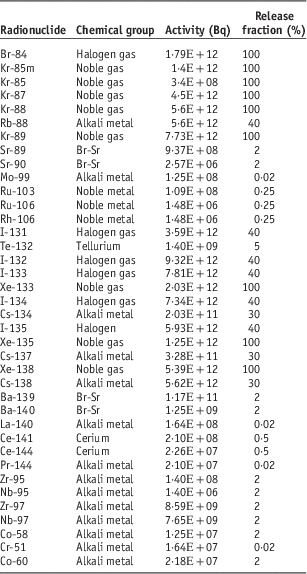
In a hypothetical nuclear accident condition, it has been assumed that the performance of nuclear power plant would be disturbed due to the failure of instrumentation and control system lines or the HVAC system and other natural phenomena such as an earthquake. As a consequence of each subsystem failure, an over the legal limit amount of steam-gas radionuclide’s mixture are released into the environment. The released radionuclides appear in two main forms, the first are those that escape from the reactor stack in the form of a dispersed gas and the second form are released as particles into the medium. 13 The main released radionuclide materials from BNPP in a nuclear accident are listed in Table 1. 7 , 13 , Reference Sadeghi, Sajadi and Salartash 14
Released radionuclides from Bushehr Nuclear Power Plant into environment in the accidental condition

TEDE calculation
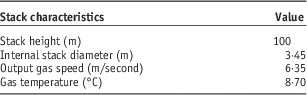
The TEDE was calculated by HOTSPOT health physics code. This code provides a first order approximation of the associated radiological effects with the atmospheric release of radioactive materials. The HOTSPOT program was created to equip emergency response personnel and planners with a fast, field portable set of software tools for evaluating. The radionuclides in the workplace program provide a guide for initial planning of experiments and workplace environments.Reference Homann 15 , Reference Yves, Cabral and Brum 16 To calculate the TEDE, the activity and radionuclide properties, stack diameter, receptor height and atmosphere conditions, such as stability class and wind speed are taken into account during calculations. Table 2 presents the main physical specifications of BNPP.
Physical specifications of Bushehr Nuclear Power Plant stack

Environmental condition
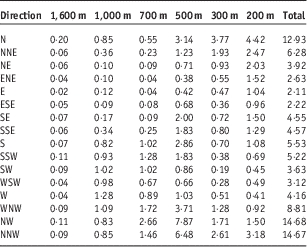
The weather condition specifications around the BNPP reactor site have been considered in HOTSPOT calculations. The site of BNPP reactor is a coastal zone so the ocean breeze causes prevailing northwesterly winds. The frequency of wind speed and direction for a 10-year period is presented in Table 3. 7 The predominant wind direction is west to east, and usually occurs during the day. 7 , Reference Shoaib Raza and Iqbal 17 The average wind speed was considered to be 14 m/second. In addition, the wind speed of 2 m/second was also considered, as the lower limit of wind speed, for comparison purposes.
Wind speed in the various directions around of Bushehr Nuclear Power Plant site

Cancer risk estimation
Different biological models are introduced for cancer risk estimation from radiation exposure. In this study, the BEIR VII report was employed to evaluate the cancer risk incidence from different levels of irradiation. The BEIR VII is a risk estimation model which has been released by the national institute of health. This cancer risk estimation model is primarily based on the data from atomic bomb survivor studies, medical radiation studies, occupational radiation studies and environmental radiation studies. 10 , Reference Yves, Cabral and Brum 16 All of the physical and biological factors such as dose rate, dose magnitude, radiation quality, sex, age, different organ sensitivity, and other characteristics of the exposed individual are taken into account in this risk estimator model. According to the BEIR VII report, the cancer risk for various organs, except leukaemia, at different ages and levels of exposure can be estimated by excess relative risk (ERR) expression (Equation 1).Reference Cember and Johnson 3 , 10 The ERR expression indicates the risk of cancer incidence due to the radiation exposure and can be obtained through the following equation:
 $${\rm ERR}\,{\equals}\,\beta _{s} D\,\exp \left( {\gamma e^{{\asterisk}} } \right)\left( {{a \over {60}}} \right)^{\eta } $$
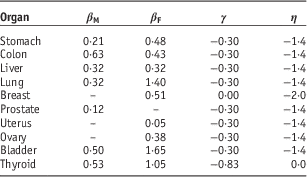
where β s Footnote 1 is the ERR per Sievert for exposure at ages greater than 30 years old to the age of 60 years old, γ the pre-decade increase in age at exposure over the range of 0–30 years old, e the age at exposure and η the exponent of attained age and a is the attained age after exposure. The values of these cancer risk constants for cancer incidence in different human organs are reported in Table 4. 10
Cancer risk constants for different human organs

The calculated TEDEs from hypothesis nuclear event were imported into the ERR expression (Equation 1) to estimate the cancer risk incidence for different organs of the male and female sex at different ages. 10
RESULTS
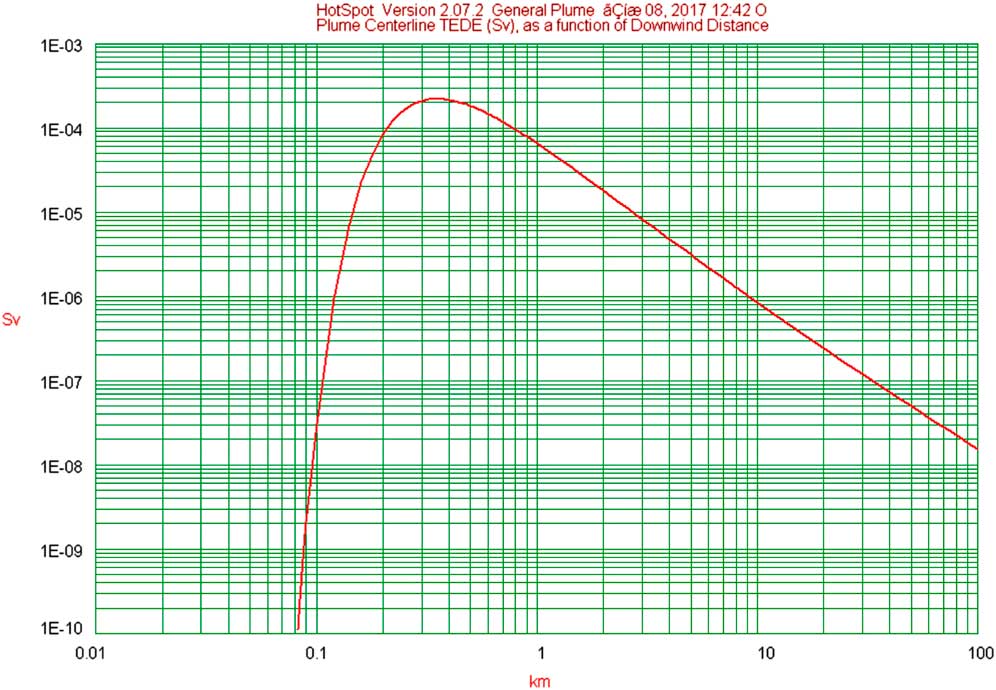
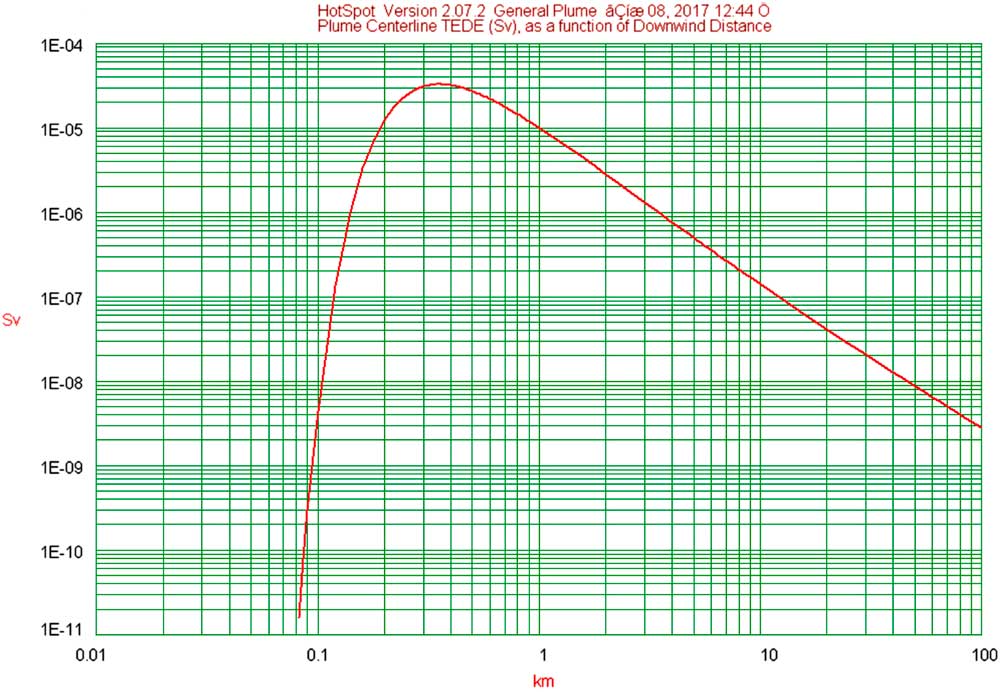
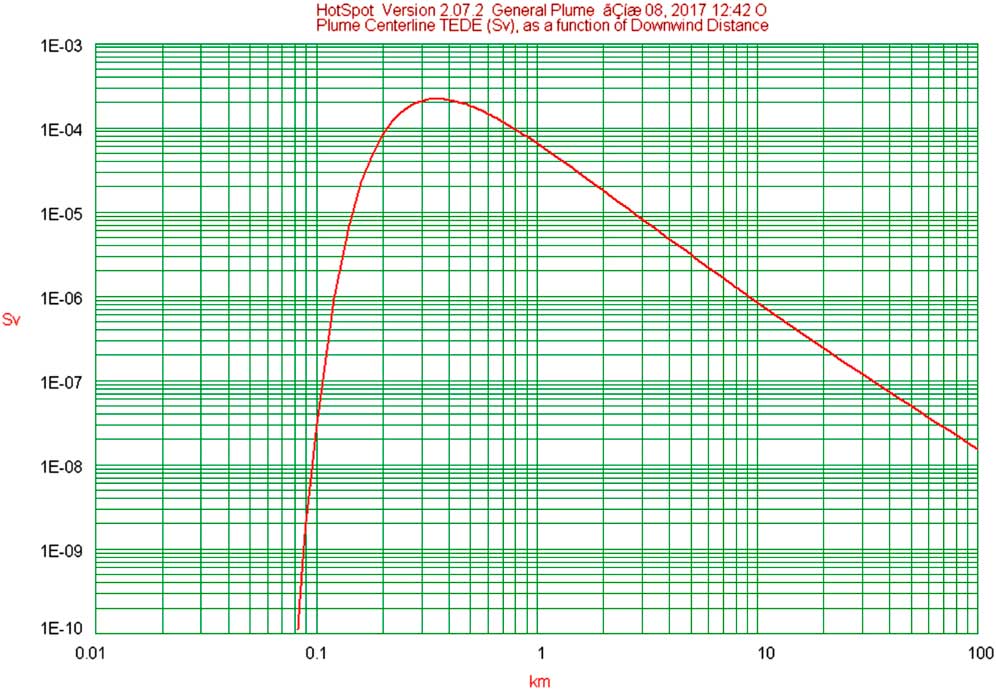
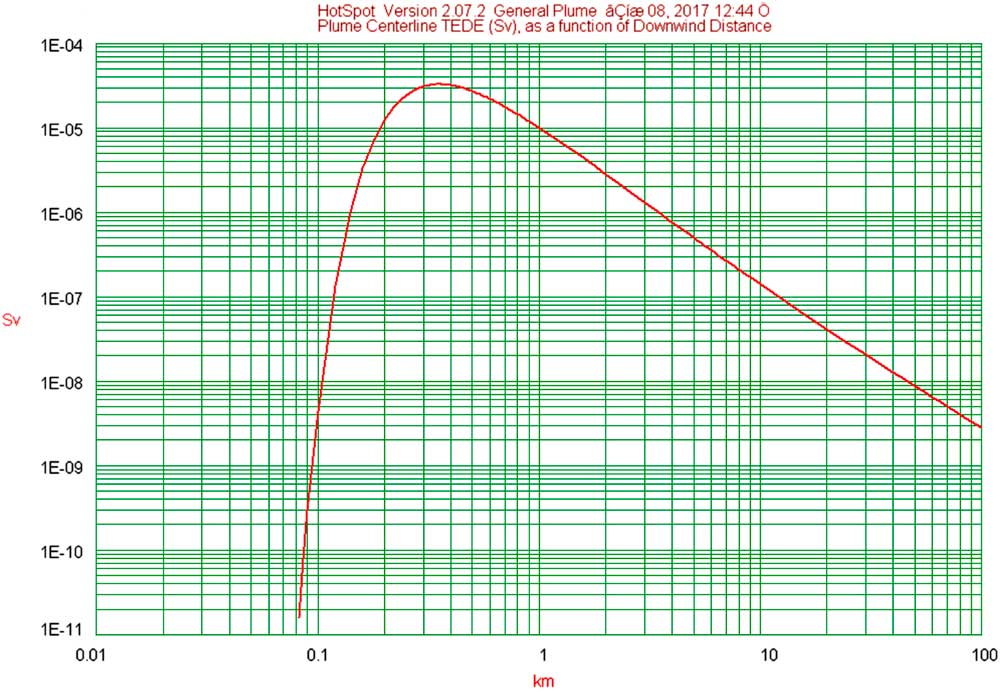
The calculated TEDE at different distances from the reactor site for very unstable atmospheric condition in the minimum and maximum wind speeds is reported in Figures 1 and 2, respectively.
Total effective dose equivalent (TEDE) as a function of distance from reactor cite for 2 m/second wind speed.
Total effective dose equivalent (TEDE) as a function of distance from reactor cite for 14 m/second wind speed.
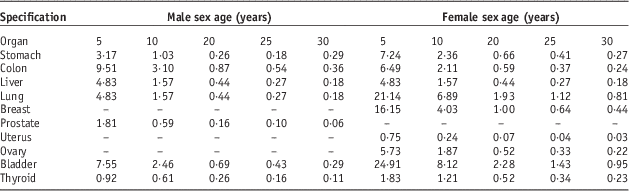
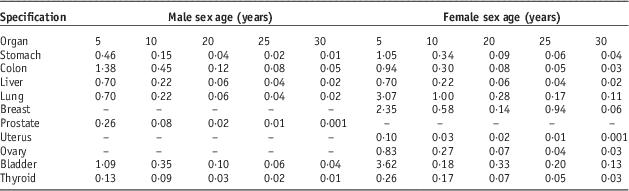
The results of cancer risk estimation for different combinations of biologic organ/age at different TEDE levels are presented in Table 5 and in Table 6 for minimum and maximum wind speeds, respectively. It should be mentioned that the reported data are corresponding to the maximum TEDE levels for each wind speed around the reactor site.
Excessive relative risk per 103 persons of male and female sex for 2 m/second wind speed at the 0·22 mSv radiation exposure

Excessive relative risk per 103 persons of male and female sex for 14 m/second wind speed at the 0·032 mSv radiation exposure

DISCUSSION
As reported in Figures 1 and 2, at the low wind speed (2 m/second), the maximum TEDE occurs at the distances nearer to the reactor site. Because of the low wind speed, dispersion of released radionuclide materials is slow and therefore, radionuclide concentration is high in close priximity to the reactor site. As a consequence, the maximum TEDE occurs in this region. In addition, with increasing distance away from the reactor site, the TEDE considerably decreases. This expected result is due to the decrement of radionuclide concentration at greater distances as well as the inverse square law.
The cancer risk incidence for different biologic organs at different ages which are estimated by BEIR VII model, are presented in Tables 5 and 6, for minimum and maximum wind speeds, respectively. As demonstrated, the probability of cancer incidence for different organs at a fix exposure level has an inverse relation with the age of exposed person. The age impact on cancer risk incidence of different organs is more considerable for lower ages (such as 5 or 10 years old). This is due to the fact that cell evolutions are not completed at lower ages and therefore, the biologic organs are more sensitive to the radiation. On the other hand, the probability of cancer incidence is a mild function of age at higher ages (25 years old and greater).
As expected, with increasing the TEDE, the cancer risk incidence also increments for all of the biologic organs. But, because of the different sensitivity of distinct organs, the cancer risk incidence is not the same for all the organs understudy. As it can be seen from Tables 5 and 6, the most probable organ for cancer incidence in male and female sex was colon and bladder, respectively. Prostate and uterus had the lowest radiation sensitivity and cancer risk incidence in male and female sex, respectively. Furthermore, comparing the reported ERRs in Tables 5 and 6 reveals that the risk of cancer incidence is higher at lower wind speeds. This fact can be attributed to the higher calculated TEDE at lower wind speed.
Comparison of the cancer incidence probability for different organs of male and female sex indicated that the female sex is more subject to the risks of radiation dose. This fact can be attributed to the different sensitivity and physiologic performance of female sex organs in comparison to the male sex ones. The worst cancer incidence probability was found to be the bladder where the cancer risk incidence for female was three times greater than corresponding value for the male one.
Conclusion
The impact of released radionuclides from a hypothetical nuclear accident at the BNPP on cancer risk incidence for different combinations of biologic organ/age of male and female sex was evaluated in this study.
The results demonstrate that younger persons are more subject to the cancer risk incidence because of both the intrinsically greater radio-sensitivity of their organs and their longer remaining life expectancy during which a cancer may develop.
The probability of cancer risk incidence decreases as the age of exposed person increases. Furthermore, the values of cancer risk incidence for different organs slightly change at the ages beyond 25 years old.
The most probable identified risk was related to the colon and bladder for the male and female sex at the entire range of ages understudy, respectively.
Finally, based on the obtained results, it seems necessary to establish a radiation health risk management program to avoid the unfavourable effects of low-dose radiation exposure on the local population. The most important issues in this regard could be including:
(1) Residents and public buildings should be located as far from the risk zone around the nuclear power plant site where the concentration of released radionuclides would be very high after the accident.
(2) There should be provision of a follow-up service for the exposed population, through clinical examinations such as ultrasound or complete blood count (CBC) test to estimate the long-term effects from low-dose radiation exposure.
(3) Promotion of a dose monitoring system around the nuclear power plant site.
(4) Preparing and implementation of a comprehensive medical radiation emergency unit for quick initial reaction to such random nuclear accidents.
(5) Public notification about the stochastic effects of low-dose radiation exposure and related issues which are of main concern.
Acknowledgement
None.
Conflicts of Interest
None.