Introduction
TBI is the most common cause of disability in young people with approximately 22,000 new cases in Australia per year (Australian Institute of Health & Welfare, 2007). The complex neuro-behavioural effects of TBI result in a range of physical, sensory, cognitive, communication, personality, behavioural and social consequences disrupting the quality of life of survivors and their families over many years (Access Economics, 2008). Across this broad range of deficits associated with TBI, the potential for post-traumatic OI is not routinely assessed in clinical settings (Drummond, Douglas, & Olver, Reference Drummond, Douglas and Olver2013; Schofield, Moore, & Gardner, Reference Schofield, Moore and Gardner2014). While exact figures are difficult to ascertain, research to date indicates that as many as 50–60% of patients with TBI admitted to rehabilitation facilities may have an OI (Callahan & Hinkebein, Reference Callahan and Hinkebein2002). Despite the potentially high incidence of OI in the context of TBI, it continues to receive less clinical and research attention than other areas of impairment (Callahan & Hinkebein, Reference Callahan and Hinkebein2002; Constanzo & Zasler, Reference Constanzo, Zasler, Getchell, Doty, Bartoshuk and Snow1991; Doty et al., Reference Doty, Yousem, Pham, Kreshak, Geckle and Lee1997; Haxel, Grant, & Mackay-Sim, Reference Haxel, Grant and Mackay-Sim2008; Mueller & Hummel, Reference Mueller and Hummel2009; Schofield et al., Reference Schofield, Moore and Gardner2014).
Across the research literature, reported incidence estimates vary widely-ranging from 30% (Constanzo & Zasler, Reference Constanzo, Zasler, Getchell, Doty, Bartoshuk and Snow1991) to as high as 87% (Doty et al., Reference Doty, Yousem, Pham, Kreshak, Geckle and Lee1997). Haxel and colleagues (Reference Haxel, Grant and Mackay-Sim2008) reported an overall prevalence of OI following TBI of 12.8% together with significant rates of unawareness of the deficit. Variability in OI incidence rates reflects several methodological considerations including the nature of olfactory assessments used, the cut-off scores applied to indicate impairment and the severity and chronicity of injury in the participant sample (Haxel et al., Reference Haxel, Grant and Mackay-Sim2008; Schofield et al., Reference Schofield, Moore and Gardner2014). To date, incidence rates have been derived exclusively from studies conducted internationally and there is no comparable data available in the Australian context. This lack of data means that it is difficult to ascertain the scope and impact of the impairment within the Australian health care context.
A relatively high incidence of OI following TBI is to be expected given the areas responsible for olfactory functioning are vulnerable and have a high propensity for damage due to the mechanics of the injury. Injuries such as facial fractures (Bert, Menco, & Morrison, Reference Bert, Menco, Morrison and Doty2003; Renzi, Carboni, Gasparini, Perugini, & Becelli, Reference Renzi, Carboni, Gasparini, Perugini and Becelli2002) resulting in direct injury to sinonasal structures (Reiter, DiNardo, & Costanzo, Reference Reiter, DiNardo and Costanzo2004), and damage to the olfactory bulbs, olfactory tracts, orbitofrontal and medial temporal cortices, the thalamus and the amygdala (Bert et al., Reference Bert, Menco, Morrison and Doty2003; Doty et al., Reference Doty, Yousem, Pham, Kreshak, Geckle and Lee1997; Eslinger, Damasio, & Van Hoesen, Reference Eslinger, Damasio and Van Hoesen1982; Levin, High, & Eisenberg, Reference Levin, High and Eisenberg1985; Varney, Pinkston, & Wu, Reference Varney, Pinkston and Wu2001; Yousem, Geckle, Bilker, McKeown, & Doty, Reference Yousem, Geckle, Bilker, McKeown and Doty1996) can all give rise to OI post TBI. The acceleration-deceleration forces associated with TBI also create shearing injuries to the olfactory nerve fibres at the level of the cribriform plate (Davidson, Murphy, & Jalowayskii, Reference Davidson, Murphy and Jalowayskii1995; Mueller & Hummel, Reference Mueller and Hummel2009). Further, Mueller and Hummel (2009 p9283) have suggested that recovery from OI post TBI may be influenced by the presence of olfactory nerve transection where ‘reconnection might be prevented by mechanical occlusion of the cribriform plate with fibrotic tissue’.
Despite lack of agreement regarding incidence rates, there is consensus across researchers that the olfactory system regenerates poorly after TBI (Bromley, Reference Bromley2000; Constanzo & Zasler, Reference Constanzo, Zasler, Getchell, Doty, Bartoshuk and Snow1991; Deems et al., Reference Deems, Doty, Settle, Moore-Gillon, Sharman, Mester and Snow1991; Doty et al., Reference Doty, Yousem, Pham, Kreshak, Geckle and Lee1997) and that the likelihood of recovery decreases with increasing time post injury (Temmel et al., Reference Temmel, Quint, Schickinger-Fischer, Klimek, Stoller and Hummel2002). In addition, the presence of OI can have a substantial effect on everyday functioning and quality of life (Blomquist, Bramerson, Stjarne, & Nordin, Reference Blomquist, Bramerson, Stjarne and Nordin2004; Callahan & Hinkebein, Reference Callahan and Hinkebein1999; Croy, Nordin, & Hummel, Reference Croy, Nordin and Hummel2014; Drummond, Douglas, & Olver, Reference Drummond, Douglas and Olver2007, Reference Drummond, Douglas and Olver2013; Hummel & Nordin, Reference Hummel and Nordin2005; Santos, Rieter, DiNardo, & Constanzo, Reference Santos, Reiter, DiNardo and Costanzo2004; Temmel et al., Reference Temmel, Quint, Schickinger-Fischer, Klimek, Stoller and Hummel2002).
In our qualitative study (Drummond et al., Reference Drummond, Douglas and Olver2013) the wide-ranging consequences of OI post TBI were identified and described with specific focus on the implications this impairment can have on an individual's activity and participation levels. The limitations identified by participants covered multiple categories including Eating and Enjoyment of Food, Food Preparation, Personal Safety, Personal Hygiene, Work, Leisure and Relationships. Similar areas of daily life function were also identified in the recent general review of olfactory disorders conducted by Croy et al. (Reference Croy, Nordin and Hummel2014). Despite having the potential to impact numerous everyday activities, response to the presence of OI is not uniform across individuals. For some individuals the presence of an OI may have very little bearing on their life, even for those individuals who may have a severe OI. However for others, particularly those who have occupations reliant on the sense of smell (for example, fire fighters, chefs, wine makers) even a mild OI may have devastating and life changing consequences.
The combination of potential for high incidence after TBI, enduring nature and substantial implications for everyday life makes this impairment one that warrants systematic research efforts and greater focus during the rehabilitation process. In this article, we describe the results of the first phase of a longitudinal study designed to measure the incidence and ongoing consequences of OI following TBI. This phase of the study had three aims: (1) to identify the incidence of OI post TBI in a consecutive sample of adults admitted to the Brain Injury Rehabilitation Program at Epworth Hospital, Australia over a period of 30 months; (2) to explore the sensitivity and specificity of the screening assessment, the PST, compared to the comprehensive assessment, the UPSIT in adults with TBI; and (3) to investigate whether age and injury-related variables (duration of PTA and presence of facial fractures) make a significant contribution to the prediction of the severity of OI. Based on results in the literature, we hypothesised that the frequency of post-traumatic OI in a rehabilitation setting would fall within the range of 50–70% and that age, severity of injury and presence of facial fractures would make a significant contribution to the prediction of severity of OI.
Method
Participants
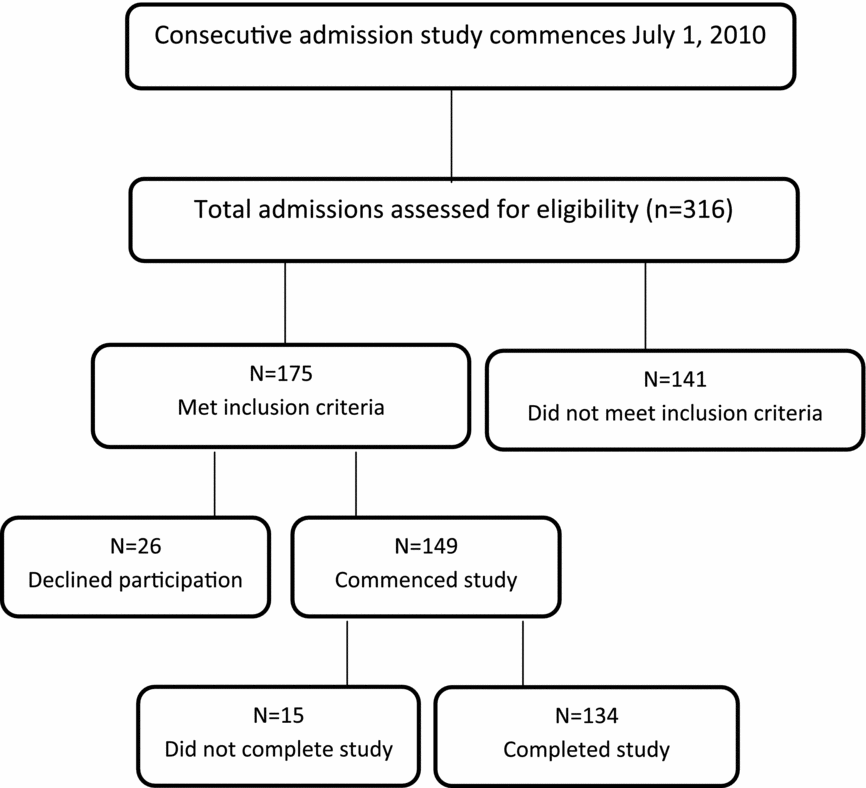
Individuals consecutively admitted to the Brain Injury Rehabilitation Program at Epworth Rehabilitation in Melbourne between 1 July 2010 and 21 December 2012 were invited to participate in the study. Eligibility criteria required that participants were over 18 years of age, had sustained a TBI, were deemed out of PTA as assessed using the Westmead PTA scale (Marosszeky, Ryan, Shores, Batchelor, & Marosszeky, Reference Marosszeky, Ryan, Shores, Batchelor and Marosszeky1997), had the ability to cooperate with the methodology, and had sufficient communication and cognitive capacity to consent to and complete the methodology. As shown in Figure 1, 175 admissions (55.4%) were eligible for participation and 76.6% of these were recruited to and completed the study.
Recruitment of participants.

Measures
The following assessments were conducted on each participant:
Self-report
Prior to olfactory assessment participants were asked to respond with a yes/no to the question ‘since your accident have you noticed any changes to your sense of smell?’. Those participants who responded ‘yes’ were then asked to rate their perception of the severity of their OI using the descriptors of mild, moderate, severe or no smell. The self-report component of the procedure was added to the protocol after data collection had commenced and was included to examine the participant's awareness of the presence of an OI.
University of Pennsylvania smell identification test (UPSIT) (Doty, Shaman, & Dann, Reference Doty, Shaman and Dann1984)
The UPSIT is a time and cost effective method of assessing olfactory function which is supported by well-documented normative data (Doty et al., Reference Doty, Shaman and Dann1984). Using a microencapsulation technique (commonly known as scratch ‘n’ sniff) each participant is presented with 40 odorants. These odorants were specifically chosen by the developers of the UPSIT as they were true to their intended odour, they represented a range of qualitative odour-classes and there was a combination of odours that contained both single and multiple components (Doty et al., Reference Doty, Shaman and Dann1984). When presented with the odorants each participant indicated the answer by choosing one of the four multiple-choice options. The presence of impairment and its associated severity is determined by the number of incorrect responses. The normative percentile data (n = 3928) which provides the classification of severity of OI is adjusted for the participant's age and gender. From the age of 15 to 85+ years of age a score of 34 for males; 35 for females, or less results in the classification of an OI ranging through mild, moderate, severe, anosmic and possible malingering as the number of correct answers by the participant diminishes. Callahan and Hinkebein (Reference Callahan and Hinkebein2002) note the UPSIT demonstrates high test-retest reliability (r = 0.918) and discriminant validity across known diagnostic groups and malingerers.
Pocket smell test (PST) (Sensonics, 1995)
The PST is a three odorant forced-choice brief screening assessment. It was constructed using the same microencapsulation technique and utilises the same administration procedure as the UPSIT. One error is considered indicative of the potential presence of OI. All participants are assessed using the same three odorants (peanut, mint and paint thinner). The PST was administered prior to the UPSIT and all participants were blinded to their results.
Procedure
Institutional ethics approval was obtained prior to the commencement of data collection. Most of the participants were assessed in the quiet environment of the Speech Pathology office. Those willing to participate but unable to attend the speech department due to orthopaedic injuries, were seen in their hospital room. The door was closed and the assessment conducted when they were the sole occupant to minimise any distractions.
In addition to the first author, two qualified Speech Pathologists who both had more than six years’ experience working with individuals following TBI across the recovery continuum from acute care to community based rehabilitation, facilitated the data collection. All assessment sessions were conducted in the same format and order and all clinicians were trained in the administration of the olfactory assessments. The olfactory assessments were stored within a dark, cool cupboard as recommended in the manufacturing guidelines.
Following resolution of PTA (and agreement to participate within the study) each participant was assessed. The time lag between date of injury and presentation of the olfactory assessments differed across participants. This variation was a direct result of severity of injury, that is, duration of PTA. The median time difference between date of injury and assessment was 44.6 days (range 4–127 days).
Data Analysis
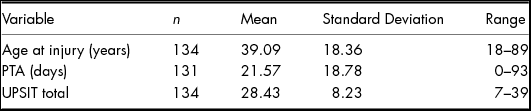
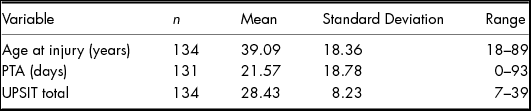
Descriptive statistics (mean, standard deviation and range) were calculated for age, duration of PTA and total score on the UPSIT. Cross tabulation of participants’ performance on the PST compared to the UPSIT was used to compute sensitivity, specificity and overall accuracy of the PST. Total score on the UPSIT was used for all statistical analyses. One way analysis of variance (ANOVA) was used to compare groups with and without OI on the variables of age, injury severity and presence of facial fractures. Standard multiple regression analysis was conducted using age, injury severity and facial fractures as predictors of performance on the UPSIT (score out of 40). Preliminary analyses were conducted to ensure there were no violations of the normality, linearity, multicollinearity and homoscedasticity assumptions for regression.
Results
A total of 316 individuals were screened for eligibility. Of these 175 (55.38%) were eligible to participate and 134 (76.57%) participants (101 males, 33 females) were recruited to and completed the study. Table 1 provides descriptive statistics for age, severity of injury (duration of PTA) and UPSIT total score. The most common cause of injury was moving vehicle related accidents (MVA n = 110, 82%) with motor vehicle crashes (n = 77) being the highest contributor. Motorcycle crashes (n = 13), pedestrians hit by a moving vehicle (n = 14), cycling accidents (n = 5) and train accidents (n = 1) also contributed to the overall MVA total. Other origins of injury included falls (n = 19, 14%), assaults (n = 3, 2%), horse riding accidents (n = 1, 1%) and military related injuries (n = 1, 1%). All participants were admitted to the Brain Injury program during their inpatient stay. The minimum inpatient stay was 15 days with the longest being 243 days (median = 66.8 days).
Descriptive Statistics for Age, Injury Severity (PTA Days) and UPSIT Total Score (n = 134)
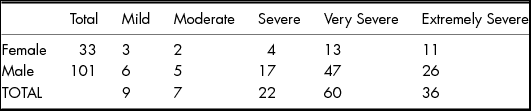
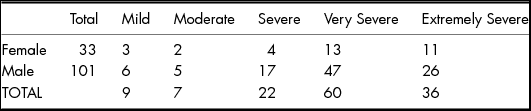
Duration of PTA across the sample ranged from less than one day (n = 13) to 93 days (n = 1). The PTA duration of four participants was not recorded at the acute hospital but was retrospectively determined by an experienced neuropsychologist using assessment data. PTA duration for a further three participants was unknown. Injury severity was categorised using PTA duration and the cut-offs specified by Jennett and Teasdale (Reference Jennett and Teasdale1981): very mild <5 minutes, mild 5–60 minutes, moderate 1–24 hours, severe 1–7 days, very severe 1–4 weeks, extremely severe >4 weeks. The distribution of participants across severity of injury and gender is shown in Table 2.
Distribution of Sex and Injury Severity (n = 134)
The participants had diverse backgrounds covering 17 different countries of birth with only the continent of South America not represented. Educational background also showed the diversity of the group with the most frequently occurring level of education being completion of high-school (59 participants, 44.0%). Forty participants (29.8%) had either completed or were currently enrolled in a University degree at the time of injury. The lowest level of education reported was Grade six at primary school.
Vocationally, 90 participants (67.2%) were working in a paid role at the time of the injury with an additional six participants identifying themselves as ‘homemakers’. Fourteen were students, twelve were retired and the remaining thirteen reported themselves to be unemployed. Using the Australian and New Zealand Standard Classification of Occupations (Trewin & Pink, Reference Trewin and Pink2006) the most frequently represented working group was that of ‘Technician and Trade Workers’ with 22 participants holding a position of employment within this category. The next occupational classifications with high representation were ‘Professionals’ (n = 19), ‘Machinery Operators and Drivers’ (n = 11), ‘Managers’ (n = 10) and ‘Community and Personal Service Workers’ (n = 10). Eighty-two (61.2%) of the 134 participants were in a relationship at the time injury, 39 were single and relationship status was unknown for 13. Sixty-two (46.3%) participants had a parenting role at the time of their injury.
Incidence of Olfactory Impairment
PST
When assessed using the PST, 73 (54.48%) of the participants were unable to correctly identify the three odorants even when presented with the multiple-choice options. Forty-six (34.33%) participants identified two correctly, 16 (11.94%) identified one and 11 (8.21%) participants were unable to identify any of the odorants correctly.
UPSIT
Eighty-nine of the 134 (66.42%) participants demonstrated an OI on the UPSIT. Of these, 30 presented with a mild impairment, 27 a moderate impairment, 9 a severe impairment and 23 participants presented as anosmic (classified as having no sense of smell).
The average time taken to complete the UPSIT was 24 minutes with a range of 15–60 minutes. Nine participants required additional sessions to complete the UPSIT, with eight requiring two sessions and one participant requiring three sessions for completion. Additional sessions were completed on consecutive days. The additional time for these nine participants related to their reported levels of pain or needing to cease the session early to attend medical appointments.
Sensitivity, specificity and overall accuracy of the PST compared to the UPSIT
The utility of the PST as a screening assessment was investigated as part of this study. Each of the participant's performance on the PST and the UPSIT was analysed in a cross tabulation matrix and the sensitivity, specificity and overall accuracy of the PST computed against the results of the UPSIT. Sensitivity in this case refers to the ability of the PST to correctly identify those patients with OI as determined by performance on the UPSIT. Specificity on the other hand refers to the ability of the PST to correctly identify those patients without OI as determined by performance on the UPSIT. Finally, accuracy is the proportion of true results, either true positive or true negative, yielded by the PST in comparison to the UPSIT. The PST was found to have 62.92% sensitivity, 62.22% specificity and 62.69% accuracy, all of which are considerably lower than the recommended threshold value of 80% for acceptable levels. Of particular interest were those participants (false negatives) who achieved three out of three ‘no impairment’ on the PST but when assessed using the UPSIT were categorised as having some degree of OI. Of these 33 participants, 16 scored within the mild OI category, 13 within the moderate category and 2 each were classified as having a severe OI and no sense of smell (anosmia). In contrast there were 17 participants who were assessed as having impaired olfaction on the PST (false positives) but who fell within the ‘normal’ performance range for their age and gender on the UPSIT. Of these 17 participants, two scored one out of three and the remaining 15 scored two out of three.
Comparison of participants with and without OI
Participants with an OI were compared against those without OI on age, injury severity (PTA duration) and presence of facial fractures. The mean age of those with OI (Mean 41.45 years, SD 19.73 years) was significantly higher than that of those with normal olfactory function (Mean 34.42 years, SD 14.41 years) (F (1132) = 4.49; p = .036). While the mean PTA duration of those with OI was longer (Mean 23.29 days, SD 20.91 days) than those within the normal range on the UPSIT (Mean 18.16 days, SD 13.17 days), this difference did not reach significance (F (1129) = 2.20; p = .14).
Fifty-one of the 134 (38.06%) participants had documented facial fractures. Of these 51 participants with facial fractures, 36 (70.59%) had an OI (mild n = 13; moderate n = 12; severe n = 2; anosmic n = 9). Of the 83 (61.94%) participants who did not have facial fractures, 53 (63.86%) were assessed as having an OI (mild n = 17; moderate n = 15; severe n = 7; anosmic n = 14). The mean score on the UPSIT did not differ significantly for those with facial fractures (Mean 28.18, SD 8.16) and those without (Mean 28.58, SD 8.32) (F (1132) = 0.08; p = .79).
Self-report of impairment
In addition to the standardised assessments, descriptive self-reports of impairment were also obtained. Unfortunately, this component of the assessment was added after recruitment had commenced. Consequently, the information was available from 85 of the participants who were asked whether they thought they had an OI and if so, how severe they would rate their impairment using the scale of mild, moderate, severe or no sense of smell. In total 26 participants self-reported the presence of OI and 59 participants did not. On testing, 33 (56%) of the 59 participants who did not self-report a problem were shown to have OI (6 anosmic, 3 severe, 13 moderate and 11 mild). Of the 26 participants who reported a difficulty, 20 (77%) were impaired and 6 (23%) were unimpaired on the UPSIT. Of the 20 participants who correctly self-reported presence of OI, two performed better on the UPSIT than indicated by their self-rating, 12 performed more poorly, four correctly identified their level of impairment and two did not specify their perceived level of OI.
Predicting Olfactory Function
Standard multiple regression was used to assess the ability of three variables (age, PTA duration, presence of facial fractures) to predict performance on the UPSIT. Cases with missing data were excluded from this analysis leaving a total sample of 131 participants. Preliminary analyses showed that the assumptions of normality, linearity, multicollinearity and homoscedasticity had not been violated. The three variables were entered simultaneously and R for regression of the model was significantly different from zero, (R = 0.321, F (3, 127) = 4.86, p = .003). The total variance explained by the model as a whole was 10.3% (8.2% adjusted). Injury severity (PTA duration) (p = .003) and age (p = .02) had regression coefficients that differed significantly from zero with duration of PTA recording a higher beta value (beta = −0.25) than age (beta = −0.20). Injury severity uniquely accounted for 6.35% of the variance and age 3.92% of the variance in UPSIT performance.
Discussion
This study has provided further evidence that the incidence of OI is high in adults with TBI admitted to rehabilitation with 89 (64.42%) of the 134 participants being assessed as having some form of OI and 31 of these having a severe OI or being rendered anosmic. The number of participants assessed as having an OI differed between the PST, a screening assessment, and the UPSIT, a comprehensive assessment. From a clinical perspective the opportunity to utilise a screening assessment to identify individuals who require further assessment would prove to be a time and cost effective methodology, provided the screening assessment was highly sensitive with high accuracy. The current results showed the PST fell considerably below acceptable threshold levels for screening yielding poor sensitivity (62.92%), poor specificity (62.22%) and poor overall accuracy (62.69%) levels when compared to the UPSIT. In the case of our sample, if the PST screening technique was solely applied 61 participants would not have undergone further olfactory testing, However, due to the methodology used in this study, all completed the UPSIT and 33 of these 61 participants (24.63% of the total sample) were found to be false negatives and subsequently diagnosed as having an OI. This finding is consistent with that of Callahan and Hinkebein (Reference Callahan and Hinkebein2002) in their mixed severity TBI study which showed that 20% of their sample performed without error on the PST but were assessed to have an OI on further testing with the UPSIT. From a clinical perspective these findings support the caution which needs to be taken when using the PST screening assessment. Further, the reduced accuracy of screening combined with a lack of deficit awareness in a high proportion of those with OI emphasises the need for clinicians to comprehensively assess olfactory function in this population.
Consistent with the literature reporting a decline in olfactory acuity as age increases within the normal population (Doty et al., Reference Doty, Shaman and Dann1984; Kamath & Doty, Reference Kamath and Doty2014), we found that age made a significant contribution to performance on the UPSIT following TBI. We also found that severity of injury made a significant contribution and together age and injury severity accounted for 10.3% of the variability in scores on the UPSIT. These findings highlight the likelihood of increased risk of OI in older adults who sustain severe TBI. Despite our sample showing that the presence and severity of OI increased with increasing severity of the brain injury, the impact of OI on the 10% of our sample who had sustained a mild TBI must not be dismissed. The question of whether the presence of facial fractures resulted in someone being more likely to have an OI was also examined. Our results suggest that while the proportion of participants with OI was approximately 10% higher in the group with facial fractures, the presence of facial fractures did not make a significant contribution to prediction of performance on the UPSIT.
Knowing that OI can lead to widespread consequences for an individual and their significant others across many domains in life (Blomquist et al., Reference Blomquist, Bramerson, Stjarne and Nordin2004; Croy et al., Reference Croy, Nordin and Hummel2014; Drummond et al., Reference Drummond, Douglas and Olver2013), clinicians need to ensure that they do not over or under emphasise the consequence(s) of OI. It is important to remember that individuals will respond differently to the presence of the impairment which may not seem in proportion to the level of their OI or their brain injury. Factors such as their vocation, their roles and responsibilities in life and their interests will influence how significant the OI is for them.
As was the case in this study, previous studies have shown that self-report is an unreliable means of identifying the presence and severity of OI. This lack of awareness of deficit was also noted during the interview process when the participants were questioned about the changes to their sense of smell and any perceived or experienced implications. Commentary from the participants highlighted that the presence of a mild OI can have consequences just as devastating as a severe OI depending upon the individual's social, vocational and personal roles. Therefore, it is important that team members within the multidisciplinary team have a thorough understanding of the potential implications of OI, regardless of its severity. Assessment of post injury olfactory function and detailed discussions of the implications need to be explored with emphasis placed on areas of high risk such as safety, occupation and food consumption. Food related experiences provide a good example of how OI can have a substantial impact on psychosocial wellbeing. Food related experiences include cooking and dining out for pleasure which not only relate to food consumption but also provide individuals with an important source of social interaction. Such activities may become untenable due to the individual's sudden lack of enjoyment in food as a result of OI and associated taste changes. Consequently lack of ‘food pleasure’ may result in a lack of willingness to engage in these pre-morbid social activities. A lack of continued involvement may contribute to a diminished level of continuing social contact with friends and family which in turn can have significant impact on social and psychological wellbeing. As OI is an ‘invisible disability’ the reaction from others is often disbelief and a lack of understanding. It is important that the results of studies such as this one are shared amongst clinicians, individuals with TBI and their families to ensure that proactive assessment, increased awareness of consequences and engagement in discussions surrounding strategies to minimise the consequences of OI are provided. The combination of the high number of people experiencing OI post TBI alongside the known consequences for these people and their families serves to emphasise the importance of further exploration of the longitudinal changes that may occur over time.
Study Limitations
As with all studies, the generalisability of these findings needs to be considered in the context of the limitations of recruitment. These results were obtained through a single centre study carried out in a specialist brain injury unit in one state (Victoria) of Australia. Whilst a consecutive admission methodology was utilised, injury characteristics revealed that the final sample was skewed towards those with more severe brain injuries. Despite this high representation of participants with severe and extremely severe brain injuries, the incidence rate 66.42% in our sample was consistent with comparable reports within the international literature.
Conclusion
OI affects a significant number of people following TBI and is more likely to be present in older individuals who sustain more severe brain injuries. The combination of the high number of people experiencing OI post TBI alongside the known consequences for these people and their families underpins the need for further research in this area. Clinicians who provide services to people with TBI need to lobby their organisations and funding bodies for appropriate resources to ensure these individuals and their families receive the specialised and appropriate level of intervention they need.
Acknowledgements
The authors thank the participants for their generous contribution to this research. The authors also thank Epworth Health Care Speech Pathologists Chloe Douglas and Hayley Dell’Oro for their invaluable assistance with recruitment and data collection.
Financial Support
Financial assistance was received from the Victorian Brain Injury Recovery Association; Epworth Health Care Scholarship Program; Epworth Monash Rehabilitation Medicine Unit; and the Latrobe University Post Graduate Support Grant and Health Sciences Post Graduate Program.
Conflict of Interest
None.
Ethical Standards
The authors assert that all procedures contributing to this work comply with the ethical standards of the relevant national and institutional committees on human experimentation and with the Helsinki Declaration of 1975, as revised in 2008.