Great apes are considered to be important seed dispersers in palaeotropical habitats due to their large body size (this would be reflected in the amount of foods consumed) and large home ranges (Poulsen et al. Reference POULSEN, CLARK and SMITH2001, Wrangham et al. Reference WRANGHAM, CHAPMAN and CHAPMAN1994). Furthermore, the great apes might process seeds in a way that maintains their viability (Lambert Reference LAMBERT1999). Previous studies of seed dispersal by great apes have generally taken the form of lists of seeds found in their faeces (Voysey et al. Reference VOYSEY, MCDONALD, ROGERS, TUTIN and PARNELL1999a, Wrangham et al. Reference WRANGHAM, CHAPMAN and CHAPMAN1994), effects of passage through their guts on seed germination (Idani Reference IDANI1986, Wrangham et al. Reference WRANGHAM, CHAPMAN and CHAPMAN1994), and effects of dispersal location on germination/seedling survival (Gross-Camp & Kaplin Reference GROSS-CAMP and KAPLIN2005, Rogers et al. Reference ROGERS, VOYSEY, MCDONALD, PARNELL and TUTIN1998, Voysey et al. Reference VOYSEY, MCDONALD, ROGERS, TUTIN and PARNELL1999b). In contrast with the richness of reports about aspects of seeds after their dispersal, few studies have investigated the dispersal pattern of seeds. In this study, we report on the estimated distances of seed dispersal by the wild bonobo (Pan paniscus Schwartz), a species of great ape.
We observed a unit group of bonobos called E1 at Wamba (0° 11′8″N, 22° 37′58″E), in the northern section of the Luo Scientific Reserve, Democratic Republic of Congo, from the end of November 2008 to the beginning of January 2009. The study site comprised primary forest, old secondary forest, young secondary forest, swamp forest and agricultural fields (Furuichi et al. Reference FURUICHI, MULAVWA, YANGOZENE, YAMBA-YAMBA, MOTEMA-SALO, IDANI, IHOBE, HASHIMOTO, TASHIRO, MWANZA, Furuichi and Thomson2008, Hashimoto et al. Reference HASHIMOTO, TASHIRO, KIMURA, ENOMOTO, INGMANSON, IDANI and FURUICHI1998). Annual rainfall was about 2900 mm (Furuichi et al. Reference FURUICHI, MULAVWA, YANGOZENE, YAMBA-YAMBA, MOTEMA-SALO, IDANI, IHOBE, HASHIMOTO, TASHIRO, MWANZA, Furuichi and Thomson2008). During the study, the E1 group was composed of 9 adult (≥15 y old) males, 7 adult females, 1 adolescent (≤8 – <15 y) male, 2 adolescent females, 6 juveniles (≤2 – <8 y), and 2 infants (≤0 – <2 y), for a total of 27 animals. The E1 group has been habituated to humans since 1973 (Kano & Mulavwa Reference KANO, MULAVWA and Sussman1984); thus we could observe them at close distance (c. 10 m). We tried to locate parties of the E1 group from dawn to dusk, on 6 d of each week. During observation, we recorded the location of the group every 10 min using GPS equipment (Garmin GPS map 60CSx, Kansas, USA). We also recorded the activity of visible bonobos by scan sampling every 10 min. Activity was categorized as feeding, moving, resting, grooming and other (including copulating, genital to genital (G–G) rubbing and alerting). When bonobos were feeding, we recorded the food type (categorized as fruits, leaves, terrestrial herbaceous vegetation (THV) and animal matter), species name and its location. When we observed the bonobos defecating, we searched for and collected the faeces if possible. Using a 1-mm mesh sieve, we sieved the faeces in river water, and then dried the contents in the sun for several days. We measured the length, width and height of each seed (n = 5) with a vernier caliper to the nearest 0.05 mm. Seeds were classified as small (<5 mm) or large (≥5 mm) based on their longest dimension (Gross-Camp & Kaplin Reference GROSS-CAMP and KAPLIN2005). We directly counted the number of the large seeds, while the numbers of the small seeds were roughly estimated as either >1000 or >100.
We observed the E1 group over 29 d for a total of 254 h. The bonobos were mostly observed in the primary forest and to a lesser extent in the swamp forest. Members of the E1 group showed symptoms of respiratory infection (e.g. coughs and snivels) for about half of December (especially 8–22 December). Movement patterns and activity budgets of the group during this time differed from those observed during other periods (Sakamaki et al. Reference SAKAMAKI, MULAVWA and FURUICHI2009). Thus we excluded the data collected during this ‛disease’ period (13 d or 122 h) from the following analyses.
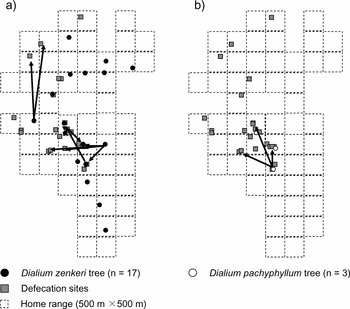
The mean ±SD h spent in observation, distance moved, and speed of movement of the E1 group was 8.3 ± 3.0 h d−1, 2.7 ± 1.8 km d−1, and 342 ± 202 m h−1 (n = 16), respectively. The estimated range of the group during the study period was 13.5 km2 (unit grid size: 500 m × 500 m) (Figure 1). The bonobos of the E1 group spent more time feeding (46.3% ± 8.7%) than on other activities (moving: 27.2% ± 9.9%; resting: 19.5% ± 10.4%; grooming: 5.8% ± 7.1%; other: 1.2% ± 1.5% (n = 10)). They spent 64.9% of their feeding time on fruits, 15.6% on leaves, 18.3% on THV and 0.5% on animal matter. Among the fruits, the group members fed mainly on two species of Dialium: D. zenkeri Harms (35.3% of fruit feeding time) and D. pachyphyllum Harms (28.1% of fruit feeding time). The bonobos did not spit out these seeds. They also fed on Musanga cecropioides R.Br. & Tedlie fruits (18.2% of fruit feeding time), whose seeds they often spat out as wadges. They remained at a given Dialium sp. tree for long periods (mean ± SD: 0.73 ± 0.73 h at a single D. zenkeri tree (n = 22) and 1.3 ± 1.0 h at a single D. pachyphyllum tree (n = 3)). They visited a small number of Dialium trees per day (1.9 ± 0.7 D. zenkeri trees (n = 11) and 1.0 ± 0.0 D. pachyphyllum trees (n = 3)). The number of Dialium trees utilized by the E1 group during the study period was small, at 17 D. zenkeri and 3 D. pachyphyllum trees (Figure 1).
Range of the E1 group during the study period (from the end of November 2008 to the beginning of January 2009, excluding the ‘disease period’) and the estimated dispersal distances of Dialium zenkeri (a) and Dialium pachyphyllum (b). Arrows show directions of dispersal. If we obtained several distances, we showed only the longest one. Note that number of arrows is smaller than that of faecal samples because several faecal samples were defecated at the same place. Grid size is 500 m × 500 m.

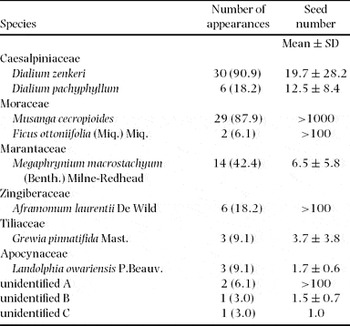
During the observation period we collected 33 faecal samples in total. Almost all faeces (91%) contained D. zenkeri seeds and 88% contained seeds of Musanga cecropioides, while a relatively small percentage (18%) of faeces contained D. pachyphyllum seeds (Table 1). The greatest mean numbers of seeds in a single faecal sample were those of Musanga cecropioides (>1000), Aframomum laurentii De Wild, and Ficus ottoniifolia (Miq.) Miq. (>100). The mean number of seeds per sample of D. zenkeri and D. pachyphyllum were 20 and 12, respectively (Table 1).
Plant species, seed appearance, and number of seeds within the faeces (n = 33) of the bonobos. Values in parentheses are percentage of appearance.

In general, it is difficult to evaluate the dispersal distance of seeds carried by free-moving wild animals, and therefore many researchers estimate dispersal distance by combining the passage time of seeds observed in captive animals and radio-tracked ranging patterns of wild individuals (Hickey et al. Reference HICKEY, FLYNN, BUSKIRK, GEROW and WILLSON1999). However, if we can conduct continuous observation from feeding to defecation, and if gut passage time is known, then dispersal distance can be estimated by recording the locations of feeding and defecation sites, with the straight distance between the two locations being the dispersal distance. We could apply the independent bout method (Julliot Reference JULLIOT1996) to the seeds of the two species of Dialium because (1) the bonobos utilized a limited number of Dialium trees as noted above, (2) we could follow the bonobos for almost the entire day and record most feeding trees, and (3) the gut passage time of the seeds has been reported for chimpanzees, a sibling species of bonobo (Idani Reference IDANI1986, Lambert Reference LAMBERT1998). Their body weights are similar to each other (chimpanzees: 31.1–41.6 kg, Lambert & Garber Reference LAMBERT and GARBER1998; bonobos: 33.2–45 kg, Stumpf Reference STUMPF, Campbell, Fuentes, MacKinnon, Panger and Bearder2007), and this would suggest that there is little difference in the gut passage time (Lambert Reference LAMBERT1998), and therefore it seemed reasonable to substitute the passage time of the chimpanzees for that of bonobos. According to Lambert (Reference LAMBERT1998), transit time (minimum retention time), mean retention time, and time of last appearance of markers for captive chimpanzees were 23.2 h, 31.5 h and 63.3 h, respectively. Terakawa et al. (Reference TERAKAWA, ISAGI, MATSUI and YUMOTO2009) recently reported that most of the faecal samples from the Yakushima macaques (Macaca fuscata yakui) contained seeds of diverse maternal origins from several locations. According to this, if there were several candidates for given seeds, all of which were assumed to be the mother tree.
The mean (± SD) dispersal distances of D. zenkeri and D. pachyllum were 783 ± 494 m (range: 145–1886 m) (Figure 1a) and 777 ± 312 m (range: 434–1031 m) (Figure 1b). There was no difference in the dispersal distance of seeds between the two Dialium species (Mann–Whitney U test, n1 = 17, n2 = 5, U = 36, P > 0.05). Since there was no significant correlation between the dispersal distance of D. zenkeri and the gut retention time (Spearman's rank correlation: r s = 0.142, P = 0.471), the actual retention time is not that critical to the dispersal distances of this species. On the other hand, there was a significant positive correlation between the dispersal distance of D. pachyphyllum and the gut retention time (r s = 0.692, P = 0.038), and therefore most seeds passing through the gut relatively quickly might be dispersed for shorter distances.
Bonobos dispersed seeds over longer distances than do other small-sized primate species inhabiting tropical forests (e.g. woolly monkey Lagothrix lagotricha, 130–450 m, Yumoto et al. (Reference YUMOTO, KIMURA and NISHIMURA1999); red howler monkey Alouatta seniculus, 220–440 m, Julliot (Reference JULLIOT1996), Yumoto et al. (Reference YUMOTO, KIMURA and NISHIMURA1999); gibbon Hylobates muelleri × agilis, 340–430 m, McConkey & Chivers (Reference MCCONKEY and CHIVERS2007); it is noteworthy that all of these estimates were made by the independent bout method). Therefore bonobos might disperse seeds across a wider range of vegetation types (though the dispersal estimates of D. pachyphyllum might be biased by the retention time). Recently, however, it has been determined that seeds removed from the parent tree do not necessarily have a greater chance of survival, depending on the plant species and/or specific incident (Augspurger Reference AUGSPURGER1984, Chapman & Chapman Reference CHAPMAN and CHAPMAN1996). Thus, to draw conclusions about the adaptive significance of dispersal distances of seeds, the relationship between seed dispersal distribution and performance (e.g. germination and growth of seedlings) must be field tested. Furthermore, the present study was conducted during a brief period involving a limited number of tree species. Perhaps the ranging pattern of the bonobos and thus seed dispersal are a reflection of the food resources (Hashimoto et al. Reference HASHIMOTO, TASHIRO, KIMURA, ENOMOTO, INGMANSON, IDANI and FURUICHI1998) and the dispersal distance may change during other times of the year (Gross-Camp & Kaplin Reference GROSS-CAMP and KAPLIN2005, Lambert & Garber Reference LAMBERT and GARBER1998). In the future, temporal changes in the dispersal should be studied.
The present study provides the first estimate of the dispersal distance of seeds by great apes, an important aspect of endozoochorous seed dispersal. The independent bout method that we employed could easily provide essential information contributing to estimations of seed dispersal patterns caused by subject animals. Since there are many study sites at which researchers can observe habituated animals, this method should be applied in other areas to study seed dispersal by the great apes.
ACKNOWLEDGEMENTS
We would like to Dr T. Furuichi for his invitation to study at Wamba, the members of the Department of Ecology and the Social Behavior of Primate Research Institute, Kyoto University, and two anonymous reviewers for their constructive comments. We also would like to thank Dr N. Mwanza, Mr M. Mulavwa, and other staff at the Research Center for Ecology and Forestry in D. R. Congo and the field assistants for their cooperation during the fieldwork. This study was financially supported by the Japan Society for the Promotion of Science Grants-in-aid for Scientific Research (No. 17255005 to Dr T. Furuichi).