Introduction
Recent UK policy initiatives have highlighted quality of life (Department of Health and the Medical Research Council, 2009; Department of Health, 2009) and communication (Commission for Social Care Inspection (CSCI), 2008) as target areas for improvement in dementia care, with similar initiatives emerging internationally (Alonso et al., Reference Alonso, Krishnamoorthy, Gomez, Krishnamoorthy, Prince and Cummings2010; Beer et al., Reference Beer2010). In both the home environment and in institutional care, communication with people living with dementia (PLWD) is often less than optimal, with evidence-based carer communication training a rarity (CSCI, 2008). The care provided by medical professionals in hospitals and the community has also come under scrutiny. Within hospitals there is a perception from Consultant Old Age Psychiatrists that non-specialist staff are poorly informed in their knowledge of dementia and that little progress is being made in coordinating generalist dementia training (National Audit Office, 2010a; 2010b). In the community, only 31% of general practitioners (GPs) felt that they had sufficient dementia training and 70% felt they spent too little time with PLWD (National Audit Office, 2007). In either context, good communication has been highlighted as a key component from the very start of the therapeutic relationship (Pinner and Bouman, Reference Pinner and Bouman2003). Continuing professional education for all groups aiming to improve care for PLWD has been recommended by a number of authorities (Department of Health, 2009; National Institute for Health and Clinical Excellence and Social Care Institute for Excellence (NICE-SCIE), 2006).
Care for PLWD in general non-dementia specialist hospital environments has been criticized by all stakeholders, and places considerable demands on overstretched staff and accommodation. In the UK, PLWD over 65 years of age are currently occupying up to a quarter of all National Health Service hospital beds at any one time. Evidence suggests that PLWD spend considerably longer in hospital than is the case for non-dementia patients with similar medical problems. A large majority, 89%, of nursing staff identified working with people with dementia as challenging (Alzheimer's Society, 2009). There is evidence to suggest that poor communication with PLWD may cause significant harm including contributing to loss of cognitive ability as a result of a downward spiral in interpersonal communication where perceived deficits are reinforced and genuine abilities are insufficiently supported. Research suggests that improving communication may have positive effects on PLWD, on informal (usually family member) carers, and on people working in formal care environments (for a systematic review of recent research into communication strategies for people with dementia in residential and nursing homes, see Vasse et al., Reference Vasse, Vernooij-Dassen, Spijker, Rikkert and Koopman2010). A number of studies have demonstrated that communication training for staff in long-term care institutions has direct benefits for residents living with dementia (Peterson et al., Reference Peterson, Berg-Weger, McGillick and Schwartz2002; Savundranayagam et al., Reference Savundranayagam, Ryan, Anas and Orange2007a; Reference Savundranayagam, Ryan, Hummert, Weatherall, Watson and Gallois2007b). Reciprocally, effective communication with PLWD may also improve staff morale, increase job satisfaction and reduce staff turnover (Zimmerman et al., Reference Zimmerman2005; Savundranayagam et al., Reference Savundranayagam, Ryan, Hummert, Weatherall, Watson and Gallois2007a; Reference Smith2007b).
Internationally, there are numerous examples of published guides to improving communication with PLWD aimed at different user groups such as long-term care assistants, health professionals such as nursing staff, and family members of PLWD (e.g. Dodd et al., Reference Dodd, Worral and Hickson1990; Goldsmith, Reference Goldsmith1996; Mace and Rabins, Reference Mace and Rabins1999; Santo Pietro and Ostuni, Reference Santo Pietro and Ostuni2003; Williams et al., Reference Williams, Hyer, Kelly, Leger-Krall and Trappen2005; Alzheimer's Society, 2010a). Although much of the advice offered is pragmatic and helpful, and often based on personal expertise, communication strategies based on empirical research or any theoretical framework are rare (Young et al., Reference Young, Manthorp, Howells and Tullo2011). Moreover, their content rarely if ever incorporates the specific perspective of all stakeholder groups, particularly PLWD whose input has historically been under-represented in research (Young et al., Reference Young, Manthorp and Howells2010). Take-up of the advice, and its application to care has, perhaps as a consequence, been very infrequent (CSCI, 2008; Department of Health and the Medical Research Council, 2009).
The aim of this project was to address the acknowledged need for improved communication with PLWD by developing a new intervention, later named Dementia Toolkit for Effective Communication (DEMTEC), involving a range of stakeholders, including PLWD and their carers, which would be grounded in theory and the available empirical evidence, and related to the experiences and needs of end-users. A solid theoretical foundation and a high relevance to stakeholders would, it was hoped, increase the applicability of the toolkit and so increase its application. Development of an instrument which was adaptable to the needs of individuals in different care environments, in diverse sociocultural contexts, and over time, was also a primary aim.
Methods
The following research questions formed the focus of this study:
1. How useful and relevant is existing communications advice to its different audiences?
2. How much of it is applied to care?
3. Can advice be indexed in such a way as to be both comprehensive and applicable to the needs of individuals (both PLWD and carers)?
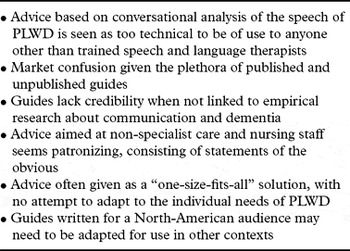
Preliminary work consisted in the first instance of the observation of practice in different care environments in the UK (general and dementia-specialist long-term care institutions, day-care centers and psychogeriatric wards). Semi-structured interviews with professionals, including residential home managers, care workers, nurses and physicians were then conducted. The views of PLWD and their informal carers were also sought in this second stage. There were numerous reports from them of poor communication between PLWD and healthcare professionals. Criticism included PLWD being frequently subjected to patronizing speech. Both PLWD and their informal carers also frequently expressed beliefs that their concerns had not been listened to, and also noted a lack of real communicative engagement by medical professionals (especially non-dementia specialists such as GPs). Important communication episodes, especially the point of diagnosis, were highlighted as being badly handled by practitioners. All professional participants during this preliminary stage reported that they had had no specific training in communicating with PLWD. Both lay and professional participants confirmed that there was a perceived lack of suitable practical guidance and little availability of training on communication with PLWD. Criticisms of existing communication guides from both lay and professional participants are summarized in Table 1.
Criticisms of existing guides to improving communication with people living with dementia (PLWD)

In response to these initial findings, a larger-scale project to capture experience and opinion was devised. Consultation with a range of UK-based stakeholders was initiated using the “Code of Practice for Communicating with People Living with Dementing Illnesses” (CoP), a summary of the findings of the preliminary work (Young and Manthorp, Reference Young and Manthorp2009). Participating stakeholders were asked to reflect in detail on their own experiences of communication in relation to dementia, and to comment on whether the CoP was representative of good practice. PLWD and family members were interviewed independent of any direct influence by professionals or paid carers in order to try to ensure that this previously under-represented group could express their views in a “safe” environment.
Data collection was carried out in a variety of environments (chiefly the homes of PLWD, or Alzheimer's Society premises) and a total of 79 people contributed to this stage of the process. Of these, 31 were PLWD, 19 were informal carers (usually family members of the PLWD) and 29 were professionals. The professionals consisted of six dementia care specialist nurses; five health and communications researchers; four managers of long-term general and dementia care specialist institutions; four senior administrators for long-term care providers (housing associations and local authorities); four professionals from the Alzheimer's Society (care and communications specialists); two old age registered general nurses; two professional care specialists from non-dementia organizations; and two speech and language therapists.
The CoP presented pilot data using the “3-level” structure, later adapted for use in DEMTEC. Level 1 was intended as a clear and agreed statement by UK-based stakeholders of their beliefs about dementia, the psycho-social effects of dementia on communication, and empowering approaches to communication involving individual PLWD. Level 2 consisted of ten specific components of good communication practice that were consistent with the philosophy of Level 1. Each component consisted of a “what”, a “why” and a series of “hows”, i.e. a brief definition, a rationale for including this component in the CoP and a list of implications for, and specific guidance on, effective communication practices related to this component. Level 3 of the CoP consisted of practical advice about how the advice in Level 2 could be operationalized and individualized to the needs of specific PLWD.
Results
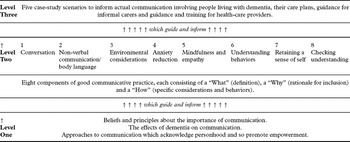
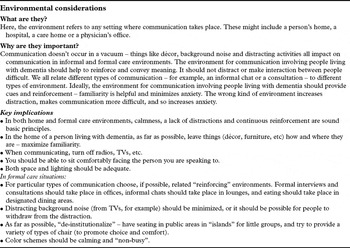
It was felt by the majority of stakeholders that “Code of Practice” as a title was too prescriptive and potentially off-putting. Participants agreed that a “toolkit” was a more appropriate title, reflecting a guide that was advisory rather than compulsory. The acronym DEMTEC (Dementia Toolkit for Effective Communication) was suggested by a PLWD and was readily adopted. Table 2 gives an overview of DEMTEC's structure and contents, and Table 3 gives an example of a Level 2 component in full. This details the advice given regarding making the care or home environment as conducive as possible to good communication practices.
Dementia Toolkit for Effective Communication (DEMTEC): an overview

An example of a DEMTEC Level Two component in full

Participants confirmed their preference for the formulation PLWD (people living with dementia) rather than “people with dementia” or “patients with dementia” which was felt to over-emphasize the condition at the expense of individuality. The language of the toolkit was felt to be appropriate for both a lay and a multidisciplinary professional audience, although it was suggested that language could be simplified further for users who may have some difficulties with English, for whatever reason.
The overall “3-level” structure of the toolkit was viewed by both groups as accessible and fit for purpose (Table 2). The majority of participants felt that Level 1 was a necessary foundational statement about the importance of effective communication with PLWD. A number of changes to the “how” advice of Level 2 were agreed, reducing it from ten components to eight and simplifying the language used. Level 2 components, a rationale for the inclusion of each one, and the specific advice came from lay and professional participants.
In order to show how Level 3 might serve its function of individualizing the principles in Level 1, and the advice in Level 2, participants agreed that case studies of PLWD would effectively illustrate the communication principles laid out by DEMTEC. It was also felt, particularly by the professional participants, that the scenarios should reflect the likely effects of dementia on communication at different stages of the condition. While anxious to dispel ideas that there are “typical” experiences of dementia, professional participants also felt that there were enough communicative common features involved in living with dementia in its broadly early-to-middle and later stages to warrant advice of specific relevance to both groups. In response to these opinions, five case studies were produced demonstrating how communication might be made more effective by incorporating advice from DEMTEC. It was suggested by participants that the case studies could also be used as the basis for multidisciplinary professional training.
Discussion
The DEMTEC consultation process highlighted frequent incidents of less than adequate communication between medical professionals and PLWD, reiterating the pressing need to improve medical education about dementia that has recently been raised by a key UK policy initiative (Department of Health, 2009). Although there are some examples of educational interventions to improve communication between medical trainees and PLWD internationally (Goldstein et al., Reference Goldstein, MaLossi, Kye and Young1999; Robinson et al., Reference Robinson, Bamford, Briel, Spencer and Whitty2010), undergraduate teaching time devoted to dementia, at least in the UK, is variable. Moreover, it is unclear whether qualified physicians go on to receive further training in the postgraduate environment (Tullo et al., Reference Tullo, Gordon, Blundell, Masud and Gladman2010). DEMTEC has a potentially valuable role in dementia-specific training for both undergraduate students and non-specialist physicians in the later stages of their training, particularly in the development of appropriate communication skills.
Given the acknowledged need for ongoing training for healthcare professionals working with PLWD, DEMTEC has a number of potential applications as a training tool. The underlying principles of good communication set out by DEMTEC (Table 2) are highly relevant to the clinical environment and staff could be encouraged to think about whether the daily care that they provide to individual patients appears to fit the model, or whether small modifications could be made to improve communication. DEMTEC includes a number of “case studies” – examples of the challenges of providing appropriate care for PLWD. In a group setting, staff could outline their own “cases” of caring for individual patients with dementia, perhaps highlighting the more difficult aspects of communication, and using DEMTEC to discuss, share and evaluate pragmatic alternative approaches.
The consultation process used to construct and refine DEMTEC involved a small but wide-ranging sample of opinion and experience. The process confers a number of advantages to the toolkit including, perhaps most importantly, the input of PLWD that has hitherto been largely excluded from guides to improving communication. The toolkit contains principles about effective communication and practical advice that is adaptable to individual PLWD in a number of different care and socio-cultural environments. The work is based on empirical research pertaining to models of communication, but using language that has been endorsed as appropriate for professionals, PLWD and their families.
Although DEMTEC has been designed to enhance communication with PLWD, it has yet to be field tested in environments which demonstrate that its practical use leads to an objective improvement. Evaluation and dissemination are therefore vital for benefits to be realized. Initial testing of the efficacy of DEMTEC is to be through its evaluation, pre- and post-intervention, in a number of locations including day centers and long-term specialist residential homes for PLWD in the UK. Testing for efficacy will involve the analysis of change in health-related quality of life of people living at various stages of dementia. The methodology of this evaluation will involve a more structured approach to interviewing PLWD using dementia-specific quality of life psychometric instruments, for example DEMQOL and DEMQOL-proxy (Smith et al., Reference Smith2007), as well as objective measures of effective communication between staff and PLWD. Once its efficacy has been demonstrated, versions of DEMTEC will be freely available to all stakeholder groups through web-based dissemination.
The end product of the empirical work, DEMTEC, will be widely disseminated in a variety of forms tailored to the specific needs of different user groups on a free-to-all-users basis, once it has been tested for efficacy in different contexts. Dissemination will be in the first instance in the UK, but it will then be rolled out internationally. This will include web-hosting with the collaboration of the Alzheimer's Society UK. Hosting will offer interactive communication advice based on the principles and specific considerations included in DEMTEC, and will also provide a mechanism for feedback on practical uses of DEMTEC, and so influence its future development. Other methods of web-based dissemination will be through various channels relating to the international caring community under the auspices of Alzheimer's Disease International and links with dementia care training networks. These international links are currently being explored. DEMTEC is readily translatable into languages other than English, and has already been translated into Spanish and Catalan language versions (Young et al., Reference Young, Manthorp and Howells2010). We will continue to encourage further translations provided the end products are free to users in some form.
One key audience for DEMTEC will be care workers whose first language is not English – a considerable part of the workforce in both North America and the UK. A version will be produced with a simple, direct writing style suitable for a lower level of English language competency. The three-level structure of DEMTEC will also allow for the principled discussion of different socioculturally-influenced beliefs about aging and disability between carers from different backgrounds, facilitating a sharing and cross-fertilization of attitudes and approaches to care and communication. This should increase the likelihood of international uptake of adapted variants of the toolkit, and make it more relevant to the many non-Western people working in care environments in North America and the UK and in other situations where a large part of the care workforce does not share the primary cultural background of the majority population. For example, the stress in Level 1 on the central importance of acknowledging and supporting individual personhood, agency and empowerment in interaction might be seen as a decidedly “western” orientation, and so may need to be adapted in different national and sociocultural environments, or may be an issue for cross-cultural dialogue in training in multicultural care environments.
In developing this toolkit our work with the spectrum of stakeholders has reinforced in us a sense that, despite progressive cognitive impairment, PLWD can contribute to the development of effective communication strategies in partnership with formal and informal carers. The DEMTEC instrument described here is a translation of real-life experience, best theory and best practice into a tool to empower PLWD and their carers. Training in the use of DEMTEC, and its application to care, is likely to provide highly cost-effective benefits in terms of improved quality of life, and so, we argue, will be a worthwhile investment even in the highly straitened times facing providers of health and social care across the world.
Conflict of interest
None.
Description of authors' roles
T. Young formulated the research questions, designed and co-supervised the conduct of the study, contributed to the drafting and revision of the paper, and produced the final version. C. Manthorp formulated the research questions, co-supervised the conduct of the study, contributed to its design and to the drafting and revision of the paper. D. Howells co-supervised the conduct of the study and contributed to the drafting and revision of the paper. E. Tullo wrote the first draft of the paper and contributed to its further drafting and revision.
Acknowledgments
We gratefully acknowledge the help of the Alzheimer's Society UK for the provision of resources for the study. We also gratefully acknowledge the contribution of the participants in the research, not least those who are living with dementia.