At the first National Dance Congress and Festival, which was held in New York in May 1936, Edna Ocko, the dance editor of New Theatre Magazine, told the assembled delegates, “One cannot minimize the importance of an artist's social point of view, for it is he who, bringing his ideas before vast audiences, can organize and direct social thought” (25). Noting that young, politically aware choreographers had already embraced the political potential of dance, Ocko listed several topical social themes recently explored in choreography, including the need for “Negro and white unity”—an assertion championed by other speakers and formally adopted in the final session of the gathering when the delegates passed the following resolution: “Whereas the Negro People in America have been subject to segregation and suppression which has limited their development in the field of creative dance, be it resolved that the Dance Congress encourage and sponsor the work of the Negro People in the creative fields” (Ocko Reference Ocko1936, 27 and “Resolutions” 1936, 94).
One of the dance artists who performed at the National Dance Congress and Festival and who had been involved in organizing the event was Franziska Boas.Footnote 1 Energetic and committed to using dance as a form of grassroots social activism, Boas was exactly the kind of dancer Ocko urged to take a leadership role in making dance socially relevant. Indeed, Boas's long and productive career can be read as an impassioned response to the pledge to encourage and sponsor African Americans in dance as well as in society more generally. Notably, her New York studio, the Boas School of Dance, which opened in 1933, was interracial. Her short-lived student company, the Boas Dance Group, and her annual summer school at Lake George in upstate New York were also open to dancers from all racial and ethnic heritages. In 1950, no longer able to afford to live in New York, Boas moved to Rome, Georgia, where she became the head of the Dance and Physical Education Department at Shorter College as well as the founding Chair of the Rome (Georgia) Council on Human Rights, an interracial organization dedicated to desegregating the town.Footnote 2
Boas was not well-known during her lifetime and has been largely forgotten by dance historians, but when placed within the frame of the Civil Rights Movement, her career functions as a useful case study about the politicized implications of white antiracism activism.Footnote 3 One the one hand, Boas's career can be viewed as an attempt to redefine whiteness as a cultural practice committed to antiracism activism, as her actions were unequivocally motivated by the conviction that racial equality must prevail. Yet, even someone as steadfast in her belief in progressive social change as Boas invites a consideration of the pervasiveness and persistence of white privilege. Essentially, Boas's whiteness provided her with options, agency, and authority not available to African Americans.Footnote 4
Accessing archival documents located in the Franziska Boas Collection (FBC) at the Library of Congress as well as Boas's private papers in Massachusetts, this article argues that Boas's career, while shaped by a genuine desire to facilitate nonthreatening, nonovertly political, opportunities for interracial interaction, nonetheless discloses contradictory racialized assumptions and actions that demonstrate how the campaign for equality and the fortification of existing disparities could—and often did—coexist. In recovering the history of Boas's activist use of dance, the purpose here is neither to venerate nor to vilify. Instead, this article seeks to understand the ways in which Boas's career shows how dance and the Civil Rights Movement intersected and, in so doing, constructs a definition of whiteness that is complex in its simultaneity of antiracist activism and the revivification of racialized privilege.
Definitions of Privilege/Contexts of Influence
In order to examine the implications of Boas's civil rights strategies, it is first helpful to understand the political ramifications of whiteness and to contextualize her activism. The definitional parameters of whiteness have changed throughout the twentieth century and thus point to the constructed and unstable nature of race itself. Charting the ebb and flow of several categories such as Celts, Anglo-Saxons, Caucasians, and so on, Matthew Frye Jacobson argues that race “resides not in nature but in politics and culture,” and has exerted a powerful force on the history of European immigration and settlement (Reference Jacobson1999, 8–9). Who did and who did not fit within the “white” or “Caucasian” category changed during the twentieth century.Footnote 5 As late as the 1920s and 1930s, for instance, Jewish people's status as “white” was still contentious.Footnote 6
Despite the shifting categorization of whiteness—or perhaps because of its amorphous nature—the concept of whiteness has increasingly garnered attention from scholars. Critical whiteness studies, which Cynthia Levine-Rasky has defined as “the emerging corpus of writing that takes white racialization and the exercise of domination and privilege as its departure point in anti-racism,” provides a useful frame through which to rethink “whiteness” as a social force (2008, 52). In this way, the point is not to essentialize white people, but to consider that “‘white’ is best understood not as an empirical reality, but as a process of becoming, even as a way of ‘doing’ identity. More important, ‘white’ is significant in its conveyance of power and privilege rather than its demarcation of ‘race’ defined by physicality, religion, place of origin or any other quantifiable measure” (Levine-Rasky Reference Levine-Rasky2008, 52).
As previous scholars have observed, the power and privilege of whiteness is often aided and expedited through the faulty assumption that whiteness is unmarked because white people are often in positions of authority and white culture treated as the social norm.Footnote 7 Thus, while white privilege is not synonymous with white racism, it nevertheless participates in the perpetuation of racial inequality (Fitzgerald Reference Fitzgerald and Schaefer2008, 1404).
In exploring the various ways that whiteness exerts itself, scholars have increasingly examined whiteness and white women within the context of the Civil Rights Movement in the United States.Footnote 8 This research into the intersection of race and gender, however, generally has not included women working in the field of dance. The intention here is not to detract from the African-American leadership in the struggle for equality, but to position dance in dialogue with Gail S. Murray's comments in Throwing Off the Cloak of Privilege: White Southern Women Activists in the Civil Rights Era, that “without the story of white response—in all its various guises—to black activism, the full story of the civil rights movement cannot be understood. A critical investigation of the white female activist experience remains necessary” (Reference Murray2004, 4). In this light, Boas's career provides access to a variety of ways that the terms “white,” “female,” and “dance” intersected, and serves as a reminder that “throwing off the cloak of privilege” was not—and is not—easy because the hegemony invested in whiteness is stubbornly systemic and unacknowledged.
The sources of inspiration for Boas's commitment to antiracist activism were both professional and personal. Even an abbreviated examination of select events and choreographic works demonstrates that Boas was neither the first nor the only dancer interested in using the art form to subvert racism.Footnote 9 There had been African diaspora/African-American companies, artistic directors, choreographers, and dancers prior to and/or contemporaneous with Boas, including the New Negro Art Theatre, Edna Guy, Charles Williams, Pearl Primus, and Katherine Dunham, among many others, who emphatically demonstrated that talent and technical excellence were not hierarchically delineated according to race and, therefore, had political import. For instance, many of the artists associated with the Harlem Renaissance created “highbrow” art as a political strategy to demonstrate African-American excellence oriented to Eurocentric expectations and standards.Footnote 10
A rethinking of racialized identities by African-American artists, however, occurred during subsequent decades. In April 1931, for instance, Edna Guy and Hemsley Winfield staged the “First Negro Dance Recital in America,” which was the first of coproduced performance by African-diaspora artists (DeFrantz Reference DeFrantz2002, 27). As Thomas F. DeFrantz states, this trend was a way to reclaim history and culture through the body: “In the 1930s and 1940s dancers and choreographers Pearl Primus, Asadata Dafora, and Katherine Dunham realized that African American cultural values emphasize the participatory nature of performance. For them, theatrical dance offered a way into the artistic imagination of black people grappling with the legacy of colonialist encounter” (Reference DeFrantz2004, xiv).
Race in post–World War II dance in the United States remained fraught with tension. In the 1960s, for instance, “‘Black dance’ became a category of performance, in large part because of the Black Arts movement and its collective attempt to define a ‘black aesthetic’” (DeFrantz Reference DeFrantz2002, 5), though the phrase “Black dance” underscored racialized tensions because, as DeFrantz notes, it was generated by “white critics as a shorthand for work they felt uncomfortable with or ill-prepared to address” (Reference DeFrantz2002, 5). During this same period, a desire to counter negative images of the United States was ostensibly a factor in the use of dance as a form of cultural diplomacy.Footnote 11 For instance, the U.S. Department of State sponsored the Alvin Ailey American Dance Theatre tour of nine African countries in 1967 (Croft Reference Croft2007, 178).Footnote 12
During Boas's career, dance also was politicized and harnessed for its utility in the leftist class struggle. As Mark Franko has noted in examining dance during the 1930s: “The dancing body had didactic, stylistic, and recreational import that artists sympathetic to labor were keen to exploit. The kinesthetic and psychological correlation of labor to danced movement contributed to the definition of modernism as aesthetic ferment with social ramifications” (2002, 4).Footnote 13
New York City, in particular, became the center for the coupling of dance and leftist political activism. The Workers Dance League (later the New Dance League), for instance, was an umbrella organization established in 1932 to provide administrative support for members.Footnote 14 The dance groups who became affiliated with the organization included, among others, the International Workers' Order Dance Groups, the Needle Trades Worker's Industrial Union Dance Group, the Red Dancers, and the New Dance Group.Footnote 15 Representing a broad and often fractious spectrum of leftist politics under the slogan “dance is a weapon in the class struggle,” these groups used movement to express their anxiety about poverty, unemployment, the rise of fascism, censorship, war, and racial and ethnic persecution.Footnote 16 Often the participants were immigrants or first generation Americans. Many were Jewish or belonged to other groups regularly subjected to discrimination. Most struggled economically and were unemployed or underpaid. In short, most had a personal stake in the activism they enacted with their bodies. This commitment to social change frequently meant political participation beyond the footlights: the dancers walked picket lines, attended political meetings, lobbied governments, and held classes espousing the values of the leftist agenda in their studios after teaching dance technique.
Several leftist white dance artists were similarly committed to social change through dance, and interracial dance performances were important demonstrations of artistic desegregation. In 1930, the white choreographer Edith Segal choreographed Black and White, Unite and Fight, which conveyed the message that, through interracial solidarity, African Americans and white people could defeat discrimination.Footnote 17 In the early 1940s, choreographers Jane Dudley, Sophie Maslow, and William Bales joined forces, touring the college circuit with their interracial group of dancers.Footnote 18
Despite the activist motivations of leftist dancers in the 1930s, as Susan Manning has suggested, dance did not fully achieve the interracial engagement present in the movement's stated intentions: “Without a doubt, the social formations of leftist dance reached out to Negro dancers to a much greater extent than the social formations of modern dance did […]. Yet, the patronage and critical advocacy of the leftist dance network always co-existed with assumptions that limited the participation of Negro dancers” (2004, 59).
Throughout the three decades under discussion here (and beyond), Africanist aesthetic influences were regularly “invisibilized”—to apply a term coined by Brenda Dixon Gottschild—in the embodied and unacknowledged “borrowings” of white artists. Mid-twentieth-century theaters, for instance, were attended by spectators inattentive to the “intercultural fusions” present in choreographic works (Manning Reference Manning2004, xxiv). Or, as Charles “Honi” Coles recounted in an oral history interview, in 1949 he, along with Cholly Atkins (his dance partner) and the arranger Benny Payne, created a routine for the “Mamie is Mimi” number in the second act of the musical Gentlemen Prefer Blonds. Only Agnes de Mille, however, was credited as the choreographer in the program. De Mille's autobiography, published some years later, did not correct the record (Stearns and Stearns Reference Stearns and Stearns1979, 309 quoted in Gottschild Reference Gottschild1996, 33).
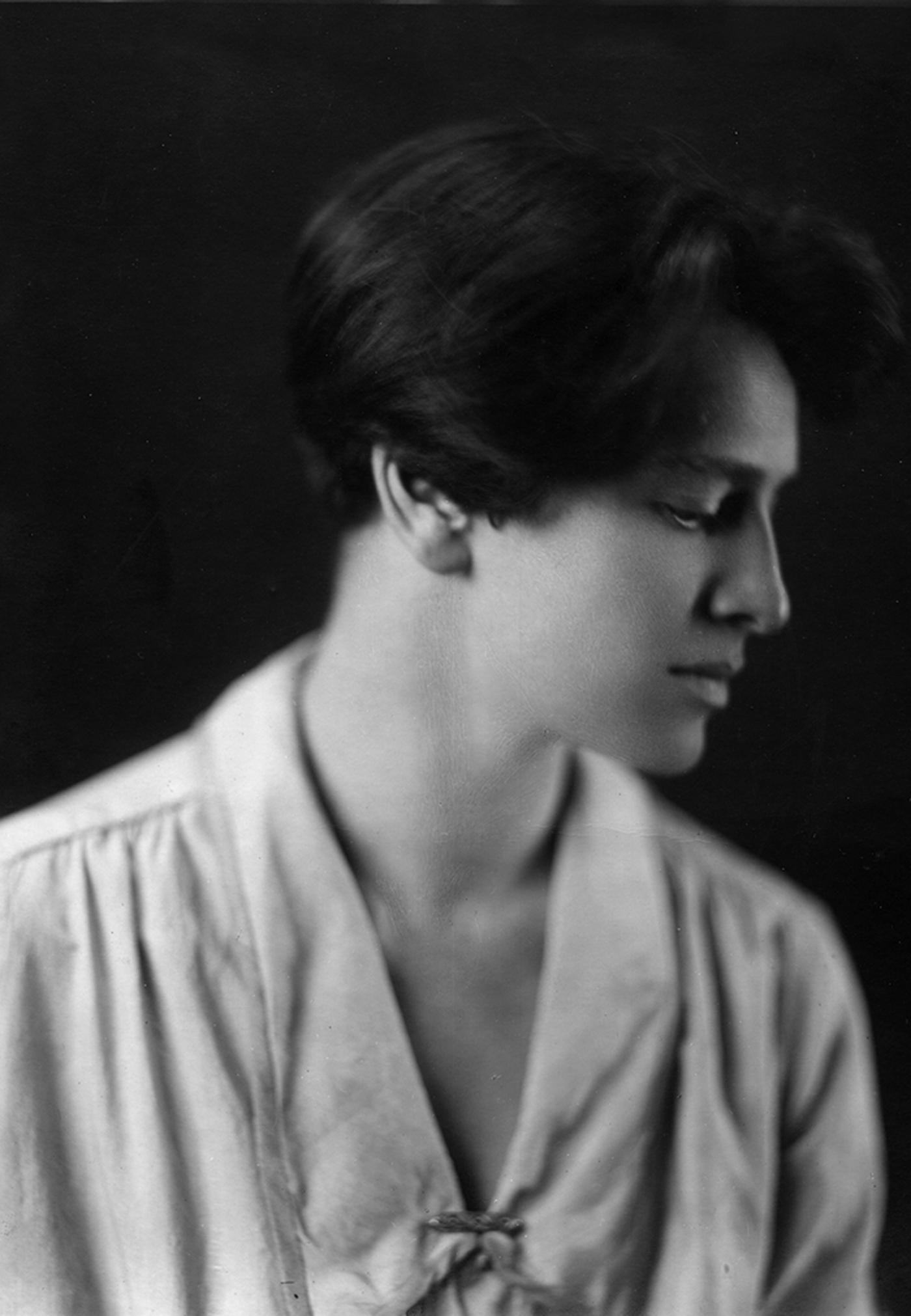
In addition to working in a dance milieu often motivated by racial activism, yet mired in racial inequality, Boas was also influenced by her family's political views. Born in 1902, Boas was the youngest child of Marie Krackowizer Boas and Franz Boas, the eminent anthropologist.Footnote 19 By rejecting the broad generalizations about behavior that had previously dominated his discipline, Franz Boas instead emphasized cultural relativism—the theory that differences in societies stem from their specific historical, social, and geographical situations and not from a biological hierarchy with western European societies at the top and all other racial and ethnic groups deficient by comparison. Likewise, he championed historical particularism, in which each society was to be examined on the terms of its individual history and values and not by assuming universal laws about the structures or development of cultures. In other words, Boas was raised in a familial environment where cultural relativism and historical particularism were advocated by a father who demonstrated that one's vocation could be used to rethink the established social order. She often acknowledged her father publicly in interviews, telling one reporter that she had been guided by his observation that dance was an important way to build relationships between people of different racial heritages because the arts were a meritocracy insofar as talent could not be obfuscated by skin color (“We Visit a Night School for Dancers” 1946). As a result of her familial influences, it is not surprising that Boas believed that she could use her own profession to become an active participant in the pursuit of racial parity. Indeed, throughout her long career, she steadfastly believed in what she called “motility” as an epistemology through which perceptions of identity and environment are constructed and constantly revised (Boas Reference Boas1953, 29). From this stance, it is not difficult to believe that dance can provide an opportunity for personal and social empowerment (see Photo 1).
Franziska Boas, photographer unknown. Photograph courtesy of Gertrud (“Trudel”) Michelson.

Since Boas was born into a family with strong humanist ideals during a time when many artists felt their vocations came with the responsibility of being socially aware and politically engaged, her desire to use dance to improve the lives of her students was not an anomaly, but in accordance with those values cherished by her family and reinforced by many of her peers. Just as important, Boas could empathize with people who had faced discrimination or had been socially marginalized because of familial and personal experiences. As a child, she had heard the stories her father told about how a bear had scratched his face during his expedition to the Arctic. She later discovered that the “bear scratches” were really dueling scars resulting from her father defending himself against anti-Semitic slurs as a student in Kiel (Cole Reference Cole1999, 59–60).Footnote 20 Although Franz Boas had been raised as an orthodox Jew, Franziska and her siblings grew up in a home environment where religion was not actively practiced. Nevertheless, while a student at Barnard in the early 1920s, Franziska Boas would sometimes hear insults against Jewish people and then defiantly tell her surprised peers that she was half Jewish.Footnote 21
In addition to experiencing anti-Semitic insults, Boas was familiar with homophobia. In the 1940s, Boas became involved in a long-term relationship with a woman, Jan Gay.Footnote 22 The name “Jan Gay” was a pseudonym used by Boas's partner, Helen Reitman, who was a journalist, publicist, and author of children's books as well as a treatise on nudism, On Going Naked (Gay Reference Gay1932; see also Gay and Gay Reference Gay and Gay1930, Reference Gay and Gay1931a, Reference Gay and Gay1931b, Reference Gay and Gay1932a, Reference Gay and Gay1932b). Most notably, Gay was also an early activist for gay and lesbian rights in New York.Footnote 23 After Boas moved to Rome, Georgia, in 1950, her relationship with Gay ended. Boas then became involved with Martha Griffin, an art professor at Shorter College. Their partnership lasted for more than twenty years.
Given that Boas lived her life openly (at least in New York), and those people close to her knew about her relationships with both Gay and Griffin, it might seem odd that Boas does not appear to have actively promoted the rights of same-sex couples—particularly in light of Gay's commitment as an “out” activist for gay and lesbian people. Whatever her reasons, Boas instead focused her attention on trying to improve the lives of other demographics of people who had been the targets of discrimination, particularly African Americans. Thus, while Boas's own intersectionality, particularly her Jewish heritage and her sexual orientation, did not feature prominently in her activism, these aspects of her personal history nevertheless help to situate her as a person with direct and multiple understandings of prejudice.
Racially Integrated Dance Classes
One of the most fundamental ways that Boas participated in the Civil Rights Movement was to provide opportunities for interracial interaction in her studio in New York. Her school (like that of the New Dance Group, for instance) was open to anyone who wished to study with her, regardless of skin color.Footnote 24 Boas also wanted to have an interracial staff. At various times during the period she taught in New York, teachers at her studio included African American Claude Marchant, formerly a member of Katherine Dunham's company, and African percussionist Norman Coker (“African Drummer Teaches at Interracial School” 1946).Footnote 25
According to Louis Althusser, formal education “teaches ‘know-how’, but in forms which ensure subjection to the ruling ideology” [Emphasis in original] (1969, 128). In other words, scholastic experiences are central to the reinforcement and perpetuation of dominant social structures. While Althusser references traditional state-school contexts (1969, 147–148), Boas's career conversely demonstrates that some teachers used their interaction with students as a means to instigate social change. To this end, seeing African-American teachers ostensibly activated a process for Boas's African-American students in which they were “hailed” not for the maintenance of a racist social paradigm, but instead in a way that implicitly invited them to identify with African Americans in positions of authority and with the ability to exercise judgment in their jobs.Footnote 26
At the same time, however, it is clear that Boas was aware of the systemic problems that limited opportunities for dance instruction for African Americans, placing them at a disadvantage. First, in order to attract African-American students, Boas knew she needed to seek out and reassure them that they were welcome in a studio run by a white woman. To do so, Boas mobilized a wide variety of methods, including through word of mouth and lecture demonstrations she gave in schools in Harlem such as P.S. 136. She also not only placed her ads in dance publications, but also promoted her school in African-American newspapers such as The Pittsburgh Courier (Graham Reference Graham1945). In addition, she promoted her school to organizations such as the Associated Negro Press and the NAACP.Footnote 27 In the early 1940s, Boas continued to search for ways to reach African-American students by contacting the Council on African Affairs in New York and inviting its administrators to visit her studio.Footnote 28
Boas was aware that access and participation in dance instruction were directly tied to economics.Footnote 29 She knew, for instance, that many of her African-American students could not afford to travel to downtown Manhattan every day. Furthermore, those African-American students with jobs to pay for their classes and transportation expenses usually could not attend on a regular basis, and therefore were sometimes slower to make progress than those who attended more consistently. These financial problems were particularly vexing for Boas, prompting her to write, “How can I get scholarships for my negroe [sic] pupils? How can I provide for their future placement?!”Footnote 30 To address this issue, Boas often offered her own “scholarships” at the Boas School of Dance by waiving tuition for her African-American students.
Boas's New York school was not the only venue for her racially integrated dance classes. She also had a summer school at Bolton Landing on Lake George, which began in 1944 and was held annually until approximately 1949.Footnote 31 In 1945, the Boas School of Dance in New York City had fifty students. Of those fifty, four were African American (Graham Reference Graham1945). Eighteen students, including one African-American dancer, accompanied Boas to Lake George that year.Footnote 32
To make her attempts to include as many African-American students as possible, Boas continued her practice of personally providing scholarships and waiving tuition when funding was an impediment. She sought out scholarship students during her master class tours and through her correspondence with colleagues who taught in African-American universities.Footnote 33 Curtiss James, a junior at Hampton Institute studying music, was able to participate in the Bolton Landing summer school in 1946 because of the Franz Boas Scholarship that Boas had established to honor her father's memory.Footnote 34 Similarly, in 1948, Pearl Kennedy and Doria Alexander, both students at Fisk University, were the recipients of the Franz Boas Scholarship.Footnote 35
Importantly, Boas's summer school not only provided opportunities for interracial interaction for the students in her classes, but helped to model desegregation for the citizens of Bolton Landing. “One of my race students is going with me this summer to Bolton Landing-On-Lake George, N.Y.,” she told an interviewer shortly before heading to Bolton Landing. “I am having my own building, so that my students may live and work side by side together, so that those in the community will observe that mixed groups can do it successfully” (Boas quoted in Graham Reference Graham1945). As she promised, her “race” student and her white students took the same classes, ate together, participated in the same leisure activities, and cohabited in a single residence. Picnics were communal, and everyone crammed into a Buick station wagon and a Crosley, which served as the summer school's transportation for the students and Boas's instruments to the local high school auditorium for performances.
In advertising her summer school, Boas boldly emphasized its desegregated status. In 1947, for instance, she approved a prospectus titled, “Suggestion for a Picture Story on the Boas School Bolton Landing, N.Y.” Although the intended publication for this story proposal is unknown, its message was clearly stated in its first paragraph:
Franz Boas' theories of racial equality are to be found not only in his books on anthropology but in practical trial at the school of modern dance and allied arts which is directed by his daughter, Franziska Boas, at Bolton Landing-on Lake George, N.Y. There are three Negroes among Miss Boas' professional dance students and one on the faculty.Footnote 36
While Boas wanted to show the local residents of Bolton that racial equality could be and, to a certain extent, already was a feature of their community, in reality, the town's response was mixed. From the beginning, some of the local residents welcomed Boas's interracial summer school. In the first year the summer school was interracial, four children from the local community enrolled.Footnote 37 Local artists, including husband and wife David Smith and Dorothy Dehner, were supportive of Boas's efforts. Another local resident, Hugh Wilson, a musicologist at Yale, appeared to have no problem with the interracial nature of the group when he taught music classes at Boas's summer school.Footnote 38 However, there were also incidents of discrimination during the 1945 session when Boas's “race student” was barred from entering local businesses.Footnote 39 Similarly, according to Boas's partner and supporter, Jan Gay, “[T]he harmonies of gong and cymbal and drum that issue from the Boas studio have baffled the townspeople for four summers, now, as had the phenomenon of young Negro men and women sharing the classes, the residence, and the sports of the students.”Footnote 40 Nevertheless, Boas tried to make her interracial school as accessible and integral to the summer activities of the local community as possible. To this end, she held open houses, offered free classes for local residents, and participated in the Bolton Landing summer festival.Footnote 41
The interracial status of Boas's studio, company, and summer school might not appear to be particularly radical within a New York context, but it is to be remembered that the social and political circumstances for African Americans in the post–World War II years were not straightforward, even in the northern states. In the years immediately following the end of the war, New York was a hub for groups such as the Negro Labor Victory Committee and the metropolitan chapter of the National Council of Negro Women (Fairclough Reference Fairclough2001; “Jobs for Negroes Discussed in City” 1945; Weisbrot Reference Weisbrot1990). Yet, even after the Supreme Court in the United States struck down restrictive covenants on the transference of land in 1948, for example, segregation persisted (Meyer Reference Meyer2001). Thinking of New York City and the northern United States more generally as a contested space, where the intricacies of race relations were negotiated on a daily basis, helps us to understand the potential political volatility and social power Boas engaged in as she gathered students from various races together in her dance classes.
As Boas's New York studio and her summer school at Bolton Landing demonstrate, interracial interaction in the studio was generally predicated on two main concepts: familiarity and liminality. Familiarizing nondancers with a model for desegregation was also important, especially at Bolton Landing, where her activities would have been more noticeable because the population was small and close-knit. Of course, quantifying the success of Boas's efforts is difficult, but the relaxed atmosphere at the lake, where the responsibilities and artistic objectives for the students were less stringent, ostensibly encouraged an equally relaxed interaction between the summer school's participants. Moreover, although Boas identified herself as a New Yorker, long-time residents of Bolton Landing had watched her grow up since her family had spent many summers at Lake George.Footnote 42 As a result, Boas's familiarity (and similarity) to the people she was trying to influence arguably made social change a less threatening proposition.
Liminality has been a touchstone of performance studies scholarship, but also can provide a conceptual framework in which to view dance history. The literal threshold of the dance studio can also be viewed as a metaphorical threshold to dislodge social norms and provide the opportunity to rehearse alternative behavior before returning, potentially altered, to what Victor Turner has called “mundane life” (Reference Turner1986). Thus, while liminality in an anthropological sense often ultimately leads to the reinscription of social norms, by familiarizing her students with enjoyable in-studio interracial experiences, Boas provided a non-overtly political space for her students to embody interracial equity that they then could ideally align themselves with ideologically.
Boas also provided visual and aural cues about intercultural collaboration that presumably alluded to and normalized non-western and/or non-industrialized cultures. In addition to being a creative dance teacher, Boas was a well-respected percussionist and had a large collection of percussion instruments from around the world, including “drums from Haiti, China, Africa and tom toms made of thick skins painted in native colors, caring [sic] the fur trimmings of various animals from the areas from which the instruments came” (Graham Reference Graham1945). While it is possible that these instruments could be used to render non-western cultures exotic, Boas's informal anthropological tutelage at the knee of her father suggests that these instruments were used to facilitate lessons in cultural understanding and respect. Moreover, these instruments arguably helped to naturalize the presence of non-western cultural traditions in Boas's studios in New York and Lake George, marking these spaces as culturally plural.
Despite all of her efforts, it remains unclear to what extent—if any—white students resisted the interracial status of Boas's school since it was predicated on the desire to limit white privilege of unfair access and opportunity. One presumes that those white dance aspirants who did not support racial integration opted not to attend the Boas School of Dance, or did only once or twice before realizing that their beliefs would be challenged intolerably. If so, questions arise related to the impact of this kind of activism on white students. Did being under the tutelage of African-American teachers help white students to experience a kind of defamiliarization that allowed them to rethink previously sublimated understandings of racialized social norms? Or, did Boas simply attract white students who already shared her antiracist goals? Equally concerning, did white students leave their interracial dance classes and African-American teachers simply reassured of their own liberalism without feeling the need to engage in direct political action? That is, did the experience of working with African-American teachers facilitate the interpellation of white liberalism in which respectful interracial interaction need not move beyond the physical and emotional effort required by dance classes?
Boas's personal strategy regarding racial tension was to refuse to be thwarted by others' hesitancy or hostility; she remained unwavering in her commitment to use her studio to facilitate interracial interaction. Or, as she stated to one interviewer, she “never thought it wise to ask a class whether they would ‘mind’ having any particular person enter the group” (“We Visit a Night School for Dancers” 1946).Footnote 43 When, on occasion, a new student might be uncertain about “the mixed nature of the group,” Boas claimed that such qualms were always subsumed in the “common effort” of the work (“We Visit a Night School for Dancers” 1946). Yet, beneath the optimism of Boas's comments is the sense that she indeed did encounter moments of hesitancy or recalcitrant attitudes about her interracial project.
In this light, the absence of primary-source confirmation of the impact of the spatial liminality at the Boas School of Dance does not foreclose the opportunity to speculate about unintended problems—problems that could theoretically function to racialize the space and thereby re-inscribe white privilege instead of eradicate it. For instance, where did people stand when they participated in classes at the Boas School of Dance? Who stood at the front of the class, where they most easily could see the teacher and reciprocally be seen? In what order did students perform exercises that traveled across the room? Who led and who was at the back of the line? Did the attire of students convey economic status and thus emphasize class disparities that corresponded with race? Did Boas's African-American students ever feel the pricks of microaggression—those small, but painful pointed comments, subtle yet hostile rejections, and other “dispiriting transactions” that signal racist attitudes during interracial encounters (Delgado and Stefancic Reference Delgado and Stefancic2012, 2)? Moreover, how might Boas herself and the teachers in her employ have unwittingly restricted interracial liminiality through their own comments and/or by the choices they made in managing their classes? Even Boas's genuine desire to use her studio to promote equal opportunities ironically can be viewed as reinforcing white control of political agendas, particularly for any African-American students who simply wished to dance and might not have wanted to be placed in the middle of an interracial experiment.
Interracial Collaborations
In addition to making her studio interracial, Boas also was in favor of interracial collaborations. She had never been particularly interested in choreographing for the purpose of public performances, and thus, despite having had a dance school for over a decade, had not succumbed to the temptation to attach a professional dance company to her studio. In the spring of 1945, however, this reluctance began to change when Marchant joined the teaching staff, and the two of them began to work with some of their students to create an interracial group piece with the express goal of a public performance.Footnote 44
The choreography initially was inspired by the persecution of republican groups during the Spanish Civil War. Yet, as the dancers worked, the choreography began to evolve thematically as they found localized and personal parallels. In the end, the Spanish Civil War was transposed into a twenty-minute “dance drama” about the oppression of African Americans in the United States.Footnote 45 Boas decided that she would like to perform in the work, portraying a malevolent “blinded white ringleader” during one section of the piece and an honorable “White Man” in another. Marchant danced the lead role of the “Negro.”
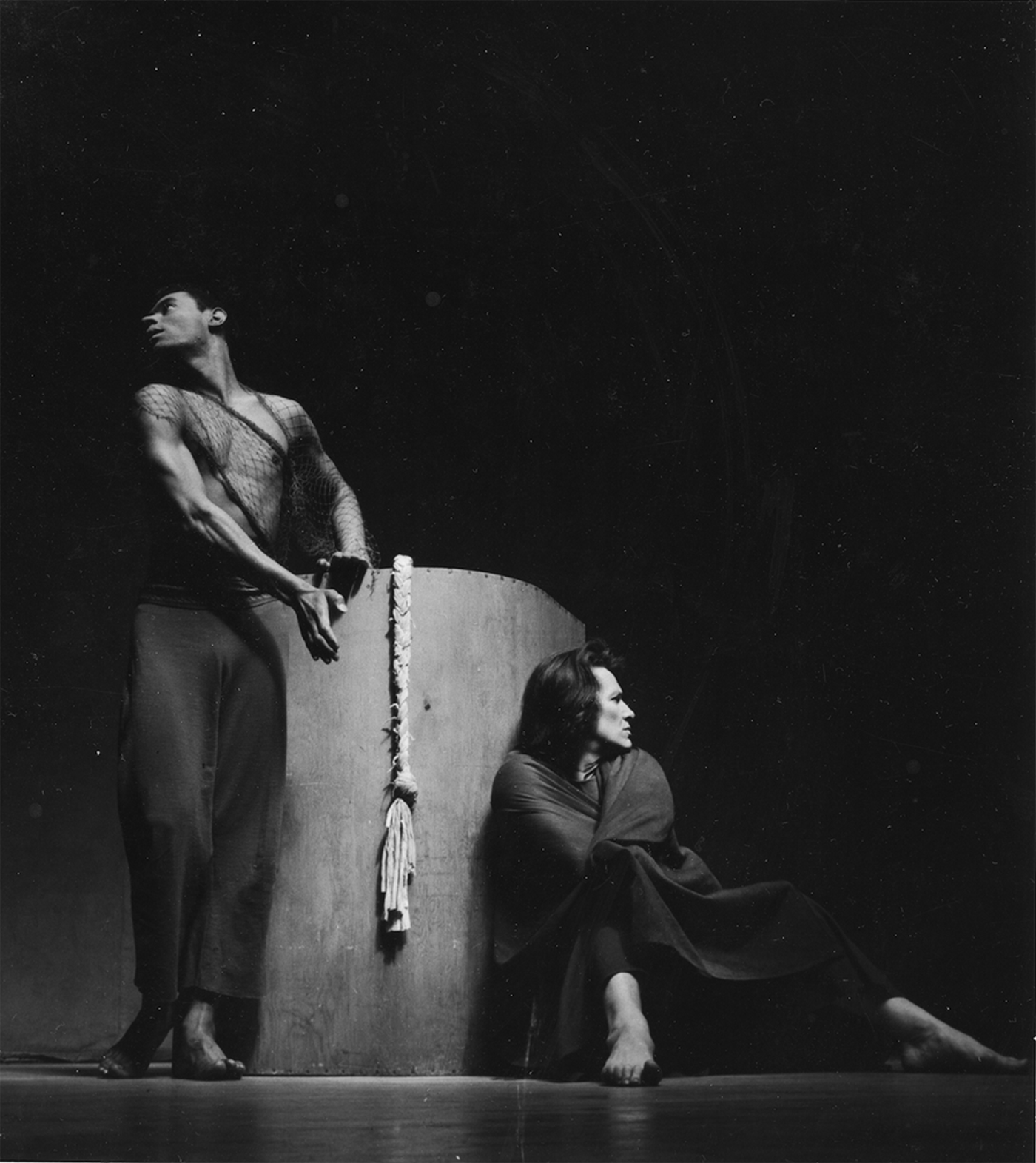
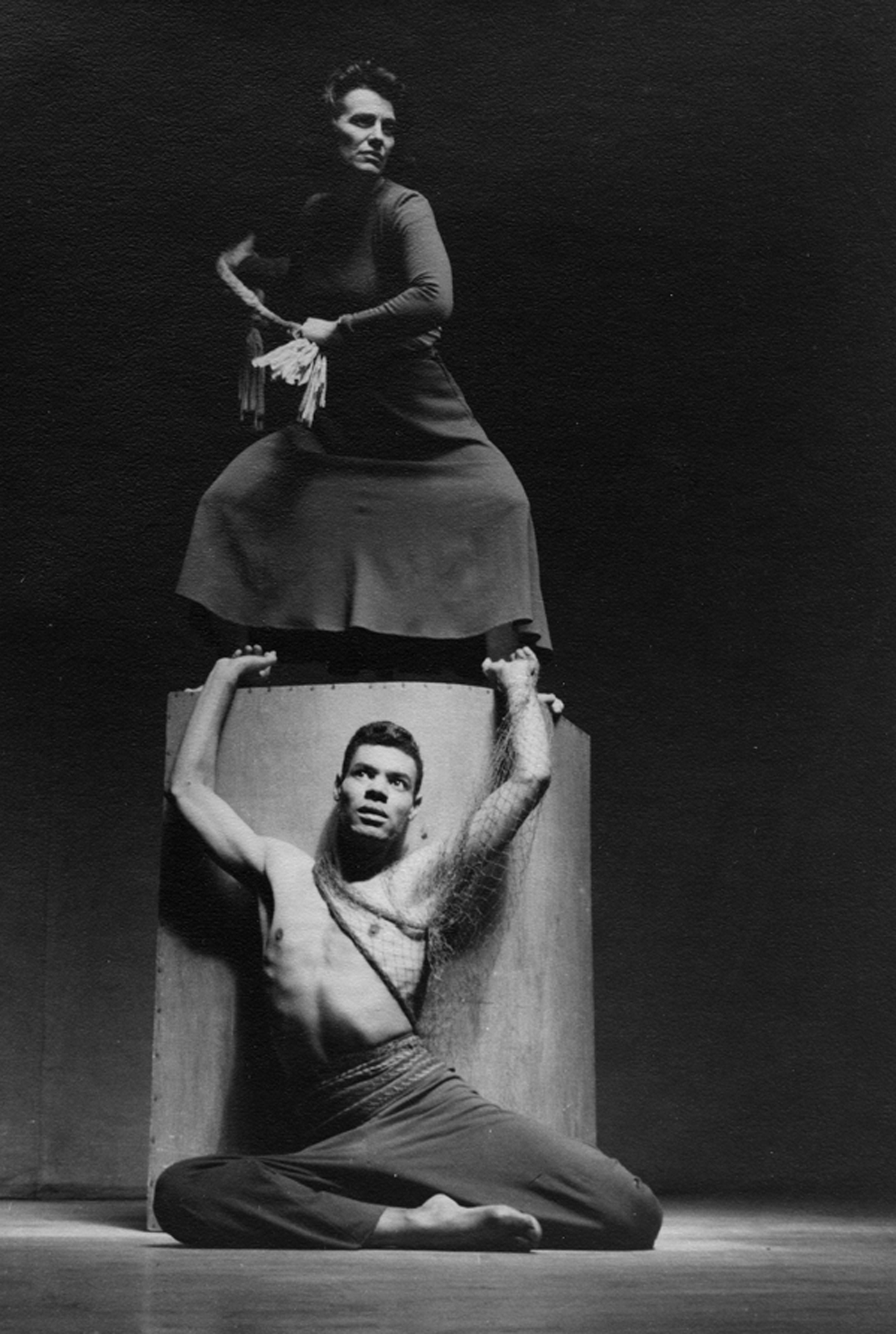
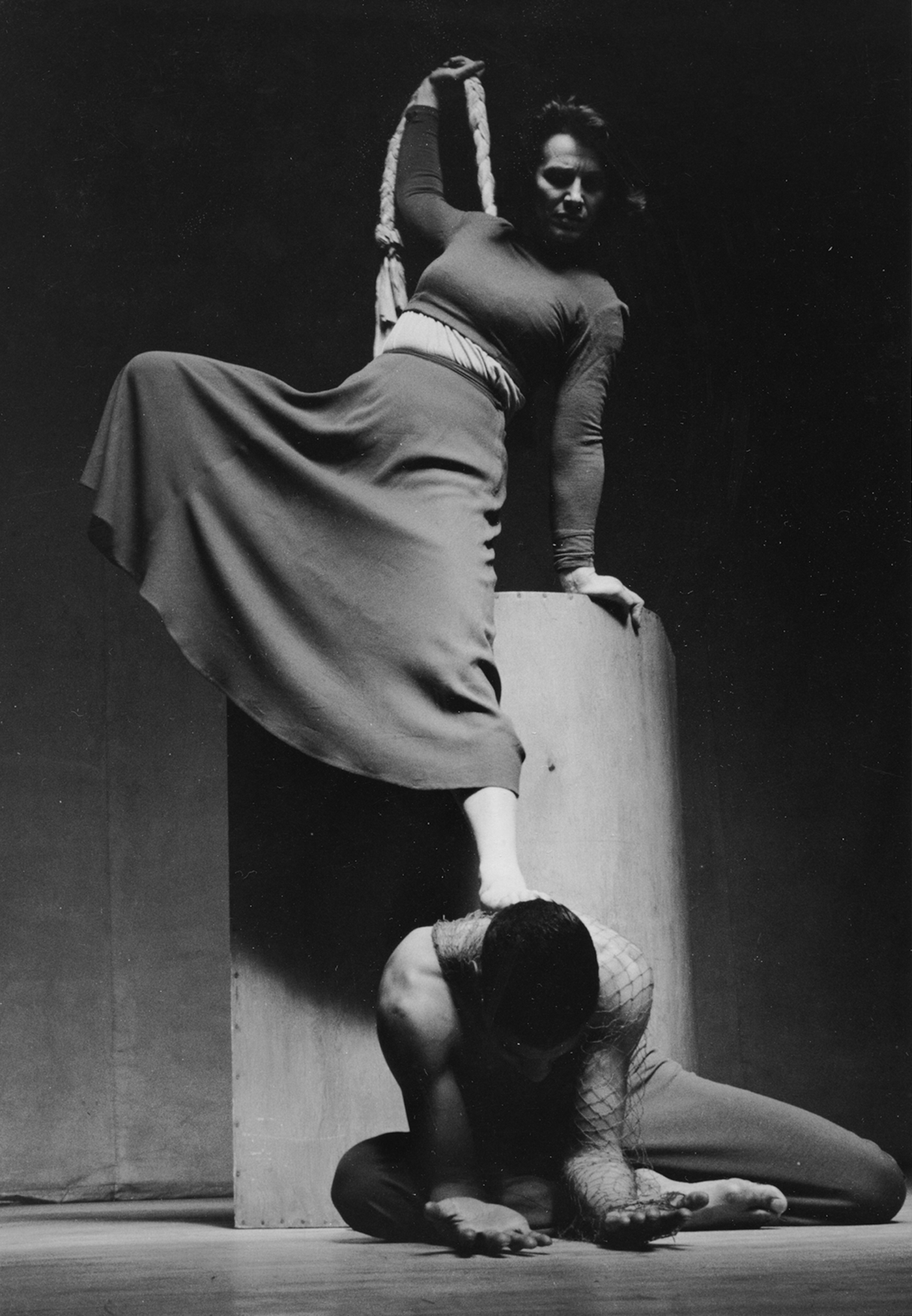
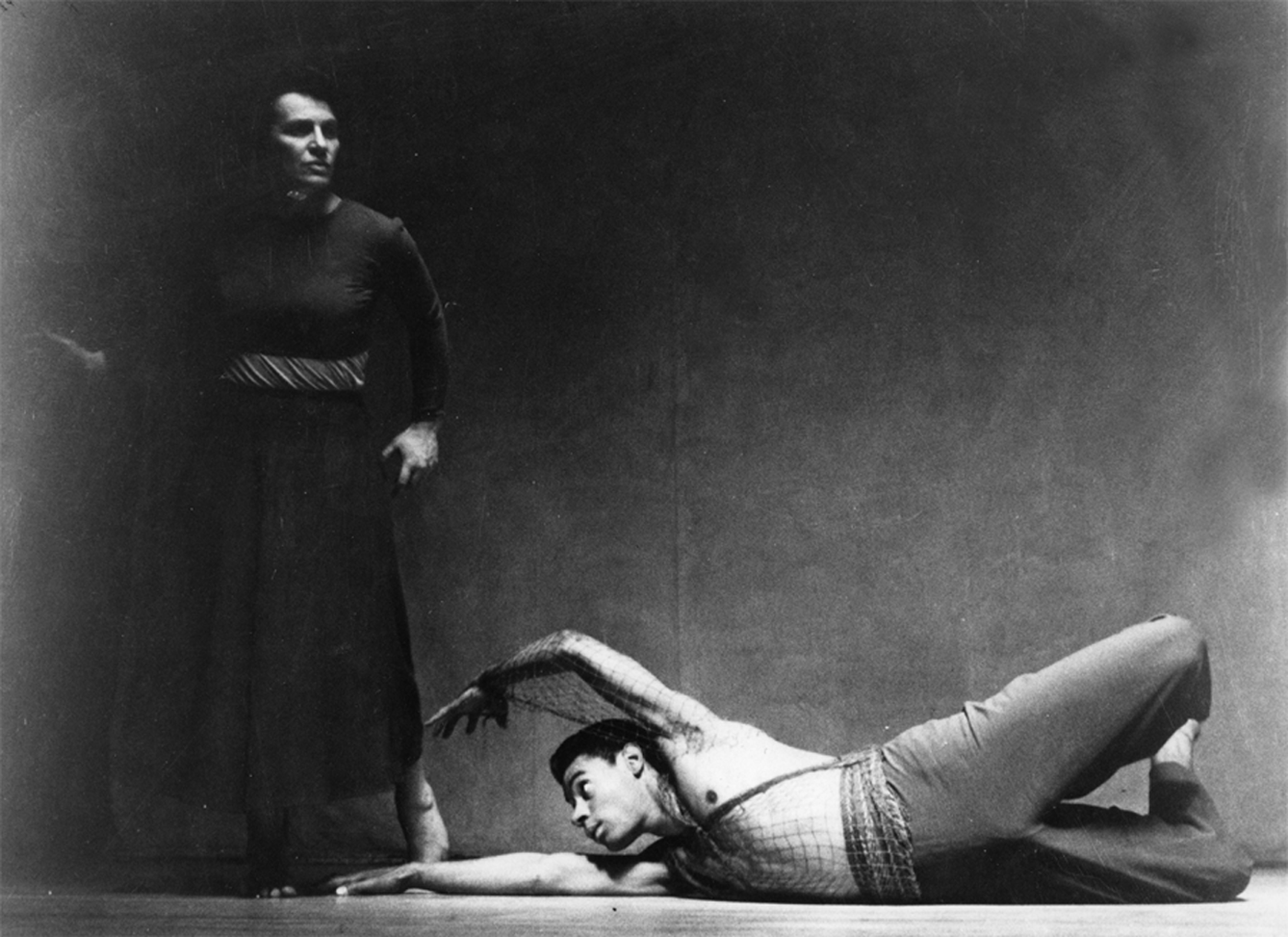
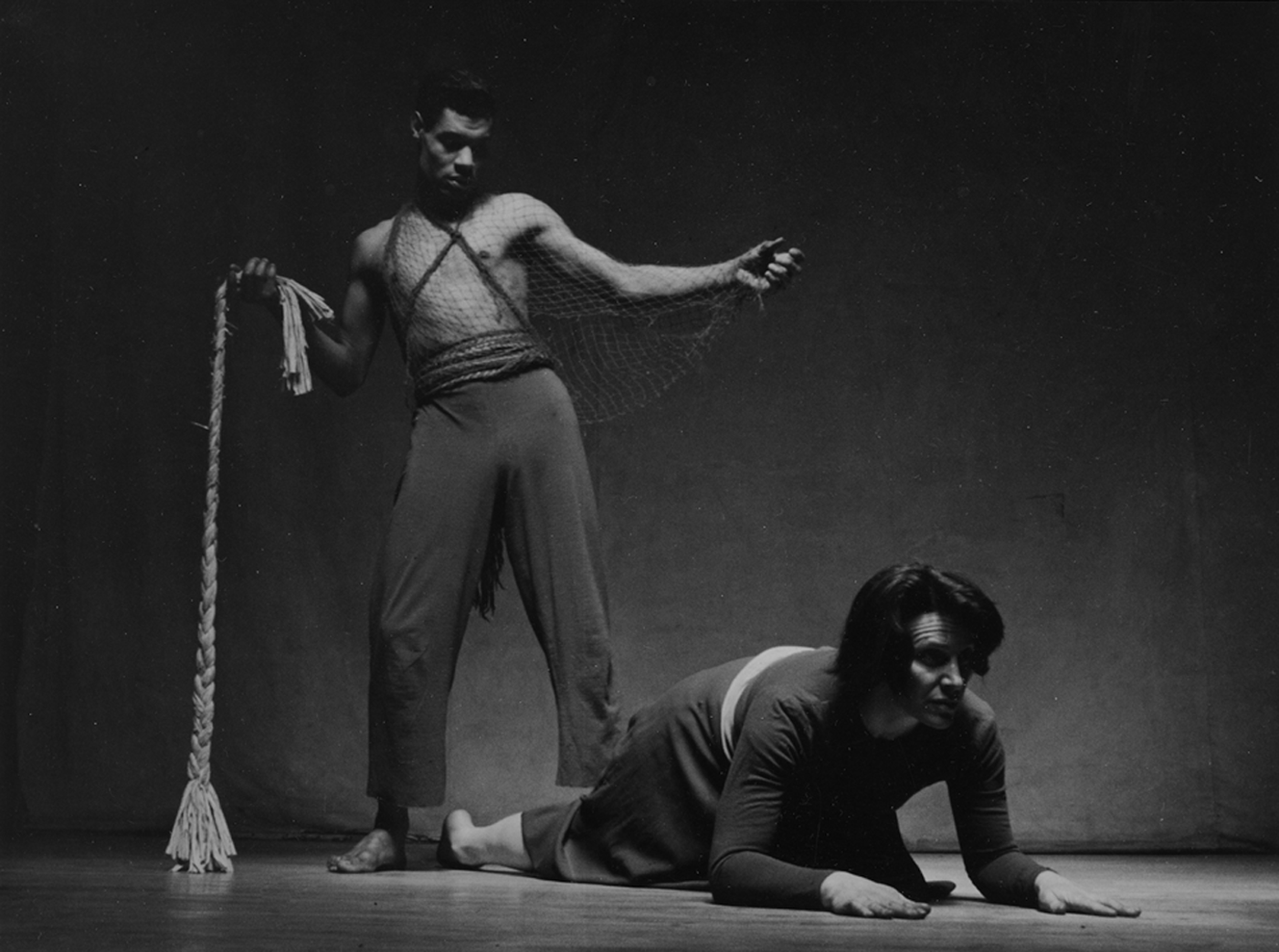
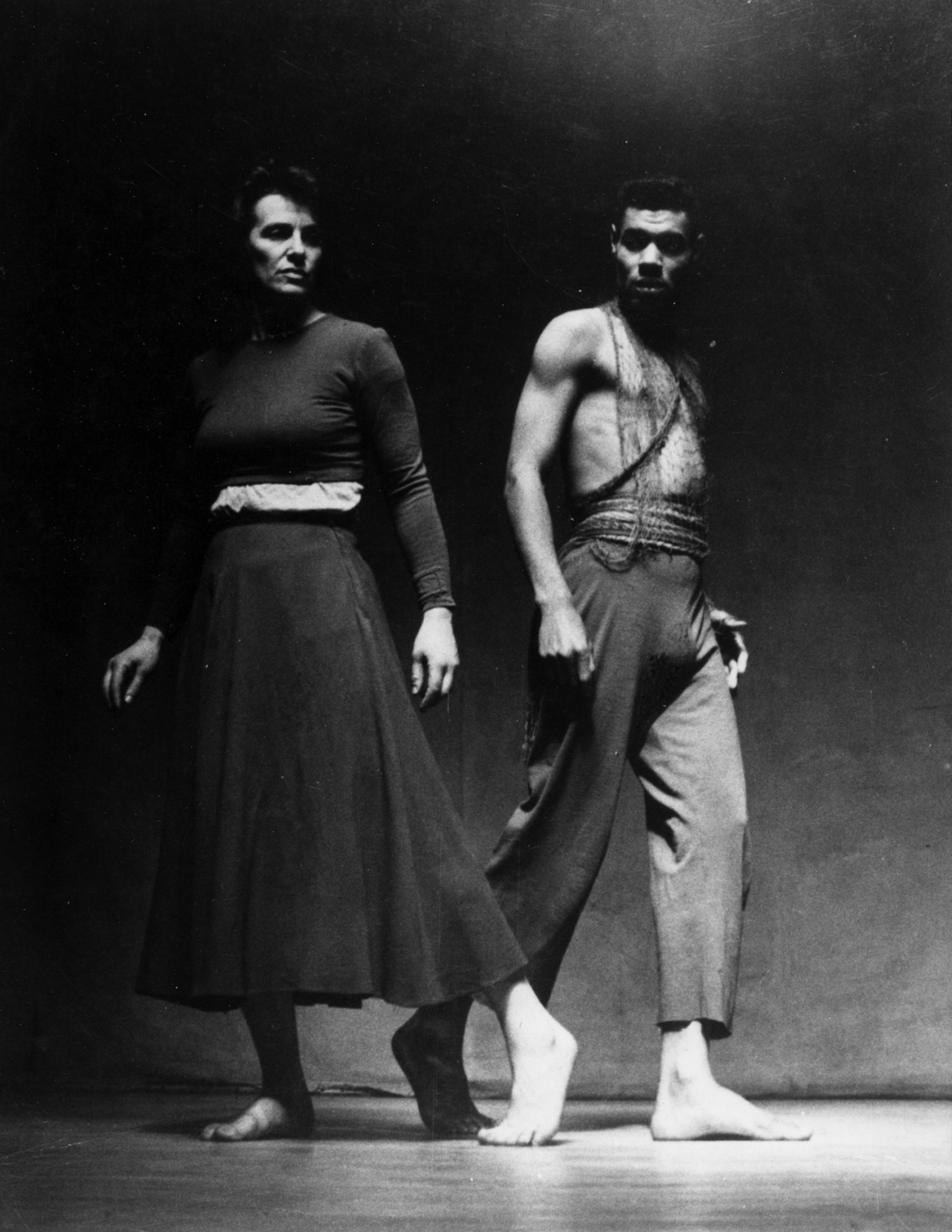
Early in the piece, Marchant's character tries to escape from the oppression in which he dwells. At one stage in the work's development, Boas felt that the Negro should be prevented from fleeing by a group of “his blinded fellow men” that swarms him. In rehearsals, she refined this idea, instead suggesting that the Negro should be stopped by a group of white dancers who perform a “symbolic lynching.” At another point in the piece, Marchant stands on one side of the block while Boas sits on the other (see Photo 2). They face away from each other while the whip hanging over the block divides and calls attention to the symbolism of the distance between them. As the dance progresses, a struggle ensues between the Negro and Boas as the blind white ringleader. Boas's character crouches on a block-like structure, as if ready to strike (see Photo 3). Using a rope prop as a whip, she looks off in the distance. Sitting directly beneath her with his arms above his head as if surrendering is Marchant, as the Negro, as if alluding to the violence unleashed on slaves. Boas dismounts her perch by stepping on Marchant's back (see Photo 4). During this section of the piece, the balance of power shifts between the two. This section ends with the Negro discovering that he is actually the stronger of the two—that he can manipulate and control the whip and the ringleader's ability to move (see Photos 5–7).
Franziska Boas and Claude Marchant in their dance drama, 1945. Photographer: P. A. Dearborn. Photograph courtesy of Gertrud (“Trudel”) Michelson.
Franziska Boas and Claude Marchant in their dance drama, 1945. Photographer: P. A. Dearborn. Photograph courtesy of Gertrud (“Trudel”) Michelson.
Franziska Boas and Claude Marchant in their dance drama, 1945. Photographer: P. A. Dearborn. Photograph courtesy of Gertrud (“Trudel”) Michelson.
Franziska Boas and Claude Marchant in their dance drama, 1945. Photographer: P. A. Dearborn. Photograph courtesy of Gertrud (“Trudel”) Michelson.
Franziska Boas and Claude Marchant in their dance drama, 1945. Photographer: P. A. Dearborn. Photograph courtesy of Gertrud (“Trudel”) Michelson.
Franziska Boas and Claude Marchant in their dance drama, 1945. Photographer: P. A. Dearborn. Photograph courtesy of Gertrud (“Trudel”) Michelson.

The rest of the piece explores ways to find a peaceful resolution to discrimination and racial violence. During this section, the White Man character tells his companions to honor the Negro. The white performers then begin to dance in a circle around and with the Negro. Despite this acceptance of difference and diversity, this was not the end of the work, as Boas saw the figures as “shadows because they are not yet free agents.”Footnote 46 As the dance continues, the Negro and the White Man are stranded together in a “vast emptiness.” Accompanied by funereal music, they at first pass each other without seeing one another (see Photo 8), but gradually converge in larger groups as they search for a leader and “the right way which they find.”Footnote 47
Franziska Boas and Claude Marchant in their dance drama, 1945. Photographer: P. A. Dearborn. Photograph courtesy of Gertrud (“Trudel”) Michelson.
The dance drama ends as the characters work and play together “without thought of color or creed.” The conclusion of the work, according to Boas, was intended to show that the way to end racism in the United States was through “comradeship.”Footnote 48
Unfortunately, the “dance-drama” was never performed publicly. Boas and Marchant had a quarrel, and Marchant ended up leaving Boas's studio during the summer of 1945. The disagreement arose after Boas left her New York studio in Marchant's care while she was in Bolton Landing.Footnote 49 Apparently, there had been complaints about various infractions of Boas's rental lease, including one incident when the police had been summoned because of complaints about excessive noise.Footnote 50 Marchant was indignant and hotly denied the allegations when confronted by Boas.Footnote 51 By the beginning of August 1945, just as Boas was completing her first interracial summer school, she asked Claude Marchant to leave.Footnote 52
Conflicts between a teacher and her associate left to run the school are hardly unique to the Boas School of Dance, yet Boas's choice to fire Marchant seems severe. In the absence of all of the details, it is only possible to speculate about why this incident led to the end of Boas's and Marchant's professional association—speculation attuned to the prevalence of white privilege. For example, did Boas express any skepticism about the nature of the noise complaint? Was the complaint racialized in any way? Marchant rejected the claim that the percussion accompaniment in his classes had been too loud, so was there a possibility that the complainant was responding not to excessive volume, but to the particular rhythms that might be identified as African, ethnic, and/or “foreign”? Similarly, was the complainant aware that Marchant was in charge? If so, was the exercise of custodial authority by a young African-American man perceived as troubling? Did it cause a cognitive dissonance too overwhelming to accept by whoever called the police?
The employer/employee relationship is by nature hierarchical, but the power imbalance between Boas, a white woman and the boss, and Marchant, an African-American man and a member of her staff, was underscored with the unfolding of a real-life dance drama not entirely unlike the one that they had created in the studio in terms of its expression of troubled interracial relations. Being entrusted with the stewardship of the Boas School of Dance cast Marchant in the role of an African-American in the process of obtaining experience that ostensibly could help him “escape” stereotypical employment scenarios. Thus, the responsibility could not help but be imbued with racialized significance for Marchant.
It is also possible to suggest that the extent of Boas's liberalism was tested when her own security was at risk.Footnote 53 Indeed, her personal financial situation was always one step away from disaster. New York was an expensive city, and she was in a vocation that was not financially lucrative at the best of times. Therefore, she possibly was frightened of losing the lease for the studios and had to act swiftly to appease her landlord, with whom she had ongoing difficulties. To be fair, it was not only her own interests that were at stake. Boas no doubt would have wanted to continue to waive tuition to make her classes accessible to her economically disadvantaged students, including African Americans, and she also had other employees whose livelihoods she would have not wanted to put at risk, including her other African-American employees such as her longtime secretary, Gertrude Martin.
Importantly, Boas and Marchant eventually were able to resolve this impasse through “comradeship,” as the original dance drama proposed. They later renewed their friendship and remained in contact until the end of Boas's life. Yet, immediately after the incident, Boas took swift and definitive action, which placed her business before Marchant. Whether intended or not, the resulting impression is that Marchant's voice—the voice of a young African-American man—was not heard.
Despite the end of Marchant's formal affiliation with the Boas School of Dance, there is one positive outcome of the Boas–Marchant collaboration worth noting: Boas's decision to start the Boas Dance Group, her student company, which ran from 1945 to 1947. Not surprisingly, Boas insisted that the group be interracial, and throughout the company's short existence there were different African-American and other non-white members including Betty Peters, a student at New York University; Lei Smith, a young woman from Hawaii who was a student at the New York School of Social Work; and Minnie Willis, who performed in the Boas Dance Group's only public performance in April 1946 (“We Visit a Night School for Dancers” 1946).
How interracial disagreements were handled during the Civil Rights Movement requires further scholarly attention and, as a result, Boas's “failures” in interracial collaboration are particularly illuminating.Footnote 54 Beyond her attempted interracial collaboration with Marchant, Boas also tried to codevelop a business association with Katherine Dunham, a dancer of mixed racial heritage who was heralded as one of the major figures in the history of African-American modern dance.Footnote 55 From January to June of 1944, Boas taught for Dunham's interracial school.Footnote 56 In the fall of 1944, Dunham was attempting to establish a permanent school and create a second company. She consulted Boas about the organizational and administrative details of Boas's school, and even considered buying or leasing the building that housed Boas's studio space, in order to give her own school a permanent home.Footnote 57 For a while, notices about Dunham's school listed Boas as a faculty member and the address for Boas's studio—323 West 21st Street—was used on the school's letterhead.Footnote 58
Dunham also appears to have wanted Boas to teach at her school. As she wrote to Boas at the time, “I would be very happy to have you join me in this because I have so much confidence both in your understanding of the material which you teach as well as in your understanding of the whole wide scope of function in movement.”Footnote 59 Initially, Boas was quite agreeable to the proposed collaboration. Not only would the administrative support supplied by Dunham be welcome, but also, Boas was interested in the possibility of artistic partnership. As she wrote to Dunham, “I am extremely anxious to compose some dances for a mixed group of white and Negro men and women, and would like to be able to have some sort of agreement with you that my students could work in some of your classes and yours in some of mine if they wish it.”Footnote 60
By February 1945, however, the proposed venture had soured. Conflicts appear to have become insurmountable between Boas, another teacher for Dunham, Talley Beatty, and Emily Hamilton, Dunham's appointed administrator. Boas, whom Dunham envisioned as teaching percussion and body mechanics while emphasizing the “social anthropological aspects of dance,” seems to have had concerns about not having a voice in other aspects of the school.Footnote 61 Dunham regretted the failure of the plan, writing:
I did think and still do think that your particular approach to the fundamentals of movement of learning is a good one and I want very badly to be associated with you because I would always have the same problem of not finding in my own Company, people who are mature enough in thought to be able to properly teach beginners.Footnote 62
Even given her apparently strong desire to work with Boas, when Dunham reopened her interracial school in the fall of 1945, Boas was no longer affiliated as an instructor, though she remained on amicable terms with Dunham.Footnote 63
Boas's relationship with Dunham is important because it demonstrates that white artists/activists did not always hold the position of power in their interaction with African-American colleagues. Dunham, an artist whose racial and ethnic background marked her as “colored” and therefore a target of racial discrimination, was ecumenical in her dealings with her white dance peers, yet she had a clear plan for her school and did not allow herself to be swayed by the advice of an outsider like Boas. More to the point, Dunham was better known than Boas and had a nationally and internationally lauded career and company. She also had more staff and students than Boas did. If Boas was hoping for a partnership, it is understandable if Dunham had conceived of the alliance in hierarchical terms.
While neither of her collaborations with Marchant or Dunham ended the way Boas might have wished, they nevertheless are important. Race apparently was never mentioned during the disputes (or, more accurately, is not part of the historical documentation). Yet, when viewed together, these two incidents revivify and complicate notions of white privilege in interracial collaborations. On the one hand, that Boas was able to maintain cordial relations with Marchant and Dunham, despite the lack of consensus about the best model of collaborative engagement, arguably demonstrates an ethos of mutual respect that extended to personal, employment, and business dealings, and helps to define mid-century modern dance in New York as socially progressive. However, it is also imperative to remember that, in both instances, Boas ultimately remained in control of the options she exercised: to dismiss Marchant and not to adhere to employment terms with Dunham that did not suit her. Few of her African-American counterparts had this luxury of choice.
White Advocacy and Advice
Another civil rights strategy evident in Boas's career was a desire to publicize the hardships faced by African-American dancers and to advocate for opportunities for African-American dancers while simultaneously offering African-American dancers advice on how best to negotiate performance opportunities in order to avoid racist stereotypes and exploitation. In addition to exemplifying Boas's good intentions, this strategy, in which a white woman provided professional advice to young African-American dancers, is another unwittingly example of how white privilege was a subcutaneous presence in the Civil Rights Movement.
First, it is important to note that creative dance, the type of movement that Boas taught, can be seen as having implications for her racial equality agenda. As one of the first graduates of the New York Wigman School, Boas had been introduced to the transplanted principles and practices of Ausdruckstanz via the school's main teacher, Hanya Holm. In her own studio, Boas continued the Ausdruckstanz emphasis on the potential of movement to convey emotion and the use of structured improvisation as a means to hone technical ability and individual choreographic expression. Specifically, she rejected the impulse to create a mimetic and fixed self-named modern dance technique that implicitly defined “good” students as those who emulated her the most closely and “bad” students as those who could not. Instead, creative dance was arguably more aligned with the educational theories of John Dewey insofar as Boas implemented a student-centered approach focused on helping each dancer to develop his or her unique creativity.
Ironically, this belief in the inclusiveness and accessibility of creative dance led Boas to exclude certain genres from her roster of acceptable dance forms. Most prominently, Boas urged her students, particularly her African-American students, to forfeit commercial dance opportunities such as those provided by performing in Broadway shows. In 1949, for instance, she was invited to speak at a meeting of the International Council for Negro Folklore, held at the 110th Street Community Center, an institution whose mandate was “the advancement of intercultural living.”Footnote 64 The title of her talk on June 8 was “The Negro and the Dance.”Footnote 65 That same year, Boas's article, “The Negro and the Dance as an Art,” was published in the journal, Phylon: The Atlanta University Review of Race and Culture (Boas Reference Boas1949). In this article, and in her talk, Boas articulated her belief that dance as an art and dance as a craft or show business were so incompatible that she felt that a dancer must choose between them. While the creative artist independently must search internally for themes for composition, she dismissed the Broadway dancer as a reproductive artist.Footnote 66
When applying this belief to the issue of race in her article, Boas championed the artistic freedom that defined creative dance as representative of and the means to social freedom and inclusion. Specifically, in “The Negro and the Dance as an Art,” Boas urged African-American dancers not to collude with their own cultural marginalization by endorsing the apparent white prejudice that African Americans are entertainers, not artists. She felt that many talented dancers had been marginalized because the only way they could perform was if they presented, expected, and therefore, accepted, stereotypes of traditional or pseudo-ethnic dances, or allowed themselves to be exploited as western-defined “exotics” in commercial productions.
Frustratingly, it is unclear which commercial productions Boas was referencing in her article. Was her article a veiled critique of Dunham's choreography in productions like Tropical Revue (1943–1944), Carib Song (1945), or Bal Nègre (1946)? Was Boas opposed to the 1946 revival of Show Boat, which was choreographed by Helen Tamiris and featured the Trinidadian-born dance artist Pearl Primus? Or, were her words aimed at Calypso, a production renamed Carribean Carnival (1947), which Primus choreographed and which contained works like Rookombay that were performed by her former associate Claude Marchant and Josephine Premice, another artist who had taken classes with Boas?
What is clear, however, is that the “entertainer,” according to Boas, was someone who simply capitalized on natural ability to perform “hip-swinging” and sensationalist dances. (Curiously, Boas did not question the racial stereotype embedded in the use of the phrase “natural ability.”) Instead, she advised that the “artist” was the product of years of serious training and became a vehicle for important “Art.” In her article, Boas depicts how the image of African-American dancers as entertainers can be used to argue that racial equality had been achieved because talented dancers were being allowed to perform in public, but at the same time, the image of these dancers as entertainers reinforces negative stereotypes about unschooled performance and/or overt sexuality. In her article, Boas peeled away the cultural mythology that African Americans were purveyors of so-called “low-brow entertainment,” while the realm of the more intellectually challenging “high art” was the exclusive purview of white people.
In a very real sense, Boas was responding to audiences and dance reviewers who held preconceived ideas about types of dance suitable for African Americans to perform. For example, even as late as 1963, during some of the most passionate years of the Civil Rights Movement in the United States, John Martin, the well-respected dance critic for The New York Times, wrote in his John Martin's Book of the Dance,
Certainly the [racially] “integrated” company is a normal artistic development, and the only problem it involves is to keep the Negro dancer from having to pretend to be what he is not and to deny what he is.
Race—exactly like sex, age, height, vocal range, temperament—carries with it its own index of appropriateness. (Reference Martin1963, 189)Footnote 67
The issue of the “appropriate” kind of dance for African-American dancers was a subject of discussion not only among white people, but among African Americans as well. For instance, Leonore Cox, an African-American dancer and instructor at the Lincoln School for Nurses, called for more dance training for African Americans to prepare them for “concert dance,” while simultaneously urging them not to reproduce the aesthetics of other artists: “Let us choose themes not merely because other people do them, but because they are significant enough to us to dance them, to dance them not as other groups have danced them, nor as other groups might dance them, but the way we, as Negroes respond to them. Let us continue to create—not imitate” (Reference Cox1936, 55).
The suitability of modern dance for African Americans was debated in magazines such as Dance Observer. After the Broadway debut of Pearl Primus in 1944, for instance, writer Lois Balcom responded to one viewer's opinion that Primus would “never be a great modern dancer because she can't get away from her race,” by suggesting that the very genesis of modern dance was to be found in the pursuit of individuality. To that end, Balcom counseled Primus to avoid stereotypical expectations (Reference Balcom1944a, Reference Balcom1944b).Footnote 68 Similarly, Dance Observer writer George W. Beiswanger made a particularly passionate call for racial equality on the stage:
The theory that the Negro should do—and no one else—his own special kind of dancing … is the last refuge of race prejudice. We permit ourselves the notion because it seems to pay the Negro so fine a compliment. But what kind of compliment is it which carries the implication, tacitly embraced if not openly stated, that to the Negro all other realms of dance are racially closed? … [I]t is necessary and high time to assert with conviction and vehemence that the Negro has just as much right to the entire heritage of human dance as anyone else and that there are those of his race with the natural abilities and spiritual impulses to lay claim to that heritage. (Reference Beiswanger1943, 40)
At the opposite end of the spectrum of opinions were many African Americans who believed that dance invested with markers of their African heritage were to be avoided. After establishing the Negro Dance Group, one of her earliest dance companies, Katherine Dunham allegedly discovered that the word “Negro” displeased many of the very people she had intended to attract—African Americans. According to Dunham, “[T]he Negro mothers immediately disapproved! They refused to send their children to me for fear they might be taught Negro dancing” [Emphasis in original] (Dunham quoted in Foulkes Reference Foulkes2002, 56). Tellingly, the ballet classes Dunham offered had no trouble drawing African-American students. Similarly, after Ellen Wimmer, one of Boas's white students, had studied creative dance for approximately five years, she began to teach for Boas in the 1940s. One of her first assignments was to give lessons at a community center in Harlem. However, she soon learned that the children in her class did not want to do movements that resembled or evoked traditional African dancing, which they rejected with disdain.Footnote 69 Thus, this self-censorship by some people within the New York African-American community suggested that dance was viewed as a means of social mobility, either “up” or “down.”
For her part, in “The Negro and the Dance as an Art” (1949), Boas counseled that the most effective solution to the problems faced by African-American dancers was the creative dance training she offered at her school. In this way, Boas reasoned, the African-American dancer would be able to avoid the trap of commercialization and conversely value the ideas and emotions expressed through the movement because natural body rhythms were independent of national or ethnic dance forms.
As Anthea Kraut has noted, during the 1920s and 1930s, African-American artists both exploited and rejected “primitivist notions, often in debates over the relationship between black folk culture, race and nation” (2008, 214). For instance, Zora Neale Hurston's efforts to produce “black folk dance” in commercial venues raise the issue of authenticity. As Kraut writes, “[I]n mobilizing the rhetoric of authenticity, Hurston placed her concert squarely within a long tradition of commercialized representations of black culture. Her revues thus force one to confront the ways in which she was simultaneously critical of and complicit with the marketplace's operation and effects” (2008, xi).
As with the work and performances of other artists conversant in the aesthetics associated with the African diaspora, it is not known if Boas was, in part, thinking about and commenting on Zora Neale Hurston's “black folk revue” while writing her article. Yet, in any case, Boas does not appear to be aware of the paradox inherent in the cultural work performed by people like Hurston and illuminated by Kraut in the following way:
As African American woman working with black folk dance in the 1930s, Hurston faced a distinct if not singular dilemma: calling attention to her methodical orchestration of her stage material and her active training of cast members compromised the perceived naturalness of her revue, yet downplaying her own artistic agency meant forgoing credit for the creativity and labor that under wrote her concert. (2008, 55)
“The Negro and the Dance as an Art” suggests that this balancing act between authenticity and authorship that Hurston and others attempted to enact was not detectable to Boas, who only saw the primitivist imagery in the unnamed productions she rejected.
While “The Negro and the Dance as an Art” provides a provocative entry into mid-twentieth-century attitudes toward racialized categories of acceptability in dance, as a civil rights strategy, it also illuminates the thorny and rarely broached issue of white self-interest in the politics of civil rights activism. Instead of chipping away the cultural mythology of African-American performance ability in her article, Boas actually adds to the layers of stereotypical representation. Implicit in her urging of African-American dancers to eschew their heritage in favor of so-called high art is the belief that traditional ethnic dances are not high art and do not require intensive training. In other words, there is one definition of high art—Boas's definition (Foulkes Reference Foulkes2002, 75; Lindgren Reference Lindgren2000, Reference Lindgren2005). Moreover, throughout her article, Boas consistently reduces all African Americans to a single entity, “the Negro,” thereby eliminating the possibility of diversity and choice within the African-American community. In this respect, Boas evokes the experience of those African Americans who participated in the Negro Units of the Federal Theatre Project during the 1930s in the United States. Critics attending the performances by the Negro Units usually circumvented opportunities for cultural transformation by using race authenticity as a barometer for acceptability and evaluating performances based on stereotyped expectations (Fraden Reference Fraden1996, 8). Furthermore, when Boas advocated that to gain respectability African-American dancers should become creative modern dancers, she was being rather duplicitous, because as a teacher of creative modern dance, she had a clear financial interest in attracting students to her studio, which at the time was only months away from collapsing under its debt load. Finally, though Boas's approach was to help dancers find their own movement styles and vocabularies through structured improvisations, Boas paradoxically advanced a belief that in order to find their own creativity, students needed her watchful eye and comments. In this way, the opinions of a white person are implicitly invested with authority as an unquestioned norm.Footnote 70 As a result, Boas's article re-inscribes white privilege insofar as it implicitly asserts white authority as “natural” and best able to establish standards of evaluation and judgment.
Unfortunately, given Boas's activist intentions, her article evokes the paternalism that is a salient feature in the history of race relations in the United States.Footnote 71 Rooted in Christianity, the paternalist movement took root in the lower South (primarily South Carolina) in the early 1800s as a way to rationalize and recast slavery in terms that emphasized white responsibility for slaves who in turn were expected to be grateful and obedient. As Lacy K. Ford argues, paternalism was never an accurate reflection of reality and was a concept critiqued during the same period it was promoted, even as it gained credence in the upper South (particularly Virginia) a few decades later. Nevertheless, “[t]he ideal of paternalism advanced as a trope through which more and more slaveholders understood themselves and their role as masters” (Ford Reference Ford2009, 8). While Boas obviously was not intending to conjure this trope in her article, the echoes of paternalism can be detected in the tone of her comments.
Boas's apparent blind spot regarding the importance of creative dance over all other dance experiences should not cloud an understanding of her commitment to making her studio accessible to all students, particularly African Americans. Nevertheless, in her article, “The Negro and the Dance as an Art,” Boas criticized “ethnic” dances in Broadway shows as demeaning, exploitive, and perpetuating negative stereotypes of African-American dancers, but she did so in a tone of paternal authority by implicitly claiming that she knew what was best for African Americans.
Quiet Activism
The final civil rights strategy to be examined is Boas's commitment to working within existing institutional structures to effect change—a tactic that defined her dance activism in the South. In other words, Boas's dance-related activities in the South can be read as deliberately, yet peacefully, challenging prevailing social values and attitudes. Granted, civil rights activism has been criticized by proponents of critical race theory “for its cautious, incremental quality” because “the system merely swallows up the small improvement one has made, and everything remains the same” (Delgado and Stefancic Reference Delgado and Stefancic2012, 63 & 64). Yet, Boas's “quiet activism” involving dance-related activities while working within organizational systems should remind theorists that attentiveness to historicization is needed when evaluating past antiracist efforts. In this way, Boas's quiet activism should be acknowledged as an important, nonlegislated contribution to the slow, but eventual, change in social attitudes within Georgia, and one of the only modes of social agitation that was possible in the face of the volatility of the southern United States during the 1950s and 1960s.
Throughout the 1940s in New York, while Boas undertook important and innovative work within the field of dance, her personal and administrative responsibilities became increasingly burdensome. She and her husband became estranged and eventually divorced in 1944. After the dissolution of her marriage, Boas struggled financially to keep her studio. Her problems were compounded by her continued insistence that her classes be accessible to students who were racially and economically disadvantaged. Thus, she continued to charge little, and sometimes nothing, for her instruction. In 1949, the problems became insurmountable.Footnote 72 During this period of professional havoc, Boas scrambled to find a position at a college or university. She canvassed friends and colleagues about the availability of dance jobs at post-secondary institutions, including those for African Americans.Footnote 73 She eventually found employment at Shorter College in Rome, Georgia.
At the time of her arrival, racial relations in Rome were typical of the southern United States in the early 1950s. African Americans and white people did not eat together in restaurants. They did not sit together on buses. Schools were not integrated. Similarly, waiting rooms and public washrooms were delineated by race. Even water fountains represented a divide that could not be breached without social and legal consequences, or, in the most frightening instances, violent repercussions. As one resident of Rome during the time period observed, “There were countless invisible and artificial barriers which were not to be crossed, especially by blacks, for whom there was no such thing as equality of opportunity.”Footnote 74 While there were numerous lower class white people in Rome, many of whom worked at the various textile mills and were ridiculed as “lintheads” and “white trash” by the more affluent local white residents, so too did this lower stratum of society expect to be afforded respect and deference by African Americans (Brattain Reference Brattain2001, 43 & 47).Footnote 75
Not all white people in the South, however, were complicit with racist laws and practices. Racial tensions in the southern United States following World War I had resulted in the formation of a Commission on Interracial Cooperation (a.k.a. Interracial Commission)—a nongovernmental group of white and African-American community leaders with the goal to further interracial cooperation.Footnote 76 In the early 1950s, the Commission had become the Southern Regional Council with various branch organizations, including the Georgia Council on Human Relations (a.k.a. Georgia Council), which was formed in 1953 and was dedicated to desegregating local businesses and promoting opportunities for peaceful interracial interaction. Subsisting on private donations, the Georgia Council helped adherents start chapters in their communities. The Rome chapter of the Georgia Council was created in October 1961.Footnote 77 Boas was a charter member and served as the organization's first chair from 1961 to 1962.
Among the Rome Council's successes was its functioning as a liaison between African-American groups agitating for their civil rights, and local businesses and the local police force.Footnote 78 The Rome Council was also active in lobbying boards of education to support desegregation of local schools and calling for the implementation of fair employment and classroom instruction policies.Footnote 79 The Rome Council similarly monitored the integration of African Americans into jobs and companies previously exclusively reserved for white people. Moreover, the organization undertook removal of discriminatory signs from the county courthouse.Footnote 80 Finally, members of the Rome Council, including Boas, regularly wrote letters to the local newspaper and city officials to commend progress when it was made, to correct bigoted statements, and to urge all citizens to work together for peaceful and equitable solutions to racial problems.Footnote 81
Given her visible and vocal presence in the campaign to desegregate Rome, Georgia, the question arises as to why Boas did not work to desegregate Shorter College, the institution where she worked. Perhaps personal concerns were a factor. Boas was putting her own career—and arguably her own physical safety—at risk by advocating for “Human Rights” in the white college setting. Moreover, while she had power in relation to her students, as a contracted instructor of dance—a subject that held a tenuous position within the academy—Boas had little authority within Shorter College.
Within the context of the educational system of Shorter College, Boas's activist efforts were more muted than the actions of the Rome (Georgia) Council of Human Relations. Nevertheless, she embedded social critiques into the curriculum. For instance, Boas appears to have used her lectures on non-European dance to promote an understanding of non-European cultures that was respectful and laudatory. She criticized culture in the United States, specifically, and Western culture, in general, for the damage caused by white people's actions towards non-white and non-industrialized societies. Finally, in many of her classes about non-European dance, Boas promulgated the idea that cultural beliefs were learned, thereby implying that while dominant social opinions in the South had been naturalized, they were not “natural.”Footnote 82 In her lectures about non-European dance, Boas spoke of the negative impact of the “white man” in boldface terms. At the beginning of her “Dance in non-European Cultures” course in defining the perimeters of the material to be studied, she stated that the course would not tread near “those territories that have been too heavily tainted by the culture of the white man.”Footnote 83 She told her students that they would focus primarily on the practices of indigenous cultures still intact, despite that fact that “the white man and his culture has [sic] persistently destroyed those native cultures with which he has had contact.”Footnote 84 Even more provocative were the words that Boas crossed out of her speaking text in which she coupled cultural insensitivity with religion: “As long as the white-man and particularly the American must be a missionary there is very little hope for change of attitude. The bulldozer can well be used to symbolize the behavior pattern of the American when confronted with any stranger….”Footnote 85 At the lectern, however, Boas used less vitriolic words and instead told her students that as communications technology increasingly diminished the metaphoric distance between cultures, the “stronger” culture would always dominate and therefore, Western culture needed to be careful not to destroy different cultures when it came into contact with them.Footnote 86
Despite her critique, Boas's conflation of “Americanness” and “whiteness” unintentionally reaffirms the latter as the national “face” and norm. Moreover, it is unclear if Boas ever broached the topic of more inferential forms of racism—racism that George Lipsitz has defined as “a system of structured inequality that allows white people to remain self-satisfied and smug about their own innocence” (Reference Lipsitz2006, 46). It is unknown how students responded to Boas's comments and what, if any, ensuing in-class or after-class conversations occurred. Did engaging with racism at the level of power imbalances between Western and other cultures allow students to ignore the more individualized and personal examples closer to home?
Beyond her lectures, Boas requested that students make charts for the dances of various non-European cultures in her assignments. Besides identifying the place, names of the dances, and formal aesthetic elements such as space patterns, gesture patterns, musical rhythms, and instruments used, Boas required students to think about dance from a functionalist perspective by asking them to list the social purposes of dances within various cultures.Footnote 87 In so doing, she emphasized that dance allowed its participants—in the societies studied, this often meant the entire community—to gather and to express shared desires and values through movement. Dance was a way to communicate and reaffirm the bonds that connected individuals to each other and to the history of their cultures. For her exams on non-European dance, Boas included questions inspired by her father's anthropological theories, such as “What is meant by ‘cultural relativity’?” and “Are there any ‘pure’ human races?”Footnote 88
Outside of the formal classroom setting, Boas appears to have tried to foster interracial interaction by helping students, particularly those who were members of the College's Dance Club (a student group open to anyone who wanted to choreograph and dance on an extracurricular basis), to participate in activities organized by the Georgia Dance Association. In 1955, for instance, the group travelled to Spelman College, a college for African-American women in Atlanta, to watch Pearl Primus perform.Footnote 89 The events not only showed Boas's students the possibilities of dance beyond the state of Georgia, but facilitated a cultural dialogue through dance between the North and South, and African Americans and white students.
Although the responses of the students who participated in these fieldtrips are unknown, this example of “education in the guise of entertainment,” to borrow George Lipsitz's phrase, raises questions about how Boas's young white students would have viewed their African-American counterparts as well as the African-American artists to which they were exposed on these excursions. To what extent did the white students only allow themselves to act as “consumers” of African-American culture instead of being transformed by the personal engagement with the artists? Similarly, to what extent was it possible for the students to compartmentalize respect for the talented African-American artists they saw and keep this respect separate from the more spurious and recalcitrantly negative attitudes they might feel toward the African Americans with whom they interacted on a daily basis? Finally, the very fact that these Shorter College students had the financial means and time to participate in these field trips underscores their white privilege.
Boas's use of her position at Shorter College to influence her students raises the issue of activist pedagogy as well as invites a debate about the social role of educational institutions. It is possible to argue that Boas tried to persuade her students to recognize their own complicity in maintaining the racist status quo. By placing questions about racial purity on exams—exams that could be given failing grades—it is possible to accuse Boas of strong-arming her students into writing what they knew their professor wanted to read. Boas's critics no doubt would claim that reiteration does not equate with education. Thus, the appropriateness of Boas's use of her position as a professor and her classroom to promote her political ideology might be questionable, even if the goal was attempting to stop racism. At the very least, Boas's lectures about non-European dance exemplify how education always inculcates—always communicates a value system—whether conservative or progressive in ideological allegiance, explicitly or implicitly, deliberately or unintentionally.
Researchers who conducted a study about racism involving school children in Philadelphia in 1948 most likely would have appreciated the tactics Boas used in her quiet activism (Mackenzie Reference Mackenzie1948). (Although it is unclear that Boas's actions were directly motivated by this study, she was aware of it.Footnote 90) Starting from the assumption that racism was a learned, not innate, phenomenon, the experiment tracked 400 children from disparate backgrounds. The researchers concluded that educational environments had the potential to influence young students' social and political views, and that, regardless of the subject matter, as a figure of authority, the teacher had the power to sway students. Therefore, the teacher's attitude towards different people and groups was always instructional, whether intentionally so or not. The researchers discovered that an effective method to address and dispel negative stereotypes was through the introduction of positive images. For instance, in the experiment, a group of school children who believed that all Jewish people were in the retail business were taken to the office of a dentist who—much to the amazement of the children—was Jewish. Similarly, children who had voiced a belief that African Americans were dangerous criminals visited the well-kept homes of cordial African Americans.
Boas would not have been able to take her white students to the homes of African Americans without losing her job. However, her reading assignments and lectures about non-European dance provided a surrogate experience in confronting discriminatory convictions and offering more positive alternatives to consider. The subjects of the 1948 Philadelphia study were elementary-school aged. Therefore, it may not be safe to assume that the study's strategies and results are automatically transferrable to college-age students with the same results. Nevertheless, the memories of one of Boas's former students at Shorter College, Ellen Burks Zeller, confirm the effectiveness of this strategy:
One vivid memory I had regarding [Boas's] stand on Human Rights was walking into the lobby of the gym and seeing a big spread of articles from Life Magazine concerning integration. It was even more poignant because Jessie, the black custodian, was standing in front of the bulletin board reading every word. I had heard a little of [Boas's] opinion of the South, but this was my first experience with a strong pro integration statement from someone I knew well and admired. Having grown up in rural Alabama in a predominantly black, post civil war culture this had a strong influence on me.Footnote 91
It is hard to quantify the visceral and ideological impact of the kind of quiet activism Boas implemented while at Shorter College. Did the critiques she embedded into her lectures and her extracurricular activities take hold and manifest themselves as political action on the picket line or in the polling booth? Or, perhaps a more modest, but still important, outcome may have been the acceptance or a lack of fear of the societal change that ultimately occurred in the lifetime of her students.
Conclusion
Boas's use of dance as a form of social activism to facilitate interracial interaction contains important ideas beyond the strictly dance context. For instance, Boas's desire to create and facilitate opportunities for her students to participate in social activism indicates that she innately understood that her progressive views would have more of an impact on her students if they were not passive receivers, but instead actively tested, enacted, and adapted her ideas themselves. In this way, Boas's use of dance demonstrates that political theory is most empowering when embodied. Moreover, Boas's activism was directed at young adults in New York and in Rome, Georgia, who comprised the majority of her students—the demographic for whom power was in ascendance. By instilling in her New York and Lake George students the value of cooperative interracial ideals and by gently pushing her students at Shorter College to consider that southern attitudes towards race and gender were constructed not innate, Boas sought to alter the views and thus the actions of members of a generation about to inherit their society.
The fact that the arts, particularly dance, are often dismissed as trivial entertainment can be seen as having been used as an advantage in promoting racial equality. The seemingly “inconsequential” arts can be a powerful, unsuspected conduit for the kind of political commentary that might otherwise be censored in more official expressions. Instead of rallies, Boas held rehearsals. Instead of inciting crowds, she built coalitions of colleagues and inspired small groups of young adults who were about to embark on their lives as contributing members of their society.
Not only did Boas take advantage of dance's reputation of being socially insignificant and advocate a color blind approach to racism, but her activities were marked by her noncombative style and the fact that her interracial dance classes were nonlegislated. People could join or not. Her manner when introducing her ideas in places like Bolton Landing at Lake George or Shorter College was always conciliatory and “quiet.” To a very real extent, this method was the only practical way to proceed, as violence over race was but a misspoken word away, especially in the South during the period spanning Boas's career. To force the issue too strenuously was to court physical intimidation and harm. From twenty-first century and critical race theory perspectives, this approach to agitating for social change can be viewed as inefficient. Quiet activism is inevitably slow activism. In examining her civil rights strategies, it becomes apparent that Boas's career underscores the liminality of the self and society, and the potential for all educational experiences to be catalysts for change. During her lectures at Shorter College, for instance, Boas repeatedly emphasized that attitudes about race were the result of social indoctrination. As such, racist attitudes could be peeled away from racist actions. Thus, Boas's use of dance as a form of social activism reiterates that change is always possible.
Boas's career also demonstrates how facilitating opportunities for interaction can yield understanding. In other words, the discovery of commonality can be achieved simply by bringing people together. At some point in her career, Boas jotted a note on a scrap of paper, “My theme has been and still is to bring together the many isolated individuals who gradually come together to form one group.”Footnote 92 She included various examples such as facilitating meetings of the “oppressor and oppressed” in dialogues between white people and African Americans such as informally occurred in the classes in her New York school and the Boas Dance Group. In arranging, via the Georgia Dance Association, for dance artists from the northern United States to perform in the South, Boas was initiating conversations between the North and the South that began with dance but ideally would extend to other areas.
Boas was deeply dedicated to antiracist activism. Yet, her career also provides an opportunity to think about how white privilege could be reaffirmed through actions undertaken in the name of equality. To raise this issue is not to diminish Boas's career, but instead to use it to render white privilege visible, an important component in addressing inequality. Or, as Stephanie M. Wildman has suggested, “if whites do not see whiteness, they cannot see the privileges associated with it” (Reference Wildman2005, 248). Indeed, as Wildman goes on to counsel, “self-consciousness can be the first step toward action” (Reference Wildman2005, 265).
In this light, it is possible to note that the very fact that Boas had the choice whether or not to devote so much of her energy to the issue of race set her apart from the very people she wanted to assist—people who were inescapably, continually, and systemically reminded that they differed from the pervasive and unacknowledged assertion of white normativity. Choice also meant control over the level of engagement. How much were—and are—white people willing to risk to ensure racial parity? Their livelihoods? Their lives?
It is equally important, though no doubt troubling for proponents of activist dance practices, to consider if dance was not the agent of social change Boas had hoped, but instead a facilitator of the status quo. That is, could activism in the studio and the classroom provide the flexibility in systemic racism that enables it to continue? Could dance actually work to maintain inequality by assuaging white guilt, and providing moments of cathartic release and hope without effecting real social change?
The efficacy of strategies also needs to be addressed. One of Boas's main strategies was to treat all of her students the same regardless of race. However, does color-blindness really further white privilege if, as Ruth Frankenberg has asserted, “it averts the white gaze from the harsh realities of power imbalance” (1993, 189)?
This issue of power imbalance is a difficult one for white antiracist activists. How does a person capitalize on the social power she or he has in order to end it? The power imbalance Boas faced with Claude Marchant especially underscores how disagreements in hierarchical interracial relationships always have racialized implications. Similarly, white activist impulses must constantly be attuned to detecting and addressing racialized assumptions and paternalistic views that position white opinions as authoritative and unquestionable.
The use of dance to help traditionally marginalized demographics of people raises numerous complex and vexing issues, and invites further discussion. In the final assessment, however, it is clear that Boas's coupling of dance and social activism was motivated by her conviction that dance was a means to acquire personal and communal knowledge.Footnote 93 In turn, she believed knowledge would empower her students and affect their actions both in and beyond her classes. This infusion of a political ethos into a performing art defines Franziska Boas's career while simultaneously highlighting the potential for antiracist activism and the fortification of white privilege to coincide. The resulting lessons continue to instruct.