INTRODUCTION
Gelatinous macroplankton including cnidarian medusae, ctenophores and pelagic tunicates are widely recognized as key ecosystem consumers of energy and nutrients in coastal ecosystems (Pauly et al., Reference Pauly, Graham, Libralato, Morissette and Palomares2009; Purcell, Reference Purcell2009), and recent evidence of increasing occurrence and magnitude of these ‘jellies’ has generated considerable concern (e.g. Graham, Reference Graham2001; Brodeur et al., Reference Brodeur, Decker, Ciannelli, Purcell, Bond, Stabeno, Acuna and Hunt2008; Richardson et al., Reference Richardson, Bakun, Hays and Gibbons2009). This, however, is a product of human interactions with largely bloom-forming nuisance species around populated shallow coastal seas. In fact, these animals occupy all regions of the world's oceans—Arctic to Antarctic, surface to abyss—and are among the most conspicuous organisms of the deep mesopelagic and bathypelagic realms (e.g. Robison, Reference Robison2004). Observational information on these comparatively inaccessible animals is limited by technology and cost, thus basic distributional data are lacking from the largest habitable space (in terms of volume) on Earth due solely to absence of coverage.
The SERPENT Project (www.serpentproject.com) is a global collaboration between academia and the petroleum industry designed to facilitate scientific research using industrial remotely operated vehicles (ROVs) and other industry resources. Technological advances in deep-sea drilling combined with an increasing demand for petroleum has stimulated exploration and production in the Gulf of Mexico (Gulf), USA beyond the continental shelf. Moreover, the presence of large numbers of drillships, rigs and other structures, equipped with ROVs capable of working to 3000–4000 m, has provided a unique opportunity to study marine life in the mesopelagic and upper bathypelagic zones of the Gulf without the additional cost of operating expensive equipment and ships simply for observational purposes. In 2005 SERPENT began a regional programme (Gulf SERPENT) to study planktonic and nektonic marine organisms in the Gulf. In addition to conducting dedicated surveys for marine life with the ROVs, operators were encouraged to document any chance encounters with potentially interesting marine organisms.
In this paper we report four observations of the primarily deep-distributed medusa Stygiomedusa gigantea (Browne, Reference Browne1910; Cnidaria: Scyphozoa: Semaeostomeae) conducted from industrial ROVs participating in the Gulf SERPENT project. Collectively these four observations constitute the first records of S. gigantea from the Gulf. In addition to our data on the distributions and behaviour of S. gigantea in the Gulf, we have attempted to summarize all worldwide available records of the distribution of this large medusa in order to synthesize what is currently known of its habitat and ecology.
The class Semaeostomeae contains the largest known scyphomedusan genera including the genus Stygiomedusa. Members of this genus are characterized by a large disc shaped bell with four oral-arms and dark red-brown coloration (Kramp, Reference Kramp1961). One species S. gigantea Browne, Reference Browne1910 is currently recognized in this genus (Matsumoto et al., Reference Matsumoto, Raskoff and Lindsay2003), and earlier descriptions of S. fabulosa Russell Reference Russell1959 and S. stauchi Repelin, Reference Repelin1967 are considered synonyms.
Stygiomedusa is one of, if not the largest, invertebrate predator in many deep-sea ecosystems, yet very little is known about its distribution, diet, environmental tolerances, or behaviour. The majority of published S. gigantea records are from trawl or net samples. Direct observations of this large jellyfish from submersibles and ROVs are infrequent (Vinogradov & Shushkina, Reference Vinogradov and Shushkina2002; Drazen & Robison, Reference Drazen and Robison2004; Kitamura et al., Reference Kitamura, Miyake, Lindsay, Fujikura, Okutani and Maruyama2008). Specimens have been collected from, or observed in, the North Atlantic Ocean (Harbison et al., Reference Harbison, Smith and Backus1973), South Atlantic Ocean (Repelin, Reference Repelin1967), Southern Ocean (Larson, Reference Larson1986; Piatkowski et al., Reference Piatkowski, Rodhouse, White, Bone and Symon1994; Torres et al., Reference Torres, Burns, Denker, Daly, Ju, Friedlaender, Zhou and Morin2002; EGS-SCAR, 2006), the Gulf of California (Drazen & Robison, Reference Drazen and Robison2004) and the North Pacific (Burd & Thompson Reference Burd and Thompson2000; and possibly Vinogradov & Shushkina, Reference Vinogradov and Shushkina2002). There do not appear to be any published records of its existence in the Gulf of Mexico. Given the connection between the Gulf and the Atlantic, it is reasonable to suppose that S. gigantea is present within the mesopelagic and upper bathypelagic regions of the Gulf.
MATERIALS AND METHODS
Observations of Stygiomedusa gigantea were provided by industrial ROV teams participating in the Gulf SERPENT project. Each observation was the result of an opportunistic encounter where S. gigantea was observed during the course of routine industrial work. Participating ROVs were each equipped with an analogue colour video camera capable of transmitting NTSC video with a resolution of approximately 480 horizontal scan lines by 640 vertical scan lines. Video was transmitted to the surface and stored digitally on hard drives or DVDs. Videos were provided to the Gulf SERPENT project on DVDs in either DVD Video Object (.VOB), Audio/Video Interleave (.AVI), or Windows Media Video (WMV) formats. They were subsequently converted to Moving Picture Experts Group (.MPEG) files with MPEG-2 encoding using VideoRedo Plus (DRD Systems Inc.) or YASA Video Converter (Yasasoft). Still images were extracted from video frames using Topaz Moment (Topaz Labs Inc.) and deinterlaced using Adobe Photoshop. Measurements were performed by importing the resultant still images into Matlab. Original videos were archived on the SERPENT Project website (http://www.serpentproject.com/pubsuppmatl.php#benstygio).
We reviewed the Gulf SERPENT video database for any additional observations of S. gigantea and then searched peer-reviewed literature and non-peer-reviewed reports for records of S. gigantea. Unpublished (non-peer-reviewed) records of S. gigantea were located by searching the worldwide web using a variety of search engines, the Global Biodiversity Information Facility (GBIF), the Ocean Biogeographic Information System (OBIS), as well as other biogeography database websites. Museum collections were examined for archived material using the World Register of Marine Species specimen search and search engines linked to individual collections. On-line cruise reports from the Mar-Eco surveys of the Mid-Atlantic Ridge, Discovery 2010 and GLOBEC Southern Ocean Program were also searched for references to S. gigantea. Larson (Reference Larson1986) was used to locate collections or observations from early expeditions to the Southern Ocean, including the cruises of the USNS ‘Eltanin’. Additional metadata from the ‘Eltanin’ cruise stations were obtained from the University of Southern California (1965). Video libraries at the Monterey Bay Aquarium Research Institute (MBARI) were searched using the Video Annotation and Reference System (VARS) for S. gigantea. For every record we attempted to determine the collection depth, geographical coordinates, dates and times. All times recorded as GMT were converted to local times using the US Naval Observatory website (http://www.usno.navy.mil/USNO/astronomical-applications/data-services/rs-one-day-world). In cases where the collection depth was a range, the mean was used as an estimate of collection depth. The entire dataset was submitted to OBIS.
To evaluate evidence of S. gigantea vertical migration, we calculated the time elapsed since local sunrise or sunset for each observation and used this to assign observations to either day or night. In cases where there was continuous daylight, observations were assigned to daytime irrespective of their time of day. To compare the vertical distributions over the entire latitudinal range of the observations in the dataset, we normalized the depths by dividing the observed depth (or mean of a depth-range) by the bottom depth. If an observation included the bottom depth we used the original data, otherwise we estimated the bottom depth using GeoMapApp software (www.geomapapp.org), which accesses global bathymetry data with 30 × 30 arcsec resolution (Becker et al., Reference Becker, Sandwell, Smith, Braud, Binder, Depner, Fabre, Factor, Ingalls, Kim, Ladner, Marks, Nelson, Pharaoh, Trimmer, von Rosenberg, Wallace and Weatherall2009). In the few cases where the predicted bottom depth was less than the recorded maximum sampling depth, we used the maximum sampling depth as an estimate of the bottom depth. In order to examine the temperature and salinity ranges of S. gigantea, we used a subset of the dataset that included the temperature and salinity associated with each record.
RESULTS
Gulf of Mexico observations
A total of four individual Stygiomedusa gigantea were observed during 2005, 2006, 2008, and 2009. Each observation was the result of a chance encounter with the animal during routine industrial subsea work. Since the Gulf SERPENT programme was initiated in 2005, no S. gigantea were observed during dedicated surveys. The first Gulf observation occurred on October 30, 2005 at a depth of 1747 m (5730′) beneath the ‘Discoverer Deep Seas’ drillship (Table 1: observation 89; Figure 1). This observation occurred from 13:17:00–13:17:28 (local time) and the individual was videotaped by a Subsea7 ROV (Figure 1). The animal was swimming in the water column near the drilling riser with its oral arms extended.
Stygiomedusa gigantea below the ‘Discoverer Deep Seas’ in 2005.

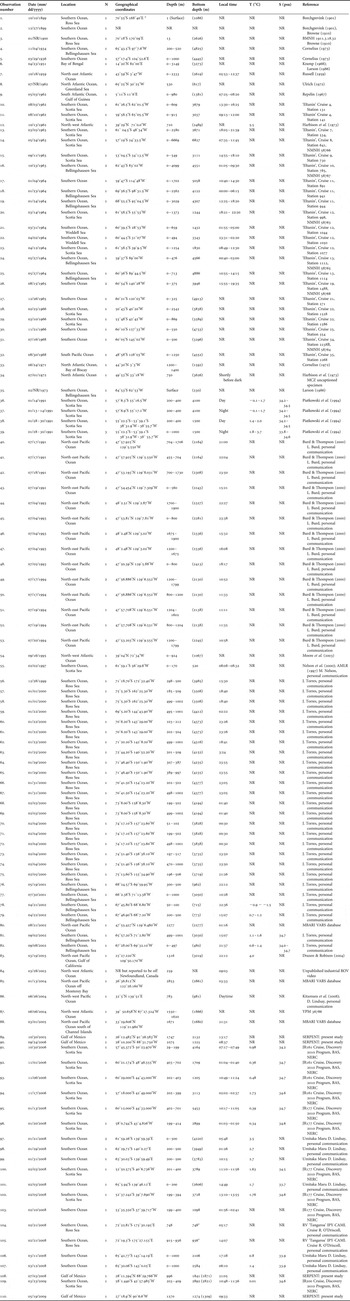
Worldwide collection/observation records of Stygiomedusa gigantea. When geographical coordinates delineated an area or transect, the arithmetic centre of the region was used as an estimate of the location. Collection times are local time and indicate the time interval during which the net was fished or the duration of the observation. Single times are assumed to indicate recovery time. Where single times are listed, they are (or are assumed to indicate) the end of the observation or collection. Time-ranges indicate the period spanning the sampling interval of a net. NR, unreported; CD, continuous daylight; *, estimated. Bottom depths in parentheses were estimated from Becker et al. (Reference Becker, Sandwell, Smith, Braud, Binder, Depner, Fabre, Factor, Ingalls, Kim, Ladner, Marks, Nelson, Pharaoh, Trimmer, von Rosenberg, Wallace and Weatherall2009) using GeoMapApp. Museum abbreviations follow Leviton et al. (Reference Leviton, Gibbs, Heal and Dawson1985).

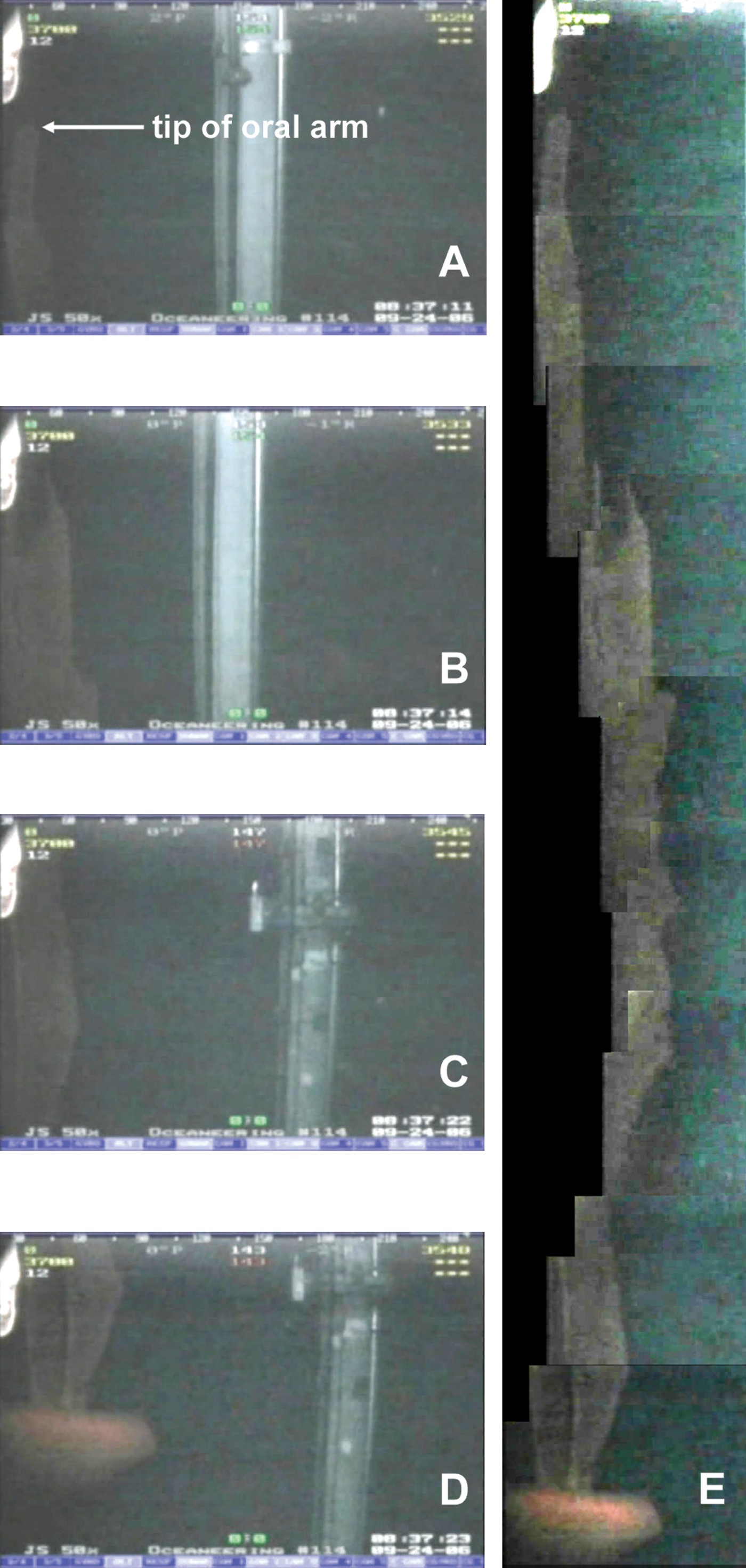
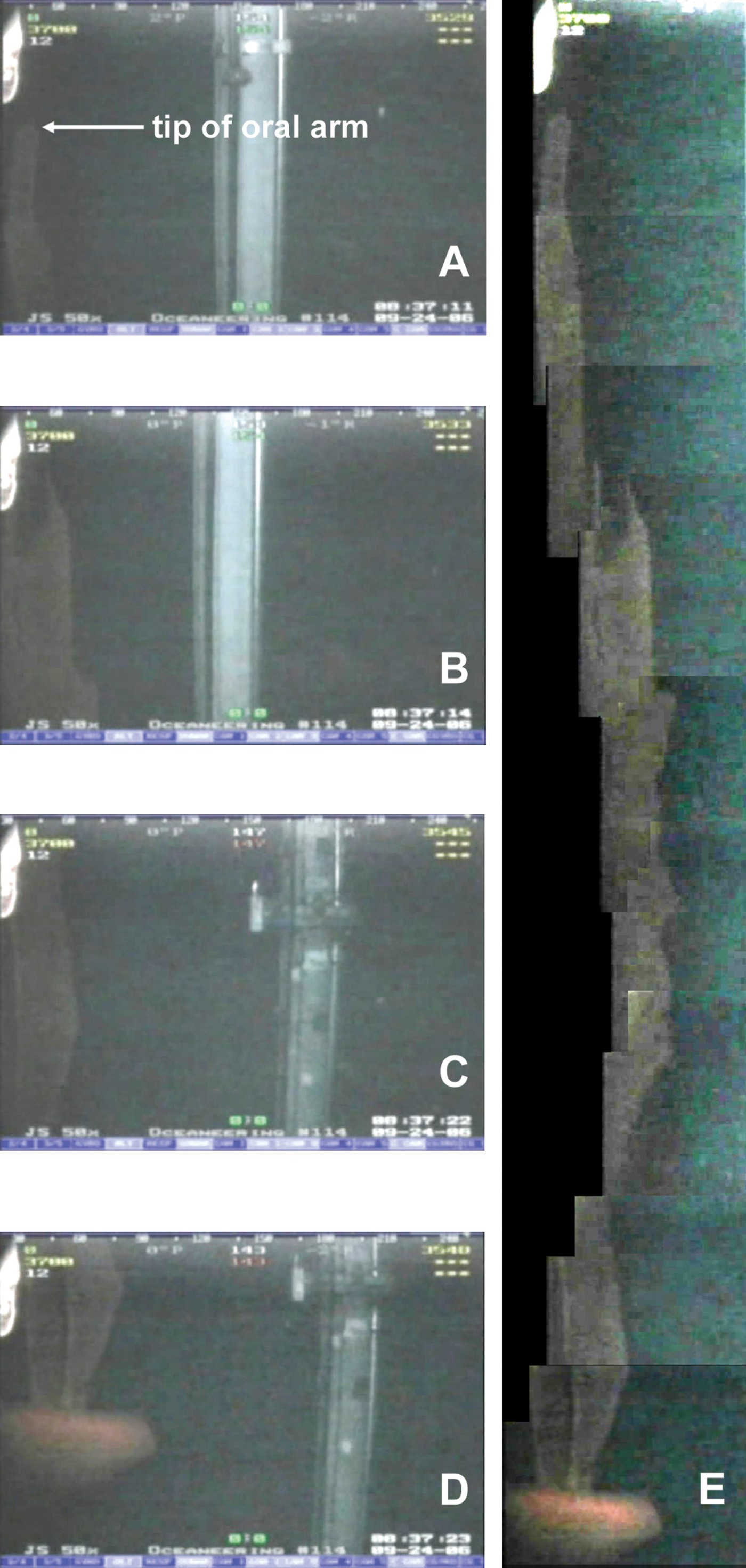
On 24 September, 2006 a second S. gigantea was encountered at 1075 m (3528′) while an Oceaneering ROV conducted a riser inspection below the drillship ‘GSF Explorer’ (Table 1: observation 90). The organism (Figure 2) was videotaped for approximately 18 seconds while the ROV descended past it. In this observation the animal was oriented with the bell downwards and oral arms extended vertically. The ROV crew did not become aware of the presence of the animal for several seconds after its oral arms became visible. When they noticed the jellyfish, they panned the ROV camera to the left and imaged the majority of bell as the ROV continued descending past it. By subtracting the depths at which the distal tips of the oral arms first became visible (1075.6 m) and the bell appeared (1081.4 m), the length of the animal was estimated to be 5.8 m. Based on this length, the width of the bell was estimated to be 0.73 m. A composite image of the entire visible portion of the animal was assembled from individual video frames (Figure 2).
Stygiomedusa gigantea beneath the GSF ‘Explorer’ in 2006 in a bell-down posture to the left of the riser. (A) Depth 3528 ft; (B) depth 3533 ft; (C) depth 3545 ft; (D) depth 3548 ft; (E) composite image from consecutive frames showing the visible portion of the entire animal. The low illumination and limited dynamic range of the video is responsible for the increased noise in the composite image.
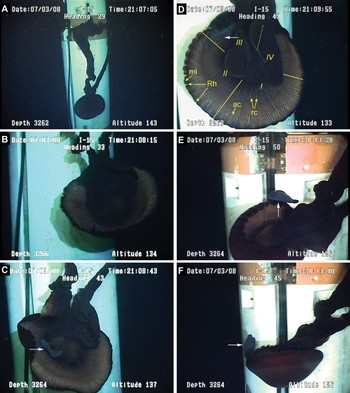
A third S. gigantea was documented on 3 July, 2008 at 996 m (3267′) by a Saipem America ROV inspecting a riser below the ‘Thunder Horse’ semi-submersible rig (Table 1: observation 106). This specimen was first detected at 21:05 (local time) and observed for 10 minutes 43 seconds (Figure 3). Rather than freely swimming in the water column, the animal appeared to have wrapped some of its oral arms around the riser. The diameter of the riser was 1.3 m and this was used as a scaling factor to estimate the diameter of the animal's bell when it was in close proximity to the riser. This approach gave bell diameter estimates ranging from 94–100 cm. During the encounter a fish, which appeared to be Thalassobathia pelagica Cohen 1963 was clearly visible swimming inside or in close proximity to the bell (Figure 3). The coloration of the fish was blue-grey and its length was estimated to be 27–34 cm TL based on its relative size in relation to a bell diameter of 97 cm.
Six still images of Stygiomedusa gigantea below ‘Thunder Horse’ in July 2008. The location of the commensal fish Thalassobathia pelagica is indicated with a white arrow. Panel (D) illustrates the distinctive characters of Stygiomedusa gigantea as described in Mianzan & Cornelius (Reference Mianzan, Cornelius and Boltovskoy1999). Four sections of tetraramous body plan are labelled I–IV. In each section are ten radial canal (rc) segments, and five Rhopaliar (Rh) segments indicated by rhopalium (sensory body) furrows. (ac) Anastomosing gastrovascular canals. There are also ten marginal lappet (ml) structures per section.

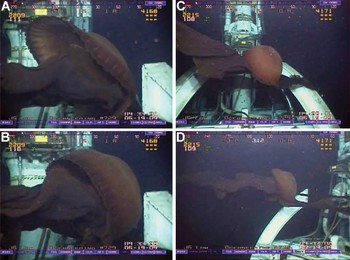
The most recent encounter with S. gigantea occurred on 19 May 2009 at 1270 m near the seafloor below the semi-submersible rig ‘Development Driller I’ (Table 1: observation 108). An Oceaneering ROV observed the jellyfish at 09:33 (local time) and recorded observations (Figure 4) for 6 minutes 22 seconds. One of the oral arms of this animal appeared to be attached to some of the subsea well structure and during the observation, the jellyfish swam or was carried by the current in different directions but remained attached to the well structure. The length of the oral arms was estimated to be 3.7 m based on the dimensions of the nearby wellhead.
Stygiomedusa gigantea beneath the ‘Development Driller I’ in May 2009.

Global distribution
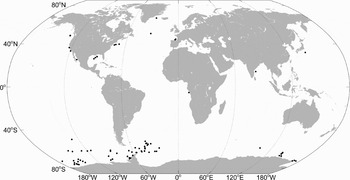
Our search revealed 110 observations or collection records representing a total of 118 individuals whose identities were reported as being Stygiomedusa gigantea (Table 1). These records spanned the 1899 sightings by Borchegrevink (1901) to the most recent Gulf SERPENT Project observation in 2009. Excluding the four Gulf of Mexico observations, the majority of records were from the Southern Ocean (N = 82), followed by the Pacific Ocean (N = 22), Atlantic Ocean (N = 9), and Indian Ocean (N = 1). The collection data suggest a cosmopolitan distribution (Figure 5).
Locations where Stygiomedusa gigantea has been collected or observed. Where collection areas were reported as an area, the centroid of the area was plotted.

Vertical distribution and diel vertical migration pattern
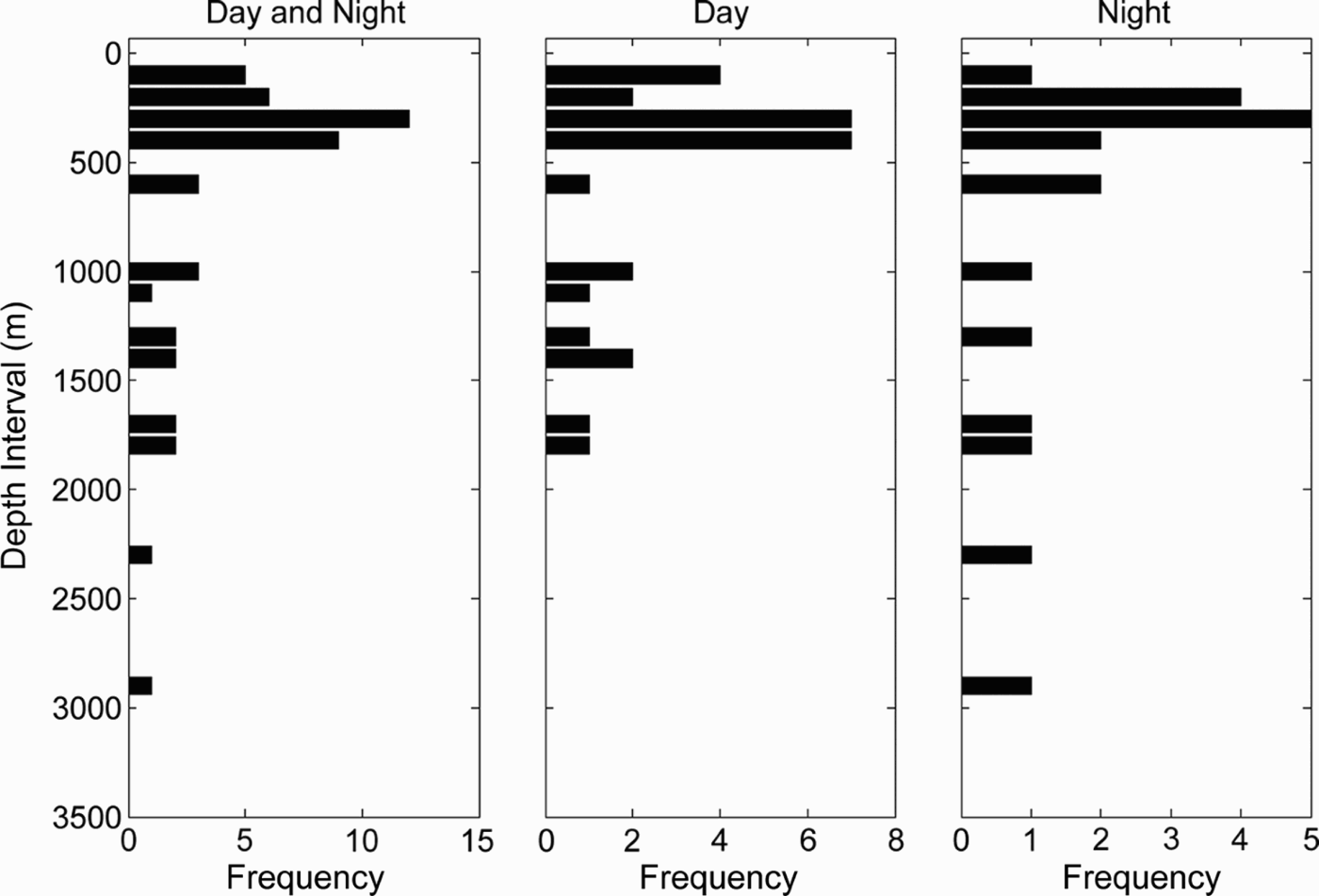
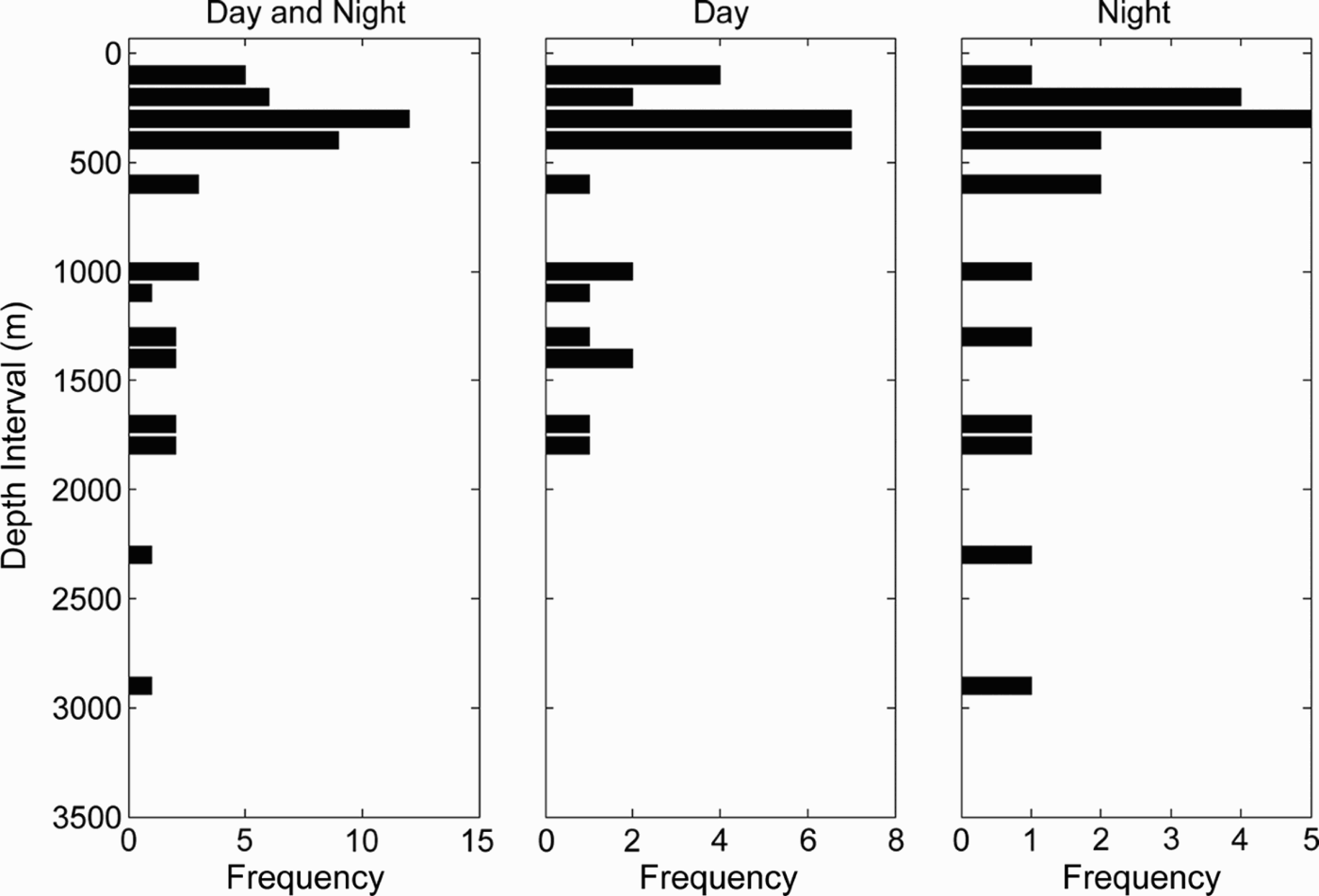
In the Gulf of Mexico, S. gigantea was observed within a depth-range (996–1747 m, mean of 1272 m, median of 1172.5 m) that can be considered exclusively bathypelagic. Globally, however, the range of depths encompassed 0–6665 m. Given that many observations were collected with non-opening/closing net systems, a simple average of the range of deployment depth intervals did not provide a useful estimate of S. gigantea's depth distribution, and considering a surface distribution is certainly not appropriate. A subset of 49 records where the vertical interval sampled by the net was 500 m or less was used to estimate the vertical distribution pattern. The average of the upper and lower sampling interval indicated a global mean and median depth of 657.6 m and 350.5 m, respectively (Figure 6). There was no clear evidence of a diel vertical migration (Figure 6). When these data were broken down by ocean, the mean and median depths of occurrence were: Southern Ocean (505.1 m, 351 m); Atlantic Ocean including the Gulf of Mexico (920.4 m, 996 m); Pacific Ocean (1214.1 m, 1215 m); and the Indian Ocean (1574.5 m), noting that a single observation occurred in the latter.
Vertical distribution of Stygiomedusa gigantea estimated from 49 records where the vertical resolution of the sampling gear or the vertical interval of the net was 500 m or less. Determination of the time of collection (day or night) was estimated by taking the temporal midpoint of the tow relative to local sunrise and sunset. In cases where there was continuous daylight, tows were classified as daytime collections.
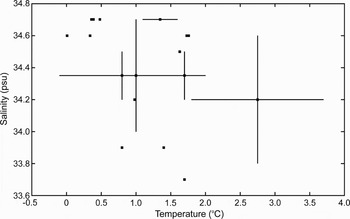
A subset of observations included data on temperature, salinity, or both variables. The ranges of temperature and salinity over which S. gigantea was observed spanned 4.9°C (–0.9–4.0°C) and 1.0 psu (33.7–34.7 psu). A T-S plot suggests that there is an inverse relationship between temperature and salinity with higher salinities being associated with lower temperatures (Figure 7). A linear regression of salinity against temperature was significant (P < 0.0001) with a slope of –0.165 and an intercept of 34.58.
Salinity and temperature associated with a subset of observations of Stygiomedusa gigantea for which both variables were measured.

DISCUSSION
Prior to these observations, Stygiomedusa gigantea had not been observed in, or collected from the Gulf of Mexico. Given the records of this species from the North Atlantic Ocean (Table 1) its presence in the Gulf of Mexico was a logical extension of its Atlantic range. With this species confirmed in the North and South Atlantic Ocean, the North and South Pacific and the Gulf of California, the Southern Ocean, and the Indian Ocean, it appears that Larson (Reference Larson1986) was correct in suggesting that it is a cosmopolitan species that is probably present in the mesopelagic and upper bathypelagic zones of all oceans.
The greatest numbers of records come from the Southern Ocean. Without sampling effort information it is impossible to determine whether this region represents an area of particularly high abundance, or whether the elevated numbers are simply a consequence of more intensive zooplankton sampling in the Southern Ocean.
Several studies (Harbison et al., Reference Harbison, Smith and Backus1973; Drazen & Robison, Reference Drazen and Robison2004) have noted the symbiotic relationship between S. gigantea and the fish Thalassobathia pelagica (family Bythitidae). Our 2008 SERPENT observation clearly showed a fish whose morphology was consistent with T. pelagica in close association with S. gigantea. Whether or not this species of fish was also present in the 2005 and 2006 SERPENT observations could not be determined. It was clearly absent from the 2009 SERPENT observation. The 2008 SERPENT observation extends the range of T. pelagica into the Gulf of Mexico, where it has not been previously collected. Thalassobathia pelagica has been observed in the Atlantic and Pacific Oceans. Based on comparisons of specimens of T. pelagica from the North Pacific and North Atlantic, Prokofiev & Kukuev (2008) suggest that there is one species with a circumglobal distribution within the tropics and that it is carried into boreal waters by warm currents flowing poleward. Since T. pelagica does not appear to have been collected in the Southern Ocean, it would be interesting to determine the degree to which it co-occurs with S. gigantea.
Stygiomedusa gigantea is a very distinctive species that is easy to identify given its large size and morphology. Some identifications, particularly the early ones prior to the description of this species, were based on limited morphological information (e.g. Borchegrevink, 1901), or reclassifications of medusae whose original descriptions were inconsistent with their putative identities (e.g. a new species of Cassiopeia; Kramp, Reference Kramp1968). Others were based on the recoveries of parts of the medusa. There are other large semaeostome medusae such as Poralia, Deepstaria and Tiburonia (Matsumoto et al., Reference Matsumoto, Raskoff and Lindsay2003) whose fragments might be confused with Stygiomedusa. Some of these may be species other than S. gigantea. For example, we did not know that Tiburonia existed prior to Matsumoto et al. (Reference Matsumoto, Raskoff and Lindsay2003) and prior to its description, it was common to identify large red medusae as S. gigantea. In the absence of contradictory information, we have accepted the identification provided with each record and assume that the majority of records summarized in this paper are likely to be of S. gigantea.
In the case of the Gulf observations, in the absence of a sample of the whole animal for morphological examination, or a tissue sample for genetic analysis, a conclusive identification is not possible. The organisms in all four observations had morphological characteristics consistent with S. gigantea. The lengths of the oral arms were greater than 1 m and in the one case where they could be accurately measured, they extended almost 6 m. The observation from 2005 had four oral arms clearly visible, and in all four cases, the bell resembled a wide-brimmed hat as described in Matsumoto et al. (Reference Matsumoto, Raskoff and Lindsay2003). Coloration was consistent with the red-brown colours described in other records (e.g. Russell & Rees, Reference Russell and Rees1960; Matsumoto et al., Reference Matsumoto, Raskoff and Lindsay2003). Our Figure 3D clearly shows the distinctive anastamose canal patterns, a total of 40 radial canals and associated lappets, and 20 rhopaliar sections as described by Mianzan & Cornelius (Reference Mianzan, Cornelius and Boltovskoy1999) for S. gigantea.
Two of the four video sequences from the Gulf clearly show S. gigantea sticking to the subsea structure of the inspected platforms (Figures 3 & 4). These two animals are visibly adhered to the structure and not simply tangled in structural members. We believe this provides interesting information about feeding strategy since much can be inferred about feeding based upon bell morphology, swimming kinematics and distribution of capture surfaces such as marginal or sub-umbrellar tentacles and oral lobes (Costello & Colin, Reference Costello and Colin1995; Raskoff, Reference Raskoff2002; Dabiri et al., Reference Dabiri, Colin, Costello and Gharib2005; Colin et al., Reference Colin, Costello and Kordula2006). This particular species lacks tentacles, but has extraordinarily long, highly flattened oral arms. The drag of these elements certainly imparts a large energetic cost, so we must assume that they are adaptive. Long, flattened oral lobes in the large surface dwelling scyphomedusa, Drymonema dalmatinum, are used in the retention and digestion of captured medusae (Larson, Reference Larson1987; our own observations), and superficially have a strongly adherent property reminiscent of S. gigantea's oral lobes observed by us. Tentacles are considered the primary capture surfaces of semaeostome medusae, and their absence here would suggest capture of small crustaceans, larger gelatinous animals or even suspension feeding on detritus occurs—much like ‘flypaper’—on the oral lobes. We also believe digestion most likely occurs within the folds of these oral lobes as it does with D. dalmatinum.
Whether or not S. gigantea undertakes diel vertical migration is not clear. Piatkowski et al. (Reference Piatkowski, Rodhouse, White, Bone and Symon1994) collected three individuals between 200 and 400 m during the day and three between 0 and 1000 m at night but their sampling methodology did not permit finer determination of where the individuals were collected. Torres et al. (Reference Torres, Burns, Denker, Daly, Ju, Friedlaender, Zhou and Morin2002) collected S. gigantea at night between 50 and 100 m and during the day between 200 and 500 m. Burd & Thompson (Reference Burd and Thompson2000) had samples that encompassed the same absolute range (0–1900 m) during both day and night. The mean of the tow mid-depths for samples that contained S. gigantea were slightly deeper during the day (1145.4 m) compared to the night (949.9 m), however this difference was not statistically significant. The four Gulf observations suggest that there may have been some vertical migration pattern since both the nocturnal observations (21:32 and 21:05 h local time) were further above the bottom (385 m and 845 m, respectively) than the daytime observations (08:37 h and 09:33 h local time; 150 m and 4 m, respectively). Two of the observations were of animals that were attached or caught on subsea structures and so we cannot determine whether their presence at the observed depths was unconstrained and indicative of their preferred depth at those times. Moreover, when we assembled the global data with sampling resolutions of 500 m or less, the results did not support any pattern of diel vertical migration.
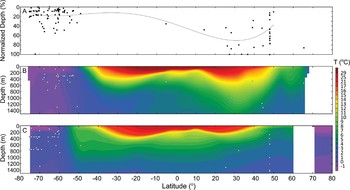
Temperature may be an important determinant of the upper depth-range of this species. Our data suggest that it is found from −1.5–4°C. Several of the Southern Ocean records were from the surface and when mean collection depths were normalized (expressed as a percentage of the bottom depth) and plotted as a function of latitude, the Southern Ocean and southern hemisphere records are all within the upper 60% of the water column (Figure 8A). Although there are only two observations from near the equator (±20°), both were in the middle portion of the water column. From 20–40°N, S. gigantea was generally found in the lower 60% of the water column (Figure 8). Above 45°N, the amplitude of its distribution occupied from 10–80% of the water column. The more surficial distribution in the Southern Ocean and deeper distribution at mid-latitudes in the northern hemisphere parallels the distribution of waters within S. gigantea's thermal tolerance range. For example, if we assume that the temperature range −2 to 6°C encompasses the thermal tolerance range for this species, then a meridional annual average profile of temperature for the Southern, Atlantic and the Pacific Oceans (Figure 8B, C) appears to explain the differences in the depth distribution of S. gigantea in the southern and northern hemispheres. South of the Antarctic Circumpolar Front (ACF), most of the water column is within the range of thermal tolerance of S. gigantea. From ~50°S–45°N, the epipelagic and much of the mesopelagic is likely too warm for S. gigantea and its distribution is shifted below depths where the average annual temperature is <13°C. Near 50°N, the distribution again extends closer to the surface in the North Pacific Ocean as favourable temperatures extend throughout most of the water column.
(A) Normalized depth of occurrence as a function of latitude for Stygiomedusa gigantea. Depths were normalized by dividing the observed depth by the bottom depth and multiplying by 100. In cases where collection depths were intervals, the arithmetic means of the upper and lower depth bound were used as an estimate of the depth of occurrence. The line is a 4th degree polynomial function fitted to the mean normalized depth of occurrence at latitude intervals of 10°; (B) depth of collection of S. gigantea ( ) superimposed on the climatological mean annual temperature profile for the Southern and Atlantic Oceans at 29.5°W. The Gulf of Mexico records are not plotted; (C) depth of collection of S. gigantea (
 ) superimposed on the climatological mean annual temperature profile for the Southern and Pacific Oceans at 142.5°W. Climatological mean temperature profiles were taken from World Ocean Atlas 2005 data (http://ferret.pmel.noaa.gov/).

An alternative but not mutually-exclusive hypothesis explaining the differences in vertical distribution of S. gigantea at low and high latitudes may be due to the relative penetration of light at high and low latitudes. Many deep-sea scyphomedusae contain porphyrin-based pigments (Herring, Reference Herring1972; Jarms et al., Reference Jarms, Tiemann and Båmstedt2002). When exposed to daylight photodecomposition can convert these porphyrins into toxic compounds (Herring, Reference Herring1972). At high latitudes, the low angle of incidence of the sun may permit ascents to shallower depths without damage to porphyrin pigments, whereas in lower latitudes, migration into surface waters would have adverse consequences. Light intensity also has the potential to mediate predation by visual predators. While we do not know what organisms consume S. gigantea, if it is preyed upon by visual predators, remaining at depths where light intensities are too low for visual detection would be adaptive. At low latitudes where light penetration is deeper, S. gigantea would have to reside at greater depths to avoid detection, than would be necessary near the poles.
Sir Frederick Russell first described Stygiomedusa (S. fabulosa) in 1959 (Russell, Reference Russell1959). Fifty years later, it remains an uncommonly-sampled species, and its presence in a net continues to make an impression on those who collected it. Russell's choice of species name was highly appropriate and it is unfortunate that S. fabulosa has been replaced by S. gigantea. Over time, we have steadily accumulated over a hundred examples of this deep-sea giant and we can use these data to begin to understand the factors that influence its distribution and abundance. Stratified sampling systems equipped with CTD sensors are essential if we are to obtain accurate estimates of its depth distribution and the environmental conditions that prevail there. Many of the records we obtained were from systems such as the Isaacs–Kidd Midwater Trawl, which do not collect stratified samples.
Stygiomedusa gigantea is a very large species with a cosmopolitan distribution. It does not appear to be abundant but it is potentially an apex predator that plays an important role in ocean ecosystems. There is ample room for research on its diet and feeding behaviour and this knowledge gap will likely be bridged by additional in situ observations. The increasing use of ROVs, particularly industrial systems via the SERPENT Project will also advance our understanding of this enigmatic scyphomedusa. As the industry expands into the deep water region of the Gulf of Mexico, and elsewhere around the world, the number of ROV observations will likely increase and produce a better understanding of the ecology of species such as S. gigantea, as well as the discovery of new taxa.
ACKNOWLEDGEMENTS
The authors are grateful to BP, Chevron, BHP Billiton, Oceaneering, Saipem America, Subsea7 and the SERPENT Project for making the ROV footage available. In particular we thank: T. Rooney (BP), T. Kastropil (Discoverer Deep Seas); S. Southworth and P. Lockwood (GSF ‘Explorer’); R. Trichell, W. Easley, K. Kimmell, D. Sampey (‘Thunder Horse’); and N. Ross and J. Roberts (‘Development Driller I’). We are indebted to M. Nelson, J. Torres, A. Baldinger, D. Lindsay, B. Burd, D. Lindsay, U. Piatkowski, G. Stowasser, P. Rodhouse, N. Cunningham, V. Fuentes, and R. O'Driscoll, who all kindly provided data on S. gigantea collections. We thank G. Matsumoto and D. Lindsay for critically reviewing an earlier draft of this manuscript and anonymous referees for their comments. This is Contribution 17 of the SERPENT Project. This study was funded by grants from NOAA's Office of Ocean Exploration (NA05OAR4601057) and the Minerals Management Service (GM-92-42-133) to M.C.B.