1. Introduction
Discovery proceeds in stages of construction, evaluation, and revision (Darden Reference Darden1991). Each of these stages is constrained by what is known or conjectured about what is being discovered. A new characterization of mechanism (Machamer, Darden, and Craver Reference Machamer, Darden and Craver2000) aids in specifying what is to be discovered when a mechanism is sought. Constraints arise from the organization that any mechanism is expected to exhibit, including spatial, temporal, and hierarchical organization (Craver and Darden Reference Craver, Darden, Machamer, Grush and McLaughlin2001). Here, the focus is on three reasoning strategies to guide mechanism discovery in constructing new ideas about possible and plausible mechanisms. Strategies for evaluation and revision of hypothesized mechanisms will be discussed in other work. Talk of mechanisms is ubiquitous in biology (as noted by, e.g., Wimsatt Reference Wimsatt, Schaffner and Cohen1972; Brandon Reference Brandon, Asquith and Kitcher1985; Burian Reference Burian and Sarkar1996). The extent to which “mechanism” is an important metascientific concept in other areas of science requires further investigation.
Three reasoning strategies for constructing new ideas about mechanisms will be discussed in this paper—schema instantiation, modular subassembly, and forward/backward chaining. Schema instantiation provides an abstract type of mechanism that may be specified to apply to a particular case. Types of mechanisms may be depicted in abstract mechanism schemata; instantiation is the process of making a schema less abstract and applicable to a particular case. In modular subassembly one searches for types of modules to assemble into a hypothesized mechanism. A strategy operating at an even finer grain is to reason stage by stage about how gaps in what is known about the productive continuity of a mechanism are to be filled, either forward chaining from a convenient starting point or backward chaining from a later stage.
Whether or not scientists actually used these reasoning strategies in their discoveries of mechanisms, the strategies could have been used. The strategies are what I call “compiled hindsight,” that is, hindsight that can be extracted from an analysis of historical cases (Darden Reference Darden1991). The strategies are “advisory,” not descriptive or prescriptive (Nickles Reference Nickles, Pitt and Pera1987; Darden Reference Darden1991, 15–17; cf. strategies of decomposition and localization in Bechtel and Richardson Reference Bechtel and Richardson1993). In a discovery episode, one or more of these strategies might prove useful, and they are good candidates for items to be taught in science education. However, no claim is made here that this is a complete list of strategies for constructing mechanisms or that any of these three will necessarily be useful in all discovery episodes.
After a brief summary of previous work on the characterization of mechanisms and on constraints provided by their organization, this paper then discusses each of these strategies in turn, illustrating them with brief examples from biology.
2. Characterization of Mechanism
A mechanism is sought to explain how a phenomenon is produced (Machamer, Darden, and Craver Reference Machamer, Darden and Craver2000) or how some task is carried out (Bechtel and Richardson Reference Bechtel and Richardson1993) or how the mechanism as a whole behaves (Glennan Reference Glennan1996). Mechanisms may be characterized in the following way:
Mechanisms are entities and activities organized such that they are productive of regular changes from start or set-up to finish or termination conditions. (Machamer, Darden, and Craver Reference Machamer, Darden and Craver2000, 3)
Mechanisms are regular in that they usually work in the same way under the same conditions. The regularity is exhibited in the typical way that the mechanism runs from beginning to end; what makes it regular is the productive continuity between stages. Complete descriptions of mechanisms exhibit productive continuity without gaps from the set up to the termination conditions, that is, each stage gives rise to the next.
Mechanisms are composed of both entities (with their properties) and activities. Activities are the producers of change. Entities are the things that engage in activities. Activities require that entities have specific types of properties. For example, two entities, a DNA base and its complement, engage in the activity of hydrogen bonding because of their properties of geometric shape and weak polar charges.
For a given scientific field, there are typically entities and activities that are accepted as relatively fundamental or taken to be unproblematic for the purposes of a given scientist, research group, or field. That is, descriptions of mechanisms in that field typically bottom out somewhere. Bottoming out is relative: different types of entities and activities are where a given field stops when constructing its descriptions of mechanisms. In molecular biology, mechanisms typically bottom out in descriptions of the activities of cell organelles, such as the ribosome, and molecules, including macromolecules, smaller molecules, and ions. The most important kinds of activities in molecular biology are geometrico-mechanical and electro-chemical activities. An example of a geometrico-mechanical activity is the lock and key docking of an enzyme and its substrate. Electro-chemical activities include strong covalent bonding and weak hydrogen bonding.
Entities and activities are interdependent (Machamer, Darden, and Craver Reference Machamer, Darden and Craver2000, 6). For example, appropriate chemical valences are necessary for covalent bonding. Polar charges are necessary for hydrogen bonding. Appropriate shapes are necessary for lock and key docking. As we will see, this interdependence of entities and activities allows one to reason about one, based on what is known or conjectured about the other, in each stage of the mechanism (Darden and Craver Reference Darden and Craver2002).
A mechanism schema is a truncated abstract description of a mechanism that can be filled with more specific descriptions of component entities and activities. An example is represented in a portion of Figure 1, a diagram of James Watson's version of the central dogma of molecular biology. (For differences between Watson's and Crick's versions of the central dogma, see Keyes Reference Keyes1999a, Reference Keyes1999b.) This is a very abstract, schematic representation of the mechanism of protein synthesis.
Schema for DNA replication and protein synthesis.

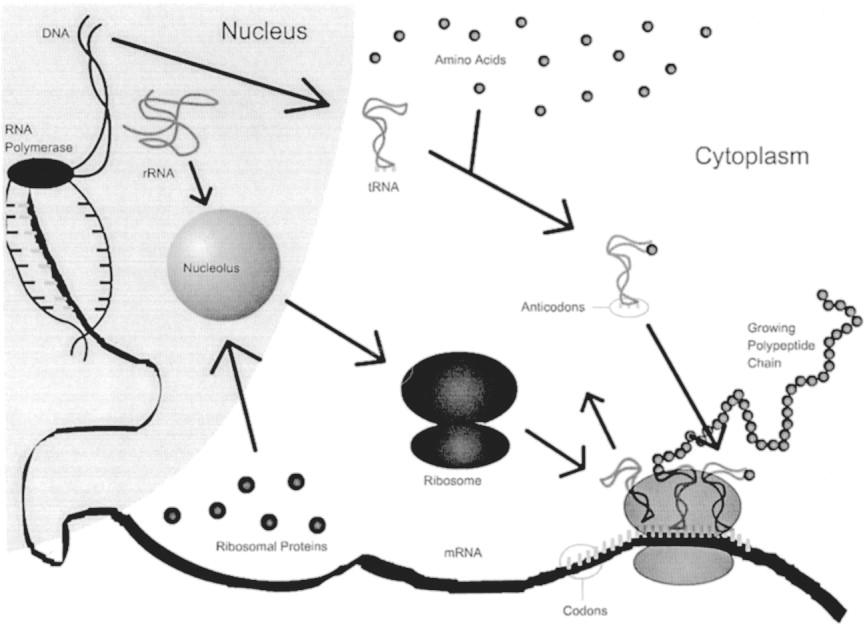
A more detailed diagram in Figure 2 of the protein synthesis mechanism satisfies the constraints that any adequate description of a mechanism must satisfy. It shows how the phenomenon, the synthesis of a protein, is carried out by the operation of the mechanism. It depicts the entities—DNA, RNA, and amino acids—as well as implicitly, the activities—the geometrico-mechanical docking of the messenger RNA and the ribosome, and the activity of hydrogen bonding of the transfer RNA and the messenger RNA. It shows the spatial relations of the components and the temporal order of the stages. This schema can be instantiated with actual DNA sequences, complementary RNA sequences, and particular amino acids to provide a description of a particular mechanism for synthesizing a particular protein, a polypeptide chain.
Diagrammatic schema for protein synthesis.

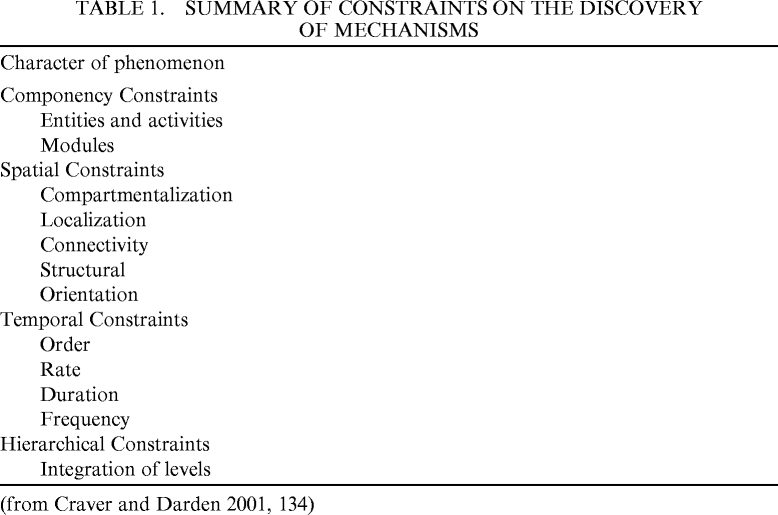
Note the general constraints that this mechanism satisfies. (They are listed in Table 1 and indicated here by italics.) There is a phenomenon that the mechanism, when working, produces, namely the synthesis of a protein. The nature of the phenomenon, which may be recharacterized as research on it proceeds, constrains details about the mechanism that produces it. For example, the components of the mechanism, the entities and activities, must be adequate to synthesize a protein, composed of amino acids tightly covalently bonded to each other. There are various spatial constraints illustrated in Figure 2. The DNA is located in the nucleus (in eucaryotes) and the rest of the machinery is in the cytoplasm. The ribosomal particle has a particular structure that allows it to attach to the messenger RNA and orient the codons of the messenger so that the particular transfer RNAs can hydrogen bond to them. There is a particular order in which the steps occur and they take certain amounts of time. All of these constraints can play roles in the search for mechanisms and, then, they become part of an adequate description of a mechanism.

| Character of phenomenon |
| Componency Constraints |
| Entities and activities |
| Modules |
| Spatial Constraints |
| Compartmentalization |
| Localization |
| Connectivity |
| Structural |
| Orientation |
| Temporal Constraints |
| Order |
| Rate |
| Duration |
| Frequency |
| Hierarchical Constraints |
| Integration of levels |
(from Craver and Darden Reference Craver, Darden, Machamer, Grush and McLaughlin2001, 134)
To sum up so far: Reasoning to find any particular mechanism is aided by this characterization of what a mechanism is, as well as the constraints that any adequate description of a mechanism must satisfy. But further guidance is needed in mechanism discovery. Guidance can come from schema instantiation, modular subassembly, or reasoning about the entities and activities themselves.
3. Schema Instantiation
Schema instantiation begins with a highly abstract framework for a mechanism, a schema, which is then rendered less abstract during the process of instantiation. Instantiation is usually characterized as supplying values for the variables in a schema, as in Kitcher's (Reference Kitcher, Kitcher and Salmon1989) discussion of the instantiation of deductive argument schemata. This is too restrictive. Schemata may be stated with varying degrees of abstraction; one may specify details piecemeal to make a mechanism schema less abstract before one gets all the way down to a description of a particular mechanism.
There are many types of mechanisms: transport mechanisms, control mechanisms, repair mechanisms. Consider the example of selection mechanisms. To find a mechanism to carry out the task of producing adaptations, one might consider a selection schema (Darden and Cain Reference Darden and Cain1989; Skipper Reference Skipper1999). At a high degree of abstraction, a selection schema may be characterized as follows: first comes a stage of variant production, then a selective interaction that poses a challenge to the variants, followed by differential benefit for some of the variants. Specifying this abstraction, that is, rendering it less abstract, can produce natural selection in evolutionary biology or a different specification yields the clonal selection theory in immunology (Darden and Cain Reference Darden and Cain1989). Supplying further details yields an instantiation, that is, a description of a particular mechanism for, e.g., producing stout beaks on Galapagos finches for cracking hard seeds during drought conditions.
As another example of a schema, consider a chemical reaction schema:

To find a mechanism for energetically unfavorable synthesis reactions, biochemists typically instantiate a chemical reaction schema in which reactants consume energy to form high energy intermediates, which then recombine into the product, with enzymes catalyzing each step. (For more discussion of biochemists’ search for high energy intermediates, see, e.g., Allchin Reference Allchin, Hull, Forbes and Burian1994). So, the very abstract chemical reaction schema is further specified:

An early hypothesis about protein synthesis attempted to instantiate such a schema. As it turned out, another schema had to be devised and added to this one because protein synthesis is different from other synthesis reactions. This schema was incomplete when applied to the protein synthesis case. It had no role for nucleic acids, which are not reactants or products but do play an important role in ordering the amino acids in proteins in the mechanism of protein synthesis.
There are several sources of schemata. One is the history of science. Analogous theories can be grouped and an abstract schema can be constructed by dropping the specific details, e.g., an abstract mathematical schema for wave phenomena can be constructed by dropping details and differences between water, sound, and light waves (Holyoak and Thagard Reference Holyoak and Thagard1995, 12). At a lower degree of abstraction, once some phenomenon to be produced, some start or end stage, and some entities and/or activities (or roles for them) are specified, this mathematical schema may become a mechanism schema. In the selection schema discussed above, the history of science supplied analogous cases for schema construction. Dropping details of genic, organismic, and group selection yields a natural selection schema; dropping further details yields an even more abstract selection schema that may be instantiated for other selection mechanisms, such as clonal selection in immunology.
In addition to finding analogs in the history of science, scientists often use “local analogies” to similar mechanisms in their own field and “regional analogies” to mechanisms in other, neighboring fields (Dunbar Reference Dunbar, Sternberg and Davidson1995). Thus, closely related areas of contemporary science are also a source for mechanism schemata.
Another method for schema construction is to sketch hypothetical roles that components of the mechanism being sought are expected to carry out. In 1952, Watson sketched the protein synthesis mechanism that began with DNA, had some as yet unknown stage involving RNA carrying the pattern of bases from the DNA to the cytoplasm, and ended in the synthesis of the protein (Watson Reference Watson1968). Further work was needed to convert Watson's sketch into a schema with three different RNA components playing various roles in the mechanism. Crick (Reference Crick1988) later analogized the role of the ribosome to a reading head of a tape recorder, which moves along the tape-like messenger RNA and reads the genetic code. However, no evidence exists that this analogy played a role in the discovery of the role of the ribosomes or provided a source for constructing a schema in this case. This historical evidence is consistent with Dunbar's work. He showed that in contemporary molecular biological laboratories such “long-distance” analogies were not used in research, but were, instead, used to bring home a point or to educate new staff members (Dunbar Reference Dunbar, Sternberg and Davidson1995).
Once a schema is chosen or sketched in a discovery episode, then the task is to find the entities and activities, or modular groups of them, that play the roles outlined in the abstract schema. A schema has place holders, variables, black boxes, that may be filled piecemeal as empirical evidence is found for the various components. The lack of an entity or activity or module to fill a role in a schema points to the need for further work.
By about 1970, the details of the protein synthesis mechanism had been worked out. By then, the schema DNA→RNA→protein became textbook knowledge that could be instantiated whenever a protein synthesis mechanism was needed. In fact, it may be a module in other mechanisms.
4. Modular Subassembly
A second strategy to guide mechanism discovery is modular subassembly. This strategy involves reasoning about groups of mechanism components. One hypothesizes that a mechanism consists of known modules or types of modules. One cobbles together different modules to construct a hypothesized mechanism. Evolution itself often works by copy and edit; finding these recurrent motifs has been a powerful tool in discovery in biology. There are various types of receptors, types of neurotransmitters, types of enzymes, types of control components (e.g., inducers, repressors). Knowledge of such types of modules can be used to string together a plausible candidate mechanism in a particular discovery episode.
Once a new type of module is found, that can open up a new hypothesis space of possible mechanisms. The 1970 discovery of the enzyme reverse transcriptase, which copies RNA back into DNA, was such a module. It opened up a space of possible mechanisms with feedback into DNA from elsewhere. Reverse transcriptase was shown to be a module in the mechanism by which retroviruses copy their RNA back into the host DNA (discussed in Darden Reference Darden, Lennox and Wolters1995). It then became a module that has been used in controversial proposals of possible mechanisms for directed mutation (Cairns et al. Reference Cairns, Overbaugh and Miller1988) and for feedback from the soma to germline cells in the immune system (Steele et al. Reference Steele, Lindley and Blanden1998).
Instructive type mechanisms contrast with selective type mechanisms. Neo-Lamarckian mechanisms are instructive mechanisms that contrast with Neo-Darwinian, selective ones. In instructive mechanisms, the inefficient module of producing many variants is eliminated; an instruction is received from the challenging environment, an adapted form is constructed in response to that instruction, and the adaptation is then passed on in inheritance. In such instructive mechanisms, fairly elaborate modules are needed for receiving and appropriately responding to an instruction, as well as for appropriately changing the DNA (or RNA) that is passed to the next generation. Few possible mechanisms for the production and inheritance of adaptive, acquired characters have been proposed in the history of biology. Reverse transcriptase has generated interest as a possible module to fill the role of appropriately changing the genetic material.
Cairns and his colleagues (Cairns et al. Reference Cairns, Overbaugh and Miller1988) claimed to have found a phenomenon of directed mutation in E. coli. The bacteria seemed to be able to make more adaptive mutations in response to an environmental challenge (in addition to the usual array of spontaneous mutations). One of the hypothesized instructive mechanisms to account for this phenomenon of directed mutation used reverse transcriptase as a module for conveying information (base sequence) back to the DNA. The hypothetical, instructive mechanism involved the production of variant RNAs, some way of monitoring them for success (a black box never filled), and then the reverse transcribing of the successful one back into the DNA (Cairns et al. Reference Cairns, Overbaugh and Miller1988). This proposed mechanism of 1988 has been disproved; reverse transcriptase was not found to play a role in producing directed mutation. Work continues on other possible mechanisms for directed mutation, not using a reverse transcriptase module (Foster Reference Foster1999).
Steele and his colleagues proposed an immunological mechanism with both selective and instructive modules (Steele et al. Reference Steele, Lindley and Blanden1998). Antibodies are formed by the well-understood mechanism of clonal selection. Then a hypothesized instructive component takes over. RNA copies of the antibody gene are captured by supposed endogenous retroviruses, carried to the germ cells, and reverse transcribed into the germline DNA. This is a wild idea! It has yet to receive much evidence in its support. Its value for our purposes is to show how the discovery of a new type of module, reverse transcriptase, expands the space of possible mechanisms. Of course, empirical evidence is necessary to rule some in and others out. But the subject of how mechanisms are tested empirically must be left for another time. (For preliminary work on testing hypothesized mechanisms, see Craver and Darden Reference Craver, Darden, Machamer, Grush and McLaughlin2001; Craver Reference Craver2002.)
5. Forward/Backward Chaining
A schema provides the overall framework of the mechanism. Modular subassembly provides working subcomponents for sections of the schema. Finally, at a finer grain, one can reason about the entities or activities themselves. Forward/backward chaining are reciprocal strategies for reasoning about one part of a mechanism on the basis of what is known or conjectured about other parts in the mechanism. Forward chaining uses the early stages of a mechanism to reason about the types of entities and activities that are likely to be found downstream. Backward chaining reasons from the entities and activities in later stages in a mechanism to find entities and activities appearing earlier.
Forward chaining is illustrated by Watson and Crick's suggestion about DNA replication. As soon as the double helix structure of DNA was proposed, properties of the double helix indicated how it could be copied. Watson and Crick's famous line in their 1953 paper shows their ability to reason to the next stage: “It has not escaped our attention that the specific [base] pairing we have postulated immediately suggests a possible copying mechanism for the genetic material” (Watson and Crick Reference Watson and Crick1953, 737). DNA has polarly charged bases that hold the structure together with their complementary hydrogen bonds. These entities could obviously play a role in the first stage of a copying mechanism. The double helix could open and allow complementary bases to line up along it. The polar charges are activity enabling properties. They immediately suggest what happens in the next stage of the mechanism. Continuing to forward chain, one then could see how two identical helices would result.
Backward chaining is nicely illustrated by Zamecnik and Hoagland's work on protein synthesis (Hoagland Reference Hoagland1955; Hoagland et al. Reference Hoagland, Zamecnik, Stephenson and Zirkle1959; Zamecnik Reference Zamecnik1960; discussed in Rheinberger Reference Rheinberger1997). Biochemists knew the endpoint of the protein synthesis mechanism was a string of amino acids held together by strong covalent bonds. They thus reasoned back toward free amino acids. Since energy was required to form such strong bonds, that activity required a high energy intermediate in the immediately preceding step. They isolated such a high energy intermediate. Surprisingly, it was associated with RNA. Biochemical reaction schemata had no role for RNA to fill, and reasoning backward from protein to free amino acids did not suggest an RNA intermediate.
Meanwhile, the molecular biologists were reasoning forward from the DNA double helix to the next stage in the protein synthesis mechanism. Biochemists and cell biologists had, to their surprise, empirically discovered that RNA was involved in the mechanism. Molecular biologists suggested that RNA carried the genetic code. The order of the bases in DNA is transcribed to similarly ordered bases in RNA, which is then translated into the order of the amino acids in the protein during protein synthesis. These tandem strategies served to fill gaps in the productive continuity of the proposed mechanism. The molecular biologists reasoned forward from the DNA while the biochemists reasoned backward from the finished protein; their work met in the middle of the mechanism, with the discovery of the various types of RNAs and their roles in the middle of the mechanism. (The protein synthesis case and the strategy of forward/backward chaining is discussed in more detail in Darden and Craver 2002.)
Even if one cannot find a possible overall schema or familiar modules, one can reason forward from the beginning or backward from the end of the mechanism in a search for its productive continuity from start to finish. The nature of the entities and activities at each stage guides the discovery of the prior and subsequent stages. Even with cyclic (e.g., feedback) mechanisms, some isolatable stage can serve as a relative starting point for reasoning about earlier or later ones. Thus, the strategy of forward/backward chaining seems likely to be available when anything is known, or can be conjectured, about entities and activities anywhere in the hypothesized mechanism.
6. Conclusion
The idea that what is to be discovered is a mechanism guides reasoning in its discovery. Not surprisingly, knowing the nature of the product shapes the process of discovering it. Philosophers should be less pessimistic about understanding reasoning in discovery, at least reasoning in the discovery of mechanisms.
Engineers know a lot about how to design and construct actual physical mechanisms in artifacts. They need an overall framework, which is like a schema. They may be able to reuse modules that they have used in other mechanisms. As the detailed mechanism is being designed, either forward from the beginning or backward from the end, ideas for what to put in to fit properly and fill gaps may be obvious or at least highly constrained. A prior stage may suggest what to use next or a later stage may suggest what could have produced it. The engineering process of designing a mechanism goes through cycles of construction, evaluation and revision as components are proposed, evaluated, and possibly redesigned. The goal is to construct a smoothly working mechanism. There is a strong analogy between an engineer designing a mechanism and a scientist discovering one that already works in nature. We understand a lot about how to build actual mechanisms; that reasoning can illuminate reasoning in scientific discovery.
In conclusion, guidance in discovering mechanisms may be provided by schema instantiation, modular subassembly, and forward/backward chaining. Compiled hindsight about previously used schemata, modules, and types of entities and activities may be of use in current discovery episodes. The history of science is a good source of such compiled hindsight. Philosophers should exploit it to find reusable components in mechanism discovery.
This work was supported by the National Science Foundation under grant number SBR-9817942. Any opinions, findings and conclusions or recommendations expressed in this material are those of the author and do not necessarily reflect those of the National Science Foundation. Many of the ideas in this paper were worked out in collaboration with Carl Craver; this paper could not have been written without his valuable help. Some of the strategies discussed here are discussed in more detail in our recent joint paper on the protein synthesis case. We've had fruitful discussions about mechanisms with Peter Machamer, Stuart Glennan, Bill Bechtel, and Jim Woodward. Thanks to my undergraduate research assistant David Didion for drawing Figure 2 and other helpful work.