The continued dominance of London as the preeminent global financial center at the start of the twenty-first century remains a puzzle. London's position of dominance has continued despite Britain's abstaining from the common currency of the European Union and despite the rise of first New York, then Tokyo, and now Shanghai as major financial centers in much larger economies. Why is it that Frankfurt, the banking and financial center of the largest economy in Europe and now the seat of the European Central Bank, cannot displace London, or for that matter New York? The same question arises for Paris, which combines both central government functions and an entrenched cosmopolitan elite from government, business and culture. The puzzle of persistent ‘capitals of capital’, as Youssef Cassis (Reference Cassis2006) has expressed it, has stimulated a great deal of scholarly work by business historians to discern what economic, political, legal and social forces create such continuity in the existence of financial centers.
Historians typically invoke arguments about network externalities that, once created by a diversity of trade and manufacturing opportunities, can sustain a cosmopolitan financial center long after trade or manufacturing activities have moved elsewhere.Footnote 2 Economists elaborate on economies of scope and scale that caught the attention of Charles Kindleberger at the breakup of the Bretton Woods system in the 1970s, with consequences that persist to the present.Footnote 3 All of these analyses consider a center as a complete financial system, comprising a variety of institutions ranging from a central bank to credit cooperatives combined with a variety of markets ranging from government debt to exotic derivatives. The precise composition of institutions and markets in each center's financial system usually varies with predictable consequences for the extent and depth of its corresponding network of financial ties, which in turn determine the dominance and persistence of the center.
Until the introduction of the common currency in the European Union in 1999, it was easy to distinguish some financial centers as ‘market-oriented’ (London and New York) from others as ‘bank-oriented’ (Frankfurt, Paris and Tokyo). Only in the twenty-first century have we seen a rapid convergence of the two distinctive systems of finance under the competitive pressures of global finance, culminating, it appears at present, with the global financial crisis that began in 2007. Yet finance textbooks remind us that the two methods of bringing the potential supply of loanable funds into contact with the underlying demand to exploit investment opportunities in an economy are ultimately complementary. Jeremy Atack (2010) points out that bank and market systems perform the same five basic functions of (1) providing liquidity, (2) resolving denomination mismatches, (3) reducing credit risk, (4) mediating maturity differences, and (5) bearing interest rate and exchange rate risk, but that institutions and markets do it in different ways. The distinction may also be seen as the difference between personal exchange, based on confidential information between the banker and the client, whether the client is a depositor or a borrower, and impersonal exchange, based on publicly available information accessible to all participants.
Two implications follow from these distinctive methods of organizing financial intermediation: one is that innovations in either institutions or markets create disruptions in the intermediation carried on by the other branch of the system – crises are frequently the result. Another implication, however, is that when both components are operating effectively to perform the five financial functions listed above, the performance of each is enhanced and the economy prospers as a result. The monitoring capabilities of the banks over the liquidity needs of their clients are increased by their observation of the fluctuations in the stock market, as well as the prices of the securities issued by their business borrowers. The price discovery function of capital markets, on the other hand, is improved by the operations of intermediaries who use superior information to buy or sell any given security.
In The Rise of Financial Capitalism (1990), Larry Neal argued that financial innovations in western Europe, driven by the incredible expansion of trade-oriented port cities of the Atlantic in the sixteenth century, ‘were adopted only fitfully by other European states over the course of the seventeenth century. In the case of Holland and England, the innovations were implemented in improved, more efficient form, because the process of transplantation eliminated the legal restrictions and encumbrances that had been imposed in the country of origin’ (p. 10). The basic idea was that innovations can become more productive when they are transplanted, an idea that goes back at least to Thorstein Veblen in his Theory of the Leisure Class. In the 1980s it had general credence among economic historians who accepted the Gerschenkron hypothesis of the ‘advantages of backwardness’ (Gerschenkron Reference Gerschenkron1962).
Following the lead of Herman van der Wee (Reference van der Wee1963 and 1977) and P. G. M. Dickson (Reference Dickson1967), Neal went on to argue that the British capital market in government debt created after the ‘Glorious Revolution’ of 1688 was more efficient in many ways than the original innovation in the Netherlands based on the Verenigde Oost-Indische Compagnie (VOC). The British market was based on the government's long-term debt owed to a government-chartered and supported joint-stock company such as the Bank of England or the New East India Company, while the Dutch market was based on a variety of debt instruments issued by the individual cities and provinces of the Netherlands. True, the capital of the VOC was privately invested, as Gelderblom and Jonker (Reference Gelderblom and Jonker2004) emphasize. Over the course of the eighteenth century, however, even Dutch investors recognized the financial advantages for them that were created by the rapidly growing amount of British government debt available to them. Although crises interrupted this process in the years 1719-21, what makes the experience of the eighteenth century so interesting is that both the British and Dutch economies eventually recovered and prospered through the remainder of the eighteenth century until general warfare broke out again in 1793. Neal argued that the Dutch enthusiasm for the British innovations, readily recognizable to them as imitating and improving on their own financial system, helped lay the basis for eventual industrialization in Britain, essentially by allowing Britain to win its strategic wars with France thereafter. He paid little attention to the consequences for the Dutch economy, save that the English East India Company increasingly prospered relative to the Dutch Verenigde Oost-indische Compagnie (Neal Reference Neal1990, ch. 6).
Since publication of The Rise of Financial Capitalism in 1990, an entire generation of new scholars have dealt with many aspects of Neal's thesis. Their work and ours requires modifications, sometimes minor, sometimes major, of the several components of that argument. Given the current concerns over how to reestablish complementarity between the distinctly different functions of financial institutions and markets, we focus first on how the bank-oriented system of the Netherlands and the market-oriented system of Britain arose in the seventeenth century prior to the Glorious Revolution of 1688. Then we describe how, with some travail and further experimentation, the two countries established a symbiotic relationship that finally fell into place from roughly 1723 to 1783, a symbiosis that proved highly beneficial for both financial systems. Finally, we take up the sundering of the symbiosis, which took place first gradually and then abruptly, during the wars that finally ended in 1815. By this time London had no problem maintaining its preeminence as a financial center, while Amsterdam was then forced to play subsidiary and supporting roles, first to the market-oriented systems of Britain and America and then to the bank-oriented systems of the European continent.Footnote 4
I
At the close of the sixteenth century, both Britain and the Netherlands managed to break away from political dominance by the Spanish empire under Philip II, Britain with the defeat of the Spanish Armada in 1588 and the Netherlands with its Eighty Years War with Spain beginning in 1585. Thereafter each country managed to pursue independent paths toward modernity, both political and economic, before reaching political accommodation with each other in 1688. We focus here on the distinctly different innovations in finance undertaken by each country, innovations that laid the basis for the later emphasis on market forms of finance in Britain and bank intermediation in the Netherlands. Herman van der Wee (Reference van der Wee1963) described in detail how novel financial instruments evolved in Antwerp to finance the growing volume of international trade in that city over the course of the sixteenth century. Later, he argued that ‘[t]he revitalization of financial methods in the 15th and 16th centuries followed two distinct paths of development: one inspired by Italian procedures and passing from Geneva-Lyons-Genoa to Amsterdam; the other, more independent of Italian influence and more innovative, went from Antwerp to London’ (van der Wee Reference van der Wee and Fackelman1993, p. 145).
According to van der Wee, Antwerp developed the foreign bill of exchange as a negotiable instrument through the process of serial endorsement, which provided increasing security for final payment of the bill to each successive endorser. All previous endorsers were equally responsible with the initial accepter of the bill for making payment. Developed first for standard obligation notes, and then extended to foreign bills of exchange, serial assignability contrasted with final payment taking place with each successive transfer of the note. Van der Wee expanded on the later significance of these innovations in Antwerp by noting that private circulation of negotiable bills of exchange was adopted in the seventeenth century by the British and further developed there. In contrast, clearing payments through a public bank became the basis for the Dutch payments system through the seventeenth century, setting the stage for the continued divergence of the two financial systems.
Antwerp's innovations were driven essentially by the need to make use of private credit instruments to facilitate payments in its prospering market when silver from the mines in southern Germany was diverted to Lisbon by the Spanish rulers in order to finance the Portuguese trade with the East Indies. The Dutch revolt soon followed and eventually succeeded first in removing Spanish forces from what became the United Provinces of the Netherlands. By closing off the Scheldt River, the Dutch destroyed the international trade of Antwerp, which remained under Spanish control. The Amsterdam city fathers welcomed the flight capital of the Antwerp merchants, but they insisted on maintaining it within the confines of the Bank of Amsterdam, established in 1609 and explicitly modeled on the Rialto Bank of Venice. In this way, the city fathers maintained their political authority while the Antwerp merchants sustained their overseas trading opportunities, but now directed them from Amsterdam (Lesger Reference Lesger2006). By forcing the deposit of the specie, silver and gold earned from the expansion of overseas trade into accounts at the Bank of Amsterdam, the city authorities circumvented the problem of currency shortage that had driven the Antwerp merchants to make the financial innovations described by van der Wee.
By contrast, the joint kingdoms of England & Wales and Scotland under James I and VI had no public bank, or wealthy merchants, or sophisticated bankers, much less a stock of metallic moneys stored in a central secure place. As Kerridge (Reference Kerridge1988, p. 47) phrased it, ‘Banking was still without “bankers” so-called.’ They were rather merchants or factors making payments from one inland trading city to another as part of their trading activities. Foreign bills of exchange in Britain were negotiated by ‘remitters’, who were largely Italians and Netherlanders (ibid.). By mid-seventeenth century, then, the same process that van der Wee described for Antwerp in the previous century was occurring in England – the bills obligatory issued person to person for extended periods of time were becoming transferable by endorsement and virtually indistinguishable from inland bills of exchange. Persons wanting to receive immediate cash would go to the nearest commodity market and try to sell inland bills of exchange on London; sellers flush with cash, especially cattle drovers after disposing of their herds for cash, would want to buy inland bills of exchange, rather than carry back large sums of money. The bill on London became the standard means of payment, and the bill market in London then became the clearing process for the settlement of accounts in lieu of a public bank (Kerridge Reference Kerridge1988).
In Holland, by sharp contrast to these developments in Britain, the Bank of Amsterdam provided efficient clearing of payments among wholesale merchants and their suppliers. A group of kassiers developed to intermediate between shopkeepers dealing with small amounts of cash and wholesalers dealing with large transactions through the Bank of Amsterdam (de Vries and van der Woude Reference De Vries and van der Woude1997; Quinn and Roberds Reference Quinn, Roberds, Atack and Neal2009). Rather than dealing with each other in a network web as became the case with goldsmith-bankers in London, each kassier dealt with his set of customers and the Bank of Amsterdam. The stable, but never actually minted, bank guilder became the standard unit of account for foreign and wholesale transactions. The central role of the Wisselbank in the payments system of Amsterdam was assured by the city authorities who outlawed all existing moneychangers and cashiers from competing with the Wisselbank in providing payment facilities. Further, they also outlawed the kassiers' notes that had been issued as receipts for coins placed with them for safekeeping. These notes had been used as means of payment among merchants, a practice that eventually flourished among goldsmith-bankers in London. The kassiers were allowed to resume business in 1621, but only as licensed officials and under the restriction that they could not hold specie for longer than 24 hours before depositing it in their account at the Bank of Amsterdam (Dehing and 't Hart, pp. 40-4).
While London had no centralized banking system or a broadly based and well-functioning market for long-term government debt before 1688, over the course of the seventeenth century it did develop a centralized market in company shares. The creation of the English East India Company (EIC) in 1601 led to a secondary market in shares by the middle of the century. Unlike the Dutch competitor that soon followed, shareholders in the EIC ran the company and were elected annually. Indeed, this was to be the standard form in all subsequent chartered joint-stock companies in England and Scotland, demonstrating that company promoters in Britain had to appeal to a broad market pool of potential investors to have any success. As a result, British companies had more flexibility in decisions regarding increases in equity through new equity offerings and with stock splits. Relative to Amsterdam and Holland, London and England saw the chartering of a wide range of companies especially during the second half of the seventeenth century. Scott (Reference Scott1912) in his history of English, Scottish and Irish joint-stock companies lists over fifty separate companies. Some of these were small and some did not last very long. But what is clear is that prior to 1688, most sectors and a wide range of individuals had some experience with the equity market and the secondary market in shares. As a result, London had developed centralized brokers who dealt in company shares and stood ready to buy and sell (Carlos, Key and Dupree Reference Carlos, Key and Dupree1998). It was this market that would grow exponentially in the last decade of the seventeenth century (Murphy Reference Murphy2010).
The importance of maintaining political control by the local city elites in the Netherlands while enjoying the fruits of capital imports also characterized the structure of the United East India Company (VOC, for Verenigde Oost-Indische Compagnie), the Dutch competitor to the EIC founded in 1602. The political jealousies of the separate provinces and the individual trading cities toward the eminence of Amsterdam meant that the VOC shares were divided up among the six participating cities. Amsterdam, by far the dominant city, had to agree to keep its share of the company's capital stock just below half. The remaining shares that were split up among the other six cities never provided a large enough body of tradable securities to allow an active stock market to emerge outside Amsterdam. Even there, only the capital stock of the Amsterdam chamber of the VOC provided enough volume of trading activity to sustain the livelihood of a small group of stockbrokers (de Korte Reference De Korte1983).Footnote 5 Direction of the company was maintained by a board of directors, the Heeren XVII, appointed by each city in proportion to their share of the total capital stock. To avoid any political conflict, much less a shareholders' revolt, the capital stock remained fixed from 1621 until 1795.
The pressing demands for war finance dominated the political powers in both Britain (Civil War and interregnum 1640-60) and the Netherlands (Thirty Years War, 1618-48), and led to financial innovations in government finance for both countries in the seventeenth century. The differences in British and Dutch experiments in raising new sources of funds had consequences that made their respective paths to modernity diverge even farther. How each country tried to resolve the ‘big problem of small change’ with their domestic coinage provides an instructive example of path dependence in the development of each country's financial system.
In the Netherlands, the desperate finances of the individual provinces by the middle of the Eighty Years War (1568-1648) between the Netherlands and Spain had led each of the fourteen mints in the Netherlands (eight provincial and six municipal) to follow its own policy in the timing and extent of successive debasements. Mints in the adjacent areas of the Spanish Netherlands and Westphalia also produced their own variants. Foreign coins were introduced in profusion as well by merchants from abroad. By 1610, it has been estimated that moneychangers in Amsterdam had to keep track of nearly a thousand different gold and silver coins.Footnote 6 As would be the pattern throughout the Netherlands until 1795, the province of Holland took the initiative in clarifying the situation. In 1638, the city of Amsterdam decreed that its unit of account, the guilder, should contain slightly less than 10 grams of pure silver – a standard that remained unchanged until the 1930s. This measure also set the relative value of the current coin to the guilder of account used to value deposits in the Amsterdamse Wisselbank.Footnote 7 In 1659, the States General of the Netherlands followed the Amsterdam example, completing the monetary unification of the country.
Britain, by contrast, was unable to initiate comparable reforms in its coinage. This was partly due to separate coinages in England, Ireland and Scotland and the political difficulties of making reform in one kingdom without a corresponding reform in the others, a problem that plagued the British currencies even after the recoinage of 1696. The ‘big problem of small change’ (Redish Reference Redish2000; Sargent and Velde Reference Sargent and Velde2002) for Great Britain as a whole persisted until 1817, when the government finally minted token coins with fixed rates of convertibility to their large denomination coins and bank notes – the ‘standard formula’ according to Sargent and Velde. Only then were the thousands of token coins issued privately and locally over the previous two centuries displaced, as well as the country bank notes that had exploded during the suspension of convertibility of Bank of England notes from 1797 to 1817. The inability of the successive governments in Britain to implement the ‘standard formula’ already in place in the Netherlands and most of continental Europe with respect to coinage meant that the differences between the two financial systems with respect to banks and capital markets were sustained as well.
The contrasting case of the goldsmith-bankers in London with kassiers in Amsterdam highlights why we can characterize even the seventeenth-century financial systems as bank-centered in Amsterdam and market-centered in London (Richards Reference Richards1929; Quinn Reference Quinn1994), even while accepting the overall superiority of the Dutch financial system with both banks and markets operating effectively. In London, the goldsmith-bankers held their own reserves in gold or silver rather than turn all specie over to a central repository such as the Tower of London or the mint, where it could be seized by the central authority. By issuing notes that gave the holder the right to withdraw the specie upon due notice, the goldsmith-bankers created an increase in the means of payment. Importantly for the security of the system as a whole, they held each other's notes in sufficient quantity to have a claim upon the reserves of other goldsmiths in case of a sudden demand for redeeming their own notes. These also served as a ‘poison pill’ against a threat by a competing bank. In this way, the goldsmiths created a mutually reinforcing payments network that laid the basis for further market interactions in the future when markets for new securities appeared (Quinn Reference Quinn1997). Maintaining the credibility of the network required multiple monitors both among the goldsmiths in London and with their correspondents overseas (Neal and Quinn Reference Neal and Quinn2001). The dispersal of metallic reserves among multiple agents across the British network contrasted with the concentrated reserves maintained in the public deposit bank in Amsterdam – and this contrast drove financial innovation along separate paths in the two cities.
During the prolonged struggle for independence from Spain, the individual provinces and cities in the Netherlands created public debt instruments in prolific quantities. Each of them was backed by specific taxes dedicated to a specific debt issued by a particular province or, most typically, the general taxes of an individual municipality (Fritschy Reference Fritschy2003). Only when the threat of defeat at the hands of the Spanish seemed imminent in 1574 was the province of Holland able to control the excise taxes collected province-wide on beer and wine by the six major towns, laying the basis for the Dutch financial revolution according to Fritschy (Reference Fritschy2003). As the struggle for independence from Spain lengthened into the eventual Eighty Years War, culminating only with the Treaty of Westphalia in 1648, the public finances of Holland gradually tended more toward reliance on short-term bonds, obligations, serviced by tax-receivers located in the towns. When needed, forced loans were raised on the basis of updated censuses of wealth in the province. Although there were three Anglo-Dutch wars (1652-4, 1665-7 and 1672-4) in the period between 1648 and 1688, Holland's public finances were sufficiently robust that only the last required forced loans, and these were in the form of obligations. These short-term bonds, while requiring more frequent turnover than annuities by the authorities, were issued and serviced by local tax receivers, and could be transferred by endorsement, or in some cases were issued to bearer. As a result, the secondary market for bonds issued by the province of Holland cannot be measured directly, but it was clearly active enough to make obligations the dominant form of public debt issued during the eighteenth century (Gelderblom and Jonker Reference Gelderblom, Jonker, Atack and Neal2009b, Reference Gelderblom, De Jong and Jonker2010).
The emphasis on the public debt issued by the self-governing cities in the Low Countries did constitute an early financial revolution (Tracey 1985), especially when adopted by the province of Holland (Fritschy Reference Fritschy2003; t'Hart Reference 'T Hart1991, Reference 'T Hart1993, Reference 'T Hart2006; Gelderblom and Jonker Reference Gelderblom, Jonker, Atack and Neal2009b, Reference Gelderblom and Jonker2010). But the municipal and then provincial taxes that backed the public debts highlights the striking fact that the Netherlands, due to the fragmented character of its political structure, never issued a truly national debt backed by a national taxing authority until the Napoleonic period. Despite the constant pressures placed on Dutch financial resources by the repeated assaults of the French or English, the national response was to seek neutrality, especially after the enormous expenditures required for the War of the Spanish Succession, and to resist the importunate demands of warlike stadholders such as William III. Consequently, the Netherlands did not imitate the financial revolution that developed in England over the course of the eighteenth century, even though its constituent cities and provinces had developed the basic elements of funded, fungible and assignable debt backed by perpetual taxing authorities – the essential elements of the financial revolution of England. Moreover, as shown below, the Dutch did not need a national debt for creating a deep secondary market for securities while they had full access to the English market.
II
Neal (Reference Neal1990), following Dickson (Reference Dickson1967), attributed much of the success of the financial reforms initiated under William III to his Dutch financial advisors, while acknowledging the unique way some of the Dutch techniques were imported and improved. The importance of previous fiscal reforms under Charles II (Chandaman Reference Chandaman1975) and even earlier under Cromwell (Ashley Reference Ashley1934, repr. 1966) have been extolled by Michael Braddick (Reference Braddick1996). Despite the appropriation of church lands by Henry VIII, the re-allocation of them to local gentry and nobles to support the Tudor dynasty meant that the English monarchy had very limited resources from which to maintain a prestigious court, much less to wage-sustained warfare overseas. To increase their revenue meant increasing taxes and the Civil War permanently put control of taxes in the hands of Parliament. Under Cromwell the excise was introduced on the Spanish and Dutch models, but under centralized authority, unlike the provincial models of Spain and the Netherlands. Further, even the land tax was reassessed by Parliament and then collected on a monthly basis. Both innovations went far beyond anything attempted in the Netherlands then or even later. Centralized collection of the excise under Cromwell was followed by central control (and reallocation) of the customs revenues as well under Charles II. Finally, the rationalization of Treasury accounts initiated by George Downing meant that at least the Exchequer could monitor the flow of receipts and expenditures on a regular basis. Implicit in the increased pace of collection of tax revenues and improved monitoring of their flow was the possibility for securitization of anticipated future taxes, well before the regime change in 1688 (Roseveare Reference Roseveare1991; Coffman Reference Coffman2009).
Marjolein t'Hart (Reference 'T Hart1991) took issue with Dickson over whether it was ‘the Devil or the Dutch’ that were primarily responsible for the implanting the key elements of the Dutch city and provincial models of public finance in Britain after 1688. She concluded that it was more the likely the Devil, given both the history of prior tax innovations and fiscal reforms in England and the ambivalence of William himself over becoming controlled by mercantile interests whether in London or Holland. While the idea of a funded long-term debt was self-consciously based on the successes of the Dutch cities and provinces, the importance of annuities was declining for Holland after the mid-seventeenth century. Even for Britain, short-term debt was far more important as a source of finance for William's wars (Sussman and Yafeh Reference Sussman and Yafeh2006). The importance of the prior rationalization of the Treasury as well was made clear in the work by Roseveare (Reference Roseveare1991), who also emphasized the importance of centralized collection of tax revenues and management of them at the Treasury before the establishment of the Bank of England. The pressures of war finance during the War of the Spanish Succession finally led the province of Holland to initiate a state lottery loan, a direct imitation of the many lottery loans created earlier in England, a striking example of financial innovation in the opposite direction.Footnote 8
III
The South Sea bubble initially drew many new Dutch investors into the London market as the price of South Sea stock was rising. When it collapsed, many of the Dutch were caught holding claims on the new subscriptions and eventually in the new perpetual annuities that were distributed in 1723 to the existing stockholders of the company. So extensive was the Dutch participation in the London stock market of 1720, the Dutch scholar Groeneveld (Reference Groeneveld1940) proclaimed that year saw the creation of a cosmopolitan Dutch investor class. Charles Wilson's pathbreaking work (Wilson Reference Wilson1941) documented extensively from Dutch notarial archives the interlacing of Dutch mercantile capital with British merchants, often intermediated through exchanges of English government stock (Wilson Reference Wilson1941). Alice Carter (Reference Carter1975) continued dredging out details of the extent of Dutch holdings in English government stock thereafter. David Ormrod (Reference Ormrod2003) has explored the changing forms of mercantile organization that emerged in the eighteenth century in response to the increased size and scope of Anglo-Dutch trade, while James C. Riley (Reference Riley1980) has extolled the role of Dutch merchant bankers in providing government finances to the rest of Europe, especially the Hanseatic port cities and German principalities as well as Tsarist Russia and absolutist France.
To appreciate the complementarity that we argue arose between the financial systems of Amsterdam and London in the period from 1688 to 1780, we draw attention to the rising importance of stockjobbers in London and merchants bankers in Amsterdam. Stockjobbers became symbolic of the new importance of the stock market in London, especially for dealing in the large increases in government debt. Goldsmith-bankers, while wealthy and profitable, were limited in the number of partners they could have (six) and ultimately in the amount of capital stock at their disposal. After the collapse of the South Sea bubble, and the failure of the goldsmith-banks that were most active in stockjobbing, such as Mitford and Merttins, private bankers stayed away from backing large-scale projects, while successful stockjobber-dealers such as Robert Westley (Bank of England stock) or Richard Lockwood (York Buildings) became prominent figures in the City.
The major merchant bankers in Amsterdam also did very well indeed during the stock market manias that swept through Paris and London in the years 1719–20, but mainly by providing safe havens for flight capital from France rather than promoting new joint-stock companies in the Netherlands. Based on their accounts in the Bank of Amsterdam, Buist (Reference Buist1974, appendixes) shows how firms such as Andries Pels & Sons, Clifford & Company, de Neufville and, by the middle of the eighteenth century, the house of Hope became the icons of patrician capitalists. It is the interaction between the leading stockjobbers in London and the leading merchant bankers in Amsterdam that illuminates the complementarity of the two financial centers – London, focused on developing the financial products most attractive for public investors, and Amsterdam, managing private portfolios in search of high, secure returns.
The creation of the Bank of England in 1694 finally gave London a bank that could act on a scale as large as that of the Bank of Amsterdam. Unlike the Bank of Amsterdam, however, the Bank of England was a joint-stock company along the lines of the East India Company, Royal African Company and Hudson's Bay Company to name a few of the already existing companies. It was created not by a merchant guild or government. Subscriptions of capital came from a wide variety of persons: goldsmith-bankers, a larger number of small merchants and artisans in London, and a number of Dutch individuals, both naturalized and foreign. The governance of the bank set out in its charter was the same as that of the existing joint-stock companies. There was an elected, not appointed, court of directors, and each shareholder with £500 capital was entitled to vote for the Directors. The Bank of England's corporate structure, therefore, made it far more responsive to the economic and financial demands of its customers and especially its shareholders than was the case for the Bank of Amsterdam, which was always subject to governance by the city authorities, or the VOC, which had to deal with six separate sets of city authorities that made up the Heeren XVII.
As was the custom for the existing goldsmith-bankers in London, the Bank of England could and did issue banknotes with a total redeemable value greater than the stock of silver and gold on hand. This made it a fractional reserve bank, unlike the Bank of Amsterdam. Moreover, it could discount bills of exchange in competition with the services provided by existing merchant houses, lawyers, scriveners and goldsmiths. Payments among account holders were facilitated by book transfer, as in the case of the Bank of Amsterdam. In combination with the services already provided by the Bank of Amsterdam, then, the Bank of England enabled multilateral clearing of international payments among European merchants to occur thereafter (Sperling Reference Sperling1962). In many respects, the English centralized financial market and the pre-existing secondary market in shares would give it an advantage over its Dutch counterparts in the eighteenth century.
The new coinage created in 1696 solved for the time being the difficulties of the Bank, but in light of the continued export of silver and import of gold, the mint ratio was set at 16:1, making England effectively on a gold standard, while the Netherlands was thereafter on a silver standard with a mint ratio of 15.5:1, although both were legally on a bimetallic standard. The consequence of having both gold points and silver points limiting the range within which exchange rates on bills of exchange could fluctuate was to narrow further the possible fluctuations in the course of the exchange rate on foreign bills of exchange between the two countries (see Flandreau Reference Flandreau2004; Quinn Reference Quinn1994). This unforeseen outcome of Isaac Newton's direction of the re-minting process served not only to facilitate further the payments for the growing trade between the two mercantile powers, but also to remove most exchange risk in capital movements between them. The monetary basis for the financial symbiosis of the two countries was therefore in place from 1697, when the English recoinage was completed, to 1797, when the Bank of England was forced to suspend convertibility of its notes into gold or silver.
A further advantage of the corporate structure of the Bank of England, compared to that of the VOC, was the concentration of its capital stock in one city, London, instead of divided up in fixed proportions determined by political considerations among the various port cities, as was the capital stock of the VOC. In the long run, this meant that the Bank of England (chartered in 1694), the New East India Company (chartered in 1698) and the South Sea Company (chartered in 1711), like all earlier English joint-stock companies, were all fully capable of increasing their capital stock in order to enlarge their activities when that met the interests of the stockholders. The VOC, by contrast, never increased its capital stock throughout the eighteenth century, even as trade between Europe and Asia continued to grow. Finally, the transfer books and stock ledgers of the Bank of England, modeled on those of the VOC, were kept available for transfers on all business days for the Bank. Those of the VOC, by contrast, were usually opened for transfers when dividends were to be paid out. Consequently, trade in Bank of England shares (as in all joint-stock companies in London) could be daily for spot transactions, while trade in VOC and West India Company (WIC) shares in Amsterdam had to be on a forward, time contract basis. Eventually, especially after the refinance of the South Sea Company's shares in 1723, much of the business of Amsterdam's stockjobbers revolved around the enormous capital stock of the English companies, and the British government long-term debt.
The establishment of the South Sea Company in 1711, which imitated the earlier successes of the Bank of England and the New East India Company in refinancing depreciated wartime government debt, created more opportunities for cross-holdings. In 1712, the Scottish financier John Law, then resident in Amsterdam, bought shares in the South Sea Company through the agency of his friend and mentor, Lord Ilay, using the services of Ilay's goldsmith-banker in London, George Middleton.Footnote 9 By the end of 1720, when more Dutch money came to London in pursuit of the speculative gains to be had during the run-up in price of South Sea stock, Dutch holdings in Bank of England stock amounted to nearly 20 percent of the new purchases of Bank stock from 1720 to 1725, a period when the Bank's stock increased by 50 percent (Carlos and Neal Reference Carlos and Neal2006, table 9). Indeed, the success of the English system of joint-stock companies led at least one Dutch man to emulate the model:
We have established a company to insure ships, for the perils at sea, war and piracy, which is necessary for the trade and maritime trade, and which have been successfully established likewise in England, and have fully secured the insurance by gathering a large pool of capital: as such the initiator of this company believes that it would be a good idea to establish such a company, by collecting capital, in Rotterdam, as has been successfully done in England, and proposes to subscribe under the following conditions:…Footnote 10
Pledging of shares of widely held corporations such as the VOC as collateral for private loans occurred almost immediately in the Netherlands at the beginning of the seventeenth century (Gelderblom and Jonker Reference Gelderblom and Jonker2004). We know that this had begun to occur in England at the end of the seventeenth century from the accounts of Francis Child, a major London goldsmith-banker (Quinn Reference Quinn2001). While the Dutch innovation enabled Amsterdam merchants to obtain loans from a wider range of sources at lower rates of interest almost immediately, the accounts of Francis Child analyzed by Quinn indicate that lending rates to merchants in London actually rose while pledging various forms of government debt as collateral for their borrowings from Child. Quinn argues that the rise in interest rates was a response to increased postwar demand for loanable funds by the private sector, which was taking advantage of peacetime opportunities for investment in the period 1698-1705. Child's loans guaranteed by government securities became larger, much more numerous, and for longer periods compared to his practice before the accession of William III (Quinn Reference Quinn2001, pp. 604 and 611). In terms of using Dutch techniques in the capital market in London, Anne Murphy (Reference Murphy2009) has demonstrated that at least one broker, Charles Blunt, in London had created an active business in options during the stock market boom of the 1690s.
The South Sea Bubble, however, disrupted this business for a few years (Charles Blunt became bankrupt and committed suicide!). Despite the efforts of the South Sea Company to sustain the level of their overpriced stock with the Bubble Act of June 1720, the bubble collapsed and the South Sea Company was restructured under government supervision. Robert Walpole's government managed, with the self-interested help of the Bank of England, to restore the vitality of the London stock market by converting one-half of the South Sea stock into perpetual annuities offering 5 percent interest for five years, to be reduced then to 4 percent and eventually to 3 percent. Thus, Walpole at a stroke created an enormous stock of homogeneous, readily transferable, and fungible financial assets that were widely held by at least 35,000 individuals (Carlos, Neal and Wandschneider Reference Carlos, Neal and Wandschneider2007). While the remaining stock of the South Sea Company was gradually wound up due to the resistance of the Spanish empire against allowing it to expand upon its monopoly of the slave trade, both the Bank of England and the East India Company periodically increased their capital stock.
Meanwhile, the attention of actionistes in Amsterdam turned as well to the English securities, which now represented the largest mass of tradable securities available to European investors. The mini-bubbles that were initiated throughout the Netherlands in late 1720 failed to amount to much, creating only a brief spurt in the price of West India Company shares and one marine insurance company in Rotterdam (Frehen, Goetzmann and Rouwenhorst Reference Frehen, Goetzmann and Rouwenhorst2009; Gelderblom and Jonker Reference Gelderblom and Jonker2009a).
The Bank of England then quickly outstripped the Bank of Amsterdam as a focal point for the international payments system of Europe with its success in withstanding the shock of the collapse of the South Sea scheme in the autumn of 1720. Even before the expenses of the War of the Spanish Succession had exhausted the fiscal capacity of the Province of Holland to pay most of the cost of Dutch wars as it had in the last half of the seventeenth century, the Bank of Amsterdam had made its deposits irredeemable in 1700. Thereafter, deposits could only be cashed out by transferring them to another depositor willing to acquire them for their usefulness in settling accounts with other bank customers. Nevertheless, this enabled them to retain full value for settlement of debts denominated in bank money in the first place, thus protecting creditors in Amsterdam from the possibilities of debasement or paper inflation. This was an advantage for Dutch creditors, and international merchants dealing through the port facilities of Amsterdam, but the growth of the Bank of Amsterdam's deposits in the future was limited by the expansion of trade and capital flows directed through Amsterdam. The growth of London measured in terms of both trade and capital continued to outstrip that of Amsterdam. Throughout the rest of the eighteenth century, while the population of Amsterdam stagnated, barely rising from 200,000 in 1700 to 217,000 in 1800, that of London continued to rise: from 575,000 in 1700 to 865,000 in 1800 (de Vries Reference De Vries1984, p. 271 (Amsterdam), p. 270 (London)).
The work of Isaac de Pinto (1771) argued for the symbiosis of the two mercantile powers in the field of government finance, especially in sustaining the remarkable rise of British national debt over the course of the century. The business of actionistes, first described in cynical detail by Josef de la Vega (1688), gradually evolved from an active trade in shares of the VOC to a much more active trade in the 3 Percent Consols created by the British government in 1751. The root of this generally maligned and much misunderstood trade was twofold: first, the very size of the capital stock available in the secondary market and the large number of shareholders with manifold motives for holding shares created a large customer base for the services of the stock dealers; second, both Dutch and English joint-stock shares could be pledged as collateral for loans of varying length.Footnote 11 Creditors accepting shares as collateral for their loans in case of future default naturally sought to protect their position by buying a put for future delivery of the shares at a price sufficient to maintain their value as collateral for the loan. Selling put options and offsetting the consequent risk by buying call options became the specialized business of stockjobbers.
The business of dealing in options on securities was well understood and actively practiced in both Amsterdam and London by the end of the seventeenth century. De la Vega described it in his Confusion de Confusiones in terms of creating artificially smaller divisions of the shares of the VOC, termed ducatons, and de Pinto elaborated on the various strategies that options provided to the stock dealers in Amsterdam. He noted that a purchaser of £1,000 3 Percent Consols for forward delivery in Amsterdam at the next rescounter (settling) date had four possibilities when the contract came due.
First, he could pay then the agreed sum of money and have the full amount inscribed in his name in the books maintained by the Bank of England.
Second, if he anticipated a rise in the price, he could pay an actioniste a modest sum to prolong the settlement of the contract another three or more months.
Third, he could sell the contract to another individual and pocket the difference in price if the price of the Consol had risen in the meantime.
Fourth, he could pledge the £1000 Consol he had committed to purchase as collateral for a loan of cash to be used for another venture. (de Pinto 1771, p. 299)
Pledging a security not yet paid for as collateral for a loan was something that de Pinto lamented could not be done with French rentes. He considered this legal restriction on French government securities to be a fatal flaw for French finances. As discussed below, it became illegal as well for British subjects, but they could take advantage of the Amsterdam facilities to avoid the costs of this restriction for them. And the British government could avoid as well the loss of finance implied by restrictions on derivative contracts in Britain.
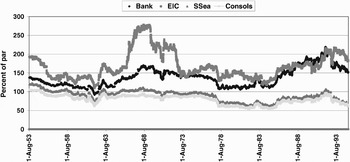
De Pinto argued that Dutch stock jobbing in the British annuities (mainly 3 Percent Consols) became essential and necessary for the British government because it borrowed increasingly large sums to wage each successive war in the eighteenth century. After borrowing 3 million in sterling to finance the War of the Austrian Succession, the British government borrowed at first 6, then 8 and finally 12 million pounds sterling as the expenses of the Seven Years War mounted (1756-63). The activity of stockjobbers, or actionistes in Amsterdam, he was convinced, enabled Britain to float these enormous sums at reasonable prices (see Figure 2, Consols), while the huge quantity of tradable securities available to investors provided continued livelihood to the Amsterdam stock dealers. De Pinto, according to Wilson, was on the payroll of the English East India Company (Wilson Reference Wilson1941, p. 160), and the scion of a family long associated with investments in English securities, so his testimony carries the authority of a well-established and experienced participant in the financial markets of both London and Amsterdam.
The most enduring, and ultimately most controversial, piece of legislation to arise in the eighteenth century was Barnard's Act (7 Geo. II, cap. 8). The Act was intended to eliminate time bargains in public securities altogether, the thought being that this would remove sudden movements in the prices of the various forms of government debt by eliminating the pernicious business of stockjobbing. Parliament passed the Act originally in 1733 for a period of three years to see what effect it might have, and then made it permanent in 1736 after it appeared that there had been few obviously adverse consequences of the Act.
Sir George Caswall, the disgraced stockjobber and prime mover of the South Sea scheme years earlier, tried to kill the bill by raising the specter that Navy victuallers and suppliers would not be able to raise cash for supplying the Navy's needs without possessing the government's promises to pay, which they needed to pledge as collateral to their bankers (or ‘monied men’ as Caswall phrased it). In reply, Barnard squelched Caswall's argument by saying that the short-term forms of government debt – Navy, Victualling and Exchequer bills – were not considered to be ‘public securities’ and therefore were not covered by the bill. His main argument in favor of the bill, namely that stockjobbers were essentially con artists whose efforts were a diversion from more useful pursuits, carried the day with the majority of the House of Commons (Budgell 1733-5, pp. 266-72).
The effect of Barnard's Act, when the necessities of war finance arose a few years later with the War of the Austrian Succession, was twofold. On one account, it gave a great deal of business to Dutch brokers, who only did business on time, and for quarterly accounts – February, May, August and November. Isaac de Pinto asserted that Britain's success in raising war finance for the War of the Spanish Succession, the War of the Austrian Succession and the Seven Years War was due to the ability of stockjobbers in London to sell their commitments to brokers in Amsterdam. The separation of broker and jobber functions, according to de Pinto, put brokers in London and jobbers in Amsterdam.
For subsequent historians (Wilson, Dickson), however, Barnard's Act simply forced the group of London jobbers, whether they had business connections in Amsterdam or not, to deal only with each other in London, knowing that it was to neither party's advantage to report the other to the authorities. The reward for reporting a violation of the Act to the authorities was only £500 and had to be split with the government. However the traders in London responded to Barnard's Act and the temptation of large new issues of prime government debt during the 1740s, 1750s and 1760s, it is clear that their connections with Amsterdam were strengthened substantially. If Barnard's Act had little effect in practice on the London stockbrokers, then the rising interest of Amsterdam stockbrokers in English securities came from the demand of their Dutch customers for remunerative placements of their capital, not from displacement of stock exchange business in derivatives to Amsterdam. But whenever the London stockbrokers tried to organize more formally, the restrictions imposed by Barnard's Act and other statutory restraints on securities trading became binding (Neal Reference Neal, Ma and van Zanden2011). The testimony of de Pinto about the importance of Amsterdam's well-developed derivatives market with its experienced professionals for the initial placement of large blocks of British government debt cannot be dismissed.
IV
A series of disruptions to the financial ties between London and Amsterdam ensued shortly after de Pinto's work was published in 1771. Revolutions, first in North America and then in France, strained the political ties between the United Kingdom and the United Provinces and ultimately their financial ties as well. In the continued historical debate over the timing and causes of the relative decline of Amsterdam to London, it is clear that the expenses of the War of the Spanish Succession (1702-13) had finally removed the Netherlands from further active participation in the great power politics of Europe. Thereafter, despite the strategic interests of Holland and Zeeland, which required open access to the high seas to maintain the prosperity of their long-distance merchants, the Netherlands maintained neutrality in the remaining wars of the eighteenth century. The long Anglo-Dutch connection came to a bitter end, moreover, perhaps with the Fourth Anglo-Dutch War (1780-4) (Wilson Reference Wilson1941), certainly with the Batavian Republic created under French revolutionary pressure in 1795 (Neal Reference Neal1990), and finally with the incorporation of the kingdom of Holland into the French empire by Napoleon in 1810 (Riley Reference Riley1980).
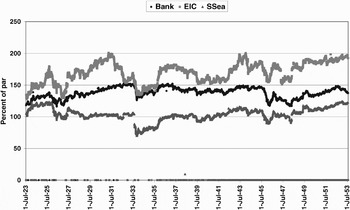
The threat of war generally caused a temporary fall in all British ‘funds’ including Bank of England stock in 1728, and actual war created sharper and longer falls in government debt prices as in 1740 (War of Austrian Succession) and again in 1756 (Seven Years War). When peace negotiations signaled the end of the war, however, prices would rebound. The certainty of an initial fall in price of British securities and an ultimate rise upon a successful conclusion of the war created obvious incentives for Dutch financiers to buy up British securities at the outset of a war and then sell them off at the conclusion (see Figure 1.) At the end of the War of Austrian Succession, as prices of the perpetual 3 percent annuities issued to finance the British participation in the war rose closer to par, the government began a conversion of its 4 percent annuities. The price of the 4 percent annuities went above par as the 3 percent annuities approached par, as the current yields of the two versions of British government debt had always converged. Both annuities were redeemable at par by the government, but instead of simply issuing new 3 percent annuities at close to par and using the proceeds to redeem the 4 percent annuities, the government chose to offer life annuities as an extra ‘sweetener’ or douceur to the holders of the 4 percent annuities. The life annuities were added to an equal book value of the new 3 percent annuities that replaced the 4 percent annuities.
The British ‘funds’ 1723–1753

Various explanations were offered at the time for this procedure, which has recently been re-examined by Christopher Chamley (Reference Chamley2007). Chamley shows that the 4 percent callable bonds were priced as derivatives of the 3 percent annuities that in 1748 replaced them, the first step in Pelham's eventual consolidation of the accumulated British debt into the 3 Percent Consols. Excessive pessimism about the rebound of prices of the new 3 Percents allowed the government to reduce its borrowing cost as bond prices recovered after the war much sooner than expected, according to Chamley. Life annuities were offered to investors to compensate them for the inconvenience of making the transfer from one security to another, but perhaps also to lock in foreigners to the new securities as the life annuities were not as easily transferred as the perpetual annuities, and hence much less liquid.
Isaac de Pinto had another explanation for the offer of life annuities, however, which was based on the widespread use of British securities as collateral for private loans. If the holder of the security had already pledged it as collateral for an outstanding loan, repaying the private loan ahead of time imposed a cost on the debt-holder that might be compensated by the additional income from the added life annuity. The huge mass of 3 Percent annuities now available to Dutch investors (l'océan d'annuités according to de Pinto) provided less interesting rates of return than the earlier forms of British government debt. Higher returns were also potentially available if other European governments could be induced to offer guarantees similar in nature to those that had proved so successful for the British government since 1688.
With the consolidation of British debt into the 3 Percent Consolidated Annuity in 1751, and the overall reduction in interest rates paid by the Pelham administration, Dutch investors began looking for more attractive returns elsewhere, as analyzed by Riley (Reference Riley1980, ch. 5). Beginning with Austria, Dutch investors expanded their range of foreign government loans to neighboring states – Denmark, Sweden and then beyond to Russia, Poland, Spain, and then to France and especially the newly created United States of America (Riley Reference Riley1980, chs. 6 and 7). These were managed primarily by individual merchant banks, each country's loans becoming the primary responsibility of a single house, whose reputation was the key to the marketability of the country's debt to Dutch investors. This initiated a process of merchant banking that eventually became the model for the British success in foreign lending, led by the House of Rothschild, in the nineteenth century.Footnote 12
In addition to the disruption to Dutch financiers caused by Pelham's conversion, a series of financial crises began to occur in Amsterdam, each arising in fact from events initiated in London. The crisis of 1745, the result of the Jacobite incursion that year in the midst of the general European War of the Austrian Succession, caused all the British securities to dip sharply, reaching bottom at the end of March 1746. The recovery upon news of the Jacobite defeat and dispersal was equally abrupt, but prices of the British funds never reached prewar levels even after concluding the Treaty of Aix-la-Chapelle (see Figure 1). The continued expansion of British debt with each succeeding war of the eighteenth century necessarily weighed on the market price of existing debt held by the Dutch.
The next crisis to affect Dutch investors was in 1763, when the results of the Battle of Plassey became known and the price of East India Company stock shot up spectacularly. As some Dutch houses, notably the firm of Gebruder Neufville, had sold English East India Company stock short on the expectation that the French forces would prevail, a liquidity crisis unfolded. This affected a large number of firms throughout the Netherlands, Britain and Germany, and led to serious consideration of establishing a jointly funded insurance fund in Amsterdam to act as a lender of last resort. As it became clear that the focus of the problem was the single firm of Neufville, the proposal was abandoned and the Dutch firms focused on working out their eventual claims on Neufville, which eventually paid out 60 percent of its debts to the various creditors. Having successfully quarantined the toxic assets created by the Neufville firm, the remaining Dutch merchant bankers then resumed their profitable business in the expanded trade throughout Europe that ensued (Wilson Reference Wilson1941, ch. 6).
The subsequent crisis in 1772 was more serious, as it involved outright fraud by a Scottish bank, which somehow had inveigled large accommodation loans from Clifford & Sons, long one of the leading merchant banks in Amsterdam in their role as agents for the English East India Company. The extent of Clifford & Sons debts to the banking community of Amsterdam and London was so great that a mutual lending bank, first proposed in 1763, was actually established. The Stads-Beleeningkamer served its purpose well, extending credit with municipal support to established banking houses on the basis of commodities and domestic debt posted as collateral. Again, however, the source of the systemic failure was quickly identified to be the one firm, and its creditors in London actually came to its rescue while taking over its subsequent business. Accordingly, the nascent lender of last resort in the form of a mutual insurance fund was wound up in 1773.
When the Fourth Anglo-Dutch War broke out in 1784, however, Amsterdam bankers were truly faced with a systemic crisis that was not focused on any particular banking house. The Stads-Beleeningkamer was resurrected and left in place, albeit not with enough funding to serve truly as a lender of last resort during the turmoil of the following decades. The hostility of the British to Dutch investors for their continued financial support of American colonial aspirations throughout the American Revolutionary War did provoke the British attack on Amsterdam in 1784. But even earlier, when Lord North commissioned an inquiry into the extent of Dutch holdings of the British national funds in 1777, Dutch stockholders felt pressure to either withdraw or conceal their holdings in the British funds thereafter (Wilson, p. 190). Opinions vary on the extent to which this occurred. Wilson argued that the Dutch had little alternative but to withdraw, but Carter noted little change in the holdings of wealthy Dutch recorded in the Collateral Succession Tax records of the city of Amsterdam. Carter noted that while prices of British funds fell with the American and Dutch Wars, this made the yield on them, which rose to nearly 5 percent, all the more attractive (Carter 1953, p. 338). While holdings of French rentes by the wealthy Dutch increased in the 1780s as well, that did not require them to reduce their holdings of British securities.
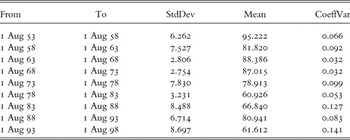
Figure 2 presents the situation that confronted Dutch investors in the British funds from the consolidation of the 3 Percent annuities, the prices of which began to appear in the Course of the Exchange in 1753, until the end of 1795, when the French occupation of Amsterdam cut Dutch investors from their normal access to the London market. The surprising volatility of the English East India Company stock was clearly a matter of continuing concern for the Dutch investors, and not merely those who had lost in their speculative ventures at the end of the Seven Years War. The price movements in the stock of the Bank of England, while subdued compared to those of the East India Company, also became more volatile after mid-century. Even the new ‘blue-chip’ security available in unprecedented quantities for investors throughout Europe, the 3 Percent Consol, became increasingly volatile over the course of the last half of the eighteenth century, especially when Britain became ensnared in the American Revolutionary War. Table 1 calculates the coefficients of variation in the price of 3 Percent Consols over successive five-year intervals from 1753 to the summer of 1798 in order to quantify the increased volatility in British security prices that were an increasing concern for Dutch investors. Further, the gradual rise in price of the Consols after the Treaty of Paris in 1783 simply meant that new investors were receiving lower yields as the price approached par again.
British funds, 1753–1795

Volatility measures of British Consols (five-year averages), 1753–1798

Riley, like Carter, attributes Dutch investment in foreign government securities, whenever and wherever it occurred, to their continued search for reasonable returns on their surplus capital. Even after the establishment of the Batavian Republic under the watchful eyes of French armies in 1795, and the fleeing of the wealthiest merchant bankers such as Henry Hope to join his correspondents in London, fresh Dutch investment in government securities continued. Only now it was domestic Dutch government debt that was finally centralized into a combined national debt, replacing the scattering of annuities and bearer bonds previously issued by the cities and provinces. The debt was used to pay off the liberation forces of the French in the first instance, but thanks to the tax reforms of the Patriots the debt service was kept up faithfully. Later, under Napoleon's sterner rule, the Dutch found themselves providing funds to the various satellite kingdoms under French rule, so they in turn could pay tribute to the French empire.
Indeed, had Napoleon fully understood the possibilities of Dutch finance, with its cosmopolitan connections through family-run firms dispersed throughout Europe and the Atlantic economy, he might have been able to utilize it more effectively for financing his occupation armies. Gabriel Ouvrard, in fact, managed to get Napoleon's permission to carry out a daring scheme to supply his Spanish forces with silver piastres minted in Mexico. His plan required using the remaining facilities of Hope & Company in Amsterdam, with whom he retained good connections, to use their well-established relations with Barings & Company in London to bring the Mexican coins from Vera Cruz to Portsmouth (using the British warship Diana), then to Antwerp (presumably on fishing smacks), and to Paris using Ouvrard's connections. It proved successful in providing much-needed payment to Napoleon's troops in Spain, but the share taken by Barings proved equally successful in payment to Wellington's Peninsular Army. Ouvrard's commissions so infuriated Napoleon that he put the talented financier in prison in 1806, and proceeded to implement his ill-fated Continental Blockade. That effort succeeded in disrupting the trade flows that had provided the basis for transferring capital loans and repayments through the financial center of Amsterdam. It also succeeded in fully displacing the center of international capital from Amsterdam to London.Footnote 13
Meanwhile, the attraction of London as a destination for flight capital from the nobles and merchants in Europe who were subjected to the expropriations of Napoleon's forces brought fresh capital and talent into service for the British military and naval effort (Neal Reference Neal1990, ch. 9; 1991). Rather than put Ouvrard's counterpart in London, Nathan Rothschild, in prison, the British government took advantage of his network of agents on the Continent to continue smuggling specie, much counterfeit, for the financing of Wellington's troops in Europe (Kaplan Reference Kaplan2006). Indeed, the House of Rothschild took advantage of its position in the London capital market to become the leading merchant banking house of Europe after 1815 (Ferguson Reference Ferguson1998).