Introduction
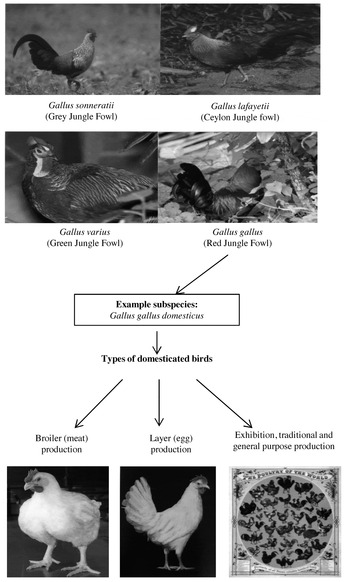
Domestication of chickens is a dynamic process that started in ancient times when birds were kept for entertainment and then used for food production (Al-Nasser et al., Reference AL-NASSER, AL-KHALAIFA, AL-SAFFAR, KHALIL, ALBAHOUH, RAGHEB, AL-HADDAD and MASHALY2007; Tixier‑Boichard et al., 2011). Gallus gallus domesticus, a subspecies of the red jungle fowl (Figure 1), is considered the ancestor from which domesticated chickens were developed and further subspecies derived (Al-Nasser et al., Reference AL-NASSER, AL-KHALAIFA, AL-SAFFAR, KHALIL, ALBAHOUH, RAGHEB, AL-HADDAD and MASHALY2007).
An illustrated overview of chicken taxonomy from wild jungle fowl species to the various production lines of commercial poultry. (Al-Nasser et al., Reference AL-NASSER, AL-KHALAIFA, AL-SAFFAR, KHALIL, ALBAHOUH, RAGHEB, AL-HADDAD and MASHALY2007; Scanes et al., Reference SCANES, BRANT and ENSMINGER2004; Langhout et al., Reference LANGHOUT, DIERICX and BAUWENS2010).

During the early domestication process, G. g. domesticus would have become adapted passively to a domestic environment in which food, water and protection from predators were provided by humans (Al-Nasser et al., Reference AL-NASSER, AL-KHALAIFA, AL-SAFFAR, KHALIL, ALBAHOUH, RAGHEB, AL-HADDAD and MASHALY2007; Tixier-Boichard et al., Reference TIXIER-BOICHARD, BED'HOM and ROGNON2011). After the mid-1800s, domesticated chickens were bred increasingly to select for certain traits (e.g. adaptation to captivity) in the United States and Europe (Al-Nasser et al., Reference AL-NASSER, AL-KHALAIFA, AL-SAFFAR, KHALIL, ALBAHOUH, RAGHEB, AL-HADDAD and MASHALY2007; Cheng, Reference CHENG2010). Breeding programs became highly specialised during the 1900s and commercially desirable traits (e.g. meat production – ‘broilers’ or egg production – ‘layers’) became important (Al-Nasser et al., Reference AL-NASSER, AL-KHALAIFA, AL-SAFFAR, KHALIL, ALBAHOUH, RAGHEB, AL-HADDAD and MASHALY2007; Tixier-Boichard et al., Reference TIXIER-BOICHARD, BED'HOM and ROGNON2011). As a result, domesticated poultry lost some genetic diversity and display behavioural, physiological and physical characteristics distinct from their wild ancestor (Al-Nasser et al., Reference AL-NASSER, AL-KHALAIFA, AL-SAFFAR, KHALIL, ALBAHOUH, RAGHEB, AL-HADDAD and MASHALY2007; Cheng, Reference CHENG2010). Concurrently, the environment in which chickens lived changed during domestication. As such, established interactions that existed among pathogens, specifically Eimeria parasites, and the natural intestinal microbiota undoubtedly adapted to the changing environment and may have impacted the domestic chicken.
History of domestication and commercialisation of poultry
Advancement of the poultry industry from small backyard production to specialised production companies (commercialised poultry) occurred as a result of changes to rearing methods and scientific achievements in breeding, genetics, housing, management and disease control over the course of less than a century (Scanes et al., Reference SCANES, BRANT and ENSMINGER2004; Al-Nasser et al., Reference AL-NASSER, AL-KHALAIFA, AL-SAFFAR, KHALIL, ALBAHOUH, RAGHEB, AL-HADDAD and MASHALY2007).
For successful commercial poultry production to be achieved certain conditions must be satisfied: 1) ability to purchase purpose-bred chickens (e.g. broilers versus layers); 2) ability to purchase or internally hatch quality day old chicks; 3) ability to mill or purchase nutritious feed, and to purchase vaccines, pharmaceuticals and equipment; 4) availability of a skilled poultry service industry; 5) control infectious disease agents; and 6) establish domestic or international markets to which poultry may be sold at competitive prices (Alders and Pym, Reference ALDERS and PYM2009). Developed countries have the economic capacity to achieve the conditions necessary for large intensive poultry production. Conversely, many developing countries lack the infrastructure to permit intensive rearing on a large-scale basis (Alders and Pym, Reference ALDERS and PYM2009).
poultry production in the developed world: intensive rearing
During the 1940s, poultry production was revolutionised via intensive rearing of large numbers of birds that improved productivity by controlling the environment and establishing type-specific management systems (Sainsbury, Reference SAINSBURY2000). In North America, litter and conventional cages are two popular housing management methods (Bell, Reference BELL2002; Lacy, Reference LACY2002). Broilers are commonly reared on floor with litter from day of hatch to slaughter in the same facility during their relatively short life span (usually less than eight weeks of age) (Lacy, Reference LACY2002). Broiler breeder and layer pullets (sexually immature females) are commonly reared in one facility and then transferred to breeder or table egg production facilities at sexual maturity (Bell, Reference BELL2002). This review focuses on rearing practices for layers; however, practices for breeders are similar. Layers are commonly reared to production in conventional cages (Suprenant et al., Reference SUPRENANT, LACOBBUCCI and GAUMOND2008); however, reliance on this type of caging is changing because of increased concern and legislation regarding animal welfare in such systems (Vanhonacker and Verbeke, Reference VANHONACKER and VERBEKE2009).
poultry production in the developed world: free range rearing
Recently, consumers have shown support for commercialised free range poultry as opposed to intensively reared poultry (Vanhonacker and Verbeke, Reference VANHONACKER and VERBEKE2009). Broilers and layers may be reared under production type-specific free range systems from day of hatch.
Commercialised free range pullets are often confined to a controlled indoor environment similar to their conventional counterparts, for reasons of disease protection, until sexual maturity at approximately 20 weeks of age (Dawkins et al., Reference DAWKINS, COOK, WHITTINGHAM, MANSELL and HARPER2003). For mature layers, the free range system allows for access to pasture from floor housing (Bell, Reference BELL2002).
Commercialised free range broilers are bred to grow to market weight slowly over a period of two to three months rather than eight weeks or less for their conventional counterparts (Lacy, Reference LACY2002; Dawkins et al., Reference DAWKINS, COOK, WHITTINGHAM, MANSELL and HARPER2003). Initially, these broilers are brooded on litter similar to conventional broilers but, unlike conventional broilers, free range broilers are allowed access to outdoor pasture during the day (Moyle et al., Reference MOYLE, ARSI, WOO-MING, ARAMBEL, FANATICO, BLORE, CLARK, DONOGHUE and DONOGHUE2014).
While both commercial free range broilers and layers are given access to a full outdoor run, only a fraction of the birds for either production type may actually use all of the space given; most will remain indoors or huddle close to the house especially if the preferred outdoor habitat (i.e. a covered area) is not provided (Dawkins et al., Reference DAWKINS, COOK, WHITTINGHAM, MANSELL and HARPER2003; Hegelund et al., Reference HEGELUND, SERENSEN and HERMANSEN2006; Moyle et al., Reference MOYLE, ARSI, WOO-MING, ARAMBEL, FANATICO, BLORE, CLARK, DONOGHUE and DONOGHUE2014). Should poultry remain near or within the barn there may be potential for a heightened disease risk because higher transmission rates may occur with the locally increased bird density. Unless netting is used to eliminate access to the pasture and barn, wild birds will inevitably exploit the flocks’ feeders and drinkers; regardless of nets, these wild birds can spread infectious agents through shed feathers and droppings. These systems require higher input, are affected by weather (Nagle and Glatz, Reference NAGLE and GLATZ2012) and outdoor run management may affect the bird (Dawkins et al., Reference DAWKINS, COOK, WHITTINGHAM, MANSELL and HARPER2003; Hegelund et al., Reference HEGELUND, SERENSEN and HERMANSEN2006).
poultry production in the developing world
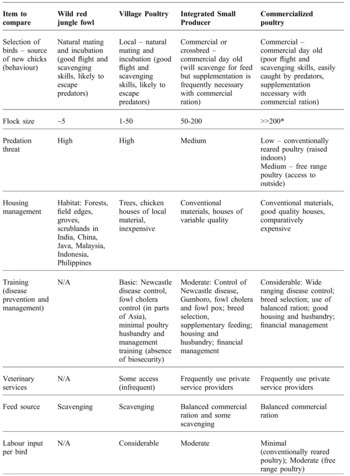
Village poultry, non-industrial poultry and poultry production systems employed widely with chickens, may be found in all developing nations; however, some countries will have a combination of intensive and village poultry production (Alders and Pym, Reference ALDERS and PYM2009; Nnadi and George, Reference NNADI and GEORGE2010). Village poultry production is a minimal input, minimal output system (Table 1) where easily managed, resilient birds (similar characteristics to their wild ancestors) are preferred rather than high production potential (Alders and Pym, Reference ALDERS and PYM2009).
A summary of comparisons between village, integrated small producer and commercialised poultry production systems (Suprenant et al., Reference SUPRENANT, LACOBBUCCI and GAUMOND2008; Alders and Pym, Reference ALDERS and PYM2009).

*Average commercial flock size in the United States ranges between 20,000 and >100,000 depending on poultry production type (e.g. broilers, layers, etc.).
Eimerian-microbiota-host interactions from ancestral fowl to modern chickens
Domestication of chickens and modern poultry production altered how bacteria, viruses, fungi and parasites interacted with poultry. The poultry microbiome (see Yeoman et al., Reference YEOMAN, CHIA, JERALDO, SIPOS, GOLDENFELD and WHITE2012 for a comprehensive review) has been an active area of study in recent years, in part, due to increased interest in antibiotic-free poultry production. The focus of this section is the interaction between Eimeria spp. and chicken rearing, Eimeria spp. and the intestinal microbiota as well as combined interactions among Eimeria spp., the intestinal microbiota and the host.
effect of chicken domestication on transmission of Eimeria spp
Eimeria spp. are host-specific, fecund apicomplexan parasites and have long been recognised as ubiquitous in galliform birds (Yabsley, Reference YABSLEY2008) both wild (Fernando and Remmler, Reference FERNANDO and REMMLER1973) and domestic (Chapman, Reference CHAPMAN2003). Eimerian parasites undergo genetically limited endogenous and subsequent exogenous development to become infectious. Due to this genetic limitation, coccidiosis severity is directly related to the initial dose of infective oocysts ingested and immune status of the host (Reid, Reference REID1990). Additionally, the concentration of infective oocysts in a rearing environment can impact the likelihood of coccidiosis.
The external infectious process is dependent on temperature, access to oxygen and humidity levels (Reyna et al., Reference REYNA, MCDOUGALD and MATHIS1983). The interplay of abiotic and biotic factors, such as secondary bacterial activity, may influence the viability and survivability of the parasite (Reyna et al., Reference REYNA, MCDOUGALD and MATHIS1983; Reid, Reference REID1990). Eimeria spp. must undergo faecal-oral transmission to infect hosts (Williams, Reference WILLIAMS1999). Strong protective immunity usually develops following repeated infections; yet, even protected birds may shed small numbers of oocysts without signs of illness (Williams, Reference WILLIAMS1999). Different types of poultry rearing methods may have an influence on the eimerian-host interaction (Adene and Akande, Reference ADENE and AKANDE1978).
In the wild, red jungle fowl (~5 per flock; bird density of ~100 birds/km2) will roam extensively around a nest or roost site as they forage for food (Collias and Collias, Reference COLLIAS and COLLIAS1967). Consequently, Eimeria spp. shed in the faeces are widely scattered so the density of infectious stages remains low which decreases the likelihood of ingestion of large numbers of infective oocysts required to cause disease. Such dispersed oocysts will result in continuous ingestion of small numbers of oocysts and elicit strong protective immunity in the host (Yabsley, Reference YABSLEY2008). Low infective challenge pressure and limited numbers of susceptible birds greatly reduce the likelihood of clinical coccidiosis in such populations (Yabsley, Reference YABSLEY2008).
Due to the ubiquitous and fecund nature of the parasite, finding a commercial flock that is not shedding oocysts is rare (Ruff, Reference RUFF1999). Intensification of poultry may increase the rate and intensity of parasite transmission by various means. Chickens that were bred for performance have demonstrated less roaming behaviour (e.g. purposeful movement to scratch for feed) than their wild counterparts; thus, birds with reduced roaming activity may be more likely to ingest oocysts found in their immediate vicinity and therefore may have an increased chance of transmission (Schutz et al., Reference SCHUTZ, FORKMAN and JENSEN2001; Al-Nasser et al., Reference AL-NASSER, AL-KHALAIFA, AL-SAFFAR, KHALIL, ALBAHOUH, RAGHEB, AL-HADDAD and MASHALY2007). Different selected lines of poultry may have different susceptibilities to coccidiosis (Jeffers et al., Reference JEFFERS, CHALLEY and MCGIBBON1970; Bumstead and Millard, Reference BUMSTEAD and MILLARD1992). Broiler and egg production sectors rear large flocks (Table 1) in controlled environments that may enhance infective oocyst accumulation and transmission compared to their wild counterparts, but in ways that may be unique in each system (Bell, Reference BELL2002; Lacy, Reference LACY2002; Suprenant et al., Reference SUPRENANT, LACOBBUCCI and GAUMOND2008). These combined changes to the birds and their environments have altered the long-established eimerian-host relationship and turned a comparatively innocuous parasite into a serious pathogen.
Intensive production of broilers provides a large number of densely packed, immunologically susceptible chickens walking on faeces-laden litter that supports the oocysts becoming infectious. Consequently, these conditions allow for transmission of Eimeria spp. and may give rise to subclinical and clinical coccidiosis depending on the numbers of infective oocysts ingested (Chapman, Reference CHAPMAN2000).
Layers can be reared either on litter or in cages. In a typical cage system manure is captured below the cage using a conveyor belt. In theory, birds have minimal access to faecal waste implying little opportunity for Eimeria transmission; nevertheless, birds may still ingest oocysts through contaminated feed or water (McDougald, Reference MCDOUGALD2003), from the manure belt, from the cage floor, or from dirty feathers around the vents of cage-mates (Price, Reference PRICE2012).
Commercial free range poultry can experience coccidiosis outbreaks (Berg, Reference BERG2001). Replacement pullets for free range layer farms are usually reared in a controlled indoor environment (Berg, Reference BERG2001) and may experience exposure to Eimeria spp. comparable to conventionally reared pullets until production begins. If the provided pasture does not promote foraging and roaming behaviour, poultry may remain concentrated around the house, feeders or drinkers increasing the likelihood of parasite transmission (Hegelund et al., Reference HEGELUND, SERENSEN and HERMANSEN2006). Coccidia-infected birds may contaminate the pasture with oocysts; but, whether these oocysts are infective to present or future flocks is dependent on external factors such as climatic conditions or bacterial degradation (Horton-Smith, Reference HORTON-SMITH1949; Reyna et al., Reference REYNA, MCDOUGALD and MATHIS1983).
To combat coccidiosis in commercial poultry, biosecurity, house management (e.g. reduce the risk of contamination among birds in a single flock or between flocks from pests, etc.) and disease prevention methods (e.g. drugs or vaccines) must be followed (Scanes et al., Reference SCANES, BRANT and ENSMINGER2004; McDonald and Shirley, Reference MCDONALD and SHIRLEY2009). Conversely, village poultry demonstrate a unique eimerian-host interaction that may be related to a lack of biosecurity measures and reliable access to veterinary services. Village poultry are local breeds that likely have a higher genetic diversity than birds reared industrially (Alders and Pym, Reference ALDERS and PYM2009). One village may have many producers with small flocks of mixed ages; these birds may be reared without adequate barriers to separate each producer's flock with no coccidiosis control measures (Alders and Pym, Reference ALDERS and PYM2009). Consequently, fowl are free to roam among different producer flocks of different ages and acquire infective oocysts either from other flocks or mechanical vectors (Ashenafi et al., Reference ASHENAFI, TADESSE, MEDHIN and TIBBO2004). Implementation of economically feasible biosecurity and coccidiosis prevention measures may help reduce disease in village poultry flocks of developing nations.
development of drug-resistance by Eimeria spp
Complementary to the intensification of the commercial poultry industry, anticoccidial drugs were developed and exploited to prevent coccidiosis (Stephan et al., Reference STEPHAN, ROMMEL, DAUGSCHIES and HABERKORN1997; Campbell, Reference CAMPBELL2008; Chapman et al., Reference CHAPMAN, JEFFERS and WILLIAMS2010). Heavy reliance on the most effective drugs (frequently a single drug or class of drugs) provided the ideal environment for selection of drug‑resistance, which remains a common problem globally (Peeters et al., Reference PEETERS, DERIJCKE, VERLINDEN and WYFFELS1994; Abbas et al., Reference ABBAS, IQBAL, SINDHU, KHAN and ARSHAD2008). The biology of Eimeria spp. contributes directly to the rapidity of the development of drug-resistance via asexual replication (essentially mitosis) followed by sexual reproduction that leads to the production of oocysts (Barta, Reference BARTA2001). The sexual reproduction of the nuclear genome of coccidia, providing a means of rapid genetic recombination, coupled with its immediate meiosis to haploid infectious sporozoites, ensures that any advantageous genetic polymorphism can be quickly amplified and fixed in the population of coccidia (Greif et al., Reference GREIF, STEPHAN and HABERKORN1996; Chapman, Reference CHAPMAN1997; Shirley, Reference SHIRLEY2000). Large numbers of parasites subjected continuously to drug pressure provide more chances that an Eimeria strain with genetic resistance against a particular anticoccidial is present in the population and will be selected; however, accurately estimating the time required for drug-resistance to develop has not been possible (Chapman, Reference CHAPMAN1984; Abbas et al., Reference ABBAS, IQBAL, SINDHU, KHAN and ARSHAD2008). Drug-resistance, once developed, will generally remain a characteristic of the specific Eimeria strain but development of this trait may be geographically specific (Chapman, Reference CHAPMAN1984; Abbas et al., Reference ABBAS, IQBAL, SINDHU, KHAN and ARSHAD2008). Fitness is not affected negatively by acquiring resistance against some classes of anticoccidials; therefore, resistance can persist in the parasite population long after the selective pressure (i.e. the anticoccidial) has been removed. For example, drug-resistance against the anticoccidial zoalene remained in field isolates of Eimeria many years after regular use of zoalene was halted (Martin et al., Reference MARTIN, DANFORTH, BARTA and FERNANDO1997). In contrast, resistance to ionophorous anticoccidials usually persists only under selective pressure; ionophore-susceptible strains tend to out-compete ionophore‑resistant strains following cessation indicating reduced fitness in the resistant lines (Chapman et al., Reference CHAPMAN, JEFFERS and WILLIAMS2010).
Strategies have been implemented in the poultry industry to combat development of resistance. However, consumers and governments have become increasingly reluctant to the use of preventative drugs in food production animals (Dibner and Richards, Reference DIBNER and RICHARDS2005). Consequently, recent government legislation has been enacted in a number of countries to greatly restrict in-feed drug use (i.e. partial or total bans) in food production animals including poultry (Williams, Reference WILLIAMS1998). Strict legislation and decreased novel drug development has fuelled the search for effective alternatives to control coccidiosis (Stephan et al., Reference STEPHAN, ROMMEL, DAUGSCHIES and HABERKORN1997; Barta, Reference BARTA2001).
Changing microbiota with chicken domestication and the relationship with Eimeria spp
The complicated ecosystem that is the microbiome in the chicken digestive tract has been studied for years. Development of this microbiome, including bacteria, fungi, viruses and protists, occurs at both macro and micro scales. Co-evolution of the chicken in its environment occurs on a macro scale while micro interactions between the host and the microbiome of its digestive tract, as well as among components of the microbiome itself (Ley et al., Reference LEY, LOZUPONE, HAMADY, KNIGHT and GORDON2008; Yeoman et al., Reference YEOMAN, CHIA, JERALDO, SIPOS, GOLDENFELD and WHITE2012) all occur simultaneously in an interrelated manner.
Feed and its method of acquisition as well as the environment are critical determinants governing evolution of many animal species (Ley et al., Reference LEY, LOZUPONE, HAMADY, KNIGHT and GORDON2008) and their microbiota (Rook, Reference ROOK2012). Selection pressure on the host (e.g. diet or access to feed) can impact the microbiome of the digestive tract (Ley et al., Reference LEY, LOZUPONE, HAMADY, KNIGHT and GORDON2008). Ancestral poultry, and to a degree village poultry, have a varied diet obtained through environmental foraging whereas industrialised poultry are usually fed a defined diet provided ad lib. Ancestral poultry had access to a more varied microbiota but likely at low levels whereas modern poultry may have access to limited microbiota, albeit at high levels. The intestinal microbiome of ancestral and modern poultry changes with the changing intestinal environment from a young animal to ‘adulthood’ (Lu et al., Reference LU, IDRIS, HARMON, HOFACRE, MAURER and LEE2003; Pedroso et al., Reference PEDROSO, MENTEN and LAMBAIS2005; Yeoman et al., Reference YEOMAN, CHIA, JERALDO, SIPOS, GOLDENFELD and WHITE2012). Antibiotics in the feed may further impact the composition of the intestinal microbiome in modern poultry (Pedroso et al., Reference PEDROSO, MENTEN, LAMBAIS, RANCANICCI, LONGO and SORBARA2006).
Early studies with gnotobiotic (‘bacteria-free’) chickens suggested the severity of an Eimeria spp. infection could be exacerbated by the presence of intestinal flora (Morse, Reference MORSE1908; Fantham, Reference FANTHAM1910). Later studies confirmed this effect for only some Eimeria spp. The severity of infections with E. tenella was increased in conventionally reared chickens possessing indigenous intestinal flora (part of the natural microbiome) compared to similarly challenged gnotobiotic birds (Visco and Burns, Reference VISCO and BURNS1972; Bradley and Radharkrishnan, Reference BRADLEY and RADHARKRISHNAN1973). The presence or absence of indigenous intestinal flora did not affect the severity of infections with other Eimeria spp., such as E. acervulina (Ruff et al., Reference RUFF, JOHNSON, DYKSTRA and REID1974), E. maxima (Rice and Johnson, Reference RICE and JOHNSON1973) or E. brunetti (Hedge et al., Reference HEDGE, REID, JOHNSON and WOMACK1969); nonetheless, not all of the pathological changes associated with the latter Eimeria spp. may be independent of the intestinal flora (Ruff et al., Reference RUFF, DYKSTRA, JOHNSON and REID1975). None of these studies identified the mechanisms underlying these interactions nor explored the impact that such interactions may have on any resulting immune response.
Pifer and Yarovinsky (Reference PIFER and YAROVINSKY2011) suggest that indigenous gut bacteria indirectly impact immune responses against various pathogens including Toxoplasma gondii, a coccidian parasite related to Eimeria spp. When mice deficient in certain immune receptors (toll like receptors 2, 4, or 9) and lacking intestinal microbiota were infected orally with T. gondii, some normal immune responses against the parasite were impaired (e.g. impaired dendritic cell maturation and subsequent activation of innate and adaptive immune response); in contrast, when gnotobiotic mice of the same strain were infected systemically, these responses functioned normally (Benson et al., Reference BENSON, PIFER, BEHRENDT, HOOPER and YAROVINSKY2009). Interestingly, expansion of Gram-negative bacterial populations subsequent to oral T. gondii infection was associated with the activation of toll like receptor 4 (Heimesaat et al., Reference HEIMESAAT, FISCHER, JAHN, NIEBERGALL, FREUDENBERG, BLAUT, LIESENFELD, SCHUMANN, GOBEL and BERESWILL2007). Together, these results suggest that changes to the gut microbiome following intestinal damage associated with oral T. gondii infection, rather than T. gondii alone, activate innate receptors and impact the immune response against this pathogen (Heimesaat et al., Reference HEIMESAAT, BERESWILL, FISCHER, FUCHS, STRUCK, NIEBERGALL, JAHN, DUNAY, MOTER, GESCHER, SCHUMANN, GOBEL and LIESENFELD2006; Reference HEIMESAAT, FISCHER, JAHN, NIEBERGALL, FREUDENBERG, BLAUT, LIESENFELD, SCHUMANN, GOBEL and BERESWILL2007; Benson et al., Reference BENSON, PIFER, BEHRENDT, HOOPER and YAROVINSKY2009; Pifer and Yarovinsky, Reference PIFER and YAROVINSKY2011). Similar results have been found with mammals infected with other parasites (Duarte, Reference DUARTE2004). Other receptors can be activated by the parasite directly, by indigenous bacteria or via host-derived activators (Pifer and Yarovinsky, Reference PIFER and YAROVINSKY2011). Most studies exploring the interaction of the microbiota, an invading pathogen and the host immune system have used murine models (Pifer and Yarovinsky, Reference PIFER and YAROVINSKY2011). Despite some similarities, extrapolation of results obtained with T. gondii in mice to Eimeria spp. in chickens must be made cautiously because of differences between the parasites, hosts and their intestinal microbiome. Characterising bacteria involved in indigenous bacteria-dependent immunity is complex because not all bacteria and their functional interrelationships can be identified using current technology (Yeoman et al., Reference YEOMAN, CHIA, JERALDO, SIPOS, GOLDENFELD and WHITE2012).
Kimura et al. (Reference KIMURA, MIMURA, NISHIDA, KOBAYASHI and MITSUOKA1976) studied the relationships between a defined caecal flora of lactobacilli, streptococci, enterobacteria and Clostridium perfringens with E. tenella. Chickens were administered E. tenella orally and then intestinal and caecal contents were analyzed periodically from a day before infection to 18 days post infection (DPI) using media and culturing methods (Kimura et al., Reference KIMURA, MIMURA, NISHIDA, KOBAYASHI and MITSUOKA1976). Changes to the microbiota were found only in the caecal samples which were interpreted to reflect the caecal localisation of E. tenella (Kimura et al., Reference KIMURA, MIMURA, NISHIDA, KOBAYASHI and MITSUOKA1976). When birds were inoculated with 20,000 infective E. tenella oocysts, the mean total viable bacterial counts of lactobacilli and streptococci per one gram of wet caecal content decreased at 5 DPI coincident with destruction of the caecal mucosa, whereas other beneficial indigenous bacteria (e.g. Bacteroides spp.) started to decrease in number at 5 DPI reaching a minimum at 7 DPI (Kimura et al., Reference KIMURA, MIMURA, NISHIDA, KOBAYASHI and MITSUOKA1976). Interestingly, C. perfringens numbers increased at 7 DPI and enterobacteria showed elevated numbers at 13 DPI (Kimura et al., Reference KIMURA, MIMURA, NISHIDA, KOBAYASHI and MITSUOKA1976).
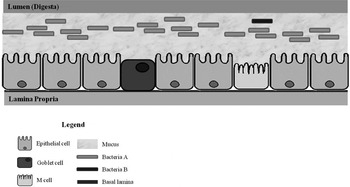
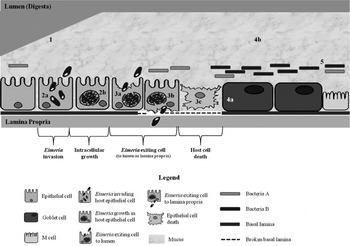
The question remains as to why these relationships between the microbiota and Eimeria spp. occur. Many interactions may occur among Eimeria spp., microbiota and the host intestinal environment during a diseased (Figure 3) compared to a healthy (Figure 2) state. During an Eimeria spp. infection the microbiota may be altered (Collier et al., Reference COLLIER, HOFACRE, PAYNE, ANDERSON, KAISER, MACKIE and GASKINS2008; Kitessa et al., Reference KITESSA, NATTRASS, FORDER, MCGRICE, WU and HUGHES2014) as the result of direct Eimeria‑induced signalling activation or microenviromental changes resulting from parasite development and associated cell destruction or some combination thereof (Figure 3).
Diagrammatic representation of the healthy gastrointestinal tract. The healthy gastrointestinal tract consists of an epithelial layer and basal lamina to act as a barrier between the lumen and lamina propria, mucus to cover the surface of the epithelial layer and indigenous microbiota (Scanes et al., Reference SCANES, BRANT and ENSMINGER2004).

Diagrammatic representation of possible interactions among Eimeria species, microbiota and the host intestinal environment. When the intestinal tract has been infected with Eimeria species several possible interactions may occur: 1) Some Eimeria species may weaken the intestinal mucosa (e.g. E. necatrix or E. tenella) or alter the gut environment through increased mucogenesis (e.g. E. maxima) (Collier et al., Reference COLLIER, HOFACRE, PAYNE, ANDERSON, KAISER, MACKIE and GASKINS2008) or change the acidity level of the digesta (Williams, Reference WILLIAMS2005); 2) When Eimeria species enter the intestinal epithelial cell they may leave apical invasion proteins attached to invaded cells or in the lumen (Chapman et al., Reference CHAPMAN, BARTA, BLAKE, GRUBER, JENKINS, SMITH, SUO and TOMLEY2013) to potentially activate the inflammatory signalling cascade substantively damaging the epithelial cell; 3) When Eimeria species exit a cell they break the cell membrane (3a, 3b) causing cell death (3c) and the products from cell death may help to initiate an inflammatory signalling cascade (Barker, Reference BARKER1993). Additionally, the “hole” in the epithelial layer (3a), especially if it extends as far as the lamina propria and breaks the basal lamina (3b), may allow leakage of proteins (Joyner et al., Reference JOYNER, PATTERSON, BERRETT, BOARER, CHEONG and NORTON1975) and entry of opportunistic bacteria that may amplify the inflammatory activation signal (Barker, Reference BARKER1993; Williams, Reference WILLIAMS2005); 4) Goblet cell size and number (4a) as well as the type of mucin being generated (4b) have been demonstrated to change with an Eimeria species infection perhaps as a result of the activated inflammatory signalling cascade (Collier et al., Reference COLLIER, HOFACRE, PAYNE, ANDERSON, KAISER, MACKIE and GASKINS2008; Kitessa et al., Reference KITESSA, NATTRASS, FORDER, MCGRICE, WU and HUGHES2014); and 5) The change in the environment, via changes to the intestinal environment or changes in the signalling cascade or changes to mucin dynamics, may impact the relative number and composition of the intestinal microbiota (Collier et al., Reference COLLIER, HOFACRE, PAYNE, ANDERSON, KAISER, MACKIE and GASKINS2008; Kitessa et al., Reference KITESSA, NATTRASS, FORDER, MCGRICE, WU and HUGHES2014).

In addition to Eimeria spp. impacting the local microbiome, the microbiota may alter the digestive tract in ways that affect the coccidial infection process. For example, chickens treated with a defined probiotic culture containing beneficial bacteria (e.g. Lactobacillus spp.) prior to challenge with E. acervulina demonstrated elevated IFN-γ levels in serum and intestinal washes earlier in the challenge infection than birds without probiotics (Dalloul et al., Reference DALLOUL, LILLEHOJ, TAMIM, SHELLEM and DOERR2005). The probiotic-treated birds shed significantly fewer oocysts during primary infections suggesting that cellular immune responses were enhanced by feeding probiotic cultures to the broiler chicks (Dalloul et al., Reference DALLOUL, LILLEHOJ, TAMIM, SHELLEM and DOERR2005). Although probiotic cultures may ameliorate coccidial infections to some degree, it is possible that a less desirable microbiome could respond to eimerian‑induced intestinal host cell destruction with additive, or synergistic, inflammatory signalling that could exacerbate pathogenic changes (Nagi and Mathey, Reference NAGI and MATHEY1972; Visco and Burns, Reference VISCO and BURNS1972; Bradley and Radharkrishnan, Reference BRADLEY and RADHARKRISHNAN1973). Interactions between Eimeria spp. and the host, and indirect interactions between Eimeria spp. and the intestinal microbiome have been demonstrated but direct interactions between Eimeria spp. and the intestinal microbiota remain to be determined.
Conclusions
The co-evolutionary history between Eimeria spp. and poultry (Barta, Reference BARTA2001) suggest that not only have the parasites adapted to suit an external environment in which chickens naturally thrive, but Eimeria spp. have also adapted to the intestinal environment, including its microbiome, supported by the chicken diet. Concurrently, poultry and their intestinal microbiome, in particular the Eimeria-microbiome-host relationship, diverged from the association experienced in the wild as the birds adapted to changes associated with domestication. As dramatic as the change from wild fowl to domesticated breeds of chickens may appear, the eimerian-microbiome-host interactions may have changed even more.
Acknowledgements
The editing advice of M. Hafeez and M. Ogedengbe (University of Guelph, Guelph, Ontario, Canada) are gratefully acknowledged. K.R. Price obtained funding from a post-graduate scholarship (NSERC-CGSD) from the Natural Sciences and Engineering Research Council of Canada – Grant No.: 444432.