INTRODUCTION
Cancer diagnosis, treatment, and follow-up are extremely traumatic and stressful, with distress, fear of death, and existential suffering, as well as adjustment problems, anxiety, and depression as the most frequently reported emotional consequences (Mitchell et al., Reference Mitchell, Chan and Bhatti2011; Simonelli et al., Reference Simonelli, Siegel and Duffy2016).
Systematic reviews carried out within the previous decade indicate that lower levels of distress and emotional problems, as well as higher levels of well-being, are associated with various domains of spirituality or religiosity (Schreiber & Brockopp, Reference Schreiber and Brockopp2012; Visser et al., Reference Visser, Garssen and Vingerhoets2010; Sherman et al., Reference Sherman, Merluzzi and Pustejovsky2015; Salsman et al., Reference Salsman, Pustejovsky and Jim2015). Several studies document that many with a diagnosis of cancer turn to religion and spirituality to help them cope with the illness and its treatment (Canada et al., Reference Canada, Murphy and Fitchett2008). Research using the Functional Assessment of Chronic Illness Therapy–Spiritual Well-Being Scale (FACIT–Sp), a popular measure of the religious/spiritual components of quality of life in cancer patients, has shown that domains of spirituality/religiosity are associated with the quality of life (QoL) of people with chronic disease (Brady et al., Reference Brady, Peterman and Fitchett1999; Canada et al., Reference Canada, Murphy and Fitchett2008). More generally, religiousness would appear to be particularly efficacious in enhancing psychological health (Ardelt, Reference Ardelt2003; Krause, Reference Krause2003; Steger et al., Reference Steger, Frazier and Oishi2006), well-being, and QoL (Taylor, Reference Taylor2006; Westerhof et al., Reference Westerhof, Bohlmeijer and Valenkamp2004; Wong, Reference Wong2012), especially among those with cancer and patients who are terminally ill (Breitbart, Reference Breitbart2002; McClain et al., Reference McClain, Rosenfeld and Breitbart2003; Puchalski, Reference Puchalski2012; Scheffold et al., Reference Scheffold, Mehnert and Müller2014; Woll et al., Reference Woll, Hinshaw and Pawlik2008). This effect may result from a perception that religion offers a remedy for the fear of death evoked by the symptoms of severe diseases. In addition, a recent metaanalysis showed that meaning in life plays an important role in cancer patients' psychological adjustment (Winger et al., Reference Winger, Adams and Mosher2016). Empirical evidence that has tested the “terror management theory” (TMT) has highlighted that the forms in which life is provided with meaning depend on the awareness of mortality (Burke et al., Reference Burke, Martens and Faucher2010; Greenberg et al., Reference Greenberg, Solomon and Pyszczynski1997; Lambert et al., Reference Lambert, Eadeh and Peak2014; Martens et al., Reference Martens, Burke and Schimel2011). It has been postulated that human beings quell the potential for terror deriving from awareness of mortality by investing in cultural worldviews that imbue life with meaning (Pyszczynski et al., Reference Pyszczynski, Greenberg, Solomon, Forgas, Williams and Laham2005). From this point of view, every culture provides a sense that life is meaningful by offering an account of the origin of the universe, prescriptions for appropriate behavior, and an assurance of immortality. Such provision is useful in negating death and suppressing concerns about mortality in conscious thought (Rutjens & Loseman, Reference Rutjens and Loseman2010). On the one hand, the way in which human beings conceptualize and search for meaning, which influences both QoL and subjective well-being, predicts positive psychological functioning (MacDonald et al., Reference MacDonald, Wong, Gingras and Wong2012; Robak & Griffin, Reference Robak and Griffin2000; Vos, Reference Vos2015). On the other hand, meaninglessness is associated with emotional distress and psychological suffering (Kissane et al., Reference Kissane, Clarke and Street2001; Caruso et al., Reference Caruso, Nanni, Riba, Sabato, Mitchell, Croce and Grassi2017), including demoralization and disengagement (Wong & Fry, Reference Wong and Fry1998). The conviction of being immortal characterizes religious beliefs (Dechesne et al., Reference Dechesne, Pyszczynski and Arndt2003), and the representation of death as a passage helps to cope with the fear of death (Ronconi et al., Reference Ronconi, Testoni and Zamperini2009; Testoni et al., Reference Testoni, Ancona and Ronconi2015; Reference Testoni, Visintin and Capozza2016a; Reference Testoni, Falletti and Visintin2016b). However, the relationship between religiosity, assumed as faith in God, and the process of how cancer patients construe the sense of their life events and manage fear of death has been little studied.
Therefore, we conducted a study to test the hypothesis that the greater the perceived meaning of life, the less stress will be caused by the pathology. We took into consideration that sources of meaning represent generalized and relatively stable orientations toward life (Schnell, Reference Schnell2010). We postulated that an inverse relationship exists between meaning of life and depression, anxiety, and ontological representations of death as annihilation. We further postulated that people who believe in God tend to represent death as a passage and to have a stronger perception of the meaning of life, while those who do not tend to represent death as annihilation and to have a weaker perception of the meaning of life. Our expectations were that a faith in God and the representation of death as a passage would be important components of the meaning of life and would help manage fear of death and anxiety. Thus, the aims of the study were to evaluate: (1) the association of meaning of life with psychological distress, anxiety, and depression, in particular whether a stronger perceived meaning of life reduces anxiety and depression; (2) the correlations between all these variables and participants' representations of death; and (3) the association of meaning in life and representation of death with religious factors, anxiety, distress, and depression, assuming that literal immortality is linked to religious faith and offers an efficacious buffer against anxiety.
PARTICIPANTS AND METHODS
A two-phase cross-sectional study among healthy patients and patients affected by cancer was conducted. The first phase involved a series of healthy people mainly recruited from university settings.
The second phase was exploratory. Cancer patients were randomly recruited from two hospitals in Northern Italy. The eligibility criteria were as follows: aged >18 years; no cognitive disorders at clinical interview; no use of psychotropic medications; and an interest in the topic of the research
The same research team member (I.T.) individually administered the interview schedule, comprising the four instruments and some additional questions (see below), which required about 45 minutes per subject. Each participant in both phases was informed about the aims of the research, which followed the APA Ethical Principles of Psychologists and Code of Conduct and the principles of the Declaration of Helsinki, and was approved by the ethics committee of the Department of Health (Asolo, Italy). The study is reported according to the Strengthening the Reporting of Observational Studies in Epidemiology (STROBE) guidelines (Vandenbroucke et al., Reference Vandenbroucke, von Elm and Altman2014).
Instruments
The following instruments were administered: the Personal Meaning Profile (PMP), the Testoni Death Representation Scale (TDRS), the Distress Thermometer (DT), and the Hospital Anxiety and Depression Scale (HADS).
The PMP (Wong & Fry, Reference Wong and Fry1998) was designed to be a comprehensive assessment of the specific sources of an individual's perceived meaning of life. It is thus based on the human need for meaning in life and is individually constructed as a culture-based cognitive system, and it takes account of the choice of activities, objectives, personal values, and sense of fulfillment (Wong, Reference Wong2010; Reference Wong2012). The questionnaire includes 57 items, each assessed on a 7-point Likert-type scale (1 = not at all, 7 = a great deal), with 7 subscales identifying the following dimensions of the meaning of life: Achievement (16 items, e.g., “I pursue worthwhile objectives”); Relationship (9 items, e.g., “I am highly regarded by others”; “I am trusted by others”); Religion (9 items, e.g., “I believe that life has an ultimate purpose and meaning”; “I believe that human life is governed by moral laws”); Self-Transcendence (8 items, e.g., “I seek higher values, values that transcend self-interest”; “I attempt to leave behind a good and lasting legacy”); Self-Acceptance (6 items, e.g., “I have learned that setbacks and disappointments are an inevitable part of life”; “I am at peace with my past”); Intimacy (5 items, e.g., “I have someone to share intimate feelings with”); and Fair Treatment or Perceived Justice (4 items, e.g., “Life has treated me fairly”) (Wong, Reference Wong, Wong and Fry1998). The PMP was adapted through a translation and back-translation process, made by two mother-tongue experts and administered to a sample of 422 students (average age = 21 ± 2.23 years) to examine the factor structure of the scale (see the online supplementary materials). Data regarding validation of the PMP are available from the authors upon request.
The TDRS, validated in Italian by Testoni et al. (Reference Testoni, Ancona and Ronconi2015), is a short 6-item scale that employs a 5-point Likert-type scale (from 1 = strongly disagree to 5 = strongly agree) to evaluate the ontological representations of death as annihilation or as a passage. Lower scores indicate that the individual represents death as a passage, whereas people with higher scores represent death as total annihilation. The total reliability score of the scale was good (Cronbach's α = 0.86) (please see the online supplementary materials).
The DT (Roth et al., Reference Roth, Kornblith and Batel-Copel1998) is a single-item distress-screening scale, used in the National Comprehensive Cancer Network (NCCN) Distress Management Guidelines (NCCN, 2017) for the assessment of cancer patients' distress, and is available internationally (Donovan et al., Reference Donovan, Grassi and McGinty2013). It consists of a visual analog scale where respondents are asked to rate their level of distress during the previous week from 0 (no distress) to 10 (extreme distress). The DT has been validated in Italian, with a cutoff score ≥ 4 indicating significant clinical distress (Grassi et al., Reference Grassi, Johansen and Annunziata2013).
The HADS (Zigmond & Snaith, Reference Zigmond and Snaith1983) is a 14-item self-report measure of anxiety (7 items) and depression (7 items). For each item, respondents are asked to indicate which of 4 options (rated from 3 to 0, score range = 0–42) comes closest to describing how they have been feeling in the previous week. In the current study, HADS–A and HADS–D subscale scores were utilized, as the validated Italian HADS has been shown to be a valid and reliable tool by several studies (e.g., Costantini et al., Reference Costantini, Musso and Viterbori1999; Grassi et al., Reference Grassi, Sabato and Rossi2009).
Additional questions regarding sociodemographic characteristics, religious orientation, and type and phase of the disease were contained in the questionnaire booklet that included the four instruments.
Statistical Analyses
The internal reliability of the subscales of the PMP was examined using Cronbach's α coefficient. Confirmatory factor analysis of the PMP was undertaken by maximum likelihood (ML) methods. We decided to calculate all of the correlations between the instruments because all were of interest to the research objectives. Correlational analysis was performed with Pearson's r coefficient. Student's t–test in the first phase and the nonparametric Mann–Whitney test in the second phase were employed to examine intrasample differences. Student's t–test was also utilized to examine intersample differences. A path model was developed in order to test an indirect association between the PMP and perceived distress as assessed by the DT through their relationships with anxiety and depression (HADS), and tested using ML estimation (Figure 1). The cutoff values considered were: root mean square error of approximation (RMSEA) <0.08, and non-normed fit index (NNFI) and comparative fit index (CFI) >0.95 (Schreiber et al., Reference Schreiber, Nora and Stage2006). Statistical analyses were conducted using the Statistical Package for Social Science (SPSS, v. 21.0) and LISREL 8.80 statistical software (Jöreskog & Sörbom, Reference Jöreskog and Sörbom2007).
Parameter estimates of the path model to test the indirect effect of personal meaning profile (PMP–Total) on perceived distress (DT) through anxiety and depression (HADS). The numbers refer to standardized coefficients.

RESULTS
The results of the two phases of the study are now presented.
First Phase
There was a total of 219 healthy participants in the first phase. The average age was 21 ± 2.14 years, with 79% females (n = 173) and 21% males (n = 46). Some 40% reported that they were agnostic or atheist, and 60% stated that they were religious believers (44% observant, 56% nonobservant), among whom 93% were Catholic Christians, 8% spiritualists, 1% Muslims, and 1% Baha'i.
In confirmatory factor analysis of the PMP, the 7-factor model (Wong & Fry, Reference Wong and Fry1998) was confirmed (fit index: X 2, df = 1518, N = 422 = 4836.14, p < 0.001; RMSEA = 0.07, NNFI = 0.94, CFI = 0.94), and good/acceptable reliability scores were found for the 7 subscales (PMP–Achievement α = 0.93, PMP–Relationships α = 0.88, PMP–Religion α = 0.79, PMP–Self-Transcendence α = 0.79, PMP–Self-Acceptance α = 0.70, PMP–Intimacy α = 0.72, PMP–Fair Treatment α = 0.61). The data regarding validation of the PMP are available upon request from the authors.
The TDRS showed a significant negative correlation (r = –0.62, p < 0.05) with PMP–Religion, suggesting that representation of death as annihilation does not correlate with the religious dimension. Negative significant correlations were found between PMP–Self-Acceptance and the DT (r = –0.41, p < 0.001); the HADS–A (r = –0.46, p < 0.001); and the HADS–D (r = –0.50, p < 0.001). HADS–D score was also negatively correlated with PMP–Total (r = –0.55, p < 0.001); PMP–Achievement (r = –0.49, p < 0.001); PMP–Relationship (r = –0.50, p < 0.001); PMP–Fair Treatment (r = –0.47, p < 0.001); and PMP–Intimacy (r = –0.41, p < 0.001). Table 1 presents the values of Cronbach's α and Pearson's correlation coefficient for the PMP (total score and subscales), the TDRS, the DT, and the HADS subscales.
Reliability estimates and intercorrelations of study variables in healthy subjects (N = 219)

Reliability estimates (Cronbach's α) are shown in parentheses on the diagonal.
*p < 0.05, **p < 0.01, ***p < 0.001.
Significant differences were found between religious and nonreligious participants for overall PMP scores and subscales. Higher life meaning scores were found among the former (4.84 ± 0.71) in comparison to the latter (4.36 ± 0.74) (t = 4.71, df = 217, p < 0.001), as well as for PMP–Religion (4.37 ± 1.15 vs. 2.62 ± 0 85) (t = 12.13, df = 217, p < 0.001); PMP–Self-Transcendence (4.74 ± 0.09 vs. 4.25 ± 0.97 (t = 3.77, df = 217, p < 0.001); and PMP–Fair Treatment (4.96 ± 0.88 vs. 4.68 ± 1.16) (t = 2.03, df = 217, p < 0.001). In addition, differences were observed for TDRS scores, with higher scores on death as a passage (2.75 ± 0.81) in the first group and higher scores on death as annihilation (3.84 ± 0.79) in the second group (t = –9.87, df = 217, p < 0.001). No significant differences were found between genders.
A path model was developed to enable an indirect association between the PMP and perceived distress (DT) through anxiety and depression (HADS) to be tested (Figure 1). The data supported the proposed model with goodness-of-fit indices: X 2 (df = 1, N = 219) = 2.46 (p = 0.120); RMSEA = 0.085, NNFI = 0.96, CFI = 0.99. All path coefficients in the model were significant at the 0.001 level, and the model explained 25% of the variance in distress. It showed the presence of a significant indirect linkage of meaning of life (PMP) with distress (DT: β = –0.26. p < 0.001) through depression and anxiety (HADS).
Second Phase
Among the 30 cancer patients recruited for the second phase, 20 (66.6%) were females and 10 (33.3%) males, with an average age of 58 years (SD = 10,83). Some 19 were outpatients and 11 inpatients. The distribution of cancer types was as follows: 30% breast, 23.3% lung, 13.4% gynecological, 13.4% gastrointestinal, 6.7% urologic, 3.3% osteosarcoma, 3.3% liver, 3.3% brain, and 3.3% melanoma. More than a third (36.7%) were undergoing treatment (chemotherapy and/or hormonal treatment), and a further 6.7% were off therapy. The cancer phases for the remaining patients were as follows: 6.6% newly diagnosed cancer, 13.3% recurrent phase, and 36.7% palliative care phase. Most were religious (83.3%, among whom 48% were observant and 52% nonobservant) and Catholic Christians.
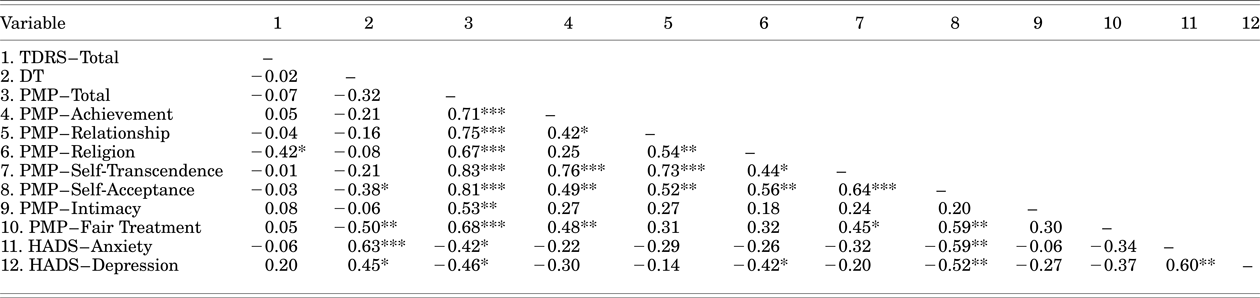
Table 2 provides the Pearson correlations of the scales in the sample of cancer patients. The TDRS showed a negative correlation with the PMP–Religion subscale (r = –0.42, p < 0.05), while the DT was negatively correlated with the PMP–Fair Treatment subscale (r = –0.50; p < 0.05) and with the PMP–Self-Acceptance subscale (r = –0.38 p < 0.05). A negative association was observed between the HADS subscales and the PMP–Self-Acceptance scale (respectively: r = –0.59, p < 0.01 for HADS–Anxiety, and r = –0.52, p < 0.01 for HADS–Depression) and PMP–total score (respectively: r = –0.42, p < 0.05 for HADS–Anxiety and r = –0.46, p < 0.05 for HADS–Depression). Also, HADS–Depression was found to be significantly and negatively correlated with the PMP–Religion subscale (r = –0.42, p < 0.05). Finally, there were statistically significant differences between religious and nonreligious participants on TDRS score (16.36 ± 5.74 vs. 21.60 ± 4.28; z = –2.04, p = 0.04) and on the PMP–Religion subscale (4.70 ± 1.07 vs. 2.76 ± 0.35; z = –3.21, p < 0.01).
Intercorrelations of study variables in cancer patients (n = 30)

*p < 0.05, **p < 0.01, ***p < 0.001.
Exploratory Comparison Between Cancer Patients and Healthy Participants
As a further analysis, we examined the differences between the mean scores on the representation of death (TDRS), meaning (PMP) and the HADS between cancer patients and healthy participants (Table 3). Significant differences between the two groups were found on depression (t = –4.95, df = 247, p < 0.001); the TDRS (t = –30.54, df = 247, p < 0.001); PMP–Total (t = 2.83, df = 247, p = 0.005); PMP–Achievement (t = 3.50, df = 247, p = 0.001); and PMP–Relationship (t = –5.56, df = 247, p < 0.001). Cancer patients reported higher HADS–D scores and higher TDRS scores, indicating a greater tendency to representation of death as total annihilation than that observed in healthy participants. Healthy participants showed a higher level of personal meaning (PMP–Total) compared to cancer patients, although they reported lower scores than cancer patients on the PMP–Relationship subscale.
Descriptive statistics of study variables in healthy subjects and cancer patients and t-test results

DISCUSSION
In this study, we examined the characteristics of a sense of meaning in life by using the PMP, which contains a section dedicated to religiosity, in particular to a faith in God. We also examined the meanings of death in terms of the ontological representations of death as annihilation or as a passage by using the TDRS, and their association with psychological stress. The results of the research confirmed our expectations. We thus observed that faith in God and the representation of death as a passage are important components of the meaning of life and help one to cope with fear of death and anxiety. Higher scores on meaning of life were associated with lower levels of psychological distress, anxiety, and depression.
The PMP was shown to be a potential tool to be utilized in oncology settings, where it is important to survey and take into consideration the existential condition of cancer patients. In fact, it can be integrated with the FACIT–Sp, specifically focused on spirituality, because of its emphasis on the existential need for meaning, including more specifically the religious dimension. Indeed, in our cross-sectional study, both among healthy subjects and cancer patients, the experience of meaning of life and some of its factors (including PMP–Self-Acceptance, Intimacy, Achievement, Relationships) were found to be related to lower psychological distress scores (on the HADS and DT). These results support the literature that demonstrates the contribution of personal meaning, as measured by the PMP, to mental health and well-being (Schreiber & Brockopp, Reference Schreiber and Brockopp2012; Visser et al., Reference Visser, Garssen and Vingerhoets2010; Sherman et al., Reference Sherman, Merluzzi and Pustejovsky2015; Salsman et al., Reference Salsman, Pustejovsky and Jim2015; Winger et al., Reference Winger, Adams and Mosher2016). Our findings are consistent with those of two previous studies in cancer patients that employed the PMP and observed a positive correlation between meaning of life and psychological well-being and a negative correlation between meaning of life and distress (Jaarsma et al., Reference Jaarsma, Pool and Ranchor2007; Rohánszky et al., Reference Rohánszky, Konkolÿ Thege and Bodoky2011).
It is important to underline that anxiety and depression are particularly intense in patients who do not accept themselves. In fact, the strong negative correlation of DT and HADS–A with PMP–Self-Acceptance confirmed that distress is related to poor adjustment to the one's own situation. In contrast to these results, other authors (Jacobsen, Reference Jacobsen2007) have suggested that a weakly perceived meaning of life in cancer patients may contribute to development of maladjustment and psychopathological symptoms. Thus, it is necessary to more specifically focus research on the relationships among anxiety, depression, and problems in attributing meaning to one's own sickness state.
A second important result was that we were able to confirm the role of religion and representation of death. The TDRS demonstrated that nonreligious participants carry an ontological representation of death as annihilation, while religious participants represent death as a passage, confirming previous studies (Testoni et al., Reference Testoni, Ancona and Ronconi2015). Believers in God represent death as a passage and have a more strongly perceived meaning of life. They tend to cope better with distress, anxiety, and depression than nonbelievers, who represent death as annihilation and have a weaker sense of the meaning of life. Nonreligious patients seem to be more likely to develop depression, to report distress, and to perceive life as having less meaning, more injustice, and lower levels of transcendence (as measured by the PMP).
All of these results corroborated our hypothesis that religiosity may be a protective mechanism in coping with cancer and that religiosity and representations of death influence one's psychological response to cancer. Representation of death as a passage seems to engender hope in the patient, protecting him/her from the fear of death (Testoni et al., Reference Testoni, Ancona and Ronconi2015), in agreement with TMT (Greenberg et al., Reference Greenberg, Solomon and Pyszczynski1997).
Possible differences between cancer patients and healthy people need to be investigated further. We conducted an exploratory examination of such differences and, as expected, higher levels of depression, but neither anxiety nor distress, were observed in cancer patients, as well as their representation of death as annihilation rather than a passage to a different dimension. More information would emerge in longitudinal studies, which are certainly necessary to further this field of study.
STRENGTHS AND WEAKNESSES OF THE STUDY
The strength of our study is that we assessed the multiple components related to representation of death and meaning of life. This may broaden the person-centered approach in palliative and supportive care, not only for patients with cancer but also for healthy individuals, including caregivers and family members. This can have practical applications in terms of psychological interventions, since a series of studies has recently shown the effectiveness and efficacy of meaning-centered psychotherapy when applied to cancer patients at different stages of the disease (Breitbart et al., Reference Breitbart, Rosenfeld and Pessin2015; Rosenfeld al., Reference Rosenfeld, Saracino and Tobias2016; van der Spek et al., Reference van der Spek, van Uden-Kraan and Vos2014), as well as to healthcare professionals and caregivers (Fillion et al., Reference Fillion, Duval and Dumont2009; Applebaum et al., Reference Applebaum, Kulikowski and Breitbart2015). Further data examining the role of individual representations of death, aside from meaning, could be of help in developing meaning-centered interventions.
The main limitations of our present report include the young age of the healthy Italian subjects who participated in the first phase of the study and the small sample size of cancer patients participating in the second. More data are necessary on larger samples with broader variability in terms of age, gender, and religious orientation in order to generalize our results. Also, a series of possible other factors potentially involved in the development of distress, anxiety, and depression in both healthy people and cancer patients (e.g., personality, coping mechanisms, illness representation, and beliefs) were not examined herein.
CONCLUSIONS
We strongly suggest that the role of both the meaning of life and the meaning of death as components of coping strategies should be more specifically examined in future research, with a view to identifying the value of taking these into account in the areas of cancer and palliative care.
ACKNOWLEDGMENTS
The authors would like to thank all of the participants in our study. In addition, Professor Julian Little, from the School of Epidemiology and Public Health at the University of Ottawa and a visiting professor in the Department of Biomedical Sciences of the School of Medicine at the University of Ferrara, is deeply acknowledged for his help in revising and editing our manuscript.
CONFLICTS OF INTEREST
The authors hereby declare that they have no conflicts of interest to report.
SUPPLEMENTARY MATERIALS
To view supplementary materials for this article, please visit https://doi.org/10.1017/S1478951517000669.