After the Conquest of 1521, the Spanish built the viceregal capital of New Spain on the ruins of Mexico-Tenochtitlan, the Aztec imperial capital. A subsequent and immediate necessity of conquest was the reshaping of native thought—a project that included the rewriting of pre-Conquest Aztec history. In the new histories, which were designed for European readers, the featured players, the pre-Conquest rulers, were given totally human, European-style personalities and motivations. Their fates and images were severed from the supernatural beings and forces with which they had previously been inextricably linked.
At the time the Spanish arrived, the rulers of central Mexican polities were called tlatoque (sing. tlatoani) or huei tlatoque, Nahuatl (Aztec) terms for “speakers” and “great speakers.” The former controlled cities or sections of cities, while the latter were paramount rulers of larger areas and empires. In addition to providing access to material and human resources, both titles entailed responsibilities to negotiate with the anthropomorphized beings that controlled the natural forces of the territory. Thus, the fortunes of a city depended on its ruler's success in dialogues with human, natural, and cosmic realms. The ruler was guided by paradigmatic allegories focusing on the actions of human and divine beings in the past, sequenced according to a complex calendar that charted the waxing and waning of their powers. In the final century before the Conquest, the ruler's actions and the ceremonies that surrounded them were choreographed to follow these paradigms, and in accordance, he took the guise of the divine beings, incarnating them in the form of ixiptla (see Hvidtfeldt Reference Hvidtfeldt1958). During the process of coordinating the past and the present, both the stories and the calendrical structures were reshaped by the Aztecs. After the Spanish Conquest, the roles of the descendants of native rulers, now called caciques and principales, were altered greatly. Alienated from their traditional territories and forced to abandon their non-Christian ideas about the world, their responsibilities and powers were secularized and the calendrical and allegorical frames of the past were gradually replaced by European ideas of time, causation, and narrative sequence (on the role of allegory in history writing, see White Reference White1973). In the Spanish and Spanish-influenced chronicles created during this period, like the Codex Durán, the actions themselves were reconceived as having mostly literal dimensions. Obvious metaphors remain—those of a universal nature that could be comprehended easily by a Western audience without damage to Euro-Christian ideas (for instance the comparison of native rulers to the sun). Otherwise, as will be seen, native ways of thinking are either disguised or were obliterated. Some actions were given generalized rather than historically specific forms, or were described so vaguely that historical variants are obscured, while others were interpreted literally, when the original intent was allegorical or figurative.
The first lengthy ruler biographies known to us are found in the cognates of the Crónica X tradition, which focused on the actions of the rulers of Tenochtitlan. Interestingly, although all the surviving members of this tradition are written in Spanish and date from the second half of the sixteenth century, the tradition appears to have been created earlier by one or more native historians. One written version in the native language, now lost, is known to have existed, and the presence of oral variants in early colonial times has been hypothesized. The principal survivor is Part 1 of the Codex Durán, which was named for its creator, the Dominican Friar Diego Durán. In the text itself, Durán mentions the lost Nahuatl manuscript as his principal source. Given the closeness of Durán's history to Hernando Alvarado Tezozomoc's cognate version, the Crónica mexicana, it appears that Durán depended heavily on the pre-existing native tradition, and his history must be considered a type of translation of this lost manuscript with elaborations and emendations based on other sources and his own experience. In other words, the Crónica X version of Aztec history was probably created by native Mexicans educated at a European school such as the Colegio de Santa Cruz at Tlatelolco (see also Douglas Reference Douglas2000 on native participation in the secularization process). Durán added to this history two other treatises apparently of his own creation—one on the calendar and the other on monthly rituals—and employed several native artists to illustrate the entire work. The illustrations are what make his the most celebrated of the surviving Crónica X manuscripts (Couch Reference Couch1987).
The Codex Durán was completed between 1579 and 1581. It is on European paper and in European book form. After its discovery in the Biblioteca Nacional in Madrid in the nineteenth century, it was published in Mexico in two volumes as the Historia de las Indias de Nueva España y islas de Tierra Firme (Durán Reference Durán and Kintana1867–1880 [1579–1581]). Since then, it has served as the primary source of Aztec history. A well-known Spanish edition was prepared by Angel María Garibay Kintana (Durán Reference Durán and Kintana1967). The most comprehensive English translation is by Doris Heyden (Reference Heyden1994). Hernando Alvarado Tezozomoc's cognate, the Crónica mexicana (Alvarado Tezozomoc Reference Alvarado Tezozomoc and Orozco y Berra1980 [ca. 1598]), was created independently and without pictures. (For the Crónica X group, see also Barlow Reference Barlow1945; Colston Reference Colston1973; Couch Reference Couch1987; Dykerhoff Reference Dykerhoff1970; Milne Reference Milne1984; Tovar Reference Tovar1976).
This paper focuses on remnants of native symbolic thought in the Codex Durán's verbal narrative and images of a series of events central to Aztec history, and on their reconstruction through comparison with other colonial sources and with archaeological remains. The events are those of the 1473 civil war between Tenochtitlan and Tlatelolco that occurred 46 years before the Spanish arrived. Tenochtitlan and Tlatelolco were two separate cities that may originally have been two halves of one polity (Mexico) occupying an island in Lake Texcoco in the Basin of Mexico. The civil war was a last-ditch effort by the Tlatelolca Mexica and their allies in the Valley of Mexico to challenge the power of the Tenochca Mexica, who had recently risen to political dominance over the empire. (On the civil war, see Barlow Reference Barlow, Monjarás-Ruiz, Limón and de la Cruz Paillés1987; Garduño Reference Garduño1996. Primary texts are Alvarado Tezozomoc Reference Alvarado Tezozomoc and Orozco y Berra1980 [ca. 1598]:Chapters 41–46; Codex Cozcatzin Reference Cozcatzin1994 [1572]:Folios 14v–15r; Durán Reference Durán and Ramirez1967 [1579–81]:2:Chapters 32–34; Heyden Reference Heyden1994:Chapters 32–34; Tena Reference Tena2004 [1560–1620]:24–29, 95; and Torquemada Reference Torquemada1969 [1615]:1:173–180). The protagonists were Axayacatl of Tenochtitlan, who won the war, and Moquihuix of Tlatelolco, who lost the war and his life. It is especially in the study of the written and pictured images of the loser that we learn much about the symbolic underpinnings of Aztec rulership and history, as conceived before the Conquest.
The basic facts of the civil war are as follows. Axayacatl came to the throne in 1469 on the death of Motecuhzoma I, who was his grandfather. Axayacatl's mother was Motecuhzoma's daughter, and his father was a descendant, probably the son, of an earlier ruler. Rudolf Van Zantwijk (Reference Van Zantwijk1985:187–189), Susan Gillespie (Reference Gillespie1989:98–106), William Barnes (personal communication 2003), and Lori Diel (Reference Diel2003) have investigated the passing of Tenochca rule to a grandson of the previous ruler through a female rather than a male. Although their individual stances on the circumstances differ, all would probably acknowledge the power of royal women in Aztec society to have been a matter of contemporary debate. I believe also that reactions to this genealogical irregularity may be seen behind the large number of references to women in accounts of the events before and during the civil war, but this was only one of a number of factors that increased political tensions in the Valley of Mexico in the pre-war years. The defunct Motecuhzoma was a long-lived ruler who had led Tenochtitlan to primacy over an empire that began as an alliance of several powers. Thus, other Valley of Mexico rulers were predisposed to challenge the throne's new occupant, regardless of his background, attempting to restore the importance of their own cities. One of these challengers was Axayacatl's brother-in-law, Moquihuix, the ambitious ruler of Tlatelolco, which had become rich from its control of trade in the empire. The war actually broke out after the 1472 death of Nezahualcoyotl of Texcoco, another long-lived ruler who had maintained the status quo while he lived.
Moquihuix came to the throne perhaps two years earlier than Axayacatl (see conflicting dates in Tena Reference Tena2004 [1560–1620]:25, 95), and, as a master architect (Alva Ixtlilxochitl Reference Alva Ixtlilxochitl and O'Gorman1975–1977 [1600–1640]:2:92), he must have been involved in the rebuilding of key religious structures in his city before hostilities broke out—a skull rack, a temple for conquered gods (called Cohuacalli or Cohuaxolotl), and the Great Temple—that is, the Tlatelolca Templo Mayor. These building activities are mentioned in the Anales de Tlatelolco (Tena Reference Tena2004 [1560–1620]:26–27, 95) and Torquemada (Reference Torquemada1969 [1615]:1:173), and it is possible that other new buildings were created in the same years, perhaps a whole new ceremonial precinct. Torquemada notes that the Tlatelolca Cohuaxolotl was created to mock a new Tenochca building with the same purpose, which Burr Brundage (Reference Brundage1972:174, 180, 308–309) sees as constituting a clear military threat. I believe that all of Moquihuix's new buildings were close imitations of those in Tenochtitlan, built to irritate and mock the Tenochca, as the two cities moved toward war (Umberger Reference Umberger, Berdan, Blanton, Boone, Hodges, Smith and Umberger1996a:96–97).
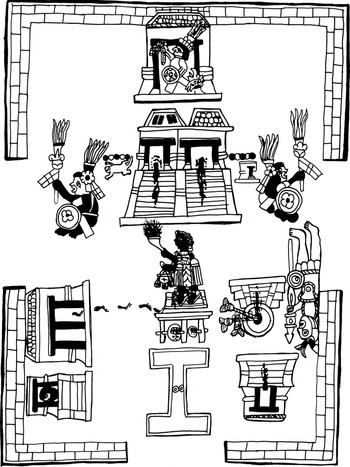
From these mentions of buildings, it seems that Tlatelolco had a repertory of important buildings similar to Tenochtitlan's. These building types are revealed best in Fray Bernardino de Sahagún's Primeros Memoriales plan (Sahagún Reference Sahagún and Sullivan1997 [1559–1561]:Folio 269r). There have been a number of arguments about the Primeros Memoriales plan (Figure 1). Most notable are attempts to link it to actual cities: either Tenochtitlan or Tepeapulco, where Sahagún worked on the manuscript (Sullivan in Sahagún Reference Sahagún and Sullivan1997 [1559–1561]:117–120, Notes 1–10). I suggest instead that it was an ideal schema whose permutations varied according to time and place and occurred in many, if not all, Aztec towns. Thus, Tenochtitlan, Tlatelolco, and Tepeapulco might all have had comparable buildings arranged in different ways. Not surprisingly, given Aztec respect for the ancient past (Umberger Reference Umberger1987b), the Toltec city of Tula has the only central Mexican archaeological center with the Primeros Memoriales arrangement (Umberger Reference Umberger, Berdan, Blanton, Boone, Hodges, Smith and Umberger1996a:91). In other words, Aztec notions of the buildings appropriate to a ceremonial precinct came from there. (The same features are at Chichen Itza but without the geometrical alignment of Tula.) It is to be supposed that these buildings in Aztec cities may not be obvious in archaeological remains, especially if they were not lined up like those at Tula (however, see Smith Reference Smith2008).
Colonial native Mexican artist, plan of typical Aztec ceremonial center with great double temple, or Templo Mayor, representing Coatepetl. Drawing by the author (after Sahagún Reference Sahagún1993 [1559–1561]:Folio 269r).

All of the structures of the Primeros Memoriales plan had closely related meanings in Tenochtitlan and Tlatelolco: they symbolized structures at the mythic landscape called Coatepetl, “Serpent Mountain,” as described by various sources (e.g., Durán Reference Durán and Ramirez1967 [Reference Durán and Kintana1579–1581]:2:32–34). Thus, Moquihuix's rebuilt ceremonial precinct was a new Coatepetl, challenging that of Tenochtitlan. In addition to being a pyramidal replica of the Serpent Mountain, its Great Temple, like that of Tenochtitlan, was the site of power of a second image of the Mexica tribal god Huitzilopochtli, who had risen to power on that hill. The right shrine of each Templo Mayor was that of the tribal god specifically, and the other to the left was dedicated to the ancient Mexican rain god Tlaloc, probably duplicating a shrine that existed on Coatepetl before the arrival of Huitzilopochtli. In Sahagún's account, Huitzilopochtli's mother is sweeping on Coatepetl when she becomes pregnant (Sahagún Reference Sahagún, Anderson and Dibble1950–1982 [1575–1578]:4:Book 3:1–2), so I would guess that she was sweeping a shrine rather than the bare earth.
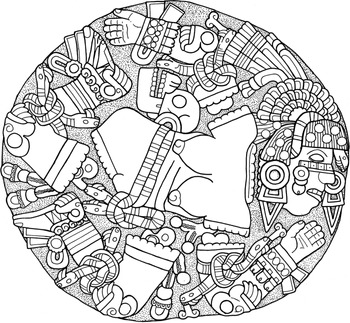
The layout of Tula indicates that the Aztecs inherited the myth of Coatepetl from the Toltecs (or revived it), as they did so many other traits. We know from both colonial sources and archaeology that sculptures of the main characters of the myth decorated the Great Temple of Tenochtitlan, and new ones were made for enlargements of the temple. In addition to the image of Huitzilopochtli in the shrine above, they included sculptures of the rival enemy sister, whom Huitzilopochtli defeated to establish his control over the mountain/pyramid. The earliest dated image of the sister found at the foot of the Tenochtitlan pyramid lies on a buried platform below the celebrated masterpiece (Figure 2), to be discussed later. The earlier sculpture was installed in the 1450s (Matos Moctezuma Reference Matos Moctezuma1990), and its presence indicates that the characters of the myth were visualized by this date, if not earlier. The sculpture made for the 1487 temple was called Coyolxauh by Durán (Reference Durán and Ramirez1967 [Reference Durán and Kintana1579–1581]:2:333), and all other sculptures of the enemy sister at the Tenochca Templo Mayor are called Coyolxauhqui by modern scholars, although some actually may have been called by alternative or additional names. The Tlatelolco pyramid was probably decorated likewise with images of the actors in the myth, although none have been found in excavations of that site (Tlatelolco a traves de los tiempos 1944–1957; Umberger Reference Umberger, Berdan, Blanton, Boone, Hodges, Smith and Umberger1996b:256–259).
Team of pre-Conquest Aztec artists, Great Coyolxauhqui Stone, representing a murdered enemy sister of the god Huitzilopochtli, circa 1469–1473. Discovered at foot of Great Temple of Tenochtitlan in Reference Peña Gómez1978; now in Museo del Templo Mayor, Mexico City. Drawing by the author.

TWO MAJOR VARIANTS OF THE COATEPETL MYTH
Variants of the Coatepetl story then formed a “charter myth” for both Mexica cities, and these, I believe, were constantly reshaped for specific occasions in different times and places. One Tenochca version is told in the Codex Durán (Reference Durán and Ramirez1967 [1579–1581]:2:32–34; Heyden Reference Heyden1994; see also Alvarado Tezozomoc Reference Alvarado Tezozomoc and Orozco y Berra1980 [ca. 1598]: 227–229) as having occurred long before the civil war, at a time when the Tenochca and Tlatelolca were members of a single migrating Mexica tribe that had just entered the environs of central Mexico under the guidance of the god Huitzilopochtli. After building a settlement at Coatepetl around a version of the ceremonial center described above, the Mexica were divided by a disagreement between political factions that accepted or questioned, respectively, the god's command that they abandon the experimental city. A fight broke out between these loyal and dissident factions; the dissident leaders are called Huitznahua[tl], a name of disputed meaning (“Southerner?”), and Coyolxauh[qui]. Huitzilopochtli murdered both at night on the ballcourt, where their bodies were found in the morning.
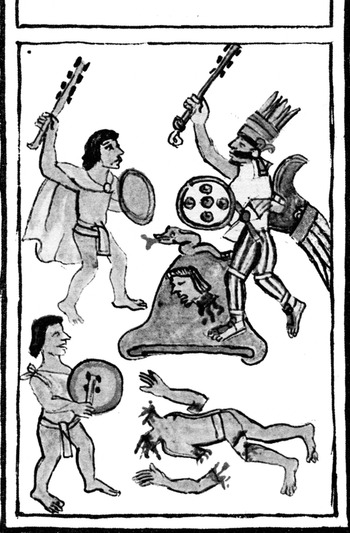
In the variant of the story told in Sahagún's Florentine Codex (Sahagún Reference Sahagún, Anderson and Dibble1950–1982 [1575–1578]:4:Book 3:1–5), the focus is on a natural mountain called Coatepetl, not a human settlement, and the actors are the gods Huitzilopochtli and Coyolxauhqui. The latter and her divine companion-brothers, the Centzonhuitznahua (“400 Southerners”?) symbolize the enemies of Huitzilopochtli in Durán's version (Figure 3). In the Florentine Codex, the actors have the kinship relations of humans, but the implications of their actions are cosmic. As Eduard Seler (Reference Seler1960–1961[1902–1923]:3:327–328, 4:157–167) pointed out many years ago, this struggle among gods is readily interpretable in terms of the rise and fall of cosmic bodies in the sky. The setting, Coatepetl, is the earth visualized as a mountain, and Huitzilopochtli's rise to dominance is described as his birth from a mother called Coatlicue, “Serpents, Her Skirt,” another image of the earth. This birth takes place on the mountaintop, and Huitzilopochtli has to maintain his control there. Soon after, he faces an attacking rebel army, whose members, the Centzonhuitznahua, are called his siblings, and whose leader, Coyolxauhqui, is termed his sister. He kills some of these enemies and drives away the rest, throwing the body of Coyolxauhqui off Coatepetl. It lands at the bottom, dead and dismembered. In this allegory, Huitzilopochtli is the sun rising from the earth in the morning, obliterating the moon (Coyolxauhqui) and stars (the Centzonhuitznahua), and driving them into the Underworld in the west (see also Matos Moctezuma Reference Matos Moctezuma1981, Reference Matos Moctezuma1990). Sahagún explains how the Aztecs used these same cosmic metaphors more broadly to express political and social success and failure, as well as the steps in a person's course through life (Sahagún Reference Sahagún, Anderson and Dibble1950–1982:2:Book 1:81–84, Addendum 2 from the Codex Matritense [1559–1561]).
Colonial native Mexican artist, Huitzilopochtli's defeat of Coyolxauhqui and the Centzonhuitznahua at Coatepetl. From Sahagún Reference Sahagún1979 (1575–1578):1:Book 3:Folio 3v. Photograph published with permission of the Archivo General de la Naciòn, Mexico City.

Significantly, while the Florentine Codex text speaks of the rival leader as a sister, the pictured Coyolxauhqui is very much like the other sibling enemies, wearing a male loincloth and revealing no female traits (Gillespie Reference Gillespie1989:65, Figure 3.2). The gender of this personage is differentiated from the others only in the text. I have argued elsewhere that Coyolxauhqui was not a moon deity in the sense of a permanent identification with the moon but, rather, that she became like the moon only in defeat (Umberger Reference Umberger and Boone1987a:412, 424–428). I would add here that the same is true of the character's gender. Both cosmic identity and gender were impermanent, metaphorical aspects. In other words, the identification of one character with the sun and masculine gender and the other with the moon and feminine gender was a consequence of a change in relative status—the waxing of the powers of one and the waning of the other's. The original referent could have been male.
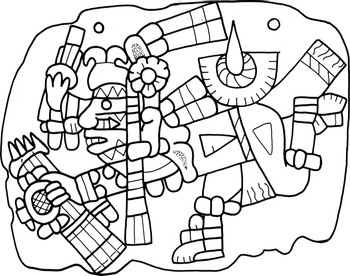
The idea of a defeated male transforming into a female is indicated in another pre-Conquest image: a greenstone pendant found in a cache under the Great Coyolxauhqui Stone. On one side it has the head of the defeated Coyolxauhqui (García Cook and Arana Alvarez Reference García Cook and Arana Alvarez1978:Figure 55), which presumably was female, given the dismembered monumental image above the cache (Figure 2). On the other side is another Coyolxauhqui (Figure 4), wearing the marigold headdress and in the same running pose as the monumental figure. (Although it looks alive, a wound in the chest reveals that the heart has been removed.) What is striking about this Coyolxauhqui is its male gender. The implication is that Coyolxauhqui transformed from male to female.
Male “Coyolxauhqui” figure on back of greenstone pendant in the shape of decapitated Coyolxauhqui head (note outline of profile on bottom contour), indicating transformation from male to female in defeat. From offering cache found under Great Coyolxauhqui Stone (Figure 2) in Reference Peña Gómez1978, circa 1469–1473. Drawing by the author.

In Durán's version of the story, the Coyolxauhqui and Huitznahuatl characters are described as murdered on the ballcourt. The archaeological discovery of the celebrated monumental image of the enemy sister at the foot of the Great Temple pyramid indicates that Sahagún's version, wherein Coyolxauhqui falls to death from the mountain, is closer in this respect to the story that must have been activated at the time of the civil war. Durán does not note the similarity of the warfare events to those at Coatepetl, and this is not surprising, since the version of the myth he repeated emphasized the ballcourt as the locus of death (see also Alvarado Tezozomoc 1980 [ca. 1598]:229). In addition, his history of the war does not make it evident that the Great Temples of Tlatelolco and Tenochtitlan must have been considered rival versions of Coatepetl. Nor are the rulers characterized or pictured as rival Huitzilopochtlis, each intent on turning his enemy into the defeated enemy sister. In fact, the enemy sister is not mentioned at all, and Huitzilopochtli appears as the temple images of Tenochtitlan and Tlatelolco. The only remaining hint of the mythic and allegorical underpinnings is in the Codex Durán's cognate, Alvarado Tezozomoc's Crónica mexicana (1980 [ca. 1598]:383), where Moquihuix's lieutenant is called Teconal Huitznahuatl, the latter being the name of Coyolxauhqui's ally in the Codex Durán version of the story and one of the Centzonhuitnahua in the Florentine Codex version. His real name may have been Quetzahua (Torquemada Reference Torquemada1969 [1615]:1, 179), and his title may have been Mixcoatl Tlailotlacteuctli (Tena Reference Tena2004 [1560–1620]:27). Despite the lack of other references to the sacred characters, it is obvious even in Durán's literal rendition of the events of the war that it was staged to follow the story in a version that was both more complete than and different from these two surviving examples.
RULERSHIP METAPHORS BEHIND THE STRUCTURE OF THE MYTH
The most obvious allegory behind the myth, the cosmic allegory, is alluded to in neither of the Crónica X histories of the war, although the general identification of Tenochca rulers with the sun is articulated often (Umberger Reference Umberger and Boone1987a:425–426). There is a clue in the Codex Cozcatzin, a colonial source from a different tradition. When the victorious Axayacatl came down from the pyramid, he looked toward the sun, which finally appeared after a period of invisibility (Codex Cozcatzin Reference Cozcatzin1994 [1572]:Folio 15r).
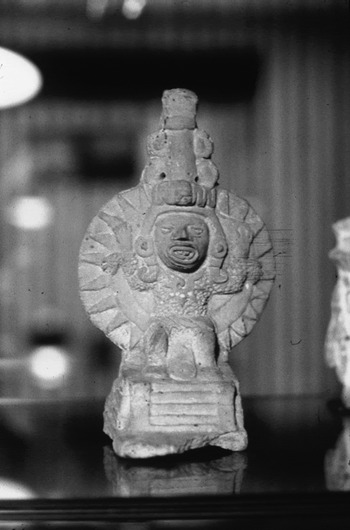
Other metaphorical associations of the mountain/pyramid are stated explicitly only in non-historical sources. Most important is its characterization as a seat of rulership, a symbolic throne. The ruler's rightful place is characterized abstractly as the “high place” in colonial writings (Maxwell and Hanson Reference Maxwell and Hanson1992:176–177, 182–183), but it is visualized concretely in pre-Conquest ceramic figurines (Figure 5), where personages dressed as supernatural beings sit on pyramid-like thrones with suns on their backs (Umberger Reference Umberger1984). Apparently, the high place was conceived in different scales as a pyramid and a throne, and the two ideas were interchangeable.
Ceramic figurine of Ruler-Xipe with a sun disc on his back and sitting on a miniature pyramid throne. Photograph by the author, by permission of Museum für Volkerkunde, Berlin.

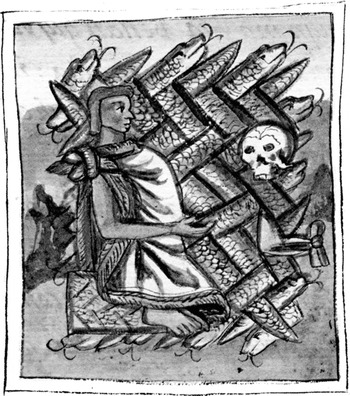
The seat of rulership was pictured also as a mat woven from live serpents, the coapetlatl, rather than the usual reed strips (Sahagún Reference Sahagún, Anderson and Dibble1950–1982 [1575–1578]:12:Book 11:80–81). Sahagún's first illustration of this concept depicts the serpent mat itself. In the second illustration, the ruler sits on the serpent mat (Figure 6), and the crown and the skull in front of him indicate, according to the Nahuatl text, that if he maintained his place on the mat, the reward was rulership, and if he lost control, the result was death. Sahagún's third illustration pictures what happened when the ruler lost control of the mat. The serpents disentangle and go off in different directions. In this metaphor, the individual serpents probably represented the different strands of society that only a powerful ruler could coordinate.
Colonial native Mexican artist, ruler sitting on serpent mat. From Sahagún Reference Sahagún1979 (1575–1578):3:Book 11:Folio 84r. Photograph published by permission of the Archivo General de la Naciòn, Mexico City.

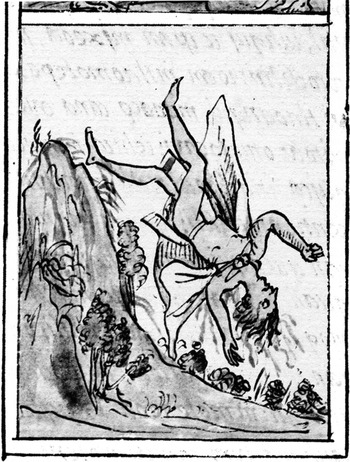
The successful ruler then maintained his position on the “high place” and his control of the serpent mat, both metaphors incorporated into the idea of the Great Temple as Coatepetl, “Serpent Mountain.” It is for this reason that a small, woven serpent mat is represented on the pavement west of the image of the shattered body of the image found under the great Coyolxauhqui monolith (Matos Moctezuma Reference Matos Moctezuma1990). This is the mat of rulership that the enemy coveted but lost to the Tenochca (whoever the enemy was during the 1450s). The unsuccessful ruler was the one who lost control of the mat and fell from the high place, transformed into a metaphorical woman and the moon. In a final metaphor, the person who falls from a high place is called a drunkard (Sahagún Reference Sahagún, Anderson and Dibble1950–1982 [1575–1578]:5–6:Book 4:15–17; Figure 7). Sahagún does not say that the unsuccessful ruler was like a drunkard, but the fact that the fallen Moquihuix's name translates as “Drunken One” makes one suspect that this was another metaphorical reference to the failure of someone haughty and “drunk with power.” (See also Pohl Reference Pohl1998 on the sociopolitical function of noble drinking in central Mexico.)
Colonial native Mexican artist, drunkard falls from precipice. From Sahagún Reference Sahagún1979 (1575–1578):1:Book 4:Folio 13v). Photograph published by permission of the Archivo General de la Naciòn, Mexico City.

THE CIVIL WAR IN THE CODEX DURÁN
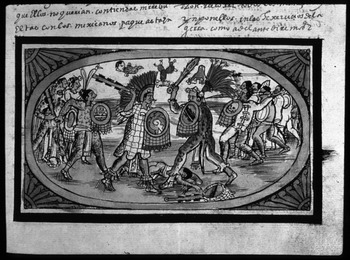
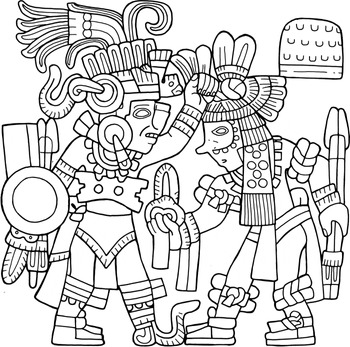
In the Codex Durán, the war featured two battles, both of which were pictured by the painter that Christopher Couch (Reference Couch1987:303–305) has dubbed Artist A, the most notable and competent of the creators of the Durán illustrations. The text makes it clear that the first battle (Figure 8) was a Tlatelolca attack on Tenochtitlan (Durán Reference Durán and Kintana1967 [1579–1581]:2:258). The two battling rulers stand (probably) on the border between their cities, and their armies are depicted behind them. A change in ground color from yellow to red may delineate the border between the cities. The text indicates that the armies are on Tenochca territory. Subsequent events reveal that the Tlatelolca were probably attempting to reach and occupy the enemy's Great Temple but were driven back by the Tenochca.
Colonial native Mexican artist (Artist A), the first battle of the Aztec civil war. From Codex Durán, circa 1579–1581, Biblioteca Nacional, Madrid, Chapter 33. Photograph by permission of Biblioteca Nacional, Madrid.

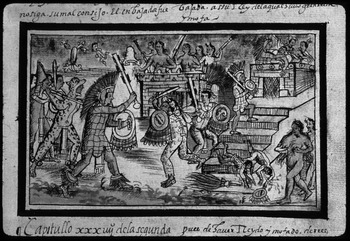
In contrast, during the second battle, the Tenochca invaded Tlatelolco, and the Tlatelolca were pushed back first to their market and then to their temple. In Figure 9, the two rulers are repeated in almost the same poses in the center of the picture, but the right background has been elaborated. Behind Moquihuix and his lieutenant Teconal is the Great Temple of the Tlatelolca, where reappearances of the main characters represent later points in the narrative. Axayacatl ascends the steps leading to Tlatelolca Huitzilopochtli's shrine on top. In a third appearance, he and his (unnamed) lieutenant are presented attacking their enemy counterparts on top of the shrine. The dead bodies of Moquihuix and Teconal appear at the base of the pyramid, where the triumphant Tenochca threw them (Durán Reference Durán and Kintana1967 [1579–1581]:2:263). Since the pyramid represented Coatepetl, this action was done obviously in imitation of Huitzilopochtli's defeat of Coyolxauhqui and her allies, as depicted and described in Sahagún's version of the myth.
Colonial native Mexican artist (Artist A), the second battle of the Aztec civil war. From Codex Durán, circa 1579–1581, Biblioteca Nacional, Madrid, Chapter 34. Photograph by permission of the Biblioteca Nacional, Madrid.

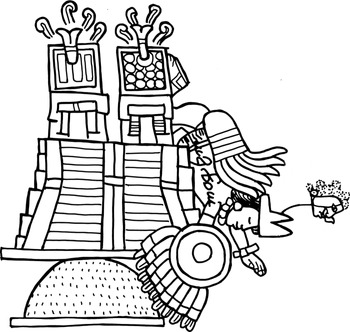
Colonial native Mexican artist, depiction of fall of Moquihuix. From Codex Mendoza, Bodleian Library, Oxford University, Folio 10r. Drawing by the author (after Berdan and Anawalt Reference Berdan and Anawalt1992 [1541–1542]:4).

The scene of Moquihuix's fall is pictured in many codices and described in others, and he is the only imperial-period Aztec ruler to have ended this way. (For an earlier Culhua precedent, see Juan Cano's account in García Icazbalceta Reference García Icazbalceta and Cano1941–1944 [ca. 1531]:3:240–280.) Moquihuix falls alone or with his second in command; he is pushed by the enemy ruler or self-propelled; and all participants wear a variety of costumes, obviously most not intended to reproduce what they wore on the actual occasion but, instead, to allude to symbolic matters that are no longer clear. Pictorial variants of the scene are found in the Codex Azcatitlan ([sixteenth century] Boone Reference Boone2000:Figure 136), Codex Mendoza ([Reference Mendoza1540–1541] Figure 10), Codex Mexicanus ([1571-1590]; Boone Reference Boone2000:Figure 150), Codex Cozcatzin (Reference Cozcatzin1994 [1572]:Folios 14v–15r), perhaps the Codex Saville ([sixteenth century] Figure 15; see also Boone Reference Boone2000:Figure 28), and Codex en Cruz ([1553–1569] Boone Reference Boone2000:Figure 152).
Apparently, Artist A did not know what the principal pyramid of Tlatelolco looked like, so he mistakenly represented the murder of the two Tlatelolca leaders on the roof rather than inside the temple or on the platform, and he depicted the temple of Tlaloc as a separate building without a pyramid base. On the roof of this building are five women, some with staffs that look like weapons and at least two, nude. In the lower-right corner of the illustration at the base of the Huitzilopochtli pyramid are two more women; the one visible in front is nude and expressing milk from her breasts. These puzzling details involving women (called a diversionary tactic in the text) probably did occur, but they must have had metaphorical and historical dimensions that are not mentioned. Durán's text says that a squadron of nude women, accompanied by boys with blackened faces and feathered heads, attacked the Tenochca, some of the women “slapping their bellies, while others squirted milk at the soldiers” (Durán Reference Durán and Kintana1967 [1579–1581]:2:263; Heyden Reference Heyden1994:260). Alvarado Tezozomoc (Reference Alvarado Tezozomoc and Orozco y Berra1980 [ca. 1598]:392) adds further details. The nude Tlatelolca women had the red lips of prostitutes, and some carried shields and macanas (maquahuitl in Nahuatl, a wooden sword edged with obsidian blades). Other women bared and displayed their buttocks to the Tenochca and slapped their private parts. Some climbed to the top of the pyramid and from there threw brooms (recalling Coatlicue?), weaving implements, filth, and chewed bread on the Tenochca below.
WARTIME THREATS AND MOCKERIES
These events recall the mockeries commonly made during preparations for battle, wherein warriors were called women, a taunt questioning their ability to win the contest and foreshadowing their future humiliation through vestment in women's clothing. Alvarado Tezozomoc makes it clear that the women at the battle were ridiculing the Tenochca, accusing them of cowardice (see also Klein Reference Klein, Cordy-Collins and Sharon1993, Reference Klein1994). The boys, in turn, can be seen as another mockery of the adult male warriors of the Tenochca army, in their immaturity and inexperience. These generic explanations are acceptable, but other evidence may suggest additional, more historically specific references in the postpartum state evident in some of the women. Together with the boys, they may represent mothers and sons in a pointed reference to Axayacatl's inheritance of the throne through a mother rather than a father.
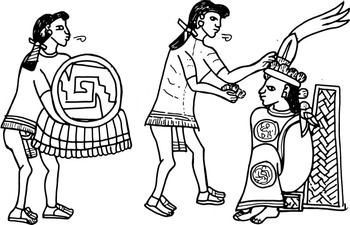
Although one may be tempted to follow the colonial accounts and see these as generalized, unvaried forms of action, more historical specificity may be hypothesized. Another example is the described decoration of Moquihuix by a Tenochca ambassador with the ointments/pitch and insignia applied to the dead (Heyden Reference Heyden1994:258)—a typical preliminary to open warfare that threatens ultimate defeat and death. This type of action is pictured in the Codex Mendoza (Berdan and Anawalt Reference Berdan and Anawalt1992 [1541–1542]:Folio 66r, text on Folio 65v), where Aztec warriors decorate an enemy ruler with a shield, funerary feathers, and unguent (Figure 11). In the register above this scene, the threat is realized when the same warriors, now dressed as officials, execute the defeated ruler.
Colonial native Mexican artist, representatives of the Aztec empire decorating head of enemy leader as part of a declaration of war against him. The feathers are symbolic of his impending death. From Codex Mendoza, Bodleian Library, Oxford University, Folio 66r. Drawing by the author (after Berdan and Anawalt Reference Berdan and Anawalt1992 [1541–1542]:4).

But did Aztec protocol always take the same forms? Could not the paraphernalia of death have been different on different occasions? In other words, could not the headdress put on Moquihuix before the civil war have been that of the enemy sister (Figure 2)? The headdress of the monumental figure, after all, has as the central element a marigold, an Aztec symbol of death, rendered probably in feathers (Heyden Reference Heyden and Boone1987:119–121). Placed on an enemy's head, it would have been a humiliating reference portending death as well as conversion into a loser/woman/moon. It would have been especially appropriate for an enemy ruler. The feathers on the heads of the little boys in the second battle might have represented the same thing.
The examples of feather headdresses are described too vaguely to identify. But because the fall of the defeated leader was compared to the enemy sister's fall in the end, it is feasible to think that this was anticipated from the beginning—that threats on the part of both sides before and during the war involved allusions to this sister. A problem with some colonial sources or parts of sources, such as the section of the Codex Mendoza cited earlier, is the generalization of materials in a non-historical context. Such representations resulted probably from the need to simplify and clarify Aztec customs for an uninitiated, Western audience. Fray Juan de Torquemada's (Reference Torquemada1969 [1615]:1:173, 177) supports the possibility that the feathers might have been more like Coyolxauhqui's than the representation in Mendoza when he states that the Tlatelolca sacrificed women representing the goddesses Chantico (“In the House”) and Cohuaxolotl (“Serpent Twin”?), the name of the structure for conquered gods, built by the Tlatelolca also before the battle. Since these were other names for the enemy sister, comparable to Coyolxauhqui (Klein Reference Klein, Josserand and Dakin1988), should not their sacrifice be considered the same type of threat against the enemy? I am guessing that both the Tenochca and the Tlatelolca called the rival leader by the variant names of the enemy sister before the battle decided their respective fates—one of them continuing to be the representative of Huitzilopochtli, and the other becoming like the enemy sister. The image installed in Tenochtitlan at the same time (Figure 2) shows links in her postpartum traits to another enemy sister, Malinalxochitl, who is the subject of a separate myth (Durán Reference Durán and Kintana1967 [1579–1581]:2:30–32, 37–38). Given the mixture of aspects of Coyolxauhqui and Malinalxochitl in the Tenochca image, it must be acknowledged that we actually do not know what the enemy sister was called in Tenochtitlan at this time. However, like other scholars, I use the name Coyolxauhqui because that is the name connected to the Coatepetl myth.
The threats and humiliating actions documented for the civil war take many forms. In some cases, the specificity of the imagery is described; in others, it is not, as seen earlier. In some cases, its inflammatory nature is made explicit; in others, it is not. Before the war, the Tlatelolca built new buildings in their rival mythic center, sacrificed the avatars of the enemy sister, and presented the funerary accoutrements to Axayacatl. Moquihuix sent his inexperienced young warriors onto the lake to hunt flying ducks and other waterfowl with their atlatls, in preparation for hunting the Tenochca. Vendors at the Tlatelolca market threatened some Tenochca warriors who happened to be there with the words, “What merchandise have you brought to sell? So you want to sell your intestines, your liver, or your heart?” (Heyden Reference Heyden1994:253). During the war, the Tlatelolca warriors threatened multiple times to bloody the Tenochca temple with the Tenochca leader's blood and then desecrate and make it unusable. During the second battle, a Tlatelolca warrior danced on a sacrificial stone on the pyramid platform, shouting to the Tenochca below, no doubt with further threats of mutilation and sacrifice (Alvarado Tezozomoc 1980 [ca. 1598]:392). Taunts and insults involved complex female imagery, as well. As described earlier, the message of most was that the male warriors would be transformed into females in defeat; it is possible that they involved more specific insults against Axayacatl and his mother.
After the war, all of these threats were visited on the losing Tlatelolca. They were made to quack like ducks, apparently a subject of future jokes that characterized them as “quackers and imitators of other water fowl,” according to Durán (Reference Durán and Ramirez1967 [1579–1581]:2:264; Heyden Reference Heyden1994:261; see also Codex Cozcatzin Reference Cozcatzin1994 [1572]:Folio 15r [Spanish translation, 104]; Torquemada Reference Torquemada1969 [1615]:1:180). Their temple was bloodied by the sacrifice of their own leaders, who were then thrown from the symbolic mountain. It was desecrated further before abandonment; the image of the defeated god was removed and (presumably) imprisoned in Tenochtitlan; Tlatelolca men were treated like women, confined to their houses; and the Tlatelolca ruling house, its Tlacocayotl, was ended, and replaced by a military governor. No doubt in actuality the same threats were thrown back and forth by the battling forces, and the Tenochca would have been treated the same if they had lost. The Codex Durán was a document intended to justify the Tenochca, so they are presented as victims forced to react to Tlatelolca taunts. The taunts and responses of the Tenochca side, however, are clearly represented in sculptures, offering caches and funerary remains at the Tenochca Great Temple, which, unlike the Tlatelolca temple, was not stripped and continued as the focal point of ceremonies after the war, including those celebrating the Tenochca triumph. These remains reveal the variety of metaphors used, and details of imagery reveal interesting elaborations.
THE EVIDENCE OF ARCHAEOLOGICAL REMAINS
As is well known to pre-Conquest specialists, the Reference Peña Gómez1978 discovery of the monumental image of Coyolxauhqui (Figure 2) led to the excavation of the Great Temple of Tenochtitlan, and Eduardo Matos Moctezuma, the director of the excavations, dated the installation of the monument by means of a date plaque on the side of the IVb platform on which it was installed (Matos Moctezuma Reference Matos Moctezuma1981). The date on it, 3 House, corresponds to the year 1469, when Axayacatl ascended the throne. The Coyolxauhqui sculpture was found still in its original location directly in front of the staircase on the right (south) leading to the temple of Huitzilopochtli. This location confirmed what had been established even before the excavation: that the temple of Tenochtitlan represented the Serpent Mountain of myth, with Coyolxauhqui lying at its base, as in the Florentine Codex illustration (Figure 3). The triumphant Tenochca god, of course, took the form of the idol in the shrine above.
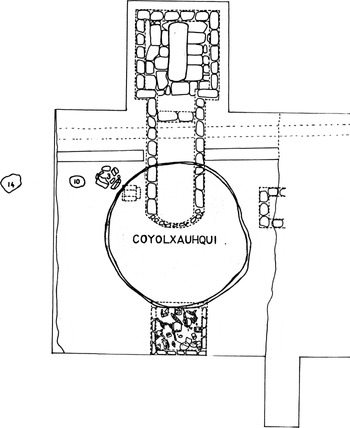
The Coyolxauhqui sculpture was installed after the platform was built (Figure 12), but its exact date is unknown. Cecelia Klein (Reference Klein1994) was the first to link this image of the defeated enemy goddess with the civil war but did not speculate on the time of its installation (see also Lévine Reference Lévine1997). It could have been placed in front of the temple as part of the preparations for war; during the war as a taunt directed against the enemy; or at the end of the war, when the outcome had become clear. I believe it was created near the beginning of the war and that decapitated heads of four women found in Offering Cache 1, the cist below its western edge (García Cook and Arana Alvarez Reference García Cook and Arana Alvarez1978:39; Peña Gómez Reference Peña Gómez1978), are the remains of a sacrificial ceremony comparable to the one that the Tlatelolca performed. Whatever its date of creation, like Moquihuix's imitative buildings, this monument was clearly an inflammatory image that initiated and/or responded to a series of insulting acts.
Plan of the area around the Great Coyolxauhqui Stone on the terrace of Phase IVb of the Tenochtitlan Templo Mayor with the locations of the funerary vases of the tlatoani Moquihuix and his lieutenant Teconal indicated (Offerings 14 and 10, respectively). Drawing by the author (after García Cook and Arana Alvarez Reference García Cook and Arana Alvarez1978:Figure 8, with additions from Matos Moctezuma Reference Matos Moctezuma1978:Plan 2).

We know from existing accounts that, on throwing Moquihuix from his own temple, the Tenochcas trashed and defiled this false Serpent Mountain and took the image of Huitzilopochtli from it (Durán Reference Durán and Kintana1967 [1579–1581]:2:264). At the same time, they must have taken the body of the hapless ruler to be cremated in a place that has not yet been identified and then buried (I believe) at the foot of the Tenochca Great Temple. His remains, I suggest, are in one of the two archaizing Toltec urns found by archaeologists in Offerings 14 and 10 to the north of the great Coyolxauhqui Stone (Matos Moctezuma Reference Matos Moctezuma1983). And I suggest that the remains of his lieutenant were in the other urn. More cremated remains were found in Offering 3 between the two vessels and the Coyolxauhqui Stone (García Cook and Arana Alvarez Reference García Cook and Arana Alvarez1978:51–53). These are the remnants of a variety of objects and animals. I would guess that they were deposited at the same time, the remains of offerings to accompany the dead. The installation of individual offerings and monuments on the platform cannot be linked to individual steps in the hostilities, but their general sequence has been determined (García Cook and Arana Alvarez Reference García Cook and Arana Alvarez1978:79–80). The offerings below the Coyolxauhqui had to be placed there before the monument capped them, and the holes for the two urns seem to have been dug later—that is, after the installation of the offering chambers, the monument, and a stucco layer on the floor around the monument (García Cook and Arana Alvarez Reference García Cook and Arana Alvarez1978:79–80; López Luján Reference López Luján, de Montellano and de Montellano1994:224; Umberger Reference Umberger and Boone1987a:429; Wagner Reference Wagner and Moctezuma1982:127).
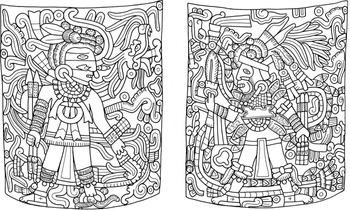
Each vessel bears a figure on its front, and the two were buried upright in such a fashion that the profile heads of the figures faced each other (Figure 13). According to Ximena Chávez (Leonardo López Luján, personal communication 2003), scientific testing of the cremated remains indicated different individuals in the two urns, so each figure seemingly corresponded to the personage contained. Although their archaizing form and location at a Great Temple indicate that they contained the remains of important people, both burials were also in a humiliating position, as Matos Moctezuma has noted, being at the base of the temple. In this location there is an inherent contrast with the burials of successful Tenochca rulers at the top near the triumphant god.
The figures of the deities Tezcatlipoca (?) and Mixcoatl (?) on the fronts of the ceramic vessels containing the probable remains of Moquihuix and Teconal, circa 1473. Museo del Templo Mayor, Mexico City. Drawing by the author (after Nicholson and Quiñones Reference Nicholson and Keber1983:94–97).

Because the remains were cremated and because the urns and the monument lack hieroglyphs, it is difficult to know who the two personages were. We lack the burials of the late Tenochca rulers under the floor of the Huitzilopochtli shrine at the top of the pyramid. The only upper floors of the pyramid remaining are on Phase II, and two funerary vases were found under the floor of the Huitzilopochtli shrine (Offerings 34 and 39), but they date from the early fifteenth century (López Luján Reference López Luján, de Montellano and de Montellano1994:339; Matos Moctezuma Reference Matos Moctezuma1983). Although they are rather paltry, given their position they must have contained the remains of honoured personages, probably rulers of the pre-imperial period. They give little idea of the burials of the later kings, destroyed by the Spanish with the imperial stages of the temple. The burial of high-status enemies at the Templo Mayor being rare, too, it is difficult to say what either type would look like archaeologically. If other enemy rulers were buried at the base of the temple, described by the Nahuatl expression as “at the foot/feet of Huitzilopochtli” (Umberger Reference Umberger and Boone1987a:434–436), they have not yet been found. In fact, the Phase IVb platform is the only area in front of the staircase to have been excavated. Accounts of the stages of rulers' burials and some of the contents exist, indicating rich deposits with the cremated remains (e.g., López Luján Reference López Luján, de Montellano and de Montellano1994:230–237; Umberger Reference Umberger and Boone1987a). Klein (Reference Klein1986:154–157) gives a greater idea of the variety of these items. Her quote from Acosta (Reference Acosta, Markham and Grimstone[1590] 1963:3:316) is especially apt. About deceased warriors, he says that their “trophies and marks of honor” were carried along with the body to the place of cremation. I am suggesting that in the special case of enemies buried at the Templo Mayor, these “marks of honor” were chosen by the victors, and they were marks of dishonor.
A circumstantial case can be constructed to identify the occupants of the two urns as Moquihuix and Teconal, the Tlatelolca leaders who fell together from the Tlatelolca temple, according to Durán. The primary evidence is in the contents of the vessel on the left (Offering 14). In addition to the human remains, the urn contained a group of obsidian duck-head pendants that archaeologists believe once formed a necklace (Matos Moctezuma and Solís Olguin Reference Matos Moctezuma and Solís Olguin2002:Number 279). These show no evidence of burning, which means they were not part of the cremation but, rather, added to the burial. Among its many meanings, the duck was a symbol of the water that was crossed on the way to the underworld. For this reason, as López Luján has documented, similar duck-head pendants were placed in earlier burials at the Tenochtitlan Great Temple, these being, presumably, burials of the honoured dead (López Luján Reference López Luján, de Montellano and de Montellano1994:223–240; personal communication 2003).
Notwithstanding this honorific association, the burials next to the Coyolxauhqui Stone within the IVb platform of the Great Temple involved unmistakably humiliating associations, as mentioned earlier, and texts indicating that the image of the duck embodied insulting references directed against enemies during the same period cannot be ignored. It appears first as a threat at the outset of the war, when Moquihuix compared the Tenochca to the ducks hunted by Tlatelolca warriors preparing for battle, and again at the end, when the Tenochca avenged the insult by forcing the defeated Tlatelolca to behave like ducks. I suggest that the Tenochca buried the duck-head necklace with the defeated leader with the same insulting objective in mind. There may be further metaphorical references here—perhaps a comparison of the underworld associations of the duck with the solar associations of Huitzilopochtli's hummingbird and the volatile forms that warriors took to accompany the sun. At any rate, the necklace must be acknowledged to be as much an insult as the burial next to Coyolxauhqui was. Both were realizations of death threats.
The identification of the northern vessel as Moquihuix's, specifically, is further supported by its position of priority over the other vessel. The two vessels were arranged with the figures on them forming a scene comparable to those on Aztec stone monuments, such as the well-known Dedication Stone. In her study of the Dedication Stone, Klein (Reference Klein and Boone1987:317–324) suggested that in this type of arrangement the figure on the left (from our point of view) is the predecessor of the figure on the right. This is true for the particular monument she studied, but the wider application of the arrangement to different types of hierarchy is explained better by an adage recorded by Sahagún in the Florentine Codex. Accordingly, a ruler says to his representative or subordinate, “I place you to my left in my obsidian sandals” (Sahagún Reference Sahagún, Anderson and Dibble1950–1982 [1575–1578]:7:Book 6:259, 1979 [1575–1578]:2:Folio 214v), and in the accompanying illustration, the ruler's subordinate is to his left (the viewer's right). Considering the arrangement from this point perspective, the figure on the left has priority over the figure on the right. Generally, in this arrangement priority is a matter of either time/age or relationship in a political hierarchy. It is a matter of time in the case of the dead ruler Tizoc and his successor Ahuitzotl on the Dedication Stone and in the case of the ancient Tlaloc and the newcomer Huitzilopochtli (usually translated as “Hummingbird on the Left”) in the arrangement of their shrines on the Templo Mayor/Coatepetl. It is a matter of political hierarchy in the case of the Florentine Codex adage and the funerary urns of Moquihuix and his subordinate Teconal.
The funerary vessels themselves are archaizing versions of high-status Toltec vessels (Nicholson and Quiñones Keber Reference Nicholson and Keber1983:95–96) and are thus referents to the noble Toltec heritage of the dead leaders. However, the deity figures on them (Figure 13), like the duck-head necklace, probably mix negative with positive references. They depict the culture-hero deities Tezcatlipoca on the left and Mixcoatl on the right. Signs of high status are the deity costumes, the rampant serpents, the atlatls, and the smoking mirror foot of the Tezcatlipoca figure.
Signs of defeat are less easily identified. Most apparent is Tezcatlipoca's feather headdress, which is of the type worn by victims to be sacrificed and comparable to the decorating of the ruler in preparation for death in the Codex Mendoza (Figure 10). A possible reference to Moquihuix's demotion is the small serpent decorating the figure's weapon. This could be a reference to his having formerly represented Huitzilopochtli, whose atlatl was in the form of a fire serpent. Another representation of the demoted Tlatelolco Huitzilopochtli is on the Stone of Tizoc (Figure 14). Here the figure has the headdress of Coyolxauhqui instead of the Hummingbird headdress of Huitzilopochtli. He does not have a serpent atlatl, his former status as the high god being alluded to with a starry-sky mask, but, as with the other captive ruler-deities on the monument, the atlatl itself serves as an allusion to his original higher status as a noble (Umberger Reference Umberger, Berdan, Chance, Sandstrom, Stark, Taggart and Umberger2007). On the funerary vessel, I believe, the atlatl refers to the personage's demotion from Huitzilopochtli to Tezcatlipoca. As for the image of Mixcoatl, the Anales de Tlatelolco (Tena 2004 [1560–1620]: 27) calls one of the Tlatelolcan leaders Mixcoatl Tlailotlacteuchtli. This personage, who is said to have directed the other traitors, must be Teconal acting as Moquihuix's lieutenant. The image may be a reference to his title. It lacks obvious humiliating features, but the feathers of a sacrificial victim are visible on the front of the headdress, and the necklace of deer ears refers to the story of Mixcoatl's killing of women disguised as deer (another reference to defeated women). These hypotheses about the vessels need further investigation.
The figure at right is the conquered Tlatelolca Huitzilopochtli, carved on the Stone of Tizoc some 13 years after the civil war. He is depicted as a male with the “starry-sky” mask of Huitzilopochtli combined with the headdress of Coyolxauhqui instead of the hummingbird headdress of the male god, circa 1485, Museo Nacional de Antropología, Mexico. Drawing by the author.

The supernatural connections and powers of all tlatoque were considered as emanating from the same sources—the tonalli derived from their Toltec heritage. Thus, the executions of the tlatoani Moquihuix and the high noble Teconal would not have been treated lightly by the Tenochca, especially since Moquihuix and Axayacatl were close relatives. Thus, most aspects of these burials give contrasting messages about high status and defeat.
NAME CHANGES
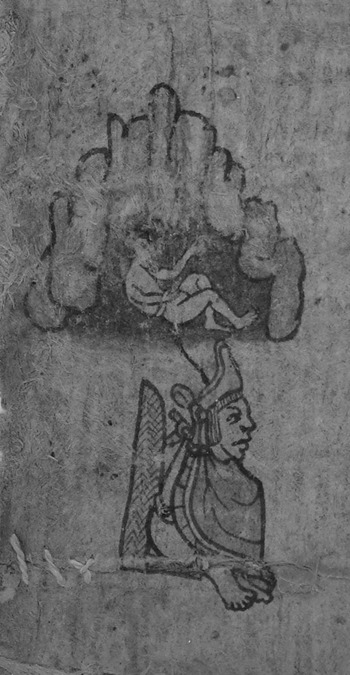
The accounts of the civil war suggest avenues of further research that cannot be pursued here. One involves the multitude of references to women: although much on this subject was presented earlier, many aspects are still unexplored. Another involves the naming and renaming of people and gods. Although this subject requires more thought, I will remark on some of the evidences in the civil war accounts. It is well known that a person or deity had many names. In the case of the civil war, some of these names, having metaphorical allusions appropriate to the occasion, had to have been given after the final battle. (Or, perhaps, a previous name was altered somewhat to yield an insulting variant.) Examples are the name Moquihuix (“Drunken One”) and the name and one title given to Moquihuix's second in command. A depiction of Moquihuix that connects his fall with drunkenness is in the Codex Saville (Figure 15). In the section covering the reign of Axayacatl, an enthroned ruler is below a scene of a man lying at the bottom of a cliff, and the ruler and scene are connected by a line of the type used for a name glyph. Although this is not his standard glyph, a pulque god head (Figure 10), this must be Moquihuix, and the scene of the fallen man is used by the artist as a variant way to express the idea. At the same time, it reveals the metaphor behind his name more clearly than the image of a king falling from a pyramid; Moquihuix was like a drunken man who fell from a high place. As seen before, Teconal also bore the title Huitznahua in one source and the name Teconal itself means “Charcoal.” His name and title before the war may have been Quezahua and Mixcoatl Tlailotlacteuchtli.
Colonial native Mexican artist, enthroned ruler below scene of man who has fallen from cliff, probably a hieroglyphic representation of the name Moquihuix (“Drunken One”). From the Codex Seville, National Museum of the American Indian, Washington, DC. Photograph by William L. Barnes, by permission of the National Museum of the American Indian.

The same is true of deities; not all of their names are positive references to varied spheres of natural powers. Rather, losing deities could be referred to by a number of negative sobriquets. Thus, after the war, the losing Huitzilopochtli was probably taken to Tenochtitlan and installed in the Huitznahuac calpulli, where he would have been called Huitznahuatl (in this context, signifying chief loser). I believe this to have been the case because part of the punishment of the Tlatelolcans was to care for Huitznahuatl's temple (Codex Mendoza [10-1541] in Berdan and Anawalt Reference Berdan and Anawalt1992:4:Folio 18v–19r). He may also have been called Painal (“He Who Hastens,” Huitzilopochtli's deputy) (Sahagún Reference Sahagún, Anderson and Dibble1950–1982 [1575–1578]:2:Book 1:3) and Maquizcoatl (“Bracelet Snake” a two-faced Huitzilopochtli; Historia de los Mexicanos por sus pinturas [ca. 1535] in Garibay Kintana Reference Kintana and María1973[ca. 1535]:23; Sahagún Reference Sahagún, Anderson and Dibble1950–1982 [1575–1578]:12:Book 11:78–79).
CONCLUSION
Returning to the Codex Durán, it should be obvious by now that the authors of this colonial view of Aztec history, the creators of the Crónica X version, removed as much as they could the Aztec allegorical underpinnings from their accounts of the events. The stories involving ducks were easily rendered as literal actions, but all stories involving Huitzilopochtli's enemy sister could not be, so they were removed. We do not know what forms of the myth of Coatepetl were activated during the civil war, but it is probable that allegorical corollaries for other historical actions were included, and elaborations were added as the events unfolded. Whatever their mythic forms, they obviously varied in significant ways from the fragments that remain in Durán's and Sahagún's reports. In the case of the Crónica X accounts, as represented by both the Codex Durán and the Crónica mexicana, the myth of Coatepetl recounted in the early section does not match the historical account of the war in the later section. So in addition to the secularization of history in the Crónica X, there is evidence of a disjunction, a lack of coordination, between the mythic and historical sections. (This type of disjunction between sections is more obvious in other colonial sources.) The myths remaining, unfortunately, are paltry, de-historicized fragments of what was once a multitude of re-conceptions activated at different times and in different places to parallel historical circumstances.
In the analysis of both mythic and historical materials, we need to be more aware of the effects of Western editing, generalizing, and categorizing, which separated the two bodies of information. The deep past of myth and the more recent past of history were intricately linked in the historical process, and the modern scholar needs to reintegrate them through studies combining colonial and pre-Conquest materials.
Acknowledgments
The ideas presented here were delivered at the British Museum as part of “Aztec Art and Culture: An International Symposium,” March 23, 2003, scheduled in connection with the exhibition Aztecs at the Royal Academy of Arts, London. The original title of the paper was “Aztec Kings and the Codex Durán.” A more developed form, “Aztec Kings and the Codex Durán: The Metaphorical Underpinnings of Rulership,” was published in Arts and Architecture of the Americas (ARARA) (Umberger Reference Umberger2003). This is a revised and rewritten version. I thank the editors of ARARA for permission to republish these ideas and Andy Barnes, Lori Diel, Eduardo Douglas, Diana Fane, Gerardo Gutiérrez, Patrick Hajovsky, Leonardo López Lújan, and Barbara Moulard for comments, questions, and additional information that made it a stronger essay. Finally, I am grateful to Eduardo Douglas and Xavier Noguez for their careful reading of the manuscript and to Casandra Hernández for translating the summary into Spanish. In the article I discuss the Aztecs' flexible adaptation of mythic structures during a sequence of historical events. In Umberger (Reference Umberger2002), I discuss their adaptation of the calendar to schedule another series of events. These two articles should be seen as a pair of complementary arguments about Aztec historical thought, differing according to the evidence available for their respective periods. Also see Taggart (Reference Taggart1983) on variations in modern myths that parallel social differences among groups.