




No CrossRef data available.
Article contents
Quitline in smoking cessation: A cost-effectiveness analysis
Published online by Cambridge University Press: 01 November 2004
Abstract
Objectives: The cost-effectiveness of the Swedish quitline, a nation-wide, free of charge service, is assessed.
Methods: The study was based on data of a sample of 1,131 callers enrolled from February 1, 2000 to November 30, 2001. Outcome was measured as cost per quitter and cost per year of life saved. Cost per quitter was based on a calculation of the total cost of the quitline divided by the number of individuals who reported abstinence after 12 months. The cost per life year saved (LYS) was calculated by the use of data from the literature on average life expectancy for smokers versus quitters, the total cost of the quitline, and the cost of pharmacological treatment.
Results: The number of smokers who used the quitline and reported abstinence after 1 year was 354 (31 percent). The accumulated number of life years saved in the study population was 2,400. The cost per quitter was 1,052–1,360 USD, and the cost per life year saved was 311–401 USD. A sensitivity analysis showed that, for outcomes down to an abstinence rate of 20 percent, the cost per LYS rose modestly, from 311 to 482 USD. Discounting the cost per LYS showed the cost to be 135 USD for 3 percent and 283 USD for 5 percent.
Conclusions: The Swedish quitline is a cost-effective public health intervention compared with other smoking cessation interventions.
Information
- Type
- GENERAL ESSAYS
- Information
- International Journal of Technology Assessment in Health Care , Volume 20 , Issue 4 , November 2004 , pp. 469 - 474
- Copyright
- © 2004 Cambridge University Press
Tobacco smoking is the single, largest, preventable and treatable public health problem (10;11). Numerous measures are used for tobacco prevention—legislation, bans, fiscal policies/pricing, campaigns, educational programs—and for cessation—counseling and cognitive behavior therapy, pharmaceuticals, hypnosis, and acupuncture. Many of these interventions have been assessed for effectiveness (6;17), and some for their cost-effectiveness (8;14;19;22). It is widely acknowledged that the majority of smoking cessation methods are both effective and cost-effective (6;23). Telephone helplines (quitlines) have gained increased recognition as effective interventions for smokers (17;24). The promising results have led to a rapid proliferation of helplines, ranging from simple call centers to sophisticated, integrated services. However, quitlines have not yet been evaluated for their cost-effectiveness.
The Swedish quitline was established in 1998 as a nationwide free of charge service. By 2001, it was operating 51 hours per week through three to four telephone lines. When the service is closed, or all lines are busy, an answering machine and a 24-hour interactive voice response serve as back-up. All calls are registered on computerized patient records (7). The reported quit rate of the Swedish quitline is 31 percent, similar to the results achieved in other nonrandomized trials (5). The aim of this study is a cost-effectiveness analysis of this Swedish quitline.
MATERIAL AND METHODS
The perspective of this study is on the cost of the Swedish quitline over 2 years in relation to the number of quitters during the same time and to available data about life years saved for those who quit smoking. All costs are considered fixed because the budget for the quitline is related to a fairly steady number of people reached by the services over time.
No calculations were made of potential future cost savings due to decreased demand of medical care for those who quit. The reason for this strategy is (i) the poor precision by which future potential cost savings can be estimated, and (ii) to exercise caution in calculating the cost-effectiveness of the quitline.
Patients Enrolled in the Study
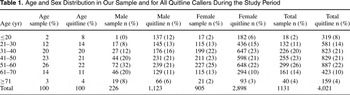
The total number of calls during the study period was 13,763, including 8,503 new callers. Of the latter, 4,021 were registered in the database and 1,131 agreed to participate in the study, that is, to be subjected to follow-up 1 year later (Table 1). The majority of callers were women (80 percent).

For callers signing up for counseling, name, address, gender, age, tobacco use, and individual aspects of smoking behavior, were registered. One year after the first contact, all consenting patients received a detailed, fourteen-item follow-up questionnaire (7). The age and sex distribution in the quitline as a whole compares well with the sample's, with two exceptions: there are fewer men than women in the youngest age group (<20 years old) and more men in the 61-to 70-year-old age group.
Cost Calculations
The cost calculations are based on the following sources: (i) data recorded for 4,021 patients calling the Swedish quitline during a 22-month period (from February 2000 to November 2001); (ii) cost data obtained from the financial records of the Center for Tobacco Prevention, the operator of the quitline; (iii) official data on life expectancy for different age groups in Sweden (16); (iv) life expectancy data for smokers and quitters from a large cohort study in the United States (18); (v) review of published studies on smoking cessation for data about costs (8;13;15;20); (vi) cost of pharmacological treatment for smoking cessation paid for by the patients (Apoteket AB Pricelist OTC Pharmaceuticals 2002).
Cost of Quitline
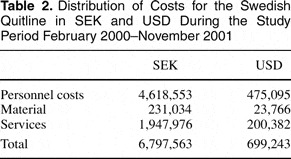
The total cost of the services provided by the quitline over the 22-month study period was 0.7 million USD (Table 2). The dominant cost item of the quitline was salaries including social overheads.

The second largest cost item summarized as “cost of services” includes rent of office premises, equipment, information technology services, printing, advertising, telephone, fax, travel, cleaning, and cost of consultants. Cost of material includes office supplies, library service, forms, stationary, and miscellaneous costs. The cost of nicotine replacement was calculated from self-reported use at the 12-month follow-up. The average cost per person per day was 1.2 USD. Prescriptions of bupropion (Zyban®) were reported in seventeen cases with a per capita cost of 101 USD. The total cost of the pharmacological treatment for the study population was 45,772 USD.
Life Expectancy
Life expectancy for men and women in Sweden was calculated from official statistics (16), see Table 5. To calculate life expectancy for smokers and quitters, data from a longitudinal cohort study in the United States was used (18). Data for quitters before the age of 35 were not reported in the U.S. study (Table 3).

Measurement of Outcome
Quitter/Abstinence
Abstinence was defined as not a single puff of smoke 7 days before follow-up by self-report. This strategy has been found to be an accurate measurement of abstinence (9) and was selected for practical and economical reasons.
Life Years Saved—LYS
The ultimate aim of prevention, treatment, and rehabilitation is improvement in health; reduced mortality and morbidity, and improved or maintained quality of life. Although the link between an intermediate outcome measure such as number of quitters, and the ultimate aim of smoking cessation is known, there is an argument for calculating life years saved or quality adjusted life years saved. This process makes it possible to illustrate the relative effectiveness of different interventions for health improvement. We used life years saved (LYS) as an outcome measure.
Measurement of Cost-Effectiveness
The cost per quitter enrolled in the quitline was calculated as the total cost of the quitline divided by the number of individuals who were abstinent after 12 months. In Figure 1, a more conservative approach has been taken into account assuming 274 (24 percent) being abstinent after 1 year and, thus, taking into consideration the spontaneous quitters (7 percent), those who already had stopped before first call (23 percent), those relapsing (70 percent), and those who will be helped (45 percent). The cost per life year saved was calculated by dividing the total cost of the quitline including the cost of pharmacological treatment for smoking cessation by life years saved. Table 4 provides examples of the relative cost-effectiveness, expressed in cost per year of life saved, of different smoking cessation measures; brief advice (8), Quit & Win contest (20), advice and self-material (8), general practitioner counseling (8), antismoking campaign (15), pharmacotherapies (13), and the Swedish quitline (Table 4).


Distribution context for calculations with a more “realistic approach.” It is assumed here that 7% are spontaneous quitters, 23% of those calling the quitline quit before first call, 70% will relapse, and that 45% will be helped.
For currency conversion from SEK to USD, we used an average exchange bank rate for 2002 of 9.721 (The Riksbank average exchange rate. www.riksbank.se). The average exchange rate for year 2002 from Pound Sterling to USD was 1.432 (www.statistics.gov.uk). All prices were recalculated according to the Consumer Price Index up to the same year, 2002.
Sensitivity Analysis
Quit rate and life years saved may vary depending on the validity of findings in other studies. The robustness of the results, therefore, may be tested in a sensitivity analysis (4).
In this analysis, the data used for quit rate and life years saved are varied to determine whether the results will change significantly. Thus in our sensitivity analysis, we recalculated the cost-effectiveness ratios by reducing life years gained from an average of 8 years to an average of 6, 4, and 2 years, respectively (3). Likewise, we recalculated the cost-effectiveness of reducing the rate of quitters from 30 percent to 25, 20, 15, 10, 7, and 6 percent, respectively.
Discounting
Discounting LYS has important implications when comparing cost per year of life saved between different investments or different programs. In some cases, costs are incurred immediately and remain undiscounted. In our study, costs are discounted at 3 percent and 5 percent over the 2-year (22-month) period of the study. Benefits are discounted by two alternative rates: 3 percent and 5 percent and are based upon someone who quit by the age of 35 and who after these years will gain 8 years in life expectancy. Life expectancy is extended from 72–80 years. We also calculated the undiscounted rate (0 percent) of the benefits. The calculations are based on the cost per life years saved for the quitline. The state of the art suggests that benefits should be treated in the same way as costs, and discounted at the same rate (4). Ethical approval was obtained by Karolinska Institutet Dnr 00-367.
RESULTS
A total of 4,021 individuals received tobacco cessation counseling over the study period. Often, they were advised on single aspects such as nicotine replacement therapy or smokeless tobacco. Of the 4,021, 1,131 subjects enrolled in the evaluation. After 1 year, 354 (31 percent) smokers reported abstinence. The cost per quitter for the Swedish quitline was between 1,052 and 1,360 USD.
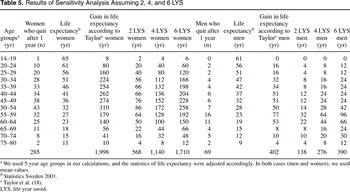
In Table 5, the accumulated life years saved for each group is presented. These are divided with the total cost of the quitline, including pharmaceuticals. The accumulated life years gained was 2,400, and the cost per life year saved is equivalent to 311–401 USD (Figure 1).

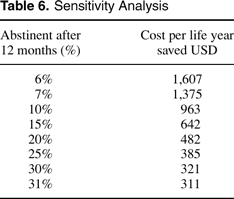
As shown in Table 6, the lowest quit rate corresponds to 1,607 USD per LYS and the highest to 311 USD. For outcomes down to 20 percent abstinence, the cost per year of life saved changed modestly (from 311 to 482 USD).

The sensitivity of the data on life years saved was tested by calculating the effects of 2, 4, and 6 life years saved, instead of an average of 8 life years saved (Table 5). The lower value, 2 years of life saved, increased the cost of the quitline from 311 USD to 1,056 USD per LYS. When changing to 4 years, the cost per LYS was 526 USD and for 6 years, 355 USD.
Without a discount rate (0 percent), the cost per life year saved was 39 USD. Using a discount rate of 3 percent and 5 percent gives a cost per LYS at 135 and 283 USD, respectively. The discounted costs was 689,104 USD for 3 percent and 682 461 for 5 percent.
DISCUSSION
To our knowledge, this report is the first published study evaluating the relative cost effectiveness of a quitline. The cost per life year saved of the Swedish quitline was estimated to between 311 and 401 USD (Table 6). The cost per quitter ranged between 1,052 and 1,360 USD. The higher figures are based on a more “realistic approach” compensating for the spontaneous quitters and those who already had stopped before first call (Figure 1). It is known that other smoking cessation interventions (Table 4) are highly cost-effective in terms of the cost per LYS (8;14;22) as compared with most medical interventions and prevention programs (19).We measured effectiveness using LYS (4). Our life expectancy calculations (Table 3) were based on the study by Taylor et al. (18), known to have a larger and more comprehensive sample than others (21), enabling us calculations for different ages.
Our study is based on data collected from a program that is run in a real-life situation as opposed to a randomized clinical trial. First, it may be argued that the individuals in our sample were more motivated to quit smoking than the average smoker. Callers to a quitline who do not get the requested support are reported to have a spontaneous 12-month quit rate of 7 percent (25) compared with the 2–3 percent spontaneous quit rate seen annually in the general smoking population (6). Second, 23 percent of the callers in this study had stopped smoking immediately before first contact (1–4 days) and called as they feared an impending relapse. The relapse rate is believed to be very high in this group, but with our support, their 12-month abstinence rate was 50 percent (128/256), which was 50 percent higher than that of the other callers. Third, our definition of abstinence at 12-month follow-up, although widely used, does not guarantee life-long abstinence (12).
As shown in Table 6, we used 6 percent as the lowest quit rate in our sensitivity analysis. This yields a cost of 1,607 USD as compared with 311 USD per year of life saved for the 354 (31 percent) abstinent smokers. Thus, the argument that the ratio of cost to effectiveness is sensitive to the quit rate is valid. However, the results in terms of cost per quitter and cost per life years saved remain cost-effective in comparison with several other measures for smoking cessation. The results also show that even “pessimistic” estimates of the quit rate compare favorably with other health-care interventions (13).
Our method does not enable assessment of possible future benefits, in terms of cost savings due to less consumption of medical care, decreased productivity losses due to sick-leave and smoking breaks (22), and the excess costs of passive smoking in the unborn child, children, and adults (26).
Mortality is used as an end point. However, smoking cessation also leads to a compression of morbidity and improvement in quality of life (1), which is not included here. The uncertainty around these future benefits may cause an underestimation of the effectiveness of the quitline.
To use U.S. data for assessing life expectancy for Swedish smokers and quitters introduces a potential bias. However, the smoking panorama in Sweden does not differ much from that of the United States and other rich countries.
Abstinence was not biochemically validated, but the National Health Survey has concluded that self-reported smoking status among respondents is reliable. Among reported nonsmokers, only 1.4 percent had serum cotinine >15.0 ng/ml, the selected cut-off point for identifying smokers in their report (2).
POLICY IMPLICATIONS
This study supports the supposition that smoking cessation telephone quitlines can be particularly cost-effective health interventions and strongly suggests that they should be part of comprehensive, publicly funded, national tobacco control programs.
The authors thank Mats Toftgard (CTP) for statistical advice. All staff members at the Swedish quitline are also acknowledged. Thanks to Lars-Åke Marké for assistance in the discounting analysis. The first author is funded by the Karolinska Institutet and the Stockholm County Council.
The views in this study are those of the authors and not of the funding bodies. None declared competing interest.
The Swedish quitline is funded by the Swedish Government through The National Institute of Public Health, The Swedish Cancer Society, The Swedish Heart-Lung Foundation, and The National Corporation of Swedish Pharmacies.
References
Brønnum-Hansen H,
Juel K.
2001
Abstention from smoking extends life and compresses morbidity. A population based study of health expectancy among smokers and never smokers in Denmark.
Tob Control.
10:
273–
278.Google Scholar
Caraballo RS,
Giovino GA,
Pechacek TF,
Mowery PD.
2001
Factors associated with discrepancies between self-reports on cigarette smoking and measured serum cotinine levels among persons aged 17 years and older. Third National Health and Nutrition Examination Survey, 1988-1994.
Am J Epidemiol.
153:
807–
814.Google Scholar
Crealey GE,
McElmay JC,
Maguire TA,
O'Neill C.
1998
Costs and effects associated with a community pharmacy-based smoking cessation program.
Pharmacoeconomics.
14:
323–
333.Google Scholar
Drummond MF,
O'Brian B,
Stoddart GL,
Torrance GW.
1997.
Methods for the economic evaluation of health care programs.
2nd ed.
Oxford:
Oxford University Press
El-Bastawissi AY,
McAfee T,
Zbikowski SM, et al.
2003
The uninsured and Medicaid Oregon tobacco user experience in a real world, phone based cessation programme.
Tob Control.
12:
45–
51.Google Scholar
Fiore MC,
Bailey WC,
Cohen SJ, et al.
2000.
Treating tobacco use and dependence. A clinical practice guideline.
Rockville, MD:
U.S. Department of Health and Human Services. Public Health Service
Helgason A,
Tomson T,
Lund KE, et al.
2004
Factors related to abstinence in a telephone helpline for smoking cessation.
Eur J Public Health.
14:
306–
310.Google Scholar
Parrot S,
Godfrey C,
Raw M, et al.
1998
Guidance for commissioners on the cost effectiveness of smoking cessation interventions.
Thorax.
53
(Suppl 5):
1–
38.Google Scholar
Patrick DL,
Cheadle A,
Thompson DC, et al.
1994
The validity of self-reported smoking: A review and meta-analysis.
Am J Public Health.
84:
1086–
1093.Google Scholar
Peto R,
Lopez AD,
Boreham J,
Thun M,
Heath C.
1994.
Mortality from tobacco in developed countries 1950-2000: Indirect estimates from national vital statistics.
Oxford:
Oxford University Press
Peto R.
1994
Smoking and death: The past 40 years and the next 40.
BMJ.
309:
937–
939.Google Scholar
Pierce JP,
Gilpin EA.
2003
A minimum 6-month prolonged abstinence should be required for evaluation smoking cessation trials.
Nicotine Tob Res.
5:
151–
153.Google Scholar
Rapid and systematic review for NICE Bupropion SR and NRT for smoking cessation,
2002.
Available at: www.nice.org.uk/pdf/Buproprionreview.pdf.
SBU—The Swedish Council on Technology Assessment in Health Care.
1998.
Metoder för rökavvänjning. [Methods for smoking cessation].
Rapport nr 138,
Stockholm:
Swedish Council on Technology Assessment in Health Care
Shipley RH,
Hartwell TD,
Austin WD,
Clayton AC,
Stanley LC.
1995
Community stop-smoking contests in the COMMIT trial: Relationship of participation to costs.
Prev Med.
24:
286–
292.Google Scholar
Stead LH,
Lancaster T,
Perera R.
2003.
Telephone counselling for smoking cessation. (Cochrane Review)
In: The Cochrane Library, Volume 1.
Oxford:
Update Software
Taylor DH,
Hasselblad V,
Henley SJ,
Thun MJ,
Sloan FA.
2002
Benefits of smoking cessation for longevity.
Am J Public Health.
92:
990–
996.Google Scholar
Tengs TO,
Adams ME,
Pliskin JS, et al.
1995
Five-hundred life-saving interventions and their cost-effectiveness.
Risk Anal.
15:
369–
390.Google Scholar
Tillgren P,
Rosén M,
Haglund BJ, et al.
1993
Cost-effectiveness of a tobacco ‘quit and win’ contest in Sweden.
Health Policy.
26:
43–
53.Google Scholar
Tsevat J,
Weinstein MC,
Williams LW,
Tosteson AN,
Goldman L.
1991
Expected gains in life expectancy from various coronary heart disease risk factor modifications.
Circulation.
83:
1194–
1201.Google Scholar
Warner KE.
1997
Cost effectiveness of smoking cessation therapies. Interpretation of the evidence and implications for coverage.
Pharmacoeconomics
11:
538–
549.Google Scholar
World Bank.
1999
Curbing the epidemic: Governments and the economics of tobacco control.
Washington, DC:
The World Bank
8:
196–
201.
Zhu SH,
Anderson CM,
Tedeschi GJ, et al.
2002
Evidence of real-world effectiveness of a telephone quitline for smokers.
N Engl J Med.
347:
1087–
1093.Google Scholar
Zhu SH,
Melcer T,
Sun J, et al.
2000
Smoking cessation with and without assistance a population-based analysis.
Am J Prev Med.
18:
305–
311.Google Scholar
Mackay J,
Eriksen M.
2002.
The tobacco atlas.
World Health Organisation. London:
The Hanway Press
Age and Sex Distribution in Our Sample and for All Quitline Callers During the Study Period
Distribution of Costs for the Swedish Quitline in SEK and USD During the Study Period February 2000–November 2001

Gain in Life Expectancy for Smokers Who Quit at Different Ages (15)

Cost-Effectiveness of Smoking Cessation Interventions

Distribution context for calculations with a more “realistic approach.” It is assumed here that 7% are spontaneous quitters, 23% of those calling the quitline quit before first call, 70% will relapse, and that 45% will be helped.
Results of Sensitivity Analysis Assuming 2, 4, and 6 LYS
Sensitivity Analysis
 You have
Access
- 48
- Cited by