Introduction
The most important causes of sudden hearing loss are vascular phenomena and viral infection. Adhesion of a virus to the erythrocyte produces haemagglutination, hypercoagulation and endothelial cell oedema in capillaries.Reference Nomura and Hiraide1 As a result, the vascular supply to the inner ear is blocked and hypoxia develops. Hypoxia causes a decrease in vascular permeability, and therefore oedema increases. Consequently, ischaemia occurs.Reference Nomura and Hiraide1, Reference Davis and Hunt2 After the ion exchange mechanism is disrupted, irreversible damage develops.Reference Trump, Berezesky, Cowley, Cowley and Trump3
Disruption of the ion exchange mechanism may be relieved by hyperbaric oxygen therapy. Our objective was to investigate the effectiveness of hyperbaric oxygen therapy in the management of sudden hearing loss.
There is no standard definition or treatment protocol for sudden hearing loss. However, the use of steroids is an established treatment method for this condition, and withholding steroids in such cases is considered malpractice in our country. Because of this, we had to use steroids for all our patients; therefore, designing a placebo-controlled, double-blinded experimental study to investigate treatment issues was not possible.
Methods
Sudden hearing loss is defined as sensorineural hearing loss of a minimum of 30 dB in at least three frequencies occurring within a period of three days.Reference Wilson, Byl and Laird4 Our study included 59 ears of 57 patients with sudden hearing loss matching this definition, who were seen at the out-patient clinic of Haydarpasa Training Hospital, Gulhane Military Medical Academy, between 1994 and 2006. Exclusion criteria were as follows: age under 18 years, history of fluctuant hearing loss, intracranial malignancy and presentation with acute neurological symptoms. Since sudden hearing loss is seen very rarely, a power analysis showed that our sample size was much greater than would be required for a 95 per cent confidence interval and p < 0.05.
The ethical committee of our institution approved the study, and all enrolled patients gave written, informed consent.
Subjects were allocated randomly, using a computer, into study and control groups. The study group comprised 38 ears of 36 patients (two with bilateral sudden hearing loss; 12 women and 24 men; age range 18–82 years; mean age 46.8 years). The control group comprised 21 patients with unilateral sudden hearing loss (eight women and 13 men; age range 20–75 years; mean age 44.5 years).
All patients were hospitalised. A detailed history was taken, with the help of a questionnaire, covering chronic and recent acute diseases.
All patients then underwent physical and otoscopic examination. The following investigations were performed: audiological testing (i.e. pure tone audiography, and acoustic impedance measurements including stapedius reflex threshold and decay), blood biochemistry, complete blood count, erythrocyte sedimentation rate, prothrombin time, bleeding time, viral studies (i.e. mumps, cytomegalovirus, herpes simplex and rubella), fluorescent treponemal antibody testing and immunological studies (i.e. autoantibodies for rheumatoid factor, anti-mitochondrial antibody and anti-nuclear antibody). A temporal computed tomography (CT) scan as performed for all patients.
All patients had idiopathic sudden sensorineural hearing loss.
The study group was treated with hyperbaric oxygen therapy plus standard steroid therapy, comprising prednisolone (Deltacortil tb® 5 mg (Pfizer, Istanbul, Turkey), 1 mg/kg starting dose, reducing thereafter and ceasing in three weeks) and famotidine (Duovel film tb (Sanovel, Istanbul, Turkey), 40 mg once daily). Hyperbaric oxygen therapy was carried out in a multipatient hyperbaric chamber (Galeazzi, Livorno, Italy) and was administered in 10 sessions. Sessions lasted for 90 minutes at a pressure of 2.5 atmospheres of absolute pressure. Sessions were administered daily, and the whole therapy period lasted 10 days.
The control group was treated with only the standard steroid protocol mentioned above.
Both groups were evaluated with pure tone audiography every second day during the therapy period.
Results were analysed statistically using the Wilcoxon signed rank test and the Mann–Whitney U test. Results were evaluated using a confidence interval of 95 per cent, and p < 0.05 was accepted as denoting statistical significance.
Results
In the study group, 34 patients were admitted within three days of sudden hearing loss onset (bilateral in two cases). Of the remaining two patients, one was admitted on the seventh day and the other on the 10th day. In the control group, all patients were admitted within three days. Tinnitus accompanied the sudden hearing loss in 14 study group patients and six control group patients.
Both of the study group patients with bilateral sudden hearing loss were treated with hyperbaric oxygen therapy. However, one of these two patients' ears showed no hearing improvement.
Three patients had previously been treated for hypertension. One of these patients had suffered sudden blindness of unclear aetiology 10 years previously. One patient had been treated with 3000 mg acetylsalicylic acid for acute rheumatoid fever three months previously. Ten patients had an abnormally high triglyceride level.
All control group patients had normal CT scans. However, one study group patient had CT signs of previous intracranial ischaemia.
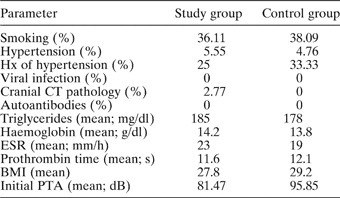
Patients' main characteristics are outlined in Table I.
Patient characteristics

Hx = history; CT = computed tomography; ESR = erythrocyte sedimentation rate; s = seconds; BMI = body mass index; PTA = pure tone audiography
Seven study group patients and two control group patients reported suffering a recent infection, but neither group showed any serological evidence of this. None of the patients had a history of trauma; therefore no tympanotomy procedures were required.
None of the patients of either group complained of vertigo on admission. However, in the questionnaire, three study group patients and one control group patient described mild vertigo. On examination, no physical, objective signs of vertigo (such as nystagmus) were elicited. At the end of treatment, two of the three study group patients with vertigo and the one control group patient with vertigo were completely healed.
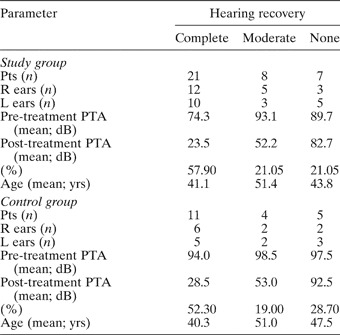
In the study group, patients' hearing was regained completely in 22 ears (i.e. improvement of more than 50 dB) and moderately in eight (i.e. 10–50 dB improvement). Eight ears showed no improvement (i.e. <10 dB improvement). Complete and moderate hearing improvement was accepted as a successful outcome. The success rate for the study group was 78.95 per cent.
In the control group, hearing was regained completely in 11 patients and moderately in four. Six patients showed no improvement. The success rate was 71.30 per cent (Table II). The success rate of the study group was greater than that of the control group, but this difference was not statistically significant (p > 0.05).
Patients' hearing outcomes

Overall success rates were 78.95% for the study group and 71.30% for the control group; this difference was not statistically significant (p > 0.05). Pts = patients; R = right; L = left; PTA = pure tone audiogram; yrs = years
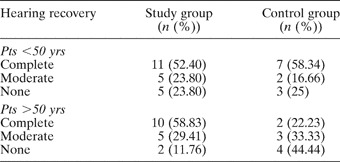
In order to detect any age-related differences in treatment outcome, all patients were divided into those older and younger than 50 years. The results for these two groups were compared using the Mann–Whitney U test. The differences in treatment outcome between the two groups were not statistically significant (p > 0.05) (Table III).
Comparison of hearing outcomes in patients older and younger than 50 yrs

Pts = patients; yrs = years
Discussion
In the management of idiopathic sudden hearing loss, the main aim is to improve blood flow or oxygenation of the cochlea. For this reason, several treatment modalities are used.Reference Gandin5 If the aetiology is apparent, treatment should address this aetiology. It has been reported that idiopathic sudden hearing loss spontaneously resolves in 66 per cent of cases.Reference Mattox and Simmons6 Previous reports have described treatment of sudden hearing loss with: stellate ganglion blockage, vasodilators (oral papaverine, histamine infusion, oral nicotinic acid and inhaled carbogen therapy), anticoagulant drugs, low molecular weight dextran, corticosteroids, diuretics and sedative drugs. Hyperbaric oxygen therapy has been recommended as definitive treatment.Reference Donaldson7–Reference Bahgat and Shenoi10
The cochlea is very sensitive to ischaemia, which it can tolerate for only 10 to 20 minutes. If ischaemia persists beyond 30 minutes, the endocochlear potential will be injured irreversibly.Reference Byl11, Reference Matsuaka, Shitara, Okamata and Sano12 Hyperbaric oxygen therapy increases erythrocyte elasticity and lowers blood viscosity; as a result, it improves microcirculation and increases the partial oxygen pressure of the inner ear.Reference Oriani, Oriani, Marroni and Wattel13 Hyperbaric oxygen therapy causes vasoconstriction, but tissue oxygenation increases as the arterial partial oxygen pressure increases. Transcapillary fluid exchange decreases and fluid resorption increases, thereby reducing the inflammation and oedema caused by ischaemia. Hyperbaric oxygen therapy provides Na–K pumps with oxygen, thereby helping to restore the ion balance and electrophysiological function of the inner-ear structures and to prevent further morphological degeneration.Reference Oriani, Oriani, Marroni and Wattel13
Pilgramm et al. reported that haemodilution plus hyperbaric oxygen therapy was better than conventional therapy in the treatment of sudden deafness.Reference Pilgramm, Lamm and Schumann14 Hoffmann et al. used hyperbaric oxygen therapy for patients with sudden hearing loss who could not be treated with conventional therapy; in the first three months, 30 per cent of patients obtained hearing gains of 10 dB and 10 per cent obtained gains of more than 20 dB.Reference Hoffmann, Bohmer, Desloovere and Cramer15
After 11th International Congress on Hyperbaric Medicine in 1993, most of the otolaryngology authorities decided that hyperbaric oxygen could be used in addition to haemodilution and vaso-active drugs for the treatment of sudden hearing loss. If hyperbaric oxygen therapy treatment is started within 48 hours of onset of hearing loss, results are generally satisfactory.Reference Oriani, Oriani, Marroni and Wattel13
Aslan et al. reported that the addition of hyperbaric oxygen therapy to conventional treatment improves the outcome of sudden hearing loss, especially in patients younger than 50 years; however, they found no benefit in patients older than 60 years.Reference Aslan, Oysu, Veyseller and Baserer16 We found no difference in hearing improvement, comparing patients older and younger than 50 years (p > 0.05). Kestler et al. recommended hyperbaric oxygen therapy as secondary treatment for sudden hearing loss if standard therapy was unsuccessful.Reference Kestler, Strutz and Heiden17
• This study aimed to evaluate the effectiveness of hyperbaric oxygen therapy in the management of sudden sensorineural hearing loss
• The study population included 59 ears diagnosed with sudden sensorineural hearing loss
• A combination of hyperbaric oxygen therapy plus systemic corticosteroid therapy was found to offer no significant advantage compared with steroid therapy alone
Lamm et al. reviewed 50 reports on a total of 4109 patients with sudden hearing loss or acute noise-induced hearing loss who were treated with hyperbaric oxygen therapy following unsuccessful conventional therapy.Reference Lamm, Lamm and Arnold18 Patients were admitted later than two weeks but within six weeks, and 50 per cent showed significant improvement. Most of the patients admitted later than six weeks but within three months received hyperbaric oxygen therapy and conventional treatment, but without a successful outcome. Lamm et al. recommended that, even if patients were admitted later than three months, they should be treated with hyperbaric oxygen therapy.
In their series, Satar and colleagues did not find any beneficial effect of adding hyperbaric oxygen therapy to conventional therapy.Reference Satar, Hidir and Yetiser19 They also did not find old age to be a poor prognostic factor.
In our study, a success rate of 71.30 per cent was obtained in the standard treatment group. This rate increased to 78.95 per cent in the study group. However, the difference between the two groups was not statistically significant. Two patients in the study group were admitted seven to 10 days after onset of hearing loss. Of these, an improvement in hearing was achieved in only one patient. In contrast to many study outcomes, we conclude from our findings that combined treatment of sudden hearing loss with hyperbaric oxygen therapy is not superior to conventional treatment. Since our sample size was more than adequate for such a rare condition, as shown by power analysis, we believe that our results represent a genuine lack of effectiveness of additional hyperbaric oxygen therapy. The economical burden of hyperbaric oxygen treatment should also be kept in mind.
Conclusion
The addition of hyperbaric oxygen therapy to conventional treatment for sudden hearing loss does not appear to be beneficial. If a patient has any contraindications to conventional treatment (e.g. old age, peptic ulceration or hypertension), hyperbaric oxygen therapy may be given as alternative therapy. However, the use of hyperbaric oxygen therapy alone as an alternative to conventional treatment for new onset sudden hearing loss requires further research.