Introduction
Fatigued pigs during the transport and slaughter process are a cause of significant financial loss to the pig production industry, and provide a significant animal welfare concern in modern production systems (Benjamin, Reference Benjamin2005). Many possible causes of fatigued pigs have been suggested in the literature including pre-transportation handling, group sizes, temperature during transport, nutrition status, etc. (Peeters et al., Reference Peeters, Driessen, Steegmans, Henot and Geers2004; Ellis and Ritter, 2005; Lewis and McGlone, Reference Lewis and McGlone2007).
Feed in the stomach and small intestine provides nutrients that can be used as a substrate to make muscle pH lower during times of stress (Carr, 2006). Warriss and Brown (Reference Warriss and Brown1983) have shown that pork quality may be improved if the pig’s stomach/GI tract is empty/diminished at processing. While absence of feed in the stomach and small intestine may prevent pale pork, the pig may be in a state of low blood glucose and therefore at risk of becoming fatigued.
Pigs are shipped at all times of the day and night to supply the processing plants with enough pigs for the day’s needs. Rademacher and Davies (2005) reported variation in rates of fatigued pigs when shipped at different times of day. We hypothesize that part of the variation in the rate of fatigued or down pigs is due to the pigs having insufficient blood glucose, which may cause light-headedness or fatigue.
The control of feed intake and the feeding behaviour of pigs is directly related to various metabolic and neural signals of energy balance status, and loss of appetite is a common symptom of stress or disease (Fernendez et al., Reference Fernendez, Meunier-Salaun, Ecolan and Mormede1995). Fasting pigs have been shown to be more aggressive to unfamiliar pigs, have higher general activity levels and enhanced stress-induced glycogen depletion (Kelley et al., Reference Kelley, McGlone and Gaskins1980; Fernendez et al., Reference Fernendez, Meunier-Salaun, Ecolan and Mormede1995). If there is a long time between a given pig’s last meal and the onset of shipping, and if this is followed by a long transport time, then the pig may be at risk of having an empty stomach at processing and possibly a greater risk of becoming fatigued and/or stressed. Pig’s feeding behaviours are not sufficiently understood to be able to manage gastrointestinal (GI) contents of the pig.
Feeding behaviour traits are under a degree of genetic control, with moderate heritabilities reported for traits such as feed intake per visit and number of visits per day (Hall et al., Reference Hall, Hill, Brampton and Webb1999). Also, feeding behaviour traits have been shown to have a correlation with performance traits, in some cases independent of the total daily feed intake (Hall et al., Reference Hall, Hill, Brampton and Webb1999). Therefore, the feeding pattern of pigs appears to have an influence on the performance of growing pigs, and on the risk of fatigue and stress during transport in finishing pigs. Feeding behaviour traits may also be important targets for pig breeders.
This study was initiated to understand how the distribution of pig feeding may vary with time of the day. Specifically, this study sought to determine (1) how often pigs take meals during the day, (2) the times of the day they eat and (3) a first approximation of the time from feed consumption to excretion (rate of passage) when housed in groups in conventional finishing facilities.
Material and methods
This study was performed at the Texas Tech University Swine Unit and was approved by the Texas Tech University Animal Care and Use Committee. The subjects chosen for experimentation were progeny of the Camborough 22 (C-22), PIC USA breeding stock located on site. The facility was a fully concrete-slatted building with supplemental ventilation and heat. Feed (corn-soy-vitamin-mineral) and water were provided ad libitum. The nutrient composition of diets was presented in detail in Ji et al. (Reference Ji, McGlone and Kim2006). The study was conducted in the late summer of 2005 during mild weather (14°C average air temperature with 56% humidity).
Subject pigs were randomly selected by pen from a standard indoor finishing barn with forced ventilation. For inclusion within this study, the individual pigs (both gilts and barrows) needed to be at or over 68 kg live weight and not be on any medications or feed additives (this includes in-feed antibiotics). To ascertain pig’s eating frequencies and time of meals, pens were fitted with video recorders over the feeders (two feeding spaces per feeder). All 10 pigs per pen (N = 5 pens) were then weighed and the largest, smallest and two intermediate pigs were selected and marked (circle, stripes, dot and crosses) for viewing over a 24-h period. The video was recorded in time lapse (0.833 frames/s). Once recording was finished, the tapes were digitized and analysed using the Observer 5.1 program (Noldus, Leesburg, VA, USA). These behavioural settings have been previously used in pig research by Dailey and McGlone (Reference Dailey and McGlone1997) and Hulbert and McGlone (Reference Hulbert and McGlone2006). Feeding behaviour was recorded when a pig’s head was in the feeder. A bout of behaviour (in this case feeding) is defined as a period of behaviour followed by a period of non-behaviour, which is based on a bout criterion interval of a given length of time. A bout criterion interval of 7 min was set based on previous work with pigs by Petrie and Gonyou (Reference Petrie and Gonyou1988) and based on our data from this study. Therefore, if an individual pig eats and then drinks, and within 7 min, eats again, then this is considered the same bout or meal.
Once the frequency and time of day of feeding were established, chromic oxide was added to the feed as a marker to determine the rate of passage of feed (solids) through the pigs (Stein et al., Reference Stein, Kim, Neilsen and Easter2001). All of the randomly selected pigs in the pens from the previous experiment were marked with an individual number on their back for easy identification during live observations. The feeders were then emptied and a diet containing 0.3% chromic oxide was introduced. The individual pigs were then observed (by live observations) until they first ate the new diet. Observers were located away from the pens and had no interaction with the pigs to limit the observer effect on the behaviour of the pigs. Observers waited until each group-housed pig was observed to defecate green-coloured faeces (indicating that the feed had passed through their system although a better measure could be absorption of glucose in the SI but this was not measured). The time was then recorded and the total time calculated for the passage of feed through the gut.
Behavioural measures were analysed using SAS (SAS, Cary, NC, USA) General Linear Models and Excel (Microsoft, Redmond, WA, USA). The effects of the model included fixed effect of pig size (small, medium and large) and pen. The number of meals (or feeding bouts) was determined using the bout criteria interval (BCI) of 7 min. Regression equations were calculated to model the near-diurnal cycle in pig feeding. Models were calculated to show the time for feed to pass from eating to defecation (‘throughput time’) given varying lengths of time off feed (or transport). Models calculated a first approximation of the percentage of pigs that may have an empty gut given certain times of day off feed (shipped) and transport/pre-stun times (from 0 to 12 h).
Results
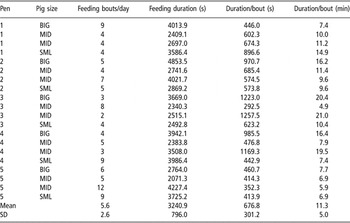
Small, middle and large pigs within a pen had similar (not significantly different) numbers of meals, feeding durations and rates of passage when compared using ANOVA (mean values shown in Table 1). Variation among pigs must be due to factors other than the size of the pig within the pen.
Mean values of feeding behaviour measures from 20 late-finishing pigs

Pigs are from PIC USA genetics in an indoor, fully slatted facility.
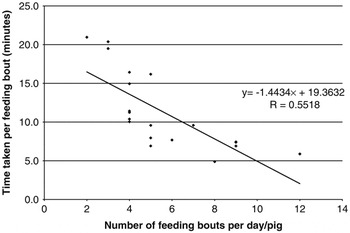
Pigs ate 5.6 ± 0.61 meals per day on average (Table 1). The average bout length of these meals was 11.3 ± 1.1 min and pigs spent a total of 54 min (s.e. = 2.97) per day eating. Data presented in Figure 1 indicate that pigs that took fewer meals per day increased their duration of feeding. Thus, some pigs took fewer, larger meals per day while others took more number of meals of shorter duration.
Presented in the graph is the relationship between number of feeding bouts per day and the time per feeding bout (minutes). Note the linear decline that indicates that as the number of feeding bouts increased, the duration of each meal decreased. N = 20 pigs.

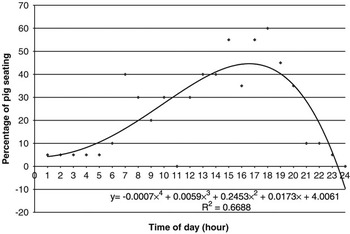
The daily pattern of feeding among the pigs evaluated is presented in Figure 2. Pigs showed a near-diurnal cycle in feeding behaviour. A true diurnal cycle would have its peak activity in mid-day (about 1200 h). The observed pattern of feeding was shifted to the right relative to a strictly diurnal cycle. Most feeding happened between 0700 and 1900 h.
Graph shows the diurnal cycle in pig feeding behaviour. Pig feeding behaviour was in a variation on a diurnal pattern, but shifted to the right in an inverse χ 2 distribution (one can also see two peaks in feeding behaviour; one on the morning and one in afternoon). Most pigs ate from 0700 to 1900 h. N = 20 pigs at 24 times of day.

From the feed marker study, the average pig required 20.46 ± 0.31 h for the feed to move from intake through defecation. The range in rate of feed passage was from 18 to 24 h.
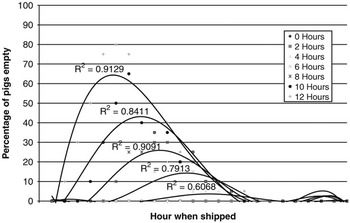
From the above data, we determined for each individual pig, when its last meal was, assuming the pig was removed from the pen at differing times of the day (to simulate shipping at different times of the day). For example, assume a given pig ate two meals per day at 0100 and 1300 h. If the pig was shipped at 0700 h, it was 6 h since its last meal. Such times were determined for each pig each hour of the 24-h day. If that pig’s rate of passage was 18 h, then that pig (shipped at 0700 h, 6 h after the last feeding) would have an empty intestine 12 h after it leaves the barn (as a first approximation). This information was calculated for each pig and then the group as a whole was considered in models that illustrate (Figure 3) a first approximation of the percentage of pigs with empty GI tracts depending on the hour of the day they were shipped and the transport duration.
Models are presented showing the percentage of test pigs that were predicted to have empty/diminished GI tracts (or that the feed passage time had been exceeded). Lines are modelled for differing transport durations from 0 to 12 h. Note that as transport times increased, the percentage of pigs with empty GI tracts increased during the hours from 0200 to 1400. These models predict more pigs will arrive at processing with empty/diminished GI tract reserves if they are shipped in early morning and with transport times over 4 h.

Discussion
This study has illustrated that variation in feeding behaviour in finishing pigs in relation to shipping time may be a crucial determinant of pigs with empty GI tracts during transport and slaughter, potentially leading to fatigued and stressed pigs and variation in pork quality. It would seem that the traditional practice of shipping pigs in the morning may not be optimal in terms of how pigs could lack enough feed in their stomachs to have energy stores to walk from the rest pen at a processing plant to the stun area. This lack of feed could be a contributing factor to the condition known as the fatigued pig.
The results in Table 1 show the individual pig data for the 20 test subjects including the number of feeding bouts (or meals) as well as the duration of each feeding bout. A bout of behaviour was defined as an occurrence of that behaviour, followed by a period of any other behaviour. The length of non-target behaviour must reach some minimum value of time for the next episode to be considered a different bout of behaviour. If a pig feeds, drinks, and feeds again, this is one meal or one bout. The BCI used for this study was 7 min based on work by Petrie and Gonyou (Reference Petrie and Gonyou1988). This 7-min BCI was calculated among nursery (younger) pigs. A new BCI may be necessary for finishing pigs for both this and other genetic lines. However, changing the BCI does not change the relative differences among treatments in the duration of behaviour. Nor does a different BCI change the last meal taken or the estimated rate of passage of feed.
From the data shown in Table 1 one can see that pigs took from 2 to 12 meals per day. This is a large range; however, most pigs were in the range of 4 to 7 meals per day. Generally, pigs take fewer but larger meals as they grow. During lactation, the piglets consume 20 to 30 meals per day. By late finishing, some pigs may be down to as few as 2 meals per day.
Data presented in Table 1 and Figure 1 provide evidence to support the idea that as the number of meals per day increased, the duration of each meal decreased. The total duration of feeding behaviour was more constant than the number of meals or the duration of feeding per feeding bout. The coefficient of variation (CV) for the total feeding duration per day was 25% while the CVs for the number of feeding bouts and duration per bout were 48% and 44%, respectively. The daily cycle of feeding behaviour of finishing pigs is presented in Figure 2. The pattern in Figure 2 is shifted to the right. This pattern may be called a ‘Chiurnal’ cycle in that it resembles a χ 2 distribution (in reverse) rather than a true diurnal cycle that would resemble a normal distribution with a mean of about 1200 h. However, the raw data also indicate that the pig may have a near-crepuscular feeding pattern with a major meal in the morning and again in the evening. The reverse χ 2 curve, however, fits the data reasonably well compared to other relationships we examined.
When one barn of pigs is marketed in several batches over time, the first few batches marketed are often not taken off feed so that the remaining pigs do not slow in weight gain. Models we calculated were based on pigs not taken off feed. If pigs are first taken off feed, that time would need to be taken into consideration when estimating the time required to cause an empty GI tract.
We used the raw data from Figure 2 and determined, for each pig at each hour of the day, how long it had been since it had eaten. Together with our first approximation of the rate of passage of feed, we estimated when each pig’s GI tract would be empty/diminished for each hour of the day, but depending on when it ate last. We added to that information transport/lairage times of 0 to 12 h. The result is the model presented in Figure 3. This graph shows the percentage of pigs estimated to have an empty/diminished GI tract at each hour of the day. A different regression line, with a similar shape, was created for each transport time from 2 to 12 h. One can readily see that more pigs will have empty GI tracts with longer trips, especially if the pigs leave the barn (stop eating) in the morning hours. The model predicted that pigs shipped 0 to 4 h had fewer than 10% of the pigs with empty GI tracts, regardless of the time of the day. As the transport times increased, the percentage of pigs with empty GI tracts would naturally increase. However, depending on when the transport began, the relative time since a meal would vary considerably.
We use the term that our estimates of throughput time are a first approximation. We acknowledge that the rate of passage of feed is strongly influenced by several factors. Stress can increase the rate of feed passage (Kim et al., Reference Kim, Lindemann, Cromwell, Balfagon and Agudelo2007). Transported pigs may vomit and lose most or all of their stomach contents (Bradshaw et al., Reference Bradshaw, Parrott, Forling, Good, Lloyd, Rodway and Broom1996). When animals stop eating, the rate of passage of feed slows and this also leads to a greater incidence of stomach ulceration (Bidner et al., Reference Bidner, Ellis, Miller, Hemann, Campion and McKeith1999). Therefore, while this study presents a first approximation of the rate of feed passage, the work will need to be replicated under various field conditions including transporting pigs at different times after a meal.
The models presented in Figure 3 may lead to recommendations about the best time of the day to move pigs out of a barn for transport to slaughter. If the time from the farm to stun is 6 h or more and if the objective is to have feed in the stomach at stun, pigs should be leaving the building and be transported in the period from 1600 to 2400 h. As transport times increase, the need for afternoon shipping becomes more important. Pigs loaded on a truck at 0400 through 0800 h have the greatest risk of having no feed in their GI tract at stun. For early morning truck loading experiences, the risk of diminished GI tracts is increased with transport times over 4 h long.
Because submissive pigs are often smaller in body weight than more dominant pigs (Salak-Johnson et al., Reference Salak-Johnson, McGlone, Whisnant, Norman and Kraeling1997), we expected that smaller pigs within pens would take fewer or shorter duration meals. This was not the case, indeed, in pen 1 for example the smallest pig in the pen had the longest meal duration. Dominance order has large effects on young or stressed pigs (McGlone et al., Reference McGlone, Salak, Lumpkin, Nickolson, Gibson and Norman1993), but social dominance probably has little effect on long-established social groups that have abundant resources such as ad libitum access to feed and water. In these late-finishing pigs, body size and the correlated dominance order are expected to have a small effect on feeding behaviours when feeding quantity and availability are not restricted.
‘Transport times’ was used here as a term for the time from leaving the pen to the stun area. Many US midwestern farms and plants would require 1 h (±30 min) to load a truck/trailer and a 2-h rest is often recommended prior to stun (personal observation). Three hours must be subtracted from the transport numbers in Figure 3 (a 12-h transport is really a 9-h transport + 1-h loading + 2-h rest) if one wishes to relate the time on the transport vehicle rather than the entire transport experience. Some pigs have a much longer rest period and this could increase the risk of fatigue caused by diminished GI tracts at stun. While our estimates are conservative, the models may explain why some pigs are fatigued getting off the vehicle after transport and some becoming fatigued after lairage.
Under the conditions of this study, pigs were on full feed. This means that when they ate feed containing chromic oxide, the next meal (a few hours later) would push along the marked feed. If the pigs were taken off feed, they would likely have a slower rate of passage (feed passage rate slows when not eating). However, the stress of the transport experience empties the large intestine and thus has an immediate effect of increasing rate of passage. Handling may also increase the rates of passage of feed. Rough handling may increase feed passage rate even more (this needs to be studied). The exact times that the stomach and small intestines would be empty (and thus no GI tract nutrients to draw upon) are likely to be a little different among pigs handled and transported in commercial settings. Such studies need to be conducted using relevant genetic lines and environmental conditions, including different seasons.
Farms with high rates of fatigued pigs may benefit from loading trucks in the afternoon or evening rather than in early morning if their conditions are similar to those of this study (or else the farm may wish to determine when pigs eat in case the daily feeding pattern differs from the one reported here). However, to transport directly after the main eating period is not ideal, as Warriss (Reference Warriss1998) suggested, because feeding up to 4 h prior to transportation can have a negative effect in terms of increasing the incidence of vomiting during transportation.
A better understanding of pig feeding behaviours would be useful if the objective was to have empty/diminished stomachs at processing. A pig that is hungry is considered by EU guidelines to have reduced welfare in that animals should be free from hunger (EU council directive 91/630/EEC). However, an empty GI tract may reduce the risk of accidental carcass contamination (Franklin et al., Reference Franklin, Mathew, Vickers and Clift2002). If a pig is presented to the stun with an empty stomach, this may be better for pork quality and food safety, but an empty/diminished stomach puts the pig at risk of being hungry and perhaps becoming fatigued. This is a case where animal welfare, and food safety and pork quality objectives are in conflict.
Acknowledgements
This project was supported and funded by the Pork Industry Institute at Texas Tech University and Elanco Animal Health. Thanks are also due to Mr Jacob Rieff, Mr Jeff Dailey, Dr Sung Woo Kim, and Mrs Lindsey Hulbert for help in data collection and technical assistance. We thank Dr Ross Houston and the anonymous reviewers for critical reading of the manuscript. Finally thanks should be conveyed to the staff of the Texas Tech University Swine research center, Mr Stanley Harris, and Mr Edward Carrasco, for their help and time caring for the animals in this study.