1. Introduction.
Evolutionary psychologists often argue that if natural selection has shaped human cognitive architecture, human cognition is likely to be massively modular (e.g., Tooby and Cosmides Reference Tooby, Cosmides, Barkow, Cosmides and Tooby1992). That is, as a first approximation, the mind is likely to consist of many systems, each having been designed by natural selection to fulfill a specific function. This proposal has encountered much resistance. Arguments based on neuroscience are among the strongest objections against the massive modularity of human cognition.Footnote 1 Most of these neuroscientific objections have been rebutted—successfully, in my mind (Samuels Reference Samuels1998; Machery and Barrett Reference Machery and Barrett2006).
In this article, I focus on a new neuroscientific argument against the massive modularity hypothesis. Quartz (Reference Quartz, Scher and Rauscher2002) has recently argued that an important finding about the evolution of the human brain—the allometric relation between the volume of most large scale brain parts (neocortex, thalamus, etc.) and the volume of the brain—is inconsistent with the massive modularity of human cognition. If Quartz's argument were sound, it would have major implications: evolutionary psychologists would have to rethink one of their core tenets and the numerous hypotheses based on it. In what follows, I argue however that Quartz's argument fails to undermine the massive modularity hypothesis.
Here is how I will proceed. In Section 2, I briefly elucidate the massive modularity hypothesis. In Section 3, I spell out Quartz's argument against this hypothesis. The last two sections rebut his argument. In Section 4, I argue that the finding highlighted by Quartz does not show that the volume of the human neocortex did not evolve in a mosaic manner. In Section 5, I argue that even if it were the case that the volume of the human neocortex did not evolve in a mosaic manner, it would not follow that the massive modularity hypothesis is false.
2. The Massive Modularity Hypothesis.
2.1. Modules.
The notion of modularity is used in many different ways in cognitive psychology and in neuropsychology. To prevent any confusion, it is useful to contrast the notion of module developed by Fodor in the Modularity of Mind (Reference Fodor1983) and the notion endorsed by most evolutionary psychologists. Fodorian modules are those psychological systems that possess most of the following properties. A Fodorian module has a specific type of input; it produces shallow or nonconceptual outputs; it is fast, automatic, cognitively impenetrable, and informationally encapsulated; it is realized in a discrete brain area; it is innate; and it has specific breakdowns. Fodor (Reference Fodor1983) has argued that our senses, our motor systems as well as the systems underlying our linguistic faculty are modules, so defined.
Be it as it may, the notion of module that is used by evolutionary psychologists—the notion of a Darwinian module—is substantially different from the notion of a Fodorian module (e.g., Barrett and Kurzban Reference Barrett and Kurzban2006). What characterizes Darwinian modules is that they are designed to fulfill a specific function. That is, first, Darwinian modules are adaptations—the products of evolution by natural selection. Second, they fulfill a specific function: they evolved to underlie a specific cognitive competence. Third, being committed to some form of adaptationism, evolutionary psychologists often assume that modules are well designed for fulfilling their function.
Some Darwinian modules might be fast and automatic, if being fast and automatic is a property of their evolved design. Other Darwinian modules might be cognitively impenetrable or informationally encapsulated, if they have been designed to fulfill their function in such a way. But, by contrast with Fodorian modules, Darwinian modules need not be fast, automatic, cognitively impenetrable, or informationally encapsulated.
Modules are neural systems. It is important to emphasize that the notion of Darwinian modularity does not entail that these systems are localized. Rather, Darwinian modules can be distributed. Since the neocortex is often believed to play an important role in cognition, many modules are likely to be, partially or entirely, neocortical systems. But, since it is also known that subcortical brain structures, such as the cerebellum, play an important role in some cognitive tasks, several modules might also involve some subcortical structures.
There are very few examples of uncontroversial Darwinian modules. Famously, Tooby and Cosmides have argued for the existence of a cheater detection module (Cosmides Reference Cosmides1989). This hypothesized module is designed to fulfill a specific function—identifying cheaters, that is, individuals who have broken contracts and norms. Tooby and Cosmides argue that information about contracts and norms as well as information about potential cheaters are represented in a specific way. Moreover, this information feeds into a well designed reasoning system that determines whether a given individual has broken a contract or a norm. This hypothesized cheater detection module is supposed to be a distributed neural system. Neuropsychological evidence from brain lesions suggests that complete bilateral damage involving both the orbitofrontal cortex and the amygdala affects reasoning about social norm violations, but not about prudential norm violations (Stone et al. Reference Stone, Cosmides, Tooby, Kroll and Knight2002). Thus, the distributed neural network that involves these neural areas might be an essential component of the hypothesized cheater detection module.
2.2. The Massive Modularity Hypothesis.
The massive modularity hypothesis proposes that the human mind consists of many Darwinian modules. To put it differently, according to evolutionary psychologists, many human cognitive competences, such as choosing a mate, choosing one's diet, seeing, spatial orientation, face recognition, or syntactic parsing, are underwritten by dedicated Darwinian modules. For instance, it is often proposed that in humans, a cognitive system was specifically selected for recognizing faces.
Importantly, the massive modularity hypothesis is not committed to the claim that the human mind consists only of Darwinian modules (Tooby and Cosmides Reference Tooby, Cosmides, Barkow, Cosmides and Tooby1992). Even though some evolutionary psychologists regard this possibility with skepticism, it is consistent with the massive modularity hypothesis that besides our modules, humans also have a cognitive system that can be put to use in many tasks, for instance a capacity to learn to solve new tasks. Moreover, evolutionary psychologists are adamant that many competences, such as reading, programming in C++, and piloting an airbus, are not underwritten by dedicated modules. There is no module whose evolved function is, say, to read, since, obviously, reading is a recent cultural invention. Rather, reading is underwritten by a collection of modules that evolved for other reasons.
3. Quartz's Argument from the Evolution of the Brain.
Quartz (Reference Quartz, Scher and Rauscher2002) has argued that recent progress in the study of the evolution of the human brain undermines the massive modularity hypothesis. He refers to an important finding—the allometric relation between brain parts and the whole brain. In this section, I examine this finding and I spell out Quartz's argument.
3.1. Allometry and Evolution.
The term ‘allometry’ was introduced in 1936 by the evolutionary biologist Julian Huxley (Huxley and Teissier Reference Huxley and Teissier1936). ‘Allometry’ refers to the proportional relationship between the volume (or size, or weight, etc.) of an organ and the volume (or size, or weight, etc.) of the whole body, between the volume (or size, or weight, etc.) of the part of an organ and the volume (or size, or weight, etc.) of the whole organ, or between some physiological property and the volume (or weight etc.) of the body. Allometric relations can be studied during development (ontogenetic allometry), across individuals (static allometry), across environments (plastic allometry), or across species (evolutionary allometry). In what follows, I focus on evolutionary allometry.
Allometric relations between the part of an organ and the whole organ (mutatis mutandis, for an organ or a physiological property and the body) are described by power laws:

where x is the volume (size, etc.) of the part of the organ (or some other physiological property), y is the volume (size, etc.) of the organ, b and k are parameters. The parameter k is usually called ‘the constant differential growth-ratio’. Importantly, for a given part and a given whole, k is constant, regardless of species, age, and environment. That is, if the volume of the part of an organ is allometrically related to the volume of the whole organ, during evolution, the volume of the part is a function of the volume of the whole organ raised to a constant exponent.Footnote 2
When the volumes of two organs are allometrically related, these organs do not evolve independently of one another with respect to their volume (mutatis mutandis, for any other physiological property). Particularly, if natural selection were to favor a change in volume of one of these two organs, this change would be accompanied by a related change in volume of the other organ. In such cases, evolution is said to be concerted (Striedter Reference Striedter2005). By contrast, if the volume (or any other property) of an organ evolves independently of the volume of the other organs, its evolution is said to be mosaic. A simple example might cast some light on this point. Across a large number of mammalian taxa, the metabolic rate (r), measured in kilocalories per day, is an allometric function of the weight (w), measured in kilograms, of the organism:

In these taxa, any selection for an increased mass would have resulted in a non-selected increase in metabolic rate—and vice versa. The body weight and the metabolic rate have a concerted evolution. Natural selection does not favor a change in one of these two physiological variables without changing the other one.
3.2. Allometry and the Brain.
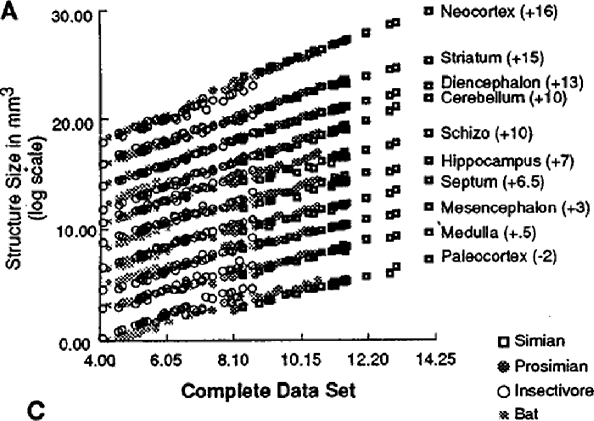
Allometric relations are found at many levels of biological organization, from the dimensions of cells, to the blood circulation time, to the length of bones, to the weight of organs, to the volume of the brain. In what follows, I focus on allometric relations in the brain. In an influential paper, the neuroscientists Finlay and Darlington (Reference Finlay and Darlington1995) have argued that across many mammalian taxa, the volume of many brain parts is an allometric function of the volume of the whole brain. Using the data from Stephan et. al Reference Stephan, Frahm and Baron1981, Finlay and Darlington (Reference Finlay and Darlington1995) mapped the logarithm of the volume of 11 adult brain parts, such as the cerebellum, the striatum, and, most important for present purposes, the neocortex, as a function of the logarithm of the volume of the brain across 131 mammalian species, including homo sapiens. Save for the accessory olfactory nucleus, these brain parts constitute the entire brain. Finlay and Darlington highlighted the diversity of the niches of these species as well as the range of brain volumes and body weights represented in their sample.Footnote 3
They found that, except for the main olfactory bulb, the logarithm of the volume of all the brain parts studied is a linear function of the logarithm of the volume of the brain, establishing thereby that the volume of these brain parts is a power function of the volume of the whole brain (Figure 1).
Allometric relations between the volume of the brain and the volume of brain parts (Finlay et al. Reference Finlay, Darlington and Nicastro2001, 266).

Finlay and Darlington (Reference Finlay and Darlington1995) concluded that the volume of 10 of the 11 brain parts studied is an allometric function of the volume of the whole brain. They concluded that in mammals, the evolution of the volume of brain parts has been concerted.Footnote 4
3.3. Quartz's Argument.
Quartz claims that Finlay and Darlington's finding is inconsistent with the massive modularity hypothesis:
despite a 10,000-fold range in neocortex size across mammals, the relative size of many brain structures is highly correlated. I review evidence indicating that that heterochronic changes in the duration of neurogenesis result in the coordinated pattern of brain size across a variety of mammalian species. These results, suggest that neural systems covary highly with one another as a consequence of the restricted range of permissible alterations that evolutionary psychology can act upon. This makes the massive modularity hypothesis of narrow evolutionary psychology untenable. (Reference Quartz, Scher and Rauscher2002, 189; see also Quartz Reference Quartz1999, 49)
Quartz's rationale for this strong claim goes as follows. (a) He takes the massive modularity hypothesis to be committed to the thesis that each module has “a semi-independent evolutionary account” (Reference Quartz, Scher and Rauscher2002, 190), that is, to use a more common terminology, to the thesis that modules evolved in a mosaic manner: the massive modularity is true only if it is possible for each module to have been under selective pressure independently of the other modules, at least to a large extent. This follows from the fact that each Darwinian module is supposed to have evolved to fulfill a specific function. (b) Since modules are assumed to be (maybe distributed) neural systems, particularly neocortical systems, the massive modularity hypothesis is true only if it is possible for neural systems in the neocortex to have been under selective pressure independently of one another, at least to a large extent. (c) Finlay and Darlington found that across mammalian taxa, the volume of brain parts, including the volume of the neocortex, is allometrically related to the volume of the whole brain. Quartz takes this finding to show that the necessary condition stated in (b) is not fulfilled.
Unfortunately, Quartz does not justify the last step of this argument as precisely as one might want: we are not told why (c) shows that (b) is not fulfilled. We need to reconstruct Quartz's argument, by making explicit some implicit premises. But, as we shall see, doing so will bring to light the shortcomings of Quartz's argument. (d) The idea, it seems, is that if the volume of the brain parts considered by Finlay and Darlington, including the neocortex, is allometrically related to the volume of the whole brain in mammals, then the volume of the main parts of the human brain, including the human neocortex, evolved in a concerted manner, not in a mosaic manner. (e) If the volume of the human neocortex did not evolve in a mosaic manner, then no system within the human neocortex evolved in a mosaic manner. (f) It follows from (a) to (e) that the massive modularity hypothesis is false. Premises (d) and (e), which remain implicit in Quartz (Reference Quartz, Scher and Rauscher2002), seem necessary for the argument to go through.Footnote 5
4. Mosaic Cortical Evolution?
Quartz is rightly impressed by Finlay and Darlington's work. However, the rejection of the massive modularity hypothesis does not follow from their work—or so I contend in the remainder of the paper. In this section, I argue that premise (d) ought to be rejected: Finlay and Darlington's finding does not show that the volume of the human neocortex did not evolve in a mosaic manner.
4.1. What did Finlay and Darlington Really Show?
It is important to understand correctly the significance of Finlay and colleagues’ finding. They show that for a large range of mammals, the volume of the whole brain accounts for most of the variance in the volume of the brain parts under consideration, including the neocortex. The significance of this finding is that during mammalian evolution, the increase in volume of the neocortex, did not result from a positive selection for a larger neocortex, independently of the volume of the other brain parts (mutatis mutandis, for the cerebellum, the striatum, etc.). But this is not tantamount to showing that during the evolution of a given mammalian taxon, the increase in volume of the neocortex has not evolved, to some extent, in a mosaic manner.
The reason is that some variance in the volume of the brain parts considered by Finlay and Darlington is not accounted for by the volume of the whole brain. Thus, for many brain volumes v, many species have a neocortex (and also a striatum, a cerebellum, etc.) whose volume diverges from the allometric expectation, based on v. Because for these species, the volume of the neocortex diverges from the allometric expectation, based on their brain volume, the volume of their neocortex has evolved in a mosaic manner and might have been under selection, independently of the volume of the other brain parts.
An example might cast some light on this idea. Based on the research of Krebs et al. (Reference Krebs, Sherry, Healy, Perry and Vaccarino1989) on the volume of the hippocampus in birds that store food (‘storers’) and birds that do not (‘non-storers’), Striedter (Reference Striedter2005, 171–172) has shown that the volume of the hippocampus—a brain structure involved in spatial memory—is allometrically related to the volume of the telencephalon. He also found that for many species, the volume of the hippocampus diverges from allometric expectations by a factor of 2, showing that the volume of the hippocampus evolved to some extent in a mosaic manner. Importantly, storers have a larger hippocampus than expected based on their brain volume, and non-storers have a smaller hippocampus than expected based on their brain volume. Since across species, a large hippocampus correlates with a need for spatial memory, these divergences from allometric expectations suggest that the volume of the hippocampus has been under independent selection.
Similarly, because some variance in the volume of the neocortex is not accounted for by the volume of the brain, Finlay and Darlington's finding does not show that the volume of the neocortex in humans or in primates has not been under independent selection.
4.2. Evidence for Mosaic Evolution of the Neocortex.
The point above raises two questions:
• Is there any evidence that the volume of the neocortex diverges from the allometric expectation in humans, or, at least, in primates?
• Is there any evidence that this divergence results from selection?
Answers to both questions are tentatively affirmative.Footnote 6
Barton and Harvey (Reference Barton and Harvey2000) have reanalyzed the data set used in Finlay and Darlington (Reference Finlay and Darlington1995). Surprisingly, their analysis led to a very different conclusion. While recognizing the existence of some constraints on changes in brain volume, they concluded that these constraints did not prevent the mosaic evolution of the volume of brain parts. They write: “the constraints are evidently insufficiently tight to prevent … evolutionary change in individual neural systems” (Reference Barton and Harvey2000, 1057–1058). Barton and Harvey's analysis is not inconsistent with Finlay and Darlington's (Reference Finlay and Darlington1995) analysis. Rather, while Finlay and Darlington focus on the fact that brain volume accounts for most of the variance in the volume of the brain parts under consideration, Barton and Harvey focus on the unaccounted variance.
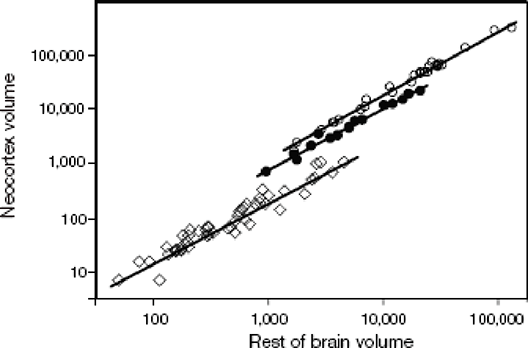
Particularly, Barton and Harvey plotted the volume of the neocortex against the volume of the noncortical brain in a double logarithmic scale. Unsurprisingly, they found that the volume of the neocortex was an allometric function of the volume of the noncortical brain (Figure 2).
Allometric relations between the volume (mm3) of the noncortical brain and the volume of the neocortex (open circles, haplorhines; closed circles, strepsirhines; diamonds, insectivores; Barton and Harvey Reference Barton and Harvey2000, 1055).

However, they also found differences between the intercepts of the regression lines for the insectivore mammals and for the two primate taxa, that is, the haplorhines, which include the tarsiers, the new world monkeys, the old world monkeys, and the apes, and the strepsirhines, which consist of the non-tarsier prosimians (Figure 2). These differences in intercepts mean that after having taken into account the allometric relationship between the neocortex and the whole brain, there remains a substantial difference (in fact, a fivefold difference) in the volume of the neocortex between the primates and the insectivores, as well as a smaller difference between the haplorhines and the strepsirhines.
The differences in neocortex volume between orders show that the increased volume of the neocortex in primates in general and in haplorhines in particular is not merely the result of its allometric relation with the volume of the whole brain. Rather, besides the convergent evolution of the volume of the neocortex, which explains much of the increase in volume of the neocortex during mammal evolution, the volume of the neocortex has also evolved in a mosaic manner in primates and, among primates, in haplorhines.
Finally, since cortical tissue is metabolically expensive (Aiello and Wheeler Reference Aiello and Wheeler1995), it is very plausible that this mosaic evolution resulted from positive selection for a larger neocortex.
4.3. An Objection.
Quartz could reply that Barton and Harvey's analysis does not show that the human neocortex differs from the allometric expectation, based on the volume of the human brain and on the intercept for the haplorhines’ regression line. Thus, evidence is lacking that the increase in volume of the human neocortex has evolved in a mosaic manner. But, if the increase in volume of the human neocortex has not evolved in a mosaic manner, then the human mind is not massively modular—or so the objection could go.
Such a reply would, however, cut both ways. It is true that Barton and Harvey's analysis does not tell whether the human brain diverges from the allometric expectation. But neither does Finlay and Darlington's analysis. Thus, pace Quartz, Finlay and Darlington's finding does not undermine the massive modularity hypothesis.
5. Massive Modularity Upheld.
5.1. Evolution of the Neocortex vs. Evolution of Its Volume.
In this section, I argue that premise (e) ought also to be rejected. To put it simply, even if we grant that the volume of the human neocortex evolved in a concerted manner, other aspects of the neocortex might have evolved in a mosaic manner.
So, let us grant for the sake of the argument that the volume of the brain parts considered by Finlay and Darlington (Reference Finlay and Darlington1995), including the neocortex, evolved in a concerted manner. The main difficulty for Quartz's argument is that there is obviously more to the evolution of the neocortex than its change in volume. In spite of the supposed concerted evolution of the volume of the neocortex, distributed or localized neural systems within the neocortex might have been under selective pressure, to a large extent independently of one another and of the rest of the brain. Mosaic changes in various properties in these neocortical systems might have been selected for, such as their relative volume, their connections within each other, their internal structure, and so on.
Compare indeed the neocortex with the human body. The volume and weight of many organs are allometrically related to the dimensions of the whole body. However, other properties of these organs have evolved in a mosaic manner. Particularly, the concerted evolution of the volume and weight of a given organ in the human body is consistent with parts of this organ having been under selection independently of other parts of the same organ or of other organs. Consider the heart. The weight of the heart, in grams, is allometrically related to the weight of the body, in kilograms:

Thus, the weight of the heart and the weight of the body evolved in a concerted manner. But, it would be preposterous to infer from this fact that no parts of the heart evolved, in some respect or other, in a mosaic manner (Fishman and Olson Reference Fishman and Olson1997). The four valves in the heart are particularly well designed for fulfilling their function, suggesting that at least to some extent, these valves have been the target of selection, independently of the other parts of the heart.
Similarly, pace Finlay and Darlington (Reference Finlay and Darlington1995) and Quartz (Reference Quartz, Scher and Rauscher2002), the allometric relation between the volume of the neocortex and the volume of the rest of the brain is not inconsistent with the massive modularity hypothesis. Nor does it make the massive modularity hypothesis unlikely to be true.
5.2. Evidence for the Mosaic Evolution of Some Neocortical Systems.
Evidence suggests that some neocortical systems have evolved to some extent in a mosaic manner. This shows that whether or not the volume of the neocortex evolved in a concerted manner, it was possible for neocortical systems to evolve in a mosaic manner.
There is a large body of evidence for evolutionary changes in the neocortex during mammalian evolution besides the evolution of its volume—including the addition of new cortical areas, the modification of connections, and the emergence of new cells (Striedter Reference Striedter2005). For instance, primates have twice as many premotor areas as non-primates. Primates are the only mammals who possess a premotor area dedicated to the face and the mouth, with direct projections to the spinal cord (Striedter Reference Striedter2005, 307). Striedter (Reference Striedter2005) notes that these evolutionary changes enable primates to increase their motor control, which was probably adaptive in the ecological niche of early primates, the ‘fine-branch niche’.
Now, most of these evolutionary changes take place during the evolution of whole taxa, not during the evolution of single species. They distinguish primates from non-primate mammals, or, within primates, strepsirhines from catarrhines, and so on. Thus, Quartz might object that what is really needed to support the idea that human neocortical systems could have evolved in a mosaic manner is evidence of mosaic evolutionary changes in the neocortex within the evolution of individual species, preferably within the evolution of the human species. For many modules assumed by evolutionary psychologists (but, of course, not all) are supposed to be specific to the human species. So the question is: Is there any evidence for the mosaic evolution of neocortical systems during the evolution of individual species or, at least, during the evolution of taxa smaller than primates or catarrhines?
The answer is ‘yes’. Finlay and Darlington's work focuses on allometric relations between very coarse brain divisions (neocortex, cerebellum, striatum, etc.). The size of the neocortical areas themselves has been left untouched. It is known, however, that the size of many neocortical areas varies across mammals, depending on their functional importance for the species under consideration. For instance, the relative size of the somatosensory cortical areas is to a large extent predicted by the functional importance of the represented organs for the species under consideration. The snout is represented by a larger relative area in the somatosensory cortex of pigs than in the somatosensory cortex of other mammals such as dogs (Striedter Reference Striedter2005, 159). This suggests that the size of the area of the somatosensory cortex dedicated to the snout has been under selective pressure. The evolution of the size of this area seems to have taken place independently of most other neocortical systems.
There is also evidence that the internal structure of some neocortical systems, particularly the visual system, has evolved, probably by natural selection, in a mosaic manner. Preuss and colleagues have shown that there are many structural differences between, on the one hand, the visual system in humans and in apes and, on the other, the macaque visual system (e.g., Preuss Reference Preuss, Kaas and Collins2004). To take a single example, the organization of layer 4A in the macaque visual cortex is widespread, though not universal, among new world and old world monkeys, suggesting that it was present in the ancestors of apes and humans. However, the organization of layer 4A is very different in humans and apes, showing that it has been extensively modified during hominoids’ evolution. It is likely that evolutionary changes in layer 4A in hominoids’ visual cortex took place independently of most (but not all) other neocortical areas. This example shows that a very specific property of a neocortical system has probably evolved in a mosaic manner. Thus, whether or not the volume of the neocortex evolved in a concerted manner, it was possible for neocortical systems to evolve in a mosaic manner.
6. Conclusion.
Relying extensively on Finlay and Darlington's finding, Quartz (Reference Quartz, Scher and Rauscher2002) argues that the massive modularity hypothesis is false. Since the volume of the neocortex evolved in a concerted manner, he concludes that natural selection did not act on neocortical systems independently of one another, which is a necessary condition for the massive modularity hypothesis to be true. Quartz's argument is unsound. Finlay and Darlington's finding does not show that the volume of the human cortex did not evolve, at least to some extent, in a mosaic manner. Further, even if the volume of the human neocortex had evolved in a concerted manner, it would not follow that the neocortex and the neocortical systems did not evolve in a mosaic manner. Similarly, while the size of many organs in the human body is allometrically related to the size of the whole body, many properties of the parts of these organs have evolved to some extent in a mosaic manner. Evidence shows that some neocortical systems evolved in precisely this way. Thus, pace Quartz, Finlay and Darlington's finding fails to undermine the massive modularity hypothesis.