Background
Social media, prevention of healthcare-associated infections (HAIs) and antimicrobial stewardship (AS) each impact every area of medicine, from pediatrics to geriatrics, inpatient to outpatient, from the emergency room to the operating room. No corner of medicine remains free from the social media “eye,” or the need to optimize the quality of care and patient safety by preventing HAIs, outbreaks, and adverse events secondary to inappropriate antimicrobial use. Independently, each have power to change medicine; however, synergistically, the impact could be transformative.
HAIs are both common and costly. Up to 15% of patients develop such infections, resulting in in nearly 100,000 deaths per year.Reference Septimus, Yokoe, Weinstein, Perl, Maragakis and Berenholtz1 In fact, HAIs are the fifth leading cause of death for hospitalized patients; they carry substantial costs both in patient morbidity and mortality, and in healthcare expenditures.Reference Septimus, Yokoe, Weinstein, Perl, Maragakis and Berenholtz1–Reference Scott3 An abundance of data exists in the medical literature regarding HAI prevention, ranging from cleaning techniques to inserting a central venous catheter or managing a ventilator. Nevertheless, despite the research and the impact of infection prevention (IP), translating research into clinical practice is often slow, incomplete, and arduous.Reference Morris, Wooding and Grant4, Reference Krein, Olmsted and Hofer5
Today, preventing HAIs also requires the prevention of the development of multidrug-resistant organisms (MDROs) through AS. According to the Centers for Disease Control and Prevention (CDC), at least 2 million infections and 23,000 deaths are due to antimicrobial resistant infections each year.Reference Septimus, Yokoe, Weinstein, Perl, Maragakis and Berenholtz1, 6 Although IP procedures play a role in stopping the spread of resistant organisms, inappropriate and unnecessary use of antibiotics drives the development of antimicrobial resistance. Between 2010 and 2015, US antibiotic expenditures exceeded $50 billion,Reference Suda, Hicks, Roberts, Hunkler, Matusiak and Schumock7 and >50% of these antibiotics were prescribed inappropriately, particularly in the outpatient setting.Reference Fleming-Dutra, Hersh and Shapiro8, Reference Shively, Buehrle, Clancy and Decker9 Newer data from the CDC estimate that ~500,000 people develop C. difficile infections annually, with ~15,000 subsequent deaths, representing a significant public health toll, in part due to inappropriate antibiotic use.6 Furthermore, in addition to the development of MDROs or C. difficile infections, unnecessary or inappropriate antibiotic prescribing is more likely to result in preventable drug adverse events. A recent study demonstrated that antibiotic-related adverse drug events led to >70,000 annual emergency department visits in patients younger than 19 years old.Reference Lovegrove, Geller, Fleming-Dutra, Shehab, Sapiano and Budnitz10
The evolution of social media has created a new venue for rapid dissemination of information, advocacy on critical issues, and education to a broader audience.Reference Mitchell, Petrie, Morton and Dancer11–Reference Cawcutt, Erdahl and Englander13 Raising awareness of HAIs and AS research among healthcare providers, administrators, and even patients is the first step in improving the speed of change in clinical practice.Reference Morris, Wooding and Grant4 In this review, we discuss how social media platforms provide a conduit of implementation science for sharing research with broader audiences and how they may impact bibliometrics (statistical measures of the impact and reach of studies). Bibliometrics includes 2 major categories, generally referred to as conventional and alternative metrics, and both may be affected by virtual dissemination.Reference Knowlton, Paganoni and Niehaus14
The impact of infection prevention, epidemiology, and antimicrobial stewardship
As with all of medicine, our history in IP and AS laid the foundation for today’s advances in both disciplines. In the late 1800s, the life expectancy was <50 years due to diseases such as tuberculosis, smallpox, typhoid fever, and many more.Reference Smith, Watkins and Hewlett15 Fortunately, early infectious diseases and microbiology pioneers changed the landscape of diagnosis, treatment, prevention, and control of these diseases. Dr. Robert Koch demonstrated that tuberculosis was caused by a bacteria that remained viable in dried sputum on linen and clothing for weeks.Reference Blevins and Bronze16 These findings resulted in new public health policies, including sterilization of clothing and linen of patients with tuberculosis and restriction of spitting in public places.Reference Blevins and Bronze16 Imagine how much greater his reach and impact could have been if his results had been shared on social media? How many more lives could have been saved?
Dr. John Snow became the first epidemiologist through an in-depth investigation into the epidemic of cholera that implicated the Broad Street pump in London, proving that the disease was caused by sewage contamination of the water.Reference Newsom17 Despite clear proof of this correlation, Snow’s theories did not ‘go viral’—he was met with significant pushback from his peers. One can theorize that social media dissemination of his theory could have accelerated adoption by engaging a wider network of peers who supported his work.
Finally, when Sir Alexander Fleming accidentally discovered penicillin in 1928, medicine was transformed. This discovery heralded a new era for combating disease. Today, antibiotics make it possible for patients to receive organ transplants, for premature neonates to survive, and for complex surgeries to succeed. However, Fleming warned about the dangers of antibiotic misuse and advocated for AS in his Nobel laureate lecture in 1945.Reference Fleming18 Nevertheless, decades after Fleming’s speech, challenges with antimicrobial use and IP have resulted in of the emergence of MDROs. What if his message was spread earlier?
The time gap between research and change in clinical practice
Innate to the process of biomedical research is the duration of time spent from idea generation to bench or proof-of-concept research through clinical trials, publication, incorporation into guidelines, dissemination and education, and finally implementation into clinical practice.Reference Morris, Wooding and Grant4, Reference Young, Nickson and Gantner19, Reference Bauer, Damschroder, Hagedorn, Smith and Kilbourne20 Several studies have reported an average time gap of 17 years.Reference Morris, Wooding and Grant4, Reference Young, Nickson and Gantner19, Reference Bauer, Damschroder, Hagedorn, Smith and Kilbourne20 The potential delays in translation of impactful research to clinical care portends a sacrifice of early adoption of advances that could improve patient outcomes.Reference Morris, Wooding and Grant4 Furthermore, only approximately half of best practices are implemented in a widespread fashion among clinicians.Reference Bauer, Damschroder, Hagedorn, Smith and Kilbourne20, Reference Balas and Boren21 IP and AS involve a near constant evolution of research, treatments, and interventions focused on improving patient safety that warrant faster dissemination and implementation.
There is a critical need for implementation of science in IP and AS. This need is highlighted within guidelines with specific wording in “Implementing an Antibiotic Stewardship Program: Guidelines by the Infectious Diseases Society of America and the Society for Healthcare Epidemiology of America.” Implementation science is alluded to not only in the title, but also within the guideline text in regard to research gaps in “large-scale implementation,” and the contextual arena in which stewardship occurs.Reference Barlam, Cosgrove and Abbo22 In “Maintaining the Momentum of Change: The Role of the 2014 Update to the Compendium in Preventing Healthcare-Associated Infections,” the frank need for implementation strategies to translate evidence-based recommendations into “widespread, reliable practice” is emphasized.Reference Septimus, Yokoe, Weinstein, Perl, Maragakis and Berenholtz1
Implementation science and social media
Implementation science is formally defined as “the scientific study of methods to promote the systematic uptake of research findings and other evidence-based practices into routine practice, and, hence, to improve the quality and effectiveness of health services.”Reference Bauer, Damschroder, Hagedorn, Smith and Kilbourne20, Reference Eccles and Mittman23, Reference Niehaus, Silver and Katz24 Implementation science evolved out of the time lapse and uptake gaps in bringing best practices to patients; it differs from quality improvement because it is focused on optimizing generalizable adoption of currently underutilized best practices.Reference Bauer, Damschroder, Hagedorn, Smith and Kilbourne20 Dissemination of research is embedded in implementation, and we would argue, is a critical step in developing such interventions.Reference Niehaus, Silver and Katz24 If you are not aware of a best practice, it is impossible to implement it.
A key component of implementation of research is knowledge sharing, which historically has occurred frequently in the form of interpersonal conversations between clinicians bridging the subspecialties, research, and clinical practice realms.Reference Young, Nickson and Gantner19 With a reported 2.5 million academic articles published per year (doubling every 9 years), it can be difficult for a single manuscript to reach readers, garner attention, and provide the future citations researchers rely on to demonstrate impact of their work.Reference Warren, Raison and Dasgupta25
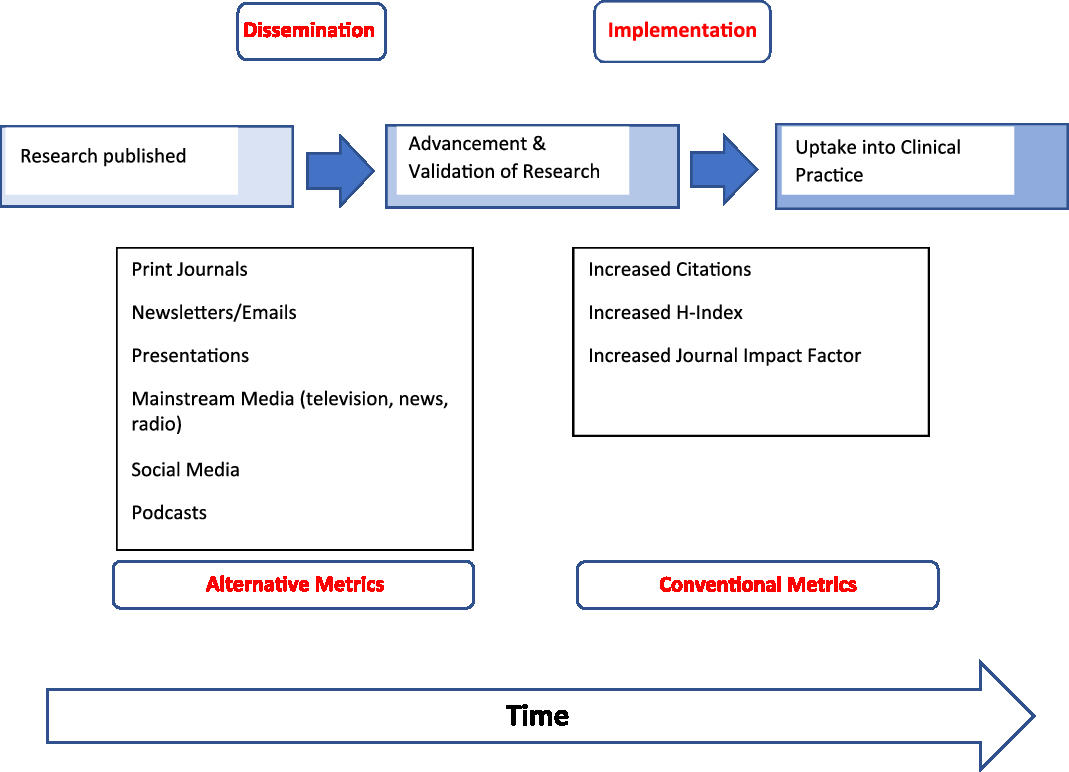
Given the increased utilization of social media, knowledge sharing can be accelerated and may speed the process of bringing best practices to the bedside.Reference Young, Nickson and Gantner19, Reference Niehaus, Silver and Katz24 Figure 1 depicts the interactions between research publications, implementation science, and bibliometrics.
Progression of research to clinical practice.

Medicine and the media
Media plays an integral role in the sharing of medical information and is frequently reported by various news outlets, organizations, and individual healthcare personnel in print and, increasingly, digitally and on social media. Mitchell et alReference Mitchell, Petrie, Morton and Dancer11 demonstrated that issues related to antibiotic-resistant organisms are no longer known to the medical community alone; they are common among news and other mainstream media outlets discussing everything from infections, antibiotics to “superbugs” and their potential “deadly” consequences. Mitchell et alReference Mitchell, Petrie, Morton and Dancer11 also highlight the journals comprising the most IP literature cited by the lay media: the American Journal of Infection Control (48.2% of articles cited) and Infection Control and Hospital Epidemiology (34.1%).
Mainstream healthcare-related outlets, such as blogs, are increasingly common as a way to translate scientific literature that is immediately relevant, provides timely education, or shares opinions on published research.Reference Birgand, Troughton and Moore26 Many of these blogs are written by academicians or clinicians to both achieve the aforementioned goal and to increase organizational or individual readership and/or citations.Reference Birgand, Troughton and Moore26 However, despite the ubiquitous impact of IP and AS, there is a paucity of related blog content.Reference Birgand, Troughton and Moore26
With the prevalence of social media use today, to provide critical education regarding how to prevent HAIs, inappropriate antimicrobial use and adverse events, advocacy and further support for IP and AS, the healthcare industry must embrace and integrate social media communication and consider its impact as it pertains to IP and AS.
Among social networks and with network analysis, the potential for broad information dissemination is large and ever growing.Reference Surani, Hirani and Elias12, Reference Mishori, Singh, Levy and Newport27 Twitter, specifically, has hundreds of millions of users worldwide, encompassing patients to medical professionals among the many specialties comprising medicine.Reference Mishori, Singh, Levy and Newport27 Patients are also no longer relying solely on the clinical opinions of healthcare providers but are independently looking for greater information regarding diseases, diagnoses, and treatments.Reference Nagendran and Dimick28 With this broad audience, there is substantial potential to disseminate research, education, and innovative strategies for implementation of research to healthcare professionals and the public, both quickly and effectively.
Healthcare professionals and social media
As newer generations enter the patient and physician workforce, they are increasingly engaged with social media, thereby demanding that clinical research dissemination evolve to the social structures and platforms in which they are engaged.Reference Surani, Hirani and Elias12, Reference Nagendran and Dimick28 In an anonymous survey of healthcare workers in Texas, 87.9% endorsed using social media with ~1 hour of use per day.Reference Surani, Hirani and Elias12 A generational gap was noted, with a significant increase in the proportion of those under 40 years of age being more engaged in social media, compared to those who were older.Reference Surani, Hirani and Elias12
Beyond individual clinicians engaging in social media, many organizations and journals, including SHEA and IDSA, use various external social media platforms (discussed in a later section of this article) to disseminate information to members and the public on a large scale.Reference Mishori, Singh, Levy and Newport27, Reference Nagendran and Dimick28 Public health agencies can also take advantage of social media as a means to influence the narrative and to disseminate accurate information about health concerns. An analysis of tweets related to the 2009 H1N1 influenza pandemic found that 90% of tweets with keywords #H1N1 or #swineflu contained links to credible information, and only 4.5% of tweets were classified as misinformation or speculation.Reference Chew and Eysenbach29
Bibliometrics and social media—How do we measure research dissemination?
Bibliometrics are the statistical methods used to measure the impact of scholarly publications; it encompasses 2 broad categories: conventional and alternative metrics.Reference Knowlton, Paganoni and Niehaus14 Bibliometrics can be used to measure the impact of a single author, an article within a specific journal, or an entire journal.Reference Knowlton, Paganoni and Niehaus14 These metrics are critical for academicians to understand because they reflect the traditional impact of published work and the level of dissemination of research, and in many cases, they are used in the academic promotion process.
Conventional bibliometrics
Common conventional metrics include the Hirsch index (H-index), the number of citations of a given publication (citation count), and journal impact factors.Reference Knowlton, Paganoni and Niehaus14 The H-index evaluates the impact of an individual researcher by both quality and quantity of research. Citation counts reflect how many other publications find the research impactful enough to reference a given publication. The journal impact factor accounts for the overall citations and circulation of publications within the journal. These metrics innately require significant time to change given the publication requirements, and furthermore, they are unable to account for current productivity.
Alternative metrics
Alternative metrics are algorithm-based measures of the digital attention and impact a specific publication garners in real time (from the moment of publication), both overall and within the respective journal.Reference Knowlton, Paganoni and Niehaus14, Reference Niehaus, Silver and Katz24, Reference Warren, Raison and Dasgupta25 This tracking uses the digital object identifier (DOI)—a unique set of numbers and letters assigned to each journal article. Outlets weighted in the algorithm include blogs, social media posts, research citations, mainstream news, policy documents, and more.Reference Niehaus, Silver and Katz24 Alternative metrics do not supplant conventional metrics, but they do represent a complementary measure of immediate impact. Several companies provide readily available alternative metric data, such as Altmetric (https://www.altmetric.com/) and Plum Analytics (Plum X Metrics, https://plumanalytics.com/learn/about-metrics/).
After an article is published, social media activity may increase the number of both downloads and eventual citations, particularly among those readily available to all readers, such as those with open access.Reference Cawcutt, Erdahl and Englander13, Reference Young, Nickson and Gantner19, Reference Warren, Raison and Dasgupta25, Reference Evaniew, Adili and Ghert30–Reference Cosco32 Cawcutt et alReference Cawcutt, Erdahl and Englander13 demonstrated that strategic social media dissemination of publications (via Twitter) can statistically increase the alternative metrics of a given article. A study that investigated the correlation between social media (specifically Twitter) and the conventional bibliometric of journal citations was published in the Journal of Medical Internet Research (JMIR).Reference Eysenbach33 The authors reviewed all tweets referencing a subset of published articles in JMIR in a 1-year period and found that highly cited articles were 11 times more likely to have been highly tweeted, with a 93% specificity and 75% sensitivity of predicting the top-cited articles based on the top-tweeted articles.Reference Eysenbach33 The “Twimpact factor,” or number of tweets citing the article in the first 7 days after publication, was most predictive of later citations.Reference Eysenbach33 This finding suggests that it may behoove authors and journals to engage in intentional and targeted dissemination of publications via social media, specifically, Twitter. Furthermore, with journal impact factors and researchers relying on citations to demonstrate the overall impact of the science, a social media strategy may positively augment the traditional timelines of dissemination, and citation of publications and should be recommended.
Healthcare organizations, such as Mayo Clinic, are evolving their academic promotion criteria to include social media activity and engagement to continue to promote positive impact of providers engaged on social media platforms.Reference Cabrera, Vartabedian, Spinner, Jordan, Aase and Timimi34 Some medical journals have created social media and/or digital content editorial positions, and within the specialty of infectious diseases, the IDSA has recognized this value by recruiting members for a new Digital Strategy Advisory Group.
Leveraging social media for dissemination of research
Social media develops online communities; therefore, understanding the platforms and communication strategies is critical for successful dissemination of information. Each platform requires specific strategic considerations. A brief review is included below, with a concentration on Twitter. Additional platforms include Facebook, Instagram, Reddit, Snapchat, Pinterest, LinkedIn, and many more. Blogs are not inherently a social media platform per se, but they are often disseminated on social media platforms; therefore, they are included in this section. Detailed description of each platform is beyond the scope of this article.
Social media platforms
Twitter. Of the available platforms currently, Twitter appears to be the leading platform for medical professional use.Reference Evaniew, Adili and Ghert30 Twitter is a microblogging platform with hundreds of millions of users worldwide.35 Users have limited characters per post, or “tweet,” and they can amplify others’ messages by commenting or sharing (“retweeting”). In a study focused on orthopedic research, Twitter comprised 82% of mentions followed by Facebook with 13%. Other social media platforms assessed in the study, including Reddit, Pinterest, Google+, LinkedIn comprised <1% of activity, suggesting that the highest value platform (for healthcare professionals) is Twitter.Reference Evaniew, Adili and Ghert30
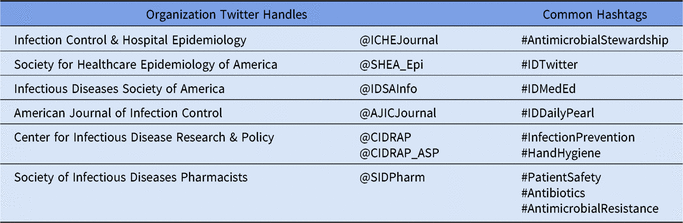
Twitter accounts may be developed to represent individuals, organizations, societies, and journals. See Table 1.Reference Niehaus, Silver and Katz24, Reference Glowacki, Lazard, Wilcox, Mackert and Bernhardt36–Reference Goff, Kullar and Newland39 Beyond simple posts of new articles or announcements, Twitter has been used to conduct more in-depth engagement, including journal clubs and formalized online chats, virtual following of national or regional society meetings and conferences, education, professional networking, public health outreach from the CDC regarding Ebola and Zika virus infections, and clinical trial recruitment for both investigators and patients.Reference Tonia, Van Oyen, Berger, Schindler and Künzli31, Reference Glowacki, Lazard, Wilcox, Mackert and Bernhardt36, Reference Mitchell, Russo, Otter, Kiernan and Aveling40–Reference Mayol and Dziakova45
Selected Twitter Handles and Common Hashtags Related to Infection Prevention & Antimicrobial Stewardship

Facebook. Facebook is the most commonly used social media platform overall, with 2.27 billion monthly active users.46 Posts do not carry the same character limitations (as Twitter), allowing for more text in any given post. Users retain the ability to “like,” comment on, or share posts of others. Despite being the leading platform overall, Facebook is not the most common platform used professionally among healthcare workers.Reference Evaniew, Adili and Ghert30
Instagram. Instagram is a photograph-based mobile social network that allows users to share photos and stories linked by common terms (hashtags). Instagram has >1 billion monthly users, and these users trend toward a younger age demographic.47 Several ID-related individuals and organizations share AS education on this platform.Reference Gauthier and Spence48
Blogs. Blogs are websites updated with specific content, including specialty-specific blogs, such as Controversies in Hospital Infection Prevention (http://haicontroversies.blogspot.com/) or other organizational (eg, https://blog.unmc.edu/infectious-disease/ co-directed by authors K.A.C. and J.R.M.) and privatized blogs.Reference Birgand, Troughton and Moore26 Blog articles maybe more popular because they can be published immediately and their tone may be less censored than peer-reviewed journals. However, journals remain the ideal accepted location to publish original research for both credibility and academic promotion criteria.
How can social media be leveraged successfully for the advancement of journals, organizations, and researchers?
Development of social media strategies, aligned with the principles of implementation science, may accelerate the dissemination of research ranging from the individual scientist, to their respective institution, and even extend to professional organizations and journals. An example of this is PM&R journal, the official journal of the American Academy of Physical Medicine and Rehabilitation, who published their strategic social media initiative via Twitter, focused on disseminating research and information regarding the field to healthcare professionals and the public, while encouraging inclusivity of the diverse background of physiatrists, and monitoring both traditional and alternative metrics.Reference Niehaus, Silver and Katz24 The strategy, aligned with the aims of the journal and overarching Society, consists of original posts and re-posts of content from the journal and other reliable sources, as ways to further disseminate research in a coordinated fashion.Reference Niehaus, Silver and Katz24
Other journals, such as the Journal of General Internal Medicine, have also engaged in strategic initiatives including journal clubs held via Twitter to engage a larger audience with authors and journal editors.Reference Mehta and Flickinger41 Critical aspects include widespread promotion in advance via social media, websites, and newsletters, with the time and date of the event combined with intentional posts to lead the discussion.Reference Mehta and Flickinger41 Twitter posts with hashtags for identification, links, and current popular topics have been most likely to be engaging and reposted during infection control conferences.Reference Mitchell, Russo, Otter, Kiernan and Aveling40 Images are also frequently added for interest, but they may not always garner increased attention.Reference Mitchell, Russo, Otter, Kiernan and Aveling40 However, visual abstracts are associated with increased attention and dissemination.Reference Ibrahim, Lillemoe, Klingensmith and Dimick49
Social media may be an effective way to ensure that created content is viewed by target audiences, compared to other traditional dissemination methods such as e-mails or institution home pages. One study found that compared to their hospital epidemiology home page or e-mail list, posting links to hand hygiene awareness videos on Facebook resulted in significantly increased engagement.Reference Pan, Sheng, Tien, Chien, Chen and Chang50 Although this activity did not ultimately result in an increase in hand hygiene compliance, it created discussion about identifying effective methods of communicating important information to healthcare workers.
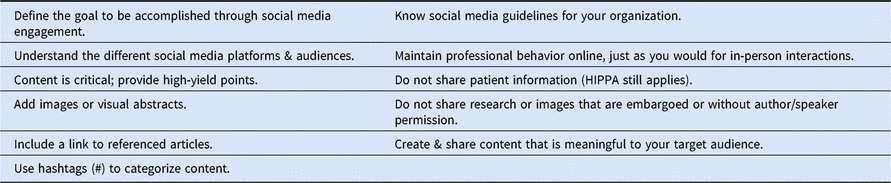
Social media is also a conduit for education initiatives for IP and AS. Pisano et alReference Pisano, Pettit and Bartlett51 used Facebook and Twitter accounts to engage with internal medicine residents about AS and infectious diseases using trivia questions and promoting links to clinical pathways on the AS website. This intervention led to a modest improvement in knowledge demonstrated by internal medicine residents of antibiotics based on before-and-after tests and to a significant increase in use of AS clinical pathways for clinical decision making.Reference Pisano, Pettit and Bartlett51 Additionally, the use of hashtags (eg, #antibiotics, #meded, etc; see Table 2 for examples of ID-related accounts to follow and hashtags to use) allowed the transfer of knowledge outside of the institution so that others could benefit from the AS pearls, and the authors noted more engagement with users on Twitter than Facebook.Reference Pisano, Pettit and Bartlett51 A systematic review concluded that although certain challenges may be associated with adopting social medical education strategies, the opportunity for innovation, and for increasing learner engagement and knowledge retention is worth further investigation of how social media can be incorporated into medical education curriculum.Reference Cheston, Flickinger and Chisolm52
Best Practices for Disseminating Research via Social Media

Pitfalls of social media in healthcare and best practices to avoid them
Like any other tool, use of social media in health care can be associated with some pitfalls, and best practices must be used to mitigate these. The following are key practices to help maintain a professional social media account. (See Table 2 for an abbreviated list of pearls and pitfalls for using social media professionally.)
1. Patient confidentiality: Healthcare professionals must apply Health Insurance Portability and Accountability Act standards to social media engagement, and if they receive queries regarding patient information, they should direct individuals to their physician for evaluation. Never reveal information or engage in discussion that could identify a patient.
2. Misinformation: IP and AS principles can be misconstrued and misrepresented, even by well-meaning colleagues. To avoid sharing misinformation, only share information from reliable sources, such as peer-reviewed journals, the Centers for Disease Control and Prevention (CDC) or other trusted organizations and/or individuals.
3. Intellectual property misappropriation: Sharing new information from conferences (eg, IDWeek or the SHEA Spring Conference) or lectures may lead to early adoption of innovative IP or AS interventions. However, if these data are embargoed or permission to share is not granted by author, problems may arise. To avoid this, only share information with permission from the speaker or author.
4. Inappropriate behavior: Although individual social media posts may not represent employers, social media is public and searchable on the Internet. Therefore, posts or engagements should be reflective of conversations an individual would be comfortable speaking into a microphone in front of a crowd of strangers.
Conclusion
Tenets of infection prevention and antimicrobial stewardship impact all of medicine, creating a demand for dissemination of pertinent research and best practices. Given the profound clinical, financial, and public health impacts of infection prevention and antimicrobial stewardship combined with the incomplete uptake of best practices, multimodal strategies employing social media are critical to increase the speed and reach of our research. Although social media should not supplant traditional communication methods, researchers and journals should strategically utilize evolving online communication platforms to increase the dissemination of research.
Acknowledgments
None.
Financial support
No financial support was provided relevant to this article.
Conflicts of interest
Dr Silver reports grants from the Binational Foundation to study culinary medicine and from the Arnold P. Gold Foundation to study health disparities. All other authors report no conflicts of interest relevant to this article.