


Introduction
Worldwide, suicide ranks in the top five causes of mortality among 15- to 19-year-olds (WHO, 2000). In Australia, suicide is the most frequent cause of death among the young, accounting for approximately one quarter of deaths for those aged 15–24 years (Australian Bureau of Statistics, 2011). Suicide-related behaviours are more common than suicide in Australia and worldwide. These behaviours include suicidal ideation and suicide attempt (often referred to as deliberate self-harm; DSH), both with, and without, intention of dying (Hawton et al. Reference Hawton, Rodham, Evans and Weatherall2002). For example, the ratio of suicide attempts to completed suicides is 25:1. Suicide attempts have a 7–11% 12-month prevalence rate (Nock et al. Reference Nock, Borges, Bromet, Cha, Kessler and Lee2008), and at any point in time 15–25% of young people may be experiencing suicidal ideation (Grunbaum et al. Reference Grunbaum, Kann, Kinchen, Ross, Hawkins and Lowry2004). Suicidal ideation, and threats or gestures of suicide attempt have been shown to predict future suicide attempt (Prinstein et al. Reference Prinstein, Nock, Simon, Aikins, Cheah and Spirito2008), making these phenomena an important target for intervention.
Several potential targets for intervention have been identified from research. Deficits in problem solving in individuals with suicide-related behaviours have been consistently shown in both adults and adolescents (Pollock & Williams, Reference Pollock and Williams1998, Reference Pollock and Williams2004; Grover et al. Reference Grover, Green, Pettit, Monteith, Garza and Venta2009; Labelle et al. Reference Labelle, Breton, Pouliot, Dufresne and Berthiaume2013) with social problem-solving deficits highlighted in adolescents (Arie et al. Reference Arie, Apter, Orbach, Yefet and Zalzman2008). Studies of adolescents and young adults have shown difficulties both in terms of being able to generate sufficient, and effective, solutions to problem situations (Schotte & Clum, Reference Schotte and Clum1982, Reference Schotte and Clum1987; Sadowski & Kelley, Reference Sadowski and Kelley1993). Similarly studies of young adults have shown a tendency for these individuals to focus on the potential negative outcomes of solutions, as opposed to potential positive outcomes (Dixon et al. Reference Dixon, Heppner and Anderson1991, Reference Dixon, Heppner and Rudd1994; Rudd et al. Reference Rudd, Rajab and Dahm1994).
Recent work in adolescents has compared the specific nature of problem-solving deficits between individuals with suicide-related behaviour and those with depression. Research indicates that those exhibiting suicide-related behaviour may make a poor choice of solution and fail to consider long-term negative consequences of their actions (Wilson et al. Reference Wilson, Stelzer, Bergman, Kral, Inayatullah and Elliott1995; Oldershaw et al. Reference Oldershaw, Grima, Jollanta, Richards, Simica, Taylora and Schmidt2009). Adult studies have shown they are also more likely to choose solutions that are deemed ‘passive’ (in that they rely on chance or the actions of another person) (Pollock & Williams, Reference Pollock and Williams2004), compared to those experiencing depression. In addition, both adults and adolescents with suicide-related behaviours demonstrate a negative appraisal of problems and their ability to resolve them (i.e. negative problem orientation) (Wilson et al. Reference Wilson, Stelzer, Bergman, Kral, Inayatullah and Elliott1995; D’Zurilla et al. Reference D’Zurilla, Chang, Nottingham and Faccini1998).
Coping, defined as efforts to deal with stress, is intricately linked to problem solving (Spence et al. Reference Spence, Sheffield and Donovan2002), and coping strategies, including problem solving can be protective against suicide-related behaviours (Piquet & Wagner, Reference Piquet and Wagner2003; Khurana & Romer, Reference Khurana and Romer2012; Mathew & Nanoo, Reference Mathew and Nanoo2013). Poor coping skills, in particular emotion-focused coping (i.e. directed towards managing the negative emotions associated with the stressor) and a lack of problem-focused coping strategies (i.e. directed towards the source of the stress) (as defined by Lazarus & Folkman, Reference Lazarus and Folkman1984) have been associated with past suicide attempt and to be predictive of future attempts in adolescents (Lewinsohn et al. Reference Lewinsohn, Rohde and Seeley1996) For example, studies have shown that adolescents who had made suicide attempts were more likely to utilize emotion-focused coping strategies compared to problem-focused strategies (Puskar et al. Reference Puskar, Hoover and Miewald1992; Wilson et al. Reference Wilson, Stelzer, Bergman, Kral, Inayatullah and Elliott1995). Similarly, an association has been shown between emotion-focused coping and suicidal ideation (Horwitz et al. Reference Horwitz, Hill and King2011). The converse has also been confirmed; with task-focused coping being reduced in young people who repeatedly attempted suicide (Curry et al. Reference Curry, Miller, Waugh and Anderson1992; Nrugham et al. Reference Nrugham, Holen and Sund2012; Mathew & Nanoo, Reference Mathew and Nanoo2013).
While these potential targets for intervention have been highlighted in research, the evidence base for effective interventions for young people demonstrating suicide-related behaviour is limited (Robinson et al. Reference Robinson, Hetrick and Martin2011). Cognitive behavioural therapy (CBT) has been identified in a recent systematic review as the most promising approach investigated in young people thus far (Robinson et al. Reference Robinson, Hetrick and Martin2011). In adults, there is evidence to suggest that cognitive behavioural problem solving (PST) interventions are beneficial for reducing repeated suicide attempts (Salkovskis et al. Reference Salkovskis, Atha and Storer1990), promising in terms of preventing repetitive self-harm (Hawton et al. Reference Hawton, Townsend, Arensman, Gunnell, Hazell, House and Von Heeringen1999), and effective with regard to improving depression and hopelessness (Townsend et al. Reference Townsend, Hawton, Altman, Arensen, Gunnell, Hazell, House and Von Heeringen2001). In addition, a recent study of adolescents showed that those who received PST experienced a significant reduction in ‘suicide potential’ (measured on a scale that included items related to hopelessness, suicidal ideation, negative self-evaluation and hostility; Cull & Gill, Reference Cull and Gill1988), and depression scores, and a higher rate of recovery from depression when compared to those in the waitlist comparison (Eskin et al. Reference Eskin, Ertekin and Demir2008).
Therefore, based on the extant literature at the present time, the best approach to clinical interventions for youth with suicide-related behaviours may be the cognitive behavioural approach. Interventions that include enhancement of problem-solving skills, with a particular focus on enhancing skills in order to modify negative problem orientation, as well as cognitive interventions that specifically target the negative cognitions related to problems and one's ability to solve these problems, may be beneficial. Together these should improve problem-solving orientation and coping skills, which are associated with suicidal ideation.
We have developed a CBT-based intervention called ‘Reframe-IT’ for youth experiencing suicidal ideation (Robinson et al. in press a). Problem solving is frequently incorporated into CBT (Weersing et al. Reference Weersing, Rozenman and Gonzalez2009) and given the evidence regarding problem-solving deficits in individuals with suicide-related behaviours we ensured this was incorporated.
We developed our intervention to be delivered over the Internet given increasing evidence of: (1) the popularity of this means of communication among youth (Subrahmanyam & Lin, Reference Subrahmanyam and Lin2007); (2) the increasing use among youth of the Internet as a means of acquiring health information (Gould et al. Reference Gould, Munfakh, Lubell, Kleinman and Parker2002); and, (3) emerging evidence suggesting it is an effective form of treatment delivery for depression and anxiety in adolescents (Calear & Christensen, Reference Calear and Christensen2010; Richardson et al. Reference Richardson, Stallard and Velleman2010). The intervention was not open access but delivered in a monitored environment, which has been shown to improve rates of adherence and treatment outcomes (Spek et al. Reference Spek, Cuijpers, Nyklicek, Riper, Keyzer and Pop2007; Christensen et al. Reference Christensen, Griffiths and Farrer2009; Neil et al. Reference Neil, Batterham, Chrisensen, Bennett and Griffiths2009; Cavanagh, Reference Cavanagh, Bennett-Levy, Richards, Farrand, Christensen, Griffiths, Kavanagh, Klein, Lau, Proudfoot, Ritterband, White and Williams2010).
The primary aims of the pilot study were to test the effects of this intervention on suicidal ideation, depression and hopelessness among secondary school students, and this has been reported in another publication (Robinson et al. in press a). We also examined, and reported in an additional paper, the levels of distress and suicidal ideation on a weekly basis in order to monitor the acceptability and safety of the intervention (Robinson et al. in press b). However, we also felt it was important to examine how the intervention works to improve those problem-solving and coping deficits that have been associated with suicide-related behaviours, and to explore which aspects of CBT young people find most helpful, in order to further refine the intervention and facilitate translation of research findings into everyday clinical practice (Weersing et al. Reference Weersing, Rozenman and Gonzalez2009). Therefore, the current study aims to: (1) examine whether or not the programme leads to increased problem solving and increased coping skills; and (2) examine which aspects of the intervention are considered to be most helpful by participants and to what extent. The specific hypotheses were that the Reframe-IT intervention would improve problem-solving and coping skills. Additional questions were:
(1) Do young people find the intervention helpful?
(2) What specific CBT or problem-solving skills taught within the intervention do young people find helpful?
(3) Is there any evident pattern of improvement in distress over the course of the intervention period, and if so does it tell us anything about the helpfulness of the modules delivered as part of the intervention?
Methods
Study design
This was a small pilot study that employed a pre-test/post-test design with an 8-week intervention phase. Participants were assessed immediately before beginning the intervention (baseline), weekly (distress scores and helpfulness ratings) and immediately after the intervention was complete (post-intervention).
Sample
Eleven secondary schools from the northwestern suburbs of Melbourne and in the Barwon area, just outside of Melbourne agreed to participate in the pilot study.
Students were eligible to participate if they: (1) were aged 14–18 years; (2) had presented to a member of their school wellbeing team; and, (3) had reported experiencing suicidal ideation during the past month. Exclusion criteria were any intellectual disability, the presence of psychotic symptoms and/or an inability to speak English.
Students who met the inclusion criteria were asked at the discretion of the school wellbeing team if they were interested in participating in the study. If they replied ‘yes’, the school wellbeing staff member gave them a consent form to take home. Once the consent form was signed by the student and their parent or legal guardian, the school wellbeing team contacted the study team and an appointment was made to conduct the baseline assessment. Details about the limits of confidentiality (that all information would remain confidential unless the young person was deemed to be at risk of harm to themselves or others, in which case this information would be passed to their school welfare co-ordinator and/or emergency contact; this would be done with their full knowledge) were provided in the written information and verbally by the research team undertaking the assessments and delivering the intervention (see below). No incentives for participation in the study were provided. Following the baseline assessment a safety plan was also completed and uploaded onto the Reframe-IT website.
Intervention
The Reframe-IT intervention was developed by the research team and comprises eight modules, designed to be administered once a week at school. Each participant had access to his or her own personalized webpage accessed via a secure login. Only the participant and the research team could access the page. There was no social networking function.
The site comprised an adult ‘host’ character who delivered the therapy verbally, and a series of video diaries made by young people (actors), that told a different ‘story’ each week, to demonstrate the skill that was being taught by the host. There were also two activities to be completed each week related to the same skill being taught. The site also included a message board, a series of factsheets covering a range of related topics, downloadable MP3s and a list of local and national helplines and services that participants could access if they wished. As the weeks progressed, additional items were added to the site (e.g. an activity diary).
The eight modules incorporated standard CBT approaches commonly used with young people (Weersing et al. Reference Weersing, Rozenman and Gonzalez2009). These were: engagement and agenda setting; emotional recognition and distress tolerance; identification of negative automatic thinking; behavioural activation – help-seeking and activity scheduling (including relaxation techniques); problem solving, with a specific focus on managing suicidal ideation; detecting and challenging problematic thinking, and cognitive restructuring.
Researcher involvement was two-fold. Two researchers (J.R. and G.C.) conducted the face-to-face assessments and facilitated delivery of the programme, which included setting up appointments; managing Internet issues; and sitting with the young person while they watched each module of Reframe-IT on a laptop. The assessments and the delivery of the intervention took place at the participants’ school. Two other researchers provided clinical supervision and moderated the website (S.H. and S.B.) by checking the responses to a weekly ‘distress-check’, which was completed online at the end of each module. If scores on this were high, this information was fed back to the school staff. The moderator (S.H.) also checked completed activities and responded with personalized but standardized messages and checked the message board daily responding as appropriate.
Outcomes
The primary outcome of interest was problem orientation as measured at baseline and post-intervention by the Negative Problem Orientation Questionnaire (NPOQ), which has been demonstrated to have good psychometric properties in young adults (internal consistency α = 0.92; test–retest reliability over 5 weeks, r = 0.80, p < 0.01) (Robichaud & Dugas, Reference Robichaud and Dugas2005) and, while not validated in adolescents, has been used in in this age group (Spence et al. Reference Spence, Sheffield and Donovan2002). The NPOQ has 12 items assessing an individual's perceived threat of problems to their wellbeing, their confidence in being able to solve problems and how much they focus on the potential negative outcomes of solutions that are implemented with some items indicative of self-blame and worry (McWilliams et al. Reference McWilliams, Cox and Enns2003). Each item has a scale of 1 (‘not at all true of me’) to 5 (‘extremely true of me’) with the total score of NPOQ ranging from 12 to 60, with a lower score indicating a less negative problem-solving orientation.
Second, coping was measured at baseline and post-intervention using the Coping Inventory for Stressful Situations (CISS; Endler & Parker, Reference Endler and Parker1990), which has not been validated in adolescents but has been shown to have good psychometric properties in clinical and non-clinical, adult and young adult populations (internal consistency α = 0.76; test–retest reliability, 0.51–0.73) (Endler & Parker, Reference Endler and Parker1994; McWilliams et al. Reference McWilliams, Cox and Enns2003). Participants are asked to rate how often they would utilize a particular behavioural response to a difficult, stressful, or upsetting situation on a scale from 1 (‘not at all’) to 5 (‘very much’). It has three subscales, namely Task-focused coping, Emotion-focused coping and Avoidance-focused coping; in this study we have used task-focused coping (equivalent to the problem-focused coping concept of Lazarus & Folkman, Reference Lazarus and Folkman1984) and emotion-focused coping, given the literature pointing to these as important in adolescents with suicide-related behaviours. For the Task-focused subscale, higher scores indicate better coping; for the Emotion-focused subscale, lower scores indicate better coping.
The perceived helpfulness of each individual module was measured using a specifically designed questionnaire administered weekly. Participants were asked to rate how helpful they found the module that they had just completed on a scale of 1 (‘very unhelpful’) to 5 (‘very helpful’).
Psychological distress was measured at baseline and post-intervention as well as each week immediately following delivery of the module, using the Kessler Psychological Distress Scale (K10), which has been shown to have strong psychometric properties (Andrews & Slade, Reference Andrews and Slade2001; Kessler et al. Reference Kessler, Andrews, Colpe, Hiripi, Mroczek, Normand, Watters and Zaslavsky2002) and has been validated in adolescents (Chan & Fung, Reference Chan and Fung2014). The K10 has 10 items each with a scale of 1 (‘none of the time’) to 5 (‘all of the time’), resulting in a total score which ranges from 10 to 50. The lower the score, the lower the level of distress.
Statistical methods
Descriptive statistics, including frequencies and means and standard deviations were calculated and paired samples t tests were performed to examine the impact of the intervention on coping (CISS) and problem-solving skills (NPOQ).
Time trend over the study period for the K10 scores was examined by observing mean change between successive weeks (baseline, weeks 1–7, and post-intervention data were used). The time trend was further examined by fitting a mixed-effects model that included both a linear term as well as a quadratic term and using baseline K10 as a covariate on the K10 scores from baseline to post-intervention. Pearson correlations were undertaken for the K10 change scores against the helpfulness total scores (calculated from the sum of the ratings of each of the eight modules for each individual). Type I error was set at 0.05 for all analyses.
Safety, supervision and ethics
Several safety measures were in place and have been reported elsewhere (Robinson et al. in press a). Ethical approval was obtained from the University of Melbourne Human Research Ethics Committee and the Victorian Department of Education and Early Childhood Development Ethics Committee. Written consent was required from all students and their parents/guardian.
Results
We were unable to collect reliable data from school staff regarding the number of students and parents approached for participation in the study; nor how many declined participation and their reasons. Thirty-four students were referred to the study, from nine schools (the remaining two schools did not refer any students to the programme). Of these 34 students, baseline assessments were conducted with 32, and 27 students began the intervention. Of the five students who completed a baseline assessment but did not begin the intervention, one reported feeling better and not requiring treatment, one participant required in-patient treatment before the intervention was able to begin, and despite numerous attempts, the research team were unable to contact the remaining three students in order to begin the intervention. Twenty-one students completed all eight modules and a post-intervention assessment. Of the six participants who dropped out during the intervention, one reported feeling better and did not feel they needed to continue the programme, one moved school, one moved interstate, and the research team were unable to contact three participants to ascertain why they did not want to continue. There were no statistically significant differences in demographic and baseline characteristics between those who dropped out and those who completed all eight modules in any of the measures. A statistically significant reduction in the primary outcomes, including suicidal ideation, clinician- and self-rated depression, and hopelessness was observed over the intervention period (Robinson et al. in press a).
Demographic and baseline characteristics of the sample
The main results of the study, including demographics and baseline characteristics, are reported elsewhere (Robinson et al. in press a). In summary, the majority of participants were female, had a mean age of 15.6 years, lived with a family member and identified themselves as Australian. No participants identified themselves as Aboriginal or Torres Strait Islander. Twelve of the 21 participants reported a previous suicide attempt. Eight of the participants reported being engaged with outside mental health services prior to receiving the Reframe-IT programme, three were referred to outside services at the same time as starting the programme, one was referred on for additional support on completion of the programme, and the remaining nine participants were either only engaged with their school wellbeing team, or did not report receiving any additional support.
Did the CBT-based Internet-based programme (Reframe-IT) impact on problem-solving appraisal and coping?
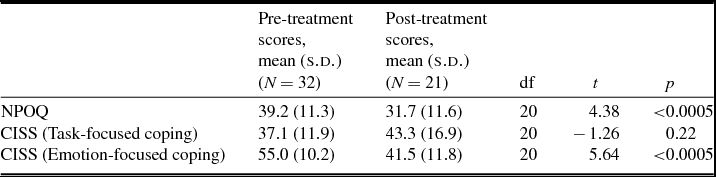
A statistically significant result was seen for the NPOQ and for the Emotion-focused coping subscale of the CISS, a coping strategy that was used less over time (see Table 1) with large effect sizes for both (η2 = 0.96 and η2 = 1.2 respectively).
Pre- and post-test negative problem orientation and task- and emotion-focused coping scores and paired t test results
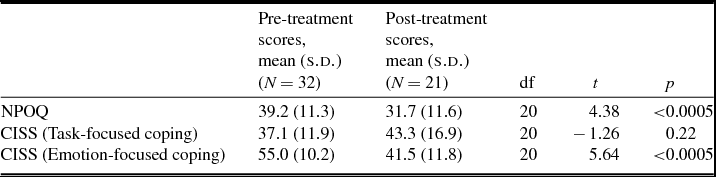
NPOQ, Negative Problem Orientation Questionnaire; CISS, Coping Inventory for Stressful Situations.
What aspects of the CBT based Internet-based programme (Reframe-IT) were perceived to be most helpful?
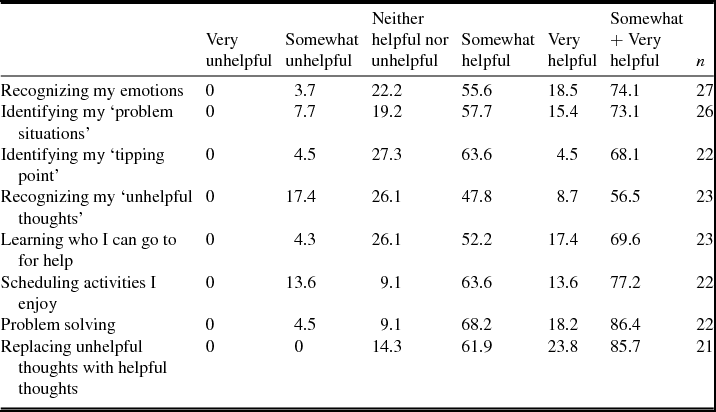
The majority of participants found all the modules included in Reframe-IT helpful (see Table 2), with more than two-thirds rating each module, except module 4 as either ‘somewhat’, or ‘very’, helpful. There was some variation in helpfulness ratings. The two modules that had the highest percentage of young people rating them as either ‘somewhat’ or ‘very’ helpful were the problem-solving (86.4%) and cognitive restructuring modules (85.7%). By contrast, the ratings for module 4 (which is about recognizing unhelpful thoughts), suggested it was less helpful than module 8 (which is about replacing unhelpful thoughts with helpful thoughts).
Perceived helpfulness of each module – responses in percentages

n, Number of respondents.
What was the nature of improvement in distress and does this relate to the helpfulness of modules?
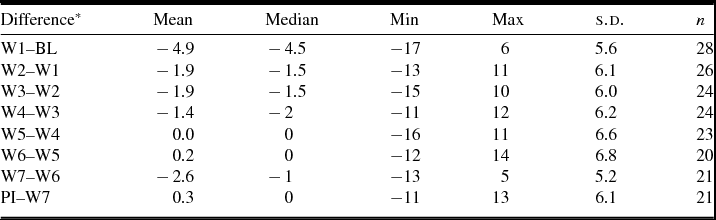
There was an overall decreasing time trend over the study period, with the biggest decrease in distress seen between baseline and week 1, continuous decreases up to week 4, and minimal (although still continuous) decreases from week 4 to post-intervention, with the exception of the change between week 6 (scheduling pleasurable activities) and week 7 (see Table 3).
Summary statistics of difference in K10 total scores between adjacent time-points
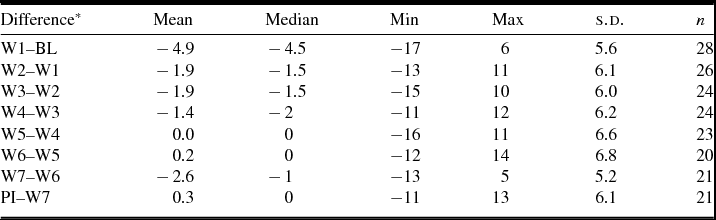
* BL, Baseline; PI, post-intervention; W1, week 1, W2, week 2, etc.
Using a fixed-effects model there was a negative linear term for time that was significant. However, the quadratic term was not significant confirming that there was a significant decreasing time trend over the intervention period (see Table 4).
Results of mixed-effects model analysis on the K10 scores from baseline to post-intervention

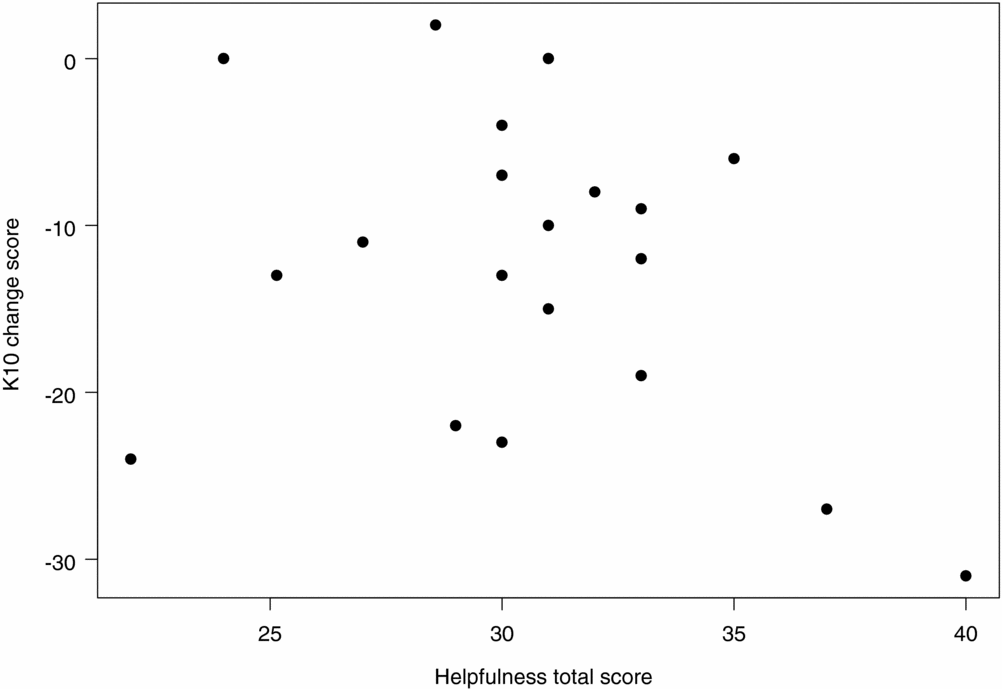
Figure 1 shows a slight tendency for higher helpfulness scores to be associated with bigger drops in K10. However, this downward trend was mainly due to two individuals who had the highest helpfulness score and the biggest drops in K10. The corresponding Pearson correlation coefficient was -0.32 and was not statistically significant (p = 0.17).
Plot of K10 change score against helpfulness total score.
Discussion
Key findings
The Reframe-IT programme appears to show promise as an intervention to improve negative problem-solving orientation and to reduce emotion-focused coping. While there were improvements in task-focused coping, these were not significant.
Including a targeted problem-solving skills development intervention within Reframe-IT was considered important in terms of enhancing participants’ skills. The problem-solving skills that were taught aimed to enable adolescents to evaluate the pros and cons of potential solutions to identified problems, thus addressing a specific deficit identified in previous research. We hypothesize that a reduction in negative problem orientation, an important component of which is self-efficacy (D’Zurilla, Reference D’Zurilla1986), would also mean a greater inclination to actively address problems or daily stressors. This was not reflected in our results, but it may be that as problem-solving skills are consolidated over time, task-focused coping strategies would be increasingly utilized.
Reframe-IT also included a focus on cognitive restructuring. Specific targeting of negative cognitions related to one's ability to solve problems may help to address the tendency to view problems negatively that individuals with suicide-related behaviours demonstrate (D’Zurilla, et al. Reference D’Zurilla, Chang, Nottingham and Faccini1998). The scale used to measure this construct (NPOQ) includes items indicative of self-blame and worry (McWilliams et al. Reference McWilliams, Cox and Enns2003), so that the findings of this study in regard to reduced emotion-focused coping also potentially reflect a reduction in these phenomena. Cognitive restructuring skills are instrumental in teaching young people to recognize unhelpful thinking, such as self-blame and worry, and consciously substitute unhelpful thoughts with alternative and helpful thoughts.
Overall, these results suggest that problem-solving skills development, as well as cognitive restructuring should be considered as potential techniques for an intervention package for young people with suicidal ideation. Indeed, from the perspective of the adolescents in our study, these modules were reported to be particularly helpful. Further, there was some indication that a higher level of perceived helpfulness of modules is associated with larger reductions in levels of distress.
It is interesting to note that while the first group of modules focus on identifying and recognizing difficult emotions, situations and unhelpful thinking rather than on teaching skills to deal with these (these skills are taught in the second group of modules), improvements in psychological distress are nevertheless and, in fact, more evident in the first 4 weeks of delivery of the intervention. This may simply be due to the fact that these young people were recruited into the study at the point where they were most in crisis and there was a natural resolution of the crisis. However, this finding does reassure us that while the initial modules did not provide young people with any tangible skills to deal with the difficulties they were facing, it appears that these orientation modules can be safely administered in this way (i.e. in isolation from skill development modules). Our findings with regard to the safety of delivering this intervention, reported in another publication (Robinson et al. in press b) support this contention. These early modules are important modules to deliver as they form the basis of the future work in the final modules.
Limitations
This was a small pilot study with no control group; as such we cannot be certain that the changes seen between baseline and post-intervention can be attributed to the intervention. While our primary outcome measures (NPOQ; CISS) have not been validated in adolescents, they have been validated with young adults and used widely in adolescent populations. The small study size also meant that in some cases formal statistical testing was not meaningful; and for example we did not control for the amount and type of additional mental health treatment being received by young people in the study in this analysis. However, there were consistent effects demonstrated in terms of the effect on problem-solving orientation and coping, with the components of therapy designed to address these deficits perceived as the most helpful by the adolescent participants in the study. This has generated meaningful hypotheses that need to be tested in a fully powered randomized trial to substantiate the findings of this study.
We were unable to collect reliable data regarding the number of students approached for participation in the study, and therefore do not have a precise consent rate nor reasons for declining participation. It must also be noted that rates of attrition were relatively high with 13 students dropping out of the study. While this is not unusual in studies testing Internet-based interventions (Christensen et al. Reference Christensen, Griffiths and Farrer2009), it did reduce our sample size by approximately one third and introduced the potential for a degree of bias in the sample. It was reassuring that those who dropped out were no different at baseline from those who completed the study on our outcomes of interest.
In this study we were not able to undertake mediation analysis due to the lack of measurement at multiple time points. This type of analysis should be undertaken in future studies to investigate whether the changes in problem-solving skills and coping strategies mediate changes seen in suicidal ideation.
Conclusions
Little research has been undertaken to explore how interventions might work to impact on the processes associated with the manifestation of symptoms such as suicidal ideation. Nor has there been much research investigating the helpfulness of interventions from the perspective of young people, in particular among those with suicide-related behaviours. This pilot study has provided some direction for future studies that could examine the mechanisms of change in interventions with young people with suicidal ideation; such studies should investigate how interventions impact on problem solving and coping to influence treatment outcomes.
Key points
(1) Little research has been undertaken to identify effective interventions for adolescents with suicidal ideation.
(2) Deficits in problem solving and coping skills appear to be associated with suicidal ideation.
(3) Adolescents report finding the components of the intervention that taught problem-solving skills and cognitive restructuring skills particularly helpful.
(4) Further investigation of interventions that include enhancement of problem-solving skills, as well as cognitive restructuring to address adolescents’ appraisal of problems and their ability to solve them, are warranted.
Ethical approval
Ethical approval was obtained from the University of Melbourne Human Research Ethics Committee and the Victorian Department of Education and Early Childhood Development Ethics Committee. Written consent was required from all students and their parents/guardian (Ethics ID: 1033768).
Acknowledgements
This study received funding from the American Foundation for Suicide Prevention and from an NHMRC Program Grant. J.P. is on a National Health and Medical Research Council Senior Research Fellowship. S.H. and S.B. are both on a National Health and Medical Research Council Early Career Fellowship. O.Y.H.R.C. is affiliated with Melbourne Health and the University of Melbourne and receives funding from the Colonial Foundation.
Declaration of Interest
None.
(1) Understand some of the deficits that may be associated with suicidal-related behaviour in young people.
(2) Think about how the different approaches or components of CBT may more or less suited to addressing these deficits.
(3) Understand what approaches or components of CBT young people find most helpful and what the implications of this may be.




Comments
No Comments have been published for this article.