1. Introduction
Turbulent flows in natural and engineering problems are often profoundly influenced by system rotation. Over the years, considerable effort has been devoted to characterising the turbulent statistics and flow structures under such rotational effects. Among various configurations, spanwise rotating plane Poiseuille flow (RPPF) has emerged as a canonical model for studying rotating wall-bounded turbulence, owing to its geometric simplicity and the abundance of available experimental and direct numerical simulations (DNS) data for validation (Johnston Reference Johnston1998; Jakirlić et al. Reference Jakirlić, Hanjalić and Tropea2002). As a result, RPPF has been intensively investigated through both experiments (Johnston, Halleen & Lezius Reference Johnston, Halleen and Lezius1972; Nakabayashi & Kitoh Reference Nakabayashi and Kitoh1996, Reference Nakabayashi and Kitoh2005; Visscher et al. Reference Visscher, Andersson, Barri, Didelle, Viboud, Sous and Sommeria2011) and numerical simulations (Kristoffersen & Andersson Reference Kristoffersen and Andersson1993; Grundestam, Wallin & Johansson Reference Grundestam, Wallin and Johansson2008; Yang & Wu Reference Yang and Wu2012; Dai, Huang & Xu Reference Dai, Huang and Xu2016; Xia, Shi & Chen Reference Xia, Shi and Chen2016; Brethouwer Reference Brethouwer2017; Zhang et al. Reference Zhang, Xia, Shi and Chen2019) over several decades. In RPPF, the flow tends to stabilise when the system rotation aligns with the mean flow vorticity, but destabilises when the two oppose each other. Consequently, the corresponding channel sides are referred to as the stable (suction) side and unstable (pressure) side, respectively (Bradshaw Reference Bradshaw1969; Johnston et al. Reference Johnston, Halleen and Lezius1972).
Thanks to extensive experimental and numerical studies, several turbulent features of RPPF have been identified. On the pressure side, turbulence is enhanced due to the system rotation, whereas on the suction side, flow relaminarises beyond a critical rotation rate (Grundestam et al. Reference Grundestam, Wallin and Johansson2008; Wallin, Grundestam & Johansson Reference Wallin, Grundestam and Johansson2013). The mean streamwise velocity
 $U$
on the pressure side follows a linear law
 $U = 2\varOmega y + C$
rather than the classical log-law in non-rotating wall-bounded turbulence (Johnston et al. Reference Johnston, Halleen and Lezius1972; Nakabayashi & Kitoh Reference Nakabayashi and Kitoh1996; Nickels & Joubert Reference Nickels and Joubert2000; Hamba Reference Hamba2006). Here,
 $\varOmega$
is the system rotation rate, and the intercept
 $C$
, when normalised by the friction velocity on the pressure wall, exhibits a logarithmic dependence on the ratio of friction Reynolds number to the friction rotation number, which are defined at the pressure side (Yang et al. Reference Yang, Xia, Lee, Lv and Yuan2020). Additionally, the Reynolds shear stress, the production term of turbulent kinetic energy and higher-order moments of streamwise velocity fluctuations also display linear distributions in this region (Xia et al. Reference Xia, Shi and Chen2016; Brethouwer Reference Brethouwer2017; Xia, Brethouwer & Chen Reference Xia, Brethouwer and Chen2018). Moreover, large-scale streamwise roll-cells – also referred to as Taylor–Görtler (TG) vortices or the secondary flows – are observed on the pressure side (Johnston et al. Reference Johnston, Halleen and Lezius1972; Kristoffersen & Andersson Reference Kristoffersen and Andersson1993). Using conditional averaging, Dai et al. (Reference Dai, Huang and Xu2016) found that turbulence is relatively stronger in the upwash regions of the TG vortices. Based on a thermal analogy (Bradshaw Reference Bradshaw1969) and DNS of both two- and three-dimensional RPPF, Zhang et al. (Reference Zhang, Xia, Shi and Chen2019, Reference Zhang, Xia and Chen2022) identified three important flow structures (plumes, inertial waves and plume currents) and elucidated different self-sustaining mechanisms in RPPF. In particular, they demonstrated that secondary flow patterns are driven by the basic large-scale plume currents, which are fed by small-scale plume-like structures ejected from the pressure wall. They also introduced a clustering analysis algorithm capable of extracting multiple large-scale flow patterns in each case (Zhang, Xia & Chen Reference Zhang, Xia and Chen2022).
While passive scalar transport in non-rotating turbulent channel flow has been widely studied (Abe, Kawamura & Matsuo Reference Abe, Kawamura and Matsuo2004; Pirozzoli, Bernardini & Orlandi Reference Pirozzoli, Bernardini and Orlandi2016; Abe & Antonia Reference Abe and Antonia2017), it has received less attention in rotating channel flows, despite its relevance to numerous engineering applications. Matsubara & Alfredsson (Reference Matsubara and Alfredsson1996) experimentally investigated heat and momentum transfer in RPPF, and found that the classical Reynolds analogy between momentum and heat transfer breaks down under system rotation. Using DNS, Liu & Lu (Reference Liu and Lu2007) studied passive scalar transport in RPPF at low and medium rotation numbers, and observed that the non-dimensional scalar flux decreases with increasing rotation number. Brethouwer (Reference Brethouwer2018) investigated the passive scalar transport at high Reynolds numbers, and confirmed that rotation weakens the similarity between scalar and velocity fields, thereby invalidating the Reynolds analogy in RPPF. His results also indicated that in the outer region of the unstable side, scalar scales increase relative to turbulence scales due to rotation – another phenomenon manifesting the growing dissimilarity between the velocity and scalar fields under system rotation. In a follow-up study, Brethouwer (Reference Brethouwer2019) examined the effect of alternative scalar boundary conditions, where the scalar varies linearly along the streamwise direction. His results reaffirmed that the classical Reynolds analogy remains invalid in RPPF, regardless of the scalar boundary conditions applied.
Benefiting from the continually improving understanding of near-wall coherent structures, various effective flow control techniques, mainly on drag reduction, have been developed in non-rotating channel flow. These include homogeneous injection/suction control (Sumitani & Kasagi Reference Sumitani and Kasagi1995), active opposition control strategy (Choi, Moin & Kim Reference Choi, Moin and Kim1994; Toedtli, Leonard & McKeon Reference Toedtli, Leonard and McKeon2025), and large-scale control strategies (Schoppa & Hussain Reference Schoppa and Hussain1998; Iuso et al. Reference Iuso, Onorato, Spazzini and Di Cicca2002). More recently, Yao et al. (Reference Yao, Chen, Thomas and Hussain2017, Reference Yao, Chen and Hussain2018) validated a large-scale drag reduction approach using near-wall spanwise opposed wall-jet forcing. At
 $ \textit{Re}_{\tau }= 180$
, their method achieved notable drag reduction across a wide range of control parameters, with optimal drag reduction approximately 19 %.
In contrast to the extensive body of work on non-rotating flows, flow control in RPPF has received considerably less attention. As one example of passive control, Wu, Piomelli & Yuan (Reference Wu, Piomelli and Yuan2019) used DNS to analyse the impact of virtual sandgrain roughness. They found that the roughness on the suction side destabilises the flow, counteracting the stabilising effect of system rotation. Furthermore, they attributed the persistent and significant Reynolds stresses observed across all rotation numbers considered to the presence of the rough wall. A recent study by Zhang, Xia & Chen (Reference Zhang, Xia and Chen2024) proposed an injection/suction control strategy to enhance the large-scale motions and turbulent transport of passive scalar in RPPF. Their approach employs spanwise-distributed injection/suction slots of uniform width on one wall, while the opposing wall remains non-penetrative. The DNS results revealed that applying injection/suction on the unstable side, when optimally configured, significantly enhances large-scale plume currents and turbulent transport efficiency at small to moderate rotation numbers. In contrast, control applied on the stable side exhibited negligible effects across all tested cases. They observed that the optimal configuration can effectively provoke the separation of plumes near the injection slots, which in turn leads to an augmentation of the large-scale plume currents.
While Zhang et al. (Reference Zhang, Xia and Chen2024) established that injection/suction slots can enhance passive scalar transport in RPPF across various flow parameters, their investigation was confined to a single, uniform slot width. In RPPF, the Coriolis force – acting as a direct source term in the streamwise momentum equation – breaks the inherent symmetry between injection and suction processes that would otherwise be dynamically equivalent in non-rotating channels. This fundamental asymmetry implies that the specific slot configuration may critically influence control efficiency. The present work therefore systematically evaluates two distinct slot distribution strategies, namely a uniform configuration, where injection and suction slots share an identical width, and a non-uniform configuration, where their widths are independently varied. By exploring an extensive parameter space of slot-width combinations and analysing the resultant flow organisations, this work makes a key advance by decoupling the individual roles of injection and suction, thereby moving beyond the uniform-slot framework of Zhang et al. (Reference Zhang, Xia and Chen2024). This approach enables a separate assessment of how each process distinctly contributes to the large-scale motions and facilitates the design of improved slot-configuration-based control strategies. The remainder of this paper is structured as follows. Section 2 presents the flow set-ups and control configurations. Section 3 analyses the resulting passive scalar transport efficiency and the responses of plumes and plume currents under control. Section 4 discusses the underlying physical mechanisms associated with varying injection and suction slot widths. Finally, § 5 summarises the key conclusions of this study.
2. Flow set-ups and control configurations
2.1. Problem set-ups and governing equations
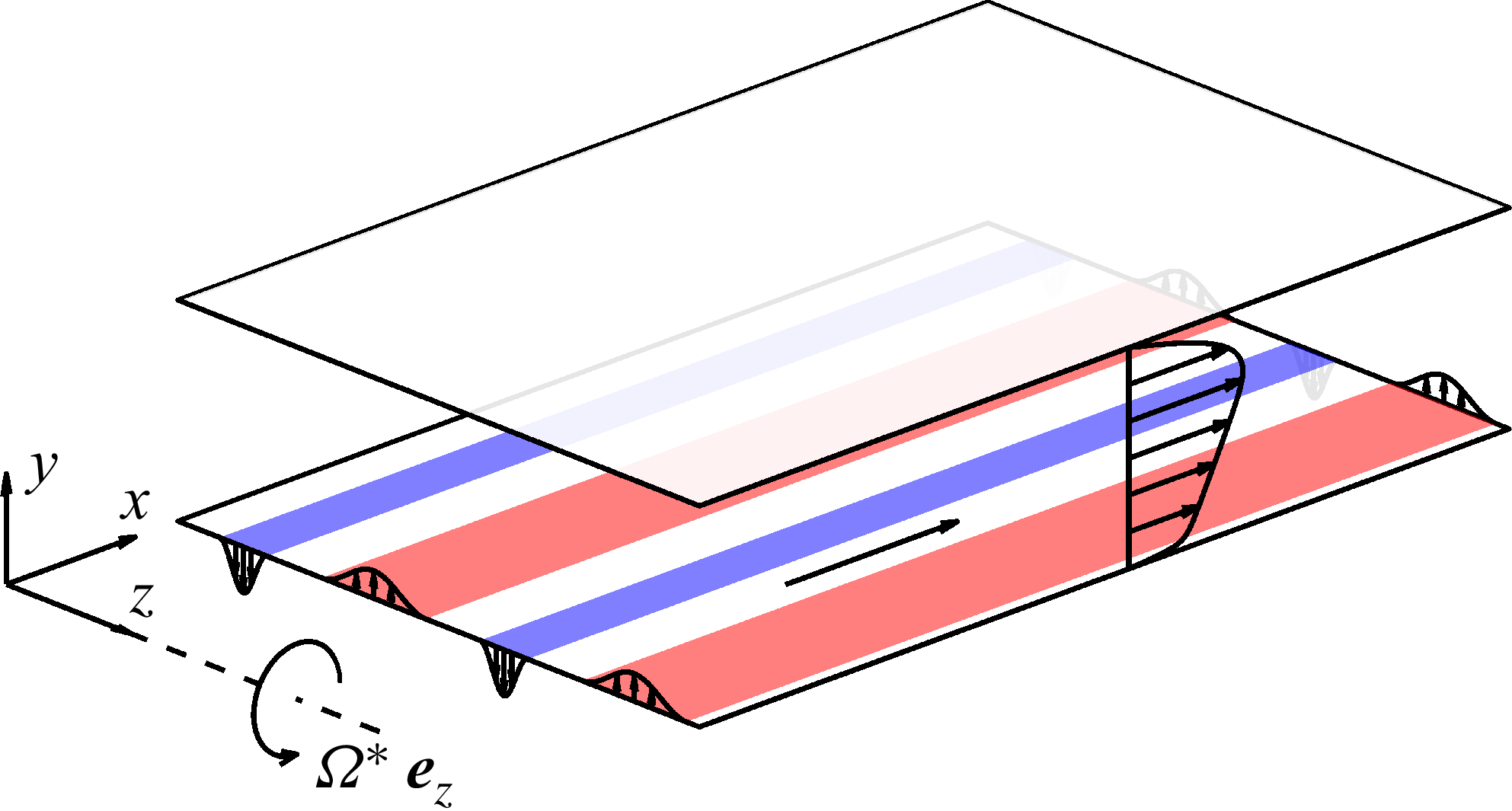
As illustrated in figure 1, we consider a spanwise rotating turbulent channel flow with passive scalar transport. The channel is bounded by two parallel walls at
 $y^*=\pm h^*$
, where
 $h^*$
is the channel half-width. A constant mean pressure gradient
 $-{\rm d}P^*/{\rm d}x^*$
drives the flow in the streamwise (
 $x$
) direction, while the whole system rotates about the spanwise (
 $z$
) axis with a constant angular velocity
 $\varOmega ^*_z$
. The passive scalar
 $\phi ^*$
has fixed values at both walls, namely
 $\phi _B^*$
at the bottom (
 $y^*=- h^*$
), and
 $\phi _T^*$
at the top (
 $y^*=h^*$
). The non-dimensional governing equations for the velocity
 $\boldsymbol{u}=(u_1, u_2, u_3)=(u, v, w)$
and passive scalar
 $\phi =(\phi ^*-\phi _T^*)/(\phi _B^*-\phi _T^*)$
are given by (Zhang et al. Reference Zhang, Xia and Chen2024)
 \begin{align} \begin{aligned} \boldsymbol{\nabla }\boldsymbol{\cdot }\boldsymbol{u}&=0,\\[2pt]\frac {\partial \boldsymbol{u}}{\partial t}+\boldsymbol{u}\boldsymbol{\cdot }\boldsymbol{\nabla }\boldsymbol{u}&=-\boldsymbol{\nabla }\!p+\textit{Re}_{\tau }^{-1}\,{\nabla} ^{2}\boldsymbol{u}-Ro_{\tau }\,\boldsymbol{e}_{z}\times \boldsymbol{u},\\[2pt]\frac {\partial \phi }{\partial t}+\boldsymbol{u}\boldsymbol{\cdot }\boldsymbol{\nabla }\phi &=Pr^{-1}\,\textit{Re}_{\tau }^{-1}{\nabla} ^{2}\phi , \end{aligned} \end{align}
where
 $ \textit{Re}_\tau =u_\tau ^* h^*/\nu ^*$
is the global friction Reynolds number,
 $ \textit{Ro}_\tau =2\varOmega _z^*h^*/u_\tau ^*$
is the rotation number, and
 $ \textit{Pr} =\nu ^*/\kappa ^*$
is the Prandtl number. Here,
 $\nu ^*$
is the kinetic viscosity,
 $\kappa ^*$
is the scalar diffusivity, and
 $u_\tau ^*=\sqrt {-({d}P^*/{d}x^*)(h^*/\rho ^*)}$
is the global friction velocity, with
 $\rho ^*$
being the reference density. Unless otherwise stated, all quantities are non-dimensionalised using
 $h^*$
,
 $u_\tau ^*$
and the scalar difference
 $\phi _B^*-\phi _T^*$
. The boundary conditions feature streamwise-uniform, spanwise-distributed injection and suction slots on the bottom pressure wall. The top wall is stationary and no-slip. The corresponding boundary conditions are prescribed as
 \begin{align} y & =-1:\ \phi =1,\quad \boldsymbol{u}=-V_{s}\boldsymbol{e}_{y}\sum _{k=-\infty }^{\infty }\eta \left (\frac {z-kD}{d_{s}}\right ) +V_{i}\boldsymbol{e}_{y}\sum _{k=-\infty }^{\infty }\eta \left (\frac {z-(k+1/2)D}{d_{i}}\right )\!, \nonumber\\y & =+1:\ \phi =0,\quad \boldsymbol{u}=0. \end{align}
Here,
 $D=2\pi /N_{\kern-1pt J}$
is the spanwise period, representing the distance between the centrelines of two adjacent injection (or suction) slots, with
 $N_{\kern-1pt J}$
being the number of injection (or suction) slots per spanwise interval
 $2\pi$
,
 $V_i$
and
 $V_s$
are the maximum wall-normal velocities for the injection and suction slots, respectively, and
 $d_i$
and
 $d_s$
are the widths of the injection and suction slots. The function
 $\eta (\xi )$
defines the velocity profile of the slots (Zhang et al. Reference Zhang, Xia and Chen2024):
 \begin{align} \eta (\xi )=\begin{cases}\cos ^2(\pi \xi ),& |\xi |\leqslant \frac {1}{2},\\[6pt]0,& |\xi |\gt \frac {1}{2}.\end{cases} \end{align}
Sketch of the three-dimensional RPPF with injection/suction slots at the pressure wall.

Zhang et al. (Reference Zhang, Xia and Chen2024) demonstrated that the optimal improvement in turbulent transport of passive scalar is achieved when the spacing between injection slots aligns with, or slightly exceeds, the intrinsic spacing of two adjacent rising plume currents – a spacing that itself varies with
 $ \textit{Re}_\tau$
and
 $ \textit{Ro}_\tau$
. For instance, at
 $ \textit{Re}_\tau =180$
, the optimal configuration was
 $N_{\kern-1pt J}=2$
for
 $ \textit{Ro}_\tau =5$
, and
 $N_{\kern-1pt J}=3$
for
 $ \textit{Ro}_\tau =10$
. Building on this, the present study primarily examines the situations with
 $ \textit{Re}_{\tau }=180$
,
 $ \textit{Ro}_{\tau }=5$
and
 $N_{\kern-1pt J}=2$
. Here,
 $ \textit{Pr}=1$
is the same as in Zhang et al. (Reference Zhang, Xia and Chen2024), and
 $d_i$
and
 $d_s$
are independently varied over the set
 $\{\pi /8, \pi /6, \pi /4, \pi /3, \pi /2\}$
, leading to two distinct slot distribution strategies, namely the uniform configuration with
 $d_i=d_s$
, and the non-uniform configuration
 $d_i\neq d_s$
. For all cases,
 $V_i$
and
 $V_s$
are adjusted to maintain a root mean square wall-normal velocity
 $v_{\textit{rms},w}=0.1$
on the controlled wall, while ensuring a zero net mass flux. This
 $v_{\textit{rms},w}$
value is less than
 $1\,\%$
of the bulk velocity
 $U_b$
, and is only
 $40\,\%$
of the optimal value (
 $v_{\textit{rms},w}=0.25$
) known to achieve maximum drag reduction via opposition control in non-rotating turbulent channel flows (Chung & Talha Reference Chung and Talha2011; Yao, Garcia & Hussain Reference Yao, Garcia and Hussain2025). We have also investigated examined cases with lower (
 $v_{\textit{rms},w}^2=0.005$
, case R5I8S8-A) and higher (
 $v_{\textit{rms},w}^2=0.02$
, case R5I8S8-B) intensities, with corresponding parameters detailed in Appendix A. The choice
 $v_{\textit{rms},w}^2=0.01$
(
 $v_{\textit{rms},w}=0.1$
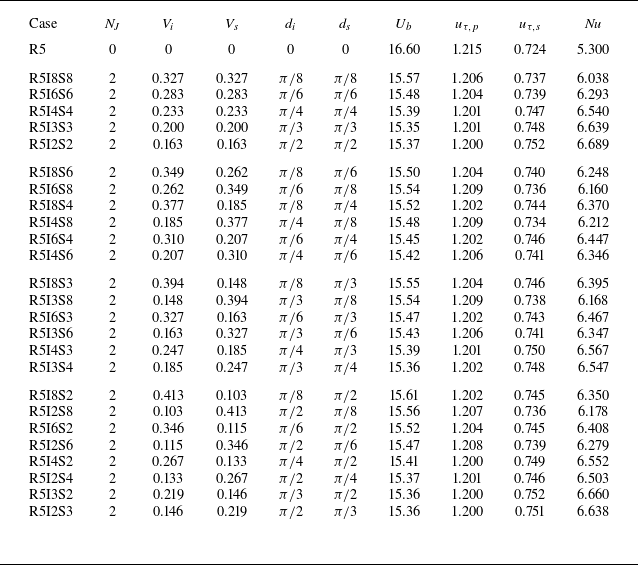
) effectively modulates the large-scale structures without introducing undue disruption of the bulk mean flow, while also enabling direct comparison with the results of Zhang et al. (Reference Zhang, Xia and Chen2024). The detailed control parameters and several response quantities are summarised in table 1. The naming convention for the cases is as follows. The reference case without control is labelled R5. Controlled cases are named ‘RXIYSZ’, where ‘X’ is the value of
 $ \textit{Ro}_\tau$
, and ‘Y’ and ‘Z’ indicate the injection and suction slot widths via
 $d_i=\pi /\text{Y}$
and
 $d_s=\pi /\text{Z}$
, respectively. For example, case ‘R5I3S8’ corresponds to
 $ \textit{Ro}_\tau =5$
(with
 $N_{\kern-1pt J}=2$
),
 $d_i=\pi /3$
and
 $d_s=\pi /8$
.
Details of the DNS cases at
 $ \textit{Re}_{\tau }=180$
,
 $ \textit{Ro}_{\tau }=5$
and
 $ \textit{Pr}=1$
.

The governing equations are solved using AFiD, a well-validated finite difference code (van der Poel et al. Reference van der Poel, Ostilla-Monico, Donners and Verzicco2015). It operates on a staggered grid, employing a second-order central difference scheme for spatial derivatives, and an explicit second-order Adams–Bashforth scheme for time advancement. The pressure Poisson equation is solved using a discrete Fourier transform in the horizontal directions coupled with a tridiagonal matrix solver. We use domain size
 $4\pi \times 2\times 2\pi$
with resolution
 $256\times 192\times 256$
, consistent with previous works (Zhang et al. Reference Zhang, Xia and Chen2022, Reference Zhang, Xia and Chen2024). After a statistically steady state is achieved for each case, the three-dimensional flow field is sampled at intervals
 $\delta t = 0.2$
over total duration
 $50$
time units for statistical analysis. In the following, unless stated otherwise,
 $\langle f\rangle _i$
denotes the ensemble average of a quantity
 $f(x,y,z,t)$
over the index
 $i$
, where
 $i=t,x,y,z$
. For brevity,
 $\langle f\rangle =\langle f\rangle _{t,x,z}$
.
2.2. Characteristics of the injection and suction velocities
For the configuration with
 $N_{\kern-1pt J}=2$
, the maximum injection and suction velocities,
 $V_i$
and
 $V_s$
, depend on the slot widths
 $d_i$
,
 $d_s$
, the spanwise period
 $D=\pi$
and
 $v_{\textit{rms},w}$
. The product of the velocity and width for each slot type is given analytically by
 \begin{align} Q_c=V_i d_i=V_s d_s=v_{\textit{rms},w} \sqrt {\frac {8Dd_i d_s}{3(d_i+d_s)}}= 0.1 \sqrt {\frac {8\pi }{3}\frac {d_i d_s}{d_i+d_s}}. \end{align}
Here,
 $Q_c$
represents the total mass flux injected into the system through the injection slots, which must equal the total mass extracted through the suction slots to satisfy global mass conservation.
Spanwise distributions of the injection and suction velocities
 $v_w(z)$
for different slots configurations: (a) cases of uniform configuration with
 $d_i=d_s$
; (b) typical cases of non-uniform configuration with
 $d_i\neq d_s$
.

Spectrum
 $E_{vv,w}(k_z)$
for different slots configurations: (a) cases of uniform configuration with
 $d_i=d_s$
; (b) typical cases of non-uniform configuration with
 $d_i \neq d_s$
.

Figure 2 shows the spanwise distributions of the wall-normal velocity
 $v_w(z)$
for two distinct slot configurations. In the cases of uniform configuration, i.e.
 $d_i=d_s$
, (2.4) implies
 $V_i=V_s=0.1\sqrt {4\pi /3}/\sqrt {d_i}\sim 1/\sqrt {d_i}$
, i.e.
 $V_i=V_s$
decreases as the slot width increases, as illustrated in figure 2(a) and table 1. Furthermore, the wall velocity
 $v_w(z)$
exhibits period
 $\pi$
and possesses an additional antisymmetry:
 \begin{align} v_w\!\left (z+\frac {\pi }{2}\right )=-v_w(z). \end{align}
In non-uniform configurations with
 $d_i\neq d_s$
,
 $V_i$
and
 $V_s$
differ and depend on specific vallues of
 $d_i$
and
 $d_s$
. Although
 $v_w(z)$
still has period
 $\pi$
, the antisymmetry in (2.5) is broken. However, a related symmetry holds for any two fixed widths
 $d_1$
and
 $d_2$
:
 \begin{align} v_w(z;d_i=d_1,d_s=d_2) =-v_w(z+\pi /2;d_i=d_2,d_s=d_1), \end{align}
as depicted in figure 2(b). For a fixed
 $d_i$
, increasing
 $d_s$
raises
 $V_i$
but reduces
 $V_s$
, and vice versa. To further characterise the differences in
 $v_w(z)$
under different
 $d_i$
and
 $d_s$
, we examine its spectra, defined as
 $E_{vv,w}(k_z) = \langle \hat {v}(k_z)\,\hat {v}^*(k_z) \rangle _{x,t}$
. Here,
 $\hat {v}^*(k_z)$
are the Fourier coefficients of the expansion:
 \begin{align} v_w(z) = \sum _{k_z}\hat {v}(k_z) \, \mathrm{e}^{{\rm i} k_z z}, \quad k_z = \frac {2\pi n}{D}=2n, \quad n \in \mathbb{Z}. \end{align}
By definition, the total energy is conserved:
 \begin{align} \sum _{k_z\geqslant 0}E_{vv,w}(k_z)=\frac {1}{2}\sum _{k_z}E_{vv,w}(k_z)=\frac {1}{2}v^2_{\textit{rms},w}=0.005. \end{align}
Figure 3 presents the spectra
 $E_{vv,w}(k_z)$
of the injection/suction velocities for various configurations. In the cases of uniform configuration (
 $d_i=d_s$
), the antisymmetry defined by (2.5) confines non-zero spectral components to wavenumbers
 $k_z=4m+2$
(where
 $m$
is an integer, taking values
 $0,1,2,\ldots$
), as shown in figure 3(a). As
 $d_i$
increases,
 $E_{vv,w}$
becomes increasingly concentrated in the lower wavenumbers, predominantly at
 $k_z=2$
, followed by
 $k_z=6$
. Notably, the energy in the
 $k_z=2$
mode grows with
 $d_i$
, even though the corresponding peak velocity
 $V_i$
in physical space decreases. The concentration and shift in spectral distribution is evident when comparing different slot widths: for
 $d_i=d_s=\pi /2$
,
 $E_{vv,w}(10)$
is nearly zero, whereas for
 $d_i=d_s=\pi /8$
, visible energy persists at
 $k_z=18$
. For non-uniform configurations with
 $d_i\neq d_s$
, the antisymmetry is broken, and spectral components generally exist at all even wavenumbers
 $k_z=2m$
, as depicted in figure 3(b). While the energy still concentrates preferentially in the
 $k_z=2$
mode, the overall spectral behaviour is more complex, and depends on the specific values of
 $d_i$
and
 $d_s$
. A key observation is that the spectrum
 $E_{vv,w}(k_z)$
is identical for any two cases where the values of
 $d_i$
and
 $d_s$
are swapped. In summary, figure 3 demonstrates that varying
 $d_i$
and
 $d_s$
in fact redistributes energy among different spectral modes.
3. Results
To facilitate the following discussion and provide a quick reference, the key parameters (including injection/suction velocities and slot widths) and performance metrics (e.g.
 $Q_c$
and
 $ \textit{STI}$
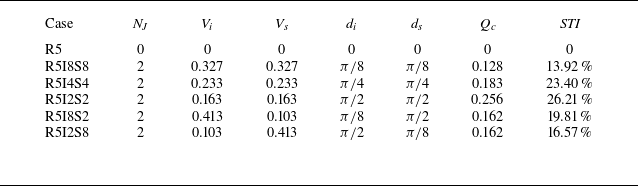
) for the representative cases are summarised in table 2.
Key parameters for representative cases.

3.1. Enhancing passive scalar transport
In the present work, we focus on passive scalar transport. Zhang et al. (Reference Zhang, Xia and Chen2024) demonstrated that injection/suction slot control can effectively enhance large-scale motions and turbulent scalar transport across various
 $ \textit{Re}_\tau$
and
 $ \textit{Ro}_\tau$
when properly configured. For instance, at
 $ \textit{Re}_\tau =180$
,
 $ \textit{Ro}_\tau =5$
,
 $N_{\kern-1pt J}=2$
and
 $d_s=d_i=\pi /8$
, the passive scalar transport was optimally enhanced by 13.9 %, as quantified by the passive scalar transfer increase rate (
 $ \textit{STI}$
):
 \begin{align} \textit{STI} = \frac {\textit{Nu}}{\textit{Nu}_{0}}-1. \end{align}
Here,
 $ \textit{Nu}=-2{d}\langle \phi \rangle /{d}y|_{y=\pm 1}$
is the Nusselt number characterising scalar transport efficiency (Zhang et al. Reference Zhang, Xia and Chen2024), and
 $ \textit{Nu}_0$
is its value for the uncontrolled case. In this study, we find that
 $ \textit{STI}$
can be further increased by varying
 $d_i$
and
 $d_s$
.
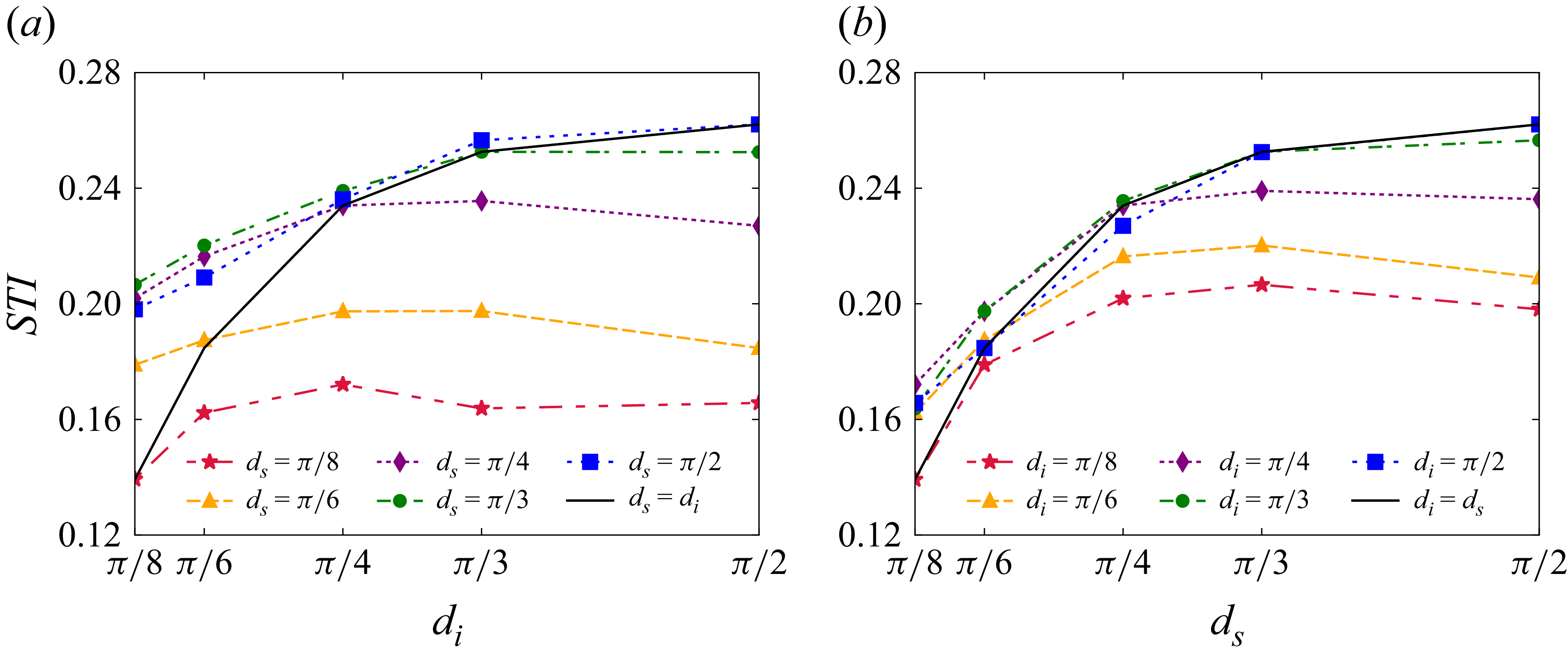
Passive scalar transfer increase rate (
 $ \textit{STI}$
) as a function of (a)
 $d_i$
and (b)
 $d_s$
.

Figure 4 shows
 $ \textit{STI}$
as functions of
 $d_i$
(for fixed
 $d_s$
) and
 $d_s$
(for fixed
 $d_i$
). For uniform slot configurations (
 $d_i=d_s$
), represented by the solid black line,
 $ \textit{STI}$
increases monotonically with the slot width, reaching a maximum of 26.2 % – nearly double the 13.9 % achieved in case R5I8S8. This result is somewhat counterintuitive, as the peak injection/suction velocity decreases with the slot width, suggesting a potentially weaker direct influence on the flow. For non-uniform configurations, the dependence of
 $ \textit{STI}$
on slot widths is more complex. As seen in figure 4(a), for a fixed
 $d_s \leqslant \pi /3$
,
 $ \textit{STI}$
initially increases with
 $d_i$
before declining. In contrast, for
 $d_s = \pi /2$
, the relationship is monotonic increasing. A similar trend is observed when
 $d_i$
is fixed, as displayed in figure 4(b): the dependence is non-monotonic for
 $d_i \leqslant \pi /4$
, with a peak at
 $d_s=\pi /3$
, but becomes monotonic for larger
 $d_i$
(
 $\pi /3$
and
 $\pi /2$
). A direct comparison between figures 4(a) and 4(b) clearly shows that the dependence of
 $ \textit{STI}$
on
 $d_i$
(with
 $d_s$
fixed) differs from its dependence on
 $d_s$
(with
 $d_i$
fixed). This difference precisely illustrates the asymmetry between the effects of injection and suction slots in RPPF.
The present control strategy, employing distinct injection and suction slots, differs from the classical opposition control by incorporating non-transpiration areas where
 $v_w=0$
. For
 $N_{\kern-1pt J}=2$
, the total spanwise length of these non-transpiration areas is
 $L_{z,nt}=L_z- 2(d_i+d_s)$
. Intuitively, one might anticipate that a smaller
 $L_{z,nt}$
– corresponding to a larger overall control area – would yield a higher
 $ \textit{STI}$
. This hypothesis is examined in figure 5(a), which plots
 $ \textit{STI}$
as a function of
 $L_{z,nt}$
. For uniform configurations with
 $d_i=d_s$
,
 $ \textit{STI}$
indeed increases as
 $L_{z,nt}$
decreases, but the rate of increase is not constant. The rise is rapid for
 $L_{z,nt} \geqslant \pi$
, where
 $ \textit{STI}$
jumps from 13.9 % to 23.4 % as
 $L_{z,nt}$
decreases from
 $3\pi /2$
to
 $\pi$
, and becomes more gradual thereafter. The relationship is more complex for non-uniform configurations, where
 $ \textit{STI}$
does not vary monotonically with
 $L_{z,nt}$
. Instead, it exhibits multiple local peaks: a first peak at
 $L_{z,nt}=7\pi /6$
(
 $d_i+d_s=\pi /4+\pi /6$
), a second at
 $L_{z,nt}=5\pi /6$
(
 $d_i+d_s=\pi /4+\pi /3$
), and a third at
 $L_{z,nt}=\pi /3$
(
 $d_i+d_s=\pi /2+\pi /3$
). This complex trend suggests that
 $ \textit{STI}$
is not solely governed by
 $L_{z,nt}$
(equivalent to
 $d_i+d_s$
), but depends on the specific values of both
 $d_i$
and
 $d_s$
. Notably, for any two cases with swapped
 $d_i$
and
 $d_s$
values (
 $d_i \neq d_s$
), the
 $ \textit{STI}$
values differ even though their wall velocity spectra
 $E_{vv,w}(k_z)$
are identical. The configuration with the larger
 $d_s$
consistently yields a higher
 $ \textit{STI}$
, which is generally lower than in the case of uniform configuration with the same
 $L_{z,nt}$
. This fact again demonstrates the distinct, asymmetric influence of injection versus suction slots in RPPF. Interestingly, the variation of
 $Q_c$
with
 $L_{z,nt}$
, depicted in figure 5(b), closely mirrors the behaviour of
 $ \textit{STI}$
: both decrease monotonically for uniform slot configurations, and exhibit peaks at identical
 $L_{z,nt}$
values in non-uniform configurations. This strong correlation suggests a direct influence of
 $Q_c$
on
 $ \textit{STI}$
, which is physically consistent since greater
 $Q_c$
implies enhanced fluid exchange through the control slots. Nevertheless, the detailed
 $ \textit{STI}$
response remains sensitive to the specific values of
 $d_i$
and
 $d_s$
, particularly in non-uniform cases where
 $d_i \neq d_s$
. We believe that this additional response to specific values of
 $d_i$
and
 $d_s$
reflects the intrinsic flow characteristics of RPPF, which will be described and analysed in detail in the subsequent subsections.
Plots of (a)
 $ \textit{STI}$
and (b)
 $Q_c$
as functions of the spanwise length of non-transpiration area
 $L_{z,nt}=L_z-2(d_i+d_s)$
.

3.2. Plumes and plume currents under controls
In Zhang et al. (Reference Zhang, Xia and Chen2022), it was reported that plume-like structures originating from the unstable side coalesce into large-scale plume currents in RPPF, with different current patterns exhibiting varying scalar transport capabilities. These observations inspired the injection/suction slot control strategy proposed by Zhang et al. (Reference Zhang, Xia and Chen2024), who argued that appropriately chosen control parameters could trigger plume separation near the injection slots, thereby stabilising and enhancing specific plume current patterns to substantially enhance scalar transport. In this subsection, we extend this phenomenological argument by analysing how these plumes and plume currents vary under different control strategies – particularly by decoupling the roles of injection and suction slots – to elucidate their effects on the scalar transport increase (
 $ \textit{STI}$
).
Plots of (a,b)
 $E_{vv}(k_z)$
and (c,d)
 $E_{uu}(k_z)$
at
 $y\approx -0.967$
(
 $y^+\approx 6$
) for different cases: (a,c) cases with
 $d_i=d_s$
; (b,d) typical cases with
 $d_i \neq d_s$
.

As illustrated previously in figure 3, varying
 $d_s$
and
 $d_i$
redistributes the energy associated with injection and suction across different spectral modes, with preferential concentration at lower even wavenumbers – specifically, at
 $k_z=4m+2$
when
 $d_i=d_s$
. This spectral preference is maintained in the near-wall region due to the inherent instability of the roll-cells and the limited total kinetic energy available, consistent with the stability analysis of Lezius & Johnston (Reference Lezius and Johnston1976), which indicates flow instability over a wide range of
 $k_z$
at the present parameters. This behaviour is reflected in figures 6(a,b), which display the spanwise energy spectra of wall-normal velocity fluctuations,
 $E_{vv}(k_z;y)=\langle \hat {v}(k_z;y,x,t)\,\hat {v}^*(k_z;y,x,t) \rangle _{x,t},$
evaluated at
 $y \approx -0.967$
(
 $y^+ \approx 6$
). Here,
 $\hat {v}(k_z;y,x,t)$
denotes the Fourier coefficients from the spanwise expansion of
 $v'(x,y,z,t)$
. Compared to the uncontrolled reference case R5, while most modes are attenuated, the selected modes –
 $k_z=4m+2$
for
 $d_i=d_s$
, and
 $k_z=2m$
for
 $d_i\neq d_s$
– are strengthened, particularly at
 $k_z=2$
. Moreover, due to the Coriolis effect, this direct influence of injection/suction control on
 $v'$
similarly selects corresponding modes of
 $u'$
in spectral space, as evidenced by the behaviour of
 $E_{uu}(k_z)$
in figures 6(c,d).
Contours of instantaneous streamwise velocity fluctuations
 $u'$
at the
 $x{-}z$
plane at
 $y\approx -0.967$
(
 $y^+=6$
): (a) R5, (b) R5I8S8, (c) R5I4S4, (d) R5I2S2, (e) R5I2S8, (f) R5I8S2. The black lines show the injection/suction velocity distributions at
 $y=-1$
.

The selective modulation of spectral modes induced by the control strategy is further manifested in the spatial organisation of instantaneous velocity fluctuations. Figure 7 displays contours of
 $u'$
at
 $y \approx -0.967$
(
 $y^+\approx 6$
), illustrating how control alters near-wall coherent structures (see the supplementary movies for dynamic evolution at https://doi.org/10.1017/jfm.2026.11486). In the uncontrolled case (figure 7
a), the flow exhibits characteristic meandering low-speed streaks, randomly distributed in the spanwise direction. The implementation of injection/suction slot control introduces a systematic modification through the Coriolis mechanism, where the term
 $-Ro_\tau \times v$
directly modulates the streamwise velocity component
 $u$
. Negative wall-normal velocity (
 $v\lt 0$
) accelerates fluid parcels in the streamwise direction, while positive
 $v$
causes deceleration, thereby reorganising the streak pattern near the wall. For control of uniform configuration with
 $d_i=d_s$
, as shown in figures 7(b–f), the inherent randomness of low-speed streaks is substantially reduced, particularly within injection zones. Concurrently, the high-speed streaks near the suction regions also become spatially fixed and less random. The spatial extent of these modulated streaks scales directly with the injection/suction slot widths. For the uniform configuration with narrow slots (
 $d_i=d_s=\pi /8$
, case R5I8S8), figure 7(b) shows slender, intense low-speed streaks at injection slots, and corresponding high-speed streaks at suction slots, attributable to higher
 $V_i$
and
 $V_s$
magnitudes. At the non-transpiration region between the injection and suction slots, the low-speed streaks exhibit preferential orientation towards adjacent injection slots, though with greater randomness and reduced intensity compared to directly controlled regions. As slot width increases (see figures 7
c,d), the strength–width trade-off exists, where maintained velocity ratios (
 $V_i=V_s$
) and diminished non-transpiration areas result in wider but weaker streaks due to reduced peak velocities. Non-uniform configurations reveal additional mechanistic insights. While both R5I2S8 and R5I8S2 maintain streak localisation near control slots, as shown in figures 7(e,f), their non-transpiration regions exhibit fundamentally different behaviours. In R5I8S2 with stronger injection and weaker suction (corresponding to smaller
 $d_i$
and larger
 $d_s$
), it produces well-organised streaks that consistently incline towards the adjacent slender strong low-speed streaks caused by the larger
 $V_i$
. Conversely, in R5I2S8 with stronger suction and weaker injection, streaks display enhanced randomness.
Quadrant contributions to the Reynolds shear stress near the pressure wall:
 $Q1\ (u'\gt 0,\ v'\gt 0)$
(yellow),
 $Q2\ (u'\lt 0,\ v'\gt 0)$
(red),
 $Q3\ (u'\lt 0,\ v'\lt 0)$
(green) and
 $Q4\ (u'\gt 0,\ v'\lt 0)$
(blue). (a) Cases of uniform configuration, R5I8S8 and R5I2S2. (b) Cases of non-uniform configuration, R5I8S2 and R5I2S8. The results from the reference case R5 without control are also shown.

To quantitatively characterise the modifications in the near-wall streaks, quadrant analysis (Wallace Reference Wallace2016) is employed to decompose Reynolds shear stress contributions based on the signs of the streamwise (
 $u'$
) and wall-normal (
 $v'$
) velocity fluctuations. The four quadrant events are classified and denoted as
 $Q1\ (u'\gt 0,\ v'\gt 0)$
,
 $Q2\ (u'\lt 0, v'\gt 0)$
,
 $Q3\ (u'\lt 0,\ v'\lt 0)$
and
 $Q4\ (u'\gt 0,\ v'\lt 0)$
, where
 $Q2$
and
 $Q4$
represent ejection and sweep events, respectively, while
 $Q1$
and
 $Q3$
correspond to outward and inward interactions (Wallace Reference Wallace2016). Previous DNS studies by Kristoffersen & Andersson (Reference Kristoffersen and Andersson1993) revealed that in RPPF at
 $ \textit{Ro}_\tau \approx 2.5$
(
 $ \textit{Ro}=0.15$
defined using
 $U_b$
), the Reynolds shear stress is predominantly contributed by
 $Q4$
motions in the immediate near-wall region and
 $Q2$
motions farther from the wall. Compared to the non-rotating case of similar
 $ \textit{Re}_\tau$
, while this general pattern persists, rotation reduces the overall magnitude of quadrant contributions and shifts the crossover point (where
 $Q4$
and
 $Q2$
contributions equalise) closer to the wall – from
 $y^+\approx 17$
at
 $ \textit{Ro}_\tau =0$
, to
 $y^+\approx 13$
at
 $ \textit{Ro}_\tau =2.5$
. In our reference case R5 (
 $ \textit{Ro}_\tau =5$
), these rotation effects are further amplified: quadrant contributions are substantially attenuated, and the
 $Q4$
–
 $Q2$
crossover point moves inwards to
 $y^+\approx 5.5$
, as depicted in figure 8. The implementation of injection/suction slot control consistently alters the quadrant contributions to the Reynolds shear stress near the pressure wall, with variations strongly dependent on
 $d_i$
and
 $d_s$
. Across all controlled cases,
 $Q1$
and
 $Q3$
contributions remain negligible, while
 $Q2$
and
 $Q4$
exhibits significant modifications. For uniform slot configuration shown in figure 8(a), widening the slots from
 $\pi /8$
to
 $\pi /2$
further displaces the
 $Q4$
–
 $Q2$
crossover towards the wall, accompanied by a systematic reduction in
 $Q4$
contributions. Meanwhile,
 $Q2$
contributions display complex behaviour, where they are suppressed in the immediate near-wall region (
 $y^+\lt 5.5$
) for narrow slots with
 $d_i=\pi /8$
, but enhanced farther from the wall (
 $y^+\gt 2$
) when slots are widened to
 $\pi /2$
. Non-uniform configurations, i.e. R5I2S8 and R5I8S2 shown in figure 8(b), produce more distinct quadrant behaviours. In case R5I2S8, characterised by weak injection (small
 $V_i$
) and strong suction (large
 $V_s$
),
 $Q4$
motions dominate near the wall, while
 $Q2$
contributions are suppressed, shifting the crossover point away from the wall. In contrast, in case R5I8S2 with strong injection (large
 $V_i$
) and weak suction (small
 $V_s$
),
 $Q2$
contributions prevail throughout the near-wall region, completely eliminating the
 $Q4$
–
 $Q2$
crossover – a sharp contrast to both the reference case R5 and R5I2S8. These results demonstrate that injection and suction strengths exert competing influences on the organisation of turbulent motions, with injection preferentially enhancing
 $Q2$
(ejection) events, and suction reinforcing
 $Q4$
(sweep) events.
To further elucidate the distinct roles of injection slots, suction slots and the non-transpiration zones, we analyse the zonal-conditional quadrant contributions to the Reynolds shear stress near the pressure wall. They are denoted as
 $\langle u'v'\rangle _{Q,i}/\langle u'v'\rangle$
,
 $\langle u'v'\rangle _{Q,s}/\langle u'v'\rangle$
and
 $\langle u'v'\rangle _{Q,n}/\langle u'v'\rangle$
for quadrant
 $Q$
over injection, suction and non-transpiration regions, respectively. By definition, these satisfy the partition
 \begin{align} \frac {\langle u'v'\rangle _{Q,i}}{\langle u'v'\rangle }\times \frac {2d_i}{L_z}+\frac {\langle u'v'\rangle _{Q,s}}{\langle u'v'\rangle }\times \frac {2d_s}{L_z}+\frac {\langle u'v'\rangle _{Q,n}}{\langle u'v'\rangle }\times \frac {L_{z,nt}}{L_z}=\frac {\langle u'v'\rangle _{Q}}{\langle u'v'\rangle }. \end{align}
Figure 9 presents the zonal-conditional quadrant contributions from
 $Q2$
and
 $Q4$
motions near the pressure wall for representative uniform and non-uniform control configurations. A consistent pattern emerges: within injection slots, fractal contributions from
 $Q2$
motions are generally enhanced, while
 $Q4$
contributions are suppressed. The opposite occurs in suction slots. These observations align with physical intuition: wall injection significantly enhances ejection motions, while suction modifies the near-wall structures to favour sweep events (Sumitani & Kasagi Reference Sumitani and Kasagi1995). Notably, both
 $Q2$
and
 $Q4$
contributions in non-transpiration zones are significantly reduced compared to the uncontrolled case R5, indicating strong non-local influence from adjacent injection and suction slots. For cases of uniform patterns shown in figures 9(a–c), higher slot velocities (
 $V_i$
,
 $V_s$
) in case R5I8S8 yield stronger
 $\langle u'v'\rangle _{Q2,i}/\langle u'v'\rangle$
and
 $\langle u'v'\rangle _{Q4,s}/\langle u'v'\rangle$
than in R5I2S2. However, the actual zonal contributions, denoted by
 $\langle u'v'\rangle _{Q2,i}/\langle u'v'\rangle \times 2d_i/L_z$
and
 $\langle u'v'\rangle _{Q4,s}/\langle u'v'\rangle \times 2d_s/L_z$
, exhibit different trends. Specifically,
 $\langle u'v'\rangle _{Q2,i}/\langle u'v'\rangle \times 2d_i/L_z$
is larger in R5I2S2, while
 $\langle u'v'\rangle _{Q4,s}/\langle u'v'\rangle \times 2d_s/L_z$
appears greater in R5I8S8. This implies a competition mechanism between slot strength and width in near-wall flow modification. In non-uniform configurations shown in figures 9(e,f), significantly enhanced
 $\langle u'v'\rangle _{Q2,i}/\langle u'v'\rangle$
or
 $\langle u'v'\rangle _{Q4,s}/\langle u'v'\rangle$
occur only when
 $V_i$
or
 $V_s$
is sufficiently large. Cases with swapped
 $d_i$
and
 $d_s$
but lower slot velocities show minimal variation due to weaker local forcing. Furthermore, despite identical
 $L_{z,nt}$
,
 $\langle u'v'\rangle _{Q,n}/\langle u'v'\rangle$
decreases more substantially in R5I2S8 than in R5I8S2, underscoring that the effect on non-transpiration zones depends critically on the relative strength of adjacent injection and suction slots.
Zonal-conditional quadrant contributions from the
 $Q2$
and
 $Q4$
motions to the Reynolds shear stress near the pressure wall: (a,d) injection region, (b,e) suction region, (c,f) non-transpiration region. (a–c) Cases of uniform configuration, R5I8S8 and R5I2S2. (d–f) Cases of non-uniform configuration, R5I8S2 and R5I2S8. The results from the reference case R5 without control are also shown.

Fractional contributions of different motions classified using
 $(u',v')$
signals to the turbulent scalar flux
 $\langle v'\phi ' \rangle$
near the pressure wall. (a) Cases of uniform configuration, R5I8S8 and R5I2S2. (b) Cases of non-uniform configuration, R5I8S2 and R5I2S8. The results from the reference case R5 without control are also shown.

In the present study,
 $\phi$
is a passive scalar, which is transported by the turbulent flow field. Experimental observations by Nagano & Tagawa (Reference Nagano and Tagawa1988) in heated turbulent pipe flow revealed that the fractional contributions to the wall-normal turbulent scalar flux
 $\langle v'\phi ' \rangle$
, when classified using
 $(u',v')$
signals, exhibit similar behaviour to those to the Reynolds shear stress
 $\langle u'v' \rangle$
. This analogous trend is maintained in the near-wall region (most profoundly in
 $y^+\lt 30$
), as evidenced by comparing figures 8 and 10, where the latter shows the fractional contributions to
 $\langle v'\phi ' \rangle$
from different quadrant motions based on
 $(u',v')$
signals near the pressure wall in the same four controlled cases and the reference case. Notably, quadrant analysis using the
 $(-\phi ', v')$
signals (not shown) yields qualitatively similar results to those in figure 10, despite minor quantitative deviations away from the wall. These consistent patterns across different signal classifications demonstrate that injection/suction slots on the pressure wall fundamentally modify the dynamics of nearby plume structures.
Building upon the work of Zhang et al. (Reference Zhang, Xia and Chen2022), in which plumes in RPPF coalesce to form large-scale plume currents, we propose that the patterns of these currents can be regulated by adjusting the widths of injection and suction slots. The dynamic behaviour of such currents is illustrated in figure 11, which presents contours of
 $v'(t,z)$
in the
 $t{-}z$
plane with
 $x=0,\ y=-0.3$
at
 $ \textit{Ro}_\tau =5$
. In agreement with Zhang et al. (Reference Zhang, Xia and Chen2024), plume currents without control exhibit continual splitting, merging and spanwise oscillation. In contrast, under control with two pairs of injection and suction slots, only two ascending plume currents persist, oscillating spanwise over time without significant splitting or merging. This confirms that the slots effectively anchor the ascending plumes, suppressing fragmentation and coalescence, and enhancing the stability of the large-scale motions (Zhang et al. Reference Zhang, Xia and Chen2024). Furthermore, as shown in figures 11(b–f), the spanwise oscillation amplitude varies with the values of
 $d_i$
and
 $d_s$
. The largest amplitude occurs in case R5I8S8, while the smallest appears in R5I2S2. Cases R5I2S8, R5I8S2 and R5I4S4 exhibit intermediate amplitudes, showing a progressive reduction in oscillatory magnitude. Thus by selecting appropriate values of
 $d_i$
and
 $d_s$
, the injection and suction slots can further stabilise the large-scale plume motions.
Contours of
 $v'(0, -0.3, z, t)$
in the
 $ \textit{Ro}_\tau = 5$
cases: (a) R5, (b) R5I8S8, (c) R5I8S2, (d) R5I2S8, (e) R5I4S4, (f) R5I2S2. The black dashed lines in (b–f) show the centres of the injection slots.

To further characterise the structural patterns and quantify their dynamics, we employ the modified K-means clustering algorithm introduced by Zhang et al. (Reference Zhang, Xia and Chen2022). Figure 12(a) shows the occurrence probabilities
 $P_N$
for clusters
 $C_N$
across six representative cases, where
 $N$
is the cluster index. Each identified cluster corresponds to a distinct centroid, representing a unique mode of large-scale flow organisation. (The cluster centroids for the six typical cases are provided in the supplementary materials.) Aligning with earlier studies (Zhang et al. Reference Zhang, Xia and Chen2024), the uncontrolled case R5 exhibits five distinct clusters
 $C_N$
(
 $N=1,\ldots ,5$
), with
 $P_N$
decreasing monotonically as
 $N$
increases. In contrast, case R5I8S8 manifests only four clusters, dominated by
 $C_2$
with the highest
 $P_2$
. A sharp increase in
 $d_i$
to
 $\pi /2$
while fixing
 $d_s=\pi /8$
further reduces the cluster number to three, accompanied by a slight rise in
 $P_1$
. On the other hand, suddenly increasing
 $d_s$
to
 $\pi /2$
with fixed
 $d_i=\pi /8$
, or simultaneously widening both
 $d_i$
and
 $d_s$
to
 $\pi /4$
or
 $\pi /2$
, collapses the system into two clusters, with
 $P_1$
rising to approximately 0.6. The distinct clustering outcomes between cases R5I8S2 and R5I2S8 again highlight the asymmetric influence of injection and suction slots in RPPF. Moreover, the reduction in the number of identified clusters (from
 $5$
to
 $2$
) and the rise in
 $P_1$
for cases with the same cluster count provide a quantitative measure of large-scale flow stabilisation. According to the modified K-means algorithm (Zhang et al. Reference Zhang, Xia and Chen2022), fewer clusters and a higher probability for the dominant cluster imply reduced oscillation in the large-scale motions.
Beyond altering cluster count and occurrence probabilities, the control strategy also modifies the scalar transport capacity of each cluster. This is quantified in figure 12(b) through
 $J_N=\langle \langle v'\phi '\rangle _N\rangle _{y}$
, where
 $J_N$
represents the wall-normal average of
 $\langle v'\phi '\rangle _N$
– the conditionally averaged scalar flux within the cluster
 $C_N$
. Figures 12(c) and 12(d) further depict the wall-normal distributions of
 $\langle v'\phi '\rangle _{C_1}$
and
 $\langle v'\phi '\rangle _{C_2}$
, respectively. Compared to the reference case R5, all controlled cases exhibit a significant enhancement of
 $\langle v'\phi '\rangle _{C_1}$
and
 $\langle v'\phi '\rangle _{C_2}$
within the bulk region, in both the magnitude and spatial extent of the nearly constant scalar fluxes. The most pronounced improvement occurs in case R5I2S2, consistent with the statistical results shown in figure 12(b).
Results of clustering analysis: (a) occurrence possibilities
 $P_N$
of clusters
 $C_N$
, (b)
 $J_N=\langle \langle v'\phi '\rangle _N\rangle _{y,z}$
, (c)
 $ \langle v'\phi '\rangle _{C_1}$
and (d)
 $\langle v'\phi '\rangle _{C_2}$
.

3.3.
Decomposition of
 $ \textit{STI}$
based on clustering results

We now establish the connection between
 $ \textit{STI}$
and the K-means clustering results. For passive scalar transport in RPPF,
 $ \textit{Nu}$
can be expressed as (Brethouwer Reference Brethouwer2018; Zhang et al. Reference Zhang, Xia and Chen2024)
 \begin{align} Nu=1+Pr\,\textit{Re}_\tau \int _{-1}^1\langle v'\phi '\rangle\, {\rm d}y. \end{align}
Through K-means clustering analysis, the integral scalar flux decomposes into
 \begin{align} \int _{-1}^1\langle v'\phi '\rangle\, {\rm d}y=\sum _{N}P_N\times J_N. \end{align}
Combining these expressions yields
 \begin{align} \textit{STI}=\frac {\textit{Pr} \textit{Re}_{\tau }}{\textit{Nu}_0}\left [\sum _{N=1}^5(P_{N}-P_{N,0})\times J_{N,0}+\sum _{N=1}^5P_{N}\times (J_N-J_{N,0})\right ]\!, \end{align}
where
 $P_{N,0}$
and
 $J_{N,0}$
correspond to the reference case R5 with
 $ \textit{Nu}_0$
held constant. For consistent comparison, we maintain the same number of clusters as in R5, setting
 $P_M=0$
and
 $J_M=0$
for
 $M\gt N_r$
, where
 $N_r$
is the actual identified cluster number. The two terms on the right-hand side of (3.5) are designated as
 $ \textit{STI}_1$
and
 $ \textit{STI}_2$
, representing distinct physical mechanisms:
 $ \textit{STI}_1$
quantifies the contribution from changes in cluster occurrence probabilities weighted by the passive transport capacities
 $J_{N,0}$
from the reference case, while
 $ \textit{STI}_2$
captures the effect of modifications in scalar transport capacities weighted by the cluster occurrence probabilities
 $P_N$
from the controlled case.
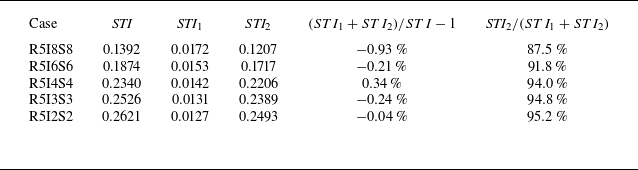
As summarised in table 3 for five cases of uniform configuration, the relative error between both sides of (3.5) remains below
 $1\,\%$
, with similar accuracy in other cases, consistent with the mathematical exactness of the derivation apart from minor numerical truncation. A key finding is the dominant contribution of
 $ \textit{STI}_2$
, accounting for over
 $87\,\%$
of the total
 $ \textit{STI}$
. This indicates that the improvements in scalar transport efficiency within clusters primarily drive the overall performance gain in
 $ \textit{STI}$
.
Terms in (3.5) from the five cases of uniform configuration.

Contributions to terms on the right-hand side of (3.5) from each cluster for the five controlled cases: (a)
 $( {(P_{N}-P_{N,0})\times J_{N,0}})/{Nu_0}$
, (b)
 $({P_{N}\times (J_N-J_{N,0})})/{Nu_0}$
.

Further analysis of individual cluster contributions, as shown in figure 13, reveals that increases in
 $P_1$
and
 $P_2$
are compensated by reductions of
 $P_3{-}P_5$
(see figure 13
a). Combined with the
 $J_{N,0}$
distribution, this cancellation results in the minimal
 $ \textit{STI}_1$
values listed in table 3. Conversely,
 $ \textit{STI}_2$
comes mainly from the first two clusters, since
 $P_N$
is small or zero for
 $N\geqslant 3$
in the controlled cases (see figure 12
a). Figure 13(b) shows that enhanced passive scalar transport capabilities (
 $J_N-J_{N,0}\gt 0$
) in these first two clusters lead to positive contributions to
 $ \textit{STI}_2$
. Cases R5I4S4, R5I8S2 and R5I2S2 exhibit particularly strong enhancement in
 $C_1$
, with higher
 $P_1$
and
 $(J_1-J_{1,0})$
values driving their superior
 $ \textit{STI}_2$
and
 $ \textit{STI}$
performance. Although cluster
 $C_2$
contributions remain consistent across cases considered, the comparatively weaker
 $C_1$
enhancements in R5I8S8 and R5I2S8 explain their lower
 $ \textit{STI}_2$
and
 $ \textit{STI}$
values.
Based on the preceding analysis, especially related to (3.5), a fundamental conclusion emerges: effective control strategies must promote the formation of more stable large-scale motions, which are accompanied by higher scalar transport capacities. Enhanced stability can be manifested both qualitatively, through reduced oscillation of ascending plume currents shown in the contours of
 $v'(t,z)$
, and quantitatively, via a reduction in cluster count and an increase in the occurrence probabilities of dominant clusters identified by the modified K-means clustering algorithm (Zhang et al. Reference Zhang, Xia and Chen2022). The combined effect of greater large-scale motion stability and the associated improvement in the passive scalar transport capability of dominant clusters ultimately leads to higher values of
 $ \textit{STI}$
. Therefore, stabilising large-scale motions represents an effective mechanism for enhancing passive scalar transport in RPPF.
4. Discussions
In this section, we discuss the control mechanism with distinct injection and suction slot widths. While Zhang et al. (Reference Zhang, Xia and Chen2024) proposed that injection promotes plume separation near the slots, which thereby enhances the self-sustaining process of plume currents (Zhang et al. Reference Zhang, Xia and Chen2022) and strengthens large-scale motions, our analysis refines this view. We demonstrate that suction slots also play a critical role beyond mere mass conservation, actively participating in flow modulation.
The efficacy of an injection slot is governed by
 $Q_c$
, which consists of two competing factors: its strength
 $V_i$
, which dictates the capability to induce plume separation, and its width
 $d_i$
, which defines the spatial extent of influence. These parameters, related through (2.4), collectively determine the slot’s ability to enhance the self-sustaining dynamics of large-scale plume currents. Similarly, a suction slot’s strength
 $V_s$
and width
 $d_s$
govern its potential to suppress plumes separation and restrain large-scale structure formation. However, when injection and suction slots are properly configured, both injection and suction can synergistically enhance the self-sustaining process of large-scale plume currents, with their combined effect modulated by their relative properties and separation distance (characterised by the
 $L_{z,nt}$
).
In uniform slot configurations,
 $V_i=V_s\sim 1/\sqrt {d_i}$
, meaning that slot strength decreases more slowly than width increases. Concurrently,
 $L_{z,nt}=L_z-2(d_i+d_s)=L_z-4d_i$
diminishes with widening slots. The above dual effects reinforce the self-sustaining process of large-scale plume currents, producing more stable large-scale motions. This is evidenced by the reduced cluster number and increased
 $P_1$
values in our K-means clustering analysis, explaining the monotonic
 $ \textit{STI}$
increase with slot width.
Sketches illustrating the formation of large-scale motions for two cases with swapped
 $d_i$
and
 $d_s$
values (
 $d_i\neq d_s$
). In the schematics, thick solid red arrows denote the ascending large-scale plume currents, while blue dashed arrows pointing downwards represent descending currents. Near the unstable (pressure) wall, unfilled red arrows indicate plumes or plume-like structures, while unfilled blue arrows illustrate suction-induced flow that promotes the aggregation of plumes around injection slots. Horizontal dashed arrows with gradient colour indicate the flow motions adjacent to the upper wall. A black dashed line in the upper channel marks the boundary between the stable and unstable sides. (a) For
 $d_s\gt d_i$
: stronger, narrower injection slots actively enhance the self-sustainment of plume currents, while the corresponding wider, weaker suction slots exert minimal disruptive influence on the flow. (b) For
 $d_s\lt d_i$
: stronger, narrower suction slots suppress the separation of adjacent hot plumes, whereas the weaker, wider injection slots provide only limited enhancement to plume current self-sustainment.

Non-uniform slot configurations introduce additional complexity, arising from competing strength–width trade-offs in both injection and suction slots, their inter-slot interactions, and the effects of
 $L_{z,nt}$
. Consequently,
 $ \textit{STI}$
exhibits a non-monotonic dependence on
 $d_i$
and
 $d_s$
. Notably, for any two cases with swapped
 $d_i$
and
 $d_s$
values (
 $d_i \neq d_s$
),
 $L_{z,nt}=L_z-2(d_i+d_s)$
remains identical, yet the flow organisation differs substantially. The underlying physical mechanism, as sketched in figure 14, is as follows. In the uncontrolled RPPF, as discussed in Zhang et al. (Reference Zhang, Xia and Chen2022), plume-like structures are generated primarily near the pressure wall, organising into rising plume currents. Meanwhile, the descending branches of the associated large-scale circulation lack active plume support, rendering the self-sustaining process of the streamwise rolls relatively weak, and leading to oscillations of the spanwise-unevenly distributed rolls (Kristoffersen & Andersson Reference Kristoffersen and Andersson1993). Localised wall-normal injection at selected spanwise locations on the pressure wall promotes plume separation and causes plumes to aggregate at these sites. This anchors plume clustering and strengthens the ascending branches of the large-scale circulation. The corresponding wall suction stabilises the motion by reinforcing the descending branches. However, if suction is too strong or localised, then it intensifies near-wall sweep (
 $Q4$
) events (see figure 8
b), suppresses plume separation, and disrupts the updrafts necessary to sustain the circulation (see supplementary movie 5). In contrast, wider, weaker suction distributes the downward momentum over a broader spanwise extent, supporting the large-scale cycle without interfering with plume generation. This dynamic explains why a configuration with stronger, narrower injection slots (larger
 $V_i$
, smaller
 $d_i$
) actively enhances plume current self-sustainment, while its complementary wider, weaker suction slots (smaller
 $V_s$
, larger
 $d_s$
) exert minimal disruptive influence. Conversely, stronger, narrower suction slots suppress nearby plume separation, while weaker, wider injection slots provide only limited enhancement in plume current self-sustainment. Consequently, the case with smaller
 $d_i$
and larger
 $d_s$
consistently generates more stable large-scale motions, which are manifested as fewer clusters and a higher
 $P_1$
value, resulting in the observed superior
 $ \textit{STI}$
performance.
5. Conclusions
This study demonstrates that spanwise-distributed injection/suction slots applied on the pressure wall provide an effective method for enhancing scalar transport in RPPF. Direct numerical simulations were conducted at
 $ \textit{Re}_\tau =180,\ Ro_\tau =5,\ Pr=1$
and
 $N_{\kern-1pt J}=2$
, with
 $d_i$
and
 $d_s$
independently varied over
 $\{\pi /8, \pi /6, \pi /4, \pi /3,\pi /2\}$
, encompassing both uniform (
 $d_i=d_s$
) and non-uniform (
 $d_i\neq d_s$
) configurations. The results reveal that
 $ \textit{STI}$
grows monotonically with slot width in uniform configurations, achieving a maximum of 26.2 %. Conversely, non-uniform configurations exhibit a more complex dependence, where
 $ \textit{STI}$
varies non-monotonically when
 $d_i$
or
 $d_s$
is small, and transitions to monotonic growth when
 $d_i$
or
 $d_s$
is large. Furthermore, among cases with swapped
 $d_i$
or
 $d_s$
values (
 $d_i\neq d_s$
), configurations with larger
 $d_s$
consistently yield higher
 $ \textit{STI}$
.
Several analytical methods were employed to establish the causal chain through which wall transpiration stabilises large-scale motions and ultimately enhances passive scalar transport in RPPF. Spectral analysis of the control velocity and near-wall fluctuations reveals that varying the slot widths
 $d_i$
and
 $d_s$
redistributes the injection/suction energy, concentrating it preferentially at lower even wavenumbers. This spectral selectivity persists into the near-wall region, systematically altering the velocity fluctuations – a change visualised in instantaneous near-wall structures, and quantified via classical and zonal-conditional quadrant analysis. These near-wall modifications subsequently influence the ascending plume currents, leading to more stable large-scale motions. The stabilisation is evidenced both qualitatively, in the temporal evolution of wall-normal velocity contours away from the wall (
 $v'(0, -0.3, z, t)$
), and quantitatively, through K-means clustering results that show a reduction in cluster count and a rise in the occurrence probability of the dominant cluster. Finally, a mathematically exact decomposition of
 $ \textit{STI}$
based on the clustering outcomes confirms that the performance gains originate primarily from enhanced scalar transport efficiency within individual clusters, evidenced by the increased occurrence probabilities and improved transport capacities of the dominant clusters.
Building on the present findings, this work also confirms the fundamental asymmetry between injection and suction within RPPF. This is demonstrated by the distinct dependence of
 $ \textit{STI}$
on
 $d_i$
and
 $d_s$
, and by the observation that non-uniform configurations with larger
 $d_s$
consistently yield higher
 $ \textit{STI}$
among cases with swapped values of
 $d_i$
and
 $d_s$
. These results contribute to a deeper fundamental understanding of slot-based flow control in RPPF.
Future work should extend this analysis to broader parameter spaces, including higher rotation and Reynolds numbers, and varying control intensities, in order to further validate the identified mechanisms. A preliminary investigation, provided in Appendix B, indicates that the current control strategy remains effective and robust under low-to-moderate rotation numbers. However, control efficacy nearly diminishes at
 $ \textit{Ro}_\tau =30$
compared to lower rotation cases – consistent with the observations of Zhang et al. (Reference Zhang, Xia and Chen2024) – highlighting a limitation of the present approach. Furthermore, data-driven optimisation frameworks, such as deep reinforcement learning, could be integrated to further enhance heat transfer efficiency. Finally, experimental validation would be valuable for substantiating these numerical findings.
Supplementary material and movies
Supplementary material and movies are available at https://doi.org/10.1017/jfm.2026.11486.
Acknowledgements
The authors acknowledge the use of DeepSeek for assistance in improving the grammar, clarity and readability of the manuscript. The tool was used solely for language refinement, and did not contribute to the generation of research content, analysis or interpretation. The use was conducted in October 2025 and January 2026.
Funding
This work was supported by the National Natural Science Foundation of China (grant nos 92152101 and U25A6006).
Declaration of interests
The authors report no conflict of interest.
Appendix A. Influence of forcing intensities
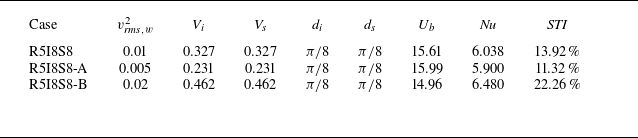
This appendix evaluates control performance of three forcing intensities:
 $v_{rms}^2=0.005, 0.01, 0.02$
. The primary numerical parameters in this work are inherited from Zhang et al. (Reference Zhang, Xia and Chen2024) to enable a direct comparison. Their results demonstrate that even a weak wall-normal transpiration – with intensity two orders of magnitude smaller than the mean flow – can effectively enhance large-scale motions in RPPF. To further justify the selection of the baseline intensity, we examined cases with lower (
 $v_{{rms},w}^2 = 0.005$
, case R5I8S8-A) and higher (
 $v_{{rms},w}^2 = 0.02$
, case R5I8S8-B) values. The corresponding parameters are summarised in table 4. The results reveal a positive correlation between control effectiveness and the net transpiration flow rate
 $Q_c=v_{\textit{rms},w}{ \sqrt { ({8Dd_i d_s})/{(3(d_i+d_s))}}}$
, with larger
 $Q_c$
yielding a more pronounced enhancement of
 $ \textit{STI}$
. At
 $v_{\textit{rms},w}^2=0.005$
(R5I8S8-A), a control effect is still observed, but the associated
 $ \textit{STI}$
is lower than for the baseline case R5I8S8. Conversely, for case R5I8S8-B (
 $v_{{rms},w}^2 = 0.02$
), the control effect becomes stronger, albeit accompanied by a more pronounced modulation of the bulk mean velocity. In summary, the baseline intensity
 $v_{\textit{rms},w}^2=0.01$
(
 $v_{\textit{rms},w}=0.1$
) was chosen because it effectively enhances
 $ \textit{STI}$
without introducing excessive reduction of the bulk mean flow, while also permitting direct comparison with the results of Zhang et al. (Reference Zhang, Xia and Chen2024).
Details of the DNS cases at
 $ \textit{Re}_{\tau }=180,\ Ro_{\tau }=5,\ N_{\kern-1pt J}=2$
and
 $ \textit{Pr}=1$
with different
 $v_{\textit{rms},w}$
.

Appendix B. Preliminary investigation on different rotation numbers
In their study, Zhang et al. (Reference Zhang, Xia and Chen2024) demonstrated that streamwise uniform, spanwise equally distributed injection/suction slots at the pressure wall – with
 $d_i=d_s=\pi /8$
– effectively enhance turbulent scalar transport at small to moderate rotation numbers for
 $ \textit{Re}_\tau =180$
. The optimal
 $N_{\kern-1pt J}$
was found to be
 $2$
for
 $ \textit{Ro}_\tau =2$
, and
 $3$
for
 $ \textit{Ro}_\tau =10$
. Although
 $N_{\kern-1pt J}=3$
also remains optimal at
 $ \textit{Ro}_\tau =30$
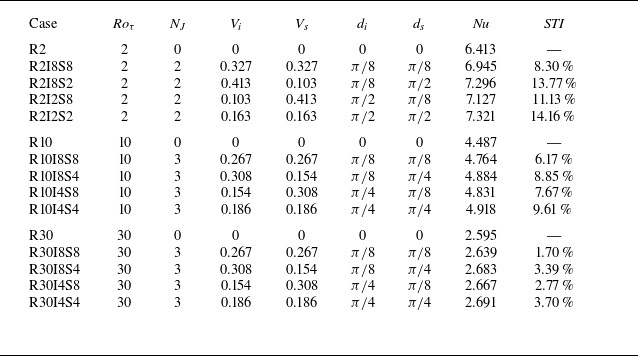
, its effect is comparatively weaker than at lower rotation numbers. In this appendix, we conduct a preliminary investigation across different rotation numbers. Results for
 $ \textit{Ro}_\tau =2, 10, 30$
under their respective optimal
 $N_{\kern-1pt J}$
with varying
 $d_i$
and
 $d_s$
are summarised in table 5. The findings indicate that
 $ \textit{STI}$
can be further increased by widening
 $d_i$
and
 $d_s$
, with the highest
 $ \textit{STI}$
occurring at
 $d_i=d_s=\pi /2$
or
 $\pi /4$
. Notably, for non-uniform configurations with swapped
 $d_i$
and
 $d_s$
values, the case with a larger
 $d_s$
consistently yields a higher
 $ \textit{STI}$
. These results confirm that the current control strategy remains effective and robust at low-to-moderate rotation numbers, where the largest
 $ \textit{STI}$
can reach as high as 14.16 % and 9.61 % for
 $ \textit{Ro}_\tau =2$
and 10, respectively. In contrast, control efficacy diminishes significantly at
 $ \textit{Ro}_\tau =30$
, with the highest
 $ \textit{STI}$
reaching only 3.7 % – thereby highlighting a limitation of the present approach. Consequently, developing optimised control strategies specifically tailored for high rotation numbers will be a key focus of future work.
Details of the DNS cases at
 $ \textit{Re}_{\tau }=180$
and
 $ \textit{Pr}=1$
for different
 $ \textit{Ro}_\tau$
.

Appendix C. Influence of velocity profiles for injection and suction slots
This appendix specifically addresses the choice of velocity profile used in our simulations. In our main DNS, we adopted a
 $\cos ^2$
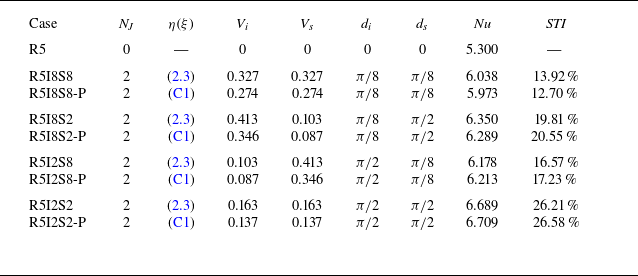
profile to ensure numerical smoothness and enable a direct comparison with the results of Zhang et al. (Reference Zhang, Xia and Chen2024). Although a parabolic profile is more common for simple experimental slots – typically laminar due to the low slot-width-based Reynolds number and implementable via a micropump – we expect the precise shape of the velocity profile to have a negligible influence on the control outcomes. To verify this expectation, we conducted four additional DNS cases using a parabolic profile, defined by the shape function
 $\eta (\xi )$
:
 \begin{align} \eta (\xi )=\begin{cases}1-4\xi ^2,& |\xi |\leqslant \frac {1}{2},\\[9pt]0,& |\xi |\gt \frac {1}{2}.\end{cases} \end{align}
The simulation parameters and corresponding
 $ \textit{STI}$
results are summarised in table 6. These results confirm that the proposed control strategy remains effective under a parabolic velocity distribution, yielding
 $ \textit{STI}$
values comparable to those obtained with the
 $\cos ^2$
profile. Although differences in
 $ \textit{STI}$
across the two profiles are less than
 $1.3\,\%$
in all cases, the overall trend is consistent: R5I2S2-P produces the highest
 $ \textit{STI}$
, R5I8S8-P the lowest, while R5I8S2-P and R5I2S8-P lie in between, with R5I8S2-P exhibiting slightly better performance. Thus we conclude that the fundamental control mechanism remains unchanged for the parabolic velocity profile, which is moreover more feasible for experimental implementation.
Details of the DNS cases at
 $ \textit{Re}_{\tau }=180$
,
 $ \textit{Ro}_\tau =5$
and
 $ \textit{Pr}=1$
for
 $\cos ^2$
and parabolic velocity profiles.