Introduction
Functional outcome deficits are common in patients with schizophrenia. 1-5 Many previous studies have shown that clinical and neurological symptoms such as extrapyramidal symptoms are associated with functional impairment. 6-18 Recently, much more attention has been paid to cognitive impairment because it is a core feature of schizophrenia.Reference Kraus and Keefe 19 , Reference Green and Harvey 20 Some studies have indicated that many cognitive domains are related to functional outcomes in patients with schizophrenia. 21-23 Moreover, cognitive function might explain approximately 20% to 60% of the variance in functional outcome, and it may be a stronger predictor than clinical symptoms.Reference Green, Kern, Braff and Mintz 22 , Reference Velligan, Mahurin, Diamond, Hazleton, Eckert and Miller 24 , 25 Our recent studies have indicated that antipsychotics are related to cognitive function in patients with schizophrenia. 26-31
Optimal management of schizophrenia requires adequate symptom control and avoidance of relapse and rehospitalization. Unfortunately, relapse and rehospitalization are common, with an estimated ≥80% of patients experiencing a relapse during their first 5 years of treatment.Reference Robinson, Woerner and Alvir 32
To determine whether cognitive impairment is associated with the number of hospitalizations to seek nearly equal recurrences of psychosis, this cross-sectional retrospective study grouped patients by the number of experienced hospitalizations. We hypothesized that the number of hospitalizations would be inversely correlated with cognitive function, so poorer neuropsychological test results would be found in patients with more hospitalizations than in patients with fewer hospitalizations.
Methods
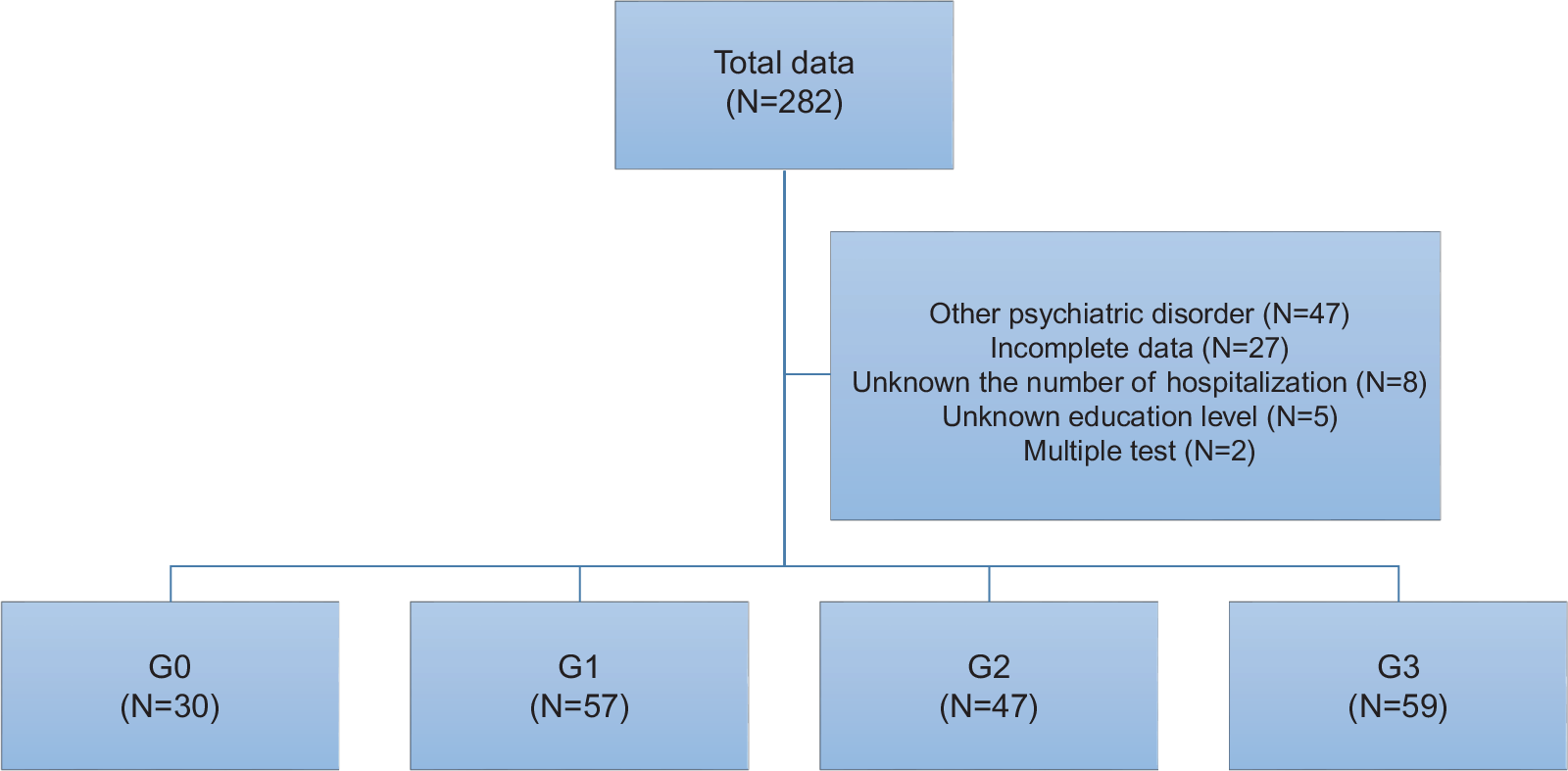
A retrospective chart review was conducted at the Department of Psychiatry, University Hospital of Occupational and Environmental Health, Japan. Cognitive tests were conducted at the University Hospital from April 2009 to December 2016 for 282 patients who had been diagnosed with some psychiatric disorders. We excluded 47 patients because they displayed other psychological conditions without schizophrenia. Schizophrenia and other psychiatric disorders were diagnosed according to the Diagnostic and Statistical Manual of Mental Disorders, 4th Edition criteria. All schizophrenia patients reported having nonexacerbated symptoms for at least 6 months, which was confirmed by clinical record review. We also assessed characteristics including age, gender, number of past admissions, onset, education level, duration of illness (DOI), antipsychotic dosage, and benzodiazepine dosage. We evaluated the Clinical Global Impressions-Severity of Illness (CGI-S) retrospectively to assess the severity of schizophrenia symptoms. The patients were divided into four groups according to the number of hospitalizations. Fifty-seven patients had experienced only one hospitalization (G1), 47 patients had two hospitalizations (G2), and 59 patients had three or more hospitalizations (G3). Thirty patients who had not experienced any hospitalizations (G0) were also included as a control group.
For analysis purposes, the antipsychotics and benzodiazepine doses were converted into an equivalent dose of chlorpromazine and diazepam,Reference Inada and Inagaki 33 respectively. Figure 1 describes the study flow.
Study flow chart.

The Ethics Committee of the University of Occupational and Environmental Health approved the study protocols.
Brief Assessment of Cognition in Schizophrenia, Japanese-language version
Trained psychiatrists assessed the patients’ cognitive functions using the Brief Assessment of Cognition in Schizophrenia, Japanese-language version (BACS-J).Reference Kaneda, Sumiyoshi, Keefe, Ishimoto, Numata and Ohmori 34 The BACS-J is designed to measure the cognitive function of people with schizophrenia; it has an established reliability and validity. The metric includes brief assessments of verbal memory, working memory, motor speed, verbal fluency, attention and processing speed, and executive function. The primary measures from each subtest of the BACS-J were standardized by creating z-scores. All healthy control data were obtained from the study by Kaneda et al.Reference Kaneda, Sumiyoshi, Nakagome, Ikezawa and Ohmori 35 The influence of age was adjusted using age-matched controls to calculate the BACS-J z-score for each patient with schizophrenia in the present study.
Statistics
All statistical analyses were performed using Statistical Package for Social Science (SPSS). For categorical variables, data are presented as frequencies and proportions, and Fisher’s exact test was used for comparisons between groups. For continuous variables, data are presented as the mean and standard deviation when assuming normality, and a one-way analysis of variance was performed for all groups. When assuming non-normality, data were presented as the median and interquartile range, and the Kruskal–Wallis test was performed for all groups. The Mann–Whitney U test was used when comparing two groups. Bonferroni’s method was used to correct for multiple comparisons. An analysis of covariance (ANCOVA) was performed with sex, education, antipsychotic dosage, and benzodiazepine dosage as covariates. We determined the estimated marginal means and standard error controlling for the effects of covariates in addition to a test of covariate effects. We also calculated the P values of tests to determine whether there were differences in the mean number of hospitalizations adjusted for the effects of covariates for all groups. We performed tests for the two individual groups for the number of hospitalizations and calculated the effect size (ES) of differences in mean values.
Results
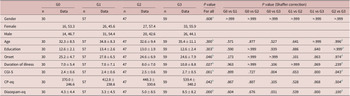
Table 1 shows the demographics and clinical variables of the four groups. All subjects were Japanese, and 91 men and 102 women were included.
Study Demographic Data

Data indication; n, %; mean ± standard deviation; median (interquartile range; IQR [25%,755]).
Abbreviation: CGI-S, Clinical Global Impressions-Severity of Illness.
a Fisher’s exact test (for all).
b ANOVA.
c Kruskal–Wallis test.
d Fisher’s exact test (Shaffer correction).
CGI score was higher in G3, compared to G0, G1, and G2. Moreover, G3 had received a higher benzodiazepine dosage than G1 and G0.
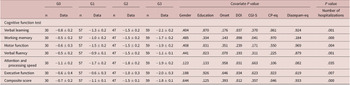
Table 2 shows the performance of each of the BACS-J tests. Low performance in attention and processing speed was associated with long DOI. Executive function was associated with a high chlorpromazine equivalent. Moreover, working memory was associated with low CGI-S.
BACS-J Results

Data indication; n, %; mean ± standard deviation. Analysis: ANCOVA was performed with each cognitive function test as a dependent variable, number of hospitalizations as the main factor, and gender, education, onset, DOI, CGI-S, CP-eq, and BZ-eq as covariates. The adjusted mean value and standard error for each number of hospitalizations are displayed, and the P values for the main factor and covariates are displayed.
Abbreviation: CGI-S, Clinical Global Impressions-Severity of Illness; DOI, duration of illness; CP-eq, chlorpromazine equivalent; BZ-eq, diazepam equivalent.
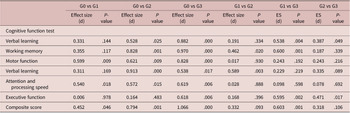
Table 3 shows the differences between groups and the ES for the differences. When comparing the groups in the ANCOVA, significant differences in cognitive performance were found between G0 and G1 in motor function (P = .009; ES = 0.60), attention and processing speed (P = .018; ES = 0.54), and composite score (P = .046; ES = 0.45). G2 cognitive score more poorly than G0, with deficits in verbal memory (P = .025; ES = 0.53), working memory (P = .001; ES = 0.83), motor function (P = .009; ES = 0.62), verbal fluency (P < .001; ES = 0.91), attention and processing speed (P = .015; ES = 0.57), and composite score (P = .001; ES = 0.794). G3 showed a greater range of impairment than G0, with deficits in verbal memory (P < .001; ES = 0.882), working memory (P < .001; ES = 0.97), motor function (P < .001; ES = 0.83), verbal fluency (P < .017; ES = 0.54), attention and processing speed (P < .006; ES = 0.62), executive function (P = .006; ES = 0.62), and composite score (P < .001; ES = 1.07). Significant differences in cognitive performance were found between G1 and G2 in working memory (P = .02; ES = 0.46) and verbal fluency (P = .003; ES = 0.59). G3 performed more poorly than G1, with deficits in verbal memory (P = .004; ES = 0.54), working memory (P = .001; ES = 0.60), executive function (P = .002; ES = 0.595), and composite score (P = .001; ES = 0.60). Finally, G3 showed a greater range of impairment than G2, with deficits in verbal learning (P = .049; ES = 0.39), and executive function (P = .017; ES = 0.471).
Differences in Cognitive Performance Between the Four Groups

Discussion
The aim of this study was to determine the relationship between the number of hospitalizations (which partially reflects the number of recurrences) in schizophrenia patients and their neurocognitive performance. To date, we have found no studies whose aim was specifically to determine the effect that the number of hospitalizations has on cognitive functions. We found that cognitive functions related to verbal memory, working memory, verbal fluency, and executive function markedly worsened as the number of hospitalizations increased. Conversely, attention, processing speed, and motor function were not influenced by the number of hospitalizations. These results suggest that the number of hospitalizations is specifically associated with some cognitive impairments, which was mainly evidenced by deficits in verbal memory, working memory, verbal fluency, and executive function. Some studies are supported by our findings of an association between relapse/multi-episode and cognitive impairment in schizophrenia. 36-40 The previous study from the 5-year follow-up where numbers of relapses within the first 5 years after onset were significantly related to a decrease in the verbal learning over time. Conversely, subjects with no recurrent episodes did not experience this decline. Based on the findings in the study of Barder et al,Reference Barder, Sundet and Rund 36 a long-term interaction between symptomatology and neurocognition appears to be present already 1 year after treatment initiation. Therefore, psychotic relapse early on in the illness serves as the most potent prediction of neurocognitive deterioration over time. Relapse has a major negative impact on patients with schizophrenia and is associated with a worse prognosis, worse cognitive function, risk of injury to self and others, risk of hospitalization, decreased quality of life and self-esteem, and a reduced ability to regain previous levels of health, functioning, and support.Reference Taylor, Chaudhry and Cross 41 , Reference Almond, Knapp, Francois, Toumi and Brugha 42 Relapse and rehospitalization can have devastating clinical consequences that are likely to be of much greater significance than some possible antipsychotic drug-mediated reduction in gray matter. Indeed, relapse and rehospitalization are themselves also associated with greater brain tissue loss.Reference van Haren, Hulshoff Pol and Schnack 43 , Reference Andreasen, Liu, Ziebell, Vora and Ho 44 These effects might be responsible for the worsening cognitive function in these patients.
Patients with G0 performed significantly better on the attention and processing speed and motor function, compared to the G1, G2, or G3. Moreover, these two domains were not influenced by the number of hospitalizations. This result may impair motor function and attention and processing speed with psychotic symptoms requiring hospitalization, however, another hospitalization may not have a significant impact. Attention and processing speed are thought to be core domains in cognitive dysfunction in people with schizophrenia. 45-47 Burton et al showed that symbol coding that best predicted the speed of processing was the best predictor of overall cognitive performance.Reference Burton, Vella, Harvey, Patterson, Heaton and Twamley 45 The current study suggests that attention and processing speed and motor function might not affect the number of hospitalizations.
The present study has some limitations. First, the present study is cross-sectional. Second, the sample size is small. Therefore, further research with a large sample size is necessary, as are observational studies. Third, the retrospective collection of risk factors is subject to recall bias and other biases. However, our data showed proportions of current stable schizophrenia that were similar to other studies. Fourth, we did not assess the duration of untreated illness, frequency and time of exacerbations occurrence, and psychiatric or physical comorbidity that may affect cognitive function. We did not separate between first-episode psychosis and first hospitalization with previous sub/clinical episodes that may also affect cognitive function. Moreover, we did not collect neuroimaging data, biological marker, and genetic data. This research might be greatly implemented by adding these data. Finally, we had limited control of both pharmacological and nonpharmacological effects in relation to neurocognitive functioning. The results in previous studies are inconclusive. Improvements in cognitive functioning have sometimes been associated with positive medication effects.Reference Keefe, Seidman and Christensen 48 , Reference Zhang, Gallego, Robinson, Malhotra, Kane and Correll 49 Nonetheless, there are also some studies that have not found an effect of medication on the cognitive course,Reference Dickerson, Schroeder and Stallings 50 , Reference Klingberg, Wittorf, Sickinger, Buchkremer and Wiedemann 51 or that effects have varied by type of medication and personal factor.Reference Hori, Yoshimura and Katsuki 26 , Reference Hori, Yoshimura and Katsuki 28 , Reference Hori, Yoshimura, Katsuki and Atake 52 However, in the present study, we controlled for a variable comprising medication dosage only using CP-equivalent. Stable clinical symptoms remained significant after this control, indicating that medication has not been a significant confounder. We also lacked sufficient data to define the effects of antidepressants, mood stabilizers, benzodiazepine, anticholinergic, and other medications. Other studies showed nonpharmacological treatment, including cognitive remediation therapy and exercise may improve the cognitive function in schizophrenia.Reference Radhakrishnan, Kiluk and Tsai 53 , Reference Firth, Stubbs and Rosenbaum 54
Conclusions
This study was retrospective in nature, we could not determine what type of influence the number of hospitalizations had. However, the current study may be evaluating the indirect influence of the worsening of psychiatric symptoms that led to hospitalization, in other words, recurrence and relapse.
Acknowledgments
Dr. Keisuke Ohta helped to collect the data.
Disclosures
Hikaru Hori, Kiyokazu Atake, Asuka Katsuki, and Reiji Yoshimura do not have any conflicts of interest to disclose.
Funding
Supported by a grant from the Ministry of Education, Culture, Sports, Science, and Technology Japan (No. 17K16406) to Hikaru Hori.