Introduction
This is the second part of a series of articles, which deals with the genetic aspects of piglet losses and the maternal behaviour of sows. In the first part, the survival rate (84.3%) and different causes of piglet losses were analysed. The fertility traits, number of piglets born alive, number of piglets born in total, stillborn piglets and the individual birth weight were investigated and their relationship to the survival rate and the different causes of piglet losses were evaluated. The estimated heritabilities for the survival rate (h 2 = 0.03) and the different causes of piglet losses (h 2 = 0.01 to 0.08) were at a low level. Especially, the very low additive genetic variances indicated that selection directly against the different causes of piglet losses would not be successful (Hellbrügge et al., 2008). Therefore, better knowledge about the maternal behaviour of the sows and factors that improve the farrowing environment would be helpful.
The main function of the maternal behaviour is to minimise neonatal piglet losses (Barnett et al., Reference Barnett, Hemsworth, Cronin, Jongman and Hutson2001). Pedersen et al. (Reference Pedersen, Damm, Marchand-Forde and Jensen2003) concluded that the responsiveness of the sow for her piglets is an indicator of good maternal care. The newborn piglets are completely dependent on the sow for access to colostrum and milk, but at the same time the sow contributes the greatest risk factor to their health and welfare (Grandinson et al., Reference Grandinson, Rydhmer, Strandberg and Thodberg2003).
In the 1960s, farrowing crates were introduced to reduce the risk of crushing (Wechsler and Hegglin, Reference Wechsler and Hegglin1997). However, the advantage due to the restriction of the sow’s movements to protect her offspring is also a disadvantage for the sows’ welfare and natural maternal behavioural attitudes. Therefore, research was started early to develop alternative farrowing systems (Baxter, Reference Baxter1991; Phillips and Fraser, Reference Phillips and Fraser1993; Schmid, 1993). But especially in loose-housed sows, piglet mortality tends to be a great problem (Damm et al., Reference Damm, Forkman and Pedersen2005). However, the decrease in piglet losses is an important factor in improving economic success in pig production, e.g. the number of piglets weaned (Röhe and Kalm, Reference Röhe and Kalm2000). Hence, it is becoming more and more important that sows respond to the signals of their piglets and behave carefully (Grandinson, Reference Grandinson2005). Signoret et al. (Reference Signoret, Baldwin, Fraser and Hafez1975) described that some sows were more responsive to the squeals of their piglets than others, so the particular problem has been important since a lot of years.
The objective of this second paper was to evaluate traits to characterise the maternal ability of sows. All of these traits should be easy to record with low extra-time and work consumption and therefore be recordable under production conditions to be possible selection criteria in pig breeding. The improvement in maternal behaviour should lead to increased piglet survival and therefore to better animal welfare.
Material and methods
Data
Litter Information
Starting from January 2004 until December, data were recorded in a closed nucleus herd of the breeding company ‘Hülsenberger Zuchtschweine’ by one person. A total of 943 Landrace sows with 1538 purebred litters from 82 sires were used. The sows were housed in farrowing crates diagonally ordered with 20 sows per compartment. All farrowing pens were of homogeneous type with a dimension of 2.74 m × 1.75 m. They were managed in a 1-week rhythm with a 21-day lactation period. Nearly 1 week before the calculated farrowing date, the sows entered the farrowing units. Between gestation and farrowing unit, the sows were washed in a separate room in normal routine work for hygiene and health reasons. After washing, the sows were penned up in the farrowing compartments with 20 sows per compartment, ordered by the calculated farrowing date. Sows from five successive housing groups formed one farrowing batch. The sows were fed according to litter size and appetite during lactation.
Litter traits
Thirteen thousand nine hundred and seventy one live-born piglets from 1349 litters were weighed individually and earmarked within the first 24 h after birth. Piglets that were mummified, stillborn and born alive were counted and the sex of live-born piglets was noted. Piglets that died were weighed on their day of death and the cause of death was determined visually. The weight of the piglets was also recorded at the age of 21 days. Special explanatory notes on the condition of their bodies were made, such as anomalies, injuries or even a physical observation and 10% of the piglets were cross-fostered. Age, nurse sow and the weight at cross-fostering were also documented for these piglets. Further information about the litter information is given in Part 1 of this article (Hellbrügge et al., 2008).
Behaviour in groups. Aggression in groups (AGGR)
Leaving the gestation centre for farrowing, the pregnant sows were routinely washed in groups. During gestation, the sows were individually penned. The washing-centre is a separated room with space for two groups with normally five sows per group. One person was inside the group to wash the sows and the observer stood outside the pens and could observe both groups at the same time. The observing period started when all sows of one group were in the washing pen and ended with the first sow leaving the pen. During washing, some sows behaved aggressively towards other sows. These attacks were scored in three classes as 1 = sporadic attacks, 2 = several, hard attacks and 3 = biting of other sows in the vulva. Due to the low number of observations, the three classes were treated as one, creating a binary trait with 1 = the sow showed aggressive behaviour towards other sows and 0 = no aggressive behaviour. For group behaviour 1220 appraisals were made and 18% of the sows showed aggressive behaviour towards other sows.
Behaviour traits during lactation
Several traits to characterise the maternal ability of sows were developed during the period of lactation: the sow’s reaction to the separation from her piglets at two different times (during the first 24 h after birth and approximately on day 21, always before weaning), the sow’s reaction to a screaming piglet and to an unknown noise (pop-music). All observations of behaviour traits were performed by the same person.
Separation test
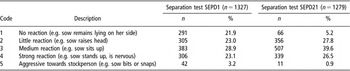
During the first 24 h after birth and approximately at day 21 before weaning, the sow’s maximum response to the separation from her litter was registered when the piglets were weighed. The sow’s body position was recorded twice per each test in four ordered categories: (1) lying on her side; (2) lying on her belly; (3) sitting; or (4) standing. The first observation was made at the start of each test, just before the piglets were picked up and the second was made at the end of each separation test, when all piglets were back beside the dam. The sow’s maximum response during the test was evaluated in these four ordered categories and coded as given in Table 1. In some cases, there was also a reaction to the stockperson who took the litter away. This reaction was only noted if the sow wanted to bite the stockperson (Code 5). The distribution and percentage of these behavioural codes are given in Table 1.
Description, frequency (n) and percentage (%) of the behavioural code levels in separation tests SEPD1 and SEPD21

Reaction to sounds
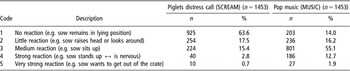
The reaction of the sow towards a piglet distress call and the reaction towards an unknown noise were analysed using a scream and music tests (SCREAM and MUSIC). When the last sow in one compartment had farrowed, a hi-fi unit was introduced into the compartment and the loudspeakers were placed in the central corridor. The sows had approximately 2 h time to accustom themselves to the hi-fi unit in the middle of the compartment before the test began. During this time, normal routine work was also carried out. The test was performed during a rest period when all 20 sows were calm and lying. For the test, the observer entered the compartment very quietly and went to the hi-fi unit. If one sow sat or stood up during entering, the test was stopped and again started at least half an hour later. In the scream test, a piglet’s distress call was played back from a cassette for approximately 30 s and the strongest reaction of the sows was noted down in five ordered categories as described in Table 2. After the scream test, the sows had at least half an hour time to calm down again. Next, the music test was performed. Popular music (‘Love Me’ by ‘The Cardigans’) was played for the same period of time and loudness as in the scream test. The reaction was also scored in five ordered categories (Table 2). Because of the lying position of all sows at the beginning of the test, no correction for the position at beginning had to be done.
Description, frequency (n) and percentage (%) of the behavioural code levels in scream (SCREAM) and music (MUSIC) tests

Statistical analysis
Analysis of fixed effects
A farrowing batch was defined as a group of sows that farrowed within the same period of time, scored according to the order of mating date and therefore order of compartment (eight classes). The fixed effect of the parity was divided into seven classes, where parities one to six were individual classes and all parities higher than or equal to seven were in the seventh class.
For all behavioural traits, the fixed effects of the farrowing batch and the parity of the sow were used. Furthermore, the fixed effect of days between farrowing and the test date in eight classes was assessed for the traits SCREAM and MUSIC. For a better allocation, the behavioural code levels 4 und 5 were combined in the statistical analysis. The significance of fixed effects and their interactions were tested with the MIXED procedure from the statistical software SAS (SAS, 2004).
Variance components and genetic correlations
The categorical dataset of the four classes in the behavioural tests during lactation was analysed using a multiple-ordered animal threshold model in which the residual variance was set equal to 1 (Sorensen et al., Reference Sorensen, Andersen, Gianola and Korsgaard1995). The Bayesian analysis of the posterior distributions of the permanent environmental variance and the additive variance for the liability were determined by Gibbs sampling algorithm implemented in the LMMG_MTH program, which is a derivative of LMMG (Reinsch, Reference Reinsch1996) for multiple ordered thresholds. The Gibbs-Sampler was applied as a single, long-chain scheme and the sampler ran 500 000 rounds. The results from each round were retained and the first 100 000 iterations were discarded as burn-in plus safety. The remaining iterations were used to estimate the variance components. Convergence was determined by visual inspection of the trace plots and the effective chain length was always above 200.
Analysing the binary dataset of AGGR, a single threshold animal model was applied. (LMMG_TH program, which is a one-threshold derivative of LMMG (Reinsch, Reference Reinsch1996)) The sampler ran 300 000 iterations where the first 50 000 iterations were discarded (burn-in plus safety).
The software LMMG is for univariate estimations only, so the genetic correlations are estimated with a linear model bivariately (VCE 4, Neumaier and Groeneveld, Reference Neumaier and Groeneveld1998). According to Gianola (Reference Gianola1982), the estimates for the genetic correlation are appropriate.
Results
Behaviour
Behaviour in groups
The primiparous sows showed a significant (P < 0.05) lower level of aggressiveness in the group (AGGR). In relation to the higher number of primiparous sows in the dataset, only 8.58% of them were aggressive. The level of aggression increased with increasing parity up to parity three, then remained relatively equal and showed the highest level in parity six. The estimated heritability was h 2 = 0.32 (Table 3).
Variance components (±s.e.) and repeatability (t) for the behavioural traits

σ 2a = additive genetic variance; σ 2sow = random permanent effect of sow; t = repeatability; σ 2e = was set equal to 1.
Behavioural traits during lactation
On average, the sows were more responsive on SEPD21 than in the other tests. The calmest response was shown by the sows in the SCREAM test. In the SEPD1, SCREAM and MUSIC behavioural tests, the primiparous sows showed the highest activity. Only in the SEPD21 test did the primiparous sows present the lowest response and the response increased slightly up to parities five and six.
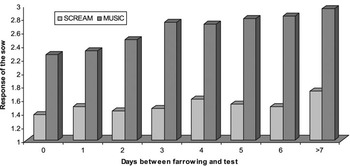
The response in SCREAM and MUSIC increased with the distance to the farrowing date up to day 3 in the MUSIC test and to day 4 in the SCREAM test (Figure 1). On average, the sows heard the sounds 4.06 days after parturition, where only 6.51% of the sows heard the tests on their day of parturition. Between the respective day and 1 week, the level of response was nearly equal, but sometime later the reactivity in MUSIC also increased.
Relation between the reaction of the sow in the scream (SCREAM) and music (MUSIC) tests and the day of testing.

In separation tests, the heritabilities ranged from h 2 = 0.06 to 0.09, whereas the heritabilities for SCREAM and MUSIC were higher (h 2 = 0.13 to 0.14). Lowest heritability and additive genetic variance were estimated for SEPD21. The random permanent effect of the sow was higher than the additive genetic effect, except for SCREAM. The highest repeatability was estimated for the reaction towards an unknown noise (t = 34.7%). Despite nearly equal environmental factors, the repeatability for SCREAM was the lowest (Table 3).
Correlations between the behavioural traits
Between the aggressive behaviour in groups and the traits of the separation test, positive genetic correlations were calculated, where the correlation with SEPD1 was the highest. More aggressive sows were also more responsive in SEPD1 and SEPD21. With SCREAM and MUSIC, negative relations were estimated so that more aggressive sows in the group were less responsive to noises (Table 4).
Genetic correlations above and phenotypic correlations below the diagonal within the behavioural traits

Despite relatively standardised environmental conditions, the genetic correlation between SCREAM and MUSIC was only at a moderate level with r g = 0.48. The correlation between the SEPD1 and the reaction to the piglet’s distress call was nearly zero and between SCREAM and SEPD21, the genetic correlation was at the height of the standard error, so that the relation between these traits is only loose. High genetic correlations were found between the traits of separation test and also between these two traits and MUSIC. The phenotypic correlations were all at a low level, especially between the separation tests and SCREAM and MUSIC test.
Correlations between litter size, piglet losses and behaviour
Correlations between the litter and the behavioural traits
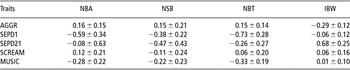
The genetic correlations between the number of piglets born alive and the traits SEPD1 and MUSIC were negative. This implicates that more-reactive sows had fewer piglets born alive in their litters. The correlation between the number of piglets born alive and SEPD21 was nearly zero. Only for AGGR and SCREAM was a low but positive genetic correlation estimated, but the correlations were indifferent as they were only within the range of the standard error. Between the behaviour traits during lactation and the number of stillborn piglets, all correlations were negative (r g = −0.11 to −0.47) so that more active and responsive sows had fewer stillborn piglets. With AGGR, a positive correlation was estimated. The correlations between the behaviour traits and the individual birth weight of the piglets were all at a low level and within the range of the standard errors, except SEPD21 on which a high correlation (r g = 0.68) was estimated. In early lactation, it could be suggested that there is no relation between these traits (Table 5).
Genetic correlations (±s.e.) between the number of piglets born alive (NBA), number of stillborn piglets (NSB), number of total born piglets (NBT) and the individual birth weight (IBW) and the behavioural traits aggressiveness in the group (AGGR), separation test on the day of birth (SEPD1) and on day 21 (SEPD21), reaction towards a piglet’s distress call (SCREAM) and towards pop music (MUSIC)

Correlations between the causes of piglet losses and behavioural traits
The correlations between the behavioural traits evaluated during lactation and the survival rate were positive (r g = 0.08 to 0.44) (Table 6). This indicated that more-reactive sows had fewer piglet losses. Also the aggressive sows in the group showed a tendency towards a positive relation to the survival rate whereas less-aggressive sows had a higher survival rate of their piglets in the subsequent litter.
Genetic correlations (±s.e.) between the survival rate (SR), crushing (CRUSH), crushing early (CRUSH_E), crushing of heavier piglets (CRUSH_H), underweight (UW) and runting (RU) and the behavioural traits aggressiveness in the group (AGGR), separation test on the day of birth (SEPD1) and on day 21 (SEPD21), reaction towards a piglet’s distress call (SCREAM) and towards pop music (MUSIC)

*No standard error available due to convergence problems.
Sows that were more reactive on SEPD1 crushed more of their piglets during the first 3 days of lactation and also lost less heavy piglets. The correlation between SEPD21 and crushing as well as crushing early was negative and very low; with the trait crushing of heavier piglets the relations were at a higher level, giving a hint that more-responsive sows on SEPD21 lost fewer of their piglets due to crushing, especially less-heavy piglets. Aggressive sows in the group crushed more piglets and the crushing occurred mostly in later lactation. The correlation of runting with SEPD1 was moderately negative, with the later trait SEPD21, the correlation was at a higher level and also negative.
Discussion
Behaviour
Behaviour in groups
The parity had a significant influence on the aggressiveness of sows in the group. Primiparous sows were less aggressive. These sows had the lowest body mass and were therefore more likely to lose a fight with an older, heavier sow. This phenomenon is quite common when a hierarchy in group-housed sows has been established (Vermeer, 1999; Brooks, 2003; Thibault, 2004). Further, Van Erp-van der Kooij (2003) concluded from her results regarding the coping styles of pigs that the dominance of sows had an important role in the level of aggression. Before testing, the sows were kept individually so that the sows had no ability to fight for the leading position. Washing of the sows provoked an additional stress factor and aggression occurred perhaps because of anxiety. Regarding the coping style theory, highly resistant animals represent a coping style that favours the fight/flight reaction. Van Erp-van der Kooij (2003) showed that these animals were more likely to show aggressive behaviour. Løvendahl et al. (2003 and Reference Løvendahl, Damgaard, Nielsen, Thodberg, GuoSheng and Rydhmer2005) analysed the level of aggression in newly grouped sows by counting the number of given and received attacks, but without management work that provokes an additional stress factor. The authors concluded that aggressive attacks made by a sow clearly showed genetic variation and they estimated heritabilities of intermediate size for mild and hard attacks (h 2 = 0.21 and 0.30, respectively), which corresponds to the value estimated in this study. Nevertheless, the results between studies were hardly comparable due to the different recording schemes. Investigations implementing the recording of data in routine work were very rare. The estimated variance components indicated that a binary trait was also adequate to handle this trait. The trait was easy to record, sufficiently heritable and could be implemented simply in management routines.
Behavioural traits during lactation
Despite the highly standardised environment, the estimated heritabilities for the behavioural traits during lactation were in the range given in the literature (Grandinson et al., Reference Grandinson, Rydhmer, Strandberg and Thodberg2003; Løvendahl et al., 2003; Vangen et al., Reference Vangen, Holm, Valros, Lund and Rydhmer2005; Gäde et al., Reference Gäde, Bennewitz, Kirchner, Looft, Knap, Thaller and Kalm2008). The number of observed animals is quite large for a behavioural study, since all records were of only 1 year and observed by one person. The implementation of behavioural tests in addition to routine work may reduce the attention given to the behavioural notes, but this will also happen under field conditions. Grandinson et al. (Reference Grandinson, Rydhmer, Strandberg and Thodberg2003) and Løvendahl et al. (2003) evaluated separation from sow and litter also under similarly normal management conditions. Grandinson et al. (Reference Grandinson, Rydhmer, Strandberg and Thodberg2003) calculated the differences between body position at the beginning and end of the test, and the estimated heritability was h 2 = 0.01 with very little variation in the piglet handling test ( = 0.005;
 = 0.009). Løvendahl et al. (2003) provoked an instant scream and simulated a handling situation. The estimated heritability was h 2 = 0.14 (
 = 0.14;
 = 1.08).
In separation tests, the sows were less responsive to a separation from their litter in the first 24 h after birth as on SEPD21, shortly before weaning. This might not be a sign of low bonding but rather reflects the physical situation of the sow after the parturition of the litter or even being tired by fever. Especially primiparous sows were unfamiliar with the routines during lactation and hence showed perhaps a more protective style (Knap and Merks, Reference Knap and Merks1987).
The estimated heritability for SCREAM test was higher than given by Grandinson et al. (Reference Grandinson, Rydhmer, Strandberg and Thodberg2003) with h 2 = 0.06. In both studies, the sows were lying before the test started and in both studies the maximum response of the sows was assessed. One explanation for the lower heritability could partly be the environmental factors due to the recording of data on seven farms in the Swedish situation and further that in the present study all sows heard the noise only once. The authors also reported that the most common reaction in their screaming piglet test was just to look for the sound. Further they also found an increasing activity of the sows in the days after parturition.
Some previous studies proved the reaction of sows towards other noises such as a calling bird (Wechsler and Hegglin, Reference Wechsler and Hegglin1997; Held et al., Reference Held, Mason and Mendl2006) or grunts from nursing sows or even the shed noises (Hutson et al., Reference Hutson, Wilkinson and Luxford1991). These authors stated that the sows were more likely to react to the playback of a piglet’s distress call and showed significantly shorter lying duration than with the other noises. Nevertheless, in the present analysis, the sows reacted more strongly to music than to the piglet’s distress call. The sows were totally unfamiliar with any music and the most common reaction was to sit up and to look around for the noise. Such an uncommon noise was chosen to exploit the full range of possible reactions. Additionally, the ‘known noise’ of a screaming piglet was played back first to reduce the risk of mixing behavioural attitudes. Older sows not only were more familiar with several noises but also these sows were more likely to have problems with leg disorders and parturition problems.
The correlations between AGGR and the traits SEPD1 and SEPD21 showed that aggressive sows in the group were more responsive towards the separation from their litters, especially on the day of birth. Whether this behaviour could be associated with a protective instinct of the sow or even could be explained by the coping style theory has to be proven in further investigations. The aggressive sows were less responsive to noises (r g = −0.12 and r g = −0.30, respectively). Especially the relatively high correlation with MUSIC would oppose the coping style theory. The sows would also be more anxious and would therefore react more strongly in the MUSIC test. Løvendahl et al. (2003 and Reference Løvendahl, Damgaard, Nielsen, Thodberg, GuoSheng and Rydhmer2005) reported a negative correlation between the body reaction of the sows towards the separation from their piglets and the mild and severe attacks in the group (r g = −0.82 and r g = −0.36, respectively). The topic that aggressive behaviour is heritable (Løvendahl et al., Reference Løvendahl, Damgaard, Nielsen, Thodberg, GuoSheng and Rydhmer2005) could be confirmed but the conclusion that selection against aggressive behaviour in the group would lead to increased maternal response could not be supported in general in this study.
The genetic correlations between SEPD1, SEPD21 and MUSIC indicated that these behavioural tests measured the same dimensions of personality and therefore had the same genetic background. A weird sound that is not clear for the dam, whether it is dangerous or not, might activate the protective instinct as well as a person picking up her piglets. In the SCREAM test, there was no hint for the sow that her piglets were threatened by somebody or something from outside; hence, most of the sows did not react. In conclusion, the correlations suggest that different behavioural tests activated different patterns of behaviour.
Correlations between litter size, piglet losses and behaviour
In general, all behavioural traits during lactation showed positive correlations with the survival rate of piglets. This indicates that more-reactive sows had fewer piglet losses, which is confirmed in the literature (Wechsler and Hegglin, Reference Wechsler and Hegglin1997; Grandinson et al., Reference Grandinson, Lund, Rydhmer and Strandberg2002; Grandinson et al., Reference Grandinson, Rydhmer, Strandberg and Thodberg2003). More-responsive sows in the behavioural tests during lactation also had a lower number of stillborn piglets. These sows were not only more responsive in behavioural tests but also these sows may be more active and perhaps may have had unproblematic births or better body conditions. Furthermore, all correlations between the behavioural traits and being underweight were positive, suggesting that calmer sows around parturition lost fewer runts since the highest proportion of underweight piglets died during the first 3 days of life.
The number of piglets born alive or in total is one of the most common selection criteria in pig production. An improvement in the maternal behaviour should not have negative influences on this trait. Regarding the genetic correlations, a selection for the behavioural traits SEPD1 and MUSIC showed favourable correlations with the survival of piglets but would adversely affect the number of piglets born alive or in total. Also, Andersen et al. (Reference Andersen, Berg and Boe2005) reported that sows that did not crush any of their piglets within one lactation showed a more protective mothering style but also had lower litter size. Furthermore, SEPD1 exhibited the greatest risk that the sows’ reaction was influenced by their health and constitution. It could be suggested that feverish sows or sows with postnatal disorder would react less than if they were healthy. Therefore, SEPD1 and MUSIC could not generally be commended for genetic evaluations.
The three behaviour traits AGGR, SCREAM and MUSIC showed nearly no relations towards the number of piglets born alive as the estimated correlations were low and only within the range of their standard errors. In the analysis of a questionnaire on the maternal behaviour of the sows, no negative influence on the number of piglets born alive was estimated either (Gäde et al., Reference Gäde, Bennewitz, Kirchner, Looft, Knap, Thaller and Kalm2008). However, especially for AGGR, the correlation with the number of piglets born alive has to be proven in further investigations. If the correlation could be confirmed, a selection for increased litter size at birth would lead to sows being more aggressive towards other pigs, which would be undesirable. Against the background of changes in the housing of swine, the requirement of pigs being capable of ‘teamwork’ increased. The trait is sufficiently heritable and easy to record, benefiting animal welfare.
SCREAM showed no negative effect on the number of piglets born alive and also no effect on the survival rate. Being more responsive in a test situation towards a piglet’s distress call reflected perhaps also a general behavioural pattern of becoming nervous when being confronted with the squeals from underweight piglets and this might lead to losing more of them.
The lowest heritability of all behavioural traits was evaluated for SEPD21 as the sows were also more active in this test. A high correlation with the survival rate was estimated, indicating that sows that want to protect their piglets against humans were also more careful with their piglets during lactation as notably the heavier piglets were less crushed. The high correlation with runting could perhaps be a hint that these sows might have had a greater ability to produce milk and therefore might have had fewer runts at weaning.
However, the recording of traits has to follow a clearly defined scheme and the scale of notes has to be used totally. Only if the sows are calm at the beginning of the test the whole scale of notes could be used and variance for breeding could exist. The traits AGGR and SEPD21 consumed lower extra-time and effort and therefore were possible candidates for selection criteria. Especially the trait AGGR seems to have a good potential for being a promising trait in common pig breeding. Out of the traits during lactation, SEPD21, seems to be the most promising trait but with the addition of the lowest heritability of the analysed traits.
Conclusion
These results suggest that breeding for mothering ability under field conditions is possible if scoring of behaviour follows a clearly standardised scheme. The correlations indicate that different behavioural tests activate different patterns of behaviour. Especially the trait AGGR shows good scope for selection. To improve maternal abilities during lactation, SEPD21 showed the highest correlation to piglet losses. A selection strategy against aggressive behaviour in the group would also enhance animal welfare.
Acknowledgements
This study was performed within the project ‘Muttereigenschaften von Sauen’ kindly financially supported by the ‘H. Wilhelm Schaumann Stiftung’ and the ‘Innovationsstiftung Schleswig-Holstein’. We thank the staff of the ‘Spreizer GmbH & Co. KG, Hamet’ and Mr. Hartmut Nüsken for the support during the recording of the data.