

1. Introduction
In the aftermath of the financial crisis, fiscal policy became a central economic policy concern. Policy-makers adopted Keynesian stimulus packages to avert recession, and then faced high levels of public debt as the cost of bank bailouts passed through to government balance sheets. The Keynesian position is that countercyclical policy—i.e. policy that dampens the business cycle, rather than exacerbates it—requires higher levels of government borrowing during the weaker parts of the cycle and then consolidation when the economy is strong. Put the other way: attempts to reduce borrowing when the economy is in recession will amplify the downturn—will be procyclical.
Establishing the extent of adherence, or not, to Keynesian precepts of countercyclical deficit spending has been a central concern of the study of policy elites (e.g., Blyth, Reference Blyth2013). Given that elite politics must act within the constraints of electoral politics, our goal with this paper is to characterize the relationship between citizens' views on government borrowing and their perceptions of macroeconomic conditions—i.e. to place citizens as a whole on a Keynesian–Anti-Keynesian scale.
In general, variation in economic performance is not easily separable from other economic and political differences, so our core approach is experimental. To elicit the responsiveness of views on the deficit to economic conditions, we manipulate perceptions of macroeconomic performance. Survey respondents in the UK in 2016 behaved in a Keynesian way: those who saw a positive report about the economy were more deficit averse, on average, than those who received a more negative view.
While characterizing countercyclicality in public preferences is important to our understanding of the political economy of macroeconomic management, there is no reason to believe that these dispositions will be constant through time. Indeed, the elite-level resurgence of Keynesian ideas in 2008 gave way, in many countries, to something rather different from around 2010 onwards (Farrell and Quiggin, Reference Farrell and Quiggin2017). Thus, we extend our experimental finding using observational evidence to describe temporal variation in the link between economic performance and support for borrowing, and to anchor our experimental results in external context. In line with our experimental evidence, we find that from 2015 onwards, people who thought the national economy was doing less well were more accepting of deficits than those who thought it was doing well.Footnote 1 Before 2013, however, there was a negative relationship between perceptions of the national economy and aversion to deficits: preferences among the British electorate appeared to be procyclical.
These results make two important contributions to our understanding of the political economy of fiscal policy. First, while we would not want to overstate claims about the macroeconomic reasoning of our respondents, our results provide important nuance to claims about citizen reactions to stimulus and consolidation which tend to stress systematic dislike of consolidation (e.g., Hübscher and Sattler, Reference Hübscher and Sattler2017). They provide equal qualification to opposing accounts stressing the surprising popularity of austerity policies since the financial crisis (Barnes and Hicks, Reference Barnes and Hicks2018). Instead, citizens' views on austerity may depend on the situation. The second important aspect of our results is that the degree of Keynesianism in public attitudes is not static. British citizens have changeable—perhaps even malleable—attitudes over what constitutes a defining feature of modern macroeconomics. This finding opens up new terrain for work at the intersection of political economy and political behavior.
2. Theoretical priors
Our starting point is to note that textbook Keynesian models yield policy prescriptions of countercyclical government spending: when the economy performs worse, governments should increase expenditure to sustain aggregate demand (e.g., Carlin and Soskice, Reference Carlin and Soskice2006). Countercyclicality is generally accepted as a core feature of Keynesian intellectual approaches. Amongst political scientists, attention has centered on whether this kind of countercyclical policy garners support at the elite level (Blyth, Reference Blyth2013; Farrell and Quiggin, Reference Farrell and Quiggin2017). While mass attitudes form the background to some of these accounts, the prevalence of Keynesian attitudes (or not) among citizens has largely been left unstudied.
There is, however, a literature studying mass attitudes toward government borrowing. Much of this has been concerned with whether people are “fiscal conservatives” or not (e.g., Blinder and Holtz-Eakin, Reference Blinder and Holtz-Eakin1983; Barnes and Hicks, Reference Barnes and Hicks2018; Bisgaard and Slothuus, Reference Bisgaard and Slothuus2018; Modigliani and Modigliani, Reference Modigliani and Modigliani1987; Peltzman, Reference Peltzman1992). There is also work on the electoral costs of deficits and budgetary consolidation, with somewhat mixed findings (e.g., Alesina et al., Reference Alesina, Carloni, Lecce, Alesina and Giavazzi2013; Brender and Drazen, Reference Brender and Drazen2008; Hübscher and Sattler, Reference Hübscher and Sattler2017). This work teaches us about citizen preferences over stimulus versus consolidation, but not about cyclicality—how these preferences are linked to macroeconomic performance—which is our focus here.
The strand of the political science scholarship on mass preferences that most directly takes macroeconomic performance into account is work within the “policy mood” approach. But the predictions we should take from this literature to the question of mass Keynesianism are mixed. The original formulations of the impact of the economy on mood is that it trends liberal when the economy is strong, and shifts to the right under contractions (Stevenson, Reference Stevenson2001). This expectation motivates our study, as it points to a potentially damaging “trap” in public opinion: when government expansion is needed (in recessions), support for it will dissipate.
Other authors working on mood have found relationships with economic conditions that would point in the other direction, however. In the British case in particular, Bartle et al. (Reference Bartle, Dellepiane-Avellaneda and Stimson2011) argue that public preferences will respond in a logical, Keynesian fashion to unemployment and inflation outcomes, demanding more government intervention when the former is high, less when the latter is.Footnote 2
Thus, the existing literature gives mixed guidance on what to expect of mass attitudes regarding macroeconomic cyclicality and public deficits. Keynesian macroeconomists endorse countercyclical policy. Scholars of the politics of ideas describe the intellectual ascendance of Keynesianism at the nadir of the financial crisis, followed by its rapid demise. Meanwhile, policy mood scholars would seem to indicate that we should expect procyclical mass attitudes.
This raises the question: is public opinion on deficits countercyclical (Keynesian), procyclical, or neither?
3. The survey experiment
The ideal way to investigate this question would be to observe individuals' views on austerity when they are faced with exogenous differences in economic growth, but such exogenous variation is near-impossible to find. However, since our concern is with attitudes at the individual level, we can leverage differences in individuals' perceptions of economic performance where there is more variation, and where we can ensure that (some) variation is exogenous. We did exactly this in two rounds of a survey experiment, fielded in the UK in March and July of 2016.
Respondents in our experiment were randomly assigned to an information treatment that presented (then) recent British economic growth as either (a) negative and worse than other European countries, or (b) positive and better than those same counterparts. All respondents were then immediately asked a question capturing attitudes about the importance of deficit reduction.
One treatment group saw the figure and caption set out in Figure 1(a). The other group saw Figure 1(b) and its caption. The first treatment presented data on average annual wages in the UK compared to the mean for the rest of Europe and France, respectively.Footnote 3 These are real data which imply that the performance of the UK economy (in this regard) was both absolutely and relatively poor for the period 2010–2014. The second treatment used data on GDP in the UK compared to the European average and France. In contrast to the first treatment, this figure implies that the British economy performed both absolutely and relatively well for the same period. Again, these are real data, so neither group was deceived. Below each figure, we presented a variant of the same text explaining the figure, where a small subset of the words were adjusted to reflect what the underlying data actually were, and whether the inference about economic performance in the UK is positive or negative.
Figures and text for the two treatment conditions in each of the two survey experiments fielded. (a) Income in the UK (as measured by average annual wages) is stagnating, and has fallen considerably over the past five years. As the figure shows, we are now around 3 percent worse off than we were in 2010. This performance is weak in comparison to other countries: the UK has done much worse than the European average, as well as other large economies like France.(b) Income in the UK (as measured by national GDP) is at all time high levels, and has grown considerably over the past five years. As the figure shows, we are now around 11 percent better off than we were in 2010. This performance is strong in comparison to other countries: the UK has done much better than the European average as well as other large economies like France.

We ran the experiment with no neutral, no-information control group as the difference from a “natural” baseline has no inferential power nor descriptive interest in terms of our question. Rather, we sought to maximize the distance on perceptions of macroeconomic performance between the two groups.
To measure attitudes about government borrowing, we replicated a question from the Eurobarometer surveys. Respondents were asked to indicate their level of (dis)agreement with the following statement: “Measures to reduce the public deficit and debt in the UK are not a priority for now.” Response options were: “Totally agree”; “Tend to agree”; “Tend to disagree”; “Totally disagree”; and “Don't know.”
The design and analysis for the experiments was not pre-registered, and we are happy to make clear that we anticipated finding procyclical policy preferences. Indeed, the reason we conducted two identical experiments was because we were surprised enough at the results from the first experiment that we feared there had either been some idiosyncratic mistake in its implementation. Experiment 1 (fielded on March 8, 2016) had a sample of 1720 and experiment 2 (June 30–July 1, 2016) had a sample of 3400.Footnote 4
Clearly, our experiment does not vary the actual performance of the economy, but rather the information our respondents have about economic performance. We are sanguine about this for two reasons. First, theoretically, people's perceptions of the economy provide the channel by which it should primarily influence their attitudes. Second, in Britain in 2015–2016, economic performance in reality was quite mixed—for example, with good performance on growth and employment, but rather worse outcomes on wages. This allows our information treatments to be credible, and to provide useful information for respondents to update their beliefs about performance.
In observational settings, how people evaluate the economy is strongly influenced by their partisan orientation toward the incumbent government (Evans and Pickup, Reference Evans and Pickup2010), and those same partisan cues shape perceptions of the budget deficit (Bisgaard and Slothuus, Reference Bisgaard and Slothuus2018); a topic where preferences for action are liable to influence by elite messages (Barnes and Hicks, Reference Barnes and Hicks2018). Disentangling how assessments of the economy and attitudes toward the deficit move together organically is therefore difficult. In contrast, while the information we present to respondents may be processed differently according to pre-existing views or partisan orientation, the assignment of good or bad news orthogonally to these party preferences means that our average treatment effect estimate is unaffected by these relationships.
3.1. Results
In this section we present our main results, based on pooling the data from both experiments.Footnote 5 The estimates that we present here are based on ordinary least squares (OLS) models, with our dependent variable recoded to an interval variable ranging from 1 to 4; higher values correspond to more hostility to government borrowing.Footnote 6
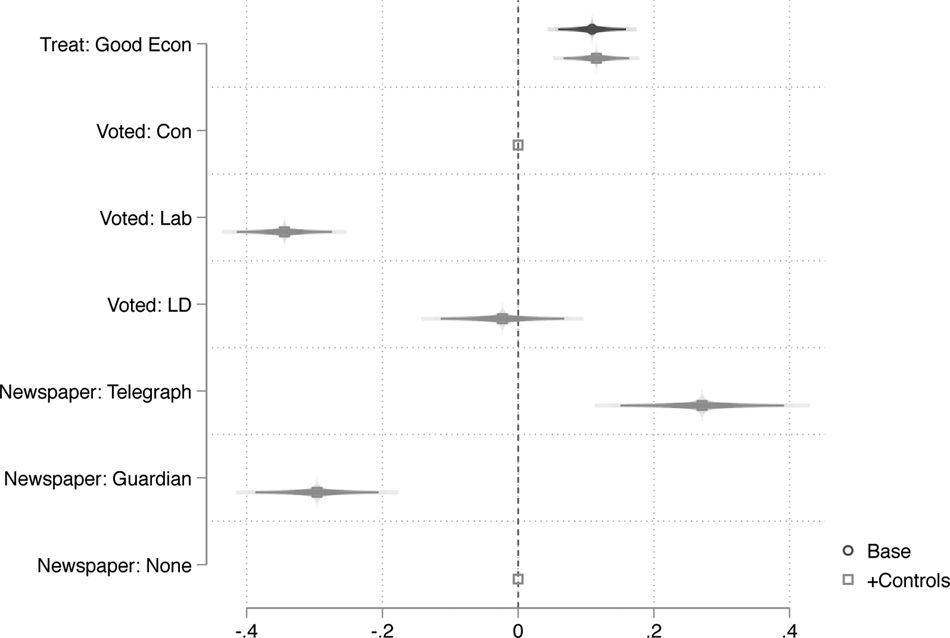
Figure 2 presents the core experimental finding. It shows a coefficient plot for two models: one with just the treatment dummy and the experiment dummy, and the other with additional controls for gross household income, newspaper readership, and 2015 general election vote. The top two points show the estimated coefficients for the “good economy” treatment, as compared to the “bad economy” treatment, in the two models.Footnote 7 Each estimated coefficient is presented as a point estimate and 95 percent (darker bars) and 99 percent (lighter bars) confidence interval. The core inference is clear: people shown a more positive view of the UK economy tend to express greater hostility for government debts and deficits. Their preferences over deficits are countercyclical.Footnote 8
Coefficient plot showing estimates of causal effect of respondents seeing information presenting the UK economy as performing well, versus badly, on reported attitudes regarding the importance of deficit reduction. Positive values imply greater support for deficit reduction. “Base” model has only the treatment dummy and a dummy for Experiment 1 versus Experiment 2. “+Controls” also includes factorial controls for: 2015 general election vote choice; newspaper readership; and gross household income. Estimates are from OLS models (model 1 in each of Tables A5 and A6 in the Supplementary material). Darker (lighter) bars show 95 percent (99 percent) confidence intervals.

The remaining points in Figure 2 show a selection of the other coefficients from the model including pre-treatment characteristics in order to provide some substantive context for the magnitude of our estimated treatment effect. In the model with controls, the difference between our treatment groups is 40 percent of the size of the (observational) difference in deficit attitudes between Guardian readers (the least anti-deficit paper in the UK), and those who report not reading a newspaper. Similarly, it is 35 percent of the Labour–Conservative voter difference.Footnote 9
4. Observational extension: external validity
Our evidence so far indicates that, in a simple survey experiment, respondents react to economic news with countercyclical deficit preferences. But, like all experiments, these results are open to skepticism about the degree to which they reflect any broader, real phenomenon. To address the question of external validity, we use observational survey data to benchmark our results against parallel measurements. We analyze data from the UK sub-sample of 16 waves of the Eurobarometer survey, fielded in the period 2010–2017, in which respondents were asked about both their assessment of national economic performance, and their preferences over national fiscal consolidation.
The Eurobarometer surveys ask half of respondents (with a random split) exactly the same question that we use in our experiment, eliciting agreement with the idea that deficit reduction is a low priority. The other half are asked for their level of agreement with a statement that deficit reduction “cannot be delayed.” To make use of the full available sample, we combine responses to these two instruments by reversing the scale of one question. The outcome takes a value between 1 and 4, scaled such that higher values indicate more negative attitudes toward public borrowing.Footnote 10
We are interested in the association between this measure and respondent perceptions of the macroeconomy. We measure the latter with assessments of “the current situation in the (NATIONALITY) economy,” which take four levels from “Very good” to “Very bad.” We again construct a numeric variable ranging from 1 to 4, where higher values correspond to more positive perceptions.Footnote 11 Just as our experimental treatment effect captures the elasticity of deficit preferences to good or bad economic news, the association between these two variables captures the elasticity of deficit preferences to perceived economic performance.
The main advantage of the subjective economic perceptions here is that it enables us to again see variation “in the macro-economy” at the individual level. It also mirrors our experiment, so holds further appeal in this specific application. However, in the observational data, the endogeneity of these assessments of the macroeconomy may be problematic. For example, Conservative voters are more likely to support fiscal consolidation, and given Conservative incumbency in office in the period in question, may have more favorable assessments of the economy (Evans and Pickup, Reference Evans and Pickup2010). In Section B.2 of the Supplementary material, we show evidence that this feature does not drive our results.
Our interest is in the association between economic performance and support for budget consolidation. Thus we estimate the following equation:

where i indexes individuals in a survey, t indexes time/surveys, Economyi,t is the numerical version of responses to the economic perceptions question, AntiBorrowi,t is the combined numerical version of responses to the borrowing attitude questions, Q i,t is a dummy for which question wording the respondent saw, and εi,t is the error term.Footnote 12 Where economic “good times” are associated with greater support for consolidation, $\beta ^{AK}_{t}$ will be positive. This represents countercyclicality in aggregate opinion.
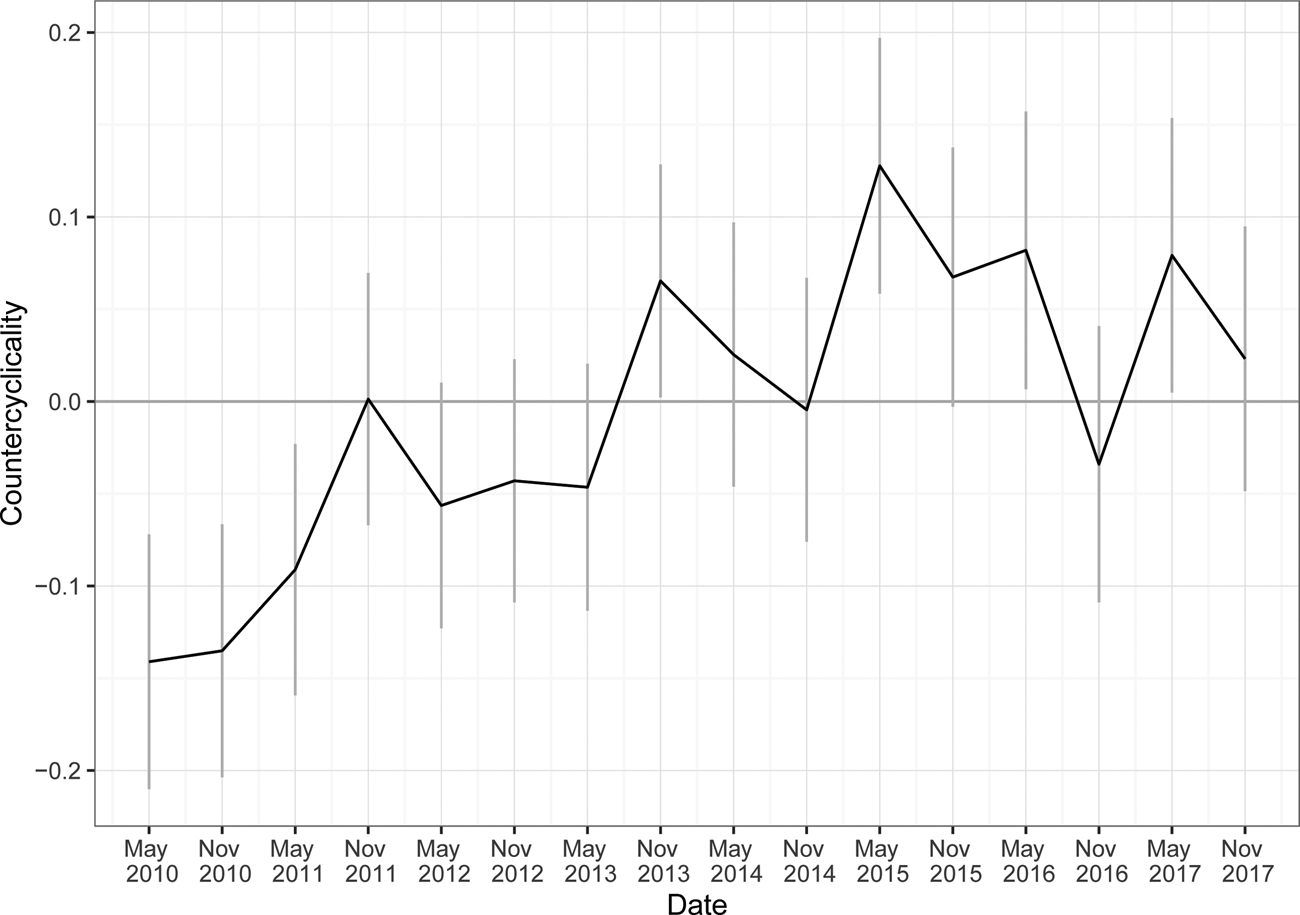
Figure 3 plots the $\beta ^{AK}_t$ estimates for the 2010–2017 period, and provides reassuring context for our survey experiment. Our two surveys bracket the May 2016 wave, which recovers a statistically significant countercyclical coefficient. The estimate from the observational data, 0.08, represents the difference in deficit preferences associated with a one-category move in macroeconomic evaluation; our treatment effect (for good versus bad news) of 0.12 is readily comparable as the outcomes are on the same scale. It does not seem incredible that the presentation of extremely negative information on average wages, compared to the very positive GDP growth story, would correspond to an effect of this size. Here, then, the Eurobarometer data confirm that the (on average) countercyclical preferences that we elicit with our treatment have a reasonable parallel outside of the experimental context.
Estimated associations between support for deficit reduction and evaluation of economic performance, based on Equation (1). Positive (negative) values indicate countercyclical (procyclical) attitudes, on average.

Further, it is interesting that, on average, public attitudes in the UK since 2015 have been generally countercyclical (with the exception of the outlying data point for November 2016), but that this countercyclicality has not always been the case since 2010. Opinion appears distinctly procyclical when the coalition government came to office (May 2010), but has become more countercyclical over time. This picks up on the final component of the “policy mood” literature, alluded to earlier, which highlights not only the macroeconomic situation but also the political and policy context as a determinant of public preferences. Increasing evidence of the Keynesian preference that borrowing respond to the economic cycle—a traditionally leftist idea—under the ongoing tenure of a right government, and in the context of a policy of unqualified pursuit of deficit reduction, is just what a thermostatic model of public opinion would predict.
5. Conclusion
The findings in this paper speak to a range of ongoing debates in the political economy literature and in the real world of British politics. The finding that citizens' preferences were procyclical in the period immediately after the 2010 general election is consistent with how political elites conceived of the issue at the time. For example, Labour's polling expert, James Morrison, noted in 2010 that “[a] Labour leader who argues that we should keep spending to secure growth is flying in the face of common sense” (quoted in Cowley and Kavanagh, Reference Cowley and Kavanagh2016, 72). Taken together, though, our experimental and observational evidence indicate that by 2016, opinion was countercyclical. Providing an accurate account on this issue is important in terms of our overall descriptive knowledge, and for political actors whose strategies should reflect both the current position and the potential for change in opinion.
Beyond the descriptive snapshot, however, the results presented here raise the larger question as to what explains the observed changes over time. These determinants need to be better understood to provide any expectation for future changes in opinion, for the consideration of a “normal” or default level of cyclicality in preferences, and to understand the potential political consequences of this pro- or anti-Keynesian view. Whatever its cause, the decline and reversal of the procyclical tendency in Britain since 2010 is consistent with cross-national evidence to the effect that right-wing parties prospered immediately after both the Great Depression and the Great Recession, before left-wing parties returned to electoral strength (Lindvall, Reference Lindvall2014). Our evidence is consistent with this electoral dynamic being related to underlying changes in attitudes about public policy. However, we have argued elsewhere that popular attitudes on deficit reduction are swayed by media coverage and elite framing (Barnes and Hicks, Reference Barnes and Hicks2018), and it may be that the “rational” Keynesian trends we observe in the observational data have less to do with a sensible reaction to evolving economic conditions (Bartle et al., Reference Bartle, Dellepiane-Avellaneda and Stimson2011) than they do with the fading salience of anti-Keynesian frames (e.g., that belts must be tightened in hard times). This interpretation leads our attention back to the elite level and arguably speaks for only limited space for public opinion to be independently politically consequential. A plausible middle-ground between the “elite' and “mass' views is that economic context conditions the susceptibility of voters to particular types of elite rhetoric.
The connection to cross-national evidence (Lindvall, Reference Lindvall2014) is suggestive of the wider contribution that this paper brings. The period of relative economic stability known as the Great Moderation led political economists to focus their attention on distributive issues within economies. Indeed, the Financial Crisis and Great Recession, if anything, provided greater rhetorical force to findings in this area. However, this distributive focus has diverted attention away from more traditional, and equally critical, agendas related to the political economy of macroeconomic management—of which Hibbs (Reference Hibbs1977) is a classic example. Part of the contribution of this paper, then, is to connect contemporary political developments back to those earlier debates.
Supplementary material
To view supplementary material for this article, please visit https://doi.org/10.1017/psrm.2019.48. To obtain replication material for this article, please visit https://doi.org/10.7910/DVN/MUPGQM
Acknowledgments
We are grateful for feedback on versions of this project to: Shaun Hargreaves Heap, Thomas Sattler, and audiences at The Hertie School of Governance “Political Economy” seminar, the University of Washington “Severyns Ravenholt Seminar in Comparative Politics,” and the King's College London “Comparative Politics” seminar.